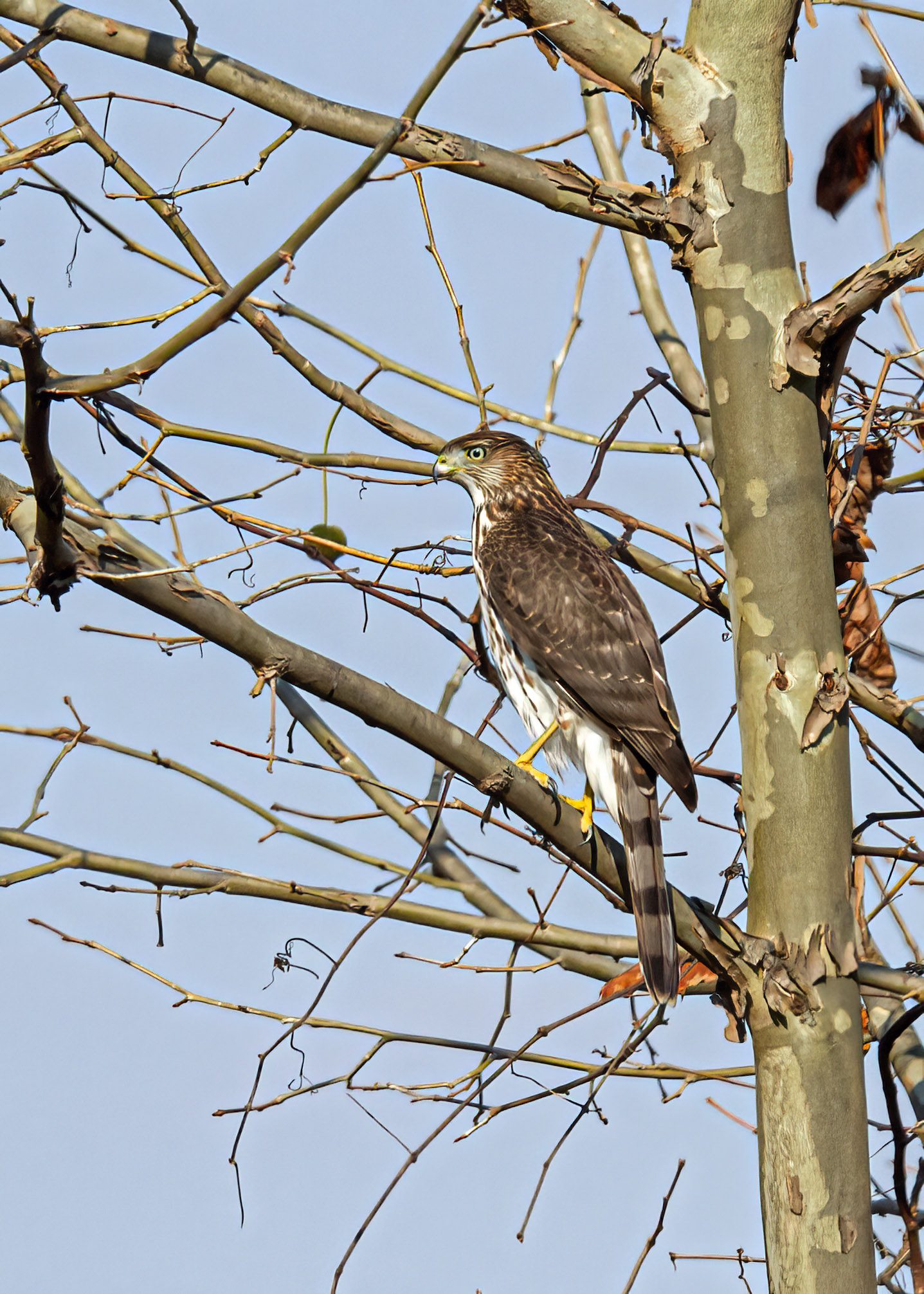
As I looked up a trail on Thursday at Occoquan Bay National Wildlife Refuge, I noted the shape of a bird perched on a shaded gate. When I zoomed in, I realized it was a hawk, which flew to a distant tree as I was capturing the first shot. I shared the images with a Facebook birding group, and the general consensus is that the bird is a juvenile Cooper’s Hawk (Accipiter cooperii).
Most of the hawks that I regularly see are Red-shouldered Hawks and occasionally I spot Red-tailed Hawks. At first I thought that this one might be a Red-shouldered Hawk, but when I looked at my photos on my computer, I was really struck by the length of the hawk’s tail and by the elongated shape of the hawk’s body that are not characteristic of a Red-shouldered Hawk.
One of the folks on Facebook who responded to my posting noted, “Juvenile Cooper’s hawk. Beautiful youngster. You caught the neat teardrop shaped breast streaking, and the short wings against the long and widely banded tail.”
As many of you know, I am an opportunistic wildlife photographer—I enjoy walking around a lot and try to capture photos of my wonderful encounters with nature, like this one.


© Michael Q. Powell. All rights reserved.


Nice photo.
Thanks, Michael.
You’re welcome, Mike.
That last shot you hit the ‘catch light’ in the Birds Eye just right. 👏 (please forgive the frozen vegetable advertisement. My IPad hates me and this is just one more way.)
Thanks, Ted. I usually take a number of photos in situations like this, knowing that birds are often changing head positions constantly and hoping to get a catch light in the eyes to make the bird come alive in the image.
Pressing the button a little extra is always a good idea.
I’m told that in the Tucson area, Cooper’s Hawks have the densest population of anywhere in the U.S. I can believe it since there’s not a day that goes by without seeing one or two. The juveniles frequently sit in our patio olive tree, scaring off the birds at our feeders.
Looks as if the bird is posing for you.