Feeds:
Posts
Comments

Archive for February, 2013

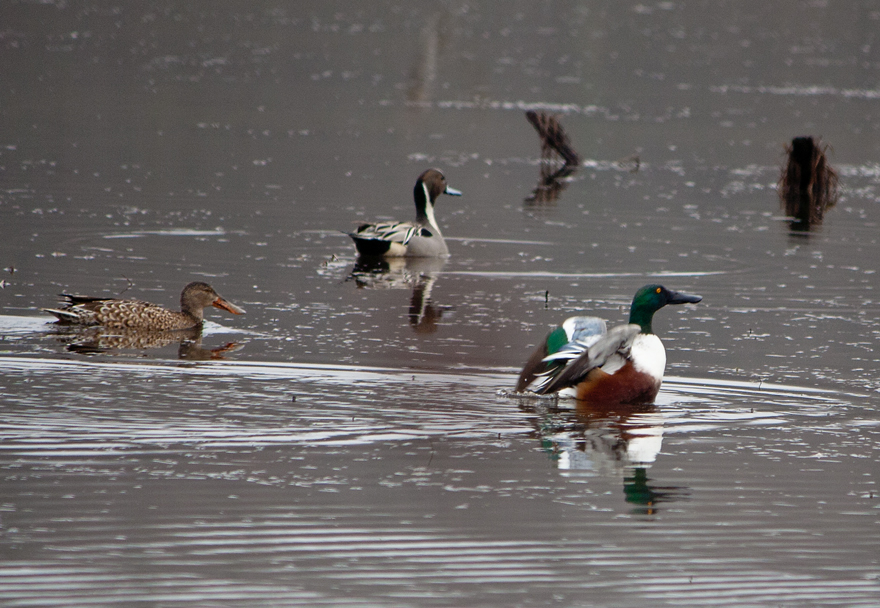
As I was focusing on some ducks yesterday on a misty, gray morning, one of them suddenly decided to take to the air and I managed to capture him just as he was starting to come out of the water.

The ducks were a little closer to the shore of a little pond at my local marshland park than is usually the case and I was squinting through the viewfinder trying to identify their types. The bright white neck of one of them made me pretty sure that it was a Northern Pintail (Anas acuta), but I wasn’t quite so sure about the pair of ducks that sort of looked like mallards, but turned out to be Northern Shovelers (Anas clypeata).

I was trying to be as quiet as I could as I took some photos, when the male Northern Shoveler somehow detected me and took off. I managed to snap a photo at a really interesting moment as the male is just starting to flap his wings. The female and the pintail aren’t  paying much attention to the male’s actions and eventually just swam away.
liftoff_blog

I tried to follow the male Northern Shoveler in flight as he headed off into the distance. Most of my shots were pretty blurry, but I got a couple that I really like. The first one is just after take off and I like the splash and the fact that his reflection is still visible. In the second one,the background is a soft blur, providing a nice backdrop for the vivid colors of the shoveler. He is in a photogenic position as he flies away and I like the fact that a portion of his head and one of his yellow eyes are still visible.

flight3_blog

flight_blogI’ll probably post some separate photos of the Northern Shoveler and the Northern Pintail a bit later, but wanted to share my good fortune in capturing this moment.

© Michael Q. Powell. All rights reserved

Read Full Post »

This past weekend I had a chance to observe the singing techniques of a newly arrived Red-winged Blackbird in my local marshland park.

I was curious to watch the blackbird as he was singing and see if I could determine how he is able to achieve such amazing volume and duration in his calls. As a singer, I have been taught to concentrate on breathing from my diaphragm when I am singing, which fills up the lungs more completely than the shallow chest breathing that most people do. In practice, what this means is that you throw out your abdomen to allow more air in and then gently squeeze with the abdominal muscles to slowly expel the air.

It looks to me that the blackbird uses similar singing techniques. I could actually see his abdomen expand as he was getting ready to sing and he engaged his entire body when he was singing.

I have some images of blackbirds simply sitting on cattails from this weekend, but I thought it would be more interesting to share a couple of the ones in which the blackbird is singing.

blackbird2_blogblackbird1_blog© Michael Q. Powell. All rights reserved

Read Full Post »

My ears told me before my eyed did that some Red-winged Blackbirds (Agelaius phoeniceus) had returned to my local marshland park. I heard the very distinctive song of the blackbird last summer and fall often enough that it’s embedded in my brain. I am working on a couple of photos of blackbirds on cattails, but thought I’d share this image first.

It’s sort of a silhouette, but the red and yellow portion of the wing are very visible, so it’s probably not a true silhouette. There is something simple and graphic about the image that I like, even though normally important details like the eyes are not visible.

blackbird3_blog

© Michael Q. Powell. All rights reserved

Read Full Post »

I usually think of Canada Geese as extroverts. They are loud and gregarious and announce their presence when they arrive. I captured this one making a big splash, literally.

Looking at the photo, I think that I must have had my focusing point on an area between the wings, because there are a lot of beautiful details in the feathers. In some ways I am using these geese as test subjects as I learn to track birds in flight (and landing) and try to time my exposures for maximum effect. They don’t seem to mind (though I am waiting for one to ask me for copies of the photos to show to his friends).

splash_blog

© Michael Q. Powell. All rights reserved

Read Full Post »

If you think that you are having a bad hair day today, check out the windblown hair of this Great Blue Heron.

It was cold and really windy today and it seemed like the small birds had sought shelter somewhere, because there were relatively few around. The bigger birds could handle the wind better and I saw lots of crows and geese and a number of vultures.

I also saw one Great Blue Heron, who was pretty far away from me. I watched him for quite some time as he stared down at the waters at the far edge of the beaver pond and I wondered if it would be possible for him to find anything to eat.

When I looked at some of my photos of the heron, I was struck by his hair. It looks like he is suffering from male pattern baldness and has grown his hair long in a vain attempt to hide that reality. Perhaps he has an artistically arranged comb over most of the time, but the wind caused his hair to go in all directions.

Do you think that they have a Hair Club for herons?

badhair_blog

© Michael Q. Powell. All rights reserved

Read Full Post »

Walking alongside a stream yesterday, I heard the unmistakable call of a Belted Kingfisher, a call that is usually described as a “piercing rattle.” Here is a link to the Cornell Lab of Ornithology, which has sound clips that you might find interesting if you have never heard a Kingfisher’s call in person.

A previous post chronicled my quest for an elusive female Belted Kingfisher (Megaceryle alcyon) at a little suburban lake that is stocked with trout. I made multiple attempts on different days to photograph that Kingfisher as she perched on tree branches overlooking the water.

Although the stream along which I was walking yesterday is only a half mile or so from the female Kingfisher’s fishing spot, I was surprised to hear a Kingfisher’s call, because there are no trees on the banks of the stream at that location. When I heard its call again, I turned my head in the direction of the sound and was surprised to see a male Kingfisher perched on a power line above the stream. (It’s really easy to distinguish a male Belted Kingfisher from a female, because the male has only a blue stripe on is chest and a female has blue and chestnut stripes.)

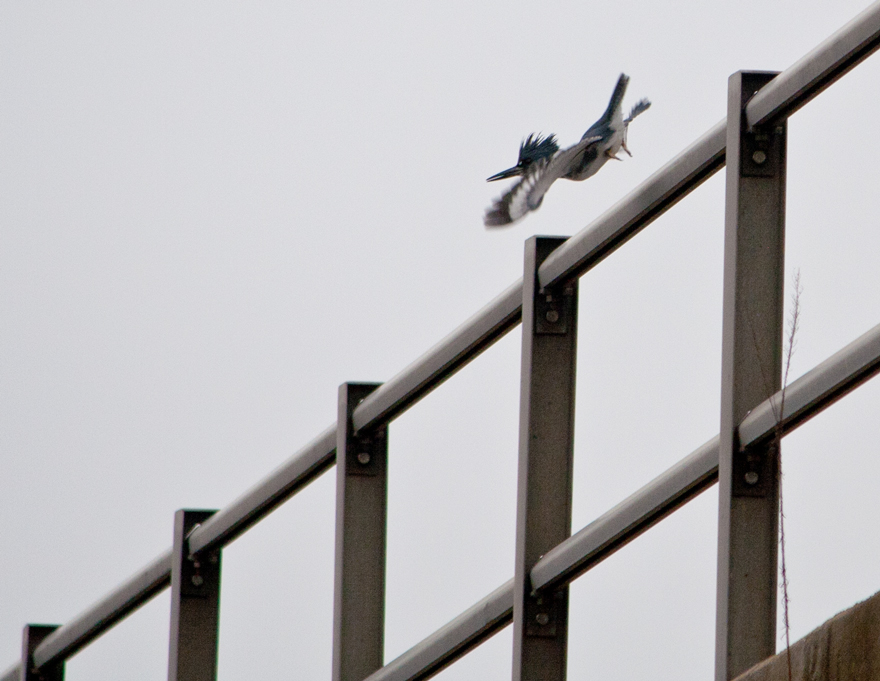
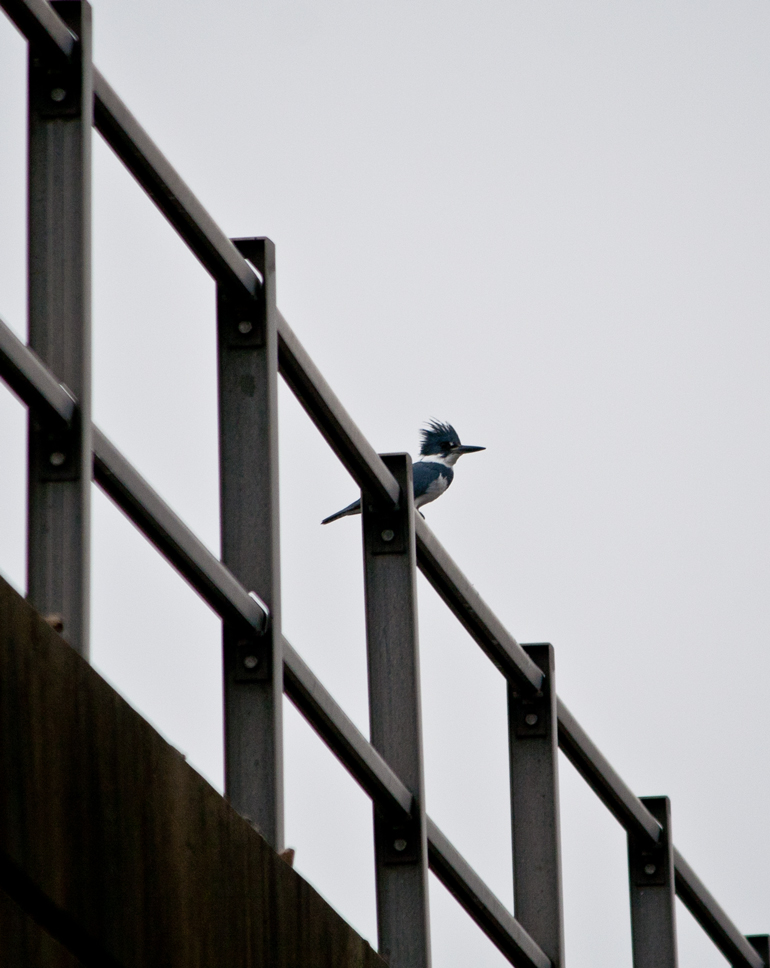
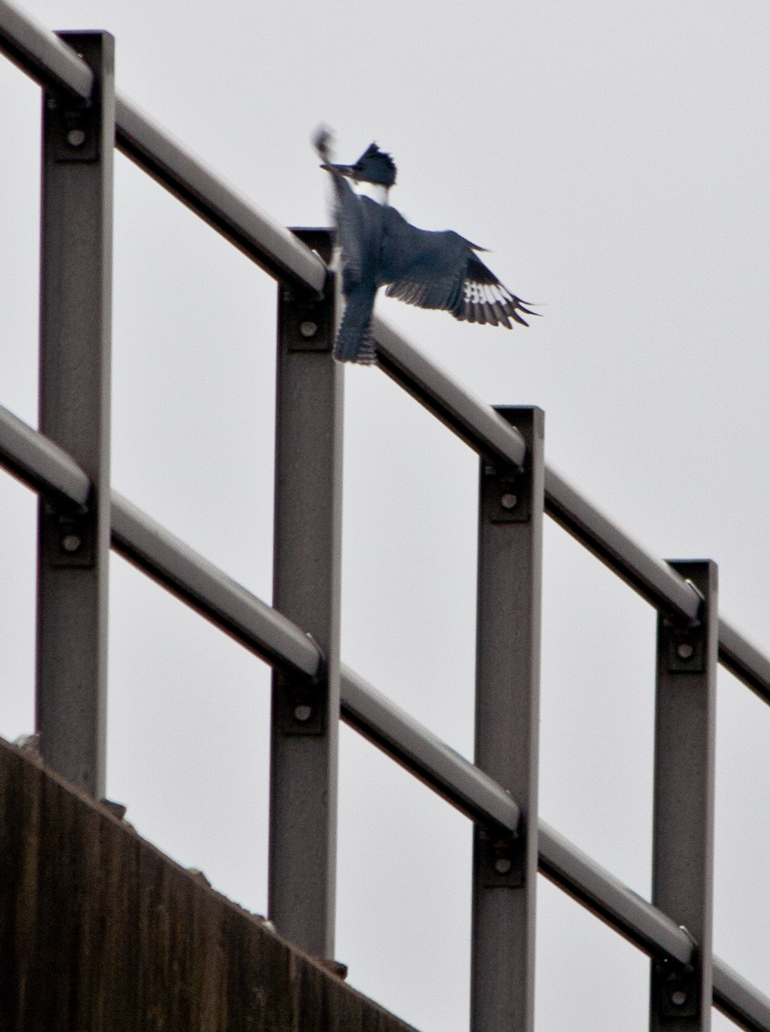
When I moved a little closer to him, he flew a short distance downstream and I located him again, this time perched on the railing of a railroad bridge over the stream. Over the course of an hour or so, he and I played  a little game in which he would pose for a few minutes on the railing and then fly downstream. A short while later he would be back on the suspended power line. I would walk slowly in the direction of the power line and once I arrived there, the Kingfisher would return to the railroad bridge.

Although I was not able to get really close to the Kingfisher, I managed to get some pretty cool pictures, including several in-flight shots. I really like the industrial-looking setting of the railroad bridge, with its simple geometric structure and beautiful angular lines. In many ways, the bridge is a much a subject in the photos as the bird.

I confessed in a previous post that I was a stalker of Kingfishers, but maybe it’s time to elevate my status—perhaps from now on I will refer to myself as a member of the Kingfisher paparazzi.

kingfisher_M3_blogkingfisher_M1_blogkingfisher_M2_blogkingfisher_M5_blogkingfisher_M6_blogkingfisher_M4_blog

© Michael Q. Powell. All rights reserved
Read Full Post »

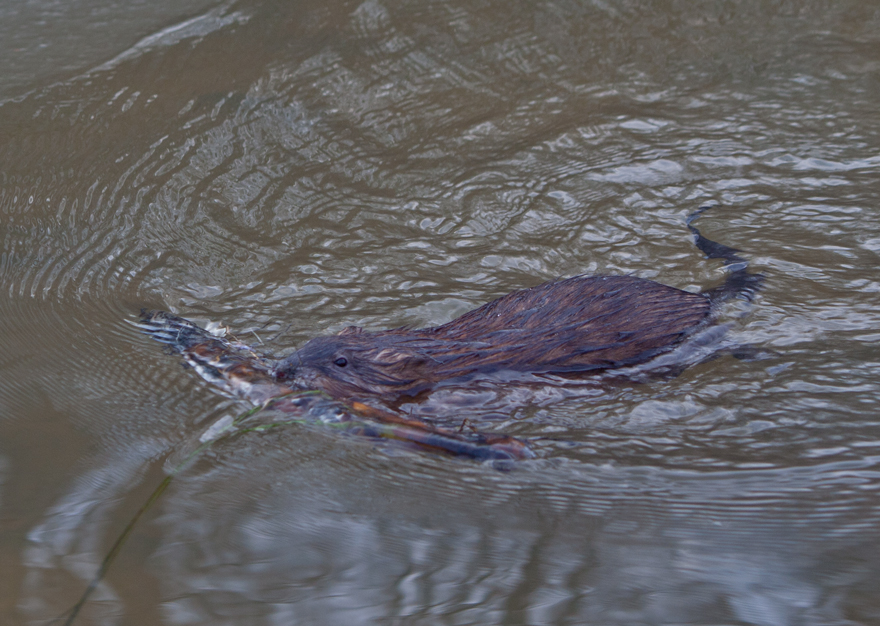
On a cold, windy day I was looking out into the beaver pond, when suddenly my eyes detected movement. Initially, it looked like some debris on the surface was being blown about, but gradually it became apparent that the little pile of debris was headed toward me. Uncertain of what I was looking at, I focused my camera on the unknown material and began to shoot.

Eventually, I realized that what I was seeing was a muskrat (Ondatra zibethicus) swimming, pushing along some plants and what looks like some berries. My guess is that he had gone out to gather food and was returning home with the results of his efforts. You can get a better  what he is transporting if you click on the photos.

The muskrat was putting so much effort into swimming on the surface that he did not seem to notice me until he was pretty close. By then, however, he was almost home, so he would have had to go underwater anyways.

I don’t know enough about what muskrats eat to hazard a guess about what exactly the muskrat was carrying across the water, but hopefully it looked more tasty to him than it does to me.

muskrat_blogmuskrat2_blog

© Michael Q. Powell. All rights reserved
Read Full Post »

What is this thing? If I squint my eyes a little, it looks like a weathered sandstone formation on the side of a steep mountain, with beautiful colors and textures.

When reality intervenes, I have to acknowledge that this is only a tree with some kind of growth on its side. I suspect that it’s a mushroom or some other kind of fungus, but I am not sure. Maybe it’s the tree version of a tumor.

Mostly, though, I don’t worry about answering my initial question—it’s not that important for me to identify what this is. I can enjoy its beauty in an abstract way by focusing on its shape and color and texture, by looking at the highlights and the shadows.

growth_blog

© Michael Q. Powell. All rights reserved

Read Full Post »

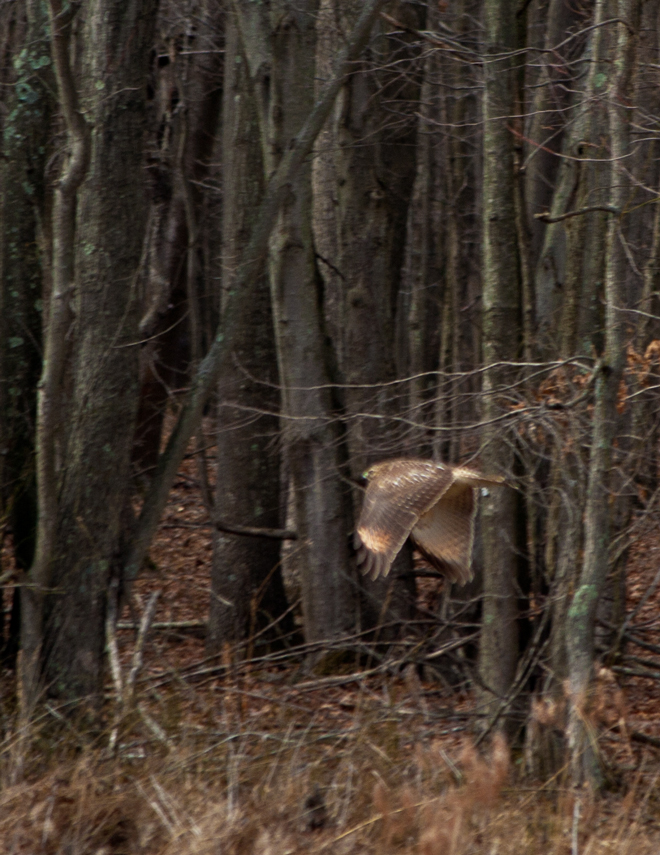
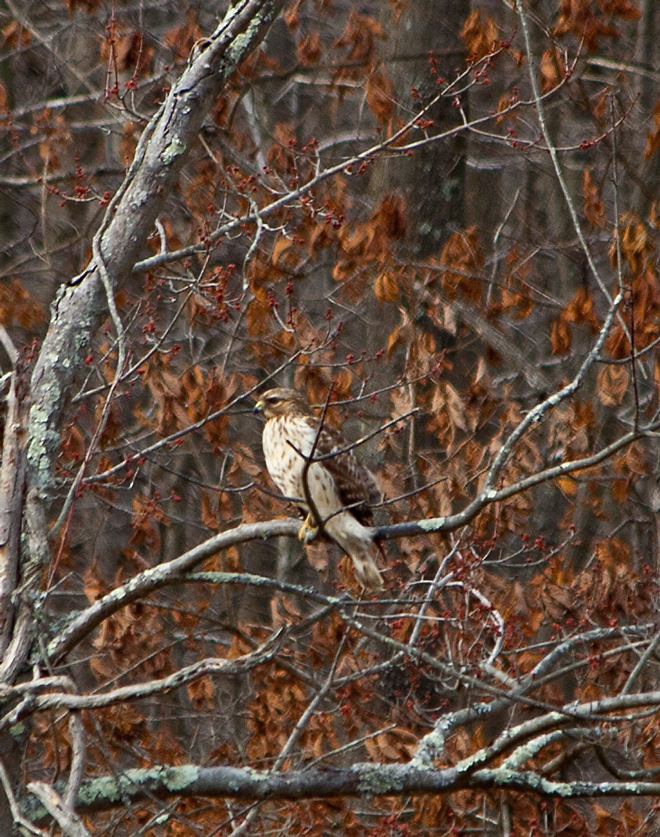
I continue to try to photograph every hawk that I see. This past weekend I encountered a hawk that was perched relatively low in a tree that was pretty far away. I got a couple of shots of the hawk in the tree that had a surprisingly large number of leaves still on it.

As I was setting up my tripod to try to get a steadier shot, the hawk took off. Instead of flying up, he flew down low across a field with trees in the background. Although I didn’t really think I would be able to get a decent shot, I kept shooting and got the shot below. I like the position of the hawk and the contrast between its light brown color and the darker tones of the tree. It not often that I get a chance to take a photo of a hawk in flight at that angle.

I am also including one of the shots of the hawk in the tree in the hope that someone will be able to help me identify his type.

hawk1_bloghawk2_blog

© Michael Q. Powell. All rights reserved
Read Full Post »

Although this looks like a fall shot, with the faded leaves still on the trees and the squirrel gathering materials to insulate his nest, I took the photo this past weekend.

When I first saw the squirrel, I couldn’t figure out what he had in his mouth, but I could see that it was bigger than the acorns on which I usually see squirrels gnawing. With our recent cold weather, I thought that perhaps the squirrel had become an omnivore and had snatched up a field mouse or other such creature to supplement his diet.

The reality is much more benign. It looks like he is merely gathering materials for his nest. According to Wikipedia, one of the breeding seasons for the Eastern Gray Squirrel (Sciurus carolinensis) runs from December to February. It is likely that the activity that I photographed is related to preparations for the potentially imminent arrival of baby squirrels, which normally are born in February or March (or May to June).

squirrel_blog

© Michael Q. Powell. All rights reserved

Read Full Post »

I love the way that a small amount of snow brings out geometric shapes that might otherwise be hidden from view, like these sinuous curves at the edge of the marsh. The iced-over water has a darker tone that contrasts with the white of the snow and gives this photo an abstract quality that I really like. The texture of the wood in the foreground and its angular line add another element of contrast.

This shot is somewhat atypical for me in that it does not contain living creatures and is not a close-up—some days shapes and patterns and light and geometry are sufficient to attract my attention.

geometry_blog© Michael Q. Powell. All rights reserved

Read Full Post »

If you look carefully at this photo you can see why I am able to take photos of the local beavers—when I am standing on the boardwalk I am virtually on top of their lodge in the center of the beaver pond.

About 18 months ago, the county replaced the boardwalk surface at Huntley Meadows Park with a synthetic material and shortly thereafter the beavers relocated themselves from another area of the park. I am not sure how the beavers decided on this spot, but they took over one of the benches on the boardwalk and integrated it into their architectural plans. This fall I followed their progress as they added mud and branches to the lodge and built up the walls surrounding the beaver pond.

The entrance to the lodge seems to be underneath the board walk itself and the recent photos I have taken of the beavers and muskrats have been in the pond area to the right. This is also one of my favorite spots for photographing geese and ducks taking off and landing and, during the summer, for getting shots of dragonflies, frogs, and turtles.

lodge_blog

© Michael Q. Powell. All rights reserved

Read Full Post »

I was fortunate enough this past weekend to be present as one of the beavers at my local marsh first emerged from the icy waters of the beaver pond and got a series of shots of that process.

It was late in the afternoon and a thin layer of ice covered the small area of open water that the beavers had cleared about 30-35 feet (9-10 meters) from their lodge. I could hear some activity in the beaver lodge and then I saw the shadow of a beaver swimming toward the hole in the ice.

When he reached the opening, the beaver stuck his head out of the ice and then more of his body. The beaver never did come out of the water completely, but seemed content to breathe in the cool, fresh air. From what I have been able to learn, the inside of the beaver lodge is pretty crowded and the air probably gets fetid, which may explain why fresh air was the beaver’s first priority.

I like all three of these shots, but the third one is my favorite. The beaver’s position is especially interesting, as he tips his head back and arches his back a little, as if to let in even more fresh air.

emerging1_blogemerging2_blog emerging3_blog

© Michael Q. Powell. All rights reserved

Read Full Post »

Preparing to leave “my” marsh yesterday afternoon, I looked over the frozen fields and waters and was struck by the beauty of the light and the reflections of the sky in the puddles. The scene was awash in shades of blue and gray. Somehow the photo of the scene is not quite as beautiful as I remembered, but I decided not to tweak it much.  In addition to capturing the moment, this photo also provides you with a view of part of the marshland where I take so many of my photos.

marsh_blog

© Michael Q. Powell. All rights reserved
Read Full Post »

I really like to show contrasts, like the difference in the expressions and body positions of these two Canada Geese.

What prompted the one on the right to get so vocal and in the face of the other? Is this the kind of taunting that I see so often in professional sports? Is it some kind of marital misunderstanding? Is the one on the right playing the role of a drill sergeant dealing with a recruit?

Whatever the cause, one I know for sure—at close range the honking was earsplittingly loud. I can only imagine the goose on the right reprising the line from a television commercial for a phone company, “Can you hear me now?”

now_blog

© Michael Q. Powell. All rights reserved
Read Full Post »

In my last posting, there were photos of what might have been a muskrat or maybe a beaver—this time I know it is a muskrat, because I can see its skinny tail.

I watched as this muskrat ferried back supplies of what I assume is food from the cattail field to the area where he lives. I was standing on a boardwalk and was able to photograph him from above as he swam right toward me. Because of the size of the stalk he was carrying, he swam mostly above water, rather than swimming under water as he normally does.

Once he got closer to me, he dove and I lost sight of him.

muskratA2_blogmuskratA1_blog

© Michael Q. Powell. All rights reserved

Read Full Post »

On days when I am trying to get photos of the beavers at my local marshland park, I sometimes see muskrats (Ondatra zibethicus) swimming in the beaver pond. The muskrats seem to be swimming from the direction of the beaver lodge so often that I wonder if they are sharing the lodge with the beavers.

Today, there was a thin layer of ice on the beaver pond, but the muskrats had created an open-water channel that they seemed to be using to get to the cattails, one of the foods they eat. Frequently the muskrats will dive and swim away when they become aware of my presence.

Today, however, I was able to get a couple of shots of what I think is one of the muskrats partially out of the water on the ice. It was getting close to sunset and the animal was some distance away, so my photos ended up a a bit grainy and soft. The more I look at the photos, the more I am conflicted about whether this is a large muskrat or a small beaver. Since I haven’t seen a muskrat out of water, I am not sure about its body shape.

Whatever he is, I especially like the pose of the animal in the first image. In the second shot, he almost looks like he is praying—it was a Sunday, after all.

muskratA4_blogmuskratA3_blog

© Michael Q. Powell. All rights reserved

Read Full Post »

It was cold and windy on Friday, but the sun was shining, permitting me to take this portrait of a resting male mallard. The subject is ordinary, but the lighting was wonderful and the bright colors of his head and bill really pop, including in his reflection in the brown waters of the beaver pond. I even managed to capture a little catch light in his eye.

It’s exciting to take photos of extraordinary subjects, but most often I am content to try to reveal some of the beauty in the ordinary things that I encounter every day.

mallard_blog

© Michael Q. Powell. All rights reserved

Read Full Post »

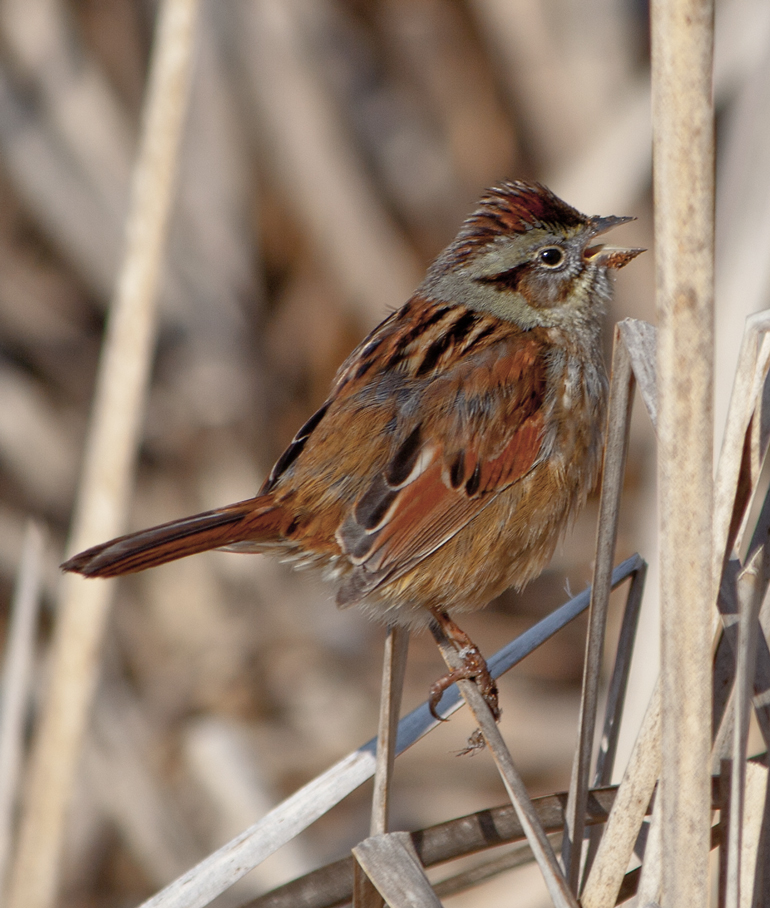
On days when no other birds are visibly active, I can always count on the sparrows to be hard at work, often accompanying their work with a song. As I watched, this sparrow (which seems to be either a Song or Swamp Sparrow) took a break from his activities and burst into song, as though compelled to share his joy and excitement with the rest of the world.

Wouldn’t it be great if we felt that way too and felt free enough to share it with others?

sparrow2_blogsparrow_blog

© Michael Q. Powell. All rights reserved

Read Full Post »

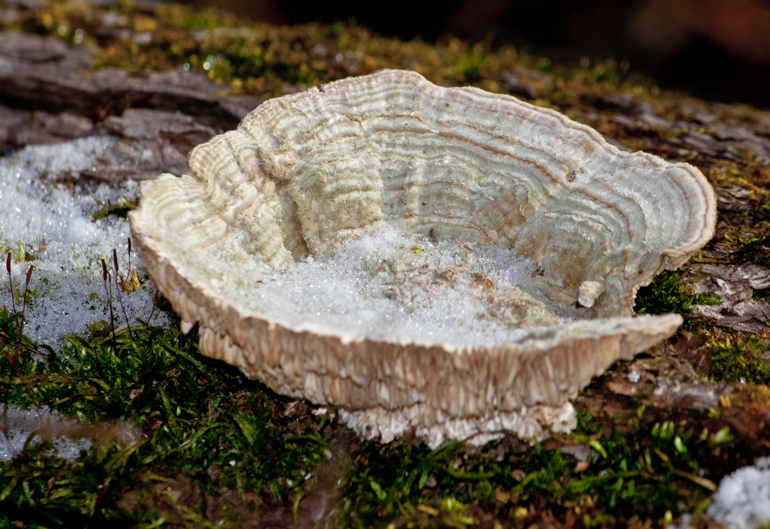
Walking through the woods yesterday, I stumbled across this mushroom bowl on a mossy log—so beautiful that I might call it “super,” but  probably need expensive market rights to call it a “super bowl.”

Seriously, though, I really do like the color and texture of the mushroom itself and the little splashes of yellow and green in the foreground. The snow in the bowl and to the side also adds a nice touch. If I remember correctly, this may have been one of the images when I used my camera’s built-in flash to throw a little light into the center of the mushroom bowl.

Until spring comes, I will probably look for more of these flower-like fungi to satisfy my desire to photograph beautiful inanimate objects (it takes more than birds and beasts to keep me satisfied).

winter_bowl_blog

© Michael Q. Powell. All rights reserved

Read Full Post »

My curiosity turned to discomfort yesterday when I realized that the large bird diving in my direction was a Turkey Vulture (Cathartes aura).

In the past, the only Turkey Vultures that I had seen were soaring high in the sky, but this one got close enough for me to see his red head. As he got a bit closer, I realized that his angle of flight would take him farther away from me than I had initially thought. Just to be sure that he did alter his course and head toward me, however, I moved around vigorously to let him know that I was still alive.

You can never be too cautious when it comes to vultures.

vulture1_blog vulture2_blog© Michael Q. Powell. All rights reserved

Read Full Post »

As the insistent honking got louder, I scanned the horizon for approaching geese and saw none.

Suddenly a pair of Canada Geese swooped over a nearby treeline and headed right at me as I stood on the boardwalk at my local marshland park. They were closing so quickly that it was hard to get my focus to lock on. At the same time I also had to adjust my zoom lens. Normally I photograph birds at the far end of my 55-250mm zoom lens, but the geese were filling up so much of the frame that I had to zoom out.

This is my best shot from the encounter. The goose and I were able to look each other straight in the eye at that moment.  The background has a nice blur, because I was shooting at f5.6, and a fair amount of the goose is in focus. I like the goose’s position too as he strains forward in preparation for the water landing. (Click on the photo to see more details)

Incoming_blog

© Michael Q. Powell. All rights reserved

Read Full Post »

Why do some hawks fan their tails out when they are soaring and others don’t?

On an overcast day earlier this week, I was watching two hawks soaring through the air together, when I happened to notice that one of them kept his tail fanned out all of the time. His tail was so noticeably striped that I am pretty sure that he is a Red-Shouldered Hawk (Buteo lineatus).  The other hawk, however, never fanned out his tail. Looking at the wings of the two hawks, I think they are probably the same kind, although one of them looks to have a somewhat longer body.

So I am left wondering why, under the same  conditions, they each chose to us their tails differently.

doublehawk1_blogdoublehawk2_blog

© Michael Q. Powell. All rights reserved

Read Full Post »

« Newer Posts