Feeds:
Posts
Comments

Posts Tagged ‘Tamron 180mm macro’

I was attracted initially by the bright red color of a cardinal flower (Lobelia cardinalis), but then I noticed a small amount of movement. When I looked more closely, I realized there was a tiny bee—the smallest that I have ever seen—busily gathering pollen. Rather than gathering pollen in little sacs, as I had seen other bees do, this bee seemed to be collecting it on his abdomen.

I don’t know much about plant anatomy, but as I searched on the internet, I learned some fascinating things about the cardinal flower, especially from a blog posting by Eye on Nature dealing with the way in which hummingbirds pollinate cardinal flowers. That posting contains some detailed images of the cardinal flower as well as some fantastic shots of a hummingbird.

I shot these images handheld with my 180mm macro lens. Ideally I should have used my tripod to get clearer shots, but the bee was so active that I feared that it would be gone if I had taken the time to set up the tripod.

It’s hard to appreciate the small size of the “bearded” section of the cardinal flower, so I enclosed an overall look at the flower as a final photo.

tiny_bee_blogtiny_bee2_blogtiny_bee-3_blogcardinal_flower_blog

© Michael Q. Powell. All rights reserved
Read Full Post »

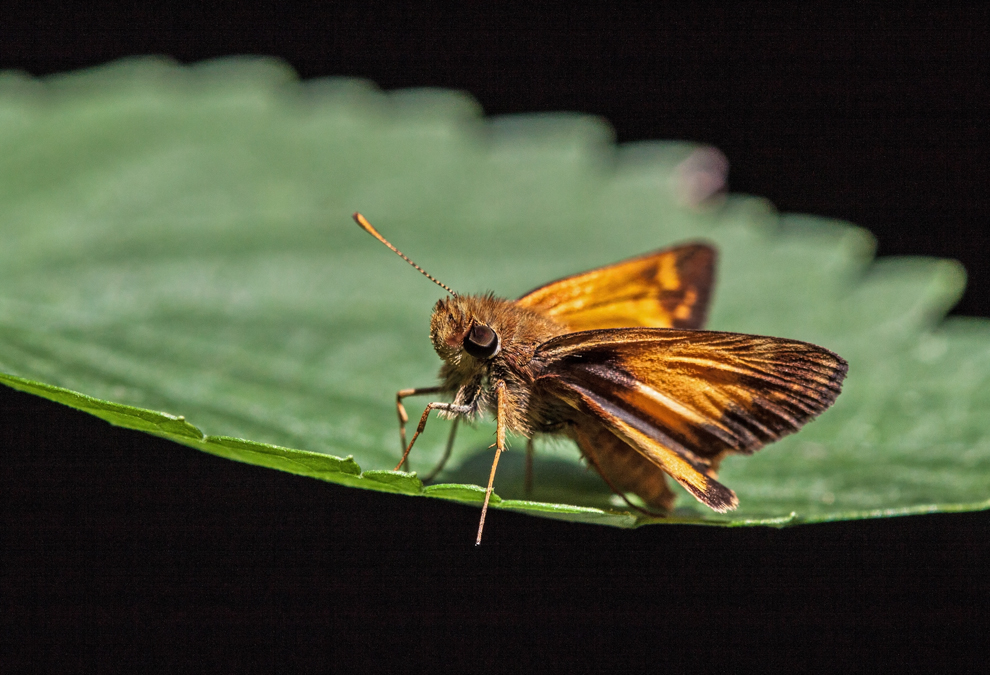
Every now and then I take a photograph and I am not really sure how I achieved the effect in the shot, like this one of a Fiery Skipper butterfly (Hylephila phyleus) on a jagged leaf.

With the exception of a few minor adjustments of the RAW image and a tiny bit of cropping, this looks just like the image I started with. When I first examined the image, I was pretty sure that I had used flash, but the EXIF data indicate that flash was not used. I took the shot handheld at ISO 400, f/6.3, and 1/500 sec. The depth of field was pretty shallow, but I did get the eye pretty much in focus, and I like the way the sharpness falls off so quickly.

I especially like the blurry jagged back edge of the leaf and the sharper near edge. The triangular shape of the wings seems to mirror those jags. Even the butterfly’s pose seems to work well, with the one leg dangling over the edge. If you click on the image, you get a higher resolution view of the photo.

I think that this is a Fiery Skipper, though I confess that I am not very good at identifying these little butterflies. Let me know if you can help in further identifying the butterfly.

skipper_leaf_blog

© Michael Q. Powell. All rights reserved
Read Full Post »

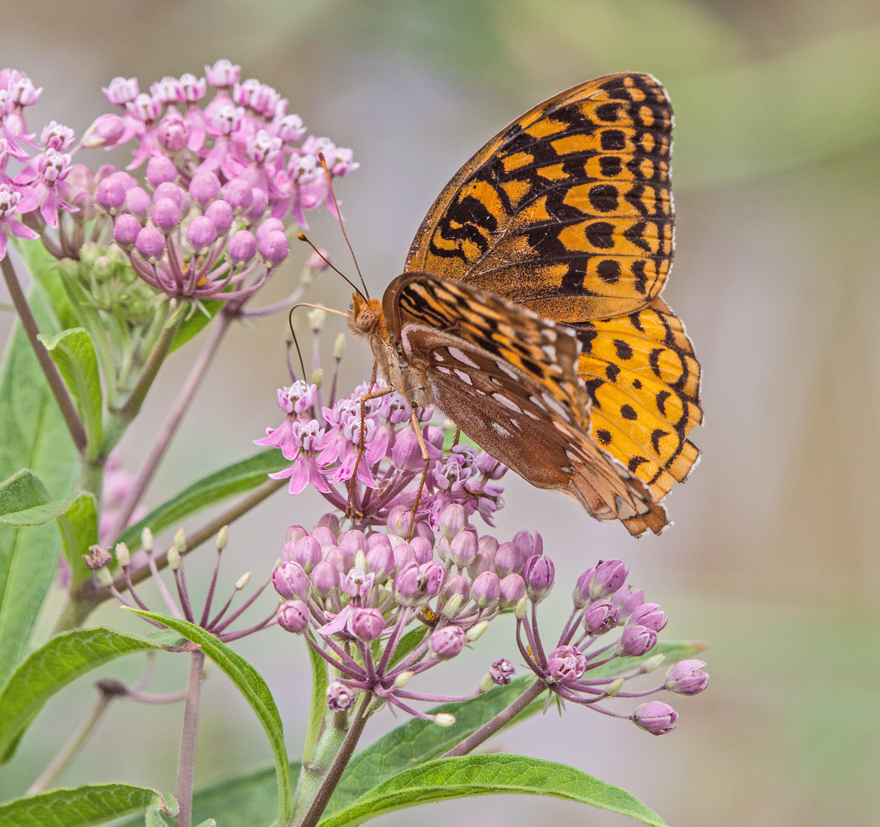
Normally I don’t think of orange and pink as colors that work well together, but I really like the result when I captured a shot of a Great Spangled Fritillary butterfly (Speyeria cybele) feeding on an unidentified pink flower.

spangled_pink_blog© Michael Q. Powell. All rights reserved
Read Full Post »

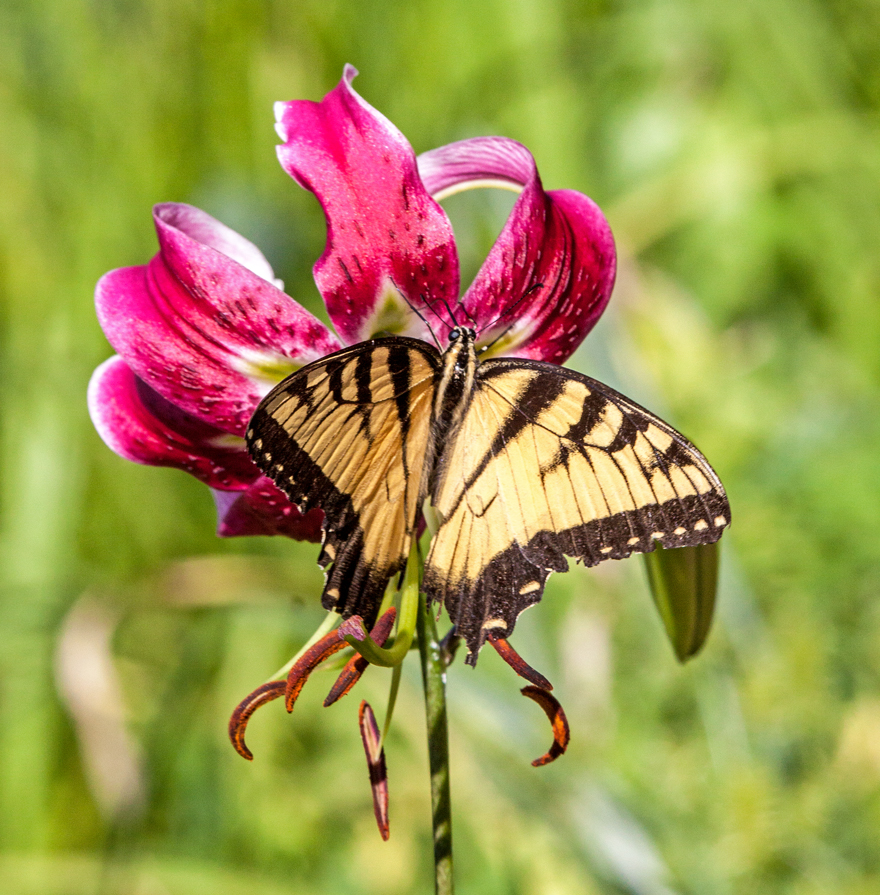
I don’t know my flowers very well, but I think that this Eastern Tiger Swallowtail (Papilio glaucus) is feeding on some kind of tiger lily (Lilium columbianum). Tiger on tiger—I like the way that sounds. Whatever the case, I love the gorgeous colors of the flowers, providing a gorgeous contrast to those of the butterfly.

tiger_blog

© Michael Q. Powell. All rights reserved
Read Full Post »

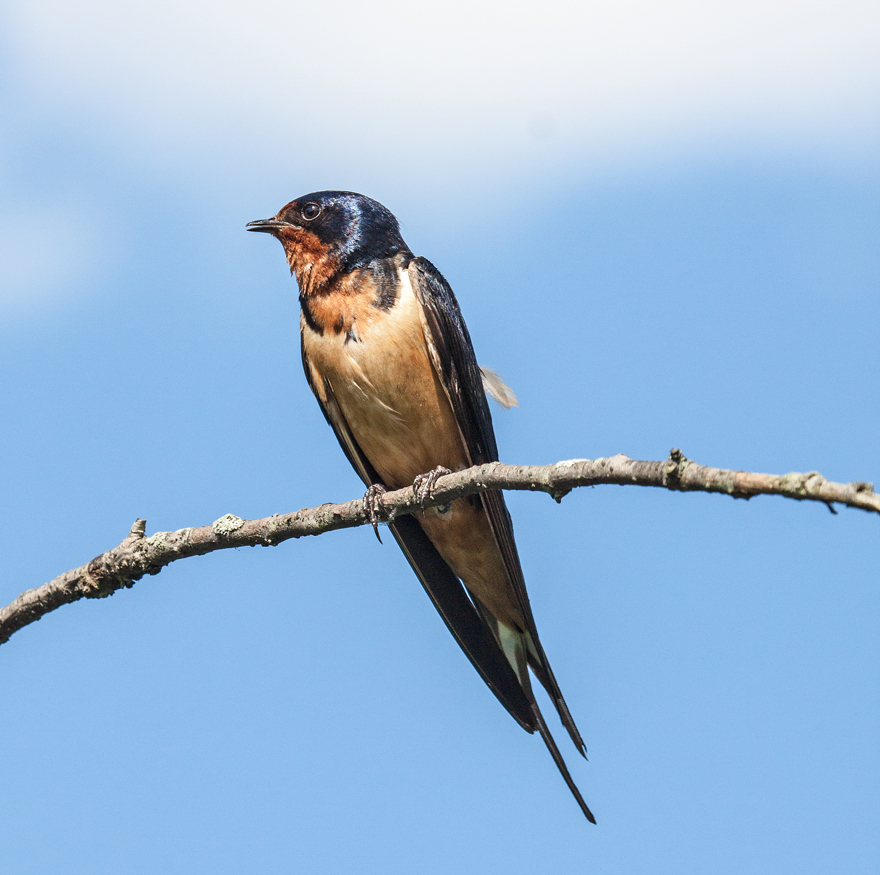
I don’t usually think of photographing birds with a macro lens, but that’s exactly what I did when I encountered this Barn Swallow (Hirundo rustica) perched on a small branch, with a beautiful blue sky in the background.

Of course, I probably should note that the macro lens in question is 180mm in focal length, so it has good telephoto capability—I had just never tried to use it in that way. My experience photographing birds this past winter suggests that this lens does not have enough reach for most birds.  I was really happy, though, with the detail it was able to capture in this situation, when I was standing almost directly below the bird.

Mentally it was an adjustment to be shooting with a prime lens and I had to keep reminding myself that if I wanted to adjust the composition, I had to change my position and move closer or farther away. That’s probably a good thing to remember when I am using a zoom lens, which has a tendency to make me a little lazy.

swallow2_blogswallow1_blog

© Michael Q. Powell. All rights reserved

Read Full Post »

The weather this week has been mostly gray and dreary and I felt the need for a burst of bright colors, so I am posting this image from last week of a two Eastern Tiger Swallowtail butterflies (Papilio glaucus) feeding on an unidentified flower against the backdrop of a brilliant blue sky. The butterflies were even cooperative enough to place themselves at different angles to add  visual interest to the shot.

swallowtails_blog

© Michael Q. Powell. All rights reserved

Read Full Post »

The wasp looked huge, even from a distance, but I could get a clear shot of it against a beautiful blue sky, so I stepped out of my comfort zone and got close enough to it to get these images.

Fortunately I was shooting with a 180mm macro lens, so I was not exactly on top of the wasp, but even so, it was a little disconcerting to try to get a shot of a moving insect that looked so enormous and a bit threatening in the viewfinder.

After I took these shots, the wasp flew away and I breathed a sigh of relief—another sting avoided.

wasp2_blog

wasp1_blog

© Michael Q. Powell. All rights reserved

Read Full Post »

Let me introduce you to the coolest-looking insect I have ever encountered, the Handsome Meadow Katydid (Orchelimum pulchellum), an insect that I photographed this past weekend at my local marsh. The name just seems to fit the insect perfectly, unlike so many other insects that seem to have been named almost randomly.

I still recall the first time that I encountered a Handsome Meadow Katydid last summer and the resulting double take—I could not believe what my eyes were seeing. The bright colors of the body were astonishing and seemed so unreal that one of my friends wondered if I had colorized the photo.

It’s the eyes, though, that make this insect so attractive for me. There is just something so alluring about those blue eyes, eyes that I don’t expect to see in an insect.

I got some pretty good shots of Handsome Meadow Katydids last year, but was growing concerned that I would not see many this year (you can tell it’s a katydid, in part, because of the length of the antennae). I actually heard this katydid before I saw it. I was passing by a small bush and hear a kind of vibrating sound. I put my ear closer and closer to the plant and finally spotted the source.

I had to go pretty wide in cropping the shot, because the katydid was stretched out along the small branch. Click on the image if you want see a higher resolution view of the photo, including those amazing eyes.

rainbow1_blog

© Michael Q. Powell. All rights reserved

Read Full Post »

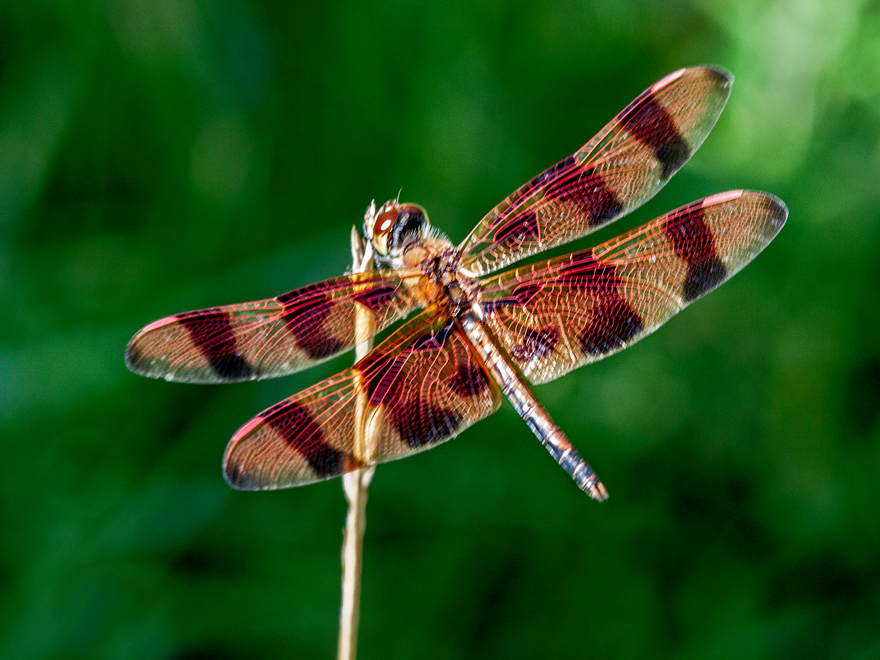
Yesterday I was happy to get some shots of my favorite dragonfly, the Halloween Pennant dragonfly (Celithemis eponina), at Meadowlark Botanical Gardens in Vienna, Virginia.

I don’t see this dragonfly at all at most of the usual places where I take photographs, so I was really excited when I caught sight of a couple of them yesterday. I chased them around for well over an hour and attempted to take a couple of hundred shots using a wide range of camera settings.

Why did I take so many photos? The dragonfly gets the “pennant”  part of its name because it likes to perch on the very tip of a weed stalk and waves in the breeze like a pennant. Yesterday, in fact, was breezy and it was quite an adventure trying to keep the dragonfly in focus, particularly because I was trying to fill the frame with the dragonfly.

The dragonflies that I photographed were reasonably cooperative and I was able to attempt shots from the side, from above, and even from below (fortunately the insects in the grass did not bite very often).

I have not been able to go through the shot to pick the best ones, but thought it would be nice to post one now, especially for those readers who may not be familiar with this beautiful dragonfly. I suspect that I will eventually post at least a couple more images in future postings.

Halloween1_blog

© Michael Q. Powell. All rights reserved

Read Full Post »

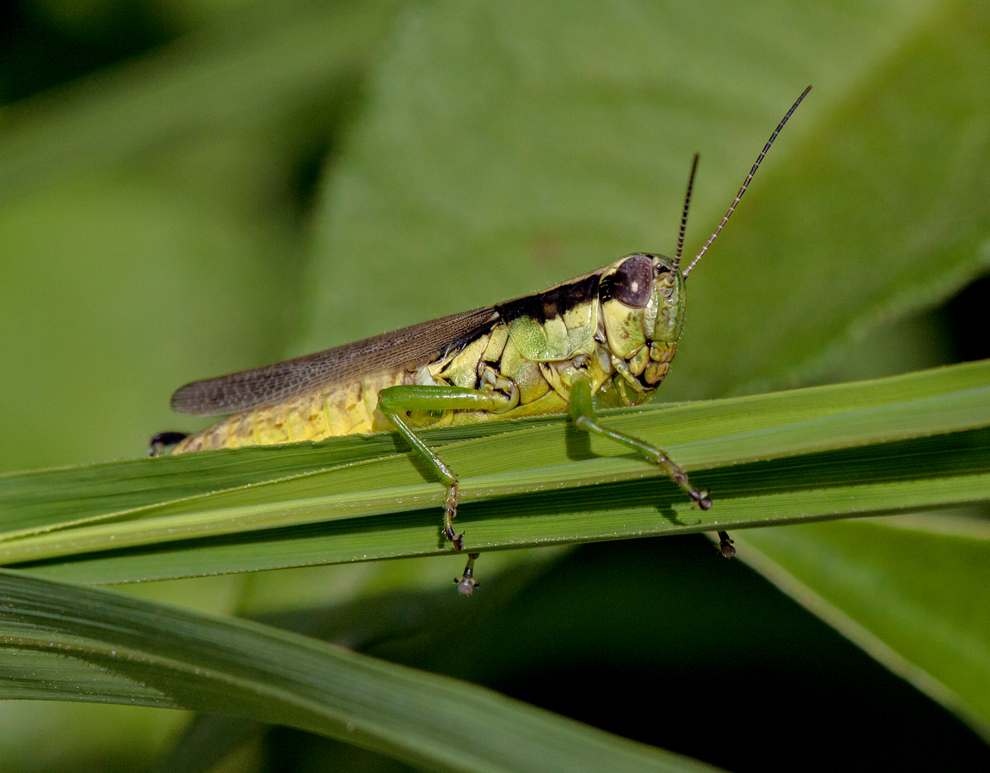
I haven’t seen many grasshoppers this summer, so I was happy to get a few shots of this one before he hopped off the leafy stalk for a new destination. I especially like the details of the eyes and the mouth.

Grasshoppers are special to me, in part because “grasshopper” is the term that my photograph mentor, Cindy Dyer, uses for me, her student. Some of you may be old enough to remember the television series Kung Fu from the 1970’s, in which Master Po, the blind monk, called his young pupil “grasshopper.”

I often wondered why he used that particular word and today I came across an explanation in Wikipedia. Apparently it stemmed from an exchange between the Master Po and the student, Caine, in the pilot episode of the series.  There is a lot of wisdom in that final response.

Master Po: Close your eyes. What do you hear?
Young Caine: I hear the water, I hear the birds.
Po: Do you hear your own heartbeat?
Caine: No.
Po: Do you hear the grasshopper which is at your feet?
Caine: Old man, how is it that you hear these things?
Po: Young man, how is it that you do not?

grasshopper1_blog

© Michael Q. Powell. All rights reserved
Read Full Post »

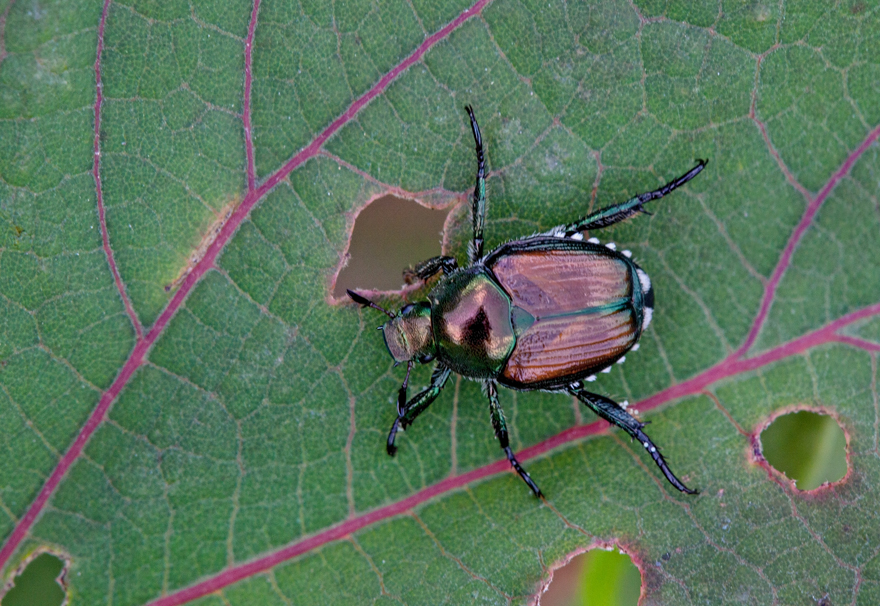
Japanese beetles (Popillia japonica) are very destructive, but also very beautiful and I sought to highlight both of these aspects in this image.

There were quite a few plant with holes chewed in them in one area of the marsh and I suspect that Japanese beetles were the culprits (this one sure looks guilty). I like the coloration and the reflectiveness of the insect’s body.  I’m not completely sure, but  I think that I see my own reflection as well as the sky in the part of the shell near the beetle’s head.

This was a situation in which I really enjoyed having my new 180mm macro lens. It allowed me to frame it the way in which I wanted without scaring away the beetle (and I did not have to do much cropping at all).

beetle_chew_blog© Michael Q. Powell. All rights reserved
Read Full Post »

I don’t often see dragonflies perched on flowers, so I was really happy when this male Blue Dasher dragonfly (Pachydiplax longipennis) decided to take a break on something more attractive than the usual broken swamp reed.

If you look closely at the dragonfly’s face (or click on the photo for higher resolution), you can see some interesting details, like his cute little bucktooth and some sparse sprouting hairs on his chin, like those of a human teenager. I also like the contrast in color between the blues and greens of his body and the pink of the flowers.

Why did the dragonfly choose to land on the flower? It almost looks like he is helping with pollination, but I suspect that is not the case. The answer to the question is probably much more simple—he landed on it, because it was there.

face_blog

© Michael Q. Powell. All rights reserved
Read Full Post »

Tiny butterflies seem to be constantly in motion and their size and speed normally make them difficult to photograph.

However, this butterfly, which I think may be a Summer Azure butterfly (Celastrina neglecta), stayed perched on a Black-eyed Susan (Rudbeckia hirta) long enough to allow me and my fellow photographer, Cindy Dyer, to take multiple shots, including some with flash. There is a whole family of small Azure butterflies, which have a wingspan of about one inch (25mm) and look pretty similar, so please correct me if I have misidentified this insect.

We encountered this little butterfly on a recent trip to Meadowlark Botanical Gardens in Vienna, Virginia. (You can check out Cindy’s image of this butterfly, along with her amazing photographs of other flowers and insects on her blog.)

I love large, colorful butterflies, like the Eastern Tiger Swallowtails that were virtually omnipresent in the garden that day, but there is something really special too about the delicate beauty and simple colors of this tiny butterfly. In this image, I like the way in which the muted tones of the butterfly provide a nice visual counterbalance to the bold colors of the flower.

azure1_blog

© Michael Q. Powell. All rights reserved

Read Full Post »

Praying mantises blend in so well with their surroundings that it is extremely rare for me to see one. This past weekend I spotted one as I was scanning the undergrowth while I was walking along the boardwalk in my local marsh.

The challenge for me was to figure out how to get a good shot of the praying mantis, which was sitting among some green leaves just about level with the boardwalk itself. I first tried shooting from directly above the insect, but I didn’t like the results very much, because I could not seem to make the praying mantis stand out from the background.

The second basic approach that I tried was to shoot at eye level with the insect. This produced some good results, like the second photo below, because I was able to capture a lot of details of the mantis and the shadows add interest to the shot.

I got my favorite image, the first one, when I shot from below the level of the insect, by hanging over the edge of the boardwalk. Framing the shot was a bit tricky because I had to place myself in the middle of the vegetation without disturbing the praying mantis (you should never disturb an insect when it is praying). I also had to shoot from an awkward angle in which it was difficult to steady the camera, so many of my shots were blurry.

Why is the first image my favorite? I like the simplicity of the color palette in the image−mostly green and black—and the pose of the praying mantis staring into the shadows from the edge of the leaf, which has wonderful details. (If you click on the image you can see a higher resolution view, which includes some details of insect’s head.)

praying2_blogpraying1_blog

© Michael Q. Powell. All rights reserved

Read Full Post »

Every since I got my new 180mm macro lens, it seems like the spider population has increased. That’s an exaggeration, of course, but somehow my new lens has caused me to be hypersensitive to spiders and insects within range of the new lens and I find myself filled with an almost irresistible urge to photograph them when I encounter them.

I saw this spider alongside a path at my local marshland park and gave in to the urge. As you can probably tell, I used flash to add a little light to the spider. I probably need to diffuse the flash more, so there is not quite as much glare, but I am happy with the way the background turned  out—I think the combination of black and green works well with the colors of the spider.

spider_with_web1_blog

© Michael Q. Powell. All rights reserved

Read Full Post »

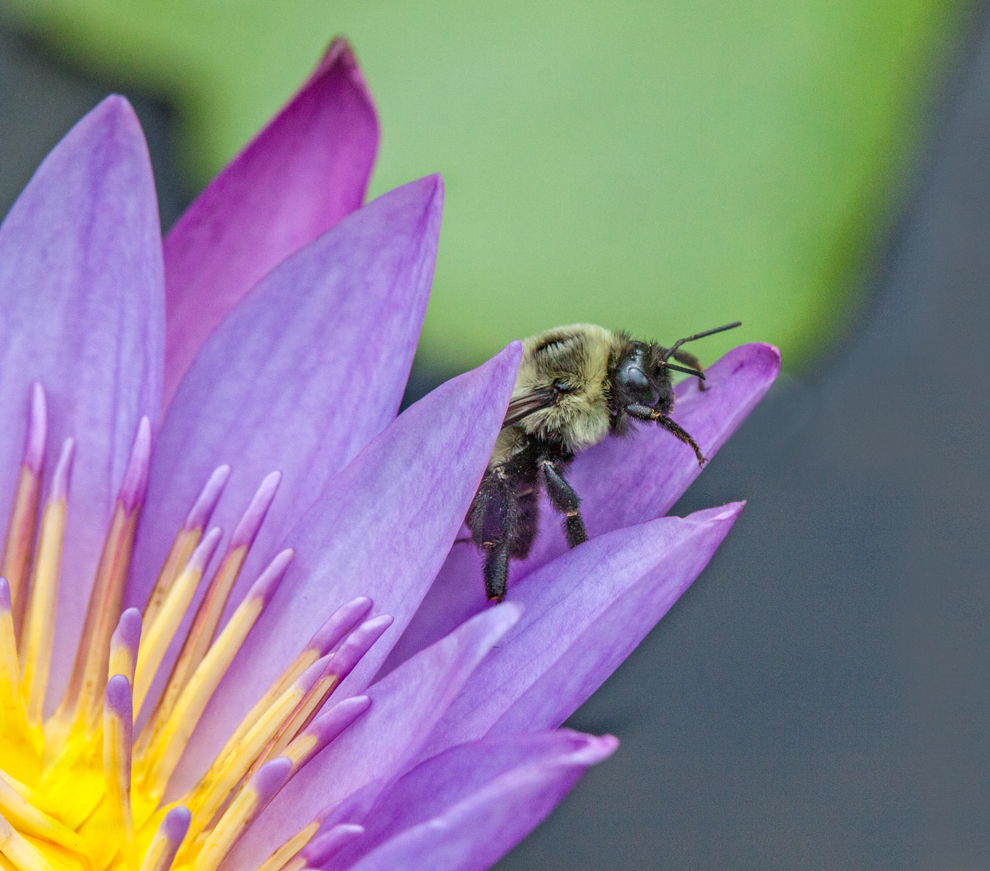
A bee landed on a petal of this purple water lily and, rather than heading for the center of the flower, the obvious source for pollen, decided to crawl down in between the petals.

I followed his movements and, after a short time, those movements ceased—I think he was stuck. Eventually the plant began to move again, this time more violently. Slowly the bee reemerged, crawling slowly up the petal, and I took this shot.

I find the tones of this image to be very soothing and purple is one of my favorite colors. If you too like purple, check out today’s postings called Violetta at Calee Photography, one of my favorite blogs.

crawling_out_blog

© Michael Q. Powell. All rights reserved

Read Full Post »

As I waited outside my neighbors’ townhouse so that we could travel to an indoor butterfly exhibit, I tried out my new macro lens in their garden and ended up with of my best butterfly shots of the day.

Cabbage White butterflies (Pieris rapae) are very common, but they are elusive when you try to photograph them. I managed to squeeze off only two shots before the butterfly flew away, but this shot illustrates why I love my 180mm macro so much. The small butterfly filled up much of the frame without me having to get right on top of it. The lens also captured a pretty good amount of detail too. If you click on the image, you can see some of the details of the butterfly’s green eye, for example.

Almost exactly a year ago, my photography mentor and muse,  Cindy Dyer, in whose garden I photographed this butterfly, challenged me to get a good image of a Cabbage White butterfly. A year later, I feel pretty confident in saying that I have met that particular challenge.

cabbage_yellow_blog© Michael Q. Powell. All rights reserved

Read Full Post »

Is photography an art or a science? One of the reasons why I enjoy photography so much is that it engages me on both levels—it speaks to my inner artist and to my inner geek.

Growing up, I remember watching Olympic figure skating and I was struck by the fact that the skaters received two sets of scores, one for “artistic impression” and one for “technical merit.” In many ways, I use a similar internal scoring system for my photographs.

Some of my photographs rate high on one scale, but fall short on the other. Every now and then, though, one of my images stands out, with high marks all around, like this shot of a Hummingbird Clearwing Moth (Hemaris thysbe).

I posted an earlier photo of this remarkable insect and I thought it was really cool that I was able to get a close-up with the wings open and frozen in action, a somewhat impressive technical feat. This image, shot from a bit farther away, gives a better view of the moth in action and is a more interesting pose. The background, which I recall was evergreen bushes, is uncluttered. Even the flower cooperated by following the “odd rule” of composition, with three clusters of tiny flowers.

It’s hard to be objective when analyzing my own work, but I know that I like this image a lot.

clearwing2_blog

© Michael Q. Powell. All rights reserved
Read Full Post »

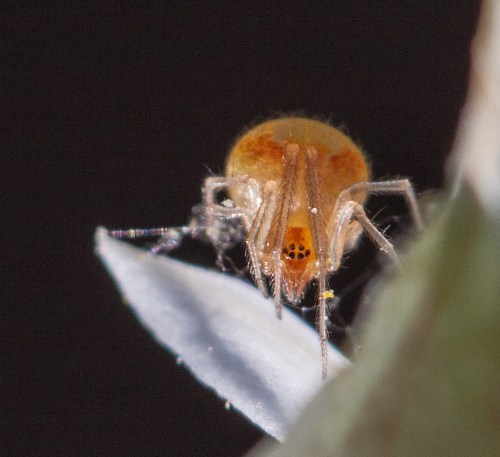
Is it just my imagination or do the eyes of this spider look like a smiley face to you too?

Eager to use my new macro lens, I went searching yesterday in my neighbors’ garden for subjects and came upon a tiny orange spider, which I have not yet been able to identify.

The spider was initially suspended in midair, but climbed up an invisible silken thread as I approached and took refuge in the shadow of white flower.

I boldly (or foolishly) tried photographing the spider handheld, but the images were blurry. Eventually I put the camera on my tripod and did my best to focus manually. For some shots, I used my pop-up flash to add a bit more light. Of course, it turned the background black, but I think that works for this shot.

In the original shot, the spider was upside down, but I decided it looked better when I rotated the image 180 degrees. I am fascinated with the multiple eyes of spiders.  There seem to a lot of different eye patterns in the different species of spider—a macro lens tends to make me look more closely at these kinds of details.

orange_spider_blog

© Michael Q. Powell. All rights reserved

Read Full Post »

Have you noticed that I really like purple water lilies? I was so struck by their beauty the first time that I saw one last year that a purple water lily appears at the top of my blog most of the time.

Earlier this week, as I was visiting Brookside Gardens in Wheaton, Maryland,  I came across an area in which two types of purple, tropical water lilies were growing. My photography mentor, Cindy Dyer, always recommends photographing the little signs that identify flowers and other plants and these water lilies were called “Panama Pacific” and “Blue Beauty.”

As I was photographing one of the waterlilies—I think it was a Panama Pacific—a bee dove headfirst into the center of the flower. Even before the bee arrived, I had noticed that the center of the water lily seemed to be glowing and that was what I was trying to capture by underexposing the shot. If you click on the photo, you can see a higher resolution view of the image, which shows an almost three-dimensional view of the flower’s center.

diving_blog© Michael Q. Powell. All rights reserved
Read Full Post »

Yesterday was my first chance to try out my new lens, a Tamron 180mm macro, and I managed to get some shots of a Hummingbird Clearwing Moth (Hemaris thysbe) at Brookside Gardens in Wheaton, Maryland.

Clearwing1_blog

This was my first encounter with this moth, which I have admired in the photos of others, and I took a lot of photos of it, using a variety of settings. I think that I got my best shots when I set the ISO to 800 and underexposed a bit, which kept the shutter speed up pretty high, although the images are a little grainy. I still have a lot of photos to go through, so don’t be surprised if I come up with an even better image to post. However, I am so happy with this image that I want to share my excitement.

I had previously used the Nikon version of this lens with a friend’s camera and was impressed enough that I eventually decided to get one for my Canon. The lens does not have any built-in image stabilization, so it probably gives optimal results when used on a tripod or when there is a lot of light. However, I was impatient to use it, so I shot handheld when shooting this moth and probably need to work a bit more on my technique for steadier shooting.

I am pretty sure that I’ll be posting many more macro shots from this lens in the future—I plan on having a lot of fun with it.

© Michael Q. Powell. All rights reserved

Read Full Post »

All of the photos that I have posted this year of the Eastern Pondhawk dragonfly (Erythemis simplicicollis) have been of females, which are a beautiful emerald green, but I think that you will agree that the male in this photo is equally stunning. I love the mixture of blue and green on its body and was particularly happy to capture this one perched on a colorful flower.

This is a shot from couple of weeks ago, when I was able to borrow my friend’s Nikon D7000 and Tamron 180mm macro lens for a little while while we were shooting at Kenilworth Aquatic Gardens in the District of Columbia. Every time that I look over the images that I shot, I am impressed by the results that I was able to achieve with a “foreign” camera—normally I shoot with a Canon.

Pondhawk lorez

© Michael Q. Powell. All rights reserved

Read Full Post »

During my trip last weekend to Kenilworth Aquatic Gardens, I used a Nikon D7000 with a Tamron 180mm macro lens to take some shots while my fellow photographer, Cindy Dyer, relaxed in the shade on a hot, steamy day.

I use a Canon, so it was not immediately obvious to me where the controls were for various functions on the Nikon.  I didn’t really have much time to poke around in the menus, so I just shot. I knew that the camera was set for aperture priority, but I didn’t realize until later that it was set at f/20.  What that meant was that the two shots that I am posting here were shot at 1/100 and 1/80 of a second respectively. I am a little surprised that they came out relatively sharp, because the Tamron lens is pretty heavy and is not a VR lens.

The subject matter is pretty familiar for folks who follow my blog—a Cabbage White butterfly (Pieris rapae) and a Blue Dasher dragonfly (Pachydiplax longipennis). I like the way that both images turned out, with beautiful backgrounds.

Did the Nikon set-up make a difference? It was nice shooting with a camera with a bigger and brighter viewfinder than my Canon Rebel XT, but that is more a function of shooting with a much newer camera. What was especially nice, though, was shooting with a 180mm macro lens. The lens felt comfortable and gave sharp results, even if focusing was a bit slow when it had to move through the full range in autofocus mode.

I probably am not ready to go over to the dark side and embrace a Nikon—in my experience it seemed that the Nikon was different from my Canon, but not necessarily better. I may consider, however, the Tamron 180mm macro lens. I love my Canon 100mm macro lens, but sometimes it would be nice to have that little extra reach and still be able to get true macro results.

Cabbage White lorezBlue Dasher lorez

© Michael Q. Powell. All rights reserved

Read Full Post »

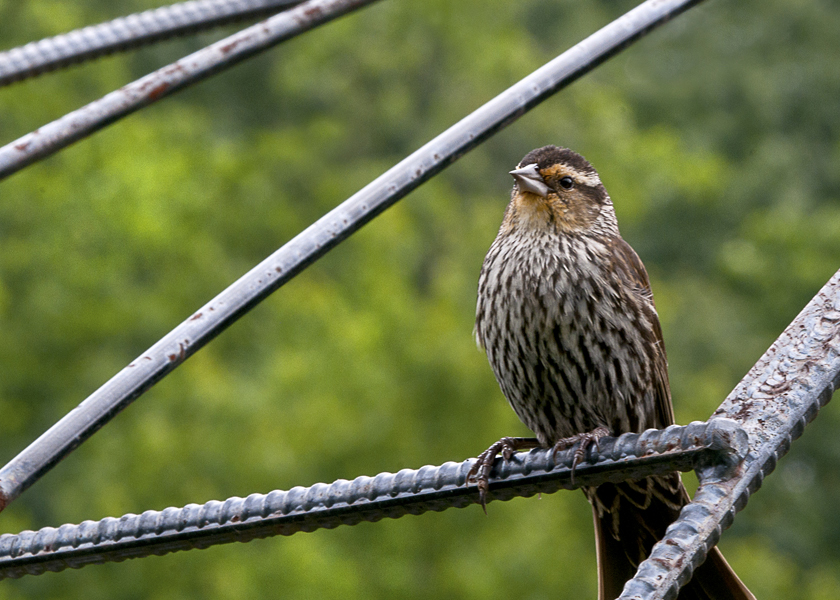
I have recently been making a lot of attempts to photograph birds, but none of the photos comes close to matching the visual impact of this female red-winged blackbird that I photographed in early June at Brookside Gardens in Wheaton, MD.

Normally you are not supposed to photograph a bird from the front, but in this case it seems to heighten the intensity of the bird’s stare. The sky was almost white that day and it disappeared when tweaks were made, but that seemed to fit with the industrial look provided by the rebar that was used to form a trellis.

Intense female red-winged blackbird

Here is another shot of the blackbird on the trellis, with some greenery in the background. You can see some of the details of the trellis, and it looks like the rusted metal is almost a perfect color match for some parts of the bird.

Bird on a wire

My blog is still less than three months old, so I have a number of my pre-blog favorites that you have not yet seen. I will occasionally share some of them when I don’t have any new material or don’t have time to prepare the new photos.

© Michael Q. Powell. All rights reserved.

Read Full Post »

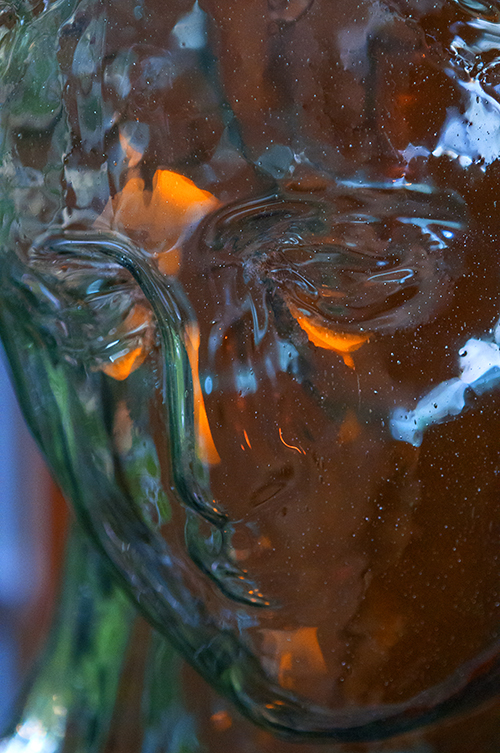
After a photo shoot this past weekend with my neighbor and photographic mentor, Cindy Dyer, we retired to her house to look over our images. I was still in the mood to shoot photos, so when she had to take a phone call, I picked up one of her Nikon D300 cameras with a Tamron 180mm macro lens and looked around for things to photograph. It was late in the afternoon and the light was starting to fade a little, but her camera allowed me to set the ISO all the way up to 3200. Even with the extreme ISO, I still found myself shooting with settings of F5 and 1/125 sec with natural light. Here is a photo of the object that I decided to shoot. Can you guess what it is from this photo?

Coke bottle glass

If you looked carefully you might have been able to detect the eyes and nose of a woman. Cindy has a clear glass woman’s head in her living room and I was photographing the light coming in from the window behind the head.

Here is another view of the head from a different angle.

Close-up glass lady head

Some of the colors in the image above were picked up from the objects that were behind the glass lady, but they have been enhanced by tweaking the tint and saturation levels in Photoshop, which gives a very interesting effect. I shot the photos, but it was Cindy who did the enhancements. I liked the shapes, textures, and lighting in my shots, but she had the vision that the images would be even better with more vibrant colors (and she was definitely right). You should check out her blog for more wonderfully creative images and beautiful flower and insect macro shots.

Here’s one last shot that shows almost the entire face of the glass head woman.

Glass woman head

You may notice that there is more blue in this image. I think that I managed to pick up some of the color of the sky, which was a beautiful shade of blue at the time.

This kind of “artsy” photography is not my normal style, but it showed me that simply picking up the camera and photographing whatever happens to be around me can sometimes lead to beautiful (and unusual) images. Somewhere I read recently that one of our primary creative goals as photographers is to photograph usual things in unusual ways. That’s a real challenge, but I think it’s a worthy aspirational goal.

© Michael Q. Powell. All rights reserved.

Read Full Post »

I took this photo on an Eastern Amberwing dragonfly (Perithemis tenera)) about a week ago when I was shooting at Green Spring Gardens in Alexandria, VA with my good friend and photographic mentor, Cindy Dyer.

Cindy is always encouraging me to upgrade my photograph equipment. For comparison purposes, she put the Nikon D300 that she was using into my hands and had me shoot with  it for a few minutes. It was equipped with a Tamron 180mm macro lens that gave it a pretty impressive reach for the dragonflies that we were shooting. It’s interesting that I was able to use my Compact Flash memory card, which was formatted in my Canon, in her Nikon and the Canon photos and the Nikon photos peacefully coexisted in separate folders on the memory card.

I was especially happy that I got a decent shot of the Eastern Amberwing dragonfly. This type of dragonfly is very beautiful, but it’s very small and elusive. BugGuide notes that this dragonfly is normally about 21-24mm long (in case you’ve forgotten, 25.4mm is equal to an inch).

I’m probably going to remain a Canon guy, but I can definitely hear the Siren call of that 180mm macro lens, which comes in a Canon version too.

Eastern Amberwing dragonfly

© Michael Q. Powell. All rights reserved.

Read Full Post »

As I start out with this blog I am posting a few of my favorite photographs. This is a close-up of what I am pretty certain is an Eastern Swallowtail butterfly. I shot it on 1 June at Meadowlark Botanical Gardens in Vienna, VA. I love this unusual perspective. It reminds me a little of a hang glider.

© Michael Q. Powell. All rights reserved.


Read Full Post »

« Newer Posts