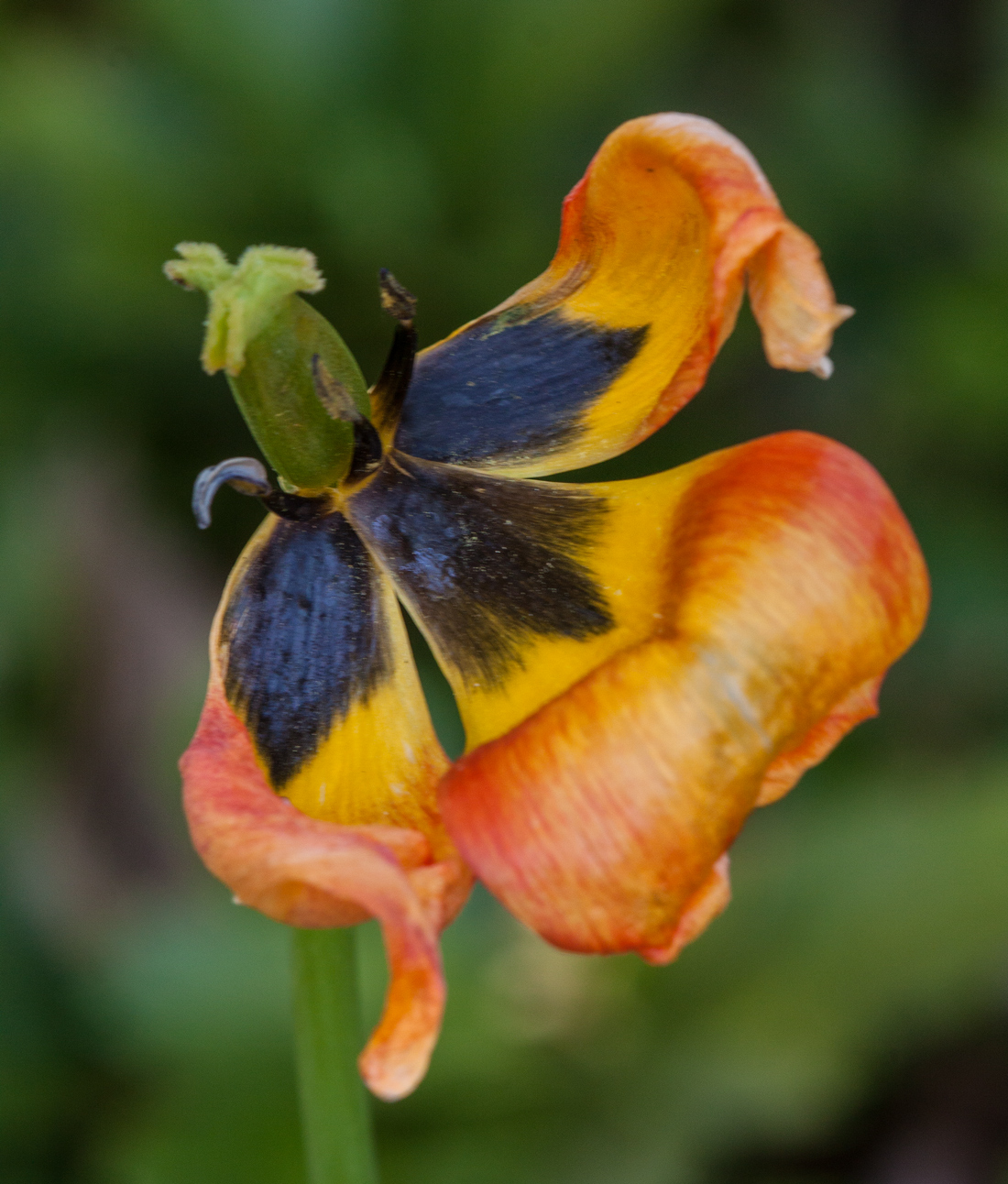
Do you pass by flowers that are past their prime? Their beauty is still visible in the fragments of their former glory.
© Michael Q. Powell. All rights reserved
Posted in Art, Flowers, Gardening, Macro Photography, Nature, Photography, spring, tagged Alexandria VA, beauty, Canon 50D, faded glory, Runnymeade, Tamron 180mm macro lens, tulip on May 2, 2014| 1 Comment »
Do you pass by flowers that are past their prime? Their beauty is still visible in the fragments of their former glory.
© Michael Q. Powell. All rights reserved
Posted in Macro Photography, Nature, Photography, Portraits, Reptiles, spring, tagged Alexandria VA, Canon 50D, Canon 70-300mm telephoto zoom lens, Coluber constrictor constrictor, Huntley Meadows Park, Northern Black Racer snake, reflection, snake, snake's eye, Tamron 180mm macro lens on April 30, 2014| 24 Comments »
What’s your first reaction when you see a snake? I was walking through the woods at my local marsh this past weekend when I spotted a snake curled up on the leaves. My first reaction was to move closer to get a shot of the snake.
The area was relatively open, but there were lots of leaves and sticks on the forest floor, so it was not really possible to get an unobstructed shot of the snake. I took a shot anyways, fearing the snake would leave, and include it as a second image here so you can see how the snake was positioned. I noticed that the snake’s head was in an uncluttered area and a clear shot seemed possible. I changed lenses from my telephoto zoom to my macro lens, set up my tripod as low as it would go, and moved really close, until the snake’s head almost filled the frame of my viewfinder. I took some shots in natural light and some with my popup flash. The snake seemed unbothered by my actions until I inadvertently moved a small branch when adjusting my position on ground and he slithered away.
When I looked at the images on my computer, I was struck by the degree to which my reflection is visible in the snake’s eye. If you click on the first photo, you’ll get a higher resolution view that shows me taking the shot (with flash this time).
I am not sure what kind of snake this is, but it looks a bit like a Northern Black Racer snake (Coluber constrictor constrictor) as described on the webpage of the Virginia Herpetological Society. I’d welcome a confirmation or correction of my identification from anyone with more experience with snakes.


© Michael Q. Powell. All rights reserved
Posted in Art, Flowers, Gardening, Macro Photography, Nature, Photography, spring, tagged Canon 50D, Leucojum aestivum, Leucojum vernum, Lewis Ginter Botanical Garden, Richmond VA, snowflakes, Spring Snowflake, Summer Snowflake, Tamron 180mm macro lens on April 29, 2014| 14 Comments »
Memories of this past winter’s unusually heavy snowfall are beginning to fade, but were revived when I saw these beautiful little Snowflakes during a recent visit to Lewis Ginter Botanical Garden in Richmond, VA.
There are two varieties of Snowflakes—the Spring Snowflake (Leucojum vernum) and the Summer Snowflake (Leucojum aestivum)—and I am not absolutely certain which variety I photographed.
I love the simple beauty of this delicate flower and am happy that I was able to isolate a couple of the blooms to showcase that beauty.


© Michael Q. Powell. All rights reserved
Posted in Art, Flowers, Gardening, Insects, Macro Photography, Nature, Photography, spring, tagged bee, Canon 50D, carpenter bee, Eastern Carpenter Bee, Lewis Ginter Botanical Garden, Richmond VA, Tamron 180mm macro lens, Xylocopa virginica on April 25, 2014| 9 Comments »
Within minutes of seeing the elegant honey bee that I featured in a recent posting, I encountered this Eastern carpenter bee (Xylocopa virginica), which is built more like a sumo wrestler than a dancer, especially when viewed face-to-face, as in the second image below.


© Michael Q. Powell. All rights reserved
Posted in Birds, Nature, Photography, Portraits, spring, wildlife, tagged baby goose, Branta canadensis, Canada Goose, Canon 50D, cute, gosling, Lewis Ginter Botanical Garden, Richmond VA, Tamron 180mm macro lens on April 24, 2014| 8 Comments »
Folks may have mixed emotions about adult Canada Geese (Branta canadensis) and many consider them a nuisance, but I think that just about everyone agrees that goslings are really cute.


© Michael Q. Powell. All rights reserved
Posted in Art, Flowers, Gardening, Insects, Macro Photography, Nature, Photography, Portraits, spring, tagged Apis, Canon 50D, honey bee, honeybee, Lewis Ginter Botanical Garden, Richmond VA, Tamron 180mm macro lens on April 23, 2014| 7 Comments »
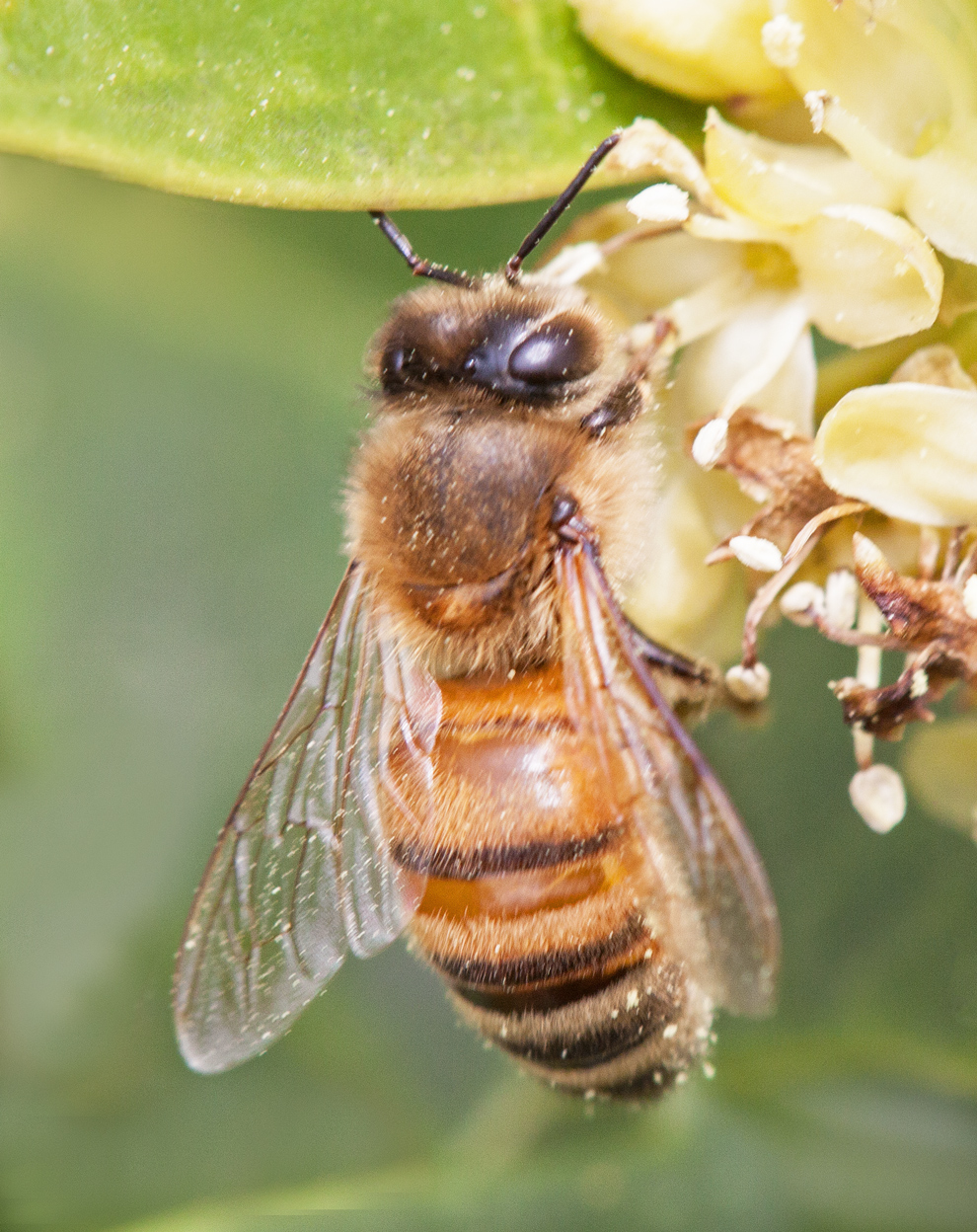
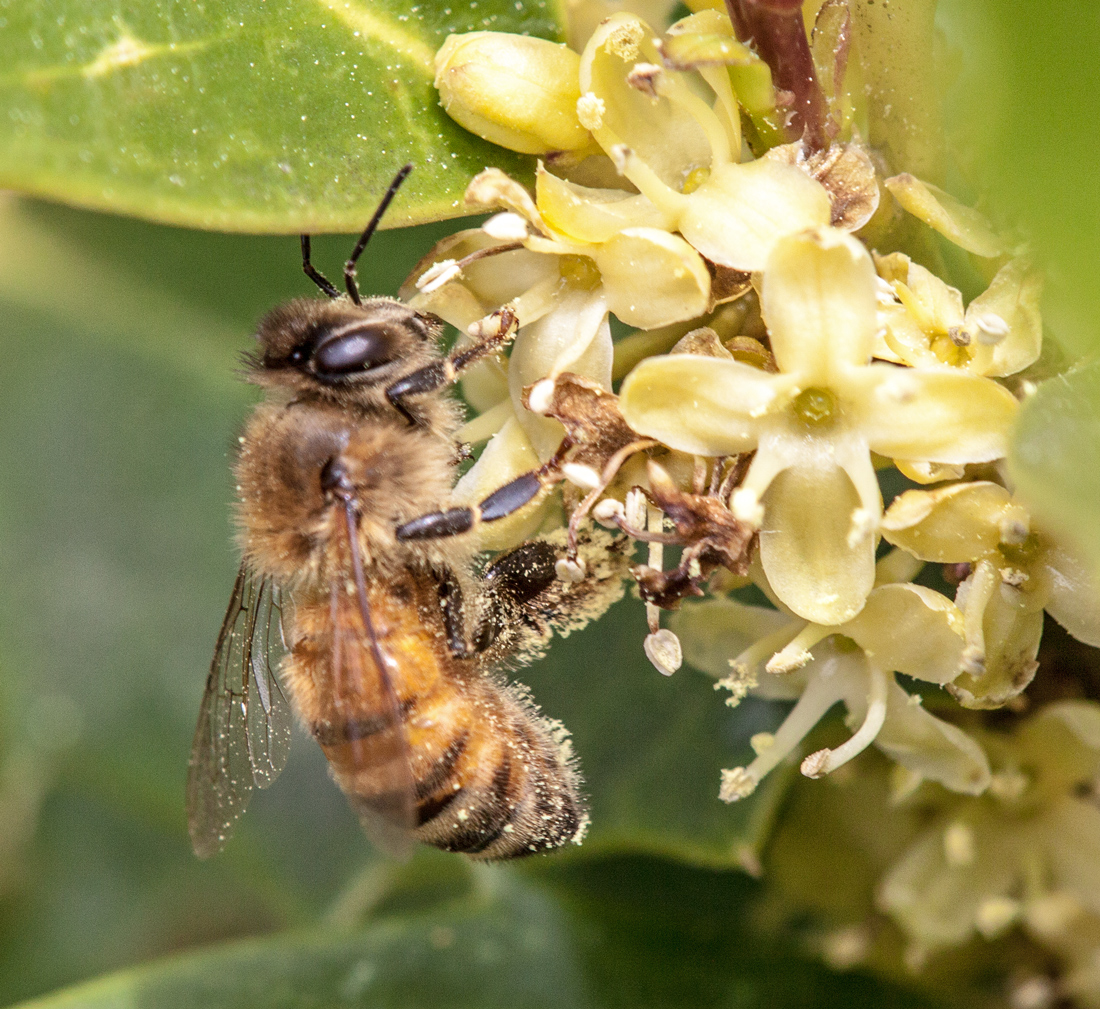
While visiting a garden during an event advertised as “A Million Blooms” I looked hard, but didn’t find any bees among the many tulips and other spring flowers. It was a bit ironic that I discovered this honey bee on a bush while waiting for my fellow photographers outside the gift shop of the Lewis Ginter Botanical Garden in Richmond, Virginia after seeing lots and lots of flowers.
I was hand-holding my 180mm macro lens for these shots, so I couldn’t close down the lens too far. In some of the shots, therefore, you can see that the depth of field was pretty narrow. Still, I am happy that I was able to capture some of the beautiful details of this honey bee, one of the first bees that I have observed this spring.

© Michael Q. Powell. All rights reserved
Posted in Insects, Macro Photography, Nature, Photography, spring, wildlife, tagged beautiful wasp, Canon 50D, Lewis Ginter Botanical Garden, oxymoron, Richmond VA, Tamron 180mm macro lens, wasp on April 21, 2014| 13 Comments »
Isn’t “beautiful wasp” an oxymoron? Can a wasp really be considered to be beautiful? I may be insect-deprived after a long winter and my perceptions may be skewed, but I find the wasp in these two images to be exceptionally beautiful.
The rich reddish-brown of its upper body, with a pattern that looks like some exotic wood, and the bluish-purple of its wings make for a stunning combination, and the holly leaf provides a perfect backdrop.
I took this shot during a visit Lewis Ginter Botanical Garden in Richmond, VA this past weekend, a garden that featured thousands of tulips and other spring flowers in bloom, but almost no insects. I actually was not inside the garden, but was waiting outside the gift shop for some fellow photographers when I spotted this wasp sprawled out on the leaf, as shown in the second image. The nice thing about my 180mm macro is that I didn’t have to get right on top of the insect to capture some good detail. When I moved in a little closer, the wasp slowly climbed up the leaf, as captured in the first shot, before it flew away.
It was nice to see insects start to reappear and I suspect that I will start using my macro lens more and more as we move deeper into spring and into summer.


© Michael Q. Powell. All rights reserved
Posted in Art, Flowers, Gardening, Macro Photography, Nature, Photography, tagged Canon 50D, dandelion, Lewis Ginter Botanical Garden, Richmond VA, Tamron 180mm macro lens, unseasonable on April 20, 2014| 1 Comment »
A few dandelions have popped up recently, but I was surprised to see one yesterday that had already gone to seed. Despite the wind that kicked up from time to time, the dandelion remained a perfect sphere.
April continues to be a mass of contradictions, with a mixture of signs of winter, spring, and even summer.

© Michael Q. Powell. All rights reserved
Posted in Art, Flowers, Gardening, Macro Photography, Nature, Photography, spring, tagged Alexandria VA, broken tulip, Canon 50D, Runnymeade, Tamron 180mm macro lens, tulip "Lady Jane", Tulipa clusiana var. 'Lady Jane', tulips on April 18, 2014| 1 Comment »
After seeing three of my recent postings that featured unopened tulips, some readers might come to the erroneous conclusion that I don’t like the colorful flowers of blooming tulips. How could that be possible? Everyone seems to like the cheery colors of tulips.
My neighbor, and fellow photographer and blogger Cindy Dyer, has planted quite a variety of tulips in her garden and I recently took some photos of two very different species. The first is a small, delicate tulip know as the “Lady Jane” (Tulipa clusiana var. ‘Lady Jane’). I am not sure that I have every seen a more petite tulip and I really like its subtle colors.
The second tulip is big and bold and multi-colored, almost a visual equivalent of shouting. This style of tulip is known as a “broken” tulip, because of the way that the colors are broken, resulting in intricate bars, stripes, streaks, featherings, or flame-like effects of different colors on the petals. According to Wikipedia, this effect was originally produced by a tulip-breaking virus, and bulbs with this effect went for exorbitant prices in 17th century Netherlands, during a period known as “tulip mania.” Today, tulips displaying a “broken” effect are stable variants and the result of breeding, not viral infection.


© Michael Q. Powell. All rights reserved
Posted in Art, Flowers, Gardening, Macro Photography, Nature, Photography, spring, tagged Alexandria VA, Canon 50D, Grape hyacinth, hyacinth, Muscari, Runnymeade, Tamron 180mm macro lens on April 17, 2014| 3 Comments »
Like tiny bunches of grapes, growing out of the ground on a stalk, grape hyacinths are one of my favorite spring flowers. I moved in really close with my macro lens in the first shot to emphasize the beautiful details and the rich dominant bluish-purple color of the plant and moved back a bit for the other two shots to highlight the varied shapes and colors of the individual “grapes.”


© Michael Q. Powell. All rights reserved
Posted in Art, Flowers, Gardening, Macro Photography, Nature, Photography, spring, tagged Alexandria VA, anticipation, Canon 50D, Runnymeade, Tamron 180mm macro lens, tulip, unopened tulip on April 16, 2014| 7 Comments »
This final image of my mini-series on unopened tulips is my favorite—I love the simple composition, the almost monochromatic palette (with the slightest touch of pink at the tip), and the sensual curves of the leaves.
It was almost six o’clock in the evening when I took this shot and the light was still pretty strong, but was starting to fade. I knew that I wanted to shoot some close-up shots of flowers, so I was using my 180mm macro lens. I probably should have been using my tripod for increased steadiness, especially because the lens does not have image stabilization (VR for Nikon folks), but I hadn’t brought a tripod with me.
As is often the case with my macro lens, I ended up focusing manually, trying to get as much of the tulip in focus as I could as I carefully composed the shot. The settings for this shot, for those who might be interested in such technical details, were ISO 400, f/8, and 1/50 second. The shutter speed is a bit slow, I’ll admit, but I was able to brace myself pretty well and I was trying to avoid increasing the ISO and introducing more noise.
If you haven’t seen the other images in this mini-series, Anticipation I and Anticipation II, be sure to check them out. Is there one that you like more than the others?

© Michael Q. Powell. All rights reserved
Posted in Humor, Macro Photography, Nature, Photography, Portraits, Reptiles, spring, wildlife, tagged Alexandria VA, Canon 50D, Common Ribbonsnake, Huntley Meadows Park, snake, snake eyes, Tamron 180mm macro lens, Thamnophis sauritus on March 25, 2014| 9 Comments »
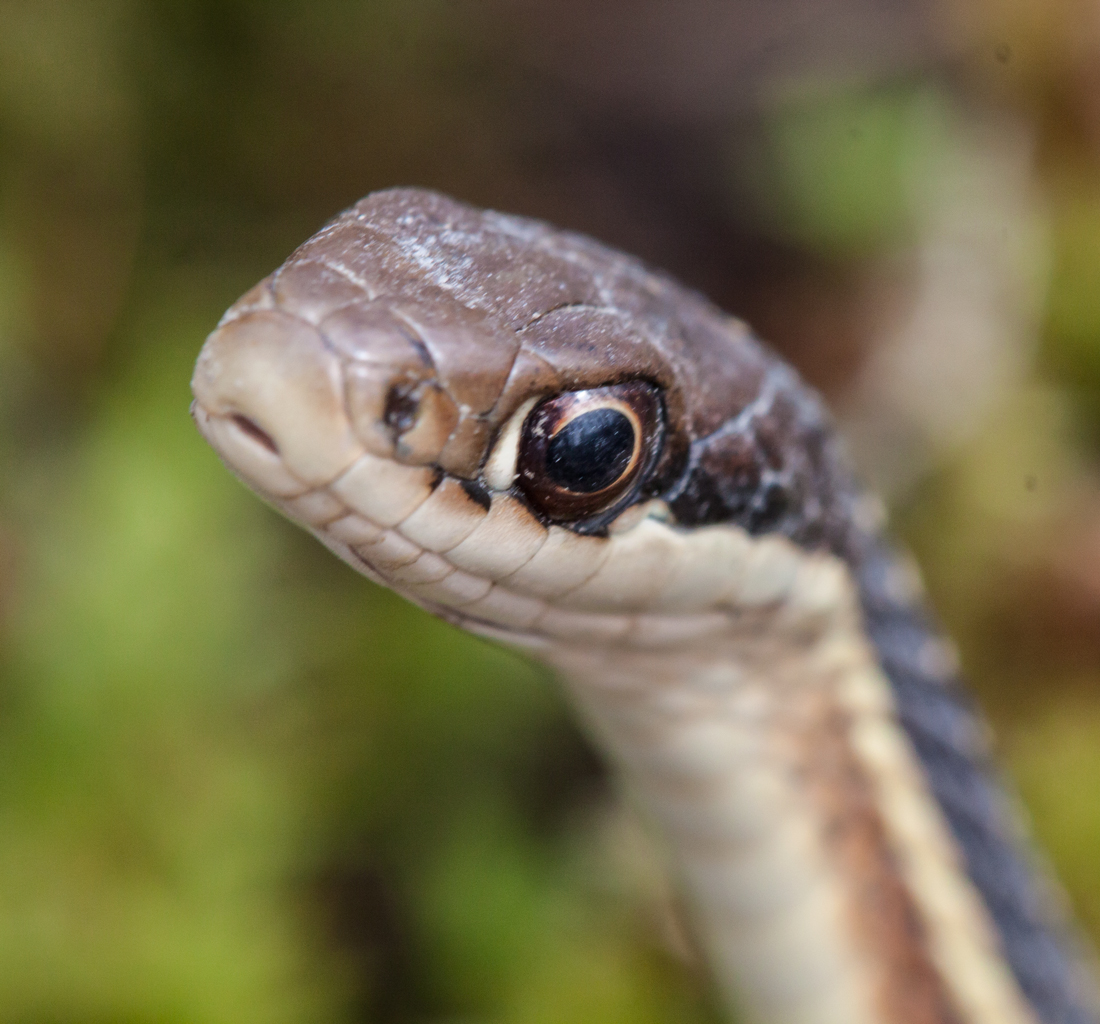
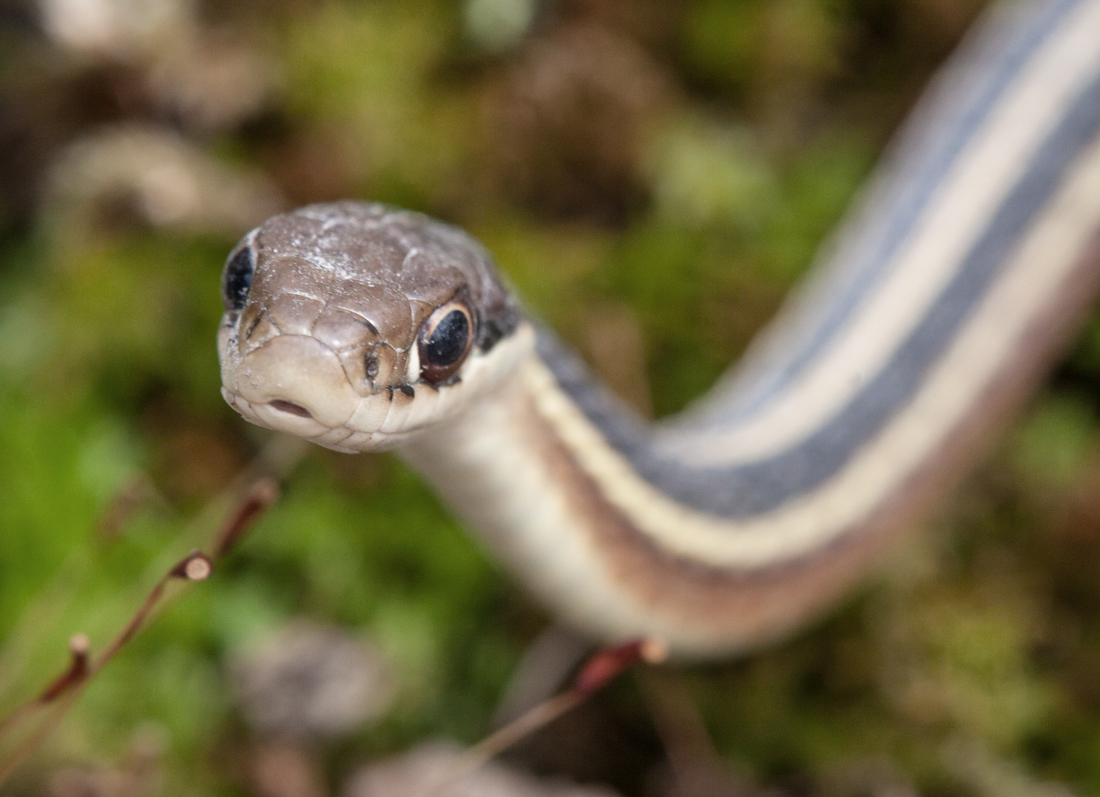
Can snakes whistle? It sure looks like this Common Ribbonsnake (Thamnophis sauritus) is trying hard to whistle as he purses his lips and seems to be blowing air in this series of shots. Who knew that snakes had lips? This snake has lips that rival those of Mick Jagger and look a bit like they were enhanced with collagen.
When you shoot subjects, how close do you get to them? My general rule for wildlife subjects is to shoot them from a distance (so I can be sure of getting a shot) and then move slowly closer and closer. I was amazed at how close this snake let me approach—this first shot was not cropped very much at all.
I like the head-and-shoulders look of the first image (taking into account the fact that snakes don’t really have shoulders), which draws attention to the snake’s eye. At times, though, I prefer the shots that show more of the snake’s body and my favorite of this group is probably the third shot. I really like the curve of the snake’s body and the tilt of its head. It’s hard to see in this reduced-size image, but two little tips of the snake’s forked tongue are visible in its partially open mouth.

© Michael Q. Powell. All rights reserved
Posted in Insects, Macro Photography, Nature, Photography, spring, wildlife, tagged Alexandria VA, Canon 50D, fly, Green Bottle Fly, Huntley Meadows Park, macro, spring, Tamron 180mm macro lens on March 24, 2014| 7 Comments »
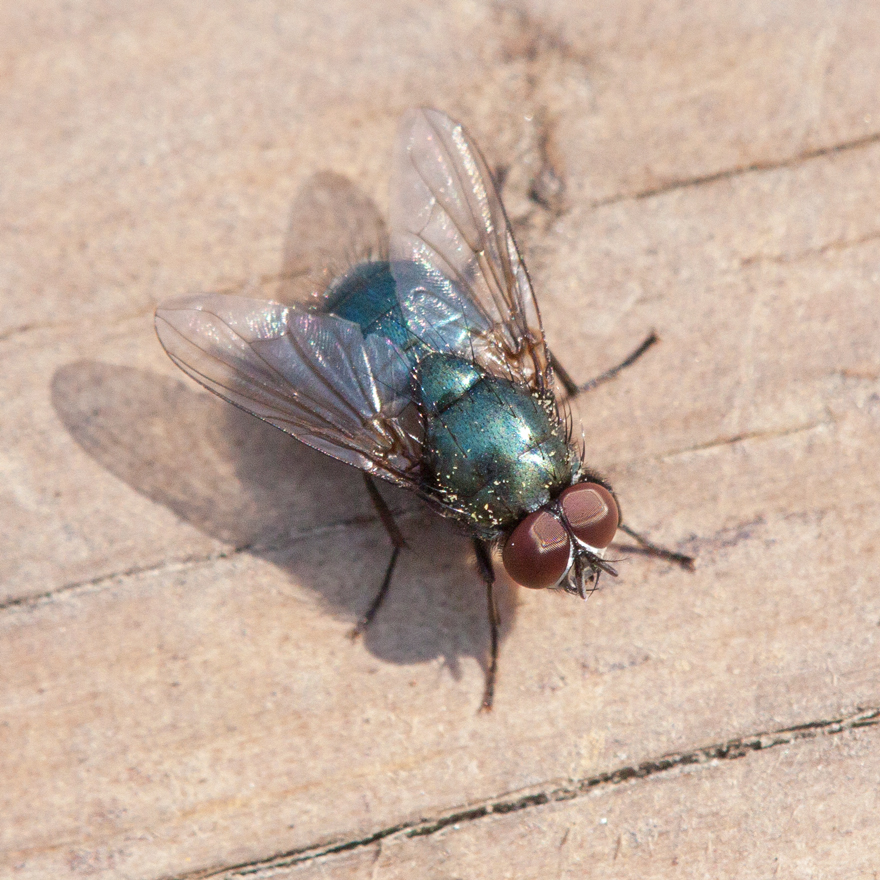
The world changed for me when I put my macro lens back on my camera, simultaneous becoming smaller and bigger. Instead of looking in the distance for birds, I switched my focus to the world immediately in from of me, searching for tiny objects that I can photograph.
In vain I long for colorful butterflies and dragonflies, but it is too early in the spring for them to appear. As soon as a fly buzzed by me, I was seized with an irresistible urge to capture its image. It’s only a fly (a Green Bottle Fly, I think), but it is symbolic of the joys to come, the time when I will spend endless hours chasing after insects, trying to capture the detailed beauty of their colors and patterns.
© Michael Q. Powell. All rights reserved
Posted in Art, Flowers, Gardening, Macro Photography, Nature, Photography, spring, tagged Alexandria VA, backlighting, Canon 50D, crocus, Runnymeade, simple things, spring, Tamron 180mm macro lens on March 24, 2014| 6 Comments »
The late afternoon sunlight shining through this crocus from behind illuminated it like a natural stained glass window. I love the beauty of simple things.

© Michael Q. Powell. All rights reserved
Posted in animals, Humor, Photography, Portraits, Sports, tagged Alexandria VA, ball, Canon 50D, eye on the ball, Freckles, Runnymeade, Tamron 180mm macro lens on March 23, 2014| 5 Comments »
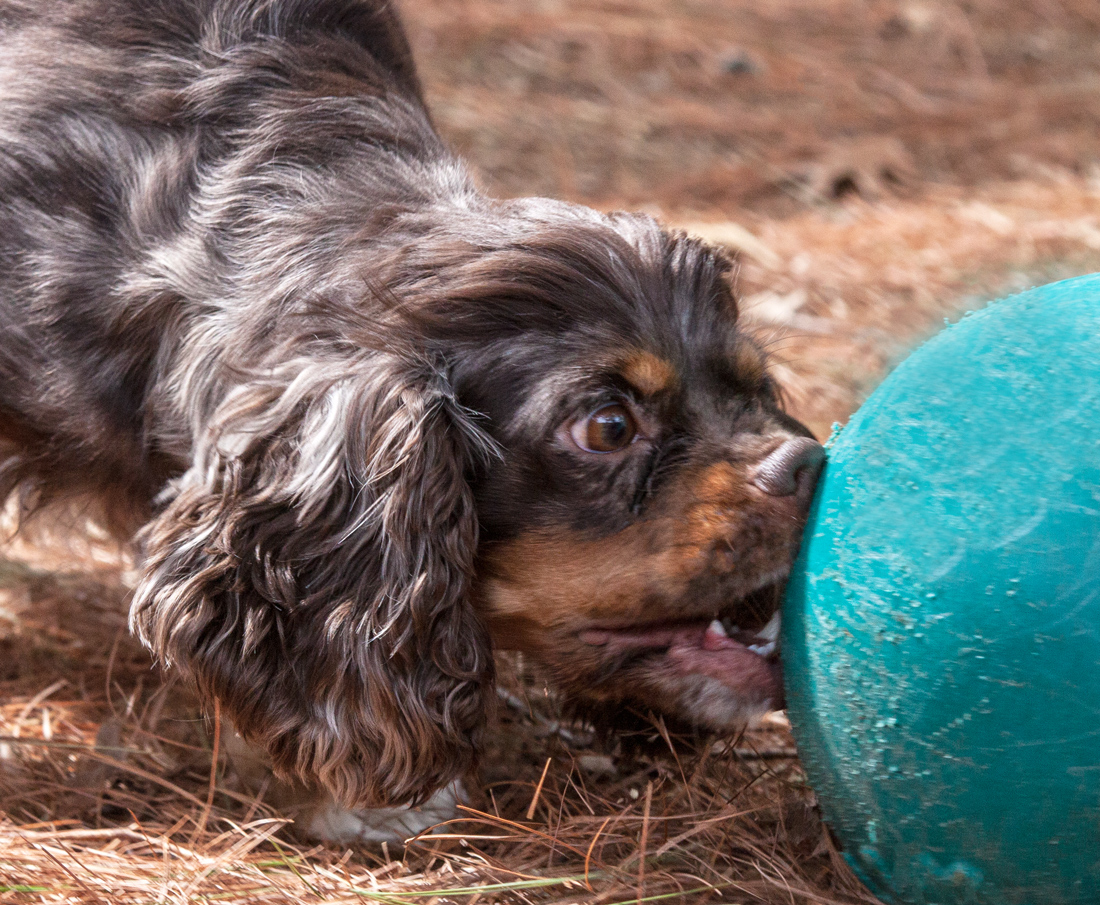
Anyone who had ever played sports has undoubtedly been told, “You have to keep your eye on the ball.” Apparently that is true for dogs too.
I took this shot of Freckles, a friend’s year-old Cocker Spaniel, as she chased a large ball in my back yard yesterday. I love the intensity of her focus, as reflected in her eyes and the expression on her entire face.
© Michael Q. Powell. All rights reserved
Posted in Art, Flowers, Gardening, Macro Photography, Nature, Photography, spring, tagged Alexandria VA, Canon 50D, crocus, Runnymeade, spring, spring flowers, Tamron 180mm macro lens on March 23, 2014| 5 Comments »
Yesterday afternoon, my dear friend and fellow photographer Cindy Dyer called to alert me that there were some crocuses blooming in her garden. The lighting was wonderful and the dirt in the background provides a simple backdrop for the gorgeous colors of this little spring flower.

© Michael Q. Powell. All rights reserved
Posted in Arachnids, Art, Macro Photography, Nature, Photography, spring, Urban, wildlife, tagged Alexandria VA, Canon 50D, jumping spider, KIA Soul, Runnymeade, spider, Tamron 180mm macro lens on March 22, 2014| 12 Comments »
Sometimes you don’t have to travel far to get good nature photos. I noticed this colorful little jumping spider on my car yesterday when I was loading my camera gear, getting ready to go out shooting. 
It was a fun challenge trying to get shots of the spider as it moved to various parts of the trim surrounding the windshield, many of which were reflective. I wasn’t sure how long the spider would hang around, so I didn’t set up my tripod and I think it would have been pretty awkward to do so.
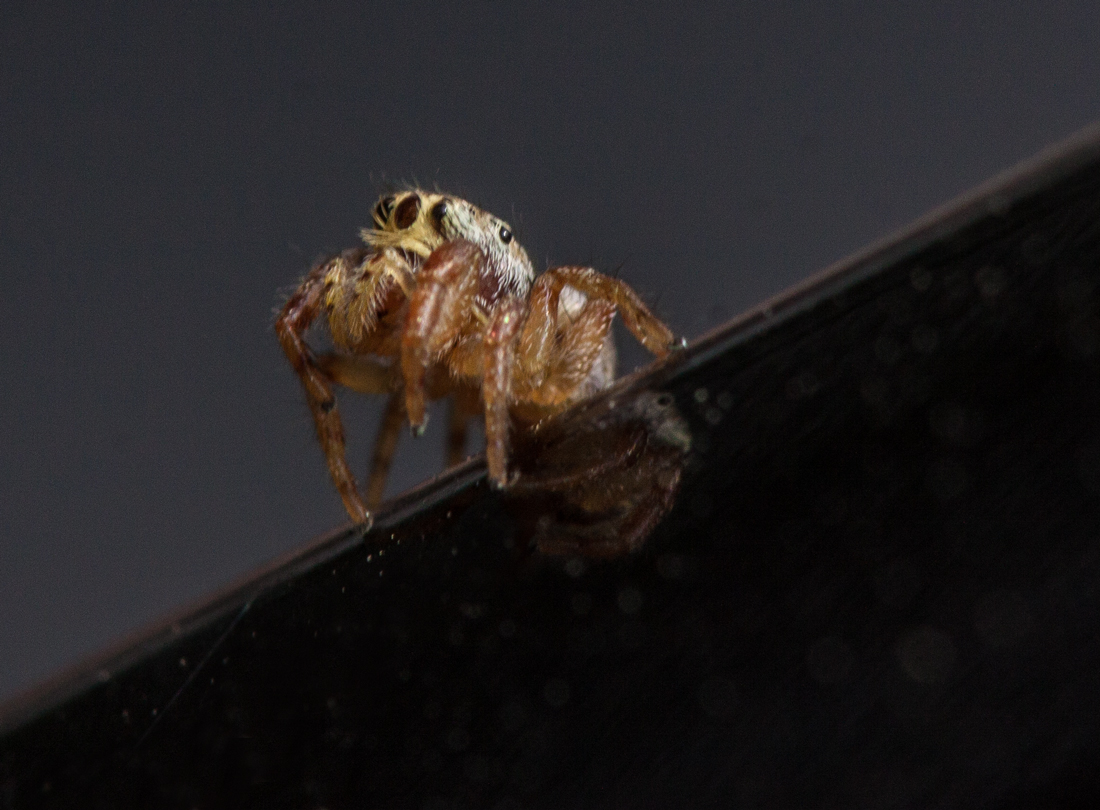
I am hoping that nobody snapped pictures of me as I sprawled my body across the hood of the car, trying to find a way to brace my body and get a decent shooting position. My Tamron 180mm macro lens lets me get in close, but it does not have image stabilization.
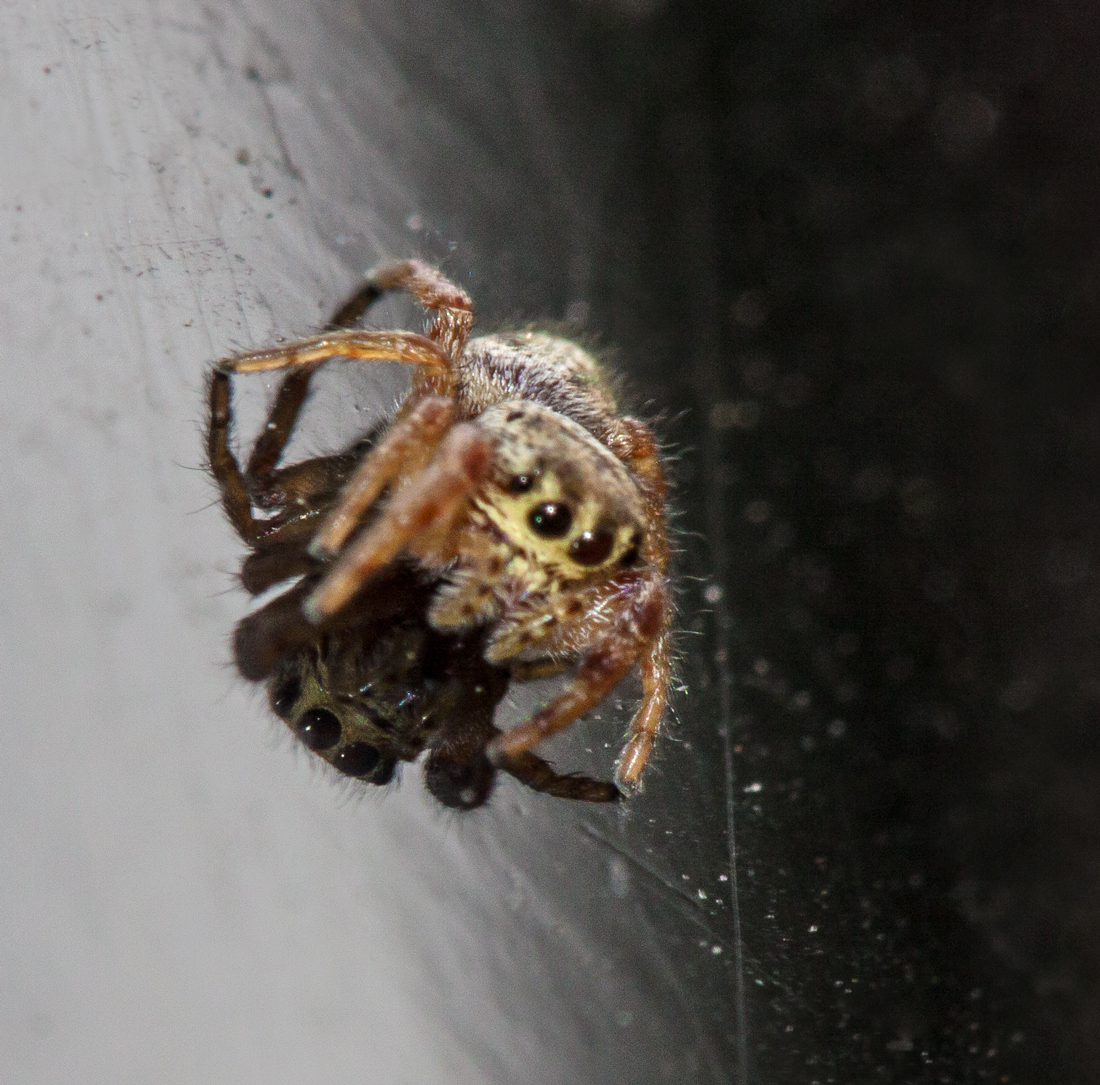 One of the first things that I noticed when I reviewed my images was that my car is dirty. In this area, they use a lot of salt on the roads when it snows and I suspect that those little white spots are salt residue. I thought about removing them in post-processing, but decided that I like the more urban, gritty feel that they give the images (and besides, it would have been a lot of work to get rid of all of them).

I am always thrilled when I find a jumping spider. There is something special about all of those eyes that simply fascinates me and I am particularly happy when I manage to get reflections in the eyes.
© Michael Q. Powell. All rights reserved
Posted in Macro Photography, Nature, Photography, Portraits, Reptiles, spring, wildlife, tagged Alexandria VA, Canon 50D, Common Ribbonsnake, Eastern Garter Snake, garter snake, Huntley Meadows Park, snake, Tamron 180mm macro lens, Thamnophis sauritus sauritus, Thamnophis sirtalis on March 21, 2014| 19 Comments »
Now that it is spring, I have started carrying around my macro lens, which I was able to use to get this really close-up shot today of an Eastern Garter snake (Thamnophis sirtalis) at Huntley Meadows Park, my favorite local spot for nature photography. The snake was curled up in a mossy area and seemed to be a little sluggish. Consequently, he did not slither away when I got down low and moved in close to take this photo.
CORRECTION: Fellow photographer and blogger Walter Sanford, who is much more of an expert in snakes than I am, has identified this snake as a Common Ribbonsnake (Thamnophis sauritus sauritus), not an Eastern Garter snake.

© Michael Q. Powell. All rights reserved
Posted in Flowers, Gardening, Macro Photography, Nature, Photography, Winter, tagged Alexandria VA, Canon 50D, green spring gardens, greenhouse, Tamron 180mm macro lens, tropical plant on February 18, 2014| 5 Comments »
Although it has started to get a bit warmer, lots of snow remain, snow that has lost its initial pristine beauty and is now flecked with brown road dirt and various chemicals. I feel a need for color, so I am posting some shots I took last month of a tropical plant in the greenhouse at my local county-run garden.
One of the challenges in shooting in this small space was the often cluttered background. I tried to frame these shots in such a way that background is not too distracting. I have no idea what kind of a plant this is, but that doesn’t bother me, for it is the color, texture, and shape of the plant that I find most interesting.
It won’t be long before I’ll see bursts of color like this outdoors—I can hardly wait.


© Michael Q. Powell. All rights reserved
Posted in Art, Flowers, Gardening, Macro Photography, Nature, Photography, Winter, tagged Alexandria VA, Canon 50D, green spring gardens, Lady's Slipper, Lady's Slipper orchid, Tamron 180mm macro lens on February 3, 2014| 13 Comments »
This past weekend, I was filled with an inexplicable urge to take some flower photos. With the exception of some clumps of snowdrops, nothing was blooming outdoors, so I slipped into the small glass-enclosed greenhouse at my local county-run garden to capture images of some of the tropical flowers there.
I was alone with the plants for an extended period of time and was able to set up my tripod and use my macro lens, which has been gathering dust the last few months. My eyes have grown accustomed to looking for birds in the distance and it was an interesting challenge to get them to focus on the smaller details of stationary objects.
I am not sure of the names of the flowers that I photographed (with the exception of the second one, which is a kind of Lady’s Slipper orchid), but my senses were satisfied temporarily with the sight and smells of these beautiful flowers.
I can’t wait for spring, when I’ll have the chance to to see more flowers (and the accompanying insects) outdoors.


© Michael Q. Powell. All rights reserved
Posted in Art, Insects, Macro Photography, Nature, Photography, wildlife, tagged Alexandria VA, Canon 50D, Handsome Meadow Katydid, Huntley Meadows Park, katydid, rainbow grasshopper, Tamron 180mm macro lens on December 15, 2013| 37 Comments »
It is pretty cool that a website (cracked.com) chose to use one of my photos in an article entitled “6 Insanely Colored Versions of Normally Boring Animals.” It is this photo that I took during the summer of my favorite insect, the Handsome Meadow Katydid and I featured in a posting called Rainbow Grasshopper.

Check out the article at http://www.cracked.com/article_20811_6-insanely-colored-versions-normally-boring-animals.html .
© Michael Q. Powell. All rights reserved.
Posted in Insects, Macro Photography, Nature, Photography, wildlife, tagged Alexandria VA, Banded Wooly Bear caterpillar, caterpillar, fuzzy caterpillar, Huntley Meadows Park, Pyrrharctia isabella, Tamron 180mm macro lens, Wooly Bear caterpillar on November 7, 2013| 6 Comments »
We’re starting to get down to the last insects of the season, and fuzzy brown caterpillars are among the few insects that I still see. Some of these are Banded Wooly Bear caterpillars (Pyrrharctia isabella) that supposedly help tell how severe the winter will be, though I confess that I can never remember how you are supposed to judge, i.e. does a wide middle section mean a short winter or a long one?
When I first took this shot, I thought the subject was a wooly bear caterpillar, but the more I look at it the less certain I feel. There seems to be a black tip on only one end of the caterpillar rather than at both ends. Despite the uncertainty about identification, I really like the shot and the way that I was able to isolate the caterpillar from the background.

© Michael Q. Powell. All rights reserved.
Posted in Arachnids, Art, Macro Photography, Nature, Photography, Portraits, wildlife, tagged Alexandria VA, Canon 50D, Halloween, Huntley Meadows Park, spider, Tamron 180mm macro lens on October 31, 2013| 3 Comments »
Some spiders can be creepy, but others are quite beautiful, like this one that I photographed earlier this month at my local marshland park. I am catching up a bit on posting photos from this month that I really liked and thought it might be good to post a spider image on Halloween night. I have not yet been able to identify this spider, but noted that it did not have a web and seemed to be lying in wait for prey on the long leaf of this plant. I’d welcome assistance in identifying the species of spider,

© Michael Q. Powell. All rights reserved.
Posted in Humor, Insects, Macro Photography, Nature, Photography, wildlife, tagged Alexandria VA, Canon 50D, grasshopper, Huntley Meadows Park, praying mantis, Tamron 180mm macro lens on October 23, 2013| 10 Comments »
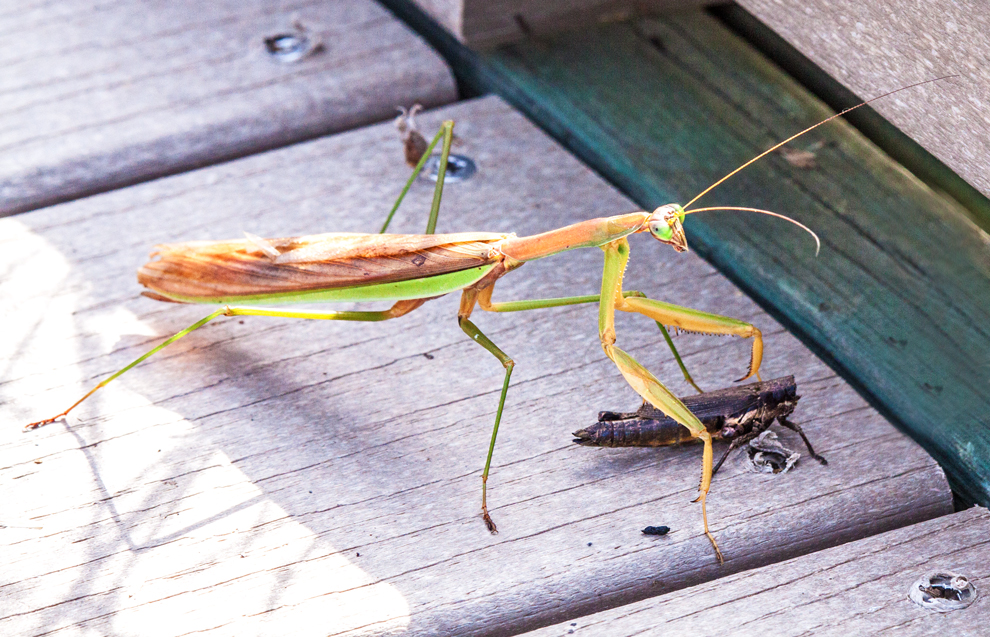
When this praying mantis began to straddle a hapless grasshopper, I wasn’t sure what was going to happen, but suspect that the grasshopper may have been the one that began to pray.
Was the mantis looking at the grasshopper as a potential mate or a potential meal? With praying mantises, the question of mate or meal is a little complicated, because some females reportedly bite off the heads of the males after mating.
As it turned out, the praying mantis ignored the grasshopper and simply climbed over him and the grasshopper’s prayer undoubtedly turned into one of giving thanks.
© Michael Q. Powell. All rights reserved.
Posted in Dragonflies, Humor, Macro Photography, Nature, Photography, tagged Alexandria VA, Autumn Meadowhawk dragonfly, Canon 50D, dragonfly, Huntley Meadows Park, Sympetrum vicinum, Tamron 180mm macro lens on October 22, 2013| 7 Comments »
When this bright red male Autumn Meadowhawk dragonfly landed briefly on my fellow photographer’s white sneaker yesterday, it suddenly struck me that we might have hit on a potential fall fashion fad. Why not accessorize plain shoes with colorful dragonflies in seasonal colors? We could start with the Autumn Meadowhawk for fall and perhaps move on to the Common Whitetail as the snow begins to fall. Spring could bring on the Green Darner and summer could feature the Blue Dasher.
Of course, we couldn’t use real dragonflies, but they could serve as models for pin-on or clip-on dragonflies. Size-wise, it looks like this Autumn Meadowhawk is about the right size.
Now that I have a marketing idea, all I need is investors.

© Michael Q. Powell. All rights reserved.
Posted in Dragonflies, Humor, Insects, Macro Photography, Nature, Photography, wildlife, tagged Alexandria VA, Autumn Meadowhawk dragonfly, Canon 50D, dragonflies, Huntley Meadows Park, mating dragonflies, Sympetrum vicinum, Tamron 180mm macro lens on October 22, 2013| 14 Comments »
There is something a little wistful about searching for the last dragonfly of the year. Most of the familiar dragonflies from the summer have disappeared and it looks like the sole remaining dragonfly in our area is the Autumn Meadowhawk dragonfly (Sympetrum vicinum).
Yesterday I spent some time trying to photograph this dragonfly along with fellow photographer and blogger Walter Sanford, who has an amazing collection of photographs of dragonflies on his blog site, including a world-class series on the Blue-faced Meadowhawk. I was willing to try to capture photos of any dragonfly that I could spot, but Walter noted that he had taken enough photos of the male Autumn Meadowhawk and was really interested in photographing females or, even better, mating pairs.
The mating pairs tended to elude him most of the day, until suddenly a pair in the “wheel” position circled around us and landed on his bare calf—talk about unprotected sex. There was no way that he could twist himself around to get a good photo, but I manage to get this shot of the two dragonflies in action.
Temperatures are supposed to continue to drop this week, so there is always a chance that these will be the last dragonflies that I see this year, though I will be out searching for them for weeks to come before I bid my final adieu to them.

© Michael Q. Powell. All rights reserved.
Posted in Arachnids, Macro Photography, Nature, Photography, Portraits, wildlife, tagged Alexandria VA, Araneus cavaticus, barn spider, Canon 50D, Huntley Meadows Park, Neoscona crucifera, spider, spots, Tamron 180mm macro lens on October 21, 2013| 3 Comments »
As the outside temperatures continue to drop, I am seeing fewer and fewer spiders. This is one of my favorite recent shots of what I think is a barn spider. I really like the way that the spots in the background mirror the spots on the spider’s abdomen.
I think that this may be a Neoscona crucifera spider, though it may be an Araneus cavaticus spider. Strangely enough, both of them are sometimes known as barn spiders.

© Michael Q. Powell. All rights reserved.
Posted in Humor, Insects, Macro Photography, Nature, Photography, tagged Alexandria VA, Canon 50D, encounter, grasshopper, Handsome Meadow Katydid, Huntley Meadows Park, katydid, Tamron 180mm macro lens on October 21, 2013| 5 Comments »
Perhaps the old adage that “opposites attract” applies to grasshoppers too. When I photographed this intimate moment on a leaf, I couldn’t figure out for sure what was going on.
Perhaps the grasshopper was attracted by the bright colors of the Handsome Meadow Katydid and was trying to start a conversation. Maybe this was a blind date set up by some well-intentioned friends. Is it possible they matched on a lot of points in the insect version of Match.com?
I have photographed grasshoppers and katydids separately, but this is the first time I have them both in a single image. It is fascinating to be able to compare the bodies of the two species and note the differences in the eyes, the legs, and many other parts.
The striking colors of the Handsome Meadow Katydid have always drawn my attention, but I am left with one question to ponder. Do grasshoppers even see in color or only in shades of gray?

© Michael Q. Powell. All rights reserved.
Posted in Arachnids, Art, Macro Photography, Nature, Photography, wildlife, tagged Alexandria VA, Canon 50D, Huntley Meadows Park, spider games, spiders, Tamron 180mm macro lens on October 19, 2013| 11 Comments »
I am not really sure what these spiders were doing, but it looked to me like they were engaged in a game that I played as a child called “King of the Hill.” The objective of the game was to climb to the top first and then to repel the efforts of the others trying to unseat you and take your place.
The two spiders seemed to be racing to the top of this plant’s stalk in the first photo and the second image shows that the one on the left was the winner. Somehow that second image reminds me of the iconic shot of King Kong on the Empire State Building, clutching the spire of the building.
It was a challenge trying to track moving subjects like this with a macro lens and my need for a higher shutter speed caused me to sacrifice some depth of field. I do like the simple, uncluttered composition that I was able to achieve and the fact that I was able to capture these little spiders in action.

 © Michael Q. Powell. All rights reserved.
Posted in Arachnids, Macro Photography, Nature, Photography, wildlife, tagged Alexandria VA, Canon 50D, Huntley Meadows Park, spider, Tamron 180mm macro lens, web on October 16, 2013| 4 Comments »
Here’s another shot of one of the numerous spiders that I observed yesterday at my local marsh, which I have not yet been able to identify.
This one was pretty big and seemed to be putting out a lot of silk, one strand at a time. If you look closely, you can spot numerous eyes and a cool orange racing stripe down the middle of its face. I took this shot from a low angle so that I could capture the spider with the sky as the partial backdrop.
© Michael Q. Powell. All rights reserved.
Posted in Arachnids, Macro Photography, Nature, Photography, wildlife, tagged Alexandria VA, Canon 50D, Huntley Meadows Park, jumping spider, spider, Tamron 180mm macro lens on October 15, 2013| 10 Comments »
There seemed to be spiders everywhere at the marsh today. When I arrived in the morning, there were webs all over the place, though not the kind that orbweavers make—plants were simply covered with web-like material. Later in the day I saw all kinds of spiders scurrying along the boardwalk and even flying through the air in a process known as ballooning.
I saw a lot of one of my favorite type of spiders, the jumping spider. I am still downloading my images from today, but here is an advance preview, an image of a jumping spider that had crawled onto part of the railing of the boardwalk. I love the details of the spider, especially the eyes, and even the peeling paint of the railing.

© Michael Q. Powell. All rights reserved.
 Mike Powell