Feeds:
Posts
Comments

Posts Tagged ‘Tamron 180mm’

Flowers are beautiful when you look at them from the front, of course, but they can be equally beautiful when you look at them from behind, especially when they are backlit. That was certainly true for these colorful violas that I photographed last week at Green Spring Gardens, a county-run historical garden not far from where I live.

I especially like the first shot, which has an abstract quality to it, caused in part by photographing the flower at close range with my macro lens. The flower is reduced to a mass of shapes and color and of light and shadows to the point where the brain at first glance does not seem to be able to figure out what the subject is.

viola

violas

© Michael Q. Powell. All rights reserved.

Read Full Post »

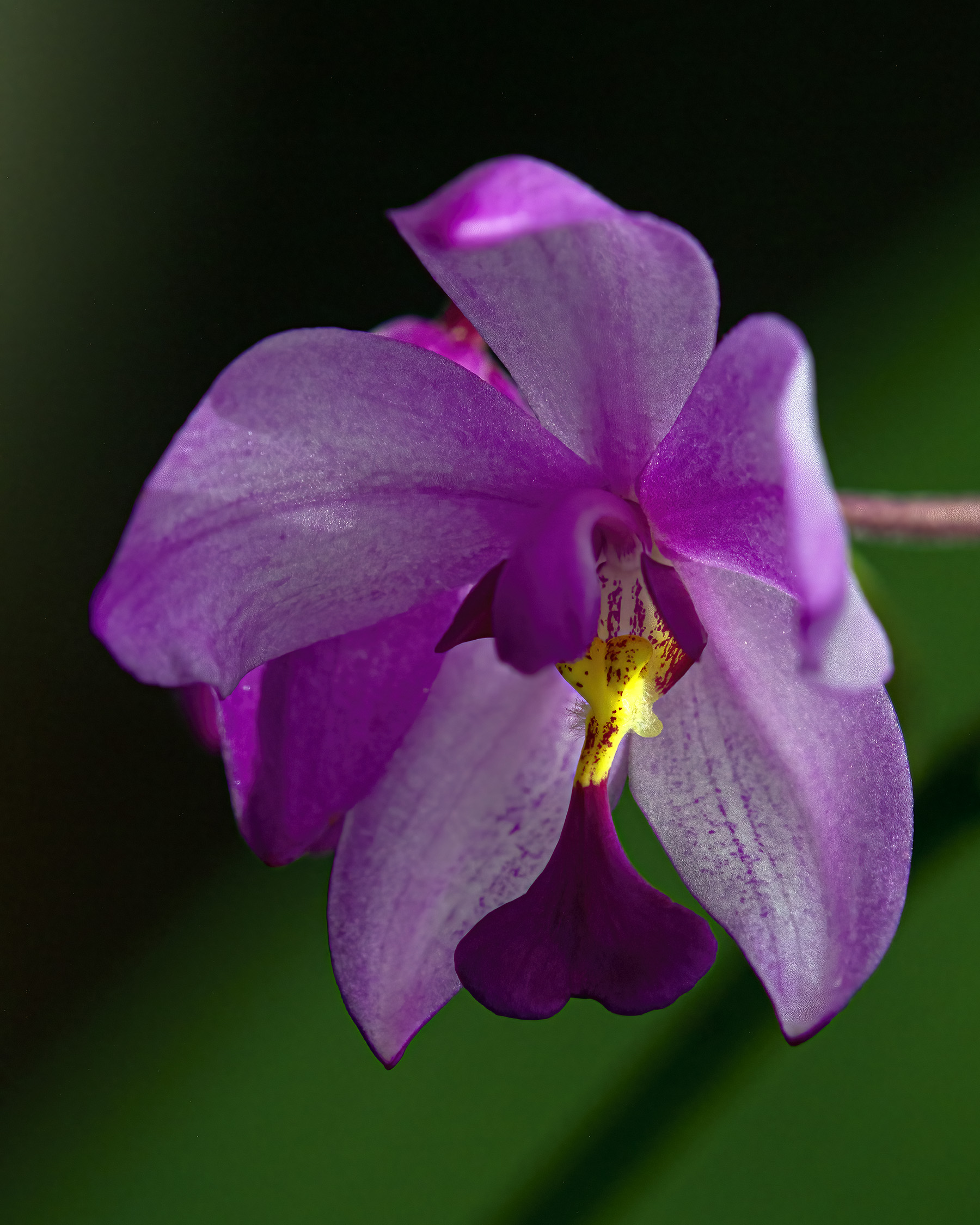
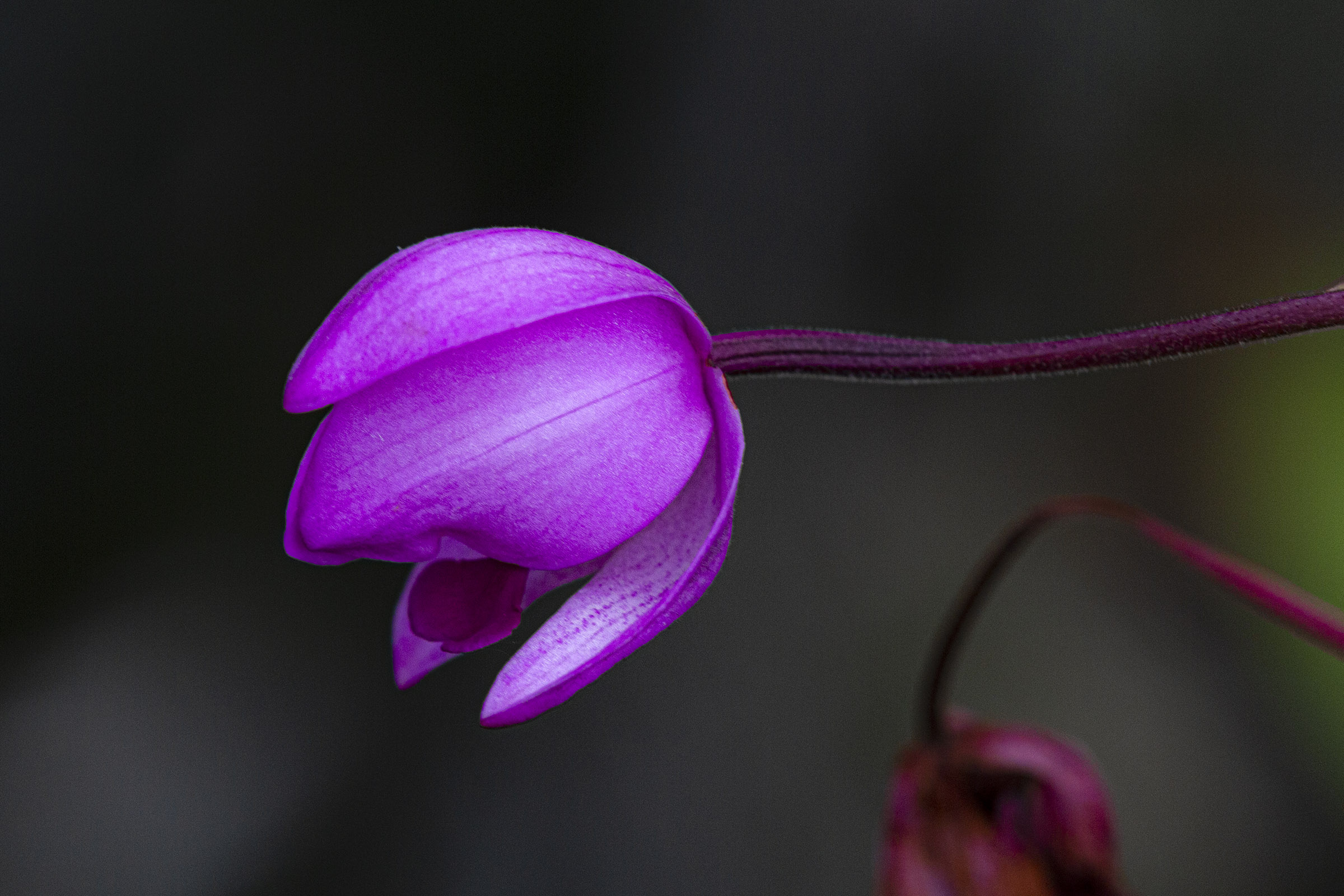
In addition to the stunning pink and purple bromeliad that I featured in an earlier posting, here are some shots of tropical plants that I observed in the “glasshouse” at Green Spring Gardens last week. The first two shots are of what I believe is a ground orchid—it may be a Phillippine Ground Orchid (Spathoglottis plicata), but there are a number of similar species, so I cannot be sure of the identification.

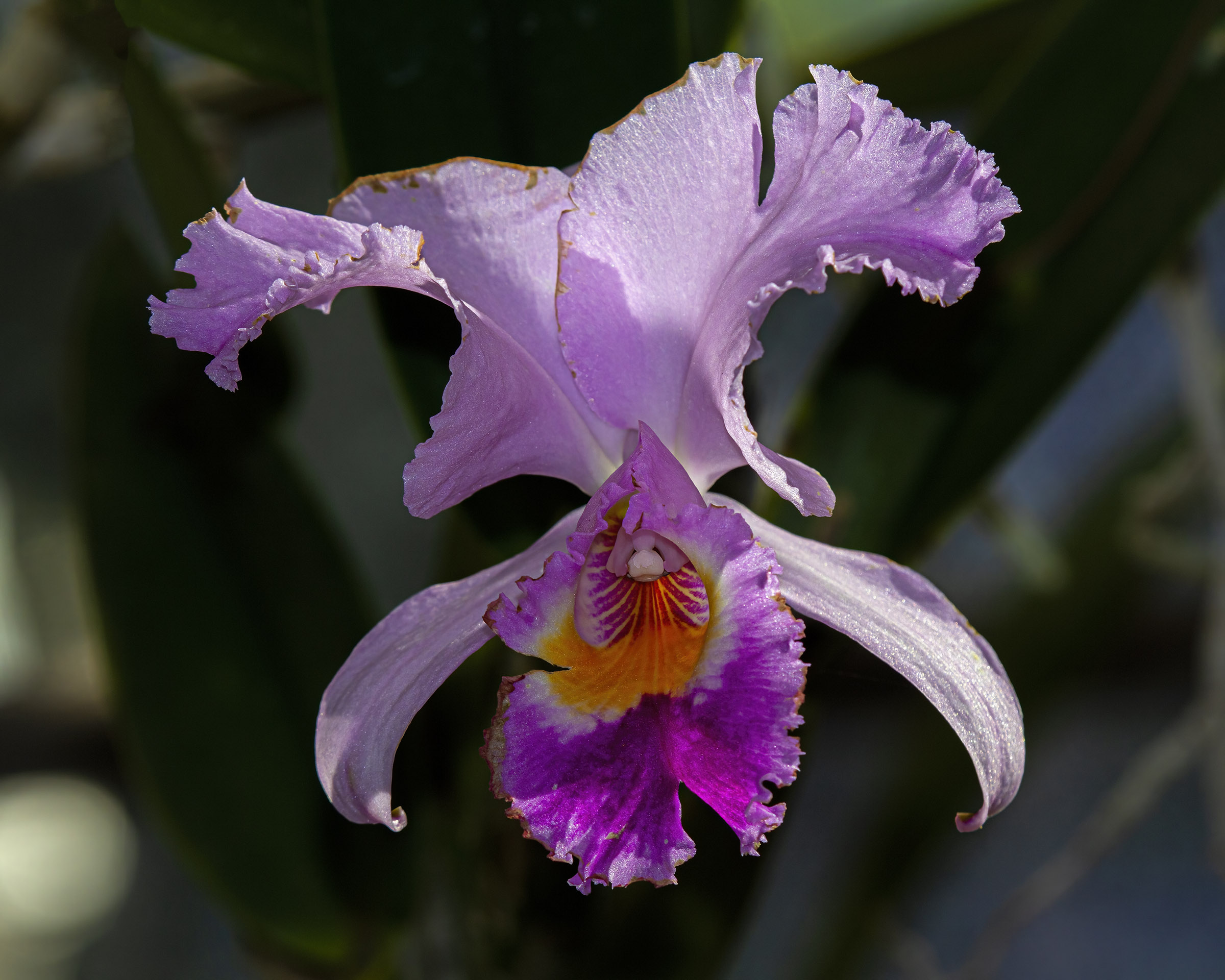
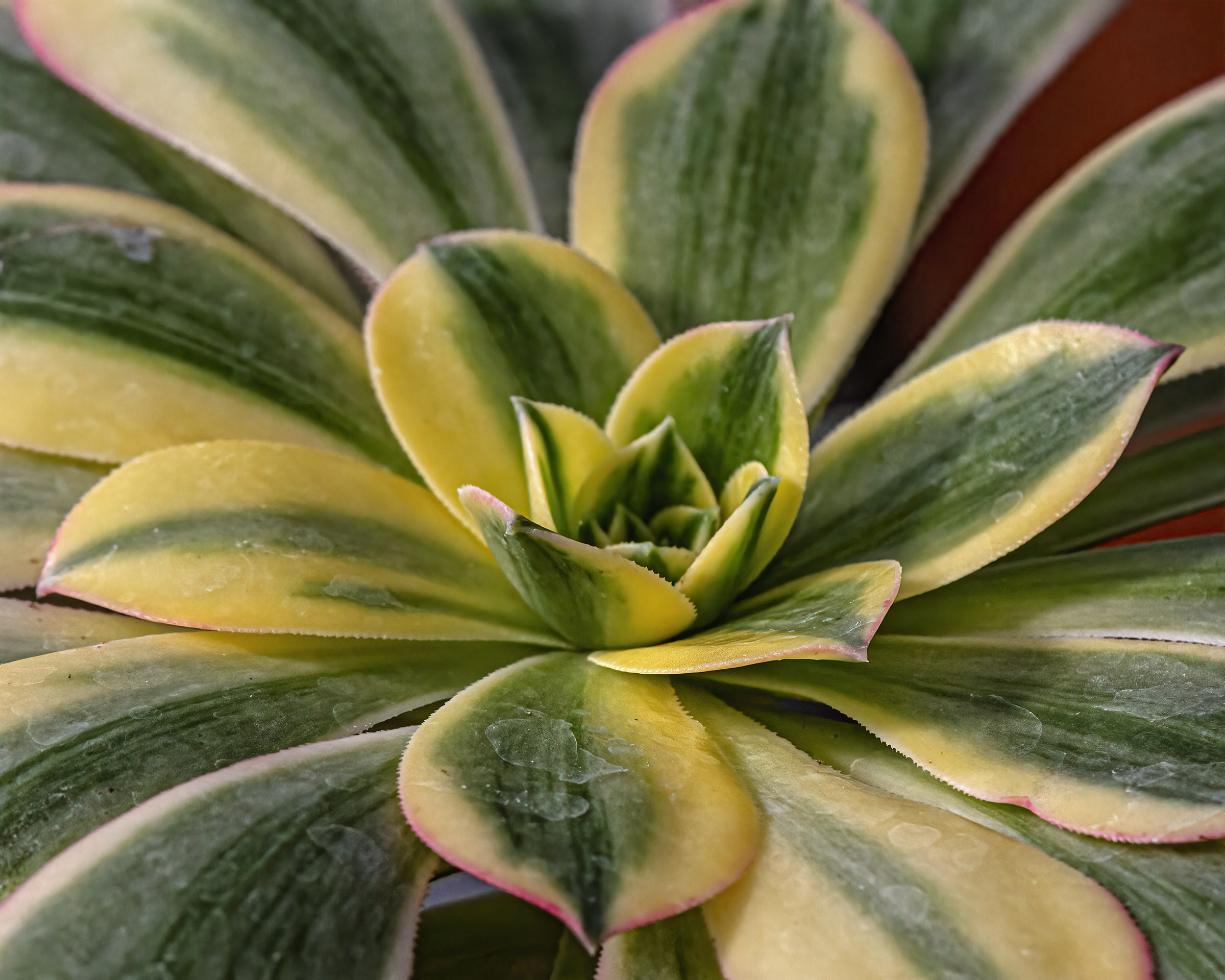
The third photo shows an orchid that is more typical of what I imagine when I think of an orchid. It is a little past its prime, but is still incredibly beautiful. The final photo is a close-up view of one of the many succulents that I observed. I love the geometric patterns of the multi-colored leaves in the image.

One of the nice things about taking photos indoors was that I did not have to worry about the wind creating movement. However, there was not a lot of space for maneuvering and the background was often cluttered, so I had to work hard to find pleasing angles for my photos.

This is a totally different style of photography that the bird photography I have been doing the past few months, but I think that it is good to mix things up a bit to keep from getting stuck in a rut photography-wise.

ground orchid

ground orchid

orchid

succulent

© Michael Q. Powell. All rights reserved.

Read Full Post »

During the gray days of winter my senses are starved for color as the world turns mostly monochromatic. Where can I find bright colors? For a few blissful moments I immersed myself in a tropical world this past Thursday when I visited the “glasshouse,” the small greenhouse at Green Spring Gardens in Alexandria, Virginia.

There were some orchids and succulents, but my eyes were immediately attracted to the amazing hot pink and purple colors of an unusual-looking plant. I had no idea what kind of plant it was, but was absolutely mesmerized by this bold colors and managed to capture a few close-up shots of it with my macro lens.

When I returned home I started my research and eventually figured out that it was some sort of bromeliad. What in the world is a “bromeliad?” Bromeliads are a group of mostly tropical plants that belong to the family Bromeliaceae. I read and re-read descriptions of the characteristics and got tangled up in the scientific jargon of plant anatomy. As I understand it, many bromeliads are able to store water in a structure formed by their tightly overlapping leaf bases—the pineapple is the only bromeliad that immediately comes to mind.

With the help of my dear friend and photography mentor Cindy Dyer, I determined that this colorful plant is probably a Blue Tango Bromeliad (Aechmea ‘Blue Tango’) or possible a Dwarf Blue Tango Bromeliad (Aechmea ‘Del Mar’). Both of these are hybrid cultivars of plants that are native to tropical areas and require high humidity levels to thrive—the glasshouse was humid, but not as steamy as some that I have previously visited.

Blue Tango Bromeliad

Blue Tango Bromeliad

© Michael Q. Powell. All rights reserved.


Read Full Post »

Yesterday I had the desire to photograph something different. For the past few months, my long 150-600mm telephoto zoom lens has remained on my camera and I have focused mostly on birds. I decided to switch back to my 180mm macro lens, the lens that I use most of the time during warmer months, and set off for Green Spring Gardens, a historic county-run park only a few miles from where I live.

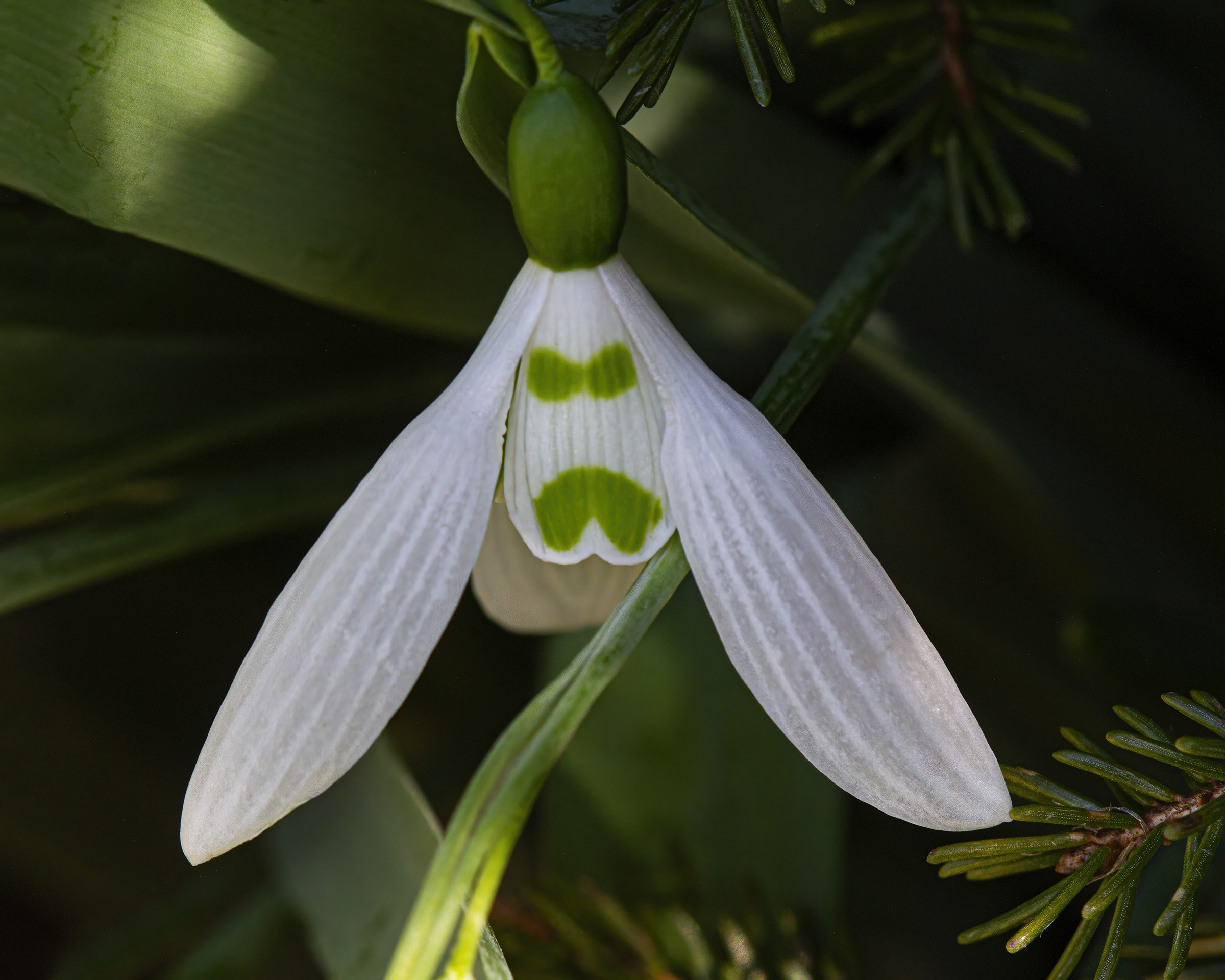
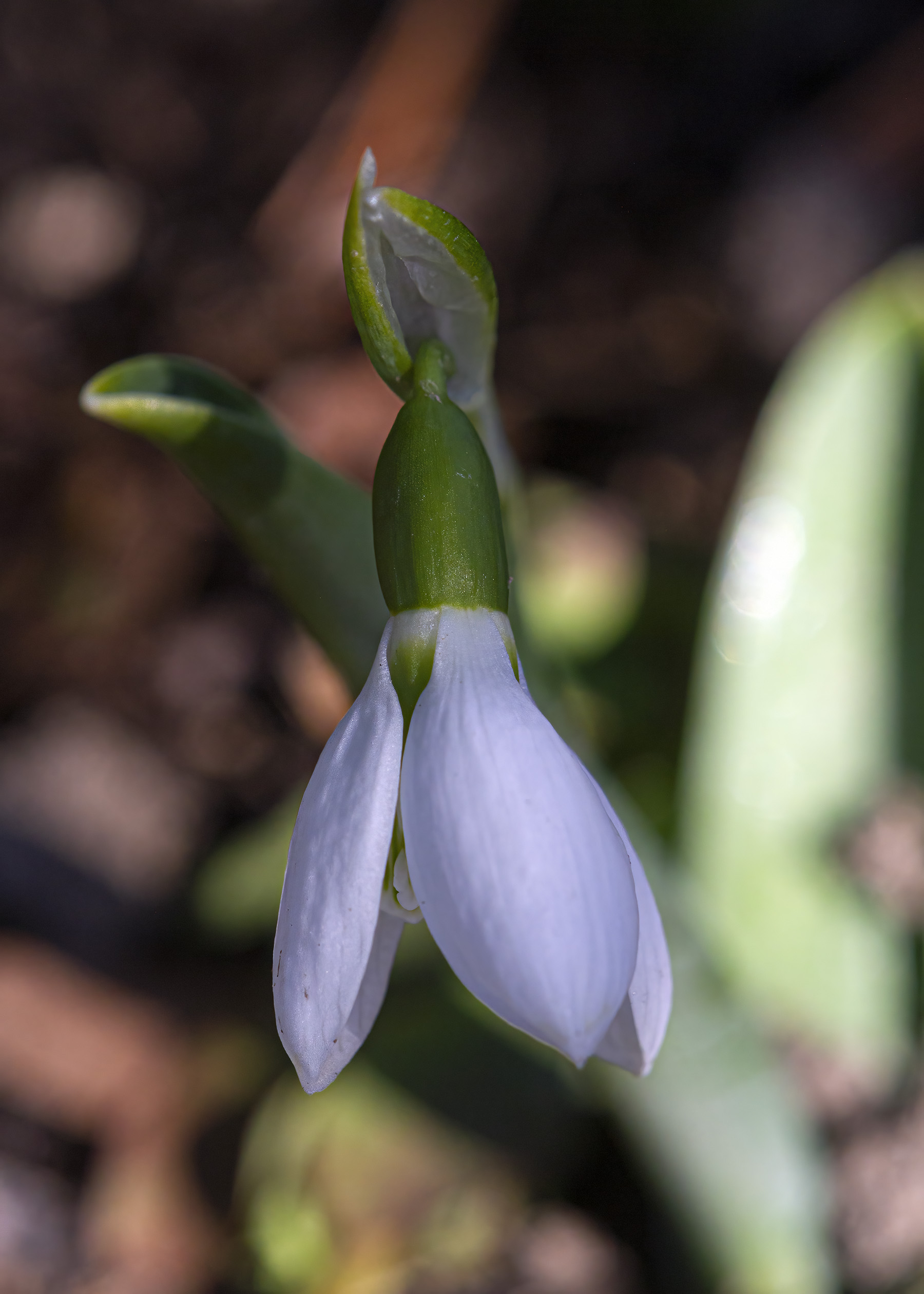
Not surprisingly, I did not spot any insects, but I was thrilled to find several patches of Snowdrop flowers (g. Galanthus) in bloom. I had a fun time trying to compose some  shots of these beautiful little flowers, though I did end up a bit muddy, because it had rained a lot the previous day.

At this time of the year the flower beds are mostly dirt and/or mulch, so it is impossible to get the smooth green backgrounds that I often strive for during the spring and summer months. However, I was able to blur the background some by carefully choosing my shooting angle and adjusting my camera settings.

During my time at the park, I also visited the “glasshouse,” a small greenhouse that houses tropical flowers, succulents, and bromeliads. It felt great to soak up the warmth of the sun in this enclosed environment and I managed to take a few photos there that I will share in a future blog posting.

Snowdrop

Snowdrop

Snowdrop

© Michael Q. Powell. All rights reserved.

Read Full Post »

Do you prefer to live your life widely or deeply? That is a curious question, but it is one that affects the way that many of us approach our photography and our lives in general. Let me reframe the question. Are you always seeking to visit new places to see new things, i.e. living “widely”, or would you rather spend your time in familiar locations with familiar subjects, going back to the same places repeatedly, i.e. living “deeply?”

As you may have guessed, I tend to put myself in the second category. I like to observe the seasonal changes at a few local areas, watching for new species to arrive and to depart (or disappear), observing the changes in the flora and the fauna, and discovering favorite spots for my photography. I am not really consumed by a need or desire to add to my “life list” of birds or insects that I have seen, though I do enjoy visiting other locations.

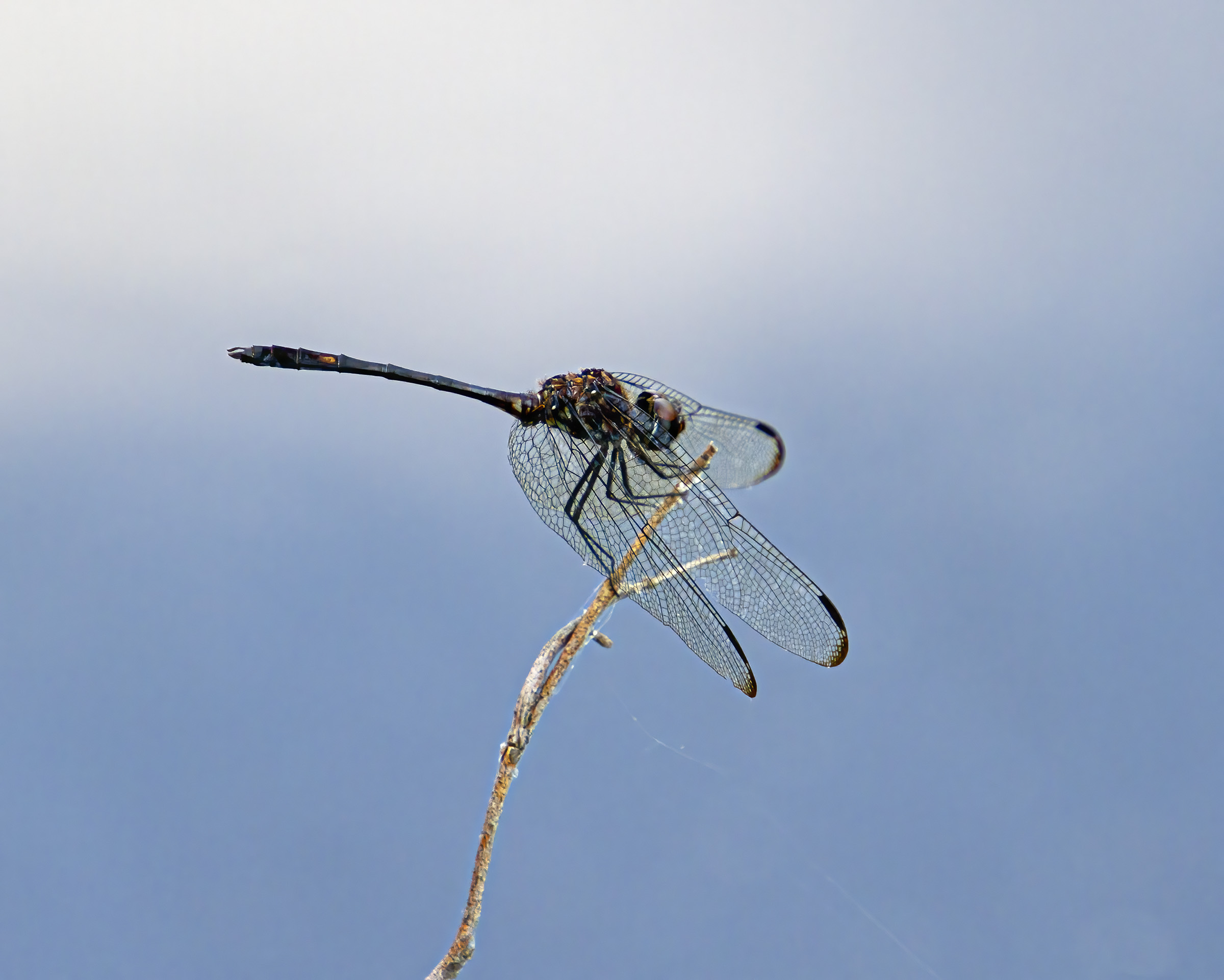
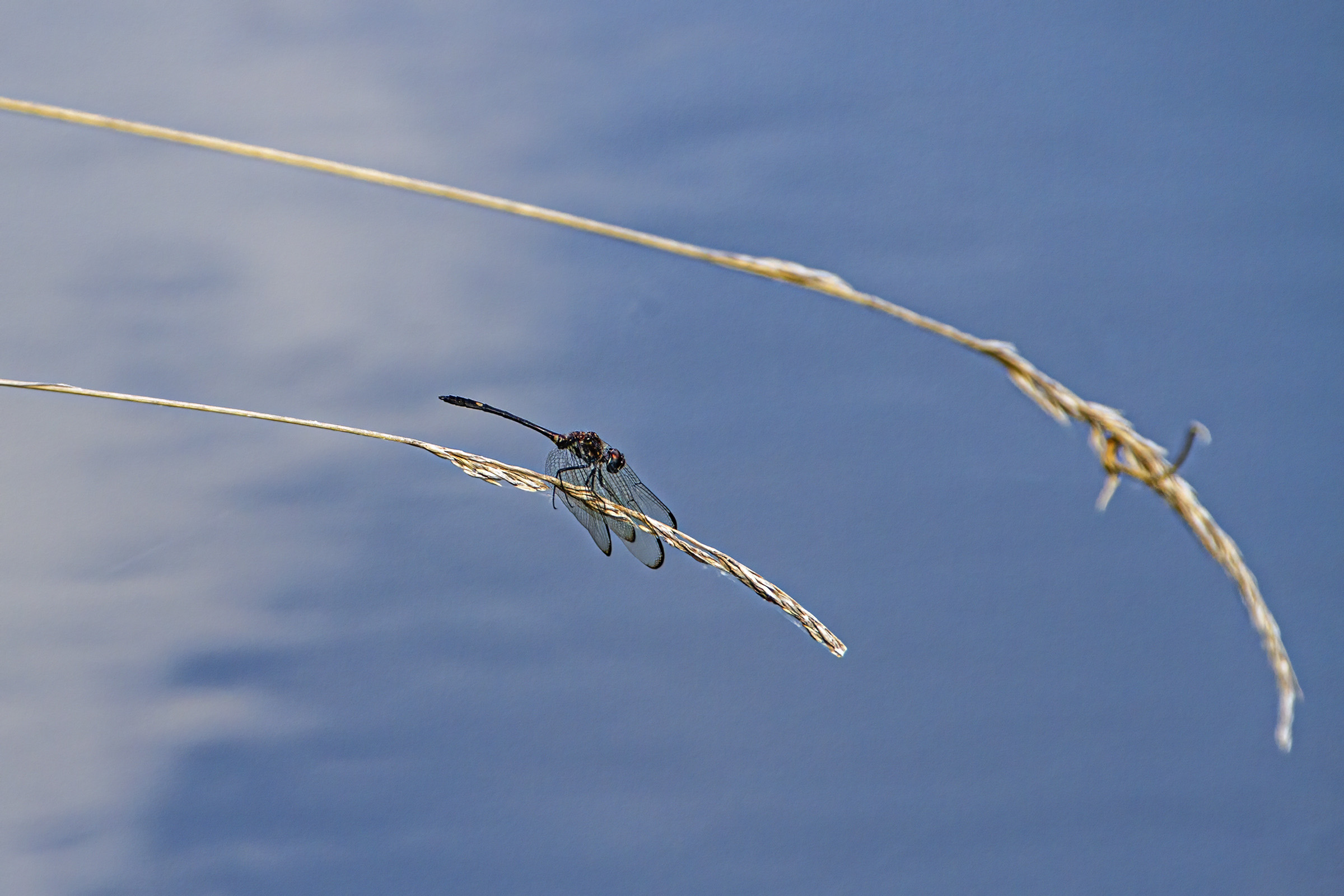
All of these thoughts were percolating in my brain on Wednesday when I visited Jackson Miles Abbott Wetland Refuge to see which dragonflies were still present. I was particularly delighted to spot several Swift Setwing dragonflies (Dythemis velox). In June 2016 at this same refuge, I first photographed a Swift Setwing—a primarily southern species that had never before have been spotted in Fairfax County, the county where I live—and each year since I have eagerly returned to learn more about the species. For more details on my initial sighting, check out my 2016  blog posting Swift Setwing dragonfly.

It is always tough to frame shots of Swift Setwings, because they like to perch on vegetation that overhangs the water and they face the water. The sun was shining brightly and I was happy to capture a couple of images in which the dragonfly appears to be perching among the clouds. I did try to get down low, but I think the background is a reflection of the sky in the water of the pond and not the sky itself.

For the second image, I was far away from the dragonfly. I couldn’t get a clear shot of the Swift Setwing, so I chose to use some vegetation blocking my view as a framing element in the foreground. I like the way that the image turned out.

Swift Setwing

Swift Setwing

© Michael Q. Powell. All rights reserved.

Read Full Post »

I love the abstract feel of this image that I captured last week at Occoquan Regional Park. The shapes and colors in the photo are much more important than the details of the subject, which I think is a Needham’s Skimmer dragonfly (Libellula needhami). From this angle, dragonflies often remind me of the biplanes of World War One, like the Sopwith Camel that was sometimes featured in Snoopy comic strips.

Photography allows for such a wide range of approaches to express myself creatively. I can be geeky and technical, as I usually am, striving to capture the minute details of my often tiny subjects or I can be as “artsy” as I choose, focusing on capturing and creating moods or feelings with the basic elements of light and darkness, of colors, lines, and shapes.

Professional photographer’s are sometimes advised to create a signature style and to stick with it. I am proudly an amateur, who captures images for love—the root word in “amateur”—and I defiantly refuse to stick to a single style. My photos and words help you to see the world through my eyes and hopefully my unbounded curiosity and enthusiasm about the world are evident in my postings. If you meet me in person, you’ll see that the “me” in my postings is not a social media persona—it is genuinely who I am.

Needham's Skimmer

© Michael Q. Powell. All rights reserved.

Read Full Post »

I love the distinctive wing markings on male Widow Skimmer dragonflies, one of only a few dragonfly species that I have encountered with both light and dark patches on their wings. I spotted this handsome male Widow Skimmer last week during a brief visit to Occoquan Regional Park in Lorton, Virginia.

One of the cool things about this dragonfly is that it looks almost like a butterfly when it is flying. With most dragonflies, the transparent wings seem to almost disappear when they are flying, but with the male Widow Skimmer, the wings are much more visible when the dragonfly is in motion.

Widow Skimmer

© Michael Q. Powell. All rights reserved.

Read Full Post »

I was excited to spot my first Monarch Butterfly (Danaus plexippus) of the season last Friday at Occoquan Regional Park in Lorton, Virginia. The milkweed was barely in bloom, but the Monarch nonetheless seemed to be really enjoying it.

I love the beauty of the Monarch, of course, but I am also very conscious of the fact that this species is considered to be endangered, threatened by the loss of habitat and by climate change. Some years I have not seen any Monarchs at all, so each sighting is special to me, reassuring me that Monarchs are continuing to survive.

As you can see, I attempted to get shots of the Monarch, the only one that I saw that day, from varying distances. When I first spotted the Monarch, I took several long distance shots like the third one below that show some of the habitat. Then I slowly moved forward, attempting to use the milkweed in my compositions.

It was a bit of a challenge to get good shots, because the butterfly was in almost constant motion, moving all around the little clumps of milkweed and changing its wing and body positions. I had to work quickly too, fully aware that the butterfly could fly off at any moment.

Monarch butterfly

Monarch butterfly

Monarch butterfly

© Michael Q. Powell. All rights reserved.


Read Full Post »

I was delighted to spot this Common Wood Nymph butterfly (Cercyonis pegala) this past Wednesday at the edge of the hike-bike trail on the back side of Huntley Meadows Park, a county-run marshland park in Alexandria, Virginia. I love the distinctive yellow patch on its wing and its really cool eyes with vertical stripes. Common Wood Nymphs usually like to hang around near the edges of the woods rather than in the fields that many butterflies seem to prefer.

Generally I like to get the plane of the sensor of my camera sensor as close to parallel as possible with my subject, so that the entire subject is in focus. In this case, though, a large mass of thorny vines kept me from being able to get my desired shooting angle and consequently the focus on the left-hand side of the subject is a little soft. That being said, I am nonetheless pretty happy with this shot of a cool-looking butterfly that I don’t see very often.

Common Wood Nymph

© Michael Q. Powell. All rights reserved.


Read Full Post »

I was thrilled on Wednesday to photograph my first Common Sanddragon dragonfly (Progomphus obscurus) of the year as he was enjoying a sandy beach near Wickford Park in Alexandria, Virginia. Unlike most dragonflies that prefer to perch on vegetation, Common Sanddragons are usually found perched flat on the sunny, sandy sections of shallow creeks.

According to the Dragonflies of Northern Virginia website, “Despite its name, this species is rare in Northern VA. In other parts of the country, where clean, sunny, shallow creeks with plenty of sandy/gravely banks are common, so too are Common Sanddragons. Our urban waterways are too influenced by stormwater, flowing fast and unchecked off impervious surfaces (roads, parking lots, roofs, etc.). This creates deeply incised, eroded banks and streambeds, with excess silt, unstable flows.”

This species is special to me because I was the first person to document its presence at Huntley Meadows Park, a county-run marshland park where I used to do a lot of my photography before it became overcrowded with photographers. Check out my June 2014 blog posting New dragonfly species in the park for the details of how I stumbled upon this “new” species.

Common Sanddragons are also special to me because in June 2016 I was lucky enough to observe and document the thirty minute metamorphosis of a water-dwelling nymph into a Common Sanddragon dragonfly. I had been collecting some discarded exoskeletons of already emerged dragonflies on a sandy bank of a stream when suddenly I felt one moving in my hand. I quickly placed it on the sand and was able to photograph the dragonfly as it was emerging. It was a remarkable encounter and I encourage you to check out my blog posting Metamorphosis of a dragonfly.

Nothing quite that exciting happened during my most recent encounter. I was able to capture some images of the dragonfly on various parts of the “beach” where I initially spotted him. He was pretty skittish and flew away multiple times, but kept returning to the same general are of the creek, sometimes choosing the sandy areas and sometimes opting for the more rocky spots. I particularly like the first photo that has a mixture of rocks and sand and has some green algae that matches the stunning eyes of this Common Sanddragon.


Common Sanddragon

Common Sanddragon

Common Sanddragon

© Michael Q. Powell. All rights reserved.

Read Full Post »

On Monday I was thrilled to spot this Prince Baskettail dragonfly (Epitheca cynosura) flying patrols over the small pond at Jackson Miles Abbott Wetland Refuge. Previously I had spotted Common Baskettails doing the same thing at this location—see my recent posting Common Baskettails in flight—but they seem to have been supplanted by the Prince Baskettails. How do you tell them apart? Although they are both part of the Emerald family, only Prince Baskettails have patterned wings, as you can see in these photos.

I really like the description of this species on the Dragonflies of Northern Virginia website:

“This sleek, elegant dragonfly could in fact be called King Baskettail, as it is the largest member of the Emerald family. There are seven families of dragonflies in the US–Emeralds are known for their glowing green eyes (hence the family name), and their endless, acrobatic flight. Like other members of this family, Prince Baskettails rarely land and can spend many hours in ceaseless flight. Look for this powerful flier making long, repeated, low patrols over open water habitats such as lakes, ponds, canals, and sluggish river sections.”

As a result of the repeated patrols, I was able to track the dragonfly as it flew by me and capture these images. The dragonfly did not get really close to the bank on which I was standing, so my autofocus would not detect my subject and I had to resort to focusing manually. I am pretty happy with the results and I encourage you to click on the images to see the beautiful markings on the body of this Prince Baskettail dragonfly.

Prince Baskettail

Prince Baskettail

Prince Baskettail

© Michael Q. Powell. All rights reserved.

Read Full Post »

Although Blue Dashers (Pachydiplax longipennis) are among the most common dragonflies in my area during the summer, they are very special to me. I remember visiting a photography show by my dear friend Cindy Dyer in 2012, I believe, and marveling at the photos that she had taken of Blue Dasher dragonflies. I decided that I wanted to be able to take photos like hers of these beautiful creatures.

I went out on numerous occasions and she taught me a lot about both the creative and technical sides of photography. She also served as a muse to me, encouraging me and gently pushing me along my path. She had a well-established blog and decided that I needed one too, so on 7 July 2012, she sat me down I created my blog. My first blog posting on the same day was entitled Blue Dasher dragonfly and it featured a male Blue Dasher dragonfly in the obelisk position, similar to the pose of the dragonfly in the final photo in today’s post. That’s one of the main reasons why Blue Dashers are so special to me.

I spotted these Blue Dashers, all of which are males, on Monday during a brief visit to Jackson Miles Abbott Wetland Refuge. Each of the three photos represents a different approach I used in attempting to capture the”feel” of my encounters with these dragonflies. The first image shows the details of colors and patterns of the body quite well. The second image gives you a sense of their environment. The final photo focuses on the obelisk pose that is believed to be a form of thermoregulation—by raising its abdomen the dragonfly reduces its exposure to the direct sunlight on hot days.

Some days I will post only a single photo, but most often I enjoy posting a small set of photos that complement each other and provide different perspectives on the living creatures that I love to photograph. Beauty is everywhere.


Blue Dasher

Blue Dasher

Blue Dasher

© Michael Q. Powell. All rights reserved.

Read Full Post »

During a recent visit to Jackson Miles Abbott Wetland Refuge I was delighted to spot a female Eastern Amberwing dragonfly (Perithemis tenera) as she was depositing her eggs in the vegetation in a small pond. Initially she would hover for a moment, as you can see in the first image, and then dip the tip of her abdomen straight downwards to release some eggs, as shown in the second image. The dragonfly repeated this process multiple times at this spot before moving on to other spots.

I have observed this process multiple times, but have rarely been able to photograph it. Eastern Amberwings are the smallest dragonflies in my area and are only about an inch (25 mm) in length, so they are a challenge to photograph. Fortunately when the female is ovipositing, she hovers a bit, which gives me time to focus on her. Sharp-eyed viewers may have noticed that the wings of this dragonfly have patterns, but are not amber in color—only male Eastern Amberwings have amber wings.

Eastern Amberwing

Eastern Amberwing

© Michael Q. Powell. All rights reserved.


Read Full Post »

Whenever I see a dragonfly in flight when I am traipsing about with my camera, I can’t help but stop and try to get a photograph of the dragonfly in the air. My success rate in not high, but sometimes I am able to capture a good image as the dragonfly zooms by me.

In mid-June I spotted a Common Baskettail dragonfly (Epitheca cynosura) as it flew back and forth over the pond at Jackson Miles Wetland Refuge. During one of its passes I managed to freeze its motion in this shot. I like the way that you can see all four wings and also the distinctive markings on its body. The bluish-green eyes really “pop” and if you look really closely, you can see the that the dragonfly folds its legs under its thorax (the torso part of its body) while it is flying.

I returned yesterday from my five-day trip up to Massachusetts and Maine to deal with a family emergency. Hopefully I will be able to get out this week and capture some new images. It’s hard to believe that it is already July.

Common Baskettail

© Michael Q. Powell. All rights reserved.

Read Full Post »

I just wanted to alert readers who may be used to me publishing a blog posting almost every day that I will be absent from this space for the rest of this week. A family emergency requires me to travel to Massachusetts and Maine and I will not have access to the internet for most of this time.

I decided though to leave you with a shot of a dragonfly facing away. While I was exploring Occoquan Regional Park earlier this month, I managed to get only a single angled view of this dragonfly before it flew away, but it was enough to confirm that it was my first Carolina Saddlebags dragonfly (Tramea carolina) of the season. Despite the odd angle, I was able to capture the patches on the hind wings that are thought to resemble “saddlebags” and its distinctive red color, so identification was not a problem.

I really like the colors and patterns of this shot, which has more of an “artsy” feel rather than a “scientific” one. Normally eye contact is desirable with a subject, but I look at that “rule” as more of a suggestion than a requirement.

Carolina Saddlebags

© Michael Q. Powell. All rights reserved.


Read Full Post »

Most of the times I am outdoors when I am photographing butterflies, but occasionally I have the opportunity to visit indoor butterfly gardens. One of the cool thing about these facilities is that they often contain tropical species that are not present in my local area.

Early in June I visited Lewis Ginter Botanical Garden in Richmond, Virginia and spent some time in the butterfly garden in an enclosed area of the large glass conservatory. Shooting in this environment challenges my composition skills and photography techniques as I try to hold my camera steady, focus on these moving subjects, and avoid including people and man-made objects in the backgrounds of the images.

Here are a few of my favorites from my time with these butterflies, several of which perched on me while I was exploring their environment. There is a double-door system that is sort of like an air lock to try to prevent the butterflies from escaping when people enter and exit. The staff folks also carefully check you when you are leaving to ensure that no butterflies are hitching a ride on you.

butterfly

butterfly

butterfly

butterfly

© Michael Q. Powell. All rights reserved.

Read Full Post »

Each time that I visit Lewis Ginter Botanical Garden in Richmond, Virginia, I spend some time in the glassed-in conservatory. At certain times of the year there is an indoor butterfly garden and there are always exotic orchids to see. Getting photos of the orchids is a challenge, because the light is limited, the shooting angles are constrained, and the room is hot and humid.

Here are a few of my attempts to capture the beauty of some of the orchids during a visit earlier in June. As you can see, I tried to vary my approach, sometimes going in close to focus on a single flower and sometimes pulling back to capture a cluster of them. I mostly avoided cluttered backgrounds—a large pot is visible in the final photo, but it is not very distracting

orchid

Orchid

Orchid

© Michael Q. Powell. All rights reserved.

Read Full Post »

I was struck by the beauty of the Japanese Water Irises (Iris ensata) that I observed during a visit in early June to Lewis Ginter Botanical Garden with fellow photographer Cindy Dyer. Most of the irises, however, were either in the bright sunlight or in the deep shadows. I was delighted when I spotted one flower that was partially illuminated by the sun in a way that made it pop out of the shadows.

I tried to capture the effects of this beautiful lighting by moving in close and focusing on the petals (photo 1)  and by moving back and including more of the stem of the flower (photo 2). I was using my 180mm macro lens, so when I talk about “moving,” I was moving my feet and not merely adjusting a zoom lens. Initially I was most taken by the first image, but the second image is growing on me more and more—I think I like them equally now. Do you have a favorite of the two shots?

Japanese Water Iris

Japanese Water Iris

© Michael Q. Powell. All rights reserved.

Read Full Post »

Dragonflies and damselflies have rather limited lifespans after they emerge from the water and are transformed from aquatic nymphs into aerial acrobats. One of their biological imperatives is to perpetuate their species, so it is not unusual to see mating activity during this time of the year that is primetime for dragonflies and damselflies.

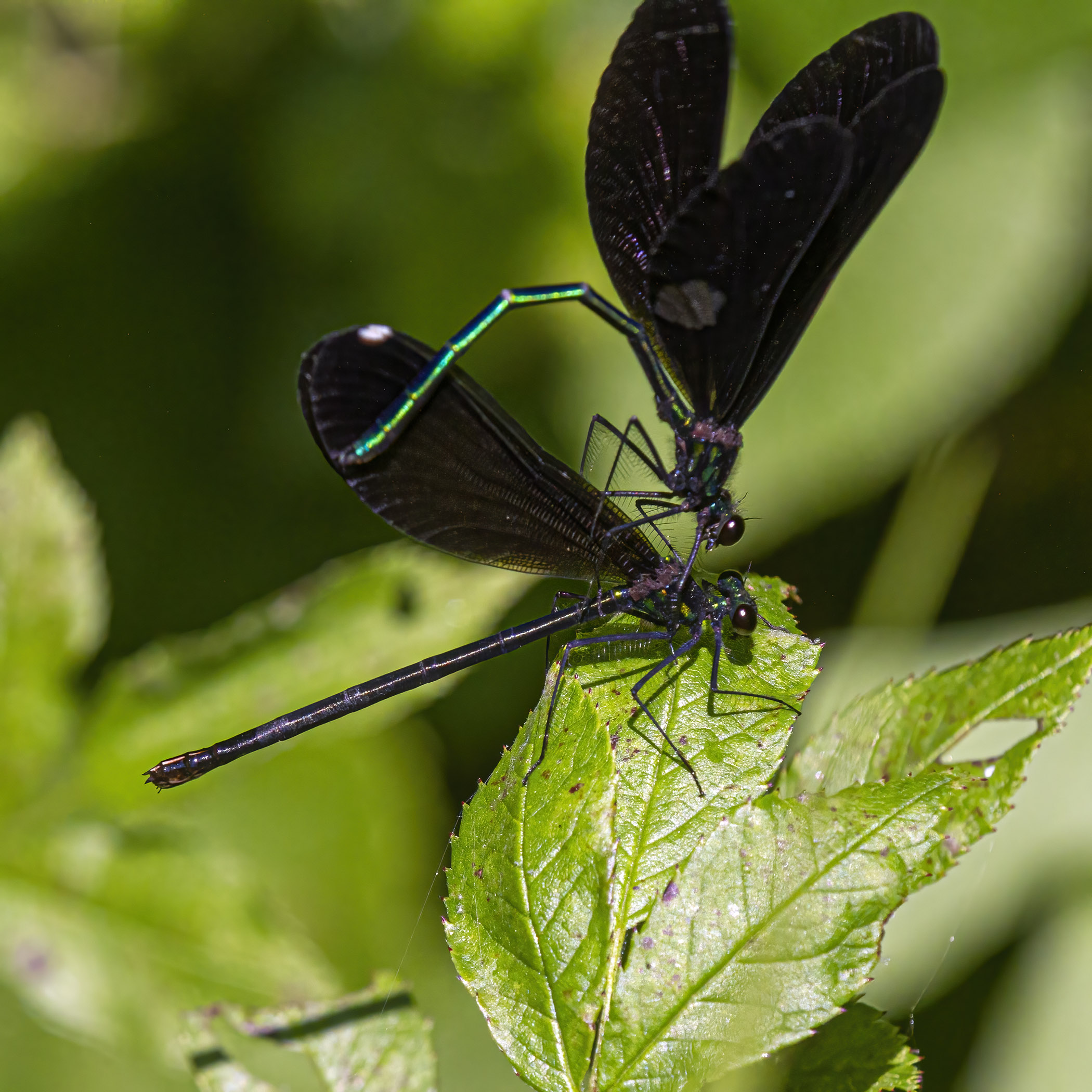
On a trip earlier this month to Occoquan Regional Park, I spotted this pair of Ebony Jewelwing damselflies (Calopteryx maculata) in their distinctive sidewards-heart mating position. I am really happy with this image because I was able to use my shooting angle and camera settings to keep the bodies of both damselflies in focus and achieve a blurry background that allows a viewer to focus on the damselflies without any visual distractions.

In case you are curious, the damselfly to the left is the female and the one with the shiny green body is the male. You can tell the genders from the mating position and from the little white patch on the wings that is present on female Ebony Jewelwings and not on the completely dark wings of the males


Ebony Jewelwing

© Michael Q. Powell. All rights reserved.

Read Full Post »

As I was seated in my car at a stoplight, I glanced across the intersection at the traffic in the oncoming lanes and was delighted to spot a giant dragonfly on the side of a U-Haul truck. I grabbed my camera off of the passenger seat where it was seated and managed to take this photo before the lights changed.

In case you are viewing this and cannot read the words on the graphic, it say “#105 Venture Across Canada, British Columbia, A Secret Urban Wilderness/Un Coin Sauvage Et Secret En Ville, Burn Bog.” According to its website, Burns Bog is “a raised bog ecosystem covering approximately 3,000 hectares of the Fraser River delta between the south arm of the Fraser River and Boundary Bay” in the greater Vancouver area of British Columbia. The site claims that the bog is the largest undeveloped urban landmass in North America at 8,000 acres.

I think that my eyes are so finely tuned to recognizing the shape of a dragonfly that I manage to spot them in the most unlikely places, like on the side of a U-Haul truck.

U-Haul dragonfly

© Michael Q. Powell. All rights reserved.

Read Full Post »

This handsome Common Green Darner dragonfly (Anax junius) does not have all of the colors of the rainbow, but it does have many of them and I love its mix of vibrant colors. The dragonfly was perched vertically really low in the vegetation when I spotted it during a recent to Occoquan Regional Park. I ended up sprawled almost flat on the ground to get this shot—my position would have made for an amusing photo, but fortunately no one else was around to capture that moment.

Mature male Common Green Darners have bright blue abdomens. The reddish pink color of this dragonfly’s abdomen suggest to me that it is an immature male. Early and late in the season, the abdomens of male Common Green Darners may appear purple. Common Green Darners have dark-colored platelets in their blood that rise to the surface when it is cold, darkening their abdomen color and attracting more sun. On bright, hot days, those dark platelets sink, and the abdomen turns bright blue again, now reflecting light.

Common Green Darner

© Michael Q. Powell. All rights reserved.

Read Full Post »

Last week I managed to capture a series of images of a hook-up between two Ebony Jewelwing damselflies (Calopteryx maculata). Initially I was focused on a female that was perched on a leaf, but then noticed a male who was circling around her. According to Wikipedia, “Calopteryx males will hover in front of a female with alternating fast and slow wingbeats; if she is receptive she will remain perched, otherwise she will fly off.” This female remained in place, so the male moved in, as you can see in the first three photos.

During mating, the male uses claspers at the tip of his abdomen to grasp the female behind her head tightly enough to resist the attempts by other males to dislodge him, a position sometimes called “tandem.” The male then flexes his abdomen to encourage the female to loop her abdomen round to interlock with him, forming the “wheel’ position,” the sidewards-heart position shown in the final photo.

I suppose that I could leave the description here, but the process that was taking place was so weird and fascinating that I thought I should explain what is going on. In order to keep from getting too graphic, I will borrow some language from Wikipedia.

“Mating in damselflies, as in dragonflies, is a complex, precisely choreographed process involving both indirect insemination and delayed fertilization….When he (the male) is ready to mate, he transfers a packet of sperm from his primary genital opening on segment 9, near the end of his abdomen, to his secondary genitalia on segments 2–3, near the base of his abdomen. The male then grasps the female by the head with the claspers at the end of his abdomen; the structure of the claspers varies between species, and may help to prevent interspecific mating… The female then curls her abdomen downwards and forwards under her body to pick up the sperm from the male’s secondary genitalia, while the male uses his “tail” claspers to grip the female behind the head: this distinctive posture is called the “heart” or “wheel.”

Wow! I think I will leave it at that. Suffice it to say that the process is complicated and the participants have to be incredibly flexible.

Ebony Jewelwing

Ebony Jewelwing

Ebony Jewelwing

Ebony Jewelwing

Ebony Jewelwing

Ebony Jewelwing

© Michael Q. Powell. All rights reserved.

Read Full Post »

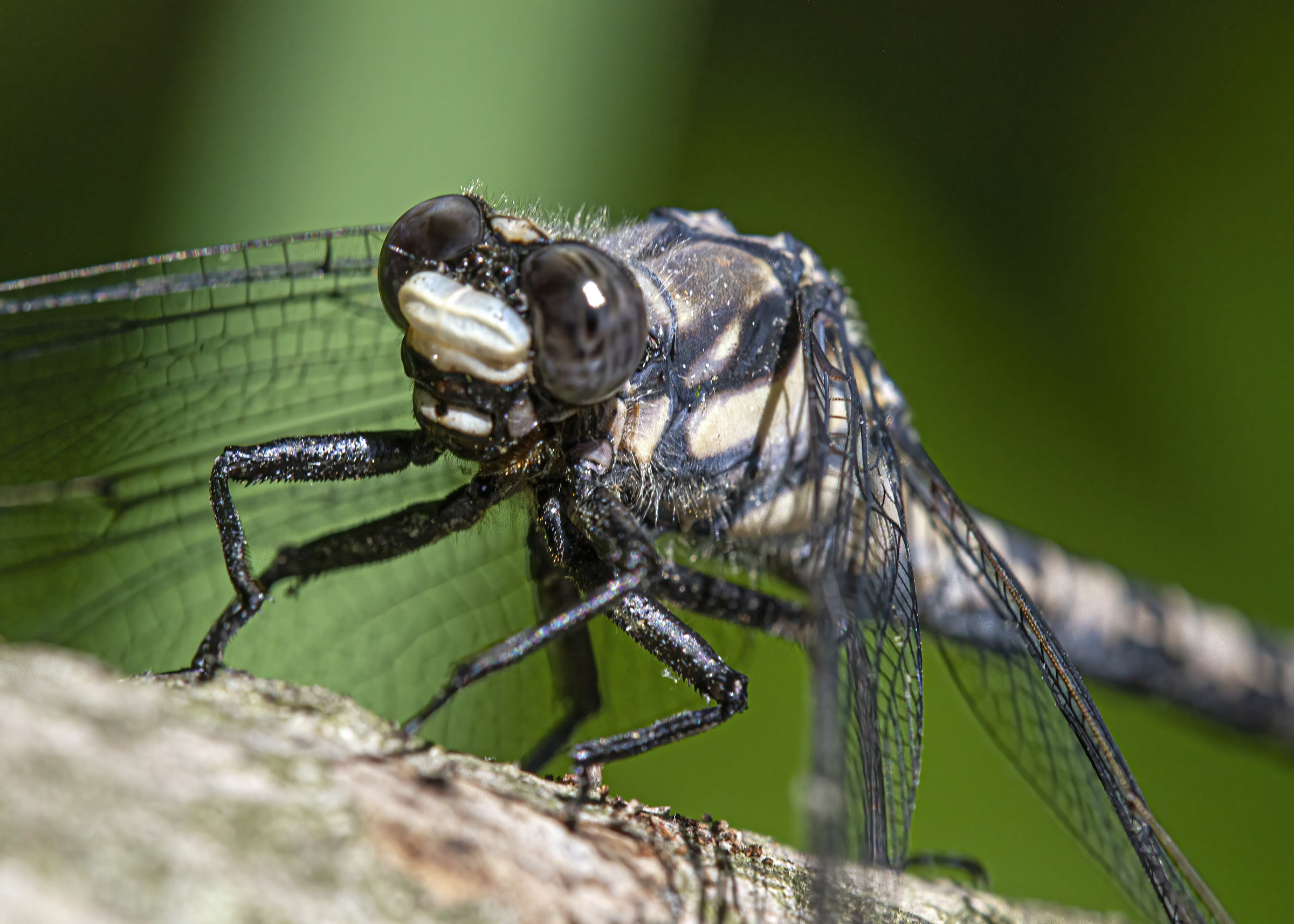
This Gray Petaltail dragonfly (Tachopteryx thoreyi) was quite cooperative and let me take a close-up portrait last week as I was exploring a small pond in Fairfax County, Virginia. Gray Petaltails are known to be quite friendly and inquisitive and I have had one perch on me on multiple occasions. During one such encounter in 2019, fellow dragonfly enthusiast Walter Sanford snapped a couple of photos of one perched on me when I was wearing a gray sweatshirt that must have made me look like a tree to the dragonfly. If you want to see the photos, check out Walter’s blog post entitled “You look like a tree to me.

Most of the time I am not able to approach a dragonfly from this angle to get a close-up shot. Dragonflies have incredible vision and I am certain that this one could see me coming. However, he apparently did not see me as a threat and stayed in place while I took several shots. As you can see, the depth of field was incredibly shallow for this shot—only a small portion of the dragonfly’s body was in focus—but I was able to keep the striking gray eyes in focus and capture a lot of details that highlight their beauty.

Gray Petaltail

© Michael Q. Powell. All rights reserved.

Read Full Post »

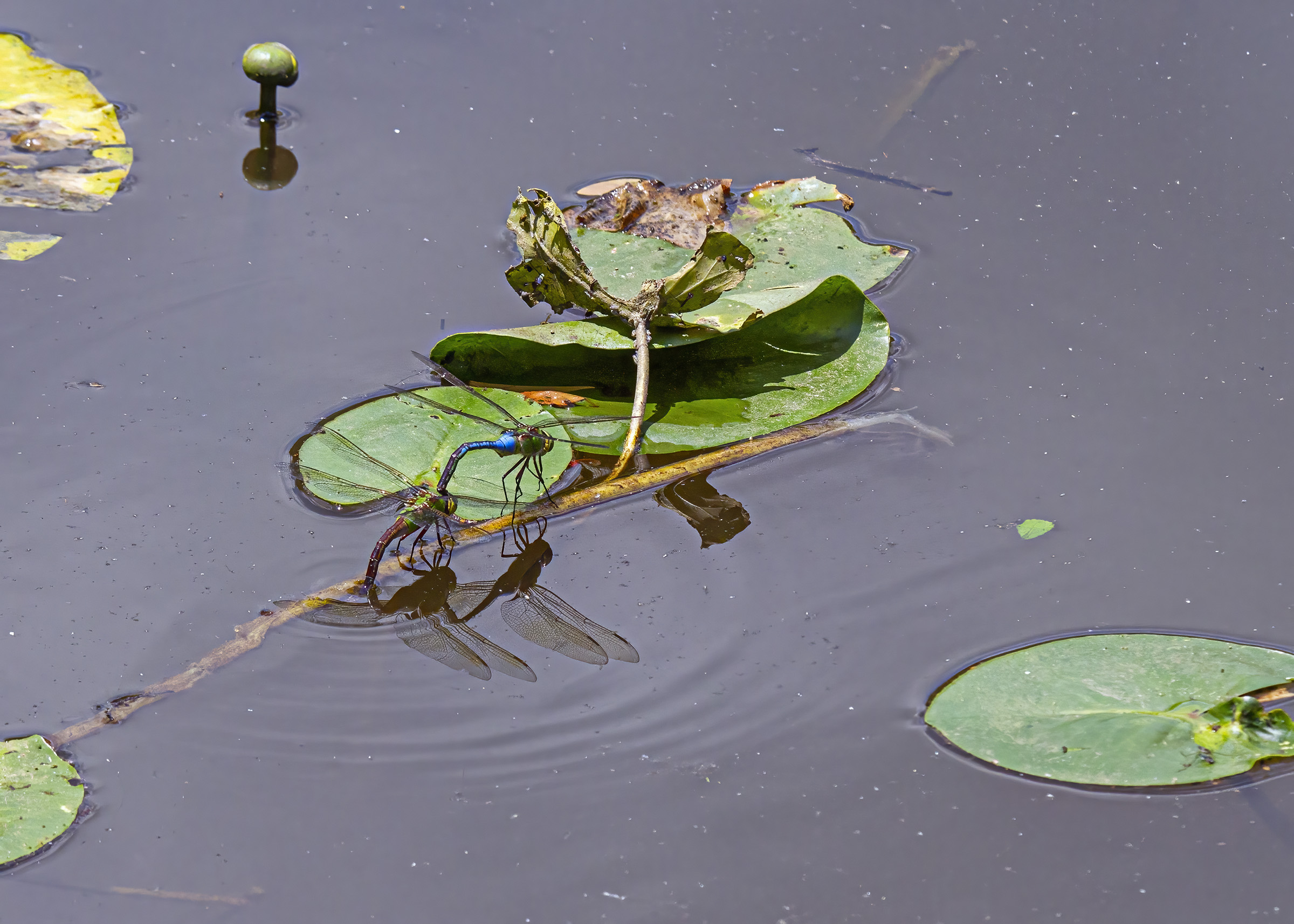
I spotted a female Common Green Darner dragonfly (Anax junius) as she was ovipositing while her male partner held onto her last Saturday at the edge of the small pond at Jackson Miles Abbott Wetland Refuge. Common Green Darners are large dragonflies—about 3 inches (76 mm) in length—so it was relatively easy to track the pair as they moved about placing eggs in various patches of vegetation in the water.

After mating takes place, the males of some species of dragonflies disappear.  In other species, the male stays nearby, guarding the female and fending off other males that might remove the initial suitor’s sperm and replace it with their own.  Some species, like this Common Green Darner, remain attached to the female in a position known as “tandem.” while egg-laying takes place.  The female Common Green Darner submerges her abdomen and lays her eggs in or on the aquatic vegetation, as you can see in these images. If you look really closely at the first image, you can see what I believe is the dragonfly’s curved ovipositor that she uses to make a little slit into the vegetation in which to place the eggs.

According to an article on Animal Diversity Web, there are two different lifecycles for Common Green Darners, one for the dragonflies that have migrated northward and one for the resident population. “Migratory adults mate and oviposit in June. Unlike resident populations, nymphal development for migrant offspring takes only 3 to 5 months, and they do not overwinter. They emerge as tenerals typically around late-August and September. They often begin their migration as tenerals, feeding along the way and developing into adults.” The timing of the activity that I observed suggests that these could be migrant Common Green Darners.

“For residents in the north, the adults mate and oviposit in late July to August. The resulting offspring hatch and develop to mid-instars and then overwinter when temperatures drop. Total nymphal development time can take 11 to 12 months for residents, as the nymphs finish development when temperatures warm in the spring and then emerge as adults in the following June and July.”

I highly recommend the article that I referenced, which has lots more fascinating information about this colorful dragonfly species.

Common Green Darner

Common Green Darner

Common Green Darner

Common Green Darner

© Michael Q. Powell. All rights reserved


Read Full Post »

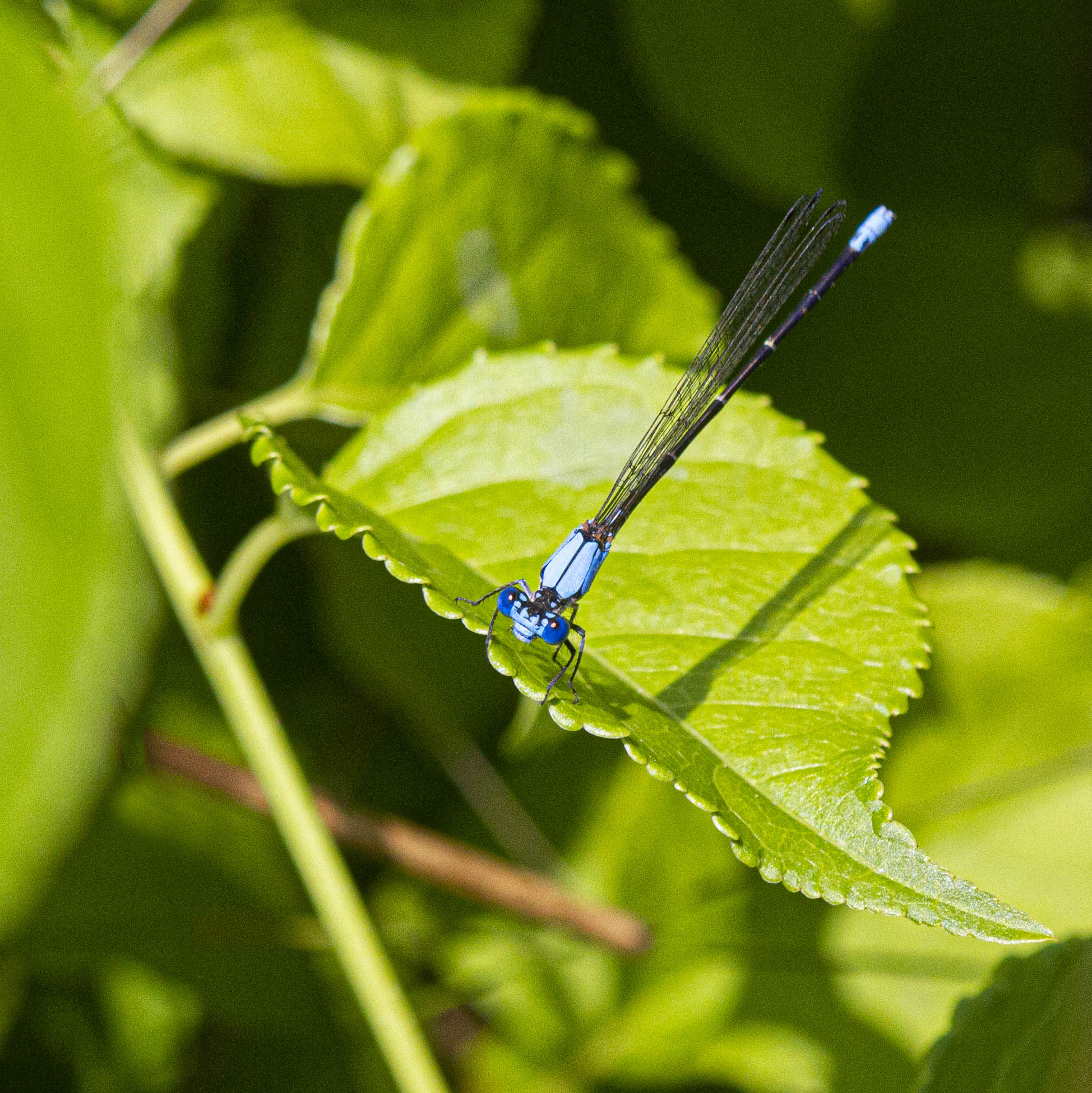
Many damselflies have distinctive shoulder stripes, but the thoraxes of Blue-fronted Dancers (Argia apicalis) are almost completely blue and have only hairline black stripes. Last Saturday I was delighted to spot some Blue-fronted Dancers at the small pond at Jackson Miles Abbott Wetland Refuge, my first sighting of this species this season. Although the blue thorax made them easy to identify, what really struck me were their brilliant blue eyes, a feature that I had never noticed before. Wow!

I was able to photograph these damselflies on various locations as I repeatedly circled the pond. Periodically I would glance out at the water, where several families of Canada Geese were swimming around with their almost grown goslings. In the final photo, you can see one of the feathers from the geese, a quirky and almost whimsical addition to my photo of the Blue-fronted Dancer—I really like that image.

Blue-fronted Dancer

Blue-fronted Dancer

Blue-fronted Dancer

© Michael Q. Powell. All rights reserved

Read Full Post »

I love the look of male Eastern Pondhawk dragonflies (Erythemis simplicicollis) when they are transitioning to adults. When they are juvenile, male Easter Pondhawks have emerald green thoraxes and black striped abdomen, like their female counterparts. Gradually the body coloration shifts to blue as they mature. I really like their appearance when, as was the case with these pondhawks that I photographed last week at Occoquan Regional Park, their bodies have beautiful shades of both green and blue.

In the second and third photos, you get a glimpse of the pondhawk’s beautiful eyes that are also a combination of blue and green. Although you can’t see it very well in these photos, Eastern Pondhawks of both genders have bright green faces, which helps to distinguish the male Eastern Pondhawks from a number of other dragonfly species that have blue bodies.

Eastern Pondhawk

Eastern Pondhawk

Eastern Pondhawk

© Michael Q. Powell. All rights reserved


Read Full Post »

I was thrilled to spot at least one male Sable Clubtail dragonfly (Stenogomphurus rogersi) last Saturday while I was exploring a small stream in Fairfax County, Virginia. I visited that section of the stream several times during the day and had multiple sightings of a Sable Clubtail, but I am not sure if there was more than one of this species or if I was seeing the same individual each time.

As you can see from these two photos, Sable Clubtails like to perch low in vegetation just above the level of the water of the stream. As a result I had to crouch really low to be able to capture these images. The lighting was brighter for the first photo and you can see many of the details of the markings on the dragonfly, but I really like the cool shadow in the second image, which has a more “artsy” feel.

Sable Clubtails are rarein our area. Fellow dragonfly enthusiast Walter Sanford did extensive research and rediscovered this species in 2018 and I have been fortunate to see a Sable Clubtail at this stream in most years since then. If you are interested in the backstory of Walter’s efforts, check out his June 2018 blog posting entitled Off-season homework pays dividends.

Sable Clubtail

Sable Clubtail

© Michael Q. Powell. All rights reserved


Read Full Post »

Many summer dragonfly species are now emerging on the scene, like this immature male Widow Skimmer dragonfly (Libellula luctuosa) that I spotted last Tuesday at Occoquan Regional Park in Lorton, Virginia.

Anecdotally, someone thought that these dragonflies appeared to be draped in mourning crepe and that is the source of the “widow” in the name of the species. The Loudon Wildlife Conservancy website states that “This dragonfly got the “widow” name because, unlike most other dragonfly species where the male stays near the female after she lays the eggs, the male in this pair leaves her after the eggs have been laid.” Either explanation is plausible, though I have seen more references to the first explanation than the second one.

I was quite fortunate that the dragonfly chose a high perch that allowed me to separate it from the rest of the background. Quite a few of the dragonflies that I have photographed recently have perched on the ground or in dense vegetation and the backgrounds in those photos have been quite cluttered.

Widow Skimmer

Widow Skimmer

© Michael Q. Powell. All rights reserved

Read Full Post »

I was a bit surprised at the way that this Eastern Ratsnake (Pantherophis alleghaniensis) had poked its head up high to peer above the vegetation on 6 June at Occoquan Regional Park. It felt like one of the snake charmers that I used to see in movies when I was growing up, although as I recall those snakes tended to be cobras. For the record, I was not playing a flute nor was I trying to hypnotize the snake.

The snake seemed to be alert and inquisitive as it scanned its surroundings. Perhaps it was looking for potential prey. As you may be able to tell, I tried to get down as low as I could to take this photo. I tried to be as stealthy as I could and he snake did not move—it was either unaware of my presence or did not view me as a threat. When I departed, it was still in the same spot with its head and “neck” elevated.

Eastern Ratsnake

© Michael Q. Powell. All rights reserved.


Read Full Post »

Usually I see Gray Petaltail dragonflies (Tachopteryx thoreyi) perched vertically on tree trunks, but this one perched horizontally on a fallen branch and stared at me after landing momentarily on my shoulder on Tuesday at Occoquan Regional Park in Lorton, Virginia.

I really like to get eye-to-eye contact with dragonflies—somehow it makes the encounter more personal and intimate. One of the consequences of shooting from this angle, though, is that much of the body of the dragonfly will be out of focus. I am ok with that and in fact it tends to pull the viewer’s eyes towards those bits that are in focus, particularly the dragonfly’s wonderful compound eyes.  Gray Petaltail

© Michael Q. Powell. All rights reserved.


Read Full Post »

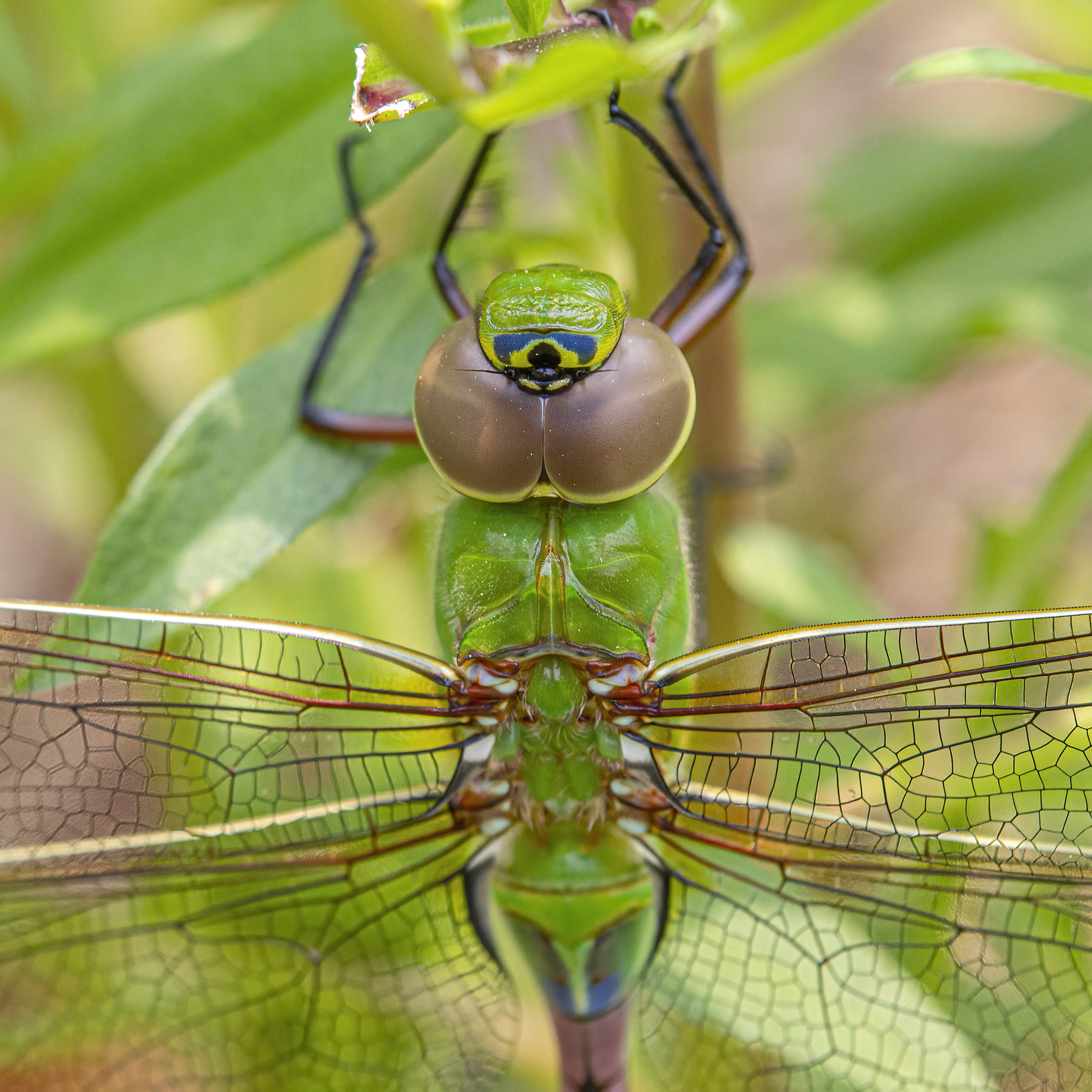
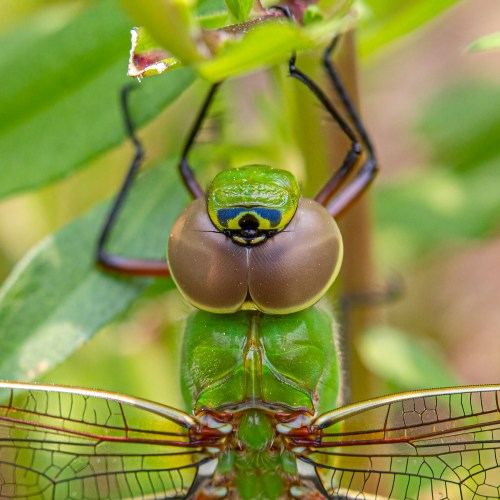
I am used to seeing Common Green Darner (Anax junius) dragonflies flying overhead, but on Tuesday I had the relatively rare chance to see one up close at Occoquan Regional Park. The Common Green Darner is a large, colorful dragonfly that is known for its long distance migratory flights. According to Wikipedia, “By attaching micro-radio transmitters to Common Green Darners, researchers have found them to be capable of migrating up to 140 kilometers in a day, though they typically cover less distance per day. ” Wow!

I spotted this dragonfly when I saw it fly to a perch in the vegetation just inches above the ground. I slowly made my way towards the vertically-perched Common Green Darner and surprisingly it did not move. I am not certain, but I had the impression that the dragonfly had newly emerged and was resting as its body parts dried out.

My 180mm macro lens gives you the impression that I was right on top of the dragonfly, but I was actually quite a bit farther away than it seems. After I took a few shots and moved away, the Common Green Darner remained in place. In fact, when I passed by the same area about twenty minutes later, it was still perched there.

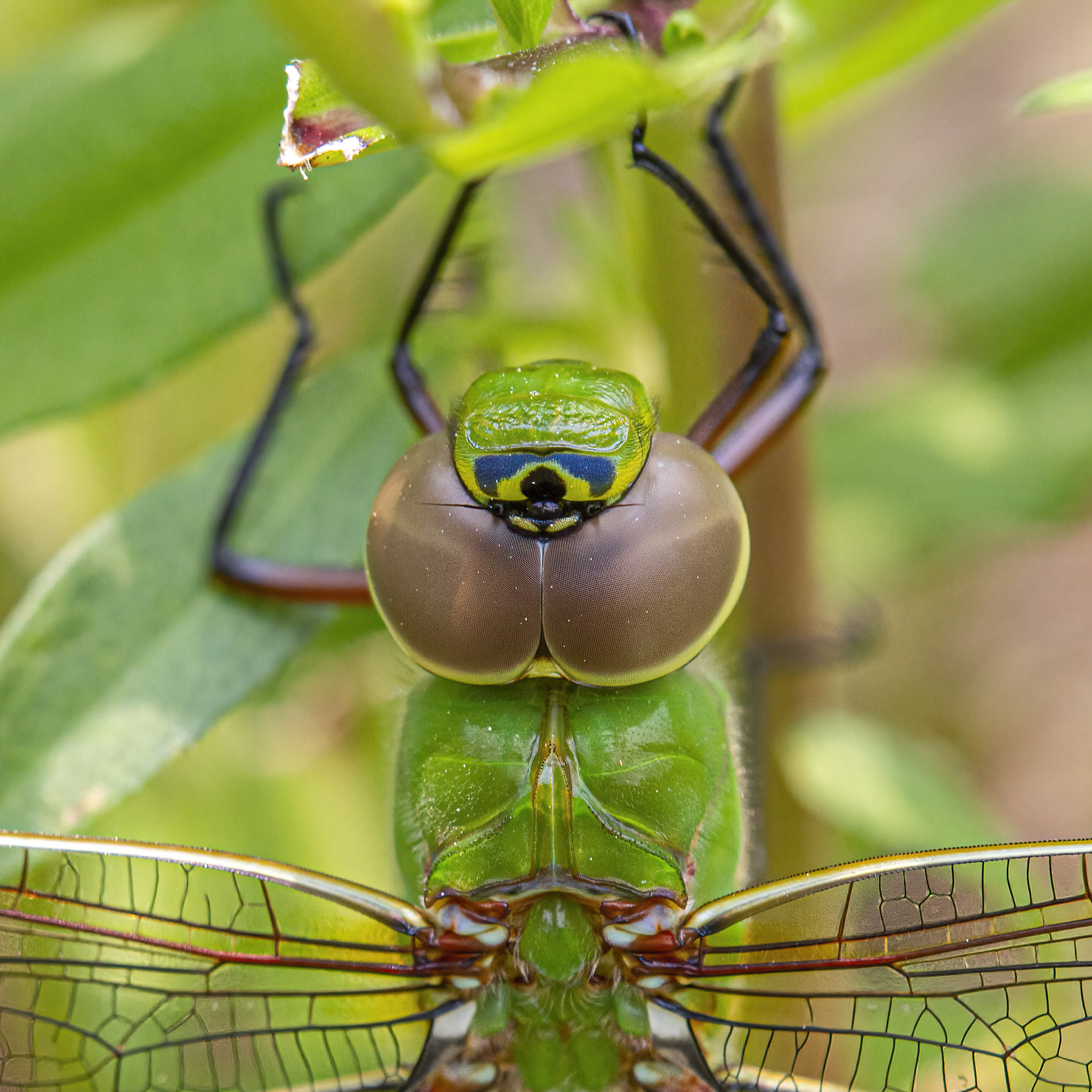
I was thrilled by the amount of detail that I was able to capture. You can easily see the distinctive “bullseye” marking, for example, on the “face” of the dragonfly. The second image is a closer crop of the first image and it helps you to see some of the ommatidia, the thousands of faceted optical units that make up the dragonfly’s amazing compound eyes. You may want to click on the image to make it larger on your screen.

According to an on-line article called Dragonfly’s Eyes, “Dragonflies have very large eyes and have very good vision. Vision dominates their behaviour, including predation and looking for mates. The compound eye is made up of ommatidia which is a visual unit consisting of a lens system and a group of light sensitive cells. A large dragonfly may have up to 30,000 ommatidia in each compound eye. Each ommatidium collects one visual information, together form a mosaic image in the dragonfly’s brain. It is believed that the insects’ compound eyes are not as high resolution as vertebrate eyes. However, the dragonfly’s visual system is extremely sensitive to movement and it points in almost all direction and gives the 360 degree visual field.”

Common Green Darner

Common Green Darner

© Michael Q. Powell. All rights reserved.

Read Full Post »

Older Posts »