Feeds:
Posts
Comments

Posts Tagged ‘Tamron 150-600mm’

Do dabbling ducks double date? It sure looked like that was the case earlier this week when I spotted a Mallard (Anas platyrhynchos) couple and a Hooded Merganser (Lophodytes cucullatus) couple swimming away from a larger group of mostly mallards for a few quiet moments together. I grew up in a family with eight siblings, so I can really understand their pursuit of peace and privacy. 

It’s almost springtime and many of the birds are searching for mates. Usually it’s the males that put on elaborate displayes, but I think the female “Hoodie” here was the one that went all out to impress her date with an elaborate hairstyle.

duck dating

© Michael Q. Powell. All rights reserved.

Read Full Post »

For a few magical moments Monday morning the sun was shining through the trees at Huntley Meadows Park with a gorgeous golden light. At first I was a little disappointed that there were no birds or animals for me to photograph, but gradually I was drawn deeper and deeper into the simple abstract beauty of the trees themselves.

The varied colors, shapes, and textures of this intimate landscape enveloped me and filled me with a kind of reverent awe and inner sense of peace. I would have liked to freeze that moment and experience it in slow motion, but all too quickly the golden light faded and reality returned.

golden1_29Feb_blog

© Michael Q. Powell. All rights reserved.

Read Full Post »

Recently, while exploring the streams in the remote back areas of Huntley Meadows Park, I have heard the unmistakable call of a Belted Kingfisher (Megaceryle alcyon) several times. Yesterday, on a warm spring-like day, I finally got a clear view of this beautiful female.

As I have mentioned before in some earlier postings, Belted Kingfishers are unusual in the bird world—the females are more colorful than the males. Females have a blue and a chestnut band across their white breasts and the males have only a blue band.

Belted Kingfisher

© Michael Q. Powell. All rights reserved.

Read Full Post »

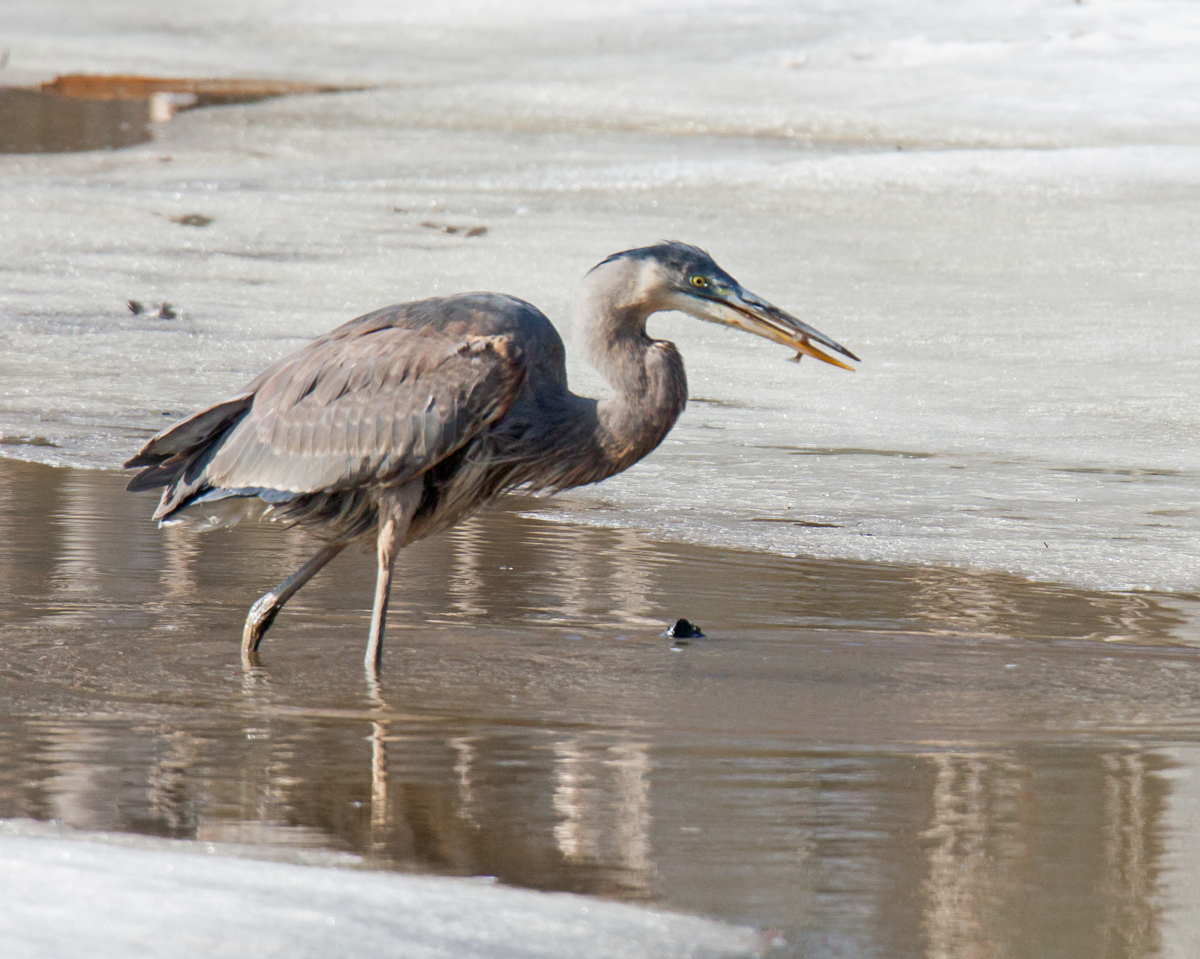
Sometimes a Great Blue Heron’s catch is big enough for a main course, but sometimes it’s only an appetizer. The good news is that appetizers are really easy for a Great Blue Heron (Ardea herodias) to swallow.

I included the second photo, which sequentially was taken before the first one, because I like the expression on the heron’s face. The heron seems to be both amused and embarrassed at the small size of the fish.

It’s obvious, though, that the heron does not have a catch-and-release policy if the fish is not of a certain minimum size.

Great Blue Heron

Great Blue Heron

© Michael Q. Powell. All rights reserved.

Read Full Post »

Like a tightrope walker, this American Robin (Turdus migratorius) inched its way along a narrow vine at Huntley Meadows Park, its eyes focused on the prize that awaited it at the other end. Periodically the robin used its wings for balance and moved forward until it reached a steady position almost within reach of the berries.

With a quick thrust forward of its head, the robin was able to snatch one of the low-hanging fruits. When I left it, the robin seemed to be enjoying its prize with a smile on its face.

American Robin

American Robin

American Robin

American Robin

© Michael Q. Powell. All rights reserved.

Read Full Post »

Although the temperature was 20 degrees (minus 7 degrees C) and the wind was blowing yesterday afternoon, I got fooled into thinking the bright sunshine would warm me up a bit. Most of the creatures at the marsh were absent from view, probably trying to keep warm in sheltered locations.

I was excited, therefore, when I head the unmistakable sound of a Pileated Woodpecker (Dryocopus pileatus) at work nearby as I was walking along a path. No other woodpeckers in our area can match the volume of a Pileated Woodpecker when it is burying its bill into a tree.

I managed to locate the woodpecker and was a little disappointed that it was high in a tree in a location where it was obscured by lots of branches. Eventually the woodpecker climbed higher in the tree and I was able to get a few relatively unobstructed shots, although I had to take them at a pretty sharp angle.

My favorite shot is the one in which the woodpecker looks like it is stalking a prey at the top of the tree. Its eyes are fixed on the target and it seems to be trying to sneak up on it. In reality, I have no idea what the woodpecker was doing, but it made for an unusual pose.

pil1_13Feb_blog

Pileated Woodpecker

Pileated Woodpecker

© Michael Q. Powell. All rights reserved.

Read Full Post »

As the early morning sunlight hit the cattails yesterday at Huntley Meadows Park, this male Red-winged Blackbird (Agelaius phoeniceus) seemed to be contemplating the start of the new day.

Red-winged Blackbird

© Michael Q. Powell. All rights reserved.

Read Full Post »

No matter how slowly and silently I move, a Bald Eagle (Haliaeetus leucocephalus) seems to sense my presence very quickly and immediately takes to the air. It’s really not that surprising, given the eagle’s amazingly keen eyesight that lets it spot prey from a long distance away.

Last weekend I spotted this Bald Eagle when it was perched atop a broken-off tree. Most of the previous times the stationary eagles that I have seen have been sitting on branches. When they took off, they seemed to push off of the branch a bit to gain some forward momentum.

In this case, the eagle appeared to initially push in an upward direction to gain a little height before flapping its powerful wings. Here are a few shots that show some of the stages of the takeoff process.


Bald Eagle

Bald Eagle

Bald Eagle

© Michael Q. Powell. All rights reserved.

Read Full Post »

Some of my favorite photos are ones with a common subject and a simple composition, like these shots I took this past weekend of a male Red-winged Blackbird (Agelaius phoeniceus) at Huntley Meadows Park. The blackbird was perched in a field of cattails and the morning light was beautiful.

Sometimes photography seems so uncomplicated—it just works.

Red-winged Blackbird

Red-winged Blackbird

© Michael Q. Powell. All rights reserved.

Read Full Post »

Do robins have tongues? I never thought much about this question until I looked at the shots I took this past weekend of American Robins (Turdus migratorius) at Huntley Meadows Park in Northern Virginia.

As a child, I was told that robins were a harbinger of spring and that may have been the case in Massachusetts. Clearly that is not the case where I live now, for an entire flock of robins was present in the park in what I would still consider the middle of winter.

Some of the robins were pecking about on the ground, but many of them were drawn to some kind of vegetation that had bluish-colored berries. I usually think of robins eating worms, so it was fascinating to watch them pick and swallow berries, acting much like Cedar Waxwings.

When reviewing my photos, I saw what appeared to be a tongue in some of my images, so I did a little research. It turns out that robins do have tongues that they use to help them swallow fruit. In fact, different birds use their tongues for a wide variety of purposes, as Laura Erickson illustrates wonderfully in a  blog posting entitled “More about Bird Tongues than a Normal Person Would Want to Know.”

In the first image below, the robin has just grabbed the berry and is starting to pull it in. In the second image, the tongue is more clearly visible and the process has moved along a bit. I hoped to get a shot of the final step in swallowing the berry, but the robin turned its head to the side at that moment.

American Robin

American Robin

Michael Q. Powell. All rights reserved.


Read Full Post »

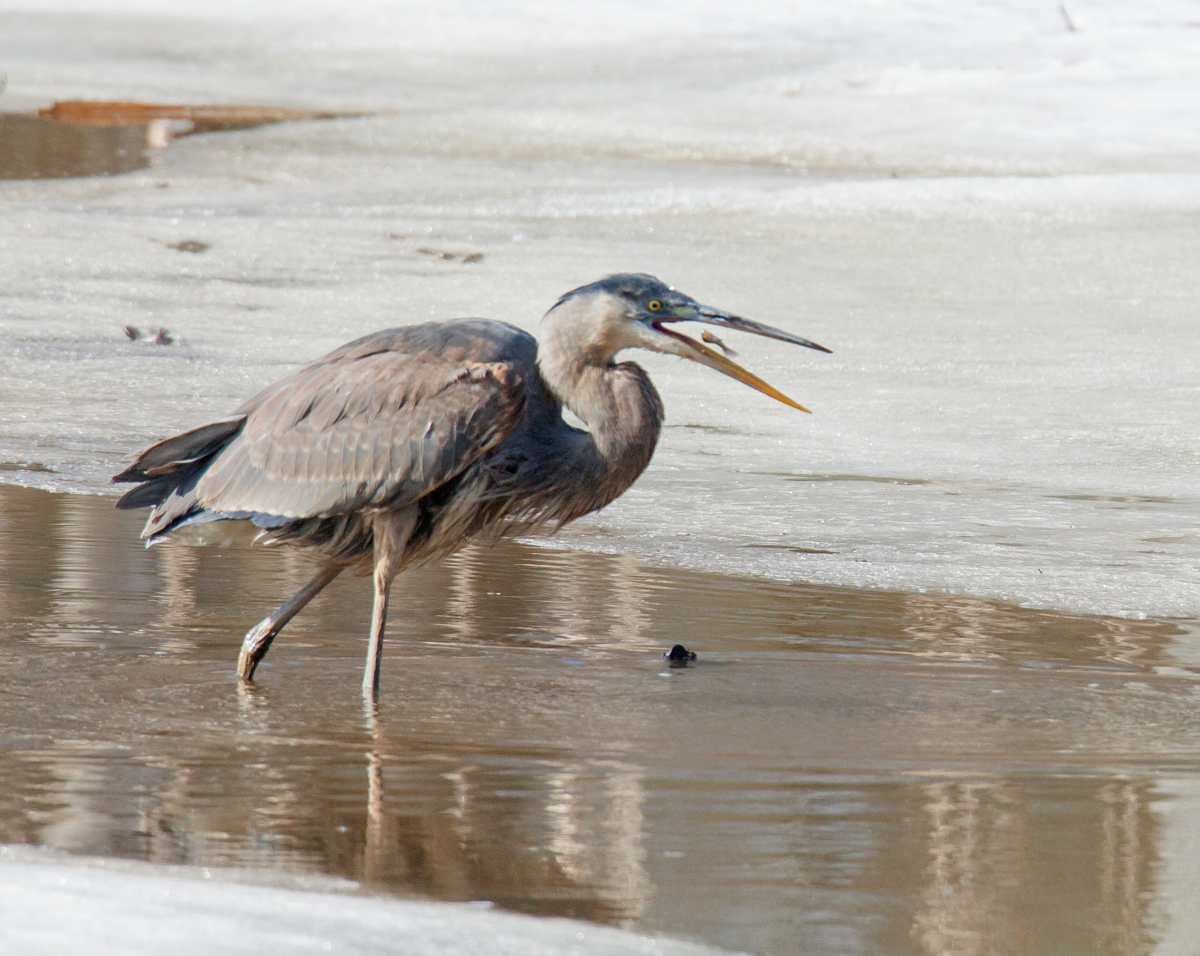
I awoke this morning thinking I would see snow on the ground again, but it seems to have turned into rain. This photo of a Great Blue Heron (Ardea herodias) and its modest catch reminds me of how snowy it was a mere two weeks ago in our area.

It’s interesting to me to see how the unusual angle of view and the low perspective make the heron’s bill seem unusually elongated and its long neck appears to be really short. The distorted perspective of the image may cause some viewers to look a second time at the photo to mentally reconfirm that this indeed is a Great Blue Heron.

I think that most photographers would agree that it is a good thing when viewers take a second look at their images or examine them more closely.

Great Blue Heron

Michael Q. Powell. All rights reserved.


Read Full Post »

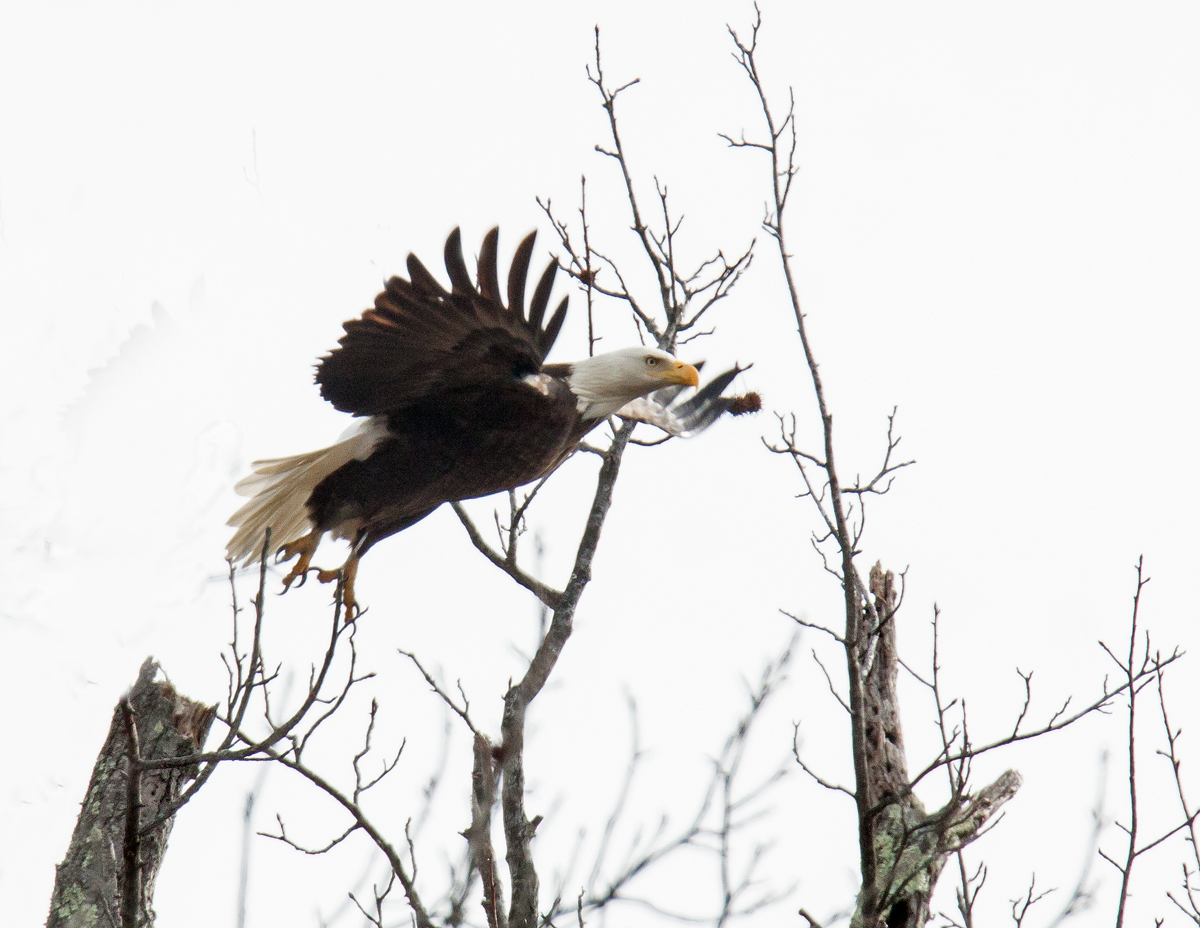
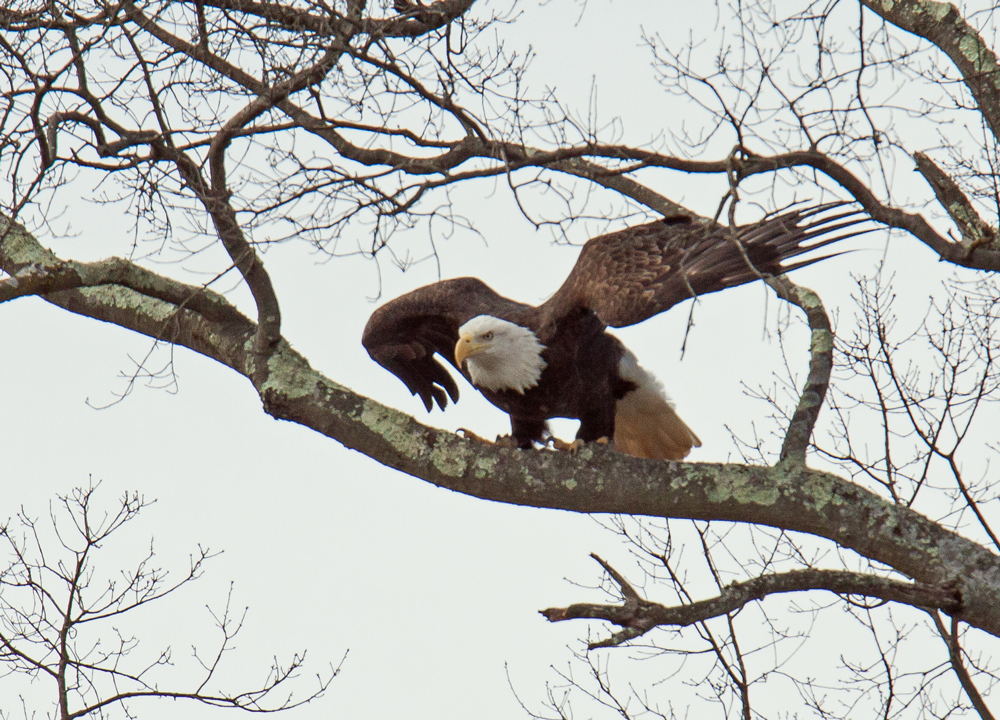
I usually miss the takeoff sequence of a Bald Eagle, because the eagle spots me before I see it, but this weekend I managed to capture a series of shots of one such takeoff.

My first indication of an eagle’s presence is often when I see it flying away. Several times this past weekend, however, I spotted a Bald Eagle (Haliaeetus leucocephalus) perched in the trees at Huntley Meadows Park and I was able to observe the eagle for at least a few minutes at a time.

In the case of these images, I was looking across a beaver pond at the eagle as it perched in the trees. In the first couple of shots, the eagle seemed to getting a little agitated and is lifting its feet and flexing its wings. Then he assumed a position that reminds me of the start of a speed skating race or a sprint, with a flexed wing ready to propel the eagle forward. Finally the eagle pushed off from the tree and descended a little with talons extended before leveling off and flying away.

Some of the time it seems an eagle just springs into motion and ignores most of the items on its pre-flight checklist as it prepares for takeoff. Other times, like this one, it follows the established procedures and waited for flight clearance from the tower.

Bald Eagle

Bald Eagle

Bald Eagle

Bald Eagle

Bald Eagle

Michael Q. Powell. All rights reserved.

Read Full Post »

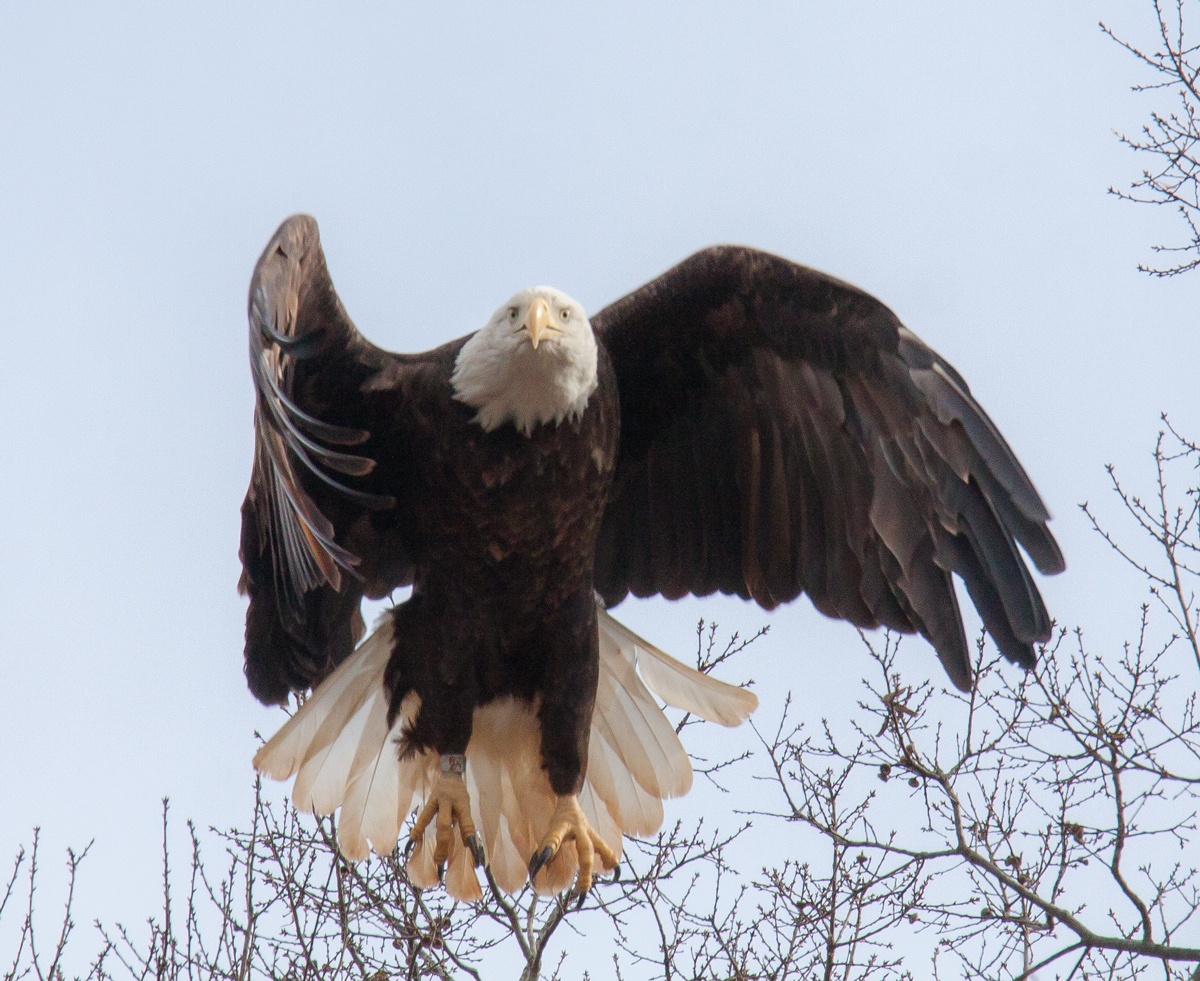
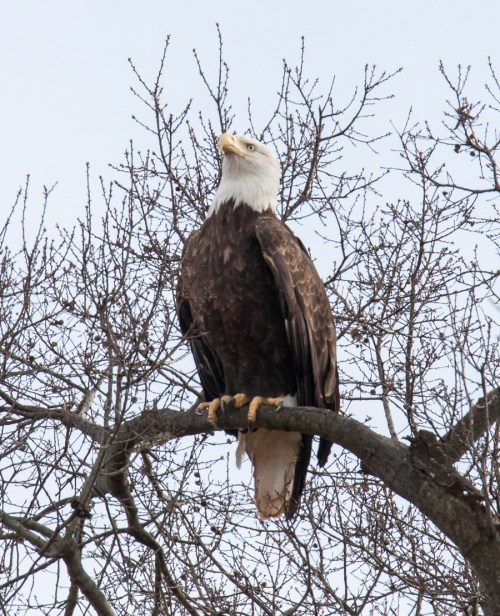
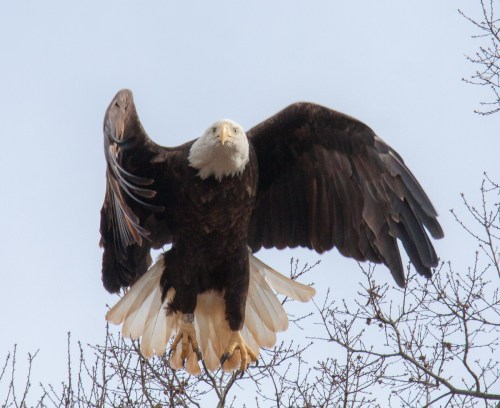
Yesterday, for the second day in a row a Bald Eagle (Haliaeetus leucocephalus) flew close to me at Huntley Meadows Park. Unlike the previous day, when the eagle simply soared by overhead, this one looked like he thought I might be a potential prey.

With the snow almost totally gone, I decided yesterday to hike out to some of the more remote regions of the park. I was following a familiar stream when I noticed a dark shape near the top of a tall tree on the opposite bank of the stream. I extended my lens to its full length and was surprised to see that it was a bald eagle.

I had time to shoot shoot only a couple of images when suddenly the eagle took off, initially heading right toward me. I kept firing as the eagle grew larger and larger in my viewfinder. I think I might have startled the eagle when I moved to bring the camera up to my eye and his instinctive reaction was to check out the movement.

Eventually the eagle veered off and flew in the opposite direction and my heart rate started to return to normal.  I don’t think that I was actually at risk, but through a 600mm lens, it sure looked like the eagle was speeding toward me with talons extended.

I couldn’t help but notice that the eagle has a band on its right foot. Whenever I capture a shot of an eagle, I will have to check to see if I can see a band. I don’t know how many eagles hang out at our park, but eagle sightings have become much more common this last year than previously.
Bald Eagle

Bald Eagle

Bald Eagle

Bald Eagle

Michael Q. Powell. All rights reserved.

Read Full Post »

Another eagle? I know that I posted some eagle photos a few days ago, but normally when I see a Bald Eagle (Haliaeetus leucocephalus), it is flying in the distance. Yesterday at Huntley Meadows Park, however, one flew almost directly over me while I was on the boardwalk.

This different perspective allowed me to get some shots that are much more detailed than usual, showing, among other things, the eagle’s tail feathers and fully-extended wings. The wingspan of this magnificent bird is amazing.

Bald Eagle

Bald Eagle

Bald EagleMichael Q. Powell. All rights reserved.

Read Full Post »

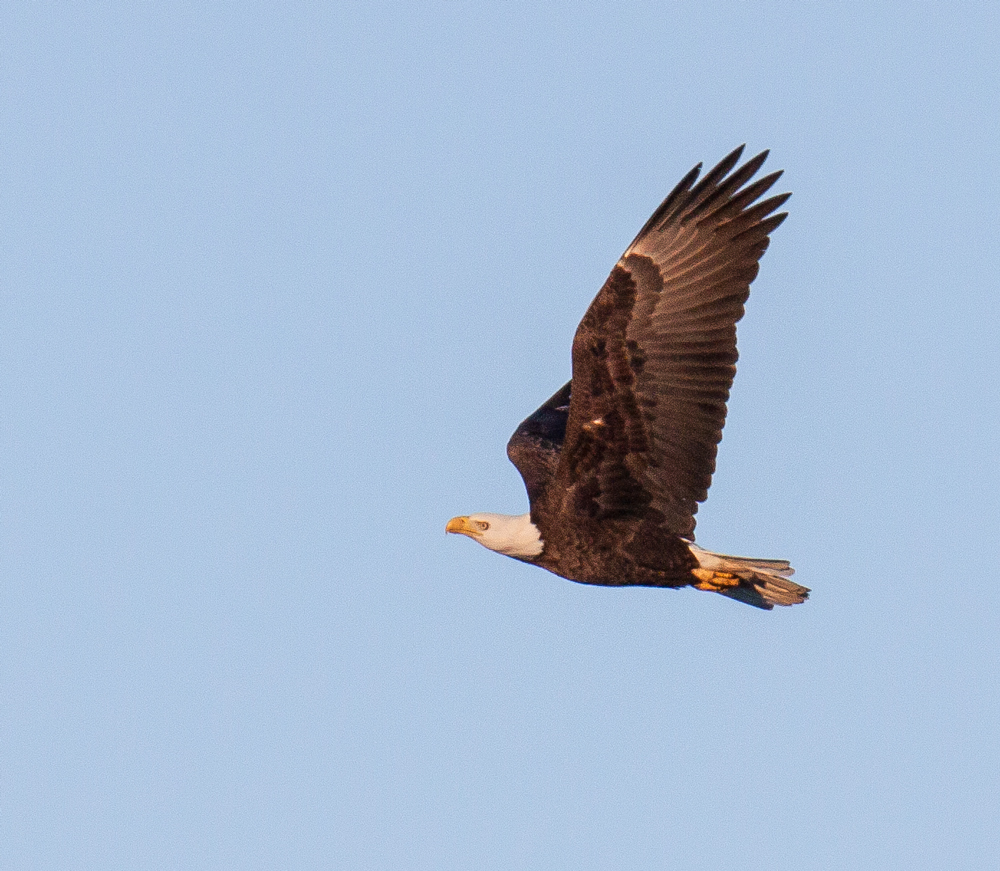
This past weekend at Huntley Meadows Park, I accidentally spooked a Bald Eagle (Haliaeetus leucocephalus) perched on a distant tree. As the eagle flew away, I was able to capture a few images that highlight some of its beautiful details.

These images were shot from a long way off and I had to do a lot of cropping. I am really happy, though, with the performance of my lens, even when zoomed out all the way, especially when the light is nice.

I continue to hold fast to the view that any day that I spot one of these majestic creatures is a wonderful day. I hope that today is wonderful for you, however you choose to define “wonderful.”

Bald Eagle

Bald Eagle

Michael Q. Powell. All rights reserved.


Read Full Post »

What lenses do you generally carry with you when you go out to shoot wildlife? This past year I have kept my Tamron 150-600mm lens on my camera the majority of the time and sometimes switch to my Tamron 180mm macro lens. The third lens that I have with me generally is a Canon 50mm lens that I use only occasionally.

While I was going to be away in Vienna, I decided to lend my long lens to a friend. We got into a conversation about the lens when I delivered it to him and I noted that one of th disadvantages of the Tamron zoom was that it is slow, with a maximum aperture of f/6.3 when extended to 600mm.

I contrasted the speed of the long lens with that of my “nifty fifty” that has a maximum aperture of f/1.8. In order to demonstrate how much more light I could get at f/1.8, I had him hold a couple of his guinea pigs and I took some portrait shots handheld in the limited available indoor light with the lens wide open. With a human subject, I would probably have been uncomfortably close, but the guinea pigs didn’t seem to mind.

Finally I took a few shots using the 180mm wide open at f/3.5. It was quite a bit harder to frame the squirming guinea pig at the greater distance, but I got a few shots that look almost like I used studio lighting.

I think my friend learned a bit more about the lenses (and I ended up lending him the 50mm lens too) and I rediscovered the joy of switching lenses and zooming with my feet.

gp1_web

gp6_blog

gp2_web

gp4_web

gp8_blog

© Michael Q. Powell. All rights reserved.


Read Full Post »
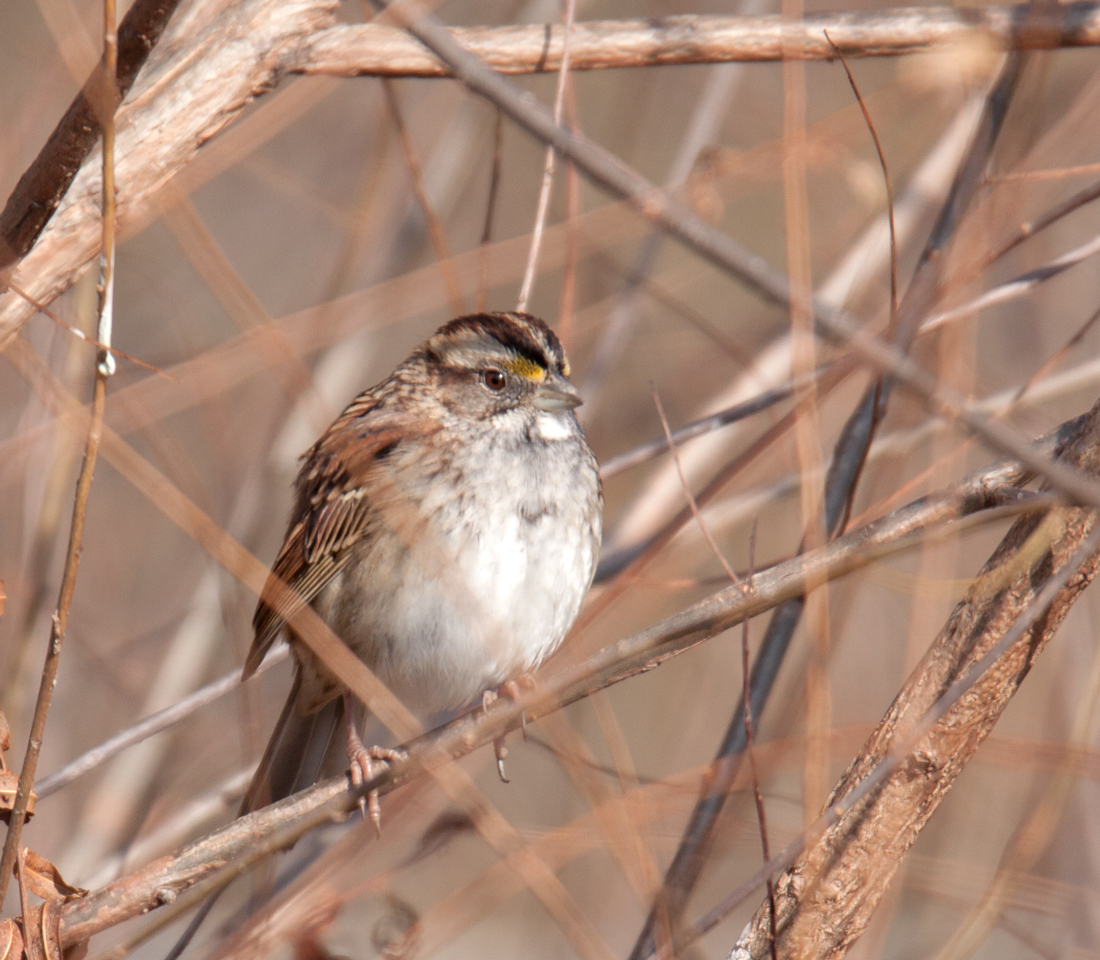
One of my goals in testing out my new Tamron 150-600mm lens was to see how well it did in capturing the little birds that hide out in the underbrush. As we move deeper into the autumn and into winter, I can always depend on hearing and sometimes spotting different kinds of sparrow poking about in the tangled plants and leaves in the marsh. These birds tend to be in constant motion, moving quickly from spot to spot after a few pecks, and this weekend I stalked a few of them to see if I could focus quickly and accurately on them.

We seem to have had a recent influx of White-throated Sparrows (Zonotrichia albicollis) and I think that all three of the images below are of members of this species. However, sparrows have often confounded me in the past, so I apologize in advance if I have misidentified them.

These sparrows seem to have individual personalities and I like the fact that they posed in different ways for me. I used to ignore sparrows and other such birds, but now go out of my way to try to photograph their beauty and individuality. I think my new lens passed the test in being able to capture portraits of these little sparrows.

White-throated SparrowWhite-throated SparrowWhite-throated Sparrow

© Michael Q. Powell. All rights reserved.

Read Full Post »
Some of the reviews of my new Tamron 150-600mm lens suggest that it has trouble capturing birds in flight, so I was anxious to test out its capabilities and the Canada Geese (Branta canadensis) coming and going from my local marsh served as my initial test subjects.

These five geese were part of a larger group that was departing from the marsh and I started tracking them as they flew past me. Initially thought that one of the geese has flown out of the frame in the second image, but then I looked more closely and realized that all five were still there—the formation was really tight (or at least the compression caused by the long telephoto lens made it look that way.

Sometimes in the past I have had problems in grabbing focus on moving subjects, especially when the background is cluttered and is competing for focus. I was happy to see that I was able to acquire and hold focus pretty well and the geese are separated from the trees in the background.

I am learning how to manage this longer lens and, for example, still have trouble sometimes pointing the extended lens at a subject and then finding the subject in the viewfinder—the field of view is not very wide at 600mm. I plan to check out the different focus options for my camera to see if any of them will improve my changes of getting clearer shots.

Does it show that I’m pretty excited with my new lens? I’ll be sharing more images as I continue to practice and learn with it.

Canada Geese in flight

Five guys in flight

Tight Formation

Tight Formation

© Michael Q. Powell. All rights reserved.

Read Full Post »

Yesterday I spotted a male Downy Woodpecker (Picoides pubescens) on an exposed branch in a tree across a small field of cattails. In the past, I would not have even attempted to take a shot because of the distance, but I recently bought a Tamron 150-600mm zoom lens and suddenly this little bird was more or less within reach. This was my first day out with my new lens and it was fun testing out its capabilities (and I’ll do a few more postings showing what the lens was able to get in different situations).

Downy Woodpeckers seem to have an amazing amount of energy and are in almost constant motion. As I watched, the little woodpecker pecked his way to the end of the branch and then stopped. He seemed to be confused and stared straight ahead at first,  Unsatisfied, he looked down and then up. Suddenly he lifted off almost straight up and I was fortunate to capture him with his wings extended.

Who knew that Downy Woodpeckers had such an impressive wingspan?

Downy Woodpecker

Liftoff

Downy Woodpecker

Looking ahead

Downy Woodpecker

Looking down

Downy Woodpecker

Looking up

© Michael Q. Powell. All rights reserved.


Read Full Post »

« Newer Posts