Feeds:
Posts
Comments

Posts Tagged ‘Tamron 150-600mm’

It is a fun challenge to try to photograph tiny songbirds, like this Golden-crowned Kinglet (Regulus satrapa) that I spotted last Thursday at Occoquan Bay National Wildlife Refuge. Golden-crowned Kinglets are approximately 3-4 inches (80-100 mm) in length and weigh about 0.1-0.3 ounces (4 to 8 grams) and they move about continuously, often high in the trees.

If you look carefully just above the kinglet’s eye, you can get a tiny glimpse of yellow, a small portion of the yellow “crown” that gives this little bird its name.

Golden-crowned Kinglet

© Michael Q. Powell. All rights reserved.


Read Full Post »

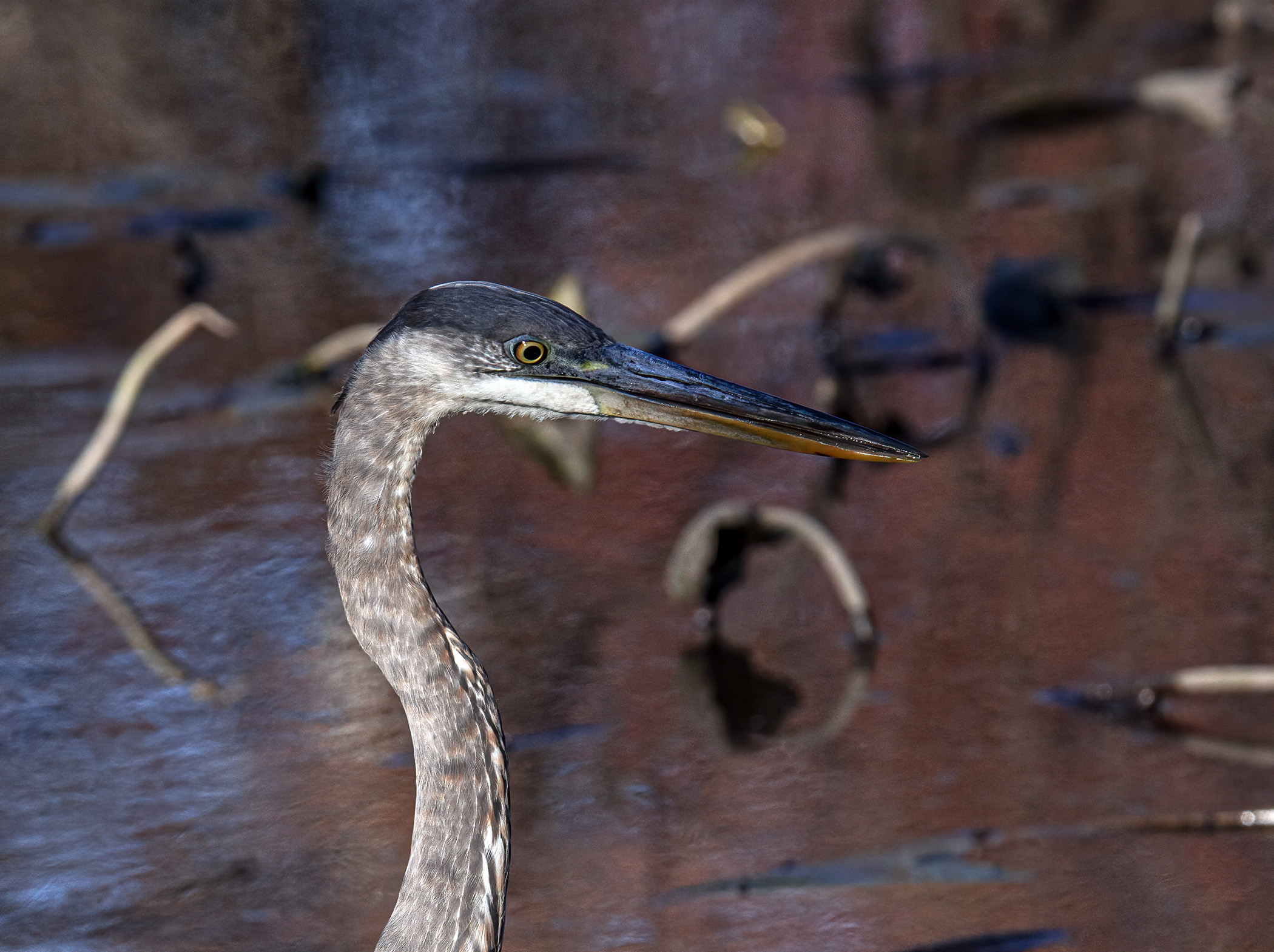
I was so close to this Great Blue Heron (Ardea herodias) yesterday at Occoquan Bay National Wildlife Refuge that there was no way I could fit its entire body into a shot. I decided to zoom in on its head and captured this little portrait of the heron as it walked slowly through the water. Ever vigilant, the heron kept its eyes focused on the water, looking for signs of potential prey, and ignored me, though I am sure that it was aware of my presence.

Great Blue Heron

© Michael Q. Powell. All rights reserved.

Read Full Post »

In the past I have seen Great Blue Herons (Ardea herodias) catch some incredibly large fish, but the tiny fish this heron caught on Thursday at Occoquan Bay National Wildlife Refuge may be the smallest prey that I have ever seen a heron catch.

Hopefully the fish was just an appetizer and not the main course.

Great Blue Heron

© Michael Q. Powell. All rights reserved.

Read Full Post »

Has anyone ever told you that you eat like a bird? This somewhat weird expression is based on the mistaken notion that birds don’t eat very much—many birds have high metabolisms and actually eat at lot, relative to their size.

Some birds also consume things that are hazardous to humans. This week at Occoquan Bay National Wildlife Refuge I have spotted multiple Yellow-rumped Warblers (Setophaga coronata) feasting on the abundant poison ivy berries. Poison ivy berries serve as an important food source for a variety of overwintering birds, including these warbler. One of the consequences of the consumption of all of these berries is that the seeds pass through the birds and are spread everywhere, guaranteeing future supplies of the poison ivy berries.

No matter how nutritious or tasty they are for the birds, there is no way that I am voluntarily going near poison ivy or tasting the berries. The berries may not kill me, but I am pretty sure they would make me really sick.

Yellow-rumped Warbler

Yellow-rumped Warbler

Yellow-rumped Warbler

© Michael Q. Powell. All rights reserved.


Read Full Post »

I am still on the lookout for summer dragonfly stragglers and survivors. There are certain dragonfly species that I expect to see during the autumn, but there are also a few particularly hard individuals from the summer species that are managing to hang on. Over the past week and a half I have spotted one Great Blue Skimmer (Libellula vibrans), one Eastern Pondhawk (Erythemis simplicicollis), and one Blue Dasher (Pachydiplax longipennis), as shown in the photos below.

It is interesting to note that all three of these dragonflies appear to be females. I wonder if female dragonflies tend to outlive their male counterparts, as is the case with humans.

I went looking for dragonflies today, after several frosty nights, and did not see a single dragonfly. The daytime temperature was only about 52 degrees (11 degrees C), which is a bit cold for dragonfly activity. Temperatures are forecast to rise to 68 degrees (20 degrees C) early next week and I anticipate that I will see a few dragonflies then.


Great Blue Skimmer

Eastern Pondhawk

Blue Dasher

© Michael Q. Powell. All rights reserved.

Read Full Post »

When I first spotted this stunning hawk last week at Occoquan Bay National Wildlife Refuge, I was really struck by the length of its tail. I suspected therefore that it was not a Red-shouldered Hawk, the most common hawk species in our area, but the colors did not quite match up with my mental picture of a Cooper’s Hawk (Accipiter cooperii), the second species that came to mind. I scoured my hard-copy and on-line resources for information and similar shots and gradually came to the conclusion that it might be an immature Cooper’s Hawk.

I posted my photo and tentative identification to the Birding Virginia group in Facebook and was a little shocked to receive confirmation of the identification from multiple viewers. One response was particular helpful, because it helped me to focus on the reasons why they concluded that it was an immature Cooper’s Hawk—I love comments in which a person is willing to take the time to explain their reasoning. The viewer explained, “Long tail, short wings, outer tail feathers are shorter than the inner tail feathers, flat, squared head with a strong suborbital ridge. Yellow eye instead of red/orange, and brown feathers instead of gray feathers indicate that it is not an adult.”

I feel like I am always learning, gaining additional knowledge and honing my observational skills. Feedback really helps in that process and I always welcome questions, comments and suggestions from all of you.


Cooper's Hawk

© Michael Q. Powell. All rights reserved.

Read Full Post »

It is hard to believe that it is already November. Rather than rushing boldly forward, I think that I will ease my way slowly into the new month, following the example of this Eastern Box Turtle (Terrapene carolina carolina) that I spotted last Thursday at Occoquan Bay National Wildlife Refuge. I believe this is a female box turtle—females of this species, which are also known as Woodland Box Turtles, generally have brown eyes, while the males most often have bright red eyes.

Eastern Box Turtle

© Michael Q. Powell. All rights reserved.


Read Full Post »

Autumn leaves floating on the dark waters of a marsh—a static moment in a season of change, a time for reflection.

Sometimes I am content to capture a feeling in my photos rather than focusing on a well-defined subject.

autumn leaves

autumn leaves


© Michael Q. Powell. All rights reserved.

Read Full Post »

I have seen groups of American Crows (Corvus brachyrhynchos) harass eagles and hawks many times in the past, so whenever I hear the excited cawing of of crows, I immediately start to look for a large raptor. When this happened on Thursday at Occoquan Bay National Wildlife Refuge, I quickly spotted the dark shadow of a large bird in a tree and assumed that it was a Bald Eagle.

I was a bit shocked when I zoomed in on the bird and realized that it was a Black Vulture (Coragyps atratus), not an eagle. I had no idea that crows would chase vultures. Sometimes the crows would perch on branches of the tree close to the vulture and appear to try to convince the vulture to leave—this is what seems to be happening in the second photo.

At other times, the crows would aggressively buzz the vulture, flying right at the vulture and veering off only at the last second. I managed to capture the first image just as one of the crows appeared ready to attack the vulture from behind, but there was no collision. The vulture flapped its wings several times to try to scare off the crows, an action that did not seem to deter the pesky crows.  A short time later the vulture departed to search for a more peaceful perch.

Happy Halloween.

crow and vulture

crow and vulture

© Michael Q. Powell. All rights reserved.

Read Full Post »

It is a fun challenge to try to photograph little birds moving about in the trees. I managed to capture this shot of an American Goldfinch (Spinus tristis) on Tuesday during a visit to Huntley Meadows Park, a local marshland refuge.

I like how the muted colors of this bird seem to reflect the autumn colors of its surroundings. I am more used to seeing goldfinches in the spring, when the adult males are bright yellow in color and are really easy to spot.

American Goldfinch

© Michael Q. Powell. All rights reserved.


Read Full Post »

Increasingly I find myself peering into trees as we move deeper into autumn, listening and watching for signs of small birds that may be hidden therein. The process can be somewhat maddening and often results in a sore neck, but my patience is sometimes rewarded and I manage to get a clear shot of one of the birds. Getting the shot, though, is only half of the challenge—identifying the bird can be equally frustrating.

Sparrow species can be particularly problematic, because so many of them are so similar in appearance. Last Thursday I photographed this sparrow at Occoquan Bay National Wildlife Refuge. As is generally the case, I did not worry about trying to identify the bird while I was in the field, but waited to do so at home. I went back and forth in my birding guide and concluded that it was probably a Song Sparrow (Melospiza melodia).

I have learned not to be overconfident in my bird identifications, though, and posted it to a Facebook birding forum. I felt gratified when a more experience birder confirmed my identification. It takes time, but I feel like I am gradually getting better at seeing the details that distinguish one species from another.

In many ways, my photography journey is focused on learning to see the world in new and different ways. As noted photographer Dorothea Lang so aptly put it, “The camera is an instrument that teaches people how to see without a camera.”


Song Sparrow

Song Sparrow

© Michael Q. Powell. All rights reserved.

Read Full Post »

As I was wandering about in Occoquan Bay National Wildlife Refuge last Thursday, I could not help but notice that the water levels were really low—the waters of the Potomac River and adjoining bodies of water are definitely influenced by the tide. Large stretches of the land that are normally covered with water were visible.

I spotted an opportunistic Great Blue Heron (Ardea herodias) poking about in the tidal pools, searching for tasty tidbits. The heron seemed to be having some success, though its “catch” was so small that I could not tell what it was, even with my telephoto zoom lens fully extended.

I love watching Great Blue Herons and am happy that they remain with us all winter, unlike their cousins, the Great Egrets, that depart my area in the autumn for warmer locations.

Great Blue Heron

© Michael Q. Powell. All rights reserved.

Read Full Post »

There are not very many dragonflies flying around this late in the season, so I was happy to spot this Wandering Glider (Pantala flavescens) last Thursday at Occoquan Bay National Wildlife Refuge. I was even more thrilled when it perched within range of my long telephoto zoom lens and I was able to get the first shot below. The dragonfly was perched really look to the ground in a grassy field and it was a challenge to frame a shot where my view was not blocked by the tall grass.

What could possibly be better than getting a shot of an elusive dragonfly like a Wandering Glider? How about capturing two of them in a single photo? My first thought when I spotted the two Wandering Gliders together last Monday at the same refuge was that they were trying to hook up—I think that one of them is a male and one a female. The hook-up did not happen, at least not while I was observing them.

The weather forecast for this week shows lots of clouds and rain and cooler temperatures. None of those conditions are particularly hospitable to dragonflies, so I suspect that the population will continue to drop as members of some species die off and others, like these Wandering Gliders, migrate to locations with more favorable conditions.

Wandering Glider

Wandering Glider

© Michael Q. Powell. All rights reserved.

Read Full Post »

I have been starting to see images of turkeys everywhere, but mostly they are cartoon-like figures in advertisements for Thanksgiving, which is only a month away. Last week I encountered a small flock of actual Wild Turkeys (Meleagris gallopavo) while I was walking along one of the trails at Occoquan Bay National Wildlife Refuge. I have seen turkeys at multiple locations within the refuge and suspect that there are a number of resident flocks there.

The turkeys slowly moved into the underbrush as soon as they became aware of my presence, but I did manage to capture a few shots of one of them. I especially like the pattern of light and shadows in the background of the first image that was caused by the sunlight filtering through the trees. I took these shots during the middle of the day and the sunlight was relatively harsh in open areas, as you can see in the second image. It is a fun challenge to balance the light to get a decent exposure in situations like this when the lighting is so mixed.

Wild Turkey

Wild Turkey

© Michael Q. Powell. All rights reserved.

Read Full Post »

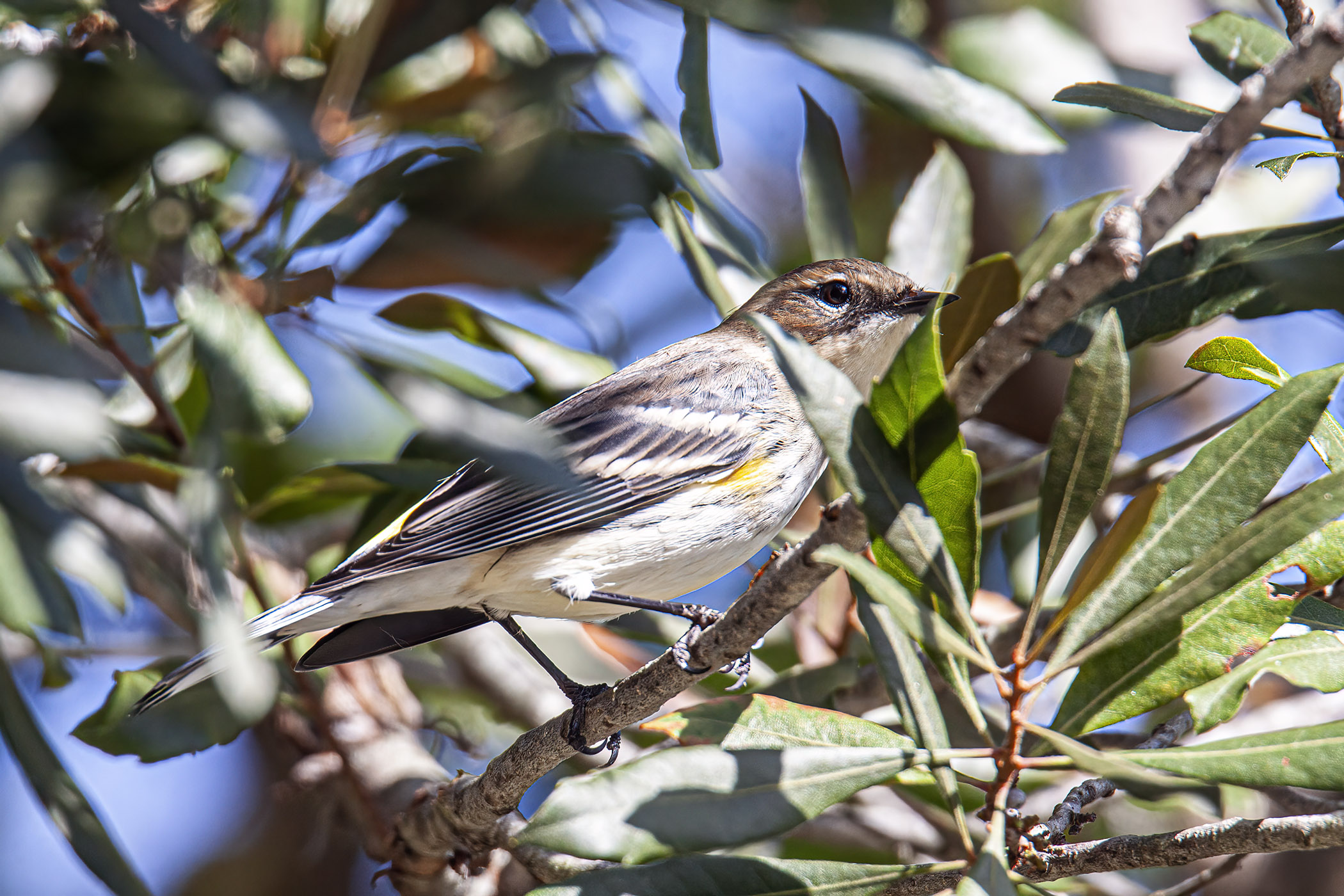
Most of the warblers that I encounter in the autumn are Yellow-rumped Warblers (Setophaga coronata). They always seem to be in motion, whether foraging in the trees or on the grass. During this time of the year, Yellow-rumped Warblers are a fairly nondescript mixture of gray and brown, highlighted by streaks of yellow under the upper portions of the wings. I captured these images during the last week or so during repeated visits to Occoquan Bay National Wildlife Refuge.

On rare occasions, as in the second photo below, I will get a glimpse of the patch of bright yellow on the “rump” that is responsible for this species’ common name. It also gives rise to a fairly common nickname among birders, who affectionately refer to Yellow-rumped Warblers as “butterbutts.” Unlike other warblers that merely pass through our area, Yellow-rumped Warblers tend to hang around for longer and I will sometimes see them during the early days of winter.

Yellow-rumped Warbler

Yellow-rumped Warbler

Yellow-rumped Warbler

© Michael Q. Powell. All rights reserved.

Read Full Post »

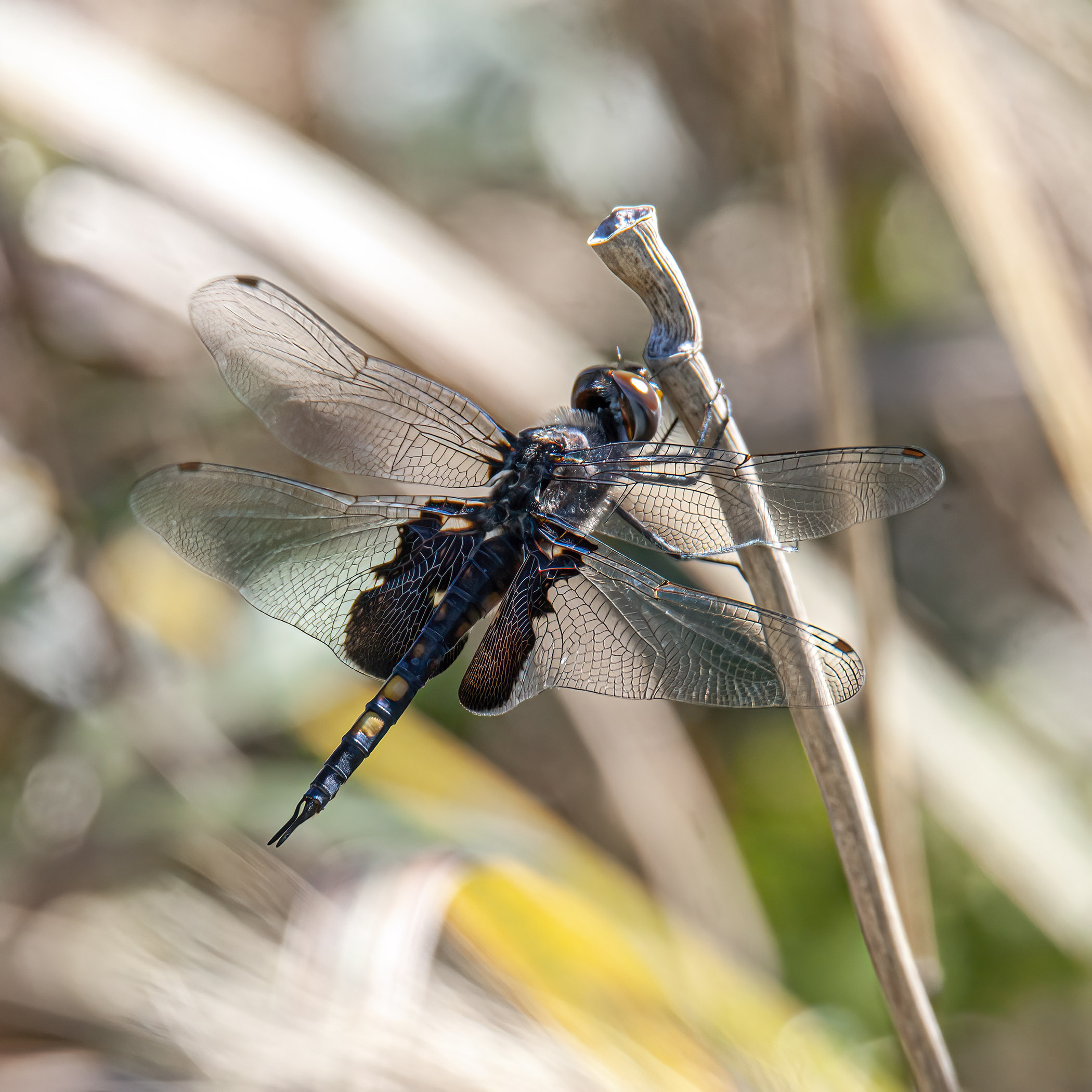
I have been amazingly fortunate this dragonfly season in being able to capture images of dragonflies that rarely perch. My luck continued on Monday when a Black Saddlebags dragonfly (Tramea lacerata) that I was observing as it patrolled high in the air came down to earth and perched within range of my long telephoto lens while I was exploring at Occoquan Bay National Wildlife Refuge.

Black Saddlebags are one of a handful of dragonflies that migrate in the late summer/early fall. On this particular occasion, the Black Saddlebags appeared to be part of a small swarm that also included at least a half-dozen Wandering Gliders and a Common Green Darner.

Black Saddlebags dragonflies are relatively large—about 2.2 inches (56 mm)—and are pretty each to identify, thanks to the distinctive dark patches on their hind wings that are visible when they are flying overhead. I encourage you to click on each of the images to get a better look at the wonderful details of this dragonfly, including its two-toned eyes and colorful markings on its wings and abdomen.

Black Saddlebags

Black Saddlebags

© Michael Q. Powell. All rights reserved.

Read Full Post »

I was delighted and a bit surprised on Monday to spot this Monarch butterfly (Danaus plexippus) at Occoquan Bay National Wildlife Refuge.  thought the Monarchs had all left the area by now to head to warmer locations. When I posted this photo is a Facebook forum, I learned that viewers also have been spotting occasional Monarchs recently in other parts of Virginia.

Although the calendar tells us that we are well into autumn, we are still reminded from time to time of the beauty of the summer days that are gradually fading from our consciousness. Time moves on inexorably.

Monarch butterfly

© Michael Q. Powell. All rights reserved.


Read Full Post »

What marks the arrival of autumn for you? Is it the colorful fall foliage or perhaps the shortening of the daylight hours and the arrival of cooler weather? For me, the reappearance of Autumn Meadowhawk dragonflies (Sympetrum vicinum) is one of the surest signs of the change in the seasons.

It seems like I have had to wait longer this year than in the past, but I am finally starting to see these small reddish-orange dragonflies as I walk the trails at Occoquan Bay National Wildlife Refuge. On Monday I spotted my first male Autumn Meadowhawks of the season, as shown in the first two photos below. The coloration of the males is startlingly bright, but you actually have to look hard to spot them, because they are only 1.3 inches (33 mm) long and often perch on low vegetation or on the ground itself.

The final image showcases the two-toned look of a female Autumn Meadowhawk. She seems to be glancing over at me and smiling, confident in her radiant beauty, her warm coloration a beautiful reflection of the autumn season.

Autumn Meadowhawk

Autumn Meadowhawk

Autumn Meadowhawk

© Michael Q. Powell. All rights reserved.


Read Full Post »

The weather is turning cooler, but there are still some hardy dragonflies around, like this beautiful female Autumn Meadowhawk (Sympetrum vicinum) that I spotted last Thursday at Occoquan Bay National Wildlife Refuge, perched high on a branch as she basked in the autumn sunshine.

Most of the time when I see an Autumn Meadowhawk it is perched on the ground, so it was a treat to see this one on an elevated perch that gave me a really good look at the shape of her tiny body—Autumn Meadowhawks are only about 1.3 inches (33 mm) in length. This dragonfly species is generally the last one that I see each year and several years I have seen Autumn Meadowhawks in December. From my perspective, the dragonfly season is still far from being over.

Autumn Meadowhawk

© Michael Q. Powell. All rights reserved.

Read Full Post »

“Not all who wander are lost.” Have you ever seen that slogan? It is so popular with van dwellers and RVers that it is almost a cliché, yet there is a real truth to that simple statement.

In fact, “wandering” is often my preferred method for encountering wildlife subjects to photograph. I like to wander along the trails (or sometimes off of the trail) and opportunistically scan my surroundings, watching and waiting for something to catch my eye.

I guess that is one of the reasons why I love the name of the Wandering Glider dragonfly (Pantala flavescens), a globetrotting species that is considered to be the most widespread dragonfly in the world, with a good population on every continent except Antarctica. According to Wikipedia, Wandering Gliders, also known as “Globe Skimmers,” make an annual multigenerational journey of some about 11,200 miles(18,000 km); to complete the migration, individual dragonflies fly more than 3,730 miles (6,000 km)—one of the farthest known migrations of all insect species.

This past Thursday, I was delighted to spot Wandering Gliders on multiple occasions as I was wandering about in Occoquan Bay National Wildlife Refuge. I was even more thrilled when several of them perched for me and I was able to capture these images. The shots give you a good look at the beautiful markings of this dragonfly species and the broad hindwings that help these dragonflies to glide long distances.

Wandering Glider

Wandering Glider

Wandering Glider

© Michael Q. Powell. All rights reserved.

Read Full Post »

I was absolutely thrilled to spot this bright yellow warbler on Tuesday at Occoquan Bay National Wildlife Refuge. Some more experienced birders in a birding forum on Facebook have identified it as a Cape May Warbler (Setophaga tigrina). When it comes to identifying warblers, I tend to be wrong as often as I am right. I have learned that it is best to ask for help rather than apologize afterwards for my errors.

I was pretty certain that I had never seen this species before, but decided to do a search of the blog to be sure. I was shocked to find that I spotted a Cape May Warbler last year at the start of October—check out that posting entitled Cape May Warbler. I relied on the help of experts last year too and somehow never internalized the identification into my brain. Alternatively, I can simply blame the aging process for this minor “senior moment.”

Cape May Warbler


Cape May Warbler

Cape May Warbler

© Michael Q. Powell. All rights reserved.

Read Full Post »

This Woodland Box Turtle, a species that is also known as an Eastern Box Turtle (Terrapene carolina carolina) was chilling out in the grass at the edge of a trail when I spotted it last week at Occoquan Bay National Wildlife Refuge. It was not moving about very much, but I could sense a real intensity in its bright red eyes.

In order to capture this shot, I got down as low as I could, though I was not quite low enough to be at eye level with the turtle. I was quite happy to be able to capture a lot of detail in the shell and in the portion of the head sticking out of the shell. I encourage you to click on the image to get a closer view of the wonderful details of this strikingly handsome box turtle.

Woodland Box Turtle

© Michael Q. Powell. All rights reserved.

Read Full Post »

As I was wandering the trails early last week at Occoquan Bay National Wildlife Refuge, I was fortunate to spot this Bald Eagle (Haliaeetus leucocephalus) perched in a tree, almost hidden amongst the leaves. I would like to think that my stealthiness permitted me to get close to the eagle, but suspect instead that the eagle was comfortable in its perch and simply did not view me as a threat.

The eagle moved its head from side to side a bit and glanced down at me occasionally, but stayed in place as I took some shots. The trail took me past the tree in which the eagle was perched and after I had passed underneath the eagle, I glanced over my shoulder and was pleasantly surprised to see the eagle was still there. I love it when I am able to capture my images without disturbing my wildlife subjects, though most of the time they are so skittish that they move away as soon as they detect my presence.

Bald Eagle

Bald Eagle

© Michael Q. Powell. All rights reserved.

Read Full Post »

It was so cool last week to spot a few warblers at Occoquan Bay National Wildlife Refuge. Every spring and fall a variety of warblers migrate through our area. Quite often I can hear them twittering and tweeting in the trees, but it is rare for me to see one clearly. Usually I will see only a momentary flash of yellow that is quickly swallowed up in the sea of green foliage.

The bird in the first photo is a a Palm Warbler (Setophaga palmarum). Most of the time I see Palm Warblers foraging on the ground, but this one accommodated me by hopping up onto a tree and giving me an unobstructed shot.  The Yellow-rumped Warbler (Setophaga coronata) in the second shot was not quite so cooperative. It was buried in the vegetation and never fully revealed itself.

The migration season for warblers will be drawing down soon. I have only modest shots like these to show for it, but I am not disappointed—some years I have not been able to get any shots at all. In the fall, the colors of the warblers tends to be more muted than in the spring, when the males are sporting their breeding plumage. Somehow the muted tones of the birds matches the mood of the season, as colors fade and we gradually move towards the monochromatic days of the winter.

Palm Warbler

Yellow-rumped Warbler

© Michael Q. Powell. All rights reserved.

Read Full Post »

The angle at which I took this shot makes it look like there was a headless heron haunting Occoquan Bay National Wildlife Refuge last week. (As most of you can probably tell a Great Blue Heron (Ardea herodias) was showing off its impressive plumage and wingspan this shot.) I think I have been seeing too many Halloween displays at local stores, causing me to see spooky things everywhere.

Great Blue Heron

© Michael Q. Powell. All rights reserved.

Read Full Post »

Most people are familiar with the words, “To everything there is a season and a time to every purpose under heaven.” Perhaps they have heard them read in a church, where they would be identified as coming from the third chapter of Ecclesiastes in the Bible. For folks of my generation, it is ever more likely that they would be associated with the words of a song by Pete Seeger made popular by the Byrds in the 1960’s.

Recently I have been really conscious of the changing seasons, of the never ending cycle of life and death. I have seen this phenomenon in nature and I have been very sensitive to it in other parts of my life.

Some of you may have noticed that I have not made a blog posting in several days, after more than a year of posting every day. I have spent the last few days in Massachusetts with my family celebrating the life and mourning the death of one of my younger brothers who died a week ago of lung cancer.

So often we think of growing older with grace and beauty, like the female Great Blue Skimmer dragonfly (Libellula vibrans) pictured below, thinking that we can somehow live forever. In fact, our days are numbered—life is so precious and yet so fragile. Celebrate life and love freely.

“To every thing there is a season, and a time to every purpose under the heaven
A time to be born, and a time to die; a time to plant, and a time to pluck up that which is planted;
A time to kill, and a time to heal; a time to break down, and a time to build up;
A time to weep, and a time to laugh; a time to mourn, and a time to dance;
A time to cast away stones, and a time to gather stones together; a time to embrace, and a time to refrain from embracing;
A time to get, and a time to lose; a time to keep, and a time to cast away;
A time to rend, and a time to sew; a time to keep silence, and a time to speak;
A time to love, and a time to hate; a time of war, and a time of peace.”

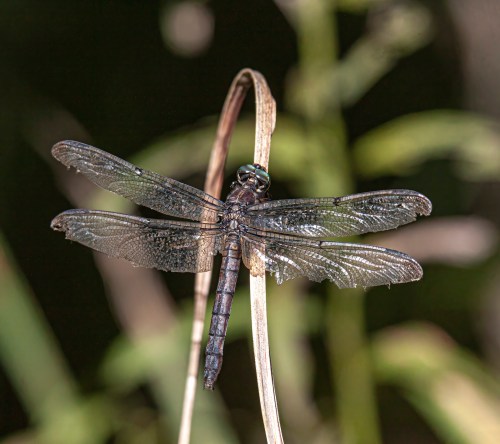
 

Great Blue Skimmer

Great Blue Skimmer

© Michael Q. Powell. All rights reserved.


Read Full Post »

I was ecstatic on Monday at Occoquan Bay National Wildlife Refuge to finally capture some images of Fine-lined Emerald dragonflies (Somatochlora filosa), a species for which I have been searching repeatedly this past month. Fine-lined Emeralds are one of several species that appear in the autumn, just as the number of most species of dragonflies is beginning to drop precipitously. I had spotted what I think were Fine-lined Emeralds several times earlier in September, but for me the sighting does not really “count” if I am not able to take a photograph.

Fine-lined Emeralds like to spend a lot of time patrolling, and a lesser amount of time perching. Unlike many of species that fly about high in the air, this species often flies at at somewhere between knee and eye-level.

On this day I spotted at least two individuals patrolling along one of the trails that runs parallel to the water. I alternated between chasing after the dragonflies and waiting for them to return—the patrol routes seem to be of a fixed length and the dragonflies would do a U-turn when they reached the end and fly back where they had been.

The dragonfly in the first two images is the same individual with a damaged rear wing, while the one in the final photo seems to be a different individual with an intact wing. I love the beautiful green eyes of this species, a characteristic they share with other members of the Emerald family. Those eyes seem to glow when the dragonfly is flying right at you.

If you look closely at the abdomen of the dragonflies, you can see the thin white/golden lines that I thought were responsible for the “fine-lined” portion of the name of this dragonfly species. However, a sharp-eyed fellow dragonfly enthusiast gently reminded me, after he read my initial posting, that the fine white stripes on the sides of the thorax (the “chest”) are responsible for the “fine-lined” name—you can see them best in the middle photo. I checked my identification guide and he is correct. Humility comes with the territory when it comes to identifying wildlife species.

Fine-lined Emerald

Fine-lined Emerald

Fine-lined Emerald

© Michael Q. Powell. All rights reserved.

Read Full Post »
I spend a good amount of time looking for unusual subjects to photograph, but I also love to photograph the everyday creatures that inhabit my day-to-day life. I spotted this Eastern Gray Squirrel (Sciurus carolinensis) last Wednesday at Occoquan Bay National Wildlife Refuge. I cannot tell for sure what the squirrel had in its mouth, but he seemed to consider it a treasure.

I love the pose of the squirrel atop the broken-off tree—there is something dynamic about its somewhat precarious position and in fact the squirrel leap jumped to a nearby tree a few seconds after I snapped this photo. I also really like the curve of the squirrel’s tail that adds a kind of whimsical touch to the image.

Eastern Gray Squirrel

© Michael Q. Powell. All rights reserved.

Read Full Post »

When I can’t get near enough to a subject for a close-up shot, I love to try to create an environmental portrait, like this image of a Great Egret (Ardea alba) that I photographed last week in the waters off of Occoquan Bay National Wildlife Refuge. Sometimes it is really cool to focus on capturing the mood of a moment more than worrying about the minute details of the subject.

Great Egret

© Michael Q. Powell. All rights reserved.

Read Full Post »

At this time of the year, a variety of colorful warblers pass through our area as they make their way south to warmer locations. Warblers are quite small and tend to spend most of their time hidden in the leaves at the top of tall trees.  As a result, it is rare for me to see more than just a flash of color. When the leaves fall from the trees, I have a better chance of spotting a small bird, but most of them are gone by that time of the year.

Last week I was fortunate to capture some shots of a bird that I was able to tentatively identify as a Black-throated Green Warbler (Setophaga virens). A lot of warblers look somewhat similar, so I went back and forth in my bird identification guide to try to identify “my” bird. I was a little surprised when some more experienced birders confirmed my identification of the warbler—it was a bit of an educated guess on my part, but a guess nonetheless.

I am in the process of recalibrating my vision now that I have switched to using my long telephoto zoom lens most of the time. Instead of looking down and scanning a close-in area for subjects, I am now trying to look for subjects that are often much higher up and farther away. In this transitional season, though, it becomes a little more complicated, because there are still some insects that I want to photograph.

It requires good camera technique and careful composition to capture images of insects at 600mm, but I have had some success in doing so, thanks in part to the monopod that I use with my long lens for additional stability. For example, my recent shots of Black Saddlebags dragonflies and Monarch Butterflies were all taken with my Tamron 150-600mm zoom lens. As I have noted before, gear does matter, but only to a much more limited extent than most people assume—my basic approach is to get the best photos that I can with whatever I have at hand.


Black-throated Green Warbler

Black-throated Green Warbler

© Michael Q. Powell. All rights reserved.


Read Full Post »

I have been really fortunate recently in getting shots of Black Saddlebags dragonflies (Tramea lacerata). Early last month I spent lots of times trying to photograph Black Saddlebags as they patrolled overhead, convinced that they rarely come down to earth to perch. As the month progressed, I was ecstatic when I managed to capture a couple of images of perched Black Saddlebags.

The last week or so, I have spotted at least one Black Saddlebags on varying types of vegetation during each of three separate visits to Occoquan Bay National Wildlife Refuge. Have these dragonflies changed their behavior? Have I changed my approach by switching from a macro lens to a longer telephoto zoom lens? Am I growing more alert and patient?

Rather than ponder the answer to these questions, I think it is best for me to celebrate the beauty of what I was able to capture in my photos, to live fully in the moment. Most of the time that I go out with my camera, I do have not specific expectations—I take things as they come and try to make the best of the opportunities that I am given.

Recently I watched a vlog by Nathaniel Drew, a  young YouTube creator whose videos I regularly watch, who stated that, “Unhappiness is wishing that things were another way.” The alternative, he continued, is to have a purpose—”Purpose, on the other hand, is about finding meaning, making sense of how things are.”

How do you find happiness? In many ways I am striving to be like the Apostle Paul, who was able to write to the Philipians, “I have learned to be content whatever the circumstances.” True contentment, I believe, can come from treasuring and celebrating what we have in our lives and not complaining or focusing on those things that we do not have.

Have a wonderful weekend.


Black Saddlebags

Black Saddlebags


Black Saddlebags

© Michael Q. Powell. All rights reserved.


Read Full Post »

« Newer Posts - Older Posts »