Feeds:
Posts
Comments

Posts Tagged ‘sparrow’

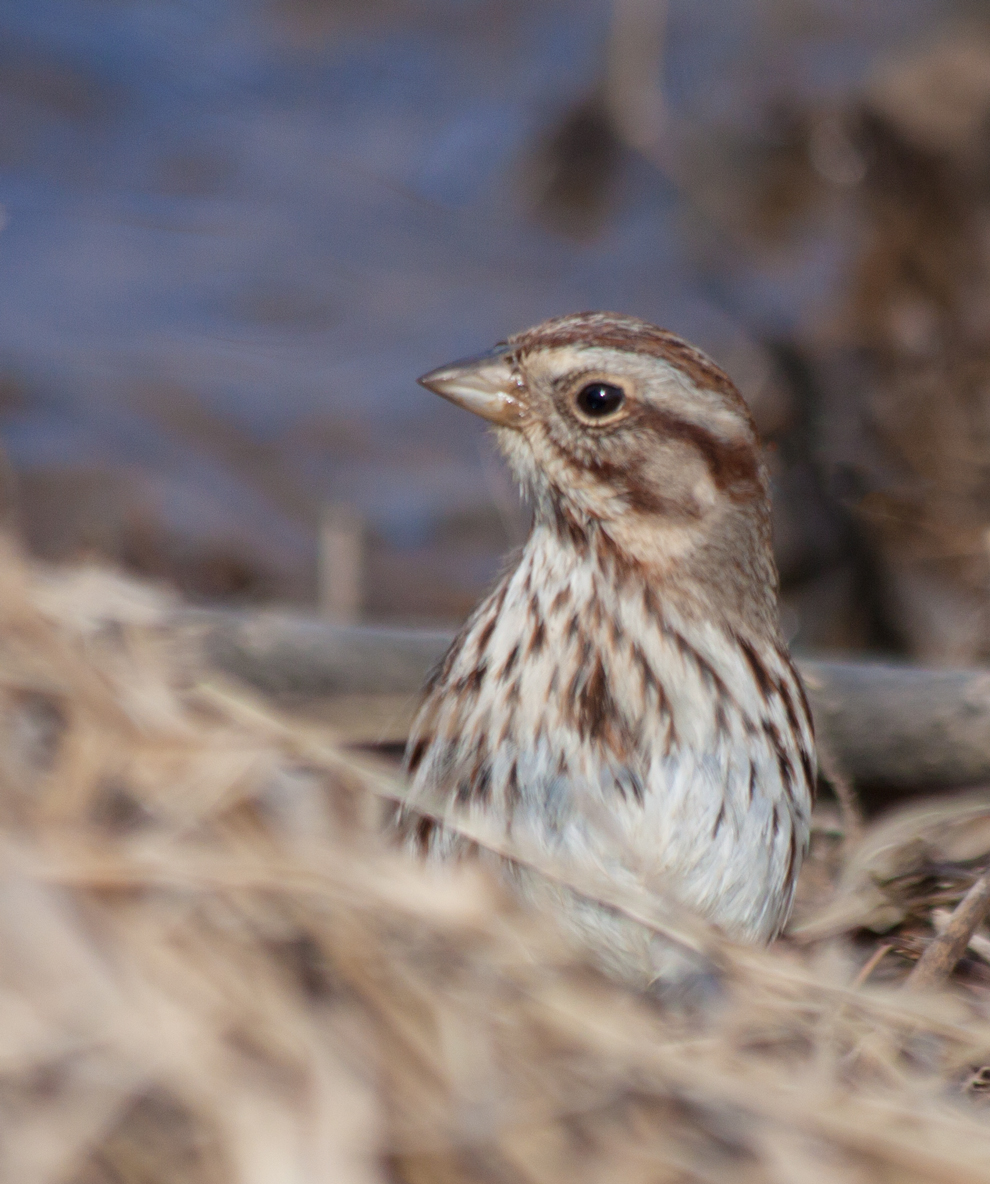
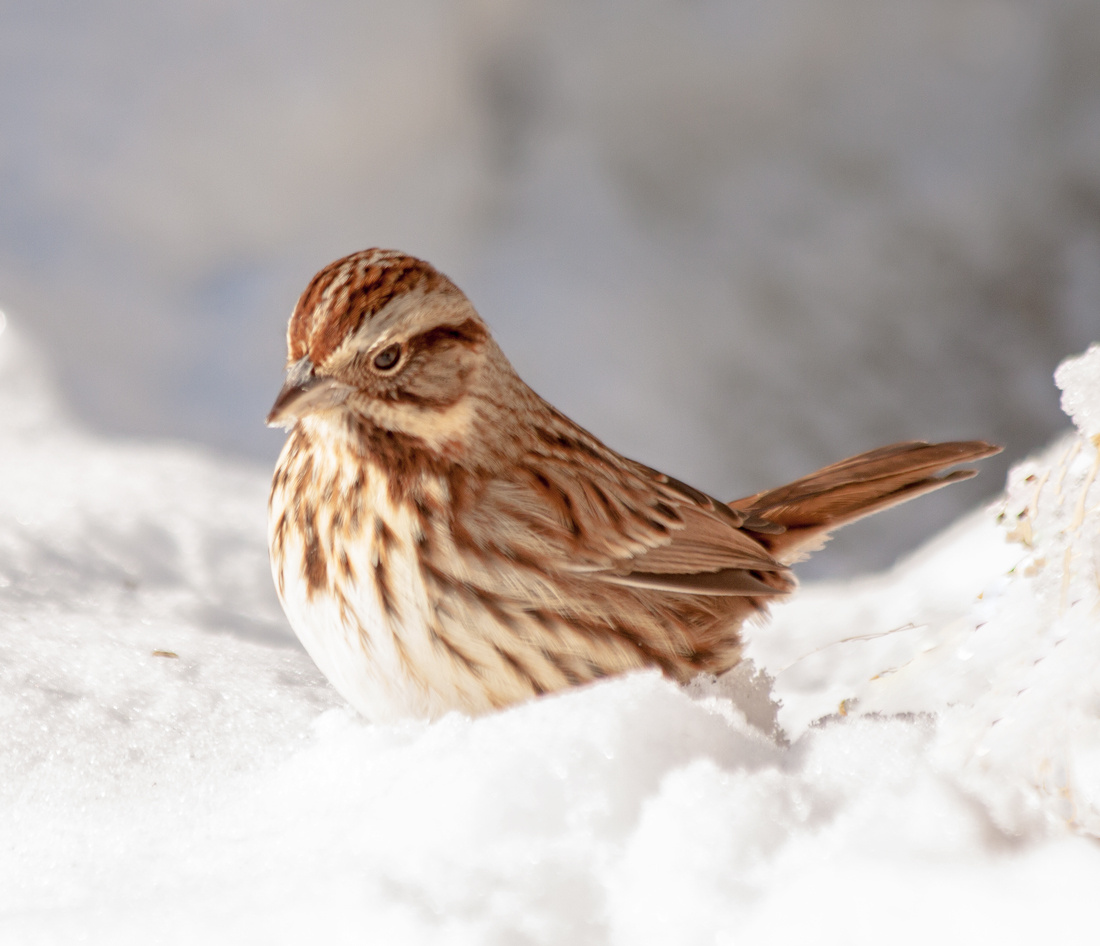
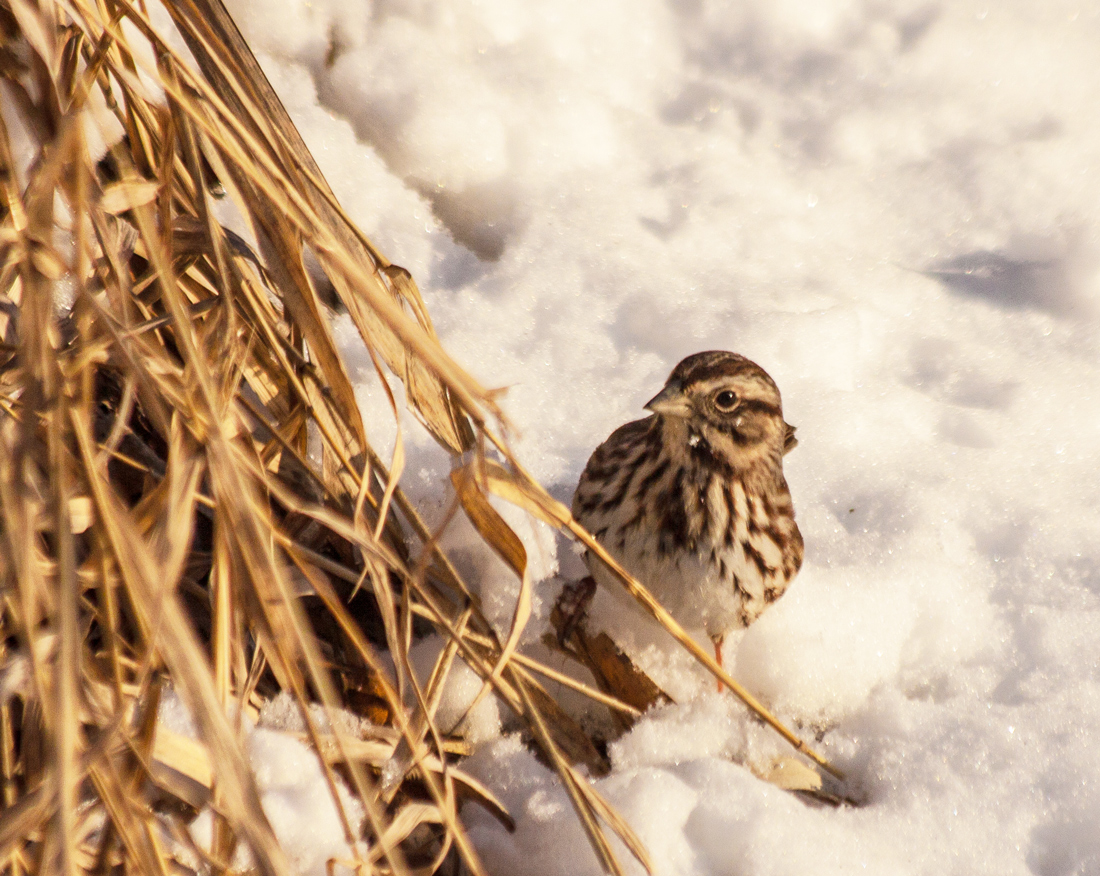
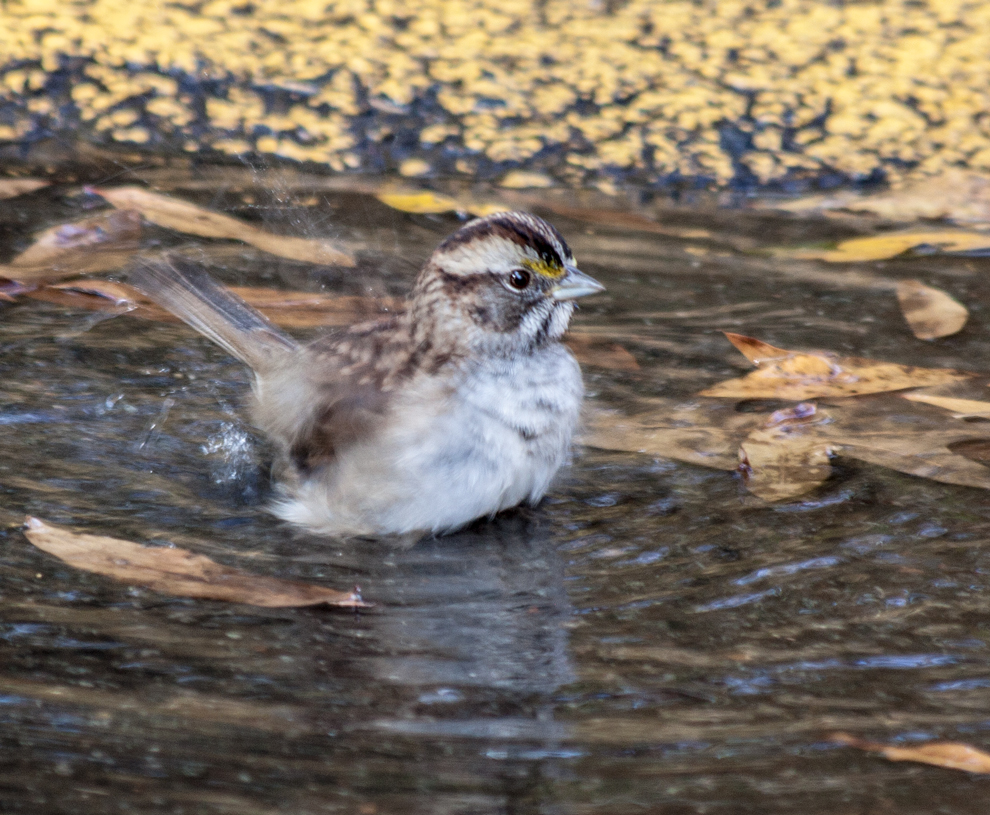
One of my goals in testing out my new Tamron 150-600mm lens was to see how well it did in capturing the little birds that hide out in the underbrush. As we move deeper into the autumn and into winter, I can always depend on hearing and sometimes spotting different kinds of sparrow poking about in the tangled plants and leaves in the marsh. These birds tend to be in constant motion, moving quickly from spot to spot after a few pecks, and this weekend I stalked a few of them to see if I could focus quickly and accurately on them.

We seem to have had a recent influx of White-throated Sparrows (Zonotrichia albicollis) and I think that all three of the images below are of members of this species. However, sparrows have often confounded me in the past, so I apologize in advance if I have misidentified them.

These sparrows seem to have individual personalities and I like the fact that they posed in different ways for me. I used to ignore sparrows and other such birds, but now go out of my way to try to photograph their beauty and individuality. I think my new lens passed the test in being able to capture portraits of these little sparrows.

White-throated SparrowWhite-throated SparrowWhite-throated Sparrow

© Michael Q. Powell. All rights reserved.

Read Full Post »

A new month started quietly, with few animals, birds, or insects visible on a cold. overcast day. I walked around my local marsh for a couple of hours and experienced nature in a series of small encounters, signs of the changing season.

A lone swallow sang softly in a tree; (CORRECTION: A sharp-eyed reader noted this is a female or immature Red-winged Blackbird)

A mallow flower bloomed unexpectedly in the water;

A squirrel peeked out from behind some branches;

The trees showcased their muted autumn colors; and

An advance party of Canada Geese came in for a landing.

© Michael Q. Powell. All rights reserved.

Read Full Post »

At this time of the year especially, I can usually depend on seeing ducks, geese, and sparrows at my local marsh—other birds may or may not be present, but these three species are my constant companions. The ducks and the geese are often loud and occasionally obnoxious, but when the sparrows sing, it’s generally a more melodious song. The ducks and geese will often fly away when I approach, but the sparrows will just take a hop or two and continue to forage for food.

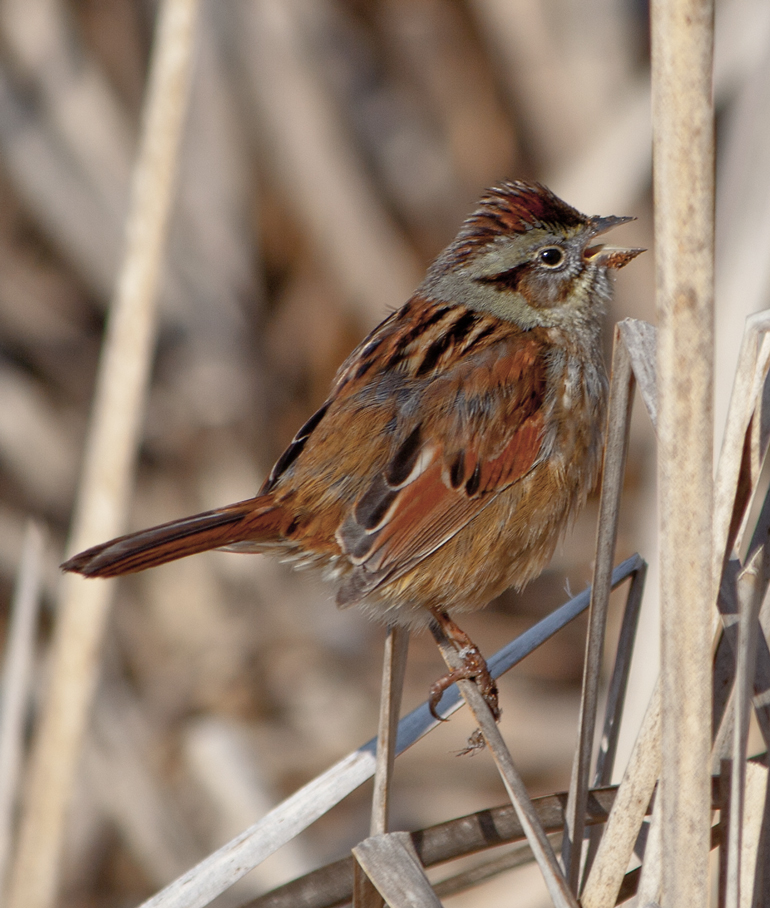
I take lots of photos of sparrows. They are usually within range and have a surprising amount of personality. Yesterday, on a cold and windy day, I captured this image of what I think is a Song Sparrow (Melospiza melodia). The light was pretty good and the sparrow cooperated by lifting its head without turning, resulting in a pleasant little portrait of this pretty little bird.

CORRECTION: A number of more experience bird watchers have noted that this is a Swamp Sparrow (Melospiza georgiana), not a Song Sparrow. Sorry for any confusion—this is not the first time I have misidentified a species, and certainly not the last.

sparrow_shadow_28Feb

© Michael Q. Powell. All rights reserved

Read Full Post »

Sometimes the birds play games with me as I try to photograph them—usually it is “hide and seek.” This little Song Sparrow (Melospiza melodia), though, seemed to be playing “peekaboo,” as the bird would hide its head and then pop up and look at me, as if to announce, “Here I am.”

peekaboo1_blogpeekaboo2_blog

© Michael Q. Powell. All rights reserved

Read Full Post »

Have sparrows become my favorite bird? This winter, I’ve spent more time with them than with any other birds and I’ve featured them repeatedly in my blog postings. I tend to be more at ease with the familiar and the comfortable, rather than the exotic and extreme. and sparrows fit well into my world, like this Song Sparrow (Melospiza melodia) in the snow.

Photographing these small birds is a challenge, though, because it is unusually tough to isolate them from their often cluttered background and they are in constant motion. I like the way that I was able to capture this sparrow, with the small patch of exposed grass amidst the snow. The light was pretty strong and blew out a few details in the chest feathers, but if cast an interesting shadow.

Perhaps sparrows are not my favorite birds, but we are good friends who spend a lot of time together.

sparrow_shadow_blog

© Michael Q. Powell. All rights reserved

Read Full Post »

I finally made it out to my local marsh this past weekend to check out the wildlife activity following our recent snowstorm and protracted period of cold weather. The boardwalks are still mostly slippery and covered with packed snow and almost all of the water in the ponds is frozen solid, which means that most of the geese and ducks have relocated. The cold spell is forecast to continue this week, so I don’t expect to see the water fowl returning any time soon.

The sparrows seemed even more active than normal, though, in constant motion as they moved from one set of vegetation to another. Often it seemed that they chose to hop from place to place, rather than fly, and I caught this Song Sparrow (Melospiza melodia) in mid-hop. (It looked like they would extend their wings a bit when they would hop down from a higher point on a plant to a lower spot).

sparrow_hopping_blog

© Michael Q. Powell. All rights reserved

Read Full Post »

Although I already posted a photo earlier today of a Song Sparrow (Melospiza melodia) in the snow, I came across one I liked even more as I was going through yesterday’s images. This sparrow (and I am never certain of my sparrow identifications) seemed to be posing for me. Somehow I was able to capture details in its eyes that I have never seen before.

After our brief portrait session, the sparrow hurried back to work.

sparrow_snow2_blog

© Michael Q. Powell. All rights reserved

Read Full Post »

We don’t get much snow here is Northern Virginia, so I was really excited to visit my marshland park yesterday to see what birds and animals were active. There were lots of crows and Canada Geese, but I was mostly attracted by the frenetic activity of the sparrows.

The sparrows moved around quickly in the snow and on the ice, foraging for food in the dried out vegetation in the cattail field. This little sparrow, which I think is a Song Sparrow (Melospiza melodia), paused for a split second and lifted its head, which made it possible for me to get this shot. (Most of my other shots have the sparrow’s head in the shadows or buried in the vegetation).

sparrow_snow_blog

© Michael Q. Powell. All rights reserved

Read Full Post »

It won’t be long before my bird photos have the colorless backgrounds characteristic of winter, so I am photographing as many birds as I can find with autumn colors in the background, like this House Sparrow (Passer domesticus) that I observed last Sunday. As I noted in a posting last month, these birds are non-native (introduced from the Old World) and sometimes crowd out native birds. Still, I find them to be beautiful, especially when they pose like this. This pose is one of my favorites, when I get to look down the tail toward the head turned to the side.

house_sparrow_autumn_blog© Michael Q. Powell. All rights reserved.

Read Full Post »

No matter how bad the weather is, sparrows seem to be omnipresent at this time of the year. I can hear them as they move about in search of food, but they often choose to bury themselves deep in the bushes and undergrowth.

This White-throated Sparrow (Zonotrichia albicollis) was snacking on some kind of berries and I managed to catch him mid-bite when he lifted his head slightly. The branches and leaves give you an idea of the challenge involved in getting an unobstructed  shot. I am happy that I was able to get the head (and eye) in focus and the pose is an interesting one, because it caught the sparrow as it was doing something—static portraits are nice, but for me it’s even nicer to capture motion and activity.

berry_blog

© Michael Q. Powell. All rights reserved.
Read Full Post »

Did you enjoy playing in puddles when you were a child? I remember a childhood of rubber boots and yellow slickers and days when my pant legs would be drenched from walking through puddles. Even now, I’ll occasionally kick my feet through a puddle of water and then glance quickly all around, hoping that nobody has seen me give in to my child-like impulses.

When I spotted this White-throated sparrow (Zonotrichia albicollis) in a shallow puddle, I thought he was merely getting a drink of water. However, he stuck his head in the water, splashed around, and seemed to be having a good time. Perhaps he was taking a bath, or maybe he was simply enjoying himself in the cool waters. (In case you are curious about the background, the puddle had formed in a low area adjacent to a speed bump at the entrance to the parking area of my local marsh park—the yellow you can see is the safety paint of the speed bump itself.)

Initially, I was unsure that this sparrow was a White-throated, because the white patch was not really obvious and the eye stripes were not as well defined as in previous photos that I have posted of this species. The yellow coloration above the lore (the area between the eye and the bill) makes it pretty likely that this is a White-throated sparrow, though it may be the brown and tan striped variant, rather than the black and white one that I featured in a posting earlier this week.

I don’t know about you, but I feel inspired to find a puddle to play in today. Have a wonderful Friday.

Sparrow_puddle_cropped_blog

© Michael Q. Powell. All rights reserved.

Read Full Post »

It was cold and overcast yesterday and there were not many birds visible, with the notable exception of sparrows. Sparrows were as active as ever, though most of the time I could only hear them and not see them. They seem to like to rot about in the underbrush most of the time.

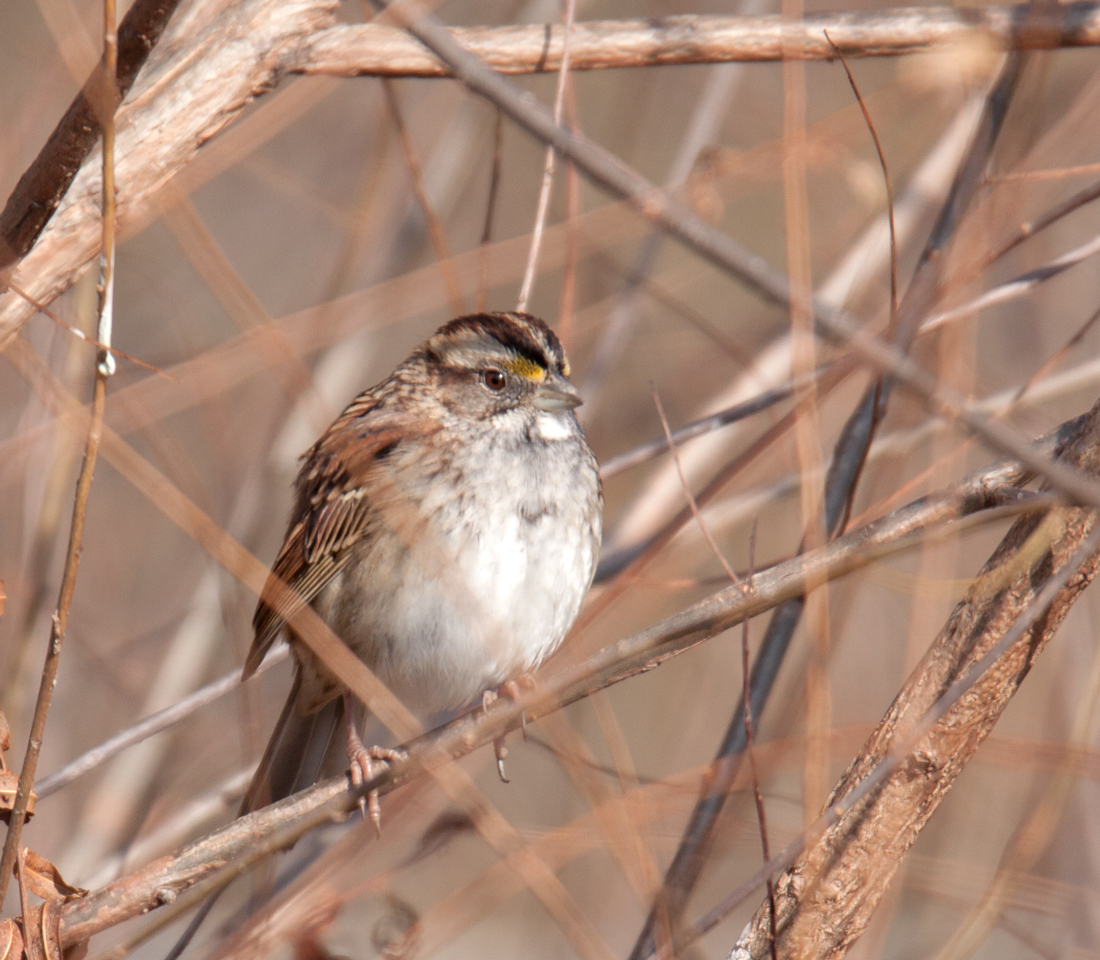
I was really happy when this White-throated sparrow (Zonotrichia albicollis) popped up for a moment and I was able to get this image. I love the facial pattern and colors of this bird, which seems to have a goatee much like my own. (My goatee started out with salt-and-pepper color, but increasingly has become mostly salt).

When researching this bird, I learned that there is another version (morph) of this bird that has brown and tan head stripes, instead of black and white. I will have to look even more closely at my photos of the White-throated sparrow, which has become more common the past few weeks, and see if I have managed to capture any images of the tan-striped variant.

sparrow_white_throat_crop_blog

© Michael Q. Powell. All rights reserved.

Read Full Post »

When I first saw this bird, I knew that it was a sparrow, but couldn’t identify it. I was baffled when I went to my Peterson Field Guide to Birds of North America, because I couldn’t find the sparrow. I went back and forth through the 14 pages covering sparrows, examining carefully the text and illustrations, but none of the species looked like this bird.

I was beginning to doubt my identification skills, so I kept looking through the field guide, desperately hoping to find the bird. On the very last page of the section of the guide with information on bird species, just before all of the range maps, I stumbled across a small section called Old World Sparrows and found the bird—it’s a House Sparrow (Passer domesticus).

Apparently Old World sparrows are non-native (as their name suggests) and are of a different family from all of the other sparrows that I have observed. The Cornell Lab of Ornithology website indicates that House Sparrows were introduced from Europe in 1851 and that they are common in places with houses, because the birds seem to prefer to nest in manmade structures, like the eaves of buildings, more than natural nesting sites. I took these photos at a little manmade lake that is partially surrounded by houses, rather than at the marsh where I do a lot of my shooting, which may explain why I have never noticed this type of sparrow before.

little_bird1_blog

© Michael Q. Powell. All rights reserved.

Read Full Post »

Perched on the end of a railing at the marsh, this sparrow seems lost in thought as it surveys the surrounding area.

Most of the time I try to get as close to my subject as possible, either with a telephoto or macro lens, but in this case I liked this image the moment that I pulled it up on my computer screen. I struggled to find words to explain why I like this particular shot, but the lines, the colors, and lighting somehow combined in a way that I find interesting and pleasing.

sparrow_light_blog

© Michael Q. Powell. All rights reserved.

Read Full Post »

Although it is enjoyable and challenging to try to photograph large, colorful birds, I often find myself returning to photographing smaller, more ordinary birds. It’s a different kind of challenge capturing images of these little birds, who seem to be in constant motion.

This afternoon I was able to photograph this Song Sparrow (Melospiza melodia) when he stopped for a moment to get a drink of water.

sparrow_blog

© Michael Q. Powell. All rights reserved

Read Full Post »

On days when no other birds are visibly active, I can always count on the sparrows to be hard at work, often accompanying their work with a song. As I watched, this sparrow (which seems to be either a Song or Swamp Sparrow) took a break from his activities and burst into song, as though compelled to share his joy and excitement with the rest of the world.

Wouldn’t it be great if we felt that way too and felt free enough to share it with others?

sparrow2_blogsparrow_blog

© Michael Q. Powell. All rights reserved

Read Full Post »

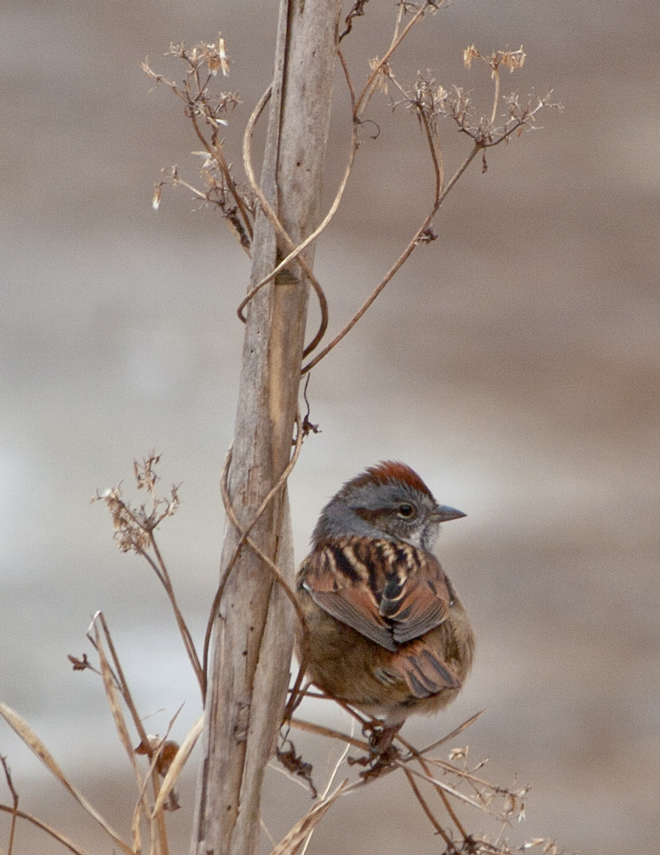
The crisscrossing pattern of the vine and the cooperative pose of the Song Sparrow combine to make this photo one of my recent favorites.

It is always exciting for me when the elements of an image work together in interesting and unexpected ways. I was attempting to photograph this Song Sparrow (Melospiza melodia) when he flew onto this stalk. He was facing away from me, but I kept shooting and them he turned his head. I am not sure that I could have intentionally come up with a more interesting pose—I love the way we are looking down his back and get to see his wings and also get a clear view of his face.

When I first looked at this photo, though, what caught my eyes the most were the crisscrossing vines, an unanticipated bonus. The X-shape of the vine is both linear and curved at the same time and I chose to crop the photo to highlight this feature.

One of the things that keeps me thrilled about photographing nature is the balance between preparation and spontaneity, between technical excellence and creativity. I try to put myself into situations outside in which I know there is a chance that I will see something interesting and then prepare myself (and my camera) to take advantage when something does happen (and it’s usually not what I anticipated).

sparrow_blog

© Michael Q. Powell. All rights reserved

Read Full Post »

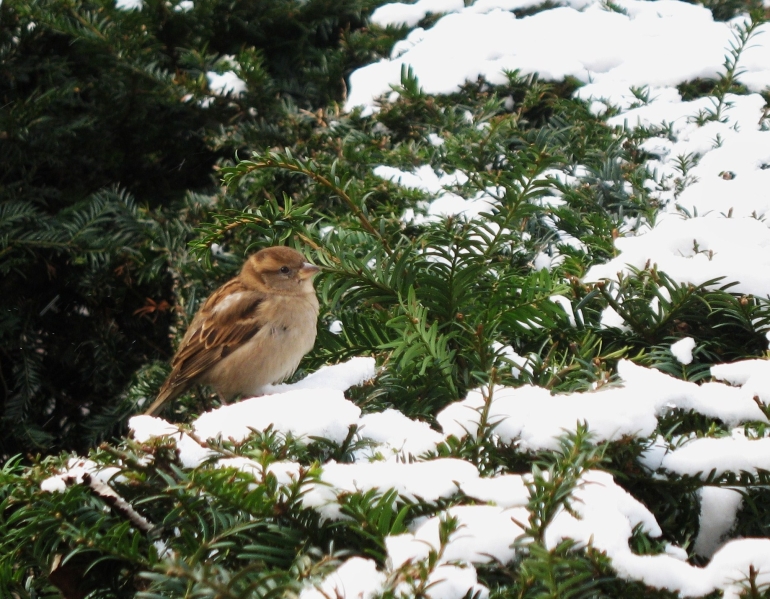
I have been photographing so many birds recently that one of my first thoughts upon arrival in Brussels yesterday was to look for birds. I did manage to get a few shots of some sparrows in a small park near the Central Train Station, the neighborhood in which my hotel is located. However, I quickly realized that the 4X zoom of my little Canon A620 is a limiting factor in getting close enough for a decent shot. I also know that at 7.1 megapixxels, I can’t afford to dramatically crop the photos.

I’m happy with these two images. I captured the first sparrow on a snowy evergreen bush. Snow may not be special to many, but my part of the USA has seen only a very small amount of snow this year. The second sparrow is perched on the railing surrounding the plants and is looking into them. I think he was singing so much that the bottom part of his beak is blurred.

I haven’t yet been able to identify these sparrows, but I wonder if they are different from the ones that I typically see in suburban Virginia.

Sparrow in Brussels

Sparrow in Brussels

Sparrow on a fence

Sparrow on a fence

© Michael Q. Powell. All rights reserved

Read Full Post »

Last month I featured a photo of an American Tree Sparrow (Spizella arborea), a species that is among the most visible and active during the cold, gray days of winter. I should probably caveat my statement about the sparrows being visible, because they are usually only partially visible as they root around in the tangled undergrowth and move quickly from place to place.

Occasionally I manage to get a somewhat clear shot of the American Tree Sparrow and I decided to share a couple of them this morning. The first one shows the sparrow in what I consider his most “natural” environment, mostly surrounded by vines and branches. I like the way he just poked out his head, permitting me to get a clear profile shot. The second image shows a sparrow at the top of cattail, a place where I rarely see them, which made it a little easier to get a clear shot.

Although I may not show photos of some of these smaller birds as often as I post photos of ducks, geese, and herons, I am attempting to photograph them almost every time that I am out shooting. I enjoy the challenge, even if my success rate is relatively low.

sparrow_blogsparrow2_blog

© Michael Q. Powell. All rights reserved

Read Full Post »

It’s almost Christmas. Decorations are visible everywhere and all the radio stations are playing non-stop Christmas music. As I am driving to work, I am reminded of (and sometimes burst into singing) the lyrics of Silver Bells, which include the line, “Strings of street lights, even stoplights, blink a bright red and green, as the shoppers rush home with their treasures.”

Even in nature I am reminded of Christmas. Despite the title of this blog posting, this bird is not called a “Santa bird,” but I enjoy making up names of the creatures that I photograph. Usually I do so when I don’t know their real names, but in this case I know that the bird is a White-throated Sparrow (Zonotrichia albicollis).

His prominent white “beard” and his round belly, though, remind me of Santa Claus, and I can’t help but smile. I recall some of the words of the famous poem ‘Twas the Night Before Christmas, “He had a broad face and a little round belly, that shook when he laughed, like a bowl full of jelly. He was chubby and plump, a right jolly old elf, and I laughed when I saw him, in spite of myself.”

Soon it will be Christmas day.

Santa bird

Santa bird

© Michael Q. Powell. All rights reserved

Read Full Post »

Thia little bird that I photographed this past weekend is not in a tree, but I am pretty sure that he is an American Tree Sparrow (Spizella arborea). The reddish eye stripe and the two-toned bill made this identification easier than usual for me. This sparrow was amazingly active, pecking at a variety of plants close to the ground.

Why is he called a Tree Sparrow if he’s not in a tree? According to the Cornell Lab of Ornithology, the birds were misleadingly named by European settlers reminded of Eurasian Tree Sparrows back home.  American Tree Sparrows are in fact ground birds that forage on the ground and nest on the ground.

Has anyone ever told you that you eat like a bird? If so, I hope they weren’t referring to this sparrow. American Tree Sparrows need to take in about 30 percent of their body weight in food and a similar percentage in water each day, according to the Cornell Lab website.

American Tree Sparrow

American Tree Sparrow

© Michael Q. Powell. All rights reserved.

Read Full Post »

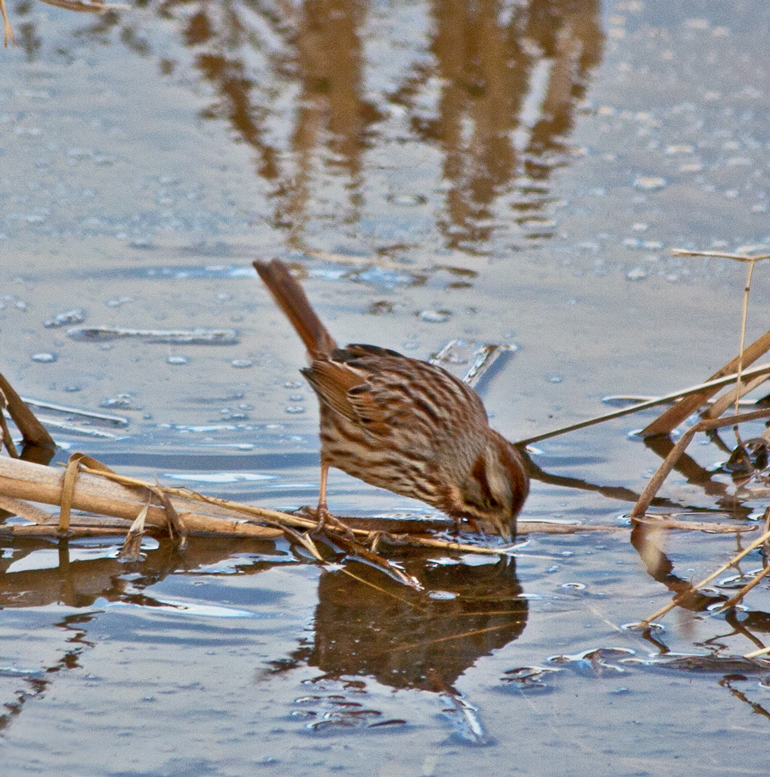
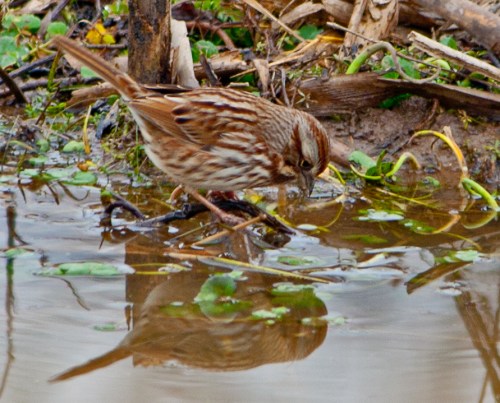
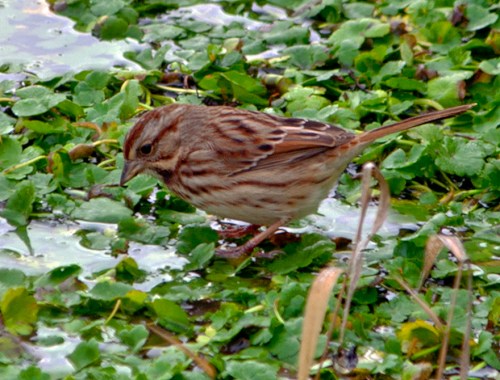
Birds seemed to be everywhere yesterday, foraging for food in the water, on dry land, 0r sometimes in between the. The latter was the case for two little brown birds, pecking for food in the still-green vegetation in the shallow marsh. Sometimes it seemed like they would stop and drink the water or gaze intently into the water, as though fascinated by their own reflection.

I am still not very good at identifying most birds on the spot, but my research skills are improving and I am pretty confident that these birds are Song Sparrows (Melospiza melodia). Gradually I am starting to see the distinguishing characteristics, like the color on the top of the head, the markings on the breast, and the shape and size of the beak.

This growing sense of the broad diversity among birds serves to magnify their beauty, as I see them as individuals, not merely as nameless little brown birds. Who knows, maybe birds appreciate it if you can call them by their names.

drink_blog

bird_green_blog

© Michael Q. Powell. All rights reserved.

Read Full Post »

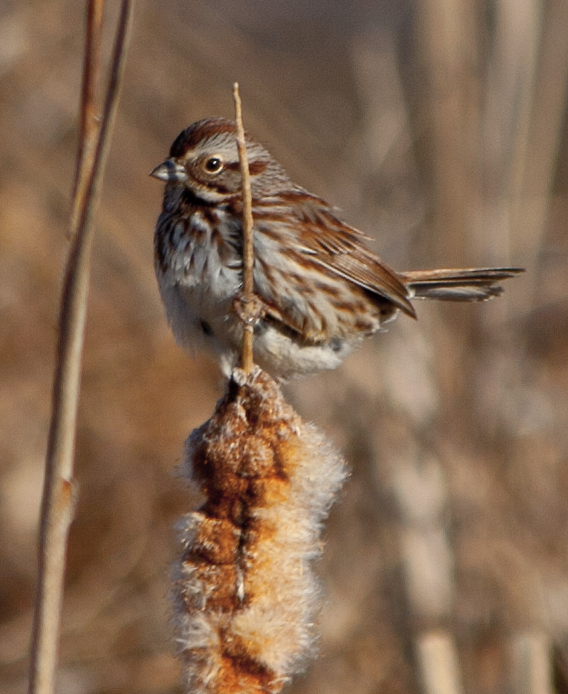
Sparrows generally fall into the general category of “little brown birds” for me and I get frustrated when I try to identify them. I decided, however, that I need to learn more about birds and attempted to identify this little bird that perched atop a cattail and provided me with a photo opportunity this past weekend. After some research on-line, I am pretty confident that this is a Song Sparrow (Melospiza melodia) and I like the way the image captured the beauty of the bird and the fuzziness of the cattails.

I may be wrong about the identification, but my effort has at least caused me to look more closely at the coloration and markings of the birds. I’m pretty sure that I’ll be getting a bird guide (and maybe even some binoculars) soon.

song_sparrow_blog

© Michael Q. Powell. All rights reserved.

Read Full Post »

« Newer Posts