Feeds:
Posts
Comments

Posts Tagged ‘Plathemis lydia’

Dragonflies sometimes look like aliens to me, with their giant eyes and other worldly flying skills. My initial impression of this photo was that it looked like an alien landscape from a science fiction movie—the terrain perfectly matched the subject.

Common Whitetail

So what’s the reality? It’s a female Common Whitetail dragonfly (Plathemis lydia) in the process of depositing eggs in the shallow water at the edge of a pond. She is hovering over the water and then will drop down and dip the tip of her abdomen in the water, causing the concentric ripples you see in the image. A short while later, she repeats the process. What you don’t see in the photo is her mate, who is hovering nearby, keeping watch over her as she ensures the continuity of his genetic line.

There will be more aliens.

© Michael Q. Powell. All rights reserved.
Read Full Post »

As we move deeper into spring, dragonfly nymphs are emerging from the water and starting their transformed lives as acrobatic flyers. This past weekend I spotted some young male Common Whitetail dragonflies (Plathemis lydia) in different stages of development.

Not surprisingly, adult male Common Whitetail dragonflies have white tails—it seems like most species are named after the characteristics of the male. Check out one of my postings from last year to see what a mature adult male looks like. When they first emerge, however, the males have the same body colors and patterns as the females. Fortunately, it’s easy to tell them apart, because the wing patterns are different in the male and female whitetails. (For more information about these dragonflies, take a look at the pages at bugguide.net.)

The dragonfly in the first shot is well on his way to becoming an adult and was bold enough to be flying over the water. The one in the second shot is younger, and seemed to content to remain in the vegetation at a distance from the open water.

A "tween" male--the abdomen is beginning to turn blue, but the adolescent body pattern still shows

A “tween” male–the abdomen is beginning to turn blue, but the adolescent body pattern still shows

An immature male, with the body pattern of a female and the wing pattern of an adult male

An immature male, with the body pattern of a female and the wing pattern of an adult male

© Michael Q. Powell. All rights reserved.

Read Full Post »

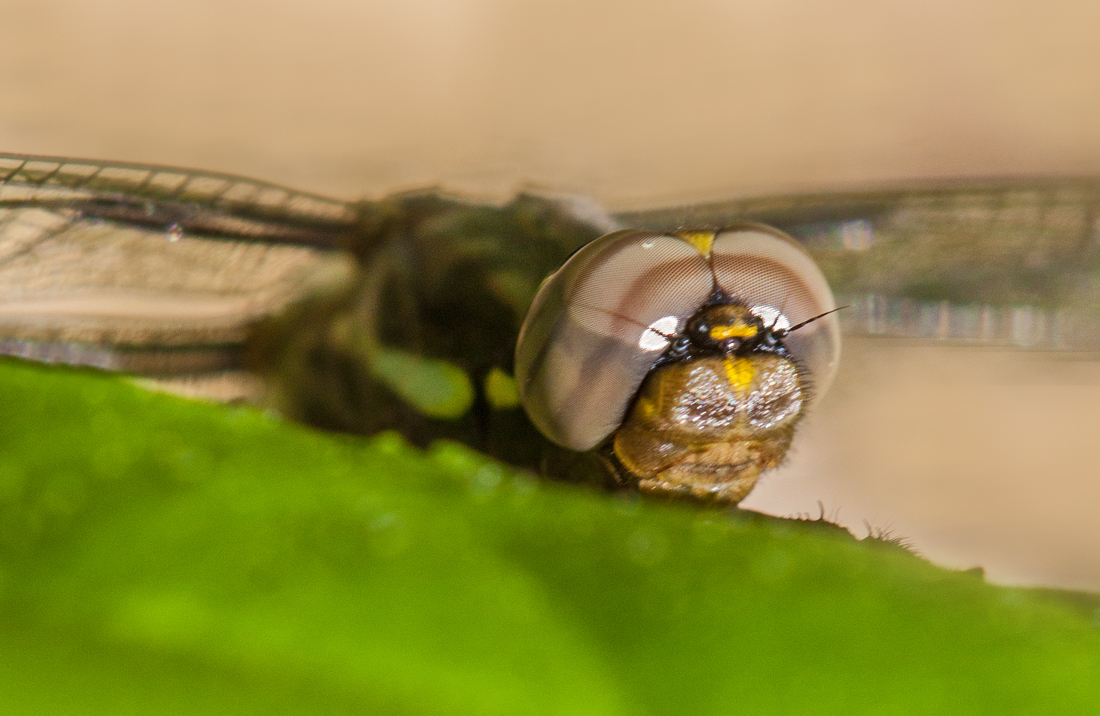
Yesterday, I seemed to be particularly fascinated by insect eyes and did a posting on a fly, whose compound eyes were pretty amazing. However, dragonflies have the largest compound eyes of any insect and I was thrilled to be able to capture this face-to-face shot of a Common Whitetail dragonfly (Plathemis lydia), peering right at me over the edge of a leaf.

A dragonfly’s eyes can have as many as 30,000 facets, known as ommatidia, that contain light-sensitive proteins, according to an article in ScienceBlogs. Although, humans also have these kind of proteins, called opsins, we have only three (red, green, and blue), whereas a dragonfly has four or five, giving it the capability to see colors beyond human visual capabilities. A dragonfly’s eyes also wrap around its head, giving it an incredible field of view. For more information and a more scientific explanation, check out a posting entitled “Super-predators” that Sue did last June in her Backyard Biology blog.

I took this shot in a wooded grassy area adjacent to a pond. It seems that the Common Whitetail dragonflies are hanging out there early in the season and not too many of them are patrolling over the water, as I commonly saw them do last summer. The fact that the dragonfly was not perched on a branch coming out of the water proved to and advantage as I was able to approach pretty closely to it in order to take this shot.

dragonfly_eyes_blog

© Michael Q. Powell. All rights reserved

Read Full Post »

It’s hard to imagine an odder couple than this dragonfly and this turtle, sunbathing together on a log in the beaver pond. What do they see in each other? How do they communicate? Love seems to find a way to overcome obstacles like these.

One thing is clear—they are happy together, sharing this special moment in the warmth of the sun. If you don’t believe me, check out the smile on the turtle’s face.

fun_blog

© Michael Q. Powell. All rights reserved

Read Full Post »

Some of my favorite images are almost minimalist in their approach, like this shot of a male Common Whitetail dragonfly (Plathemis lydia).

The composition is simple, the color palette is limited, and there is a pretty good amount of negative space. The subject is not unique and unusual—its name even indicates that it is “common.”

I managed to capture some of the details of the dragonfly, though, like the “hairs” on the legs (click on the image to see a higher resolution view), though the image is not super sharp. The shadow of the wings on the green leaf adds an additional touch of visual interest to the image.

The photo is not spectacular and showy, but I find a real beauty in its quiet simplicity.

whitetail_A_blog

© Michael Q. Powell. All rights reserved

Read Full Post »

Although I usually try to get close-up shots of dragonflies, there is something really peaceful about this longer distance shot of a male Common Whitetail dragonfly (Plathemis lydia) from this past weekend. I really like the arc of the branch and the reflection of both the branch and the dragonfly in the still water of the marsh. If you click on the image, you’ll see that there is a pretty good amount of detail in the dragonfly—I chose not to highlight those details in this posting.

Click the photo to see a higher resolution view.

Click on the photo to see a higher resolution view.

Michael Q. Powell. All rights reserved

Read Full Post »

Who hasn’t wished for an extra set of hands to get more done in this multi-tasking world?

When I first looked at this photo that I took of a male Common Whitetail dragonfly (Plathemis lydia), it looked like he had grown two extra sets of wings. Had a genie granted one of his wishes? Could he now fly faster than his friends (he is a male, after all)? Will this impress the ladies?

A close look at the image, however, reveals that the extra wings are merely illusions, shadowy reflections of a more ordinary reality.

That doesn’t mean, though, that he has ceased to dream and to wish from time to time for those extra wings.

wings_blog

Michael Q. Powell. All rights reserved

Read Full Post »

Yesterday was warm and humid, which felt almost like summer here and brought out more dragonflies.

The sun was a little harsh just before noon, but I couldn’t help chasing after the dragonflies and got this shot of a male Common Whitetail dragonfly (Plathemis lydia).

head-on_blog

Michael Q. Powell. All rights reserved

Read Full Post »

Is it just me, or does this image look like it came from a low budget science fiction movie, with a strange-looking alien creature hovering over a Martian landscape?

I was chasing dragonflies again this past weekend, trying to capture images of them in flight, and ended up with this image of a female Common Whitetail dragonfly (Plathemis lydia). It’s pretty tough to try to track these flying insects with a hand-held telephoto zoom lens extended to almost 400mm. My autofocus seemed too slow and I adapted a technique of trying to focus manually, while trying to keep the lens steady. I can’t tell for sure if this image was auto-focused or was manually focused.

Female Common Whitetail dragonflies do not have a white tail and in many ways that makes them a little easier to expose correctly. The wings are blurred, but you can still see the brown markings that identify this as a female, and not an immature male.

Last summer I was content to get a shot of a dragonfly when it was stationary, but this summer I am going to work hard to capture some more images of dragonflies in flight.

whitetail2_blog

Michael Q. Powell. All rights reserved

Read Full Post »

Although most people probably associate the descriptor “whitetail” with deer, it’s also part of the name of this dragonfly that I photographed yesterday, an immature male Common Whitetail dragonfly (Plathemis lydia).

I remember seeing the adult male Whitetail a lot last summer, and its body is a chalky white in color, as its name suggests. Males start out looking a lot like the female, which has a brown body with some white or yellow markings, according to Bugguide. However, it’s relatively easy to tell the immature males from the females, because their wing patterns are different. Males have wider bands of brown and clear wingtips (no, they are not wearing dress shoes—I am talking about the literal tips of the wings).

I am sure that I’ll get lots more photos of Common Whitetail dragonflies this summer, including some in much better light, but it was nice to see them appearing already in April.

dragonfly1_blog

Michael Q. Powell. All rights reserved

Read Full Post »

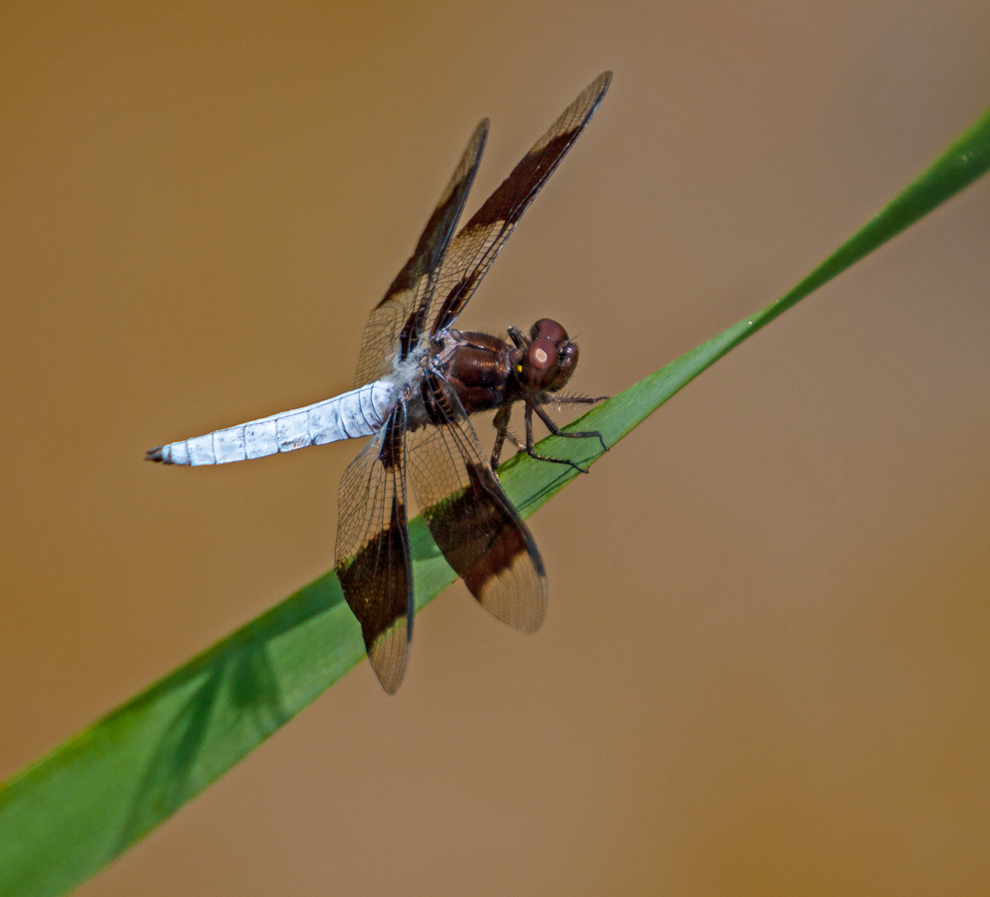
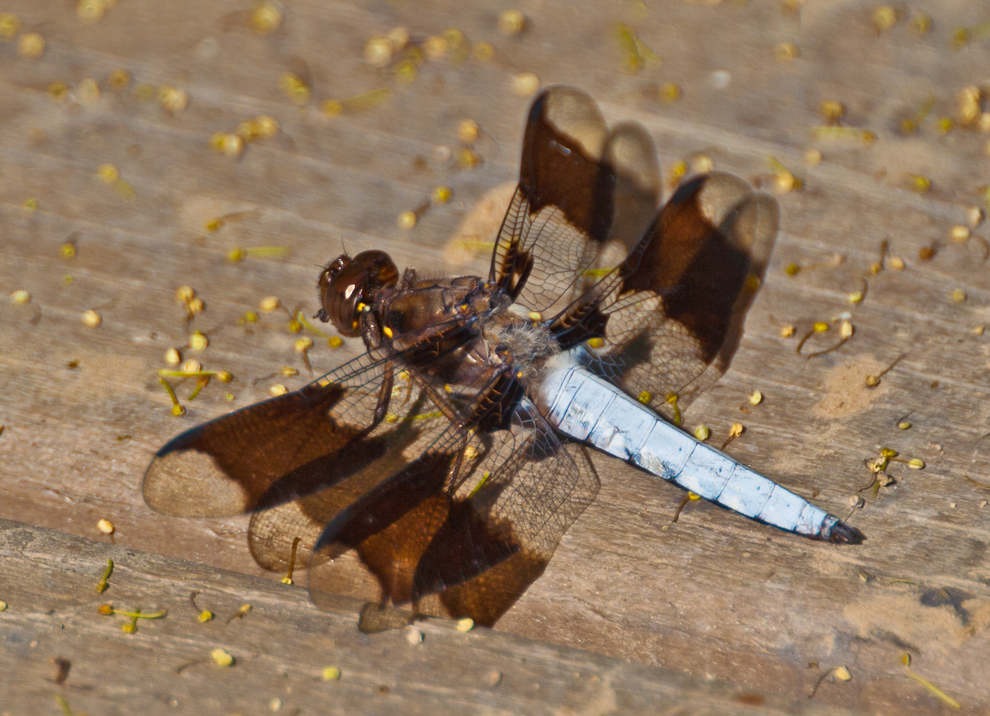
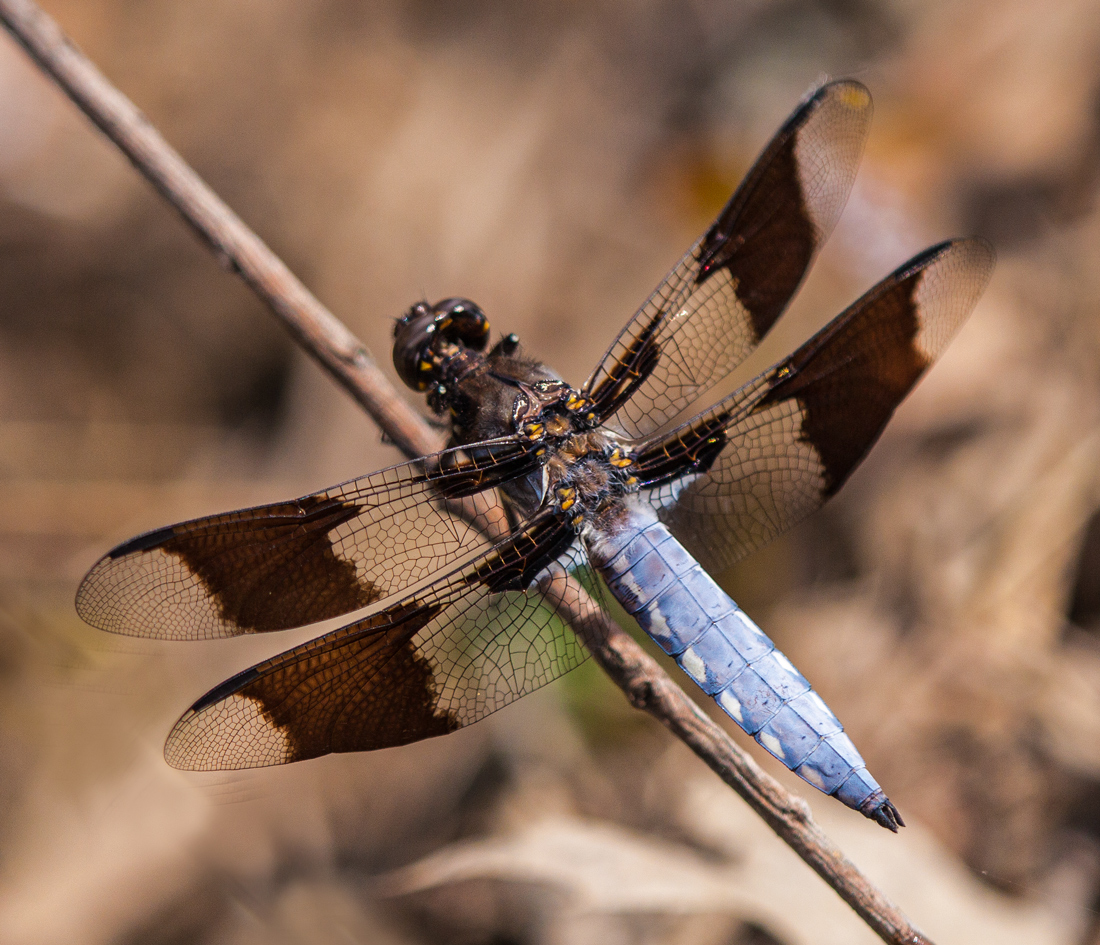
Blue Dasher dragonflies seem to have disappeared from my local marshland, but I was happy today to see that the Common Whitetail dragonflies (Plathemis lydia) are still around. They are not as elegant and colorful as some other dragonflies and are somewhat stubby and drab (and, in fact, are called “common”). My portrait below shows, however, that they possess their own special beauty.

Common Whitetail dragonfly in mid-September

© Michael Q. Powell. All rights reserved.
Read Full Post »

I took this photo at Huntley Meadows Park in Alexandria, Virginia, a marshland area that has lots of wildlife. I have managed to get lots of shots of Blue Dasher dragonflies but have had trouble getting a properly exposed image of the Common Whitetail dragonfly. The white body is usually blown out and overexposed in my images. (If you want to know some more about this type of dragonfly, check out the article in Wikipedia as a start.) This past Friday was mostly overcast and I finally got some decent photos.

I like the way this particular image turned out because of the dragonfly’s reflection in the muddy brown pond water, the little stump that pokes out of the water, and the green stalk that runs diagonally across the photo.

Male Common Whitetail dragonfly (Plathemis lydia), also known as a Long-tailed Skimmer.

© Michael Q. Powell. All rights reserved.

Read Full Post »

« Newer Posts