Feeds:
Posts
Comments

Posts Tagged ‘Occoquan Bay National Wildlife Refuge’

Adult Bald Eagles (Haliaeetus leucocephalus) are easily identifiable because of their white heads, but it actually takes four years for them to grow “bald.” In earlier stages of development their beaks and eyes are dark and their feathers are mottled. Experienced birders can tell the precise age of a juvenile by bald eagle simply by its coloration.

This juvenile eagle that I was excited to photograph on Tuesday at Occoquan Bay National Wildlife Refuge appears to be about two to three years old. The beak has turned yellow excepted for the tip and its eyes, which are dark brown when they are really young, look like they are starting to get almost as light as those of an adult. If you want to learn more about the developmental stages of a bald eagle, check out this interesting article by Avian Report on Juvenile and Immature Bald Eagles.

The young eagle was flying above the water, apparently looking for fish, when I captured these images. I tracked it for quite a while, but never did see it pull a fish out of the water. Still, I was happy with my images and definitely enjoyed my time basking in the warmth of a sunny spring-like day as I watched and waited.


Bald Eagle

Bald Eagle

© Michael Q. Powell. All rights reserved.

Read Full Post »

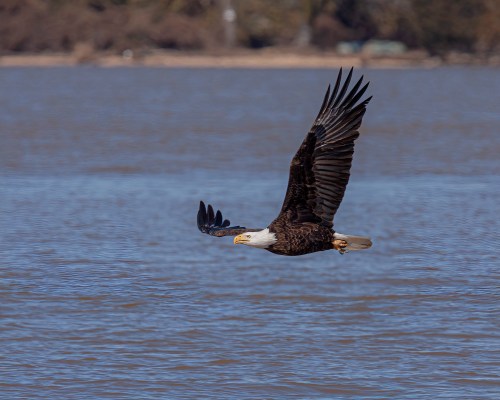
I did not have much time to react yesterday when this Bald Eagle (Haliaeetus leucocephalus) zoomed past me, flying low over the waters off of Occoquan Bay National Wildlife Refuge, so I was thrilled to capture this image. I am not really sure where the eagle was headed, but it looked like he was fiercely focused on getting there quickly.

Photographing birds in flight is rarely easy. If you spot the bird when it is far away, you might have time to check your settings, calmly track the bird as it approaches, and shoot off a burst of shots at the decisive moment. That ideal situation almost never happens in my world. More often than not, the bird seems to come out of nowhere and I frantically raise my camera to my eye and try to find the bird in my viewfinder and focus on it, never knowing for sure if the camera settings will be anywhere near appropriate.

Yesterday, I managed to snap off only three shots of the eagle and only one came out in decent focus. I decided to include the second photo to give you an idea of what I was seeing through the viewfinder—it is slightly edited, but uncropped. I end up cropping most of my images, which sometimes gives the impression that I was closer to the subject than I actually was.

As you can see the eagle was quite large in the frame in this case, which meant that my heart was really racing as I scrambled to get the shot before it was too late. For those of you who might be curious, I captured the image with my Canon 50D and Tamron 150-600mm lens at 500mm with settings of f/8, 1/1250 sec and ISO 400.

In some ways I am just using a point and shoot technique when I photograph birds in flight, but it is much more sophisticated than what most people think when they hear the words “point and shoot.” After thousands and thousands of shots, I have built up reflexes and muscle memory that help me to react quickly and instinctively in situations like this. There are no guarantees of success, of course, but I have reached a point in my development as a photographer that I feel like I have a fighting chance of getting a decent shot in some pretty challenging shooting situations.
 

Bald Eagle

Bald Eagle

© Michael Q. Powell. All rights reserved.

Read Full Post »

Sparrows are so industrious as they poke about in the underbrush that I rarely get a clean look at one. I was happy therefore that I managed to get a shot of this Song Sparrow (Melospiza melodia) when it perched momentarily on some vegetation amidst the thorny stalks recently at Occoquan Bay National Wildlife Refuge.

We have had quite a number of small snow and ice storms this winter, but it has proven difficult to capture images of bird against a snowy background. I am happy here that the sparrow chose to perch in a tiny patch of snow that adds a bit more visual interest to the shot. Several viewers yesterday commented that they like it when I show more of the bird’s environment in my photos, so I decided not to crop in too closely today.

Song Sparrow

© Michael Q. Powell. All rights reserved.

Read Full Post »

Sometimes my potential subjects are immediately visible and there are no obstructions between the us. In other cases, I have to look more deeply through the trees or vegetation to spot a distant subject.

Spotting the subject, though, is only the start. Oftentimes the bigger challenge is to find a visual tunnel that gives the clearest possible view of the subject. I frequently find myself leaning, kneeling, bending, and standing on my tiptoes as I consider my options.

When circumstances permit, I am able to capture images like this one of a perched Bald Eagle (Haliaeetus leucocephalus) that I saw a couple of weeks ago at Occoquan Bay National Wildlife Refuge. It is not as dynamic as some of my shots of the eagles building their nests, but I really like the mood of this little portrait and I am happy with the way that I was able to capture the ruffled feathers of this majestic bird.

Bald Eagle

© Michael Q. Powell. All rights reserved.

Read Full Post »

As the waves rhythmically struck the rocky shoreline, the Great Blue Heron (Ardea herodias) slowly moved forward, all of his attention focused on one small spot. It was lunchtime on Wednesday at Occoquan Bay National Wildlife Refuge and this heron was hungry. I watched and waited and finally the heron struck the water with a mighty thrust. When he pulled his bill out of the water, it was empty.

The heron paused for a moment and seemed pensive, wondering perhaps if he was looking for lunch in all the wrong places.

Great Blue Heron

© Michael Q. Powell. All rights reserved.

Read Full Post »

Timing is a critical skill in taking wildlife photographs (and in telling the lame jokes I so enjoy), and I was thrilled to capture this image last Friday as a Bald Eagle (Haliaeetus leucocephalus) was lifting off from its nest high in a tree at Occoquan Bay National Wildlife Refuge. I kept my wits about me and was able to track the eagle and get a few shots as it flew parallel to me  before turning and flying away.

If you remember yesterday’s posting with the singing eagle, you can’t help but notice the contrast in the sky colors. On Monday of last week, we had brilliant blue skies, which have been rare this winter, but when I took these photos a few days later, we had reverted to the gloomy, gray skies that are more typical.

Without the glare, I didn’t have to worry about blowing out the details of the eagle’s bright white head and tail, which was a definitely plus, but my camera and lens combination tends to work best when I have better light. Nonetheless, it is always a joy to successfully capture images of birds in flight, especially bald eagles.

I am particularly happy with the eagle’s wing positions in the final photo, though I dud have to crop it in an unusual way because it was near the bottom of the frame in the original shot—if the eagle had extended the wings, they would surely have been cut off in my shot.

Bald Eagle

Bald Eagle

Bald Eagle

© Michael Q. Powell. All rights reserved.

Read Full Post »

Bald Eagles (Haliaeetus leucocephalus) never seem happy and frequently look fierce or even angry. OK, I know that I am sometimes guilty of anthropomorphism, attributing human traits, emotions, or intentions to my wildlife subjects. How can you tell if an eagle is happy when their massive inflexible beaks make them physically incapable of a smile?

We often consider music to be a signal of happiness and songbirds sound happy. What about eagles—can they sing? I usually think of eagles as “screaming” rather than “singing,” but this image that I captured last week at Occoquan Bay National Wildlife Refuge makes me wonder if eagles can express their joy or their love in their songs.

What do you think? Does this eagle look happy to you?

Bald Eagle

© Michael Q. Powell. All rights reserved.


Read Full Post »

There may not have been much snow on Friday at Occoquan Bay National Wildlife Refuge, but the whole world was a whiter shade of pale at water’s edge, except for this handsome male Northern Cardinal (Cardinalis cardinalis).

Northern Cardinal

© Michael Q. Powell. All rights reserved.

Read Full Post »

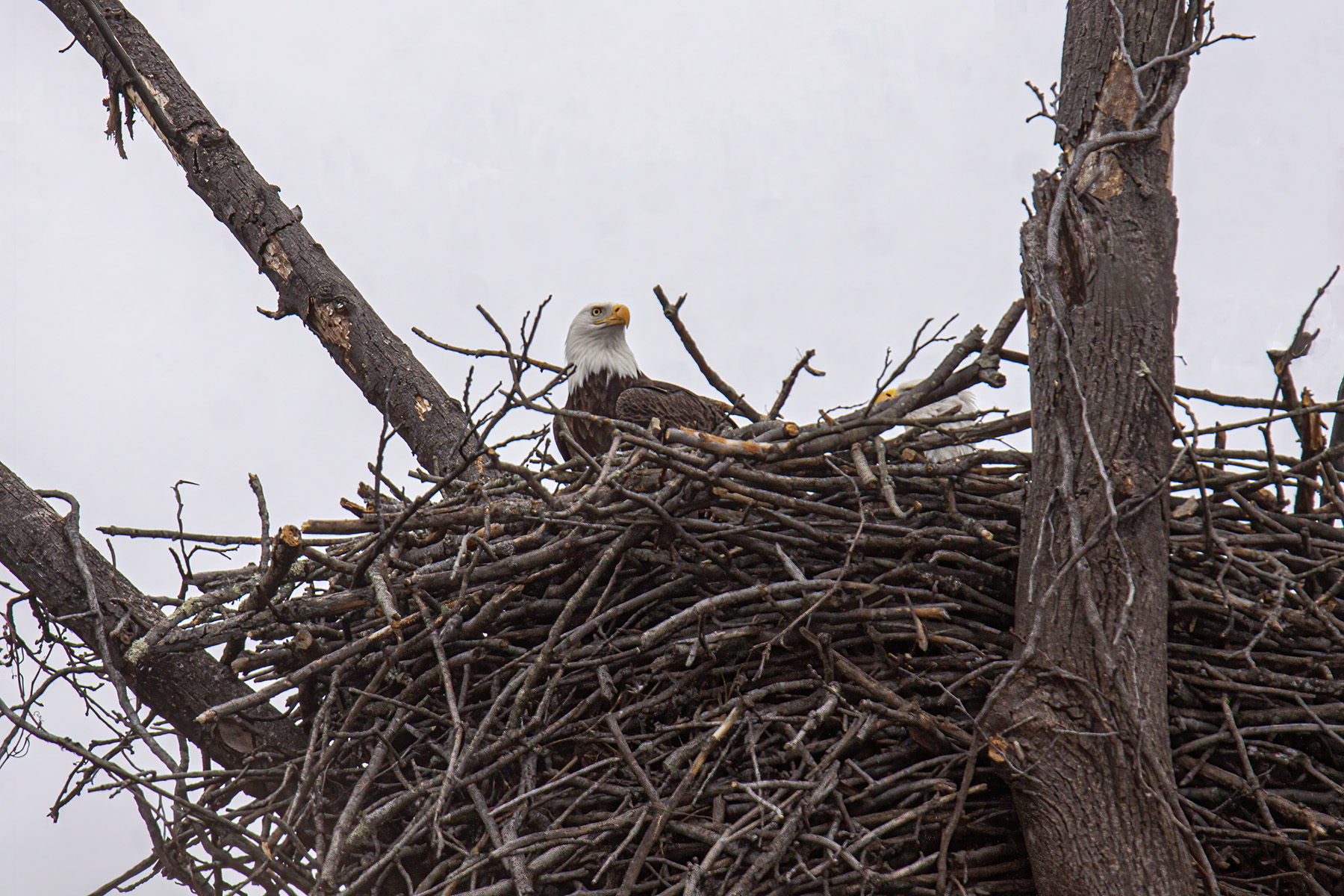
The Bald Eagle (Haliaeetus leucocephalus) was hunkered down in its large nest last week at Occoquan Bay National Wildlife Refuge but still managed to keep an eye on me through a peephole between the branches. (You may need to enlarge the first image to see the eagle, in what has been described by one of my friends as a “Where’s Waldo?” photo.) Earlier I had seen both of the eagles fly into the nest and they promptly disappeared from sight—one left a short time later.

As I watched and waited, I realized that I would have a tough time timing any shots of the eagle leaving the nest. When a bird is perched, I look carefully for indications that the bird is preparing to depart, hoping to be able to capture a decisive moment. The second shot below was the best that I could manage when I reacted to the appearance of a wing tip over the edge of the nest.

I have no way of judging the dimensions of the interior of the nest, but it looks to be really big and really deep, as you can see in the final photo. In the past, it has been hard to spot eaglets in this nest until they are old enough to climb around a little and pop their heads over the edge of the nest. I hope to see some little ones in this nest later this season.

Bald Eagle

Bald Eagle

Bald Eagle nest

© Michael Q. Powell. All rights reserved.

Read Full Post »

For almost a year now we have been taking defensive measures to minimize our risks—we now must cautiously consider our actions before we take them. “Spontaneity” has almost disappeared from our active vocabulary. Were we ever completely carefree?

When I first looked at this photograph of a Carolina Wren (Thryothorus ludovicianus) that I spotted on Monday at Occoquan Bay National Wildlife Refuge, I immediately saw it as a kind of visual metaphor for my life. Surrounded by thorns in an almost monochromatic world, this serious-looking little bird cautiously contemplates its surroundings. Is it safe yet?

No, it is not yet safe, but there are signs of hope that things are improving. Vaccinations have started and here in the Northern Hemisphere, there are already small indications that spring is on the way. The birds are preparing their nests and buds are appearing on the trees.

Our celebrations may still be muted, but even now there is joy to be found. Don’t forget to stop and look for it in today—joy in the midst of caution.

Carolina Wren

© Michael Q. Powell. All rights reserved.

Read Full Post »

My spirits are instantly lifted whenever I see an Eastern Bluebird (Sialia sialis), like this handsome male that I spotted last week at Occoquan Bay National Wildlife Refuge. Many of the bluebirds that I have seen in recent years have been a bit dull blue in color, but the blue of this bird was positively electric—it was startling how bright and vibrant it was. I definitely felt recharged after my encounter with this little bird.

Eastern Bluebird

Eastern Bluebird

© Michael Q. Powell. All rights reserved.


Read Full Post »

It is hard to get a good exposure of the feathers on the head of a Bald Eagle (Haliaeetus leucocephalus). When the lighting is too strong or direct, the bright white head risks being overexposed and the details often disappear. Even under good circumstances, the head often looks like the slicked-down hair of a 1950s greaser. I was thrilled last week when I managed to capture fluffy head feathers in this shot of a pensive eagle in the early morning sunshine at Occoquan Bay National Wildlife Refuge.

Bald Eagle

© Michael Q. Powell. All rights reserved.

Read Full Post »

Many female ducks are a muted shade of brown and it is sometimes difficult to determine their species. Often I have to rely on other characteristics, like the shape and color of their bills. It was on that basis that I decided that this duck that I spotted on Monday at Occoquan Bay National Wildlife Refuge was a female Canvasback (Aythya valisineria).

According to the Cornell Lab of Ornithology, a canvasbacks is “a large, big-headed diving duck with a gently sloping forehead and a stout neck. Its long bill meets the sloping forehead, creating a seamless look from the top of the crown to the tip of the bill.”  Indeed, the sloping forehead was the first thing that I noted when I spotted this bird among a group of smaller scaups and ruddy ducks.

Canvasbacks are one of the many species of ducks that spend their winters with us and then fly north for breeding. They always seem to stay out in the deeper waters, so I have not yet gotten a close-up shot of a Canvasback.


Canvasback

© Michael Q. Powell. All rights reserved.

Read Full Post »

Last Thursday I enjoyed watching a Bald Eagle (Haliaeetus leucocephalus) couple working on rebuilding their nest at Occoquan Bay National Wildlife Refuge. One member of the couple remained in the nest while the other one went off in search of sticks to add to the nest. Together they worked to arrange the new sticks and slowly seem to be raising the height of the walls of the nest. If you click on the images, you can get a closer look at the eagles and their building materials.

For those of you who have been following my posts on the two eagle nests at my favorite wildlife refuge, this is the “small” one, the one that was damaged last summer when a branch broke off. It is a bit of a race to see if the nest will be in good enough shape when the eagles are ready for nesting, but I am really hopeful that it will be. I will be keeping an eye on the nest and will continue to provide updates.

Bald Eagle

Bald Eagle

Bald Eagle

© Michael Q. Powell. All rights reserved.

Read Full Post »

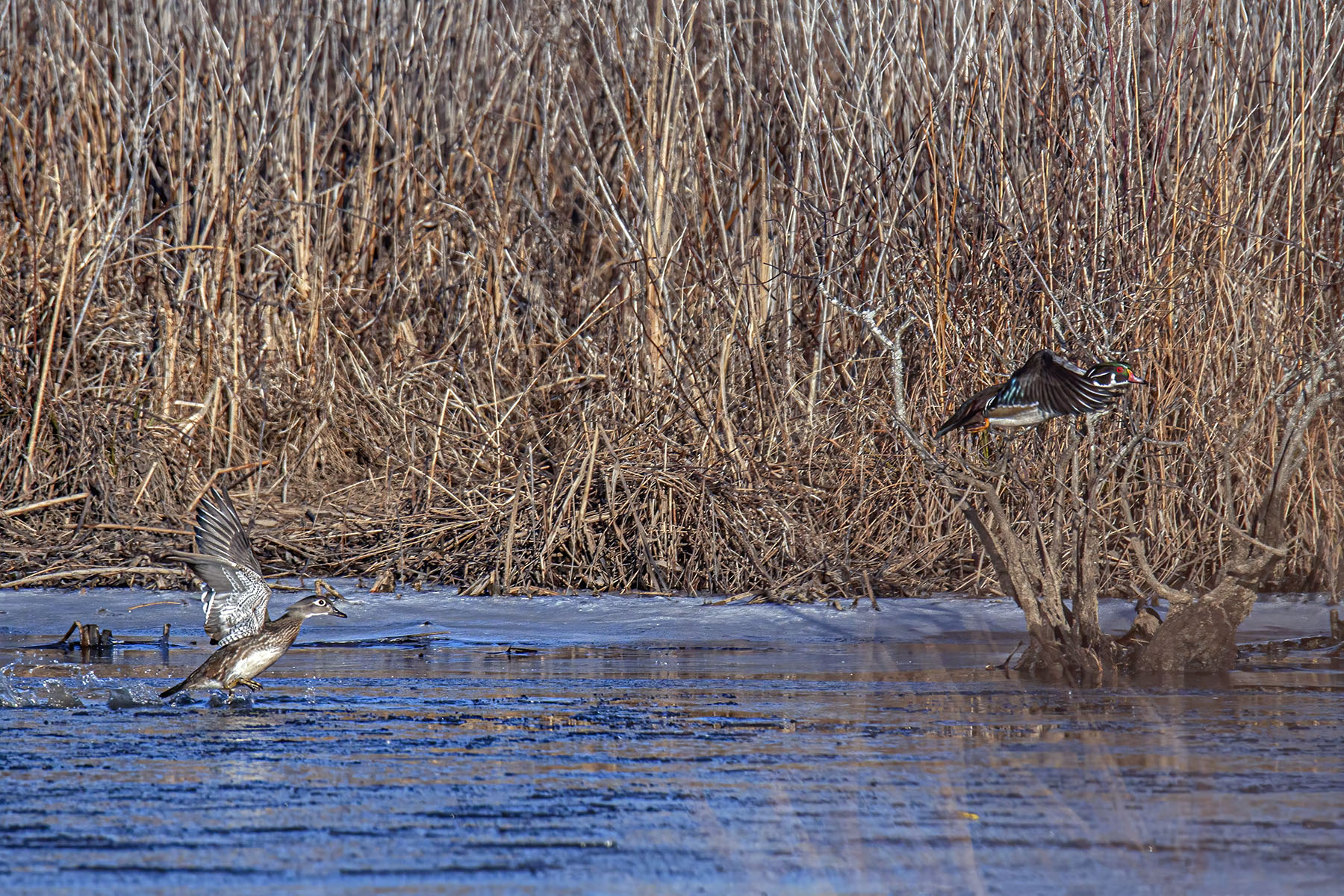
Wood Ducks (Aix sponsa) in my area are really skittish and often take to the air before I have even spotted them—they make a very distinctive and loud noise when disturbed and taking flight. Last week at Occoquan Bay  National Wildlife Refuge, however, I was fortunate to spot a pair of wood ducks at the far side of a small pond and snapped off a shot of them before they could react to my presence. Fortunately I kept shooting and managed to capture some in-flight shots as they were taking off.

Wood ducks are probably the prettiest of all of the ducks where I live. The stunning colors and patterns of both the female, on the left, and the male are breathtaking, especially when the light is good.

wood ducks

wood ducks

wood ducks

© Michael Q. Powell. All rights reserved.

Read Full Post »

At the edge of a small pond a solitary Great Blue Heron (Ardea herodias) hunched over, trying to stay warm on a frigid winter morning last week at Occoquan Bay National Wildlife Refuge. From a distance, it looked like the heron had wrapped itself in a shaggy winter coat.

The heron did not move from its single-legged pose as I passed, but seemed to be tracking me with its half-opened eyes, judging that I did not represent a threat.  There was no need to expend its precious energy in avoiding me.   Great Blue Heron

© Michael Q. Powell. All rights reserved.


Read Full Post »

It is hard to predict how a Bald Eagle (Haliaeetus leucocephalus) will take off. Will it fly up or down of maybe sidewards? Will it push off its perch or flap its mighty wings and ascend upwards? Will it wait until I am ready or wait and wait until I am not?

This past Thursday I was fortunate to capture an image of this bald eagle as it was leaving its perch at Occoquan Bay National Wildlife Refuge. The eagle was high in a tree and quite a distance away, but I was able to steady my camera on my monopod and capture a decisive moment. Be sure to check out all of the cool details on the eagle’s body, like the rows of chest feathers and the very sharp-looking talons.


Bald Eagle

© Michael Q. Powell. All rights reserved.

Read Full Post »

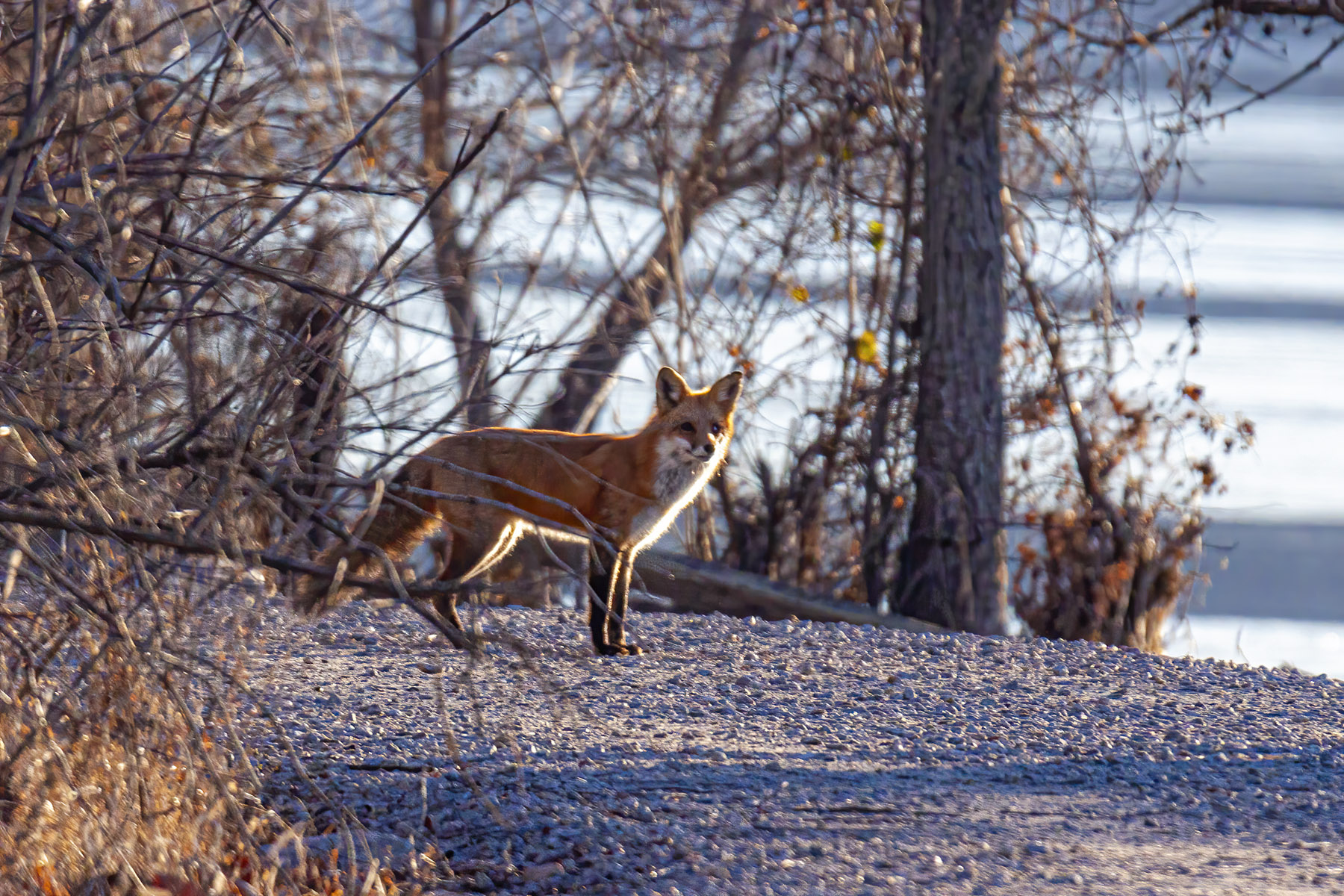
Out of the corner of my eye I detected some movement on the ground as I was looking up at an eagle nest early Thursday morning at Occoquan Bay National Wildlife Refuge. As I turned my head, a shadowy form emerged out of the brush and began to trot down the trail—it was a Red Fox (Vulpes vulpes).

I do not see foxes very often at this refuge and have been told that most of them have been killed by the resident coyotes, so this was a pleasant surprise. I tried to focus on the fox as it moved away from me, but my photos were mostly out of focus and featured only the legs and tail of the fox. Then the fox stopped and looked back in my direction for a moment and I was able to capture this image as we stared momentarily at each other.

Red Fox

© Michael Q. Powell. All rights reserved.

Read Full Post »

A lot of birds puff up their feathers to stay warm in the cold weather, but I don’t know that I have ever seen a more extreme case than this spherical White-throated Sparrow (Zonotrichia albicollis) that I spotted yesterday morning at Occoquan Bay National Wildlife Refuge.

It was right around the freezing mark and I must confess that I was bundled up in multiple layers and also looked a bit more rotund than normal. It is well known that the camera adds ten pounds and makes you look heavier. When it comes to staying warm, all vanity goes out the window for me.

White-throated Sparrow

© Michael Q. Powell. All rights reserved.

Read Full Post »

I could hear rustling in the fallen leaves along one of the trails yesterday at Occoquan Bay National Wildlife Refuge, but had trouble determining what was making the noise. Most of the time, sparrows fly away in similar situations, but this little creature seemed to be crawling about, moving in one direction undeterred by my presence. When I finally got a partial glimpse of it, I realized that it was a Winter Wren (Troglodytes hiemalis).

The Cornell Lab of Ornithology describes the appearance and behavior of the Winter Wren in these words, “It sports a palette of browns with dark barring on the wings, tail, and belly. It habitually holds its tiny tail straight up and bounces up and down. This rather weak flier hops and scampers among fallen logs mouselike, inspecting upturned roots and vegetation for insects.” Wow. I don’t recall any other instance of the term “mouselike” being used to describe a bird, but it fits pretty well.

The little Winter Wren was a ball of energy, moving all the time in and out of the vegetation, making it hard to track and even harder to photograph. Eventually it hopped up onto a perch for a few seconds and I was able to capture the first two images. Most of the time, though, it was hidden in the undergrowth, even when it was mostly exposed as in the final image, which gives you a good idea of its habitat.

I really encourage you to click on the images to get a closer view of the different shades of brown and detailed patterns on this beautiful little Winter Wren.


Winter Wren

Winter Wren

Winter Wren

© Michael Q. Powell. All rights reserved.

Read Full Post »

Northern Flickers (Colaptes auratus) have so many different colorful patterns that they sometimes remind me of patchwork quilts. If I were to be dressed in clothing with dots and stripes and patterns, I probably would look really weird, but somehow the flickers pull it off amazingly well. Compared to other woodpeckers, the flickers are fashion stars.

In addition to the patterns, they also have pops of accent colors, like the red on the back of the head, a black mustache, and bright yellow on the inside of the wings. (If you click on the image to see the details, you get a tiny glimpse of that bright yellow on the edge of the lower wing.)

I spotted this handsome male—females do not have the black mustaches—during a recent visit to Occoquan Bay National Wildlife Refuge. Believe it or not, I don’t spend all of my time observing the bald eagles at the refuge.


Northern Flicker

© Michael Q. Powell. All rights reserved.

Read Full Post »

As I noted in a posting last week, I am currently keeping an eye on two bald eagle (Haliaeetus leucocephalus) nests at Occoquan Bay National Wildlife Refuge. Eagle couples have actively used both nests in each of the years that I have been visited this refuge. In that earlier posting, I provided a look at one of them, a really large nest.

Today I am featuring the second one, which has always been quite small. During this summer, I noticed that it had gotten even smaller. I can’t tell for sure what happened, but it looks like one of the supporting branches may have broken off and a significant portion of the nest was dumped on the ground. I was afraid that the eagles would abandon the site and rebuild at another location.

I was thrilled therefore when I spotted the couple last week engaged in some reconstruction efforts that I documented in the posting Carry a big stick with a shot of an eagle carrying a large branch to this small nest. The first two photos, which I took last Monday, show the current size of the nest. For comparison purposes I included the final photo which is from January 2019—it looks to me like the nest was considerably larger two years ago.

The refuge has blocked the trails near this nest to keep the eagles from being disturbed, but I am able to get photos like these from the barrier that blocks the road. I’ll continue to watch the nest as often as I can and I am hopeful that the eagle couple will be able to restore it well enough to use for nesting this year.


bald eagle

bald eagle

bald eagle

© Michael Q. Powell. All rights reserved.

Read Full Post »

When I am walking about with my camera at Occoquan Bay National Wildlife Refuge, my favorite local spot for wildlife photography, my eyes are in constant motion. I don’t want to miss the eagles perched high in trees or soaring overhead, but I also don’t want to miss the small birds that I can hear poking about in the underbrush.

I am amazed at how much noise these little birds can make as they pick their way over, under, and through the carpets of fallen leaves. This past Wednesday I was really happy when this Carolina Wren (Thryothorus ludovicianus) perched momentarily on a fallen branch. I love this wren’s beautiful brown coloration and the wonderful accents provided by the eye stripe and detailed pattern on its long tail. After its brief pause, the wren resumed its energetic pursuits and disappeared from sight.

Carolina Wren

© Michael Q. Powell. All rights reserved.

Read Full Post »

I am now keeping an eye on two Bald Eagle (Haliaeetus leucocephalus) nests at Occoquan Bay National Wildlife Refuge. As far as I can tell, the eagles are not yet sitting on eggs and are still in the process of repairing and preparing the nests. Despite this increased activity, catching the eagles at the nest is very much a hit-or-miss proposition.

One of the nests is a very large one that I have featured multiple times in this blog, most recently in a posting on 18 January entitled Eagles in the sunlight. This past Monday, both members of the eagle couple were working on the nest and I was thrilled to capture some shots of them. I generally had to wait for them to take a break in order to get a clear shot—when their heads are buried in the branches making adjustments, their bodies more or less disappear from view.

The nest is big enough that the two eagles can both work on it at the same time. Female eagles tend to be larger than males and I think the eagle in the first image is the female. She seemed to be doing most of the work on the nest, while the other eagle, pictured in the second and third shots, periodically flew away and seemed to come back with additional small branches.

I was trying to capture a shot of both of them in a single frame when I snapped the final photo. The eagle on the left started to take off and I shifted my camera slightly and almost cut the second eagle out of the frame. I thought about cropping the second eagle out, but decided I liked the wider view of the nest provided by leaving the eagle in place. As always, I encourage you to click on the images to get a closer look at the eagles and their enormous nest.


Bald Eagle

Bald Eagle

Bald Eagle

© Michael Q. Powell. All rights reserved.


Read Full Post »

I really like the subdued beauty of female Northern Cardinals (Cardinalis cardinalis), although this one that I spotted last week at Occoquan Bay National Wildlife Refuge was such a messy eater that I wanted to pass her a napkin. The red coloration of male cardinals make them much easier to spot than  females, but sometimes the red seems so bright that it is almost garish. The female has delicate accents of red that I find more refined and at least equally appealing.

Northern Cardinal

© Michael Q. Powell. All rights reserved.

Read Full Post »

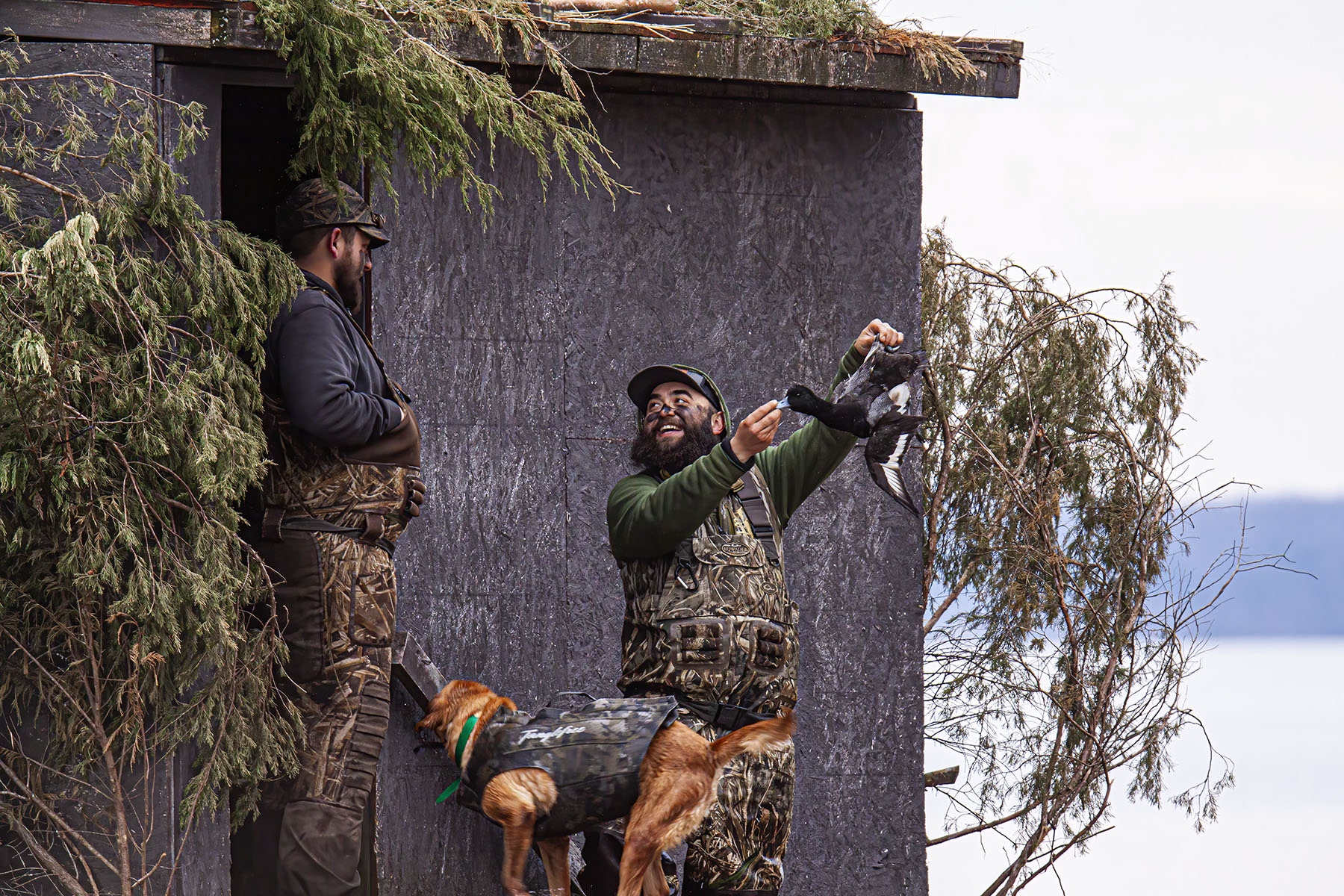
My wildlife experience at this time of the year is periodically punctuated by the sound of shotgun blasts, sometimes coming from only a short distance away—it is duck hunting season. There are a number of duck blinds in the waters off of Occoquan Bay National Wildlife Refuge that are occasionally used for hunting. Even if I don’t hear gunfire, I can often tell that a blind is occupied, because the hunter often put out a whole lot of decoys in the water that have fooled me a couple of times.

The first photo shows the duck blind that was in use on Monday. If you click on the image, you can get a better look at some of the details, including one of the hunters, a dog in a life jacket, and part of the string of decoys. The second image shows the dog swimming back past the decoys with a freshly shot duck in its mouth—it was pretty amazing to see the dog leap into the water and swim out to retrieve the duck. The final shot shows the hunter showing off the duck, which I think is a scaup, to his hunting buddy, while the dog continue to shake off the water.

I personally am not a hunter—I prefer to shoot wildlife with a camera and not with a gun. However, I do not vilify those who choose to hunt, particularly when the hunting is managed and regulated. I am also aware that fees for duck stamps and hunting licenses often are used for wildlife conservation efforts that benefit us all.

duck hunting

duck hunting

duck hunting

© Michael Q. Powell. All rights reserved.

Read Full Post »

One of the Bald Eagle (Haliaeetus leucocephalus) nests at Occoquan Bay National Wildlife Refuge seems to have suffered some damage during the off-season. It looks like one of the supporting branches broke off and more than half of the nest was dumped to the ground. The nest was relatively small in previous years and until yesterday I saw no signs that the eagles were planning to try to repair it and use it again this year.

The refuge has blocked off portions of the nearby roads to allow the eagles to nest in peace, but with my long telephoto zoom lens I am able to get a glimpse of the action. As I was standing at the barrier yesterday, I was thrilled when I saw one eagle fly into the nest and a few moments later, the second one arrived as well. After a short time together, one of the eagles flew off while the other eagle assumed what looked like a position of waiting.

A few minutes later the first eagle returned carrying a pretty large branch. I have seen ospreys carrying branches like this, but I had never seen an eagle do so. These three shots document part of the eagle’s journey with the branch. The final shot shows the eagle carefully approaching the nest where its mate was waiting. Amazingly, the eagle was able to weave its way through the branches of the tree and place its prize on the nest that is clearly still under construction.

I shot some images that show the current state of the nest that I will share in a future post. I also plan to do a post on the status of the other eagle nest at the refuge, the one that is huge by comparison with this one. Stay tuned for further developments as the eagles prepare for nesting season.

Bald Eagle

Bald Eagle

Bald Eagle

© Michael Q. Powell. All rights reserved.


Read Full Post »
I was shocked and thrilled last Tuesday when I managed to find my Common Yellowthroat (Geothlypis trichas) friend yet again at Occoquan Bay National Wildlife Refuge. This was the third day on which I have spotted this little beauty during a week-long period. I do not know for sure if he will overwinter with us or is just passing through the are, but every time I visit the refuge now, I search for him.

Each time that I have spotted the yellowthroat, he has been in a slightly different location, but always in the vegetation to the side of a trail that runs along the water’s edge. As you can see from these photos, arguably the best I have shot of this bird, the yellowthroat spends a lot of time foraging for food on and under the fallen leaves. It is not unusual for him to disappear from sight momentarily as he weaves his way through the vegetation, but his bright yellow throat makes him relatively easy to spot when he pops up in a new spot.

If you missed my earlier posts about this Common Yellowthroat, a warbler that is not usually present in our area during the winter, you can check them out at Yellowthroat in January and Yellowthroat Redux.

Common Yellowthroat

Common Yellowthroat

Common Yellowthroat

© Michael Q. Powell. All rights reserved.

Read Full Post »

Seeds from Sweetgum tree seedpods provided much-needed nourishment for some of the small birds in my area, like this Carolina Chickadee (Poecile carolinensis) that I spotted on Thursday at Occoquan Bay National Wildlife Refuge. The chickadee’s acrobatic position reminds me a little of that of a hovering hummingbird. Appearances to the contrary notwithstanding, the chickadee is not levitating—its legs are merely hidden behind its body.

It is pretty amazing that the chickadee can hang with its full body weight from the seed pod and extract seeds without causing the pod to fall from the tree. The delicate touch required reminds me of playing the classic game Operation when I was a child. The game requires you to remove various body parts from a patient using a pair of electric tweezers that buzz if you touch the edges of the cavity opening. (Check out this Wikipedia article if you are not familiar with the Operation game, which amazingly is still in production.)

Carolina Chickadee

© Michael Q. Powell. All rights reserved.

Read Full Post »

The fish was modest in size, but the Great Blue Heron (Ardea herodias) had waited so patiently to catch the fish that it was determined not to lose its prey. As the heron adjusted the fish in its mouth, it turned away from the water, so that if the fish somehow escaped its grasp, it would not be able to swim away.

A few seconds later the heron tilted its head back and swallowed the fish. The heron took a quick drink of water and went back to fishing, probably hoping that it would be able to catch a main course to go along with the tasty appetizer that it had already consumed.

I watched this little drama unfold this past Thursday at Occoquan Bay National Wildlife Refuge.

Great Blue Heron

© Michael Q. Powell. All rights reserved.

Read Full Post »

Isn’t it wonderful that birds that are so different in appearance can get along so well? Why is it that we find it so difficult to do the same?

I spotted this Ruddy Duck (Oxyura jamaicensis) and Pied-billed Grebe (Podilymbus podiceps) swimming together on Tuesday at Occoquan Bay National Wildlife Refuge. I was immediately struck by the diminutive size of the Ruddy Duck—I somehow had the mistaken impression that Pied-billed Grebes were smaller than all ducks.

I decided to include separate images of the two species that I captured earlier in January to give you a better look at them. The color of the water in each of the three shots gives you an indication of what the weather was like on the day when they were taken. It has been a really variable month weather-wise, with almost as many days above 50 degrees (10 degrees C) as below freezing and barely a trace of snow.

peaceful coexistence

Pied-billed Grebe

Ruddy Duck

© Michael Q. Powell. All rights reserved.


Read Full Post »

« Newer Posts - Older Posts »