Feeds:
Posts
Comments

Posts Tagged ‘Jackson Miles Abbott Wetland Refuge’

The countdown continues as we gradually move towards the end of the dragonfly season in my area. The Blue Dasher dragonfly (Pachydiplax longipennis) is one of the first dragonflies to appear in the spring and one of the last dragonflies to disappear in the autumn.

I spotted this tattered male Blue Dasher dragonfly during a recent visit to Jackson Miles Abbott Wetland Refuge. This was one of only a handful of dragonflies that I saw that day. The end is nearing, but I am not ready to call it quits quite yet for my dragonfly photography.

Blue Dasher

© Michael Q. Powell. All rights reserved.

Read Full Post »

Its wings are a bit tattered and its colors have faded, but this male Slaty Skimmer dragonfly (Libellula incesta) was still hanging in there at the end of September, when I spotted it at Jackson Miles Wetland Refuge at nearby Fort Belvoir, Virginia. The nights have become considerably cooler the past week and I am anxious to get out in the wild with my camera to see which hardy surviving dragonflies are still flying.

Slaty Skimmer

© Michael Q. Powell. All rights reserved.

Read Full Post »

Our weather has definitely turned cooler, and the number of insects is definitely decreasing. I therefore treasure each encounter that I have, knowing that it could be the last one of the season.

I spotted this beautiful Red-spotted Purple butterfly (Limenitis arthemis astyanax) during a recent visit to Jackson Miles Abbott Wetland Refuge. It seems to have suffered a bit of wing damaged, which did little to damage its beautiful colors. I believe that this butterfly species has two broods, one in the spring and one in late summer, which may help to explain why this butterfly’s colors are still so vibrant—some of the other butterflies that I see have colors that are worn and faded.

Red-spotted Purple

© Michael Q. Powell. All rights reserved.

Read Full Post »

Do you have a favorite damselfly? I have had the opportunity to photograph some pretty spectacular damselflies, but I am irresistibly attracted to the unique coloration of the Violet Dancer damselfly (Argia fumipennis violacea), a subspecies of the Variable Dancer damselfly (Argia fumipennis). In fact the banner photo for my blog page includes a photo of a beautiful Violet Dancer, so my fondness for this species is not exactly a secret.

Maybe I am a little weird for having a favorite damselfly. If that is what you think, perhaps you have forgotten what it is like to view the world as a child as I try to do. Years ago I remember reading a Reader’s Digest article that included the following Tweet, “I like having conversations with kids. Grown-ups never ask me what my third favorite reptile is.” That Tweet (or whatever they are called now) captured my feelings really well

I spotted this colorful little damselfly last Friday (26 September) as I was exploring a small pond at Jackson Miles Abbott Wetland Refuge. I was a little surprised, but very much delighted to see the Violet Dancer so late in the season.

I did not dare lean over the edge of the pond for fear of falling in, but I really like the long distance shot that I was able to capture. The simple lines of the vegetation and the dark pond waters help to draw the viewer’s eyes to the Violet Dancer, even though it occupies only a small portion of the frame.

As I get older I find that I care less and less about what others think about me. Dare to be weird today!

violet dancer

© Michael Q. Powell. All rights reserved.

Read Full Post »

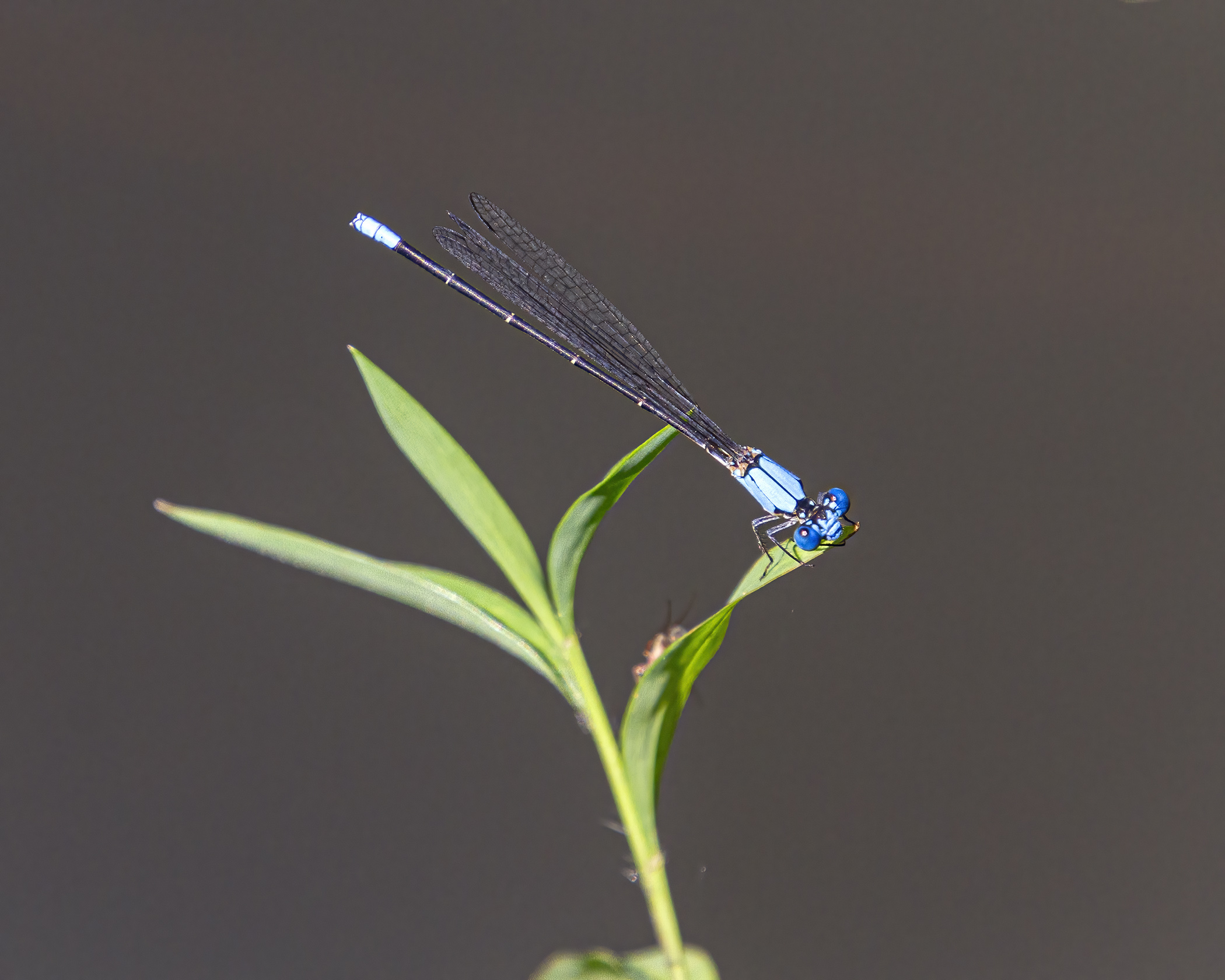
On Monday I spotted several Blue-fronted Dancer damselflies (Argia apicalis) during a visit to Jackson Miles Abbott Wetland Refuge. I don’t see this particular species of damselfly at most of my other favorite spots, so it was a nice treat to see them. According to my identification guide, Damselflies of the Northeast by Ed Lam, Blue-fronted Dancers can be found “on a wide variety of rivers and streams, occasionally lakes and ponds.”

In this case, I spotted the damselflies perched in the vegetation at the edge of a small pond (first photo) and perched on an exposed tree root a few feet from the pond (second photo). The males of this species are pretty easy to identify because their thoraxes (their “chest”) are almost completely blue, with only hairline black stripes.

Blue-fronted Dancer

Blue-fronted Dancer

© Michael Q. Powell. All rights reserved.


Read Full Post »

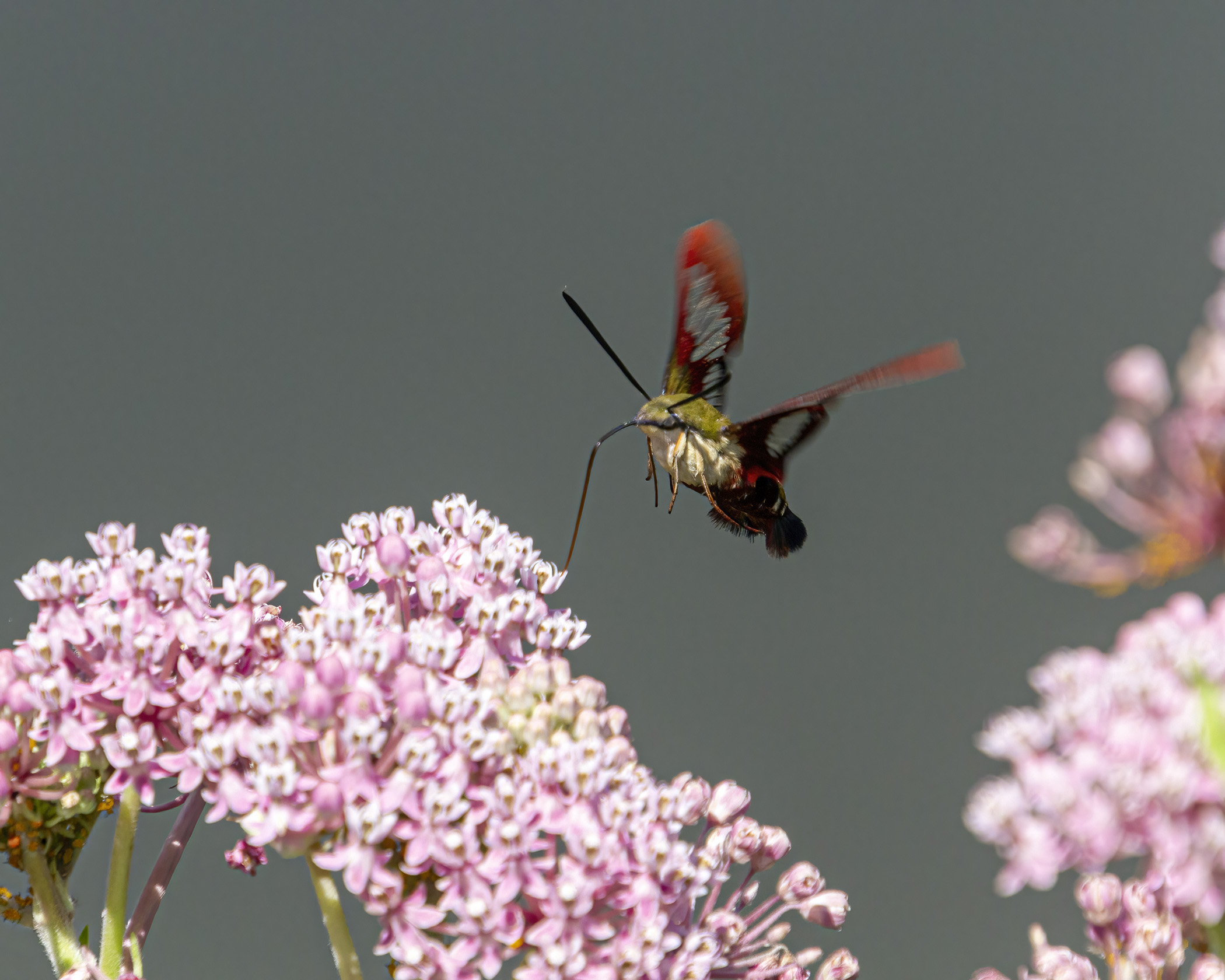
Yesterday I went out with my camera to Jackson Miles Abbott Wetland Refuge, a small nature pond that is overseen by the nearby Fort Belvoir military installation. I was looking for certain dragonfly species and mostly came up empty-handed. However, I was delighted to spot this spectacular Hummingbird Clearwing Moth (Hemaris thysbe) feeding in a patch of milkweed.

Like Hummingbirds, these moths hover in the air while extracting nectar from flower. Unlike hummingbirds that use long, slim beaks to get deep into the center of flowers, hummingbird moths use a long, hollow proboscis to suck out the nectar. The proboscis is normally coiled and is extended only when the moth is ready for action, as you can see in the photo below.

I used a relatively high shutter speed and managed to capture a pretty good view of the “clearwing” that is in the common name of this species. I did not have too much time to maneuver about, but crouched down a bit to isolate the clearwing moth against the backdrop of the pond, rather than risk having it be lost in the clutter of the vegetation.

UPDATE: I felt compelled to post the second photo below. I sort of missed it when I quickly sorted my photos, but the head-on shot really struck me as cool and unusual when I looked through the photos again. I particularly love the raised wing positions in the moment that I captured.

Hummingbird Clearwing Moth

Hummingbird Clearwing Moth

© Michael Q. Powell. All rights reserved.


Read Full Post »

Common Five-lined Skinks (Plestiodon fasciatus) are indeed quite common, but they are so skittish that they are tough to photograph. As soon as they see me (or sense my presence), they will usually scamper away to the underside of the logs on which they like to perch. On a recent visit to Jackson Miles Abbott Wetland Refuge, I spotted this skink sunning itself on a log and was able to get this shot because I approached him from behind—this technique does not work as well for dragonflies, which have massive compound eyes that provide them with a field of view of almost 360 degrees.

It is always fun to encounter juvenile skinks that have bright blue tails, but this one appeared to be an adult. I noted too that its tail was intact. Like many lizards, skinks possess the unique defense mechanism of being able to drop their tail to escape predators. The dropped tail continues to wiggle, distracting the predator, while the skink flees. Skinks can regenerate their lost tail, though the new tail may differ in structure and coloration from the original.

As many of you know, I love bad “Dad” jokes and this skink reminded me of one of them. “Where do skinks go to find a replacement for a lost tail? A retail outlet.” Sorry!

Five-lined Skink

© Michael Q. Powell. All rights reserved.

Read Full Post »

Common Whitetails (Plathemis lydia) can be found almost everywhere and are among the first dragonflies to appear in the spring and the last to survive in the fall. I nonetheless enjoy trying to capture creative images of them, like these two that I spotted this past week.

How do wildlife photographers choose their subjects? Some of them are attracted almost exclusively to rare and/or exotic species and are always looking for something new to photograph. Their mentality is close to those of many birders, who keep “life lists” of all the birds they have seen and are always lookin got add another one to the “list.”

Other photographers, like me, are content to photograph a more limited selection of subjects over and over again, hoping to capture something new and different, finding the extraordinary in the ordinary. The first photo is one such example—I love the prominent specular highlights in the image and the unusual pose of this female Common Whitetail with one of her legs extended.

At other times, I am simply trying to compose an image creatively, as in the second photo below. There is nothing super special about this shot of a male Common Whitetail, but I tried to add some visual interest by including some of the vegetation at the base of its perch and a portion of the lily pads in the distance. It is not a prize-winner by any standards, but I like the overall “feel” of the pleasant little image.

Female Common Whitetail

Male Common Whitetail

© Michael Q. Powell. All rights reserved.


Read Full Post »

I had not seen a Swift Setwing dragonfly (Dythemis velox) in several weeks at Jackson Miles Abbott Wetland Refuge and feared that they might be gone for the season. I was therefore thrilled when I spotted this one last Thursday. Most of the previous times when I have seen Swift Setwings, they have been perched with their wings pulled forward, but this one had its wings fully extended.
A bit later that same day, I spotted a Swift Setwing that appeared to be missing an entire wing, as you can see in the second photo below. I looked carefully at other shots of the same dragonfly and in a couple of them I can see at least a partial wing in that spot. It is interesting that I did not notice this problem with the wing while out in the field, and the dragonfly flew away without any issues whatsoever.

Swift Setwing

Swift Setwing

Swift Setwing

© Michael Q. Powell. All rights reserved.

Read Full Post »

Recently I have featured numerous large, beautiful butterflies feeding on blooming plants, especially thistles. Today, I decided to turn the spotlight to the smaller, more nondescript butterflies, commonly referred to as skippers, that have been equally active and visible in recent weeks.

According to Wikipedia, there are more than 3500 species of skipper butterflies in the world and many of the species are visually similar in appearance. For that reason, I am especially cautious in trying to identify one of these small butterflies. Sometimes I will request assistance in identifying specimens in one of many Facebook groups to which I belong. I have learned the “secret” to getting a response—if I make a misidentification, some experts who might not help me with an identification will feel compelled to correct me.

I spotted the little beauty in the photo below last week while I was exploring a patch of flowers at Jackson Miles Abbott Wetland Refuge. It might be a Peck’s Skipper (Polites peckius), but to me it looks a bit more like a Zabulon Skipper (Poanes zabulon). Whatever the case, I like the way that I was able to capture the butterfly in action, sipping nectar with its proboscis fully extended.

Peck's Skipper

© Michael Q. Powell. All rights reserved.

Read Full Post »

Some dragonflies will look me straight in the eye, but others, like this male Blue Dasher dragonfly (Pachydiplax longipennis), seem to prefer sidewards glances. I spotted this cute little dragonfly last Thursday at Jackson Miles Abbott Wetland Refuge. Blue Dasher dragonflies are among the first dragonflies to appear on the scene in the spring and among the last ones to disappear in the autumn.

The vegetation at this time of the year is always interesting, a combination of new growth and dried-out stems. I love both the colors and textures of the perch that this dragonfly had selected and the visible cobwebs add a nice touch of visual interest to the image.

Blue Dasher

© Michael Q. Powell. All rights reserved.

Read Full Post »

I really like Blue Dasher dragonflies. They are quite common and visible throughout most of the summer. Unlike some other dragonfly species that require specific habitats, Blue Dashers (Pachydiplax longipennis) can be found almost anywhere.

I really like the description of the species on the Dragonflies of Northern Virginia website, one of my favorite resources for information about the dragonflies in my area:

“A very little guy in a big hungry world, Blue Dashers make up for their small size with plenty of moxie. Just about everything eats them…but it certainly hasn’t affected their numbers. The most abundant dragonfly in our area, they face their predator-filled worlds head on. Males aggressively defend their small, shore-line territories against larger skimmers, and spend a great deal of time with their black-tipped abdomens pointed high in the air – an aggressive threat display. It’s also a technique used to cool down by reducing surface area to the sun, called the obelisk position. However, Dashers use it more than other species, and half the time it appears to be done for the purpose of territorial display, rather than temperature control.”

I spotted this Blue Dasher on Monday at Jackson Miles Abbott Wetland Refuge. I couldn’t get really close to the dragonfly, but like the way that the abundant vegetation helped to frame the dragonfly.

Blue Dasher

© Michael Q. Powell. All rights reserved.

Read Full Post »

This female Slaty Skimmer (Libellula incesta) that I spotted on Monday at Jackson Miles Abbott Wetland Refuge has definitely seen better days. Its wings are growing tattered and its color has darkened with age. Nonetheless, the dragonfly is carrying on and compensating as it grows older. In fact, the dragonfly seemed to be feeding on some kind of insect when I photographed it.

A few weeks ago I turned 70 and I have become increasingly conscious of the passing of time. Tomorrow is not guaranteed, so I am trying to pay more attention to living my life in the moment, as perhaps this aging dragonfly is doing.

Slaty Skimmer

© Michael Q. Powell. All rights reserved


Read Full Post »

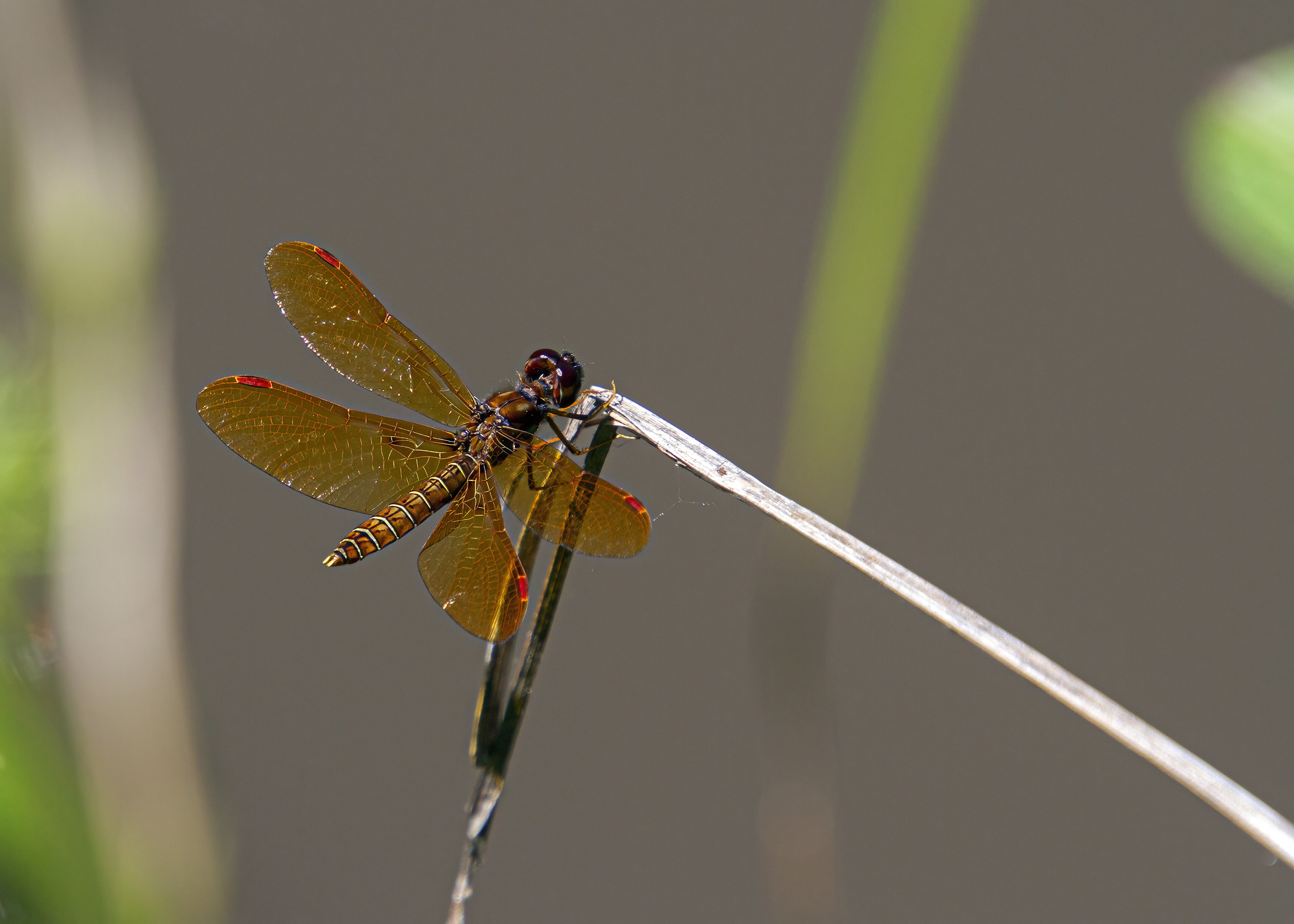
Eastern Amberwings (Perithemis tenera) are one of the smallest dragonfly species where I live—less than one inch (25 mm) in length. I often see the amber-colored males buzzing around at the ponds that I visit, but it is pretty rare for me to spot a female.

Yesterday I visited Jackson Miles Abbott Wetland Refuge and was a bit surprised to see a female Eastern Amberwing dragonfly in the vegetation near the edge of a small pond. Unlike the males, females of these species have patterned wings that are partially clear. I maneuvered around to composed a shot and managed to capture this image of the dragonfly.

According to the website Dragonflies of Northern Virginia, one of my favorite dragonfly websites, female Eastern Amberwing dragonflies are often found far from the water in meadows where they share perches with hornet and other wasps. When they are threatened, these dragonflies will rhythmically move their wings up and down while pulsing their abdomens in imitation of a wasp to scare off potential predators that believe they are about to be stung.

I don’t know if this female was checking out the males at the pond, searching for a suitable partner, or perhaps had just mated and was recovering from the experience. Whatever the case, I was delighted to spot this elusive little dragonfly.

Eastern Amberwing

© Michael Q. Powell. All rights reserved.


Read Full Post »

During a recent visit to Jackson Miles Abbott Wetlands Refuge I spotted this Blue-tipped Dancer (Argia tibialis) damselfly. I was initially quite far from it when I first saw it and was not at all certain what it was. As I got closer to it, I could see that it was mostly black and only the very tip of its abdomen was blue in coloration. I did not immediately recognize it, but figured that I would be able to do so after the fact. In doing so, I was applying one of my primary rules of photography—shoot first and ask questions later.

When I got home and was processing the images, I decided that it was probably a Blue-tipped Dancer, a fairly common dark species that is reportedly found at a diverse number of locations. Upon discovering its name, I did a search of my past blog postings and discovered that I had seen one a few times before. I guess I would have remembered the name of the species if I saw it more often, but am happy that I was able to be able to retrieve it.

Yesterday we finally had a break from the extremely hot weather and I finally was able to get out with my camera. I am pretty sure that I captured some images that I will want to share with you all. Stay tuned for more.

Blue-tipped Dancer

© Michael Q. Powell. All rights reserved.


Read Full Post »

It was uncomfortably hot for me and I tried to stay in the shade as much as possible during a recent visit to Jackson Miles Abbott Wetland Refuge. A Painted Turtle (Chrysemys picta), however, had pulled itself almost completely out of the water to maximize its exposure to the direct sunlight. For the record, I am not the kind of guy who enjoys baking in the sun on a beach.

I really like the turtle’s pose and the way that it stands out amidst all of the water and the abundant vegetation. The beautiful reflection was a nice bonus, adding a bit of symmetry and additional visual interest to the image.

Painted Turtle

© Michael Q. Powell. All rights reserved.


Read Full Post »

Pearl Crescent butterflies (Phyciodes tharos) are quite common in my area, but they are small and skittish and often feed with their wings partially open, so it is hard to get a photo of one with its wings spread wide. Last week I spotted several Pearl Crescents in a large patch of Black-eyed Susans at Jackson Miles Abbott Wetland Refuge and I stalked them for quite some time. I was delighted when I finally managed to capture this image that shows wonderfully the beautiful details of this little butterfly.

Pearl Crescent

© Michael Q. Powell. All rights reserved.

Read Full Post »

As I watched television coverage of the Olympic Games in Paris, I could not help but notice the numerous handstands in almost all of the gymnastic events for the men. There were handstands on the floor, on the rings, on the parallel bars, the high bar, and even on the pommel horse.

When I spotted this male Blue Dasher dragonfly (Pachydiplax longipennis) doing a handstand last Thursday at Jackson Miles Abbott Wetland Refuge, I immediately thought of those Olympic gymnasts.

This position is sometimes referred to as the “obelisk” pose for dragonflies. Many scientists believe that it is used as a form of thermoregulation to keep the body cooler by reducing the amount of surface exposure to direct sunlight. Several other dragonfly species use this pose, but I observe it most often with the male Blue Dasher dragonflies.

Blue Dasher

© Michael Q. Powell. All rights reserved.

Read Full Post »

I was delighted to spot this handsome male Blue-fronted Dancer damselfly (Argia apicalis) on Thursday during a quick visit to Jackson Miles Abbott Wetland Refuge. This species is not rare, but I do not see it very often at my favorite locations for dragonflies and damselflies. It is pretty easy to identify a Blue-fronted Dancer because, as its name suggests, its thorax is almost completely blue, with only a few hairline shoulder stripes.

According to Wikipedia, the damselflies in the genus Argia, are commonly known as “dancers” because of the distinctive jerky form of flight they use, which contrasts with the straightforward direct flight of bluets, forktails, and other pond damselflies.

Blue-fronted Dancers are quite small, about 1.5 inches (38 mm) in length, so it was quite a challenge to get this one in focus as he perched on some vegetation close to the ground. I am pretty sure that I switched to manual focus for this shot, because the autofocus of my camera has trouble staying on such a narrow subject and kept trying to focus on the ground.

Blue-fronted Dancer

© Michael Q. Powell. All rights reserved.

Read Full Post »

After mating, many male damselflies hold on to the female as she deposits eggs in order to keep any rival males from interfering with the process. The male grasps the head of the female with the terminal appendages of his abdomen in the “tandem” position and the two linked damselflies move about from spot to spot as the female inserts eggs into floating vegetation.

Last Friday at Jackson Miles Abbott Wetland Refuge I managed to capture this image of a Slender Bluet (Enallagma traviatum) couple as the female arched her body, made a little slit in the vegetation and inserted eggs, a process known as “ovipositing.”

I am not absolutely certain I have correctly identified the damselfly species—there are a lot of bluet species—but I have made my call primarily on the basis of the markings on the abdomens of the male and the female. I intend to post this shot in a dragonfly/damselfly forum on Facebook and will update this posting if one of the experts in the group corrects my initial identification.

Slender Bluet

© Michael Q. Powell. All rights reserved.


Read Full Post »

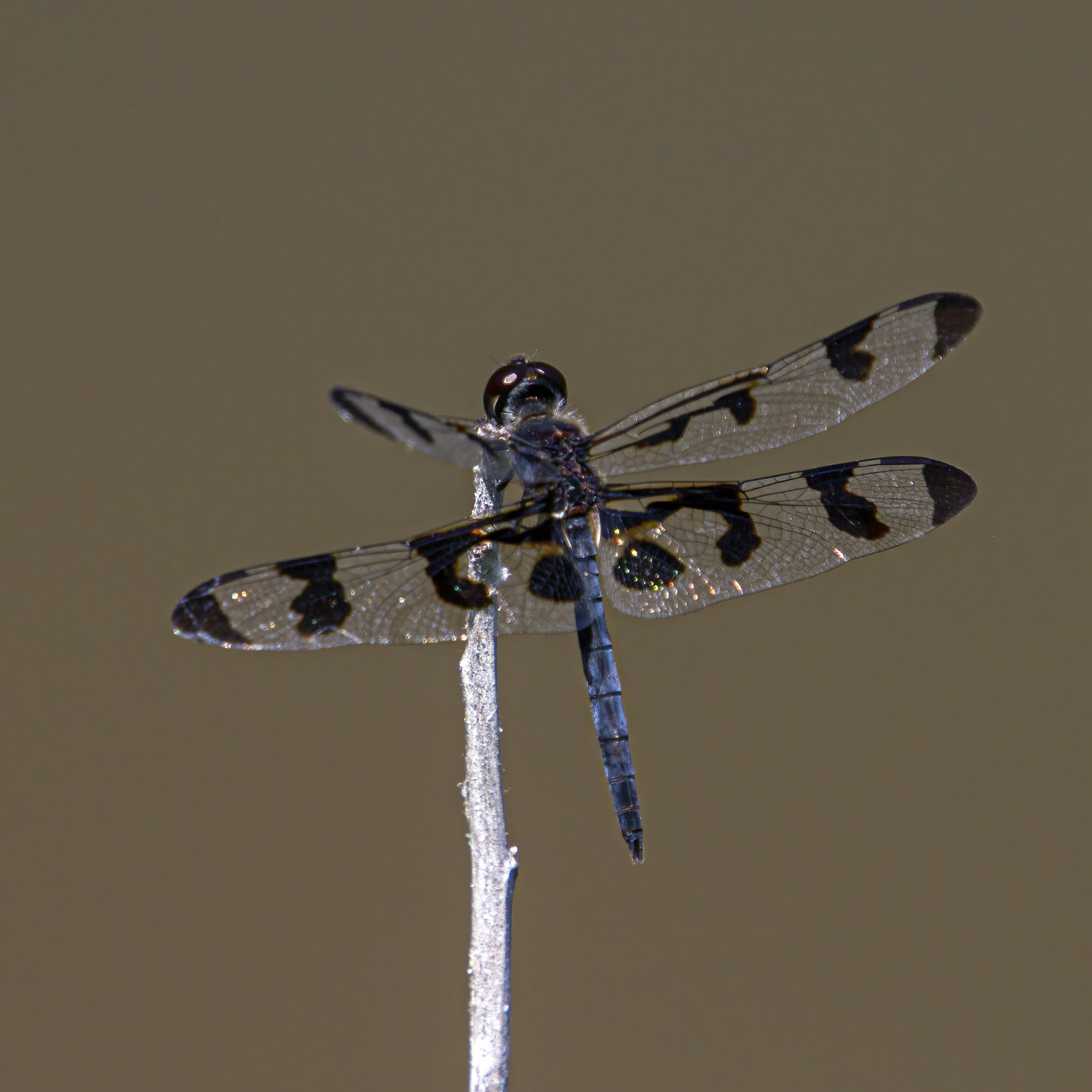
During a short visit to Jackson Miles Abbott Wetland Refuge last Friday I spotted my first Banded Pennant dragonfly (Celithemis fasciata) of the year. Pennant dragonflies like this one often perch precariously on the very tips of vegetation, which causes them to flap about in even the slightest of breezes, like a pennant.

Banded Pennants are somewhat uncommon and in some years I have not seen a single one, so I was happy to encounter this handsome male, the only one I saw all day. As you can see in all of the photos below, the dragonfly’s upper left wing did not seem to straighten out as much as the other three wings. From what I could see, though, the dragonfly was able to fly quite well despite this injury or deformity.

Banded Pennant

Banded Pennant

Banded Pennant

© Michael Q. Powell. All rights reserved.

Read Full Post »

I was thrilled to spot my first Swift Setwing dragonfly (Dythemis velox) of the season this past Friday at Jackson Miles Abbott Wetland Refuge. These little dragonflies perch in a distinctive pose with their wings pulled forward, which looked to some scientist like the “ready-set-go” position of a sprinter and is reportedly the reason for the name of the species.

Eight years ago I spotted my first Swift Setwing dragonfly ever at this same location. This primarily southern species had never before have been documented in Fairfax County, Virginia, the county where I live, so it is kind of special for me to see them each year. (You can see details of that first sighting in my 25 June 2016 posting Swift Setwing dragonfly.)

Swift Setwings like to perch facing the water on overhanging vegetation, so it is a challenge to get a shot of one without getting my feet wet.  I had to find a little visual tunnel through the vegetation to get this shot, but I did manage to stay dry.

Swift Setwing


© Michael Q. Powell. All rights reserved.


Read Full Post »

Most of the time when I spot Eastern Amberwing dragonflies (Perithemis tenera) they are busily flying about over the water, but this handsome little guy decided to rest a bit in the vegetation at the water’s edge on Thursday at Jackson Miles Abbott Wetland Refuge.

Most of the summer dragonflies have now arrived on the scene, so I may not be featuring any new species for a while. However, I am content to photograph my familiar “friends,” always hoping to capture them in different perches, activities, or lighting conditions. Each moment gives me a new chance to capture something beautiful and/or unusual. Beauty is everywhere.

Eastern Amberwing

© Michael Q. Powell. All rights reserved.

Read Full Post »

Slaty Skimmers (Libellula incesta) have now started to appear at Jackson Miles Abbott Wetland Refuge, signaling to me that summer is almost here. During the hottest months of the year, Slaty Skimmers are one of the commonly seen dragonfly species in my area, in part because they are habitat generalists—you can find them everywhere,

The greyish-blue bodies and dark eyes of the mature male Slaty Skimmers make them easy to identify. The immature members of this species, however, are a lot harder to identify, because they are similar in appearance to the young of several other species in the area. Fortunately for me, the Slaty Skimmers in these two photos, the first that I have photographed in 2024, are both mature males.

Slaty Skimmer

Slaty Skimmer

© Michael Q. Powell. All rights reserved.

Read Full Post »

When I spotted a dragonfly patrolling over the water of a small pond yesterday at Jackson Miles Abbott Wetland Refuge, I knew almost immediately that it was a Prince Baskettail dragonfly (Epitheca princeps). How could I tell? As it flew by, I could catch glimpses of the dark patches on its wings and the Prince Baskettail is the only large dragonfly with patterned wings in our area. (Prince Baskettails are almost three inches (76 mm) in length).

Seeing the dragonfly in flight was easy, but getting a clear shot of it was a considerable challenge. I watched the dragonfly and was able to determine its approximate patrol area. When it flew into that area, I attempted to track it, sometimes using my camera’s autofocus and sometimes focusing manually. Most of my shots were out of focus or did not include the dragonfly in the frame, but I managed to get a few decent shots, with the image below being the best of the lot.

Some of my fellow wildlife photographers marvel at images like this and think that high end gear or special techniques are necessary. The reality, though, is that I use relatively modest equipment and the “secret” to my success quite often is a combination of patience, practice, and persistence.

Prince Baskettail

© Michael Q. Powell. All rights reserved.

Read Full Post »

When male Eastern Pondhawk dragonflies (Erythemis simplicicollis) are very young, they have green bodies with dark banding on the abdomen, just like their female counterparts. Over time male Eastern Pondhawks are gradually transformed into a duller shade of blue and finally a powdery bluish-grey.

From an aesthetic point of view, my favorite stage of development is when they are young males and their thoraxes are a beautiful shade of green that contrasts wonderfully with their blue abdomens. Eastern Pondhawks of both genders have cool-looking green faces that help to distinguish them immediately from other dragonfly species.

I spotted this Eastern Pondhawk during a recent visit to Jackson Miles Abbott Wetland Refuge, a small refuge that belongs to a nearby military installation. It is not a contiguous part of that installation, however, and is open to the public. The composition of this shot is quite simple, but I like the way that the Y-shape of the forked branch helps to divide up the frame and lead the viewer’s eyes to the main subject.

Eastern Pondhawk

© Michael Q. Powell. All rights reserved.

Read Full Post »

I know that summer is almost here when I start to see Blue Dasher dragonflies (Pachydiplax longipennis) at my local ponds and they will some become our the most abundant dragonfly species in our area. Mature Male Blue Dashers are blue, as their name suggests, but females have a black and yellow pattern on their abdomens, like the one pictured below that I photographed on Tuesday at Jackson Mile Abbott Wetland Refuge.

Quite often Blue Dashers perch on vegetation in the “obelisk” pose, with their abdomens raised up into an almost vertical position. It is thought that this pose is a type of thermoregulation, with the raised abdomen reducing the amount of exposure to the direct sunlight and thereby keeping the dragonfly’s body a bit cooler.

Blue Dashers are sentimentally special to me because my very first posting on this blog on July 7, 2012 featured a male Blue Dasher dragonfly in an obelisk pose. In case you are curious, here is a link to that posting that was simply entitled Blue Dasher dragonfly.

Blue Dasher

© Michael Q. Powell. All rights reserved.


Read Full Post »

Whenever I visit Jackson Miles Abbott Wetland Refuge, I never fail to check a spot near a fishing platform where there is a piece of twisted rebar sticking out of the water. In the past, I have seen dragonflies of various species perching on the rebar and it provides a wonderful photographic opportunity, assuming that the dragonfly does not immediately fly away. I generally prefer to photograph dragonflies on natural perches, not on manmade ones, but this is a case when I am more than happy to break that “rule.”

On Tuesday I was delighted to spot a male Eastern Amberwing dragonfly (Perithemis tenera) perched on the aforementioned piece of rebar. I love the contrast between the colors, patterns, and textures of the natural object, the dragonfly, and those of the man-made subject, the rebar. The floating debris on the surface of the pond helps to break up the mostly uniform background without being visually distracting.

I have taken similar shots to this one multiple times, but I don’t mind repeating myself. Each encounter is unique and subtly different. As the Greek philosopher Heraclitus of Ephesus is reported to have said, “No man ever steps in the same river twice, for it is not the same river and he is not the same man.”

Eastern Amberwing

© Michael Q. Powell. All rights reserved.

Read Full Post »

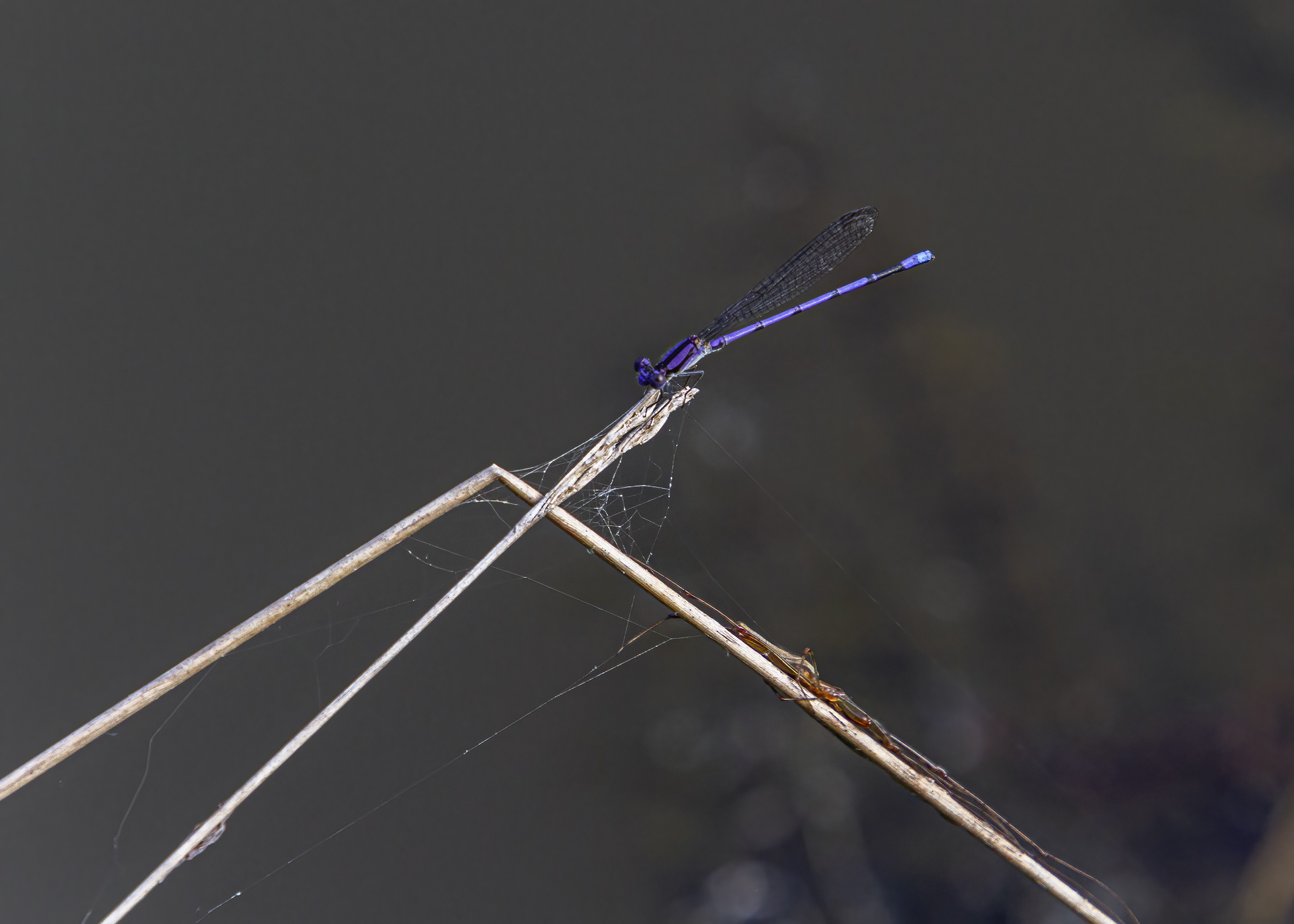
Yesterday at Jackson Miles Abbott Wetland Refuge I spotted some Variable Dancer damselflies (Argia fumipennis), one of my favorite damselfly species. I never fail to be shocked and delighted by the brilliant purple of eyes and body of the male of the subspecies known as the Violet Dancer (Argia fumipennis violacea). Some of you may have even noticed that I have used an image of a Violet Dancer as the banner image for the home page of my blog for a number of years.

Dancers are a genus of damselflies named for the distinctive jerky form of flight they use which contrasts with the straightforward direct flight of many other pond damselflies. I must confess that I don’t pay much attention to the way that particular damselflies fly, but instead rely primarily on their coloration to identify them,

Violet Dancer

© Michael Q. Powell. All rights reserved.

Read Full Post »

I know that summer is almost here when dragonflies like this male Eastern Amberwing (Perithemis tenera) begin to appear. I spotted this distinctive-looking dragonfly on Tuesday at a small pond at Jackson Miles Abbott Wetland Refuge.

Eastern Amberwings are really small at about one inch (25 mm) in length. According to the Dragonflies of Northern Virginia website, the Eastern Amberwing is “the smallest dragonfly in Northern Virginia, and second smallest in the U.S. (only Elfin Skimmers are smaller), Amberwings are fascinating little insects. No bigger than a horsefly or paperwasp, nature still found a way to pack a lot into this tiny package.”

These little dragonflies are considered to be wasp mimics, “Amberwings may be our only dragonfly that actively mimics a wasp. The markings and shape of their abdomens resemble a small wasp, but they take it several steps further. When threatened, they rhythmically move their wings up and down while pulsing their abdomens. All to imitate a wasp, we think, so as to scare off potential predators that believe they’re about to be stung.”

I love the stunning amber wings that are found on only the males of this species—the females have patterned wings that are mostly clear. As you can see in both photos, the male’s wings are quite transparent despite their darker color. I also really like the intricate patterns and markings on the abdomens of Eastern Amberwing dragonflies.

I look forward to seeing more and more Eastern Amberwings over the course of the next five months or so. Some summer dragonfly species have not yet appeared, but I am seeing more and more dragonflies as the temperatures rise and the hours of sunlight are extended.

Eastern Amberwing

Eastern Amberwing

© Michael Q. Powell. All rights reserved.

Read Full Post »

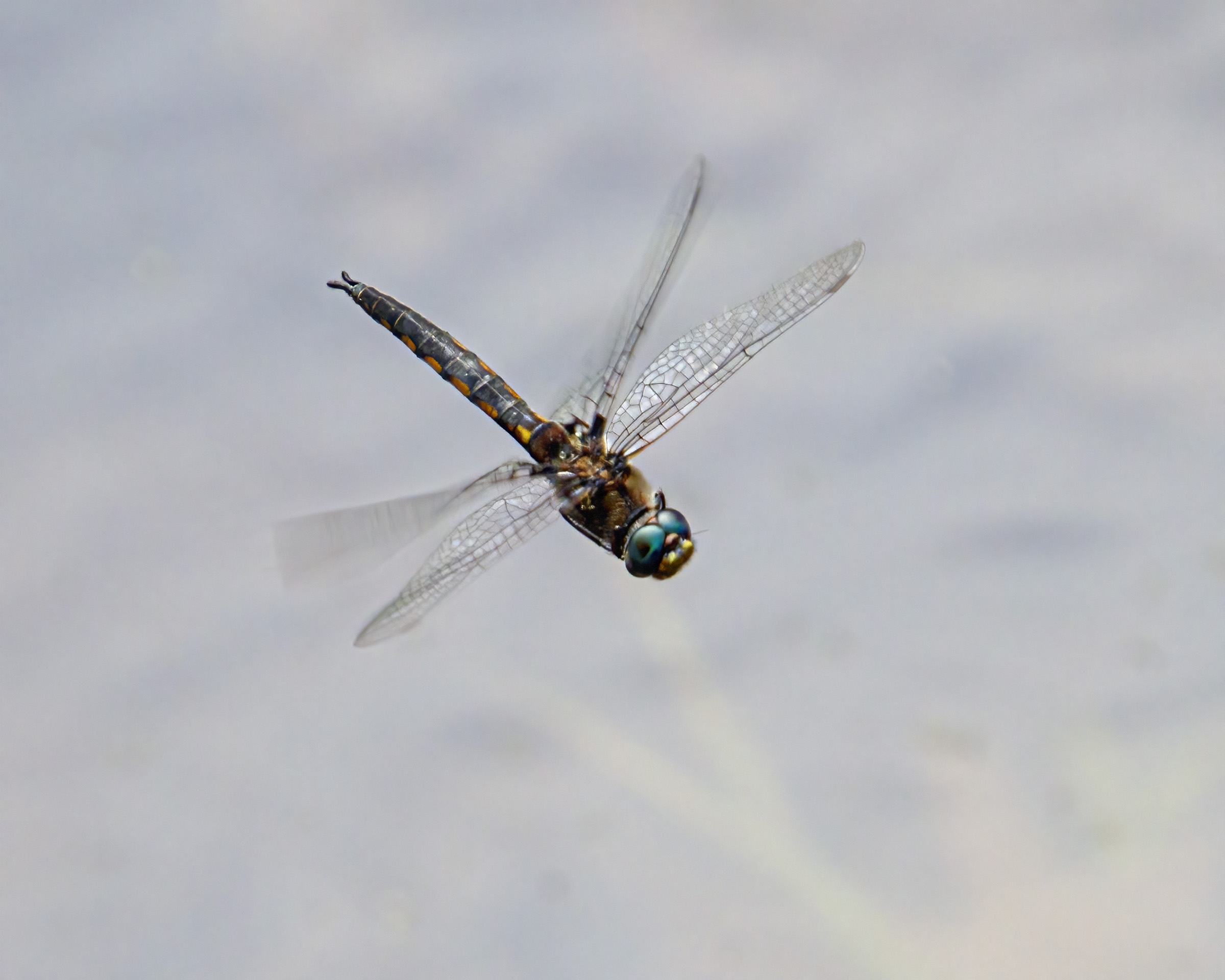
Some of the species of birds and dragonflies with the word “common” in their names are quite rare in my area. However, Common Baskettail dragonflies (Epitheca cynosura) have been quite common this month and I have seen them at a number of different locations, most notably at the small ponds that I like to visit. At these ponds, I usually spot the Common Baskettails as they conducted repeated low patrols over the surface of the water and I can never resist the chance to photograph them while they are in flight.

As I have noted in the past, it is very challenging to photograph a dragonfly while it is flight. Sometimes the dragonflies will hover a bit, giving me a better chance of getting them in focus, but often they whiz on by and I try to track them in my viewfinder. Occasionally I will manage to use auto-focus, but often I resort to manual focus, which, of course, is tough with a moving subject. I try to determine the flight track they are using and identify likely areas that they will pass through and then pre-focus on that area and wait for them to come by. Needless to say, you have to be very patient and persistent if you want to try this kind of photography.

I captured the first two shots at a small pond in Prince William County and was quite pleased with the images. The two shots were taken as part of a sequence and are quite similar with the exception of the position of the wings. Normally I am so thrilled to get a sharp shot that I am not concerned about the wing position, but in this case I had the luxury of having several variants of essentially the same shot.

The final two shots were taken at the pond at Jackson Miles Abbott Wetland Refuge. There was vegetation surrounding the water at the spot where I was standing and it sometimes would obstruct my view as I tried to track the dragonfly. In the third photo, I used one of the offending pieces of vegetation as a compositional element that makes it look like the dragonfly was approaching a finish line tape.

I included the final photo to give you a sense of the habitat. In several areas of the pond there were patches of lily pads and I tried to capture shots of the dragonfly flying over the lily pads. I was largely unsuccessful, but the photo gives you an idea of what I was trying to accomplish. (If this were a shot of a bird, it would definitely qualify as “butt shot,”but I am not sure that you can really say that a dragonfly has a “butt.”)
Common Baskettail

Common Baskettail

Common Baskettail

Common Baskettail

© Michael Q. Powell. All rights reserved.

Read Full Post »

Older Posts »