Feeds:
Posts
Comments

Posts Tagged ‘Huntley Meadows Park’

The beavers at Huntley Meadows Park have been remarkably elusive this winter, so I was excited to see this one on Monday as it swam by in the beautiful early morning light.

There are several beaver lodges in the park where I have spotted North American Beavers (Castor canadensis) in the past, but it is hard to know for sure which ones are currently active. Occasionally I will come to the park really early or stay late, hoping to spot a beaver, but this is the first one that I have spotted in many months. With a little luck I will be able to see one a bit closer than this one, which quite a distance away when I photographed it.

beaver

© Michael Q. Powell. All rights reserved.


Read Full Post »

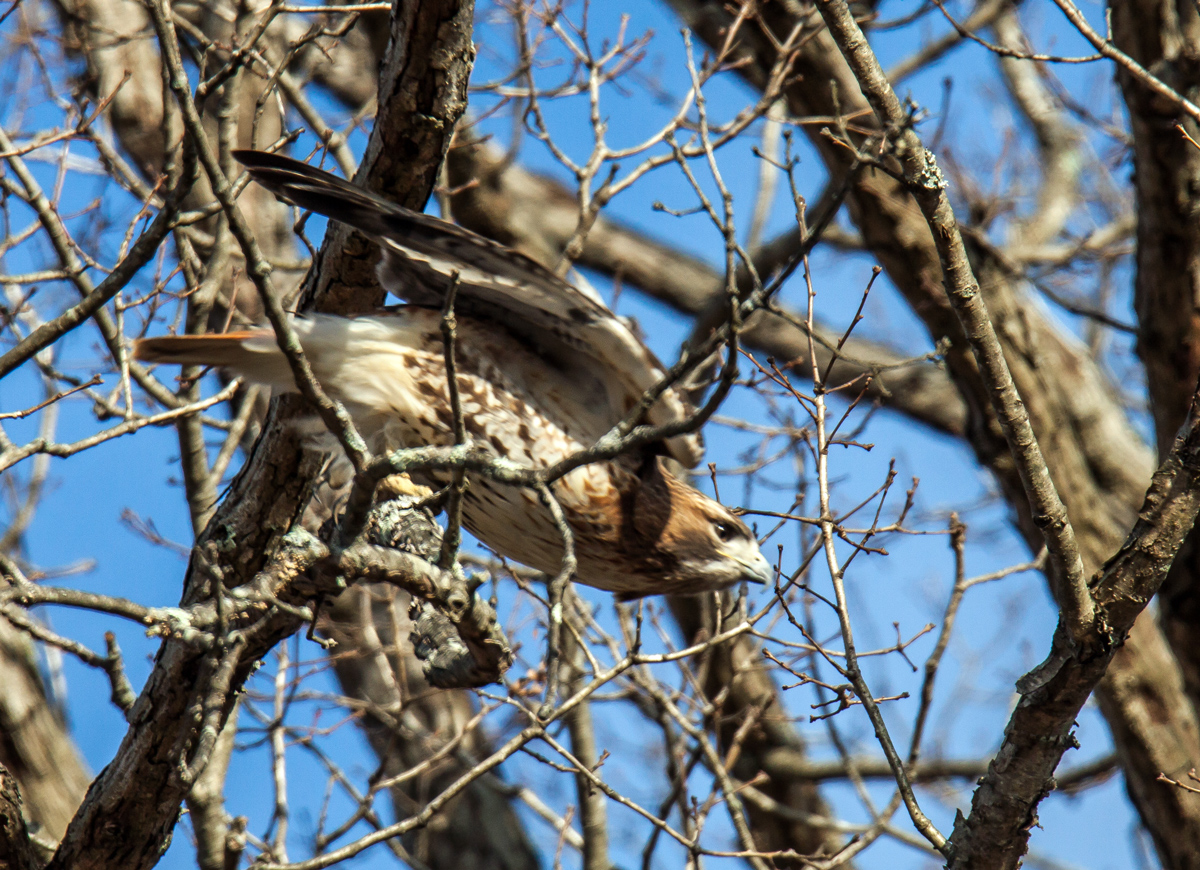
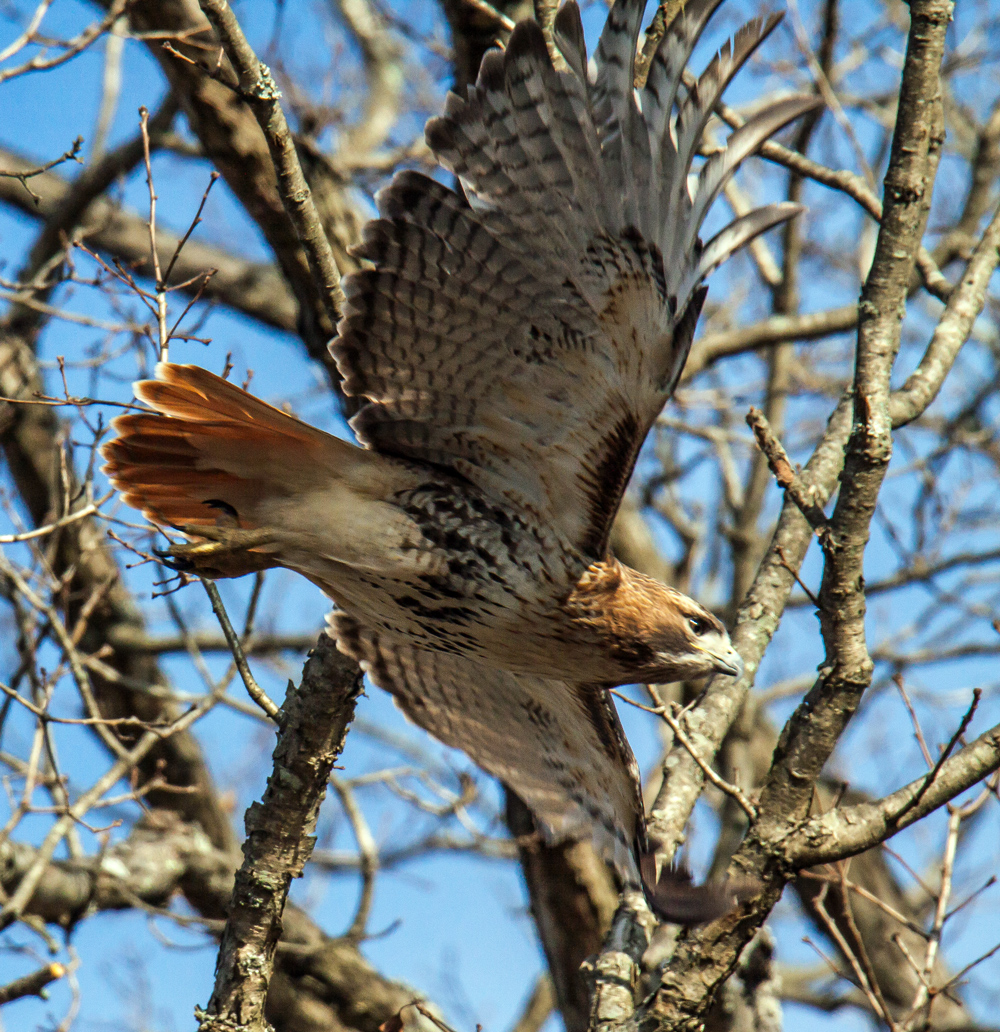
This Red-tailed Hawk (Buteo jamaicensis) seemed to be facing in the opposite direction when a sharp-eyed fellow photographer spotted it in a tree across a field. We were able to move quite a good distance across the field before the hawk became aware of our presence and took off.

Instead of flying up into the air, the hawk flew downwards initially and then flew behind the stand of trees, so I was unable to get any mid-flight shots with the sky as the background. However, I did manage to capture a sequence of shots as the hawk was getting ready to take off and also shortly after the takeoff.

Red-tailed Hawk

Red-tailed Hawk

Red-tailed Hawk

Red-tailed Hawk

Red-tailed Hawk

© Michael Q. Powell. All rights reserved.


Read Full Post »

Male Wood Ducks (Aix sponsa) are colorful and unusual looking and are one of my favorites. I spotted this one atop a nesting box at Huntley Meadows Park on Friday as he was singing in the rain. He stayed there for quite some time, periodically moving from one side of the roof to the other.

I waited and waited to see if a female Wood Duck would emerge from the box. but I never saw her. Perhaps he is keeping watch over eggs that may have been laid in the box.

Wood Duck


Wood Duck


Wood Duck

© Michael Q. Powell. All rights reserved.
Read Full Post »

This muskrat (Ondatra zibethicus) was so close yesterday morning at Huntley Meadows Park that I almost stepped back off of the edge of the slippery boardwalk as I tried to make sure that I was within the focusing range of my telephoto zoom lens.

I ended up wet from the intermittent rain, but managed to avoid falling into the water.

muskrat

© Michael Q. Powell. All rights reserved.
Read Full Post »

The Hooded Mergansers (Lophodytes cucullatus) of Huntley Meadows Park seem to spend a lot of their time in areas where they are partially hidden by the vegetation. Occasionally, though, a visual tunnel will open up briefly that lets me get a mostly unobstructed shot, like this one of a handsome male that I spotted this past Monday.

hooded merganser

© Michael Q. Powell. All rights reserved.

Read Full Post »

Sometimes photography seems so complicated with a myriad of competing factors in play as I search for interesting subjects and seek to capture their beauty. There is a kind of pull to travel to ever more exotic locales and to constantly think of upgrading my gear.

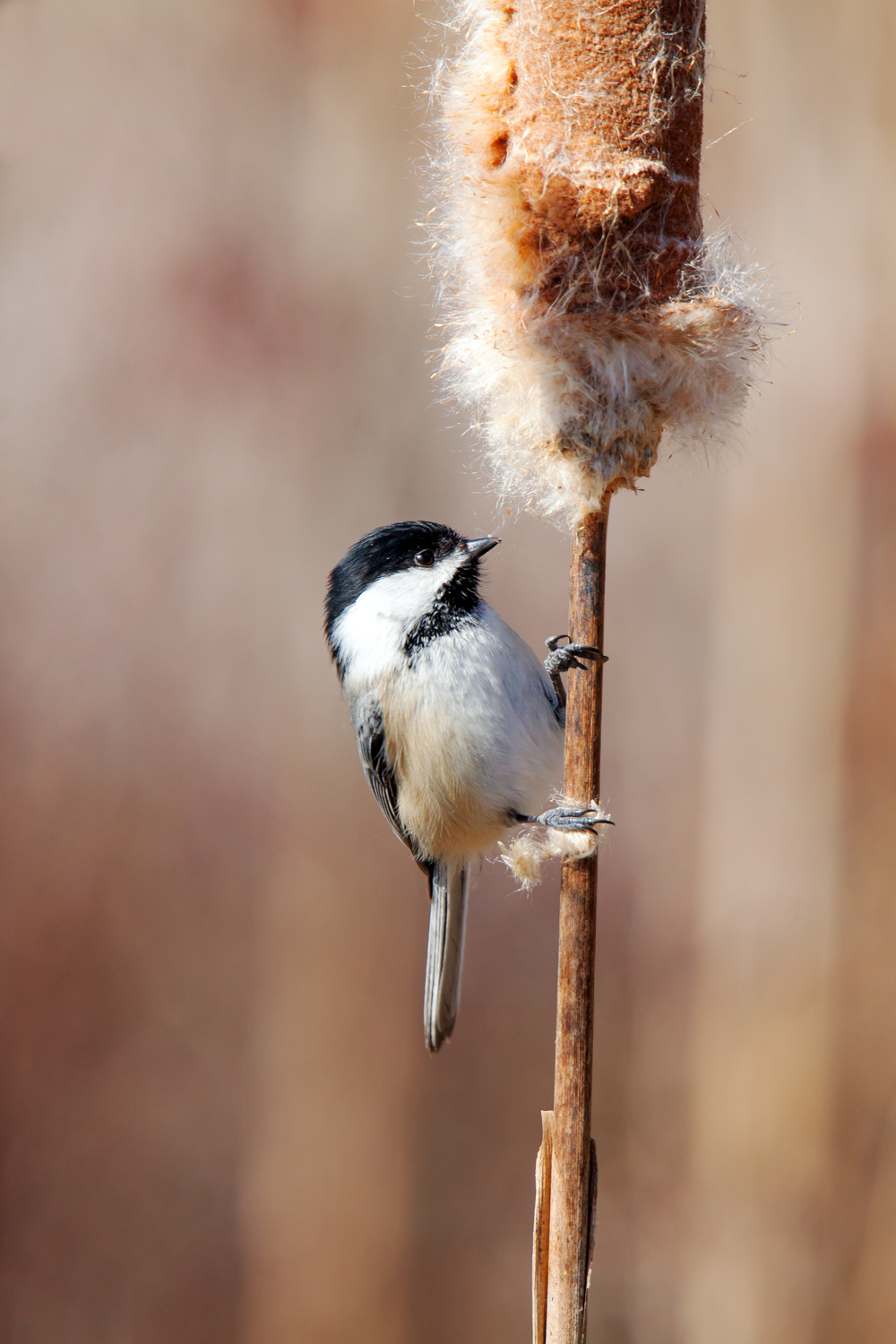
Sometimes my favorite images, however, are my simplest ones, like these shots of a Carolina Chickadee (Poecile carolinensis) that I spotted last week in the midst of the cattails of Huntley Meadows Park. The subject is commonplace, the setting is ordinary, the composition is uncomplicated, and even the color palette is restricted.

I find a real beauty in this kind of minimalism. At its heart, photography is simple, although it requires a lot of effort.

chickadee

chickadee

© Michael Q. Powell. All rights reserved.

Read Full Post »

It has been quite a while since I have seen any mammals other than squirrels, dogs, and humans at Huntley Meadows Park. Although I long to spot a fox, beaver, or even a coyote (someone saw one recently in one of the remote areas of the park), I was quite happy when I caught sight recently of a little muskrat (Ondatra zibethicus) as it munched away on some vegetation. The sound of my camera’s shutter or my movement must have alerted the muskrat to my presence and within seconds the furry creature disappeared beneath the surface of the water.

muskrat

© Michael Q. Powell. All rights reserved.

Read Full Post »

Hooded Mergansers (Lophodytes cucullatus) were really active yesterday at Huntley Meadows Park, including this female, who seemed to be contemplating using this nesting box to lay her eggs a little later this spring.

You might call it “thinking outside of the box”—or not.”  🙂

Hooded Merganser

Hooded Merganser

Hooded Merganser

© Michael Q. Powell. All rights reserved.

Read Full Post »

It’s so easy to overlook the ever-present, drab-colored sparrows when searching for birds to photograph. This past weekend, though, I stopped and watched one as it pecked away in the mud at Huntley Meadows Park, my favorite local marshland park. By slowing down and looking more closely, I was able to marvel in the beauty and industrious persistence of this little bird, which I believe is a Swamp Sparrow (Melospiza georgiana).

Slowing down and looking more closely—that’s probably a lesson I could probabl apply to more areas of my life than just photography.

Swamp Sparrow

Swamp Sparrow

Swamp Sparrow

© Michael Q. Powell. All rights reserved.

Read Full Post »

The wind was howling yesterday afternoon at Huntley Meadows Park, making the water really choppy and threatening to blow me off of the boardwalk. A solo American Coot (Fulica americana) was one of the few birds that attempted to navigate its way among the waves—it looked almost like a scene at the ocean’s shore.

American Coot

© Michael Q. Powell. All rights reserved.

Read Full Post »

This tiny chickadee was energetically digging into a cattail last week at Huntley Meadows Park. Although it is usually recommended not to photograph subjects mid-bite (at least human ones), I like the way this shot turned out of the industrious little bird.

Judging from the range maps, this is probably a Carolina Chickadee (Poecile carolinensis), although we sometimes also get Black-capped Chickadees (Poecile atricapillus). These two types of chickadees look quite similar and I am not yet skilled in distinguishing between them.

chickadee

© Michael Q. Powell. All rights reserved.

Read Full Post »

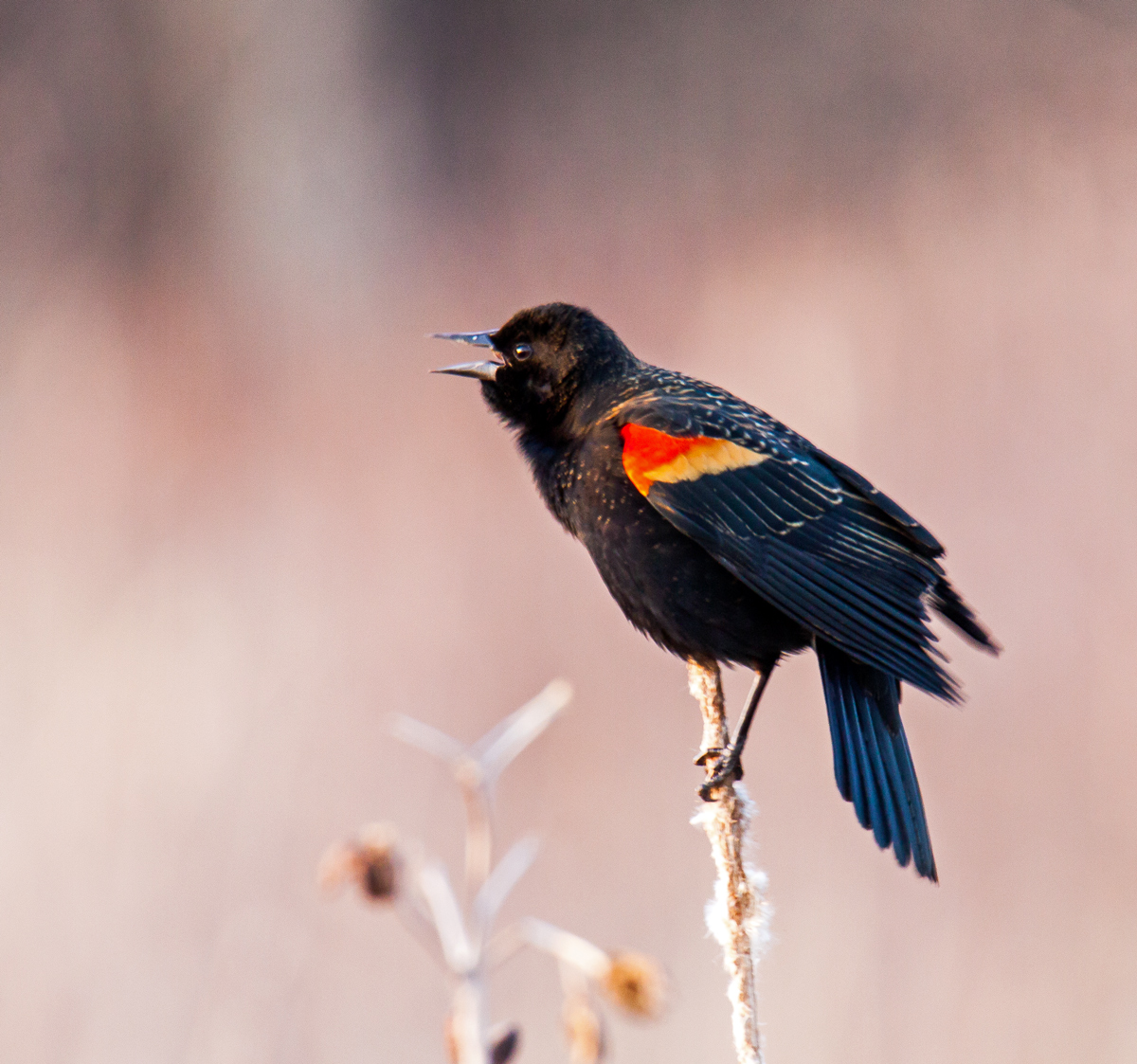
A large number of Red-winged Blackbirds (Agelaius phoeniceus) were in the trees and among the cattails yesterday afternoon at Huntley Meadows Park and their raucous calls resounded throughout the park. The males seemed to competing to see who could call out the loudest and longest, as if to say, “Can you hear me now?”

Red-winged Blackbird

Red-winged Blackbird

© Michael Q. Powell. All rights reserved.

Read Full Post »

It is hard to believe that there could possibly be any insects or other nourishment in the dried-up reeds and cattails, but this male Downy Woodpecker (Picoides pubescens) was feverishly pecking away this past Monday at Huntley Meadows Park. He was extremely focused and persistent—I hope that his efforts were eventually rewarded.

Downy Woodpecker

© Michael Q. Powell. All rights reserved.

Read Full Post »

My little chickadee—spotted yesterday afternoon in the cattails at Huntley Meadows Park. In our area, most of the chickadees are Carolina Chickadees (Poecile carolinensis), but we do get some Black-capped Chickadees (Poecile atricapillus) too. The species are so similar that I am never completely sure which one I am looking at. This one, for example, looks like some of the images that I see of the Black-capped Chickadee.

When it came to presenting this image, I was a little bothered by the large amount of negative space on the left side. However, I really like the way that the image emphasizes the tallness of the cattail. The more I looked at the image, the more I grew to like the composition, so I ended up not cropping it at all.

chickadee

© Michael Q. Powell. All rights reserved.

Read Full Post »

I had hopes of capturing lots of images of birds perched on snow-flocked branches at Huntley Meadows Park  yesterday morning, but this happy little Carolina Wren (Thryothorus ludovicianus) was the only bird that cooperated. About an inch of light fluffy snow had fallen overnight and covered the trees and cars, but the streets were totally clear—it was what some local meteorologists like to call “conversation snow.” Traffic snarls easily in Northern Virginia, but fortunately this dusting of snow did not seem to create any serious problems on the road.

So far this winter, snow has been uncommon here, but I am sure we will be blasted before long and, conditions permitting, I’ll be out again trying to capture the snowy images that I have in my mind.

Carolina Wren


© Michael Q. Powell. All rights reserved.

Read Full Post »

When I took this shot yesterday morning at Huntley Meadows Park, I assumed it was a female Red-winged Blackbird (Agelaius phoeniceus), because of its color and the pattern of the feathers. At home, though, it became clear that it was an image an immature male who is just starting to gain some of the markings of an adult male—you can just make out the beginnings of the colorful shoulder patch.

Red-winged Blackbird

© Michael Q. Powell. All rights reserved.

Read Full Post »

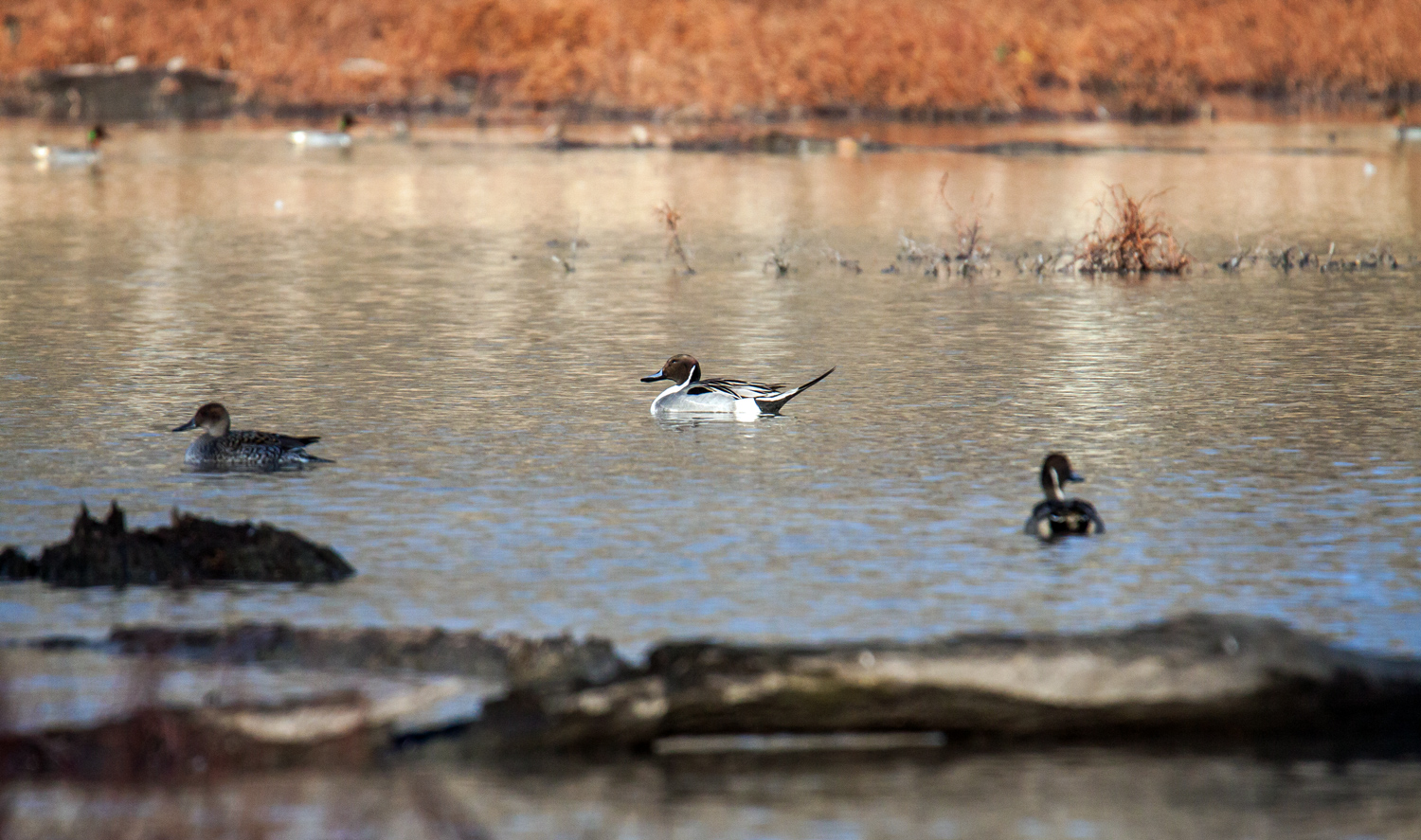
I love the mood of the early morning—there is such a sense of tranquility. Here is what what things looked like this morning at Huntley Meadows Park. The most obvious subject was a male Northern Pintail duck (Anas acuta), but I love the way that you can see other ducks and geese in the background.

Northern Pintail

Northern Pintail

© Michael Q. Powell. All rights reserved.

Read Full Post »

Does your appearance affect your attitude? Do you act differently when you are dressed formally than when dressed casually?

During the winter, I sometimes put on an utterly ridiculous looking bright red trapper hat with long floppy ears. No matter how I am feeling, I can’t help but smile when I am wearing the hat in public.

I wonder if a Northern Shoveler (Anas clypeata) feels the same way about its oversize bill. No matter when I see one, it always seems to have a goofy grin on its face. Now I admit that bills are pretty inflexible and probably don’t allow for much variation in the shoveler’s facial expressions, but the grin is contagious. In the same way that people smile back at me when I have on a goofy grin on my face when my red hat is on my head, I always smile back at the Northern Shovelers.

Wear a goofy grin today and see how other people react!

Northern Shoveler

© Michael Q. Powell. All rights reserved.

Read Full Post »

I could hear the call of Red-headed woodpeckers (Melanerpes erythrocephalus) all around my head on Saturday at Huntley Meadows Park, but they remained hidden in the trees. Finally one of them stepped out of its comfort zone and went out on a limb, and I was able to capture this image.

Red-headed woodpecker

© Michael Q. Powell. All rights reserved.

Read Full Post »

When the lighting was as dim as it was Saturday morning at Huntley Meadows Park, it felt like I was shooting in black and white. Fortunately there was a bit of color in the head and eyes of the little male Downy Woodpecker that I spotted high in the trees, framed wonderfully by the surrounding branches.

Downy Woodpecker

© Michael Q. Powell. All rights reserved.

Read Full Post »

It was so dark and gray this morning that I initially couldn’t even see what was fluttering about in the underbrush not far from where I was standing. Finally it perched and eventually I was able identify it as a Golden-crowned Kinglet (Regulus satrapa), one of the few birds that I have encountered that is even smaller than a chickadee—a bit over three inches (8 cm) in length and a weight of .2 ounces (6 g).

Golden-crowned Kinglet

Golden-crowned Kinglet

© Michael Q. Powell. All rights reserved.

Read Full Post »

Periodically I will arrive at Huntley Meadows Park early in the morning, hoping to catch a glimpse of one of the local beavers, but I haven’t seen one in quite some time. It’s very obvious, though, that North American beavers (Castor canadensis) are present and active, because their lodge, built in part on the boardwalk, keeps getting bigger every time that I see it.

Gradually the beavers are taking over more and more of a bench on the boardwalk. I noticed this morning, when I took this photo, that there is barely room now to sit down on the end of the bench. In the past, park employees have had to remove some mud when the lodge extended too far across the boardwalk and it looks like that has been the case this  year too.

I’m fully expecting to see one of these days that the bench has been totally engulfed by the beavers and incorporated into their architectural plans. At that moment I will know for certain that the beavers have taken over.

beaver lodge

© Michael Q. Powell. All rights reserved.

Read Full Post »

It’s hard to read the expression in a bird’s eyes, but this male Northern Shoveler (Anas clypeata) at Huntley Meadows Park did not seem too thrilled that its large bill had gotten tangled in the weeds.

Northern Shoveler

© Michael Q. Powell. All rights reserved.
Read Full Post »

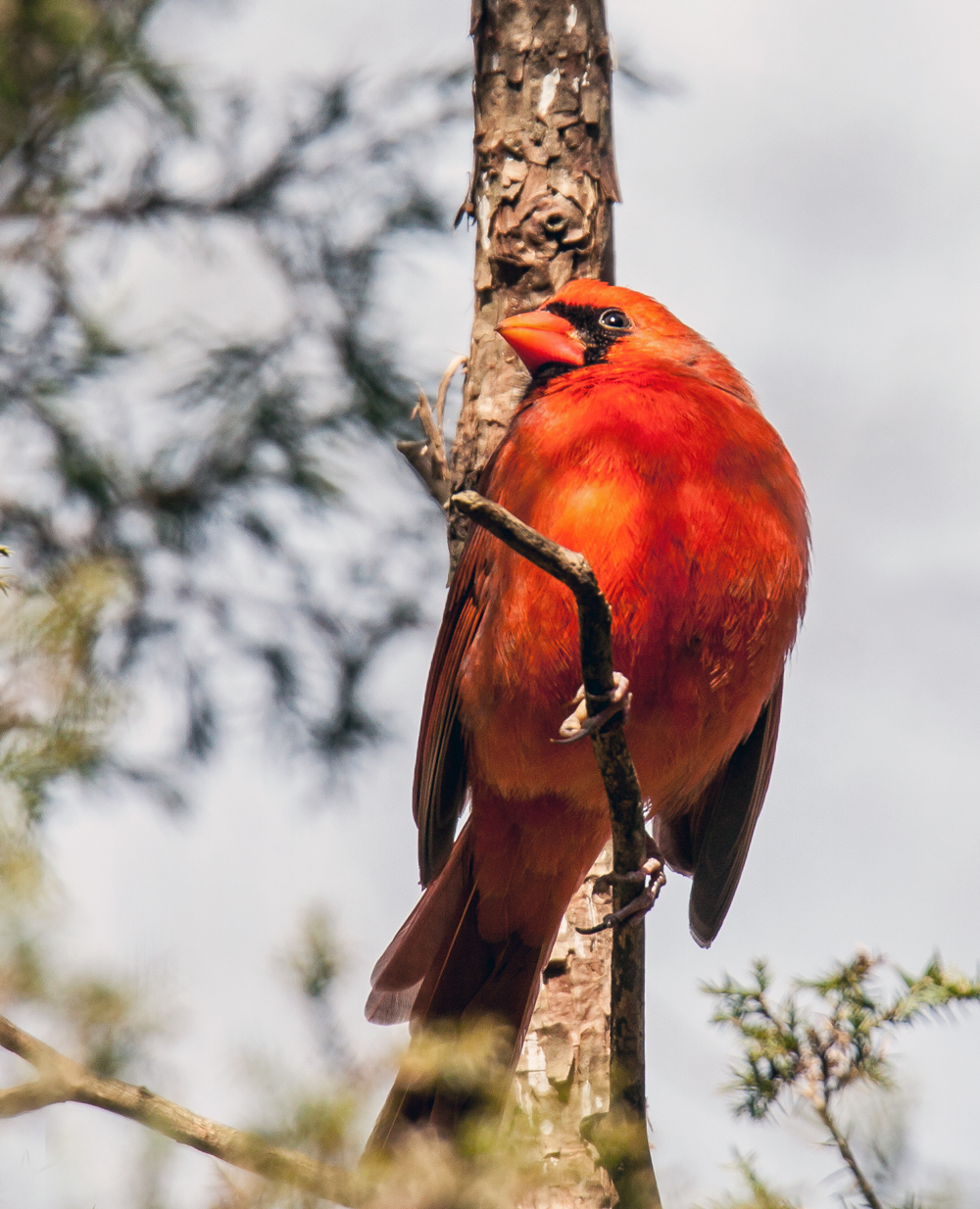
A bright red male Northern Cardinal (Cardinalis cardinalis) was buried in the bushes on Monday at Huntley Meadows Park. No matter how hard I tried, I couldn’t get an unobstructed shot. I attempted to will the cardinal to move to a new spot and amazingly it flew to a perch on the upper railing of the observation deck and posed for me.

Maybe telepathy works!

Northern Cardinal

Northern Cardinal

Northern Cardinal

© Michael Q. Powell. All rights reserved.

Read Full Post »

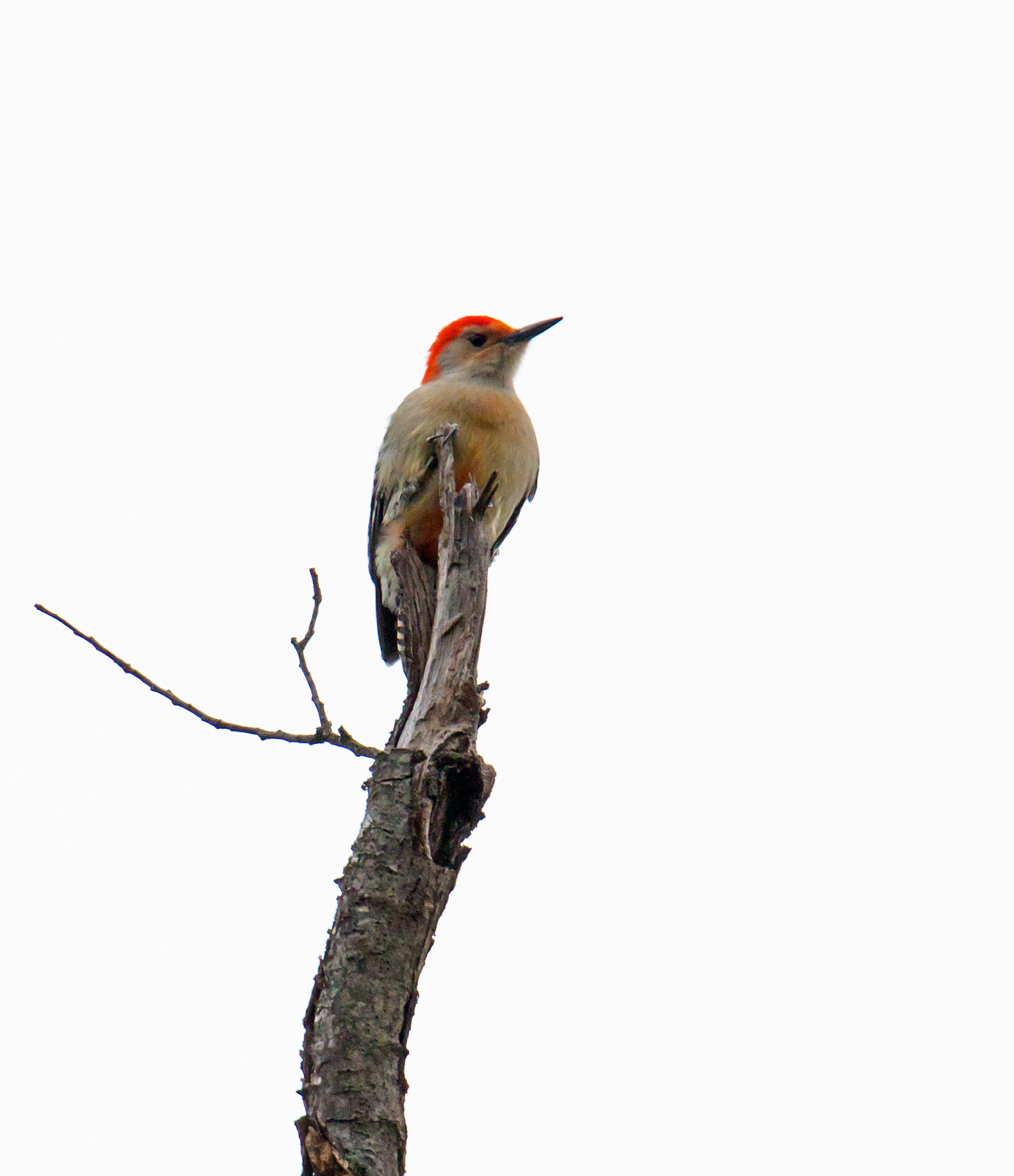
Every creature enjoys a brief moment at the top, even this humble little Red-bellied Woodpecker (Melanerpes carolinus) yesterday at Huntley Meadows Park. After working diligently at the lower levels of the tree, the woodpecker climbed to the top to enjoy the scenery and to rest for a short while.

All too quickly it was time to go back to work for this tireless and energetic little bird.

Red-bellied Woodpecker

© Michael Q. Powell. All rights reserved.
Read Full Post »

The Northern Shovelers (Anas clypeata) at Huntley Meadows Park seemed shy and skittish today. This one male, however, turned his head for one last lingering look before swimming slowly away.

Northern Shoveler

© Michael Q. Powell. All rights reserved.

Read Full Post »

Northern Pintail ducks (Anas acuta) are remarkably illusive—they never seem to come close to the shore and most often are partially hidden by vegetation. This past weekend at Huntley Meadows Park, I was able to capture some of the beautiful details of this male pintail that was out in open, albeit at a pretty good distance. I think he was initially just waking up and stretching out his long, elegant neck before settling into a more “normal” pose.

It certainly was handy to have a long telephoto zoom lens.

Northern Pintail

Northern Pintail

© Michael Q. Powell. All rights reserved.

Read Full Post »

I love it when I am able to get in close enough to capture the bold yellow stripe above the eye of the White-throated Sparrow (Zonotrichia albicollis). Often they bury themselves in the bushes and undergrowth, but this one seemed to be posing for me this past weekend at Huntley Meadows Park.

“Beautiful sparrow”—it’s definitely not an oxymoron.

White-throated Sparrow

© Michael Q. Powell. All rights reserved.


Read Full Post »

As winter days become increasingly drab and colorless, I particularly love seeing the bright colors of the male Northern Cardinal (Cardinalis cardinalis), like this one that I spotted high in a tree at Huntley Meadows Park this past weekend. Many birds blend in so well with their surroundings that they are difficult to spot—that is certainly not the case for the bold male cardinal. Throughout the winter the cardinal is with us, helping to keep our world from becoming completely monochromatic.

Northern Cardinal

© Michael Q. Powell. All rights reserved.
Read Full Post »

Although it is exciting to capture images of hawks and eagles, I am just as happy to be able to photograph the smaller everyday birds that often move about unnoticed in the trees, like this little White-breasted Nuthatch (Sitta carolinensis) that I spotted this past weekend at Huntley Meadows Park.

White-breasted Nuthatch

© Michael Q. Powell. All rights reserved.

Read Full Post »

I hope that things are looking up for you as you begin 2017. I photographed this male Downy Woodpecker (Picoides pubescens) in the morning of the last day of 2016 at Huntley Meadows Park in Alexandria, Virginia.

I’ve always admired the intense focus of these little woodpeckers. Perhaps I can look to them for inspiration as I consider my goals for this new year.

downy woodpecker

© Michael Q. Powell. All rights reserved.


Read Full Post »

« Newer Posts - Older Posts »