Feeds:
Posts
Comments

Posts Tagged ‘Huntley Meadows Park’

When I first saw this duck and his mate this week, I thought it was just another mallard couple. As I studied the male, though, I couldn’t help but notice his elongated black bill—it’s as plain as the nose on its face (wait a minute, duck don’t have noses). The female’s bill was similar in shape, but was orange in color. Not only are they long, their bills also seemed wider at the tip than at their bases, causing the ducks to look almost cartoonish.
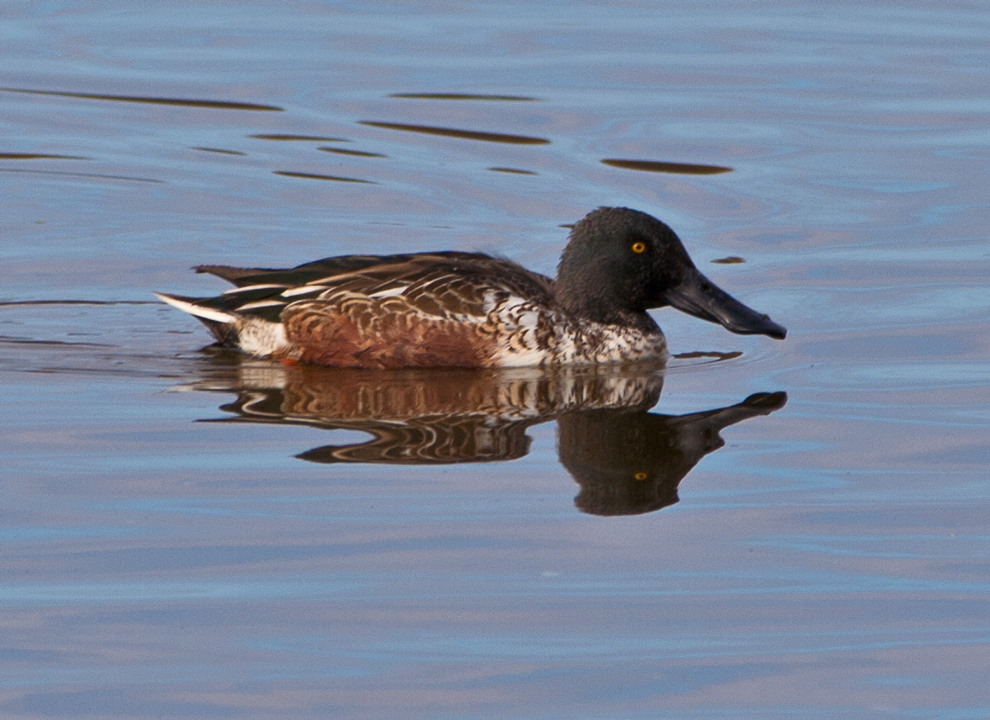
Northern Shoveler

Using the duck’s distinctive bill as a search term, it was easy for me to discover that this duck is called a Northern Shoveler (Anas clypeata). Sometimes I am baffled by the names of species, but this time the reasoning behind the name was pretty obvious. Like the mallard, the Northern Shoveler is considered to be a “babbling duck.” It forages by swimming along with its bill lowered into the water, straining out small crustaceans and other invertebrates, and generally does not tip its head and upper body forward into the water, according to the Cornell Lab of Ornithology.

Foraging Northern Shoveler

The Cornell Lab also notes that Northern Shoveler couple are monogamous and “remain together longer than pairs of other dabbling duck species.” Longer than other dabbling duck species? It makes me wonder about the divorce rate among dabbling ducks. Does “dabbling” refer to their mating habits as well as to their feeding habits? Do they stay together for the sake of the ducklings?

Northern Shoveler Couple

Speaking of ducklings, the Cornell Lab, which I highly recommend as a source of information about birds, includes the following bizarre and disgusting, yet strangely interesting factoid about this duck species, “When flushed off the nest, a female Northern Shoveler often defecates on its eggs, apparently to deter predators.” What a strange reaction.  With humans, flushing almost occurs after defecation, not before.

© Michael Q. Powell. All rights reserved.

Read Full Post »

One early morning recently I was walking through the marsh, lamenting that spectacular spider webs of the summer and early fall had disappeared. Suddenly I noticed that some of the plants were covered in a silky, web-like material. It was almost abstract in its construction and I wondered (and still wonder) about its purpose. This photo captures pretty well—in a minimalist set of colors and tone—the mysterious moodiness of that morning moment.

Natural abstract

© Michael Q. Powell. All rights reserved.

Read Full Post »

When migrating geese land at my local marsh, most of them spend their time foraging for food, storing up energy for the next leg of their trip. This Canada Goose, however, seemed to have decided to rest a bit to regain his strength and secluded himself from the feverish activity of the other geese. His position is not that unusual, but his surroundings make this photo stand out for me. The colors contrast nicely with the black of his head and I really like the reflections. Click on the photo if you would like to see it in higher resolution.

Canada Goose at rest

© Michael Q. Powell. All rights reserved.

Read Full Post »

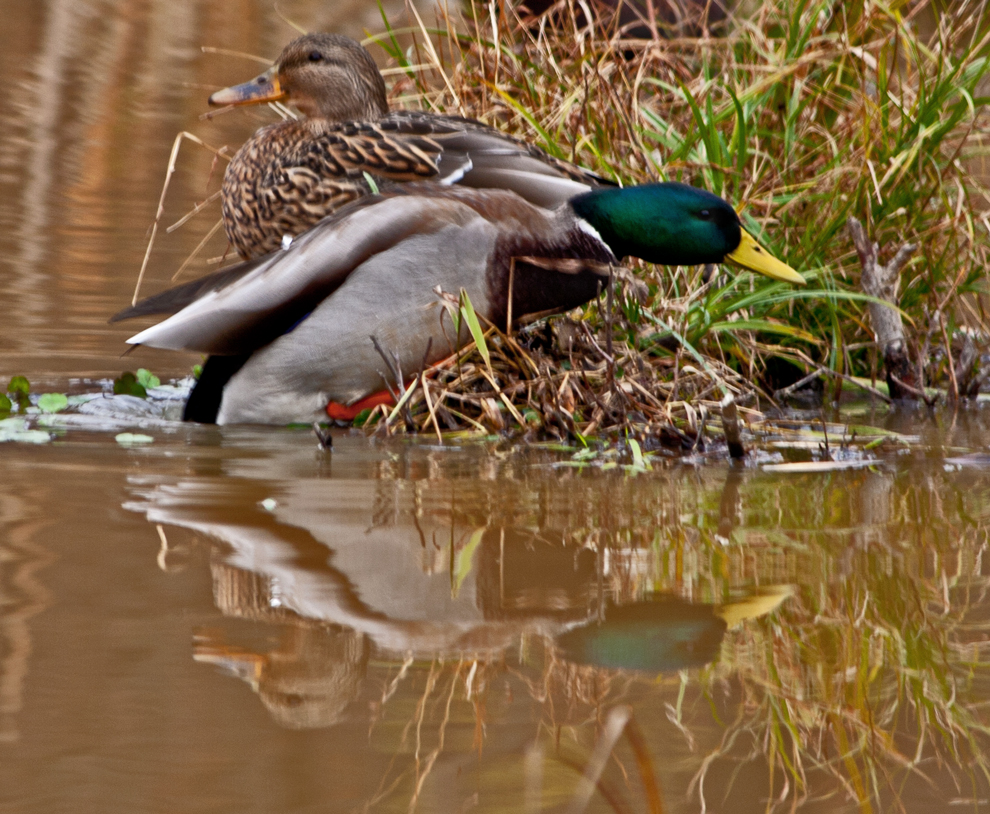
I have been watching migratory birds recently and observed that mallard ducks feed mainly by tipping forward and placing their fringed-edged bills in the water, straining out plants, seeds, and other material. The Cornell Lab of Ornithology categorizes mallards as “dabbling ducks” versus  “diving ducks” that go deep underwater to forage for food.

One mallard, though, used a different technique. Instead of dipping his head forward, he flattened himself out and placed his bill almost parallel to the water. He then slowly and systematically paddled back and forth with his beak in the water or just above it, continuously straining and restraining the surface of the water. (Did he require a restraining order?) As the photo shows, there was a lot of plant material available for him to gather. His female partner used the same technique, though I was not able to get a clear shot of her doing so.

Straining mallard

I observed another mallard straining in a different way. Along with his female companion, he was perched on a tiny piece of land. I must have startled him a little when I walked by, because he slipped into the water. Realizing he had nothing to fear from me, he tried to regain his spot. It required several vigorous attempts for him to climb out of the water and I managed to capture him straining to do so. I love the contrast between the determined look on his face and the impassive expression on the female’s face.

Mallard straining to regain his spot

Strain or strain? It’s so amazing that words can have so many different meanings—it strains the imagination.

© Michael Q. Powell. All rights reserved.
Read Full Post »

Geese and ducks continue to arrive and depart with such frequency in my local marsh that I feel like I am in a major bird airport. Fortunately, there are no long lines or security checks for them to endure. We must have a special arrangement with our northern neighbors, for the Canada Geese are not subject to any special customs scrutiny.

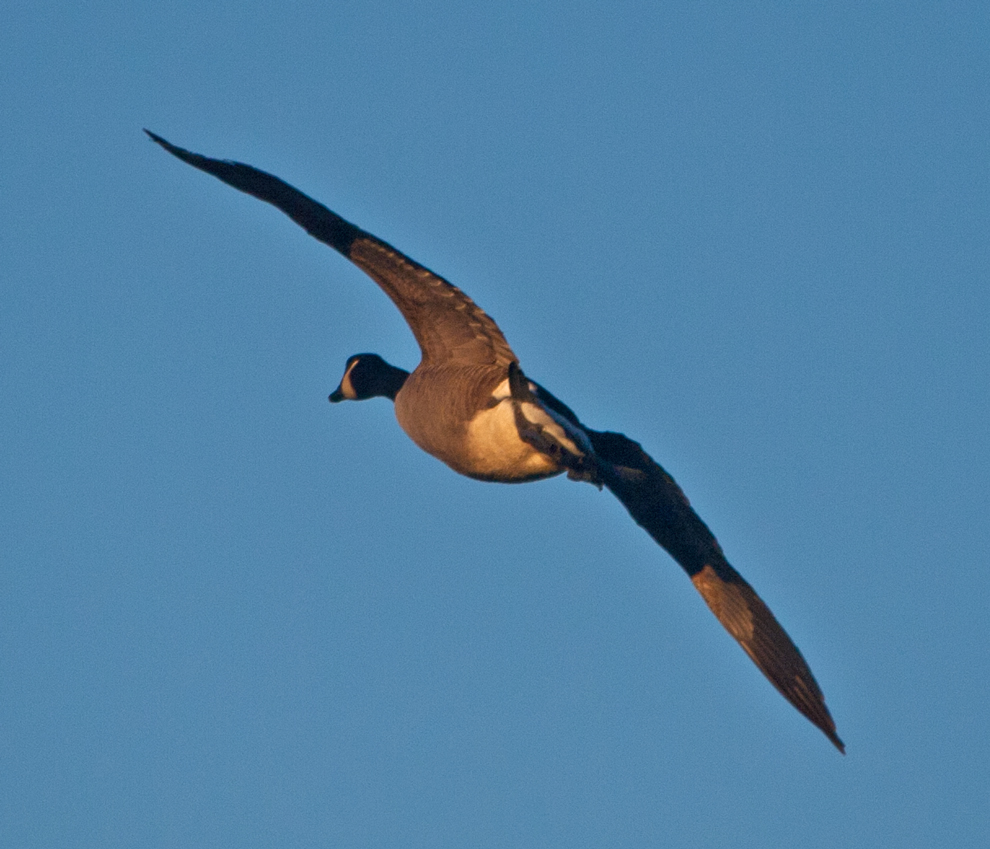
I continue to try to take photos of the geese while they are in flight, usually when the are coming in to land or taking off. Often the geese will circle around and honk loudly to announce their arrival (a kind of bird intercom system). Perhaps the birds on the ground can interpret the honks to mean something like, “Now arriving on pond number one, Canada Geese flight number one from Toronto.” My first photo is one of a Canada Goose banking. No, he is not at an ATM machine, withdrawing cash. He is making a sharp turn as he prepares to land.

Banking goose

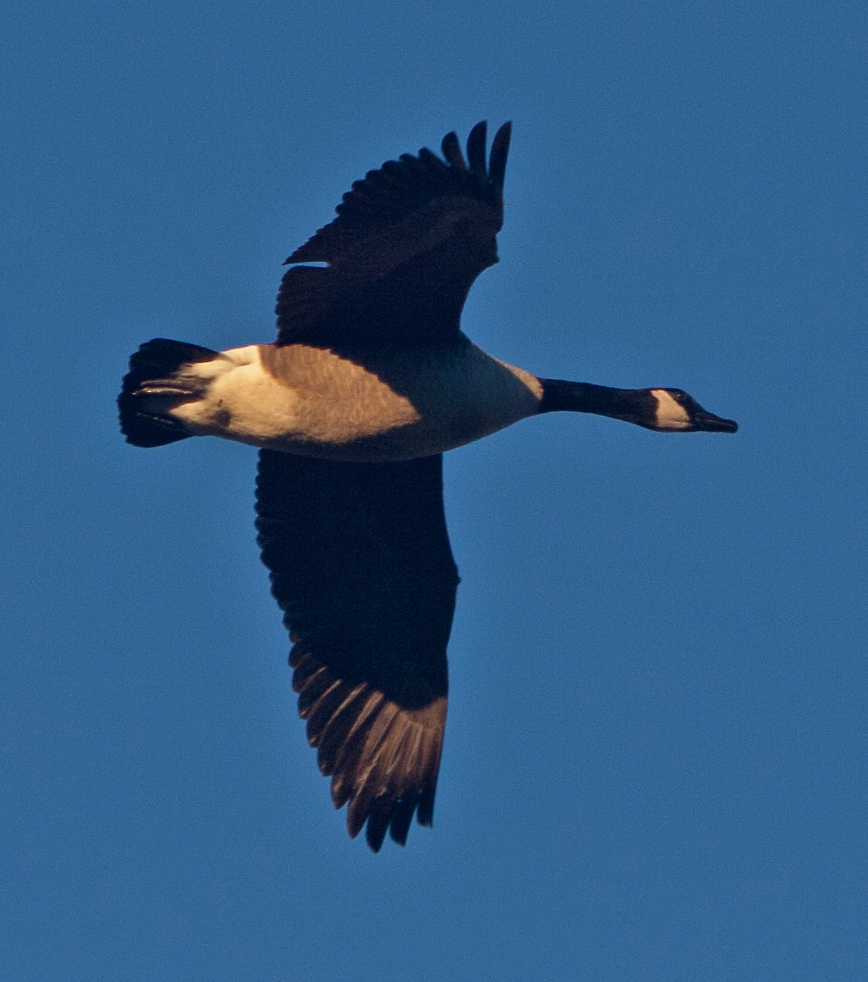
The second photo shows a goose in flight. If you click on the photo, you will notice that the goose has a zen-like look of contentment on is his face. Scientists have been working on implanting a tiny device into geese that will provide them an in-flight entertainment package (and autopilot features too) and this goose may be one of the early test subjects.

Goose in flight

Some geese hate to fly alone and prefer companionship during the long flight. A new business has sprung up that provides escort service for the lonely goose, a fledgling matchmaking company that is just getting off of the ground. The company’s contracts are full of fine print about additional charges, but some geese continue to be surprised with the bill they are presented at their final destination.

Lonely goose escort service

© Michael Q. Powell. All rights reserved.
Read Full Post »

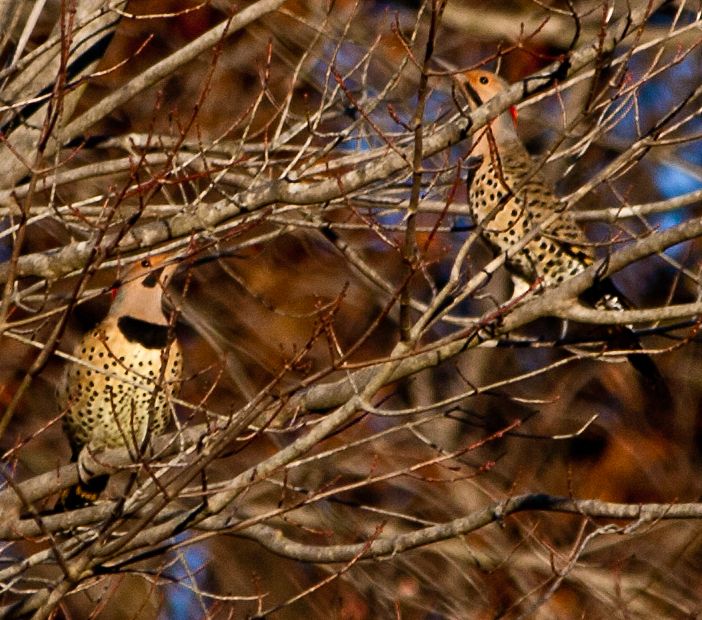
As I was walking this weekend past the beaver lodge at my local marshland park, a flash of brilliant yellow in the trees across the little pond caught my eye. Through my telephoto lens I could see that there were a couple of birds in the trees, but I couldn’t see them clearly because of tree branches nor could I identify them. Still, I kept shooting, aiming at the spot where I could see the movement and the flashes of color. Here is an example of what I was seeing (though this image is significantly cropped).

Northern Flicker couple

After returning home and doing a little research, I found out that I had photographed a pair of Northern Flickers (Colaptes auratus), a type of woodpecker that I had never seen before. I love their speckles and their black and red markings. These two birds were interacting in peculiar ways, with both of them flashing their feathers at the other, revealing the bright yellow colors that I had seen earlier.

Is this mating behavior? Were they putting on a performance for my benefit? I have not idea what was the cause for all of that behavior, but it certainly was intriguing.

None of my photos of these birds are that great, but I am always excited to share my photos when I see something for the first time. Perhaps the next time I will be better placed to get clearer shots.

“Maybe some sweet words will make an impression?”

“How do you like me now?”

“Two can play at that game.”

© Michael Q. Powell. All rights reserved.
Read Full Post »

What strikes you first when you look at a photo? Is it the color, the composition, the lighting, or some other aspect? When I first looked at this close-up photo of a Canada Goose foraging as it took a break from its migratory flying, it was the contrast in textures that grabbed my eyes. When I see these geese from a distance, I tend to see them in solid blocks of color, such as a black and white face. A closer examination reveals details like the shininess of the eyes and the beak, the burlap-like texture of the white portion of the face, and the multicolored beauty of the feathers.

What other details do I miss each day, because I fail to look closely enough?

Goose textures

© Michael Q. Powell. All rights reserved.
Read Full Post »

The light was sinking lower in the sky late this afternoon when I took this photo of two Canada geese (Branta canadensis) in the still waters of a little pond. The light was beautiful, as are the reflection of various parts of the scene in the water. If you click on the photo, you can see a higher resolution view of the scene. To use the term of a fellow blogger, Steve Schwartzman, I consider this photo to be a “semi-landscape.”

Geese in late afternoon light

© Michael Q. Powell. All rights reserved.
Read Full Post »

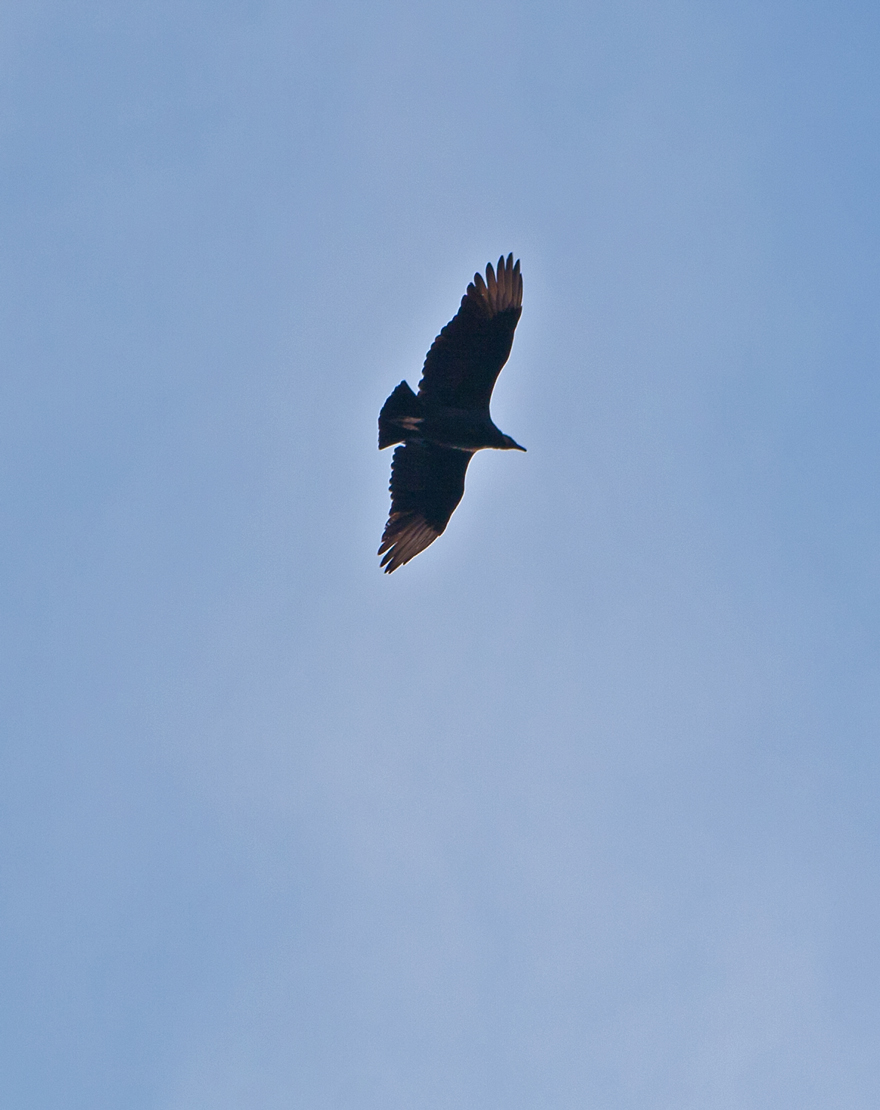
As the cool morning air was warmed by the sun last Monday, I caught sight of a group of seven large birds soaring together through the air. I could tell that they were different from the turkey vultures that I had previously photographed, but I wasn’t sure what they were. A friendly birder identified them for me as Black Vultures (Coragyps atratus).

The Cornell Lab of Ornithology website, one of my favorite places to go to learn more about birds, notes that the Black Vulture have a less developed sense of smell than Turkey Vultures, and have to rely on their sight, which is why they may soar at greater heights than the Turkey Vultures. More social than the Turkey Vultures, Black Vultures often travel in flocks and may share a common roost before they go off to forage. (I saw a whole group of them in a single tree earlier in the morning that I took these shots).

I am still in awe of these large birds with impressive wing spans. At the marshland park where I do a lot of my photography, there are a number of species of hawks, and I hope to be able to get some photos of them eventually.

© Michael Q. Powell. All rights reserved.

Read Full Post »

I was attempting to get a photo of a bird in the cattails, when suddenly I noticed that a deer had entered into the frame. Deer are pretty common and I have even seen them in my suburban neighborhood, but I have rarely seen them at a moment when I had my camera in my hand, so I was excited.

The lighting was a little uneven and harsh and it was difficult to get a completely unobstructed shot, but the deer cooperated and paused a few times, allowing me take a few relatively clear shots. I grew up in the suburbs of Massachusetts and even though my deer identification skills are not strong, I am pretty confident that this is a buck, probably a white-tailed deer (Odocoileus virginianus).

I am not a politician, but I am glad to affirm with great conviction,  “The buck stops here.”

© Michael Q. Powell. All rights reserved.

Read Full Post »

I arrived early in the marsh on a cold fall morning when the dew and a touch of frost seemed to have combined to coat objects with a kind of frozen mist. I was hoping to find some large, beautiful spiders shining in the early morning light, as I had found repeatedly during the summer and early fall mornings. My initial scan found no spider webs at all, but suddenly I spotted one in the cattails. It was not large, but its rarity made it extra special. The structure is not very complex or symmetrical and the silk threads seem to be heavy-duty, rather than delicate. I wondered what kind of spider made such a web, but did not spot the maker of the web. Perhaps she’ll continue her handiwork for a little while longer—I’ll be checking each time I return to the marsh.

Last web standing in the fall

© Michael Q. Powell. All rights reserved.

Read Full Post »

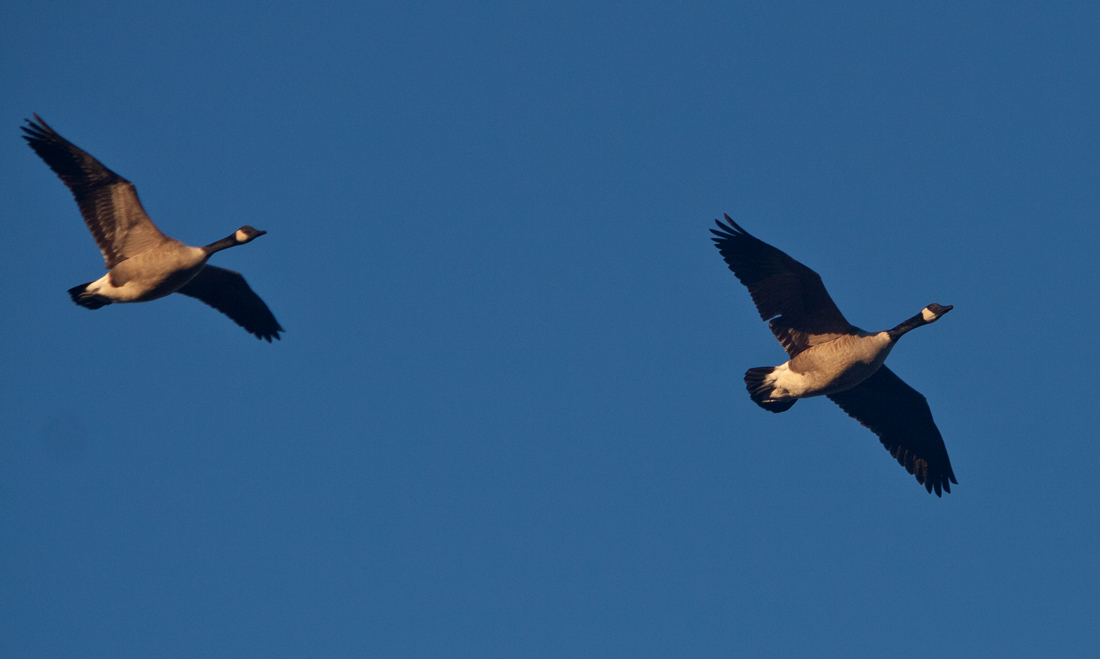
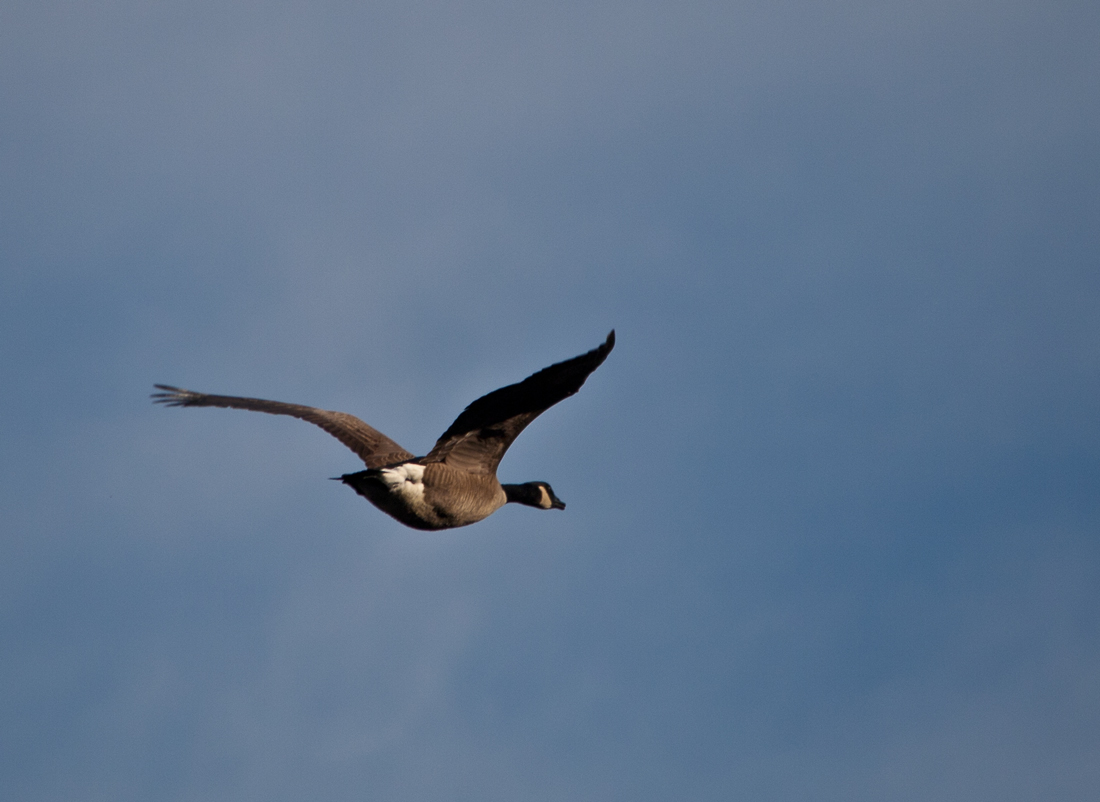
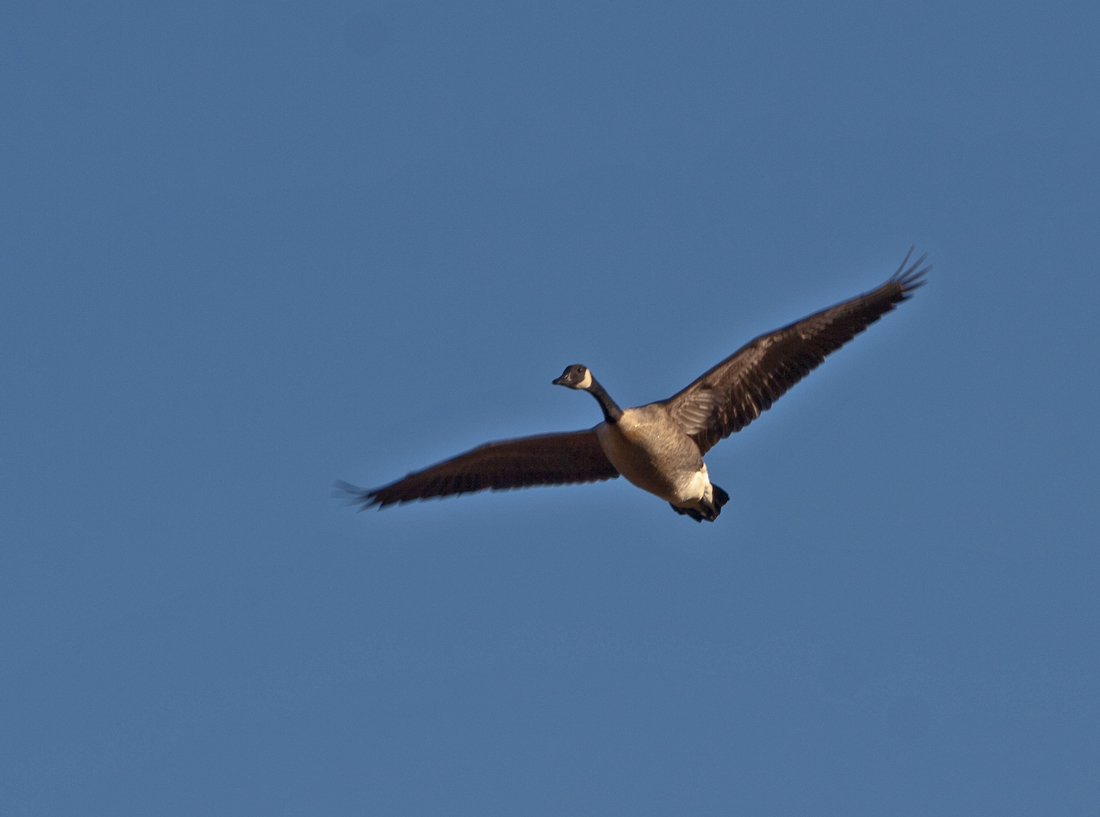
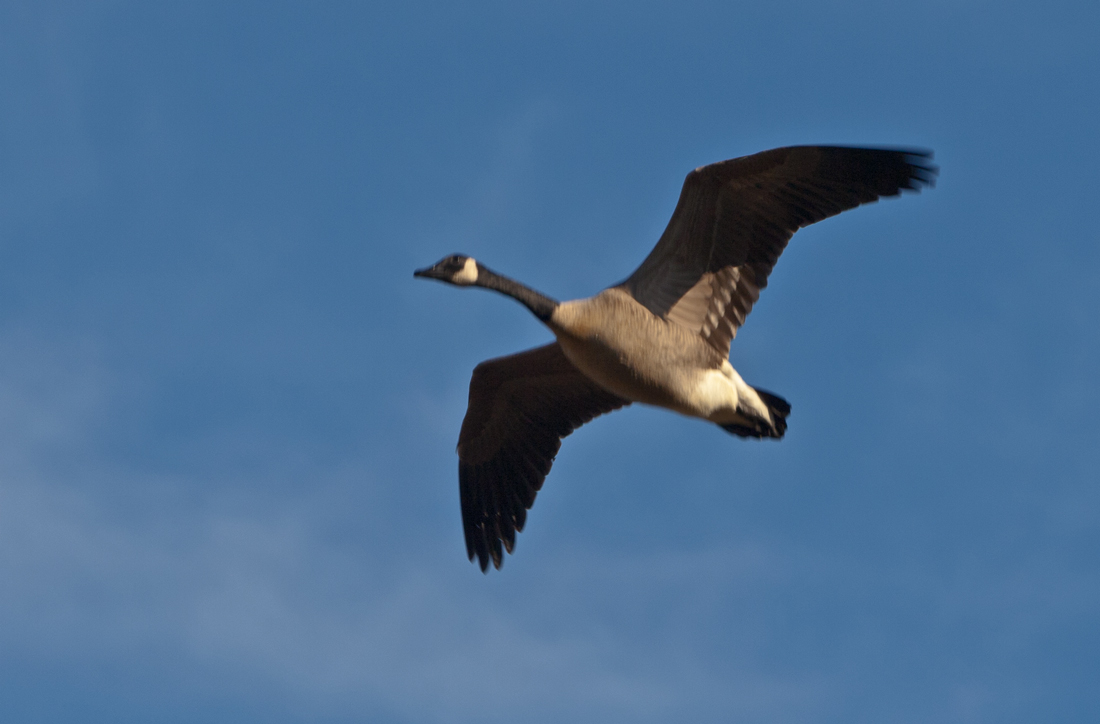
Canada Geese (Branta canadensis) continue to stop in at my local marshland (Huntley Meadows Park) as they migrate to unknown destinations. Sometimes they come in large groups, though most often I have seen them come in small groups of two to  six geese. I watched them for quite some time during this sunny weekend, and it seems that they spend most of their time on the ground foraging for food or simply relaxing and grooming themselves.

I’ve tried to take photos of the geese when they are flying and have found that this is much more challenging than I had anticipated. Lighting is perhaps the biggest issue, but the speed and direction of the geese is an almost equal problem—profile shots are great, but their relative speed seems fastest when they are moving perpendicular to the camera direction. Camera settings are sometimes hard to choose and adjust, especially when the geese decide at the spur of the moment that it’s a good time to take off. As I’ve found out repeatedly, the settings appropriate for taking photos of the geese in the water are not appropriate for geese in the air.

Here are some of my photos of geese in flight from this past weekend. As you can see, the weather was sunny and the skies were blue.  I am still working on my techniques, but I like the results so far (though I wouldn’t dare reveal how many shots I attempted in my quest to capture the geese in flight). If you click on the photos, you can see a few more details in a higher resolution view.

Migrating Canada Goose

Soaring Canada Goose

Climbing Canada Goose

© Michael Q. Powell. All rights reserved.

Read Full Post »

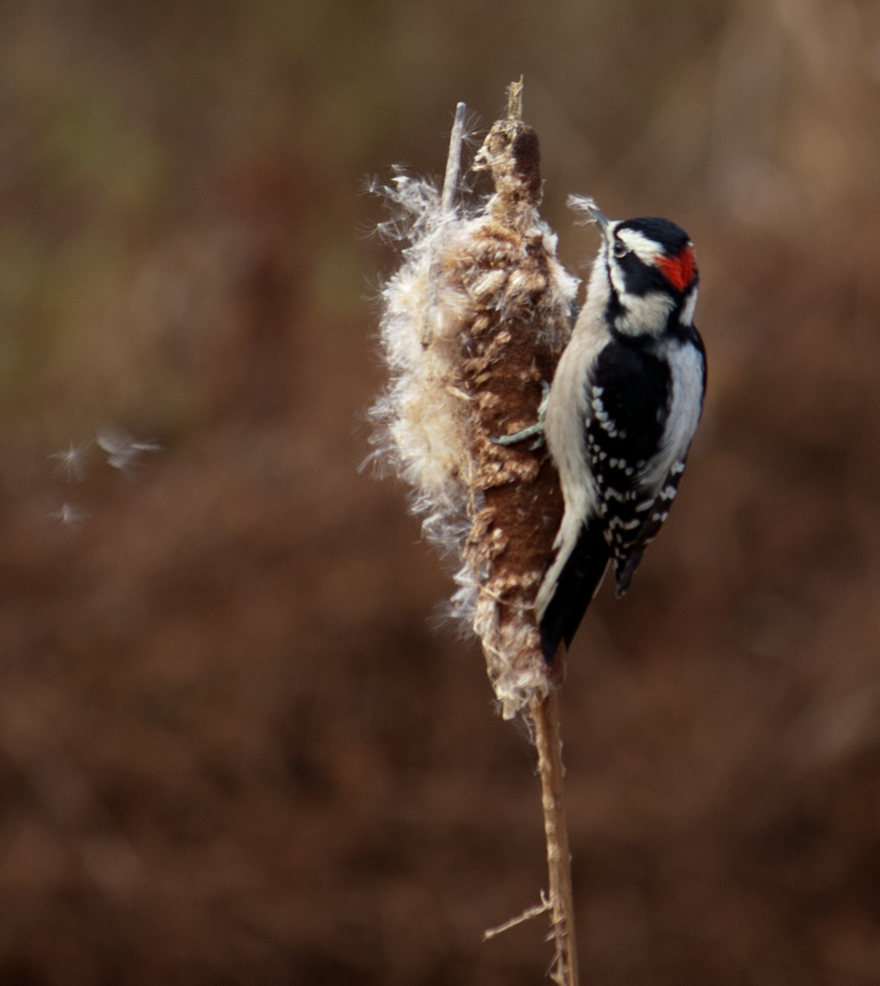
If I were a woodpecker, I would want to be a male Downy woodpecker (Picoides pubescens) and slam my head into something soft as a pillow—like this cattail—and not always into solid wood. Of course, you can end up with a mouthful of cattail fibers, and not just a tasty bug.

Downy woodpecker with mouthful of cattail

Downy woodpecker on cattail

More seriously, scientists are doing research to figure out why woodpeckers don’t end up with concussions, given that they can slam their heads into wood with the force of 1,000 times that of gravity, according to an article on livescience.com. By comparison, humans can survive a force of up to G’s, according to Air Force research, though there are reports of race car drivers surviving a force of over 100 G’s. According to the article, Chinese researchers are studying the microscopic structure of the bones surrounding the brain and also the beak to try to understand how the woodpecker’s brain is protected. If you are interested in the research, an article on a website called Inkfish explains in layman’s terms the research methodology and some of the preliminary conclusions.

© Michael Q. Powell. All rights reserved.

Read Full Post »

Looking for subjects to shoot this morning, I happened to look up and saw a large bird soaring on the wind, headed in my direction. My heart raced a little as I made a quick setting adjustment on my camera, because I figured the bird with the impressive wingspan was perhaps an eagle or at least some kind of hawk.

I was a little disappointed initially when I discovered later that the bird was “only” a turkey vulture (Cathartes aura). After a while, though, the wings and feathers and the coloration started to grow on me and I realized that the turkey vulture has a beauty all its own. (In some ways I might compare it to some of the wild turkeys that some of my fellow bloggers have featured recently in their postings—suffice it to say the turkeys are not traditionally beautiful.)

I’m still working on photographing birds in flight, but it sure is a lot easier when a bird is soaring like this one, not flying at full speed.

Turkey vulture in the fall

Turkey vulture at Huntley Meadows Park

Turkey vulture soaring on the wind

© Michael Q. Powell. All rights reserved.
Read Full Post »

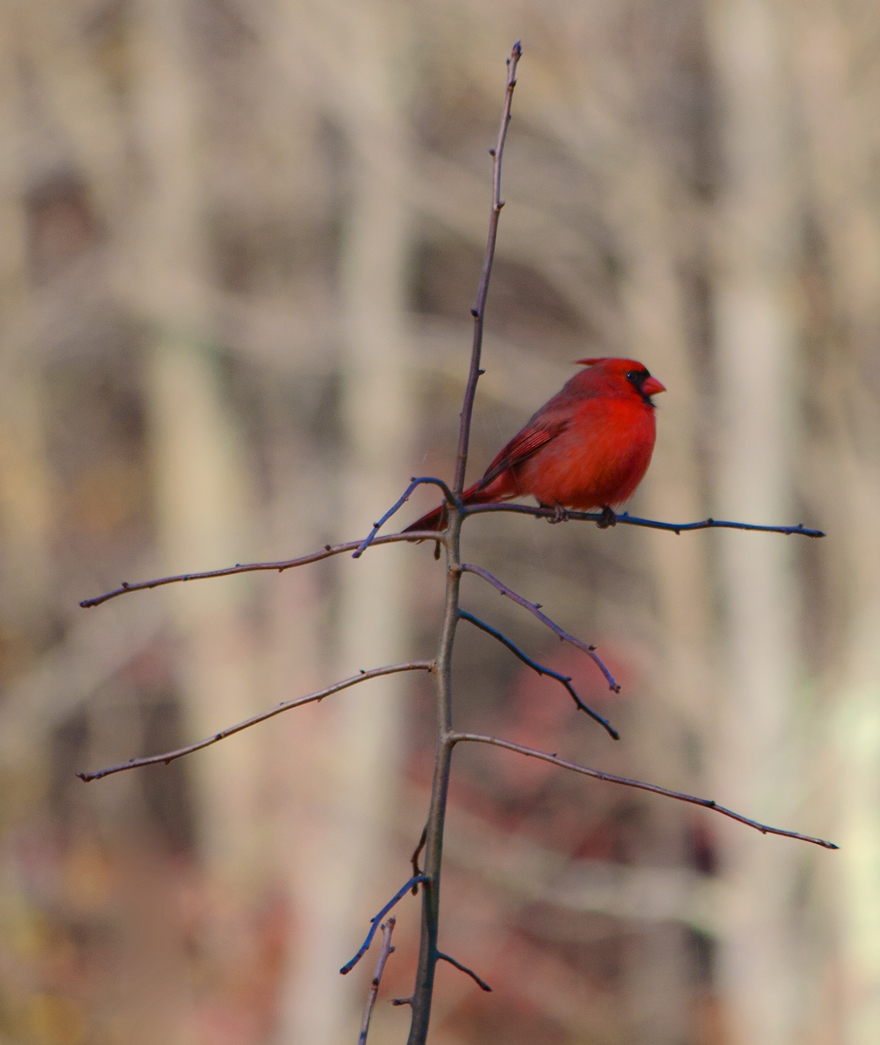
It’s difficult enough for a bright red cardinal to hide when there are lots of leaves on a tree, but when the leaves are gone, it’s impossible.

© Michael Q. Powell. All rights reserved.

Read Full Post »

During the past month or so I have posted multiple photos of male red-winged blackbirds. The female is not black and does not have a red patch on her wings, so she may not be as easily recognized as a red-winged blackbird. I think you would probably agree, however, that the coloration of the female is very striking and quite beautiful. Here is a shot of a female red-winged blackbird on a cattail that I took this past weekend. I especially love the silvery gray beak and the gold ring around her eyes.

Female red-winged blackbird on a cattail

© Michael Q. Powell. All rights reserved.

Read Full Post »

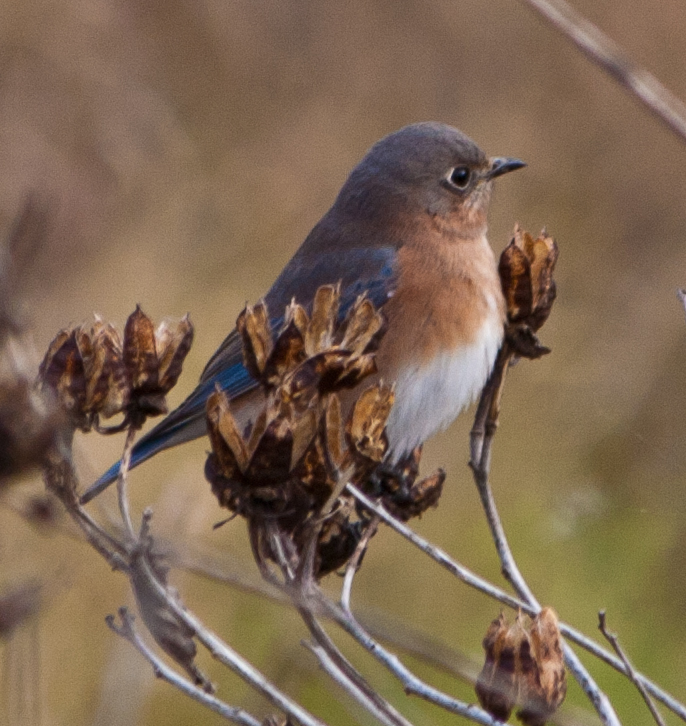
November so far have been gray and cloudy and much of the fall foliage has faded. I was therefore extra happy to see brightly colored birds today. Although I have repeatedly photographed brilliant red cardinals, today was the first day that I got a decent shot of the equally spectacular Eastern Bluebird (Sialia sialis).

I looked at the range map for the Eastern Bluebird and we may have them here all year in Northern Virginia. I guess that I’ll just have to wait and see.

Eastern Bluebird

© Michael Q. Powell. All rights reserved.

Read Full Post »

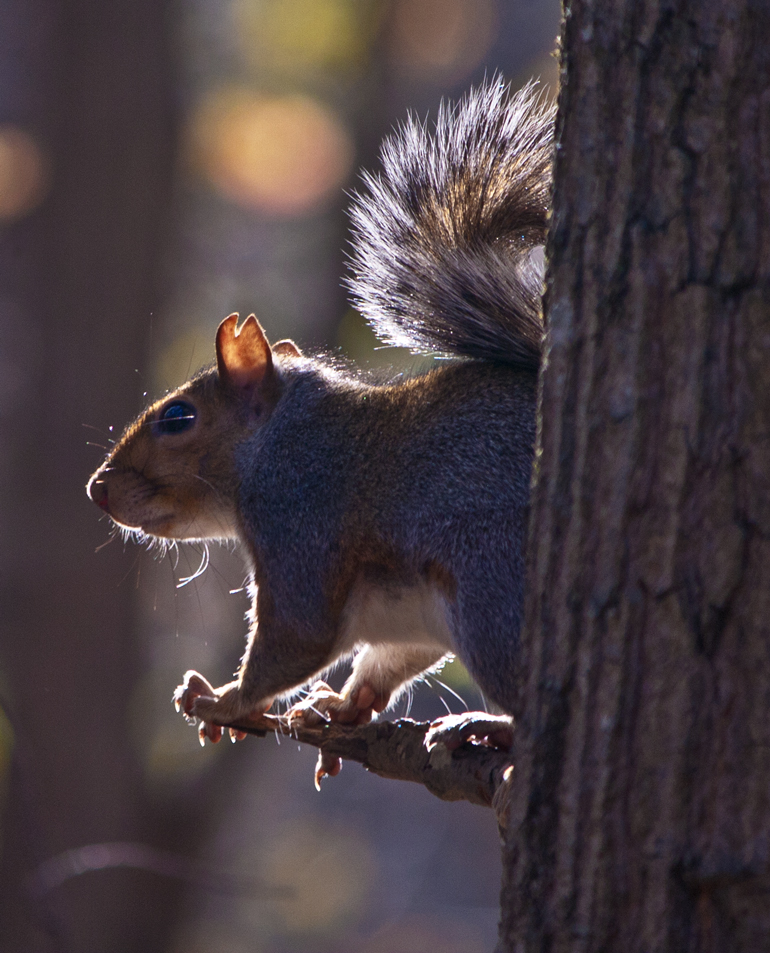
Backlighting adds drama and glamor, even when the subject is as ordinary as a squirrel.

I was almost done shooting photos today when I decided to try to capture a few images of squirrels. Usually they are too quick for me and I often end up with blurry photos. As I approached a squirrel, he climbed a tree and I stopped and waited to see if he would climb higher. Instead, he climbed out onto a tiny branch, offering me a profile shot with beautiful backlighting. I love the glow around the face and tail and the warmth of the light showing though the squirrel’s ear. Even the bokeh is nice.

Even a squirrel can look glamorous, under the right conditions.

Squirrel glamor shot

© Michael Q. Powell. All rights reserved.

Read Full Post »

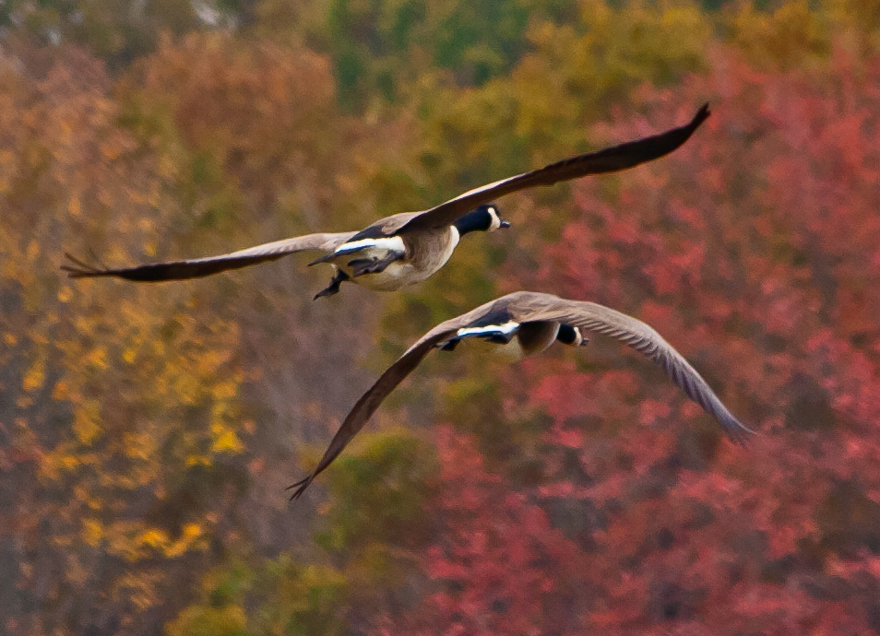
Did you ever wonder what happens if an aircraft’s radar and radio go bad? Yesterday I saw what happens when the emergency network is activated and escorts are sent out to accompany the aircraft to its final destination. In a cost-cutting measure, fighter jets are no longer dispatched, but these geese do have significant experience in long-distance flying and especially flying in formation.

Emergency escorts

© Michael Q. Powell. All rights reserved.

Read Full Post »

Looking down in the water, I was a little surprised to see a Banded Wooly Bear caterpillar (Pyrrharctia isabella) swimming, albeit not too quickly. He would slowly undulate his hairy body for a stroke and pause, and then repeat the process. It was fascinating to see the little air bubbles surrounding his mouth and the gentle ripples produced by his movement.

This caterpillar will almost certainly overwinter in his current state and pupate in the spring into an Isabella Tiger Moth. Bugguide notes that there are normally two broods, on that pupates in the summer and the other in the following spring. I have looked at some photos of the moth and can’t help but note that the caterpillar stage is a lot more attractive and interesting.

Wooly Bear caterpillar swimming (click for higher resolution)

Wooly Bear caterpillar pauses for a breath (click for higher resolution)

© Michael Q. Powell. All rights reserved.

Read Full Post »

It seemed like this beautiful male Northern Cardinal (Cardinalis cardinalis) was posing for me on the dead log, somehow knowing that this position would provide for an equally beautiful reflection.

© Michael Q. Powell. All rights reserved.

Read Full Post »

On a cold and overcast morning, I walked through the marsh today, heading toward a little pond area where I was hoping to see migrating ducks and geese. As I arrived at that area, I realized there was a deer in the distance near the far side of the water’s edge. I didn’t have time to make many adjustments and got off only two shots. This is the better of the two, and I like the pose of the deer, as she back at me before taking off. To give you an idea of the limited light, this was shot at ISO400, f5.6, and 1/30 second. I was at the far end of my 55-250mm zoom lens (and still had to crop quite a bit).

Early morning deer

© Michael Q. Powell. All rights reserved.
Read Full Post »

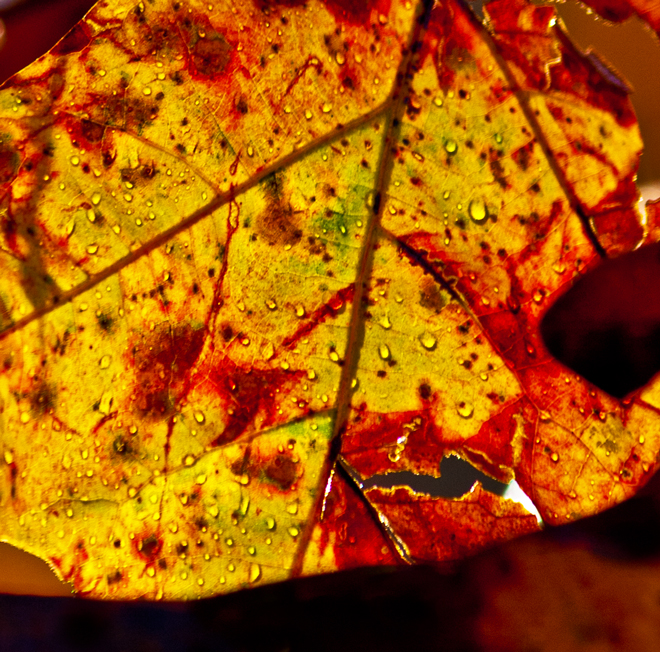
The leaf is back-lit and drops of dew glisten on its surface, a surface that is scarred and torn and unevenly colored with the tints of the fall. In its beautiful imperfection, this autumn leaf speaks to me in the simple, abstract language of lines and shapes, of light and color.

Abstract fall leaf

© Michael Q. Powell. All rights reserved.
Read Full Post »

It seems appropriate to post a photo of a spider on the evening before Halloween. I was not able to get a look at the spider’s front side when I photographed it this past weekend at Huntley Meadows Park, so I can’t identify it. I know for sure, though, that I never want to wake up in the morning and have this view of a spider. With my near-sighted vision, that would mean that it was way too close to me for my comfort. Happy Halloween!

UPDATE: Thanks to the assistance of my mentor and fellow blogger, Cindy Dyer, I am now pretty sure that the spider is the orb-weaver spider Neoscona Crucifera, sometimes known as Hentz’s orb-weaver or a barn spider (though there are other spiders known as barn spiders too).

Pre-Halloween spider enjoys a snack

© Michael Q. Powell. All rights reserved.
Read Full Post »

This past weekend I came across a caterpillar that I had never seen before.  Its black, yellow, and white markings somehow made me think of the Pittsburgh Steelers NFL team that wears those same colors. For now, I am referring to it as the Steelers caterpillar, though, of course, it has a “real” name.

I’m having trouble identifying it—it may be a Smartweed caterpillar, also known as a Smeared Dagger caterpillar (who makes up these names?), although it seems to be lacking the red coloration in the hairs that I see in most photos. If anyone can make a positive identification, please let me know. Who knows, maybe the Steelers need a fuzzy new mascot?

Pittsburgh Steelers caterpillar

© Michael Q. Powell. All rights reserved.

Read Full Post »

While I was watching migrating geese at a local marsh yesterday, one of them suddenly stretched out its wings. There was another goose right behind the one with outstretched wings and I wanted to warn him by crying out, “Duck, goose!” Instead I instinctively pressed the shutter release and got this photo. The image makes me laugh when I look at the face of the crouching goose, who does not appear to be too happy with his fellow traveler.

© Michael Q. Powell. All rights reserved.
Read Full Post »

Yesterday when I was walking the marsh, I glanced down and saw a spider web shining a foot or so above the surface of the brown, muddy water. There was a long, skinny insect on the web and my first thought was that this was a spider’s prey, but no spider was visible. I took some photos and did some internet research and was shocked to learn that strange insect is a spider, probably a Long-jawed Orb Weaver spider of the Family Tetragnathidae. Check out Bugguide if you want to learn more about this unusual-looking spider and click on the image to see more details.

Long-jawed Orb Weaver spider

© Michael Q. Powell. All rights reserved.

Read Full Post »

A trio of Canada Geese (Branta canadensis) paid a short visit today to my local marsh at Huntley Meadows Park. I suspect they are migrating, though I am not sure about that. They announced their arrival loudly and circled around before landing, so I had time to attempt some shots. I don’t have much experience in photographing birds in flight, but had limited success, as you can see in these shots. I could not get all three of them close enough to each other in the frame, so you only see two at a time. In case you wonder, the day was extremely overcast and there was not much sunlight—that is why the sky looks white in some of the photos.

This is the kind of photo that I want to be able to take, so today was good practice for me. I can tell I still need a lot of practice in tracking birds in the air.

Geese in flight at Huntley Meadows Park

Geese circling for a landing

Geese in flight during the fall

© Michael Q. Powell. All rights reserved.

Read Full Post »

A few days I posted a photo of a giant spider web (which one blogger said looked to be big enough to catch a dog) processed in a couple of different ways. I received lots of helpful comments about adjustments that I made or didn’t make. With those comments in mind, I worked on this photo of a different web that I photographed earlier in October. It’s not quite as big as the previous one, but is in better condition and the spider is still present. The web was suspended between two cattails and I had enough room to set up my tripod on the boardwalk that runs through the marsh, so hopefully my shot is pretty clear (although I confess that manual focusing is still a challenge for me). I may work on some more variations of this photo, but here is my initial effort.

So what do you think of this spider web (click on it to see a higher resolution view)?

Almost giant spider web with spider

© Michael Q. Powell. All rights reserved.

Read Full Post »

This image of a male red-winged blackbird is not spectacular or anything, but I like it just the same. I’m happy to see some of the texture of the feathers and some of the details of the eye. I’m content with the way the background turned out. Some days those small victories are reason enough for me to celebrate (and to post a photo).

© Michael Q. Powell. All rights reserved.
Read Full Post »

In the autumn, rural areas in New England are often invaded by hordes of city dwellers anxious to see the spectacular fall foliage. Locals frequently refer (often derisively) to these outsiders as “leaf peepers.” Still, it’s hard to ignore the beauty of the changing leaves, and the Northern Cardinal in this photo appears to have paused for a moment to admire the scenery. Apparently birds can be leaf peepers too.

Northern Cardinal checks out the fall foliage

© Michael Q. Powell. All rights reserved.

Read Full Post »

« Newer Posts - Older Posts »