Feeds:
Posts
Comments

Posts Tagged ‘Huntley Meadows Park’

Eastern Bluebirds (Sialia sialis) were quite active yesterday at Huntley Meadows Park, including one that was investigating tree cavities. I am not sure if the bluebird was checking out potential nesting spots for next year or was merely searching for insects. Whatever the case, it was definitely cool when the bird climbed inside the cavity and poked its head out. I was particularly happy that the sun was shining brightly, which made the bluebirds’ brilliant blue really pop.

Eastern Bluebird

Eastern Bluebird

Eastern Bluebird

© Michael Q. Powell. All rights reserved.

Read Full Post »

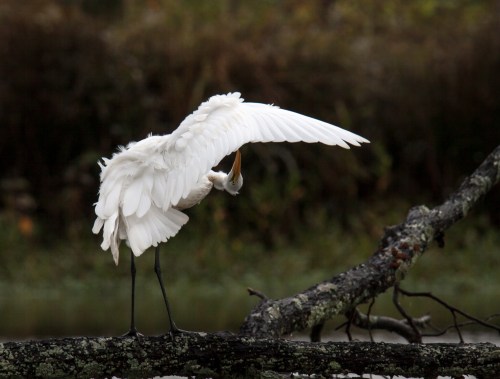
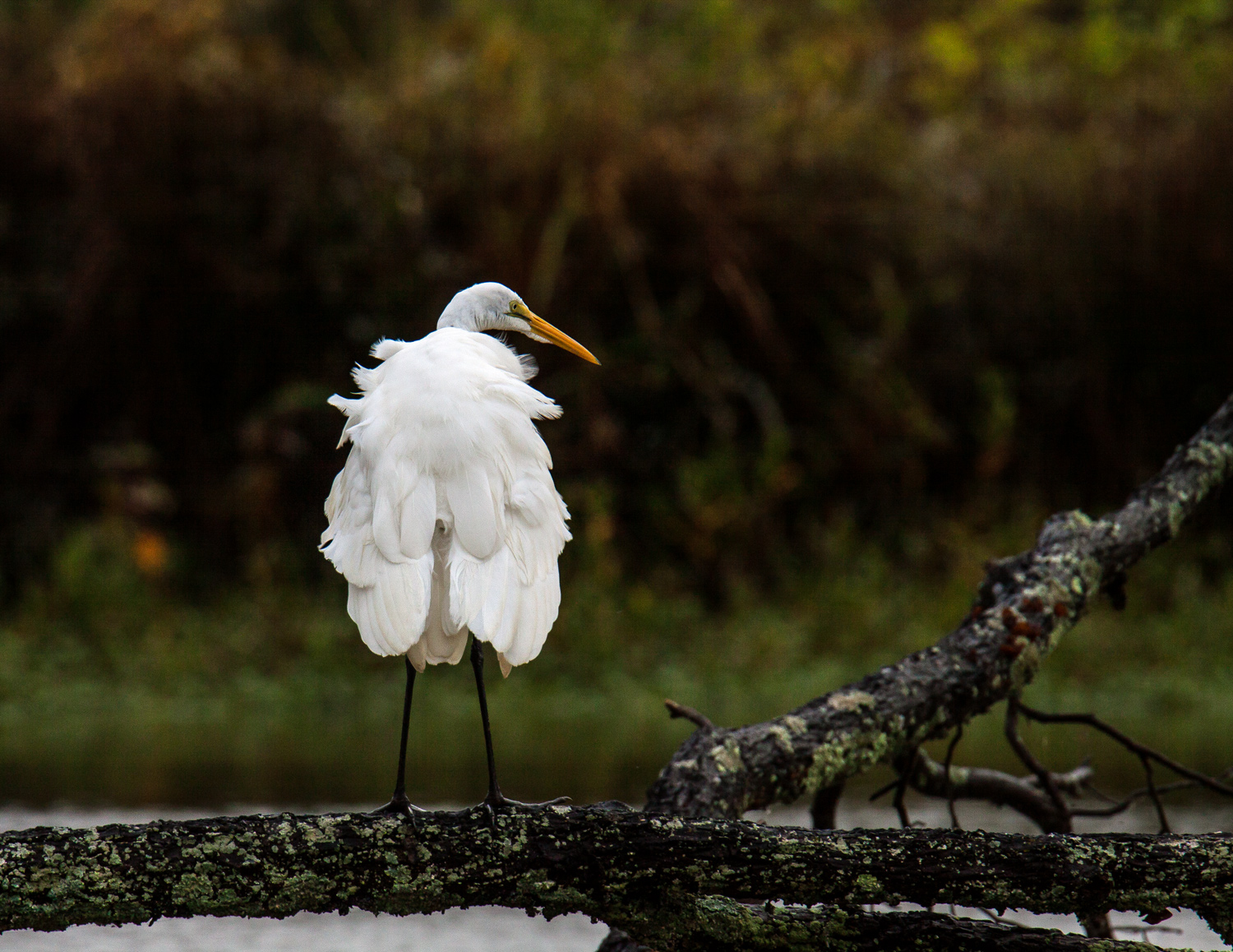
This Great Egret (Ardea alba) showed great balance and flexibility as it meticulously preened its feathers on Monday at Huntley Meadows Park. I would definitely need to see a chiropractor if I tried to imitate the position in the first image, assuming I did not completely fall over.

Great Egrets are relatively common in this park during the warmer months of the year, though they will soon depart for the winter. The Great Blue Herons, however, stay with us throughout the entire winter. I enjoy watching these large wading birds, never knowing when I will catch them in an unusual position or exhibiting an unusual behavior. The first shot is my clear favorite, because of the unusual body position, but I have included a couple of additional shots to show you various moments during the preening process.


Great Egret

Great Egret

Great Egret

© Michael Q. Powell. All rights reserved.

Read Full Post »


Read Full Post »

The heavy clouds and intermittent rain on Monday morning at Huntley Meadows Park limited the light and muted the colors, but in my eyes the beauty of this Eastern Bluebird (Sialia sialis) was in no way diminished.

The bluebird perched in a marshy area with lots of trees, so it was tough for me to get a clear shot. I was happy to find at last a gap between two lichen-covered trees that let me capture this image. A blue sky would have been nice, but I had to settle for the almost pure white sky that you see in the shot.

Eastern Bluebird

© Michael Q. Powell. All rights reserved.


Read Full Post »

It was dark and overcast yesterday morning at Huntley Meadows Park and became more eerie when a Turkey Vulture (Cathartes aura) started to circle lower and lower around me. Eventually it landed on the broken tip of a nearby tree.

After closing its wings initially, the vulture suddenly opened them wide and left them open for an extended period of time, perhaps to let them dry—it had been raining earlier in the morning. The wing position reminded me of the Double-crested Cormorants that I occasionally see with wings extended to dry them after an underwater dive.

Turkey Vulture

Turkey Vulture

Turkey Vulture

© Michael Q. Powell. All rights reserved.

Read Full Post »

It is often said that springtime is a time for love, but so apparently is autumn, especially if you are a Blue-faced Meadowhawk dragonfly (Sympetrum ambiguum). This species appears most often during the latter part of the summer and in early autumn, so springtime is not really an option for them.

I spotted this couple in flagrante delicto during a recent trip to Huntley Meadows Park. It is hard to get a real sense of scale from this photo, so you will have to trust me that these brightly-colored dragonflies are really small, about an inch and a half in length (38 mm).

Blue-faced Meadowhawk

© Michael Q. Powell. All rights reserved.

Read Full Post »

As the seasons change, some dragonflies begin to disappear, but happily some new ones appear, like this spectacular female Blue-faced Meadowhawk (Sympetrum ambiguum) that I spotted this past Monday at Huntley Meadows Park.

One of the really cool things about this species is that there are two different color variants of the females. Most of the females (and young males) are brown in color and are sometimes referred to as heteromorphs, while a smaller number of females, like the one in the photo, have a bright red color matching that of mature males and are sometimes referred to as andromorphs. This is roughly parallel to the Eastern Tiger Swallowtail butterfly, which has two different varieties of female, a yellow morph that matches the males and a black morph.

Blue-faced Meadowhawk

© Michael Q. Powell. All rights reserved.

Read Full Post »

When I spotted this praying mantis today at Huntley Meadows Park, I couldn’t help but think that it had chosen an appropriate pose to remember those who died and countless others whose live were forever changed by the tragic events of 9/11.

praying mantis

© Michael Q. Powell. All rights reserved.

Read Full Post »

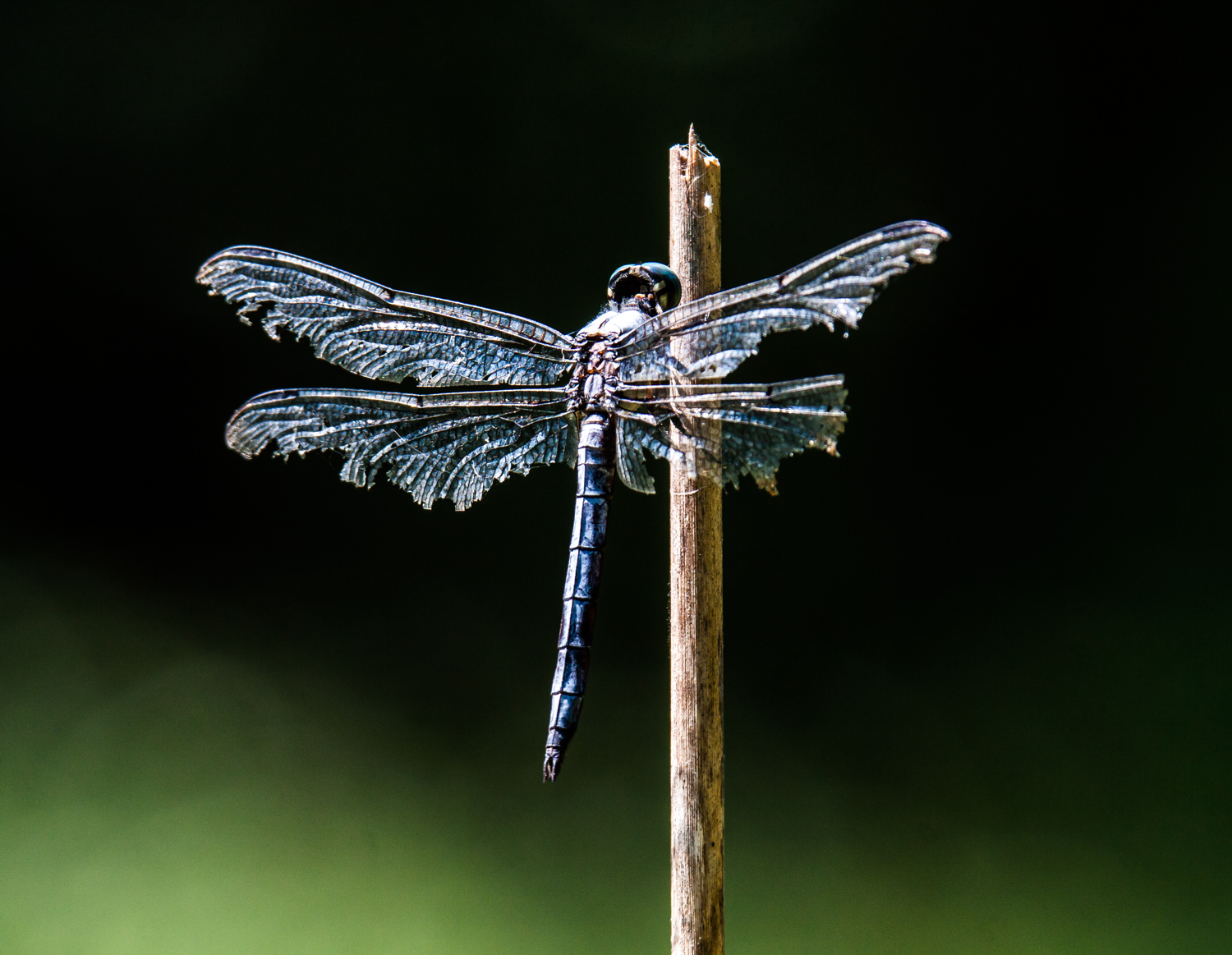
As the days of summer gradually wind down, I can’t help but notice a significant amount of wear and tear on the bodies and especially the wings of some of the dragonflies and butterflies that I see. Clearly it has been a long, tough season for some of them. Despite its tattered wings, this male Great Blue Skimmer dragonfly (Libellula vibrans) that I spotted on Monday at Huntley Meadows Park seemed to have no trouble flying, though I suspect that his days are numbered.

I hope that all of you have managed to survive this season well and that your “summer wear” refers to your clothes and not to the condition of your body.

Great Blue Skimmer

© Michael Q. Powell. All rights reserved

Read Full Post »

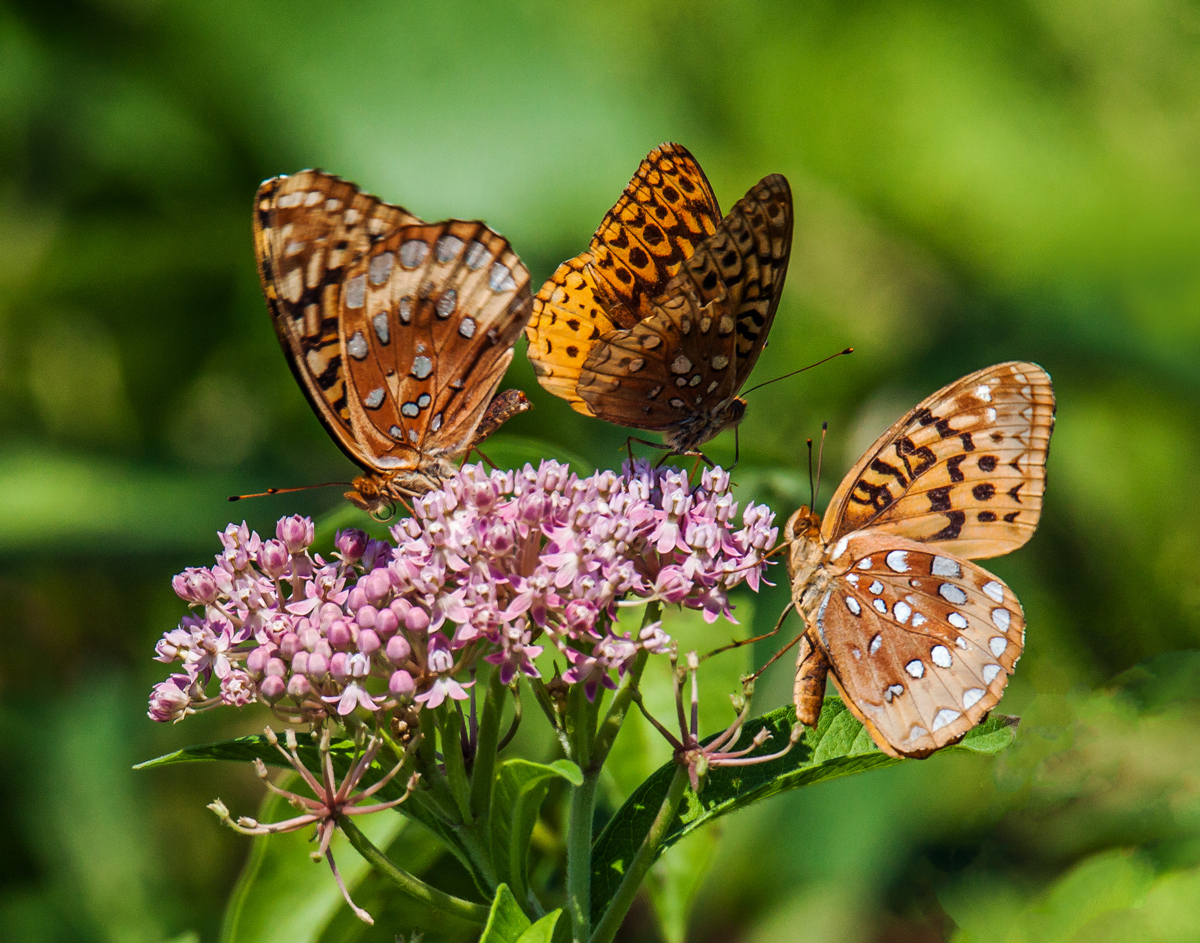
A clump of what I think is Swamp Milkweed (Asclepias incarnataseemed irresistible to a trio of Great Spangled Fritillary butterflies (Speyeria cybele) on Monday at Huntley Meadows Park. For a brief moment they coexisted peacefully, until one of them encroached into the territory of another and they all began to jostle each other for the prime spots.

I quickly snapped off a series of photos before the butterflies flew away. As is the case with almost any group, it was almost impossible to capture an image in which all of the subjects were more or less facing the camera and had interesting poses. It was roughly equivalent to trying to photograph a group of wiggly little children—single subjects seem easy by comparison.

Great Spangled Fritillary

© Michael Q. Powell. All rights reserved

Read Full Post »

I spent a considerable amount of time one morning earlier this month at Huntley Meadows Park trying to get some shots of this skittish female Belted Kingfisher (Megaceryle alcyon). It was almost impossible to get really close, so I had to rely on my long telephoto zoom lens.

Belted Kingfisher

Belted Kingfisher

Belted Kingfisher

© Michael Q. Powell. All rights reserved

Read Full Post »

Although I tend to associate Monarch butterflies (Danaus plexippus) with milkweed, this Monarch was hungrily feeding on Queen Anne’s lace (Daucus carota) this past weekend at Huntley Meadows Park. I am not sure why, but I have seen significantly more Monarch butterflies this summer than in the past few years.

Monarch butterfly

© Michael Q. Powell. All rights reserved

Read Full Post »

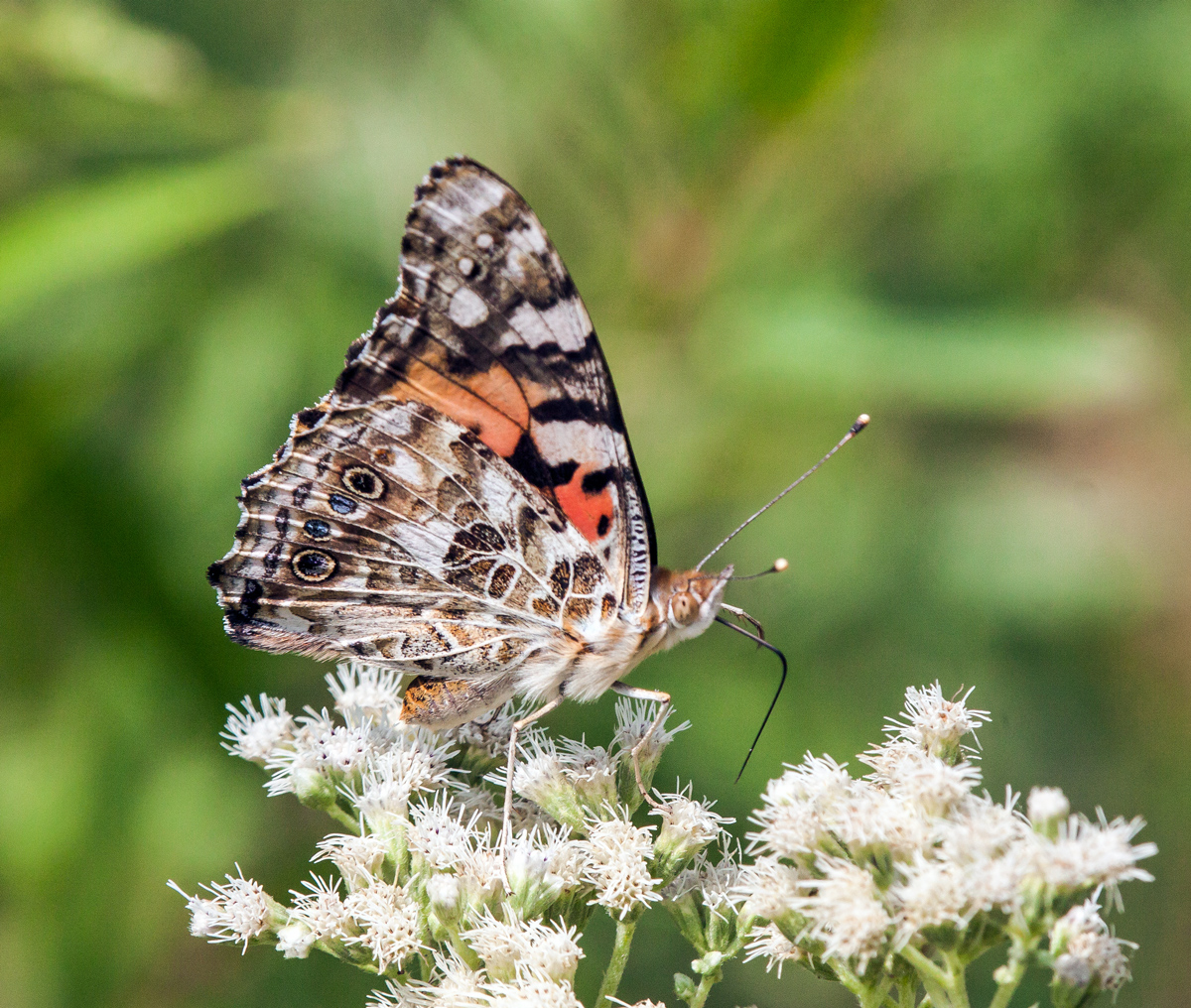
As I was exploring at Huntley Meadows Park this past weekend, I was thrilled to stumble upon this beautiful Painted Lady butterfly (Vanessa cardui), a species that I have not seen in several years. In the field, I couldn’t remember the differences between a Painted Lady and the similar-looking American Lady. Fortunately, there are plenty of resources on-line, including this helpful comparison page on bugguide.net that shows the differences between the two types. On the basis of the pattern of the eye spots, I concluded that this is almost certainly a Painted Lady.

Painted Lady

© Michael Q. Powell. All rights reserved

Read Full Post »

When I first encountered two insects this past weekend at Huntley Meadows Park, I thought they were mating. Looking a little closer, I realized it was a robber fly and its prey, which, after some research, I conclude is probably a Striped Horse Fly (Tabanus lineola). In addition to its unusual eyes, check out the sharp mouth parts of the horse fly that are used, I believe, for biting. Ouch!

There is a whole family of robber flies, known as Asilidae, of varying sizes and shapes, including the Red-footed Cannibalfly that I have featured several times recently. This robber fly was considerably smaller than a Red-footed Cannibalfly, but has many of the same general characteristics. They both grasp their prey with their long legs and inject it with saliva that paralyzes the victim. The saliva eventually liquifies the insides of the prey and the robber fly sucks out the liquified material through its proboscis. I think that the robber fly in the photo was in the middle of that process when I spotted it.

Robber Fly

© Michael Q. Powell. All rights reserved


Read Full Post »

One of the little woodland butterflies that I see only rarely is the Common Wood Nymph (Cercyonis pegala). I was therefore pretty excited when I spotted this beauty on Friday while it was perched on a tree at Huntley Meadows Park. The yellow patch is so distinctive that it was pretty easy for me to identify this one, unlike so many other woodland butterflies that are mostly brown with different patterns and colors of eye spots on their wings.

Common Wood Nymph

© Michael Q. Powell. All rights reserved

Read Full Post »

In the insect world, Red-footed Cannibalflies (Promachus rufipes) are fearsome predators. Yesterday I spotted one at Huntley Meadows Park in Alexandria, Virginia that appeared to be subduing a Hummingbird Clearwing Moth (Hemaris thysbe) that it had just captured.

What happens next? Wikipedia describes the tactics of a robber fly, the family to which the Red-footed Cannibalfly belongs, in these words:  “The fly attacks its prey by stabbing it with its short, strong proboscis  injecting the victim with saliva containing neurotoxic and proteolytic enzymes which very rapidly paralyze the victim and soon digest the insides; the fly then sucks the liquefied material through the proboscis.”

Yikes!

red-footed cannibalfly subdues hummingbird moth

© Michael Q. Powell. All rights reserved

Read Full Post »

I didn’t see the Green Heron (Butorides virescens) actually catch his breakfast last Friday morning at Huntley Meadows Park, but when he climbed up onto a protruding branch he gave me a quick look at the fish before swallowing it.

Green Heron

© Michael Q. Powell. All rights reserved

Read Full Post »

This majestic osprey (Pandion haliaetus) was keeping a close watch on a fellow photographer and me as we pointed our long lenses in its direction as it perched high in a tree early one morning this weekend at Huntley Meadows Park.

osprey

© Michael Q. Powell. All rights reserved

Read Full Post »

Early yesterday morning at Huntley Meadows Park, the Great Egrets (Ardea alba) were relaxing in the trees, awaiting the start of another beautiful day. When birds are as brilliantly white as egrets, it’s a challenge to get an exposure that retains the details in the feathers. I set the metering on my camera to spot metering and it seems to have worked pretty well. I even like the way that it darkened the background and made the egret stand out even more.

Great Egret

© Michael Q. Powell. All rights reserved

Read Full Post »

Last weekend I spotted a shorebird in the distance while exploring Huntley Meadows Park. It was sharing a log with several turtles. Initially the little bird stayed on the opposite end of the log from the turtles. Gradually the curious and energetic bird moved closer and closer to the turtles. I couldn’t tell for sure, but it looked like the bird came close to pecking one of the legs of a turtle. Perhaps the bird was surprised when the turtle reacted or the turtle made a threatening move, but in any case the bird flew off after the brief encounter.

I was pretty conftdent that the bird was some kind of sandpiper, but I have never seen one with these markings. I posted to a Facebook group and got a quick response. What was the sandpiper I had spotted? It turned out to be a Spotted Sandpiper (Actitis macularius).

Spotted Sandpiper


Spotted Sandpiper

© Michael Q. Powell. All rights reserved

Read Full Post »

Damselfly mating is, to say the least, unusual and acrobatic. Yes, I felt a little like a voyeur as I observed this pair of Ebony Jewelwing damselflies (Calopteryx maculata) on Monday at Huntley Meadows Park.

Did you notice the sideways heart that their bodies form during this process? Yeah, I am a bit of a romantic, even when it comes to mating insects in the wild. I would recommend, though, that you not try this position at home, but leave it to the professionally trained damselflies. You might otherwise require an unplanned visit to a chiropractor.

Ebony Jewelwing mating

© Michael Q. Powell. All rights reserved

Read Full Post »

Do you relax by hanging from a bar in the pull-up position? No, I don’t either, but this Mocha Emerald dragonfly (Somatochlora linearis) chose to do so on Monday when I spotted it at Huntley Meadows Park.

A couple of things really stand out whenever I am lucky enough to spot one of these beautiful dragonflies. Unlike many dragonflies, Mocha Emeralds don’t appear to like direct sunlight—they seem to hang out at small shaded streams, where the shadows and shade make photography difficult. Secondly, they often seem to hang vertically, which emphasizes their extraordinarily long slender bodies. Somehow they remind me of the super skinny young male models that many designers seem to favor, clothing them in garments that those of us with more normal physiques would never ever fit into—unlike those models, we have waists and hips.

Mocha Emerald

© Michael Q. Powell. All rights reserved

Read Full Post »

I was looking high and in the distance and the Bald Eagle (Haliaeetus leucocephalus) came in low and was almost on top of me before I saw it yesterday morning at Huntley Meadows Park. I had to scramble and pull back on my zoom lens to capture this image, which barely fit into the frame of the viewfinder. (The EXIF data for the shot indicate that it was shot at 309mm of my 150-600mm Tamron telephoto zoom lens.)

I feel like I should have been able to take better advantage of the situation that presented itself, but I am not disappointed. As I have noted repeatedly, any day with a bald eagle is a great day.

Bald Eagle

© Michael Q. Powell. All rights reserved

Read Full Post »

Cardinal flowers (Lobelia cardinalis) are now in bloom at Huntley Meadows Park. In addition to being beautiful, these vivid red flowers attract butterflies, like this Spicebush Swallowtail butterfly (Papilio troilus) that I spotted this past weekend at the park.

Spicebush Swallowtail

© Michael Q. Powell. All rights reserved

Read Full Post »

This female Ruby-throated Hummingbird (Archilochus colubris) must have been feeling tired or lazy yesterday afternoon at Huntley Meadows Park. Rather than going in through the opening in the trumpet vine flower and helping to pollinate it, she opted to drill in through the side of the flower to get to the nectar.

Ruby-throated Hummingbird

© Michael Q. Powell. All rights reserved

Read Full Post »

It looks like a massive amount of fluorescent Silly String has exploded onto parts of the marshland at Huntley Meadows Park, but I believe it is in reality a parasitic plant known as dodder. Early yesterday afternoon a White-tailed Deer (Odocoileus virginianus) found it to be so tasty that it was willing to ignore the people passing on the boardwalk less than ten feet away.

In taking this photo, I did something that I rarely do—I used the 150mm setting of my 150-600mm telephoto zoom lens. The deer was so close that I could capture only its head and shoulders, even with the lens at its widest setting.


deer and dodder

© Michael Q. Powell. All rights reserved

Read Full Post »

There is not denying that it is exciting to capture unusual moments, like a snake swallowing a catfish, or to photograph a new species, as I have done recently with dragonflies. For me, though, there is something equally satisfying about returning to a familiar location and observing ordinary subjects. It is a different kind of challenge to present the ordinary in an extraordinary way, in a way that makes people stop and realize that natural beauty surrounds them every single day.

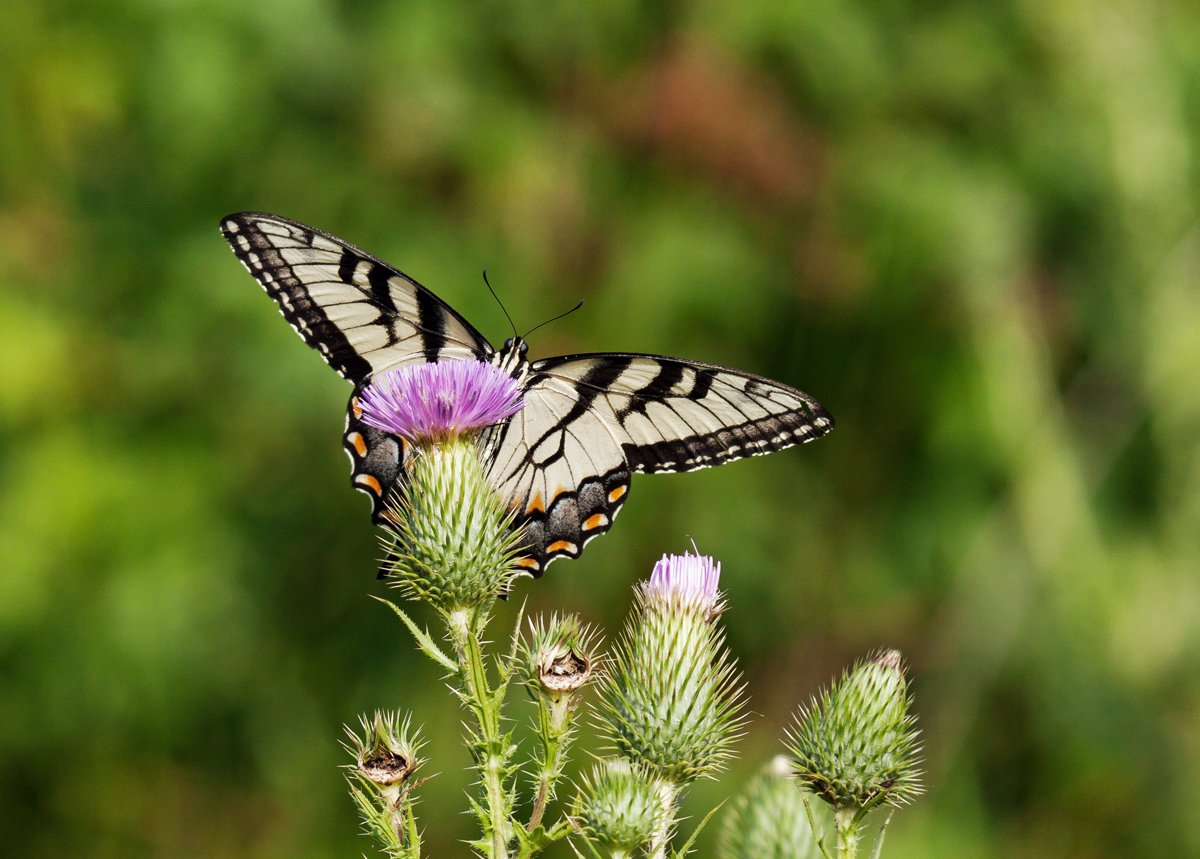
Last week, butterflies were really active at Huntley Meadows Park.  When I am in a garden, it is easier for me to guess where a butterfly will fly next, but in the wild, butterfly behavior is a little more unpredictable. When I noticed that a stand of what looks to be some kind of thistle was beginning to open, I hoped that the Eastern Tiger Swallowtail (Papilio glaucus) that was flying about would be attracted to it. Eventually it flew to the thistle and I was able to capture this image.

Spectacular? No, not really. Beautiful? I’d say so. The image works for me, because it has just enough stopping power to cause views to recall how beautiful ordinary butterflies can be, to rekindle the childhood memories of being excited by butterflies, and to remember how exciting it was abandon caution and simply and joyfully chase after butterflies.

Eastern Tiger Swallowtail

© Michael Q. Powell. All rights reserved

Read Full Post »

I have known for a while that hummingbirds are attracted to trumpet vines, so I keep my eyes open whenever I pass a stand of them near the observation tower at Huntley Meadows Park. Yesterday morning I finally lucked out and spotted a female Ruby-throated Hummingbird (Archilochus colubris) in the midst of the trumpet vines (Campsis radicansand managed to capture these images, including one in which the hummingbird was resting for a few seconds on a branch before resuming her energetic activity.

Ruby-throated Hummingbird

Ruby-throated Hummingbird

© Michael Q. Powell. All rights reserved

Read Full Post »

Green Herons (Butorides virescens) have so much personality packed into their small bodies. This one almost seemed to be smiling as it flew by me last weekend  at Huntley Meadows Park. Perhaps it was just my imagination running away with me.

Green Heron

© Michael Q. Powell. All rights reserved


Read Full Post »

Is it possible that I am sharing too many dragonfly images, that I am oversaturating the market and taxing the patience and tolerance of my readers? I realize that not everyone is as drawn as I am to these amazing little creatures and that some folks are repelled by insects of any variety or are simply not interested in them.

An old adage asserts that beauty is in the eyes of the beholder and to a certain extent I agree with that statement. However, I would counterargue that beauty is not entirely subjective, that there are cases in which the majority of people would agree that something is beautiful.

I somehow think that this might be the case for an image I captured this past Friday of a spectacular female Halloween Pennant dragonfly (Celithemis eponina) at Huntley Meadows Park. Most of the Halloween Pennants that I have photographed this year have been males, which tend to be more visible, since they are trying to attract females, so it was a treat to spot a female. In the dragonfly world, females usually are the ones that choose the partner for mating and they frequently remain in the treeline or in open fields until they are ready.

I had my 150-600mm lens mounted on my camera, because I was hoping that I might see a bald eagle or a hawk, so I was able to shoot this dragonfly from a distance without disturbing her. I focused manually and was able to capture some beautiful details of the dragonfly, such as the two-toned eyes and the long, two-toned legs. I love the organic shape and feel of the cool-looking perch that the dragonfly had chosen. The background dropped out of focus so much that it almost looks like a studio shot and draws the eyes of viewers to the subject.

When you first read the title, you might have scratched your head in puzzlement, because the color palette is more subdued than oversaturated. By now, it should be clear that I was not referring to the colors, but to the question of whether or not I am posting too many images of dragonflies. Fear not, not all of my postings will be about dragonflies, but we are in the prime period for dragonflies, so stay tuned for more images of these amazing aerial acrobats. When it comes to the quantity of my dragonfly images, I feel like some Southerners do about sugar in their sweet tea—you can never have too much of a good thing.

Halloween Pennant

© Michael Q. Powell. All rights reserved


Read Full Post »

Painted Skimmer dragonflies (Libellula semifasciata) have distinctive patterns on their wings that make them fairly easy to identify. Unlike the pennant dragonflies that I have featured recently, Painted Skimmers have chunkier bodies and tend to perch lower down on the stems of the vegetation. I spotted this slightly damaged female Painted Skimmer yesterday as I was exploring some of the back areas of Huntley Meadows Park. There were a lot of blackberry bushes nearby with plenty of sharp thorns, so I wonder if they were responsible for the damage to the dragonfly’s wings—I drew blood a few times when I got too close to the thorns, but fortunately I am not missing a chunk of me.

Painted Skimmer

© Michael Q. Powell. All rights reserved

Read Full Post »

« Newer Posts - Older Posts »