Feeds:
Posts
Comments

Posts Tagged ‘Huntley Meadows Park’

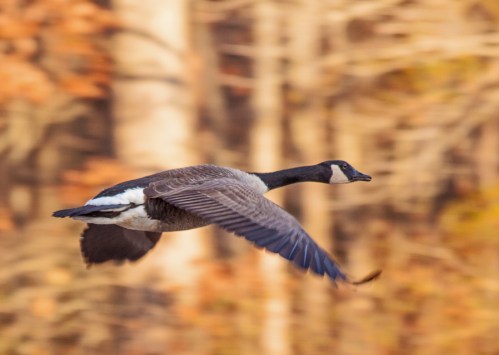
How often have you been told (or read) that you need to fill the frame with your primary subject? If you photograph wildlife as I do, you know that it is rare that you have the opportunity to “fill the frame,” especially when your subject is moving.

I was a little shocked when I first looked at this image of a Canada Goose (Branta canadensis)—not only had I filled the frame, but I had managed to compose it pretty well. Yes, this is an uncropped image of a flying goose. I was awfully lucky to get this shot and I know that several of the images in the burst I took featured cutoff bodies or heads.

Now if I could just get a raptor to fly by this closely…

goose_fill_frame_blog

© Michael Q. Powell. All rights reserved.

Read Full Post »

No matter how bad the weather is, sparrows seem to be omnipresent at this time of the year. I can hear them as they move about in search of food, but they often choose to bury themselves deep in the bushes and undergrowth.

This White-throated Sparrow (Zonotrichia albicollis) was snacking on some kind of berries and I managed to catch him mid-bite when he lifted his head slightly. The branches and leaves give you an idea of the challenge involved in getting an unobstructed  shot. I am happy that I was able to get the head (and eye) in focus and the pose is an interesting one, because it caught the sparrow as it was doing something—static portraits are nice, but for me it’s even nicer to capture motion and activity.

berry_blog

© Michael Q. Powell. All rights reserved.

Read Full Post »

Orchestral conductors tend to be flamboyant characters and that is exactly what came to mind when I first say this image  of a female Mallard Duck (Anas platyrhynchos) with fully outstretched wings. She seems to be conducting an unseen duck orchestra creating what some might call music and other would characterize as a quackonophy.

dancing_duck_blog

© Michael Q. Powell. All rights reserved.

Read Full Post »

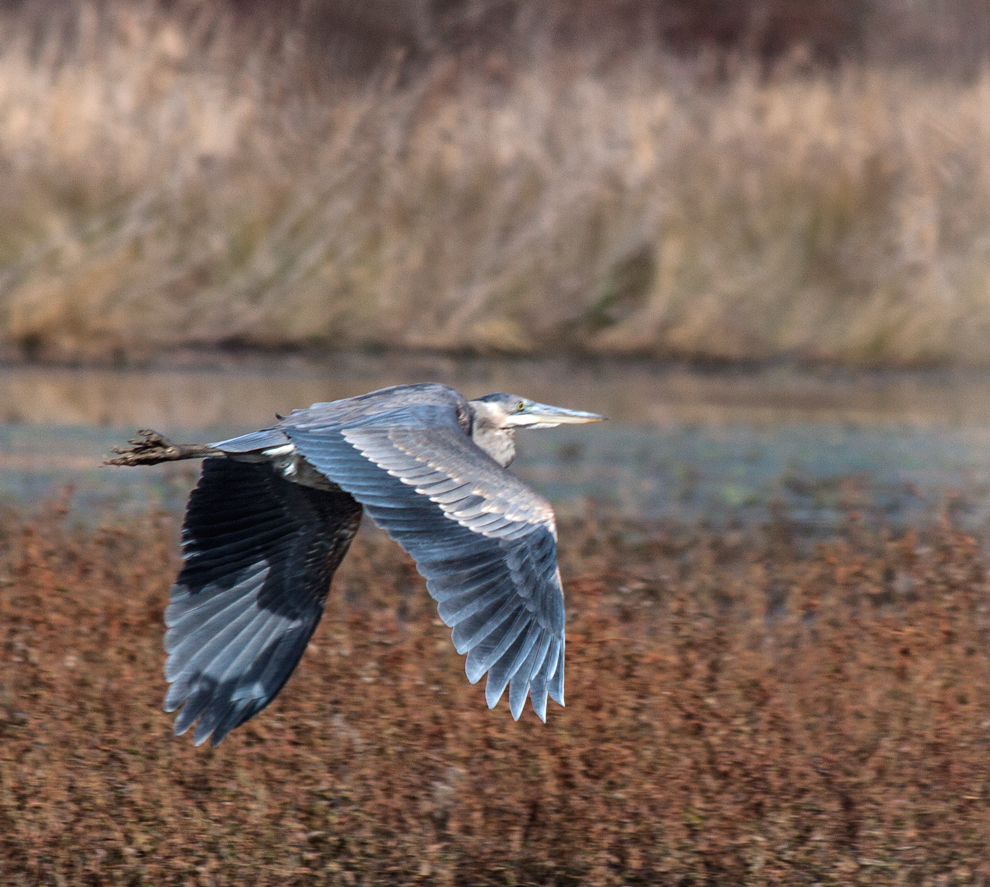
I was moving forward slowly in the underbrush, trying to get closer to some ducks, when out of the corner of my eye I detected some motion. It was a Great Blue Heron (Ardea herodias) flying low over the waters of the marshland pond.

I didn’t have time to check the settings on my camera, but the heron’s slow speed in flight did allow me to get off a few shots. This was one of the few times that I have been able to capture a bird in flying parallel to the ground at eye level and I really like this perspective.

heron_marsh2_blogheron_marsh_blog

© Michael Q. Powell. All rights reserved.

Read Full Post »

It may be mid-November, but one hardy dragonfly species is still around here in Northern Virginia—the Autumn Meadowhawk (Sympetrum vicinum).

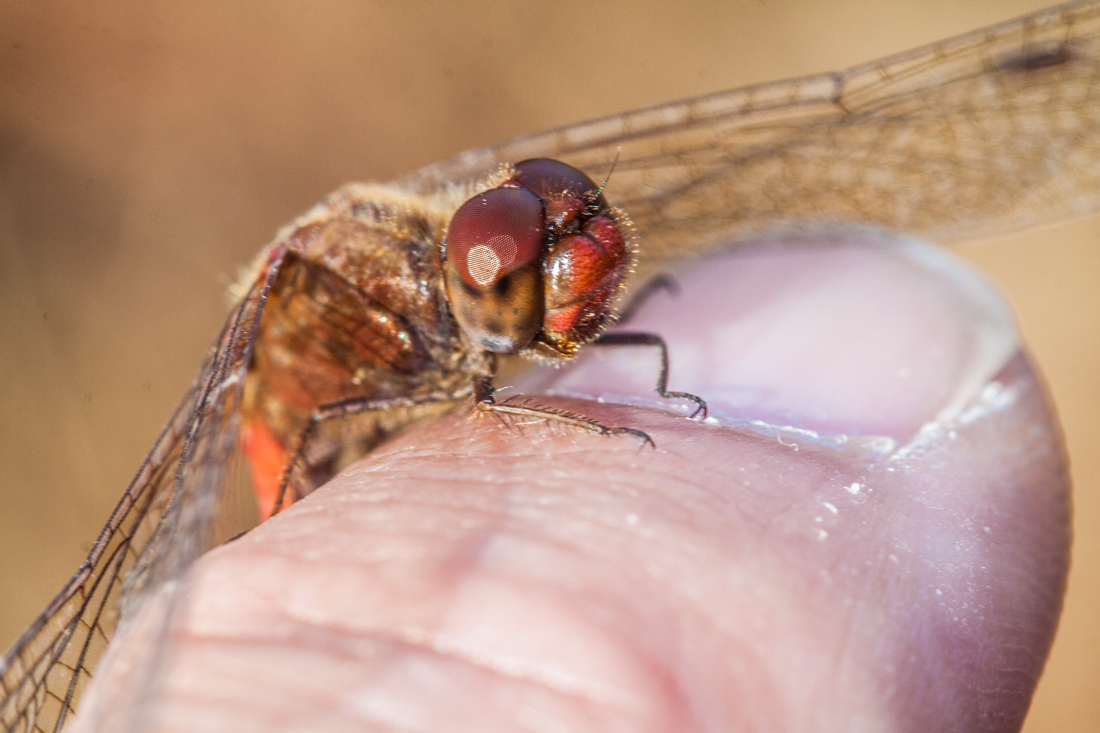
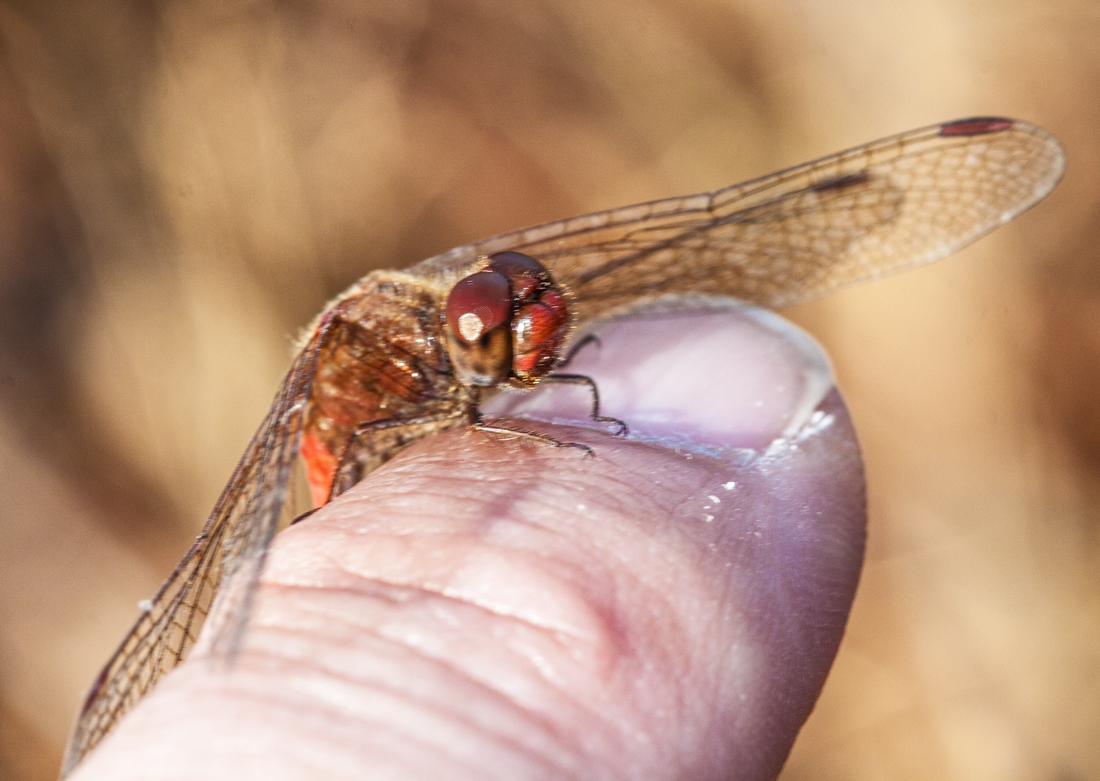
The dragonflies were unusually friendly today, perching on my sweatshirt and jeans numerous times, though they spent most of the time trying to warm themselves in the sun on the boardwalk. Here is a close-up shot of a male Autumn Meadowawk that I coaxed onto my fingertip yesterday at Huntley Meadows Park. All I had to do was slowly move my finger forward and several times a dragonfly accommodated by crawling onto the finger.

Needless to say, it was an interesting challenge trying to hold one finger out as far as I could and then focus and shoot my DSLR with the other hand. Fortunately I had switched to my macro lens—my arms would not have been long enough to get within the minimum focusing distance of the telephoto zoom lens that I had been using earlier in the day. Click on the photos to get a higher-resolution look at the details of the dragonfly’s compound eyes.

dragonfly_finger2_blogdragonfly_finger1_blog

© Michael Q. Powell. All rights reserved.

Read Full Post »

Now that most of the leaves are gone from the trees, one of the Red-shouldered Hawks (Buteo lineatus) seems to have returned to a favorite perch at my local marsh. The good news is that I know where the perch is, but the bad news is that there is a large field of cattails in mud and water between my best observation spot and the tall tree in which the hawk is perched.

The branch is parallel to the ground and seems to provide the hawk a comfortable observation post from which to survey the surroundings and look for prey. Apparently it is so comfortable that the hawk can stay in that one spot for a long period of time. I had my camera on a tripod for the first shot and I waited and waited for the hawk to fly.

A fellow Canon photographer came by and we started taking about menu settings and I took the camera off the tripod in order to check the menus. As I was thumbing through the menus, my friend suddenly blurted out that my hawk had taken off. I turned back in the direction of the hawk and was able to snap off a couple of quick shots of the hawk in flight.

The shots highlight some of the beautiful colors and patterns of the hawk’s wings and so I have chosen to include them in this posting. As one of my fellow bloggers Lyle Krahn has noted, any day that you see a hawk is a good day. Be sure to check out his blog for some awesome shots of hawks (and lots of other wildlife), including this recent posting, in which you are asked to make a difficult choice between two hawk photos for an imaginary calendar.

hawk_flying3_bloghawk_flying_bloghawk_flying2_blog

© Michael Q. Powell. All rights reserved.

Read Full Post »

He was partially hidden by the branches, but I was happy—I had finally gotten a clear view and a recognizable photograph of a Pileated Woodpecker (Dryocopus pileatus).

I have long hoped to spot a Pileated Woodpecker. I have seen evidence of their handiwork (or is it more appropriately “beakwork”) several time and heard the loud sound of these large woodpeckers at work, but I had not been able to find one. This past Monday, while I was attempting to photograph dragonflies, I heard the sound of a woodpecker in a nearby patch of woods and went to investigate. I was surprised to see a Pileated Woodpecker, because the soft tap-tap was not what I expected from this species.

My shot is really just a record shot, but the first time that I see a new bird, insect, or animal, I am invariably content to get any kind of shot. I know I can do a lot better, if I can just find a cooperative Pileated Woodpecker.

pileated_blog

© Michael Q. Powell. All rights reserved.

Read Full Post »

Sometimes you don’t have to make a choice between two options—you can have them both.

In this morning’s blog posting, I posed the question, “When it comes to images of birds in flight, do you prefer the sky as the background or some element of the earth?” and I received quite a few responses, with a greater number having a preference, in general, for background or contextual elements rather than a plain blue sky.

Sometimes I manage to get an image that incorporates the best of both worlds. This image, for example, has one Canada Goose against a leafy background, one against the sky, and one in between.

Who says you have to choose? (In the interest of full disclosure, I intentionally set up the question as a false dichotomy in order to stimulate thinking. For me, the best answer to the question I posed, which called on you to make a sweeping overgeneralization, was the person who responded quite simply with the words, “It depends.”)

geese_flying_cropped_blog

© Michael Q. Powell. All rights reserved.

Read Full Post »

When it comes to images of birds in flight, do you prefer the sky as the background or some element of the earth? Here are two photographs of Canada Geese (Branta canadensis) that I took this past Monday that illustrate my question.

Canada Geese are some of my favorite subjects as I try to improve my skills in photographing flying birds—they are relatively big, flight slowly (especially when taking off and landing), and, perhaps most importantly, there are a lot of them.

In some ways, it’s a little easier to track a bird in the sky, since there is nothing else to grab the camera’s focus (if you can lock in the focus quickly enough). However, the light is a lot more variable, particularly when a bird is circling, so proper exposure is a challenge and shadows are a sad reality. I was happy that I was able to time the second shot so that the light illuminated most of the underside of the goose. Some photographers, though, seem to look down at photos of birds in the sky and prefer more environmental shots.

I had to act quickly to get the shot of the goose with the trees in the background, when some geese took off and flew by me at almost eye level. The trees were far enough away that they blurred out and the head of the goose is mostly in focus. Depth of field is always an issue for me in shots like this—you can actually see the depth of field in the amount of the extended wings that is in focus.

So there you have it, two different shots of a goose in flight. Does the background play a role in your assessment of which one you prefer?
goose_flying_11Nov_blog

goose_flying2_11Nov_blog

© Michael Q. Powell. All rights reserved.

Read Full Post »

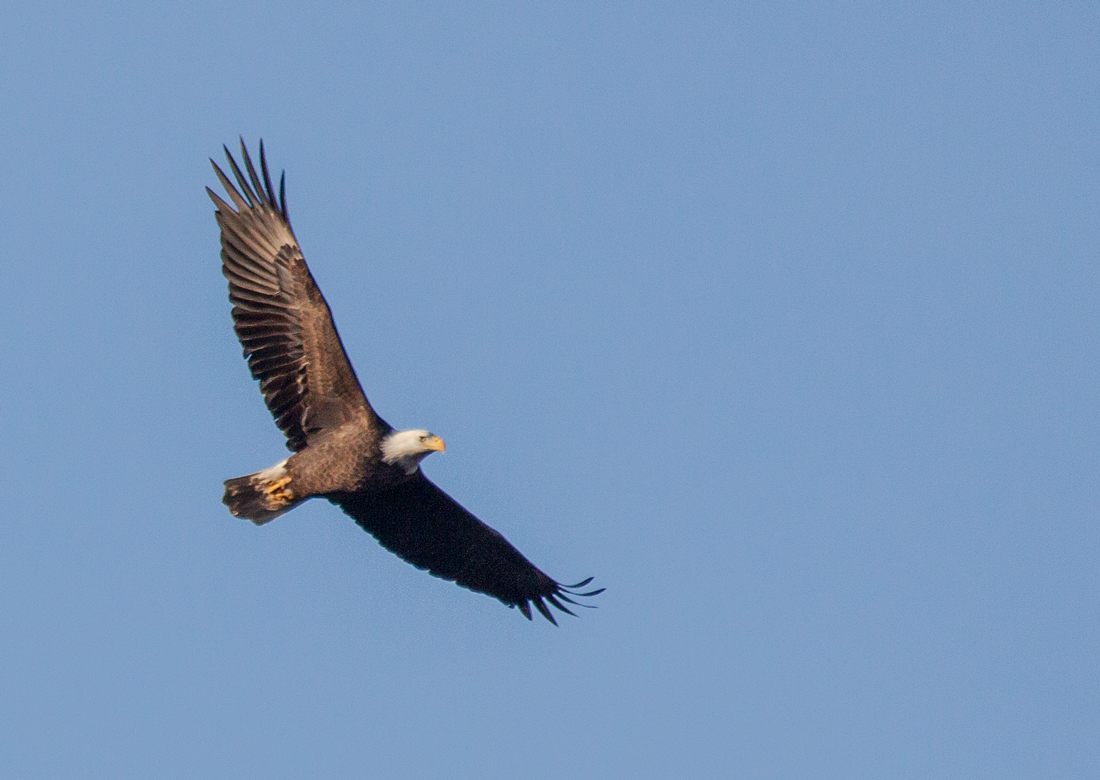
On a day devoted in the United States to the brave men and women who are serving and have served in out armed forces, it seemed appropriate that I was able to get some shots of a Bald Eagle (Haliaeetus leucocephalus), our national bird.

For a short time early yesterday morning, this eagle circled over me at my local marsh park and then flew off to a distant tree, where its white head was still visible, but was out of range of my camera.

I’m still working on my techniques for photographing birds in flight and this eagle reminded me of the importance of light in trying to get a decent shot. As the bird circled and changed its wing positions, various parts of the body would come in an out of the light and in about half of my shots, the eagle’s head is in the shadows. When the eagle’s head was in the light, however, the brilliant white color often caused the details to blow out.

The final reminder of this experience is a familiar one for anyone who has attempted to photograph birds—I need a longer telephoto lens.

eagle3_11Nov_blogeagle2_11Nov_blogeagle_11Nov_blog

© Michael Q. Powell. All rights reserved.

Read Full Post »

Did you enjoy playing in puddles when you were a child? I remember a childhood of rubber boots and yellow slickers and days when my pant legs would be drenched from walking through puddles. Even now, I’ll occasionally kick my feet through a puddle of water and then glance quickly all around, hoping that nobody has seen me give in to my child-like impulses.

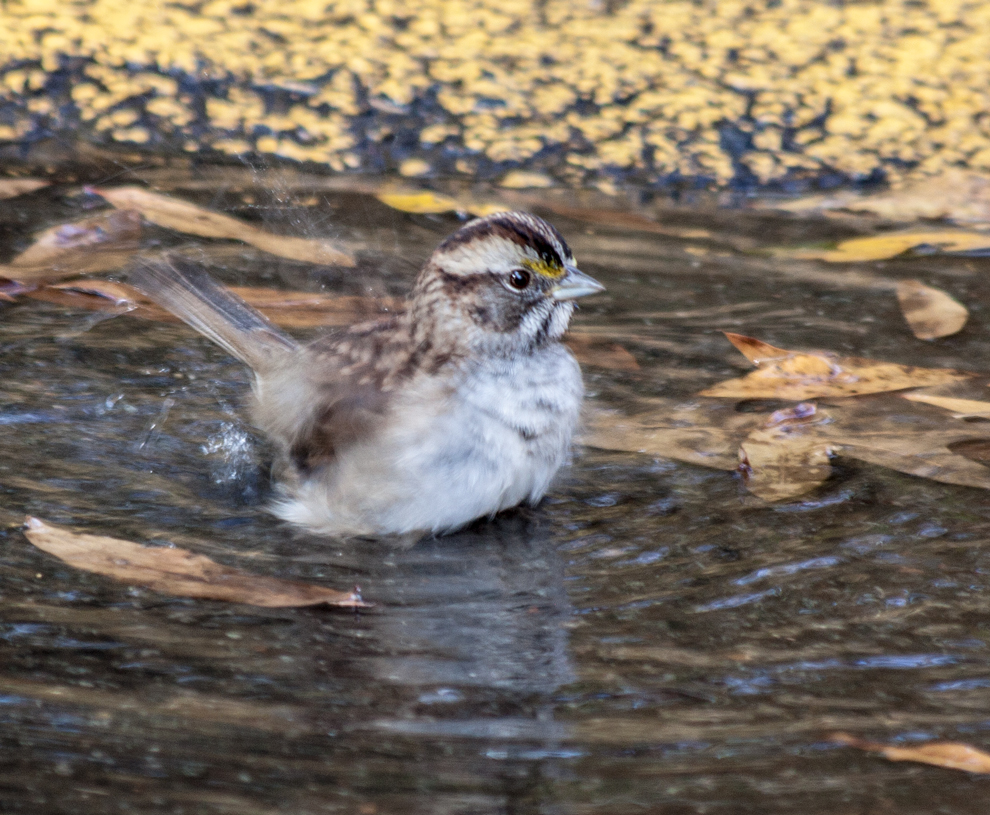
When I spotted this White-throated sparrow (Zonotrichia albicollis) in a shallow puddle, I thought he was merely getting a drink of water. However, he stuck his head in the water, splashed around, and seemed to be having a good time. Perhaps he was taking a bath, or maybe he was simply enjoying himself in the cool waters. (In case you are curious about the background, the puddle had formed in a low area adjacent to a speed bump at the entrance to the parking area of my local marsh park—the yellow you can see is the safety paint of the speed bump itself.)

Initially, I was unsure that this sparrow was a White-throated, because the white patch was not really obvious and the eye stripes were not as well defined as in previous photos that I have posted of this species. The yellow coloration above the lore (the area between the eye and the bill) makes it pretty likely that this is a White-throated sparrow, though it may be the brown and tan striped variant, rather than the black and white one that I featured in a posting earlier this week.

I don’t know about you, but I feel inspired to find a puddle to play in today. Have a wonderful Friday.

Sparrow_puddle_cropped_blog

© Michael Q. Powell. All rights reserved.

Read Full Post »

We’re starting to get down to the last insects of the season, and fuzzy brown caterpillars are among the few insects that I still see. Some of these are Banded Wooly Bear caterpillars (Pyrrharctia isabella) that supposedly help tell how severe the winter will be, though I confess that I can never remember how you are supposed to judge, i.e. does a wide middle section mean a short winter or a long one?

When I first took this shot, I thought the subject was a wooly bear caterpillar, but the more I look at it the less certain I feel. There seems to be a black tip on only one end of the caterpillar rather than at both ends. Despite the uncertainty about identification, I really like the shot and the way that I was able to isolate the caterpillar from the background.

fuzzy_brown_final_blog

© Michael Q. Powell. All rights reserved.

Read Full Post »
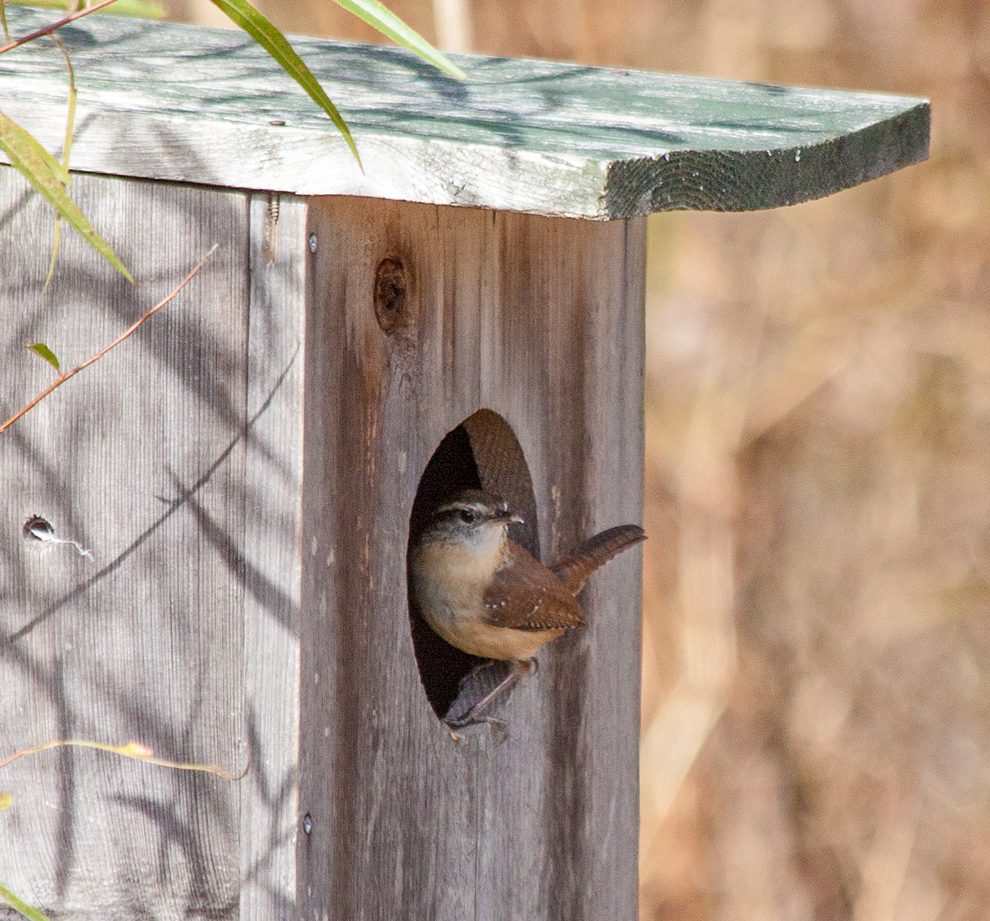
Why was this wren perching on the nesting box just prior to entering it? It’s not nesting season, is it? Was it seeking shelter on a cool, windy day? Were there insects inside to eat?

As I noted yesterday, bird activity was low on Monday—we didn’t even have any Canada geese or ducks passing through. I initially noticed this small bird, which I think is a Carolina Wren (Thryothorus ludovicianus), when it was checking out the underside of this nesting box. The box itself is pretty big and was placed there, I believe, for ducks to use. Eventually the wren perched on the edge of the entrance and peered inside and then looked all around before going inside.

wren_box_blog

© Michael Q. Powell. All rights reserved.

Read Full Post »

It was cold and overcast yesterday and there were not many birds visible, with the notable exception of sparrows. Sparrows were as active as ever, though most of the time I could only hear them and not see them. They seem to like to rot about in the underbrush most of the time.

I was really happy when this White-throated sparrow (Zonotrichia albicollis) popped up for a moment and I was able to get this image. I love the facial pattern and colors of this bird, which seems to have a goatee much like my own. (My goatee started out with salt-and-pepper color, but increasingly has become mostly salt).

When researching this bird, I learned that there is another version (morph) of this bird that has brown and tan head stripes, instead of black and white. I will have to look even more closely at my photos of the White-throated sparrow, which has become more common the past few weeks, and see if I have managed to capture any images of the tan-striped variant.

sparrow_white_throat_crop_blog

© Michael Q. Powell. All rights reserved.

Read Full Post »
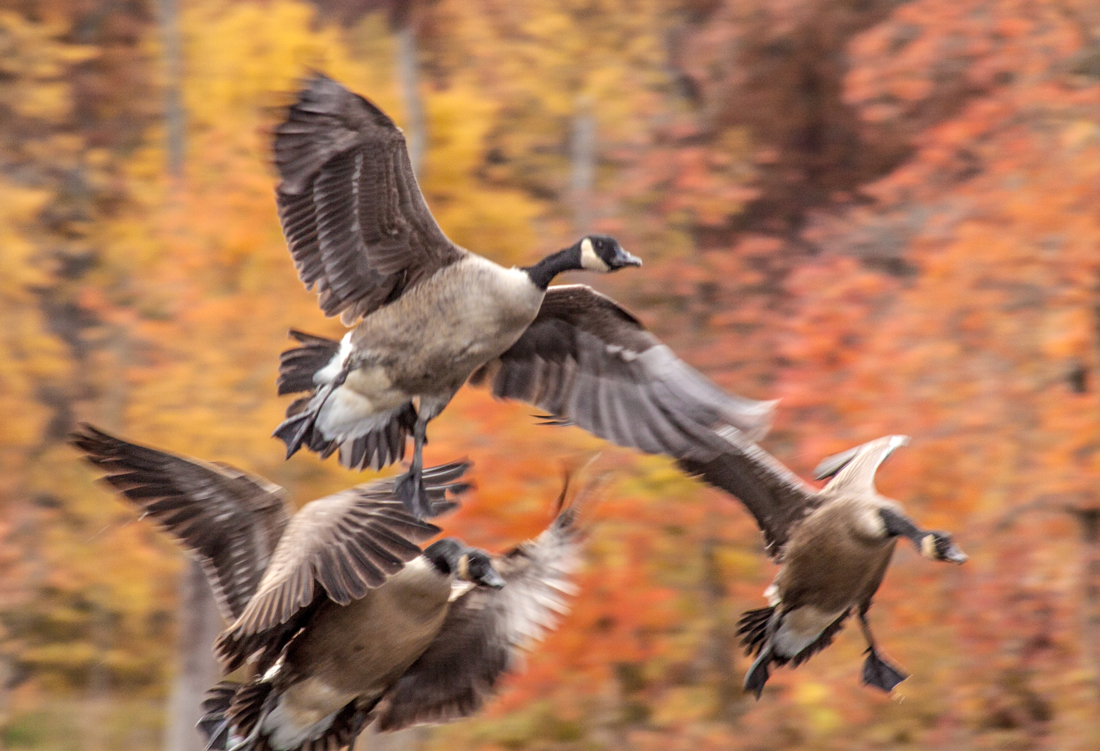
Standing at the end of a small pond, I heard the sounds of an approaching flock of Canada Geese (Branta canadensis). I looked all around as I prepared to track them and couldn’t help noticing areas of beautiful autumn foliage.

Wouldn’t it be cool  if I could capture the geese landing with the colorful leaves as a background? I put that idea in the back of my mind, remembering that it was going to be tough enough to capture decent shots of the geese without worrying about the background.

It’s a noisy crazy couple of moments when the geese come in for a landing—they come in waves and there is so much activity that it’s hard to figure out what to focus on. Usually, as I did here, I will try to concentrate on a single bird as it approaches and to keep it in focus.

I captured this image at the moment when the geese were slowing down just prior to entry into the water. My main subject is in a pretty good focus and the other geese are in interesting positions. I was surprised that I was able to get the orange background—it had been a hope, but certainly not an expectation. The result is an image that I really like, an image that combines two of the iconic elements of the autumn.

geese_landing_fall_blog

© Michael Q. Powell. All rights reserved.

Read Full Post »
Most of the time when I try to photograph ducks in flight, I end up with shadows and muted colors. Last weekend, though, the light was right and I was able to capture a small group of mallards (Anas platyrhynchos) in full color. They were pretty far away, but I like the formation that I was able to capture. There are four males and one female, and one of the males is a straggler who seems to have trouble keeping up with the group.

straggler_blog

Click on the photo to see it in higher resolution.

© Michael Q. Powell. All rights reserved.

Read Full Post »

Some spiders can be creepy, but others are quite beautiful, like this one that I photographed earlier this month at my local marshland park. I am catching up a bit on posting photos from this month that I really liked and thought it might be good to post a spider image on Halloween night. I have not yet been able to identify this spider, but noted that it did not have a web and seemed to be lying in wait for prey on the long leaf of this plant. I’d welcome assistance in identifying the species of spider,

spider_halloween_blog

© Michael Q. Powell. All rights reserved.

Read Full Post »

On Halloween night, it somehow feels appropriate to post this photograph of a spider web that I took earlier this month. Some people find spider webs (and spiders) to be creepy, but I find them to be fascinating.  I look at spider webs as a form of beautiful natural art, filled with wonderful geometric shapes and designs and always marvel at the ability of spiders to weave them.

web_halloween_blog

© Michael Q. Powell. All rights reserved.

Read Full Post »

Turnabout is fair play. In one of my earlier posts entitled “Dragonflies mating on a calf” I featured Walter Sanford, a fellow photographer and blogger. Today, in a posting called “The natives are friendly.” he featured my arm and finger as I tried to charm a couple of different dragonflies to perch on my index finger.

waltersanford's avatarwalter sanford's photoblog

Most dragonflies are skittish. Some dragonflies are “friendly,” such as Blue Corporal dragonflies (Ladona deplanata). Autumn Meadowhawk dragonflies (Sympetrum vicinum) are friendly; sometimes very friendly!

Mike Powell and I visited Huntley Meadows Park recently. We stopped to “charm” dragonflies a couple of times during our photowalk. The following gallery shows two different male Autumn Meadowhawk dragonflies perching on Mike: Photos 1-2 show Mike coaxing a dragonfly onto his finger; Photos 3-4 show another dragonfly perching on Mike’s arm.

Tech Tip: Either mouse-over or tap photos to see captions.

Copyright © 2013 Walter Sanford. All rights reserved.

View original post

Read Full Post »

The first time I saw a bird that looked like this, I thought it was a sparrow of some sort. When I saw this one, last week, I knew immediately that it was a female Red-winged Blackbird (Agelaius phoeniceus).

I have learned a lot about birds and photography this past year.  Along the way I also have learned more about myself as I seek to express myself in my words and in my images.

red-winged_female_blog

© Michael Q. Powell. All rights reserved.

Read Full Post »

My eyes caught a flash of bright blue yesterday as I was walking through Huntley Meadows Park, my local marsh, and I pointed my telephoto lens at the tree in the distance.

As I composed this shot, I was initially a little confused by what I saw. The reddish-brown color of the breast and the fact that there were some blue feathers made me think that it was an Eastern Bluebird (Sialia sialis), but the bird’s body didn’t seem blue enough. After doing a little research when I got home, I realized that most of the bluebirds that I had seen previously must have been adult males—as is the case with many other birds, the female Eastern Bluebird is more subdued in color than the male.

I didn’t have a lot of time to frame this shot, so I was happy that I managed to center the bird on the dark spot in the background and to surround it with some colorful fall foliage. All of the orange color in the image really helps the blue on the wing to pop, which is not too surprising since, if I remember color theory correctly, orange and blue are complementary colors.

bluebird_autumn_blog

© Michael Q. Powell. All rights reserved.

Read Full Post »

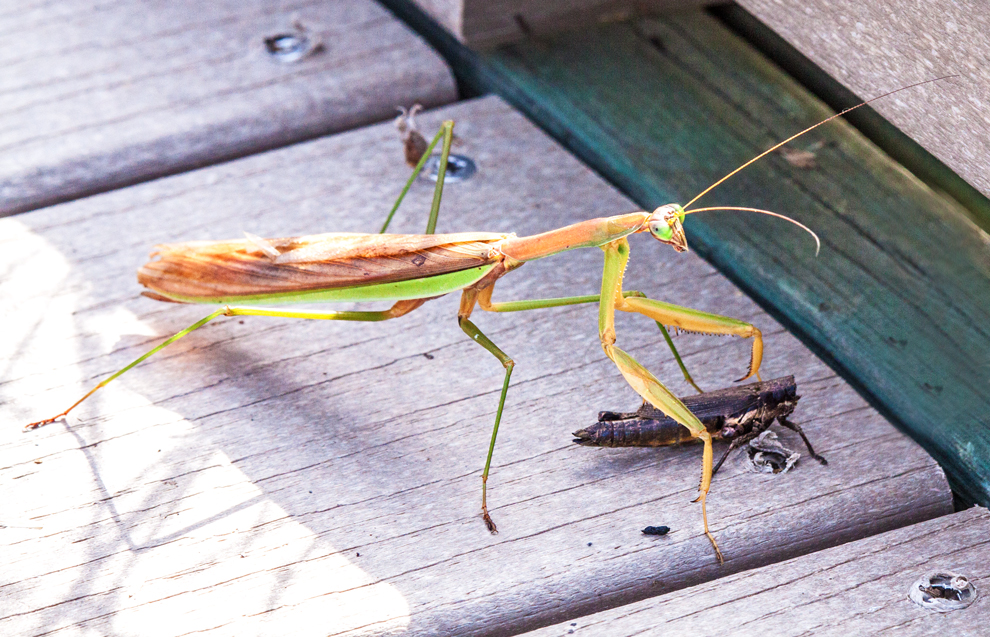
When this praying mantis began to straddle a hapless grasshopper, I wasn’t sure what was going to happen, but suspect that the grasshopper may have been the one that began to pray.

Was the mantis looking at the grasshopper as a potential mate or a potential meal? With praying mantises, the question of mate or meal is a little complicated, because some females reportedly bite off the heads of the males after mating.

As it turned out, the praying mantis ignored the grasshopper and simply climbed over him and the grasshopper’s prayer undoubtedly turned into one of giving thanks.

mantis_grasshopper_blog

© Michael Q. Powell. All rights reserved.

Read Full Post »

When this bright red male Autumn Meadowhawk dragonfly landed briefly on my fellow photographer’s white sneaker yesterday, it suddenly struck me that we might have hit on a potential fall fashion fad. Why not accessorize plain shoes with colorful dragonflies in seasonal colors? We could start with the Autumn Meadowhawk for fall and perhaps move on to the Common Whitetail as the snow begins to fall. Spring could bring on the Green Darner and summer could feature the Blue Dasher.

Of course, we couldn’t use real dragonflies, but they could serve as models for pin-on or clip-on dragonflies. Size-wise, it looks like this Autumn Meadowhawk is about the right size.

Now that I have a marketing idea, all I need is investors.

dragonfly_sneaker_blog

© Michael Q. Powell. All rights reserved.

Read Full Post »

There is something a little wistful about searching for the last dragonfly of the year. Most of the familiar dragonflies from the summer have disappeared and it looks like the sole remaining dragonfly in our area is the Autumn Meadowhawk dragonfly (Sympetrum vicinum).

Yesterday I spent some time trying to photograph this dragonfly along with fellow photographer and blogger Walter Sanford, who has an amazing collection of photographs of dragonflies on his blog site, including a world-class series on the Blue-faced Meadowhawk. I was willing to try to capture photos of any dragonfly that I could spot, but Walter noted that he had taken enough photos of the male Autumn Meadowhawk and was really interested in photographing females or, even better, mating pairs.

The mating pairs tended to elude him most of the day, until suddenly a pair in the “wheel” position circled around us and landed on his bare calf—talk about unprotected sex. There was no way that he could twist himself around to get a good photo, but I manage to get this shot of the two dragonflies in action.

Temperatures are supposed to continue to drop this week, so there is always a chance that these will be the last dragonflies that I see this year, though I will be out searching for them for weeks to come before I bid my final adieu to them.

wheel_leg_blog

© Michael Q. Powell. All rights reserved.

Read Full Post »
As the outside temperatures continue to drop, I am seeing fewer and fewer spiders. This is one of my favorite recent shots of what I think is a barn spider. I really like the way that the spots in the background mirror the spots on the spider’s abdomen.

I think that this may be a Neoscona crucifera spider, though it may be an Araneus cavaticus spider. Strangely enough, both of them are sometimes known as barn spiders.

orange_spider2_blog

© Michael Q. Powell. All rights reserved.

Read Full Post »

Perhaps the old adage that “opposites attract” applies to grasshoppers too. When I photographed this intimate moment on a leaf, I couldn’t figure out for sure what was going on.

Perhaps the grasshopper was attracted by the bright colors of the Handsome Meadow Katydid and was trying to start a conversation.  Maybe this was a blind date set up by some well-intentioned friends. Is it possible they matched on a lot of points in the insect version of Match.com?

I have photographed grasshoppers and katydids separately, but this is the first time I have them both in a single image. It is fascinating to be able to compare the bodies of the two species and note the differences in the eyes, the legs, and many other parts.

The striking colors of the Handsome Meadow Katydid have always drawn my attention, but I am left with one question to ponder. Do grasshoppers even see in color or only in shades of gray?

grasshopper_encounter_blog

© Michael Q. Powell. All rights reserved.

Read Full Post »

Although I have been seeing a lot of cardinals recently, most of them seem very skittish and fly off as I approach. This Northern Cardinal (Cardinalis cardinalis) flew away a short distance and observed me from a tree where he was almost surrounded by the foliage.

With that bright red coloration, though, it’s a little hard to conceal yourself entirely.

cardinal_foliage_blog

© Michael Q. Powell. All rights reserved.

Read Full Post »
I am not really sure what these spiders were doing, but it looked to me like they were engaged in a game that I played as a child called “King of the Hill.” The objective of the game was to climb to the top first and then to repel the efforts of the others trying to unseat you and take your place.

The two spiders seemed to be racing to the top of this plant’s stalk in the first photo and the second image shows that the one on the left was the winner. Somehow that second image reminds me of the iconic shot of King Kong on the Empire State Building, clutching the spire of the building.

It was a challenge trying to track moving subjects like this with a macro lens and my need for a higher shutter speed caused me to sacrifice some depth of field. I do like the simple, uncluttered composition that I was able to achieve and the fact that I was able to capture these little spiders in action.

spider_games2aspider_games1a© Michael Q. Powell. All rights reserved.

Read Full Post »

Have you ever watched a coot swim? When I first spotted this American Coot (Fulica americana) earlier this week at my local marsh, I thought it might be a duck. Once it started swimming, I could tell immediately that it was a coot.

Coots have a really clumsy way of swimming. They thrust their necks forward and then back, as if to generate momentum to propel themselves forward. The two photos show two different positions that the coot assumes while swimming. The Cornell Lab of Ornithology that coots, unlike ducks, don’t have webbed feet, but instead each one of the coot’s long toes has broad lobes of skin that help it kick through the water. In fact, they are closer relatives to Sandhill Cranes than to Mallards.

This coot was by itself and may be migrating through this area or may become a resident here for the winter. I was happy that I saw the coot in a relatively open area of the marsh. A short time later, the coot swam into the cattails and disappeared from sight.

Given the popular use of the term “coot,” I wonder if I am old enough to qualify as an American coot too.

coot_swimming2_blogcoot_swimming1_blog

© Michael Q. Powell. All rights reserved.

Read Full Post »
Here’s another shot of one of the numerous spiders that I observed yesterday at my local marsh, which I have not yet been able to identify.

This one was pretty big and seemed to be putting out a lot of silk, one strand at a time. If you look closely, you can spot numerous eyes and a cool orange racing stripe down the middle of its face. I took this shot from a low angle so that I could capture the spider with the sky as the partial backdrop.spider_sky_blog

© Michael Q. Powell. All rights reserved.

Read Full Post »

Perched on the end of a railing at the marsh, this sparrow seems lost in thought as it surveys the surrounding area.

Most of the time I try to get as close to my subject as possible, either with a telephoto or macro lens, but in this case I liked this image the moment that I pulled it up on my computer screen. I struggled to find words to explain why I like this particular shot, but the lines, the colors, and lighting somehow combined in a way that I find interesting and pleasing.

sparrow_light_blog

© Michael Q. Powell. All rights reserved.

Read Full Post »
« Newer Posts - Older Posts »