Feeds:
Posts
Comments

Posts Tagged ‘Huntley Meadows Park’

We usually think of springtime as the season of love, but apparently autumn is also a good season if you are a damselfly. I don’t know what was so special about this one plant sticking out of the water, but mating damselfly couples seemed to be competing for a spot to land and deposit their eggs on it this past Monday at Huntley Meadows Park in Alexandria, Virginia.

I’m no expert when it comes to identifying damselflies, in part because so many different species have similar patterns of black and blue, but I think these couples, all in the tandem position, may be Big Bluets (Enallagma durum). I’d welcome any corrections or confirmation of my initial identification.

UPDATE:  My local odonate expert, Walter Sanford, weighed in with a correction to my identification—these damselflies are Familiar Bluets (Enallagma civile), not Great Bluets. When it comes to my initial identification, you might say that I blew it.

For those who might be curious about the technical aspects of the photo, I took this with my Canon 50D at 600mm on my Tamron 150-600mm lens, which is the equivalent of 960mm when you take into account the crop sensor of my camera. I continue to be pleased with the amount of detail that I can capture with the relatively affordable long lens, even when it’s extended to its maximum length. If you click on the image, you can see even more of those wonderful details.

mating damselflies

© Michael Q. Powell. All rights reserved.

Read Full Post »

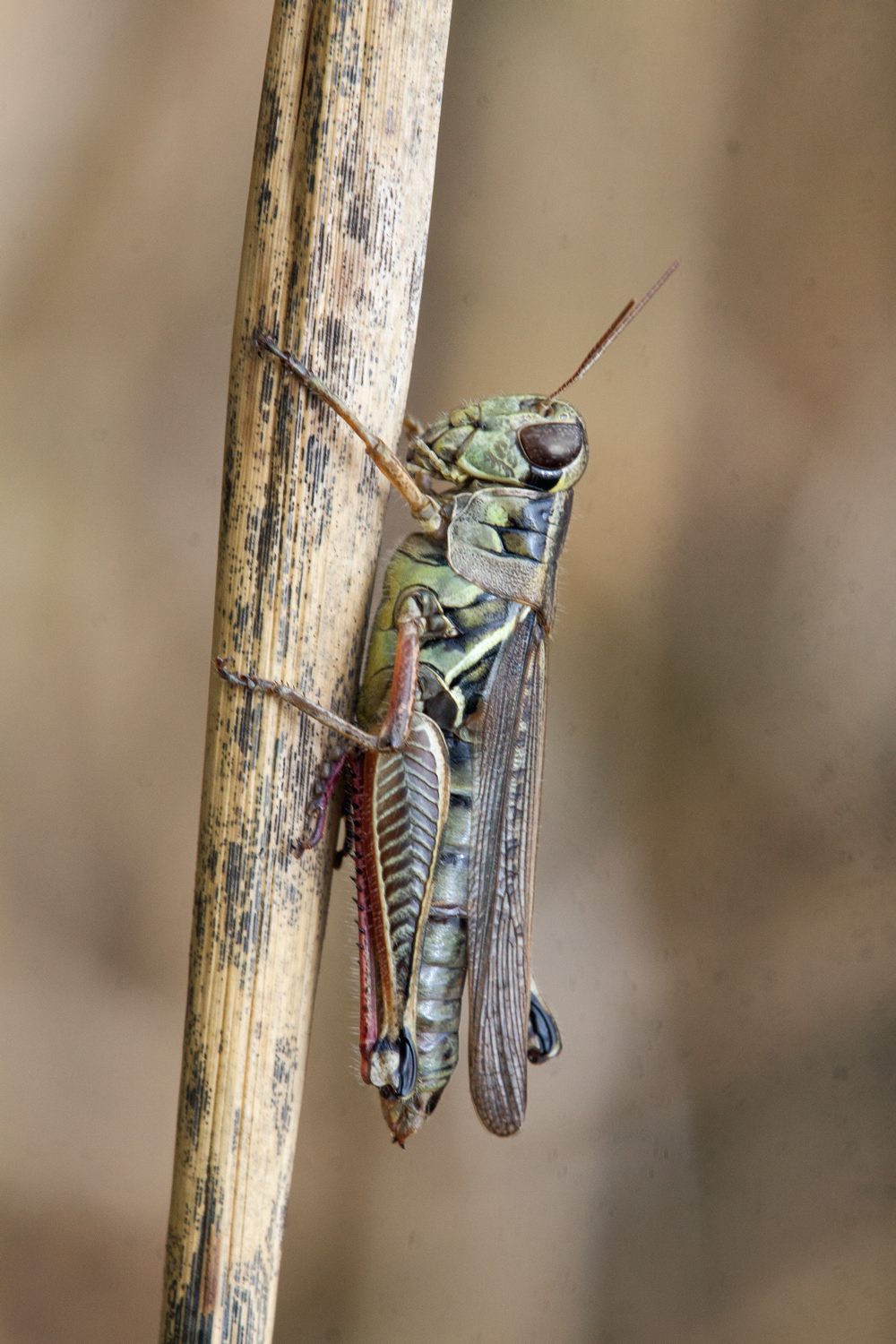
The dragonfly population continues to decrease as we move deeper into autumn, but my little winged friends seem to have been replaced by grasshoppers. Whenever I walk through the fields of my favorite marshland park, I am preceded by mini explosions of insects. Most of the grasshoppers hop far away, but yesterday one of them chose a nearby stalk of grass and posed for me.

grasshopper

© Michael Q. Powell. All rights reserved.

Read Full Post »

What do you do when an invasive species threatens a sensitive habitat? Since about 2004, Northern Snakeheads (Channa argus), a predatory Asian fish that threatens native fish populations, have been spotted on the Potomac River. They have now become established in many locations in Northern Virginia, including Huntley Meadows Park, the marshland park where I take many of my wildlife photos.

Throughout this summer, many of us have cheered when ospreys and Great Blue Herons have pulled snakeheads out of the waters, but I suspected that the birds couldn’t control the snakehead population on their own. We have not had much rainfall the last couple of months and most of the remaining water is concentrated in a series of scattered pools of muddy water.

This past Friday, I was privileged to watch a dedicated group of employees from Fairfax County enter those pools of water to remove as many snakeheads as possible. How did they do it? I don’t know the details of the equipment, but essentially two guys walked through the water delivering jolts of electricity from the “juice boxes” on their backs and other members of the group captured the stunned fish with handheld nets and deposited them into five-gallon buckets.

It may sound easy, but in practice it looked really challenging. The pools were slippery and of uncertain depth, so everyone had to move cautiously and slowly, undoubtedly conscious all of the time of the electricity. I don’t know about you, but I am just not really comfortable even thinking about mixing water and electricity.

In total, the group managed to capture about two dozen snakeheads, including several that looked to be about two feet long (61 cm). Unfortunately, the snakeheads are here to stay and I expect that efforts will have to be made every year to reduce and control the population of these fierce predators.

I was granted permission to take photos of the fishing process with the stipulation that I not interfere with the work. It was quite a challenge to try to capture action shots and avoid getting stuck in the mud. I am including an assortment of images to give you a feel of the action and the people involved in the effort,

My good friend and fellow photographer Walter Sanford also captured the action and did a blog posting today called Electrofishing for Northern Snakeheads. Walter included lots of wonderful details about snakeheads in our local area and links to related articles to accompany his images. He and I have different backgrounds and use different camera gear and periodically we like to do companion postings to provide viewers with different perspectives on the same subjects. Be sure to check out his posting.
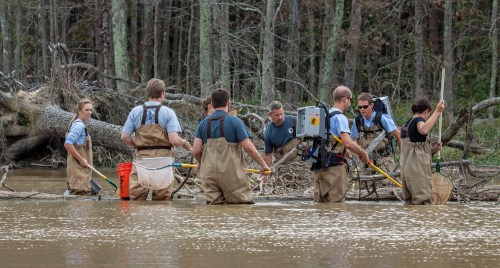
Initially the group was all together, but it eventually split up into subgroups.

Initially the group was all together, but it eventually split up into subgroups.

A drop in the bucket after netting a fish.

A drop in the bucket after netting a fish.

When the catch was bigger, it was safer to bring it to shore.

When the catch was bigger, it was safer to bring it to shore.

Net gain

Net gain

Teamwork

Teamwork

Intensity

Intensity

Electrifying performance

Electrifying performance

Can you figure out why it's called a

Can you figure out why it’s called a “snakehead?”

© Michael Q. Powell. All rights reserved.

Read Full Post »

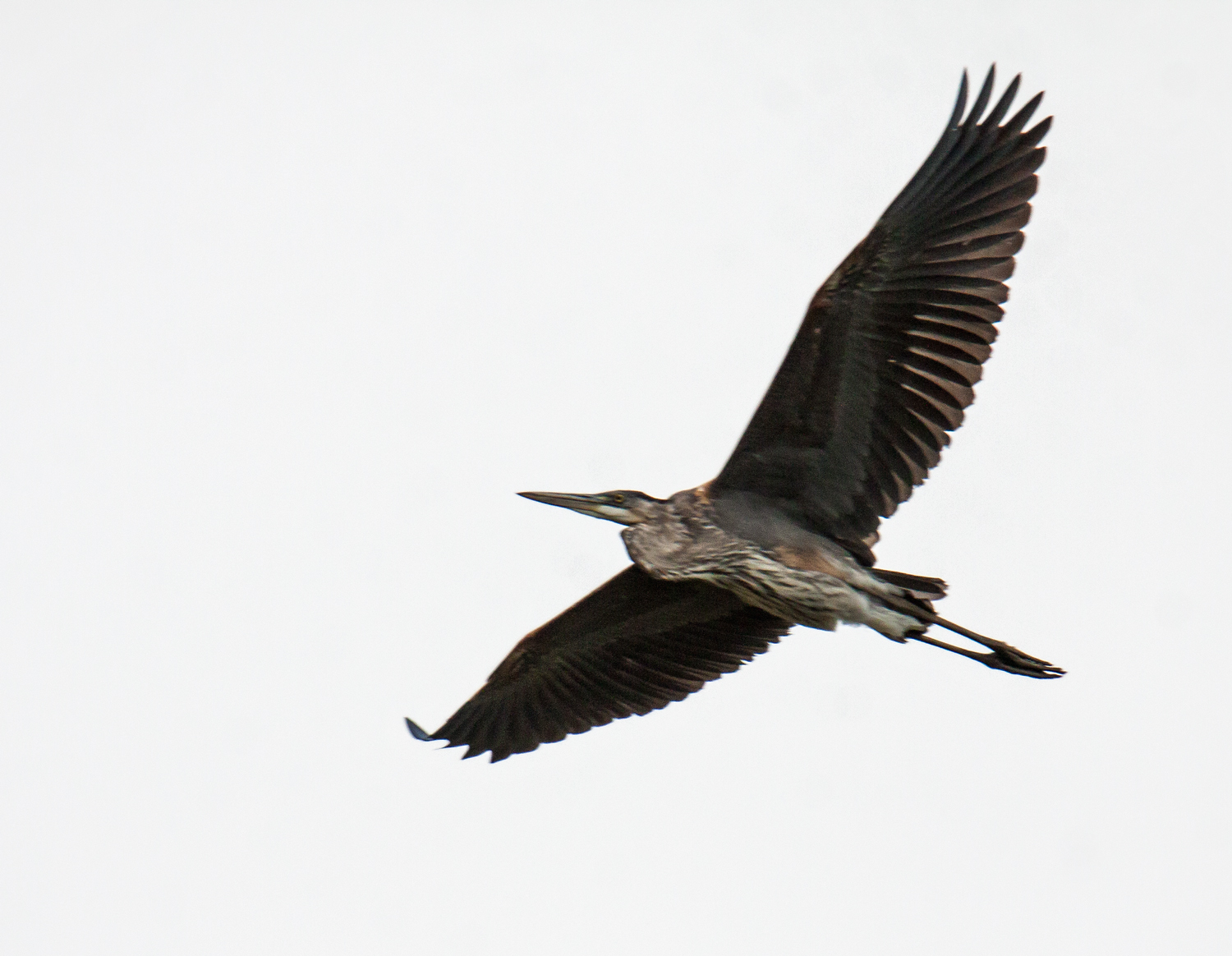
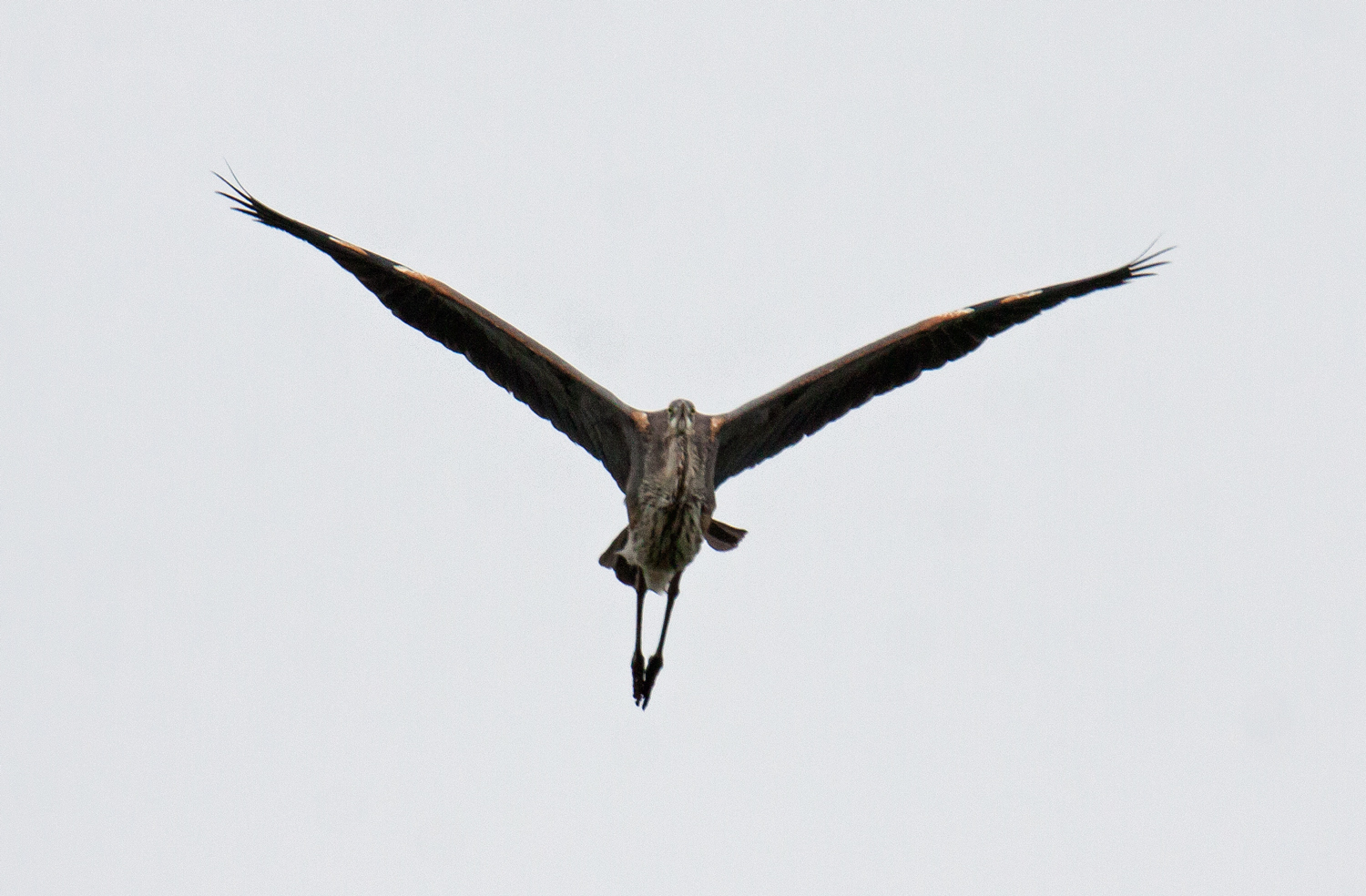
The sky was completely overcast early yesterday morning and most of the birds seemed to be sleeping in. One notable exception was this Great Blue Heron (Ardea herodias).

I spotted him in the distance flying in my direction at a pretty good speed. Normally Great Blue Herons seem to fly at a leisurely pace, but this one appeared to be in a hurry. Although the heron looked beautiful when its wings were fully extended, as in the first image, the heron appeared menacing—almost like a predator—when he was flying straight at me with legs extended.

As the Great Blue Heron flew overhead, I was treated to a great view of the underside of its body and wings, an angle of view that I rarely see, given that herons are usually flying away from me when I spot them.

I am on the fence about whether I like the white sky or not as a background. It is certainly uncluttered, but it seems a bit unnatural, almost like I was posing the bird in a studio setting.

Great Blue Heron

Great Blue Heron

Great Blue Heron

© Michael Q. Powell. All rights reserved.

Read Full Post »
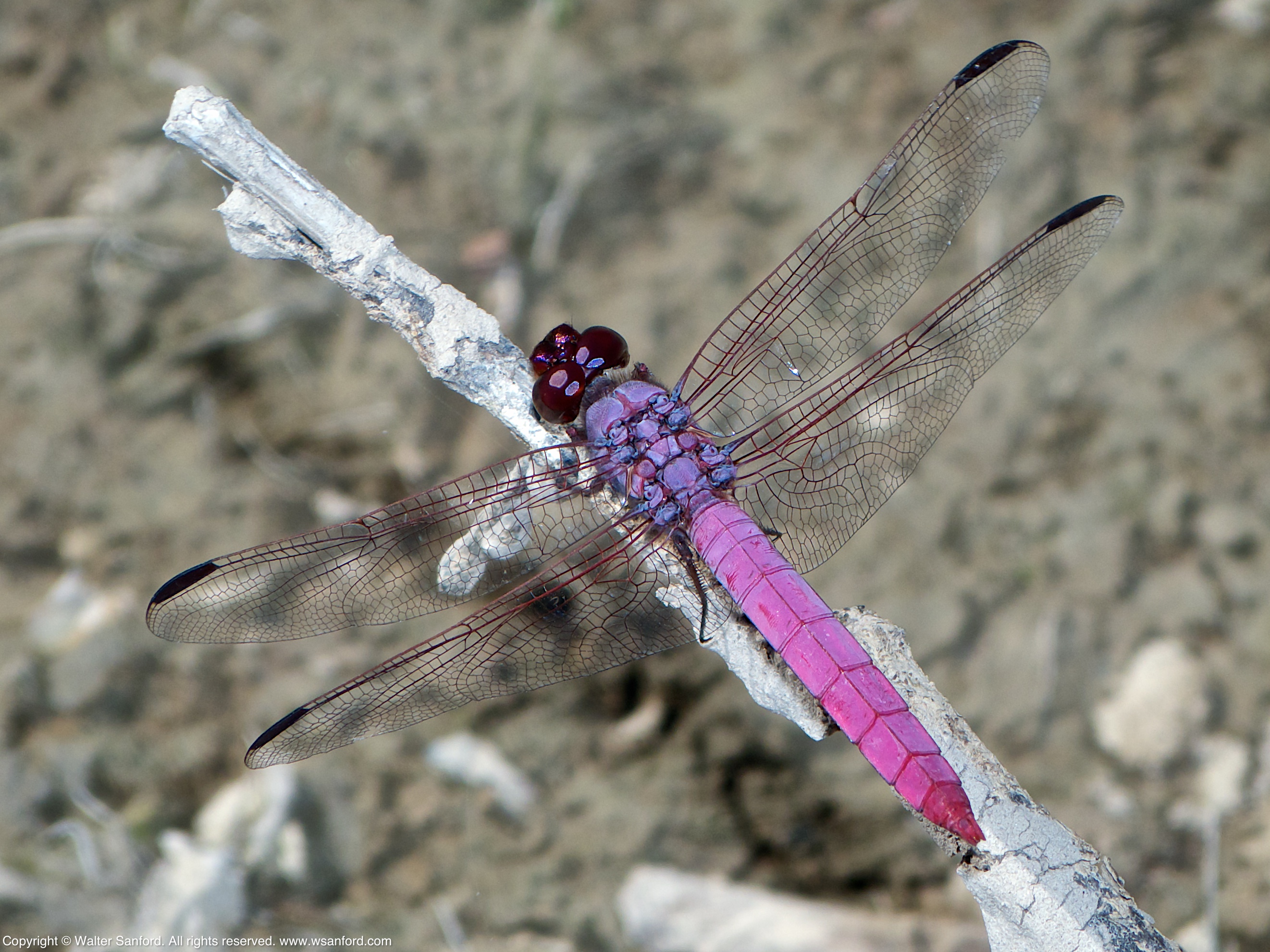
A pink dragonfly? Fellow photographer and good friend Walter Sanford was not hallucinating when he recently spotted this Roseate Skimmer dragonfly at Huntley Meadows Park, one of only a small handful of sightings ever of this species in Virginia.

He spotted one last year too, but this year managed to capture a wonderful series of images of this beauty. Be sure to check out his original posting as well as other spectacular images on his blog.

waltersanford's avatarwalter sanford's photoblog

Breaking news: I discovered a new species of dragonfly at Huntley Meadows Park — a Roseate Skimmer dragonfly (Orthemis ferruginea). This is the first official record of Orthemis ferruginea in Fairfax County, Virginia.

Actually, I discovered this species last year but was unable to shoot a photo to prove I wasn’t hallucinating pink dragonflies! On 10 September 2014, I spotted a male Roseate Skimmer that made one patrol around a pool near an old beaver lodge (one that overlapped the boardwalk that goes through the central wetland area), landed for one second (no kidding) and flew upstream along Barnyard Run; I never saw it again. This year, I have photographic proof.

This individual is a male, as indicated by its coloration and terminal appendages.

A Roseate Skimmer dragonfly (Orthemis ferruginea) spotted at Huntley Meadows Park, Fairfax County, Virginia USA. This individual is a male. 23 SEP 2015 | Huntley Meadows Park | Roseate Skimmer (male)

Dig that crazy metallic purple face!

A Roseate Skimmer dragonfly (Orthemis ferruginea) spotted at Huntley Meadows Park, Fairfax County, Virginia USA. This individual is a male. 23 SEP 2015 | Huntley Meadows Park | Roseate…

View original post 272 more words

Read Full Post »

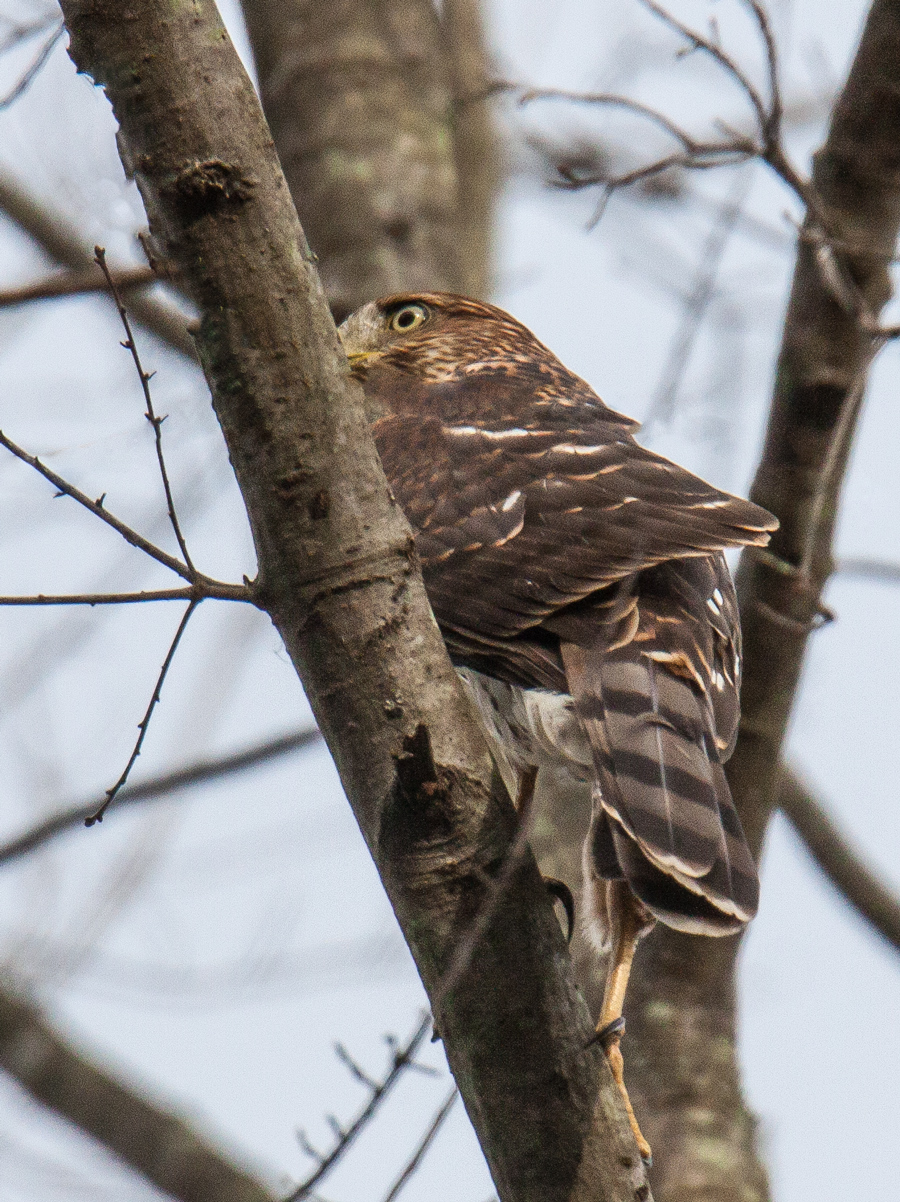
As I walked toward a brush pile yesterday at my favorite marshland park, I flushed a bird. It flew to a a nearby tree and perched. Slowly I moved closer, hoping to get a better look at the bird, which seemed pretty large, though not as large as the eagles, ospreys, and hawks that I occasionally see at the park.

I took a series of shots and was disappointed at first that the head was not visible in any of them—the bird was hunched over and facing the opposite direction. Upon closer examination, I was thrilled when I noticed a bright yellow eye in one of the shots. That yellow eye and the long, rounded tail suggest to me that this is an immature Cooper’s Hawk (Accipiter cooperii). According to the Cornell Lab of Ornithology, adult Cooper’s Hawks have red eyes, while juveniles have yellow eyes.

The young hawk’s face is partially hidden in the image and the background is cluttered, but I am excited that I was able to capture an image of a species that I knew lived in the park, but that I had never before seen. Leaves are starting to fall from the trees and I hope that I will be able to spot more birds as the density of the foliage decreases. I can hear so many birds as I walk about, but so often they remain hidden from view.

Cooper's Hawk

© Michael Q. Powell. All rights reserved.

Read Full Post »

I love the distinctive look and bright colors of the Belted Kingfisher (Megaceryle alcyon) and was thrilled to spot this female on Monday at Huntley Meadows Park.

She was initially perched on a rotten tree trunk in a meadow, which is actually a dried-up pond—the water levels at the marsh are perilously low at the moment.  Before I could get a close shot, I managed to spook her and she flew to the higher perch that you see in the first image of this posting. The second image shows her in her initial position.

I like the way that the dark leaves provide a backdrop that draws our attention to the kingfisher in the first shot, but also like the softer quality of the second shot, with the grass and the out-of-focus treeline.

Unlike in most bird species, the female Belted Kingfisher is more colorful than the male—she has a rust-colored stripe that is absent in the male.

Belted Kingfisher

Belted Kingfisher

© Michael Q. Powell. All rights reserved.

Read Full Post »

The autumnal equinox arrived yesterday, marking another change of seasons. I love the autumn, but there is something a little wistful about it, as so many of the bright summer colors begin to fade and the leaves dry out and fall off of the trees. Somehow for me it is a reminder of the inexorable passage of time and of the fragility of life.

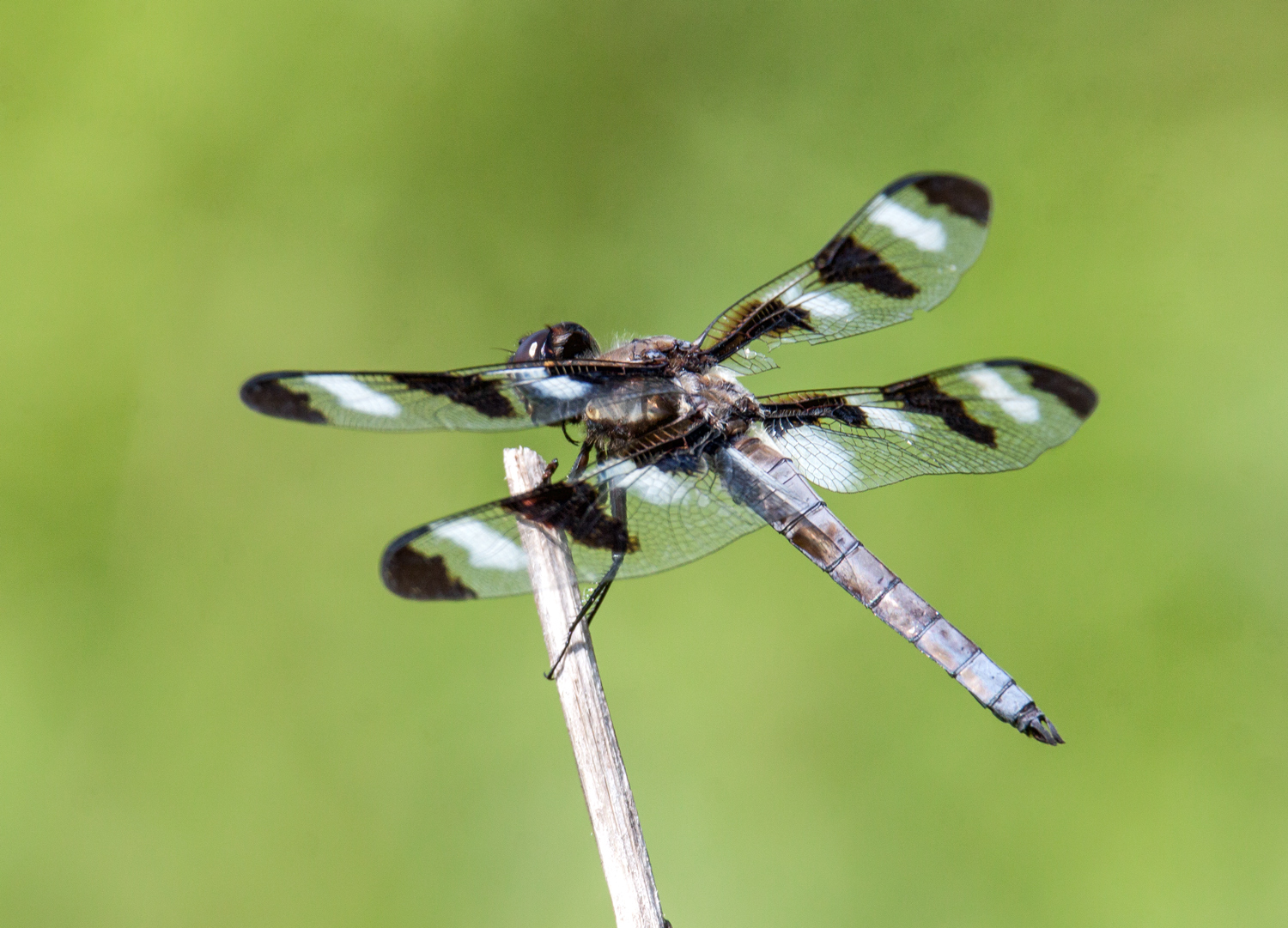
Earlier this week I saw a faded male Twelve-spotted Skimmer dragonfly (Libellula pulchella) that put me in a pensive mood, remembering how this boldly-patterned species really stood out in the spring. Now he has has almost become a part of the background, less notable, less distinctive, less likely to attract attention.

How many of us are like that? Our society worships youthful beauty and older people are often pushed out of the spotlight in favor of unblemished youths. It’s nice to have memories of the way we were, remembering our youthful beauty and capabilities, but I think it’s important to celebrate who we are and who we are becoming.

So here’s a look at that male Twelve-spotted Skimmer and a female Twelve-Spotted Skimmer that I observed last week. Wouldn’t you agree that they are still beautiful despite (or perhaps because of) their senior citizen status.

Twelve-spotted Skimmer

Twelve-spotted Skimmer

© Michael Q. Powell. All rights reserved.

Read Full Post »

The water levels at my favorite local marshland park (Huntley Meadows Park) are perilously low and I worry about the survival of some of its inhabitants. Some shore birds, however, have shown up that I don’t see regularly there, like this Killdeer (Charadrius vociferus).

The Latin name for this species seems to have been chosen well—these little birds are really loud as they fly by and announce their arrival. I find the bird’s English name to be a little creepy, although it has nothing to do with the four-legged animal, and instead was prompted by the bird’s shrill call that someone thought sounded like “kill-deer,” according to the Cornell Lab of Ornithology.

Killdeer

In an ironic twist, the same day that I took this photo, I noticed that signs have now been placed in the park that indicate that deer killing is taking place. I understand the need to manage the deer population, which can quickly get out of hand because of the lack of predators, but I always feel a slight sense of unease when I see these signs, given that I have a tendency to wander off of the “established” trails.

deer kill

© Michael Q. Powell. All rights reserved.

Read Full Post »

What’s your most challenging subject as a photographer? Do you chase the perfect lighting for your landscape photos or pursue the decisive moment in your street shots or wait endlessly for an elusive creature to appear?

At least several times a year, I will attempt to photograph dragonflies in flight. Dragonflies are small, fast, and agile. Some of them seem utterly unpredictable and almost impossible to track or fly high in the air, out of range of even long telephoto lenses.

What’s an ideal scenario? In the best of all worlds, I would like to find a dragonfly that flies a repeated route, such as patrolling a portion of a stream, and periodically hovers at my eye level or below.

Yesterday I spotted a dragonfly as I was following a stream in a remote part of my favorite marshland park. The dragonfly would hover for a while and then move a short distance away and hover again.

I was pretty excited as I put my camera to my eye and tried to find the dragonfly in the viewfinder. With my zoom lens extended to 600mm, it’s a little like looking through a straw—there is a pretty limited field of view. I set my focus to manual mode, having learned in the past that it is almost impossible for me to gain and hold focus on small moving subjects in auto mode. One of the challenges of the Tamron 150-600mm lens is that the focus ring is at the back of the lens near the lens mount, which means that it is tough to hold the lens steady and focus manually.

The dragonfly was cooperative and gave me a number of chances before it flew away. When the magical moments ended, I looked at a few of my images on the back of my camera and couldn’t immediately identify the dragonfly. Initially I thought it was a Mocha Emerald, like the one that I seen near that same location earlier in September, but the coloration and body shape was all wrong. Once I got home, I did a little research and figured out that I had photographed a Shadow Darner (Aeshna umbrosa), a call confirmed by local dragonfly expert Walter Sanford.

I am pretty happy with these shots. I know that I was lucky to see this dragonfly, but I also know that the hours and hours that I have spent shooting with this camera and lens helped me to take advantage of the situation. A combination of luck, patience, and a bit of skill—it sounds like a good recipe for handling your most challenging subjects as a photographer.

Shadow Darner

Shadow Darner

© Michael Q. Powell. All rights reserved.

Read Full Post »

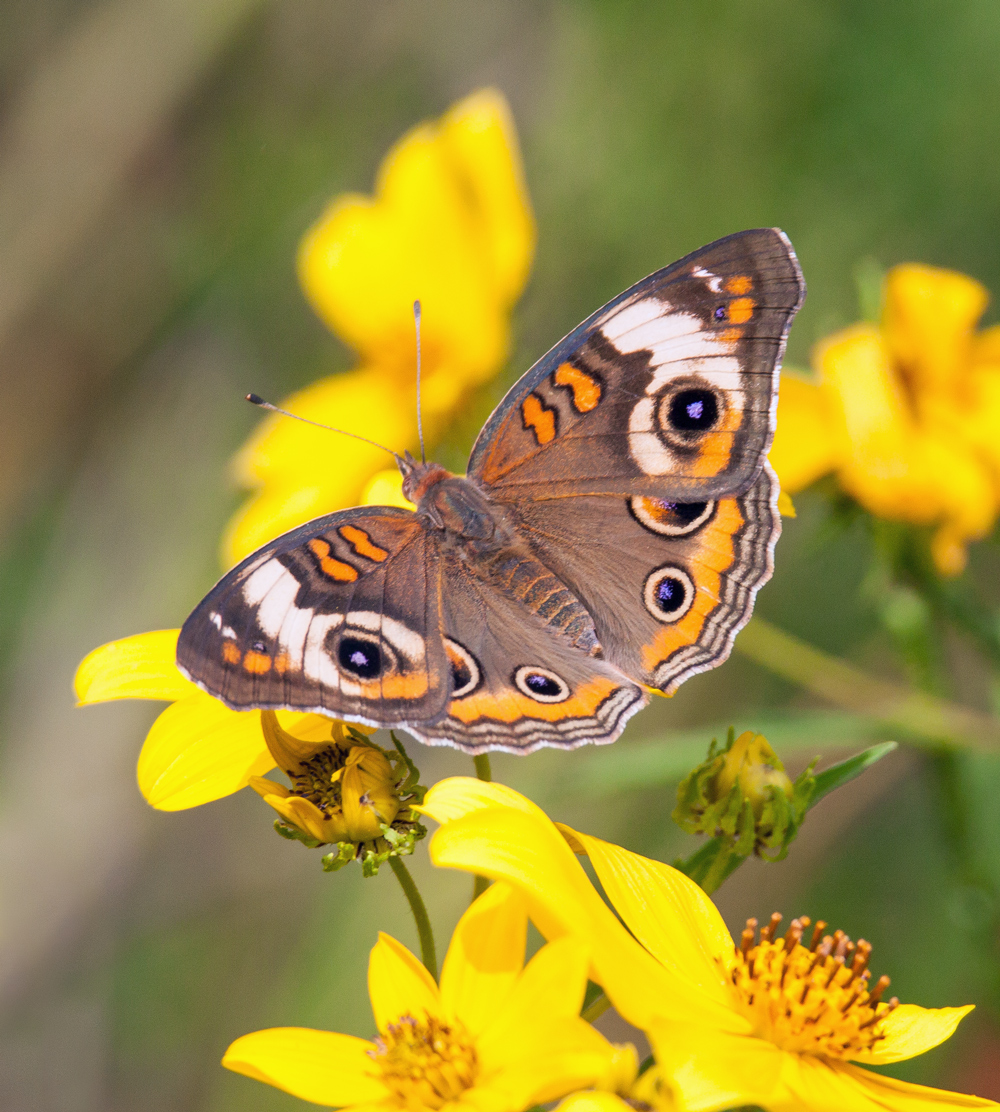
Though it is officially called “common,” the bright colors and patterns of this Common Buckeye butterfly (Junonia coenia) make it uncommonly beautiful in my eyes. (I should also note that it is not common for me to spot one—I’ve seen them only a few times this summer.)

Common Buckeye

© Michael Q. Powell. All rights reserved.

Read Full Post »

How was your summer? Did you take a vacation and relax or at least take some time off from work?

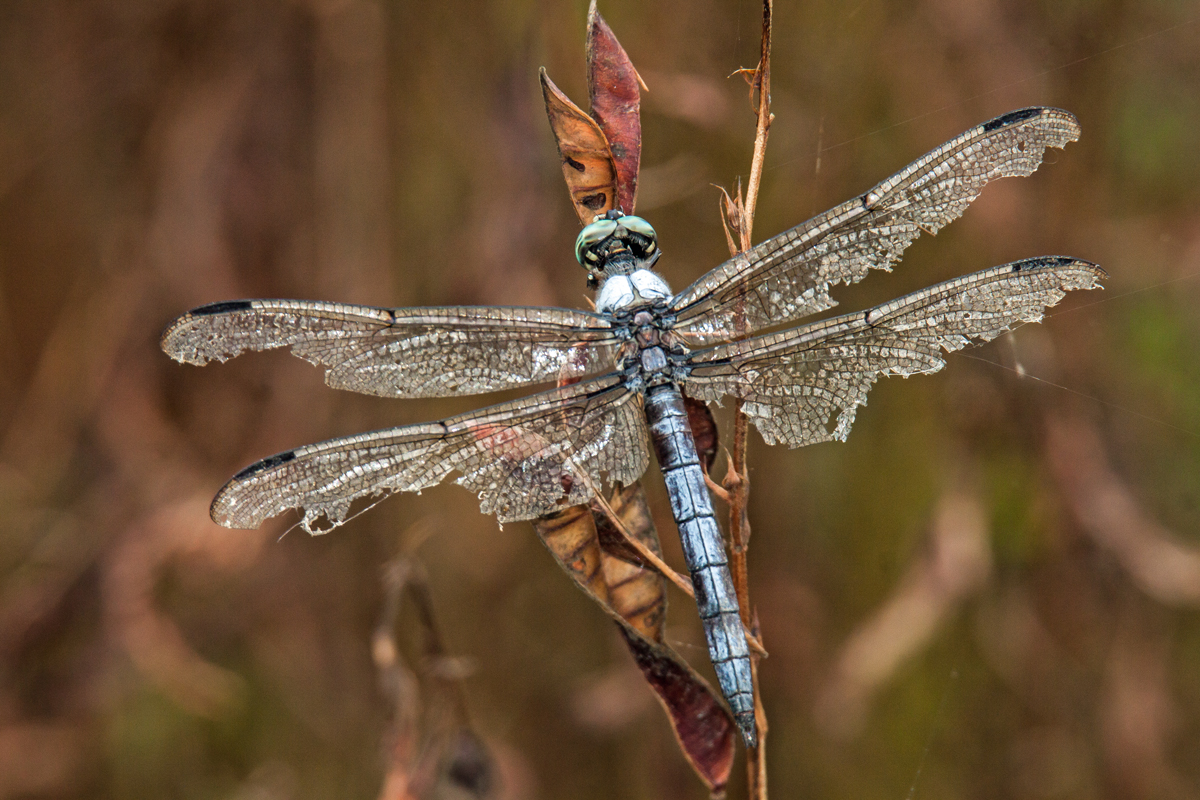
There are no vacations for dragonflies. It looks like this has been a long, hard summer for the male Great Blue Skimmer (Libellula vibrans) that I spotted earlier this month, judging from the almost shredded condition of his wings. Yet somehow, he is still able to fly and continues to survive

Autumn is almost upon us and the number of dragonflies that I observe is dropping. Before long, only a few hardy species will remain. For now, I take joy in seeing the tattered survivors, whose beauty is undiminished in my eyes.

Great Blue Skimmer

© Michael Q. Powell. All rights reserved.

Read Full Post »

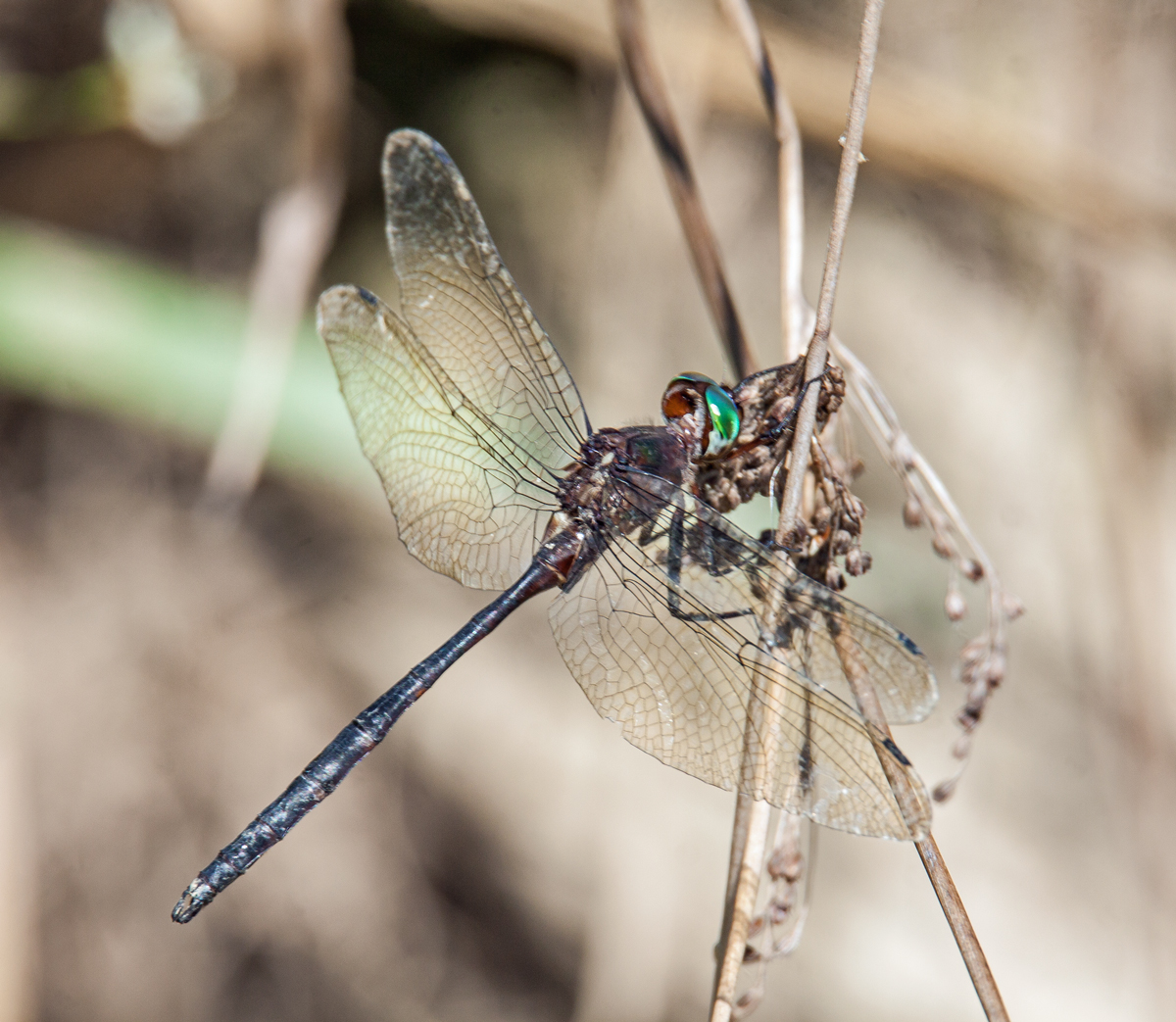
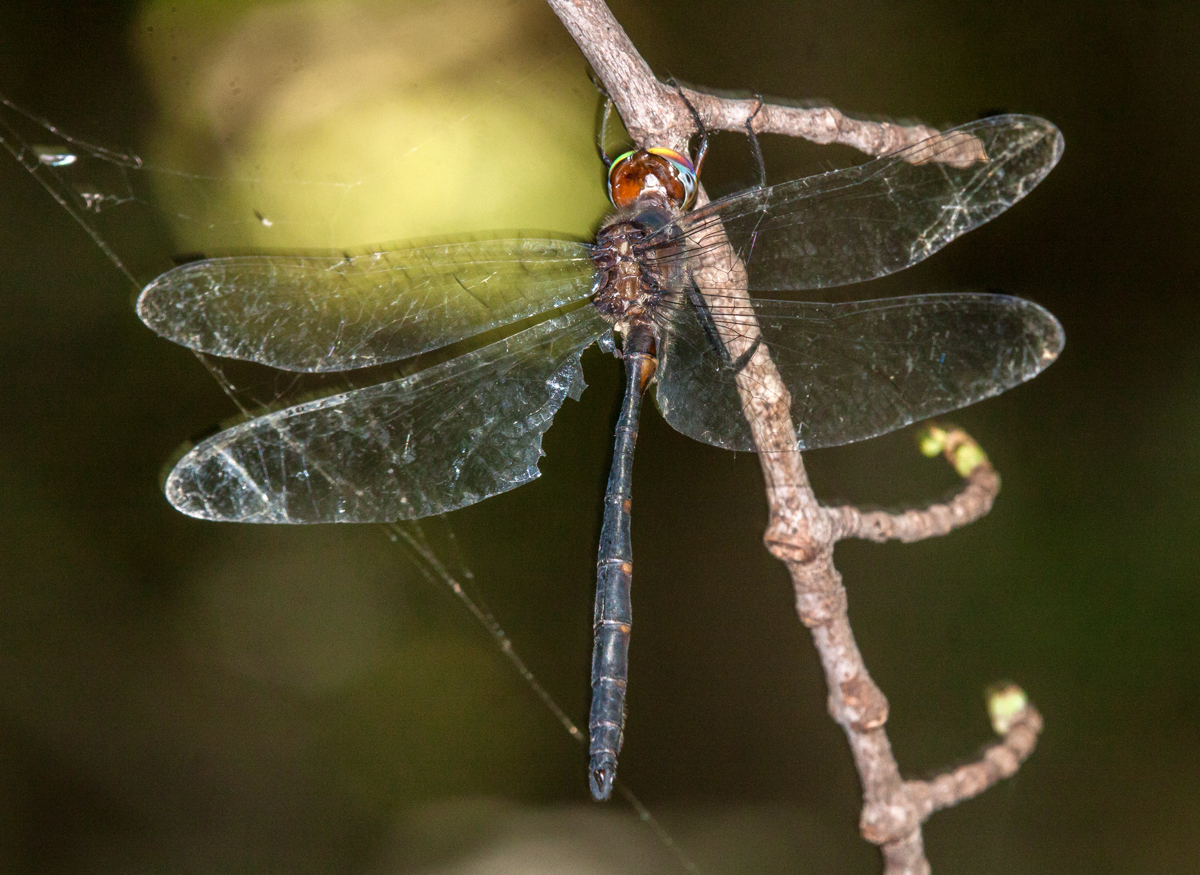
Yesterday I spotted this male Mocha Emerald dragonfly (Somatochlora linearis) while exploring one of the streams at Huntley Meadows Park and was struck again by the way this species perches vertically, rather than horizontally like so many of the other dragonflies that I see.

The words of the old Supremes song come to mind, “You keep me hangin’ on…” and now that song is stuck in my head. On the off chance that one of my readers has never heard that song (and I can’t believe that is possible), here’s a link to a really old video of the Supremes performing the song.

Mocha Emerald dragonfly

© Michael Q. Powell. All rights reserved.

Read Full Post »

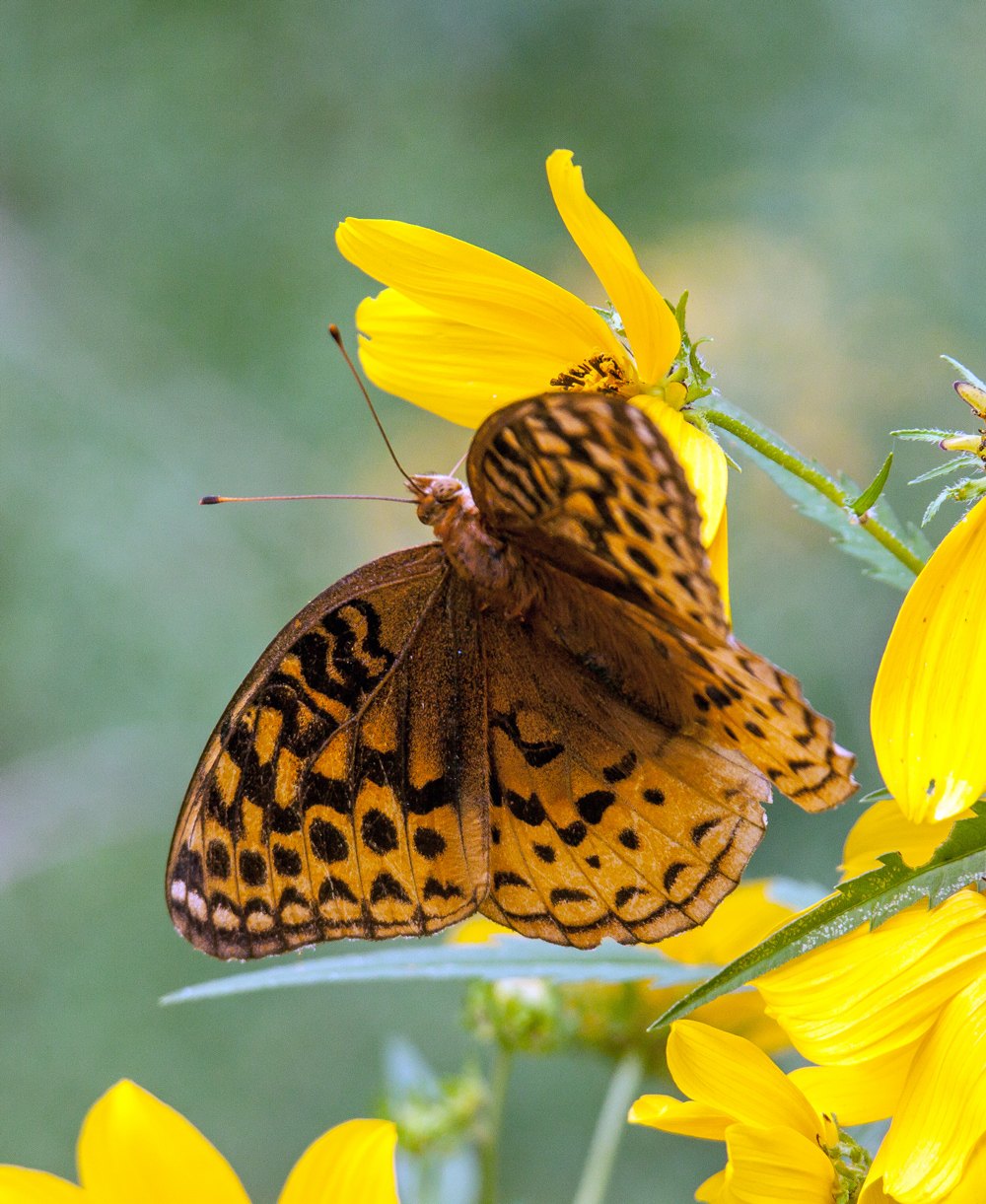
It’s amazing how a brightly colored butterfly can almost disappear from view merely by turning sidewards. Last week, I was observing a Great Spangled Fritillary butterfly (Speyeria cybele) feeding on a yellow flower when suddenly it seemed to disappear. I blinked my eyes and looked again and the butterfly looked almost like a grasshopper, because I could not see its wings.

Great Spangled Fritillary

A few seconds later, the butterfly shifted its position and its colorful wings once more came into view, providing the more conventional view of the butterfly that you see in the photo below.

Great Spangled Fritillary

I love trying to find unconventional views of familiar subjects, though it’s important not to forget that there is a lot of beauty in the familiar conventional views as well.

© Michael Q. Powell. All rights reserved.

Read Full Post »
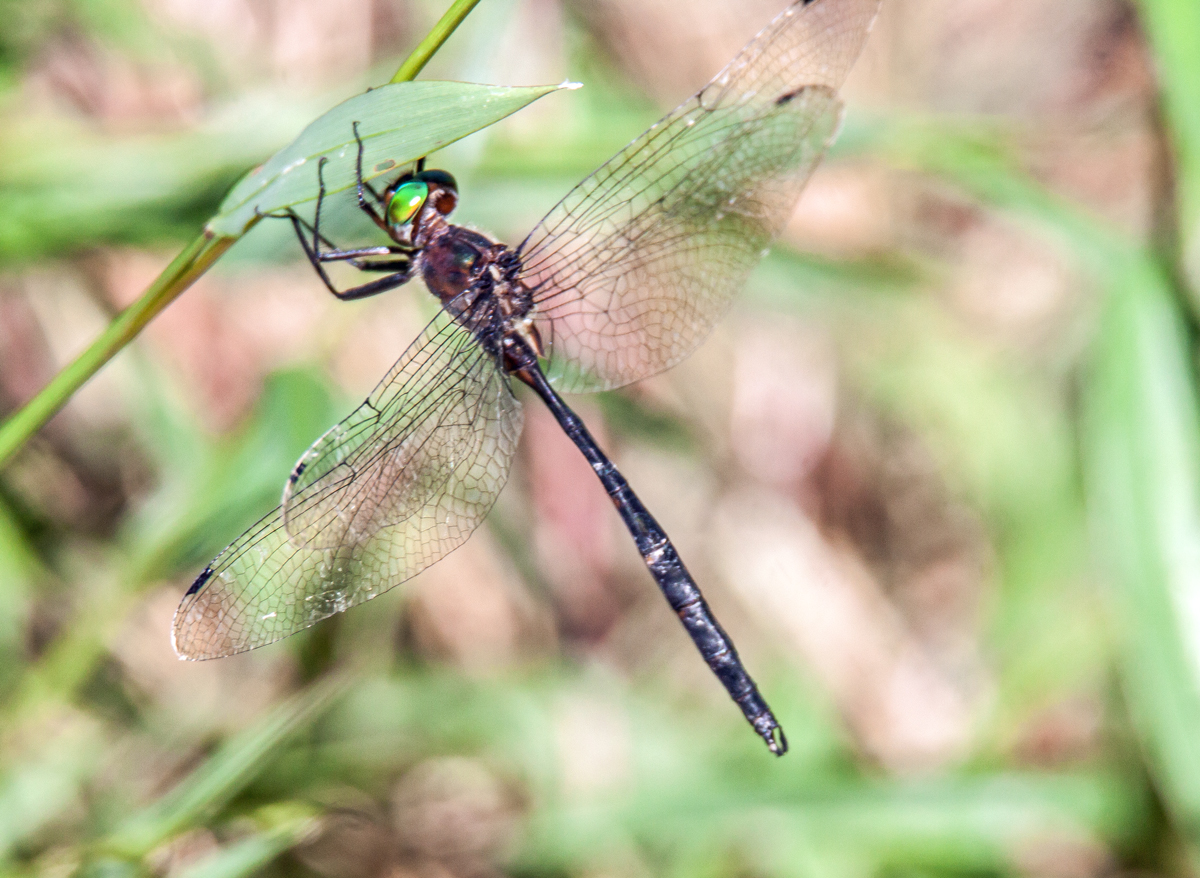
Unlike Pumpkin Spice, Mocha Emerald is not a fall Starbucks flavor—it is a cool-looking dragonfly species that I was excited to spot yesterday at my favorite marshland park.

Mocha Emerald

Every other time that I have observed a Mocha Emerald (Somatochlora linearis), the dragonfly has been perched in the shadows, so I was surprised yesterday to see one in full daylight. This Mocha Emerald, which looks to be a male seemed to be patrolling a stretch of a small stream. Occasionally it would stop to rest and perch vertically on vegetation sticking out low from the bank of the stream.

Getting a decent shot of the Mocha Emerald was quite a challenge. My camera’s auto focus had trouble fixing focus on the dragonfly’s long thin body so I had to focus manually; there was a breeze that was blowing that caused the dragonfly to swing in and out of my field of view as I looked through the viewfinder; and the background tended to be really cluttered.

The first shot is my favorite, because I was able to isolate the dragonfly by hanging over the stream (and almost falling in), although the other shots show some of the details of its body better.

Maybe there should be a Mocha Emerald latte, perhaps for Saint Patrick’s Day—I would be thrilled if it supplanted the green beer that still makes an appearance at some locations.

Mocha Emerald

Mocha Emerald

Mocha Emerald

© Michael Q. Powell. All rights reserved.

Read Full Post »
My favorite marshland park is abloom with yellow flowers. This past Friday, I spotted a Monarch butterfly (Danaus plexippus) at the edge of a meadow feeding on one of those flowers. I thought the Monarchs had flown south for the season already, but was delighted to see they are still around.

I tried to frame the image so that there would be yellow flowers in the background and the results were even better than I had anticipated.

Yellow seems to be a happy color and somehow I can’t help but smile when I look at this image. I hope that it has the same effect on all of you.

Monarch butterfly

© Michael Q. Powell. All rights reserved.


Read Full Post »

“Blue eyes
Baby’s got blue eyes
Like a deep blue sea
On a blue blue day”

Somehow the words to the old Elton John song come to mind when I gaze into the stunning blue eyes of this Blue-faced Meadowhawk (Sympetrum ambiguum). This dragonfly was unusually cooperative and let me move in to take this close-up portrait with my macro lens.

Blue-faced Meadowhawk

If you have never heard “Blue Eyes” or just want a blast from the past, here’s a link to a YouTube video of Elton John performing the song.

© Michael Q. Powell. All rights reserved.


Read Full Post »

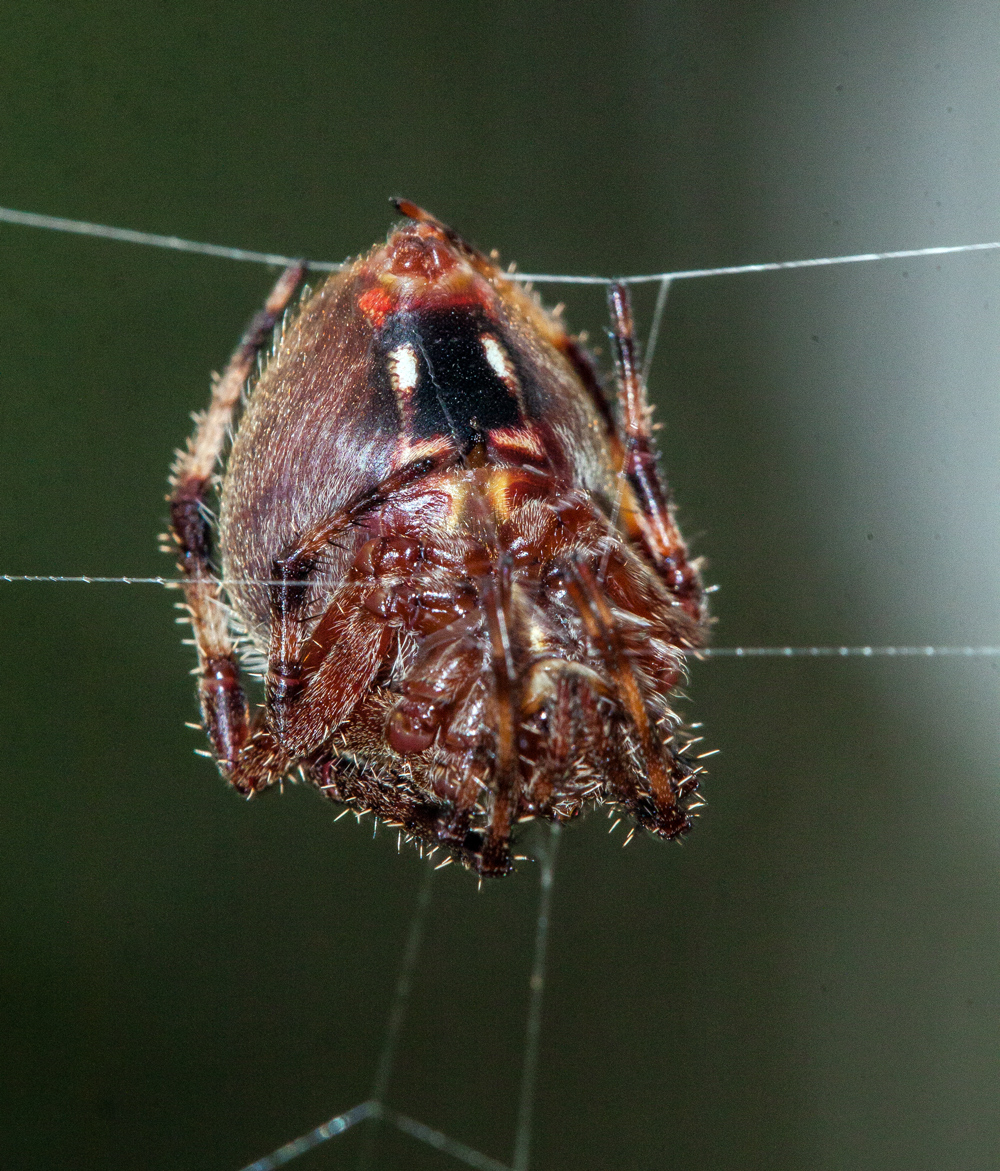
I first caught sight of this spider yesterday when I almost walked into it—it was hanging in mid-air at eye level across a path and we were less than a foot apart when I encountered it.

Initially the spider scampered up a bit and then seemed to run out of web and came to a stop, giving me some time to change to my macro lens. The spider, which I think is a kind of orb weaver (Neoscona crucifera) that is sometimes called a barn spider, was about seven feet off the ground by this time, so it was quite a challenge getting a stable shooting position. I raised the ISO and used the pop-up flash and managed to get some reasonably sharp images.

These are my favorite two images. I really like the detail in the first shot, but like the background and angle of view more in the second shot. Which one is better? I vacillate in trying to decide, so included them both.

orbweaver spider

orbweaver spider

© Michael Q. Powell. All rights reserved.

Read Full Post »
I’m back from a brief overseas trip and it’s time to switch back from shooting in urban surroundings to my more typical nature images. In the meantime, here’s a shot of a beautiful Eastern Tiger Swallowtail (Papilio glaucus) from a pre-trip visit to Huntley Meadows Park in Alexandria, Virginia.

Eastern Tiger Swallowtail

© Michael Q. Powell. All rights reserved.

Read Full Post »

Late in the summer, there is a great abundance of flying and crawling insects—they are everywhere. I enjoy photographing many of them and generally I will try to identify my subjects when I post their photos.

In this case, however, I didn’t get a close enough view or a sharp enough shot of this cool-looking insect for me to be confident in any identification. (Alas, the photo is clear enough for me to realize that I need to clean my camera’s sensor, for I can see a bunch of stops in the beautiful background of what is often called “sensor dust.”)

Still, I really like the insect’s pose at the top of the vegetation, a pose that somehow brings to mind the “King of the World” moment in the movie Titanic.

bug

© Michael Q. Powell. All rights reserved.

Read Full Post »
As we move closer and closer to the end of the summer, many of the butterflies are starting to show the effects of time, with faded colors and missing pieces of their wings. Yet somehow, at least in my eyes, their beauty is undiminished, like this Viceroy butterfly (Limenitis archippus) that I spotted this past week at my favorite local marshland park.

viceroy butterfly

© Michael Q. Powell. All rights reserved.

Read Full Post »

When watching birds, I usually have my camera’s zoom lens fully extended. On rare occasions I am actually zoomed in a little too closely, as was the case when I took the shot of a Great Egret (Ardea alba) this past Monday at Huntley Meadows Park.

Despite the clipped wings, I love the details and the beautiful arc of the feathers of its wings as this stunning bird takes to the air.

Great Egret

© Michael Q. Powell. All rights reserved.

Read Full Post »

What signs do you look for that point to the change of seasons? Throughout most of my life, the changing colors of the fall foliage have been the primary indicator of the end of summer and the beginning of autumn.

The last few years, however, I have become increasingly sensitive to seasonal changes in the dragonfly population as I have increasingly focused my attention and my camera lens on these fascinating and colorful aerial acrobats. Summer is prime time for many dragonfly species, but certain species show up much later in the season and stay with us throughout much of the autumn days.

One of these late-arriving species is the Blue-faced Meadowhawk (Sympetrum ambiguum) and I was thrilled yesterday to spot a male of this species at Huntley Meadows Park, the marshland where I take a lot of my wildlife photos. This is my first spotting of a Blue-faced Meadowhawk this season and I suspect it won’t be long before I also start seeing his “cousin,” the Autumn Meadowhawk (Sympetrum vicinum).

I particularly like the bright red color and bold pattern of this dragonfly’s body and its beautiful turquoise face. Although I may vacillate a bit from time to time, I think this is the most beautiful dragonfly species that I have ever encountered. What do you think?

Blue-faced Meadowhawk

© Michael Q. Powell. All rights reserved.

Read Full Post »

There were lots of other available thistle plants yesterday at Huntley Meadows Park, but an Eastern Tiger Swallowtail (Papilio glaucus) and a Great Spangled Fritillary (Speyeria cybele) kept jockeying for position on this single flower, each seemingly determined to gain the upper hand.

Who knew that butterflies were so competitive?

Competitive butterflies

© Michael Q. Powell. All rights reserved.

Read Full Post »

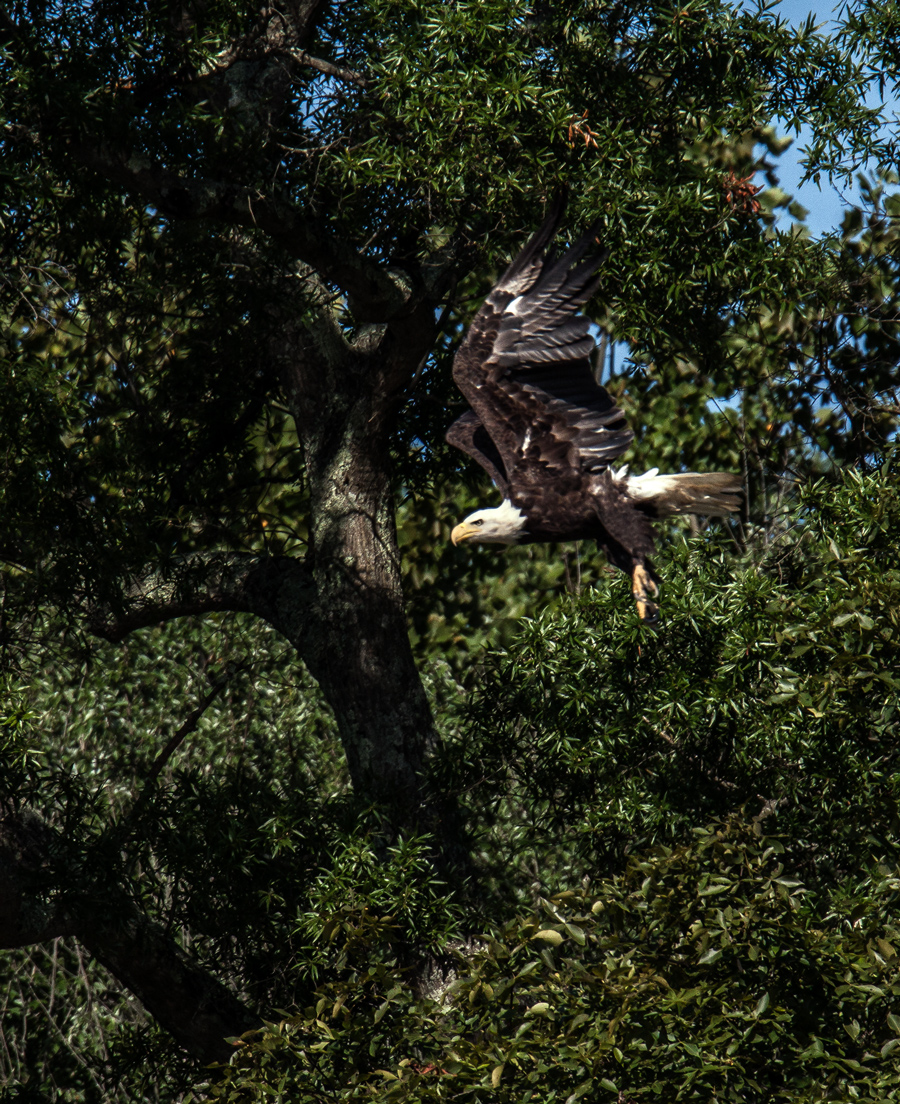
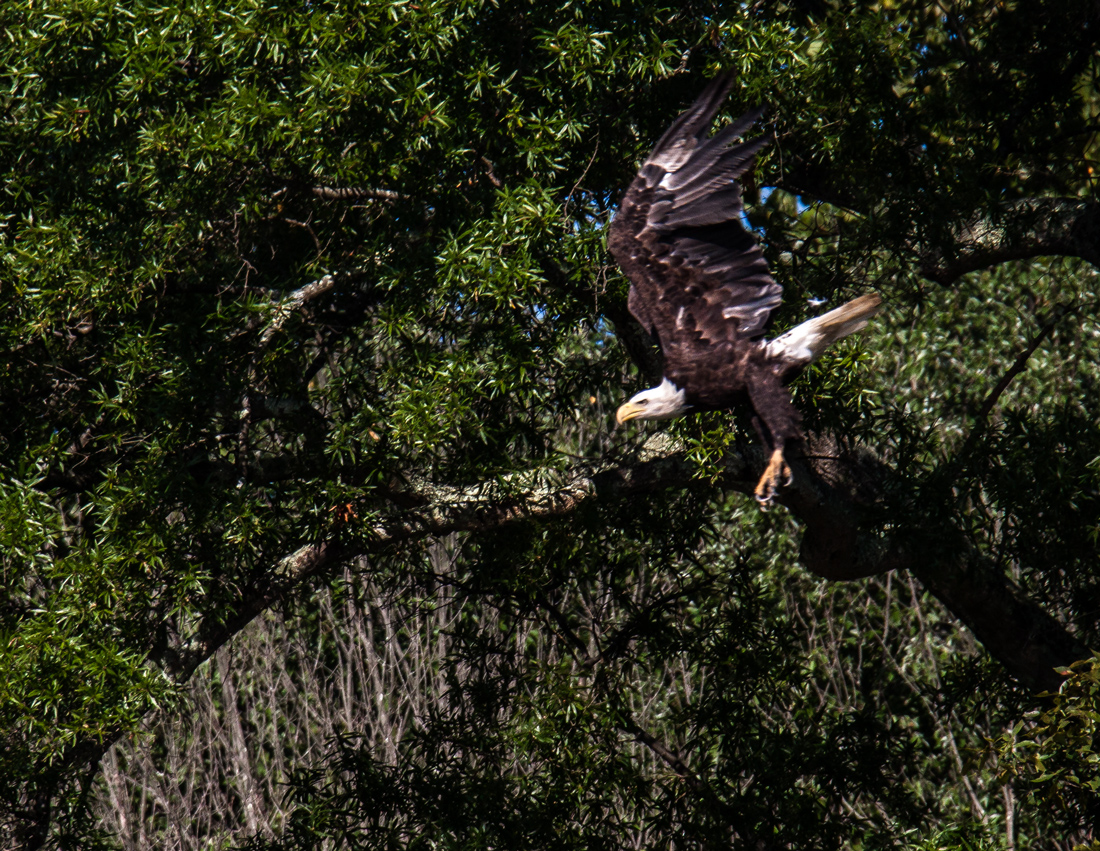
Walking down one of the informal trails at Huntley Meadows Park this past Friday, I spotted a dark shape in a distant tree. The moment that I got my camera focused on what turned out to be a bald eagle, it took off.

My camera settings were not optimal, but I somehow managed to capture some images of the eagle in flight as it flew away. The final shot in this posting shows my initial view of the eagle, just seconds before he took to the air.

As I have noted before, it’s a wonderful day for me whenever I see a Bald Eagle (Haliaeetus leucocephalus) and especially so when I am able to photograph this majestic bird.

Bald Eagle

Bald Eagle

Bald Eagle

© Michael Q. Powell. All rights reserved.

Read Full Post »

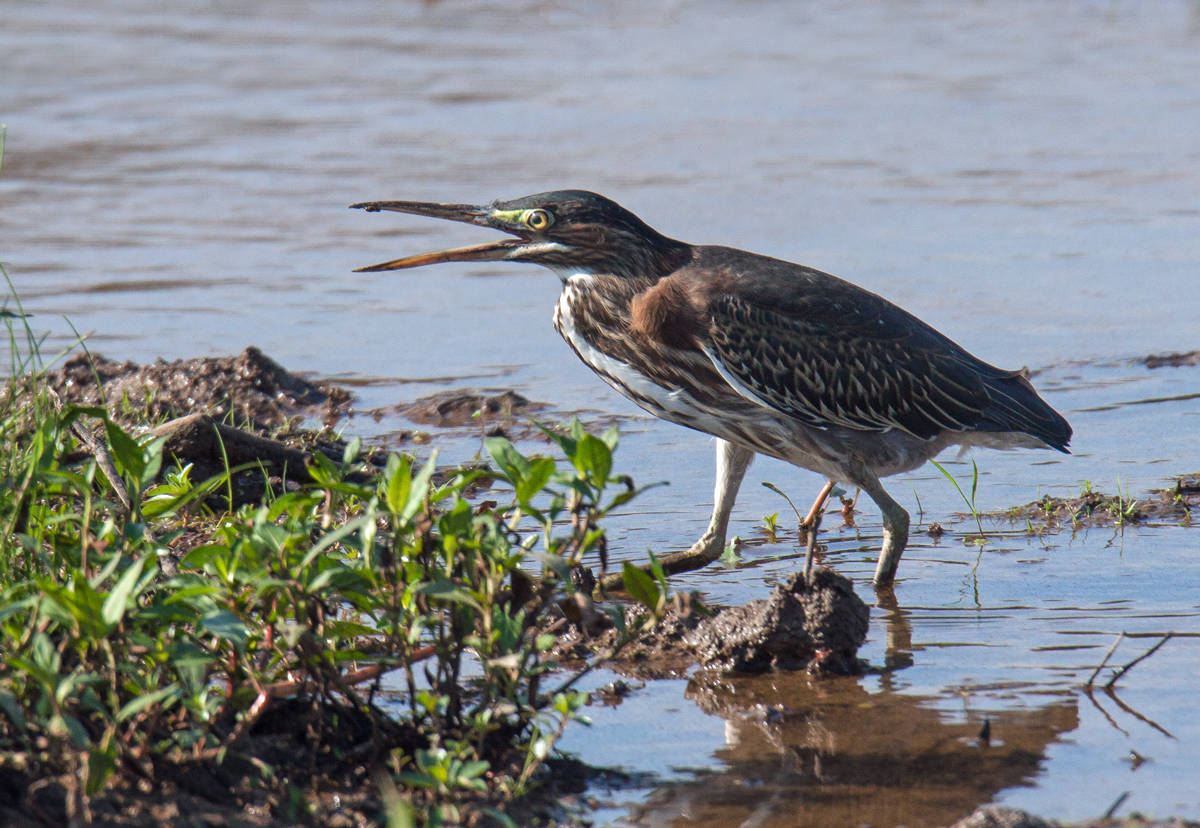
Do herons laugh? Herons remind me of many people in the Washington D.C. area—they are serious, focused, and driven. How do herons relieve their stress?

Yesterday morning I was observing a Green Heron (Butorides virescens) at my local marshland park. Suddenly he opened his mouth wide in a huge smile and appeared to be laughing.

I am not sure what prompted his actions, but I couldn’t help but smile. Laughter, after all, is contagious.

Green Heron

© Michael Q. Powell. All rights reserved.

Read Full Post »

I tend to focus on the realism of close-up details in most of my dragonfly shots, but sometimes the dragonfly seems almost abstract, a mix of colors, shapes, and patterns, like this male Twelve-spotted Skimmer (Libellula pulchella) that I encountered the past Friday.

For those readers who may not be familiar with this boldly-patterned dragonfly species, I am also including a more “traditional” shot of the same Twelve-spotted Skimmer.

Twelve-spotted Skimmer

Twelve-spotted Skimmer

© Michael Q. Powell. All rights reserved.

Read Full Post »

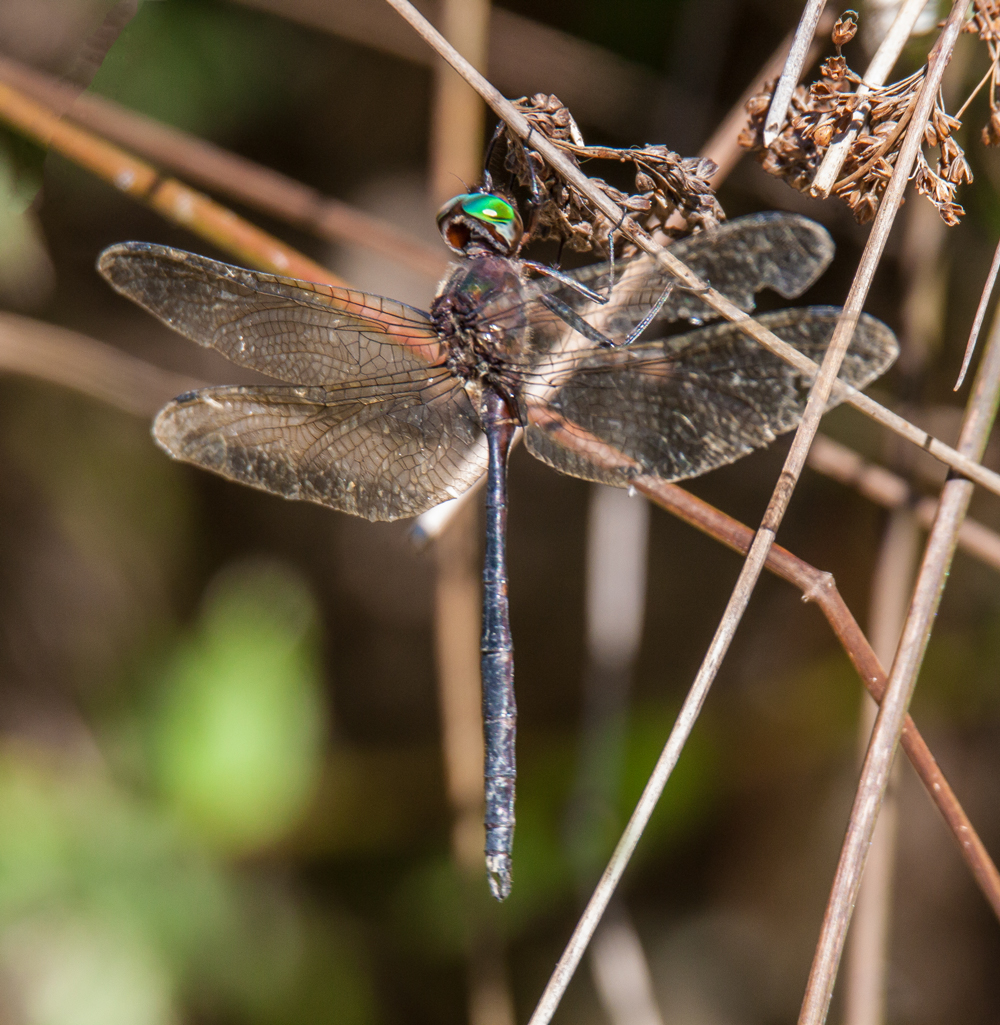
Most dragonflies appear to like the sunlight, but this Mocha Emerald dragonfly (Somatochlora linearis) that I encountered yesterday seemed to prefer the heavy shade, which made it a bit of a challenge to photograph.

I was walking along a small stream, moving in an out of patches of sunlight when I first spotted the dragonfly. I had my long telephoto lens on my camera and took some initial shots, which turned out blurry—there didn’t seem to be enough light for my camera’s autofocus to function well. I quickly set up my tripod and tried to focus manually, but that didn’t work out too well either.

Fortunately, the dragonfly seemed oblivious to my actions. I switched to my 180mm macro and moved in closer and finally was able to see well enough to focus. Because of the limited amount of light, I had the ISO cranked up to 1600 and used the pop-up flash.

As I moved about trying to get a better angle, I slid twice down the slippery bank of the stream into the shallow water and somehow managed to lose one of the little rubber feet of my tripod, but managed to get a couple of decent shots of this shadow-dwelling dragonfly.

Mocha Emerald

Mocha Emerald

© Michael Q. Powell. All rights reserved.

Read Full Post »

I can understand how an adept female Red-winged Blackbird (Agelaius phoeniceus) can catch one dragonfly, but how in the world did this one manage to catch two at once?

I can’t tell for certain, but the dragonflies in the bird’s mouth look to be female Common Whitetails (Plathemis lydia) or possibly immature males, which look like the females. The wings seem to be very transparent, so it’s possible too that these may be newly emerged dragonflies—when they first transition from the water nymph stage into dragonflies, they are very vulnerable.

Red-winged Blackbird

© Michael Q. Powell. All rights reserved.

Read Full Post »
Yesterday as I was watching some Ruby-throated Hummingbirds (Archilochus colubris) buzzing around some distant trumpet flowers at Huntley Meadows Park, one of them suddenly flew closer to a small patch of cardinal flowers (Lobelia cardinalis).  The shutter speed was too slow to stop the action completely, but you can see how perfectly the hummingbird’s bill fits into the long tubular flower that is too narrow for most bees to reach.

Hummingbirds fly really fast, so I wasn’t too surprised that there was a lot of motion blur in my shots. I was a bit shocked, however, to see that my shutter speed had fallen to 1/100 of a second for these shots, which is, of course, way too slow for the subject, particularly because I was shooting with my zoom lens at 600mm handheld. When I was focusing on the sitting hummingbird that I included as the final shot here, there was considerably more light and the subject was stationary and I did not make any adjustments when the hummingbird flew to a darker area with the cardinal flowers.

If you look closely at the shot of the perched hummingbird, you may notice that it has tiny feet. According to the Cornell Lab of Ornithology website, “The extremely short legs of the Ruby-throated Hummingbird prevent it from walking or hopping. The best it can do is shuffle along a perch. Nevertheless, it scratches its head and neck by raising its foot up and over its wing.”

Ruby-throated Hummingbird

Ruby-throated Hummingbird

Ruby-throated Hummingbird

© Michael Q. Powell. All rights reserved.


Read Full Post »
Tracking a moving bird as it weaves its way in and of vegetation is a real challenge for a photographer and it seems almost miraculous when you manage to get any shots in focus. My skills were definitely tested last weekend when I spotted a female Ruby-throated Hummingbird (Archilochus colubris)  in a patch of trumpet vine (Campsis radicans) at my local marshland park.

I did manage to get a few clear shots in which there were no branches between me and the hummingbird, but mostly I tried to find little windows among the branches through which I could get a view of a part of the bird. I was standing on a boardwalk when I took these shots, so there was not much room for to maneuver to get better angles of view. Additionally, the trumpet vines were a pretty good distance away, so I had to crank out my telephoto zoom and even then had to crop the images.

I don’t often see hummingbirds, so I was happy to capture some shots of this beautiful bird as it flitted from flower to flower.

Ruby-throated Hummingbird

Ruby-throated Hummingbird

Ruby-throated Hummingbird

Ruby-throated Hummingbird

Ruby-throated Hummingbird

© Michael Q. Powell. All rights reserved.

Read Full Post »

« Newer Posts - Older Posts »