Feeds:
Posts
Comments

Posts Tagged ‘Huntley Meadows Park’

No matter how slowly and silently I move, a Bald Eagle (Haliaeetus leucocephalus) seems to sense my presence very quickly and immediately takes to the air. It’s really not that surprising, given the eagle’s amazingly keen eyesight that lets it spot prey from a long distance away.

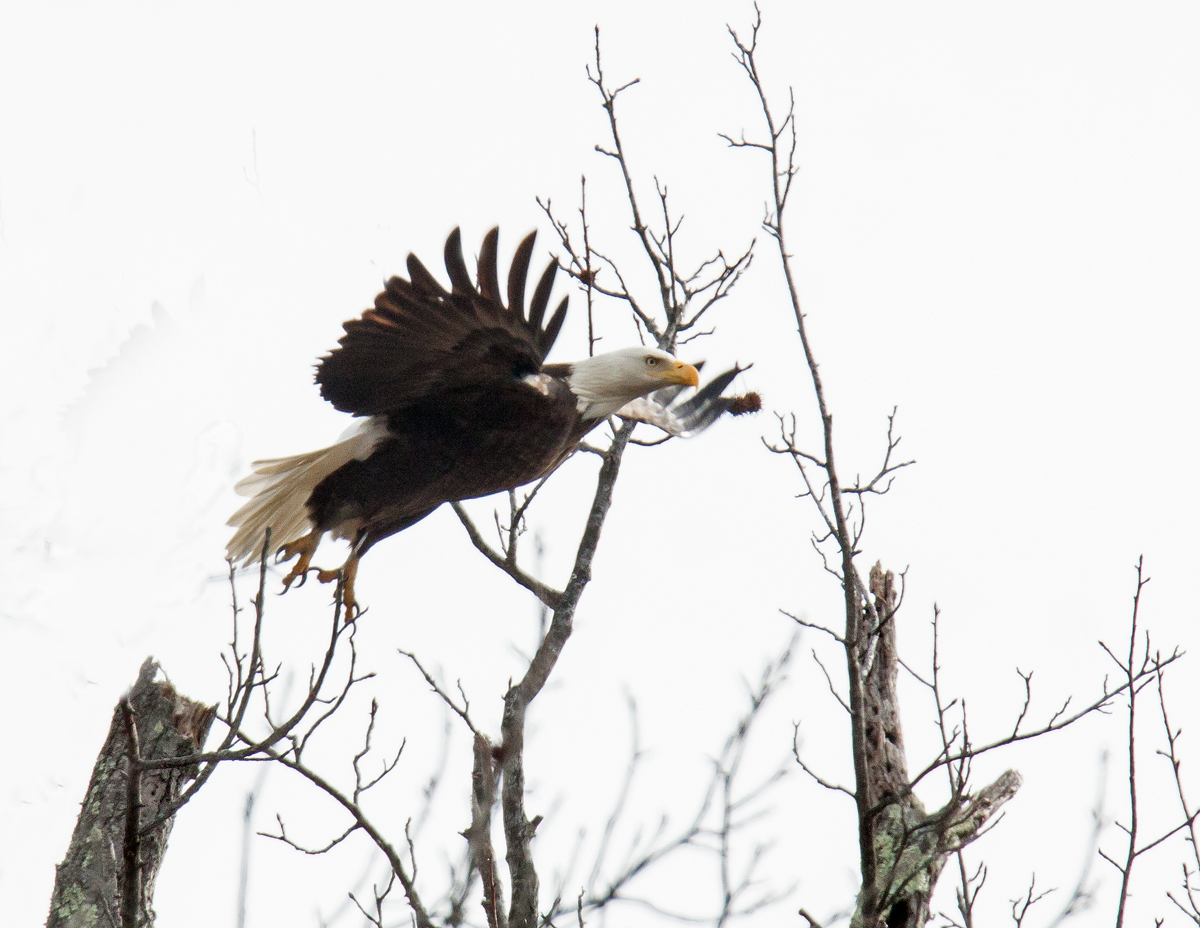
Last weekend I spotted this Bald Eagle when it was perched atop a broken-off tree. Most of the previous times the stationary eagles that I have seen have been sitting on branches. When they took off, they seemed to push off of the branch a bit to gain some forward momentum.

In this case, the eagle appeared to initially push in an upward direction to gain a little height before flapping its powerful wings. Here are a few shots that show some of the stages of the takeoff process.


Bald Eagle

Bald Eagle

Bald Eagle

© Michael Q. Powell. All rights reserved.

Read Full Post »

Some of my favorite photos are ones with a common subject and a simple composition, like these shots I took this past weekend of a male Red-winged Blackbird (Agelaius phoeniceus) at Huntley Meadows Park. The blackbird was perched in a field of cattails and the morning light was beautiful.

Sometimes photography seems so uncomplicated—it just works.

Red-winged Blackbird

Red-winged Blackbird

© Michael Q. Powell. All rights reserved.

Read Full Post »

Do robins have tongues? I never thought much about this question until I looked at the shots I took this past weekend of American Robins (Turdus migratorius) at Huntley Meadows Park in Northern Virginia.

As a child, I was told that robins were a harbinger of spring and that may have been the case in Massachusetts. Clearly that is not the case where I live now, for an entire flock of robins was present in the park in what I would still consider the middle of winter.

Some of the robins were pecking about on the ground, but many of them were drawn to some kind of vegetation that had bluish-colored berries. I usually think of robins eating worms, so it was fascinating to watch them pick and swallow berries, acting much like Cedar Waxwings.

When reviewing my photos, I saw what appeared to be a tongue in some of my images, so I did a little research. It turns out that robins do have tongues that they use to help them swallow fruit. In fact, different birds use their tongues for a wide variety of purposes, as Laura Erickson illustrates wonderfully in a  blog posting entitled “More about Bird Tongues than a Normal Person Would Want to Know.”

In the first image below, the robin has just grabbed the berry and is starting to pull it in. In the second image, the tongue is more clearly visible and the process has moved along a bit. I hoped to get a shot of the final step in swallowing the berry, but the robin turned its head to the side at that moment.

American Robin

American Robin

Michael Q. Powell. All rights reserved.


Read Full Post »

I awoke this morning thinking I would see snow on the ground again, but it seems to have turned into rain. This photo of a Great Blue Heron (Ardea herodias) and its modest catch reminds me of how snowy it was a mere two weeks ago in our area.

It’s interesting to me to see how the unusual angle of view and the low perspective make the heron’s bill seem unusually elongated and its long neck appears to be really short. The distorted perspective of the image may cause some viewers to look a second time at the photo to mentally reconfirm that this indeed is a Great Blue Heron.

I think that most photographers would agree that it is a good thing when viewers take a second look at their images or examine them more closely.

Great Blue Heron

Michael Q. Powell. All rights reserved.


Read Full Post »

I usually miss the takeoff sequence of a Bald Eagle, because the eagle spots me before I see it, but this weekend I managed to capture a series of shots of one such takeoff.

My first indication of an eagle’s presence is often when I see it flying away. Several times this past weekend, however, I spotted a Bald Eagle (Haliaeetus leucocephalus) perched in the trees at Huntley Meadows Park and I was able to observe the eagle for at least a few minutes at a time.

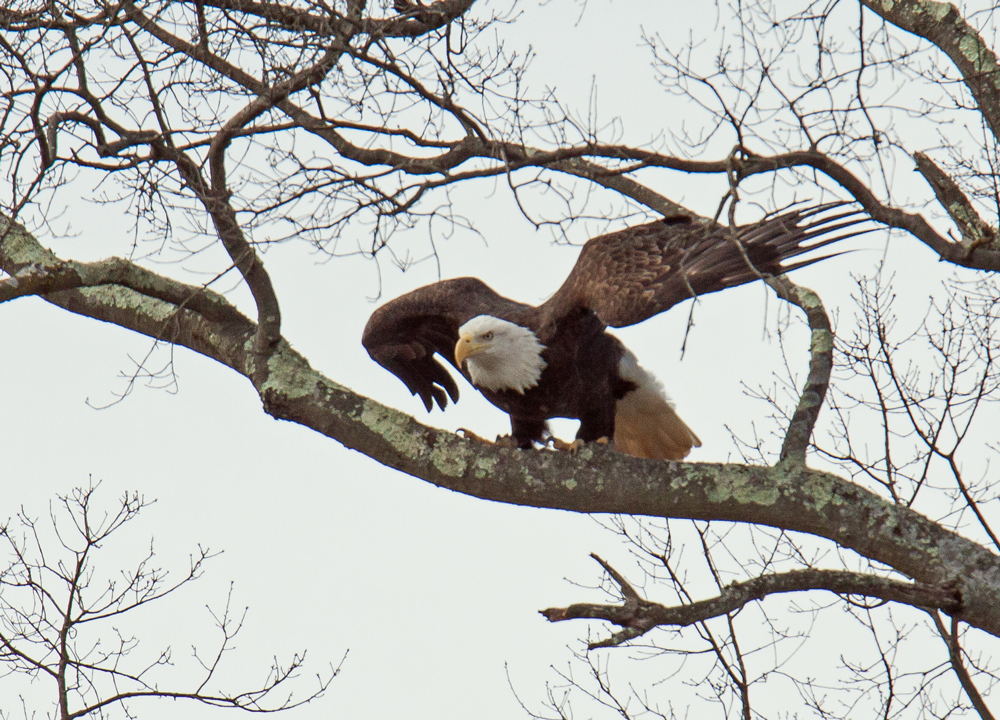
In the case of these images, I was looking across a beaver pond at the eagle as it perched in the trees. In the first couple of shots, the eagle seemed to getting a little agitated and is lifting its feet and flexing its wings. Then he assumed a position that reminds me of the start of a speed skating race or a sprint, with a flexed wing ready to propel the eagle forward. Finally the eagle pushed off from the tree and descended a little with talons extended before leveling off and flying away.

Some of the time it seems an eagle just springs into motion and ignores most of the items on its pre-flight checklist as it prepares for takeoff. Other times, like this one, it follows the established procedures and waited for flight clearance from the tower.

Bald Eagle

Bald Eagle

Bald Eagle

Bald Eagle

Bald Eagle

Michael Q. Powell. All rights reserved.

Read Full Post »

Yesterday, for the second day in a row a Bald Eagle (Haliaeetus leucocephalus) flew close to me at Huntley Meadows Park. Unlike the previous day, when the eagle simply soared by overhead, this one looked like he thought I might be a potential prey.

With the snow almost totally gone, I decided yesterday to hike out to some of the more remote regions of the park. I was following a familiar stream when I noticed a dark shape near the top of a tall tree on the opposite bank of the stream. I extended my lens to its full length and was surprised to see that it was a bald eagle.

I had time to shoot shoot only a couple of images when suddenly the eagle took off, initially heading right toward me. I kept firing as the eagle grew larger and larger in my viewfinder. I think I might have startled the eagle when I moved to bring the camera up to my eye and his instinctive reaction was to check out the movement.

Eventually the eagle veered off and flew in the opposite direction and my heart rate started to return to normal.  I don’t think that I was actually at risk, but through a 600mm lens, it sure looked like the eagle was speeding toward me with talons extended.

I couldn’t help but notice that the eagle has a band on its right foot. Whenever I capture a shot of an eagle, I will have to check to see if I can see a band. I don’t know how many eagles hang out at our park, but eagle sightings have become much more common this last year than previously.

Bald Eagle

Bald Eagle

Bald Eagle

Bald Eagle

Michael Q. Powell. All rights reserved.

Read Full Post »

Another eagle? I know that I posted some eagle photos a few days ago, but normally when I see a Bald Eagle (Haliaeetus leucocephalus), it is flying in the distance. Yesterday at Huntley Meadows Park, however, one flew almost directly over me while I was on the boardwalk.

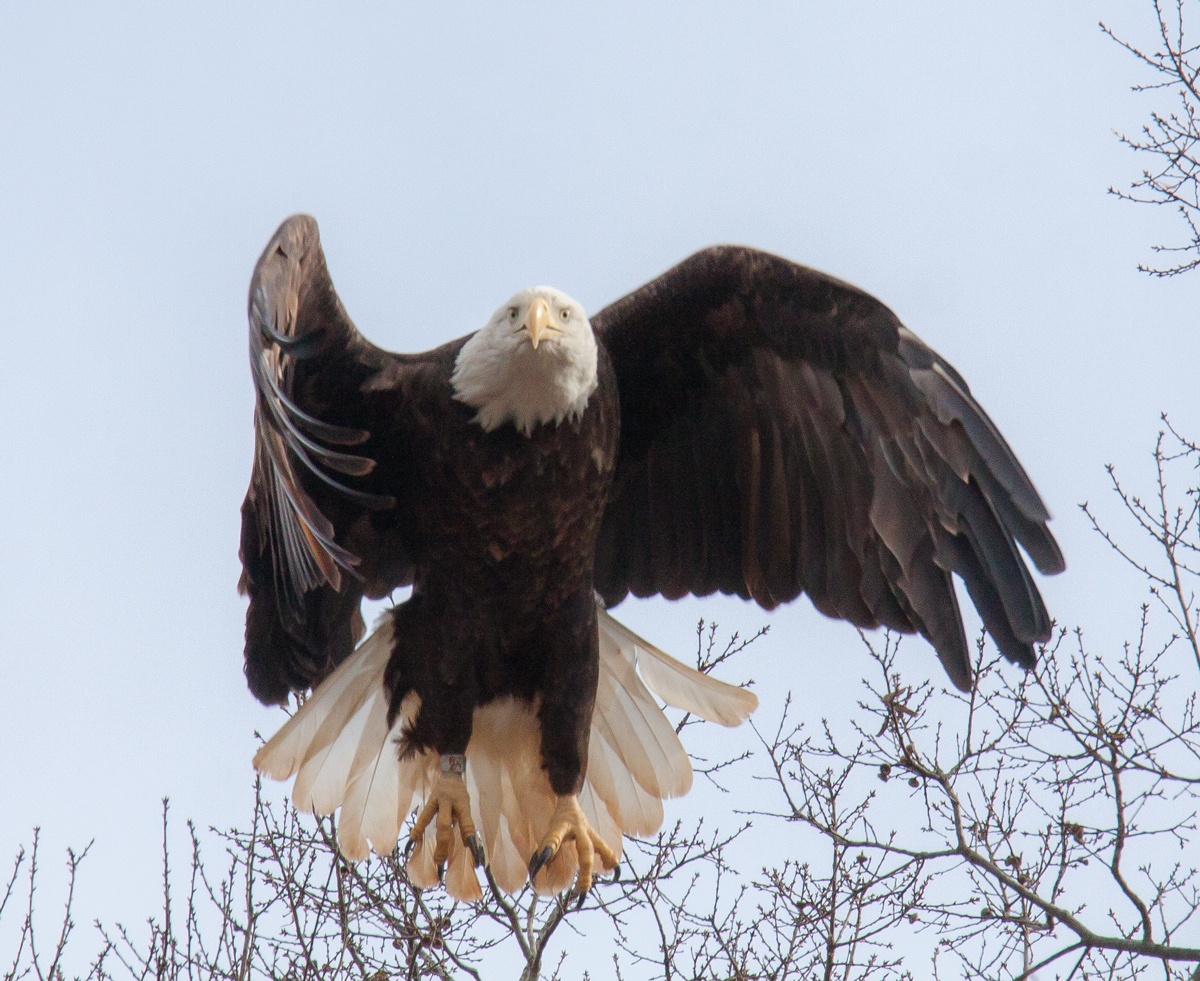
This different perspective allowed me to get some shots that are much more detailed than usual, showing, among other things, the eagle’s tail feathers and fully-extended wings. The wingspan of this magnificent bird is amazing.

Bald Eagle

Bald Eagle

Bald EagleMichael Q. Powell. All rights reserved.

Read Full Post »

As I walked slowly toward a fellow photographer pointing her camera deep into the woods, I suspected that she was looking at an owl. In a quiet voice, she explained to me where the Barred Owl (Strix varia) was perched. There were a lot of branches and vegetation between us and the owl, but eventually I was able to spot the owl.

Initially the owl was facing directly in our direction, but then shifted its body to the side, all the time watching us from behind the branches. I stretched and bent as I searched for a visual tunnel that would give me an unobstructed shot of the owl, but couldn’t find one. These are the best shots I could manage before the owl flew deeper into the woods. I think they help to give you an idea of the beauty and mystery of this elusive creature.


Barred Owl

Barred Owl

Michael Q. Powell. All rights reserved.

Read Full Post »

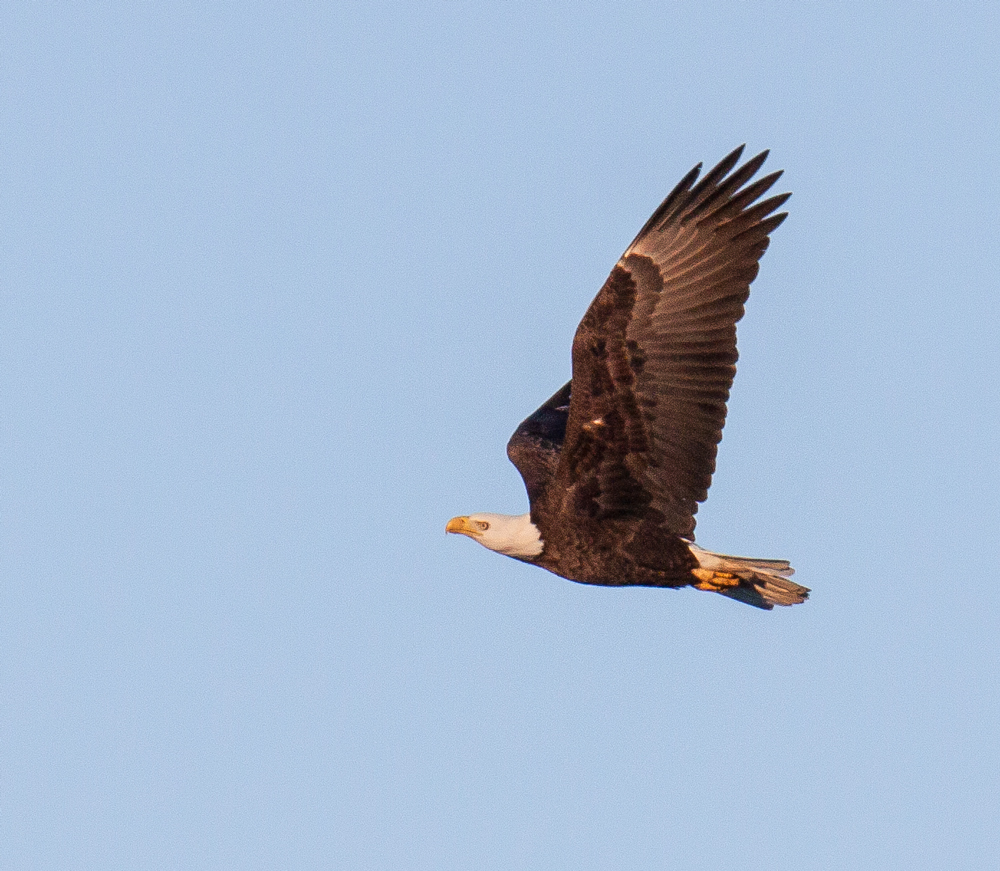
This past weekend at Huntley Meadows Park, I accidentally spooked a Bald Eagle (Haliaeetus leucocephalus) perched on a distant tree. As the eagle flew away, I was able to capture a few images that highlight some of its beautiful details.

These images were shot from a long way off and I had to do a lot of cropping. I am really happy, though, with the performance of my lens, even when zoomed out all the way, especially when the light is nice.

I continue to hold fast to the view that any day that I spot one of these majestic creatures is a wonderful day. I hope that today is wonderful for you, however you choose to define “wonderful.”

Bald Eagle

Bald Eagle

Michael Q. Powell. All rights reserved.


Read Full Post »

The White-throated Sparrow (Zonotrichia albicollis) is one of the few sparrows that I can reliably identify, thanks to its distinctive markings. I love the little white “goatee” and the touch of bright yellow near its eyes.

Like most sparrows, White-throated Sparrows seem to spend a lot of time poking about in the underbrush, where they are hard to see. During this past week, when the ground has been covered with snow, I’ve managed to get some close-up shots of them in relatively exposed positions.

I really like the way that the green vine provides an organic framing element in the first image. The sparrow in the second image was awash with bright light as it perched on a rotten stump at Huntley Meadows Park. The details of the stump were blown away, but the bird itself seems to have been properly exposed (and the background is wonderful).

White-throated Sparrow

White-throated Sparrow

Michael Q. Powell. All rights reserved.

Read Full Post »

Early yesterday morning I trudged through the crusted snow to my favorite spot at Huntley Meadows Park. Along the way I saw a Bald Eagle and a hawk, so I knew that it was going to be a good day.

My favorite spot is a beaver pond in a somewhat remote area of the park. l like to sit at the edge of the pond and watch and wait as a feeling of peace and serenity gradually envelops me. It seems so far removed from the hurried rat race characteristic of the Washington D.C. area and has a restorative effect on my overall well-being.

The pond is frozen now, so I am able to sit on one of the logs that make up the beaver dam and extend my feet over the ice. I place a big plastic bag on the log and sit on a folded towel, so it’s pretty comfortable, even when the temperature is below freezing, as it was yesterday.

As I was looking toward a Great Blue Heron to my left, I detected some movement out of the corner of my right eye. I stopped breathing for a moment when I saw that a Red Fox (Vulpes vulpes) was standing on the ice. It looked like the fox had been planning to cross the pond and stopped when it spotted me.

Our eyes met for a moment as I took a few shots. Then the unthinkable happened. I pressed my shutter button and the shutter did not engage. Glancing down at my camera, I saw that the battery had died—several hours of freezing temperatures had temporarily drained the battery. This had happened before, although never at a critical moment, so I had another battery in my pocket.

I tried to change the battery as quickly as possible, but the additional movement spooked the fox a little and and it turned around and made its way back to the far bank of the pond. I managed to get a final shot of the fox after the battery change. The fox’s face is not visible, but at least you can see its bushy tail.

Red Fox

Red Fox

Michael Q. Powell. All rights reserved.

Read Full Post »

Are sparrows cute? Normally I don’t think of them as “cute,” but this Song Sparrow (Melospiza melodia) that I spotted hopping around earlier this week at Huntley Meadows Park was simply adorable.

I really like the simple white background provided by the snow and the organic shapes and texture of the small stumps that were sticking out of the frozen waters of the pond. Those simple elements add interest to the images without detracting from the main subject, the cute little sparrow.

Song Sparrow

Song Sparrow

Song Sparrow

Song Sparrow

Michael Q. Powell. All rights reserved.


Read Full Post »
Yesterday I came upon this Great Blue Heron (Ardea herodias) in one of the back areas of Huntley Meadows Park during my first visit there in a week. There was an area of open water in an ice-covered pind and I watched the heron catch several fish. I’m still going through my photos and may post some shots of his catches later. For now, I’ll leave you with this image of the heron walking toward the edge of the water.

Although the park was technically open throughout this recent snowstorm, the gate at the entrance to the parking area was closed. A Facebook posting from a friend yesterday morning noted that the parking lot was being plowed and I immediately headed out to my favorite park. Wednesday is normally a work day for me, but I had decided to take the day off to avoid a commute that promised to be hellish.

The park is still covered with lots of snow, including the boardwalk, but was passable with some effort. In some places, there is a narrow packed snow path where others have walked. My favorite places, though, were literally off of the beaten path and I found myself wading through a foot of wet slushy snow to get to them. The only other tracks I saw in these areas were those of animals.

I’d love to return to the park today, but will probably have to go to work instead with what could be a hellish commute. Local schools have finally decided to call it quits for the entire week after several days of announcing daily closures. Even the federal government is opening with a three-hour delay today.

I feel so much more energized now after having the chance to get out in the wild yesterday with my camera. I guess that I hadn’t realized how much I had missed the experience and how important nature photography had become in my life.

Great Blue Heron

Michael Q. Powell. All rights reserved.

Read Full Post »

I woke up this morning feeling a bit like the beavers in the lodge I photographed yesterday morning at Huntley Meadows Park. They were snug and warm in their little house, surrounded by a world of snow and ice, with plenty of food at hand.

As for me, there is well over a foot of drifted snow on the ground and more is still falling. Eventually I will need to get as busy as the proverbial beaver and remove some of the snow, but for now at least, it’s nice to enjoy it from the comfortable insides of my warm and cozy house.

beaver lodge

© Michael Q. Powell. All rights reserved.


Read Full Post »

Early this morning the skies over Huntley Meadows Park were glowing red, adding a beautiful pinkish tinge to the icy landscape. The calm before the storm.

Weather forecasters predict that the Washington D.C. metropolitan area will be hit with a major blizzard starting later today, with a total snow accumulation of two feet (61 cm) or more.  The area will undoubtedly be paralyzed for at least several days.calm1_blog

© Michael Q. Powell. All rights reserved.


Read Full Post »

How low can you go? This male Northern Pintail duck (Anas acuta) stretched himself out almost completely flat as he skimmed food from the top of the water recently at Huntley Meadows Park.

It almost looks like he is sniffing out his food like a hound, but I am not even sure that birds have a sense of smell.

Northern Pintail

© Michael Q. Powell. All rights reserved.

Read Full Post »

A female Red-winged Blackbird (Agelaius phoeniceus) paused for a moment to pose as she foraged for food in the cattails of Huntley Meadows Park earlier this month.

Red-winged Blackbird

© Michael Q. Powell. All rights reserved.

Read Full Post »

Male birds generally have brighter colors and more distinctive patterns than their female counterparts and therefore tend to get a lot more attention from photographers. The females, though, have a beauty and elegance that often equals or surpasses that of the males, like this female Northern Pintail (Anas acuta) that I spotted earlier this month at Huntley Meadows Park in Alexandria, Virginia.

Northern Pintail

Northern Pintail

© Michael Q. Powell. All rights reserved.

Read Full Post »

How do birds manage to survive when it is so cold outside? I asked myself that question early yesterday morning as I walked along the exposed boardwalk at Huntley Meadows Park. The wind was blowing hard and the temperature was about 20 degrees F (minus 7 degrees C).

The landscape was empty and desolate and seemed to have little to offer as potential sources of food. Suddenly I noticed a small group of sparrows.  They would fly to a spot together and then individually forage among the dried out plants, including those sticking out of the ice. After a short period of frenetic activity, they would move on to another spot.

Initially, I knelt and tried to get some shots of the sparrows that were standing on the ice and reaching up into the vegetation. A bit later, I was able to capture some images of a sparrow perched on some plants in a more exposed position.

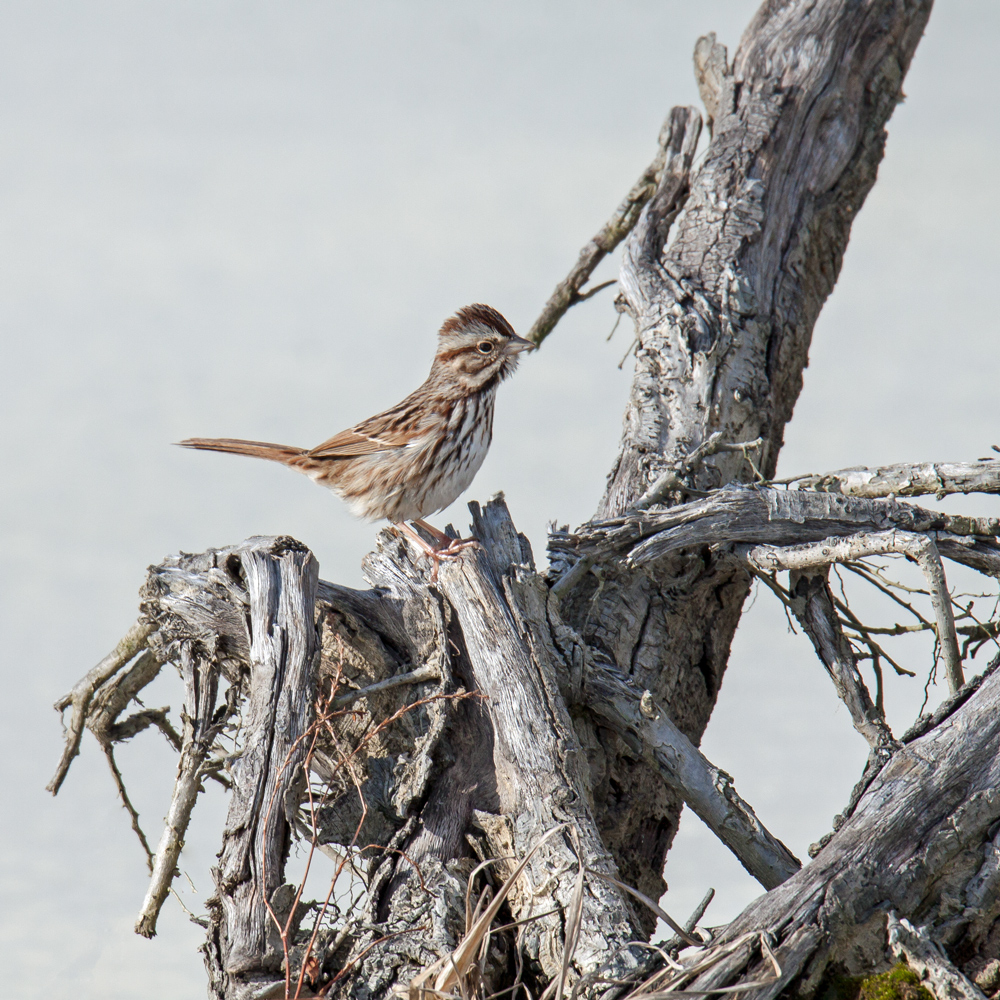
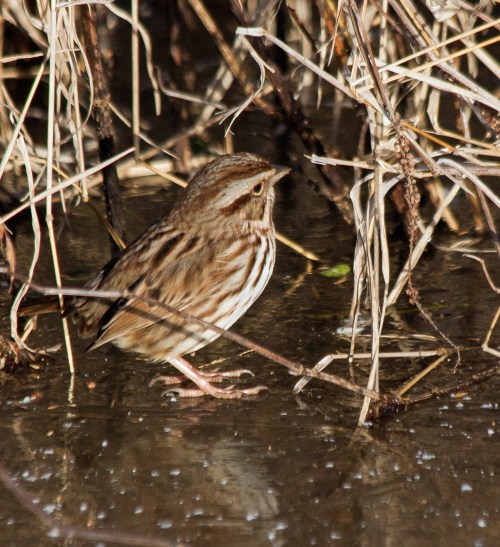
I am not really sure what kind of sparrows these are. Earlier in the day I saw some sparrows that I could identify as White-throated Sparrows, but these birds seem to have a different set of markings. After looking at my guidebooks, I have concluded that these may be Song Sparrows (Melospiza melodia) and would welcome comments from more experienced birders on the identification, especially if I have misidentified the birds.

How do these little birds survive during the winter? From what I can see, they do their part by working hard as they forage for food and God provides for their needs.

Song Sparrow

Song Sparrow

Song Sparrow

Song Sparrow

© Michael Q. Powell. All rights reserved.

Read Full Post »

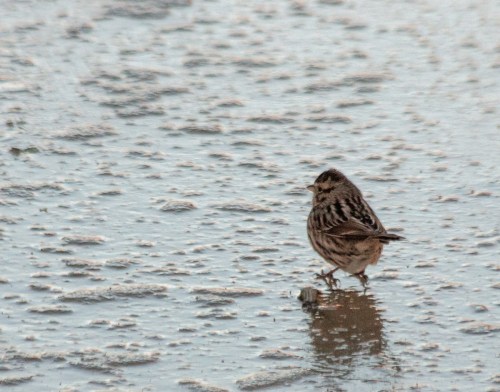
Early this morning, it was really cold and windy and most of the birds and animals showed great common sense in staying in sheltered spots. This little sparrow, however, seemed to be having a good time hopping, skipping, and skating across the frozen pond.

sparrow

solitude2_blog

sparrow

© Michael Q. Powell. All rights reserved.


Read Full Post »

If I were a woodpecker, I think that I would want to be a Downy Woodpecker (Picoides pubescens). These energetic little birds will sometimes peck away at the relatively soft stalks of reeds and cattails, rather than at the harder tree trunks of full-sized trees.

I recently captured some shots of a Downy Woodpecker in action. I was amazed that it was able to peck away at the stalk on which it was perched without losing its balance or knocking itself off of the perch. Of course, its vigorous movements made it a bit difficult to photograph, but I was persistent and managed to get some decent shots.

Downy Woodpecker

Downy Woodpecker

peck3_blog

© Michael Q. Powell. All rights reserved.


Read Full Post »
After several days of frigid temperatures, ice formed on the ponds at Huntley Meadows Park. Yesterday morning, it was finally above freezing and mist was rising from the ice, joining the low-hanging fog.

The sunlight was not strong enough to pierce the thick gray clouds and the winter landscape was almost monochromatic, filled with a sense of bleakness and desolation.

desolate_blog

© Michael Q. Powell. All rights reserved.


Read Full Post »

Some mornings when I am out with my camera at Huntley Meadows Park, I am simply entranced by the colors, shapes, and patterns of the reflections of the trees in the water. For extended periods of time I will become lost in the ever changing abstract world of reflected beauty.

Any wildlife that happens to come into the frame is a bonus.

reflect1_2Jan_blog

reflect3_2Jan_blog

reflect2_2Jan_blog

© Michael Q. Powell. All rights reserved.


Read Full Post »

One of my favorite winter ducks at Huntley Meadows Park is the male Northern Pintail (Anas acuta). Its elegant long neck and refined colors give it an almost aristocratic look.

The duck in the photo looks a little less dignified when grooming himself (don’t we all), but I really like the way that this image provides a glimpse of its personality. In the second image, you can get a sense of the length of the pintail’s neck and its startling brightness (and its regal posture). The final shot gives you an idea of the flexibility of that long neck—I think I have less than half of that range of motion in my neck.

Northern Pintail

Northern Pintail

Northern Pintail

© Michael Q. Powell. All rights reserved.


Read Full Post »

Fellow dragonfly enthusiast Walter Sanford managed to spot a dragonfly in January in Northern Virginia. Wow!

Be sure to check out his blog for more facts and photos about dragonflies, damselflies, and other little creatures.

waltersanford's avatarwalter sanford's photoblog

A single Autumn Meadowhawk dragonfly (Sympetrum vicinum), jokingly referred to as a “Winter Meadowhawk dragonfly” in a recent post, was observed on 03 January 2016 near the terminus of the Hike-Bike Trail at Huntley Meadows Park. This sighting sets a new late-date for this species for both Huntley Meadows Park (formerly 27 December) and the Commonwealth of Virginia (formerly 01 January).

An Autumn Meadowhawk dragonfly (Sympetrum vicinum) spotted at Huntley Meadows Park, Fairfax County, Virginia USA. This individual is a female. 03 JAN 2016 | Huntley Meadows Park | Autumn Meadowhawk (female)

This individual is a female, as indicated by her coloration, shape of the abdomen, and terminal appendages.

An Autumn Meadowhawk dragonfly (Sympetrum vicinum) spotted at Huntley Meadows Park, Fairfax County, Virginia USA. This individual is a female. 03 JAN 2016 | Huntley Meadows Park | Autumn Meadowhawk (female)

The following graphic image shows the current air temperature in the central wetland area around the time when I spotted the record-setting dragonfly. 51°F is nearly 20 degrees less than 70°F, widely believed to be the minimum body temperature necessary for dragonfly flight!

HMP_wx-station 03 JAN 2016…

View original post 280 more words

Read Full Post »

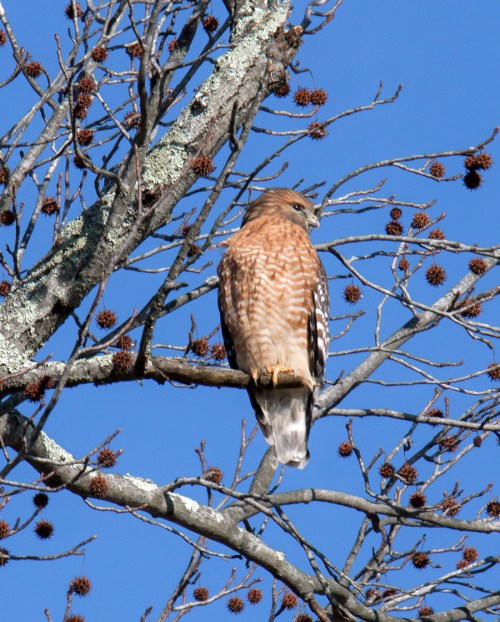
I got excited yesterday morning when I spotted a hawk perched high in a tree at my favorite marshland park. The light was coming from a good direction and I was able to identify it as a Red-shouldered Hawk (Buteo lineatus).

Frequently the hawks I see will sit in the same position for a long, long time, but this one kept changing positions. Maybe the branch was not comfortable or maybe the wind was bothersome. Whatever the case, I was able to have a miniature portrait session with the hawk as I tried to capture its best side.

Red-shouldered Hawk

Red-shouldered Hawk

Red-shouldered Hawk

Red-shouldered Hawk

© Michael Q. Powell. All rights reserved.

Read Full Post »
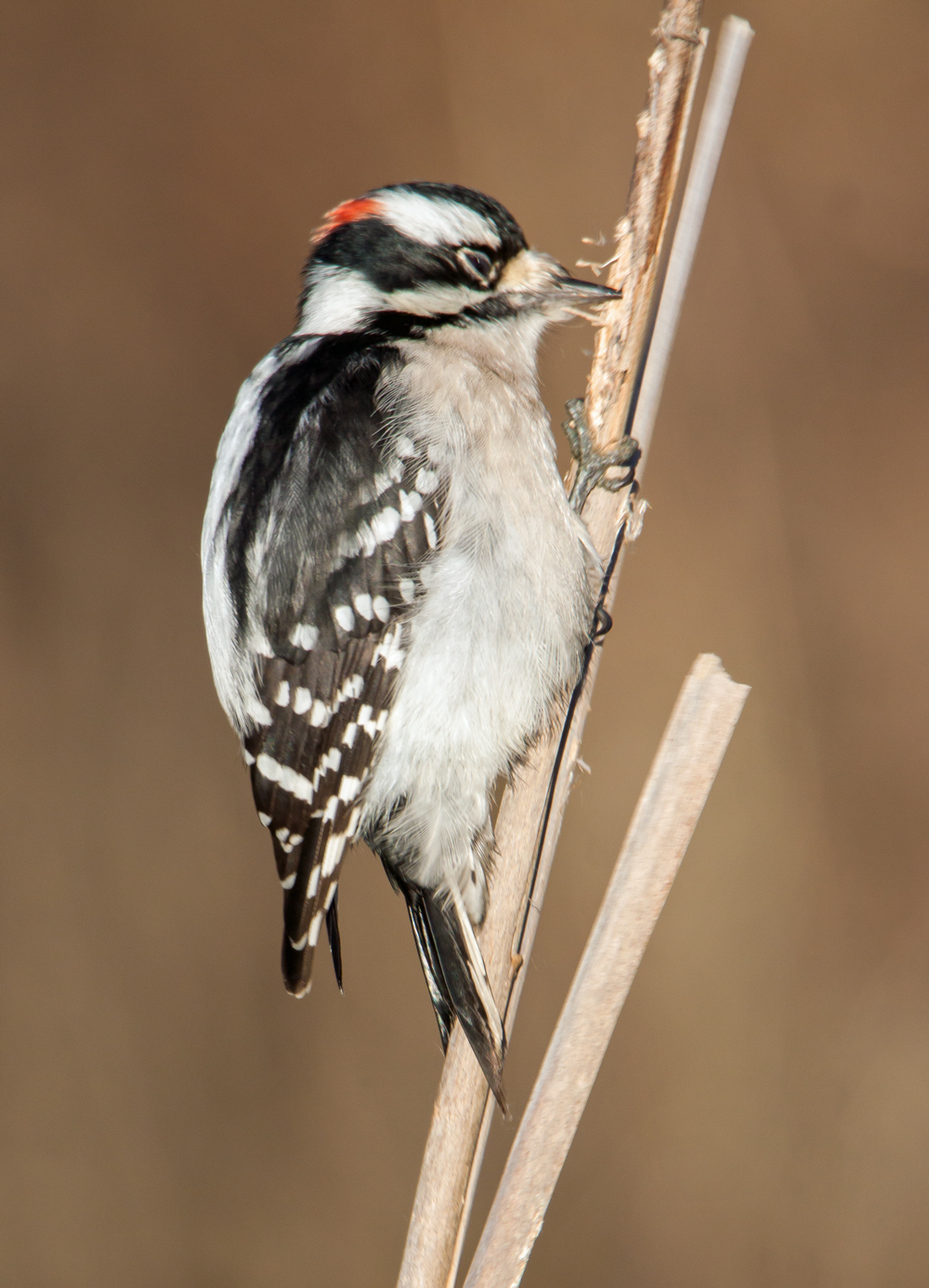
How focused are you as you begin 2016? This little male Downy Woodpecker (Picoides pubescens) seemed to be totally focused as he foraged for food yesterday in the vegetation of Huntley Meadows Park.

As for me, I’m easing my way into the new year and have not yet thought seriously about goals and plans and certainly have not made (or broken) any resolutions.

downy woodpecker

© Michael Q. Powell. All rights reserved.

Read Full Post »

It was cool and cloudy early yesterday morning at Huntley Meadows Park and there was not much activity. Perhaps the birds and animals stayed up to welcome the new year and were sleeping late.

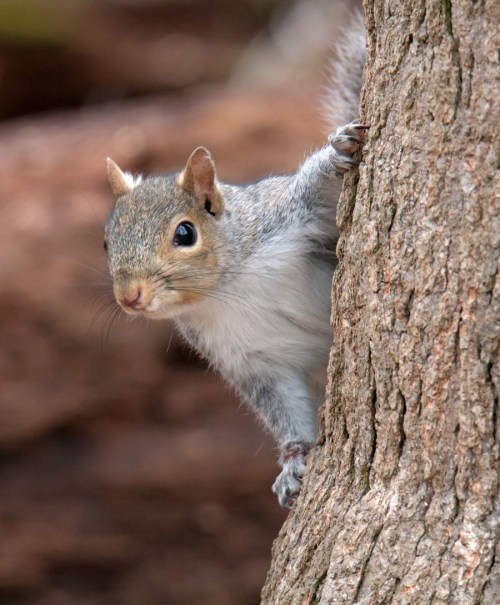
This Eastern Gray Squirrel (Sciurus carolinensis) was a notable exception—he was bright-eyed and bushy-tailed. In the midst of all of his activity, he paused for a few seconds to look in my direction and I was able to capture this modest little portrait of the squirrel.

I didn’t take any spectacular shots yesterday morning, none that are likely to make my list of favorites for 2016. I don’t feel disappointed, however, because I really enjoy taking photos of ordinary creatures and trying to capture a sense of their personalities. From that perspective, my new year of photography has already been a success.

Eastern Gray Squirrel

© Michael Q. Powell. All rights reserved.


Read Full Post »


How do you celebrate the end of the year? Do you like to go out with a bang, with a big celebration and literal or figurative fireworks, or are you more pensive and reflective? I know that I am in the latter group.

My life this past year, both personally and as a photographer, has had some high points, but mostly it has been a year in which I have tried to find beauty and meaning in ordinary things. I have visited my favorite park over and over again, photographing some of the same species repeatedly. Patience and persistence have been my hallmarks and I have been rewarded with some wonderful photographic opportunities.

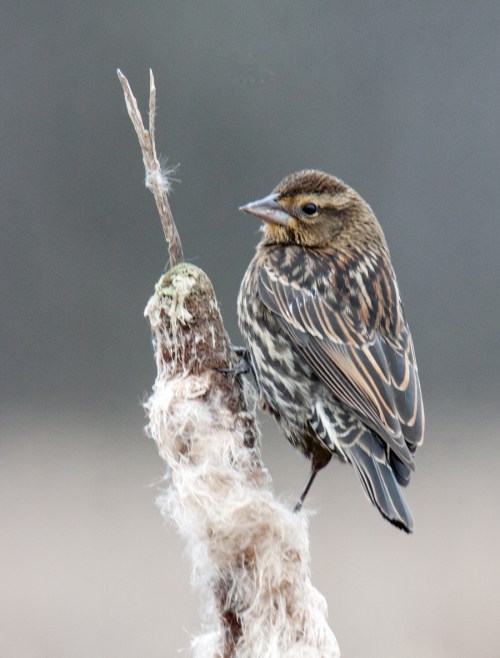
Somehow it seems appropriate that I end this year with a couple of images of this beautiful female Red-winged Blackbird (Agelaius phoeniceus) that I spotted in the cattails on Monday at Huntley Meadows Park. Red-winged Blackbirds are with us most of the year. They seem to come and go, but they are often there. The females are usually buried deep in the underbrush and are not seen as often as the more flashy and loud males. As you can see from these photos, however, the females are at least as beautiful as the males.

The blackbird’s body positions serve as a visual metaphors for my approach as I look forward to 2016—hanging on and occasionally looking back, but primarily looking forward with optimism to the future.

Best wishes to all for a wonderful 2016.

Red-winged Blackbird

Red-winged Blackbird

© Michael Q. Powell. All rights reserved.

Read Full Post »

Last week I conducted a poll to see which of my four recent photo contest entries was your favorite image and the fox came out on top with 43 percent, followed by the bluebird (28 %), the eagle 18 %), and the dragonfly (11 %). Thanks to all of you who voted and especially to those who left comments about your choice. I was intrigued, but not surprised, by the fact that the favorite of the readers—the fox— was different from the choice of the contest judge—the dragonfly.

Several readers commented, however, that the particular image of the Red Fox (Vulpes vulpes) that I used was not their favorite one. I had previously done three postings from the magical encounter with the fox and one of the other shots seemed to speak to some readers more than the one I submitted for the contest.

So I am seeking your views again by reprising all of the fox photos and asking you to vote for your favorite. Do you prefer the fox standing up or leaning over the water? Do you like it more when the fox is looking directly at you or at an angle? Does it make a difference if the fox’s bushy tail is visible? I realize that it may not be easy to narrow your choice down to a single image, so I have tried to set up the poll to permit multiple choices.

If I have set this up correctly, you can click on any image and scroll through each of them in full size. After viewing them all, select your favorite (or favorites) and register your vote. I’d be really happy if you left a few words about your choice. NOTE: If you open the posting in Reader, you may need to click on the Title to get to the poll and to actual posting in which you can scroll through the photos in larger size as a kind of slide show.


© Michael Q. Powell. All rights reserved.


Read Full Post »

“You better watch out…”

Kids are warned to be good “for goodness sake,” because Santa is coming to town. Well, Santa has come and gone, but it is prudent to remain good and cautious at Huntley Meadows Park, where I saw this camouflaged archer in a tree yesterday morning.

Each year I have seen the posted signs indicating that deer hunting will be taking place during the fall and winter. I have seen a few empty tree stands, but until yesterday, I had never seen an archer. Fortunately I was behind him when I spotted him and it is obvious from the photo that he had spotted me too and even gave me a little wave of the hand.  I passed by as quickly and quietly as I could.

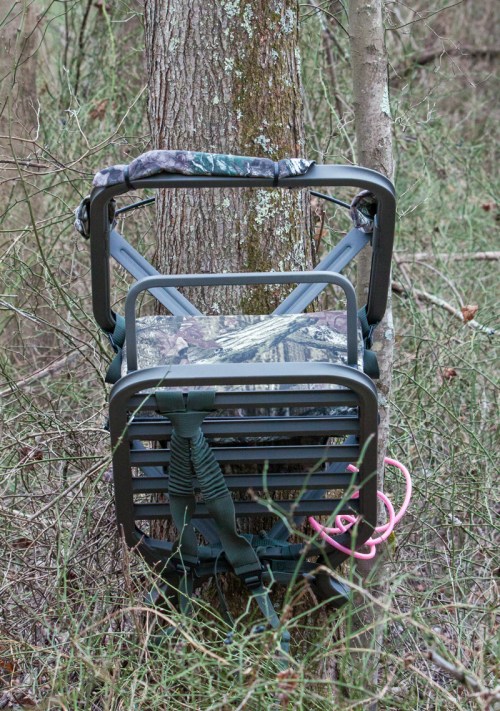
Within a few minutes of spotting the hunter, I came upon two unoccupied tree stands. I guess that I am walking around in a favorite area for the deer hunters.

That  means I need to be a bit more diligent in wearing my brightly colored stocking hats and remaining alert. I better watch out.

archer

Unoccupied tree stand

Unoccupied tree stand #1


Unoccupied tree stand #2

Unoccupied tree stand #2

© Michael Q. Powell. All rights reserved.


Read Full Post »

« Newer Posts - Older Posts »