Feeds:
Posts
Comments

Posts Tagged ‘Great Blue Skimmer dragonfly’

I love dragonflies. There is something almost magical about these incredible aerial acrobats that never fails to fascinate and enchant me.

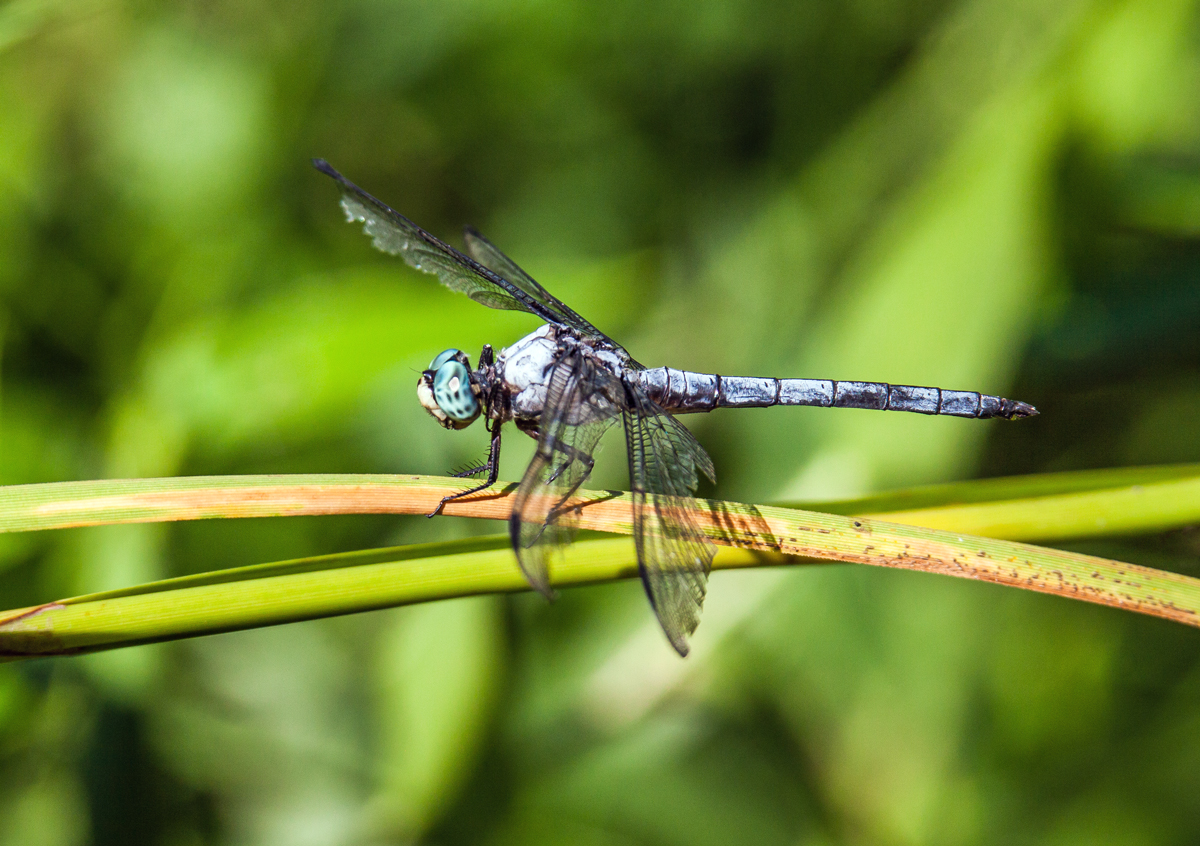
When I was attempting to compose a photo of this Great Blue Skimmer dragonfly (Libellula vibrans) last week at Occoquan Bay National Wildlife Refuge, I tried to use a leaf in the background to draw attention to my primary subject. It was only later, when I was review my images, that I realize that the leaf was heart-shaped, a perfect visual representation of my feelings towards dragonflies.

Great Blue Skimmer

© Michael Q. Powell. All rights reserved.


Read Full Post »

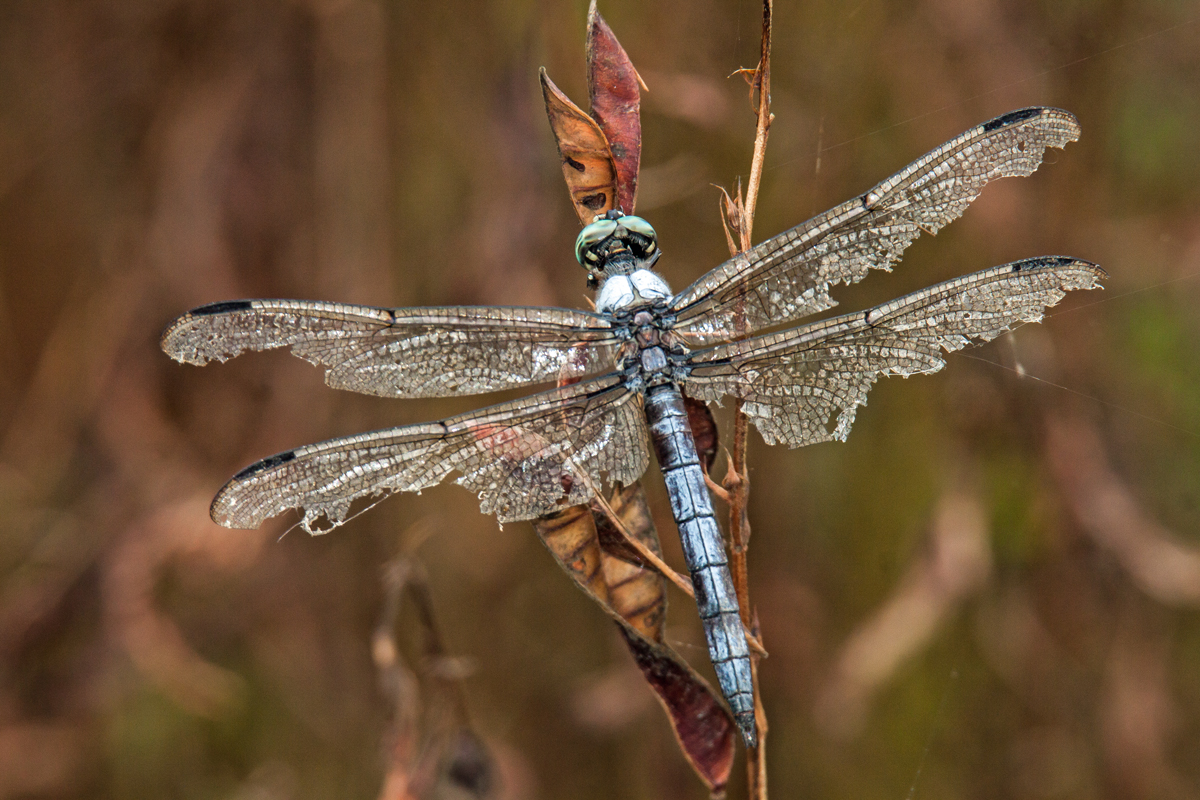
Last Saturday I inadvertently spooked this Great Blue Skimmer dragonfly (Libellula vibrans) while exploring Occoquan Bay National Wildlife Refuge and it flew up into some high vegetation. I was not hopeful that I would be able to get a shot of it, but I decided to try to do so anyways. I’m quite pleased with the result.

I really like the way that the light was shining through the dragonfly’s slightly shredded wings and the shape and structure of the branch draw in a viewer’s eyes too. Overall it’s a fun “artsy” photo that makes me smile.

Great Blue Skimmer

© Michael Q. Powell. All rights reserved.


Read Full Post »

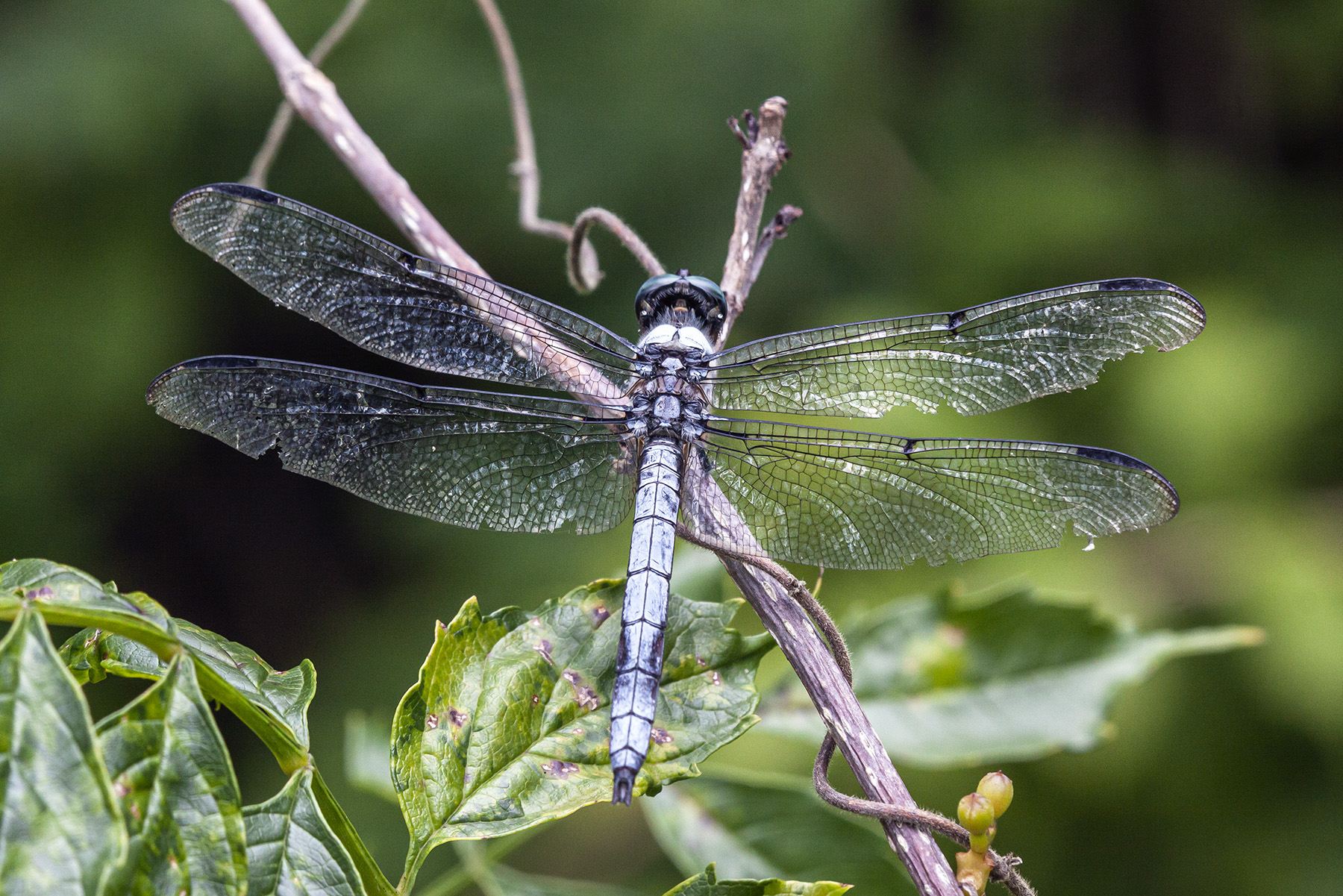
Several months ago, Great Blue Skimmer dragonflies (Libellula vibrans) were quite common at Occoquan Bay National Wildlife Refuge. As we approach the end of September, though, they have now become an uncommon sight and those that I do spot are often survivors that show signs of advanced age.

Last week I spotted this female Great Blue Skimmer. This species is quite easy to identify, because both males and females have white faces. Younger females are yellow and brown in color, but those colors gradually get duller and darker with age. Interestingly enough, their eyes also change colors—younger females have eyes that are reddish brown over a dull green and as they get older their eyes often become blue, like those of the dragonfly in the photo below.

I could not help but notice that this dragonfly has some damage to her wings, a frequent sight as the dragonflies get older. Still, she was getting along pretty well, a testament to the resilience and determination of these senior citizens of the dragonfly world.

Great Blue Skimmer

© Michael Q. Powell. All rights reserved.


Read Full Post »

How old does a dragonfly have to be to collect Social Security? OK, that’s a bit of a crazy question, but collecting Social Security is a sure sign that you are getting old. A couple of weeks ago, I received my first payment from the Social Security Administration, a sure sign that I am officially “old.” Last week I also stopped in a a Metro offices in Washington D.C. to sign up for a senior pass that allows me to ride Metro trains at a reduced rate—one of the few tangible benefits of becoming a senior.

Here in the United States, people are living longer than in the past and it is anticipated that the Social Security Administration will run out of money to pay full benefits in a decade or so of changes are not made. Politicians don’t want to deal with the issue and keep putting off coming up with a solution to the problem.

Comparatively speaking, dragonflies live uncomplicated lives. They hang on for as long as they can and then they die, hopefully after successfully procreating. Last week I spotted this elderly female Great Blue Skimmer dragonfly (Libellula vibrans) at Occoquan Bay National Wildlife Refuge. Her coloration was dark and faded and her wings were tattered, but she was still functioning. After spending a few quiet moments with her, I pushed onward, still lost in my thoughts about life and growing older.

Great Blue Skimmer

© Michael Q. Powell. All rights reserved.

Read Full Post »

Some dragonflies are openly curious and will look at me straight in the eye and even perch on me sometimes. Others will immediately fly away when they sense my presence.

This male Great Blue Skimmer dragonfly (Libellula vibrans) that I spotted during a recent visit to Occoquan Bay National Wildlife Refuge seemed to be a bit shy. He tolerated my presence well as I moved about to frame the shot, but gave me a sidewards glance instead of looking right at me. Was it shyness or maybe a little impatience that I was not taking the photo more quickly?

Whatever the case, I was happy to be able to capture his beautiful speckled blue eyes so well.

Great Blue Skimmer

© Michael Q. Powell. All rights reserved.

Read Full Post »

Can dragonflies smile? Although I realize that it is probably an anatomical impossibility, this female Great Blue Skimmer dragonfly (Libellula vibrans) sure did look like she was smiling at me when she posed for this little portrait last week at Occoquan Bay National Wildlife Refuge.

Great Blue Skimmers are quite common in our area during the summer and are relatively easy to identify because of their white faces.

Great Blue Skimmer

© Michael Q. Powell. All rights reserved.


Read Full Post »

On Monday I played a little game of peekaboo with this Great Blue Skimmer (Libellula vibrans) dragonfly at Occoquan Regional Park. As I approached, the dragonfly hunkered down and was almost hidden from view. I stopped and waited and eventually the Great Blue Skimmer lifted its head, looked right at me, and appeared to smile.

The second shot provides a more traditional view of this species, highlighting its beautiful speckled eyes and white face that help in distinguishing it from other blue dragonflies in our area. Great Blue Skimmers are quite common in my area during the summer, but this was one of first ones that I spotted this year.

Great Blue Skimmer

Great Blue Skimmer

© Michael Q. Powell. All rights reserved.

Read Full Post »

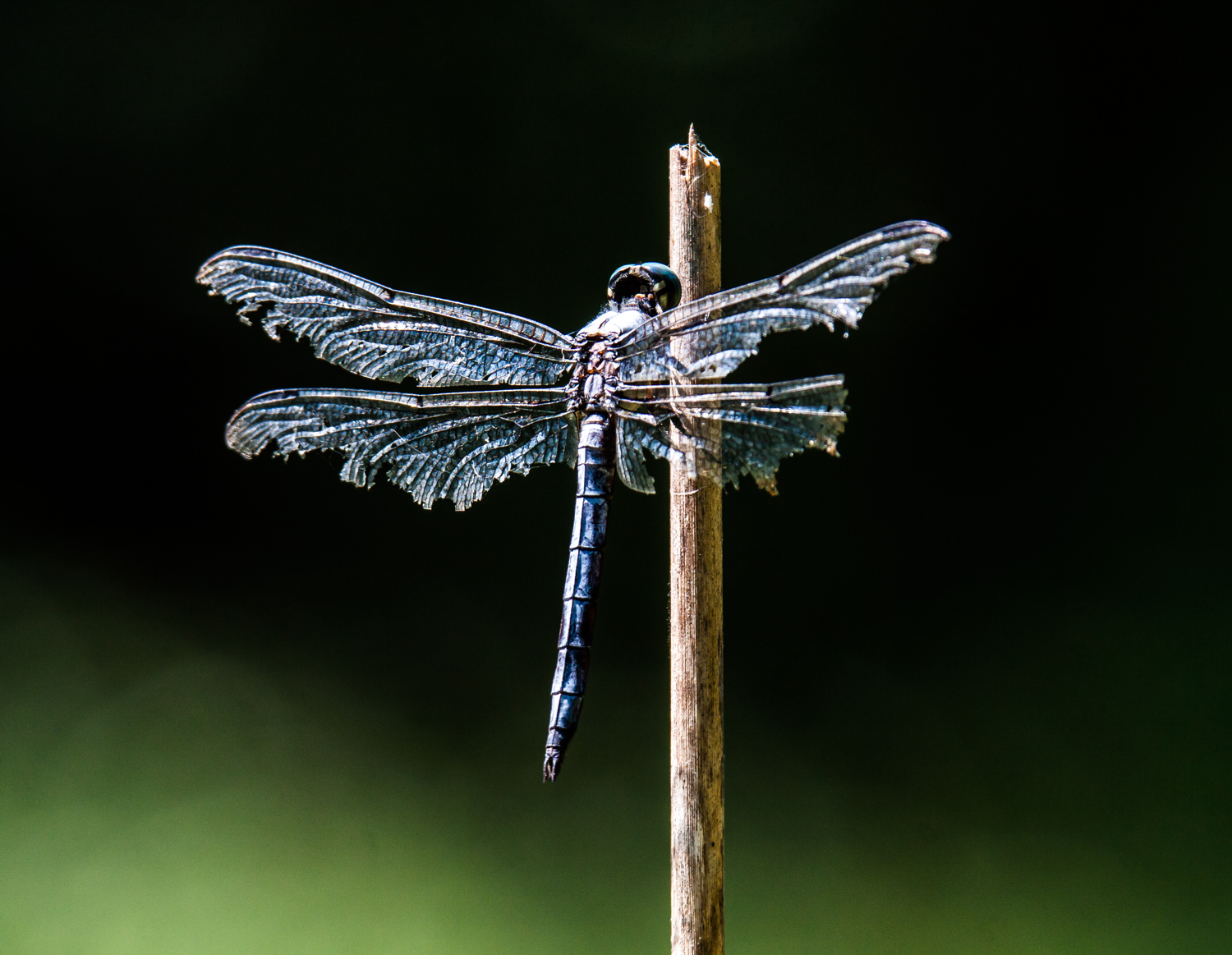
As we flip the pages of our monthly calendars from August to September, it is not unusual for me to encounter dragonflies with tattered wings. For many of these dragonflies, it has been a long, tough summer and they will only be with us for a few more weeks or perhaps a month or two. Despite the damage to their wings, the dragonflies appear to be fully capable of flight—somehow they are able to compensate for their infirmities.

I spotted this Great Blue Skimmer dragonfly (Libellula vibrans) this past Monday at Jackson Miles Abbott Wetland Refuge. It is a little tough to tell in this image, but several of the wings showed wear-and-tear. The shredded appearance of the vegetation is a perfect complement to this late season dragonfly—they both speak to me of the inexorable passage of time and the inevitable changes in our appearance and capabilities brought on the aging process.

Great Blue Skimmer

© Michael Q. Powell. All rights reserved.

Read Full Post »

It is almost autumn, late in the season for most dragonflies. For many of them, their bright colors have faded and their wings are growing increasingly tattered. Yet somehow their beauty still shines through in their mature days.

With dragonflies, as with people, I am often drawn to their eyes, the so-called “window to the soul.” Dragonflies have such striking eyes and I invariably feel myself being pulled in as I gaze into them.

This past Monday I photographed several female Great Blue Skimmer dragonflies (Libellula vibrans) as I wandered the trails at Occoquan Bay National Wildlife Refuge. In both of the photos below, the beauty of the dragonfly’s eyes really shows through. I encourage you to click on the images and you too can marvel at the wonderful colors and patterns of those eyes.

Our society tend to focus on youthful external beauty, which will inevitably fade. True beauty, I would argue, is not dependent on age—it depends more on the perspective of the beholder. If you look for beauty, you will find it for it is present all around us—beauty is everywhere.

Great Blue Skimmer

Great Blue Skimmer

© Michael Q. Powell. All rights reserved.

Read Full Post »

The calendar and the temperatures both tell me that we have entered into the long, hot, lazy days of summer. Here in the Washington D.C. area, where I live, that often means a lot of humidity too. Some days it can be a bit of a challenge to motivate myself to go out into the wild with my camera.

However, many dragonflies seem to love this kind of weather and the fields and ponds are abuzz with dragonfly activity. One of our common species is the Great Blue Skimmer dragonfly (Libellula vibrans). This past week I noticed a sharp increase in their numbers as I wandered the trails at Occoquan Bay National Wildlife Refuge.

Great Blue Skimmers have stunning blue eyes and white faces, which help to distinguish them from similar species. The Great Blue Skimmer in the first photo, which looks to be a young male, was cooperative and let me get quite close to him to get this close-up view of his head. Dragonflies of this species seem to have a pronounced overbite, which gives them a goofy grin that I find endearing.

I think that the dragonfly in the second shot is a female Great Blue Skimmer. Several dragonfly species share the same black and yellow coloration and pattern for juveniles and for females, so it can often be a real challenge to make a definitive identification. Fortunately, the differences among the species become more pronounced as the dragonflies mature.


Great Blue Skimmer

Great Blue Skimmer

© Michael Q. Powell. All rights reserved.


Read Full Post »

Most people are familiar with the words, “To everything there is a season and a time to every purpose under heaven.” Perhaps they have heard them read in a church, where they would be identified as coming from the third chapter of Ecclesiastes in the Bible. For folks of my generation, it is ever more likely that they would be associated with the words of a song by Pete Seeger made popular by the Byrds in the 1960’s.

Recently I have been really conscious of the changing seasons, of the never ending cycle of life and death. I have seen this phenomenon in nature and I have been very sensitive to it in other parts of my life.

Some of you may have noticed that I have not made a blog posting in several days, after more than a year of posting every day. I have spent the last few days in Massachusetts with my family celebrating the life and mourning the death of one of my younger brothers who died a week ago of lung cancer.

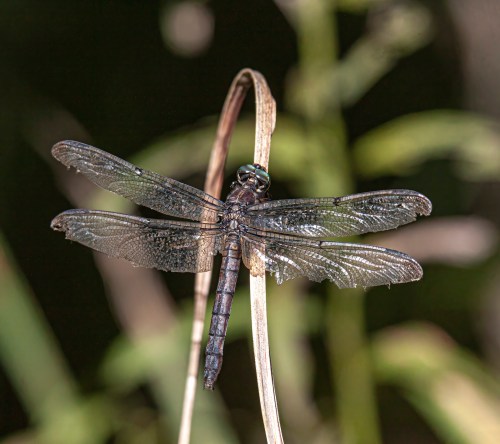
So often we think of growing older with grace and beauty, like the female Great Blue Skimmer dragonfly (Libellula vibrans) pictured below, thinking that we can somehow live forever. In fact, our days are numbered—life is so precious and yet so fragile. Celebrate life and love freely.

“To every thing there is a season, and a time to every purpose under the heaven
A time to be born, and a time to die; a time to plant, and a time to pluck up that which is planted;
A time to kill, and a time to heal; a time to break down, and a time to build up;
A time to weep, and a time to laugh; a time to mourn, and a time to dance;
A time to cast away stones, and a time to gather stones together; a time to embrace, and a time to refrain from embracing;
A time to get, and a time to lose; a time to keep, and a time to cast away;
A time to rend, and a time to sew; a time to keep silence, and a time to speak;
A time to love, and a time to hate; a time of war, and a time of peace.”

 

Great Blue Skimmer

Great Blue Skimmer

© Michael Q. Powell. All rights reserved.


Read Full Post »

Normally I do not like to have manmade objects in my wildlife photos, but in this image of a dragonfly perching on a twisted wire, I really like the juxtaposition of the natural and manmade elements.

The dragonfly is a very mature female Great Blue Skimmer dragonfly (Libellula vibrans)—the bodies of females of this dragonfly species get darker as they age and this one seems to have an almost bronze-like patina. Although there was plenty of vegetation around, she repeated perched on this wire that was blocking one of the trails on Monday at Occoquan Bay National Wildlife Refuge.

The diverse linear elements really draw my eyes to this image—the soft green lines of the vegetation in the background; the crisp angular lines of the leading edges of the wings; the slightly raised line formed by the dragonfly’s body; and the twisting lines of the wire.


Great Blue Skimmer

© Michael Q. Powell. All rights reserved.

Read Full Post »

As I focused on this male Great Blue Skimmer dragonfly (Libellula vibrans), he wearily looked up at me. His wings were tattered and his body was scratched—it had already been a long summer for him.

I was fascinated by the shape and texture of the branch on which he was perched and positioned myself to capture those details. I made sure that the nearest eye was in focus, but did not worry that most of the body was blurry and that the angle made the wings almost disappear.

The resulting photo reminded my of the diagrams in my childhood geometry textbook depicting various angles—a cute dragonfly in an acute angle.

Great Blue Skimmer

© Michael Q. Powell. All rights reserved.

Read Full Post »

As we move deeper into summer, the days of the dragonflies are gradually coming to an end. Their biological clocks are ticking as they feel compelled to make efforts to ensure the perpetuation of their species.

On Thursday I made a trip to Huntley Meadows Park, a local marshland park, and spotted this pair of mating Great Blue Skimmer dragonflies (Libellula vibrans). I could not help but notice that the wings of the dragonflies were looking tattered, especially those of the female, the dragonfly that is light brown in color. I can also see scratches along the the body of the male.

I also noticed that the female appears to be holding onto some kind of insect in her front legs. Was she planning for a snack during mating? Is the insect the dragonfly equivalent of a post-coital cigarette? I know a lot about dragonflies, but some things are meant perhaps to always remain a mystery.

Great Blue Skimmer

© Michael Q. Powell. All rights reserved.

Read Full Post »

The dragonfly was high in the tree and almost completely silhouetted when I spotted it on Friday at Occoquan Bay National Wildlife Refuge. Conditions did not seem optimal for capturing an image, but as I looked through the viewfinder of my camera, my eyes were attracted to the curlicue shape of the branch on which the dragonfly was perched. The branch, I realized, was actually the main subject of the image that I wanted to create.

I was far enough away that I could move about freely without fear of spooking the dragonfly, so I tried a number of different angles of view and shooting positions. As I later looked through the images on my computer, the placement of the sky and the clouds in the frame made me decide to feature this particular shot.

As for the dragonfly, I believe that it is a female Great Blue Skimmer (Libellula vibrans). Despite the shadowy silhouette created by shooting into the sun, there are just enough details for me for me to identify the dragonfly with a reasonable degree of certainty, though, as I noted earlier, my primary goal was to draw the viewer’s attention to the spiral shape of the curlicue branch.

Great Blue Skimmer

© Michael Q. Powell. All rights reserved.

Read Full Post »

We are definitely in the summer doldrums, with day after day of oppressive heat and humidity. This week has been a bit different only because we have had some violent thunder storms. In terms of dragonflies, the common skimmer species are flying about in great numbers. In my area, that means that on a trip Tuesday to Occoquan Bay National Wildlife Refuge, I saw lots of Common Whitetails, Eastern Pondhawks, Needham’s Skimmers, Blue Dashers, and Great Blue Skimmers.

Although I have photographed these species many times, I still chase after them, trying to capture new behavior or interesting portraits, perches, or backgrounds. That is why I was able to capture this image of this smiling female Great Blue Skimmer dragonfly (Libellula vibrans) as she perched on some stalks of Eastern Gammagrass (Tripsacum dactyloides). I do not know vegetation very well, but I remember my friend Walter Sanford identifying this type of grass to me a few years ago and somehow the name has stuck with me.

In many ways, this photograph is indicative of my favorite approach to wildlife photography. Although I will sometimes look for rare species to photograph, I especially enjoy photographing common species and highlighting their uncommon beauty. Beauty is everywhere.

Great Blue Skimmer

© Michael Q. Powell. All rights reserved.


Read Full Post »

Can dragonflies smile? It sure looked like this male Great Blue Skimmer dragonfly (Libellula vibrans) was flashing me a toothy grin when I spotted him last Friday at Occoquan Bay National Wildlife Refuge. Perhaps it was just my imagination, running away with me.

smiling dragonfly

© Michael Q. Powell. All rights reserved.


Read Full Post »

This female Great Blue Skimmer dragonfly (Libellula vibrans) seemed to be grinning at me one morning this past week at Occoquan Bay National Wildlife Refuge. Smiling is contagious, I have found.

I hope that your Sunday brings an equivalent smile to your face.

Great Blue Skimmer

© Michael Q. Powell. All rights reserved.


Read Full Post »
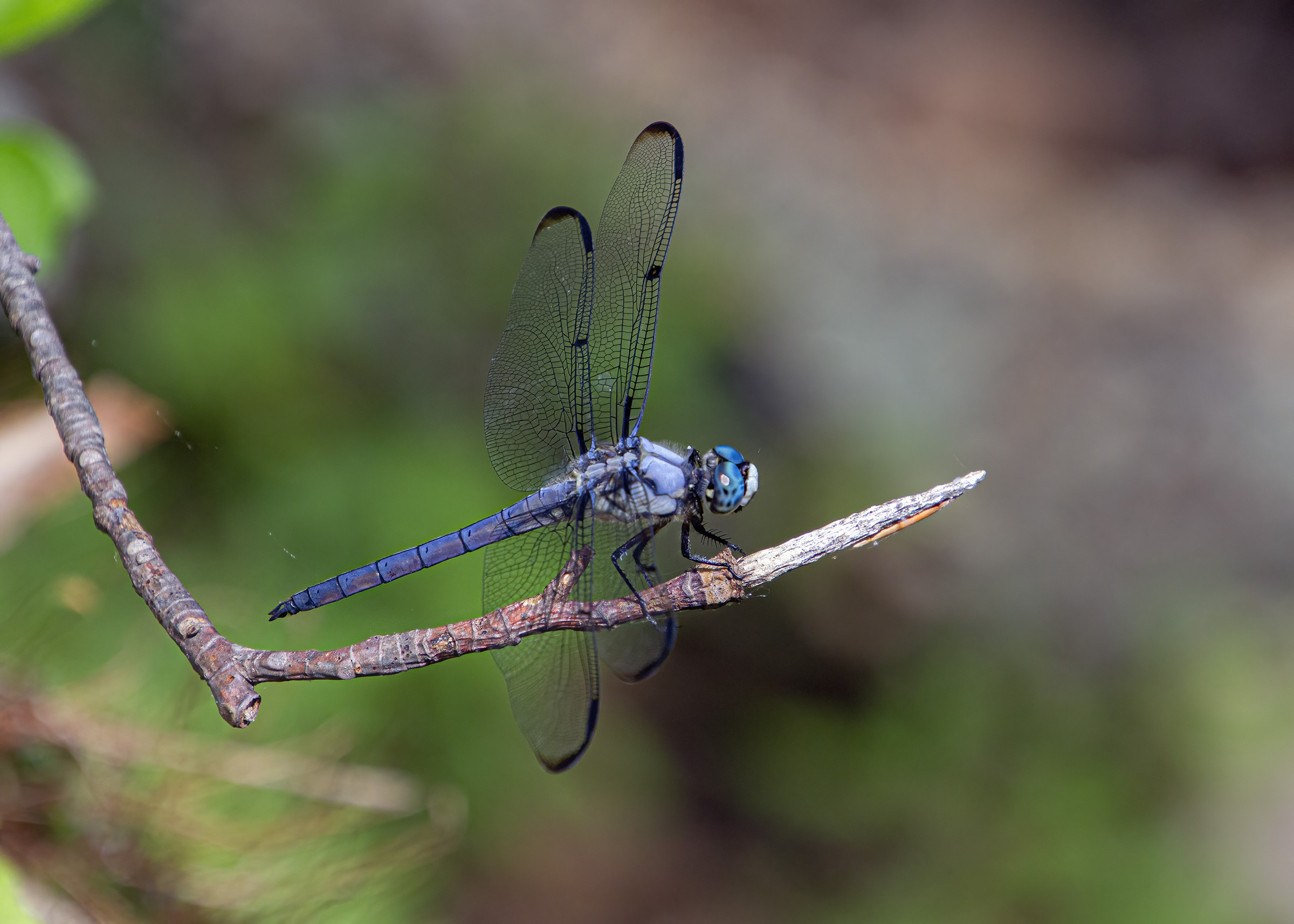
Although the astronomical calendar indicates that it is now autumn, the summer season continues for many dragonflies. Many of them are showing a lot of wear and tear, like this female Great Blue Skimmer (Libellula vibrans) with tattered wings that I spotted last week at Occoquan Bay National Wildlife Refuge.

At this time of the year it is not uncommon to see dragonflies and butterflies with damaged wings, but this is one of the most extreme cases that I have ever witnessed. Amazingly, she was still able to fly.

Great Blue Skimmer

© Michael Q. Powell. All rights reserved.

Read Full Post »

Great Blue Skimmer dragonflies (Libellula vibrans) are really common, but I enjoy photographing them anyways, like this grizzled male that I spotted earlier this week at Jackson Miles Abbott Wetland Refuge. The curling vines of the plant on which this dragonfly chose to perch add some additional visual interest to these photos.

I must confess that ordinary blue dragonflies have a special place in my heart, because my very first blog posting on July 7, 2012 featured a photo of a Blue Dasher, another common species. My photography skills and my knowledge about dragonflies have increased significantly since that time, though I am still quite proud of that initial photo that started me on this long journey into photography.


blue dasher

Blue Dasher

© Michael Q. Powell. All rights reserved.

Read Full Post »

This tattered male Great Blue Skimmer dragonfly (Libellula vibrans) seemed to be auditioning for a role as a replacement for the goose on this sign on Monday at Occoquan Bay National Wildlife Refuge. Or perhaps he was merely seeking a place of refuge—all dragonflies are welcome here.

Great Blue Skimmer

© Michael Q. Powell. All rights reserved.

Read Full Post »

It almost looks like this Great Blue Skimmer dragonfly (Libellula vibrans) was wearing cool wraparound sunglasses this past weekend when I spotted him chilling out at Occoquan Bay National Wildlife Refuge. From a distance, it looks like dragonflies have smooth bodies, but when you get a good look up close, you discover that they have tiny hairs covering various parts of their bodies.

Great Blue Skimmer

© Michael Q. Powell. All rights reserved


Read Full Post »

Two different colored dragonflies, a Needham’s Skimmer (Libellula needhami) and a Great Blue Skimmer (Libellula vibrans), were peacefully sharing a prime perch on Monday at Occoquan Bay National Wildlife Refuge.

Why is it so hard for us to peacefully coexist with one another?

peaceful co-existence

© Michael Q. Powell. All rights reserved

Read Full Post »

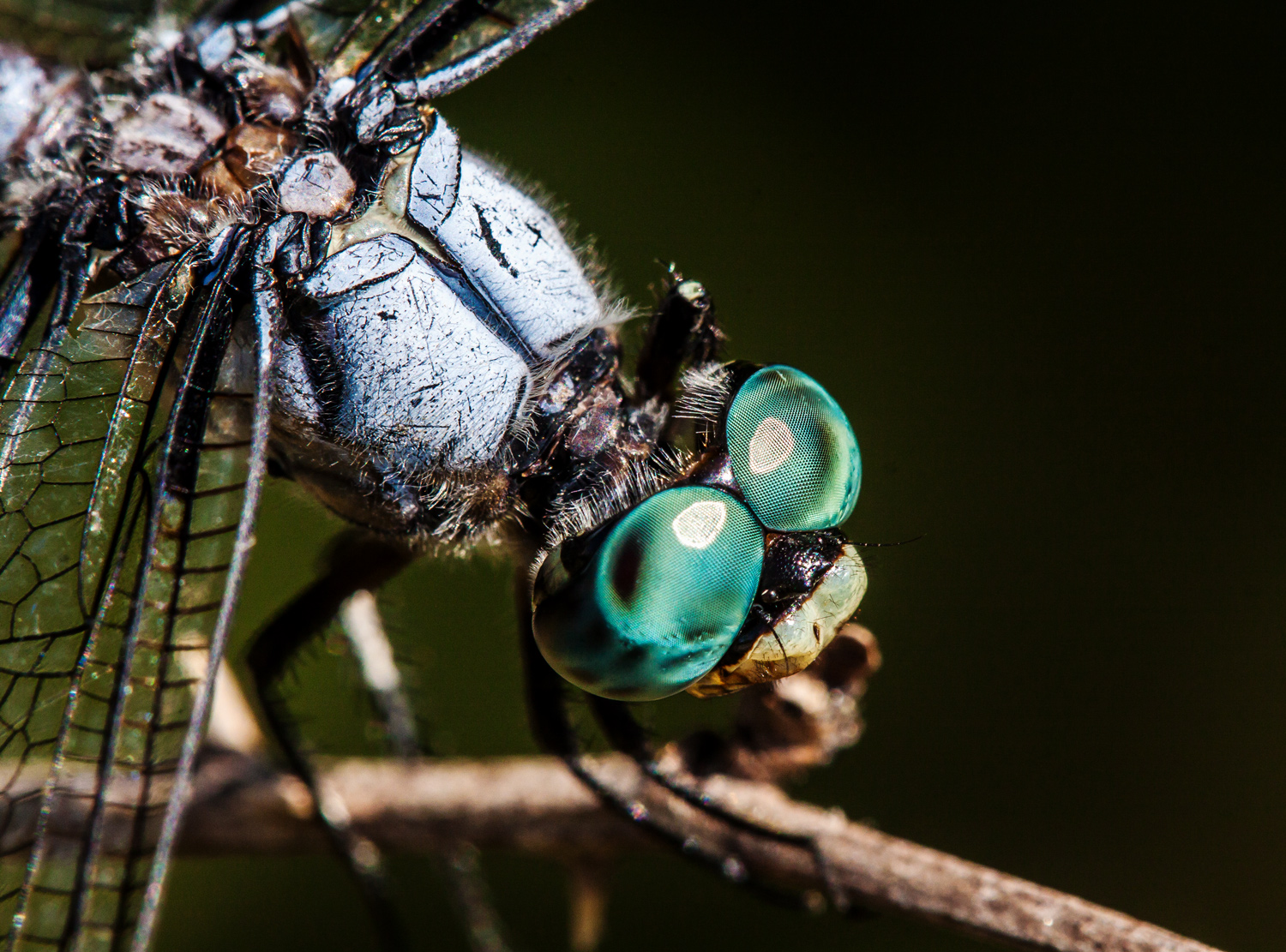
Dragonflies have amazing compound eyes that wrap around their heads. With up to 30,000 facets (ommatidia, to be technical), dragonflies have incredible vision and can even see colors beyond human visual capabilities, like UV light. For an easy to read discussion about dragonfly eyes, i.e. not overly scientific, check out this posting by “grrl Scientist” that was posted on scienceblogs.com.

I captured this close-up image of a Great Blue Skimmer dragonfly (Libellula vibrans) yesterday at Occoquan Bay National Wildlife Refuge. At least once a season, I manage to get a shot like this when a cooperative dragonfly lets me get close. I captured the image below with my trusty Tamron 180mm macro lens on my Canon 50D DSLR. This lens, which has a longer focal length than most macro lenses, gives me some stand-off distance so I can get a macro shot like this without actually being on top of the subject. The only downside to the lens is that it has no built-in image stabilization, so I have to pay extra attention to remaining steady when shooting with it—I generally use a monopod to help reduce camera shake and I think it helped for this image.

The image is framed just as I saw it in my viewfinder. Most of the time I end up cropping my images as part of my normal post-processing, but in this case it looked pretty good without any cropping whatsoever.

Great Blue Skimmer

© Michael Q. Powell. All rights reserved

Read Full Post »

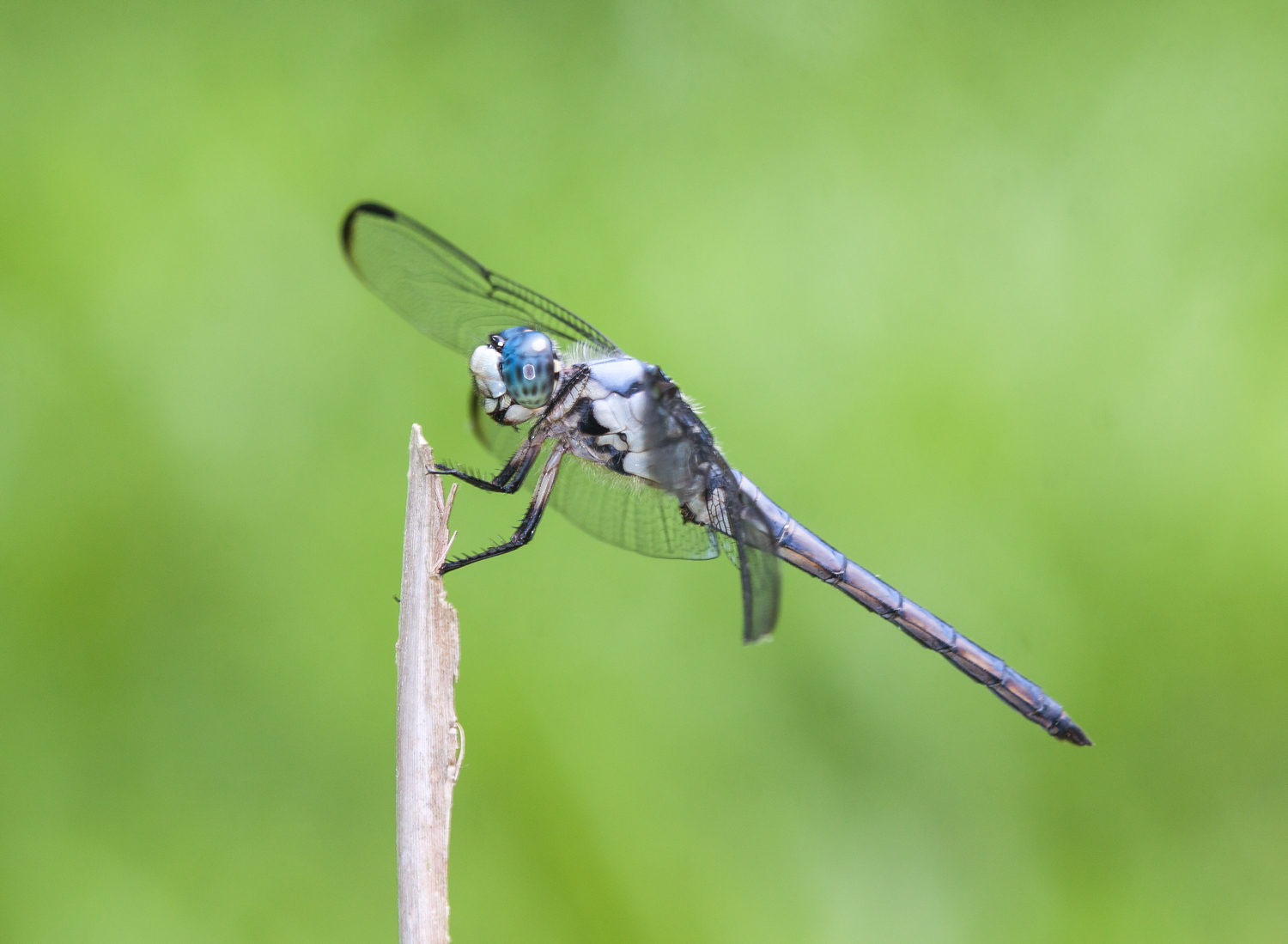
When they are immature, the males and females of many dragonfly species are very similar in coloration. To make matters worse, immature dragonflies of several different species are also similar in appearance, with only subtle differences to distinguish one species from another, like the color of the upper portions of their legs.

As a result, I am not really sure of my identification of this particular dragonfly. I lean towards it being an immature male Great Blue Skimmer (Libellula vibrans), but it might instead be a Slaty Skimmer (Libellula incesta). (The adults of these two species, by contrast, are very different in appearance and would never be mistaken for each other.)

Whatever the case, I love the two-toned eyes and overall body position of this beautiful dragonfly. It might be my imagination, but it seemed to me that the dragonfly had tilted its head a bit to check me out.

Great Blue Skimmer

© Michael Q. Powell. All rights reserved.

Read Full Post »

As the days of summer gradually wind down, I can’t help but notice a significant amount of wear and tear on the bodies and especially the wings of some of the dragonflies and butterflies that I see. Clearly it has been a long, tough season for some of them. Despite its tattered wings, this male Great Blue Skimmer dragonfly (Libellula vibrans) that I spotted on Monday at Huntley Meadows Park seemed to have no trouble flying, though I suspect that his days are numbered.

I hope that all of you have managed to survive this season well and that your “summer wear” refers to your clothes and not to the condition of your body.

Great Blue Skimmer

© Michael Q. Powell. All rights reserved

Read Full Post »

Most folks can readily identify a Great Blue Heron, but would you recognize a Great Blue Skimmer if you encountered one? This dragonfly’s wing pattern is fairly distinctive, but I usually look for its beautiful blue eyes and bright white face. I spotted these male Great Blue Skimmers (Libellula vibrans) on Monday at Huntley Meadows Park in Alexandria, Virginia.

Great Blue Skimmer

Great Blue Skimmer

Great Blue Skimmer

Great Blue Skimmer

© Michael Q. Powell. All rights reserved

Read Full Post »

Many of the dragonflies that I see this late in the summer have wings that are torn and tattered, yet they seem to still fly perfectly well. The dragonflies clearly are survivors—survivors of encounters with predators and thorny vegetation or even of overly energetic mating sessions.

Last Friday I spotted this Great Blue Skimmer (Libellula vibrans) as it perched on some bent stalks of grass. He is not a perfect specimen, but I can’t help but be drawn in by his beautiful speckled blue eyes.

Yes, he still deserves to be called “great.”

Great Blue Skimmer

© Michael Q. Powell. All rights reserved.

Read Full Post »

Females are a real mystery to me, especially when it comes to dragonflies. At this time of the year I see a lot of different dragonflies and I have featured a number of the colorful males over the past few weeks. They are relatively easy to identify when they are mature—immature males, however, often have the same coloration as females.

The challenge with females, particularly a number of the members of the Skimmer family, is that they all look pretty much the same.  This past Friday I photographed this beautiful female dragonfly and I love the two-toned coloration of her eyes. After consulting with my local dragonfly expert Walter Sanford, I have concluded that she is probably a Great Blue Skimmer (Libellula vibrans), though she doesn’t have a spot of blue on her

Great Blue Skimmer

© Michael Q. Powell. All rights reserved.

Read Full Post »

I love the speckled blue eyes of the male Great Blue Skimmer dragonfly (Libellula vibrans), like this spectacular specimen I spotted Monday at Huntley Meadows Park in Alexandria, Virginia.

Great Blue Skimmer

Great Blue Skimmer

© Michael Q. Powell. All rights reserved.

Read Full Post »

How was your summer? Did you take a vacation and relax or at least take some time off from work?

There are no vacations for dragonflies. It looks like this has been a long, hard summer for the male Great Blue Skimmer (Libellula vibrans) that I spotted earlier this month, judging from the almost shredded condition of his wings. Yet somehow, he is still able to fly and continues to survive

Autumn is almost upon us and the number of dragonflies that I observe is dropping. Before long, only a few hardy species will remain. For now, I take joy in seeing the tattered survivors, whose beauty is undiminished in my eyes.

Great Blue Skimmer

© Michael Q. Powell. All rights reserved.

Read Full Post »

Older Posts »