Feeds:
Posts
Comments

Posts Tagged ‘dragonfly’

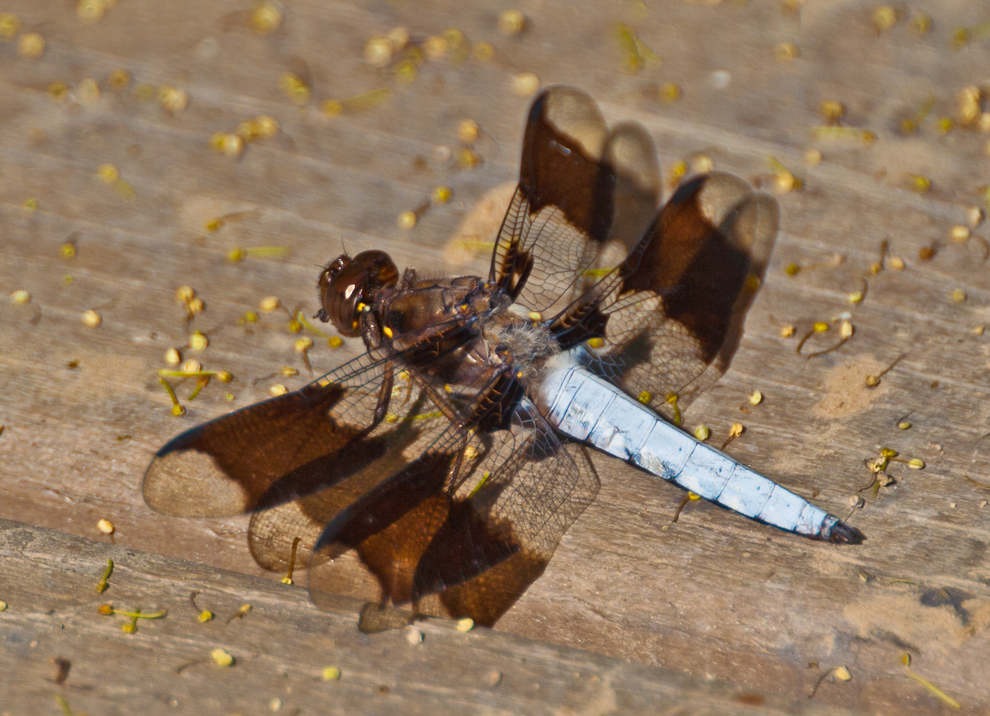
It was exciting for me to spot a new dragonfly this weekend, a male Widow Skimmer dragonfly (Libellula luctuosa).

I really like the brown and white pattern on the wings, which was distinctive enough that it also helped me in identifying it. According to Bugguide, the species name means sorrowful or mournful, perhaps because the wings of both male and female seem to be draped in mourning crepe.

The weather has turned hot and humid, which is typical for the Washington D.C. area, which seems to be great for the dragonflies, so I’ll be out as often as I can tolerate the heat, searching for new dragonflies to photograph.

brown_white1_blogbrown_white2_blog

© Michael Q. Powell. All rights reserved

Read Full Post »

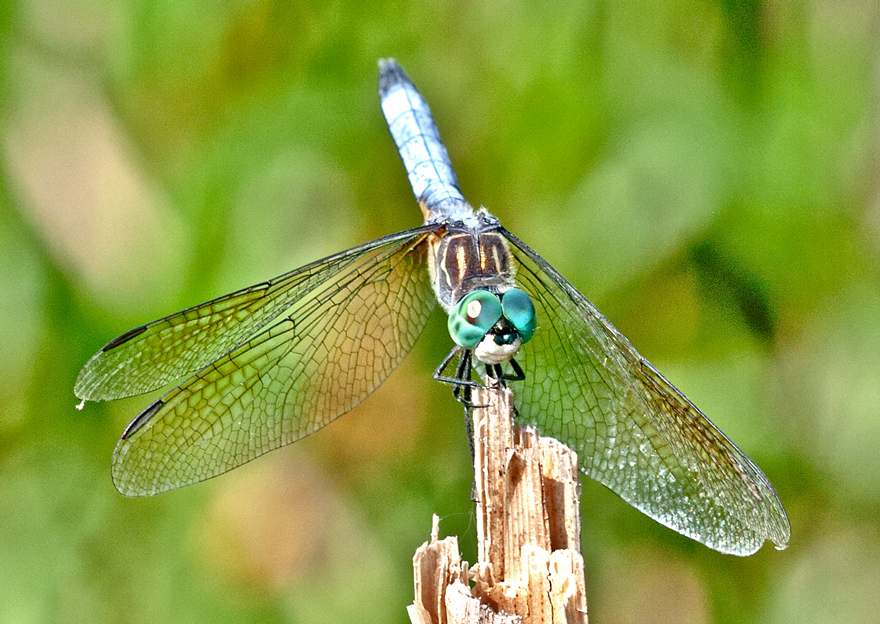
Male Blue Dasher dragonflies (Pachydiplax longipennis) assume this handstand-like position, called the obelisk posture, when they feel threatened or want to minimize exposure to the sun. I was leaning a little closer than normal to this dragonfly, because I had a 100mm lens attached to the camera and not a longer zoom lens, so maybe that caused him to be a little alarmed. As the weather warms up and more dragonflies appear, I am sure that I will be getting a lot more shots of Blue Dashers, which were my favorite dragonflies to photograph last summer.

dasher1a_blog

© Michael Q. Powell. All rights reserved

Read Full Post »

Dragonflies are super-predators, according to a posting today by one of my favorite bloggers, Sue of Back Yard Biology, thanks to their agile flying ability and incredible eyesight, but predators can also become prey. You should check out that posting for a wonderful explanation of dragonflies’ visual acuity and some beautiful dragonfly images.

The Tree Swallow (Tachycineta bicolor) in this photo has captured a male Blue Dasher dragonfly (Pachydiplax longipennis) that appears to be struggling to extricate itself from the grip of the bird. In the second shot, the swallow is offering its prize to its mate, which pokes its head of the nesting box and takes a bite of one of the wings. (If you look carefully at the first shot, you’ll see that it was taken after the second shot and part of one of the dragonfly’s wing seems to have been bitten off.)

Predator or prey? There always seem to be some creature above you on the food chain. It’s no wonder that so many of the birds, animals, and insects are so hyper-vigilant and skittish when we try to take photographs of them—their survival may depend on it.

breakfast1_blogbreakfast2_blog

Michael Q. Powell. All rights reserved

Read Full Post »

I chased around this beautiful female Eastern Pondhawk dragonfly (Erythemis simplicicollis), hoping in vain that she would land on something more natural-looking than the composite boards of the marsh boardwalk. Several times she took off and circled around a bit, but returned each time to the boardwalk.

Shooting from a high angle, I was able to capture some of the details of the dragonfly that I do not usually see, like the little hooks at the end of the hairy legs. I really like her pose as she seemed to lean toward me, without seeming threatening in any way.

As always, I was struck by the strikingly beautiful emerald color of the females of this species. It’s even more impressive in real life.

green_blog

Michael Q. Powell. All rights reserved

Read Full Post »

Continuing my quixotic quest to photograph dragonflies in flight, I went boldly out into the wild, armed with my trusty 100mm macro lens, and managed to capture this cool image of a dragonfly as it hovered over the water.

In previous attempts, I used longer telephoto zoom lenses, which increased the number of potential subjects but gave only mixed results. Using a shorter, fixed focal-length lens, I had to change my strategy a little and try to get closer to the subject.

I noticed this dragonfly hovering about the water to the side of the boardwalk on which I was walking. I crept as close as I could and tried to shoot as close to straight down as I could (the boardwalk was at least a foot (30 cm) above the level of the water and it looked like the dragonfly was hovering almost level with the boards of the boardwalk). I was really sensitive to my shadow, because I have learned that nothing scares away an insect faster than casting a shadow on it.

I used autofocus and was a little surprised to see that my dragonfly is in pretty clear focus, although the shutter speed was not fast enough to stop the action of  the wings. I shot this handheld and really tried to pay attention to my technique, because my macro lens does not have any built-in image stabilization. As I thought about it afterwards, I realized that the auto focusing on the macro lens (using what Canon calls an ultrasonic motor) is much faster and better than the focusing on my Canon 55-250 or my Sigma 135-400mm zoom lens.

I have been having some difficulties identifying this dragonfly. The coloration of the tail looks a little like a female Blue Dasher, but the beautiful blue eyes do not seem right for the female. The tip of the tail should be a help, but I can’t seem to find one that matches it.

Although I can’t identify the dragonfly, it’s my best shot to date of a dragonfly in flight and I’m pretty content with it today, though my quixotic quest is likely to continue this weekend.

hover1_blog

Michael Q. Powell. All rights reserved

Read Full Post »

When an unfamiliar dragonfly zoomed by me, one of my fellow photographers told me it was a unicorn, at least that is what I thought he said.

Sometimes when I am concentrating on a shot, I shut out my surroundings and I had had to ask him to explain his comment. It turns out that he said that it was a Unicorn Clubtail dragonfly (Arigomphus villosipes), a type that he had rarely seen in our local marsh.

I extended my 135-400mm zoom to almost maximum range and it still was tough to get a clear shot. The dragonfly flew off and returned to his perch a couple of times, but the log on which he posed was so far away that my shot doesn’t permit me to say with great certainty that it is a Unicorn Clubtail. It is clear, though, that it not a Common Whitetail or Blue Dasher, the two types of dragonflies that I see most often.

Overall, I like the effect of the triple view of the dragonfly—the dragonfly, its shadow on the log, and its reflection in the water, which, for me, helps to compensate for the softness of the focus.

unicorn_blog

Michael Q. Powell. All rights reserved

Read Full Post »

Although I usually try to get close-up shots of dragonflies, there is something really peaceful about this longer distance shot of a male Common Whitetail dragonfly (Plathemis lydia) from this past weekend. I really like the arc of the branch and the reflection of both the branch and the dragonfly in the still water of the marsh. If you click on the image, you’ll see that there is a pretty good amount of detail in the dragonfly—I chose not to highlight those details in this posting.

Click the photo to see a higher resolution view.

Click on the photo to see a higher resolution view.

Michael Q. Powell. All rights reserved

Read Full Post »

Who hasn’t wished for an extra set of hands to get more done in this multi-tasking world?

When I first looked at this photo that I took of a male Common Whitetail dragonfly (Plathemis lydia), it looked like he had grown two extra sets of wings. Had a genie granted one of his wishes? Could he now fly faster than his friends (he is a male, after all)? Will this impress the ladies?

A close look at the image, however, reveals that the extra wings are merely illusions, shadowy reflections of a more ordinary reality.

That doesn’t mean, though, that he has ceased to dream and to wish from time to time for those extra wings.

wings_blog

Michael Q. Powell. All rights reserved

Read Full Post »

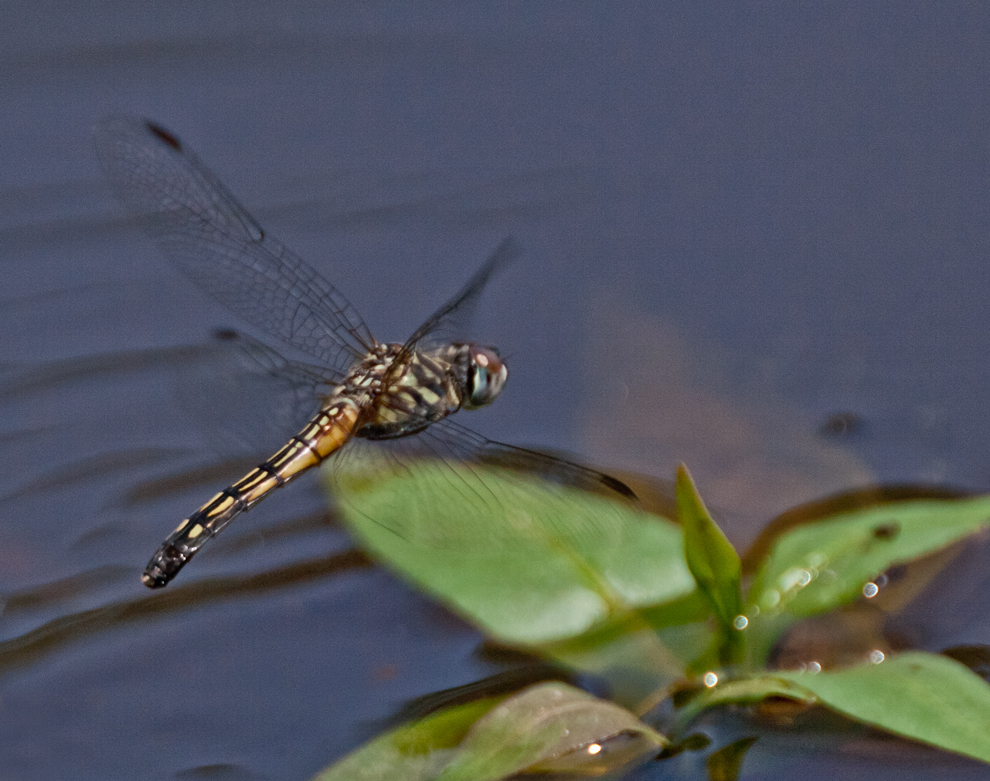
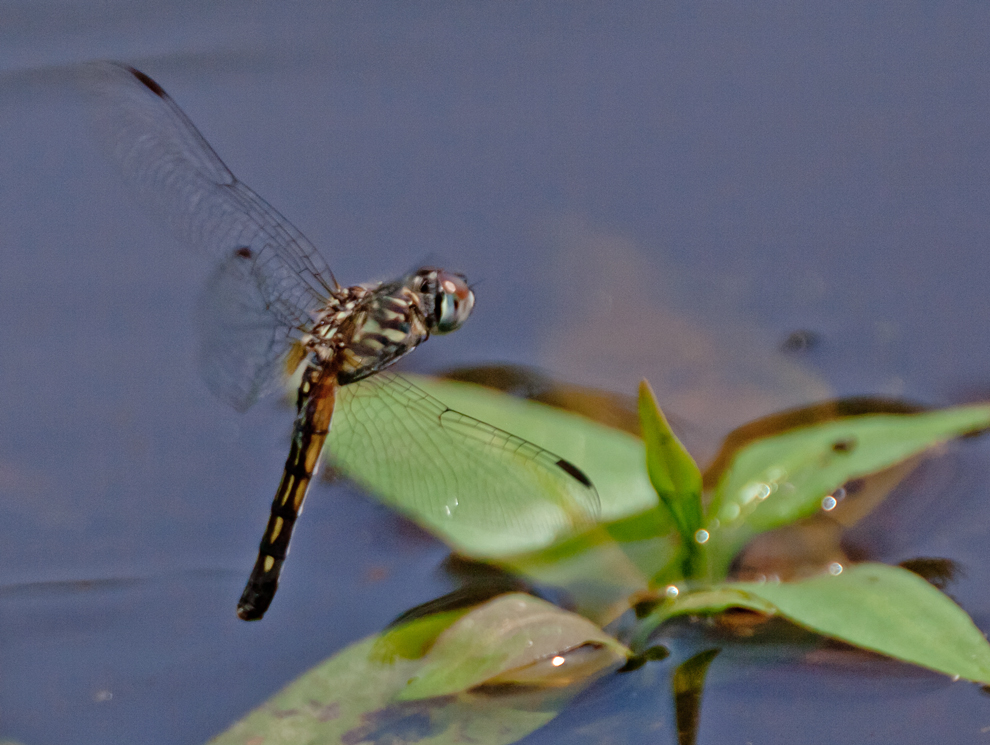
How can you photographing a dragonfly while it is flying? As we have moved into dragonfly season, I have been thinking a lot about that question and earlier this week, I had some success in getting images of a female Blue Dasher dragonfly that I believe was ovipositing.

female_dasher2_blog

Last year, I was content to photograph perched dragonflies (and still love to do so) and occasionally would capture one as it was leaving a perch. This year I am challenging myself and am actively seeking out opportunities to follow dragonflies with my lens and, if possible, to catch them in motion. They are so agile in flight, that the challenge is somewhat daunting. I have experimented with auto focusing and manual focusing. I have tried pre-focusing on an area and waiting and hoping a dragonfly would fly into it. I have had my best luck so far when I can catch the dragonfly as it is hovering.

This female Blue Dasher dragonfly (Pachydiplax longipennis) approached this little clump of vegetation several times and would begin to hover. Then she would bend her tail forward and move it rapidly back-and-forth for a few seconds, which I think meant that she was laying eggs.

female_dasher1_blog

I am definitely not an expert on dragonfly behavior and may be totally wrong about what she was doing. However, from a purely photographic point of view, this offered my best chance of getting some shots of this dragonfly in flight. As I recall, I got my best shots when focusing manually and snapping as many shots as I could when it looked like things were coming into focus.

female_dasher3_blog

The Blue Dasher female (and you’ve probably noticed that the females of this species are not blue, despite their name) flew away and returned several times, but eventually was done with her business. I am continuing to observe the different species of dragonflies and hope to identify the types of behavior they exhibit that will maximize the chance of me getting some more shots like these ones.

Michael Q. Powell. All rights reserved

Read Full Post »

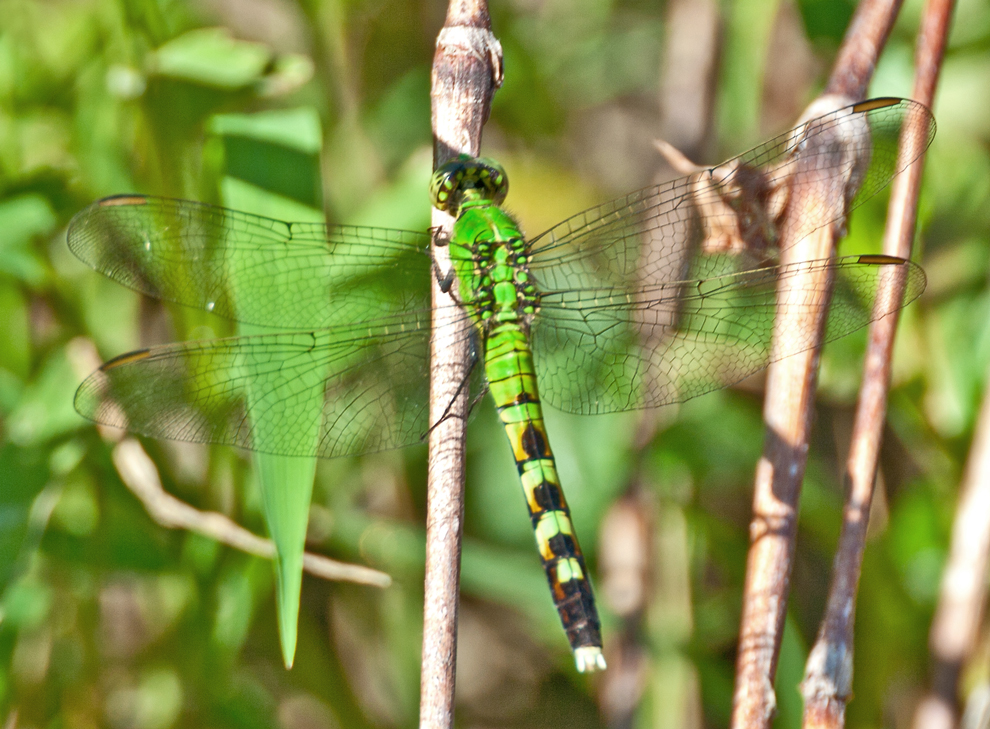
Normally, I try to have an uncluttered background for my dragonfly shots, but the brilliant green body of this female Eastern Pondhawk (Erythemis simplicicollis) really helps it to stand out (and this was the first pondhawk that I saw this spring).

Most of the dragonflies that I observe at my local marsh are either Blue Dashers or Common Whitetails, so I was really excited when a flash of emerald green caught my eye—the color is distinctive enough that I knew immediately what it was. Without paying too much attention to my surroundings, I moved forward to try to get a better angle on the dragonfly.  The next thing I knew, I was ankle-deep in marsh mud, but did manage to get some shots.

I haven’t yet seen any male Eastern Pondhawks, which are mostly blue, but I am keeping my eyes open and hope that it is only a matter of time until I photograph one this spring.

pondhawk1_blog

pondhawk2_blog

Michael Q. Powell. All rights reserved

Read Full Post »

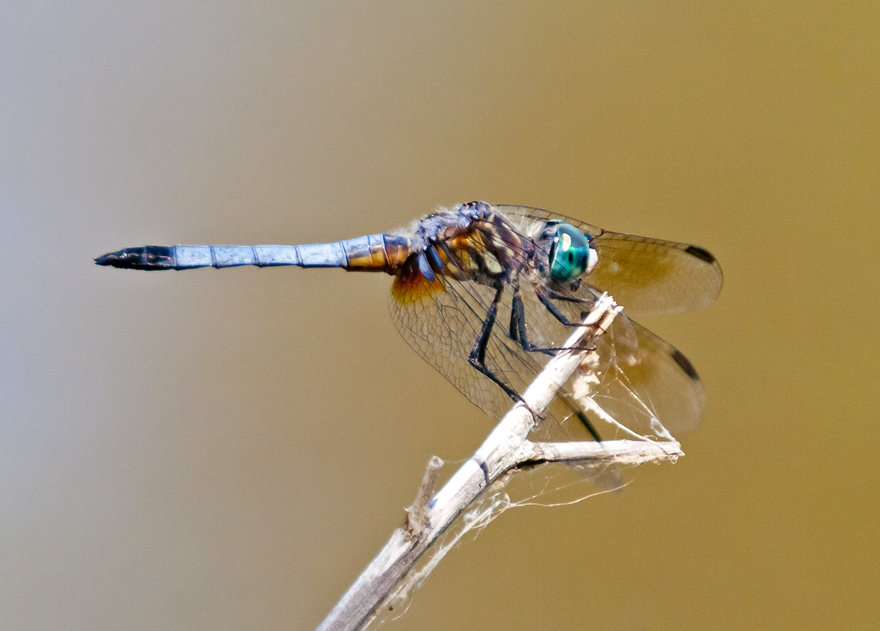
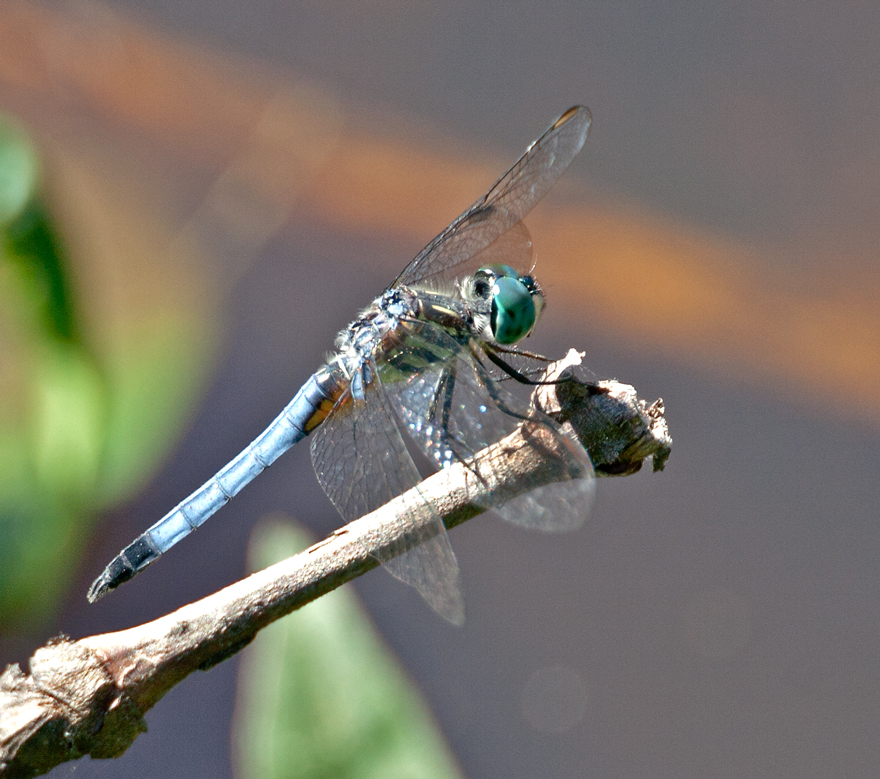
Last summer, my favorite photographic subject was the Blue Dasher dragonfly (Pachydiplax longipennis) and I was really excited on Friday to see that they are once again present at my local marshland park.

It continues to be a challenge to get close enough to capture the wonderful details of the dragonfly and to manage the background so that it is not too cluttered. I am happy to have gotten a few good images of male Blue Dashers to start the season, with the promise of more shots to come.

dasher1_blogdasher2_blog

Michael Q. Powell. All rights reserved

Read Full Post »

Yesterday was warm and humid, which felt almost like summer here and brought out more dragonflies.

The sun was a little harsh just before noon, but I couldn’t help chasing after the dragonflies and got this shot of a male Common Whitetail dragonfly (Plathemis lydia).

head-on_blog

Michael Q. Powell. All rights reserved

Read Full Post »

Is it just me, or does this image look like it came from a low budget science fiction movie, with a strange-looking alien creature hovering over a Martian landscape?

I was chasing dragonflies again this past weekend, trying to capture images of them in flight, and ended up with this image of a female Common Whitetail dragonfly (Plathemis lydia). It’s pretty tough to try to track these flying insects with a hand-held telephoto zoom lens extended to almost 400mm. My autofocus seemed too slow and I adapted a technique of trying to focus manually, while trying to keep the lens steady. I can’t tell for sure if this image was auto-focused or was manually focused.

Female Common Whitetail dragonflies do not have a white tail and in many ways that makes them a little easier to expose correctly. The wings are blurred, but you can still see the brown markings that identify this as a female, and not an immature male.

Last summer I was content to get a shot of a dragonfly when it was stationary, but this summer I am going to work hard to capture some more images of dragonflies in flight.

whitetail2_blog

Michael Q. Powell. All rights reserved

Read Full Post »

Although most people probably associate the descriptor “whitetail” with deer, it’s also part of the name of this dragonfly that I photographed yesterday, an immature male Common Whitetail dragonfly (Plathemis lydia).

I remember seeing the adult male Whitetail a lot last summer, and its body is a chalky white in color, as its name suggests. Males start out looking a lot like the female, which has a brown body with some white or yellow markings, according to Bugguide. However, it’s relatively easy to tell the immature males from the females, because their wing patterns are different. Males have wider bands of brown and clear wingtips (no, they are not wearing dress shoes—I am talking about the literal tips of the wings).

I am sure that I’ll get lots more photos of Common Whitetail dragonflies this summer, including some in much better light, but it was nice to see them appearing already in April.

dragonfly1_blog

Michael Q. Powell. All rights reserved

Read Full Post »

Today I saw my first dragonflies of the spring, which I am pretty sure were Common Green Darners (Anax junius). They buzzed by me several times, but never stopped to perch.

I had reconciled myself to the likelihood that I would not get a single shot.  Suddenly a dragonfly that I was chasing stopped and hovered over the water. I have never had any success before in capturing an in-flight image of a dragonfly, but somehow I was able to grab focus and got several pretty good shots. The beautiful, two-toned colors of this dragonfly are amazing.

I look forward to a new season of chasing dragonflies, but suspect that I will have to work hard to top this first dragonfly of the spring.

dragonfly_blog

Michael Q. Powell. All rights reserved

Read Full Post »

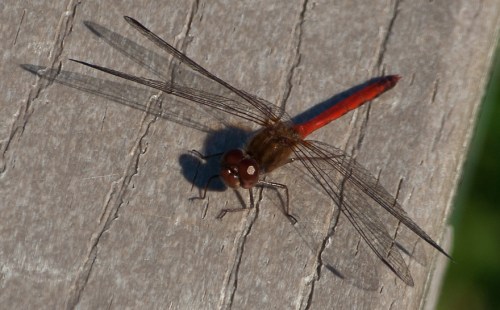
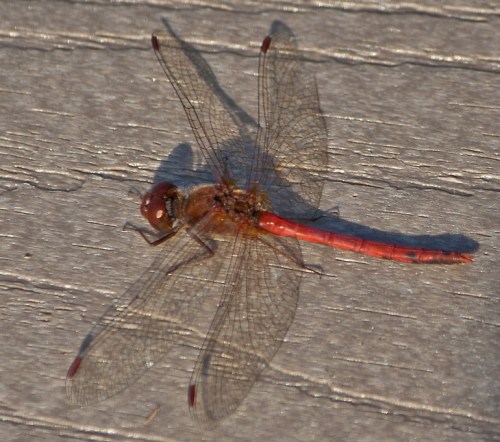
It was sunny yesterday afternoon and got up to 50 degrees F (10 degrees C), relatively warm compared to recent frosty mornings. The faded foliage and the coolness of the breeze reminded me that it is late fall. I was therefore shocked when I spotted a little red dragonfly perched on the boardwalk in front of me.

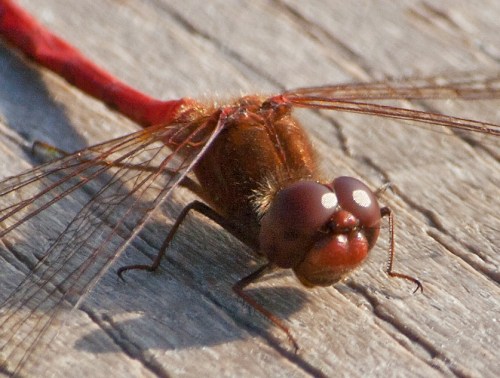
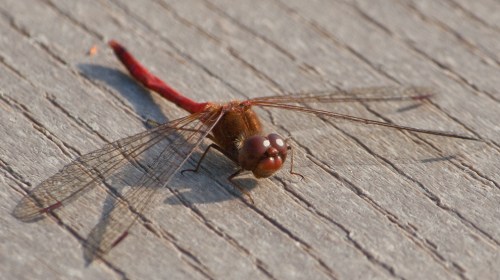
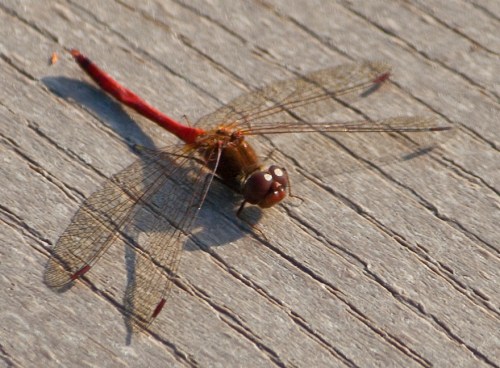
I recognized this one immediately as an Autumn Meadowhawk dragonfly (Sympetrum vicinum), the last dragonfly that I saw weeks ago and I had done a little research. For an instant I lamented that the setting was not a natural one (the boards are of a composite material), but I managed to get off a couple of shots before the dragonfly flew away. For the rest of the afternoon I keep my eyes alert and managed to spot another one in a similar pose. The second time I got down low and tried to get a shot at the level of his beautiful eyes. The first shot below is a cropped version of the resulting photo, intended to highlight some of his features that get lost when you include his wide wings. The second image is the same photo, but showing his wings. I was shooting with a telephoto zooms lens, so his tail is foreshortened a bit from this angle. The third photo is similar to the second, but was taken from a steeper angle looking down. The final image, which was actually the first one taken, was shot looking almost straight down and provides the best view of the details of the tail.

I love dragonflies, but I never expected to see one in December in Northern Virginia.  Once again I realize that I need to dream bigger, that I need to be prepared for the unexpected blessings that may come into my life, even modest ones like a beautiful red dragonfly.

Close-up of Autumn Meadowhawk dragonfly

Close-up of Autumn Meadowhawk dragonfly

Full front view of Autumn Meadowhawk

Face-to-face with Autumn Meadowhawk dragonfly

View from above

Front view of Autumn Meadowhawk dragonfly

View from above of Autumn Meadowhawk dragonfly

View from above of Autumn Meadowhawk dragonfly

© Michael Q. Powell. All rights reserved.

Read Full Post »

As the weather has cooled off, there have been fewer and fewer dragonflies buzzing around in the marsh area. Occasionally I see a Common Whitetail dragonfly, but that has been pretty much it. This past weekend, however, I encountered some new, colorful dragonflies that I am pretty sure are Autumn Meadowhawk dragonflies (Sympetrum vicinum).

It was relatively early in the morning when some fellow photographers pointed out an orange-colored dragonfly perched on some leaves. According to their information, the dragonfly was unlikely to move until the temperature rose to about 70 degrees. I wasn’t so sure about their calculations and so I hastened to take some shots with my 55-250mm zoom lens. Here is an overall shot to give you an idea what an Autumn Meadhawk looks like (the sun was a bright and I couldn’t shield it so there are some unfortunate hot spots).

Autumn Meadowhawk dragonfly

Once I had a record shot, I became a bit bolder and decided to try my 100mm macro lens. The major problem I had was that the dragonfly was about a foot below me and about two feet away from me (I was on a raised boardwalk), so holding the lens steady was a problem. I did get a couple of close-up shots, like this one. I am always amazed when you can see the little hairs on a dragonfly’s “face.”

Close-up shot of Autumn Meadowhawk dragonfly

There were still some harsh shadows and hotspots, so I decided to use my collapsible diffuser to soften the light. Unfortunately, the dragonfly must have thought I was a predator, because it flew away as soon as I cast a shadow on it with the diffuser. Later that day, however, I encountered the Autumn Meadowhawks several times, but they refused to perch on plants, preferring to land on the boardwalk. Feeling a little frustrated, I took some shots of them on the boardwalk and ended up with the following image that I like, even if it’s not exactly a “natural” environment.
Autumn Meadowhawk dragonfly on the boardwalk

I am not sure how long these dragonflies will hang around, but it is nice seeing some new species as the seasons change, an unexpected bonus for me this past weekend.

© Michael Q. Powell. All rights reserved.

.

Read Full Post »

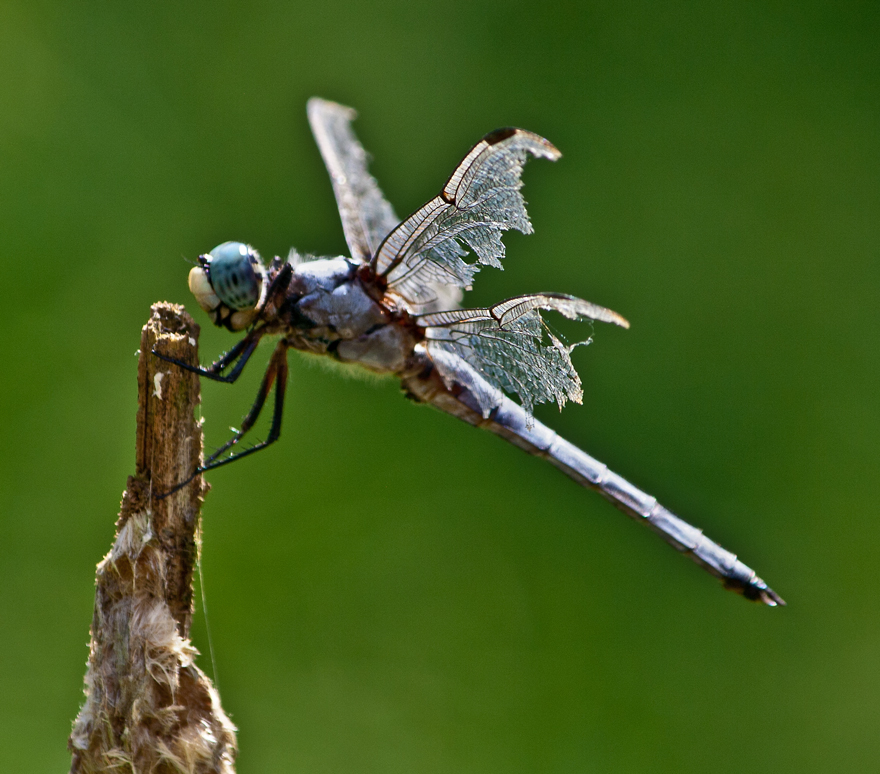
I don’t know if this Blue Dasher dragonfly is long in the tooth (do dragonflies have teeth?) or has simply had a tough life. How do you tell the age of a dragonfly? In any case, his wings are tattered and torn to such a degree that it is surprising that he can still fly. Yet I seem to detect a smile on his face, a reflection of contentment. (Yes, I know, I am guilty of anthropomorphism.)

Tattered wings,but still able to fly

I have been thinking about aging ever since Sunday when I read a wonderful column in the Washington Post by John Kelly entitled “You can learn a lot about growing old from a dog.” Kelly describes how the accelerated aging process of his dog has made him more conscious of the fact that he too is growing old. I recommend the article to all, but want to highlight the final paragraph of the column. Kelly concludes:

“Aging is unknown territory for each of us, despite the fact that humans have been doing it forever. I think there are worse ways to spend your final years than napping next to someone you love, dreaming of what was and what still might be.”

I doubt that this dragonfly will end his final days in peace and contentment like Kelly’s dog, but it is my fervent hope that we can accept the infirmities of growing old with grace and patience, and can focus—as this dragonfly appears to be doing—on the things that we are still able to do, on contributions that can make this world a better place.

© Michael Q. Powell. All rights reserved.

Read Full Post »
I was going through my recent dragonfly photos and this one really caught my eye. Somehow the combination of the dragonfly’s position and the long branch with the slight curve together made me think of a pole vaulter just before he clears the bar. It’s a little unusual that I photograph a dragonfly from below with the sky as a backdrop, but that’s what happened that day.

Maybe he’s preparing for the Dragonfly Olympics! What other events do you think they would have? I’m pretty sure they’d have gymnastics, given the frequency with which I see dragonflies do handstands.

Pole-vaulting dragonfly

© Michael Q. Powell. All rights reserved.

Read Full Post »
I took this photo on an Eastern Amberwing dragonfly (Perithemis tenera)) about a week ago when I was shooting at Green Spring Gardens in Alexandria, VA with my good friend and photographic mentor, Cindy Dyer.

Cindy is always encouraging me to upgrade my photograph equipment. For comparison purposes, she put the Nikon D300 that she was using into my hands and had me shoot with  it for a few minutes. It was equipped with a Tamron 180mm macro lens that gave it a pretty impressive reach for the dragonflies that we were shooting. It’s interesting that I was able to use my Compact Flash memory card, which was formatted in my Canon, in her Nikon and the Canon photos and the Nikon photos peacefully coexisted in separate folders on the memory card.

I was especially happy that I got a decent shot of the Eastern Amberwing dragonfly. This type of dragonfly is very beautiful, but it’s very small and elusive. BugGuide notes that this dragonfly is normally about 21-24mm long (in case you’ve forgotten, 25.4mm is equal to an inch).

I’m probably going to remain a Canon guy, but I can definitely hear the Siren call of that 180mm macro lens, which comes in a Canon version too.

Eastern Amberwing dragonfly

© Michael Q. Powell. All rights reserved.

Read Full Post »
I remember my excitement the first time I saw a really cool dragonfly a few months ago that turned out to be a Halloween Pennant dragonfly (Celithemis eponina). He had a very distinctive look with brown spots and stripes on his wings and orange veins. That first time I was happy to get any shot of the dragonfly.

Today I think that I encountered a Halloween Pennant for a second time. I was still very much taken by his looks but I had the presence of mind to circle about a bit, trying to get a good angle for the shot. The shot below is the one that I like the best of those that I took.

As I think about it, I go through this cycle a lot. I’m so in awe and wonder when I encounter something new that photography is not my first priority. Instead I am living the experience. Maybe my photos the first time are not the best, but that’s ok for me, because living my life is more important than merely recording it in my photos. That may be why I like to go back to places a second time and then focus a bit more on getting good shots.

Halloween Pennant dragonfly (Click for higher resolution view)

© Michael Q. Powell. All rights reserved.

Read Full Post »
I finally managed to get a shot of a Blue Dasher dragonfly (Pachydiplax longipennis) on a lotus flower bud this past weekend. Previously I had photographed Blue Dashers on various plants and stalks and other things, but I have always thought that it would be especially cool to get on perched on the tip of a lotus bud.

It’s nice sometimes to have your wishes fulfilled and, yes, I think the photo met my expectations.

Blue Dasher dragonfly on lotus bud

© Michael Q. Powell. All rights reserved.

Read Full Post »

I am never sure if it’s appropriate to post photos of mating insects, but decided to overlook my inhibitions and post this unusual photo of a pair of mating Eastern Amberwing dragonflies (Perithemis tenera).

Normally I have trouble getting good shots of these dragonflies because of their small size. According to BugGuide, their total length typically is 21-24 mm long (about 3/4-1 inch). In addition, they always seem to land on plants that away from the shoreline (unlike the Blue Dasher dragonflies that seem to like the plants at the very edge of the water).

This past Friday I was photographing dragonflies with Cindy Dyer at a local garden (Green Spring Gardens in Alexandria, VA) when this pair dropped from the sky and landed on a lily pad right in front of me. I happened to be shooting with a telephoto zoom so I had to back up a little to try to get a picture in focus. For those who are technically-minded, the exposure was shot at f11, 1/50 second, ISO 400, at 179mm of a 55-250mm zoom lens.

The photo is not perfectly sharp, but it gives an interesting view into the mating habits of Eastern Amberwing dragonflies. I don’t know my dragonfly anatomy very well, so it took some research to figure out who is who in this photo. The female is the one with the brown spots on her wings and she is holding on to the male’s tail. I think I’ll stop my description there and leave the rest to your imagination.

One thing that this photo taught me is that dragonflies are a whole lot more flexible and gymnastic than I realized!

Mating Eastern Amberwing dragonflies (click for a higher resolution view)

© Michael Q. Powell. All rights reserved.

Read Full Post »

I took this photo at Huntley Meadows Park in Alexandria, Virginia, a marshland area that has lots of wildlife. I have managed to get lots of shots of Blue Dasher dragonflies but have had trouble getting a properly exposed image of the Common Whitetail dragonfly. The white body is usually blown out and overexposed in my images. (If you want to know some more about this type of dragonfly, check out the article in Wikipedia as a start.) This past Friday was mostly overcast and I finally got some decent photos.

I like the way this particular image turned out because of the dragonfly’s reflection in the muddy brown pond water, the little stump that pokes out of the water, and the green stalk that runs diagonally across the photo.

Male Common Whitetail dragonfly (Plathemis lydia), also known as a Long-tailed Skimmer.

© Michael Q. Powell. All rights reserved.

Read Full Post »

I came across this tiny damselfly yesterday when I was visiting a local garden in the late afternoon. Initially I spotted her when she was flying and I was thrilled when she chose to land in a spot where I could photograph her. I apologize to the experts for not identifying the type but I find it impossible to identify damselflies (and even dragonflies are not easy).

Damselflies are particularly challenging for me to photograph because they are so long and skinny. If I photograph them from the side, the eye is often out of focus and if I try to shoot head-on, depth of field is an issue.

I ended up with a photo that I shot from above and to the side. Somehow I managed to reduce the composition to the damselfly, the branch to which she is clinging, and a couple of leaves.

I find special beauty in that kind of simplicity in nature and in my photography.

Unidentified damselfly

© Michael Q. Powell. All rights reserved.

Read Full Post »
Four weeks ago today my friend and mentor Cindy Dyer helped me to start this blog. She has been teaching me and encouraging me as I seek to express myself through my photography. I owe her my thanks.

Over the past month I’ve tried a lot of different things: short posts and long ones; serious posts and funny ones; scientific posts and artistic ones; and scarey posts and beautiful ones. Some have been successful and others less so. The best thing about this blog, however, is that I have encountered a wide array of fellow bloggers. You have taught me so much and supported me with words of encouragement and inspiration. Thanks to all of you.

My first blog posting featured a Blue Dasher dragonfly, one of my favorite subjects. It somehow seems appropriate to feature another one as I celebrate my four-week anniversary. I photographed this Blue Dasher dragonfly (Pachydiplax longipennis) in late June at Green Spring Garden, a county-run facility that has a pond as well as a garden. It is only a few miles from my house and has been a kind of laboratory for me as I have worked on my photography.

Today is a hot, humid day here in the Washington DC area and I have stayed indoors poring over some of my images from the past month or so. I came across this one and after I adjusted the exposure a bit I realized that it was a pretty good shot. The lighting and background help to make it stand out from some of my other dragonfly photos (and I have lots). I uploaded a higher resolution image to allow viewers to see some more of the details, including the “eyelashes” of the dragonfly. Be sure to click on the image.

Click on the photo for a more detailed view of the dragonfly

© Michael Q. Powell. All rights reserved.

Read Full Post »

I know that this sounds like a trick question but I asked myself this very question when I encountered the dragonfly pictured below this afternoon.  I have had lots of practice observing and photographing Blue Dasher dragonflies (Pachydiplax longipennis) and they have always been blue.

From the “waist” up this looks like a typical Blue Dasher with the distinctive chest markings. (I realize that I am not using the anatomically correct language so I apologize if anyone is offended by my ignorance.) The tail, though, is completely different in color—it is not blue.

A little research on the internet reveals that the female Blue Dasher, as shown above, is not blue. She (and juvenile males) have the yellow stripes on the tail as shown.

I am still left wondering, though, about the male-female ratio for Blue Dashers and have no explanation why until now I have seen only males.

I will leave you to ponder that mystery as you look at one of my favorite photo from yesterday of a male Blue Dasher.

© Michael Q. Powell. All rights reserved.

Read Full Post »

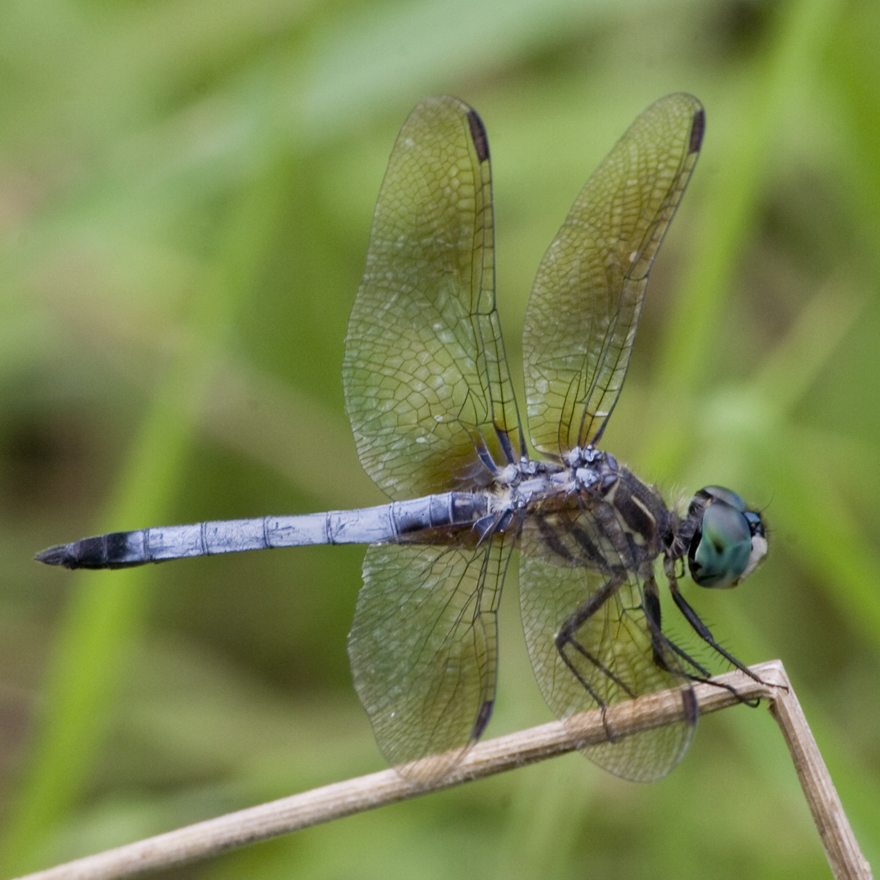
Perhaps I am going through a blue period for my favorite members of the Odonata family this weekend (one damselfly and two dragonflies) all turned out to be different shades of blue. I photographed the dragonflies in a marshy area where I expected to find them. I didn’t at all expect to see the damselfly in a garden setting but was able to get a shot when my friend Cindy Dyer pointed her out to me. (I’m calling the damselfly a “her” because it seems strange for me to refer to anything with “damsel” in its name as a “him.”)

It’s easy for me to identify the dragonfly in the middle as a Blue Dasher but I have not yet been able to identify the other two insects by name.

For now they will have to remain strangers, nameless but beautiful.

© Michael Q. Powell. All rights reserved.

Read Full Post »

« Newer Posts