Feeds:
Posts
Comments

Posts Tagged ‘dragonfly in flight’

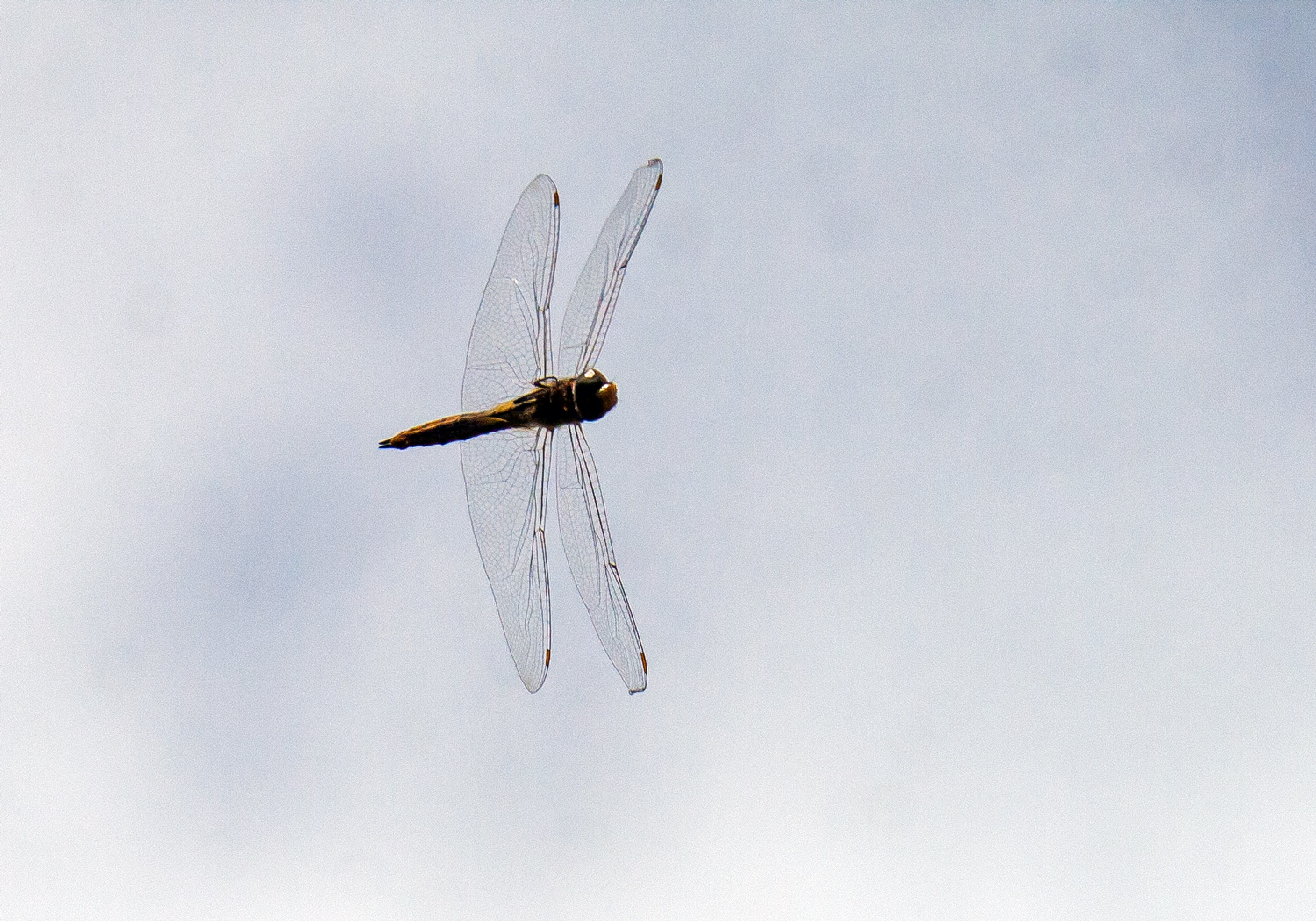
What is the most difficult subject that you try to photograph? Quite often my biggest concern is the composition of a photograph, i.e. can I capture a shot that will be visually pleasing. Sometimes that means waiting for a particular expression or wing position or moment of action, but if I am patient enough, I have a pretty good chance of getting some decent shots.

Each year, though, I try try to challenge myself to capture some “impossible shots” of dragonflies in flight. Of course, such shots are not actually impossible, but they are really difficult to pull off. Some really high-end modern mirrorless cameras have focusing systems that are so good that they can lock focus on a moving dragonfly, but I mostly use cameras with technology that is over a decade old. Usually I will try to track a dragonfly through the viewfinder of my camera and focus on it manually. It’s a little easier when the dragonfly is flying a somewhat predictable path over the water and ideally hovering a bit.

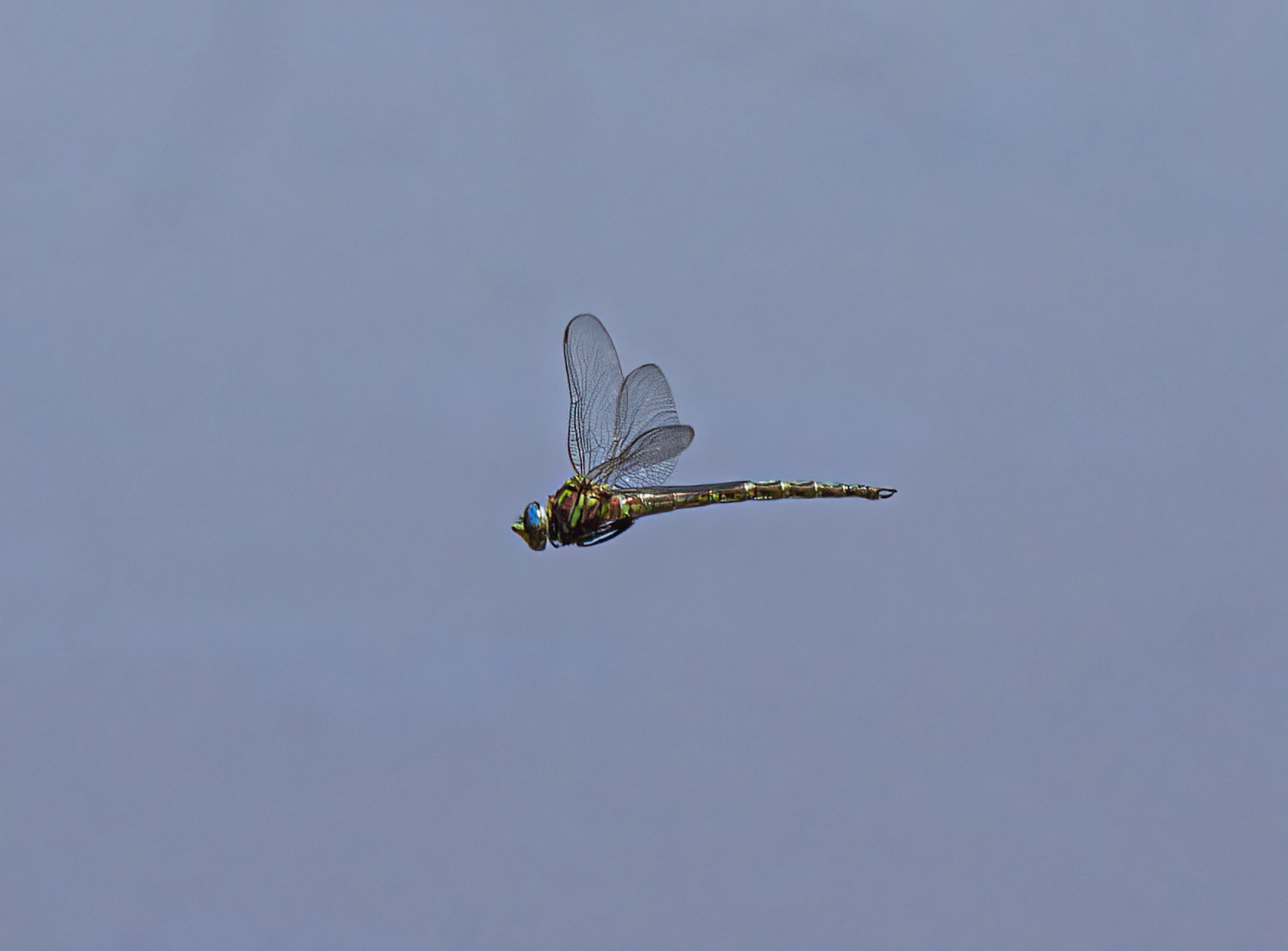
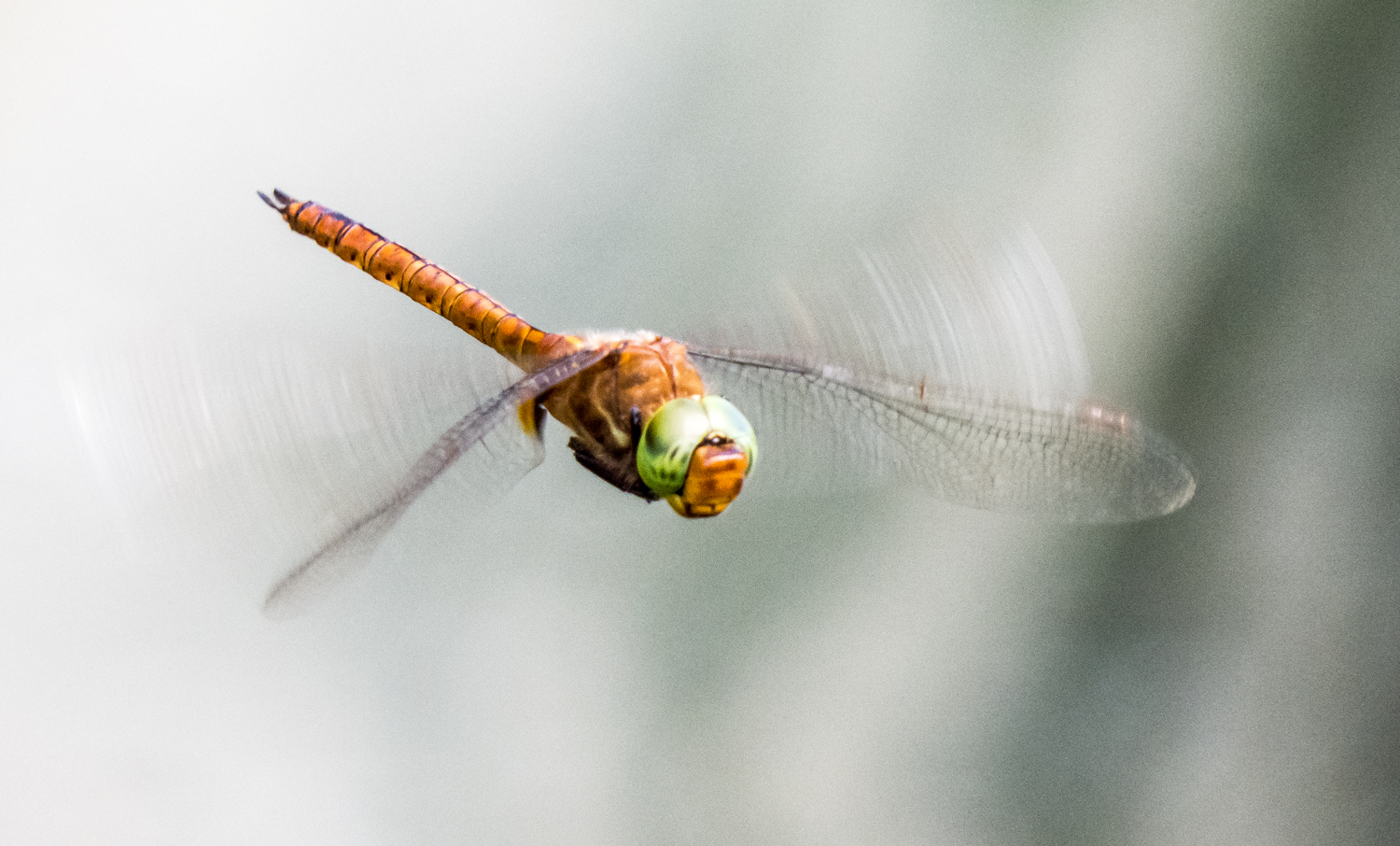
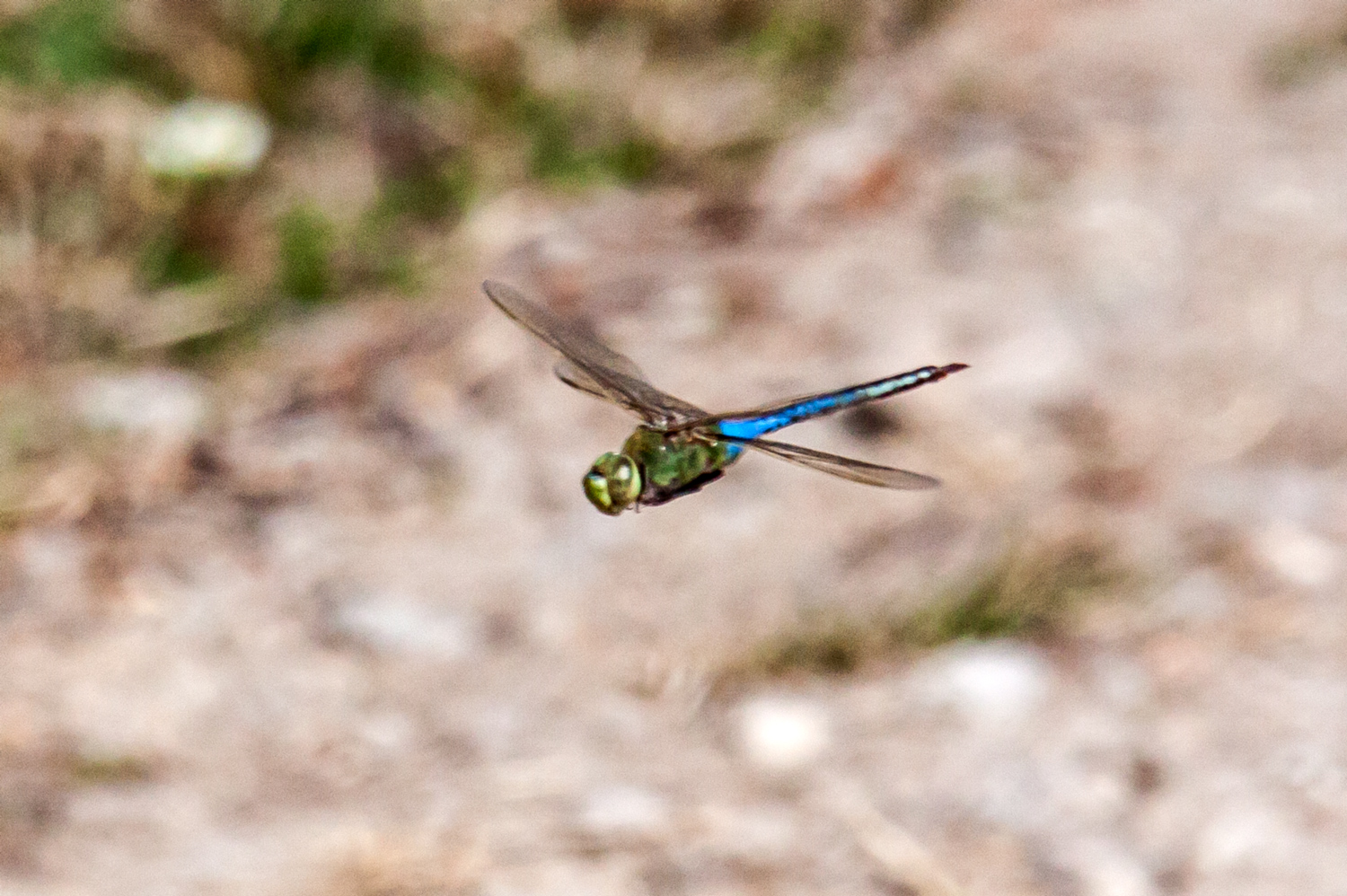
This past Monday I had my first experience this season with in-flight photography when I spotted several Common Baskettail dragonflies (Epitheca cynosura) patrolling over the water of a small pond at Occoquan Regional Park. I managed to get a decent number of shots in frame, but most of them were out of focus—clearly I am a little rusty and need more practice to regain the necessary hand-to-eye coordination. The first shot below is cropped quite a bit, but is one of my best shots from my little session.

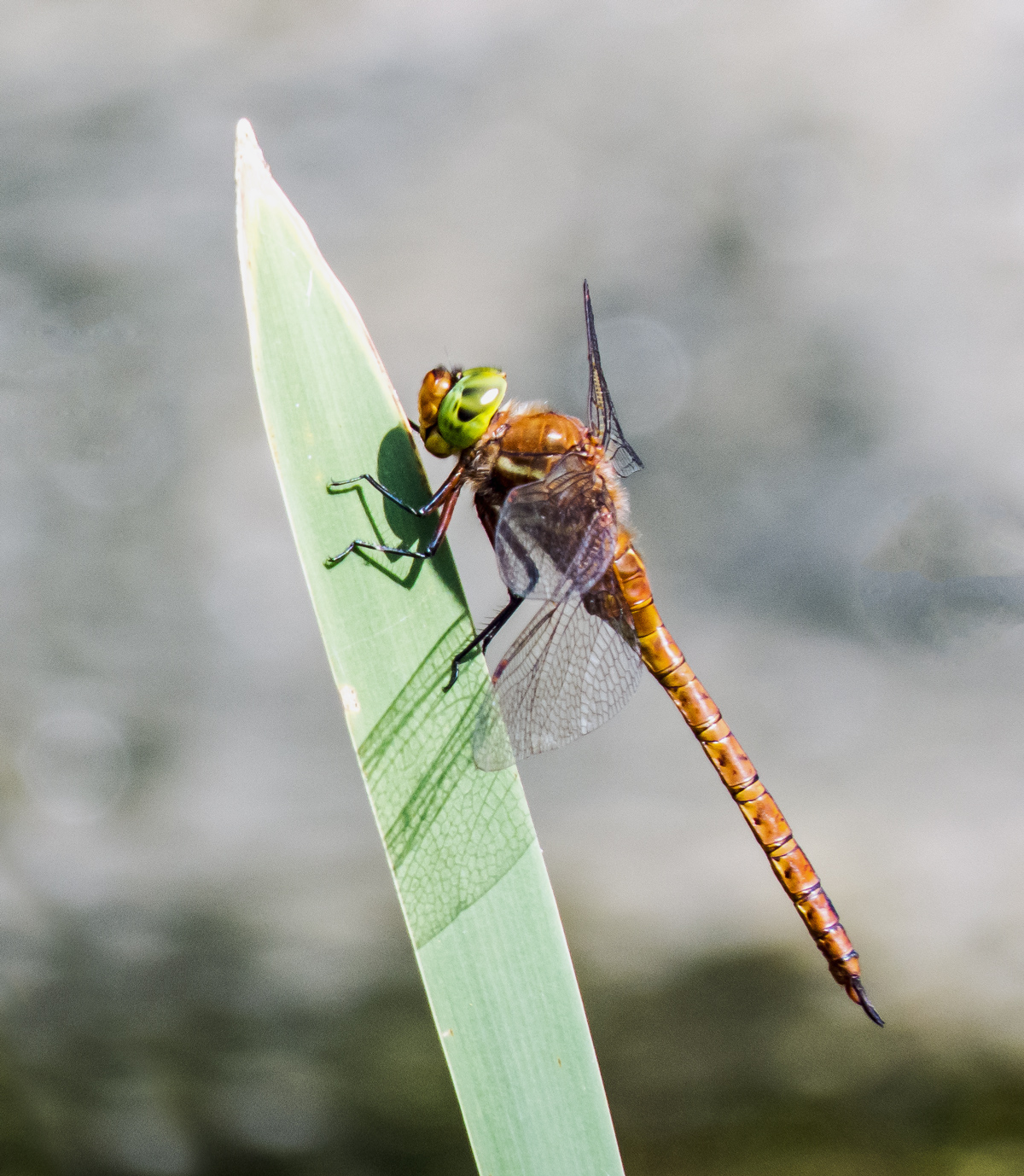
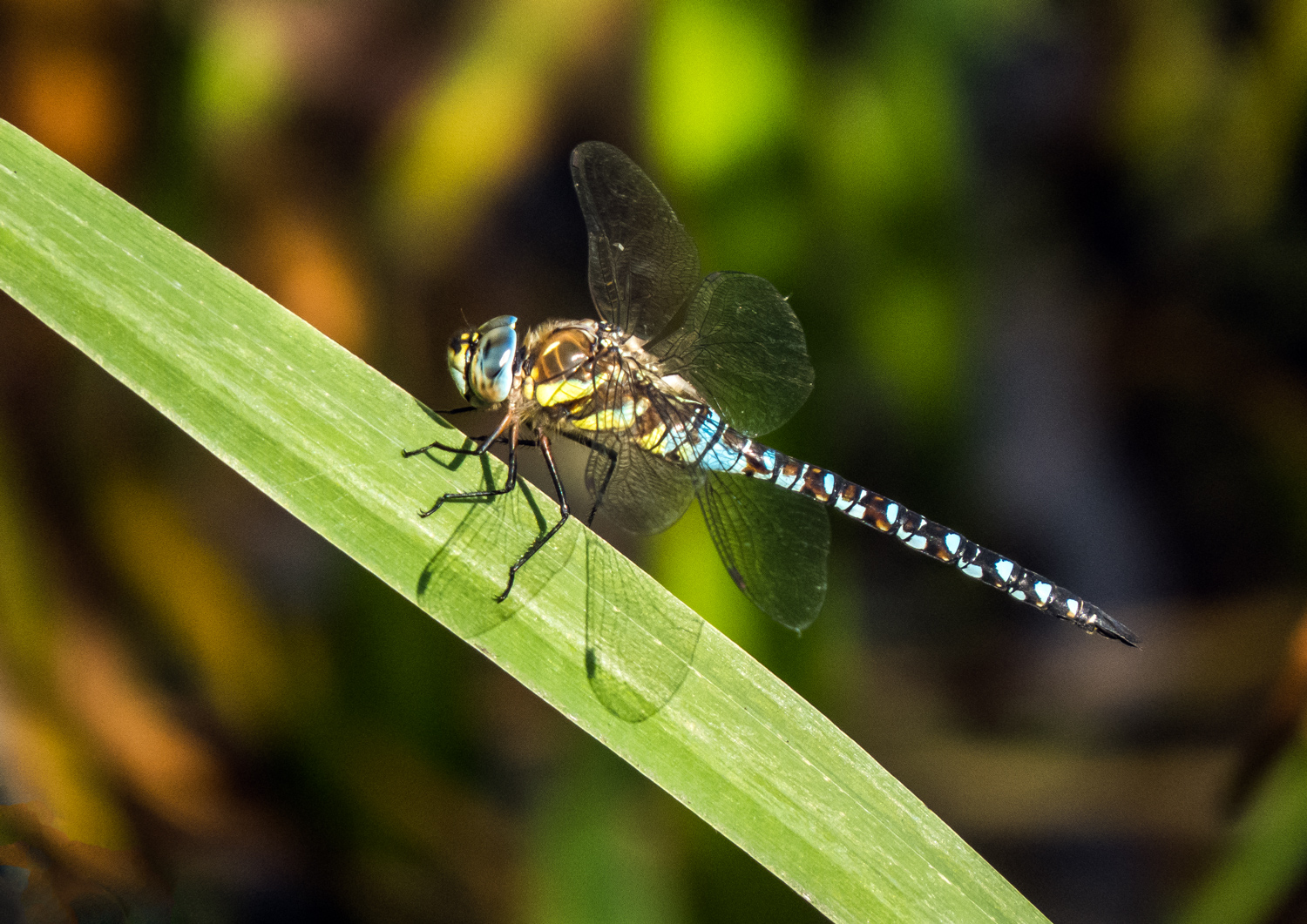
Common Baskettail dragonflies, which are only about 1.6 inches (41 mm) in length, spend a lot of their time in the air, but on that day I was fortunate when one of them decided to take a break and perched for a few moments low in the nearby vegetation. The second and third shots below provide a good side view of this beautiful little dragonfly, including its distinctive terminal appendages (the tip of its “tail”).

It’s a fun challenge for my patience and skills as a photographer to attempt to capture shots of dragonflies in flight and luck certainly plays a big part in achieving any success whatsoever. I can just about guarantee that I will be featuring a few more in-flight dragonfly photos in the upcoming months as the insects and I become more active outdoors.

Common Baskettail

Common Baskettail

Common Baskettail

© Michael Q. Powell. All rights reserved.
 

Read Full Post »

I do not tilt at windmills, but often find myself engaged in my personal quixotic quest of trying to photograph dragonflies in flight. It is such a challenging task that I titled a video that I posted on YouTube, “Impossible Shots? Dragonflies in flight.” Despite the almost overwhelming odds of getting a good shot of one of these aerial acrobats in flight, I feel irresistibly drawn to trying over and over again whenever I see a dragonfly in the air.

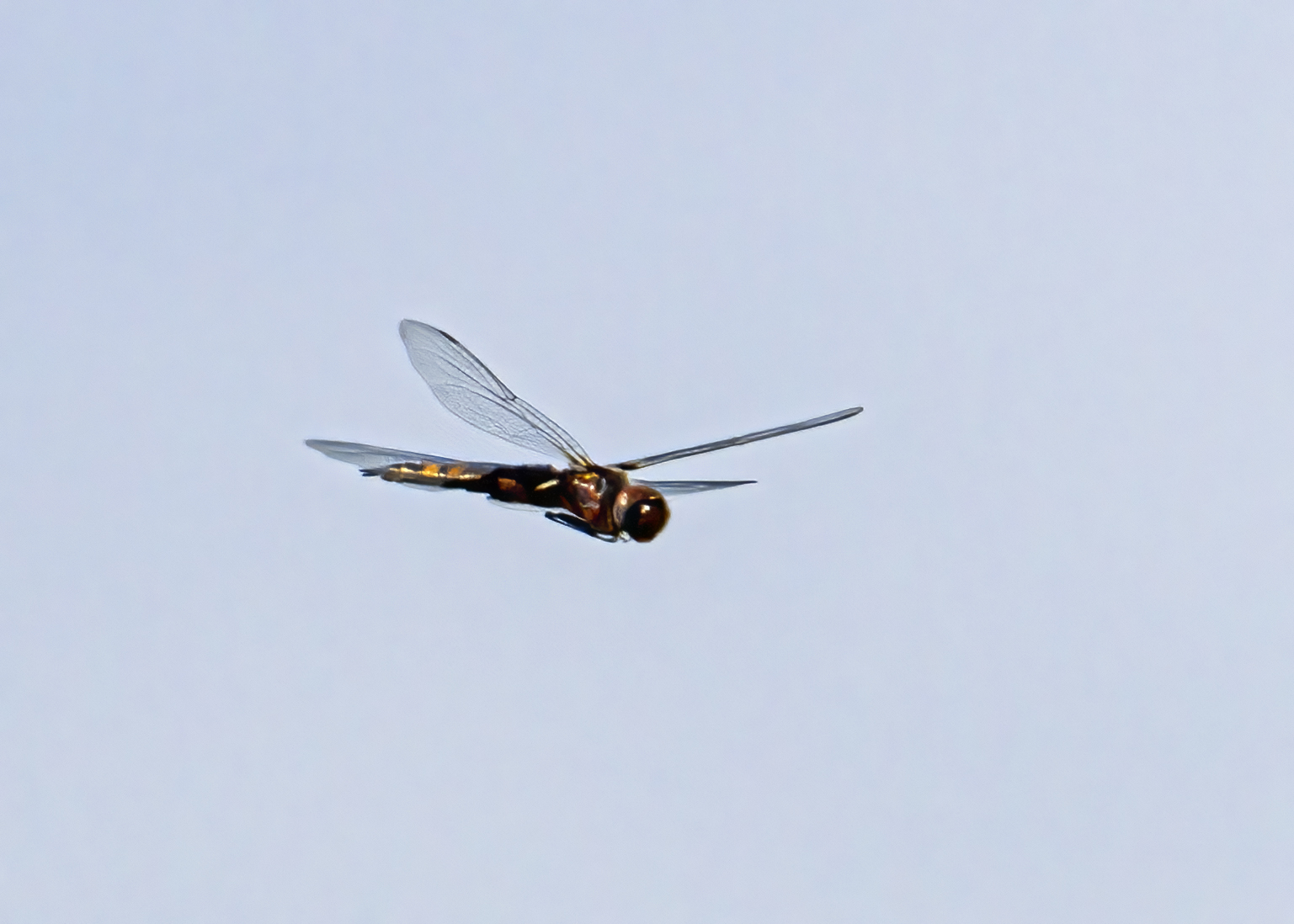
I spotted this Black Saddlebags dragonfly (Tramea lacerata) patrolling over the waters off of Occoquan Bay National Wildlife Refuge last Thursday and was thrilled to capture this shot of the dragonfly as it flew past me.Black Saddlebags dragonfly (Tramea lacerata). I love the way that you can see how the dragonfly had enhanced its aerodynamic profile by folding up its legs under its thorax, a bit like the way aircraft retract their landing gear after taking off.

In case you are curious, Black Saddlebags are only about 2 inches (52 mm) in length, so I have to be paying attention in order to even spot one. After years of pursuing my quest, though, my eyes are now calibrated to recognize the shape of a dragonfly pretty quickly and my hand-to-eye coordination has improved with practice, so that I am able to track these a lot better than when I started.

Black Saddlebags

© Michael Q. Powell. All rights reserved.

Read Full Post »

When I spotted a dragonfly patrolling over the water of a small pond yesterday at Jackson Miles Abbott Wetland Refuge, I knew almost immediately that it was a Prince Baskettail dragonfly (Epitheca princeps). How could I tell? As it flew by, I could catch glimpses of the dark patches on its wings and the Prince Baskettail is the only large dragonfly with patterned wings in our area. (Prince Baskettails are almost three inches (76 mm) in length).

Seeing the dragonfly in flight was easy, but getting a clear shot of it was a considerable challenge. I watched the dragonfly and was able to determine its approximate patrol area. When it flew into that area, I attempted to track it, sometimes using my camera’s autofocus and sometimes focusing manually. Most of my shots were out of focus or did not include the dragonfly in the frame, but I managed to get a few decent shots, with the image below being the best of the lot.

Some of my fellow wildlife photographers marvel at images like this and think that high end gear or special techniques are necessary. The reality, though, is that I use relatively modest equipment and the “secret” to my success quite often is a combination of patience, practice, and persistence.

Prince Baskettail

© Michael Q. Powell. All rights reserved.
Read Full Post »

Some of the species of birds and dragonflies with the word “common” in their names are quite rare in my area. However, Common Baskettail dragonflies (Epitheca cynosura) have been quite common this month and I have seen them at a number of different locations, most notably at the small ponds that I like to visit. At these ponds, I usually spot the Common Baskettails as they conducted repeated low patrols over the surface of the water and I can never resist the chance to photograph them while they are in flight.

As I have noted in the past, it is very challenging to photograph a dragonfly while it is flight. Sometimes the dragonflies will hover a bit, giving me a better chance of getting them in focus, but often they whiz on by and I try to track them in my viewfinder. Occasionally I will manage to use auto-focus, but often I resort to manual focus, which, of course, is tough with a moving subject. I try to determine the flight track they are using and identify likely areas that they will pass through and then pre-focus on that area and wait for them to come by. Needless to say, you have to be very patient and persistent if you want to try this kind of photography.

I captured the first two shots at a small pond in Prince William County and was quite pleased with the images. The two shots were taken as part of a sequence and are quite similar with the exception of the position of the wings. Normally I am so thrilled to get a sharp shot that I am not concerned about the wing position, but in this case I had the luxury of having several variants of essentially the same shot.

The final two shots were taken at the pond at Jackson Miles Abbott Wetland Refuge. There was vegetation surrounding the water at the spot where I was standing and it sometimes would obstruct my view as I tried to track the dragonfly. In the third photo, I used one of the offending pieces of vegetation as a compositional element that makes it look like the dragonfly was approaching a finish line tape.

I included the final photo to give you a sense of the habitat. In several areas of the pond there were patches of lily pads and I tried to capture shots of the dragonfly flying over the lily pads. I was largely unsuccessful, but the photo gives you an idea of what I was trying to accomplish. (If this were a shot of a bird, it would definitely qualify as “butt shot,”but I am not sure that you can really say that a dragonfly has a “butt.”)

Common Baskettail

Common Baskettail

Common Baskettail

Common Baskettail

© Michael Q. Powell. All rights reserved.

Read Full Post »

I was happy last Thursday when a Black Saddlebags dragonfly (Tramea lacerata) that I had been tracking overhead at Occoquan Bay National Wildlife Refuge perched for a moment, allowing me to capture this first image.  While it was flying, I attempted multiple times to get a shot of it, with minimal success. The second photo is my best one.

Some dragonflies spend a lot of their time perched, but Black Saddlebags are one of the species that spends most of its time in the air, so it is rewarding to be able to see one land and to get a shot of it. Black Saddlebags are also one of the few dragonfly species that are migrate although, according to the Dragonflies of Northern Virginia website, scientists do not fully understand why they do so and have been studying their migratory patterns.

Black Saddlebags

Black Saddlebags

© Michael Q. Powell. All rights reserved.

Read Full Post »

When I am writing a blog posting with multiple photos, I will usually lead with the “best” photo. Most of the time I have a clear favorite image, but today I struggled a bit in trying to decide which image of a Calico Pennant (Celithemis elisa) was the “best” one. I was delighted on Monday at Occoquan Bay National Wildlife Refuge to have multiple opportunities to photograph male Calico Pennants, which are among the most striking dragonflies that I encounter, thanks to their bold coloration and wonderfully patterned wings.

From a technical perspective, the first image could be considered the “best.” The background is pleasantly blurred and virtually all of the dragonfly’s features are in sharp focus. Graphically this image stands out, even when viewed as a thumbnail on a cell phone.

The background in the second image is considerably more cluttered than in the first image. However, I think the color contrast between the bright red of the dragonfly and the pinkish-purple colors in the background makes it easy to see the primary subject. The vegetation helps to provide the viewer with a sense of the environment in which I photographed the dragonfly.

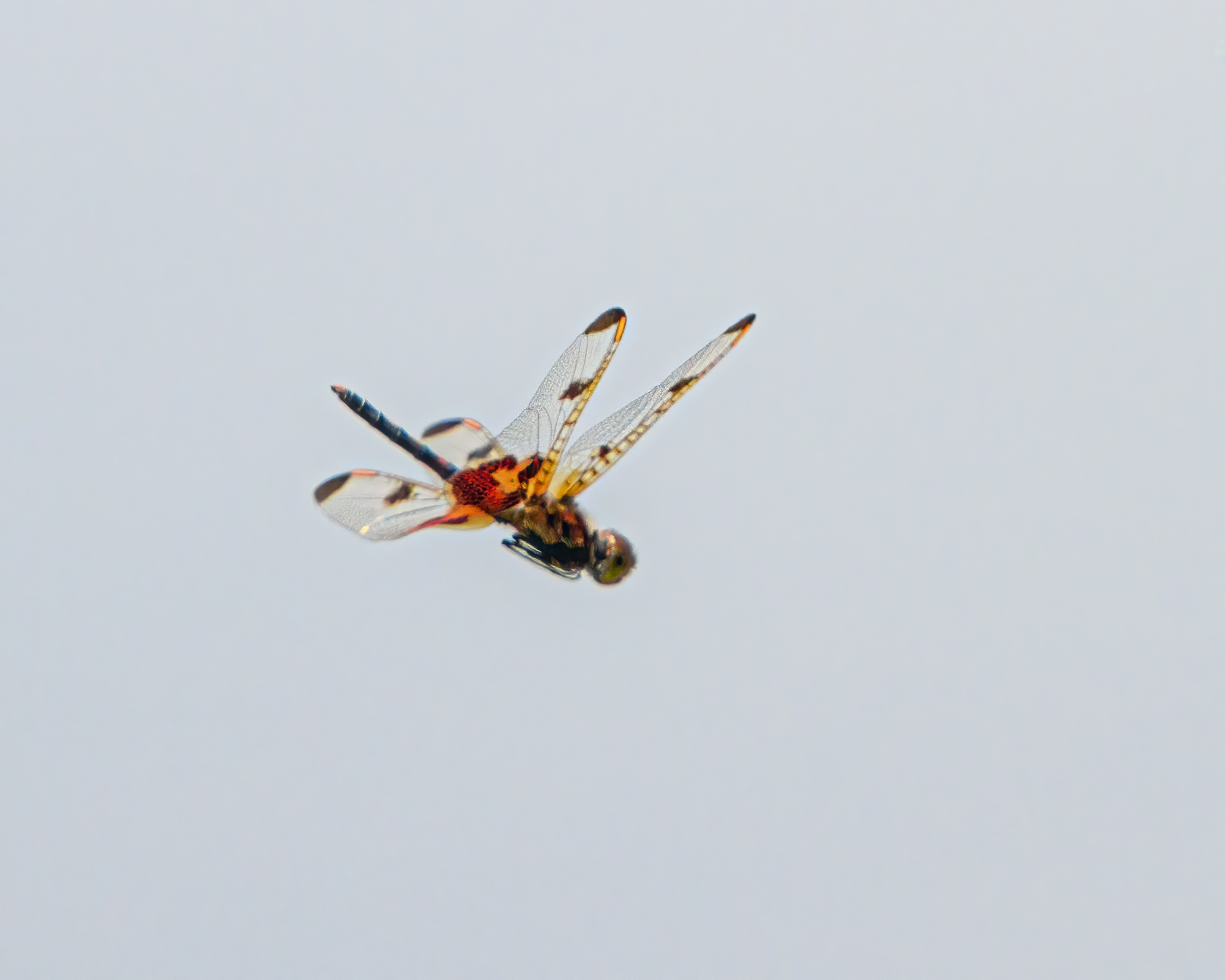
The third image was the most challenging to capture. Several Calico Pennants were flying around over the waters of a pond and I was thrilled to capture this in-flight shot, my first such photo of this species. Most of the other dragonflies that I have photographed as they were flying were considerably larger—a Calico Pennant is only about 1.3 inches (33 mm) in length—and it took a lot of persistence and concentration to get this shot.

The final shot was a lucky one. I was focused on the perched dragonfly and reacted quickly when it took off. From an artistic perspective, I really like this image. The mottled colors of the pond works well as a backdrop for the action and the contrast between the muddy brown and the bright red of the dragonfly makes the subject “pop.” I love the texture of the branch and the branch helps to lead the viewer’s eyes to the dragonfly. Finally, the dragonfly’s wing patterns are displayed beautifully as I managed to capture a moment when they were fully extended.

I don’t know if it is possible for me to state definitively which one of these images is the “best”—I like each of them for different reasons. Is there one that stands out to you more than the others? I’d welcome your views on this question.

Calico Pennant

Calico Pennant

Calico Pennant

Calico Pennant

© Michael Q. Powell. All rights reserved.

Read Full Post »

Whenever I see a dragonfly in flight when I am traipsing about with my camera, I can’t help but stop and try to get a photograph of the dragonfly in the air. My success rate in not high, but sometimes I am able to capture a good image as the dragonfly zooms by me.

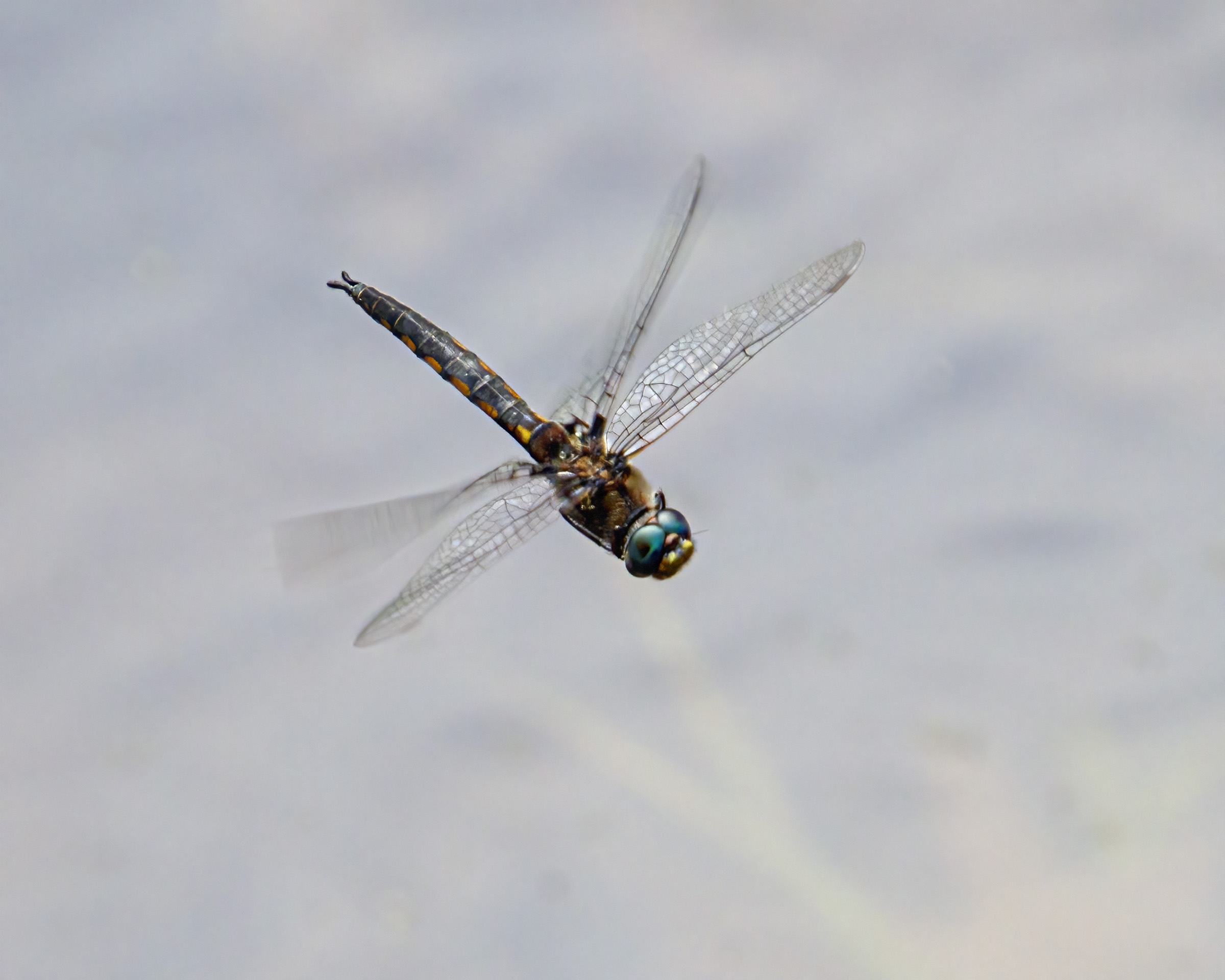
In mid-June I spotted a Common Baskettail dragonfly (Epitheca cynosura) as it flew back and forth over the pond at Jackson Miles Wetland Refuge. During one of its passes I managed to freeze its motion in this shot. I like the way that you can see all four wings and also the distinctive markings on its body. The bluish-green eyes really “pop” and if you look really closely, you can see the that the dragonfly folds its legs under its thorax (the torso part of its body) while it is flying.

I returned yesterday from my five-day trip up to Massachusetts and Maine to deal with a family emergency. Hopefully I will be able to get out this week and capture some new images. It’s hard to believe that it is already July.

Common Baskettail

© Michael Q. Powell. All rights reserved.

Read Full Post »

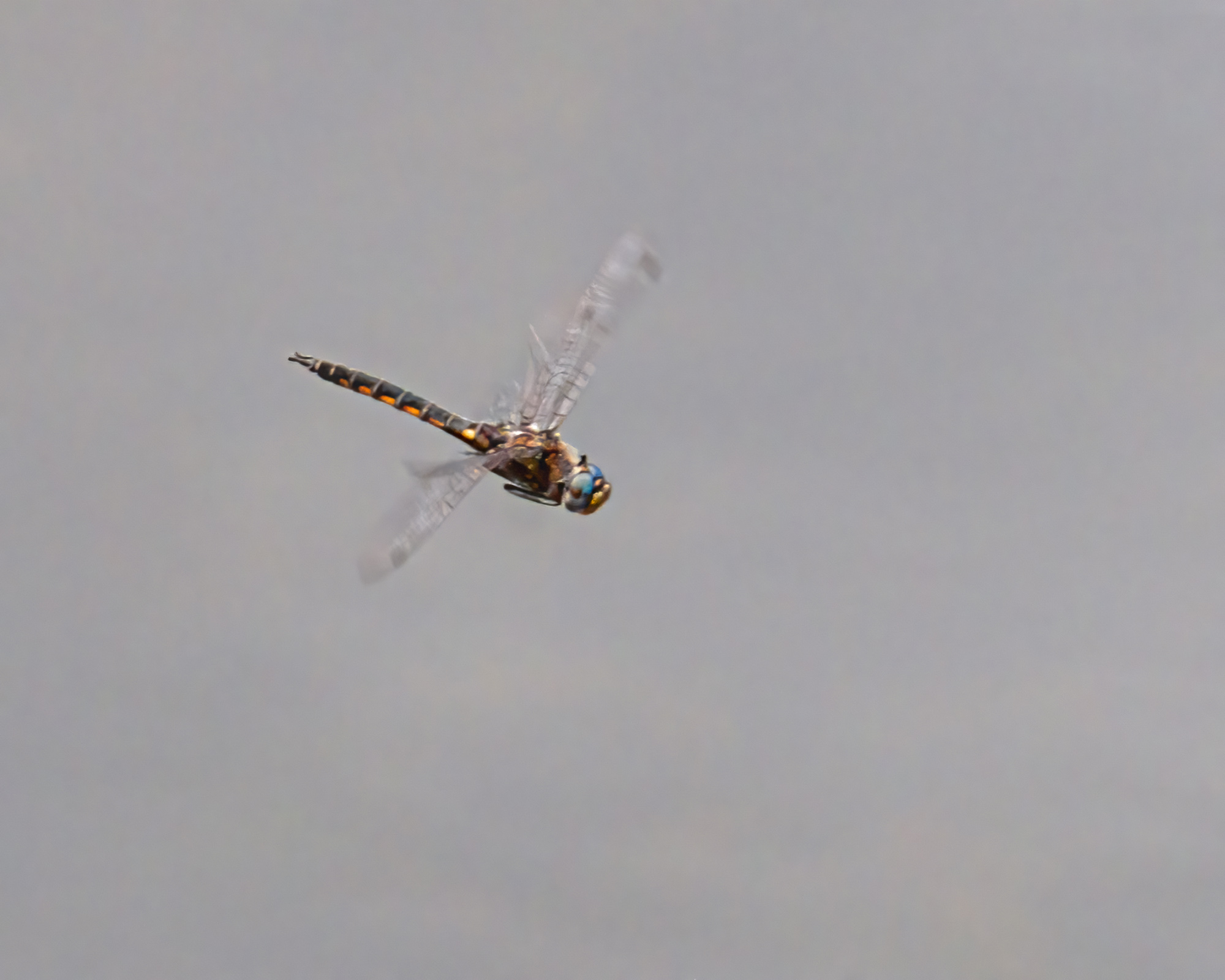
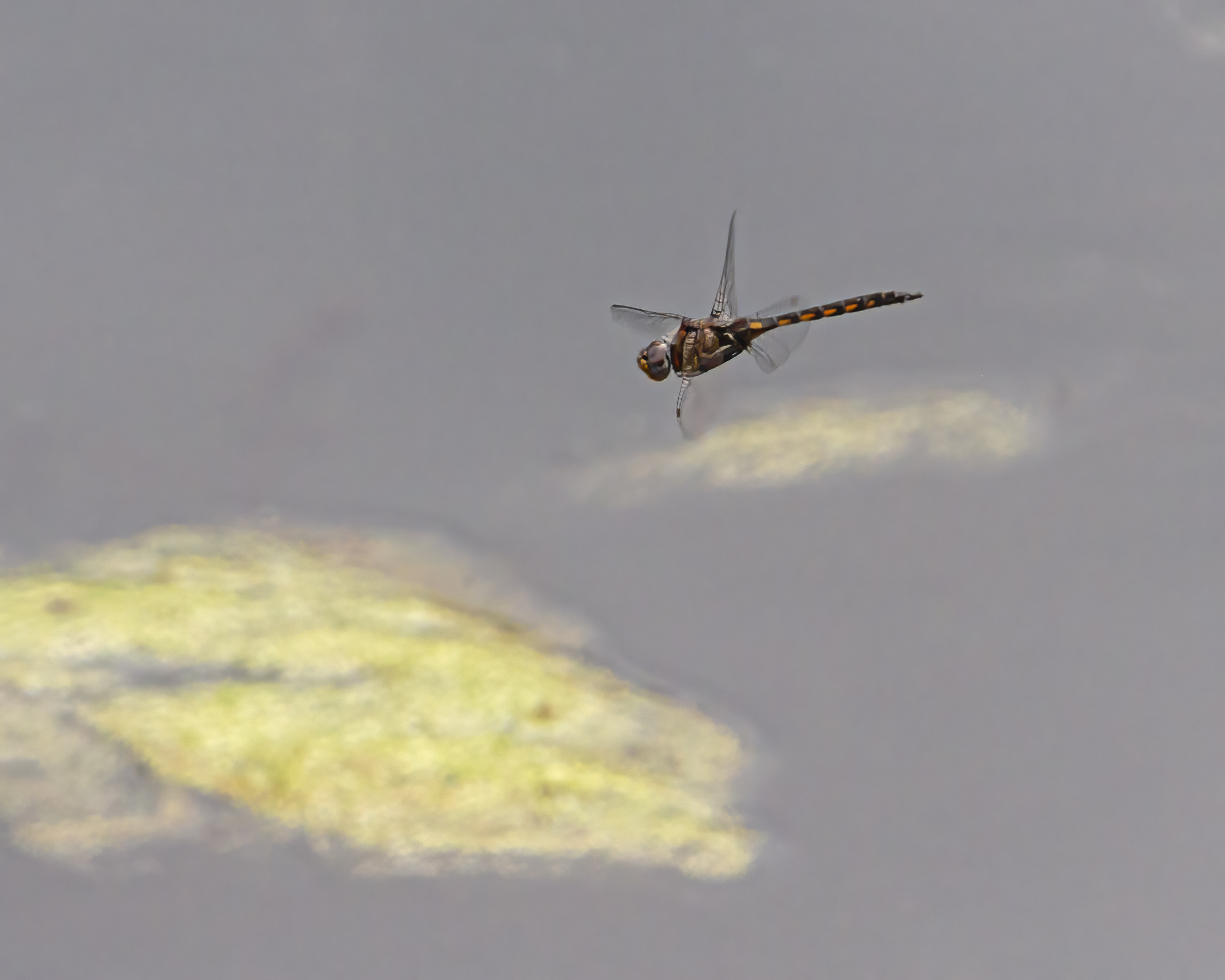
I can’t help myself. Whenever I see dragonflies flying over the water, I feel compelled to try to photograph them in flight. This past weekend I spotted several Common Baskettail dragonflies (Epitheca cynosura) flying patrols over a small pond in Orkney Springs, Virginia. The dragonflies flew by numerous times, giving me a lot of opportunities to take shots.

As is usually the case, most of my shots were out of focus or included only a portion of the dragonfly at the edge of the frame. However, as most of you know, I am quite persistent and eventually I managed to get some decent shots of the dragonflies.

Several of my sharpest shots show the dragonfly against a gray background, but lack a sense of the environment. The last three shots include patches of algae and give you a really cool perspective that reminds me of the view that you get from an airplane window when you look out and see another airplane along with the ground below.

Common Baskettail

Common Baskettail

Common Baskettail

Common Baskettail

Common Baskettail

© Michael Q. Powell. All rights reserved.


Read Full Post »

It is almost impossible, but I can’t help but try to capture images of dragonflies in flight. It is arguably the most difficult challenge of my ability to use my camera and also of my patience. None of the dragonflies in these photos flew close to the shores of the streams that I was exploring in Prince William County, Virginia, and I was using only a modest telephoto lens that I was focusing manually—the autofocus on my Tamron 180mm macro lens is relatively slow and could not focus on the dragonflies as they zoomed on by.

Last Wednesday I photographed the dragonfly in the first photo as it was patrolling over a creek. I believe that it is a Uhler’s Sundragon dragonfly (Helocordulia uhleri), which is about 1.8 inches (46 mm) in length. The dragonfly was not exactly following a pattern, but I was able to track it as it flew all around a small section of the creek.

The dragonfly in the second image may also be a Uhler’s Sundragon, though I am less confident of this identification. I really like the fact that the eyes of the dragonfly are in shart focus. It is probably just my imagination, but this dragonfly seemed to glance up at me and smile as it flew on by. In this photo, as in the first one, you really have a sense of the environment in which I found the dragonfly.

I captured the final image on Friday as I was exploring a different creek in Prince William County. The dragonfly in this photo was much larger than the ones in the other photos and was flying much faster and seemed to be conducting patrols over a much longer stretch of the creek. All the image was not completely sharp, I captured enough details to be able to identify it as male Stream Cruiser (Didymops transversa) dragonfly, a species that is about 2.2 inches (56 mm) in length.

Last year I did a short video on YouTube called Impossible Shots? Dragonflies in Flight in which I talked about one of my forays into the field and highlighted my approach to photographing dragonflies. Check it out if you want to see some more shots of dragonflies in flight or if you simply want to hear my voice and see my face. I included a link to the video in the title of the video (which should appear in color and underlined) and am also going to try to paste it into the end of posting, so you don’t have to go to YouTube to watch it. I am still just dabbling in video, but want to try to do more of it this year.

Uhler's Sundragon

Uhler's Sundragon

Stream Cruiser

© Michael Q. Powell. All rights reserved.

Read Full Post »

Here are some shots of Russet-tipped Clubtail dragonflies (Stylurus plagiatus) that I photographed at Jackson Miles Abbot Wetland Refuge last Saturday. The first image shows a male perched in an evergreen tree. Sharp-eyed views may recognize this tree, which is the same one on which yesterday’s Common Green Darner was perched.

The second image shows a female Russet-tipped Clubtail in some vegetation. If you compare the tip of her abdomen (the “tail”) with that of the first dragonfly, you can readily see they they are different. That is one of the reasons why the terminal appendages of a dragonfly are a key identification feature in determining the gender of an individual. You can’t help but notice that her left hind wind is almost completely shredded. I suspect that she can still fly, albeit with some difficulty.

The final shot shows a male in flight over the pond at the refuge. This is the first time that I have gotten an identifiable shot of this species in the air. I actually did not realize that it was a Russet-tipped Clubtail when I took a burst of shots of then flying dragonfly. I had simply reacted instinctively when I spotted the dragonfly—if it’s flying, I’m trying. It was a pleasant surprise when I opened the images on my computer and realized what I had captured.

There are a few species that emerge in September, so this year’s dragonfly season is far from over. Tomorrow marks the start of a new month, a month that I hope will be full of new opportunities for me and for all of you.

Russet-tipped Clubtail

Russet-tipped Clubtail

Russet-tipped Clubtail

© Michael Q. Powell. All rights reserved.

Read Full Post »

Black Saddlebags dragonflies (Tramea lacerata) like to fly high overhead, back and forth over trails and fields in pursuit of tiny insects that are often invisible to my eyes. They are pretty easy to identify because of the distinctive large dark patches on their wings that you can pick out even when they are flying. They are a challenge to photograph, though, because they rarely seem to perch.

When I spotted this patrolling Black Saddlebags on Monday at Occoquan Bay National Wildlife Refuge, I decided to try to capture some in-flight action shots of the dragonfly. When I am trying to photograph a dragonfly flying over a pond, I can sometimes pre-focus on an area, because the dragonfly stays at the same height above the water and flies in a somewhat predictable pattern. That technique does not work, however, with a dragonfly like the Black Saddlebags that changes altitude and direction quickly and without warning.

The first two photos give you a pretty good look at the wing pattern of the Black Saddlebags. If you look really closely at the first photo, you will note that the dragonfly has tucked in its legs under the thorax (the “chest” area), probably for aerodynamic reasons.

In the final photo, I noted that the dragonfly’s legs were extended. What was going on? As I was processing the shot, I noted some small white spots in front of and just above the dragonfly. At first I thought these might be dust spots on my sensor, but they were in different places on different shots, so I rejected that hypothesis. I think that those white spots, which you can see in the final image if you click on it and look very carefully, are small insects and the dragonfly was extending its legs to snag those insects.

The Black Saddlebags is one of several dragonfly species that migrates in the fall and this one may have been fattening up in preparation for the upcoming journey. Whatever the case, it was a fun challenge to try to photograph this dragonfly flying overhead.

Black Saddlebags

Black Saddlebags

Black Saddlebags

© Michael Q. Powell. All rights reserved.
Read Full Post »

As I stood at the edge of an open marshy area yesterday at Jackson Miles Abbott Wetland Refuge, I was excited to spot a large patrolling dragonfly. The dragonfly was flying low over the water in repetitive patterns and I suspected that it was a Cyrano Darner dragonfly (Nasiaeschna pentacantha), a species that I do not see very often.

When the dragonfly flew into the light I got a good enough look at it to confirm that it in fact was a Cyrano Darner. In case you are curious, the species is named for its long, protruding, greenish forehead that is somewhat reminiscent of the long nose of literary character Cyrano de Bergerac.

I kept hoping that the dragonfly would fly closer, but it kept its distance and the only shots I could get were at relatively long range. I am happy that I managed to capture some images that are more or less in focus and show some of the beautiful details of this dragonfly.

The second shot is a bit sharper and you can see the dragonfly’s colors and patterns better.  However, I have a slight preference for the first image, because the reflections of the vegetation in the water in the first shot give you a sense of environment that is lacking in the more clinical view of the second one.

Cyrano Darner

Cyrano Darner

© Michael Q. Powell. All rights reserved.


Read Full Post »

I can’t help myself—whenever I see a dragonfly moving through the air, I feel compelled to try to capture an image of the dragonfly in flight. It is an almost impossible challenge and success is often dependent as much on luck as it is on skill. Last Thursday as I was exploring in Prince William County, I was feeling particularly patient and repeatedly spotted dragonflies flying.

Early in the day at a small pond, I spotted a Carolina Saddlebags dragonfly (Tramea carolina) and a Common Green Darner (Anax junius) that were patrolling over the water. In situations like this when the dragonflies are flying at a constant height, it is marginally easier to get shots, because there is one fewer variable than when the dragonfly is moving up and down.The Carolina Saddlebags was flying a little closer to the shore, but I had to contend with all of the vegetation that wanted to grab my camera’s focus, so I focused manually (first photo). The Common Green Darner was flying over the open water that presented a less obstructed background, but it filled such a small part of the frame that again I was forced to focus manually—my camera’s auto-focus had trouble focusing quickly on the moving dragonfly (second photo).

My greatest challenge, however, came later in the day. If I were to assign a degree of difficulty to my photos, the final photo would be near the top of the list. When I moved to a new location and got out of my car, I immediately spotted a group of large dragonflies frenetically flying through the air, feasting on insects as they flew. The dragonflies were moving in unpredictable ways, constantly changing their flight altitude and speed. Unlike some dragonflies that hover a bit when patrolling, these dragonflies were in constant high-speed motion.

I did my best to track the dragonflies visually, but it was tough to even get one in my viewfinder. I was ecstatic when I finally managed to capture a more or less in-focus image of one of the Swamp Darners (Epiaeschna heros) as it zoomed past me relatively low to the ground, as you can see in the final photo.

When it comes to wildlife photography, some shots are easy and straightforward—I see something and take the shot and that is it. At other times, I have to work really hard and take a lot of shots before I can get a potentially good one. Last Thursday definitely fell in the latter category more than in the former one. Was all that effort worth it? I think so, but I must confess that at times I felt like Don Quixote tilting at windmills.

If you want to get a more detailed look at the details of the three flying dragonflies, be sure to click on the images.


Carolina Saddlebags


Common Green Darner

Swamp Darner

© Michael Q. Powell. All rights reserved.

Read Full Post »

I was thrilled last week to stumble upon some Brown Spiketail dragonflies (Cordulegaster bilineata) while I was exploring a stream in Prince William County. When I spotted them, they were patrolling really low, moving in and out of the stalks of the grass and other plants only inches above the ground. I was able to track several of them and capture multiple shots, including an in-flight shot when one of the Brown Spiketails decided to hover momentarily right in front of me.

According to the wonderful website Dragonflies of Northern Virginia, Brown Spiketails are considered “rare” in our area. Their preferred habitat is “clean, small sunlit, forest streams and seepages, ” an almost perfect match for the location where I spotted these dragonflies. The flight season lasts only about six weeks and peaks in mid-May.

Sometimes “my” Brown Spiketails would perch high enough above the ground that I could isolate the dragonfly from the background, as I did in the second image. Most of the time, though, they would perch low on grasses and shrubs, which meant that I too had to get low too to capture images like the third one. The background in that image is somewhat cluttered, but I think that it gives you a good sense of the habitat and the challenge of finding and focusing on such a narrow target.

Brown Spiketail

Brown Spiketail

brown spiketail

© Michael Q. Powell. All rights reserved.


Read Full Post »

If you want a fun photographic challenge, try to photograph a dragonfly in flight. It is definitely a test of your skill and patience to track and photograph a subject this small (about 1.6 inches (41 mm) in this case) while it is flying past you. I captured this image of a male Common Baskettail dragonfly (Epitheca cynosura) last Thursday at Occoquan Bay National Wildlife Refuge.

Longtime readers of this blog know that I will try to photograph dragonflies in flight at least several times every season. Some dragonfly species, like this one, will hover a little at times, which gives me a slightly better chance of getting a shot that is in focus. My camera does not focus quickly and accurately enough for me to use autofocus, so I end up focusing manually most of the time.

This shot is unusual in that I managed to freeze all of the motion of the wings—most of the time the wings are blurry. If you click on the image to see it in higher resolution, you will also note the way that the Common Baskettail (and many other species) folds its legs up under its “chest” (technically it is called the “thorax”) while flying to minimize wind resistance.

For those of you who might be curious, I ended up cropping the original image significantly, because I took the photograph with “only” my 180 mm macro lens and the dragonfly was flying over the water—I would have to have been in the water to get any closer.

Common Baskettail

© Michael Q. Powell. All rights reserved.
Read Full Post »

If you are lucky and persistent, it is not hard to photograph a perched dragonfly. Some of them are amazingly tolerant of the presence of a human and will let you get really close to them. Even when they do fly away, many of them will return to the very same perch.

If you want to really challenge your skills as a photographer and perhaps even your sanity, you attempt to photograph members of dragonfly species that fly almost constantly and rarely perch, like this male Prince Baskettail dragonfly (Epitheca princeps) that I spotted late in June at Jackson Miles Abbott Wetland Refuge. This dragonfly was flying irregular patrols low over the waters of a small pond at the refuge—sometimes he would fly relatively close to the shore, but often his flight path was unpredictable.

So how do I do it? I generally use the same 180mm macro lens that I use for close-up shots of dragonflies. However, I know that the lens tends to focus slowly and autofocus simply can’t acquire the subject, because it fills such a small part of the frame, so I switch to manual focus. I pre-focus on a general area and then as I track the dragonfly, I adjust the focus on the fly as he zooms by and fire away in burst mode. As dragonflies go, a Prince Baskettail is relatively large, almost 3 inches in length (75 mm), but it is really tough to get an in focus shot of one while he is flying.

On a second occasion when I was visiting the same refuge, I got a chance to try a variation of the technique. The dragonflies were patrolling  high overhead as I stood in a grassy area at one end of the pond. The second shot was the best that I could manage—the wing pattern suggests that it is also a Prince Baskettail, but the eye coloration and the terminal appendages at the tip of the abdomen make me wonder if this one is a female. What I discovered is that it is actually a lot harder to focus on a dragonfly when I am looking straight up than when looking down at the water and my arms get tired a lot quicker when holding my camera up hight for an extended period of time.

Prince Baskettail

Prince Baskettail

© Michael Q. Powell. All rights reserved.


Read Full Post »

Do you like to challenge yourself? I like to try to photograph moving subjects. It is not easy, even when it is a large bird like a Great Blue Heron (Ardea herodias), but it is even more difficult when it is a small dragonfly, like this Common Baskettail (Epitheca cynosura) that I photographed last Wednesday at Ococoquan Bay National Wildlife Refuge.

The dragonfly was patrolling over a small pond and at certain moments would hover for a split second before continuing. It took quite a few attempts, but eventually I was able to capture this image, which is cropped from a much larger image that came out of my camera.

Different photographers use different techniques to capture shots of flying dragonflies. I personally use my 180mm macro lens and focus manually, because the autofocus on the lens is notoriously slow and has trouble achieving focus with such a small subject. Every year I try this same challenge, often multiple times, so with a little luck and a lot of patience and persistence, I hope to be able to do more postings of dragonflies in flight in the upcoming months.

Common Baskettail

© Michael Q. Powell. All rights reserved.
Read Full Post »

Do dragonflies have noses? That sounds like a crazy question, but it is the first one that came to mind when I looked at the image that I had captured of a dragonfly in flight this past week at Jackson Miles Abbott Wetland Refuge. I could not immediately identify it, so I consulted with experts in a Facebook group and learned that it is a Cyrano Darner (Nasiaeschna pentacantha). This species has a protruding forehead—it’s not a nose— that is reminiscent of the long nose of literary character Cyrano de Bergerac.

The species in the second shot is a Prince Baskettail (Epitheca cynosura), a species that I have featured multiple times in this blog. During much of the summer, I can usually spot one or two Prince Baskettail dragonflies patrolling over the pond at the same wetland refuge and I love trying to capture shots of them in flight. What makes this image distinctive, though, is not so much the dragonfly, but the background. There were ripples in the pond and the way that I shot and processed the image turned them into a wonderfully abstract background.

When I post photos like these, I often get questions about how I am able to capture images of flying dragonflies. Luck and persistence are the keys to getting shots like these. I use my 180mm macro lens and focus manually as the dragonflies zoom by, because the dragonflies don’t fill enough of the frame for my auto-focus to engage quickly and accurately. I have found that is almost impossible for me to use a zoom lens in this task—I get overwhelmed when I try to zoom, track, and focus simultaneously.

Cyrano Darner

Prince Baskettail

© Michael Q. Powell. All rights reserved.


Read Full Post »

Do you like a fun photo challenge? Try taking a photo of a dragonfly as it zooms on by you.

Here’s an image I captured on Tuesday of a Common Baskettail dragonfly (Epitheca cynosura) in flight at Patuxent Research Refuge in Laurel, Maryland. In case you are curious, Common Baskettails are about 1.6 inches in length (41 mm).

So how would you go about getting a shot like this? I would say that the key requirements are patience and persistence. The first thing that I usually do is observe the dragonfly’s flight path and try to determine if there are particular places where it tends to hover or turn around. This particular dragonfly was flying low and not too far from the shore of a small pond.

Focusing is the biggest problem. Some photographers like to pre-focus on an area and wait for the dragonfly to fly into that area. Others will rely on the auto-focus capabilities of their cameras. I have had almost no success with those techniques. What I usually do is put my camera’s focus into manual mode and literally change focus on the fly as I attempt to track the dragonfly in the air.

I like to use my Tamron 180 mm macro lens, because it gives me a decent amount of reach and frees me from worrying about zooming in and out. I have found that simultaneously zooming and focusing manually while tracking the dragonfly is like patting your head and rubbing your stomach at the same time—it is theoretically possible but tough to accomplish in real life.

If you click on the image and view it in a larger size, you will see that I was fortunate to get my focus just about right for the middle of the dragonfly’s body. The shutter speed of 1/1000 of a second was fast enough to freeze most of the movement of the wings.

Needless to say, I took a lot of shots and my success rate was very low. Perhaps this is not your idea of a “fun” challenge. In that case, I would encourage you to find some area of your life and challenge yourself to do something that is difficult. Even if you are not successful, I think even the effort will help you to grow, especially in self-knowledge and self-awareness.

Common Baskettail

© Michael Q. Powell. All rights reserved.

Read Full Post »

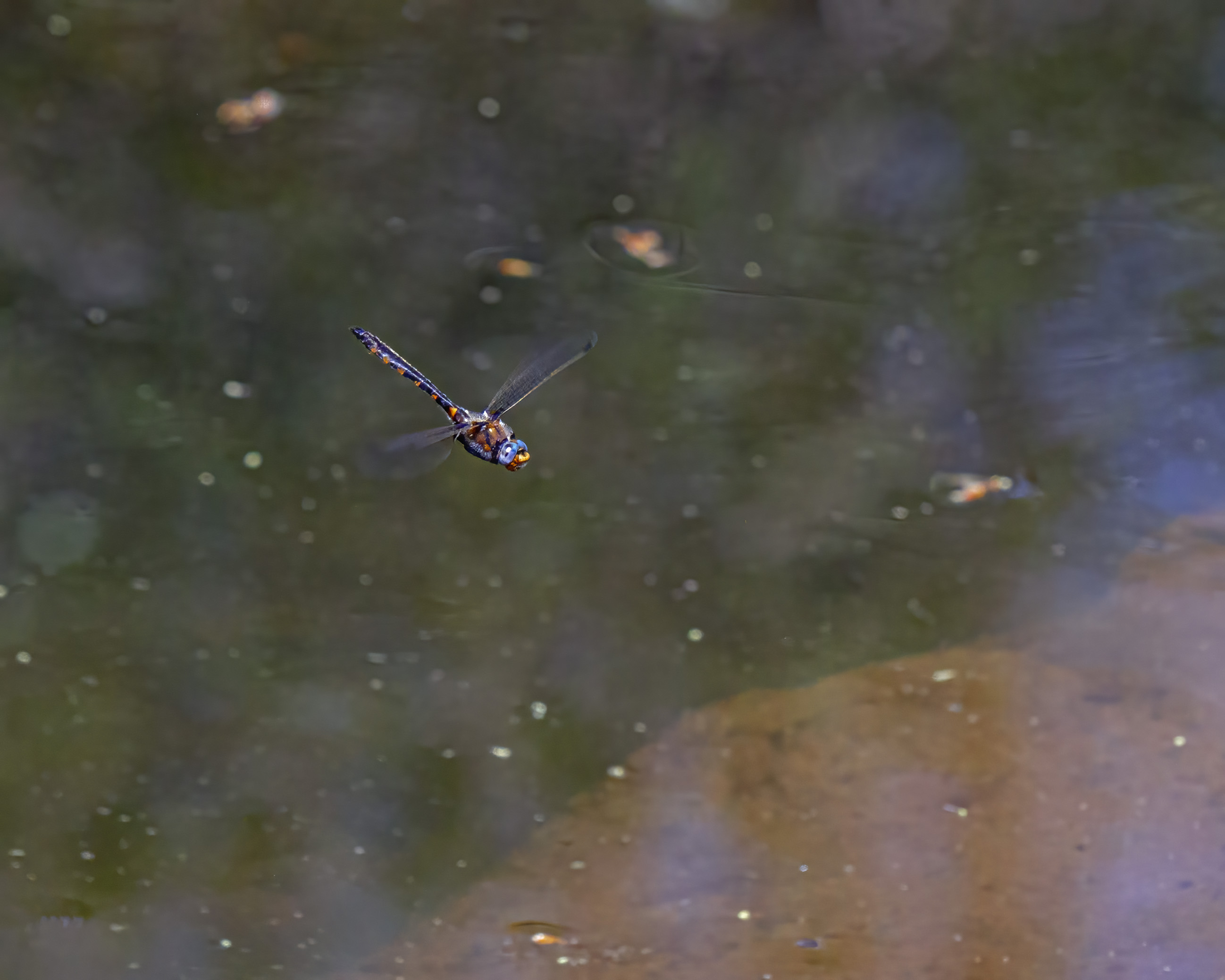
This Prince Baskettail dragonfly (Epitheca princeps) almost looks like it was flying at an airplane’s cruising altitude and was looking down at a landscape with rivers, mountains, and lakes. I spotted this dragonfly last weekend at Occoquan Bay National Wildlife Refuge and spent quite a while trying to get a shot of it in flight.

The dragonfly, however, never ventured close enough to shore for me to get a detailed shot of it. I was a little disappointed until I opened up the image on my computer and discovered that I had managed to capture a wonderful, fanciful background. Sometimes I try to document the reality that I see and other times it seems like it is just my imagination running away with me.

Prince Baskettail

© Michael Q. Powell. All rights reserved.
Read Full Post »

From time to time I will try to capture images of dragonflies in flight. Even under the best of circumstances it is a tough challenge for dragonflies are small, fast, and agile. Occasionally they will hover briefly, though most of the time it seems they choose to do so only when they are a long way away from me.

This past Monday I visited Jackson Miles Abbott Wetland Refuge and was surprised at the number of Swift Setwing dragonflies (Dythemis velox) that I observed there. As far as I know, this is the only location in our area where this species can be found. Swift Setwings are primarily a southern species, but seem to be migrating slowing northward.

Swift Setwings are  pretty small, about 1-6 to 2 inches long (42 to 50 mm), and the males, the only ones that I generally see, tend to perch at the edge of the water in overhanging vegetation. On this particular day, the dragonflies seemed to be particularly skittish, flying off as soon as I approached them. That was what prompted me to try to photograph them in flight. My Tamron 180mm macro is notoriously slow in focusing and tends to hunt a lot, so I switched to manual focusing. I made a lot of attempts and managed to get a few photos that were relatively in focus like the second image below.

While I was tracking one Swift Setwing in my viewfinder, a second one flew in and the two hooked up in mid-air in a mating position. They held the position for only a brief moment before disengaging and flying away in separate directions. I will spare you the anatomical details, but, as you can see in the first photo, dragonflies are quite acrobatic and flexible when mating.

So if you want a real photographic challenge, go out and see if you can capture some images of dragonflies in flight. It’s a fun challenge for me, even when I am not successful. If others see you doing so, it will reinforce the notion that wildlife photographers are a bit crazy, a perception that is accurate in many cases.

Swift Setwing

Swift Setwing

© Michael Q. Powell. All rights reserved.


Read Full Post »

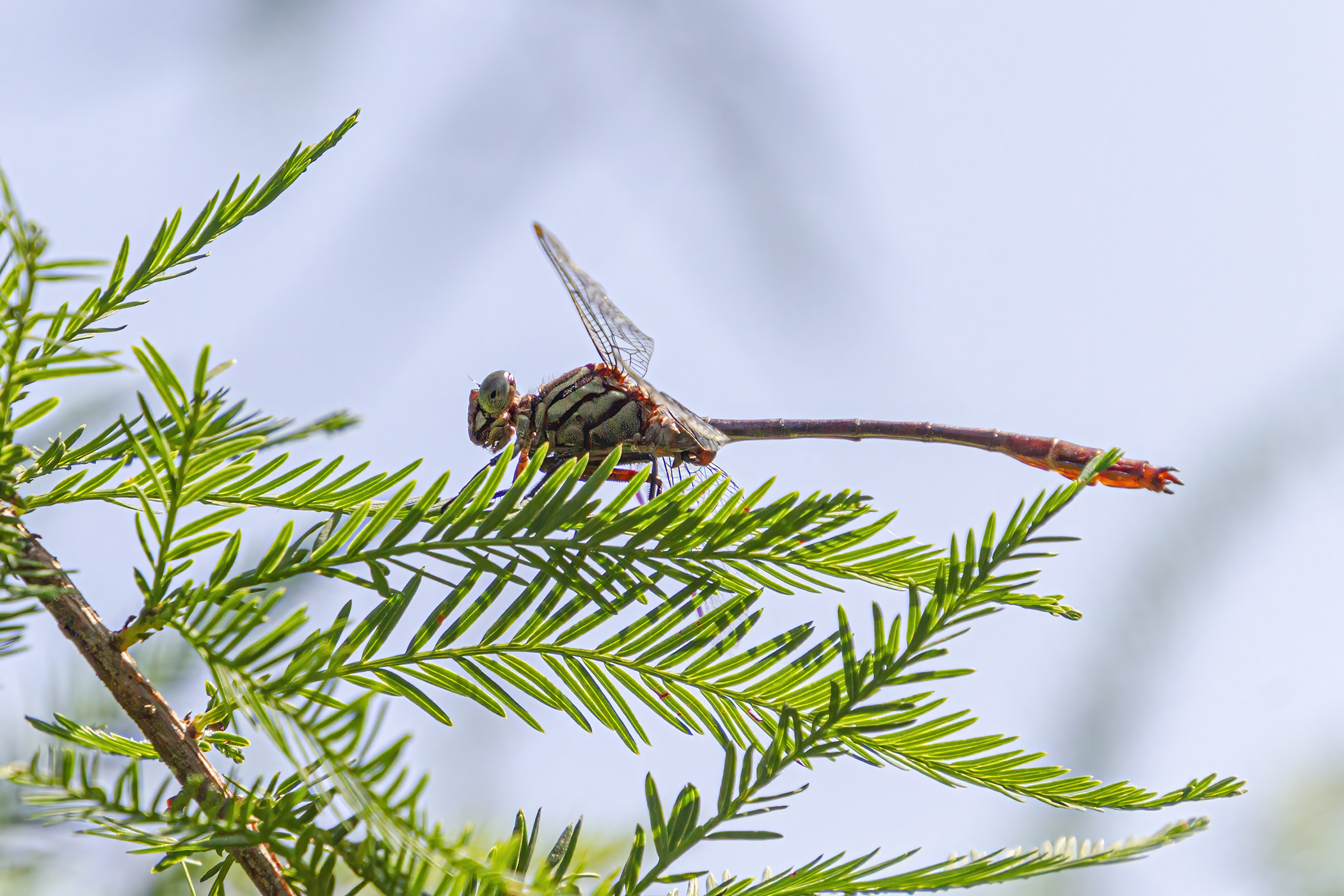
During this past weekend here in Brussels, I managed to find some really cool dragonflies, like this Green-eyed Hawker (Anaciaeschna isoceles or Aeshna isoceles) that I spotted at a pond in the Rouge-Cloître (Red Cloister) Park. This rather large dragonfly, also known as a Norfolk Hawker, is really striking as it flies, with a combination of colors that I have never seen before on a dragonfly.

With a bit of persistence and a lot of luck, I managed to capture an in-flight shot of a Green-eyed Hawker, but mostly I waited and waited for one to land. It was a little frustrating when one of them would land in a location that was too far away or in a location that did not afford me a clear shot, but eventually I was able to capture some images of a perching Green-eyed Hawker.

I was happy to capture the last photo that shows the yellow triangle on the upper part of the abdomen that is responsible for the “isoceles” portion of the Latin name of the species.

Green-eyed Hawker

Green-eyed Hawker

Green-eyed Hawker

© Michael Q. Powell. All rights reserved.
Read Full Post »

Are you patient and persistent? If so, you have the right temperament to try to photograph dragonflies in flight. Every dragonfly season I spent endless hours in mostly fruitless attempts to capture in-flight images of dragonflies. One of my friends on Facebook described this as “a near impossible task” and, of course, she is right.

My first somewhat successful effort this year was a shot of a Common Green Darner (Anax junius) patrolling above one of the paths at Occoquan Bay National Wildlife Refuge last Friday. As you might suspect, getting the moving dragonfly in focus is one of the biggest challenges, because the subject is too small for the camera’s autofocus to engage. Sometimes I will focus manually as I track the dragonfly and sometimes I will use a zone focusing technique in which I preset the focusing distance and wait (and hope) for the dragonfly to fly into the zone.

A near impossible task? It certainly is, but I enjoy the challenge the way that its pursuit confounds observers—one such observer watched me closely for several minutes on Friday and couldn’t figure out what I was trying to photograph.

Common Green Darner

© Michael Q. Powell. All rights reserved.


Read Full Post »

For quite some time I chased after a male Fine-lined Emerald dragonfly (Somatochlora filosa) one morning last week at Occoquan Bay National Wildlife Refuge, but it seemingly had endless energy and would not stop to perch. Unwilling to give up, I decided to try to shoot him in mid-air as he patrolled a section of a trail.

As you might suspect, it is pretty challenging to shoot dragonflies in mid-air. If you have a high-end camera with a really good focusing system and a fast, responsive lens, you might be able to use auto focus, assuming you  are able to track the dragonfly in your camera’s viewfinder. I was using my somewhat older Canon 50D DSLR, a camera that was made starting in 2008, and my Tamron 150-600mm zoom lens, which is sometimes slow in acquiring focus, so I was focusing manually. In this situation, I was helped a little by the fact that the dragonfly would hover a bit from time to time, although usually he would do so while facing away from me.

Patience and persistence paid off and I was pretty excited when I was able to capture this shot.

Fine-lined Emerald

© Michael Q. Powell. All rights reserved.

Read Full Post »

When I first saw this dragonfly land yesterday at Occoquan Bay National Wildlife Refuge, I had no idea what it was. Zooming in, I was shocked to see that it was a Wandering Glider (Pantala flavescens), a migratory species that almost never perches.

The Wandering Glider is considered to be the most widespread dragonfly in the world, found on every continent except Antarctica. According to odonatacentral.com, “It is a strong flier that is regularly encountered by ocean freighters and a well-known migratory species. Because of its ability to drift with the wind, feeding on aerial plankton, until it finally encounters a rain pool in which it breeds, it has been called “…the world’s most evolved dragonfly.” ”

After I got the initial shots of the dragonfly on two different perches, I decided to follow the dragonfly and wait for it to perch again. It wandered about through the air over my head for an extended period of time and never again came down to land. The last photo gives you an idea of my view during that period of waiting—note the long wings that help it to fly such long distances.

Wandering Glider

Wandering Glider

Wandering Glider

© Michael Q. Powell. All rights reserved

Read Full Post »

The most colorful dragonfly that I have spotted in Brussels during this trip has been a spectacular male Migrant Hawker dragonfly (Aeshna mixta) that was flying patrols over a small pond at the botanical garden.  It spent a lot of time in the air, but occasionally would perch for a short while. Every now it then it would hover over the water, which let me capture the second shot of the dragonfly in flight. My Canon SX50 is a little slow in acquiring focus, so I didn’t think that I would be able to capture any action shots of the dragonfly. However, I kept trying and eventually was able to get a reasonably sharp shot. When I checked out the shooting data for the image, I realized that the shutter speed had dropped to 1/100 second because of the dark water, so it’s almost a miracle that I stopped the action at all—I was shooting in aperture priority mode and was letting the camera choose the shutter speed.

Migrant Hawker

Migrant Hawker

 © Michael Q. Powell. All rights reserved

Read Full Post »

It’s a fun challenge to try to capture an image of a dragonfly in flight and I spent a lot of quality time this morning with a Prince Baskettail (Epitheca princeps) at Jackson Miles Abbott Wetland Refuge. Generally he flew patrols in the center of the pond, out of range of my lens (a 180mm macro), but occasionally he would fly tantalizingly close and give me a split second to react.

Most of the time I was unable to track him and focus quickly enough, but eventually I did manage get a few relatively sharp photos. This one is my favorite.

Prince Baskettail

© Michael Q. Powell. All rights reserved.

Read Full Post »

When fellow photographer and local dragonfly expert Walter Sanford posted a photo of a Russet-tailed Clubtail dragonfly (Stylurus plagiatus) that he had spotted on Thursday at Jackson Miles Abbott Wetlands Refuge, I was filled with an overwhelming urge to see if I could find the dragonfly. At this time of the year, as the dragonfly season winds down, I really don’t think much about finding new species, so this was an exciting challenge.

I knew the general location, but I forgot to ask Walter for more specific information about his find. Was it near the water or in the woods or along the stream or among the wildflowers? It was a kind of crazy quixotic quest, but I am pretty persistent, so I scoured the area, making loop after loop around a small pond.

My hope and my energy were beginning to fade when I suddenly caught sight of a dragonfly’s wings shining in the sunlight. The dragonfly was perched on some vegetation at the edge of the treeline. Moving as stealthily as I could, I approached the dragonfly and realized that I had found the Russet-tipped Clubtail. I often complain about the inappropriateness of the names of insects, but in this case it fit perfectly.

I managed to take a number of shots of the perching dragonfly before it flew off, heading deeper into the woods. After it had flown a short distance, it seemed to stop abruptly in mid-air. What was going on? I switched to manual focus and took a few shots and then began to worry that the dragonfly had gotten caught in a bit of spider web. (All morning long I kept running into spider webs at face level as I walked through the woods.) As I moved my hand closer to the dragonfly in an attempt to free it, the dragonfly flew off and disappeared. I didn’t see any evidence of a spider web, so it was probably only my overly active imagination.

This was one of my most memorable encounters with a dragonfly. I may stop by again this weekend to see if it is still hanging around, but the chances are not good that I will see it again. Still, lightning can strike twice and that kind of optimism helps to fuel my enthusiasm for photography.

Russet-tipped Clubtail

Russet-tipped Clubtail

© Michael Q. Powell. All rights reserved

Read Full Post »

Summer is definitely here. In the Washington D.C. area where I live, summer means endless stretches of hot, humid weather. Even the insects seem to move more slowly, like this Eastern Amberwing dragonfly (Perithemis tenera) that I recently photographed as it languidly buzzed around the vegetation at Brookside Gardens in Wheaton, Maryland.

Eastern Amberwing

© Michael Q. Powell. All rights reserved.

Read Full Post »

If you want a real photography challenge, try to get shots of dragonflies while they are in flight. Dragonflies are so small and generally move so quickly that it’s tough for the camera’s focusing system to lock onto them. On some occasions, dragonflies will hover for a few second or will follow the same route repeatedly and it’s slightly easier in those situations to capture images of the dragonfly.

Yesterday I spotted a dragonfly flying low over a slow-moving stream with its legs dangling. I have previously seen Common Sanddragons (Progomphus obscurus) on the sandy banks of this stream, but I had never seen a sanddragon act this way before. Most of the times that I have managed to get shots of dragonflies in flight, they have their legs tucked in, presumably to make themselves more aerodynamic. Initially I thought the dragonfly was coming in for a landing, but it flew around for a little while with the dangling legs.

What was this dragonfly doing? I don’t know for sure, but I wonder if perhaps this is a female dragonfly who was looking for a place in the water to deposit her eggs. Some dragonfly species deposit their eggs in vegetation and others will do so in the water.

I took these shots with my 180mm macro lens using auto focus.  I am happy that they are more or less in focus and show some of the details of the dragonfly. I like too the way that I was able to capture the dragonfly’s shadow as it was cast onto the water.

Common Sanddragon

Common Sanddragon

© Michael Q. Powell. All rights reserved.

Read Full Post »

What is the most difficult subject that you attempt to capture with your camera? Is it a certain moment when the lighting is perfect or perhaps an elusive, exotic creature in a distant location?

For me, the unicorns that I chase come in the form of dragonflies. I have an irrepressible desire to try to take photos of dragonflies while they are in mid-air. Sometimes the dragonflies will cooperate a bit and hover briefly over the water, but much of the time they are in constant motion as they zig and zag over the water in an often unpredictable pattern.

Yesterday I traveled with some fellow photographers to Lewis Ginter Botanical Gardens in Richmond, Virginia, primarily to photograph flowers. Not surprisingly for those who know me, I got distracted and focused much of my attention on searching for insects.

Toward the end of a gorgeous spring day, I finally spotted a dragonfly patrolling over a section of a small pond. I moved closer and tried to track it in my camera’s viewfinder. Over the winter, I’ve practiced tracking birds in flight and can usually keep them in the viewfinder—the challenge is to keep them in focus. With dragonflies, however, it’s a challenge to even keep them in the viewfinder and auto focus is a virtual impossibility.

Has anyone ever challenged you to pat your head and rub your stomach at the same time? That’s how I feel as I try to track a moving dragonfly and focus manually at the same time. I ended up with some out-of-focus ghostly images of the dragonfly or empty frames with a view of the water.

I managed to capture a single image that I really liked of what appears to be a Common Baskettail dragonfly (Epitheca cynosaura).  There is some motion blur, but you can see some of the beautiful details and colors of the dragonfly. (Check out a recent posting that I did to see an image of a perching Common Baskettail dragonfly at my local marshland park in late April.)

I don’t always check the EXIF data for my images, but I was curious to see what the settings were that produced this image. I was shocked to see the information, because I realized that I had neglected to change the settings of my camera when I moved from shooting a stationary subject in the sun to chasing a moving subject that was flying in and out of the shadows over the water.

The camera was set to ISO 100, f/11, 275mm (on a 70-300mm zoom lens) and 1/40 sec. Needless to say, that is not the shutter speed that I would have used if I had been paying more attention, but somehow it worked out ok. I was shooting in aperture-priority mode, as I do most of the time, and I probably should have been shooting at ISO 800, which would have given me a faster shutter speed. The bonus, though, of the low ISO was that I got a cleaner image that I could adjust more aggressively.

As we move into summer, I’ll continue my quest to capture other dragonflies in flight. For the moment, I am content with yesterday’s image, but fully recognize that a huge amount of luck was involved in capturing it.

Common Baskettail

© Michael Q. Powell. All rights reserved.


Read Full Post »

Older Posts »