Feeds:
Posts
Comments

Posts Tagged ‘Canon 55-250mm zoom lens’

Male Northern Cardinals (Cardinalis cardinalis) are featured in photographs much more frequently than their female counterparts. In fact, last week a male cardinal was the star of my blog entry entitled Cardinal Directions. The male cardinal is so bright and conspicuous that he is hard to miss, like a song played with the volume cranked up.

Sometimes, though, my eyes prefer a more delicate, refined beauty and at those moments I find the look of the lady cardinal more to my tastes. There is still some bright red coloration, but it serves as a tasteful accent against the warm brown tones of the rest of the body.

I usually have trouble getting clear shots of female cardinals, who seem to prefer the inside parts of bushes. In this case, I managed to get a mostly unobstructed view and the green of the background blurred out pretty well.

The position of her body is interesting too. It looks like she was facing forward and turned her head to look at me. Perhaps, though, I caught her in the midst of her morning exercise routine—the pose looks like the trunk twists that are done in aerobics classes. Cardinals (like most of us) are not immune to putting on some extra weight during the holiday season, it seems, and she may be trying to stay toned and fit.

Lady Cardinal

Lady Cardinal

© Michael Q. Powell. All rights reserved

Read Full Post »

Do you ever find that you totally missed a cool element of a photograph during initial review because the element was not near the center of the image? Today I looked over some squirrel shots from a week and a half ago and realized that the photo of a squirrel perched on the trunk of a tree was a whole lot more interesting than I had previously thought.

Hide and seek

Hide and seek

My attention had been so drawn to the downward-facing squirrel (is that a yoga pose?) that I didn’t even notice the squirrel in the upper right corner, peering out from inside the hollow tree. That squirrel is so cute that I enlarged the corner of the photo so you can appreciate its cuteness even more.

Cute squirrel

Cute squirrel

By itself, the cute squirrel would have been worth posting, but in combination with the other squirrel, it’s a really fun image.

The lesson learned for me is that I need to look at my photos more carefully during my first review or take the time to look at them later a second time with fresh eyes.

© Michael Q. Powell. All rights reserved.

Read Full Post »

Thia little bird that I photographed this past weekend is not in a tree, but I am pretty sure that he is an American Tree Sparrow (Spizella arborea). The reddish eye stripe and the two-toned bill made this identification easier than usual for me. This sparrow was amazingly active, pecking at a variety of plants close to the ground.

Why is he called a Tree Sparrow if he’s not in a tree? According to the Cornell Lab of Ornithology, the birds were misleadingly named by European settlers reminded of Eurasian Tree Sparrows back home.  American Tree Sparrows are in fact ground birds that forage on the ground and nest on the ground.

Has anyone ever told you that you eat like a bird? If so, I hope they weren’t referring to this sparrow. American Tree Sparrows need to take in about 30 percent of their body weight in food and a similar percentage in water each day, according to the Cornell Lab website.

American Tree Sparrow

American Tree Sparrow

© Michael Q. Powell. All rights reserved.

Read Full Post »

Do you ever find yourself really liking some of your photos that are full of technical flaws?

As a non-professional, I have had more than my fair share of blurry images, missed subjects, out-of-kilter compositions, and poor exposures. Many of them are deleted as soon as I view them on the back of the camera. Sometimes, though, the mistakes yield such interesting results that I can’t bear to delete them.

I arrived at the beaver lodge at my local marshland before the sun had fully risen one morning this past weekend, hoping to see the beavers in action. I had my camera set on ISO 400 and it was wide open at F4, with the mode set for aperture priority. I hadn’t yet set up my tripod, which I was hoping to use, because I anticipated relatively slow shutter speeds.
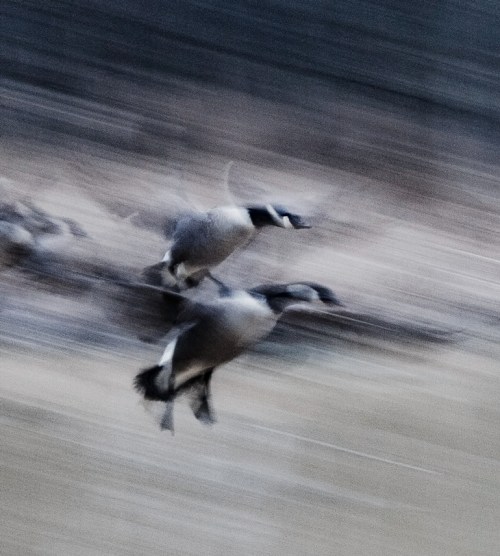
All of the sudden I hear the sound of geese approaching and it quickly became clear that they were coming in for a landing in the beaver pond. Without really thinking, I panned the camera and started shooting as I tried to follow the geese as they approached the water. Most of the photos were totally unusable. There was so little light that my camera chose a shutter speed of 1/6 of a second. Even with image stabilization, that’s too slow for handheld photos.
There was one image, however, that I really liked. The head of one goose is relatively in focus and another goose is visible (although out of focus) in the foreground. The background is blurred from my panning action. Somehow it reminds me of the photos they used to show of the finishes of races in which photos had to be developed to determine who crossed the finish line first. In this case, the geese seem to be leaning forward towards an invisible finish line in the same way that sprinters do.

Clearly this is not a great (or even good) photo, but I like it, and maybe others will find it interesting too.

Photo finish

Photo finish

© Michael Q. Powell. All rights reserved.

Read Full Post »

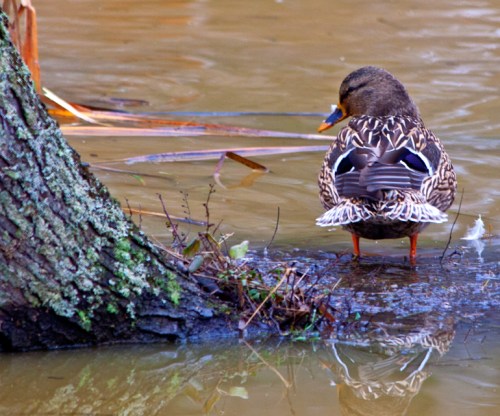
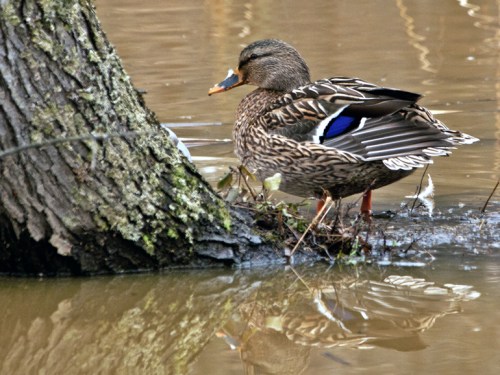
Most of the mallard ducks that I encountered today were busily foraging for food. One female mallard, however, had found a prime location on a mossy log in the pond opposite the beaver lodge and spent a lot of time preening her feathers.

It may have been my imagination, but she seemed to realize that she had an audience and began posing for me. Periodically she would even glance coyly in my direction (or so it seemed) to confirm that I was still watching her. As for the male mallards that would swim by from time to time—she ignored them completely.

Shy duck

Shy duck

Looking back

Looking back

Ready for my profile shot

Ready for my profile shot

© Michael Q. Powell. All rights reserved.

Read Full Post »

This morning I am in the mood for simplicity, so I am posting a single photo of a male Mallard Duck (Anas platyrhynchos) in flight. I like the geometric shapes in the image and how the light illuminates one wing, while keeping the other in the shadows. There is some color, but it doesn’t overwhelm the eyes. The photo is a simple one of a common subject—sometimes I need to slow down and see the beauty in simple things.

duck1_blog

© Michael Q. Powell. All rights reserved.

Read Full Post »

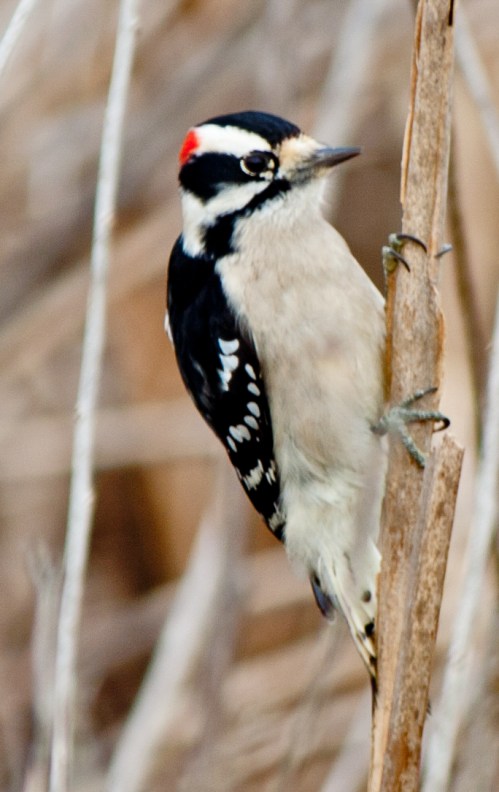
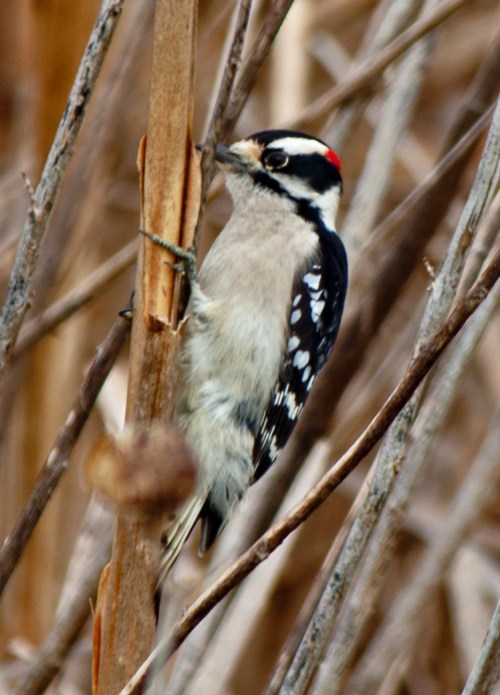
Never seeming to tire, a very active Downy Woodpecker (Picoides pubescens) yesterday was moving back and forth and up and down the stalks of cattails and other vegetation. I got tired just watching him as he performed some amazing acrobatic feats. The woodpecker would start at the bottom of each stalk and would gradually work his way up, grabbing whatever insects might be hidden inside. Many of the stalks seemed to thin to support the weight of a bird, but Downy Woodpeckers are not only small, about 5.5-6.7 inches long (14-17 cm), they are also really light at 0.7-1 oz (21-28 g), according to the Cornell Lab of Ornithology website.

I managed to get a few good shots of a male Downy Woodpecker showing some details of the bird. The first one includes a good view of his claws and the second one shows his beak, which is still partially imbedded in a piece of a stalk that had broken free.

downy2_blog

downy_blog

© Michael Q. Powell. All rights reserved.

Read Full Post »

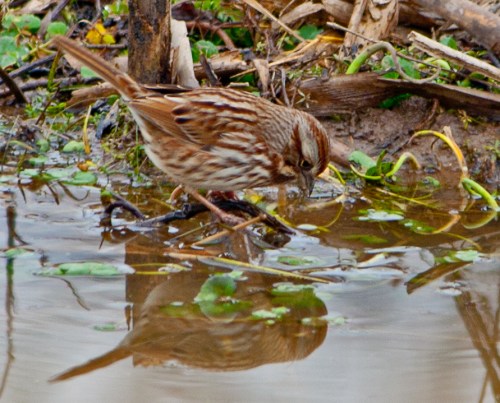
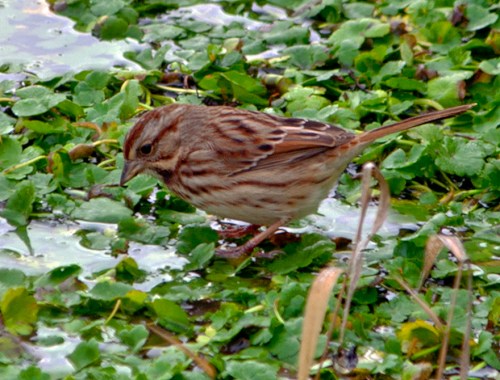
Birds seemed to be everywhere yesterday, foraging for food in the water, on dry land, 0r sometimes in between the. The latter was the case for two little brown birds, pecking for food in the still-green vegetation in the shallow marsh. Sometimes it seemed like they would stop and drink the water or gaze intently into the water, as though fascinated by their own reflection.

I am still not very good at identifying most birds on the spot, but my research skills are improving and I am pretty confident that these birds are Song Sparrows (Melospiza melodia). Gradually I am starting to see the distinguishing characteristics, like the color on the top of the head, the markings on the breast, and the shape and size of the beak.

This growing sense of the broad diversity among birds serves to magnify their beauty, as I see them as individuals, not merely as nameless little brown birds. Who knows, maybe birds appreciate it if you can call them by their names.

drink_blog

bird_green_blog

© Michael Q. Powell. All rights reserved.

Read Full Post »

The bright red plumage of the Northern cardinal (Cardinalis cardinalis) reminded me today that Christmas is almost here. I guess it is such an obvious association that National Geographic featured the cardinal on the cover of its “Holiday” catalog. Cliché or not, I can’t help but smile whenever my eyes catch sight of a cardinal and somehow my spirits are lifted, particularly when the weather is gray and gloomy as it was early this morning.

Here are a couple of shots of the same cardinal that may appear to be identical. However, if you look closer, you will notice that the cardinal has his head turned in a slightly different direction. In the first one, the cardinal was looking right at me. There seems to be something more personal about our interaction when our eyes meet. He looks a little like he is growing weary of posing for me, but is patiently waiting for me to be finished.

cardinal2_blog

In the second photo (which was actually shot before the first one), the cardinal is looking off into the distance, alone with his thoughts and not yet aware  of the intruder with the camera. In some ways this photo seems to capture him in a more natural, unposed position.

cardinal_blog

At certain moments I like the second image more than the first, but most of the time I prefer to see eye-to-eye with a subject.

© Michael Q. Powell. All rights reserved.

Read Full Post »

It was nice today to get back to nature after a week in the city of Vienna, Austria. Still a little jet-lagged, I got up early and headed out to Huntley Meadows Park on a cold frosty morning. There are still lots of migrating geese noisily coming and going through the park, and a smaller number of ducks too.  Familiar cardinals, blackbirds, and sparrow were active today as well.

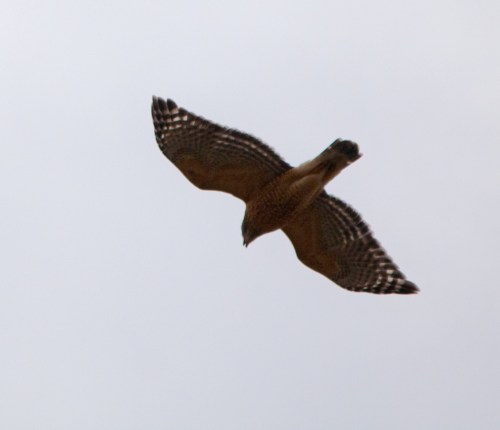
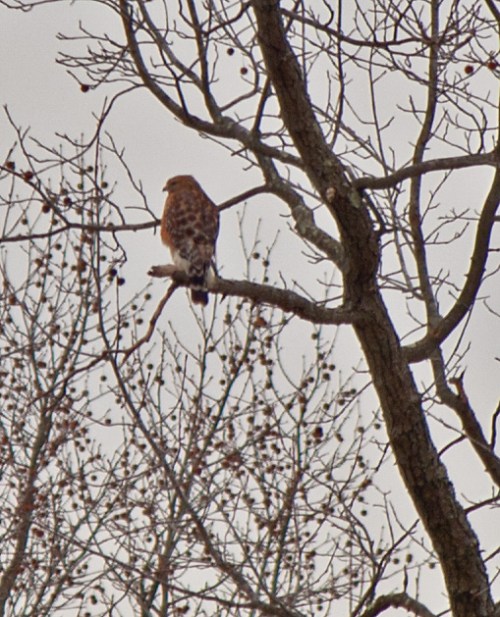
One real highlight for me today was having a hawk fly overhead. I’ve been told that there are Red-tailed Hawks, Red-Shouldered Hawks, Cooper’s Hawks, and Sharp-Shinned Hawks at the park, and I had no idea what kind of hawk it was that I managed to photograph. I saw him land in a tree across a small field and I was able to get some shots of him there. Neither of these two photos is super sharp (the light was not good and they are cropped, especially the one with the hawk in the tree), but I am happy to have been able to capture images of a beautiful, powerful bird. I think that this is probably a Red-Shouldered Hawk (Buteo lineatus), although I am not one hundred percent sure on the identification.

I hope that I will be able to see the hawks in action this winter (and possibly some bald eagles that are occasionally sighted here too).

Hawk in flight

Hawk in flight

Hawk in tree

Hawk in tree

© Michael Q. Powell. All rights reserved.

Read Full Post »

The photos in yesterday’s postings about Black Vultures were dark and gloomy and perhaps a little creepy. Today I am going to the opposite end of the spectrum with photos of a squirrel that are warm and cute.

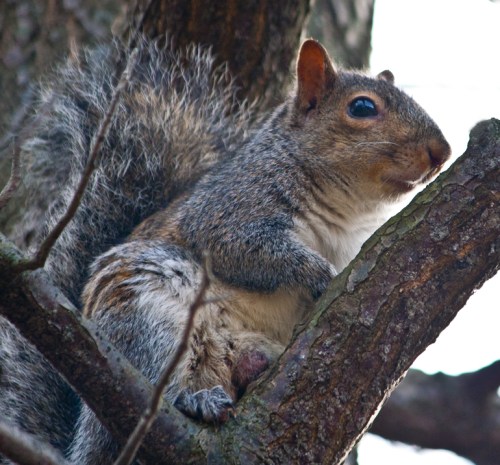
I took these first two shots just outside of my house. Watching this squirrel through my kitchen window as he was digging in the grass, uncovering an acorn, I decided to try to take his photo. When I appeared, he slowly climbed up a tree and found a comfortable spot to enjoy his treat. The first image, my favorite, shows him posing before eating. I really like the effect of the light coming in from the side. The second one shows a more serious side as he seems to have adopted a more dignified pose.

squirrel1_blog

squirrel2_blog

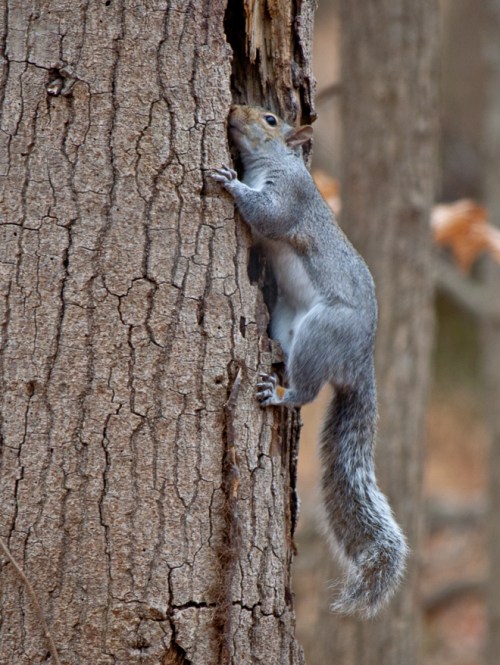
Earlier in the morning yesterday I watched as two squirrels chased each other around—I think at least one of them had amorous intentions. Part of the time they went in an out of a hollow remnant of a tree. They would enter the tree at ground level and come out of the side of the tree. Here are a couple of photos of one of the squirrels as he vainly searches for his playmate.

squirrel3_blog

squirrel4_blog

© Michael Q. Powell. All rights reserved.

Read Full Post »

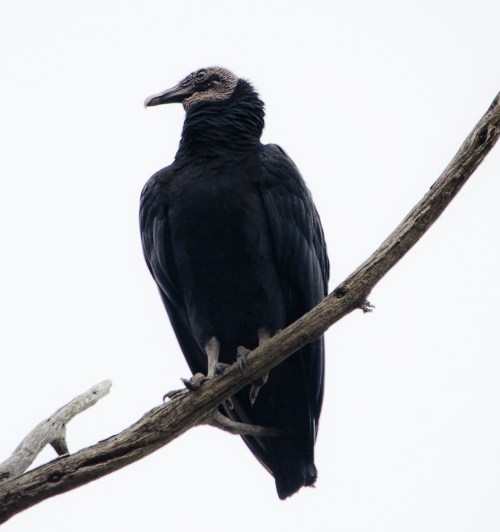
I suddenly realized that all my photos of the Black Vultures that I posted were close-up shots. Here’s a shot of what two of them looked like when they were roosting in a tree. I really like the look of the tree, especially the branch on the right side. The sky was almost white today and the two vultures were virtually silhouettes. It’s kind of a creepy image—maybe I need to save it for Halloween next year.

vultures_blog

© Michael Q. Powell. All rights reserved.

Read Full Post »

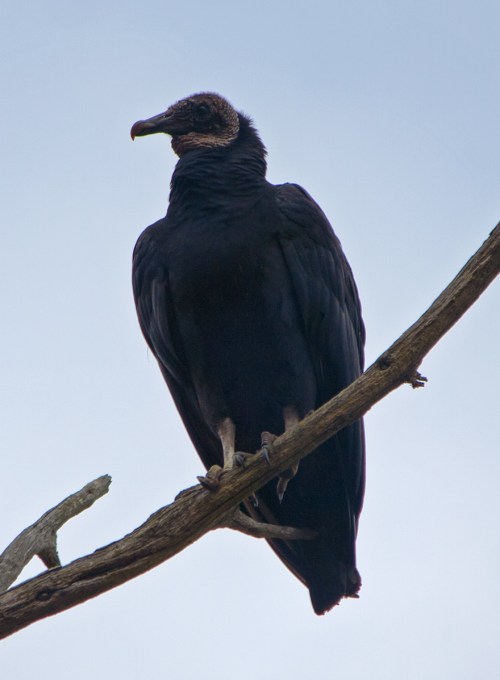
Earlier today I posted a photo of a colorful cardinal to counteract the gloominess of the day. Here is an alternative if you prefer instead to relish the grayness of the day—an image of a Black Vulture (Coragyps atratus ) roosting in a dead tree.

vulture3_blog

It was a damp, cold day today as I was walking through the marshland. I happened to look up and saw a couple of large birds perched in a dead tree. At first I thought they might be wild turkeys, but when I looked at them more carefully I realized that they were Black Vultures. Previously I had seen them soaring through the air and thought they were quite beautiful, with magnificent wingspans. When you see them up close, however, “beautiful” is not an adjective that springs to mind. To be generous, you might say that they look “distinctive” or “interesting.”

vulture1_blog

Why were they hanging around? I had no idea until I talked with some folks at the information desk in the visitor center. Apparently there is a dead deer in a nearby area and the vultures have been feeding on its carcass. I guess the vultures were resting in the trees in between meals.

vulture2_blogI processed each of these images a little differently, trying to compensate for the fact that there was not that much light,  which forced me to deliberately underexpose the photos. I think I like the first one best, the one that I desaturated almost to the point of making it black and white, although I like some aspects of the other two images as well.

© Michael Q. Powell. All rights reserved.

Read Full Post »

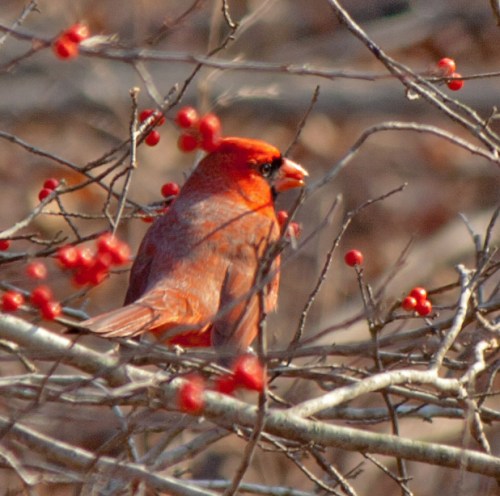
It’s a cloudy gray day. It started out with rain and the weather has improved only marginally. I feel a need for some bright colors, so I am sharing a shot I took this past weekend of a male Northern Cardinal (Cardinalis cardinalis) in a bush with bright red berries. Unlike most photos that I have taken of a cardinal, his eye is visible—normally it blends in with the black mask of his face.

The bright red color seems festive to me and reminds me that Christmas is almost here.

cardinal_blog

© Michael Q. Powell. All rights reserved.

Read Full Post »

In the marshland park where I spend a lot of time shooting photographs, there is a small, shallow pond accessible only by an unimproved trail through the woods. It’s really peaceful there. At times there are ducks there or an occasional heron or deer, but usually it’s just me and the trees and the wind and the water. How do you capture that sense of tranquility in a photo? Here’s a modest attempt to do so.

Reflections

© Michael Q. Powell. All rights reserved.

Read Full Post »

Sparrows generally fall into the general category of “little brown birds” for me and I get frustrated when I try to identify them. I decided, however, that I need to learn more about birds and attempted to identify this little bird that perched atop a cattail and provided me with a photo opportunity this past weekend. After some research on-line, I am pretty confident that this is a Song Sparrow (Melospiza melodia) and I like the way the image captured the beauty of the bird and the fuzziness of the cattails.

I may be wrong about the identification, but my effort has at least caused me to look more closely at the coloration and markings of the birds. I’m pretty sure that I’ll be getting a bird guide (and maybe even some binoculars) soon.

song_sparrow_blog

© Michael Q. Powell. All rights reserved.

Read Full Post »

Monday was a good day for vultures. It was warm and sunny and there must have been lots of thermal updrafts on which to soar. For a short while, a mixed group of turkey vultures and black vultures circles over my head and I couldn’t help but admire again their impressive wingspans. Remembering  the response of my fellow photographer and blogger Lyle Krahn to a previous posting I did on vultures, I made sure that I moved around from time to time. He commented, “If I saw that many vultures overhead, I’d be checking my pulse!”

The lighting was pretty interesting that day, for it illuminated one wing more than another, giving the birds an asymmetrical look. I decided to post a similar shot of each of the two types of vultures so that you can see some of the differences between the two.

Turkey vulture

Turkey vulture

Black vulture

Black vulture

© Michael Q. Powell. All rights reserved.

Read Full Post »

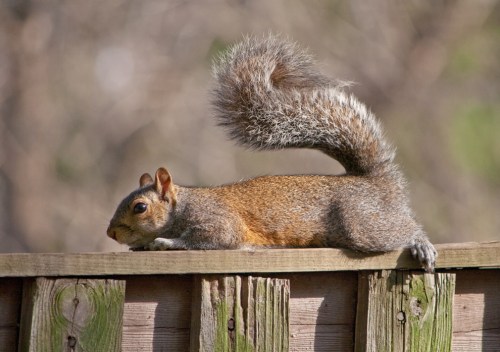
Gray squirrel on my backyard fence

Squirrels always seem full of energy. They run around much  of the time gathering food and for enjoyment chase after each other with the reckless abandon of children. It’s fun sometimes just to watch them in their frenetic activity as I was doing one afternoon this past weekend from the inside of my house. One Eastern Gray Squirrel (Sciurus carolinensis) seemed to especially enjoy running along the top of my fence. When he tired a little, he slumped down on the fence with his tail sticking up. I grabbed my camera and carefully made my way outdoors and was able to capture his pose. I like how it turned out, with the different shades of gray, green, and brown in both the foreground and the background. The squirrel’s pose suggests that he is still very alert, even if he is relaxing a little.

© Michael Q. Powell. All rights reserved.

Read Full Post »

Sunset1

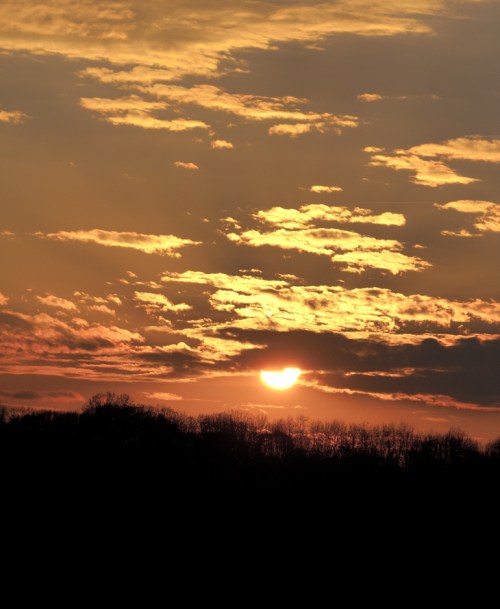
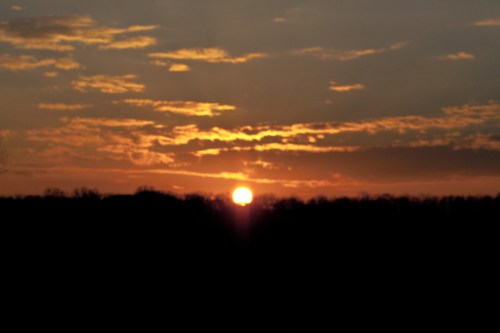
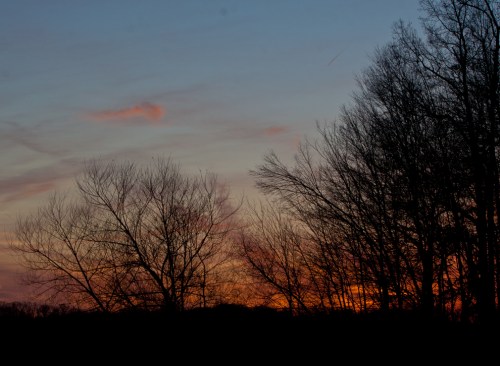
The weather at the beginning of this week has been unseasonably warm, with temperatures soaring past 70 degrees F (21 degrees C). Yesterday I spent the entire day indoors at work, but I was able to enjoy this beautiful respite on Monday afternoon, when I spent several hours meandering through the marsh. The day ended with a beautiful sunset that I tried to capture in stages, as the sun dipped lower and lower on the horizon. This sunset’s most striking characteristic was the reflected light in the clouds—the colors themselves were as striking as in some other sunsets. We will soon be back to freezing temperatures and gray skies, but I hope that occasionally we will still be treated to these amazing displays of light and color.

Sunset2

Sunset3

© Michael Q. Powell. All rights reserved.

Read Full Post »

Beaver at Huntley Meadows Park

Beaver at Huntley Meadows Park

This past Saturday I introduced you to one of the local beavers in a posting entitled Beaver at dusk. The photos of the beaver were shot at a very high ISO and were pretty grainy. Yesterday, I was fortunate enough to photograph the beaver in better light, when he came out of his lodge an hour or so before sunset. I’m still going through my photos and may work up a few more, but wanted to post one immediately.

He is a beautiful specimen of a North American Beaver (Castor canadensis). From what I’ve read, it is almost impossible to tell a male and female beaver apart, except when the female is nursing a kit (baby beavers are called kits), so I may be wrong in using male pronouns with this particular beaver.

© Michael Q. Powell. All rights reserved.

Read Full Post »

I always associate bluebirds with happiness, and I am invariably happy when I see one. There is something exceptionally beautiful about the combination of colors, the brilliant royal blue and the warm reddish brown, especially now as winter approaches and the other colors seem so muted.

I grew up with the Wizard of Oz and remember almost all of the lyrics of the the song Over the Rainbow, sung in the movie by Judy Garland. In the song, bluebirds are one of the symbols of hope. “Somewhere over the rainbow, bluebirds fly. Birds fly over the rainbow. Why then, oh why can’t I? If happy little bluebirds fly beyond the rainbow, why, oh why can’t I?”

Well, I wasn’t beyond the rainbow this past weekend, but I did see this little Eastern Bluebird (Sialia sialis), perched on a small tree in the middle of a field. He was a bit far away so I had to crop the images, which are a bit soft in focus. Nevertheless, I am sure you will agree that his beauty shines through.

If happy little bluebirds fly beyond the rainbow, why, oh why can’t I?

Eastern bluebird

Eastern bluebird

Bluebird in a tree

Bluebird in a tree

© Michael Q. Powell. All rights reserved.

Read Full Post »

This past weekend I visited my local garden, the site of many of my photos during the spring and summer, when I was concentrating my photographic efforts on flowers and insects. I was not surprised to observe that many of my favorite flowers were no longer blooming. Without these bursts of color to distract me, my eyes were drawn to simple elements, like the shapes of the branches that were now visible.

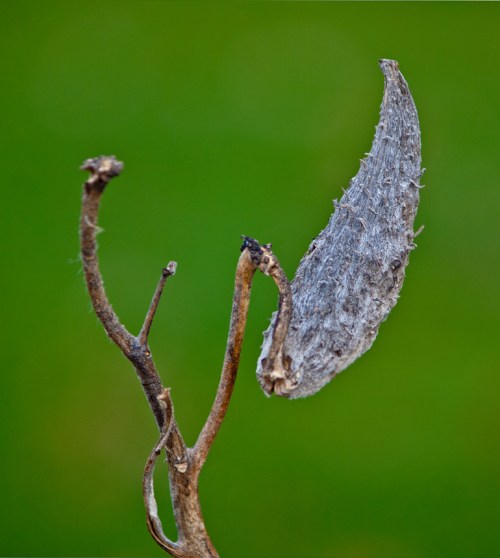
I really liked the color and texture of a particular pod—a milkweed pod, I believe—that was the sole survivor on its plant. I like the texture of the pod and its color, which is a nice contrast with the green of the background. Even the background turned out pretty well, with a few blotches of yellow helping to break up the solid green.

The composition is simple, like several of my recent photos. Maybe I’m going through a phase, but all I know is that I find simple compositions exceptionally appealing at the moment.

Pod composition

Pod composition

© Michael Q. Powell. All rights reserved.

Read Full Post »

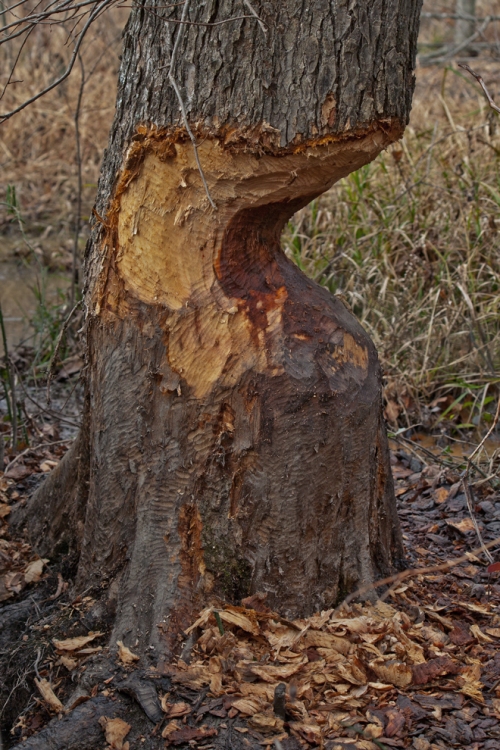
The beavers in my local marsh have been really busy recently as winter draws near (“busy as beavers,” you might say). Each time I visit the marsh I can see evidence of their handiwork. Hmm, “handiwork” is probably not the right word, since most of the evidence I see is work they have accomplished with their teeth. Maybe I should call it “dentalwork,” but that terms conjures up images of beavers with braces on their teeth. I’ll just call it “work.”

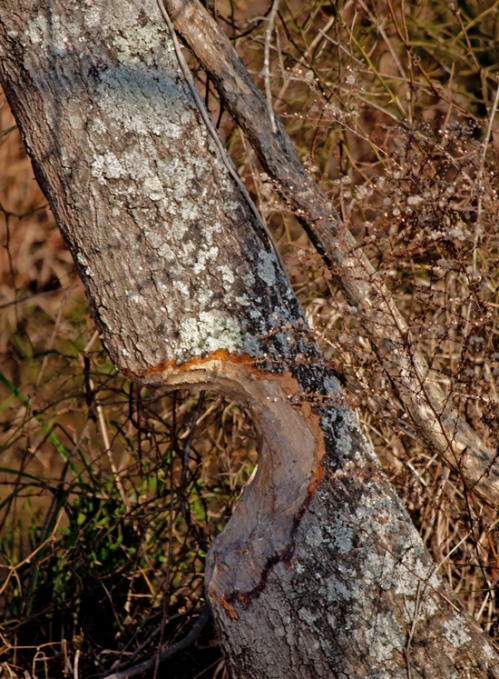
Over the past few weeks I have been noting their progress on chewing through a pretty large tree. First they chewed one side and then it looks like they gradually moved around the circumference of the tree. Circumference? Who says that high school geometry doesn’t have everyday applications? They now have gnawed (try saying that phrase quickly multiple times) into the center of the tree and I expect to see to see a fallen tree soon. I won’t be disappointed, and certainly not crestfallen.

On a slightly more serious note, I am genuinely amazed that the beavers don’t just take down small saplings. I confess that, as a result of living most of my life in the suburbs, I don’t know much about wildlife. It’s fascinating to me to look at all of the individual tooth marks in the wood that bear witness to the persistence of this industrious creature. I also see its work in the mud walls that have been built up along the edges of parts of this little pond and the ever-increasing amounts of mud that have been packed on the lodge.

The beaver is ready for a cold winter. Am I?

Let the chips fall where they may

Let the chips fall where they may

How do they gnaw this high?

How do they gnaw this high?

© Michael Q. Powell. All rights reserved.

Read Full Post »

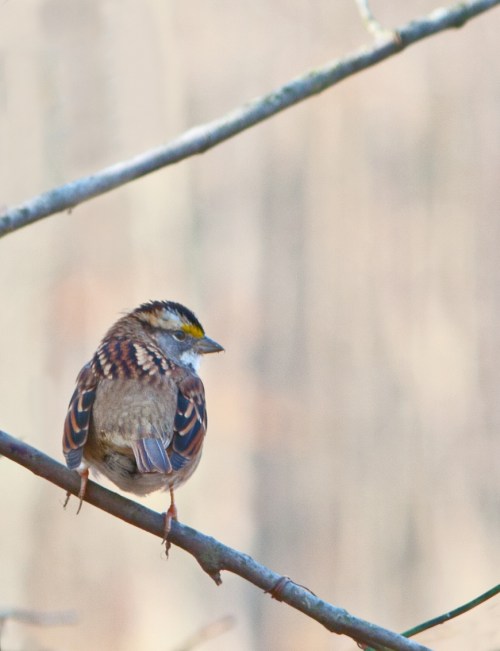
What is the main subject of this photo? I know that when I took it, I was intently focusing on the little brown bird. When I pulled the image up on my computer screen and cropped it, however, I became much more interested in the composition. The blurry background with faintly visible trees and the little branches of tree on which the bird has hooked his feet suddenly became of equal importance to me as the bird itself. I find the pose of the bird interesting, but I think its interest is magnified by the simple setting.

What do you think?

Brown bird on little branch

Brown bird on little branch

© Michael Q. Powell. All rights reserved.

Read Full Post »

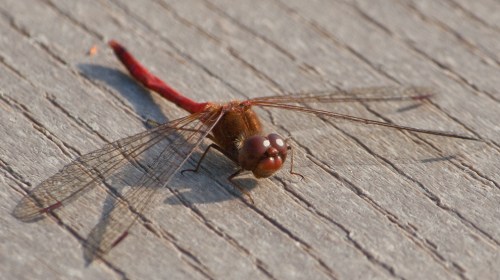
It was sunny yesterday afternoon and got up to 50 degrees F (10 degrees C), relatively warm compared to recent frosty mornings. The faded foliage and the coolness of the breeze reminded me that it is late fall. I was therefore shocked when I spotted a little red dragonfly perched on the boardwalk in front of me.

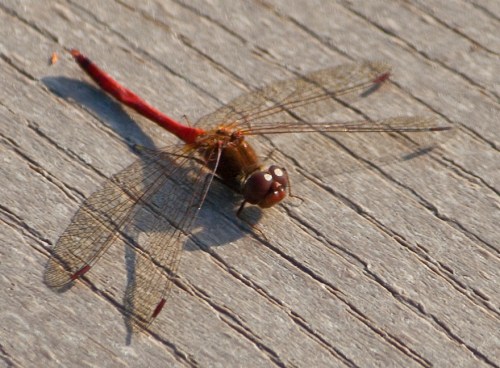
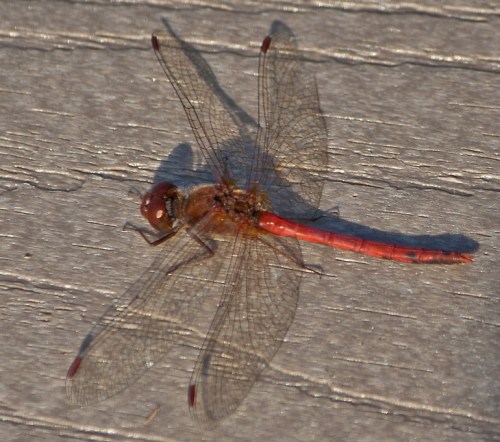
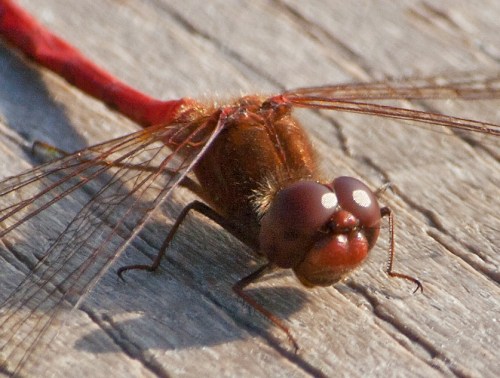
I recognized this one immediately as an Autumn Meadowhawk dragonfly (Sympetrum vicinum), the last dragonfly that I saw weeks ago and I had done a little research. For an instant I lamented that the setting was not a natural one (the boards are of a composite material), but I managed to get off a couple of shots before the dragonfly flew away. For the rest of the afternoon I keep my eyes alert and managed to spot another one in a similar pose. The second time I got down low and tried to get a shot at the level of his beautiful eyes. The first shot below is a cropped version of the resulting photo, intended to highlight some of his features that get lost when you include his wide wings. The second image is the same photo, but showing his wings. I was shooting with a telephoto zooms lens, so his tail is foreshortened a bit from this angle. The third photo is similar to the second, but was taken from a steeper angle looking down. The final image, which was actually the first one taken, was shot looking almost straight down and provides the best view of the details of the tail.

I love dragonflies, but I never expected to see one in December in Northern Virginia.  Once again I realize that I need to dream bigger, that I need to be prepared for the unexpected blessings that may come into my life, even modest ones like a beautiful red dragonfly.

Close-up of Autumn Meadowhawk dragonfly

Close-up of Autumn Meadowhawk dragonfly

Full front view of Autumn Meadowhawk

Face-to-face with Autumn Meadowhawk dragonfly

View from above

Front view of Autumn Meadowhawk dragonfly

View from above of Autumn Meadowhawk dragonfly

View from above of Autumn Meadowhawk dragonfly

© Michael Q. Powell. All rights reserved.

Read Full Post »

The beavers at my local marshland park have built a lodge that spills onto a bench on the boardwalk and the entrance to the lodge appears to be in the waters underneath the boardwalk itself. There are signs that the beavers have been actively getting ready for winter with new mud walls and fallen trees each time I visit. I’ve only seen a beaver a few times and it has always been a time of reduced visibility, i.e. early morning or late in the day.

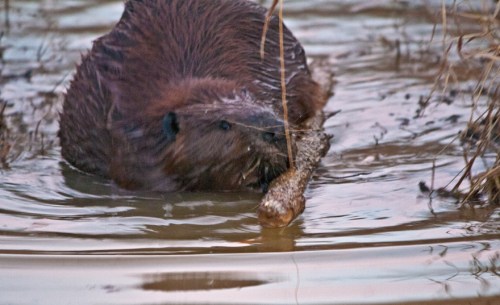
As I was walking back toward the park entrance yesterday evening after taking photos of the sunset, I heard noise near the beaver lodge and saw that a beaver was visible through the brush. I snapped a couple of photos, but realized that ISO 400 would not work, so I cranked up the ISO to 1600, the highest that my camera would go. This was uncharted territory for me, because I had already seen prominent grain when I set the ISO at 800. Even with the ISO set that high, the shutter speed was around 1/15 sec, so I tried to keep my camera on my tripod. The beaver was somewhat preoccupied and did not immediately dive, the normal reaction of a beaver when I see them, so I was able to get some shots of the beaver in action.

In many ways, these are aspirational shots, for they reflect photos that I want to take in the future with better results. I am sharing some of them, however, because I find them to be interesting, poor quality notwithstanding. It will definitely be a challenge to figure out a solution to the dilemma of getting quality shots in limited light.

Gathering more sticks for his lodge

Gathering more sticks for his lodge

Beaver close-up

Swimming beaver

Beaver with open mouth

Beaver with open mouth

Beaver looking at me

Beaver looking at me

Swimming toward the light

Swimming toward the light

© Michael Q. Powell. All rights reserved.

Read Full Post »

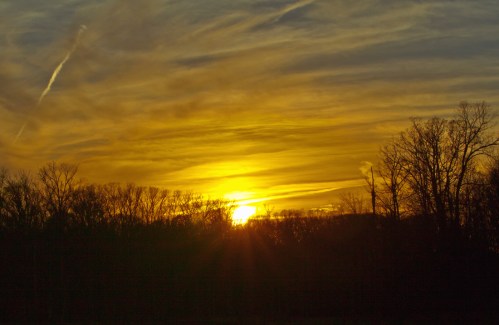
I spent much of today at home waiting for a FedEx package that required a signature, so it was late afternoon when I finally managed to get out with my camera. The sun was already pretty low on the horizon when I arrived at my favorite marshland and I didn’t find many subjects to shoot. However, almost as compensation, I was treated to a spectacular sunset. The sky was blue and there were a good number of clouds in the west to reflect the colors of the setting sun. I tried to catch the sun as it was setting as I looked across the marsh; as I looked out to the distant treeline after the sun had already gone down; and as I looked through some nearby trees at the beautiful reds that appeared. It was a gorgeous way to start the weekend.

Looking into the marsh

Looking into the marsh

Looking toward the treeline

Looking toward the treeline

Looking through the trees

Looking through the trees

© Michael Q. Powell. All rights reserved.

Read Full Post »

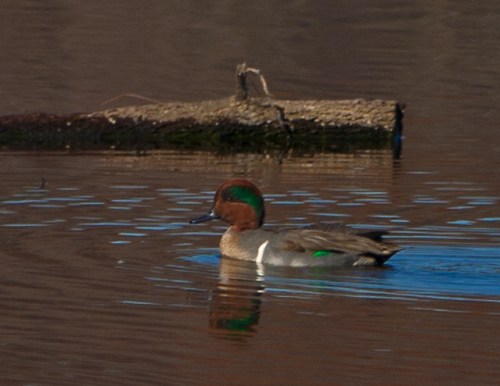
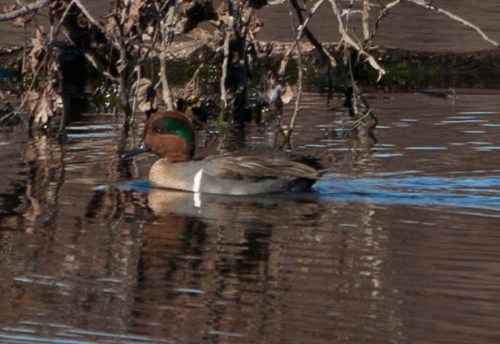
Green-winged Teal (Anas crecca) are the smallest of the North American ducks, according to duck.org (yes, that’s really the website), but I find them to be exceptionally beautiful. Their diminutive size and their predilection for congregating at the far reaches of the little pond where I have been photographing ducks have combined to make it really challenging to get good images of them.

Green-winged Teals are dabbling (rather than diving) ducks and they prefer shallow ponds to open water, according to the Cornell Lab of Ornithology. As the weather has gotten colder, they may have migrated out of my area now, so I am posting some of the best shots I have of them. I had been holding off, hoping I might get some better photos. The photos at least give you an idea of the duck’s overall  appearance and the first photo shows you the green feathers responsible for the its name.

Male Green-winged Teal swimming

Male Green-winged Teal swimming

Green-winged Teal with bushes

Green-winged Teal with bushes

Pair of male Green-winged Teals

Pair of male Green-winged Teals

© Michael Q. Powell. All rights reserved.

Read Full Post »

I knew that yesterday was the day of the full moon, so I was disappointed to see that it was already pretty high in the sky when I was driving home from work. I was surprised and pleased this morning as I was taking out the trash to see that the moon was out and was really bright. I rushed into the house, grabbed my camera and tripod and took some initial shots. I must confess that these are the first outdoor shots that I have taken in my slippers. My exposures were not right when I looked at the images on the computer, so I made some adjustments and rushed back outdoors. I blindly set the camera on manual and made some guesses on appropriate settings. I went through that cycle twice more before I got an image that I judged was ok. It’s not perfect (I need to experiment some more on settings), but it looks reasonably close to what my eyes were seeing a few short minutes ago.

Full moon in November

© Michael Q. Powell. All rights reserved.

Read Full Post »

Downy Woodpeckers (Picoides pubescens) are so small and light that they can perch almost anywhere. I was little surprised, however, when I looked down into the water of the marsh and saw a Downy Woodpecker on a very small piece of wood that was jutting out just a little above the surface of the water. I had never before seen a woodpecker that close to water level.

Downy Woodpecker just above the marsh water

The branch was small, just big enough for him to relax, but the woodpecker was not there to rest—he was there to work. There doesn’t seem like there is much room for him to maneuver, but somehow he got into position and was soon hammering away at that little piece of wood. I was concerned that the vibration might loosen the branch and cause him to tumble into the water, but that didn’t happen.

No piece of wood is too small

I guess that if you are a small woodpecker, almost any piece of wood is fair game—size does not matter.

© Michael Q. Powell. All rights reserved.

Read Full Post »

As I mentioned in another post, Monday there was ice on the small ponds that a week before had been full of migrating ducks. The ducks were all gone, it seemed. As I was passing the beaver lodge, however, I notice a small bit of bright orange on a log across the beaver pond. I looked through my telephoto lens and realized that what I had seen were the feet of a female duck, perched on the log that jutted out into the water. She was so well camouflaged that I almost missed see her. When I moved to one side, I noticed a second duck, a male, right behind them. They were huddled together, with their heads tucked in between their wings, resting and sharing their body warmth on a cold morning. Why were they alone? Had they become separated from a larger group? Were they on their way to another destination?

There was something very tender, almost intimate about this scene, about the closeness of this duck couple. The environment might be hostile and threatening, but they could face it together—at least they had each other.

Facing the world together

© Michael Q. Powell. All rights reserved.

Read Full Post »

« Newer Posts - Older Posts »