Feeds:
Posts
Comments

Posts Tagged ‘Canon 55-250mm zoom lens’

When most people think of the Vietnam Veterans Memorial, they think only of the black granite wall with all of the names, but the Three Servicemen Statue is also part of the memorial.

Frederick Hart, the sculptor of these statues, described his work in these words (according to the Vietnam Veterans Memorial Fund):

“The portrayal of the figures is consistent with history. They wear the uniform and carry the equipment of war; they are young. The contrast between the innocence of their youth and the weapons of war underscores the poignancy of their sacrifice. There is about them the physical contact and sense of unity that bespeaks the bonds of love and sacrifice that is the nature of men at war. And yet they are each alone. Their strength and their vulnerability are both evident. Their true heroism lies in these bonds of loyalty in the face of their aloneness and their vulnerability.”

I visited the memorial one evening this past weekend and took these photos of the statue. The first photo shows the torsos of the grouping (the statues themselves are full body, but I wanted to show the details of the upper bodies) and the others show the faces of each of the three soldiers.

Vietnam_trio_blogmachinegun_blogStatue 2Black_soldier_blog

© Michael Q. Powell. All rights reserved

Read Full Post »

Fog, low-hanging clouds, and reflected light gave the skies of Washington D.C. an orange-colored glow last night, which made for dramatic shots of the Washington Monument.

I don’t really understand the scientific basis for the phenomenon (perhaps air pollution contributed to it), but tried to capture it with my camera. I took these shots at about nine o’clock in the evening using my tripod and a long exposure, even thought they look like they might have been shot at sunset.

A friend convinced me to go with him to Washington D.C. with the goal of getting some photographs of the Washington Monument shrouded in heavy fog, which turned out not to be the case. Instead, we got something totally unexpected that turned out to be even better than that for which we had hoped.

Monument & TreesWashMonumentOrangeSky

© Michael Q. Powell. All rights reserved

Read Full Post »

Thanks to my fellow bloggers, I have become much more attuned to the little bits of color and texture that surround me when I walk through the woods. I used to look up and forward for animals and birds, but now I am also looking down for interesting mushrooms and tiny plants.

Here are some photos of one of the strangest looking things—I think it is a fungus—that I encountered recently. It looks a little like coral or something that you would see underwater, although it was growing on a downed tree. The texture and shape remind me a little of cross-sections of a human brain.

Whatever it is, I really like its color, shape, and intricate contours.fungus1_blogfungus2_blog

© Michael Q. Powell. All rights reserved

Read Full Post »

I tend to look at cattails primarily as a place for interesting birds and insects to perch, but earlier this month I was really struck by the beauty, texture, colors, and lines of the cattails themselves.

How do you capture the uniqueness of the cattails? Here are the results of a couple of different approaches that I used to try to respond to that question.

cattail_blog

cattails2_blog

© Michael Q. Powell. All rights reserved

Read Full Post »

When they were soaring through the sky, the vultures were beautiful, even majestic, but when they started to swoop down toward a nearby location, I couldn’t help but feel a little uneasy.

This past weekend, I was walking along the C&O Canal path, approaching Washington D.C., when a number of large black birds started swooping down in my direction. I could tell immediately that they were Turkey Vultures (Cathartes aura), because of their red heads and distinctive feather pattern.  As they got closer, they veered off toward the road that parallels the path—perhaps there was a recent bit of road kill that attracted their attention.

I don’t know why, but everywhere that I go, I seem to see vultures. In this case it was an urban setting, but I see them often when I am in the wild too. I’m trying not to develop a complex about this, but I do make sure that I take a shower before I go shooting.

vulture5_blogvulture3_blogvulture4_blog

© Michael Q. Powell. All rights reserved

Read Full Post »

Last weekend as I was hiking along the Potomac River in Virgina, following the narrow, rocky Potomac Heritage Trail, I came several large metal objects that appear to have been abandoned. They are shaped like some kind of water or fuel tanks and have lots of bolts and/or rivets. To me, they look very industrial. There also was a large wheel-like object. Although I was only a few miles from Washington D.C., the area where I saw these items was very isolated.

Does anyone have any idea about what these objects were used for and why they might have been abandoned?

tank1_blogtank2_blogtank3_blogtank4_blog

© Michael Q. Powell. All rights reserved

Read Full Post »

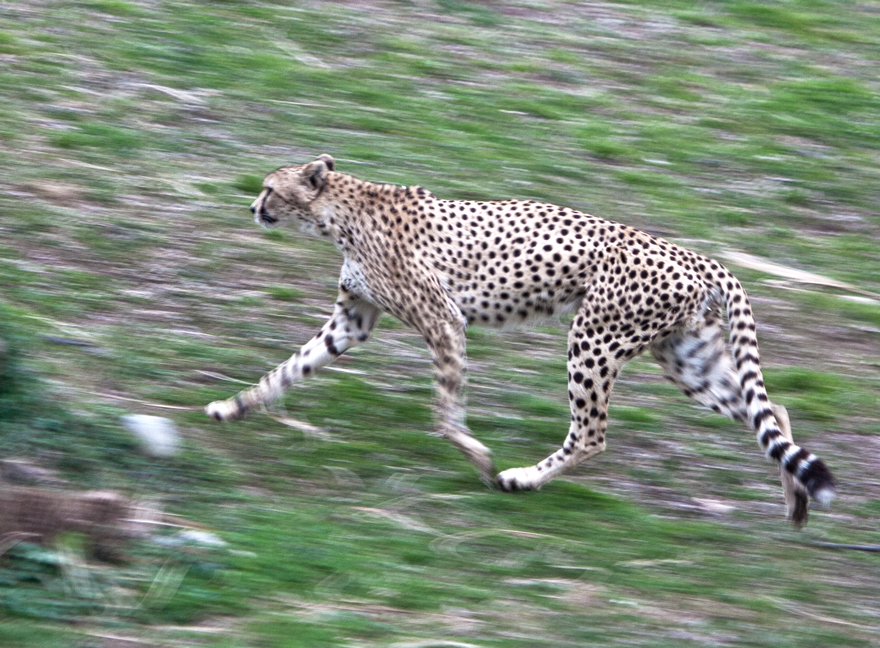
I don’t manage to go the zoo very often, but when I do, I tend to spent a lot of time with the cheetahs. There is something about cheetahs that I find irresistible, their combination of beauty and power, of strength and speed. In the largest enclosure in the cheetah exhibit area, there are normally three or four male cheetahs and they are the ones that I usually observe.

Last September I did a posting about the cheetahs at the National Zoo and this is an update of sorts. This past weekend I tried to concentrate on taking shots of the cheetahs in action. This was a challenge for a few reasons. It was late afternoon and the light was starting to fade and there were limited angles for the shots and some of the backgrounds were very undesirable.

I did finally manage to get some shots that I like, although I have trouble deciding which one is my favorite—I like each of them for slightly different reasons.

I’ll let you decide for yourself which one you like most.

cheetah3_blogcheetah1_blogcheetah4_blogcheetah5_blog

© Michael Q. Powell. All rights reserved

Read Full Post »

Continuing the theme of transitions from this morning, I thought I’d post a photo of several geese transitioning from rapid flight through the air to a complete halt on a frozen pond.

I love to watch geese coming in for a landing as they noisily announce their arrival, which is often accompanied with a big splash and energetic flapping of wings.

The situation is a bit more problematic when the ice is solid and any miscalculation could lead to physical injury.  It appears to me that the geese flap their wings as hard as they can to decelerate and attempt to carefully place their webbed feet. That is what the goose on the left appears to be doing. If that doesn’t work, as a last resort the goose can lower his tail to slow down his forward momentum, as the goose on the right is doing.

Judging from my observations, some geese are much more adept at this type of landings than others, who slip and slide and skid for a while until they finally stop moving forward.

skidding_blog

© Michael Q. Powell. All rights reserved

Read Full Post »

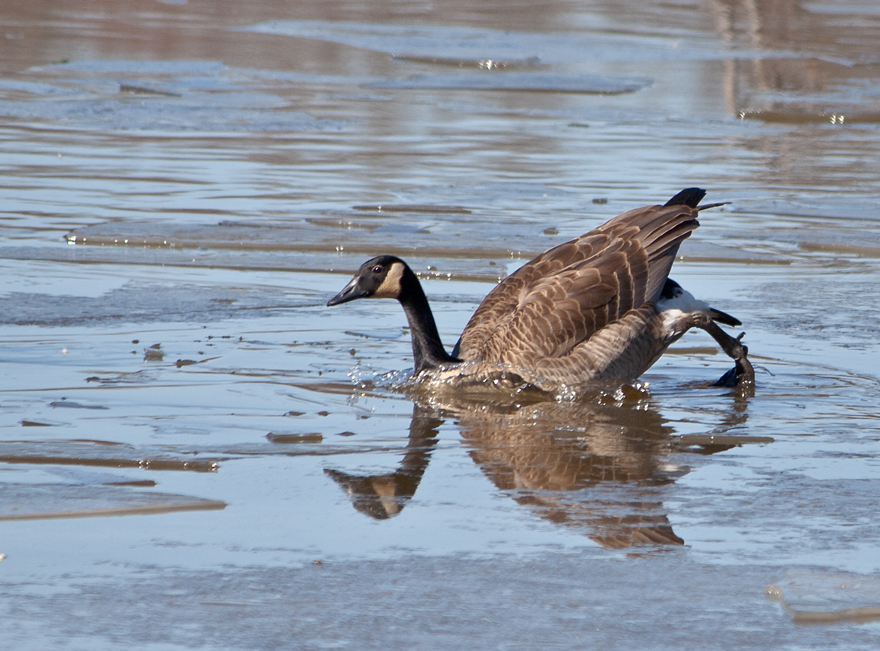
Can you figure out what is going on in this photo of a goose posing in an unusual position?

transition_blog

The pre-spring season is a often a period of transitions, as winter gradually looses its hold and gives way to spring. The old lingers, but is gradually replaced with the new.

In the first photo, the goose is transitioning from the ice, which still covers much of the pond, into a small pool of open water. I captured him at the moment when he took the plunge and gradually eased his body into the icy water.

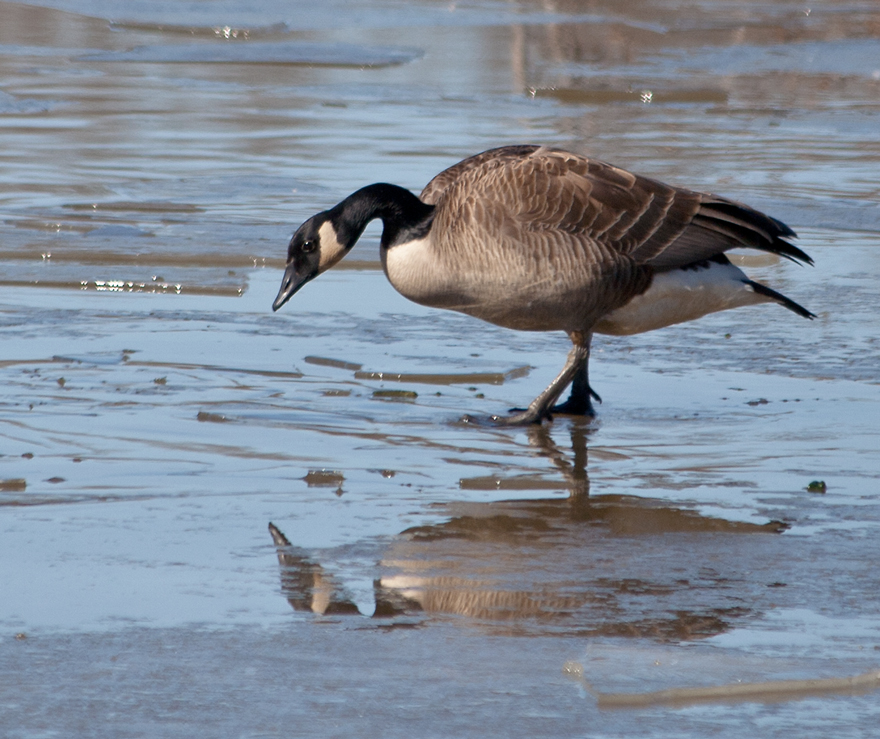
I watched him as he approached this area slowly and cautiously, staring intently at the ice, as shown in the second photo. He seemed to hesitated, uncertain about whether to continue to move forward.

reflection1_blog

I know that I approach transitions in much the same way as this goose, hesitating and cautious, frozen in uncertainty. He had the courage to move forward and embrace the change. Will I be able to do the same when these moments arrive?

© Michael Q. Powell. All rights reserved

Read Full Post »

The American Trail is one of the newest and coolest exhibit areas at the National Zoo, highlighting North American wildlife, including the North American Beaver (Castor canadensis), that I featured in an earlier post, and the North American River Otter (Lontra canadensis), pictured here.

When I arrived, the zookeepers were spreading food all throughout the area inhabited by two otters. It was a lot of fun to watch the otters scurrying about, searching for the food. They were incredibly energetic and curious (and difficult to capture in a photo).

This is my favorite shot, because I think that it does a good job of expressing some of the otter’s essential traits.

otter1_blog

© Michael Q. Powell. All rights reserved

Read Full Post »

How do Great Blue Herons manage to stay warm when it’s bitterly cold outside?

Yesterday morning was cold and windy and the beaver pond was iced over again. As I scanned the area, looking for activity, I noticed this Great Blue Heron (Ardea herodias) perched on the limbs of a fallen tree in a back area surrounded with undergrowth. He was hunched over with his wings wrapped tightly around himself and he seemed to be doing his best to maintain his body heat.

When I moved a little, he lifted his head slightly from his chest to look in my direction. Eventually he decided I was not a threat and he placed his bill back on his chest, between the feathers, and resumed his rest. Perhaps he was sleeping, though it seemed to me that the perch was a bit precarious for serious sleeping.

A few hours later, after it had warmed a bit, I saw a heron flying in the distance. Perhaps it was this blue heron, who had decided that it was time to begin his day’s activities, which I am sure included finding some unfrozen water where he might be able to locate something to eat.

GBH1_blog

© Michael Q. Powell. All rights reserved
Read Full Post »

I don’t know where the male lions were this weekend when I visited the National Zoo, but there were three or four female lions and it was fun to watch them play together.

I tried to get a group photo, but they were about as cooperative as kids, with one of them turning her back and another sticking out her tongue.

lioness3_blog

After a while they seemed to get bored with me and I caught one of them in a big yawn.

lioness2_blogI wanted very much to get an action photo, but the lions seemed content to lounge around together. This is the closest thing I got to an action photo. I like it a lot, even though it is not super sharp, primarily because of the body position and the angle of the shot.

lioness1_blog

© Michael Q. Powell. All rights reserved
Read Full Post »

To supplement their diets, the beavers at the National Zoo in Washington D.C. get crunchy vegetables like carrots and corn.

I had the chance to watch them eat this past weekend and took some fun photos of one of the beavers munching away on part of an ear of corn. This beaver, a female named Willow, was able to manipulate the corn really easily with her front paws and seemed to enjoy each bite as she slowly consumed the entire piece of corn.

I watched some videos on photographing animals at a zoo before this shoot and followed some of the tips, like shooting close-ups and paying attention to backgrounds. I did not, however, switch to shutter-priority mode, as suggested, but kept the camera in aperture-priority mode. I may have lost a few shots, because the shutter speed was too slow, but I was able to get decent results by using a more familiar approach.

beaver_corn_blogbeaver_corn2_blog© Michael Q. Powell. All rights reserved

Read Full Post »

The clicking sound of my shutter caused the napping cheetah to raise his head yesterday afternoon and look directly at me. He didn’t move the rest of his body at all, but stared intently at me for a minute or so. Reassured, he laid his head down again in his den and resumed his nap.

I visited the National Zoo yesterday and took photos of a number of different animals that I will share later, but I wanted to share this one immediately.  I like the cheetah’s expression and the positioning of the head and body. The darkness of the den really helps to showcase the beauty of the cheetah (and fortunately for me the cheetah was at the front of the den where natural light illuminated his face).

National Zoo does a good job in taking care of the animals there and, as is the case with the cheetahs, in working to ensure the survival of animals with a limited gene pool. For me, it is enjoyable to visit the different animals and to practice my photography skills to show the animals in the best possible light.

cheetah2_blog

© Michael Q. Powell. All rights reserved

Read Full Post »

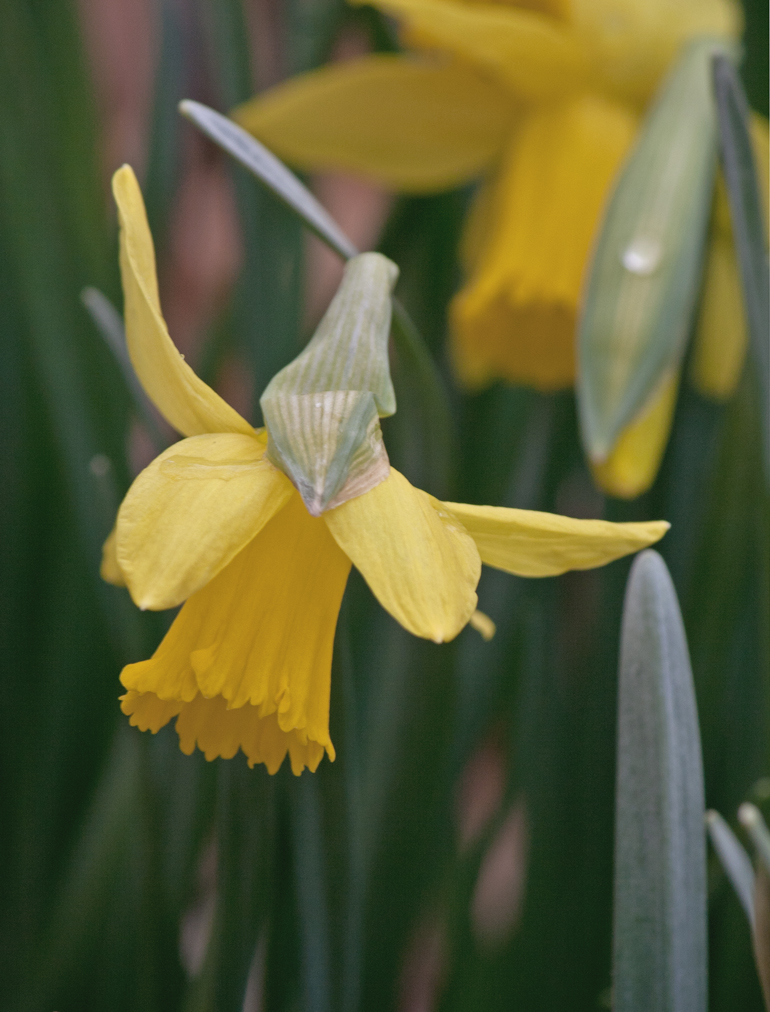
Yesterday while I was walking  in Washington D.C. along a path through Rock Creek Park, I came across a small cluster of daffodils that are already blooming. The day was cold and gray and eventually we had a small ice storm, but these hardy, bright yellow flowers remind me that spring is not very far away.

daffodil1_blog

© Michael Q. Powell. All rights reserved
Read Full Post »

The weather yesterday was so nice that turtles emerged from the mud for the first time in months to bask on logs and enjoy the warmth of the sun.

My understanding is that the turtles have been spending the cold winter months buried in the mud with their metabolism slowed way down. I would call this state “hibernation,” although there apparently is some argument in the scientific community about whether that term should be reserved for mammals and the term “brumation” used for reptiles, because the physiological processes are different. Whatever you call it, reptiles can move in and out of this state and seem to have moved out of it to soak up some sum.

The turtle in this photo looks like he has not had a lot of time to clean off the mud that fills all of the creases and crevices in his body and shell. He almost looks like he is smiling and he is definitely alert.

Most of the turtles that I have photographed previously at my marshland park have been Red-eared Sliders, but I can’t tell if this one is a member of that species or is a different type. I did note that there is a semi-circular pies missing from both the left and right front areas of the shell. Has something been gnawing on the shell? What would have caused the damage?

I looked around to see if I could see any frogs yesterday, but they are still in their wintering mode. I suspect that it won’t be long before the frogs and snakes are back and I’ll soon be keeping a look-out for my first dragonfly of the season.

turtle1_blog

© Michael Q. Powell. All rights reserved
Read Full Post »

I love the way this Mourning Dove (Zenaida macroura) turned its head to look back at me yesterday and how the soft background complements and enhances its beauty.

dove1_blog

© Michael Q. Powell. All rights reserved

Read Full Post »

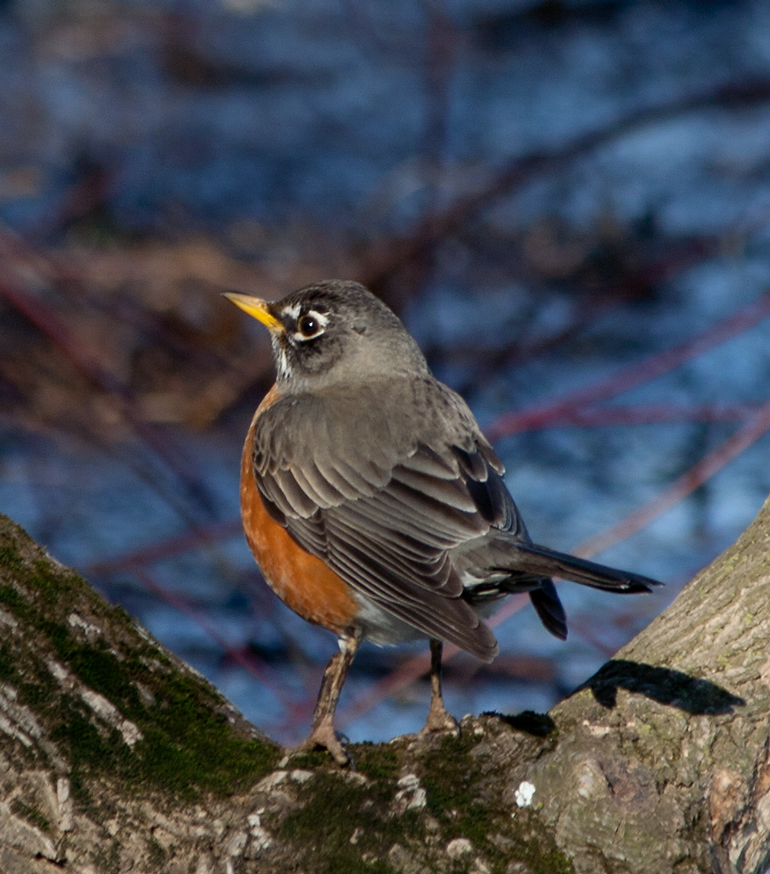
Spring is not here yet, but we had a foretaste of its pleasures yesterday, when the skies were sunny and the temperature rose to 60 degrees (15.5 degrees C). As I was walking along the Potomac River, I encountered a group of American Robins (Turdus migratorius), a traditional harbinger of spring, and got these shots.

Today is about twenty degrees colder and there’s a possibility of snow showers later in the day. Spring has not yet arrived, but we are moving inexorably toward the moment when winter finally gives way to spring.

Robin1_blogRobin2_blog

© Michael Q. Powell. All rights reserved

Read Full Post »

The familiar often looks new when perceived from a different angle, as I found out last weekend when I hiked along the Potomac River and looked across the river toward Georgetown University.

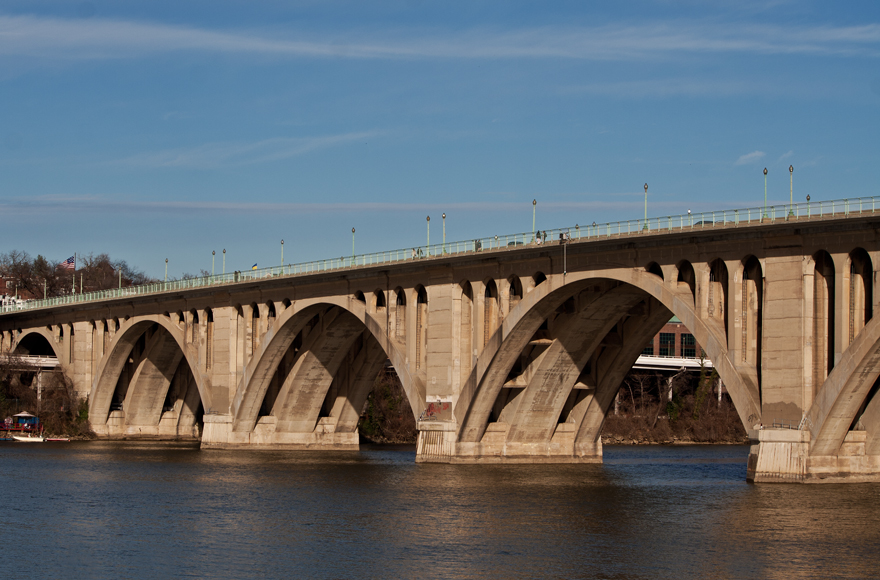
Although I have lived in this are for almost 20 years, I had never heard of the Potomac Heritage Trail, a narrow trail that begins in Washington D.C. and continues upstream, mostly at at river-level. I have driven past this scene many times and the buildings of Georgetown really stand out, but I never really saw the green boathouse tucked in at the base of Francis Scott Key Bridge, which crosses from Virginia into the District of Columbia.

The first shot shows a view from the Virginia side of the Potomac River, looking directly toward Georgetown University, and the second one shows the Key Bridge. I love the arches of the bridge, which I have crossed many times.

My little hike was a good way to force me to look at the familiar in a different way—I hope to be able to do the same with some of my other subjects too.

Georgetown1_blogGeorgetown2_blog© Michael Q. Powell. All rights reserved

Read Full Post »

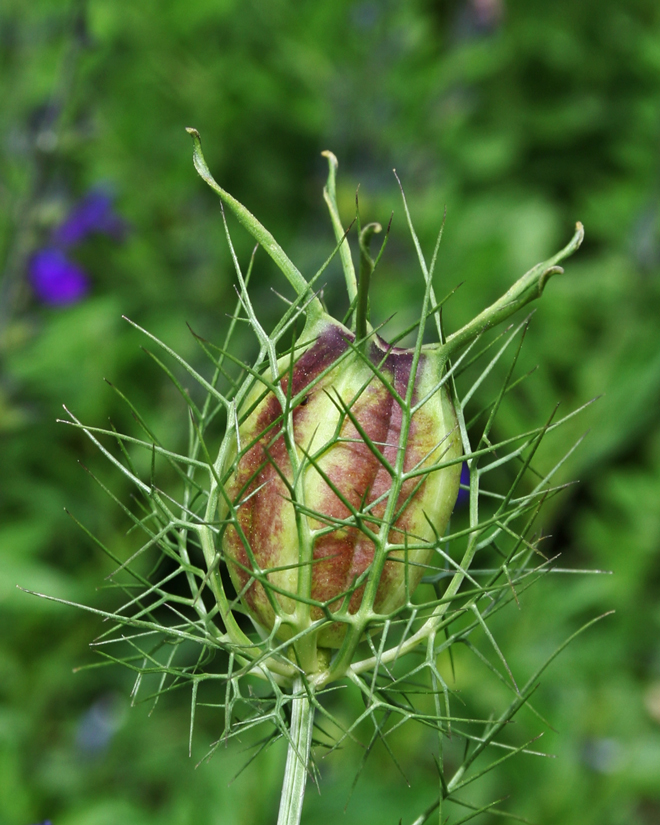
Feeling almost compelled to post a photo about love on Valentine’s Day, I thought I’d post some photos from last May (before I started this blog) of a really cool flower called Love-in-a-mist (Nigella damascena). It is extraordinarily beautiful both as a flower and as a seed pod, although the seed pod looks a bit like an alien life form. Special thanks to Cindy Dyer, my photography mentor and fellow blogger, for introducing me to Love-in-a-mist—you should check out her blog photos of this amazing flower by clicking on her name.

Love1Love2love3

© Michael Q. Powell. All rights reserved

Read Full Post »

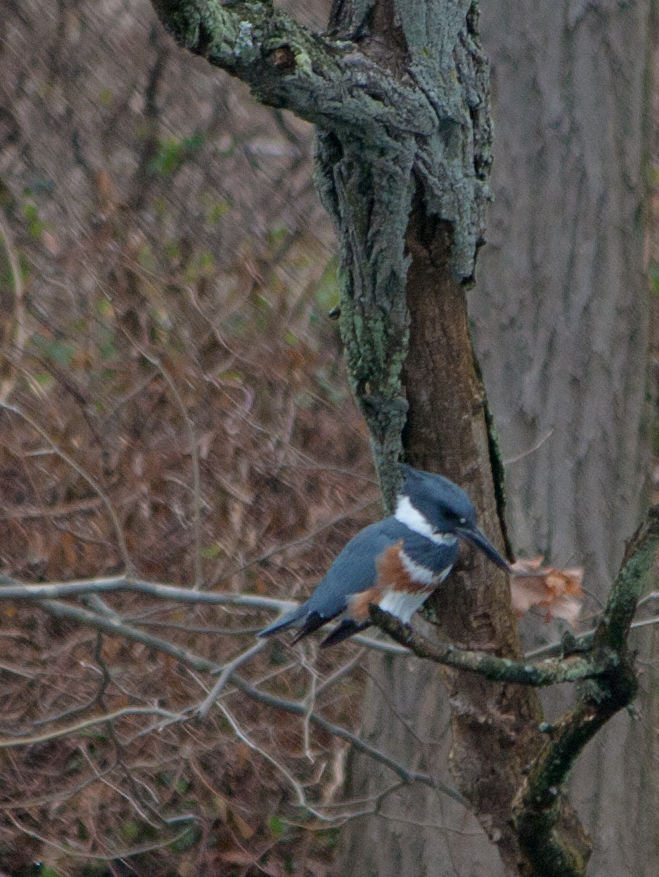
Although I was excited to discover a male Belted Kingfisher (Megaceryle alcyon) in an industrial setting, later that day I returned to my first love, a female kingfisher in a more natural environment.

Previously I posted photos of the male kingfisher and female kingfisher as I continue in my quest to get some really good photos of these amazing birds. If you compare the male and the female, you can see that the chestnut stripe really makes the female stand out (and the Belted Kingfisher is one of the few birds in which the female is more colorful than the male).

I continue to get interesting photos (and I am posting some new ones here), but I still am trying to get some better ones (these are grainy and a bit soft). By the way, can anyone figure out what she has in her bill in the last photo?

kingfisher_F2_blogkingfisher-F1_blogkingfisher_F3_blog

© Michael Q. Powell. All rights reserved

Read Full Post »

This past weekend I hiked on the Potomac Heritage Trail, a trail that follows the Potomac River beginning near Washington D.C. on the Virginia side of the river,  and is very narrow and rocky. In several places, I passed waterfalls as various streams fed into the river, including this one that was partially frozen that really caught my eye. Given that we don’t generally get much snow, this is about all I can muster for a wintery photo.

waterfall_blog

© Michael Q. Powell. All rights reserved

Read Full Post »

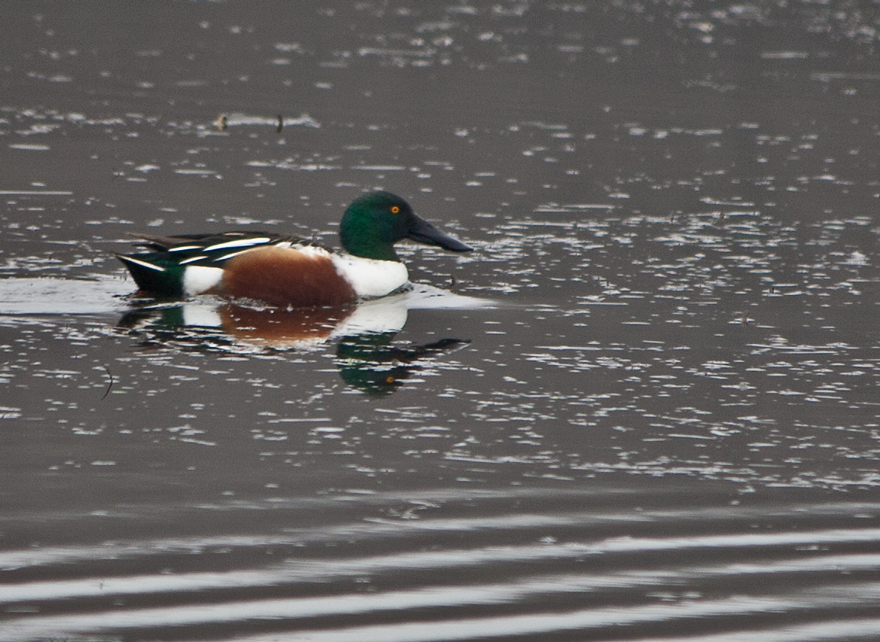
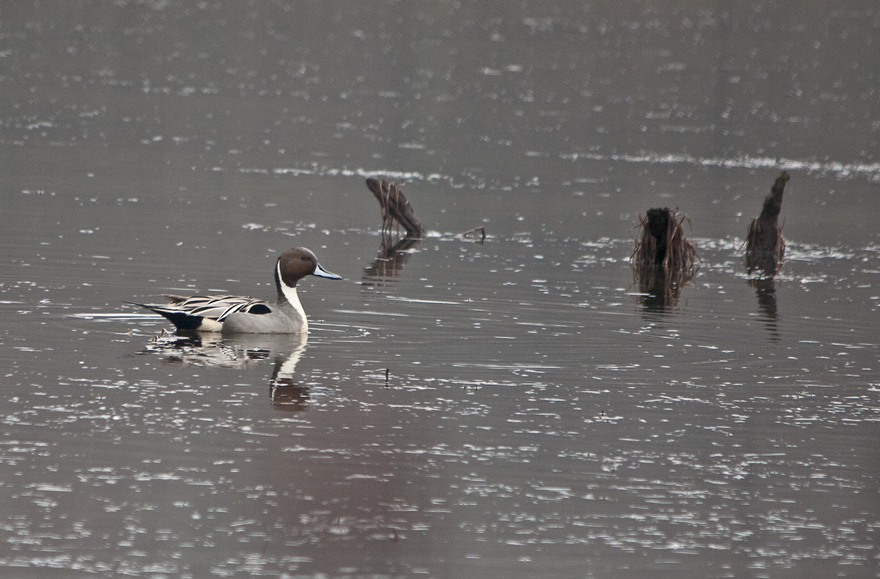
Born in Boston, Massachusetts, I have an affinity for things from the north and was amused to find that two of my favorite birds from this past weekend are called “Northern”—the Northern Pintail (Anas acuta) and the Northern Shoveler (Anas clypeata).

Sometimes it seems that I shoot subjects in cycles. At one point this past summer, I felt like I was shooting a lot of new and interesting subjects that turned out to have “Common” in their names. In addition to the two Northerners that I am featuring today, this winter I have also photographed Northern Cardinals, Northern Flickers, and Northern Mockingbirds.

The day that I took these photos was gray, misty, and overcast, which gave the water an interesting gray tinge. Fortunately there was  enough light to cast interesting reflections onto the water’s surface.

I like the contrast between the body shapes and colors of these two ducks.  The elegance of the long neck and understated, conservative colors of the pintail are quite different from the bold colors and the counter-culture look of the shoveler’s bill. In some ways, they seem to represent the establishment, on the one hand, and the rebel, on the other.

pintail_blog

Male Northern Pintail at Huntley Meadows Park

Male Northern Shoveler at Huntley Meadows Park

Male Northern Shoveler at Huntley Meadows Park

© Michael Q. Powell. All rights reserved

Read Full Post »

I love the dreamy look of the morning mist that provided such a beautiful backdrop for the flight of these two Canada Geese this past weekend.

geese_mist

© Michael Q. Powell. All rights reserved

Read Full Post »

As I was focusing on some ducks yesterday on a misty, gray morning, one of them suddenly decided to take to the air and I managed to capture him just as he was starting to come out of the water.

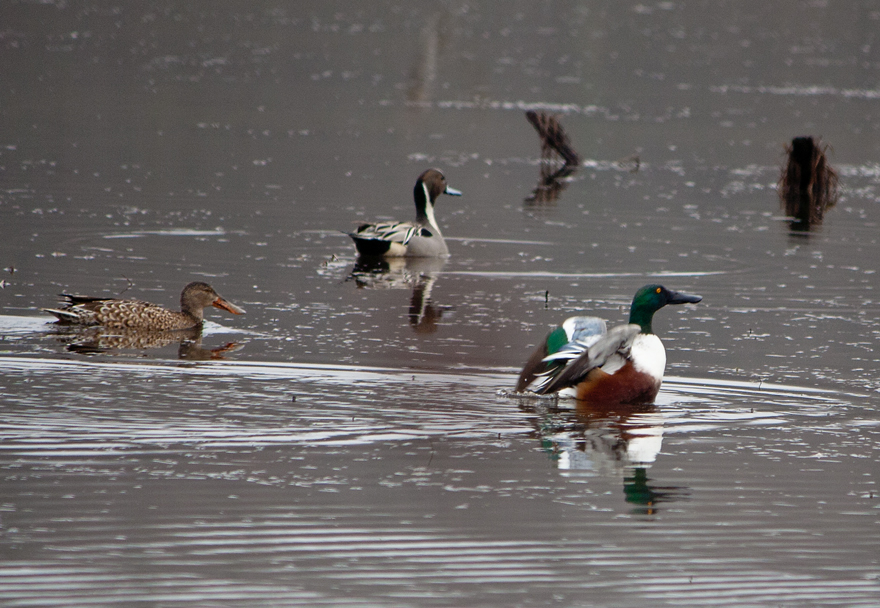
The ducks were a little closer to the shore of a little pond at my local marshland park than is usually the case and I was squinting through the viewfinder trying to identify their types. The bright white neck of one of them made me pretty sure that it was a Northern Pintail (Anas acuta), but I wasn’t quite so sure about the pair of ducks that sort of looked like mallards, but turned out to be Northern Shovelers (Anas clypeata).

I was trying to be as quiet as I could as I took some photos, when the male Northern Shoveler somehow detected me and took off. I managed to snap a photo at a really interesting moment as the male is just starting to flap his wings. The female and the pintail aren’t  paying much attention to the male’s actions and eventually just swam away.

liftoff_blog

I tried to follow the male Northern Shoveler in flight as he headed off into the distance. Most of my shots were pretty blurry, but I got a couple that I really like. The first one is just after take off and I like the splash and the fact that his reflection is still visible. In the second one,the background is a soft blur, providing a nice backdrop for the vivid colors of the shoveler. He is in a photogenic position as he flies away and I like the fact that a portion of his head and one of his yellow eyes are still visible.

flight3_blog

flight_blogI’ll probably post some separate photos of the Northern Shoveler and the Northern Pintail a bit later, but wanted to share my good fortune in capturing this moment.

© Michael Q. Powell. All rights reserved
Read Full Post »

This past weekend I had a chance to observe the singing techniques of a newly arrived Red-winged Blackbird in my local marshland park.

I was curious to watch the blackbird as he was singing and see if I could determine how he is able to achieve such amazing volume and duration in his calls. As a singer, I have been taught to concentrate on breathing from my diaphragm when I am singing, which fills up the lungs more completely than the shallow chest breathing that most people do. In practice, what this means is that you throw out your abdomen to allow more air in and then gently squeeze with the abdominal muscles to slowly expel the air.

It looks to me that the blackbird uses similar singing techniques. I could actually see his abdomen expand as he was getting ready to sing and he engaged his entire body when he was singing.

I have some images of blackbirds simply sitting on cattails from this weekend, but I thought it would be more interesting to share a couple of the ones in which the blackbird is singing.

blackbird2_blogblackbird1_blog© Michael Q. Powell. All rights reserved

Read Full Post »

My ears told me before my eyed did that some Red-winged Blackbirds (Agelaius phoeniceus) had returned to my local marshland park. I heard the very distinctive song of the blackbird last summer and fall often enough that it’s embedded in my brain. I am working on a couple of photos of blackbirds on cattails, but thought I’d share this image first.

It’s sort of a silhouette, but the red and yellow portion of the wing are very visible, so it’s probably not a true silhouette. There is something simple and graphic about the image that I like, even though normally important details like the eyes are not visible.

blackbird3_blog

© Michael Q. Powell. All rights reserved

Read Full Post »

I usually think of Canada Geese as extroverts. They are loud and gregarious and announce their presence when they arrive. I captured this one making a big splash, literally.

Looking at the photo, I think that I must have had my focusing point on an area between the wings, because there are a lot of beautiful details in the feathers. In some ways I am using these geese as test subjects as I learn to track birds in flight (and landing) and try to time my exposures for maximum effect. They don’t seem to mind (though I am waiting for one to ask me for copies of the photos to show to his friends).

splash_blog

© Michael Q. Powell. All rights reserved

Read Full Post »

If you think that you are having a bad hair day today, check out the windblown hair of this Great Blue Heron.

It was cold and really windy today and it seemed like the small birds had sought shelter somewhere, because there were relatively few around. The bigger birds could handle the wind better and I saw lots of crows and geese and a number of vultures.

I also saw one Great Blue Heron, who was pretty far away from me. I watched him for quite some time as he stared down at the waters at the far edge of the beaver pond and I wondered if it would be possible for him to find anything to eat.

When I looked at some of my photos of the heron, I was struck by his hair. It looks like he is suffering from male pattern baldness and has grown his hair long in a vain attempt to hide that reality. Perhaps he has an artistically arranged comb over most of the time, but the wind caused his hair to go in all directions.

Do you think that they have a Hair Club for herons?

badhair_blog

© Michael Q. Powell. All rights reserved
Read Full Post »

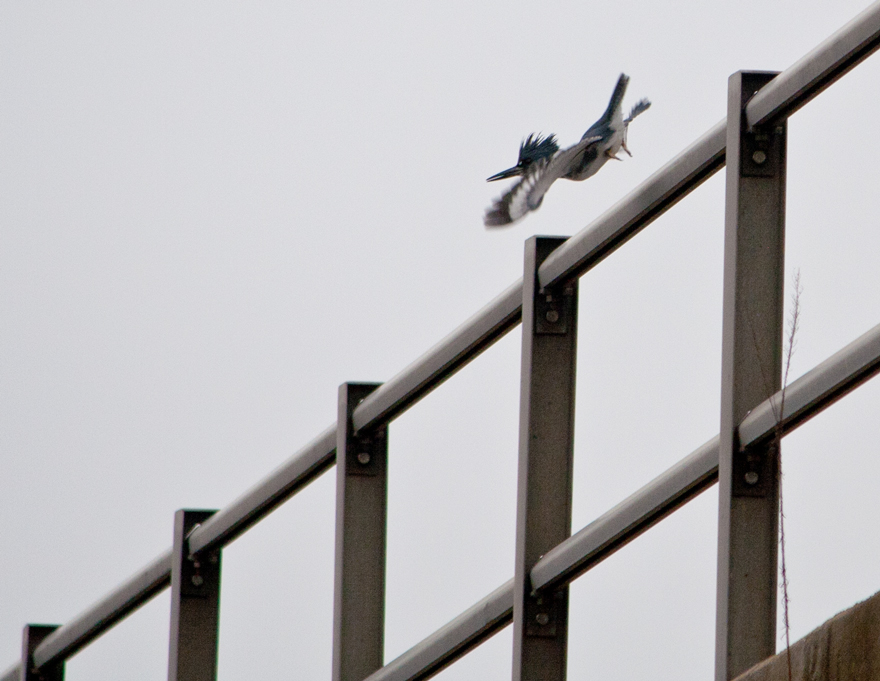
Walking alongside a stream yesterday, I heard the unmistakable call of a Belted Kingfisher, a call that is usually described as a “piercing rattle.” Here is a link to the Cornell Lab of Ornithology, which has sound clips that you might find interesting if you have never heard a Kingfisher’s call in person.

A previous post chronicled my quest for an elusive female Belted Kingfisher (Megaceryle alcyon) at a little suburban lake that is stocked with trout. I made multiple attempts on different days to photograph that Kingfisher as she perched on tree branches overlooking the water.

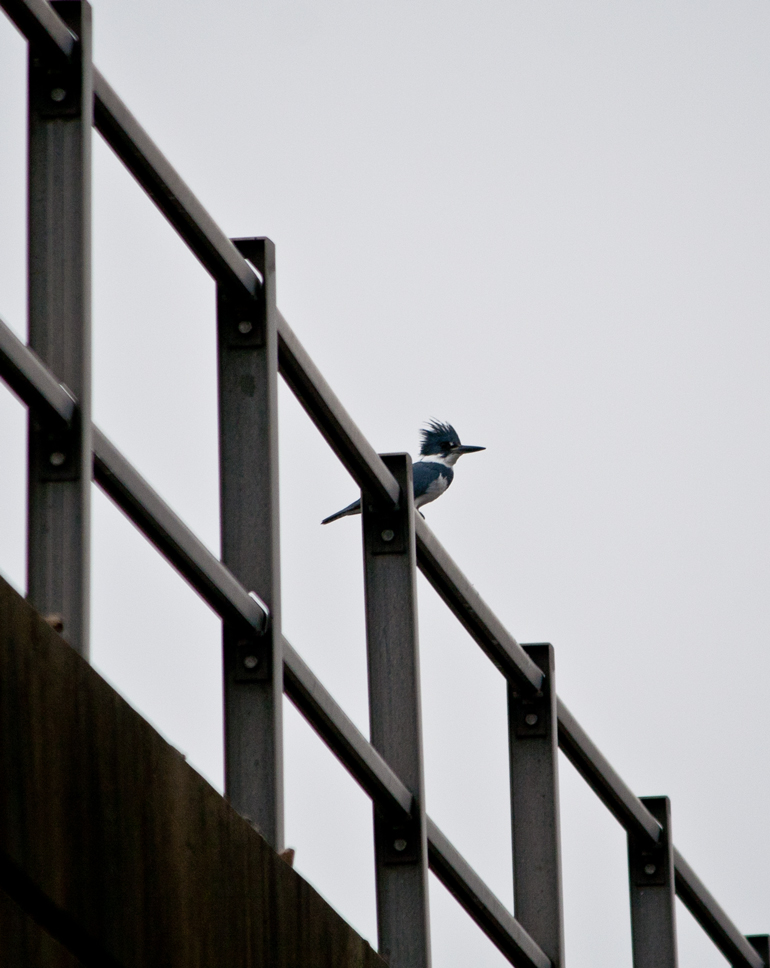
Although the stream along which I was walking yesterday is only a half mile or so from the female Kingfisher’s fishing spot, I was surprised to hear a Kingfisher’s call, because there are no trees on the banks of the stream at that location. When I heard its call again, I turned my head in the direction of the sound and was surprised to see a male Kingfisher perched on a power line above the stream. (It’s really easy to distinguish a male Belted Kingfisher from a female, because the male has only a blue stripe on is chest and a female has blue and chestnut stripes.)

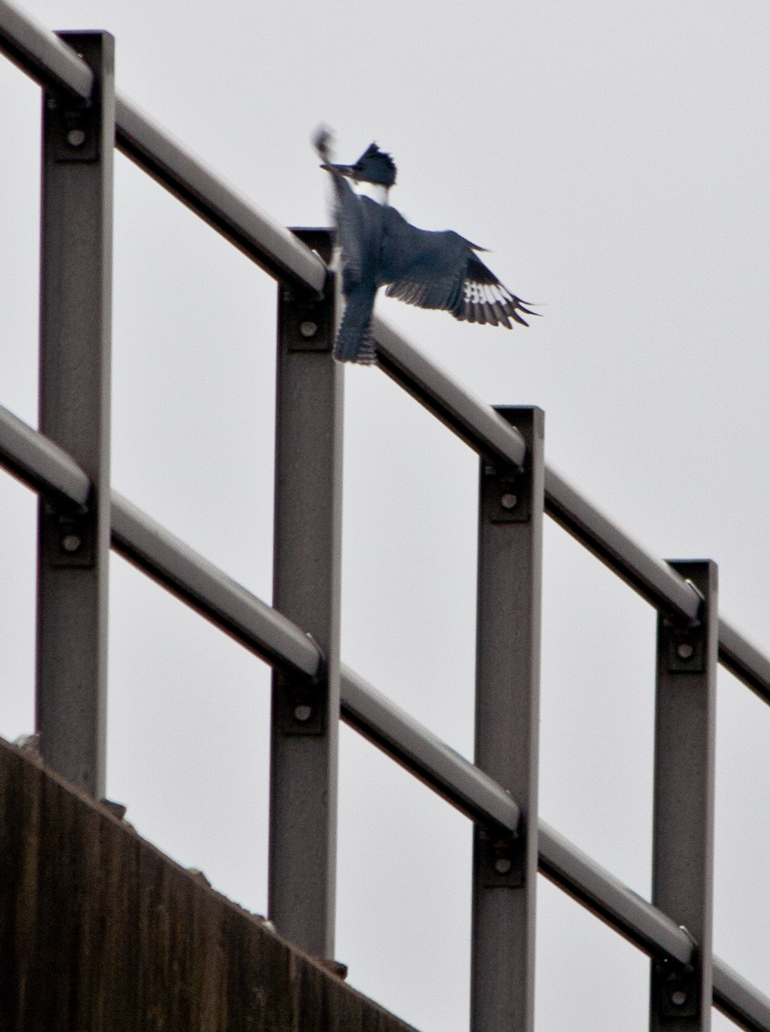
When I moved a little closer to him, he flew a short distance downstream and I located him again, this time perched on the railing of a railroad bridge over the stream. Over the course of an hour or so, he and I played  a little game in which he would pose for a few minutes on the railing and then fly downstream. A short while later he would be back on the suspended power line. I would walk slowly in the direction of the power line and once I arrived there, the Kingfisher would return to the railroad bridge.

Although I was not able to get really close to the Kingfisher, I managed to get some pretty cool pictures, including several in-flight shots. I really like the industrial-looking setting of the railroad bridge, with its simple geometric structure and beautiful angular lines. In many ways, the bridge is a much a subject in the photos as the bird.

I confessed in a previous post that I was a stalker of Kingfishers, but maybe it’s time to elevate my status—perhaps from now on I will refer to myself as a member of the Kingfisher paparazzi.

kingfisher_M3_blogkingfisher_M1_blogkingfisher_M2_blogkingfisher_M5_blogkingfisher_M6_blogkingfisher_M4_blog

© Michael Q. Powell. All rights reserved

Read Full Post »

On a cold, windy day I was looking out into the beaver pond, when suddenly my eyes detected movement. Initially, it looked like some debris on the surface was being blown about, but gradually it became apparent that the little pile of debris was headed toward me. Uncertain of what I was looking at, I focused my camera on the unknown material and began to shoot.

Eventually, I realized that what I was seeing was a muskrat (Ondatra zibethicus) swimming, pushing along some plants and what looks like some berries. My guess is that he had gone out to gather food and was returning home with the results of his efforts. You can get a better  what he is transporting if you click on the photos.

The muskrat was putting so much effort into swimming on the surface that he did not seem to notice me until he was pretty close. By then, however, he was almost home, so he would have had to go underwater anyways.

I don’t know enough about what muskrats eat to hazard a guess about what exactly the muskrat was carrying across the water, but hopefully it looked more tasty to him than it does to me.

muskrat_blogmuskrat2_blog

© Michael Q. Powell. All rights reserved
Read Full Post »
« Newer Posts - Older Posts »