Feeds:
Posts
Comments

Posts Tagged ‘Canon 50D’

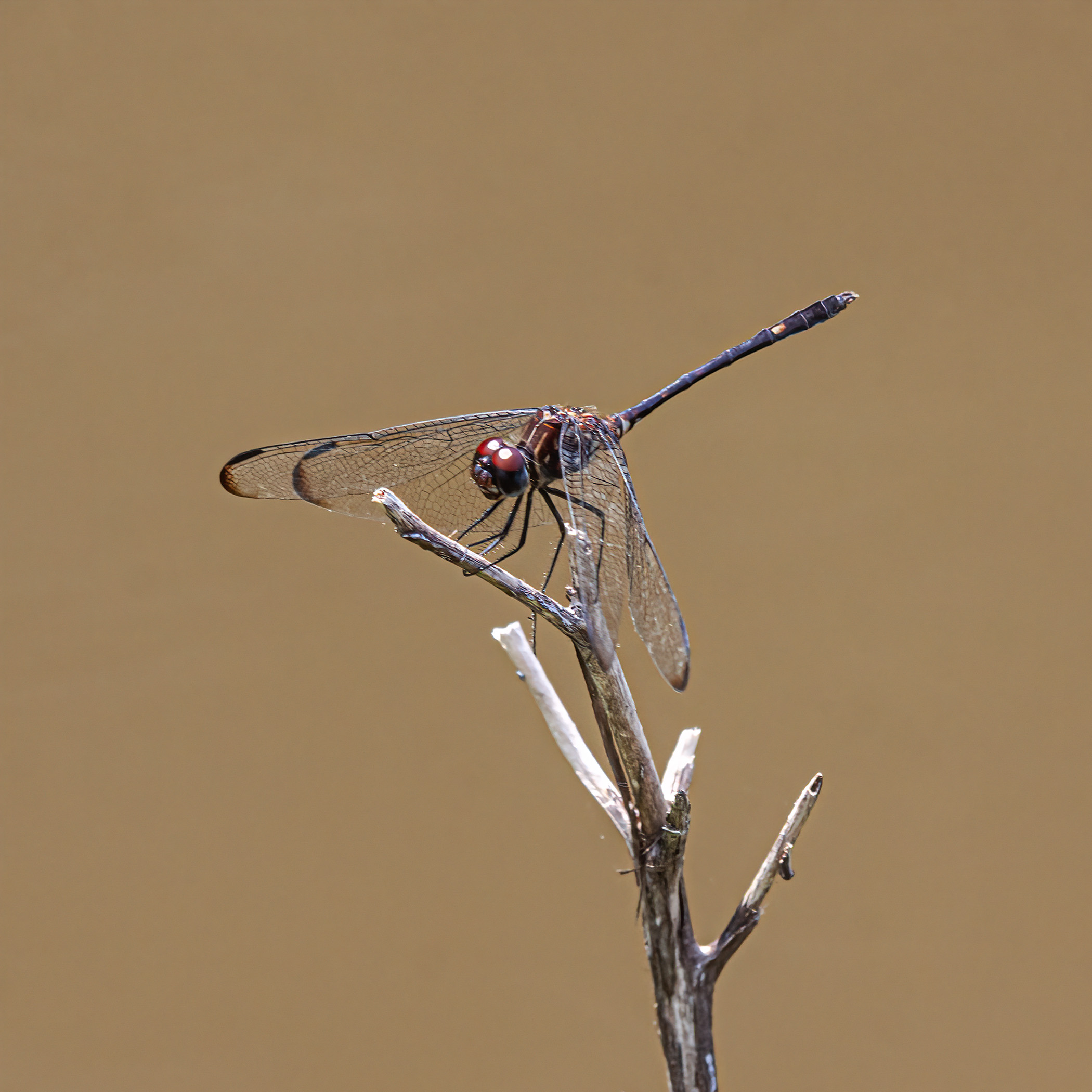
Black Saddlebags dragonflies (Tramea lacerata) are definitely migrating through my area. I have seen more than a dozen of them overhead during several visits this week to Occoquan Bay National Wildlife Refuge. It is really cool to see them hawking for insects in mixed groups that include Common Green Darners and Wandering Gliders, two other species that also migrate.

These three species spend most of their time in flight—they eat while they are flying—and it is rare for me to see one perched. Still, I track them and chase after them, hoping that these long-distance dragonflies will eventually come down to earth for a rest.

On Thursday, my patience was rewarded and I was able to get some shots of perched Black Saddlebags dragonflies. There were actually two individuals that perched briefly on separate branches of a fallen tree during a short period of time. I am not sure if the two shots below are of the same dragonfly or of different ones, but I really like the poses were wonderful in either case.

Have a wonderful weekend.


Black Saddlebags

Black Saddlebags

© Michael Q. Powell. All rights reserved.


Read Full Post »

Normally I do not like to have manmade objects in my wildlife photos, but in this image of a dragonfly perching on a twisted wire, I really like the juxtaposition of the natural and manmade elements.

The dragonfly is a very mature female Great Blue Skimmer dragonfly (Libellula vibrans)—the bodies of females of this dragonfly species get darker as they age and this one seems to have an almost bronze-like patina. Although there was plenty of vegetation around, she repeated perched on this wire that was blocking one of the trails on Monday at Occoquan Bay National Wildlife Refuge.

The diverse linear elements really draw my eyes to this image—the soft green lines of the vegetation in the background; the crisp angular lines of the leading edges of the wings; the slightly raised line formed by the dragonfly’s body; and the twisting lines of the wire.


Great Blue Skimmer

© Michael Q. Powell. All rights reserved.

Read Full Post »

It is hard to get privacy for some summer loving and rivals may try to interfere when you are a damselfly. That appeared to be the case on Monday at Occoquan Bay National Wildlife Refuge for this couple of Big Bluet damselflies (Enallagma durum) that I spotted in flagrante delicto.

Feeling a little bit like a voyeur, I was focusing on the couple when I was unexpectedly photobombed by a second male Big Bluet. As I noted yesterday, it is challenging to capture images of a flying dragonfly and it is even harder to get an in-flight shot of a damselfly. In this case it was a matter of luck and quick reactions, rather than skill, that allowed me to get the photo of the incoming damselfly.

The couple changed their position a bit, but were undeterred by the intruder.  I was happy to capture the sidewards-heart shape that is typical of mating damselflies and even more thrilled with the way that the colorful background turned out in a preview of fall colors.

big bluet

big bluet

© Michael Q. Powell. All rights reserved.


Read Full Post »

Black Saddlebags dragonflies (Tramea lacerata) like to fly high overhead, back and forth over trails and fields in pursuit of tiny insects that are often invisible to my eyes. They are pretty easy to identify because of the distinctive large dark patches on their wings that you can pick out even when they are flying. They are a challenge to photograph, though, because they rarely seem to perch.

When I spotted this patrolling Black Saddlebags on Monday at Occoquan Bay National Wildlife Refuge, I decided to try to capture some in-flight action shots of the dragonfly. When I am trying to photograph a dragonfly flying over a pond, I can sometimes pre-focus on an area, because the dragonfly stays at the same height above the water and flies in a somewhat predictable pattern. That technique does not work, however, with a dragonfly like the Black Saddlebags that changes altitude and direction quickly and without warning.

The first two photos give you a pretty good look at the wing pattern of the Black Saddlebags. If you look really closely at the first photo, you will note that the dragonfly has tucked in its legs under the thorax (the “chest” area), probably for aerodynamic reasons.

In the final photo, I noted that the dragonfly’s legs were extended. What was going on? As I was processing the shot, I noted some small white spots in front of and just above the dragonfly. At first I thought these might be dust spots on my sensor, but they were in different places on different shots, so I rejected that hypothesis. I think that those white spots, which you can see in the final image if you click on it and look very carefully, are small insects and the dragonfly was extending its legs to snag those insects.

The Black Saddlebags is one of several dragonfly species that migrates in the fall and this one may have been fattening up in preparation for the upcoming journey. Whatever the case, it was a fun challenge to try to photograph this dragonfly flying overhead.

Black Saddlebags

Black Saddlebags

Black Saddlebags

© Michael Q. Powell. All rights reserved.

Read Full Post »

The number of dragonflies of certain species seems to be dropping as we approach autumn, but there seem to be plenty of Big Bluet damselflies (Enallagma durum) still around at Occoquan Bay National Wildlife Refuge. Their bright blue coloration and relatively large size—about 1.3 – 1.7 inches (34 to 44 mm) in length—makes the Big Bluets easy to spot in the vegetation along a trail that runs parallel to the waters of the bay.

One of the big challenges when photographing dragonflies and damselflies is getting the entire subject in focus—their bodies are long and narrow and are often pointing in a direction that makes it impossible to get sufficient depth of field. This male Big Bluet cooperated by perching in a way that allowed me to photograph him from the side. The damselfly is nicely in focus, while the leafy background is mostly out of focus and does not distract the viewer’s eyes from the primary subject.

Yes, the dragonflies and damselflies are still hanging on in my area. I think I will continue to see and photograph them for at least another month or two before I gradually begin to shift my focus towards birds, which will again become my main focus during the colder months of the year.

Big Bluet

© Michael Q. Powell. All rights reserved.

Read Full Post »

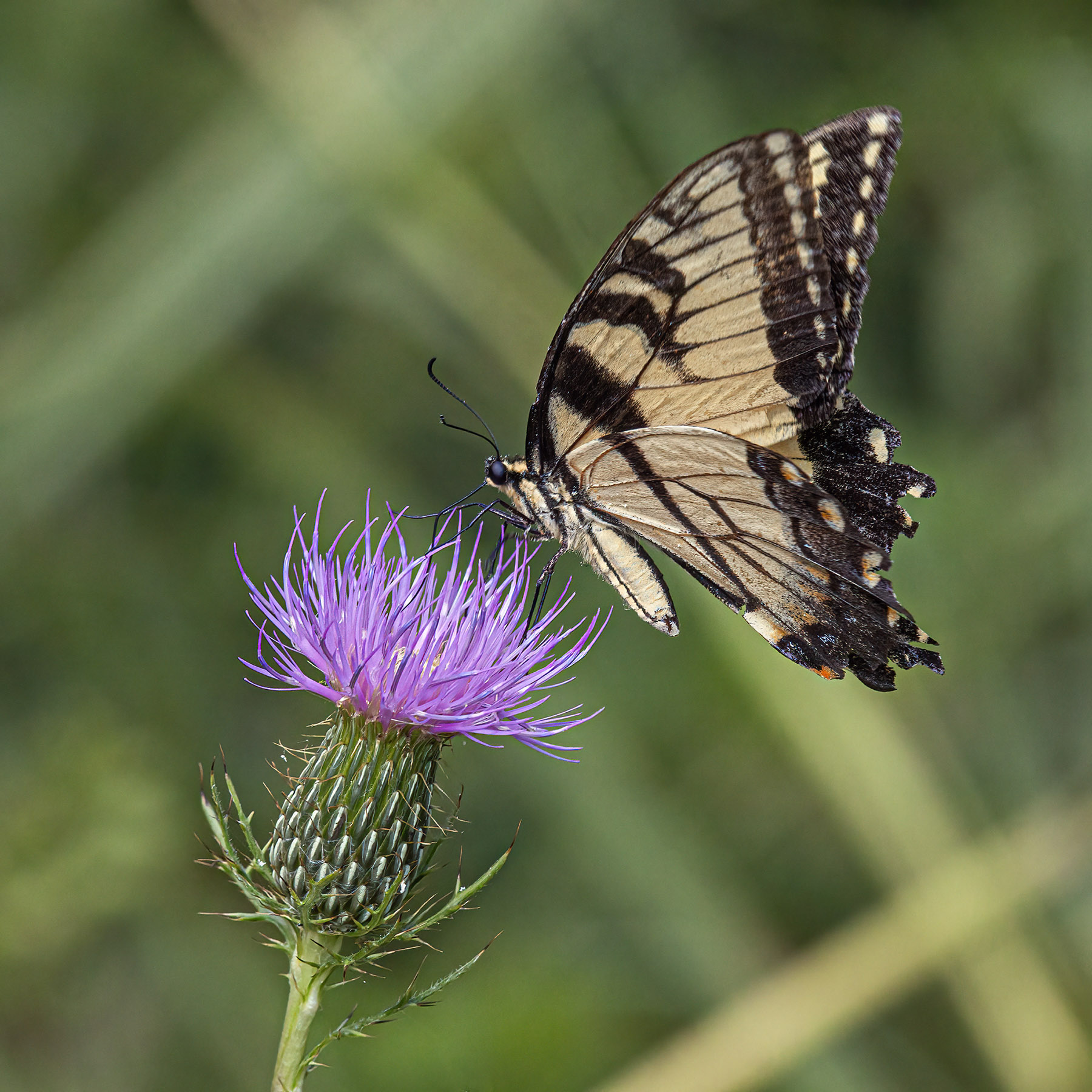
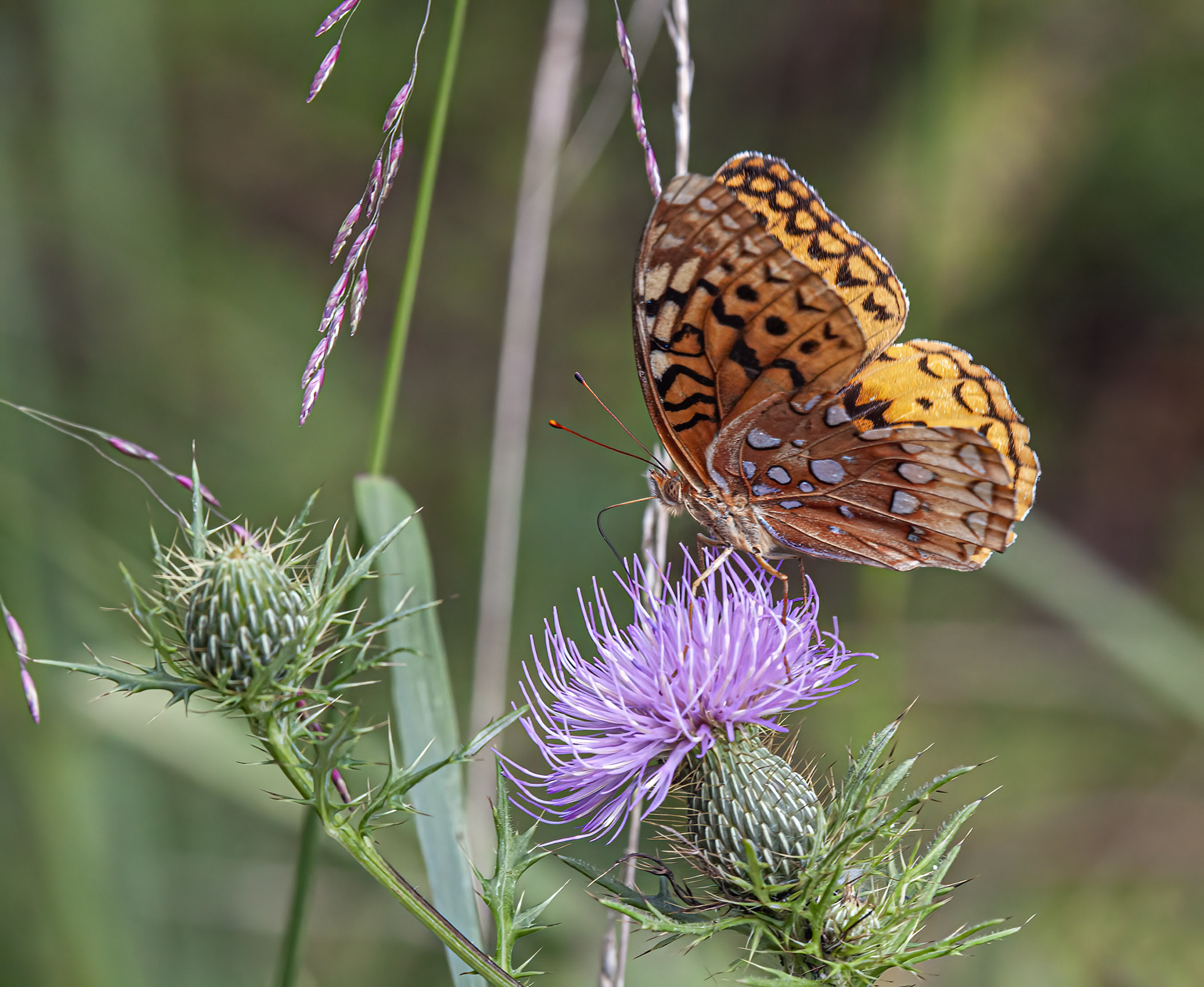
The thistles  in bloom must have been absolutely irresistible to butterflies on Saturday at Occoquan Bay National Wildlife Refuge. I was delighted to spot an Eastern Tiger Swallowtail butterfly (Papilio glaucus) and a Great Spangled Fritillary butterfly (Speyeria cybele) feeding almost side-by-side at a small patch of thistle plants.

I love the color combinations in these shots that contrast the warmer tones of the butterflies with the cooler colors of the flowers and the background. I also really like the texture of the thistles that appear to be hard and thorny, but are actually quite soft to the touch.

Eastern Tiger Swallowtail

Great Spangled Fritillary

© Michael Q. Powell. All rights reserved.

Read Full Post »

I was happy to finally photograph a mature male Needham’s Skimmer dragonfly (Libellula needhami) on Wednesday at Occoquan Bay National Wildlife Refuge. Earlier this season all of the ones I shot were immature and did not have the reddish-orange/brown tones that remind me that autumn is on the way.

Here in the northern hemisphere, autumn will begin in just a few days for those using the meteorological calendar, though many of us won’t start the season until the autumnal equinox on 22 September, according to the astronomical calendar. On the other side of the globe, spring is about to begin and new life is bursting forth in places like New Zealand and Australia, where some of my most devoted readers live. For them, the September equinox is the vernal equinox, and not the autumnal equinox and I look forward to seeing their photos of daffodils, crocuses, and other spring flowers.

Needham's Skimmer

© Michael Q. Powell. All rights reserved.

Read Full Post »

Common Whitetail dragonflies (Plathemis lydia) often perch flat on the ground, where they are relatively easy to spot. When this pretty little Common Whitetail female decided on Wednesday to perch on the side of a large tree, however, she almost disappeared from sight—the pattern of the light and shadows and the muted tones of the bark and the vegetation growing on the tree served to camouflage her presence almost perfectly.

I really like the limited palette of colors in this image and the relative simplicity of the composition. The rough texture of the bark helps to break up the background of the image and add some visual interest without being overly distracting.

Common Whitetail

© Michael Q. Powell. All rights reserved.


Read Full Post »

Although dragonflies do not actually have teeth, I could not help thinking that this female Blue Dasher dragonfly (Pachydiplax longipennis) had a bit of an overbite problem when she smiled and posed for me on Wednesday at Occoquan Bay National Wildlife Refuge. I wonder if an orthodontist would recommend Invisalign treatment for her problem—I cannot imagine seeing a dragonfly with traditional metallic braces on its mouth.

Have a happy Friday and a wonderful weekend.Blue Dasher

© Michael Q. Powell. All rights reserved.

Read Full Post »

I love it when I can get a shot that simultaneously shows the exterior markings and internal colors of a butterfly, especially when the butterfly’s outward appearance is somewhat drab. That was certainly the case with this Question Mark butterfly (Polygonia interrogationis) that I spotted last Saturday at Occoquan Bay National Wildlife Refuge. When it kept its wings closed, the butterfly blended right in with the dried vegetation in the background. As it opened its wings, the butterfly gave me a glimpse of the beautiful warm tones of its orange and brown interior.

In case you are curious about the name of this species, it comes from the white markings on the hind wing that some scientist decided resembled a question mark. The similar-looking Eastern Comma butterfly has a smaller “hook” and does not have the “dot” of the question mark. That dot is sometimes faded or missing, but fortunately there is also a way to tell the two species apart on the basis of the pattern of spots on the interior of the wings.

Question Mark butterfly

© Michael Q. Powell. All rights reserved.

Read Full Post »

I was focused so intently on getting a shot of this male Swift Setwing dragonfly (Dythemis velox) on Monday at Jackson Miles Abbott Wetland Refuge that I did notice that he was not alone on the small branch overhanging the waters of the small pond.

When I first pulled up the image on my computer,  I immediately noticed the strands of spider silk that looked like the guy line of a tent pole. It was only when I started to examine the branch closely, however, that I spotted the elongated shape of a Long-jawed Orb Weaver spider (family Tetragnathidae) perched below the dragonfly on the same branch.

The dragonfly was skittish and flew away when I got too close. I suspect that he was unaware of the fact that I was not the most immediate threat that he faced—danger was lurking from below on that branch that my experience had shown was a favorite perch for Swift Setwings.

Swift Setwing

© Michael Q. Powell. All rights reserved.

Read Full Post »

I was happy to see that some of my favorite dragonflies were still around when I visited Occoquan Bay National Wildlife Refuge last Saturday, including this beautiful female Calico Pennant dragonfly (Celithemis elisa). The bright colors—yellow for the female and red for mature males—and beautiful patterns on the wings of this species never fail to delight and amaze me.

This is the only location in our area where I can find Calico Pennants. As we move closer to the end of summer, I am never sure when I will see the last one of the season, so I look carefully for them each time I am at this refuge. You might think that it would be easy to spot Calico Pennants, because of their bright colors, but their small size—about 1.3 inches (33 mm) in length—makes them a real challenge to find and photograph.

Calico Pennant

Calico Pennant

Calico Pennant

© Michael Q. Powell. All rights reserved.

Read Full Post »

As I glanced down at the dark waters of the pond last Thursday at Huntley Meadows Park, a damselfly couple (Orange Bluets (Enallagma signatum), I think) flew by in tandem and I snapped this shot. I love how it looks like we are peering into a night sky, watching the damselflies fly past the celestial bodies of the Milky Way.

I couldn’t help but think about the opening title sequence from the Star Wars movies that begins with the words, “A long time ago in a galaxy far, far away….”

Orange Bluet

© Michael Q. Powell. All rights reserved.

Read Full Post »

As I focused on this male Great Blue Skimmer dragonfly (Libellula vibrans), he wearily looked up at me. His wings were tattered and his body was scratched—it had already been a long summer for him.

I was fascinated by the shape and texture of the branch on which he was perched and positioned myself to capture those details. I made sure that the nearest eye was in focus, but did not worry that most of the body was blurry and that the angle made the wings almost disappear.

The resulting photo reminded my of the diagrams in my childhood geometry textbook depicting various angles—a cute dragonfly in an acute angle.

Great Blue Skimmer

© Michael Q. Powell. All rights reserved.

Read Full Post »

Some days I am guilty of overanalyzing my images, trying to figure out why I like or do not like them. Today, I decided to simply present this shot of a pretty Eastern Tiger Swallowtail butterfly (Papilio glaucus) that I spotted yesterday at Occoquan Bay National Wildlife Refuge as it fed on what looked to be some kind of sunflower.

I remember so well the words of the old Shaker song, “Simple Gifts” that I sang as part of a high school chorus:

‘Tis the gift to be simple, ’tis the gift to be free,
‘Tis the gift to come down where we ought to be;
And when we find ourselves in the place just right,
‘Twill be in the valley of love and delight.
When true simplicity is gained,
To bow and to bend we shan’t be ashamed;
to turn, turn, will be our delight.
Till by turning, turning we come round right.

Have a wonderful Sunday.

Eastern Tiger Swallowtail


© Michael Q. Powell. All rights reserved.

Read Full Post »

As we move deeper into summer, the days of the dragonflies are gradually coming to an end. Their biological clocks are ticking as they feel compelled to make efforts to ensure the perpetuation of their species.

On Thursday I made a trip to Huntley Meadows Park, a local marshland park, and spotted this pair of mating Great Blue Skimmer dragonflies (Libellula vibrans). I could not help but notice that the wings of the dragonflies were looking tattered, especially those of the female, the dragonfly that is light brown in color. I can also see scratches along the the body of the male.

I also noticed that the female appears to be holding onto some kind of insect in her front legs. Was she planning for a snack during mating? Is the insect the dragonfly equivalent of a post-coital cigarette? I know a lot about dragonflies, but some things are meant perhaps to always remain a mystery.

Great Blue Skimmer

© Michael Q. Powell. All rights reserved.

Read Full Post »

With all of the recent rain, I have not gotten out as much as I would have liked—today’s weather forecast noted that we have had rain during nine of the last ten days. So I decided to share another photo today of a Monarch butterfly (Danaus plexippus) from my visit last Friday to Green Springs Garden.

In a previous posting entitled Monarchs at last, I showed Monarchs feeding on brightly-colored flowers. The background in today’s image is much more muted and the butterfly appeared to be relaxing rather than actively feeding. I love the way that you can see the butterfly’s curled-up proboscis from this angle, looking almost like a very large nose-ring—yeah, I imagine this to be a punk rock butterfly.

Have a wonderful Friday.

Monarch butterfly

© Michael Q. Powell. All rights reserved.


Read Full Post »

Compared to the brightly-colored male damselflies, females damselflies often seem dull-colored and less striking in appearance. This female Powdered Dancer damselfly (Argia moesta) that I spotted in early August alongside a stream in Prince William County is a notable exception to that general rule.

If you click on the photo, you will note the elegant shades of brown on her body that glisten in the sunlight. Her beautiful two-toned eyes are amazing and seem to draw in the viewer. It is hard to be sure, but she almost seems to be smiling or maybe even winking at me.

It takes some effort to see and to photograph such tiny insects, but it is definitely worth it for me to be able to share the beauty of nature with all of you.

Powdered Dancer

© Michael Q. Powell. All rights reserved.


Read Full Post »

If photography were an Olympic sport, would it be an individual sport or a team sport? Generally I prefer to go out with my camera on my own, following my own interests at my own pace. I like the sounds of silence punctuated only by the songs of the birds singing or the wind rustling through the treats, rather than by the harsher tones of the human voice.

I also like to keep moving and start to feel restless if I stay in a spot for more than a few minutes. I guess my style would be most closely related to that of the Olympic biathlon. This winter sport combines cross-country skiing and rifle shooting. Competitors spend most of their time in motion, stopping periodically to take a few shots and then moving on—that is my preferred style. Oh, I can be quite patient at times, like when I am trying to photograph a dragonfly in flight, but that is more the exception than the rule.

One of the consequences of my approach is that I am often in a reactive mode. I chase the action rather than wait for it to come to me, which means I have to react really quickly when a situation presents itself.

I knew from Facebook posts that Ruby-throated Hummingbird (Archilochus colubris) were active at Green Spring Gardens when I decided to visit last Friday. When I arrived, I immediately spotted a cluster of photographers that had staked out a flower bed, some of whom are shown in the final photo. It was hard to miss them, because many of them had large lenses and heavy tripods.

I avoided this group and went about my solitary pursuit of butterflies and dragonflies with my more modest and portable camera setup. Later in the day I did manage to spot a hummingbird in a distant patch of Cardinal flowers (Lobelia cardinalis). The shots are essentially record shots that merely document the presence of the hummingbird. However, hummingbirds are so cool that I am really happy whenever I manage to capture a recognizable image of one.

Ruby-throated Hummingbird

Ruby-throated Hummingbird

Green Spring Gardens

© Michael Q. Powell. All rights reserved.

Read Full Post »

It was definitely exciting to see my first Monarch butterflies of the season last Friday at Green Spring Gardens, but I was equally delighted to see some other beautiful butterflies that day. The one in the first photo is an Eastern Tiger Swallowtail (Papilio glaucus) on a flower that I later learned is a Mexican sunflower. I am pretty sure that the butterfly in the second image is a Spicebush Swallowtail (Papilio troilus), although the angle of this shot keeps me from being absolutely certain. I am not sure what kind of flower it is feeding on, but it sure was pretty.

Although I spend a lot of time in streams, fields, and marshes, I enjoy visiting gardens from time to time. It is stimulating to all of the senses to see all of the bright colors and smell the fragrant flowers. There were plenty of bees too and occasional forays into the flowers by goldfinches and hummingbirds. It was a good day.

Eastern Tiger Swallowtail

Spicebush Swallowtail

© Michael Q. Powell. All rights reserved.


Read Full Post »

Several times recently I have noted with regret that I had not yet seen any Monarch butterflies (Danaus plexippus) this summer. On Friday my luck changed and I was absolutely delighted to have multiple encounters with Monarchs during a visit to Green Spring Gardens, a country-run historical garden only a few miles from where I live. Obviously I had been looking for Monarchs in all the wrong places.

I felt carefree as a child as I chased the butterflies all over as they flitted from flower to flower. It was a hot, humid day and it was not long before I was drenched in sweat, but I was content in what I was doing.

I will let the beauty of the Monarchs speak for itself through these photos. I will only add that it was definitely worth the wait.

Monarch butterfly

Monarch butterfly

Monarch butterfly

© Michael Q. Powell. All rights reserved.

Read Full Post »

As we move deeper into summer, some species are starting to disappear. I keep a mental inventory of the ones that are still around and was thrilled to spot this male Swift Setwing dragonfly (Dythemis velox) last week when I made a brief visit to Jackson Miles Abbott Wetland Refuge.

Swift Setwings are really cool-looking and are special to me. Five years ago I spotted my first one at this same refuge and it was the first time that a Swift Setwing, a primarily southern species, had ever been documented in Fairfax County, the county where I live. Every year since 2016 I have checked this location and found Swift Setwings—apparently this species has established a breeding population here, though I have seen no reports that it has ever been seen at any other spots in the county.

Swift Setwings perched in a distinctive fashion with their wings angled down and forward and their abdomen slightly raised, so they are pretty easy for me to identify. I was particularly thrilled when this individual chose and a particularly photogenic perch, allowing me to capture this rather minimalistic portrait of aSwift Setwing in early August.

Swift Setwing

© Michael Q. Powell. All rights reserved.

Read Full Post »

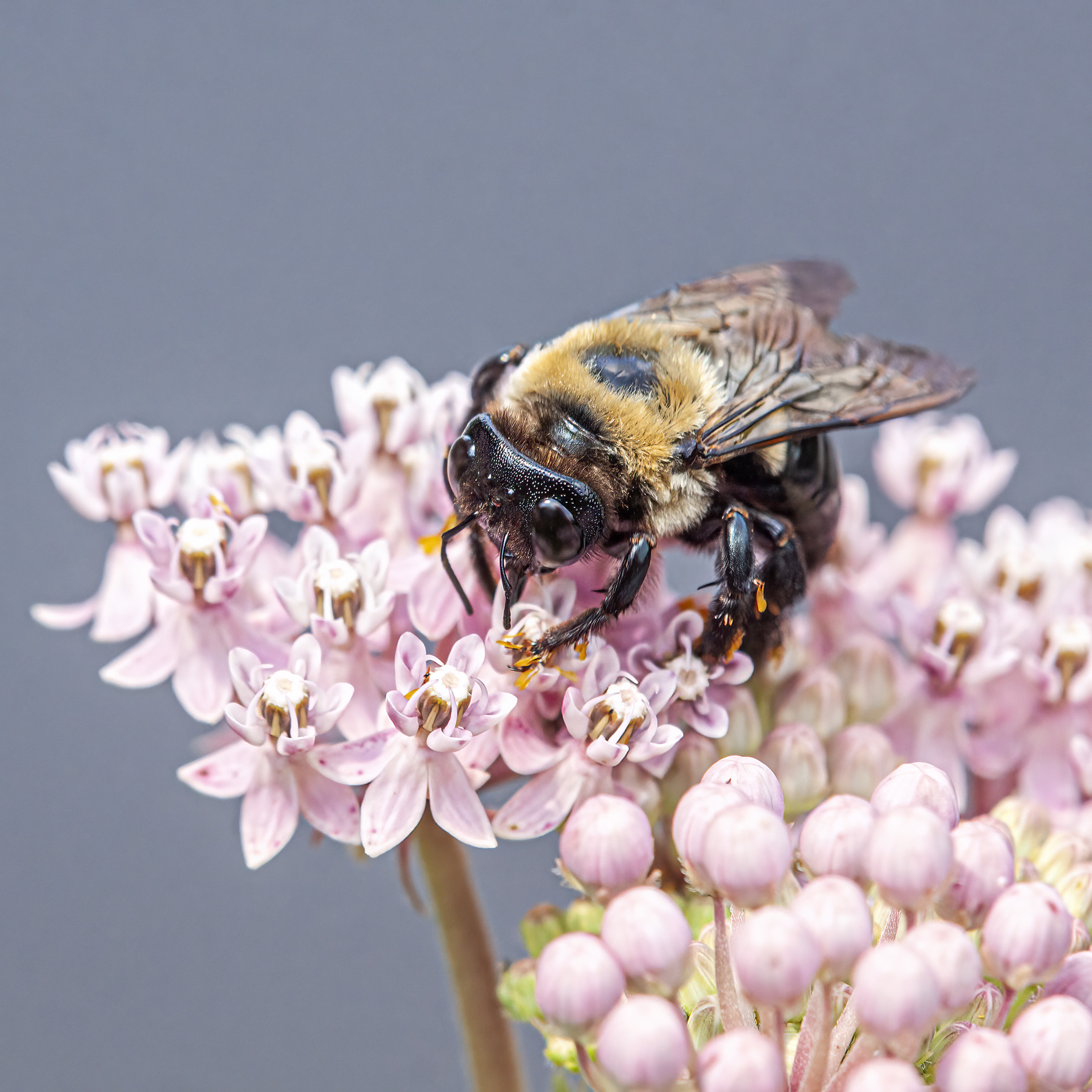
I was hoping to find a Monarch butterfly when I checked out some patches of milkweed last week at Jackson Miles Abbott Wetland Refuge, but ended up instead with some action shots of an Eastern Carpenter Bee (Xylocopa virginica). The bee was quite distracted while feeding, so I was able to get really close to it for these shots.

I like the way that I was able to capture some wonderful details of the bee as well as those of the beautiful pink milkweed.

carpenter bee

carpenter bee

© Michael Q. Powell. All rights reserved.


Read Full Post »

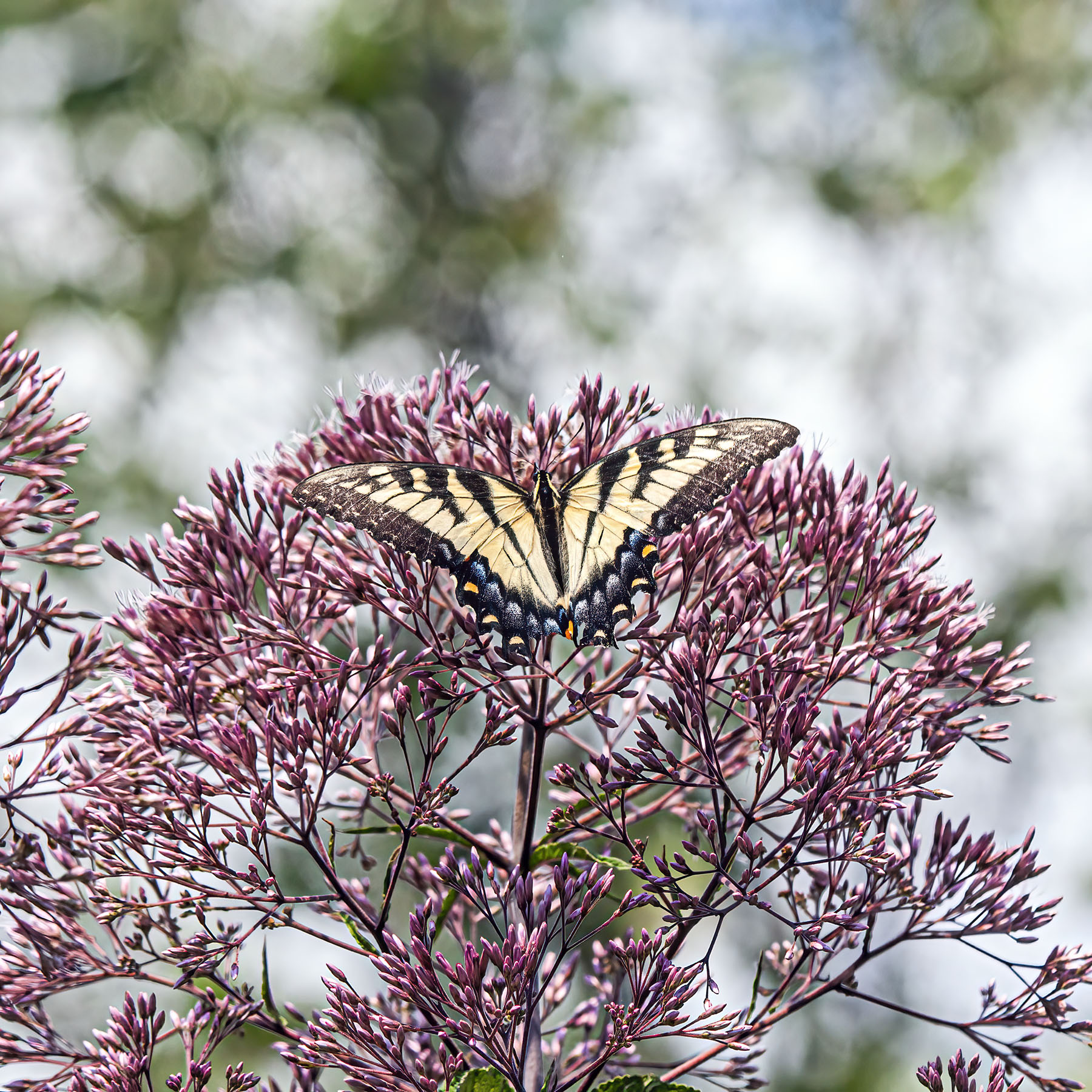
The Joe Pye Weed (Eutrochium purpureum) at Jackson Miles Abbott Wetland Refuge grows so high that I have to point my camera almost straight up to get a shot of the butterflies that seem to really enjoy this flowering plant. Although it is a somewhat uncomfortable shooting angle, it allows me to include the sky in some of my shots, as was the case with this Eastern Tiger Swallowtail (Papilio glaucus) on Monday.

I seem to be in an artistic mood recently. I noted this morning that this is the third consecutive posting in which the colors and shapes of my subjects have been of equal or greater importance as the subjects themselves. There is something about the first image especially that just seems so beautiful to me. I really like the way that the different elements in the image work together to create a harmonious whole.

In the second image, I deliberately violated one of the “rules” of photography and placed my primary subject in the center of the frame. Why? I wanted to emphasize the symmetry of the butterfly when it spread its wings. I think the photo works pretty well, though perhaps not quite as well as the first image, which has a slightly more dynamic feel to it.

Eastern Tiger Swallowtail

Eastern Tiger Swallowtail

© Michael Q. Powell. All rights reserved.

Read Full Post »

I try to pay a lot of attention to the background when I am trying to photography dragonflies. I would love it if I could capture images of colorful dragonflies perched in fields of equally colorful flowers, but that almost never happens. Most dragonflies don’t seem to like flowers and more often than not, my dragonfly shots look like the second photo below.

Now don’t get me wrong, I like that shot of a male Slaty Skimmer dragonfly (Libellula incesta) that I spotted on Monday during a short visit to Jackson Miles Abbott Wetland Refuge. The perch is mildly interesting with its shape and its visible thorn and the background is pleasantly blurred and undistracting. The details of the dragonfly are pretty sharp and in focus.

However, I think that the first shot, which I captured a little later that same day at the same location, has more of a “wow” factor. When I saw that dragonfly land, I made a quick calculation that I could get a shot of it with some goldenrod in the background. I maneuvered into place and framed the shot to match what I saw in my mind and I think it worked out really well.

Purple and yellow and complementary colors on the color wheel and provide some wonderful contrast in this image. The angled lines of the stems that cut across the image and the curves of the green leaves add some additional visual interest to the photo.

Often I am happy when I manage to get clear shots of my subjects, but in the back of my mind I am always searching for ways to make those shots more interesting. When I started to get serious about photography nine years ago, I had to think consciously about the settings of my camera, the rules of composition, and the need to steady myself and control my breathing. Most of that has now become instinctive, which frees me to focus more on creativity, on capturing ordinary beauty in extraordinary ways.

Slaty Skimmer

Slaty Skimmer

© Michael Q. Powell. All rights reserved.

Read Full Post »

Every time that I visit Jackson Miles Abbott Wetland Refuge, I alway check a spot near a fishing platform where there is a piece of rebar sticking out of the water. In the past I have seen dragonflies of various species perching on the rebar and it provides a wonderful photographic opportunity, assuming that the dragonfly does not immediately fly away, which happens about half of the time.

Yesterday a male Eastern Amberwing dragonfly (Perithemis tenera) was perched on the rebar. I love the contrast between the colors, patterns, and textures of the natural object, the dragonfly, and those of the man-made subject, the rebar. The muddy waters of the pond provide a uniform background color that really complements the amber and rust tones of the primary subjects.

One of the coolest things about this image is the long amber shadow that the dragonfly is casting onto the rebar. I am a huge fan of shadows and reflections, which often add a “wow” factor to an image, the proverbial “cherry on top.”

Eastern Amberwing

© Michael Q. Powell. All rights reserved.

Read Full Post »

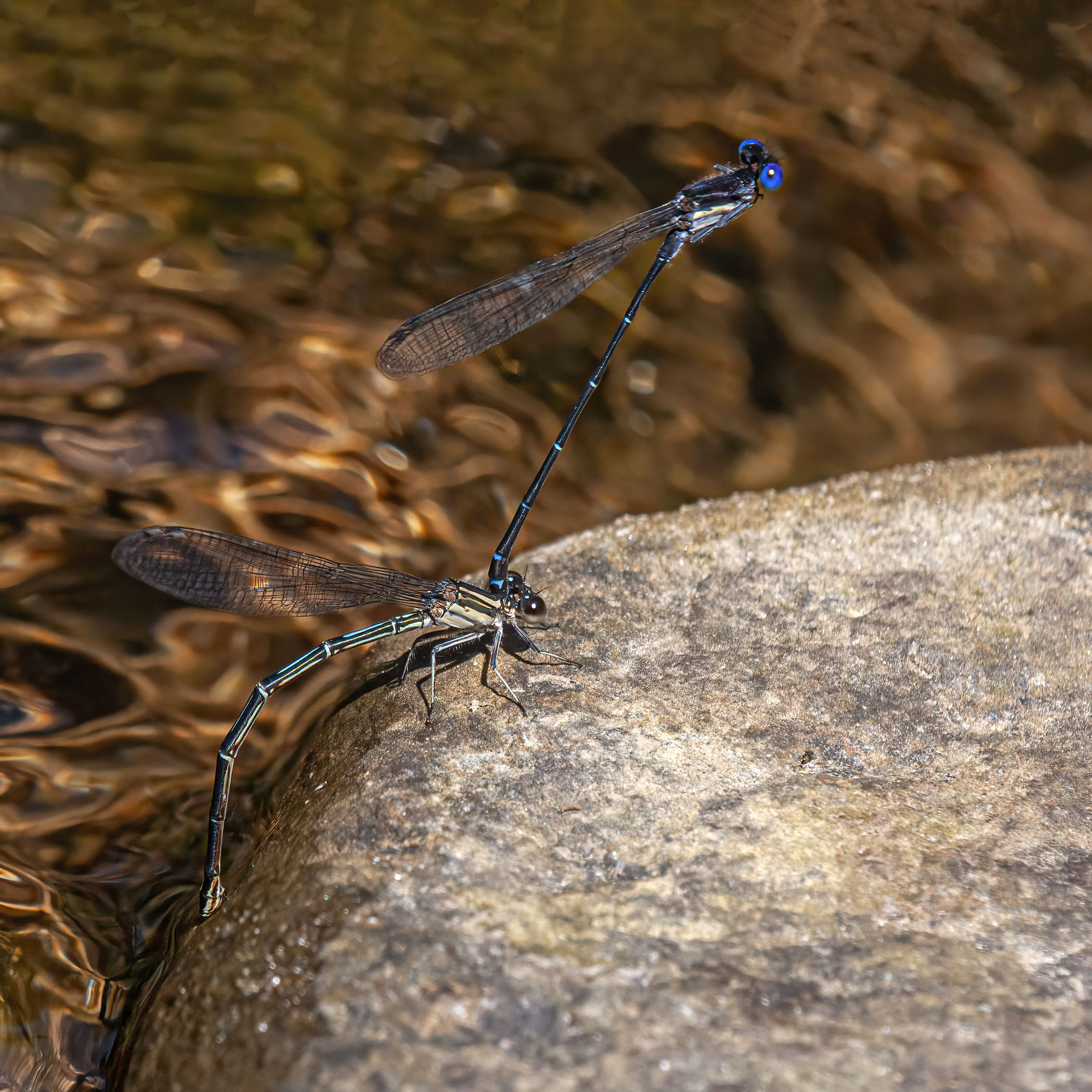
You may be revealing your age if you answer this question, but how many of you remember the 1980’s television series Solid Gold that featured pop music and the Solid Gold Dancers? Somehow my mind made that connection to my distant past when I saw the water shimmering with a metallic glow in the background of these Dusky Dancer damselflies (Argia translata) that I spotted last Thursday as I was exploring a stream in Prince William County, Virginia.

What were they doing? The pair of Dusky Dancer damselflies was in tandem, with the male holding on to the female as she deposited eggs on the side of a stone in the stream. In some dragonfly and damselfly species, the male hangs on like this to ensure that no rival male prevents the female from ensuring that his genes are passed on. With some species of dragonflies, the male instead hovers overhead as the female dips the tip of her abdomen into the water to release eggs.

This was a somewhat challenging shot for me to take, because I had to get really low and position myself carefully to get both damselflies in focus. Dusky Dancers are only about an inch and a half (38 mm) in length, so I had to get relatively close to the couple, though my 180mm macro lens gave me a bit of stand-off distance so I did not feel too much like a voyeur.

If you have not heard of Solid Gold, here is a link to a You Tube version of the episode that aired on March 14, 1981. So many of the songs and other performances brought back sweet memories of the 1980’s. You may not want to listen to the entire episode as I did, but if you can, I recommend that you jump ahead to 31:57 of the You Tube video and listen to the live version of Dionne Warwick, the original host of the TV series, singing “What the World Need Now is Love.”

I still believe in the power of those words, “What the world needs now is love, sweet love, no, not just for some, but for everyone.” Those words for me are solid gold.

Dusky Dancer

© Michael Q. Powell. All rights reserved.

Read Full Post »

At first glance you might think that the insect in this photo is a dragonfly, especially if you know how much I like dragonflies. If you look a little more closely, you will see that the wings are completely different from those of a dragonfly. This is actually a Red-footed Cannibalfly (Promachus rufipes), one of the coolest and creepiest insects that you can encounter in the wild.

Red-footed Cannibalflies, a type of robber fly, usually feed on other insects, but they reportedly are capable of taking down a hummingbird. Thankfully I have never seen that happen, since I really like hummingbirds, but several years ago I did photograph a Red-footed Cannibalfly with a large Hummingbird Moth that it had captured (see my 2017 posting Demise of a hummingbird moth).

I have a special relationship with this insect with the macabre moniker. In August 2013 I did a posting with the fairly basic title of Red-footed Cannibalfly. The posting was a modest success and had 61 views in 2013. Since that time, though, the posting has generated a lot of interest, primarily as a result of internet searches,  and the total number of views has risen to 2,842, which makes it the second most viewed posting of my more than four thousand postings to date. Yikes!

I spotted this Red-footed Cannibalfly last Thursday as I was exploring a small pond in Prince William County, Virginia. I am always amazed at the relative bulkiness of this insect compared to the average dragonfly and thought that it might have captured a prey. A closer examination of the Red-footed Cannibalfly showed that it was empty-handed or maybe I should more properly say empty-footed.

In the back of my mind I hear the words of the Wikipedia description of a robber fly attack that I included in the 2013 posting, “The fly attacks its prey by stabbing it with its short, strong proboscis  injecting the victim with saliva containing neurotoxic and proteolytic enzymes which very rapidly paralyze the victim and soon digest the insides; the fly then sucks the liquefied material through the proboscis.” It is enough to give a person nightmares.

Red-footed Cannibalfly

© Michael Q. Powell. All rights reserved.

Read Full Post »

Most of the time frogs hop away as soon as they sense my approaching footsteps. This male Green Frog (Lithobates clamitans), however, stayed in his sunny spot in the shallow waters at the edge of the pond, patiently posing for his portrait on Thursday. With a little encouragement, he even smiled a bit.

When I posted this photo on Facebook, one of my friends commented, “I’ve kissed a few of those.” Her words brought back memories of the role that I played in a theater production of The Frog Prince more than 35 years ago when I was in the military. A cast of adults put on several plays for children, which was a lot of fun, because over-the-top acting was encouraged to keep the kids in the audience engaged—I must admit that I am a bit of a ham when in the spotlight.

Wearing a mask, flippers, green tights, and a leotard, I played the role of the frog, agilely hopping about on the stage. When I was kissed and magically transformed into the handsome prince, a younger, cute blond actor continued in the role—there is only so much you can do with stage make-up.

Be bold today and go out and kiss a friendly frog or at least do something that takes you out of your normal comfort zone.

Green Frog

© Michael Q. Powell. All rights reserved.

Read Full Post »

How do I find all of the different dragonflies that I feature on my blogs? I like to visit a variety of habitats starting early in the spring and going later into the autumn. When I am out in the wild with my camera, I try to move relatively slowly as my eyes scan the ground, the vegetation, and the air for indications of dragonflies. Most of the time I need movement for me to detect a dragonfly and track a dragonfly, but sometimes I am able to spot a perched dragonfly.

During a recent visit to Occoquan Bay National Wildlife Refuge, I photographed two dragonflies that help to illustrate the importance of looking up as well as down when hunting for dragonflies. The male Widow Skimmer (Libellula luctuosa) in the first photo was perched low in some vegetation at the edge of a small pond. I watched the dragonfly fly to that perch, but my view was blocked by vegetation until I found a small visual tunnel that gave me a relatively clear view as I pointed my camera down at the dragonfly.

The male Great Blue Skimmer (Libellula vibrans) in the second photo, on the other hand, was perched high in the air in a field. Visually I had no trouble getting this shot as I pointed my camera toward the sky, but the ground was uneven and mucky and thorns were pricking my ankles as I composed the shot.

Down? Up? Straight ahead? My eyes are constantly moving when I am in target acquisition mode—that is one of the “secrets” of my dragonfly photography.

Widow Skimmer

Great Blue Skimmer

© Michael Q. Powell. All rights reserved.

Read Full Post »

I am fond of challenging myself by photographing difficult subjects like tiny spiders and dragonflies in flight. However, I find equal joy in capturing the beauty of more common subjects in simple portraits, like this image of a male Big Bluet damselfly (Enallagma durum) that I spotted on a recent trip to Occoquan Bay National Wildlife Refuge.

Beauty is everywhere.

Big Bluet

© Michael Q. Powell. All rights reserved.


Read Full Post »

« Newer Posts - Older Posts »