Feeds:
Posts
Comments

Posts Tagged ‘Canada Goose’

I am not sure what the other Canada Goose said or did, but this goose was clearly an angry bird yesterday. He seemed to put his whole body into the expression of his strong feelings, from the tip of this tongue to the tip of his tail.

Do they have a goose in the game Angry Birds?  If not, perhaps they should.

goose_tongue_blog

Michael Q. Powell. All rights reserved

Read Full Post »

What is the best way to capture motion and have the subject in focus? Recently I have been experimenting with different camera settings and shooting techniques in trying to photograph birds in flight.

Yesterday I concentrated a large part of my efforts on Canada Geese (Branta canadensis). They make good test subjects because they are large and relatively slow-flying birds (and there are lots of them). I have done a number of postings of geese taking off and landing and in those cases I usually try to freeze the action. Getting the photo in focus is not always easy, but the action is usually taking place in a small geographic space and that helps a little with getting the focus locked in.

Capturing the geese before they being the landing process or after they are in flight has always been tough for me, but I think my skills are improving with practice. Generally I will try to focus on a single goose to make things easier. Yesterday, though, I decided to try to capture a group of geese flying together and had some success using a panning technique. The background blurred nicely, the necks of the geese are in focus, the wings have a bit of motion blur, and the geese themselves have assumed interesting poses. As I recall, I had my focusing point on one of the geese in the center. Some of the photographers I see with really long telephoto lenses have special mounts on their tripods that let the lenses swing freely as they track the birds, but for the most part I have been taking these shots hand-held.

panning_blog

I used a slightly different technique with a couple of geese that were closer. Using one of the first rules I learned about photographing people and animals, I tried to focus on the nearest eye of one of the geese. Well, actually I probably was trying to keep my focusing point on the goose’s head in reality, but I was thinking of the eye. As you can see, there was not a lot of depth of field, but things worked out well with the face of the nearest goose in pretty sharp focus. The blurry wings provide a nice contrast with the sharper elements and my eyes are drawn to the goose’s eyes and open bill.

goose_pair_blog

For me, experimentation is one of the best ways to learn new things and I am definitely learning more and more about my camera and my techniques, which will help me when I try to photograph subjects, like hawks, that are less cooperative than the Canada Geese.

© Michael Q. Powell. All rights reserved

Read Full Post »

Lately I have been playing around with the auto-focus settings on my camera, trying to figure out how they work and deciding when it is appropriate to use each of the modes.

After doing some reading and watching some videos on the internet, I decided to remap one of the buttons on my camera. As a result, I no longer engage the autofocus by pushing down halfway on the shutter release—I engage it by pushing on the * button with my thumb. If you are interested in the reasoning behind this process, you can Google “back-button autofocus.”

Next I decided to experiment with AI Servo mode, which is supposed to be the best mode for moving subjects. Previously, I had been shooting in One Shot mode or AI Focus (which is a hybrid mode). Most of the time, that meant I had to achieve focus separately for each image. I am still having some difficulties with the Servo mode, in part because it’s hard to know for sure if the focus has locked on the subject, since, unlike the other modes, the camera will shoot even if nothing is in focus.

The way that it is supposed to work is that you focus on the subject with the center focus point for 1-2 seconds and then the camera will follow that subject as it moves. In the situation below, I focused on the front goose that looked like he was about to take off. When he took off, I took a sequence of six photos, only two of which were in focus. They were the second and fifth in the sequence and they came out pretty sharp.

I may be overtaxing my ancient Canon Rebel XT by shooting in RAW, shooting bursts, and having the autofocus engaged continuously. Still, it’s fascinating to experiment with the different settings and see what works best for me.

flight1_blogflight2_blog

© Michael Q. Powell. All rights reserved

Read Full Post »

Continuing the theme of transitions from this morning, I thought I’d post a photo of several geese transitioning from rapid flight through the air to a complete halt on a frozen pond.

I love to watch geese coming in for a landing as they noisily announce their arrival, which is often accompanied with a big splash and energetic flapping of wings.

The situation is a bit more problematic when the ice is solid and any miscalculation could lead to physical injury.  It appears to me that the geese flap their wings as hard as they can to decelerate and attempt to carefully place their webbed feet. That is what the goose on the left appears to be doing. If that doesn’t work, as a last resort the goose can lower his tail to slow down his forward momentum, as the goose on the right is doing.

Judging from my observations, some geese are much more adept at this type of landings than others, who slip and slide and skid for a while until they finally stop moving forward.

skidding_blog

© Michael Q. Powell. All rights reserved

Read Full Post »

Can you figure out what is going on in this photo of a goose posing in an unusual position?

transition_blog

The pre-spring season is a often a period of transitions, as winter gradually looses its hold and gives way to spring. The old lingers, but is gradually replaced with the new.

In the first photo, the goose is transitioning from the ice, which still covers much of the pond, into a small pool of open water. I captured him at the moment when he took the plunge and gradually eased his body into the icy water.

I watched him as he approached this area slowly and cautiously, staring intently at the ice, as shown in the second photo. He seemed to hesitated, uncertain about whether to continue to move forward.

reflection1_blog

I know that I approach transitions in much the same way as this goose, hesitating and cautious, frozen in uncertainty. He had the courage to move forward and embrace the change. Will I be able to do the same when these moments arrive?

© Michael Q. Powell. All rights reserved

Read Full Post »

I love the dreamy look of the morning mist that provided such a beautiful backdrop for the flight of these two Canada Geese this past weekend.

geese_mist

© Michael Q. Powell. All rights reserved

Read Full Post »

I usually think of Canada Geese as extroverts. They are loud and gregarious and announce their presence when they arrive. I captured this one making a big splash, literally.

Looking at the photo, I think that I must have had my focusing point on an area between the wings, because there are a lot of beautiful details in the feathers. In some ways I am using these geese as test subjects as I learn to track birds in flight (and landing) and try to time my exposures for maximum effect. They don’t seem to mind (though I am waiting for one to ask me for copies of the photos to show to his friends).

splash_blog

© Michael Q. Powell. All rights reserved

Read Full Post »

I really like to show contrasts, like the difference in the expressions and body positions of these two Canada Geese.

What prompted the one on the right to get so vocal and in the face of the other? Is this the kind of taunting that I see so often in professional sports? Is it some kind of marital misunderstanding? Is the one on the right playing the role of a drill sergeant dealing with a recruit?

Whatever the cause, one I know for sure—at close range the honking was earsplittingly loud. I can only imagine the goose on the right reprising the line from a television commercial for a phone company, “Can you hear me now?”

now_blog

© Michael Q. Powell. All rights reserved

Read Full Post »

As the insistent honking got louder, I scanned the horizon for approaching geese and saw none.

Suddenly a pair of Canada Geese swooped over a nearby treeline and headed right at me as I stood on the boardwalk at my local marshland park. They were closing so quickly that it was hard to get my focus to lock on. At the same time I also had to adjust my zoom lens. Normally I photograph birds at the far end of my 55-250mm zoom lens, but the geese were filling up so much of the frame that I had to zoom out.

This is my best shot from the encounter. The goose and I were able to look each other straight in the eye at that moment.  The background has a nice blur, because I was shooting at f5.6, and a fair amount of the goose is in focus. I like the goose’s position too as he strains forward in preparation for the water landing. (Click on the photo to see more details)

Incoming_blog

© Michael Q. Powell. All rights reserved

Read Full Post »

Most of the time I like to focus on individual birds, but in this case I think I prefer this panoramic-style shot of Canada Geese coming in for a landing on a snow-covered field. The expansive white backdrop allows us to see better the different body and wing positions of the geese (and I recommend clicking on the photo to see the details).

The snow is now gone from Northern Virginia, a victim of warmer temperatures and heavy rains. For many readers, snow is much more an everyday reality of the winter, but it’s rare enough here that it has a special beauty (as long as I don’t have to drive to work in it, in which case I tend to forget its beauty and view more as a nuisance).

landing_blog

© Michael Q. Powell. All rights reserved

Read Full Post »

Today when I was observing Canada Geese at Cameron Run, a tributary stream of the Potomac River, I noticed one goose that looked really different. His bill and his legs were pinkish in color, unlike his companions, who had black bills and legs; his cheek patch was brownish in color rather than bright white; and there was a black and white mottled area between his eyes and his beak.

I went searching through identification guides on the internet and it seems likely to me that this is a hybrid goose and not a separate species. One of the problems with hybrids, of course, is that there are lots of different combinations that are possible. I saw one photo that looked a little like this goose that was a probable hybrid of a Canada Goose and a Greylag Goose, but it was from the United Kingdom. Some of the photos of the dark morph of the Snow Goose also look a little like this goose.

If anyone has any ideas, I’d love to have assistance in identifying this goose.

strange_goose1_blogstrange_goose2_blogstrange_goose3_blog

© Michael Q. Powell. All rights reserved

Read Full Post »

It is not well known that geese are jealous of their water fowl colleagues, the swans, for all of the attention they get in numerous productions of Swan Lake. Geese consider themselves equally adept at dancing and have picked up regional folk dancing during their long migratory travels through numerous territories. In this photo, a goose is practicing a variation of a traditional fan dance (and it turns out that geese, unlike humans, don’t need any props for the fan dance).

dance_blog

© Michael Q. Powell. All rights reserved

Read Full Post »

On rare occasions I can anticipate a photo opportunity as a series of actions seems to heading towards an inevitable conclusion. That was the case this past weekend.

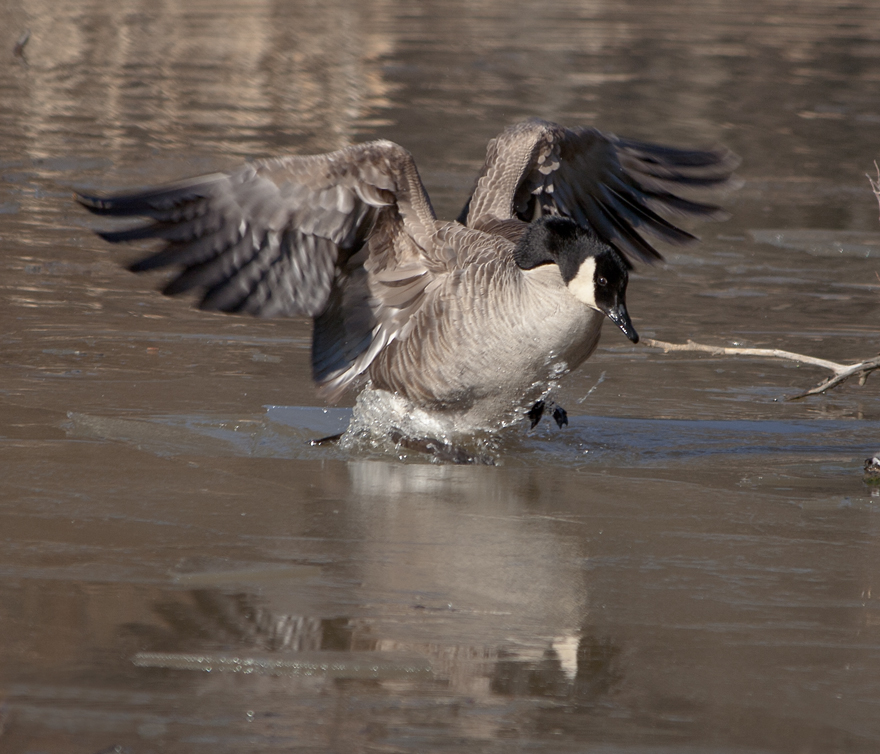
The weather here has warmed up and the layer of ice on the ponds has started to melt a bit. I watched as a mixed group of Canada Geese and Mallard Ducks started walking across the iced-over beaver pond.

A duck walked past a branch sticking out from the ice and I thought I detected some water, suggesting to me that they were walking on thin ice. A goose (in the second photo) looked down at the ice and made a mental calculation that it was safe to cross. His calculations proved to be wrong as he broke through the ice and started to sink into the water. I caught his initial reaction in the third photo. I especially like the startled look in his eyes.

Without further delay, he flapped his wings and was able to lift himself out of the water. The photo I took of that moment is the first one shown on this blog posting and is my favorite. I am happy that I was able to capture a lot of the the details of the wings and of the ice. You can see, for example, the sheets of ice that have broken off on either side of the goose. I also like the sense of action in the position of the goose, a moment frozen in time (sorry about the obvious pun).

I always feel a little strange when I post a series of action shots in non-sequential order, but I worry that folks won’t stay around to see the dramatic conclusion if all they see is the first shot (which is not that exciting, but is an important part of the story). That is why I led with the conclusion, thereby giving away the end of the story. Maybe I need to employ the kind of techniques used in television, “Stay tuned as this goose rescues himself from the frozen waters of the pond…”

Breaking the ice

Breaking the ice

Testing the ice

Testing the ice

Starting to go under

Starting to go under

© Michael Q. Powell. All rights reserved

Read Full Post »

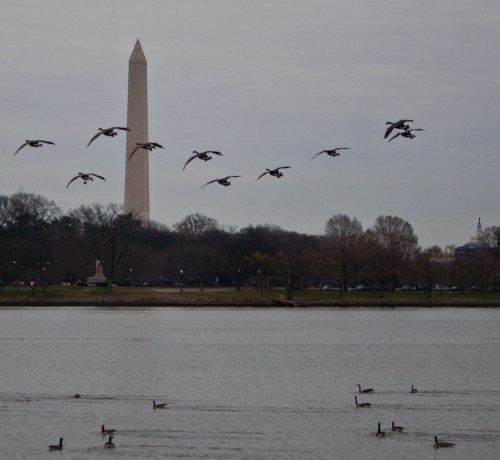
They came from the skies, invaders from the north in a tight military formation, seeking for openings to breach the defenses of their southern neighbor’s capital city.

Invaders

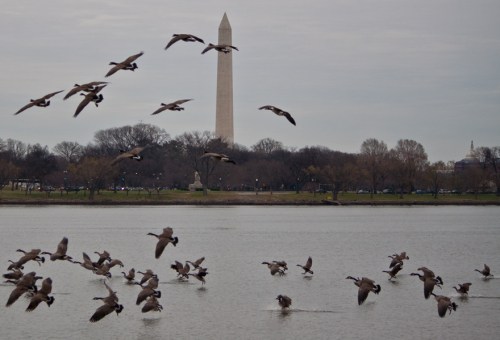
They sent out reconnaissance forces, in the air and on the waters of the Potomac River, collecting information and looking for a spot for a larger landing force.

Reconnaissance

The landing zone secure, a larger force arrived and thus began the naval blockade of Washington D.C. A declaration of war has not yet been made by either side.

Landing Force

© Michael Q. Powell. All rights reserved

Read Full Post »

The new year has started. Like these Canada Geese, we have taken off and are continuing our journeys. Who knows where we will stop along the way? The wind and other obstacles may cause us to make unexpected stops or detours—things will undoubtedly not go according to our plans or maybe not even our desires. Best wishes and prayers for all of you on your own adventures this year, that you remain safe and healthy, joyful and at peace.

newyear

Click on the photo for a higher resolution view

© Michael Q. Powell. All rights reserved

Read Full Post »

We have had temperatures below freezing most nights recently and many of the ponds at my local marshland are now covered with a thin sheet of ice. I was a little shocked today to see that ducks and geese continue to fly in and out of the pond, in some cases landing on the ice itself (some of the birds find areas that are not frozen over in which to land).

I am working on a number of photos showing these migrating birds on ice, but I thought I’d share this initial image. The goose to the left seemed to be sounding the alarm, signalling the others that it was time to fly away. As you can see from his open mouth, he was honking loudly and was flapping his wings. If you focus your attention on his feet, it looks like he may be slipping on the ice as a result of his vigorous actions. The two geese in the background appear to be ignoring him and all of his noise, although they may have joined him when he took off a few seconds later.

alarm

© Michael Q. Powell. All rights reserved

Read Full Post »

This past weekend I spent some more time watching migrating geese and and attempting to photograph them in flight. Often the geese flew in large formations, though sometimes they would arrive and depart in pairs. As I looked overt my photos, though, my favorite photos of the day feature geese trios.

I love shots like these in which it’s fun to compare the positions of the different birds, and the degree to which they are synchronizing or varying their body positions and wing movements. Each of these photos seems to form a mini-progression within itself, as though they were made up of multiple exposures of a single bird.

goose triogoose trio 2

© Michael Q. Powell. All rights reserved

Read Full Post »

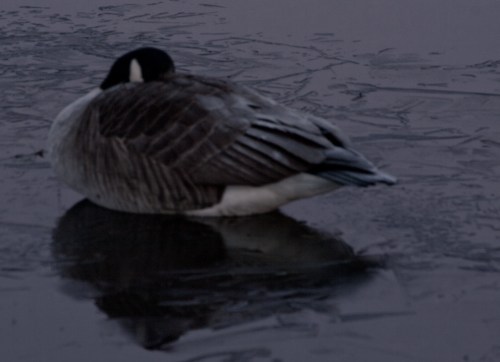
This past Friday I was up before the dawn to try to photograph the almost-full moon and already posted some photos of the moonlight reflected in the water and of the sunrise. As I was making my way along the boardwalk in the marsh, I saw that geese were asleep in the fields. With my camera on a tripod, I took some photos. This was shot at ISO100, f11, and a 25 second exposure. I like the fact that the moonlight was strong enough to cause a reflection in the water and illuminated what looks to be a thin sheet of ice on the water.

Goose asleep in the moonlight

Goose asleep in the moonlight

© Michael Q. Powell. All rights reserved

Read Full Post »

I haven’t been out shooting in nature for almost a week, so I ventured out into my marshland park early this morning. I have not yet had a chance to go through all of my shots, but I knew I really liked this one as soon as I took it and did a quick review on the LCD of my camera.

I found myself in a good position when several Canada Geese (Branta canadensis) were coming in for a water landing and was able to track them and get a good focus. The buffer of my camera fills up pretty fast, so I didn’t want to start shooting too early. Just before they hit the water, I snapped off a few exposures and managed to get this shot in which one of the geese has landed and created a splash.  A goose in the foreground is landing in the midst of the splashing water. My shutter speed (1/320 sec) was fast enough to freeze most of the motion, with the exception of a slightly blurred wing. I like the blurry wing and thing it helps give the sense of motion, as do the droplets of water.

I have been trying to shoot a scene like this for quite some time and think that this is my best result to date. (I recommend clicking on the image to get a higher resolution view.)

Splashdown

Splashdown

© Michael Q. Powell. All rights reserved

Read Full Post »

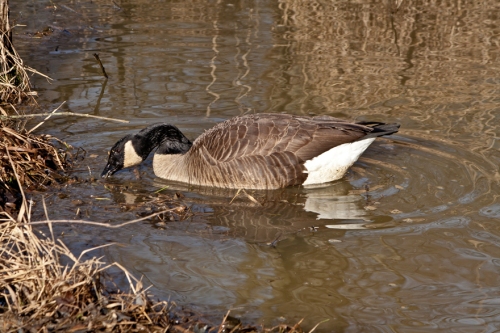
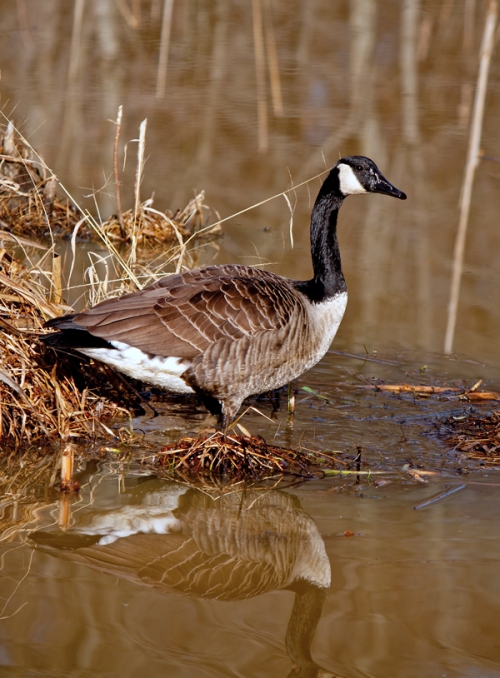
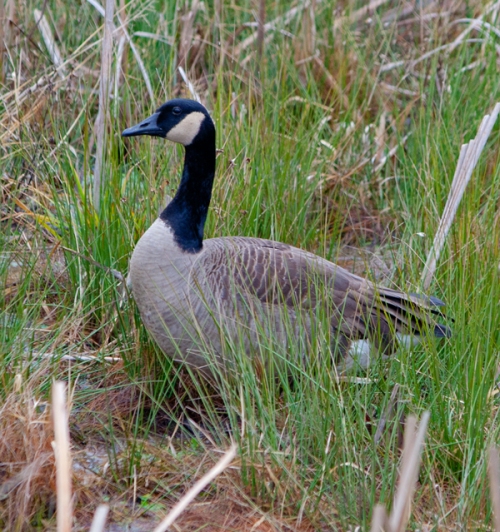
As of last week, Canada Geese continued to populate the pond and fields of my local marshland pond in great numbers. Many were engaged in foraging for food, but some look like they have been assigned sentinel duty. The photos are pretty self-explanatory—I’ll let them speak for themselves and make this posting short.

Goose in waterSentinel goosegoose_grass_blog

© Michael Q. Powell. All rights reserved

Read Full Post »

I keep trying to photograph geese and  ducks taking off and landing, using a variety of techniques. Normally I will try to catch the birds in flight, though sometimes I have trouble getting my lens to acquire focus quickly enough. I stumbled onto a panning technique when I tried to photograph geese landing in the early morning. This weekend I experimented using both techniques.

I took this first shot when several geese took off without warning almost directly in front of me. I didn’t intend to cut off the goose to the left, but I like the effect of him entering into the frame. In this image, the action is completely frozen.

Geese takeoff

Geese takeoff

The second image is an example of the panning technique. The geese are not quite in as sharp focus as I would have liked, but you can see some details. I like the way that the background is blurred and provides a sense of motion. This panning was much more deliberate than the photos that I posted previously with motion blur.

Geese liftoff

Geese liftoff

It’s so much fun experimenting with different techniques—photography is still new enough to me that I often feel like a little kid on a voyage of discovery.

© Michael Q. Powell. All rights reserved

Read Full Post »

Yesterday I spent some time watching geese and ducks at the marsh. I thought that the numbers would drop as the weather gets cold, but there actually seem to be more than there were in November, especially the geese. Once again I have been trying to take in-flight shots of these migratory birds, especially when they are taking off and landing.

I like the contrast in this photo between the impassive female Mallard Duck (Anas platyrhynchos), who seems only mildly curious about the activity taking place right in front of her, and the two Canada Geese (Branta canadensis), who are making big splashes and generating waves as they land. They look like they could be a synchronized swimming pair, though I think in that sport you lose points if you make big splashes. In the background you can see some of the fields of cattails at the marsh, as well as some additional geese in the distance foraging in the fields and in the water.

Impassive observer

© Michael Q. Powell. All rights reserved

Read Full Post »

A couple of days ago I featured a photo of Canada Geese coming in for an early morning water landing in a posting I called Photo Finish. So many people made positive comments about the photo that it prompted me to take another look at the other photos from that morning. I played around with one of them and decided to post the result.

The overall effect in this image is similar to the previous photo, but in this one you can see some reflections in the water. Tonally, it has more brown in it.  It’s a bit muddy in appearance, but it still conveys the sense of motion of the geese in flight and the panning stripped away all of the excess details in the background. I recommend that you click on the image to get a higher resolution view.

Coming in for a landing

Coming in for a landing

© Michael Q. Powell. All rights reserved

Read Full Post »

Do you ever find yourself really liking some of your photos that are full of technical flaws?

As a non-professional, I have had more than my fair share of blurry images, missed subjects, out-of-kilter compositions, and poor exposures. Many of them are deleted as soon as I view them on the back of the camera. Sometimes, though, the mistakes yield such interesting results that I can’t bear to delete them.

I arrived at the beaver lodge at my local marshland before the sun had fully risen one morning this past weekend, hoping to see the beavers in action. I had my camera set on ISO 400 and it was wide open at F4, with the mode set for aperture priority. I hadn’t yet set up my tripod, which I was hoping to use, because I anticipated relatively slow shutter speeds.

All of the sudden I hear the sound of geese approaching and it quickly became clear that they were coming in for a landing in the beaver pond. Without really thinking, I panned the camera and started shooting as I tried to follow the geese as they approached the water. Most of the photos were totally unusable. There was so little light that my camera chose a shutter speed of 1/6 of a second. Even with image stabilization, that’s too slow for handheld photos.

There was one image, however, that I really liked. The head of one goose is relatively in focus and another goose is visible (although out of focus) in the foreground. The background is blurred from my panning action. Somehow it reminds me of the photos they used to show of the finishes of races in which photos had to be developed to determine who crossed the finish line first. In this case, the geese seem to be leaning forward towards an invisible finish line in the same way that sprinters do.

Clearly this is not a great (or even good) photo, but I like it, and maybe others will find it interesting too.
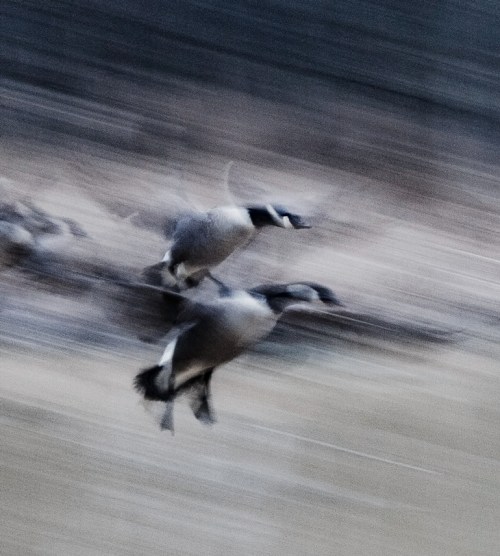
Photo finish

Photo finish

© Michael Q. Powell. All rights reserved.

Read Full Post »

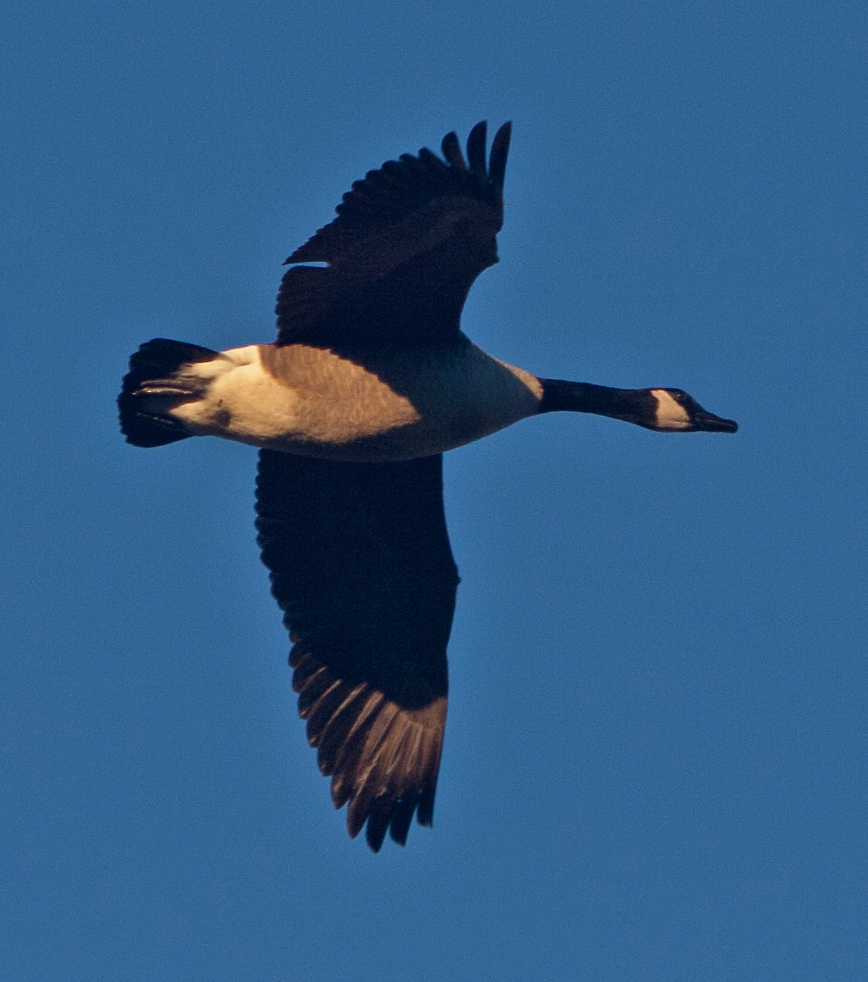
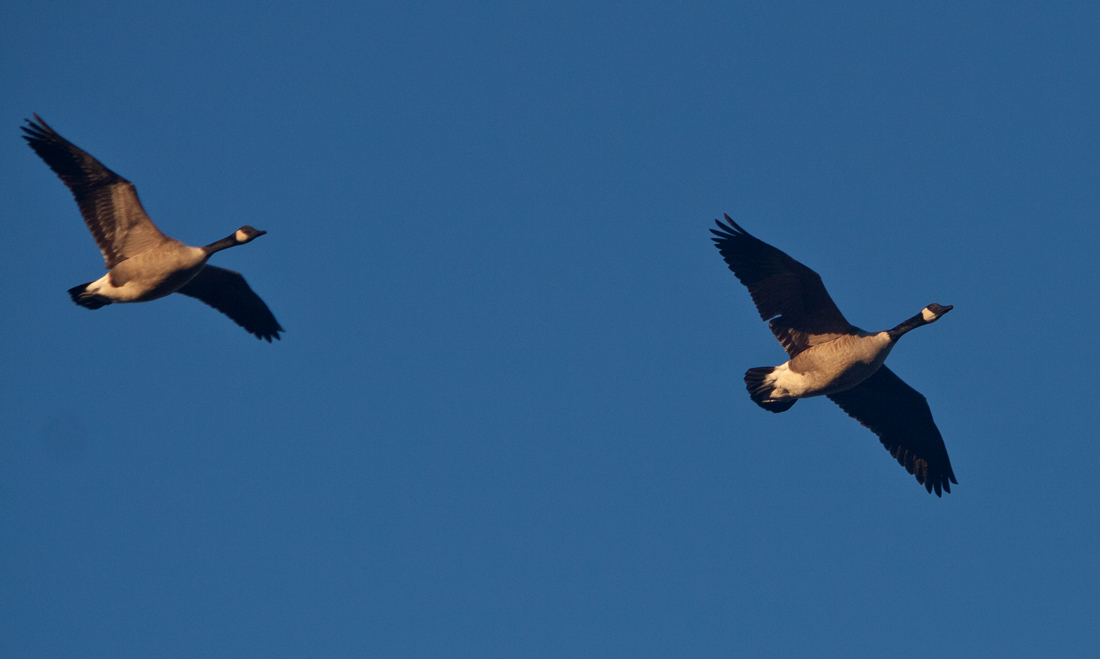
I continue my quest to capture birds in flight and geese continue to be a favorite subject. They are loud and big and fly slowly enough for me to have a fighting chance of capturing a decent image. That is not to say, however, that it’s been easy to photograph geese in flight. There are so many variables that I can’t control, particularly the direction of the geese in relation to the sun. Ideally the sun would illuminate the underside of the geese, rather than hiding parts of the body in dark shadows.

One morning earlier this weekend, conditions were relatively favorable and I was able to photograph these Canada Geese (Branta canadensis) as they flew by me. I like the different positions of the wings on each goose at the moment of the photo—it looks to me almost like a multiple exposure image, intended to show the flight of a single goose in stop=action.

Canada Geese in flight

© Michael Q. Powell. All rights reserved.

Read Full Post »

The Canada Geese (Branta canadensis) continue to make migratory stops at Huntley Meadows Park, the local marshland in which I have been taking a lot of photos recently and I have been able to observe them closely. I am always struck by their beautifully expressive eyes, which seem to reflect an inner gentleness.

The old proverb says that the eyes of the mirror of the soul. I have been told from the outset that I should always strive to have the eyes in focus when I am photographing people and animals. As far as I can tell, that’s one of the few rules of photography that is almost never broken.

How often do you make eye contact with other people? I am amazed at how infrequently people acknowledge the presence of others by looking into their eyes. It was one of the biggest adjustments I had to make when I left military service, in which you saluted and greeted everyone in uniform that you passed. So often people pass each other without any visual signal that they recognize the presence of other sentient being. Needless to say, I am not a fan of wearing headphones in public.

People may think that you are a little strange, but I encourage you to look others in the eye and smile and greet them—it’s amazing how their attitude and expressions change.

Profile of a Canada Goose

© Michael Q. Powell. All rights reserved.

Read Full Post »

When migrating geese land at my local marsh, most of them spend their time foraging for food, storing up energy for the next leg of their trip. This Canada Goose, however, seemed to have decided to rest a bit to regain his strength and secluded himself from the feverish activity of the other geese. His position is not that unusual, but his surroundings make this photo stand out for me. The colors contrast nicely with the black of his head and I really like the reflections. Click on the photo if you would like to see it in higher resolution.

Canada Goose at rest

© Michael Q. Powell. All rights reserved.

Read Full Post »

Geese and ducks continue to arrive and depart with such frequency in my local marsh that I feel like I am in a major bird airport. Fortunately, there are no long lines or security checks for them to endure. We must have a special arrangement with our northern neighbors, for the Canada Geese are not subject to any special customs scrutiny.

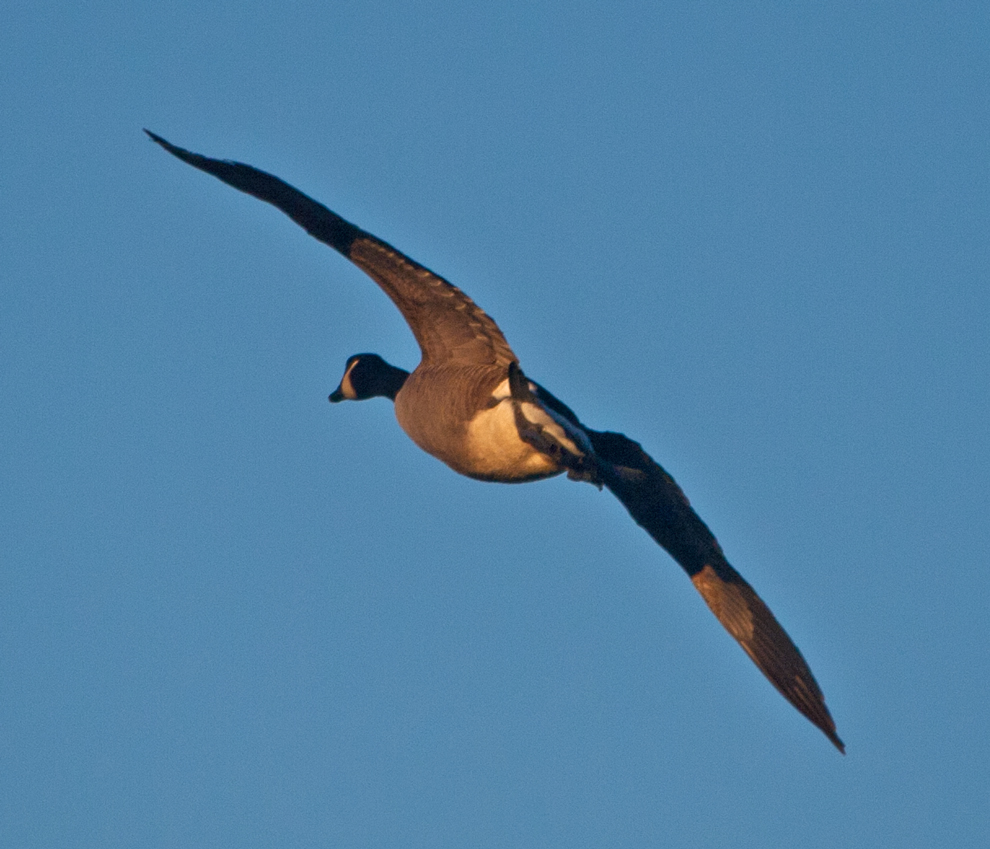
I continue to try to take photos of the geese while they are in flight, usually when the are coming in to land or taking off. Often the geese will circle around and honk loudly to announce their arrival (a kind of bird intercom system). Perhaps the birds on the ground can interpret the honks to mean something like, “Now arriving on pond number one, Canada Geese flight number one from Toronto.” My first photo is one of a Canada Goose banking. No, he is not at an ATM machine, withdrawing cash. He is making a sharp turn as he prepares to land.

Banking goose

The second photo shows a goose in flight. If you click on the photo, you will notice that the goose has a zen-like look of contentment on is his face. Scientists have been working on implanting a tiny device into geese that will provide them an in-flight entertainment package (and autopilot features too) and this goose may be one of the early test subjects.

Goose in flight

Some geese hate to fly alone and prefer companionship during the long flight. A new business has sprung up that provides escort service for the lonely goose, a fledgling matchmaking company that is just getting off of the ground. The company’s contracts are full of fine print about additional charges, but some geese continue to be surprised with the bill they are presented at their final destination.

Lonely goose escort service

© Michael Q. Powell. All rights reserved.

Read Full Post »
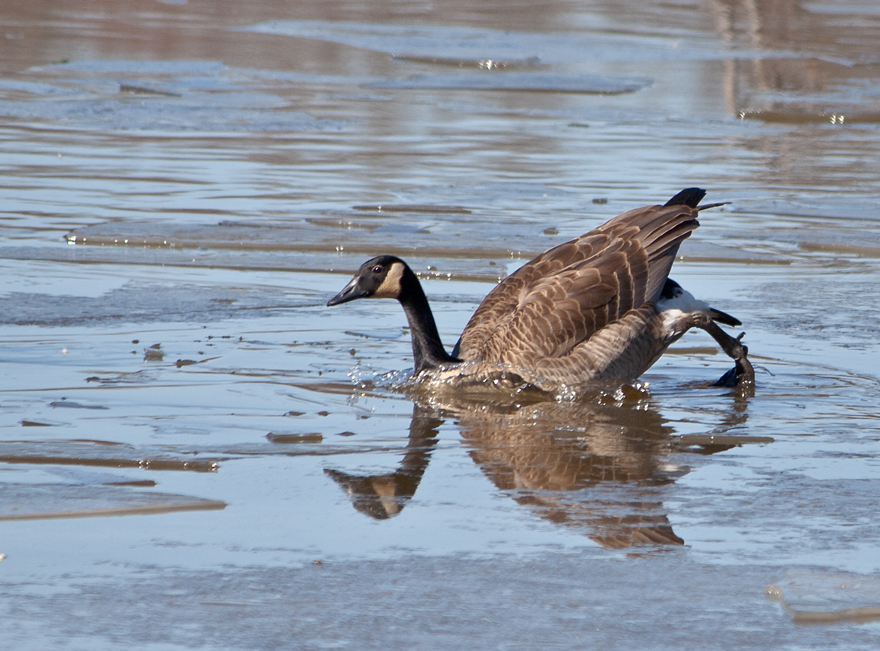
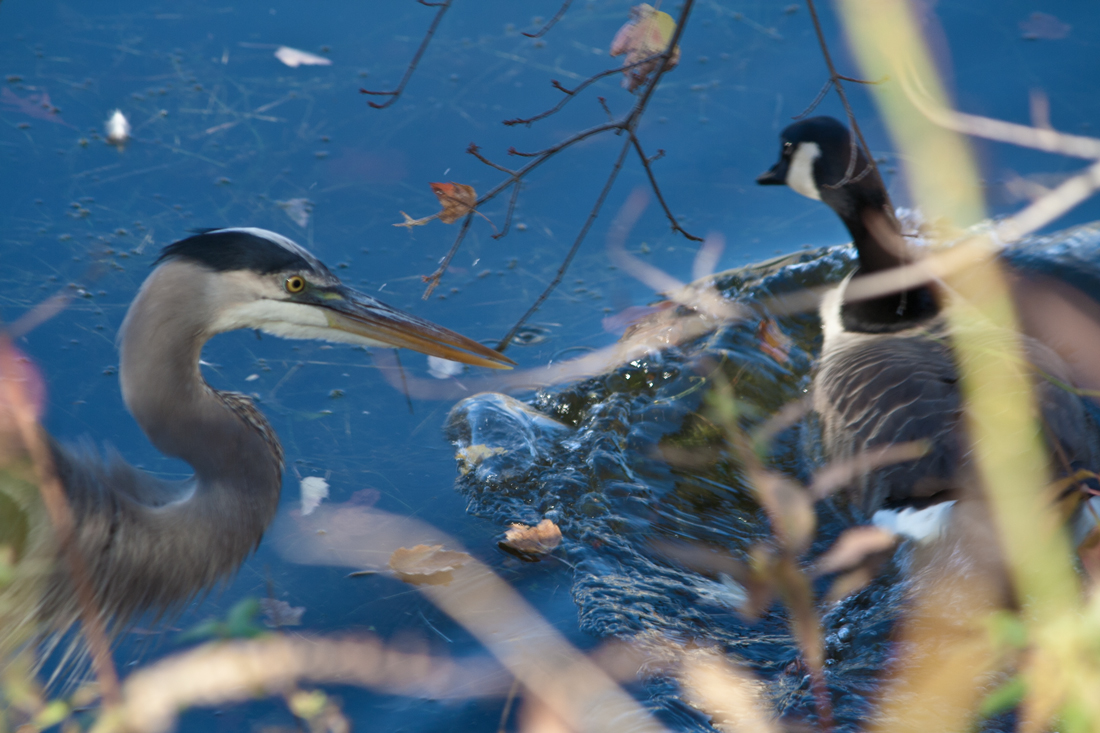
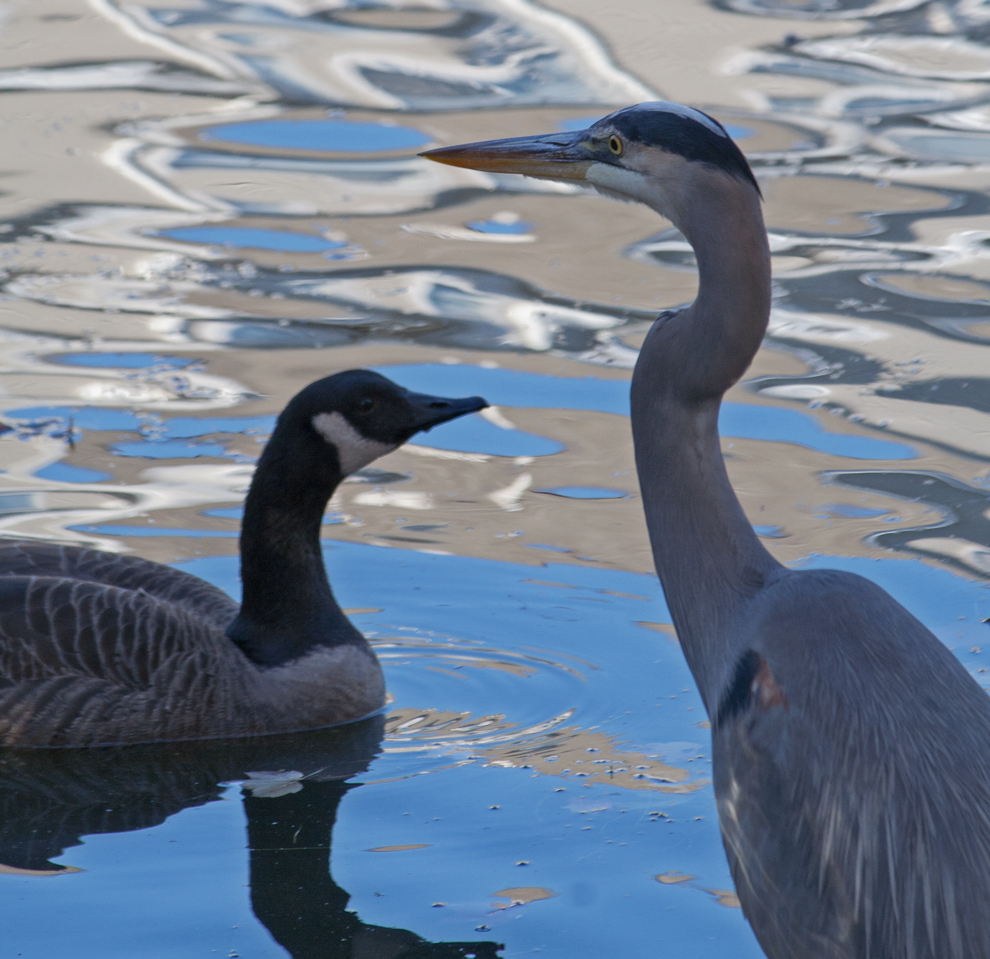
It is always interesting for me to see two species interact—you never quite know what will happen. Last Sunday, I was in the bushes in a local suburban pond area, pretty close to a Great Blue Heron (Ardea herodias). He seemed to be willing to tolerate my presence, though there were a lot of bushes that kept me from getting a clear shot. I photographed several encounters between the heron and Canada Geese (Branta canadensis) that live semi-permanently at the pond.

I took the first photo just after the heron made a threatening gesture with his beak at a goose that must have invade his personal space. The goose appears to have gotten the message and looks to be exiting the area. At the time of the shot, the sun was bright and was reflecting off the water, somehow turning it almost turquoise in color. The branches of the bush get in the way a little, but don’t detract too much from the charm of the photo. The whole effect is to make the image look almost as much like an illustration as a photograph.

“I need my personal space.”

The second photo is much less action oriented and is a study in contrasts. The goose seems to be looking at the heron with wonderment and curiosity, while the heron seems to be cool and disinterested. The background reminds me a little of a psychedelic image from the 1960’s.

“How did you grow to be so tall?”

© Michael Q. Powell. All rights reserved.

Read Full Post »
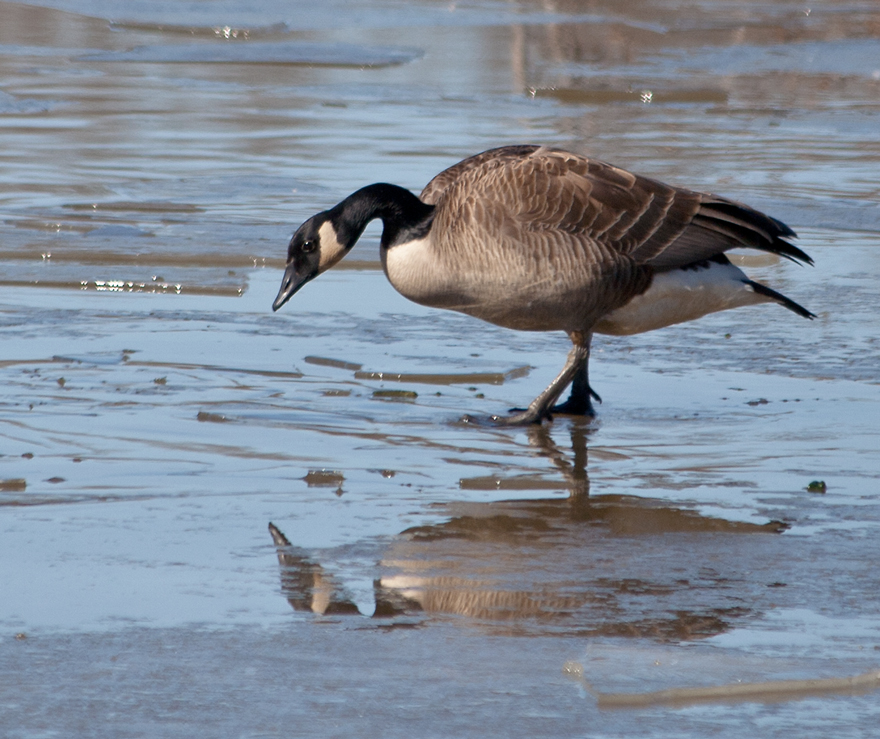
What strikes you first when you look at a photo? Is it the color, the composition, the lighting, or some other aspect? When I first looked at this close-up photo of a Canada Goose foraging as it took a break from its migratory flying, it was the contrast in textures that grabbed my eyes. When I see these geese from a distance, I tend to see them in solid blocks of color, such as a black and white face. A closer examination reveals details like the shininess of the eyes and the beak, the burlap-like texture of the white portion of the face, and the multicolored beauty of the feathers.

What other details do I miss each day, because I fail to look closely enough?

Goose textures

© Michael Q. Powell. All rights reserved.

Read Full Post »

The light was sinking lower in the sky late this afternoon when I took this photo of two Canada geese (Branta canadensis) in the still waters of a little pond. The light was beautiful, as are the reflection of various parts of the scene in the water. If you click on the photo, you can see a higher resolution view of the scene. To use the term of a fellow blogger, Steve Schwartzman, I consider this photo to be a “semi-landscape.”

Geese in late afternoon light

© Michael Q. Powell. All rights reserved.

Read Full Post »

« Newer Posts - Older Posts »