Feeds:
Posts
Comments

Posts Tagged ‘birds in flight’

I managed to see yet another Barred Owl (Strix varia) yesterday.  Unlike my other recent encounters, I spotted this owl while it was perched high in a tree—the other times I was able to catch sight of the owl only when I flew in front of me.  I got some shots of it while it was stationary and will probably post a couple of them, but surprisingly I was able to get a few shots of it when it started flying. The previous times, the owl flew away so swiftly and silently that I wasn’t able to snap a single photo.

This is my favorite image of the ones I took. The owl’s body is in the shadows, but some of the beautiful details of its feathers are visible in a wonderful semi-circle of extended wings.

Barred Owl

© Michael Q. Powell. All rights reserved.

Read Full Post »

Walking along the waterfront of Norfolk, Virginia as the sun was beginning to rise, I noticed a pair of larger birds approaching that were definitely not  gulls. I am not sure what kind of birds they are, but the shape of the bill suggests to me that they might be Brown Pelicans (Pelecanus occidentalis).

There was just enough light to partially illuminate the underside of the wings and the sky was divided into areas of pastel blue and pink. The flyover of these two birds was a great way to start the day.

Brown Pelicans in flight

© Michael Q. Powell. All rights reserved.


Read Full Post »

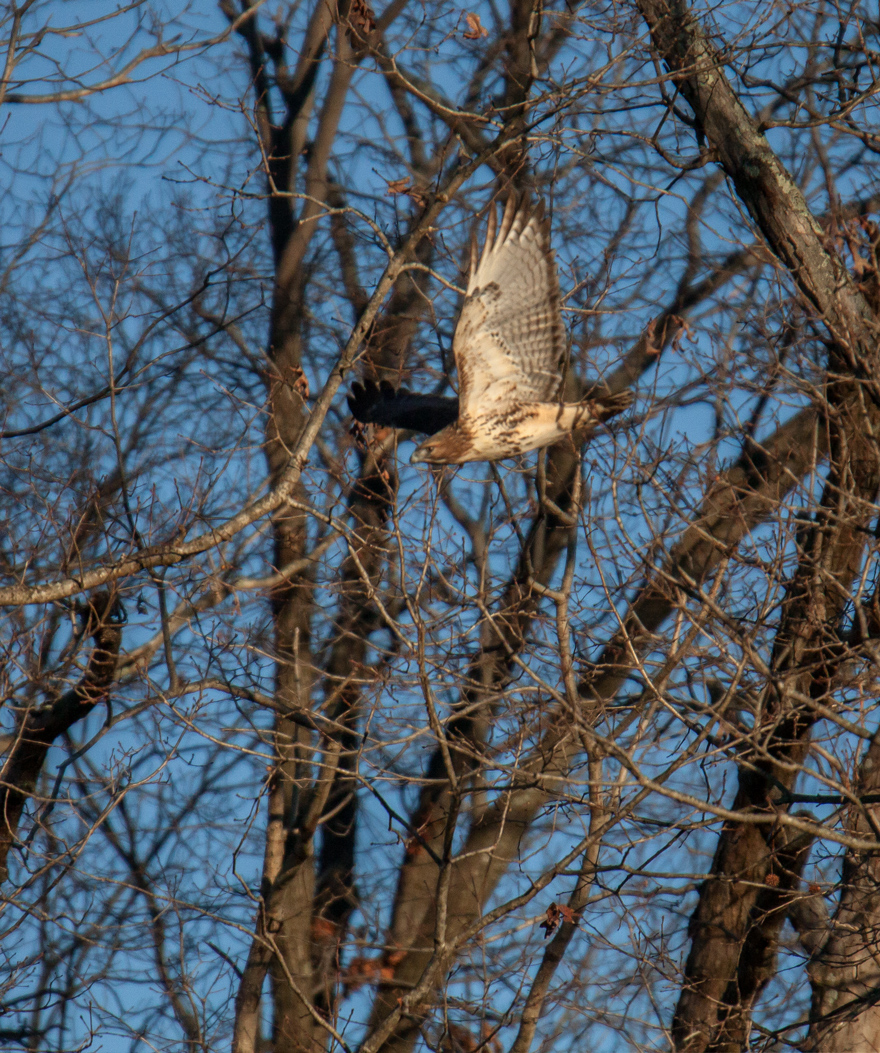
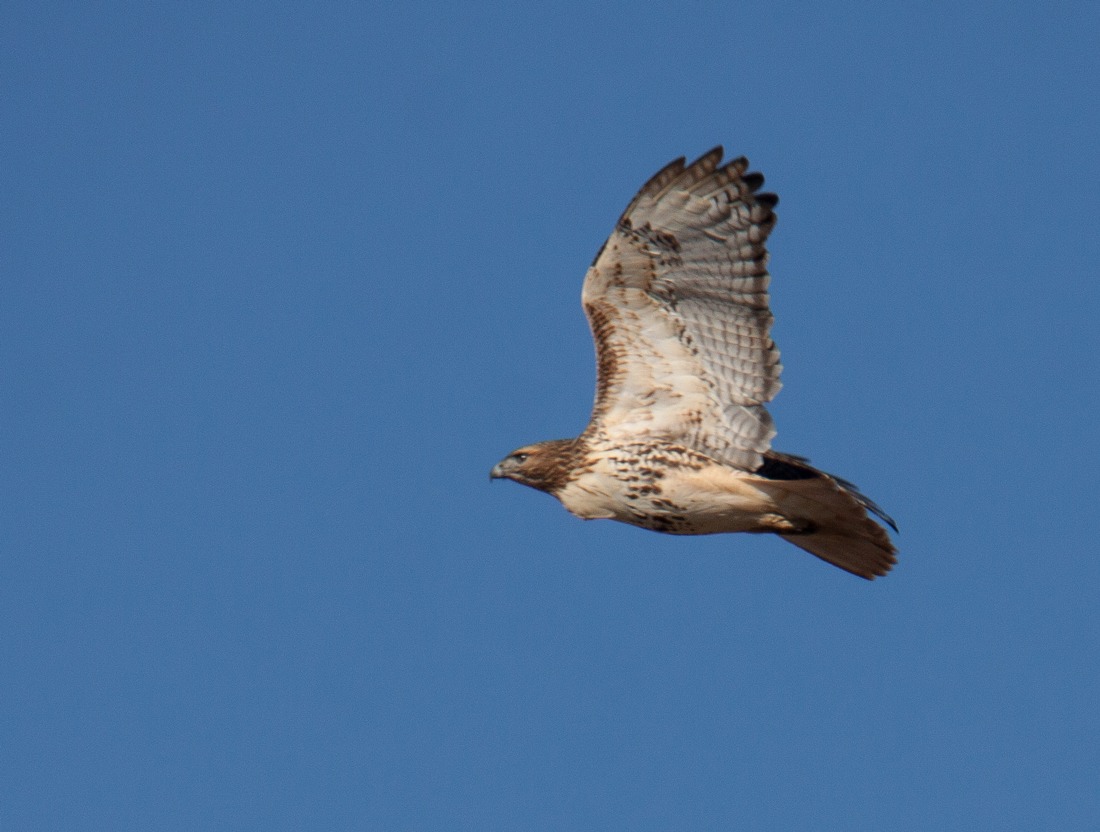
It was finally above the freezing mark yesterday, which made my trek around Huntley Meadows Park a bit easier to tolerate. Among the highlights was this Red-tailed Hawk (Buteo jamaicensis) flying overhead with a very determined (or maybe hungry) look on its face. Although Red-tailed Hawks are common in many places, most of the hawks that I see at my local marsh are Red-shouldered Hawks, so it was a nice treat to capture a Red-tailed in flight.

The blue sky provided a clean background for these shots, though I must confess that I am still having some difficulties finding and keeping moving subjects in the frame and in focus when at full zoom. I’m hoping that I have lots of opportunities to practice this winter.

Red-tailed HawkRed-tailed HawkRed-tailed HawkRed-tailed Hawk

© Michael Q. Powell. All rights reserved.


Read Full Post »

Can you identify the bird in the first photo? There is an almost abstract quality to the image that I really like that focuses on the bird’s wide wingspan more than on the identity of the bird. The unusual viewing angle, looking forward from his extended feet, enhances that effect.

As you can see in the second photos (and as you probably easily guessed), this was a Great Blue Heron (Ardea herodias). Yesterday, a blustery but sunny day, I came across this heron at my local marshland park as he tried in vain to catch some lunch. Without much warning, he took off just after I snapped the second photo, perhaps to find a better fishing spot, and I was able to capture the more unusual view that I have shown as the first image.

Great Blue HeronGreat Blue Heron

© Michael Q. Powell. All rights reserved.


Read Full Post »

There is something really special about the moment when the darkness of the night finally gives way to the early light of the dawn and the sky is tinged with delicate shades of pink and orange. The silence is broken by the sounds of awakening birds as their day begins.

It’s not an optimal time for wildlife photography—there is simply not enough light to reveal all of the colors and the details of the subjects. Recently, though, I managed to capture a sense of the dawn in this image of a duck ascending into the air, heading for an unknown destination.

Early bird

© Michael Q. Powell. All rights reserved.

Read Full Post »

Where’s Waldo? As I was observing a Red-shouldered Hawk (Buteo lineatus) in the early morning, it took off and I captured this first image, in which you can just barely make out the hawk’s face and body amid all the branches.

In the second image, the sunlight hit one of the hawk’s wings just right and illuminated it against the backdrop of the tangled branches, making the hawk a bit easier to pick out.

UPDATE: Several readers have noted that this is almost certainly a Red-tailed Hawk (Buteo jamaicensis), not a Red-shouldered Hawk—I still have lots of work to do on improving my identification skills.

Red-tailed Hawk

Red-tailed Hawk

© Michael Q. Powell. All rights reserved.

Read Full Post »

On Christmas Day I managed to fit in a short walk at Huntley Meadows Park, my local marshland park, and captured these images of a pair of Hooded Mergansers (Lophodytes cucullatus) as they took off from the water and started to gain altitude.

Hooded Merganser takeoff

Hooded Merganser takeoff

Hooded Merganser takeoff

Hooded Merganser takeoff

© Michael Q. Powell. All rights reserved.

Read Full Post »

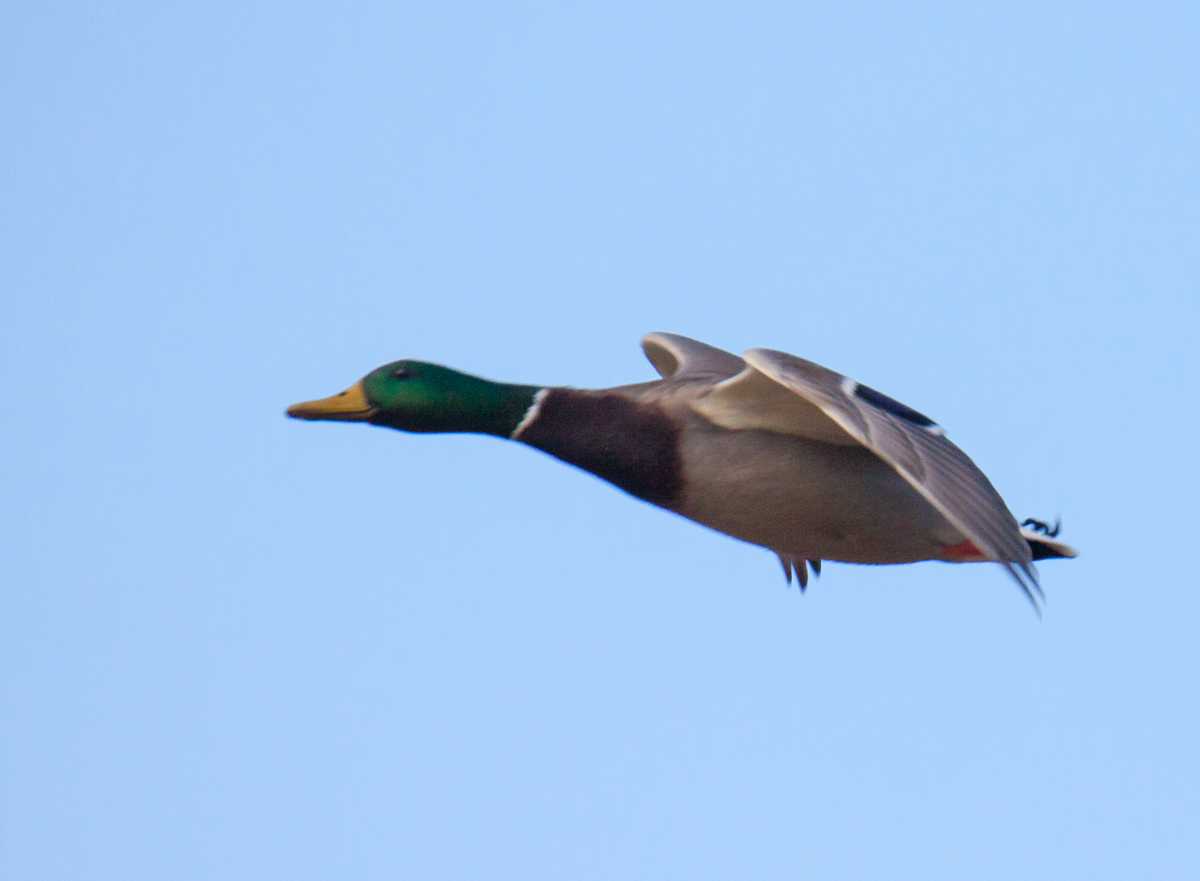
I’ve generally had a lot more difficulty capturing photos of ducks in flight than geese. Ducks are smaller, fly faster, and take off and land without the kind of advance warning that geese provide.

This past Monday, though, I managed to get some decent shots of a male Mallard (Anas platyrhynchos) as he flew past me. The background is uncluttered, a blue sky, which is ok, if not particularly interesting. As I reviewed my shots, I couldn’t help but notice how difficult it is to catch the wings in a good position, so I am happy that I took lots of shots in short bursts.

The last few days we’ve had almost constant rain, which is probably good for ducks like this one, though I would prefer to have some sunshine.

Mallard in flight Mallard in flight Mallard in flight

© Michael Q. Powell. All rights reserved.

Read Full Post »

I thought that all of the Great Egrets (Ardea alba) had left this area for warmer locations and haven’t seen one at my local marsh in weeks. However, I encountered one this past weekend on Theodore Roosevelt Island, a small island in the Potomac River opposite part of the District of Columbia.

Great Egret

The egret was initially foraging in a field of high grass in a marshy area of the park, as shown in image below. I tried to be as stealthy as I could as I crept bit closer to the egret, but it eventually sensed my presence and took to the air.

Great Egret

The bird circled around a little, but returned to its initial location after a very short period of time in the air.

Great Egret

I had some trouble getting in-flight shots of the egret. The changing light as the bird circled, combined with the bright white color of its body, made it tough to get a proper exposure. I liked the unusual body position of the flying egret in several of the shots well enough that I included them in this post, though I think the image of the egret on the ground is probably the one in sharpest focus.

During this transitional season, it’s fascinating to see which summer birds are still with us, which birds stop by as they migrate to more distant locations, and which ones arrive to overwinter here.

© Michael Q. Powell. All rights reserved.

Read Full Post »

Zooming a long telephoto lens while tracking a flying bird is like simultaneously patting your head and rubbing your tummy—it can be done but requires a lot of practice.

Yesterday as I was observing a Great Blue Heron (Ardea herodias) on the far side of a small pond, he unexpectedly took off. The heron flew towards me initially and then veered off to the side. My 150-600mm lens was fully extended at the start and as the bird approached, I frantically tried to zoom out a little. The EXIF data indicate that I was at 552mm when I took this shot and I just barely managed to keep the heron in the frame—I didn’t crop this image at all.

I’ve often been told to fill the frame with the main subject and this is one of the few times when I have been able to do so with a bird.

Great Blue Heron in flight

© Michael Q. Powell. All rights reserved.

Read Full Post »

Canada Geese (Branta canadensis) have now invaded the ponds at my local marsh in full force, but the population seems mostly transient, with lots of arrivals and departures, particularly in the early morning hours.

Earlier this weekend, I continued to practice my skills in tracking birds in flight and took a couple of shots that I really like of geese flying in the early morning mist. In both cases I managed to capture a pretty good amount of detail on the goose and the background is a pleasing blur, especially in the first image, in which the hazy outlines of a distant tree line are visible. The goose in the second image was making a turn, preparing for an upcoming landing.

Canada GooseCanada Goose

© Michael Q. Powell. All rights reserved.

Read Full Post »

Some of the reviews of my new Tamron 150-600mm lens suggest that it has trouble capturing birds in flight, so I was anxious to test out its capabilities and the Canada Geese (Branta canadensis) coming and going from my local marsh served as my initial test subjects.

These five geese were part of a larger group that was departing from the marsh and I started tracking them as they flew past me. Initially thought that one of the geese has flown out of the frame in the second image, but then I looked more closely and realized that all five were still there—the formation was really tight (or at least the compression caused by the long telephoto lens made it look that way.

Sometimes in the past I have had problems in grabbing focus on moving subjects, especially when the background is cluttered and is competing for focus. I was happy to see that I was able to acquire and hold focus pretty well and the geese are separated from the trees in the background.

I am learning how to manage this longer lens and, for example, still have trouble sometimes pointing the extended lens at a subject and then finding the subject in the viewfinder—the field of view is not very wide at 600mm. I plan to check out the different focus options for my camera to see if any of them will improve my changes of getting clearer shots.

Does it show that I’m pretty excited with my new lens? I’ll be sharing more images as I continue to practice and learn with it.

Canada Geese in flight

Five guys in flight

Tight Formation

Tight Formation

© Michael Q. Powell. All rights reserved.

Read Full Post »

Yesterday I spotted a male Downy Woodpecker (Picoides pubescens) on an exposed branch in a tree across a small field of cattails. In the past, I would not have even attempted to take a shot because of the distance, but I recently bought a Tamron 150-600mm zoom lens and suddenly this little bird was more or less within reach. This was my first day out with my new lens and it was fun testing out its capabilities (and I’ll do a few more postings showing what the lens was able to get in different situations).

Downy Woodpeckers seem to have an amazing amount of energy and are in almost constant motion. As I watched, the little woodpecker pecked his way to the end of the branch and then stopped. He seemed to be confused and stared straight ahead at first,  Unsatisfied, he looked down and then up. Suddenly he lifted off almost straight up and I was fortunate to capture him with his wings extended.

Who knew that Downy Woodpeckers had such an impressive wingspan?

Downy Woodpecker

Liftoff

Downy Woodpecker

Looking ahead

Downy Woodpecker

Looking down

Downy Woodpecker

Looking up

© Michael Q. Powell. All rights reserved.


Read Full Post »

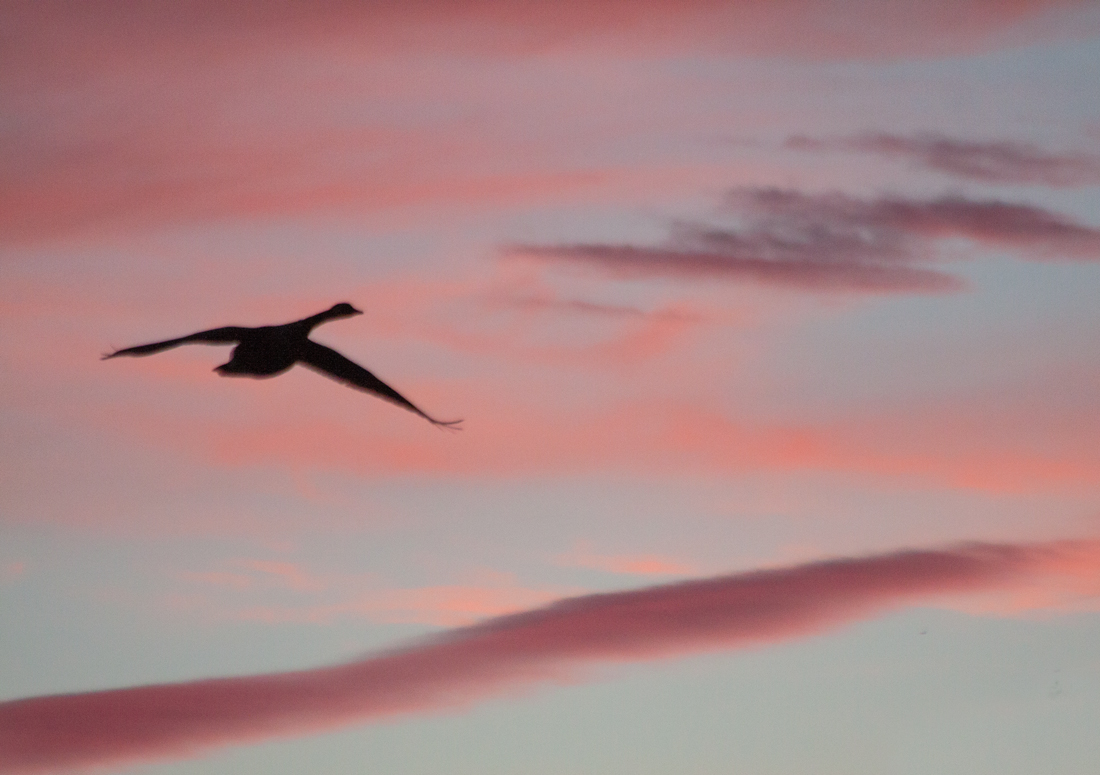
As I watched the glorious sunset at my local marsh yesterday, I kept hoping that a V-shaped formation of geese would fly into the frame. I was happy to settle for this solitary Canada Goose (Branta canadensis) and an amazing pink-tinged sky.

sunset1_oct_blogsunset2a_blog

© Michael Q. Powell. All rights reserved.


Read Full Post »

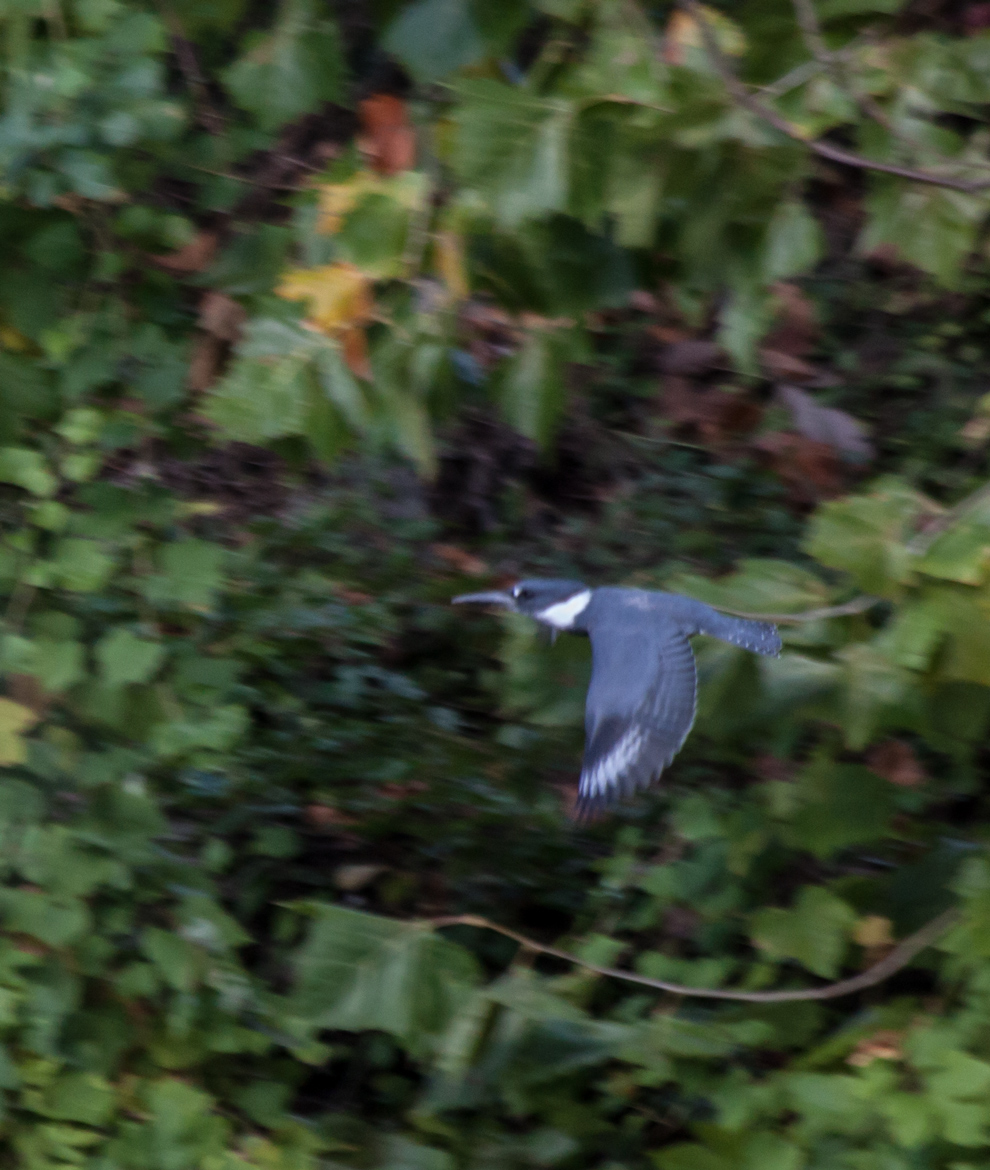
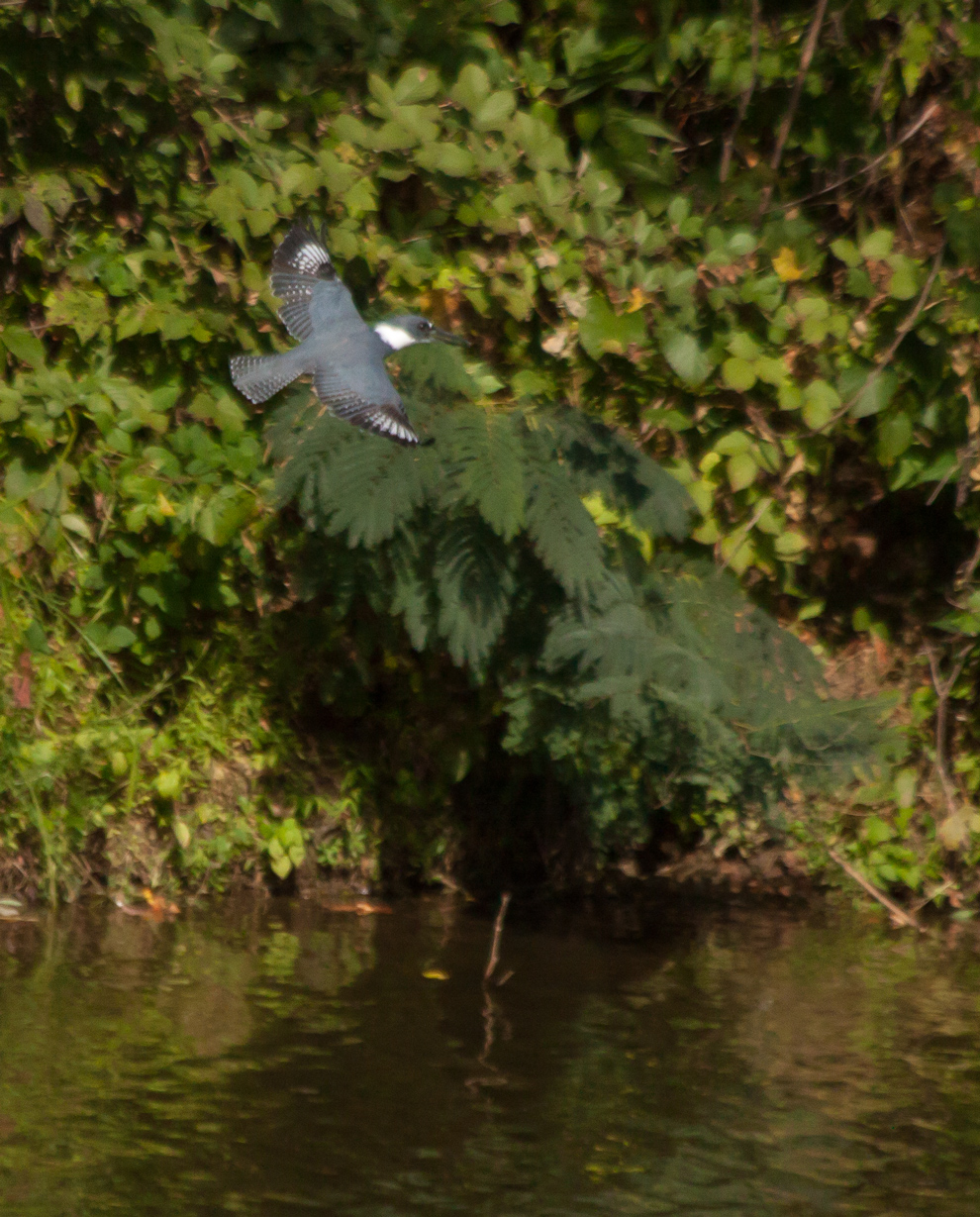
A female Belted Kingfisher (Megaceryle alcyon) lives at a small lake not far from where I live and periodically I try to photograph, but she continues to remain elusive.

Generally I try to photograph the kingfisher at one of her normal perches in a grove of trees across a narrow portion of the lake from where I am standing. It’s tough to isolate her against the backdrop of the trees, especially at this time of the year when the leaves are still on the trees, and often I only catch sight of her when she starts to fly.

Most of the shots in this posting are my attempts to capture her in flight. I am getting better at tracking the bird in the air and keeping her in focus, but it’s not easy to do as she flies in and out of the shadows and against varying backgrounds and she is somewhat hidden in these shots.

This past weekend, I decided to try to approach the grove of trees from the other side of the lake, where there is often a group of fishermen. I was fortunate that I was alone and I was able to make it relatively close to the grove of trees.  I was surprised to see that the kingfisher was on a low perch rather than high in the trees where I usually find her and I managed to squeeze off a few shots before she flew away. The first shot in this posting was from this new shooting position.

I plan to try this new approach again in the future and with a bit of luck, I may finally be able to get the kind of shot of this bird that I have been visualizing in my mind.


Belted Kingfisher

Belted KingfisherBelted KingfisherBelted Kingfisher

© Michael Q. Powell. All rights reserved.

Read Full Post »

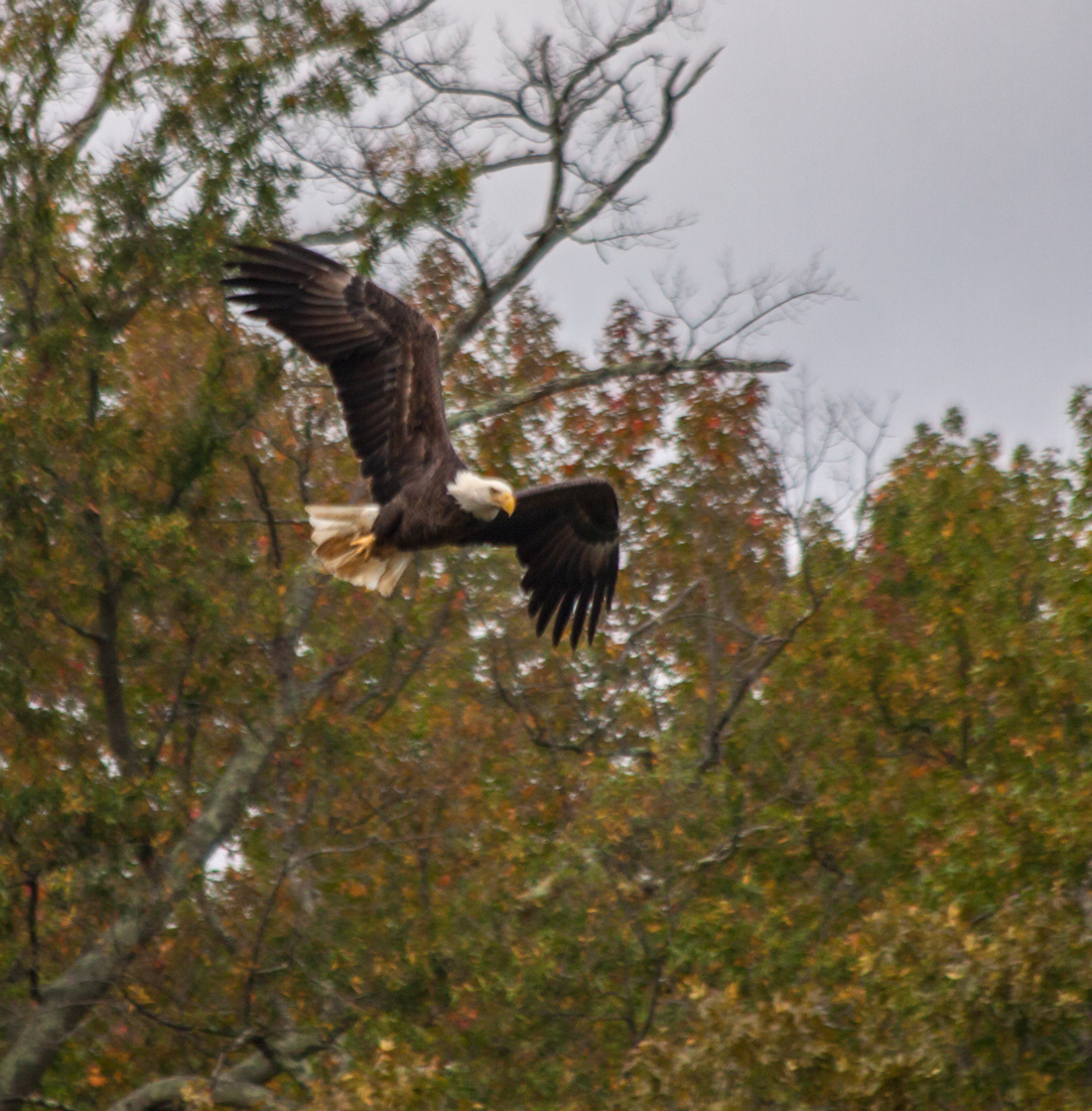
This morning I spotted a Bald Eagle (Haliaeetus leucocephalus) in a tree a my local marshland park, not far from where I had previously seen one. Once again, the eagle reacted more quickly than I did and took off before I was completely ready. This time, however, I was able to more quickly track the flying eagle and got a better shot than last time. I’m still not fully satisfied with the sharpness of this image, but I continue to believe that any day that I see an eagle is a great day.

Bald Eagle at Huntely Meadows Park

© Michael Q. Powell. All rights reserved.


Read Full Post »

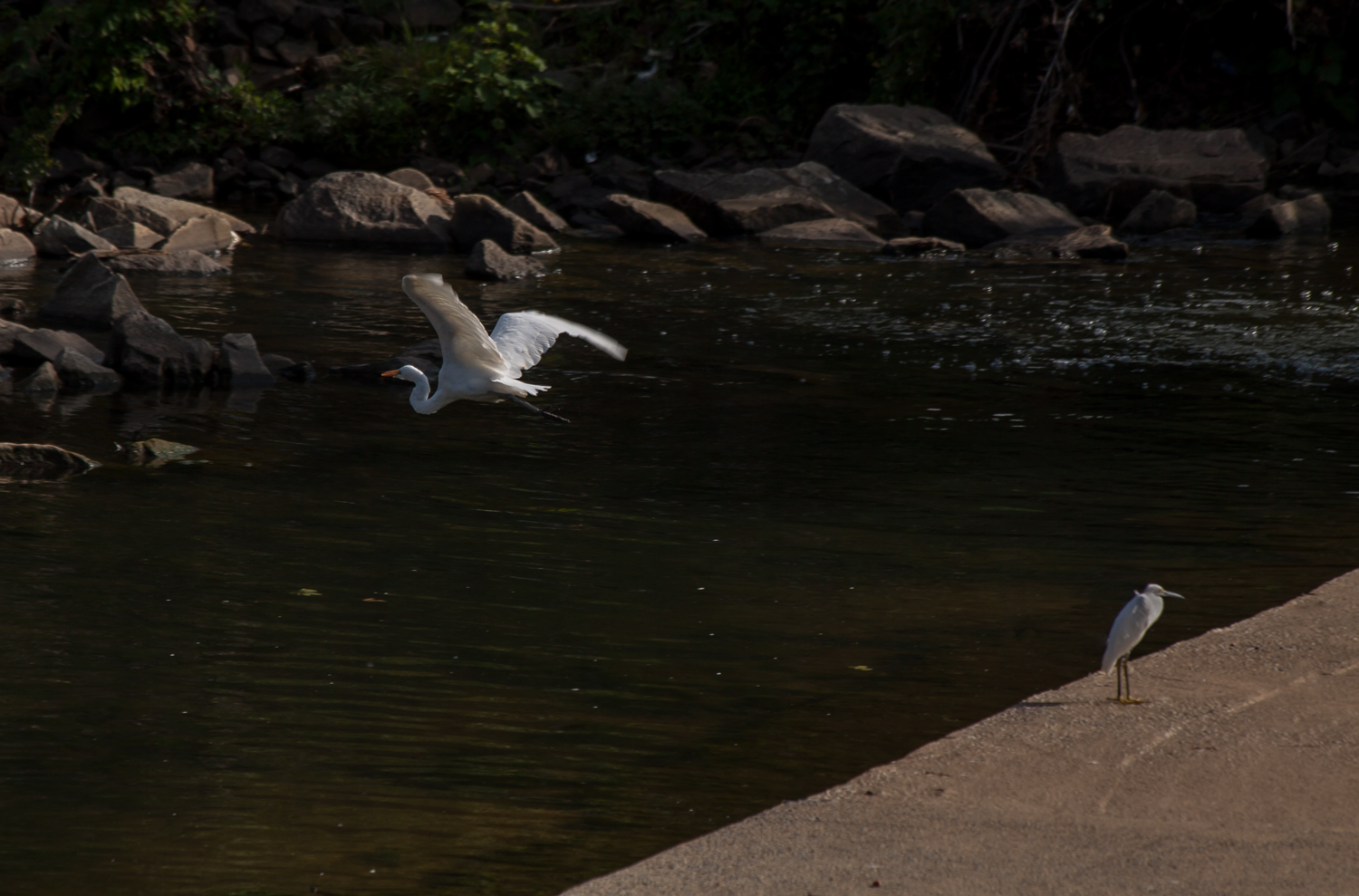
I’ve seen lots of Great Egrets (Ardea alba) over the past couple of years, but until recently I had never seen a juvenile one and had no idea that they were so small compared to the adults.

I caught this little interaction between what I assume is a mother and a young egret at Cameron Run, a tributary of the Potomac River in Alexandria, Virginia. The birds were standing on one of a number of concrete slabs that cross the entire width of the stream, presumably to slow down the flow of the water.

UPDATE: A number of more experienced birders have weighed in and pointed out that the smaller egret is not a juvenile Great Egret as I thought, but is instead a Snowy Egret (Egretta thula), a species that I had never seen before. As a result, the scenario below that I imagined is no longer valid—I’ll have to think a bit more about what herons of two different species might have been discussing.

The mother seemed to be giving instructions to the young one to stay put while she flies off to fish a short distance away.

Great Egret and baby

Mom gets a bit excited as she warns the little one to stay put

Great Egret adult and juvenile

The little one finally agrees

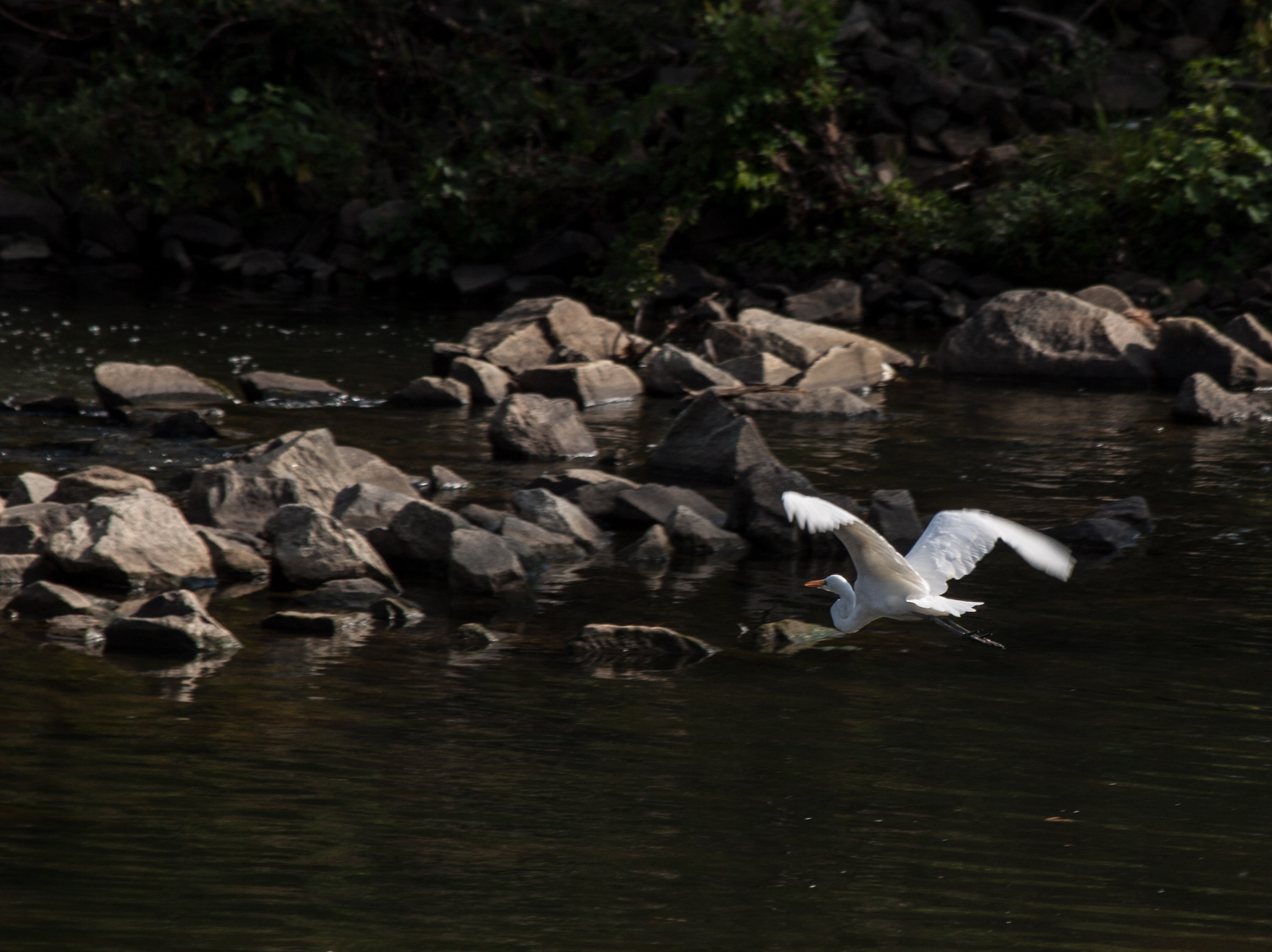
The mother eventually is reassured and takes off for the rocky edge of the water, hoping for a quick catch, so that she can feed the hungry youngster.

Great Egret adult and juvenile

Flying away for a little while

Great Egret in flight

Searching for the perfect spot for fishing

The young egret is left all alone to wait for the return of his Mom, hopefully with a tasty snack.

Great Egret adult and juvenile

Waiting for Mom

© Michael Q. Powell. All rights reserved.


Read Full Post »

Do you photograph some subjects over and over again, hoping to get better (or at least different) images? I never grow tired of observing herons and egrets at my local marshland park. Most of the time, they (and I) are standing still, waiting for a brief moment of action, generally when they are fishing or when they take off into the air. These birds look gangly and awkward when on the ground or in the water, but when they are flying, it’s like watching an aerial ballet.

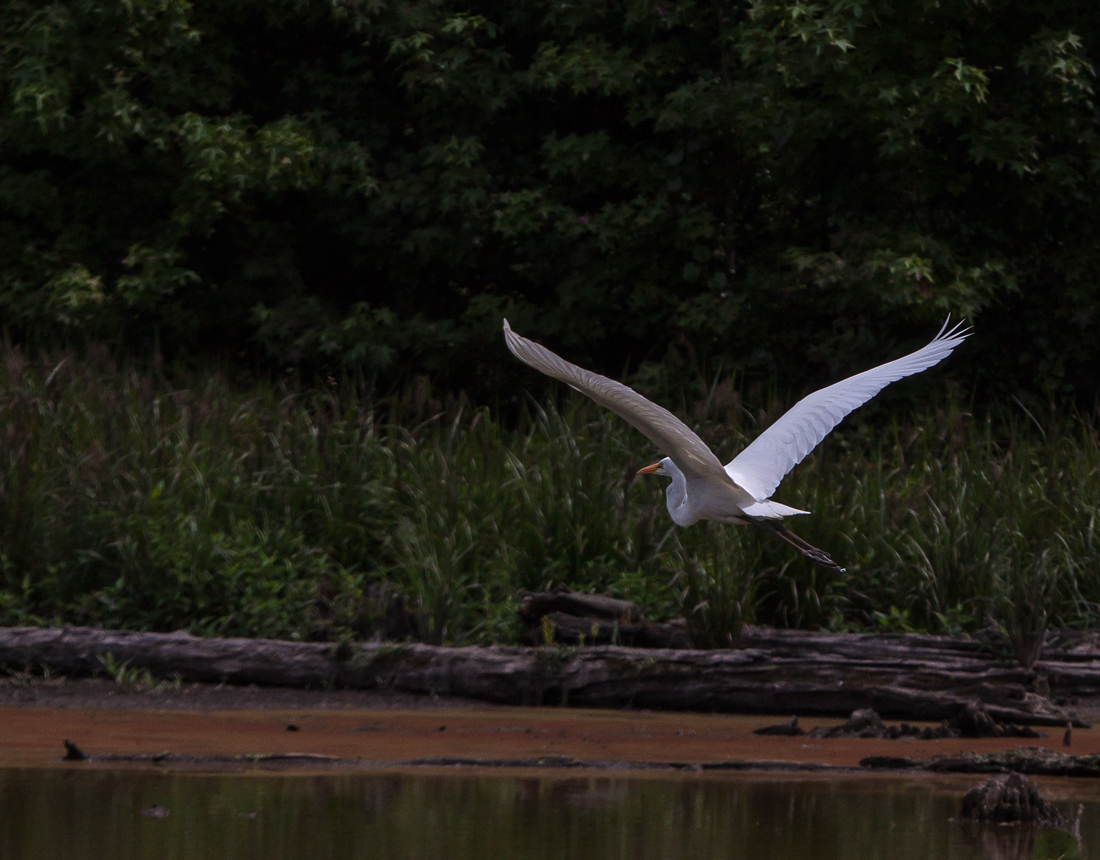
I took this shot last Friday as a Great Egret (Ardea alba) was just taking off from the muddy waters of one of the small ponds at the park. I was thrilled to be able to capture both a shadow and reflection of the graceful bird. Although I often have trouble getting a good exposure and frequently blow out the highlights, in this case I as able to capture some of the details of the wing feathers.

The egrets will be migrating out of this area soon, but I will continue to have the herons to keep me occupied in the upcoming months (and I’ll be trying to get more shots like this one).

Great Egret

© Michael Q. Powell. All rights reserved.

Read Full Post »

It’s autumn now and my thoughts (and my camera) are starting to focus more on birds than insects. This past weekend, I returned to a location where I had previous seen a female Belted Kingfisher (Megaceryle alcyon).  The kingfisher would perch on the limbs of some trees overlooking a small trout-stocked pond called Lake Cook, which is really more like a small pond, and periodically make a foray across the surface of the water and grab a fish.

I realized this time that I had a problem—there are so many leaves still on the trees that I couldn’t spot the kingfisher when I heard its very distinctive, rattling call. I could get a general idea of its location, but couldn’t see the kingfisher until it was already in flight, which mean I had to react really quickly to acquire and track it, hoping that I would be able to focus on it.

As it turns out, hope is not really an effective photographic technique and not surprisingly I ended up with a lot of blurry, improperly exposed images, in part because the kingfisher was flying in an out of the shadows. I was pleased, though, that I was able to capture a few decent images of the kingfisher in flight. I was shooting from across the pond from where the kingfisher was perched, so the shots are not close-ups of the bird, but are more like environmental action shots. Maybe I need a longer lens!

Belted KingfisherBelted KiingfisherBelted KingfisherBelted Kingfisher

© Michael Q. Powell. All rights reserved.

Read Full Post »

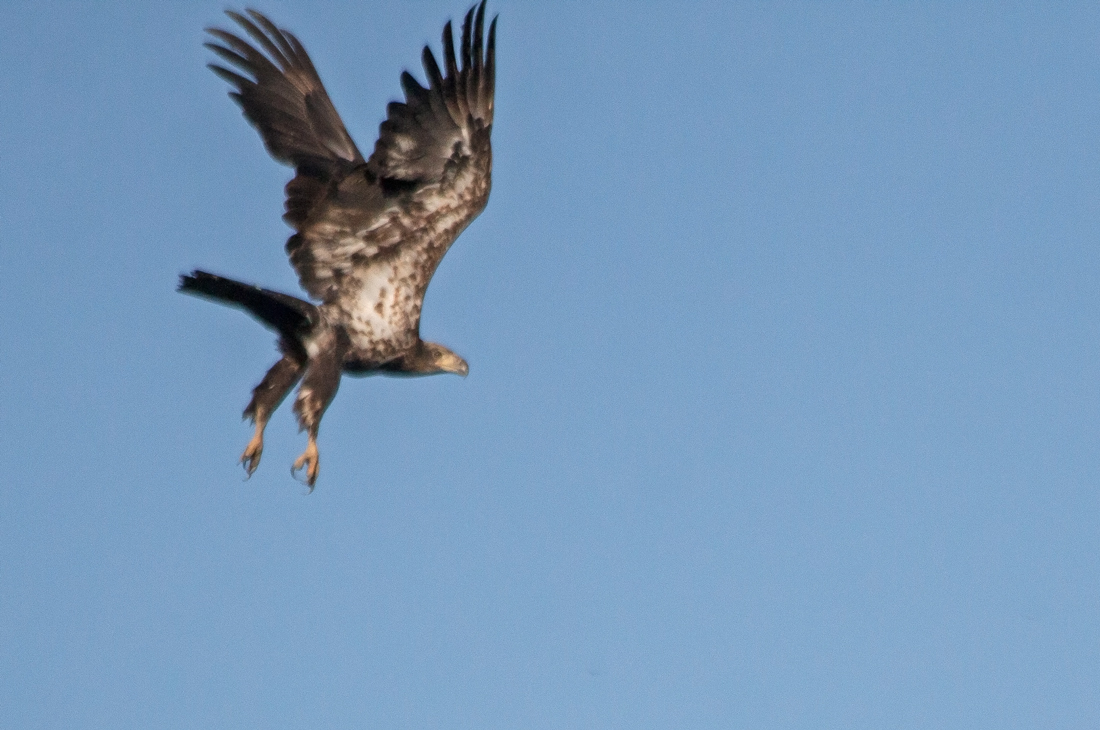
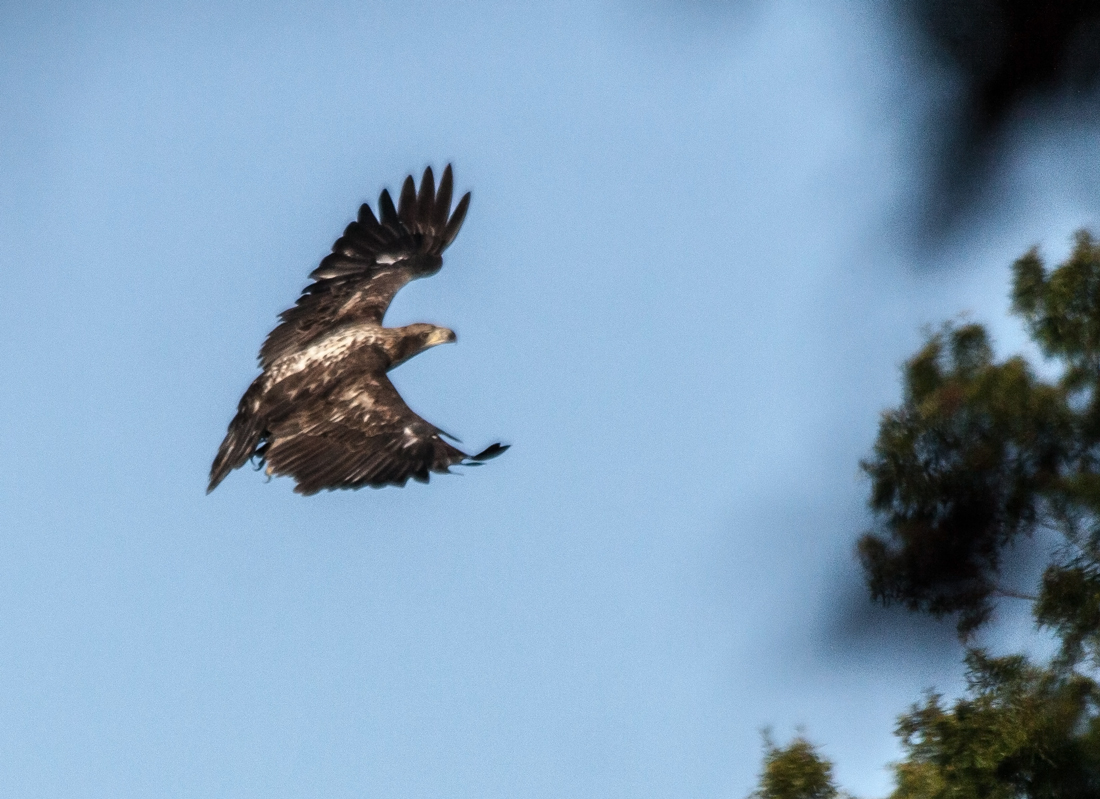
Can you react faster than an eagle can? Yesterday, I was getting ready to step out of the brush that surrounds one of the ponds at my local marsh, when I spotted a large dark shape in a dead tree that overlooks the water. I suspected that it might be a Bald Eagle (Haliaeetus leucocephalus), since I had seen eagles perched on this tree a couple of times in the past.

As I stepped forward and was starting to bring my camera to my eye, a juvenile Bald Eagle took off. The eagle flew upwards so quickly that I had trouble finding it and keeping it in my viewfinder, as you can see in my first shot. I got a few more shots as I tracked the eagle’s flight, but in most of them, the eagle’s head is obscured by its outstretched wings. Just before the eagle flew behind the trees in the distance, I got a reasonably clear shot, the second image below.

What did I learn? If an eagle spots me at the same time that I spot him, his reaction times are going to be quicker than mine. Someone I’m going to have to figure out a way to be more stealthy and more ready the next time I find myself in a situation like this. That will be my challenge this autumn as I start to take more shots of birds as the insect population gradually decreases.

eagle1_blog_sepeagle2_blog_sep© Michael Q. Powell. All rights reserved.

Read Full Post »
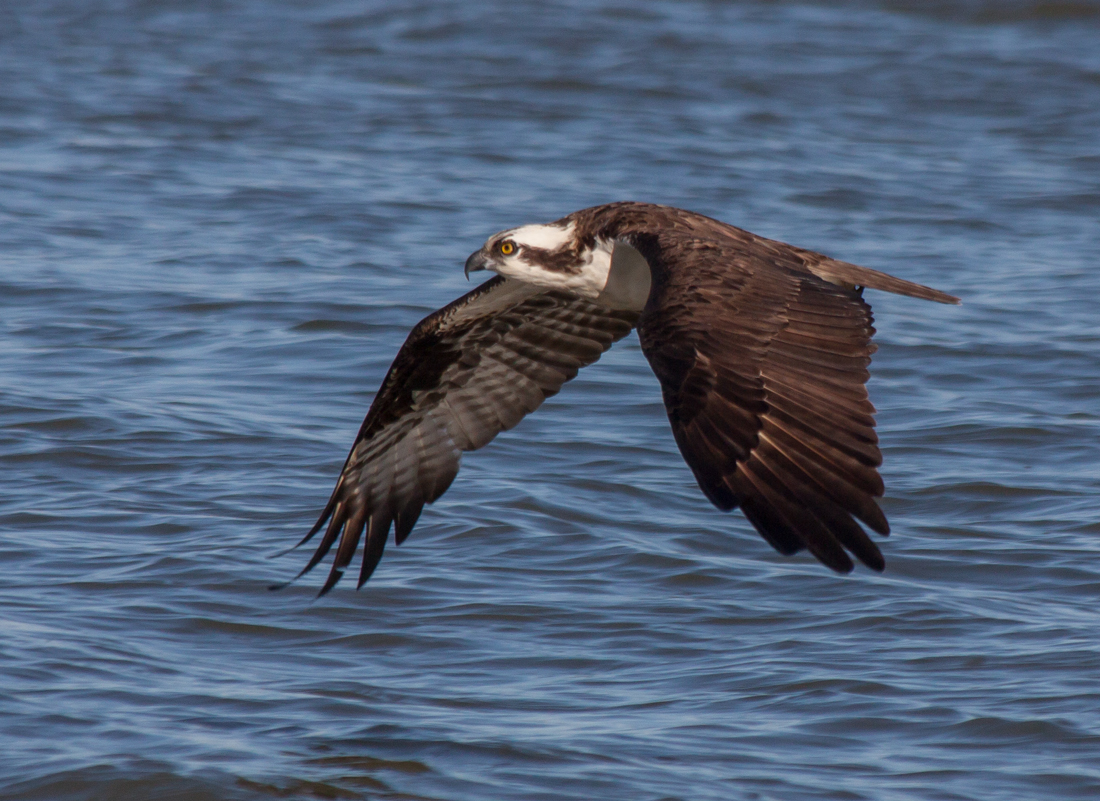
For the first time in my experience, ospreys have been hanging out at my local marsh this summer, probably because of the higher water levels as a result of a massive wetland restoration project. I love watching the ospreys soaring high in the air. They are generally too far aware for me to capture their high-speed dives into the water, but occasionally I will see one catch a fish. Recently I captured some shots of the various wing positions of an osprey flying away with its freshly caught fish.

© Michael Q. Powell. All rights reserved.


Read Full Post »

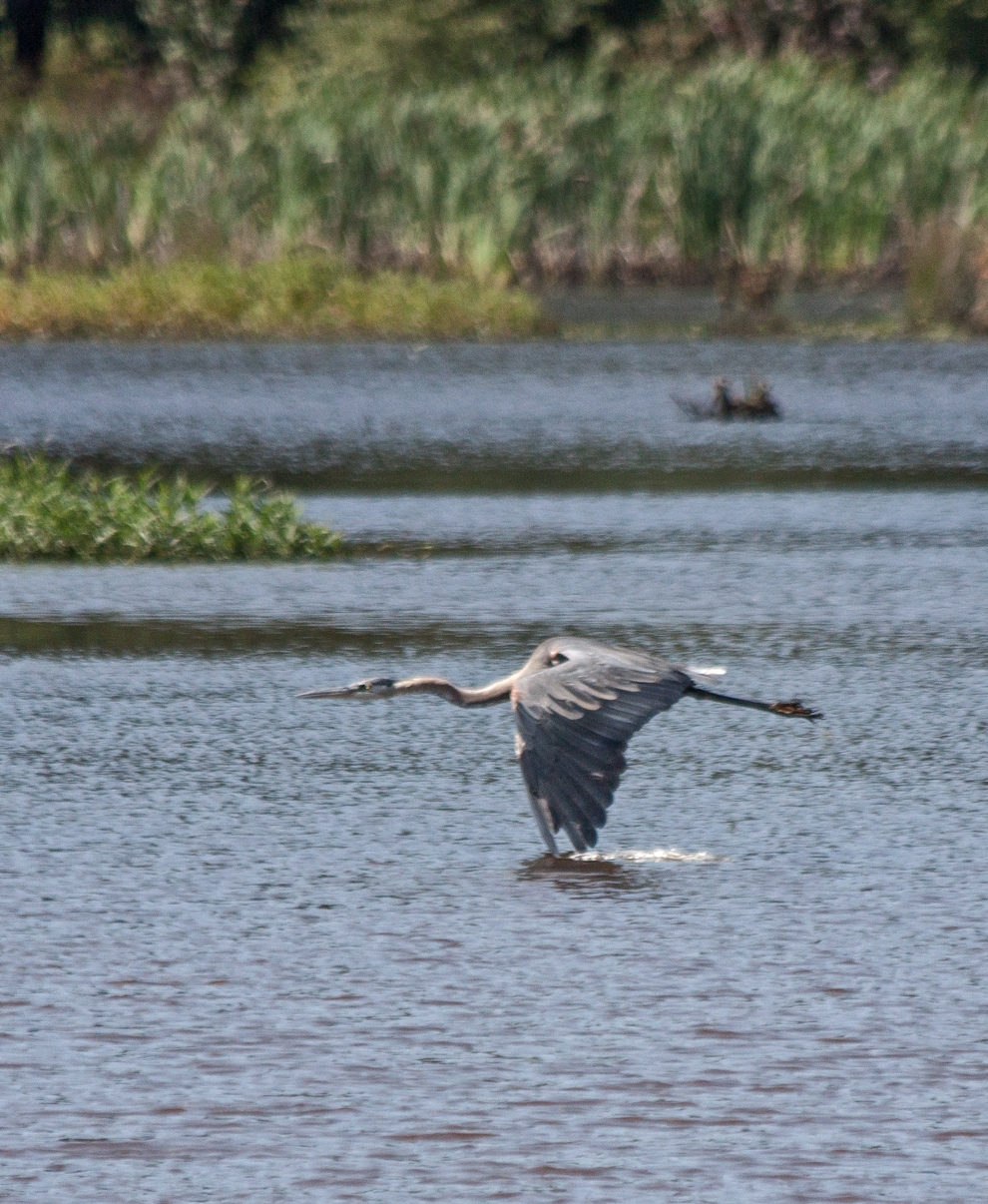
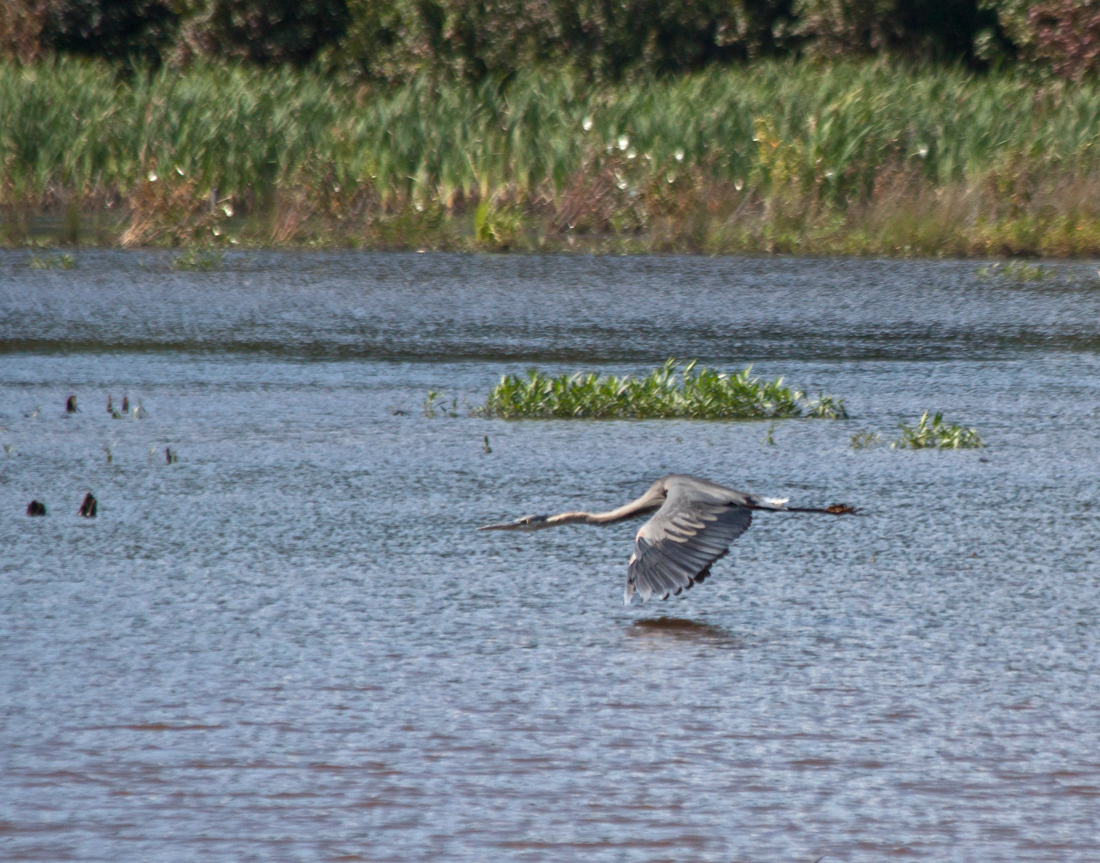
Most of time when I see Great Blue Herons (Ardea herodias) take off, they fly high into the air. This heron, however, decided to fly very low over the surface of the big pond at my local marsh—I think he was on his way to harass one of his fellow herons, because there was a lot of loud squawking shortly after I took these shots.

Generally, it’s not hard for me to decide if I want to crop a shot in landscape or portrait mode. This time, though, I vacillated and ultimately decided to do one each format.  Who says you have to choose? You can have it both ways.

heron2_low_blogheron_low_blog

© Michael Q. Powell. All rights reserved.

Read Full Post »

Generally I prefer to have a natural background for wildlife shots, but when a Green Heron (Butorides virescens) that I was observing this past Friday at my local marsh took off, I ended up shooting it against the backdrop of the boardwalk. I really like the look of the resulting shot, which juxtaposes those natural and industrial elements in an unusual way.

If you enjoy photos with this type of contrast of the natural and the man-made, check out my posting from this past week of an “industrial” dragonfly.

Green Heron Huntley Meadows

© Michael Q. Powell. All rights reserved.

Read Full Post »

I’m always thrilled to see Great Egrets (Ardea alba), like this one that I photographed on Monday at Huntley Meadows Park. Unlike Great Blue Herons, which often are willing to tolerate my presence, egrets seem to fly away as soon as they detect my presence. When egrets are flying, I never fail to be impressed by their beauty and grace, looking like ballerinas in an aerial performance.

As has frequently been the case recently, I ended up photographing a bird with a macro lens, in this case it was my Tamron 180mm. The image with the standing egret was cropped a little, but it gives you an idea of my field of view. I had crept through some chest-high vegetation in order to get near the edge of the pond for these shots.

I suspected the egret would take off and I think I had the presence of mind to switch to Servo mode on my camera, which allowed me to get some in-flight shots that are pretty much in focus. I was shooting in burst mode and captured other images as well, but the egret’s head was hid in those shots.

Great EgretGreat EgretGreat Egret

© Michael Q. Powell. All rights reserved.

Read Full Post »

Unlike the Great Blue Herons that stay in Northern Virginia all winter, Great Egrets (Ardea alba) depart for warmer locations during the winter. I was happy to note this past weekend that the egrets are now back at my local marsh, where I took these shots of one coming in for a landing.

The wing span of this bird is impressive and I love the way that it points its toes as it comes in for the landing. As is often the case, I had challenges getting a proper exposure—I try to expose for the brilliant white body, but often blow out the highlights. I am pleased that I was able to capture some of the details of the wings in these images, though the shadows caused much of the plumage to look gray, rather than white.

egret2_april_blogegret1_april_blogegret3_april_blog

© Michael Q. Powell. All rights reserved


Read Full Post »
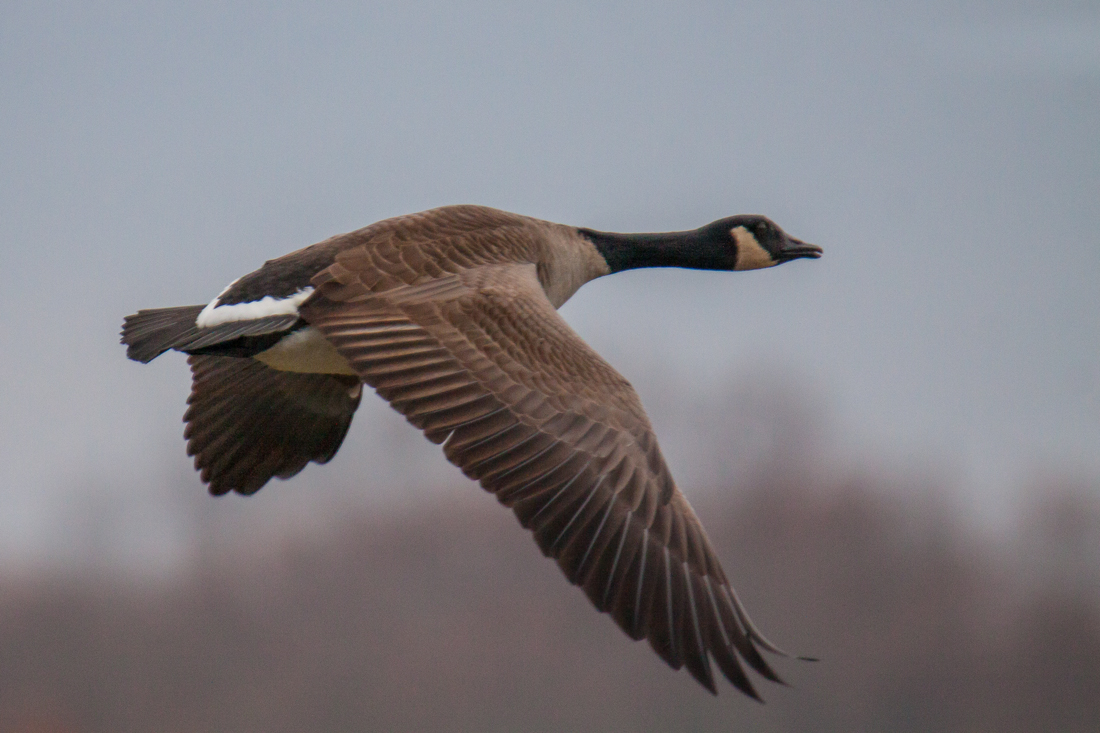
Some folks complain a lot about Canada Geese, but I enjoy trying to photograph them, especially when they are taking off and landing. It seems like the number of them has dwindled somewhat at my local marsh recently–perhaps some of them have migrated north.

Yesterday, this goose began to sound the alarm as soon as it became aware of my presence and took off a short time later, still crying out with its tongue extended. I managed to track the bird as it was taking off and to shoot a series of shots. The sky was pretty heavily overcast yesterday, so I had raised my ISO to 320 and figured that I would have enough speed to capture the action. What I didn’t realize at the time, though, was that my aperture was still set at f/11, because I had been shooting some landscapes just prior to these shots. I was in aperture priority mode and my camera chose a shutter speed of 1/1oo of a second.

In the first shot, the goose is relatively sharp and there is little motion blur, except for the background, which is blurred, I think, because I was panning as I tracked the goose. In the second shot, though, which preceded the first in time, the wings and the feet have some motion blur, which accentuates the feeling of the goose scrambling to get into the air.

I keep going back and forth in trying to decide which of this two photos I like better. The technical side of my brain wants to vote for the first one, but the artistic side prefers the second image. What do you think?

goose_alarm goose_alarm2_blog

© Michael Q. Powell. All rights reserved


Read Full Post »

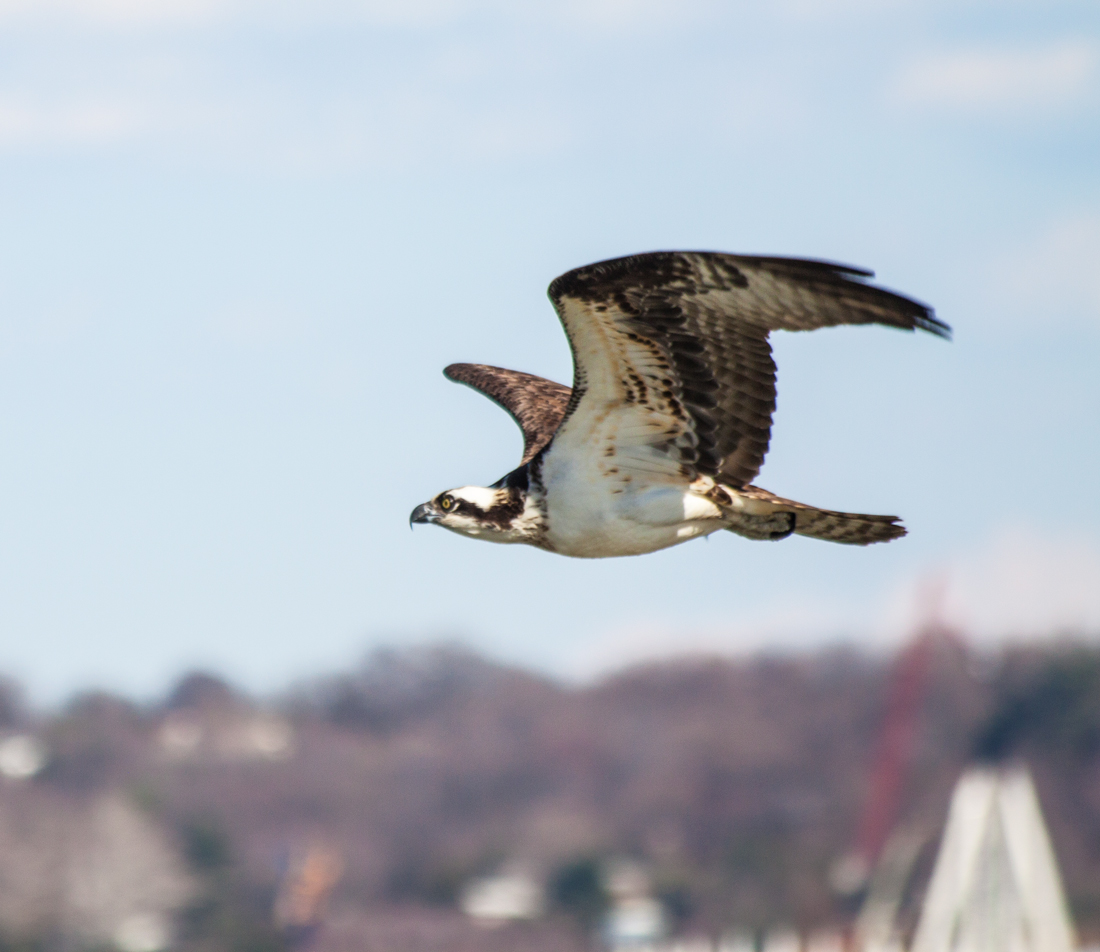
Hoping to capture a shot of an osprey  (Pandion haliaetus) snagging a fish earlier this month, I started firing my camera each time the osprey dove toward the surface of the water with talons extended, but, unlike the bird, I came up empty-handed. The osprey, it turns out, was not fishing for food—it was gathering building materials for its nest. It was impressive nonetheless to watch an osprey fly up into the sky with a pretty large branch in its grasp.

Click on the photos if you want to see a higher resolution view of the images. (I am always amazed by the osprey’s yellow eyes.)

osprey_fishing1_blogosprey_fishing2_blog

© Michael Q. Powell. All rights reserved

Read Full Post »

Soaring high above the earth, this Osprey (Pandion haliaetus) seemed to be relaxing, enjoying a moment of peace before getting back to the pressing  job of rebuilding the nest.

osprey_soar_blog

© Michael Q. Powell. All rights reserved

Read Full Post »

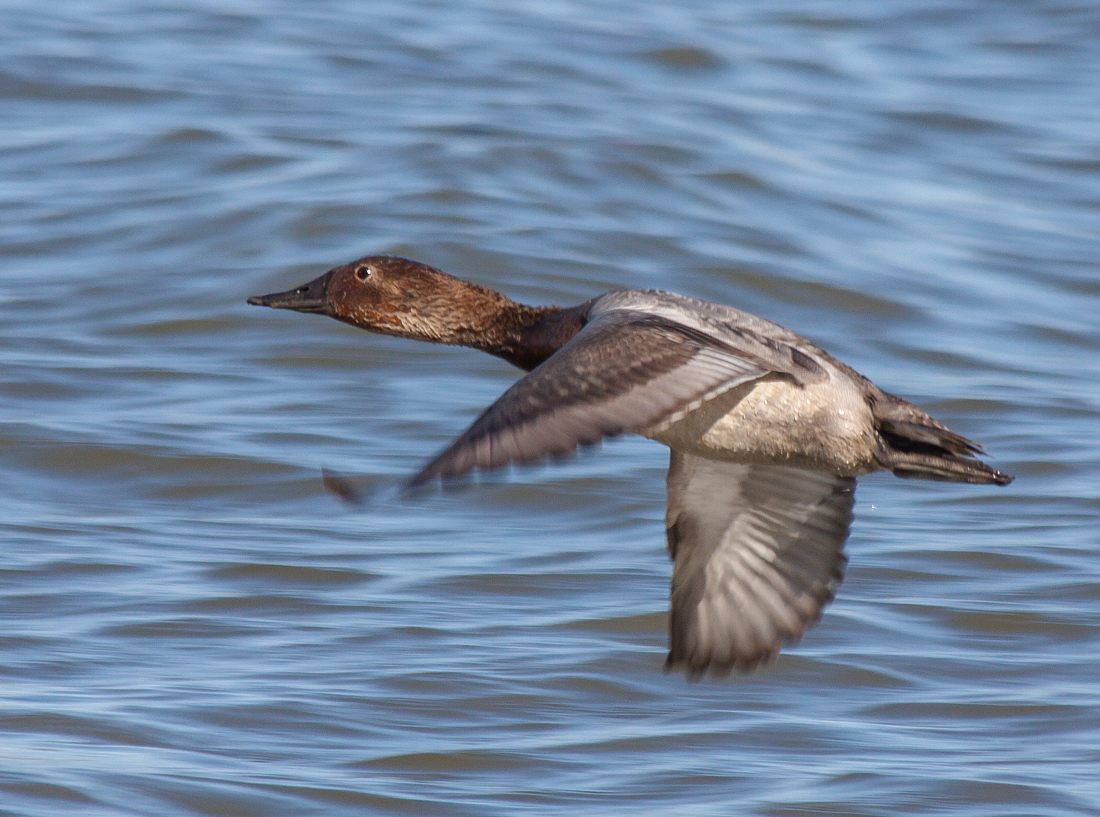
As I was observing the osprey couple on the Potomac River this past weekend, I spotted an unusual-looking duck of a species that I had never seen before. One of my fellow photographers said that he was pretty sure that it was a Canvasback duck (Aythya valisineria) and I couldn’t disagree, having no idea what a Canvasback duck looked like.

The duck was a pretty good distance away and I was looking through my telephoto lens when it decided to take off from the water. I don’t think that the duck was aware of our presence, for it initially flew toward us and parallel to the shore before veering off into the center of the river. I was able to track the duck pretty well and got some in-flight shots, including my two favorites that I am posting.

I am not one hundred percent sure of the identification and would welcome a confirmation or correction, as appropriate, from someone with more experience in identifying bird species.

canvasback_flight_blog canvasback_flight2_blog

© Michael Q. Powell. All rights reserved

Read Full Post »

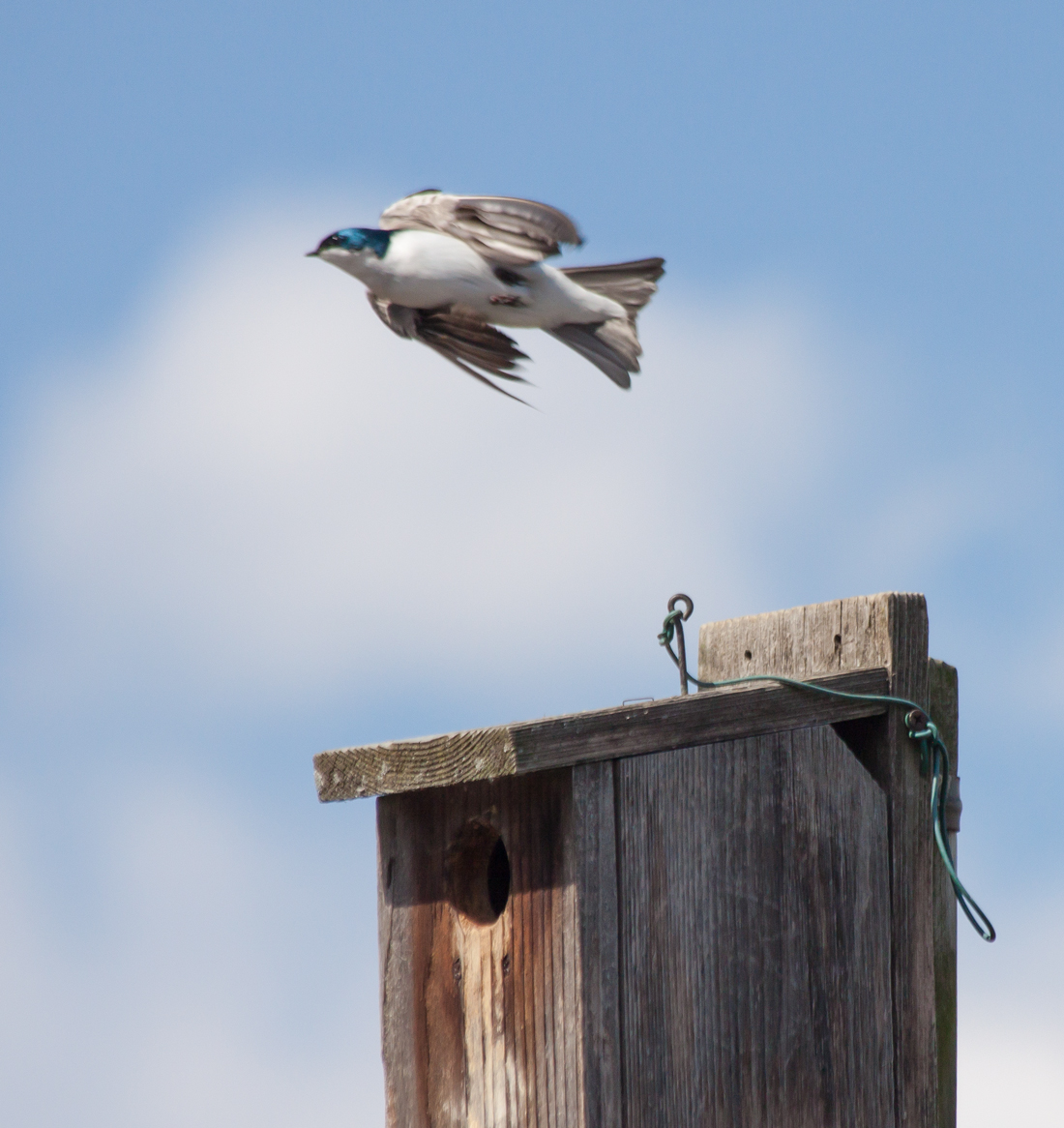
I was a little surprised to see some Tree Swallows (Tachycineta bicolor) on Saturday when I visited Dyke Marsh Wildlife Preserve, a freshwater tidal wetlands on the Potomac River. I thought it was a bit early for these little aerial acrobats to be here, given the fact that there are not yet many insects for them to catch, but they were flying about and checking out a nesting box.

Sometimes I get cool shots of birds in flight by accident, like this shot of a Tree Sparrow, which took off as I was photographing it. The angle of view is one that I have never before captured in any image.

swallow_flight_blog

Two of the swallows seemed to spend a lot of time together and I suspect that they are a breeding pair, though they were periodically buzzed by other tree swallows, which could be other potential suitors for the female. One of the swallows eventually entered the box and I suspect that the swallows are constructing a nest in it, though I didn’t see any of them actually carrying in construction material.swallow_entrance_blogIt’s a good sign for me that spring is almost here when I see birds reappearing (even as I shovel away eight or so inches of snow that have fallen in the last 24 hours).

© Michael Q. Powell. All rights reserved

Read Full Post »

A breeding pair of Ospreys (Pandion haliaetus) has returned to a nesting site only a few miles from where I live and I was thrilled to get some shots of the ospreys yesterday, on a bright sunny day.

The nest, which has been used for quite a number of years, is built on a wooden piling near the Belle Haven Marina south of Old Town Alexandria on the Potomac River. The piling is tilted quite a bit, apparently because of the pressure of the ice that accumulated when the cold temperatures this winter caused the river to freeze, but the birds seem undeterred and were busily adding sticks to the nest yesterday. It looks like the ospreys may be compensating for the angle by building the nest higher on one side than the other, though it is really hard to tell at the moment.

I took lots of shots yesterday that I need to review, but I thought I would post this one as a sneak preview and suspect that I will have enough shots for another few postings. The ospreys flew by a few times (most often the male) and I was able to get photos of them in flight andworking on the nest.  I remember hearing that there were ospreys on the Potomac River, but somehow never made the trip last year during breeding season. This year, I will try to make more frequent trips to check on the couple’s progress.

osprey_flight_blog

© Michael Q. Powell. All rights reserved

Read Full Post »

« Newer Posts - Older Posts »