Feeds:
Posts
Comments

Posts Tagged ‘Alexandria VA’

Love-in-a-mist (Nigella damascena) is a flower that looks like it came from outer space, with wild tendrils shooting out of its middle and green spikes surrounding it.

I was surprised this past weekend to see some of the plants putting out blossoms this early at a local garden that I like to visit. I had never seen Love-in-a-mist (I love saying the flower’s name) in its early stage of growth and really like the look of the bud in the last photo, surrounded by the soft green spikes, as the flower is at all stages of growth.

Before long, entire patches of this garden will be covered with this remarkable flower—we can always use more Love, whether it is in a mist or not.

love1a_bloglove3_bloglove2_blog

Michael Q. Powell. All rights reserved

Read Full Post »

One of my favorite spring flowers is the columbine (genus Aquilegia) and I especially like its distinctive shape. Yesterday I took this photo at Green Spring Gardens, a county-run historical garden, one of my favorite spots for photographing flowers.

The flower was growing at an unusual angle and I tried hard to capture the details of the flower, as well as the beautiful colors in the background. I’m pretty happy with the result.

pink_columbine_blog

Michael Q. Powell. All rights reserved

Read Full Post »

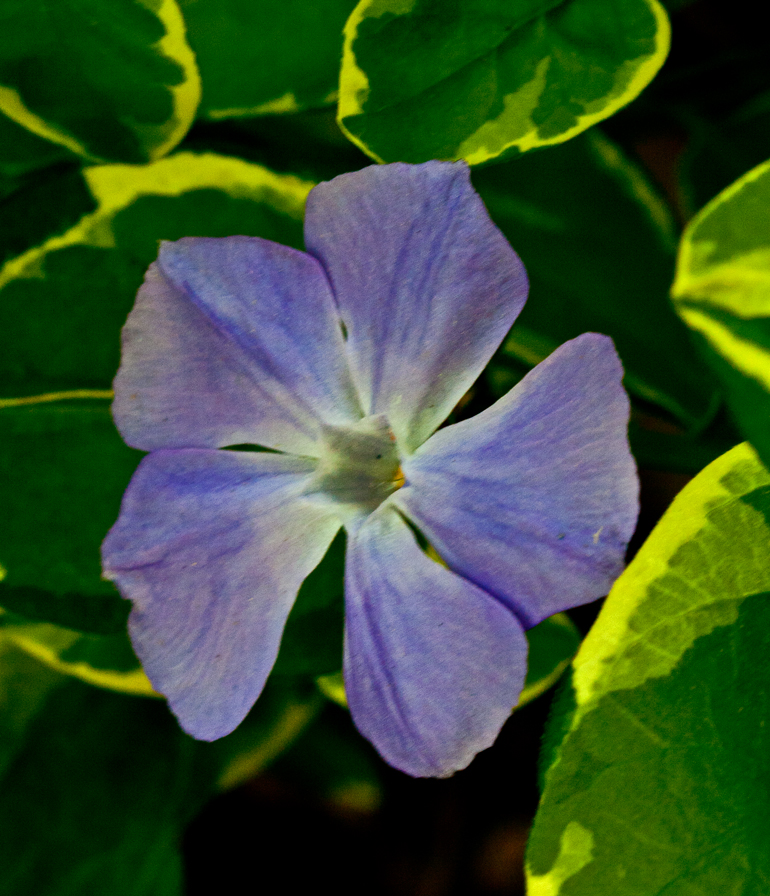
In my neighbors’ garden facing the street, a beautiful purple bearded iris has a position of prominence, but unseen by most, a more modest, but equally beautiful purple flower grows amidst the vines in a corner of the back yard.

This iris is a showy flower, with deep, rich colors, frilly petals, and the colorful accent of the beard. How can you not like such a flower? It is the first iris to bloom and doesn’t have to share its glory.

Yet I am just as attracted to the geometric simplicity of the little purple flower in the back yard. The owner, Cindy Dyer, who posts amazing flower photos on her blog, told me the name of the flower (or perhaps it is considered a weed), but it didn’t stick in my memory.

Spring offers such a bounty of flowers, that there are bound to be some that appeal to your tastes and moods and sensitivities—it is definitely worth slowing down to smell the roses (and taking in the beauty of the other flowers too).

Iris_blogpurple_blog

Michael Q. Powell. All rights reserved

Read Full Post »

Ladybugs are often considered symbols of good luck and many people look at them as cute. Consequently, you have probably never considered them as menacing (assuming that you are not an aphid), but that is the descriptor that came to mind when I first looked at this head-on image of a ladybug that I photographed yesterday.

Perhaps I am just not used to looking eye to eye with a ladybug, but this one seems to have a deadly serious look on its face, like it was not happy that I was disturbing it.

I took the shot in my neighbor’s garden, using a macro lens and a hand-held diffuser to cut down on the intensity of the sunlight. Although I stopped down the lens to get some additional depth of field, the back portion of the ladybug, including its rear legs, are out of focus, which helps to draw attention to the face.

The change in seasons means that I will probably be featuring fewer birds in my blog than during the winter, and a whole lot more insects and flowers.

ladybug1a_blog

Michael Q. Powell. All rights reserved

Read Full Post »

The soggy, overcast weather this past Friday kept people away from my local marshland park and allowed me to get these shots of a Greater Yellowlegs (Tringa melanoleuca).

I don’t normally see these birds and if I do, they are almost always beyond the range of my lens. This day, however, there were a couple of yellowlegs and another smaller shorebird, which I was told was a Solitary Sandpiper, that moved back and forth in the water, remaining within range for quite some time.

The lighting was a little  tricky for me, with the sky almost white most of the time, though sometimes the sun would peek out from behind all of the clouds. Most of the shots were a little underexposed, but I was able to correct them with a few little tweaks in post-production. I especially like the lighting in the first photo, in which the water has some color to it.

I am happy, though, that I was able to get some pretty clear shots of this beautiful bird, thanks in part to some careful focusing and the use of a tripod. (If you want to see another shot of the yellowlegs, checkout my earlier posting.)

yellowlegs4_blogyellowlegs3_blogyellowlegs2_blogyellowlegs1_blog

Michael Q. Powell. All rights reserved

Read Full Post »

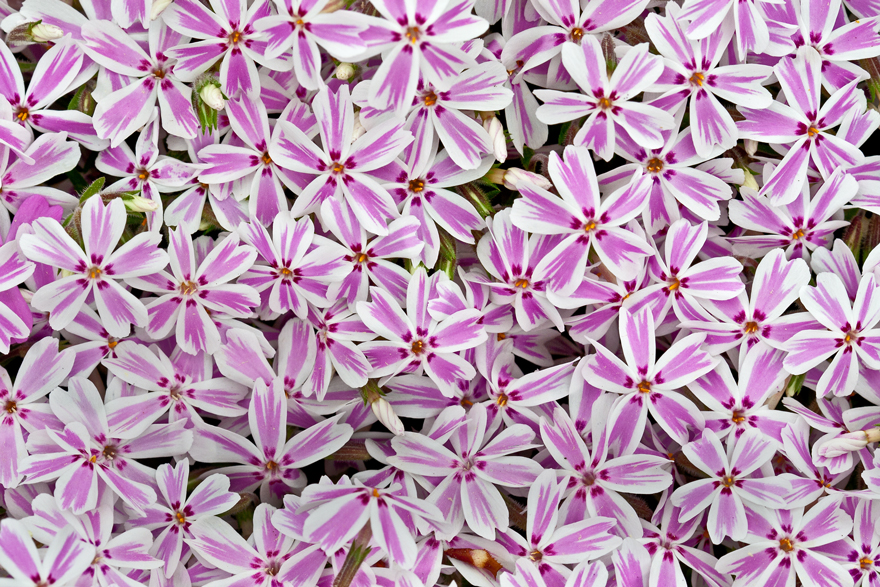
Here is a shot of the beautiful Creeping Phlox (Phlox stolonifera) that covered one whole area of the rock garden at one of the local gardens that I like to visit.

phlox_blog

Michael Q. Powell. All rights reserved

Read Full Post »

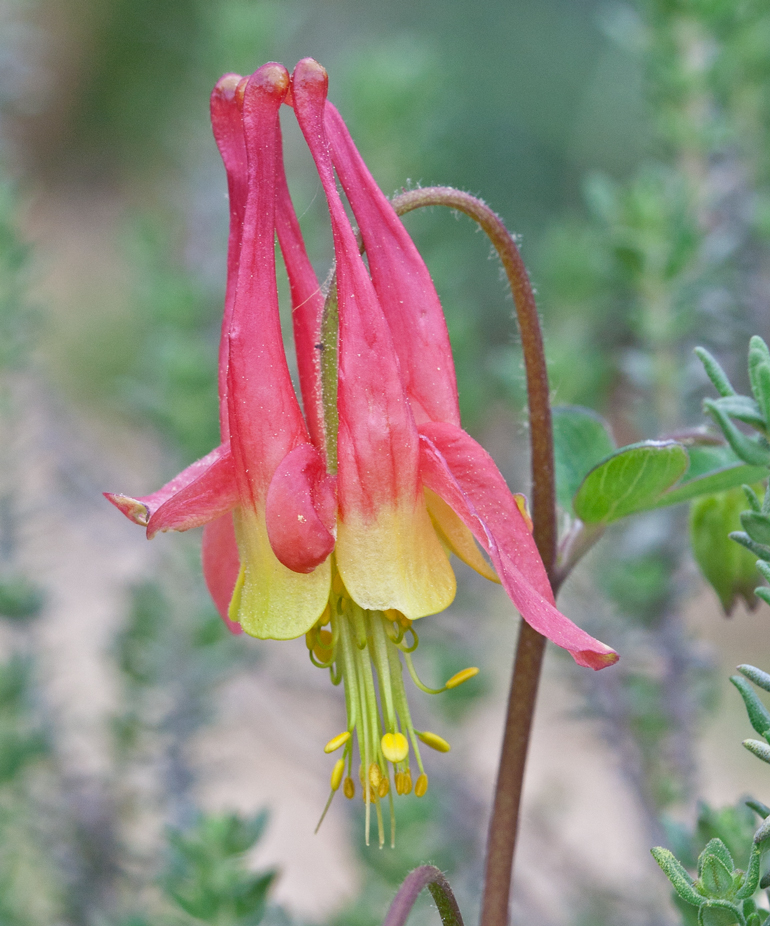
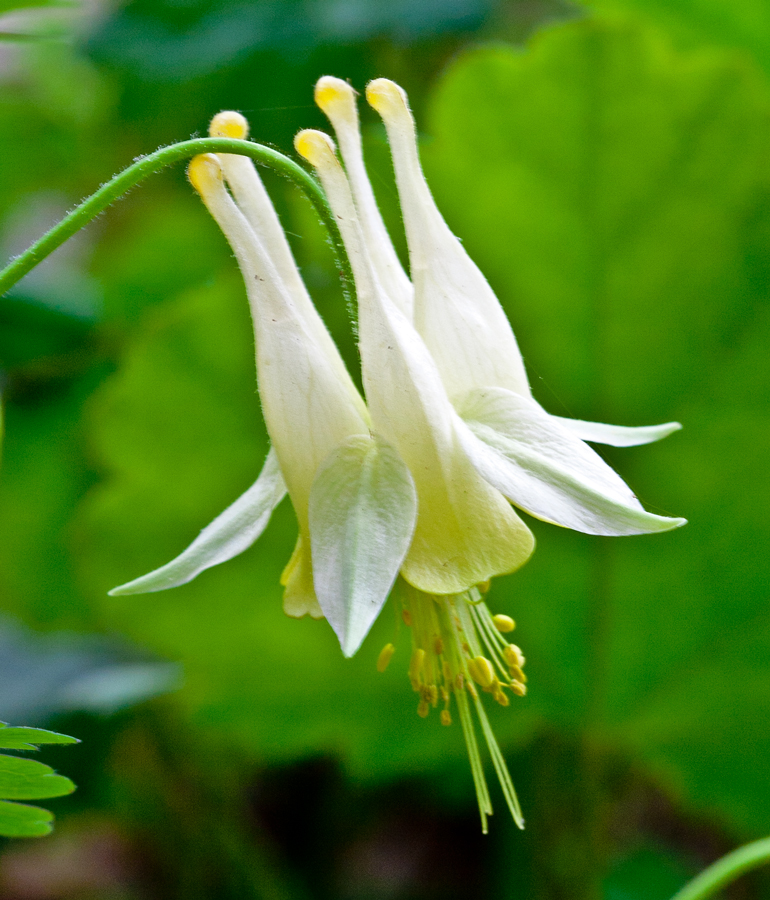
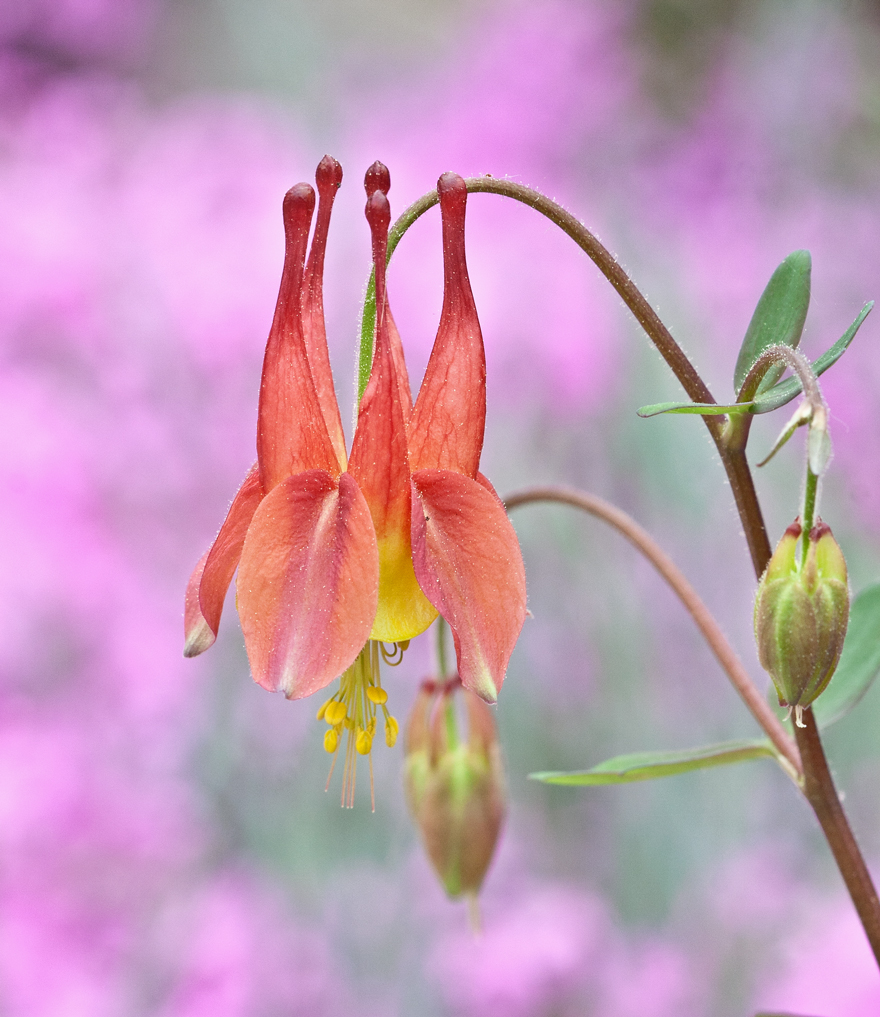
After first getting introduced to these pretty little flowers last spring, the Columbine (genus Aquilegia) rapidly became one of my favorites. They come in a lot of different colors, although the only ones blooming in the county-run garden that I visited this weekend were red-and-yellow ones and white ones.

Normally it’s not that difficult to get decent shots of these flowers, but the day was windy and that made it tough to control the depth of field (which normally requires a slower shutter speed) and stop the movement caused by the wind.

The pretty pink in the background of the final photo came from a patch of phlox that blanked a large area of a rock garden. I think I got some pretty good  photos of the phlox, so you may see them in another posting later.

columbine2_blogcolumbine1_blogcolumbine3_blog

Michael Q. Powell. All rights reserved

Read Full Post »

I like backlighting a lot, especially when the light shines through and illuminates beautiful colors, like those of this tulip in a neighbor’s garden.

backlit_tulip1_blog

Michael Q. Powell. All rights reserved

Read Full Post »

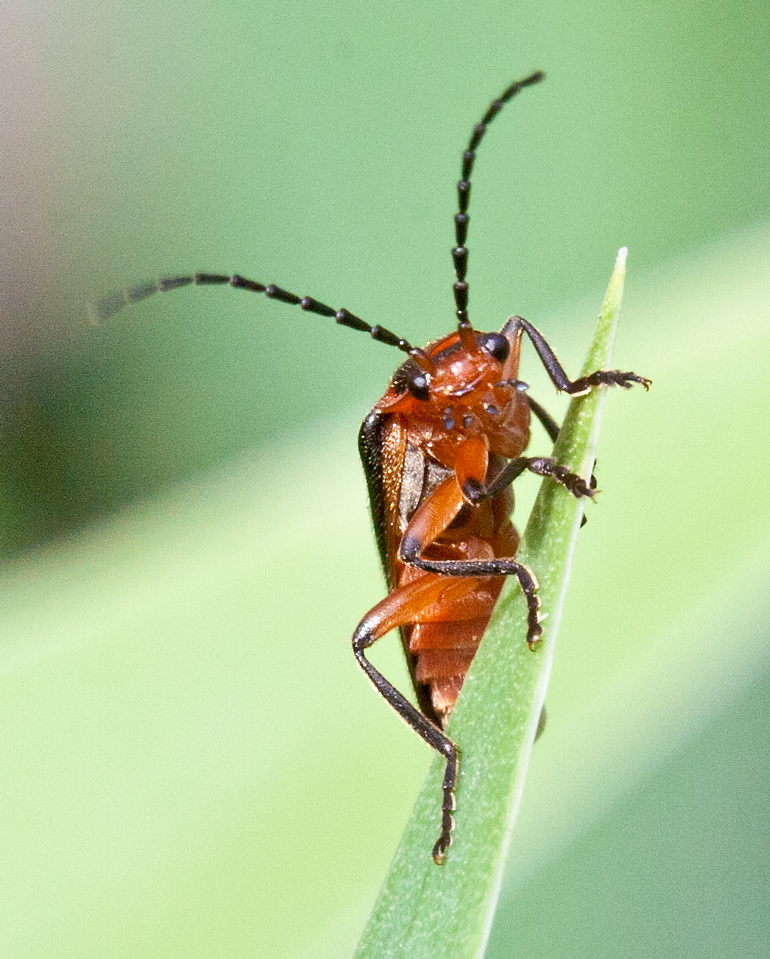
An insect on the edge of a leaf is a perfect candidate for a macro shot and when I saw this one from a distance in my neighbor’s garden, I got to work without a clue about its identity.

When I looked at the photos initially, I thought I had captured images of a Red Milkweed Beetle (Tetraopes tetrophthalmus), because of its bright red body and curved, segmented antennae. (I have a self-identified obsession with this insect that I discussed in a blog posting last year.) However, there were a few problems with that identification. This beetle seemed smaller; it was on a plant that was definitely not a milkweed plant; and it seemed too early to be seeing a milkweed beetle. My identification was further complicated by the fact that I never did see the back of the beetle.

So what insect did I photograph? I have been going over photos at bugguide.net, one of my favorite sources and wonder if this might be a Lily Leaf Beetle (Lilioceris lilii). Tentatively, though I like the name that I invented for this post, Red Spring Beetle.

I may not be sure about the identification of this insect, but I know that I like the photos that I managed to get, especially the first one. I captured a pretty good amount of detail and I like the way that he posed, looking directly at me.

red_bug3_blogred_bug2_edited-1

Michael Q. Powell. All rights reserved

Read Full Post »

I almost always take photos of nature and wildlife, but every now and then a man-made object will catch my eye, like this rusty, industrial-looking clamp.

I was visiting a friend as she was cleaning up her back yard, preparing for the flowers that will soon be blooming there, when I caught sight of  clamp. It was sitting on a rough-sawn stump and, as she told me, is used to attach a plant stand to another object.

The shape reminds me of a question mark, an industrial question mark. I really like the solidness of the piece, a solidness from which the rust detracts little. The light casts an interesting shadow and the scattered red buds are a nice complement to the rusty tones.

This was a case of shooting what caught my eye, without too much thought at the moment. I simply knew that I liked what I saw.

clamp_blog

Michael Q. Powell. All rights reserved

Read Full Post »

As I was admiring the beautiful tulips in my neighbors’ garden, I noticed this fly perched on the edge of one of them. In a different setting he might have gone unnoticed, but here the details of the fly provide a nice contrast with the wonderful primary colors of the tulips in the background.

With spring here in full force, I am reacquainting myself with my macro lens, causing me to look more closely at details like the red compound eyes of this fly and his hairy back legs.  It’s fun too to note the details of his tiny little feet.

I am now remembering how much I have to pay attention to lighting, depth of field, and shutter speed when shooting macro shots, particularly because my macro lens is not image stabilized. Very minor problems can really be magnified when I try to get in this close, especially with an animate subject.

fly_tulip_blog

Michael Q. Powell. All rights reserved

Read Full Post »

It doesn’t get much simpler than this—light shining through this leaf from behind created a graphic image that stands out from its blurry background. The color palette is mostly just shades of green. The suggestions of lines in the background help to add some visual interest.

The image is both striking and soothing to me, an interesting combination of reactions.

leaf2_blog

Michael Q. Powell. All rights reserved

Read Full Post »

We’ll have more ladybugs in our neighborhood even sooner than I expected.

My neighbor and photography mentor, Cindy Dyer, has ladybug larvae in her garden as I showed in a recent posting. Some of them have already entered the pupa stage, the final stage before adulthood. Once metamorphosis is complete, the shell splits open and a full-grown ladybug emerges. Initially, the shell is soft, but pretty rapidly the exoskeleton hardens and takes on the look that we associate with ladybugs.

Here’s a photo from today of a ladybug pupa. I think that it is probably from a Harlequin Ladybug (Harmonia axyridis), a type that is also known as the Multicolored Asian Lady Beetle. If you want to know more about the life cycle of a ladybug, check out the posting that I did last fall entitled Baby Ladybugs.

larva2_web

Michael Q. Powell. All rights reserved

Read Full Post »

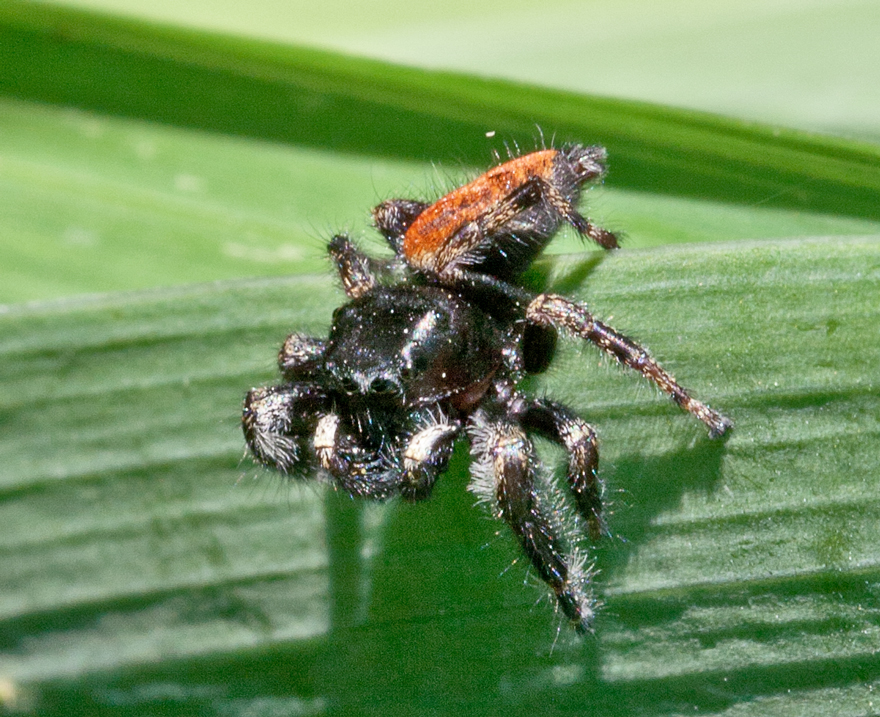
I was checking out the plants yesterday in my neighbor’s garden when I came upon this cool-looking spider, a type that I had never before encountered. From an initial check on-line, it looks like this might be a kind of jumping spider, though I really am out on a limb with the guess. In any case, I really like the combination of red and black on his body and the multiple eyes that are just visible.

With the arrival of spring, I am starting to see some familiar insects from last year and some new “friends.” It’s an exciting time for me.

spider_blog

Michael Q. Powell. All rights reserved

Read Full Post »

This is another close-up, pseudo-macro image that I shot with my telephoto zoom lens and I really like the way that the yellow in the center of the white flower seems to glow. Controlling depth of field was especially challenging when shooting something like this with my lens set a little over 300mm. I wanted the background to be as green as I could get it, which is tough at this time of year, so I had to bend low to get this angle. I achieved that goal partially,  though I was not able to blur out the background very well.

I guess it’s finally time to pull out the macro lens.

glow_blog

Michael Q. Powell. All rights reserved

Read Full Post »

The sun was almost directly in front of me, a situation that is usually not optimal for photographs, but I really liked the interplay of the light and the shadows on this white and yellow daffodil.

It’s definitely a side of the daffodil that is not featured very often, but it is a lesson for me of the value of looking for new perspectives. I like image that I managed to get by looking at the flower from the other side.

daffodil1_blog

Michael Q. Powell. All rights reserved

Read Full Post »

It may sound like an oxymoron, but I think that this pretty little flower really is called a Summer Snowflake (Leucojum aestivum).

Yesterday was a beautiful, sunny day and I took the opportunity to visit Green Spring Gardens, a local county-run local historical and horticultural center. It is still a little early in the season for most of the showy blossoms, but I came across several patches of the snowflake flower. Apparently there are two varieties of snowflakes—spring and summer—and, strange as it sounds, these are blooming so late that they are probably Summer Snowflakes.

My mind is still geared on photographing birds, so I was carrying around my camera with the 135-400mm telephoto lens. I had my macro lens in the bag I was carrying and probably should have changed lenses when I took some shots of this flower, but I guess the warmth of the sun made me feel a little lazy.

I took this shot at 400mm, which is equivalent to a 640mm on a 35mm camera, because of my crop-sensor camera. The shot is a little soft, but it is clear enough to show that I may have captured an additional subject. If you look closely at the top of the green stem, you will see what I think is a tiny spider. My fellow blogger and photography mentor, Cindy Dyer, likes to call these “bonus bugs.” You shoot check out her blog for some great shots of snowflake flowers and lots of other flowers too.

As insects and flowers return, I will have to retrain my eyes to focus on close-in details, rather than looking out into the distance, as I have during much of the winter when I was photographing a lot of birds. I look forward to the challenge.

snowflake1_blog

Michael Q. Powell. All rights reserved

Read Full Post »

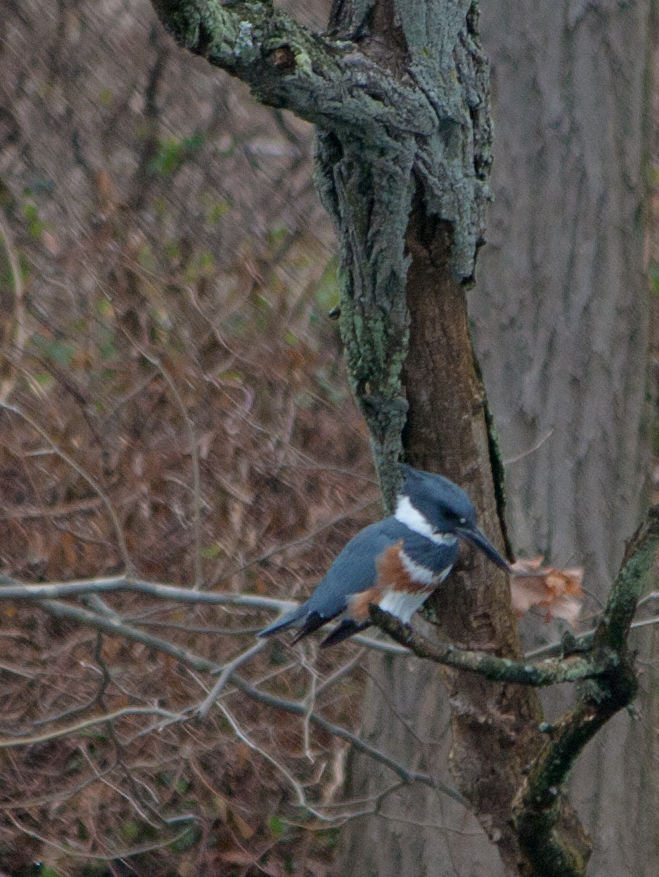
This past weekend I went back to locations where I have seen Belted Kingfishers (Megaceryle alcyon) in the past and encountered this male kingfisher (you may recall that the female has a chestnut stripe on her chest).

Initially he was on a wire above the stream, as shown in the second photo, but eventually he moved to a tree, where his pose looks more natural. He was pretty high in the tree and seemed to be surveying the entire area.

This was the first time that I was able to photograph the kingfisher with a longer lens and I had hoped to get some close-up shots. However, the kingfisher was not very cooperative this time and stayed close to the limit of the range of the lens. I was able to get pretty good detail in the first photo, however, despite a large amount of cropping, probably because I shot from a tripod.

As I said in a previous post, I enjoy stalking kingfishers—there is something about their look that I really like. I will continue to chase after them in search of better shots and hope they cooperate by staying in their current locations.

kingfisher1_blogkingfisher2_blog

Michael Q. Powell. All rights reserved

Read Full Post »

Yesterday while walking along the banks of Cameron Run, a tributary stream of the Potomac River, I encountered this unknown insect. I have been so starved for insects (photographically-speaking, not literally) that I decided I had to try to photograph it.

The insect was pretty small and would fly (or hop) when I approached, so I decided to give it a shot with the lens that was on my camera, a 135-400mm telephoto zoom. I was pleasantly surprised with the resulting photo, which almost looks like it was shot with a macro lens.

I will try to identify this little insect, but am happy with the shot and am now convinced that spring is here if insects are reappearing.

insect_blog

Michael Q. Powell. All rights reserved

Read Full Post »

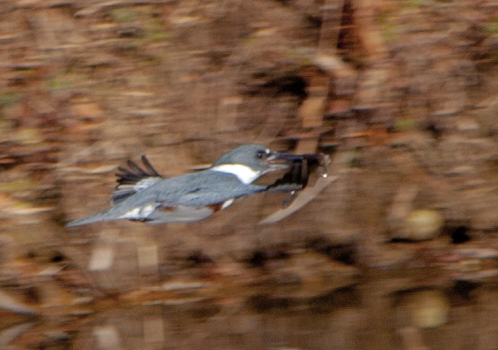
Although I was excited to discover a male Belted Kingfisher (Megaceryle alcyon) in an industrial setting, later that day I returned to my first love, a female kingfisher in a more natural environment.

Previously I posted photos of the male kingfisher and female kingfisher as I continue in my quest to get some really good photos of these amazing birds. If you compare the male and the female, you can see that the chestnut stripe really makes the female stand out (and the Belted Kingfisher is one of the few birds in which the female is more colorful than the male).

I continue to get interesting photos (and I am posting some new ones here), but I still am trying to get some better ones (these are grainy and a bit soft). By the way, can anyone figure out what she has in her bill in the last photo?

kingfisher_F2_blogkingfisher-F1_blogkingfisher_F3_blog

© Michael Q. Powell. All rights reserved

Read Full Post »

I was outdoors a lot this past weekend enjoying the beautiful weather and managed to catch a glimpse of a pair of Hooded Merganser ducks (Lophodytes cucullatus). As is usually the case, they headed in the opposite direction as soon as they perceived my presence.

I was able to get a couple of clear shots of the male (the female kept ducking under the water). I especially like the duck’s reflection in the water, which looked almost turquoise. and the ripples on the surface of the water.

merganser1_blogMerganser2_blog

© Michael Q. Powell. All rights reserved

Read Full Post »

The Black Vulture (Coragyps atratus) needs to improve its public image and what could be better in these times of economic difficulty than emphasizing its energy efficiency?  The Cornell Lab of Ornithology states that the Black Vulture “soars on thermals to gain altitude and to cover large distances with little energy expenditure.”

This past weekend we had warm weather and a breeze, which made it perfect for soaring. Normally I see Black Vultures very high in the sky and in groups, but this time I spotted a solitary vulture soaring at a a lower altitude, which permitted me to get some decent photos. The Cornell Lab notes that Black Vultures have a less well-developed sense of smell than Turkey Vultures and rely more on sight than smell to find carrion, which may be why they soar at greater heights than Turkey Vultures.

I propose that the Black Vulture become the new symbol for energy-saving practices. What do you think?

vulture1_blogvulture2_blogvulture3_blog

© Michael Q. Powell. All rights reserved

Read Full Post »
Have you ever tried to will a bird or animal to change its position slightly to enable you to get a better photo? That happened to me this weekend when I came upon this Northern Mockingbird (Mimus polyglottos).

I crept close to him and positioned myself for an unobstructed shot with a beautiful blue sky in the background. The only problem was that the mockingbird was facing the wrong direction and his head was in the shadows.

So I started a mental conversation with the mockingbird, imploring him to turn slightly in my direction so that the light coming from the right would put a catch light in his eye. I didn’t dare to get any closer and continued to repeat the thought, “Please turn your head toward me, but don’t look directly at me.” Without moving his body, the mockingbird slowly turned his head and offered me an almost perfect profile shot and held the pose.

I like the way his tail and his claws turned out, but most of all I like his face. I think the mockingbird would be happy with this portrait.

mockingbird_blog

© Michael Q. Powell. All rights reserved

Read Full Post »

I spent several hours on Sunday and Monday stalking a female Belted Kingfisher (Megaceryle alcyon). Does that make me a bad person?

I first encountered this beautiful bird a couple of weeks ago and was immediately smitten. Like a paparazzi photographer, I started snapping photos frantically when I saw her. I included some of those photos in a previous posting that I creatively entitled “Belted Kingfisher.”

Now I have started to hang out what I think are some of her favorite places, hoping desperately to catch a glimpse of her. She is still quite standoffish and won’t let me get close, but perhaps she will get used to having me around. Maybe she has commitment issues.

Here are a few shots from my recent encounters, including two in which I captured her as she was flying away.

For now, it is a classic case of unrequited love.

kingfisher1_blogkingfisher2_blogkingfisher3_blogkingfisher4_blog

© Michael Q. Powell. All rights reserved

Read Full Post »

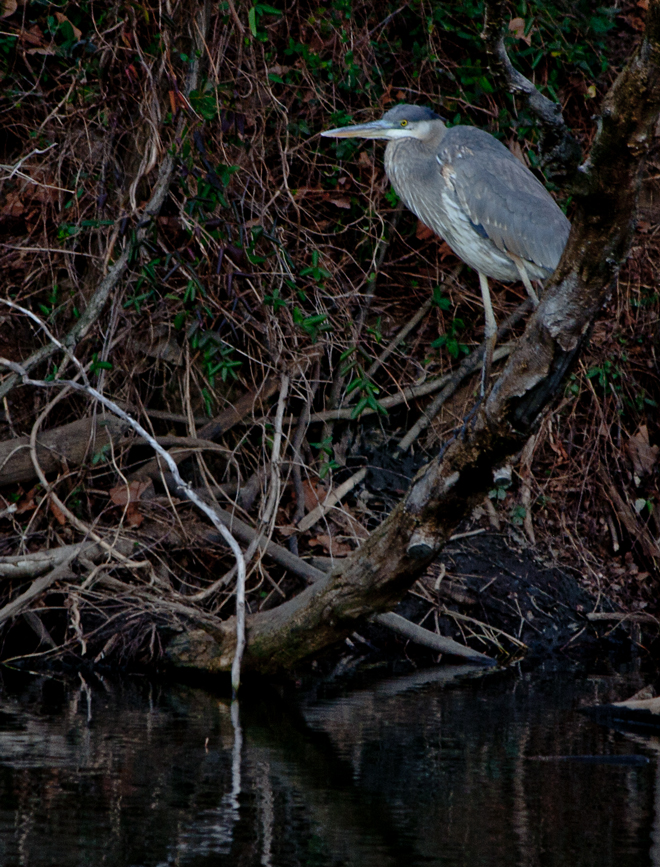
Yesterday I returned to the little lake near where I live in hopes of seeing the Belted Kingfisher again. As I was scanning the trees near the water’s edge, I caught sight of a Great Blue Heron.

Most of the time when I see Great Blue Herons, they are in the water. This one, however, seemed quite content to just stand in the shade of a tree on a slanted bank, surrounded by all kinds of roots and vines.

As I was inching my way down the slope of the opposite bank, he caught sight of me and took off immediately. Acting on instinct, I raised my camera to try to capture him in flight and lost my footing.  Sliding down the bank. I dug in my heels and managed to stop just before I reached the water.

Needless to say, I did not get any good shots of the heron’s departing flight.

GBH1_blog

© Michael Q. Powell. All rights reserved

Read Full Post »

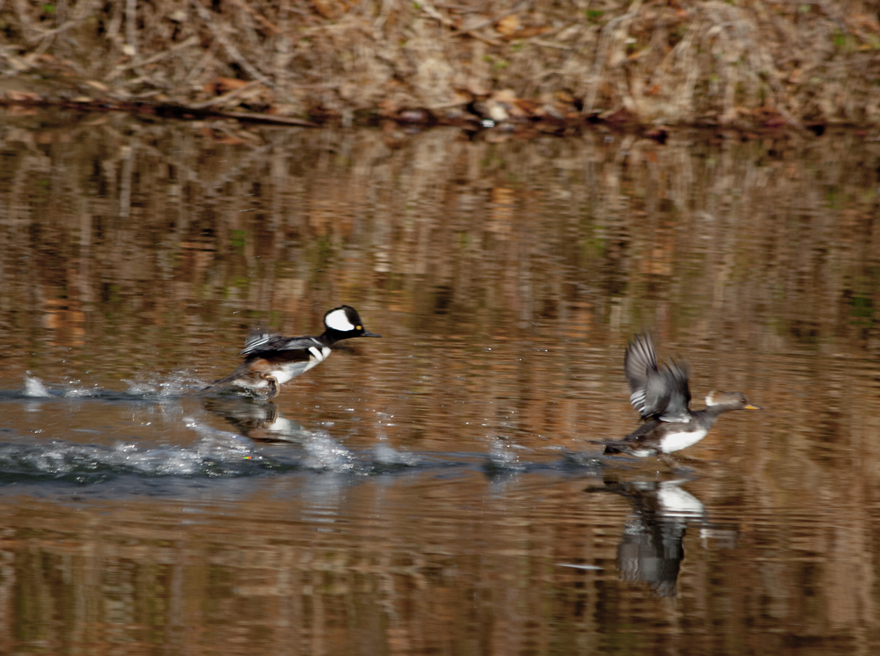
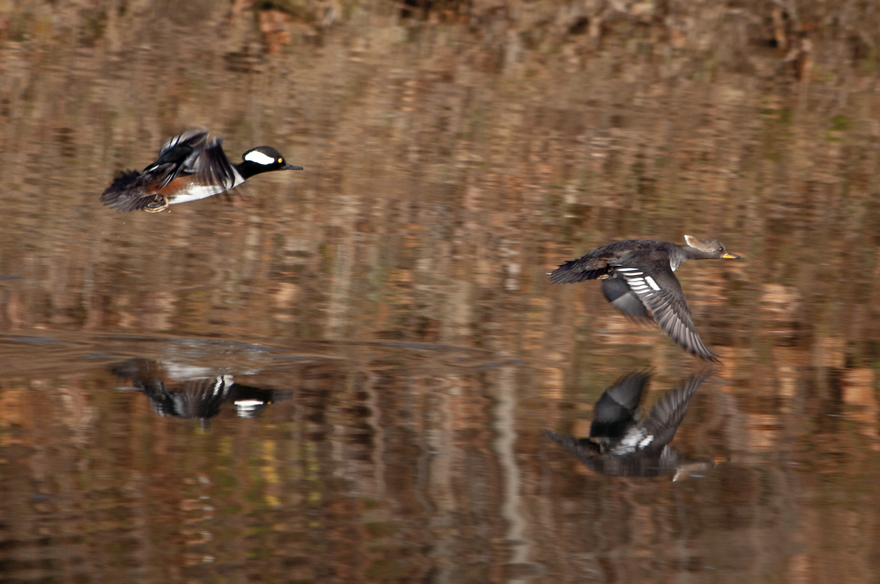
I stumbled upon a pair of Hooded Merganser ducks (Lophodytes cucullatus) at Lake Cook, a tiny urban lake, shortly after I photographed a Belted Kingfisher this past weekend. As soon I spotted them, they also became aware of my presence and immediately took evasive action. In most cases in the past, that has meant that they started swimming away. This time they seemed to have decided that more decisive action was needed and they immediately took off.

Fortunately my camera was already in my hands and the settings were about the right ones for the situation. When I started photographing birds, one of the more experienced birders whom I met recommended keeping the camera set for burst mode and that’s where I keep it most of the time now. Occasionally that means I shoot off a few extra exposures unintentionally when my trigger finger is a little heavy, but sometimes it lets me get an exposure I might not have gotten otherwise. Now, let me be clear that my almost ancient Canon Rebel XT is not a professional DSLR, so burst mode means about three frames a second, which worked out this time.

I fired off a half-dozen frames as the two ducks, a male and a female, took off from the water and I am pretty pleased with the results. It looks like the ducks get a running start on the water before they take to the air. The photo of the male duck that I featured at the start is the second one in the chronological sequence, but I thought it was the most interesting in showing the little water “explosions” as the ducks skipped across the surface. The rest are pretty much self-explanatory. I especially like the way that the heads flatten out into more aerodynamic shapes as the ducks start flying and the reflections are pretty nice. A couple of the shots are cropped to show only the male duck, because his position happened to bemore interesting than that of the female in the image (no discrimination intended).

Takeoff2_blogTakeoff1_blogtakeoff3_blog Takeoff4_blog

© Michael Q. Powell. All rights reserved

Read Full Post »

This past weekend I decided to return to a little lake (it’s actually more like a pond) where I had previously seen some Hooded Merganser Ducks. This lake is part of a regional park and, according to posted signs, is stocked with trout.

As I was looking down at the water, I was surprised when a powder blue bird flew across my field of view. It was a pretty good size bird, but I didn’t have a clue what it was. It perched on a tree across the small lake and I was able to get a couple of shots to help me identify it. I came back later in the weekend and found the bird again and was able to take some additional photos. None of the photos yet is very good, but I thought I would share some of them, because I find the bird to be exceptionally cool.

What is the bird that has me so excited? It is a female Belted Kingfisher (Megaceryle alcyon). According to the Cornell Lab of Ornithology article, the Belted Kingfisher is one of the few bird species in which the female is more colorful than the male.  In a couple of my photos you can see the blue and chestnut bands across the breast of the female kingfisher (the male has only the blue band).

The Belted Kingfishers eat mostly fish and you can see a fish in the mouth of the bird in a couple of my photos. I suspected that the kingfisher swallows the fish whole, but I was too far away to see it happen. The same Cornell Lab article states that the kingfisher often dives from a perch, catches a fish and returns to the perch. It then pounds the prey against the perch before swallowing it head first.

As I mentioned, these photos were heavily cropped and are not that great in quality, but I hope to be able to take some better ones in the future. In addition to the shots of the bird in the tree, I am including one in which I attempted to photograph the bird in flight.

kingfisher5_blogkingfisher3_blog kingfisher1_blogkingfisher2

© Michael Q. Powell. All rights reserved

Read Full Post »

As I was out shooting today, I was happy to encounter Hooded Merganser ducks (Lophodytes cucullatus) a couple of times, They are the coolest-looking ducks in my opinion (although Wood Ducks are in the running too). It’s a real challenge to get good shots of them, because they are small, fast, and skittish. I would love to find myself in a position like Phil Lanoue, a fellow blogger and incredible photographer, who recently photographed a Hooded Merganser duck coming in for a landing next to him (check out his blog posting).

I’m still going through my photos, but this one jumped out at me. It shows two duck couples swimming in formation. What is unusual is that one of the pairs appears to me a male Mallard and a female Merganser. Oh, I know that some of you are thinking that such a relationship could never work, but true love always finds a way.

I can only imagine what their children will look like.

Mixed couple

Mixed couple (click for higher resolution view)

© Michael Q. Powell. All rights reserved

Read Full Post »
Today was cloudy, windy, and overcast—definitely not an ideal day for taking photos. Sure, I like to have some clouds to cut down on harsh shadows, but you need sunlight to have shadows, and we sure did not have much of that today.

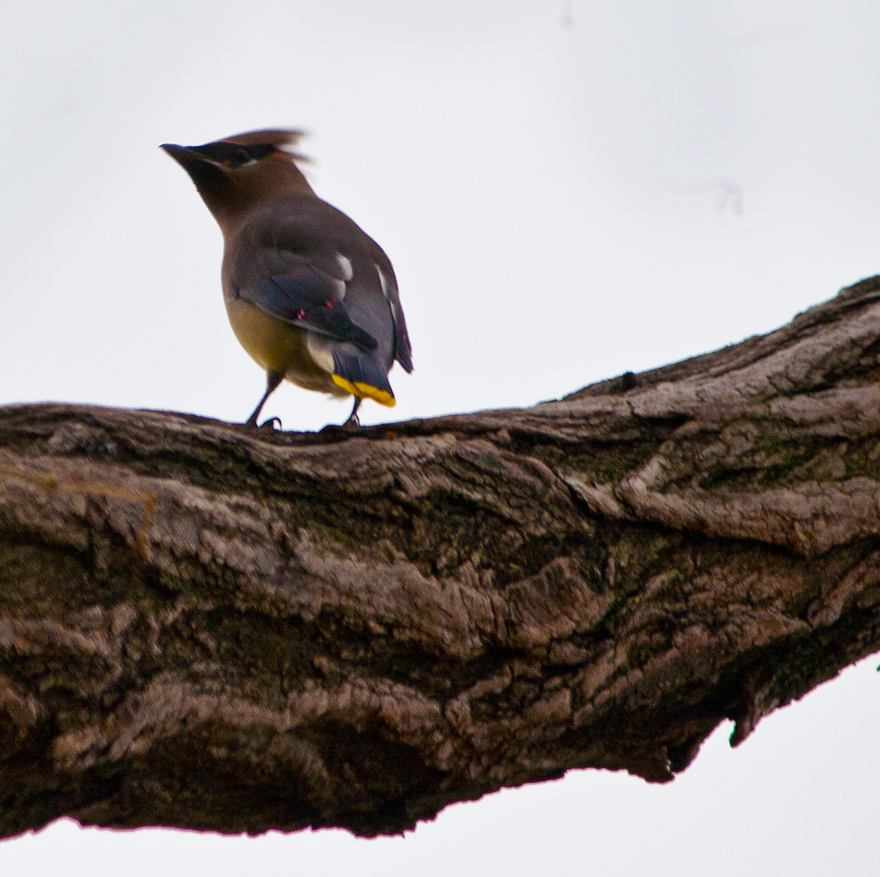
This afternoon I was walking on a path along a creek when small flock of birds flew into some nearby trees. They were pretty noisy and that attracted my attention. Looking though my telephoto zoom lens, I saw that they had an interesting silhouette, so I took some shots. They sky was already really light, but when I tweaked the exposure a little it went totally white and a really cool-looking bird emerged from the shadows. Usually I am pretty bad at identifying birds, but my initial Google search on the very distinctive yellow wing tips was successful in identifying this bird as a Cedar Waxwing (Bombycilla cedrorum).

Cedar Waxwing on a branch

According to the Cornell Lab of Ornithology, Cedar Waxwings feed on mostly fruit year-round, one of the few North American birds that specialize in eating fruit. One of the consequences of doing so, however, is that they sometimes get intoxicated from eating fermenting berries. The range map for this species suggests that they may be present year-round in this area (we are close to the northern boundary), but this is the first time that I have seen one.

This photo is more “artsy” than realistic, but I like its graphic character. It looks a bit to me like an illustration, in part, I guess, because of the white background.

© Michael Q. Powell. All rights reserved.

Read Full Post »

Reflections often look much better than the original objects that are being reflected. The water (and the objects in the water, like the rocks in this photo) can distort the “reality” and add a different tonality and texture to the reflection. As I was walking along the edge of the water, I was happy to finally find a patch of foliage with the fall colors of my childhood, but the beauty was marred by the utility poles and traffic signs of my suburban area. The reflection seems to have cleansed the image of those blemishes and shows a purer, more beautiful view, a view closer to what my heart was seeing.

Fall reflection

© Michael Q. Powell. All rights reserved.

Read Full Post »

I became engrossed watching some little shorebirds (or wading birds) this past weekend as I was attempting to photograph herons and egrets at Cameron Run, a stream tributary of the Potomac River. These small birds (there was a little group of them) would zigzag through the shallow water and periodically bob down to peck at some tasty morsel of food. They seemed to be aware of my presence and would move away whenever I tried to approach them, although they would not fly completely away.

I was unable to get any clear close-up photos of these unidentified birds, but I did manage to produce this image that I really like. There is a kind of graphic quality to the photo and the light and the reflections are nice, even though it is obviously no technical masterpiece.

Wading bird at Cameron Run

© Michael Q. Powell. All rights reserved.

Read Full Post »

« Newer Posts - Older Posts »