Feeds:
Posts
Comments

Posts Tagged ‘Alexandria VA’

I will sometimes see other birds open their wings and stretch them out for a moment, but the Double-crested Cormorant (Phalacrocorax auritus) is the only bird that I have observed that leaves its wings open for an extended period of time.

Initially I was confused when I heard the cormorant had to dry out its wings because they got waterlogged. How does a waterbird survive if its wings are not waterproof?

The Cornell Lab of Ornithology, my favorite website for information about birds, provides the following explanation of this phenomenon:

“They have less preen oil than other birds, so their feathers can get soaked rather than shedding water like a duck’s. Though this seems like a problem for a bird that spends its life in water, wet feathers probably make it easier for cormorants to hunt underwater with agility and speed.”

Double-crested Cormorant

© Michael Q. Powell. All rights reserved.

Read Full Post »

Oh say can you see by the dawn’s early light? Peering through a break in the bushes, I could just barely make out the unmistakeable shape of a male Hooded Merganser (Lophodytes cucullatus) as he slowly paddled away from the shore of a small pond at my local marshland park.

Hooded Merganser

© Michael Q. Powell. All rights reserved.

Read Full Post »

There is something really special about the moment when the darkness of the night finally gives way to the early light of the dawn and the sky is tinged with delicate shades of pink and orange. The silence is broken by the sounds of awakening birds as their day begins.

It’s not an optimal time for wildlife photography—there is simply not enough light to reveal all of the colors and the details of the subjects. Recently, though, I managed to capture a sense of the dawn in this image of a duck ascending into the air, heading for an unknown destination.

Early bird

© Michael Q. Powell. All rights reserved.

Read Full Post »

Last week, when the weather was a bit warmer and the ponds had not yet frozen over at my local marshland park, I managed to get some shots of a pair of Northern Shovelers (Anas clypeata) in action.

I quickly realized that trying to photograph two birds, rather than a single one as I usually do, significantly magnified the difficulty in getting a good shot. The two North Shovelers rarely would stay together and would wander in and out of the frame. Even worse, one of them would move closer or farther away, challenging my ability to keep them both in focus.

Northern Shovelers forage by swimming along with their bills in the water, straining out food, and never seem to completely submerge their heads. I was happy that I was able to capture some shots in which the eyes are visible, even though the bills are in the water.

I really like the first image, because the positions of the male and the female are synchronized, yet I also really like the second image, because the positions are completely out of synch. I may be confused, or perhaps a lot of different things appeal to me, depending on how I consider them.

Northern Shoveler

Northern Shoveler

© Michael Q. Powell. All rights reserved.

Read Full Post »

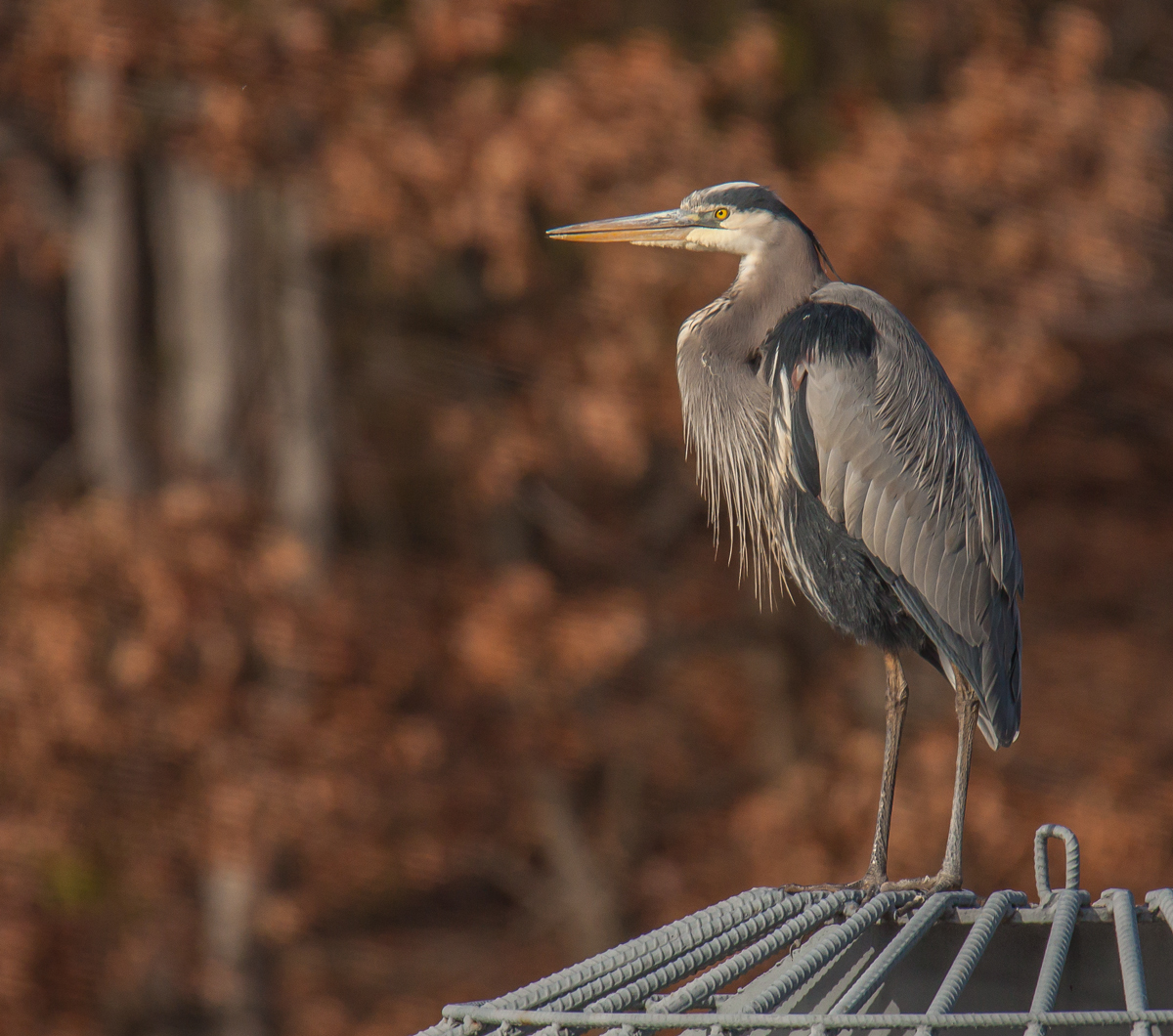
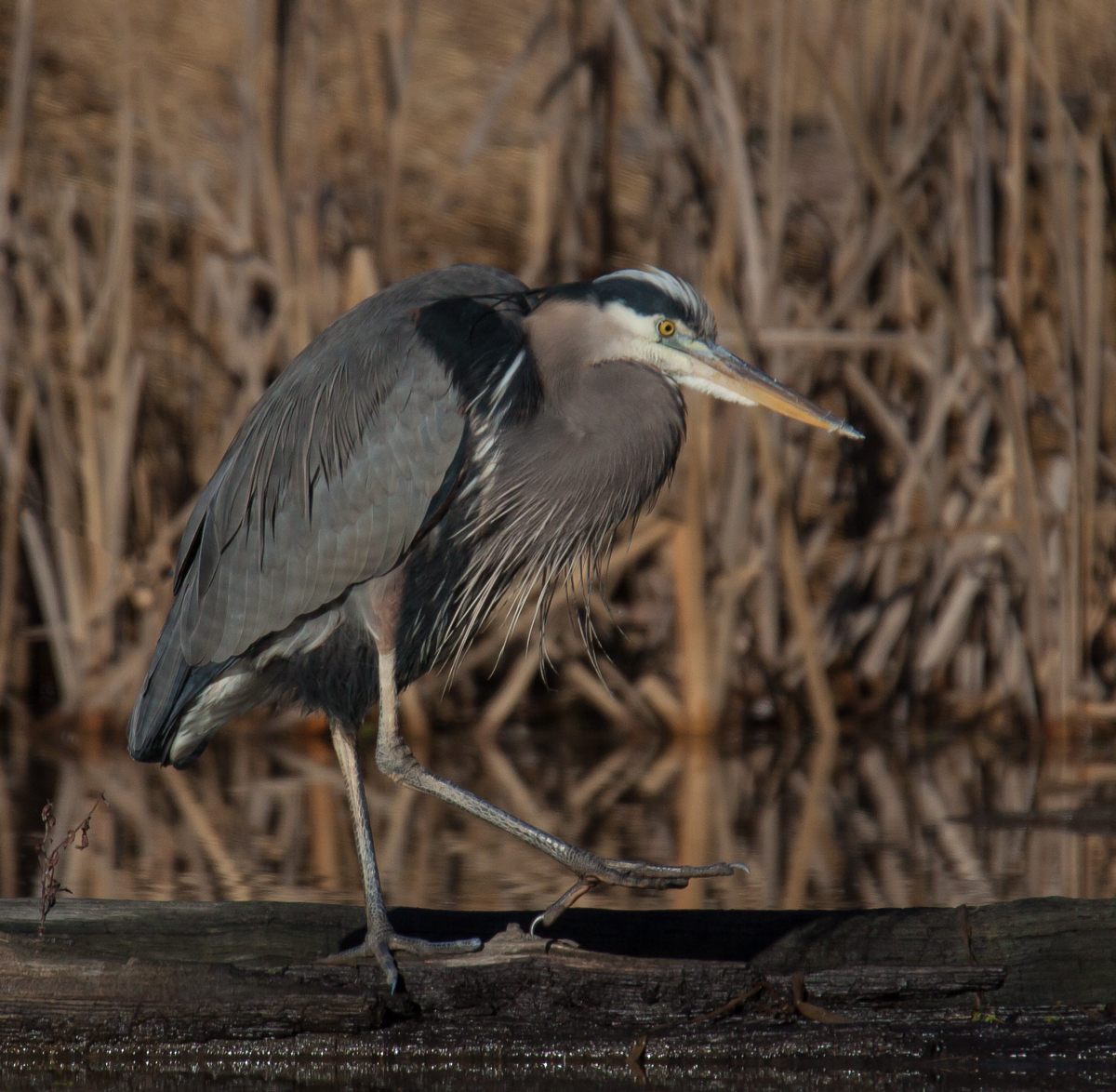
As you contemplate the promises and possibilities of the new year that has just begun, are you more like the pensive Great Blue Heron in the first image or the intensely focused heron in the second photo? (For the record, the Great Blue Heron (Ardea herodias) in both photos is actually the same one that I photographed last weekend at a local water retention pond.)

I’m more like the first heron—I am full of optimism and hope, but don’t have specific plans or resolutions.

Best wishes to all of you for a healthy, prosperous, and blessed new year.

Great Blue Heron

Great Blue Heron

© Michael Q. Powell. All rights reserved.
 

Read Full Post »

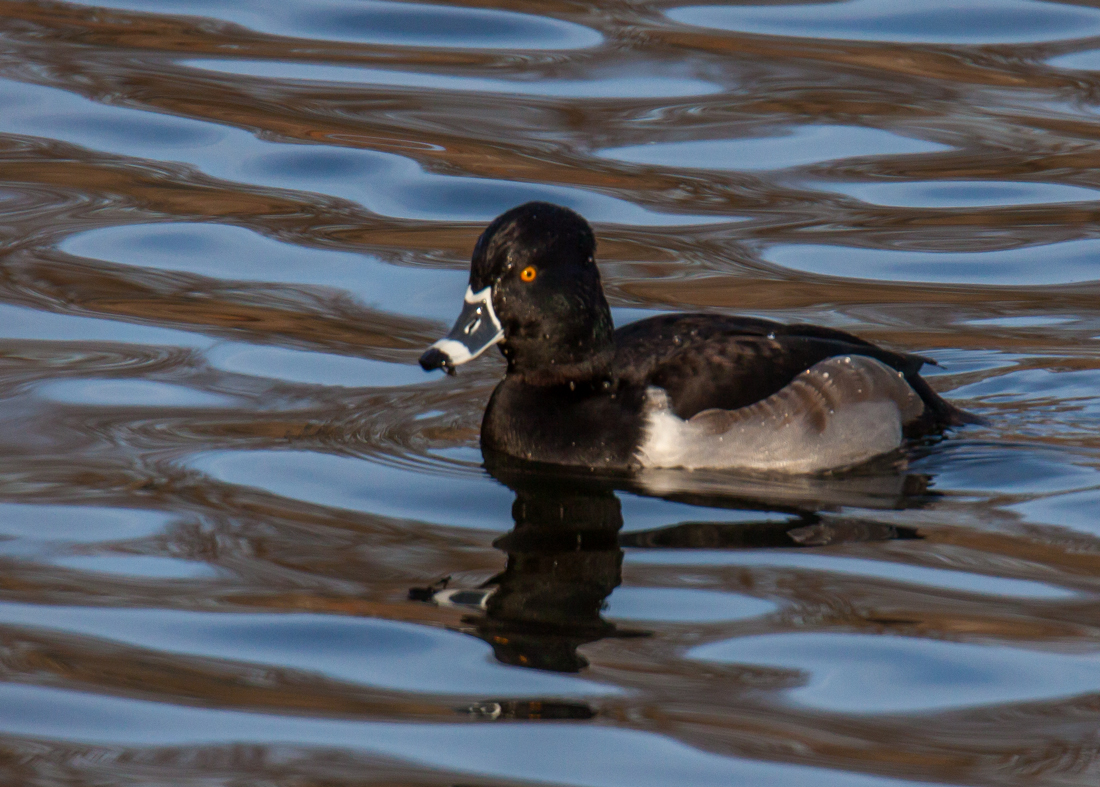
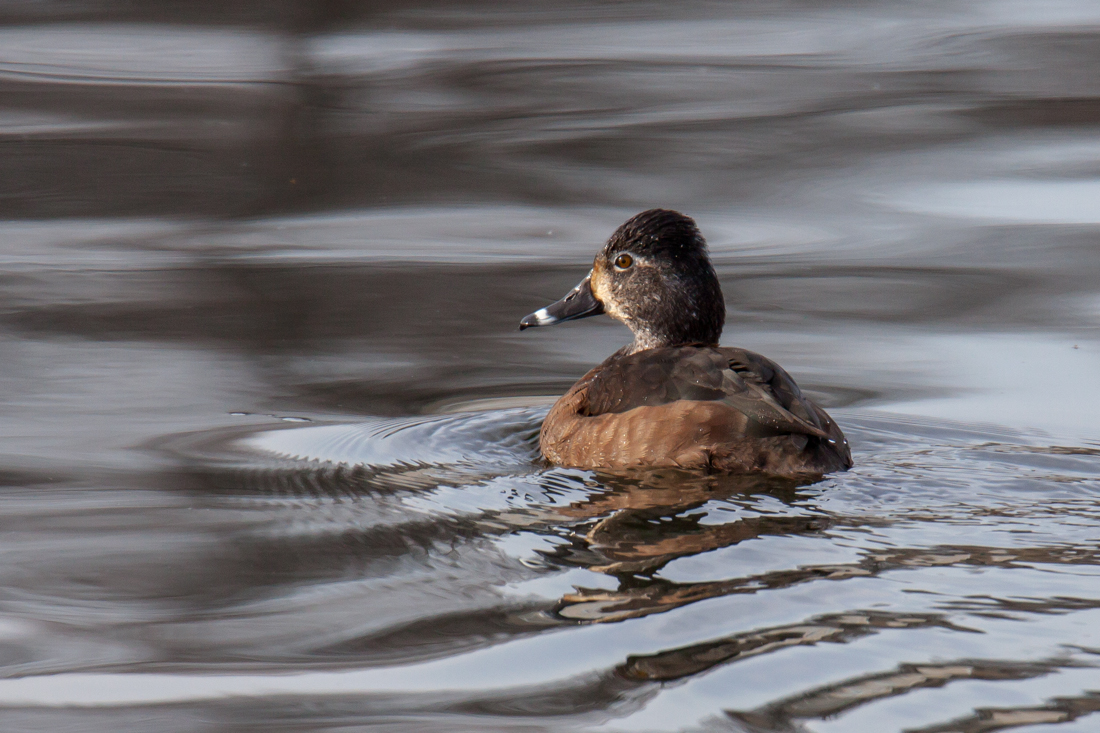
Although the rings on the bills of the Ring-necked Ducks (Aythya collaris) are very distinctive, it is their beautiful eyes that really draw me in, whether it be the startlingly yellow eyes of the male or the more subtle brown eyes of the female.

I never see these ducks in the ponds of my local marshland park, but each winter over the past few years, I have seen them in a small water retention pond in the middle of a suburban townhouse community near where I live.

Ring-necked DuckRing-necked DuckRing-necked Duck

© Michael Q. Powell. All rights reserved.


Read Full Post »

As I gazed out into the center of a small, man-made pond, I spotted gulls and geese and a few ducks. Suddenly a small bird swam into view that I couldn’t identify. It looked a bit like a duck, but the bill seemed to be very different.

I’m stepping out into the unknown by speculating that this might be a Pied-billed Grebe (Podilymbus podiceps), although it doesn’t quite match any photos that in my identification guide or that I could find on-line. I wonder if it is a juvenile bird. I would welcome a clarification, correction, or confirmation from more experienced birders. Thanks in advance for your assistance.

As you can tell, it was a bright, sunny day when I took this shot this past weekend, a welcome respite from the gray days of winter. Alas, it is cloudy again today, with rain forecast for much of the day.

Grebe

© Michael Q. Powell. All rights reserved.
Read Full Post »

Double-crested Cormorants (Phalacrocorax auritus) are strange-looking waterbirds that sit really low in the water. I’ve seen them from time to time, but until yesterday, when I saw this one at a small suburban retention pond, I never knew that they have striking blue eyes.

One of the other unusual things about this bird is that they spend a good amount of time outside of the water drying out their wings. Despite being a diving bird, the cormorant’s feathers do not shed water as well as a duck’s, for example, and they can get soaked pretty quickly.

I took some photos of the cormorant drying its wings that I will post later, but I wanted to post the image of the cormorant resting on one leg, because it shows off the blue eyes (and I like the reflection).

Double-crested Cormorant

Double-crested Cormorant

© Michael Q. Powell. All rights reserved.
Read Full Post »

Yesterday at my local marshland park, this Great Blue Heron (Ardea herodias) seemed to be dancing—I think he was rocking to the sounds of “Walk This Way” by Aerosmith.

Great Blue Heron

Great Blue Heron

© Michael Q. Powell. All rights reserved.

Read Full Post »

On Christmas Day I managed to fit in a short walk at Huntley Meadows Park, my local marshland park, and captured these images of a pair of Hooded Mergansers (Lophodytes cucullatus) as they took off from the water and started to gain altitude.

Hooded Merganser takeoff

Hooded Merganser takeoff

Hooded Merganser takeoff

Hooded Merganser takeoff

© Michael Q. Powell. All rights reserved.

Read Full Post »

I posted this image once already, but its bright Christmas colors cry out to be used again this morning.

Merry Christmas to friends and family and best wishes for a blessed New Year.

Thanks for all of your support and encouragement this past year as I have continued my journey through photography.

Northern Cardinal

© Michael Q. Powell. All rights reserved.

Read Full Post »

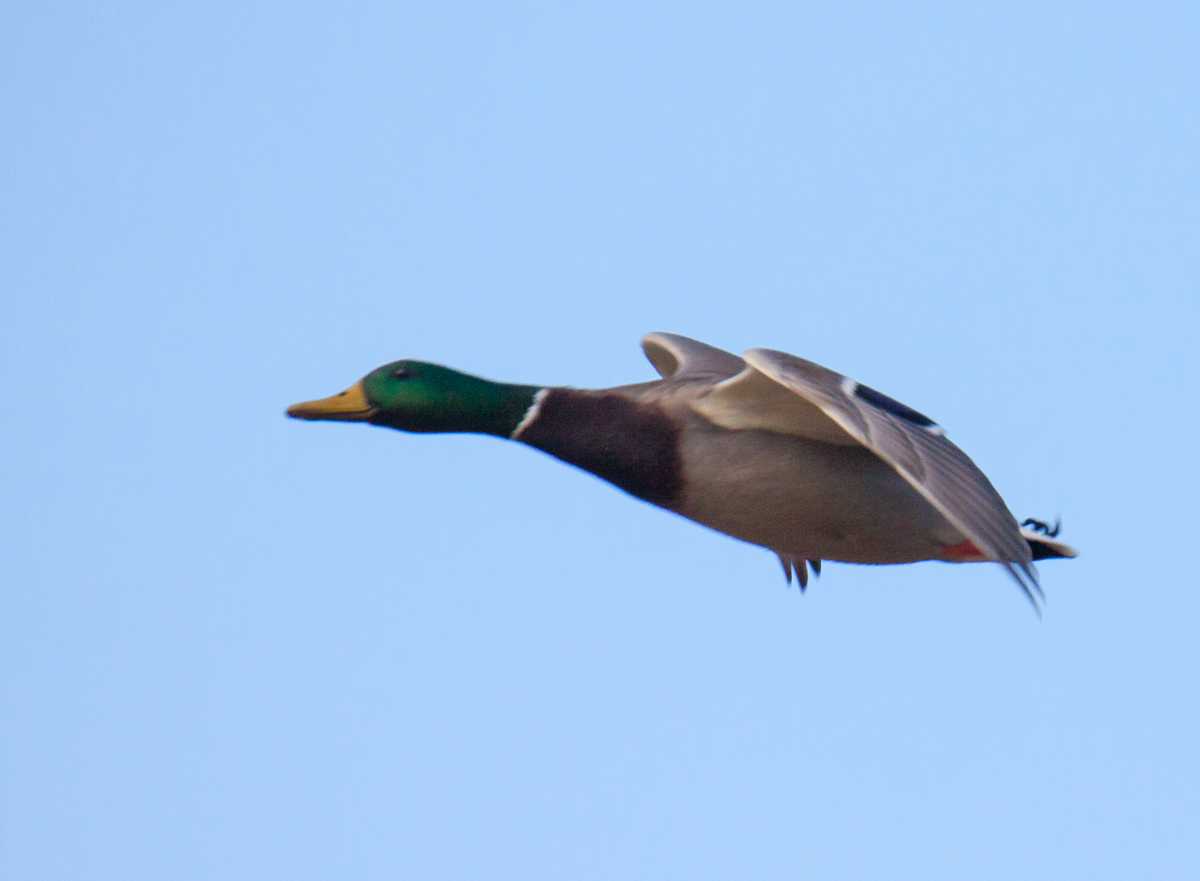
I’ve generally had a lot more difficulty capturing photos of ducks in flight than geese. Ducks are smaller, fly faster, and take off and land without the kind of advance warning that geese provide.

This past Monday, though, I managed to get some decent shots of a male Mallard (Anas platyrhynchos) as he flew past me. The background is uncluttered, a blue sky, which is ok, if not particularly interesting. As I reviewed my shots, I couldn’t help but notice how difficult it is to catch the wings in a good position, so I am happy that I took lots of shots in short bursts.

The last few days we’ve had almost constant rain, which is probably good for ducks like this one, though I would prefer to have some sunshine.

Mallard in flight Mallard in flight Mallard in flight

© Michael Q. Powell. All rights reserved.

Read Full Post »

What is the most beautiful bird that you can see in the wild in your area? We have lots of pretty birds here in Northern Virginia, but I could make a really strong case for the male Wood Duck (Aix sponsa) as the most stunning bird.

Alas, wood ducks are also amazingly elusive and it is rare that I get a glimpse of one of them. Toward the end of November, however, I was thrilled when I caught sight of one in Holmes Run, a tributary stream of the Potomac River. I was on a bridge pretty high above the stream and the duck did not seem to sense my presence, so I was able to get some decent shots as he swam in and out of the light.

The water in which the duck was swimming looks amazing, with swirls and colors that complement the Wood Duck’s bright colors and striking patterns.  I am not sure what caused the effect, but I really like it.

This was the only Wood Duck that I spotted all autumn, but it sure was worth waiting for. I’ll be keeping an eye out for these beauties as we move deeper into winter.

Merry Christmas and Happy Holidays to all of you.

Wood Duck

Wood Duck

© Michael Q. Powell. All rights reserved.

Read Full Post »

Fellow photographer and blogger Walter Sanford and I both photographed this female Blue-faced Meadowhawk dragonfly on 17 October and decided to do companion postings again, showing our different approaches to photographing the same subject.

waltersanford's avatarwalter sanford's photoblog

This is the second installment in a three-part series featuring some of my favorite photos of female dragonflies spotted while photowalkingHuntley Meadows Park during Fall 2014.

The following photos show a Blue-faced Meadowhawk dragonfly (Sympetrum ambiguum) spotted on 17 October 2014 near a vernal pool in a relatively remote location in the forest. This individual is a heteromorph female, as indicated by its coloration and terminal appendages.

Blue-faced Meadowhawk dragonfly (heteromorph female)

Female Blue-faced Meadowhawk dragonflies are polymorphic: heteromorphs are duller in color than males; andromorphs are male-like in color.

Blue-faced Meadowhawk dragonfly (heteromorph female)

Both female morphs feature the same distinctive blue eye coloration as males.

Blue-faced Meadowhawk dragonfly (heteromorph female)

Mike Powell, fellow wildlife photographer and blogger, spotted this dragonfly while I was shooting photos of a male Great Spreadwing damselfly (Archilestes grandis) perching on thigh-high grasses a few yards away. I joined Mike after my subject flew away.

I don’t recall seeing Mike’s photos of this dragonfly. Perhaps it’s…

View original post 28 more words

Read Full Post »

This past Saturday, I searched and searched for a straggler dragonfly which might have survived our recent cold spell, but I found none—dragonfly hunting season is officially over for me. That same day, however, fellow photographer and blogger (and local dragonfly expert) Walter Sanford did a blog posting with photos of a female Blue-faced Meadowhawk dragonfly (Sympetrum ambiguum) that both of us photographed on 17 October and suggested that I also post some shots.

Previously this year, Walter and I did companion postings, in which we each posted photos that showed our different photographic approaches to the same subject, which in that case was a pair of mating dragonflies. (If you are interested, check out Walter’s posting Two sides to every story and my posting My view of the mating dragonflies.)

I am fascinated by the way that two photographers shooting together consciously or unconsciously make a series of creative choices that can result in very different images. Some of the differences, of course, are attributable to the choice of photographic equipment, but many of the differences are caused by the “style” in which the photographer prefers to work.

I took these shots with a 180mm macro lens at fairly close range, which meant that I had to be thinking all of the time about depth of field. The three images I selected show how the amount of the dragonfly’s body in focus changed as I circled around the dragonfly and photographed it in various positions as it flew off and returned to the same general area.

I remember going once to an exhibition showing paintings side by side of a scene that had been rendered by two impressionist artists painting together—I think it was Monet and Renoir—and since that time I have periodically considered the question of whether or not there is an objective reality when it comes to taking (or painting) pictures. What is reality?

Be sure to visit Walter’s blog and his images of this dragonfly in his posting To All The Girls I’ve Loved Before (Part 2).

Blue-faced Meadowhawk

Blue-faced Meadowhawk

Blue-faced Meadowhawk

© Michael Q. Powell. All rights reserved.
Read Full Post »

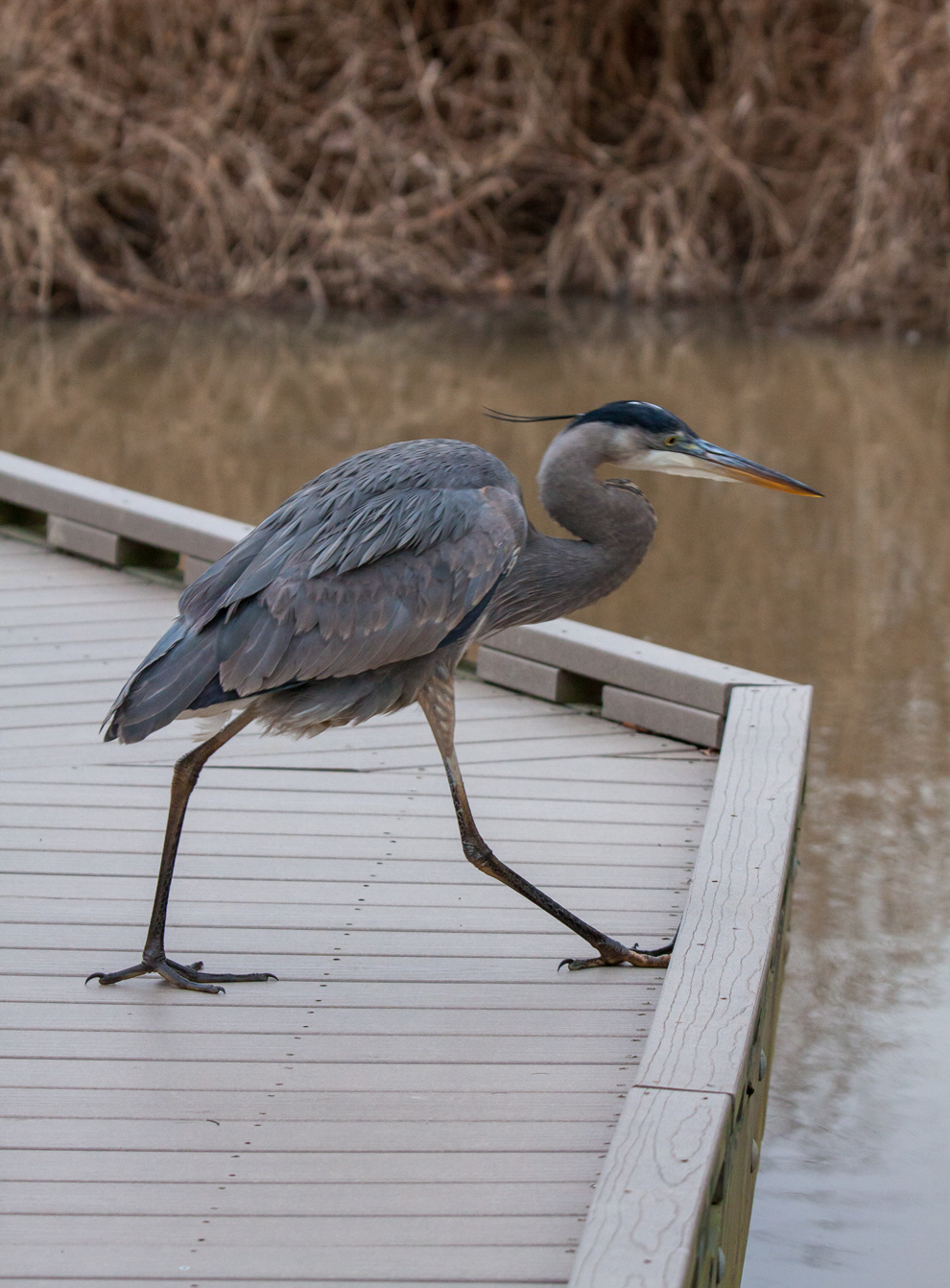
The mind can sometimes make strange associations. From the moment that I saw the pose of the Great Blue Heron (Ardea herodias) in this image, I couldn’t help but think that it looked like the kind of dragon that you see in movies and in children’s cartoons.

I took this shot in mid-December, while I was walking along the boardwalk in the familiar confines of my local marshland park. The heron had been fishing in the shallow waters of a former beaver pond to the left and decided to move to the water on the other side of the boardwalk. Rather than fly directly to the new location, the heron decided to hop up onto the surface of the boardwalk.

I posted a somewhat similar photo on 9 December, but I like this one better—the pose is more interesting, the focus is a little sharper, and the colors of the heron are more vibrant. Herons are a relatively commonplace bird in the locations I visit, but I never tire of trying to capture images of these fascinating creatures.

Does the heron remind you of a dragon? As children, we had no trouble believing in magical creatures, but, alas, most of us lost that capacity as we grew into adults.

It brings to mind a quote from one of my favorite books, Le Petit Prince by Antoine de Saint Exupéry, “Les grandes personnes ne comprennent jamais rien toutes seules, et c’est fatigant, pour les enfants, de toujours et toujours leur donner des explications.” (Grown-ups never understand anything by themselves, and it is tiring for children to be always having to explain things to them).

A dragon? Why not?

Great Blue Heron

© Michael Q. Powell. All rights reserved.

Read Full Post »

It certainly pays to look closely at a group of birds, because they may not all be from the same species. Last week I spotted this cool-looking duck in the midst of a group of mallards at my local marshland park.

I couldn’t identify the duck when I took the photos, but it was clearly not a mallard. After a bit of research on the internet, I have concluded that it is probably a Gadwall (Anas strepera), a species of ducks that I had never seen before.

Gadwall
Gadwall

© Michael Q. Powell. All rights reserved.


Read Full Post »

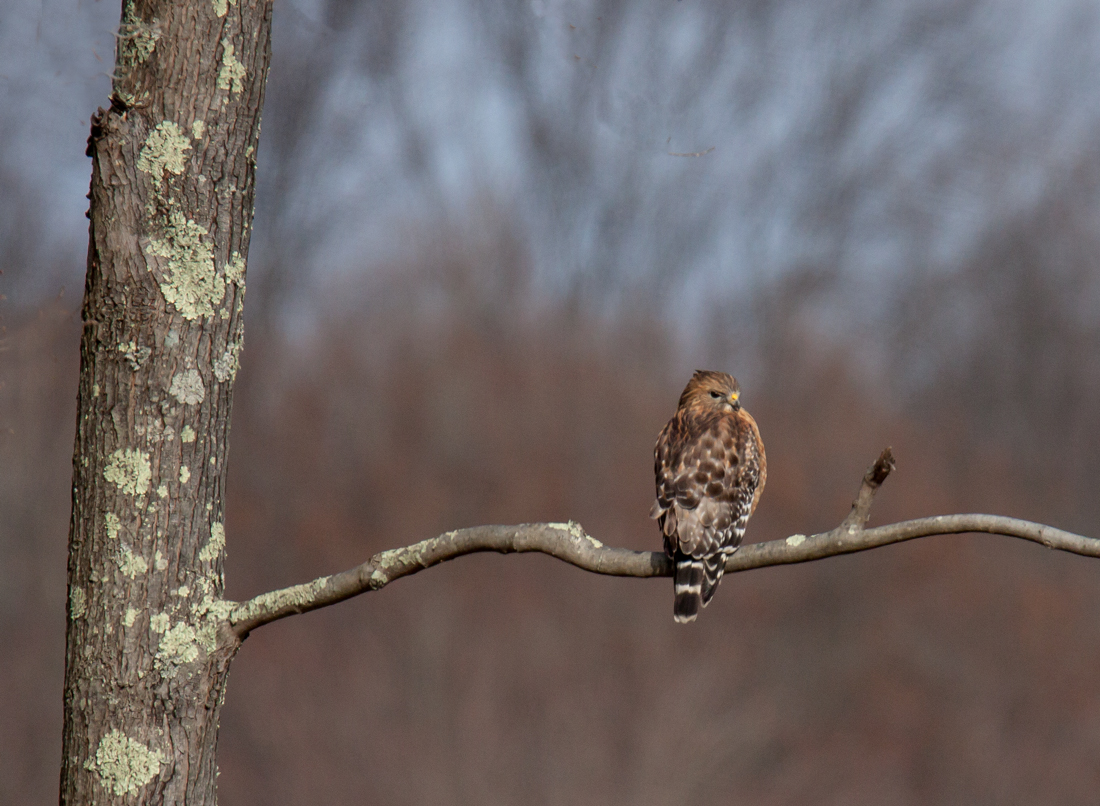
Now that the leaves have fallen from the trees, I have a much greater chance of reaching one of my goals for this winter of capturing some better shots of hawks.

One of the biggest challenges at my local marshland park is that most of the trees on which hawks seem to like to perch are inaccessible—the trees are surrounded by flooded swamps on one side and dense vegetation on the other.

This past week I took my best hawk shots in quite some time when a fellow photographer pointed out this Red-shouldered Hawk (Buteo lineatus) on the limb of a distant tree. We were able to move a little closer to the hawk, because it was facing away from us, but when the water started to get ankle-deep, I had to make do with the conditions I had.

I’ll be keeping my eyes and ears open for the sights and sounds of these magnificent birds and hope to get a bit closer to one in the coming months.

Red-shouldered HawkRed-shouldered Hawk

© Michael Q. Powell. All rights reserved.

Read Full Post »

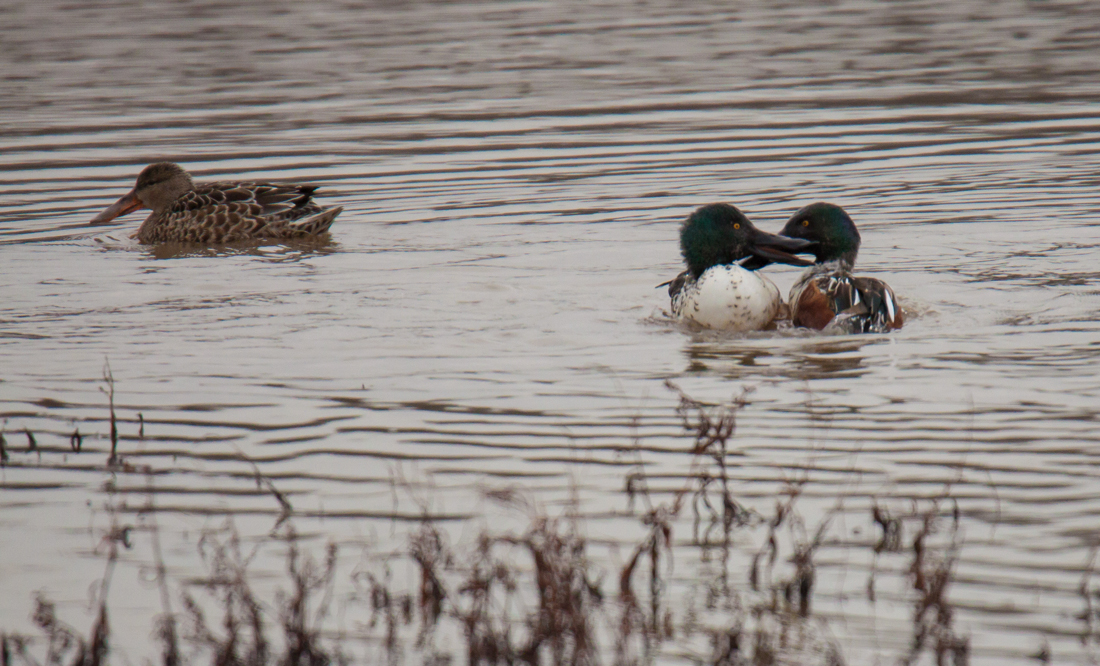
Canada Geese are often loud and aggressive in their interactions with each other, but ducks seem much calm and restrained. I was therefore quite surprised when I saw these two male Northern Shovelers (Anas clypeata) get into a minor dispute.

Northern Shovelers

I am not sure why these two ducks were squabbling, but I got one possible indication when I looked at the edge of the frame. A female Northern Shoveler was nearby and appeared to be watching the action out of the corner of her eye. Were the two males vying for her affection and attention?

Northern Shoveler


After a short period of wrestling, the two males separated and swam off in opposite directions, having settled, at least for a short time, whatever issue prompted the initial dispute.

Northern Shovelers

© Michael Q. Powell. All rights reserved.


Read Full Post »

One of the Great Blue Herons (Ardea herodias) that has been hanging around the boardwalk at my local marshland park was amazingly cooperative yesterday morning and posed for this portrait. I think the white background was caused by the very cloudy sky—it makes the shot look almost like it was taken in a studio setting.

I really like the way that you can see the wispy feathers on the top of the heron’s head. I can’t help but notice, though, that this heron has the same kind of growth pattern on the top of his head as I do.

I wonder if he would consider shaving his head (and I really hope that he does not opt for a comb-over hairstyle a bit later in life).

Is there a Hair Club for herons?

Great Blue Heron

© Michael Q. Powell. All rights reserved.

Read Full Post »

Do you prefer the bold color of the iconic male Northern Cardinal (Cardinalis cardinalis) to the more subtle coloration of the female cardinal or are you on the fence?

Yes, I am beginning today’s posting with the same question that I used in yesterday’s posting that featured a fierce-looking female cardinal, but today am featuring a male cardinal. Not far from where yesterday’s female was perched on the fence wire, her male partner was calmly sitting on a green fencepost, seemingly surveying his surroundings.

Some of yesterday’s responses suggested that many viewers prefer the bright red color of the male cardinal, a visible and welcome sight at this time of the year, when the landscape seems to be dominated by shades of gray.

The combination of the red cardinal and the green fencepost give this image a definite feeling of Christmas. Somehow I feel like it would be good to emulate this cardinal during this pre-holiday season and stop all our frantic activity for a moment, take a deep breath, and look and listen, remembering the true meaning of Christmas.

Northern Cardinal

© Michael Q. Powell. All rights reserved.

Read Full Post »

Do you prefer the bold color of the iconic male Northern Cardinal (Cardinalis cardinalis) to the more subtle coloration of the female cardinal or are you on the fence?

“Fierce” is the word that came to mind when I first saw the image I had shot of this female cardinal with the spiky red Mohawk hairstyle and don’t-mess-with-me glare. Although I took this photo at my local marshland park, the simple wire fence gives it a kind of urban feel that seems appropriate for this subject.

I wonder if she has body piercings or a tattoo—it wouldn’t surprise me if she does.

female Northern Cardinal

© Michael Q. Powell. All rights reserved.
Read Full Post »

Normally I see woodpeckers high in the trees, but some of my fellow photographers spotted this Red-bellied Woodpecker (Melanerpes carolinus) pecking about on the ground below a tree and pointed it out to me. The woodpecker appeared to be collecting acorns and then hopped upward onto the tree carrying an acorn in its bill.

Red-bellied WoodpeckerRed-bellied Woodpecker

Initially I was perplexed, because I tend to think of woodpeckers driving their bills into trees in search of insects, not transporting acorns. Then I remembered back to last winter, when I observed some Red-headed Woodpeckers (Melanerpes erythrocephalus) at my local marshland park stockpiling acorns in the hollow of a tree. Is it possible that Red-bellied Woodpeckers do the same thing?

Red-bellied Woodpecker

I checked out the Cornell Lab of Ornithology, my favorite website for information about birds, and it confirmed that Red-bellied Woodpeckers “also use cracks in trees and fence posts to store food for later in the year, a habit it shares with other woodpeckers in its genus.”

Red-bellied Woodpecker

It might be my imagination, but if you look closely at the final shot below, you can see what the outlines of what appear to be several acorns just a bit below the woodpecker’s bill. It’s a mystery to me how the woodpecker remembers where it has stockpiled food and how it keeps other birds from stealing it, but I have to assume that the woodpecker knows what it is doing.

The recent cold weather reminds me that winter is almost here and this bird seems to be preparing for those tougher times to come.

Red-bellied5_blog

© Michael Q. Powell. All rights reserved.

Read Full Post »

It was cold and gray yesterday afternoon at Huntley Meadows Park and there weren’t a lot of people around. The Chairman of the Board(walk) decided that it was a good time to survey his marsh from a different vantage point.

I just love watching Great Blue Herons (Ardea herodias) and you never know what they will choose to do next. It was unusual, however, taking photos of one using the 150mm end of my 150-600mm Tamron lens and I actually had to back up in order to fit the heron’s entire body in the frame. Shortly after I took these shots, the heron flew off a short distance, back into the water.

Chairman of the Board(walk)Chairman of the Board(walk)

© Michael Q. Powell. All rights reserved.

Read Full Post »

Some of the Eastern Gray Squirrels (Sciurus carolinensis) at my local marshland park are not gray—they are black. Some of them are pure black, while others, like this one that I photographed yesterday, seem to be a mixture of gray and black. What’s going on here?

According to Wikipedia, black squirrels are a “melanistic subgroup” of the Eastern Gray Squirrel caused by the presence of mutant pigment genes. If there are two mutant genes present, the squirrels will be jet black, but they will be brownish-black if only one such gene is present.

In a fascinating bit of historical trivia, the black subgroup seems to have been predominant throughout North America prior to the arrival of Europeans in the 16th century, as its dark color helped them hide in old growth forests which tended to be very dense and shaded. As time passed, hunting and deforestation led to biological advantages for gray-colored individuals.

Squirrels seems to be very active right recently, preparing for the colder days to come. They always seem to be in a big hurry and I was happy to be able to photograph this one as it took a short break from its frenetic activity.


Black Squirrel web

© Michael Q. Powell. All rights reserved.

Read Full Post »

As we have moved deeper and deeper into autumn, the number of dragonflies at Huntley Meadows Park has continued to drop and the sole survivor now  appears to be the Autumn Meadowhawk (Sympetrum vicinum).

During my most recent visit to the park on the 1st of December, I observed quite a few Autumn Meadowhawks, primarily perched on the synthetic boards of the boardwalk that runs through several portions of the marshland.

Some of them, however, seemed to really like one of the signs adjacent to the boardwalk that provides tips on wildlife watching at the park. The Autumn Meadowhawk in the first image seems to be fascinated by the photo of the crayfish at which it is intently staring. (This photo is an homage to fellow photographer Walter Sanford, who did a similar posting recently with the same sign and the same species of dragonflies.)

Autumn Meadowhawk

A month ago, I probably would have photographed the dragonfly with my macro lens, but now I have a telephoto zoom lens on my camera most of the time. I decided to use the dragonfly as a test for my new Tamron 150-600mm lens and took some shots at 600mm to see if I could capture any of the details of this small dragonfly, which is at most about 1.4 inches (35mm) long. If you click on the image below, which is a slightly cropped and lightly edited version of the original, you can see that the lens did a pretty good job with the details and you can even see the dragonfly’s tiny feet.

Autumn Meadowhawk

Autumn Meadowhawks frequently seem to be quite tolerant of the presence of people and sometimes will even seek it out and land on you. I will often try to coax one to perch on my finger and one of my fellow photographers, Lova Brown Freeman, took these wonderful shots of a successful attempt. Thanks, Lova. I like the fact that her final shot gives you an idea of  context in which you this activity took place. I am usually so anxious to zoom in close on the action, with macro or with telephoto, that I frequently forget to provide viewers with a view of the overall setting.

Autumn MeadowhawkAutumn Meadowhawk

© Michael Q. Powell. All rights reserved.

Read Full Post »

American Coots (Fulica americana) have strange-looking feet. I mistakenly assumed that coots had webbed feet, like ducks, and was shocked recently when I saw one out of the water to see that is definitely not the case.

The Cornell Lab of Ornithology website had this description of their feet ”

“Although it swims like a duck, the American Coot does not have webbed feet like a duck. Instead, each one of the coot’s long toes has broad lobes of skin that help it kick through the water. The broad lobes fold back each time the bird lifts its foot, so it doesn’t impede walking on dry land, though it supports the bird’s weight on mucky ground.”

Recently at the edge of the Potomac River in Alexandria, Virginia, I came upon this coot that seemed to be grooming itself. After a short time, it assumed a pose that reminded me of the crane kick position that featured so prominently in the movie The Karate Kid. Perhaps the coots have their own martial art.

Eventually the coot became aware of my presence and stopped what it was doing and looked in my direction. There was a disapproving look in its intense stare and it almost looked like it was giving me the evil eye.

American Coot

Practicing martial arts

American Coot

Giving me the evil eye

© Michael Q. Powell. All rights reserved.


Read Full Post »

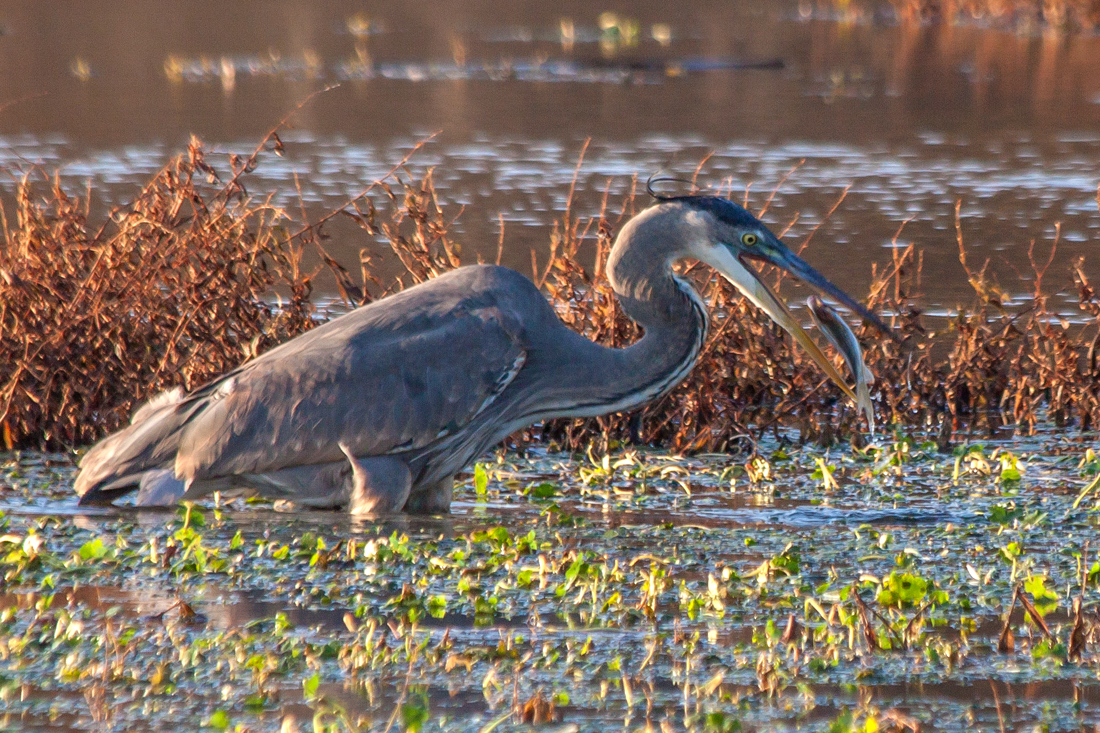
On an unusually warm date late in November I came upon a Great Blue Heron (Ardea herodias) fishing at my local marshland park. In similar situations I will often stop and wait for a little while to see if I can capture a shot of the heron catching a fish, but generally the heron is more patient that I am and I leave empty-handed.

This time, however, I felt unusually patient and I set up my tripod and waited. The sun was bright and was coming from the left, the direction in which the heron was initially facing. It is tough for me to remain continuously alert when waiting for an extended period of time and I did not react quickly enough to get a shot of the heron pulling the fish out of the water. I recovered rapidly and got some interesting shots of the heron with the fish that it had just caught.

Great Blue Heron

Not seeing eye-to-eye


Great Blue Heron

Expelling a drop of water

One of the biggest challenges for the heron is manipulating the fish so that it can be swallowed in a single gulp. Each time that the heron shakes and jiggles the fish, it runs the risk of dropping it. In this case, the heron turned away from the sun and began its maneuvers. It took some time to get the fish into position. In the last two shots, you can see the final steps of the process as the heron dips the fish in the water, presumably to make it slide down the throat more easily, and them flips the fish into the air a final time.

Great Blue Heron

Initial adjustments

Great Blue Heron

Moving into position

Great Blue Heron

Dipping the fish

Great Blue Heron

Final flip

© Michael Q. Powell. All rights reserved.

Read Full Post »

I don’t know if they are going to stay for the winter or are just passing through, but yesterday, the first day of December, there were a dozen or so Hooded Merganser ducks (Lophodytes cucullatus) cavorting in the water at Huntley Meadows Park, my local marshland park.

I was first alerted to their presence when I heard the unmistakable frog-like croak of one of the males. The Cornell Lab of Ornithology states that these ducks are usually silent except during courtship, when the courting male “makes a deep, rolling sound like the call of a pickerel frog, earning it the nickname of “frog-duck” in Georgia.” Check out this link to hear the call of the courting male Hooded Merganser. It seems a bit early for courting to be taking place, but the males were bouncing around as I have seen them do in the spring.

The Hooded Mergansers stayed pretty far out in the water and this is the best shot I could get of one of the males paddling by. The comic-like appearance of these ducks always makes me smile and I love their shiny golden eyes.

Hooded Merganser

© Michael Q. Powell. All rights reserved.


Read Full Post »

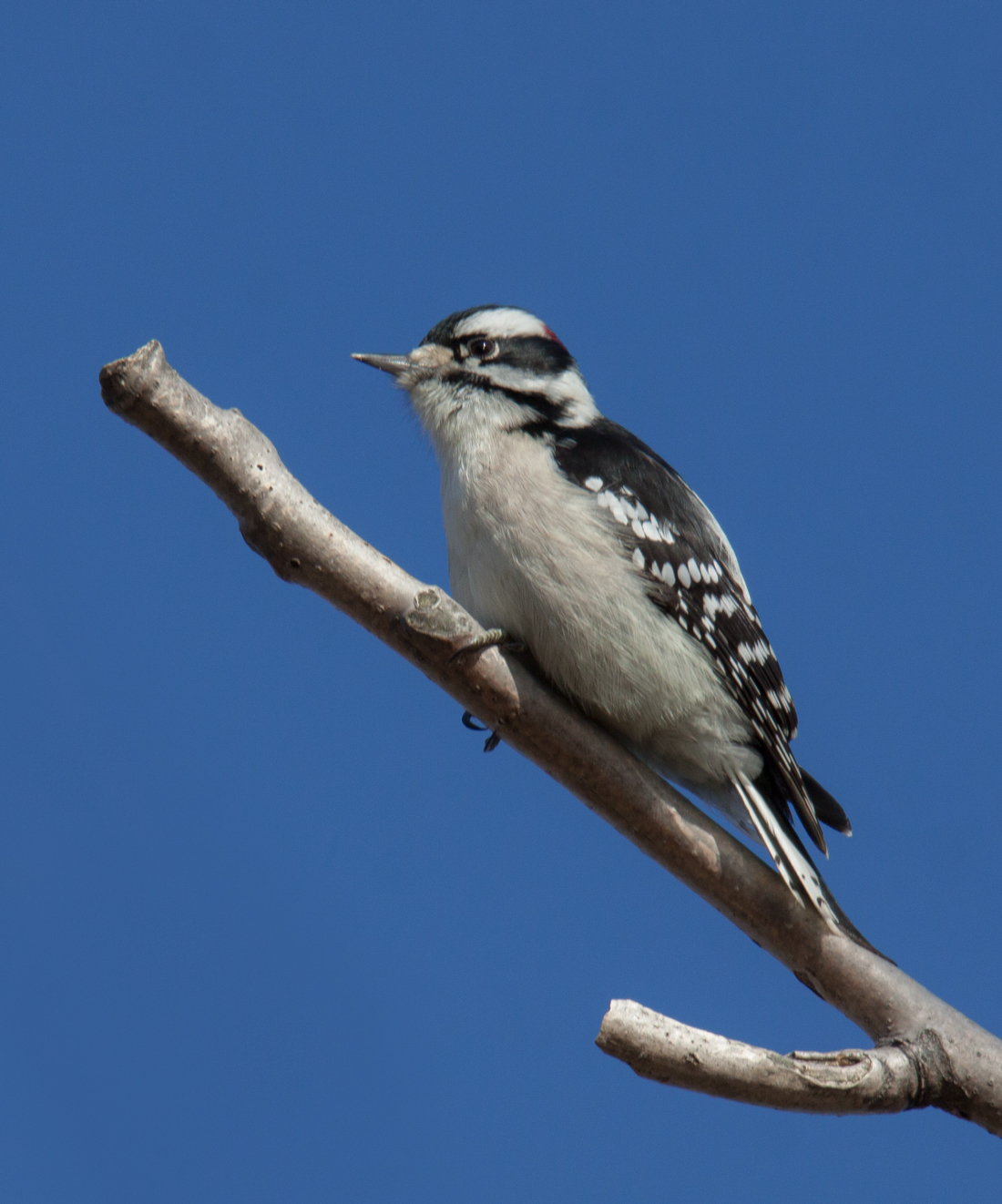
I admire the boundless energy of Downy Woodpeckers (Picoides pubescens). This weekend I watched as this male Downy Woodpecker climbed higher and higher in a tree, pecking along the way, until he ran out of branches.

He turned his body and looked up at a nearby tree and paused, which gave me a chance to get this shot of his downy white abdomen. There is a kind of tension in his position that I really like, as he clutches the branch and focuses intently on his next destination.

Downy Woodpecker

This second shot, which was taken before the first one, shows the Downy Woodpecker in a more conventional pose. He was inching his way up to the end of the branch and I was wondering what he would do next.

One thing that learned from this mini-shoot is that it is tough to hold a lens this heavy overhead for an extended period of time. I haven’t weighed the camera/lens combination, but the lens alone weights 4.3 pounds (1.95 kg).

I may have to start lifting weights to build up my arm and shoulder muscles

Downy Woodpecker

© Michael Q. Powell. All rights reserved.

Read Full Post »

Zooming a long telephoto lens while tracking a flying bird is like simultaneously patting your head and rubbing your tummy—it can be done but requires a lot of practice.

Yesterday as I was observing a Great Blue Heron (Ardea herodias) on the far side of a small pond, he unexpectedly took off. The heron flew towards me initially and then veered off to the side. My 150-600mm lens was fully extended at the start and as the bird approached, I frantically tried to zoom out a little. The EXIF data indicate that I was at 552mm when I took this shot and I just barely managed to keep the heron in the frame—I didn’t crop this image at all.

I’ve often been told to fill the frame with the main subject and this is one of the few times when I have been able to do so with a bird.

Great Blue Heron in flight

© Michael Q. Powell. All rights reserved.

Read Full Post »

« Newer Posts - Older Posts »