Feeds:
Posts
Comments

Posts Tagged ‘Alexandria VA’

As we approach the end of August, some of the more common dragonfly species are becoming much less common. Some autumn species will soon take their places. At the moment the Common Whitetail dragonfly (Plathemis lydia) is the species that I see most often. During a recent visit to Huntley Meadows Park, I spotted this young male Common Whitetail perched vertically on some vegetation.

How do I know that it is a young male? Females of this species have a different pattern of dark patches on their wings, as you can see in the second image below from earlier in the season, and different terminal appendages. Males start out with a darker coloration like that of their female counterparts and as they age they develop a white powdery substance on their abdomens called pruinosity. The dragonfly in the first photo is currently a bluish white and some of the markings are still showing through—eventually he will turn a bright white in color.

Common Whitetail

Female Common Whitetail

© Michael Q. Powell. All rights reserved.

Read Full Post »

It is a bit early to be thinking of autumn, but early signs are beginning to appear. On Monday, classes begin for public school students in our county and traffic will be crazier than ever as commuters and school buses adjust to a changed dynamic.

Some species of summer dragonflies are beginning to disappear and I have begun to search for their autumn replacements. The trails at the wildlife refuges that I haunt are now littered with fallen leaves, making it hard to spot those species that perch on the ground.

This past Monday I captured this shot of a female Common Whitetail dragonfly (Plathemis lydia) at Huntley Meadows Park. This species is one of the most common in my area at this time of the year and I spotted a lot of them during my visit to the park. I particularly like the way that I was able to capture the texture and detail of the dried leaves on which the dragonfly was perched—I can almost hear the crunch of those leaves as I walked through them that day.

Truth be told, autumn is my favorite time of the year and I am patiently waiting for it to arrive. In the meantime, I am still enjoying the summer. “To everything there is a season, and a time to every purpose under heaven.”

Common Whitetail dragonfly

© Michael Q. Powell. All rights reserved.

Read Full Post »

On Monday I spotted this Great Blue Heron (Ardea herodias) on a stump in the middle of a pond at Huntley Meadows Park. The heron seemed to be fully attentive and somehow his pose struck me as regal, like that of a monarch surveying his kingdom. The wonderful reflections in the pond added additional visual interest to the image that I was able to capture.

Great Blue Heron

© Michael Q. Powell. All rights reserved.

Read Full Post »

It is tough to get a proper exposure during the harsh midday sunlight—all too often the image will be overexposed. I sometimes will deliberately compensate by underexposing the subject, which has the effect of significantly darkening the background of the image. This doesn’t always work, but I like the dramatic result that I got when I photographed this little skipper butterfly during a visit earlier this week to Huntley Meadows Park.

As I have noted in multiple post over the years, skipper butterflies are really tough to identify. I looked over lots of images on-line and have concluded that this might be a Zabulon Skipper butterfly (Poanes zabulon) or possibly a Peck’s Skipper butterfly (Polites peckius).

Why did I go with “Zabulon” in the title of this post rather than “Peck’s?” The answer is quite simple is not a scientific determination—I think the name “Zabulon” is a lot cooler than “Peck’s.”

Zabulon Skipper

© Michael Q. Powell. All rights reserved.

Read Full Post »

How do you handle the heat? For those of us who live in the Northern Hemisphere, the last few months have seen a series of unrelenting hot days. High temperatures have frequently been in the 90’s (33 degrees C) and have occasionally pushed past 100 degrees (38 degrees C).

Despite the heat, I ventured out yesterday with my camera during the middle of the day and visited Huntley Meadows Park, a local wetlands area. Wildlife activity seemed quite low—many of the creatures seemed to be sheltering out of sight in the shade. I did manage to spot this female Eastern Pondhawk dragonfly (Erythemis simplicicollis) that was perilously perched on a flimsy bit of vegetation. I don’t know for sure if she was taking a siesta or was simply chilling, but somehow her actions seemed make a bit more sense for dealing with the heat than those of this intrepid photographer.

Perhaps the old saying is true—”Mad dogs and Englishmen go out in the midday sun.” Technically I am not English, so what does that make me?

Eastern Pondhawk

© Michael Q. Powell. All rights reserved.

Read Full Post »

On Saturday I attended a wonderful Pride Fair celebration in the City of Alexandria, Virginia on the plaza right outside of City Hall. Various civic, business, religious, and governmental groups and organizations were represented in the booths and there was a friendly, chill vibe, with lots of families attending.

Unlike the Washington D.C. Pride celebration earlier this month that I also attended that was a bit more militant, political and commercialized, this felt really supportive and comfortable. It was cool to see the face painting and balloon animals for children and I personally participated in filling in a community coloring page, using crayons for the first time in a lot of years. People were invariably friendly and reflected the widely shared sentiment that “all are welcome.”

The official Pride Month (June) is coming to an end, but I am hoping that we can continue to support and respect each other in our words and in our actions. We do not have to agree on all points, but I am hoping that we can turn aside the wings of hate and negativity that threaten to engulf us all. I am reminded of the quotation attributed to Saint Francis of Assisi that was on the inside door of a church that I used to attend, “Preach the Gospel at all times. Use words if necessary.”

Alexandria Pride

Alexandria Pride

Alexandria Pride

Alexandria Pride

© Michael Q. Powell. All rights reserved.


Read Full Post »

Shortly after waking up this morning, I walked over to my neighbor Cindy’s garden to see what was in bloom. The last time I checked, about a week ago,  there were lots of flowering day lilies, but I suspected that the recent heat had caused many of them to wilt and die. I am not sure if lilies close up at night, but I did not see any lilies in bloom in the early morning light—I was there about 6:15 today.

However, there were plenty of purple coneflowers and Shasta daisies open and I did my best to capture some their beauty with the short macro lens that I was using. I was delighted to spot a tiny insect creature crawling around on one of the daisies, as you can sort of see in the second photo. The limited light available forced me to open the aperture of the lens and created such a narrow depth of field that I could not get both the insect and the flower in focus.

Most of you know that I enjoy photographing wildlife and nature in more remote locations, but it is reassuring to know that I do not always have to travel far to find subjects—beauty is everywhere.

shasta daisy

Shasta daisy

coneflower

© Michael Q. Powell. All rights reserved.

Read Full Post »

I’m reluctant to go out in our current extreme heat here in Northern Virginia, so here’s a shot from earlier this month (11 June) of a Blue-tipped Dancer damselfly (Argia tibialis) at Wickford Park in Alexandria. This damselfly looks a bit like several other species, but the angle of this photo shows the distinguishing features of a Blue-tipped Dancer including its mostly black abdomen, the wide deep purple stripes on its thorax, and, of course, the blue color of the final two segments of its abdomen.

Some of you may recall a recent posting that featured a Common Sanddragon dragonfly perched on a leaf at this same location. Believe it or not, this is the exact same leaf. I am not sure that there is anything special about the leaf, other than the fact that it was the only on the sandy/rocky bank of the creek, but I was more than happy to capture images of both a dragonfly and damselfly separately perched on it.

Blue-tipped Dancer

© Michael Q. Powell. All rights reserved.

Read Full Post »

It is hot! It seems that much of Europe and the United States is currently experiencing sweltering heat. Here in Northern Virginia where I live, high temperatures are going to hover around 100 degrees (38 degrees C) each day this week. I might consider going out with my camera when there are heat advisories, but today there are extreme heat advisories and people are advised not to go out in the heat unless absolutely necessary.

This morning I went over my photos from an outing earlier this month and recalled my thought process when I was taking photos of Common Sanddragon dragonflies (Progomphus obscurus). I was trying to frame the shot in a way that showed the dragonfly’s face and body with an interesting background, which was a bit frustrating, because the Sanddragons tended to perch at the edge of the water facing the water.

I changed positions repeatedly and eventually I got the shot that I was imagining in my head. I love how the green of the dragonfly’s eyes matches some of the mossy vegetation and how the yellow and brown body matches the stones. The dragonfly also seems to be looking up at me and smiling, though I suspect that may be my imagination.

Stay cool and hydrated this week if you have to go outside this week!

Common Sanddragon

© Michael Q. Powell. All rights reserved.

Read Full Post »

I spotted these male Common Sanddragon dragonflies(Progomphus obscurus) on 11 June alongside a creek at Wickford Park, a small suburban park in Alexandria, Virginia. As their name suggests, Common Sanddragons prefer sandy beaches over the kinds of vegetation where many other dragonflies most often perch.

The Common Sanddragons were pretty skittish and would fly away as I approached, but would frequently return to “their” beaches a short time later. Most of the time, they would face the water, which made it problematic to get a side shot. However, one perched on a leaf a bit farther from the edge of the water and I was able to capture the first image below, my favorite image of the day.

You may notice that the Common Sanddragons in the photos have their abdomens (their “tails”) raised. I think that may be their normal way of perching or it may be a variation of the obelisk pose used by other species to regulate their body temperature by reducing the amount of their bodies exposed to the direct sunlight.

Common Sanddragon

Common Sanddragon

Common Sanddragon

© Michael Q. Powell. All rights reserved.

Read Full Post »

Variable Dancers (Argia fumipennis) are one of my favorite damselflies, as you may have guessed if you have seen the banner page of my blog that features a photo of a gorgeous violet-colored Variable Dancer. Technically there are three subspecies of Variable Dancers, but I think that all of the ones that I see in my area are members of the subspecies Argia fumipennis violacea, the Violet Dancer.

Last week I spotted several male Variable Dancers at Wickford Park in Alexandria, Virginia, as you can see in the second photo below, so I knew that they lived in that habitat. I was a bit confused, though, when I spotted the damselfly in the first photo and initially could not identify it. After poring over my reference guides and searching for the internet, I realized that the damselfly was probably an immature male Variable Dancer. Many immature male dragonflies and damselflies change colors as they mature, but this color change is particularly striking.

Today is the summer solstice for those of us in the Northern Hemisphere, officially marking the beginning of summer. (Technically it comes this evening at 10:42 where I live.) Happy Summer to all of you in the north and Happy Winter to those of you in the Southern Hemisphere.

Variable Dancer

Variable Dancer

© Michael Q. Powell. All rights reserved.

Read Full Post »

I spotted my first Ebony Jewelwing damselflies (Calopteryx maculata) of the year last week during a short visit to Wickford Park, a small suburban park with a creek that runs through it. Members of this species have distinctive dark wings and are generally found in shaded streams where the mixed lighting makes it challenging to photograph them.

Female Ebony Jewelwings have small white patches (known as pseudostigmas) on their wings that along with their terminal appendages make them easy to identify. The damselflies in these two photos are both female. I am not sure why the eyes of the damselfly in the first photo are so red in appearance—perhaps it is a result of the angle of the light or maybe it is related to the age of the individual. Whatever the case, the red eyes give the damselfly a devilish look.

Ebony Jewelwing

Ebony Jewelwing

© Michael Q. Powell. All rights reserved.

Read Full Post »

On Wednesday I visited Wickford Park, a small suburban park a few miles from where I live that has a creek that flows through it. In the past I have spotted a variety of dragonflies and damselflies at this location and once again I was rewarded with some new sightings.

I was pleasantly surprised to spot a male Slaty Skimmer (Libellula incesta), the first one that I have seen this year. During the summer, Slaty Skimmers are quite common at a number of the locations that I visit. The dark slate blue of the mature males of this species and their brown eyes make this species pretty easy to identify.

I thought about cropping this image closer to give a better look at the dragonfly, but decided that I really liked the twisting vegetation on which the dragonfly was perched and ultimately decided to keep the crop loose. What do you think?

Slaty Skimmer

© Michael Q. Powell. All rights reserved.

Read Full Post »

In those parts of the world that use a meteorological calendar, autumn arrived on the first day of September. The rest of us will have to wait until the 22nd of this month to mark the official changing of the season. As I have noted in some previous postings, I have already noted the decrease in several dragonfly species and the overall numbers of dragonflies will continue to drop during September.

It is also common for me to see butterflies with damaged wings at this time of the year. I marvel at the ability of butterflies to survive with a significant amount of damage to their wings. Last week I spotted this Common Buckeye butterfly (Junonia coenia) during a visit to Huntley Meadows Park. The butterfly was missing the lower portions of both of its wings, but somehow was still able to fly.

I recall reading somewhere that the purpose of the large eyespots on the wings of butterflies is to fool predators into attacking those portions of their bodies, thereby protecting their more vulnerable body parts. I don’t know it that was the case with this butterfly, but it may well be the cause of the damage that it has sustained.

Autumn often fills me with a vague sense of melancholy and I acutely feel the passage of time. Some aspects of life inexorably will come to a close or enter a state of dormancy.

I try desperately to hold on to the summer, but a part of me knows that change is inevitable. Enjoy the remaining portions of the season.

Common Buckeye

© Michael Q. Powell. All rights reserved.

Read Full Post »

I was delighted to spot this Great Spangled Fritillary butterfly (Speyeria cybele) feeding on a thistle flower during a recent visit to Huntley Meadows Park, a county-run wetland not far from where I live in Northern Virginia. I have not seen many of this species of butterfly this season, so I was happy to capture this artsy artsy shot of the Great Spangled Fritillary on the one open bloom of the thistle plant.

I love the way that they spiky unopened buds add visual interest to the image without drawing attention from the primary subject.

Great Spangled Fritillary

© Michael Q. Powell. All rights reserved.

Read Full Post »

Earlier this week I watched a distant Great Egret (Ardea alba) as he stared at the waters at Huntley Meadows Park. Initially he was standing tall, but slowly the egret bent over, carefully balancing himself on a floating tree trunk. We both watched and waited until the moment came when he plunged his head into the water. I fired off some shots, wondering if the egret had caught a fish.

I can’t say for certain that the egret was unsuccessful, but it sure looks to me like there was no fish in his bill as he withdrew his head from the water. It appeared to me like the egret was fishing for tiny fish, because he did not plunge his head very deep into the water. After this attempt, the egret stood upright and relaxed for a few moments, before eventually resuming his efforts.

I moved on, wishing him the best of luck in his pursuit of his next fish, as I continued to hunt for dragonflies.

Great Egret

© Michael Q. Powell. All rights reserved.


Read Full Post »

There must be something irresistible about thistle flowers, because on Tuesday I encountered multiple clusters of thistles with butterflies feeding on them during a short visit to Huntley Meadows Park. Sometimes the butterflies seemed to be socially distancing themselves, but at other times they were feeding side by side with other butterflies, including those of different species.

Of course, butterflies do not remain still while feeding—they move about constantly as they change their positions and flap their wings, complicating my efforts to capture images of them. The first photo below is one of my favorites. It shows a dark morph female Eastern Tiger Swallowtail (Papilio glaucus) sharing a thistle flower with two Great Spangled Fritillary butterflies (Speyeria cybele). I love the contrast between the colors of these two species that together provide a foretaste of the autumn season that is almost upon us.

The second photo provides a closer view of the dark morph Eastern Tiger Swallowtail. The final photo is a shot of what I believe is another female Eastern Tiger Swallowtail that has a yellow coloration similar to that of a male, but has an additional band of blue spots along the hindwings. I think it is really cool that there are two different color variants of females—in many insect and bird species, the males have more color and variation and the females are drab by comparison.

butterflies

Eastern Tiger Swallowtail

Eastern Tiger Swallowtail

© Michael Q. Powell. All rights reserved.

Read Full Post »

How does the Google search engine work? What causes information that you post to show in the first page of Google results? There are plenty of people on-line who claim to understand the Google algorithm and are willing to sell you there services for something called Search Engine Optimization, but for most of us, Google is a bit of a mystery.

When I do a daily blog posting, I expect that most of my views for that day will be from that posting, primarily from subscribers to my blog, or maybe for postings from the previous few days. Over the past ten years, I have learned that other viewers may be drawn to my site as a result of searches using Google or other search engines. In 2023, for example, 34 percent (14,473) of my 43,661 total views came from Google searches.

In the last couple of months, however, I have noticed a rise in daily views that seems to be driven largely by an increase in Google searches. I have a modest goal for my blog of about 120 daily views and in May and June the daily views have averaged over 200. I’d like to think that my blog postings have been better than average recently, but the numbers don’t bear that out.

So far this month, 59 percent of my 4,074 views came from Google searches, including 562 views of a 2013 posting called Fuzzy White Caterpillar and 217 views of a 2019 posting called Groundhog in a tree. In the case of the latter posting, when I do a Google search of “Groundhog in a tree,” my posting shows up as the first result. Yikes!

I really don’t care that much about the number of views that my blog gets, but my analytic mind is fascinated by the data. As I have noted repeatedly in the past, I use the words and images in my blog postings to share a bit of the world as I experience it, showcasing with a sense of wonder and curiosity the amazing world in which we live, as filtered through my eyes and through my brain.

In case you are curious, this white water lily was one of several that I encountered during a recent visit to Green Spring Gardens. Somehow this simple image conveys a sense of the peace and serenity that I felt as I captured the image. My hope is that we can all experience a bit more of that peace in our daily lives.

As for Google, I am somewhat perplexed and a little amused that Google seems to like me a bit more recently and is sending additional viewers my way and suspect that it is only a passing fancy. As Andy Warhol is reported to have said, “In the future, everyone will be famous for 15 minutes.”

water lily

© Michael Q. Powell. All rights reserved.


Read Full Post »

I love the way that water lilies seem to glow, as though there were a light emanating from their centers. I photographed this pretty pink water lily during a recent visit to Green Spring Gardens, a county-run historical garden not far from where I live. Several white water lilies were also in bloom, but somehow I was drawn to the solitary pink one that was surrounded by lily pads.

Whenever I see Water Lilies in bloom, I immediately think of one of my favorite artists—Claude Monet. During the last thirty years of his life, water lilies (Nymphéas in French) were the main focus of his artistic production.

water lily

© Michael Q. Powell. All rights reserved.


Read Full Post »

The poppies at Green Spring Gardens were well past their prime when I spotted them during a visit last week. Nonetheless I was drawn in by the shapes and colors of these cool flowers and captured some fun photos. The images have a kind of abstract feel to them that I really enjoy, a departure from my normal realistic style.

If you look closely at the final photo, you will notice that a bee really liked the flower too and was busily collecting pollen.

poppy

poppy

poppy

© Michael Q. Powell. All rights reserved


Read Full Post »

Most people know that Monarch butterflies love milkweed, but if you move in closer to the plants, you’ll discover a world of fascinating little creatures, like this Red Milkweed Beetle (Tetraopes tetrophthalmus) that I spotted last week at Green Spring Gardens, a county-run historical garden not far from where I live.

I first encountered these little red beetles a dozen or so years ago and became a bit obsessed with them. I am not sure if it is their “longhorn” antennae or the bold pattern on their bodies or the bright color that attracts me most—I just know that I love seeing them in all of their developmental forms (they go through several interesting instars as they grow).

This milkweed beetle was crawling around a lot, so it was hard to get a shot of it. Fortunately, it stopped for a moment when it reached the end of the leaf and I was able to capture this simple environmental portrait..

The next time you see some milkweed, stop for a moment, examine it closely, and prepare to enter a fascinating little world as the scent of the flowers envelops you.

Red Milkweed Beetles

© Michael Q. Powell. All rights reserved

Read Full Post »

I love photographing dragonflies as they perch on lotus flowers and lotus buds. Alas, the lotuses were not yet in bloom last week when I visited Green Spring Gardens, a nearby county-run garden that has a small pond with a few lotuses and water lilies.

Fortunately quite a few dragonflies were buzzing around the pond and I managed to capture this image of a male Blue Dasher dragonfly (Pachydiplax longipennis) as he perched on the tip of a rolled-up lotus leaf. I like the way that the texture of the leaf adds visual interest to the image, something that would be absent if the dragonfly had perched on a bare branch.

I will probably return to the gardens in a few weeks to see if I can get some shots of the lotuses when they are blooming. As I recall, lotuses seem to enjoy the hazy, hot, and humid days that are far too common during the summer in the Washington D.C. area.

Blue Dasher

© Michael Q. Powell. All rights reserved.

Read Full Post »

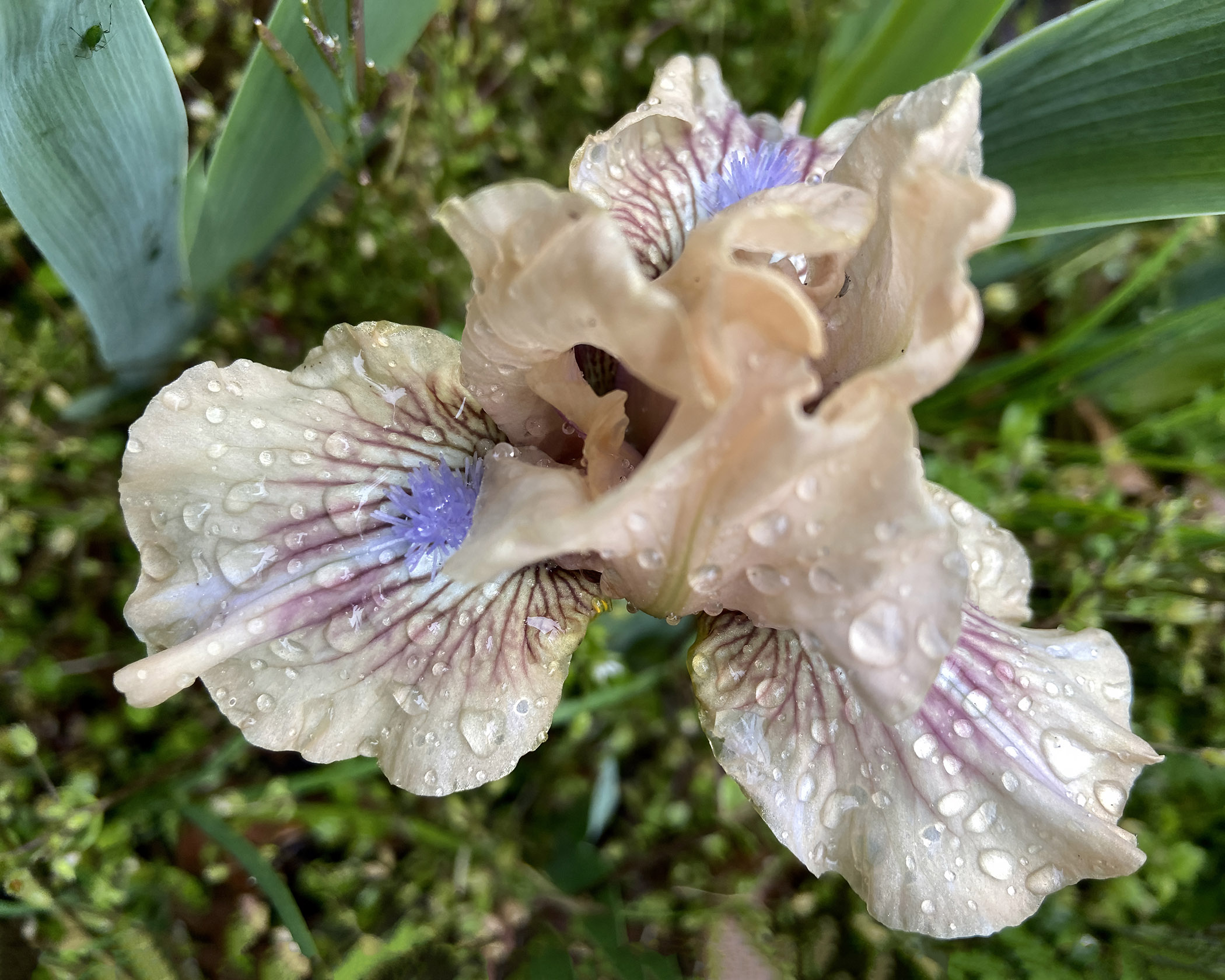
As I was preparing to go out to lunch yesterday with my dear friend and photography mentor Cindy Dyer, she glanced down at her garden and noticed that an iris was already in bloom, the first one of the spring. I suspect that this is some kind of dwarf iris, because it was nestled low in the vegetation and was only about six inches (15 cm) tall.

I thought about cropping the photo a little tighter, but wanted to retain the bug that is in the upper left corner of the image. As you might guess, I did not notice the little insect when I captured the photo with my iPhone. Cindy likes to call these “bonus bugs”—it is amazing how often I discover these “bonus bugs” in my photos when reviewing them on my computer.

Cindy has planted a wide variety of irises in her garden, so this is a sneak preview of the amazing beauty that is yet to come. I don’t know the name of this iris variety, but love the lavender color of its “beard.”

iris

© Michael Q. Powell. All rights reserved.

Read Full Post »

I spent several hours yesterday morning helping to prepare palms and flowers for today’s Palm Sunday services at St. Martin de Porres Episcopal Church in Alexandria, Virginia, my home church. We made a lot of crosses from the palms (and I braided some too), but there are plenty left to wave this morning. We will begin our services outdoors with the Liturgy of the Palms and then the congregation will process into the church singing “All Glory, Laud, and Honor” as they wave their palm fronds.

I made this little arrangement when I returned home yesterday with a cross that I had folded, two braided lengths of palms, and a leftover camellia.

Happy Palm Sunday to all those who are celebrating today as we begin Holy Week.

Palm Sunday

© Michael Q. Powell. All rights reserved.

Read Full Post »

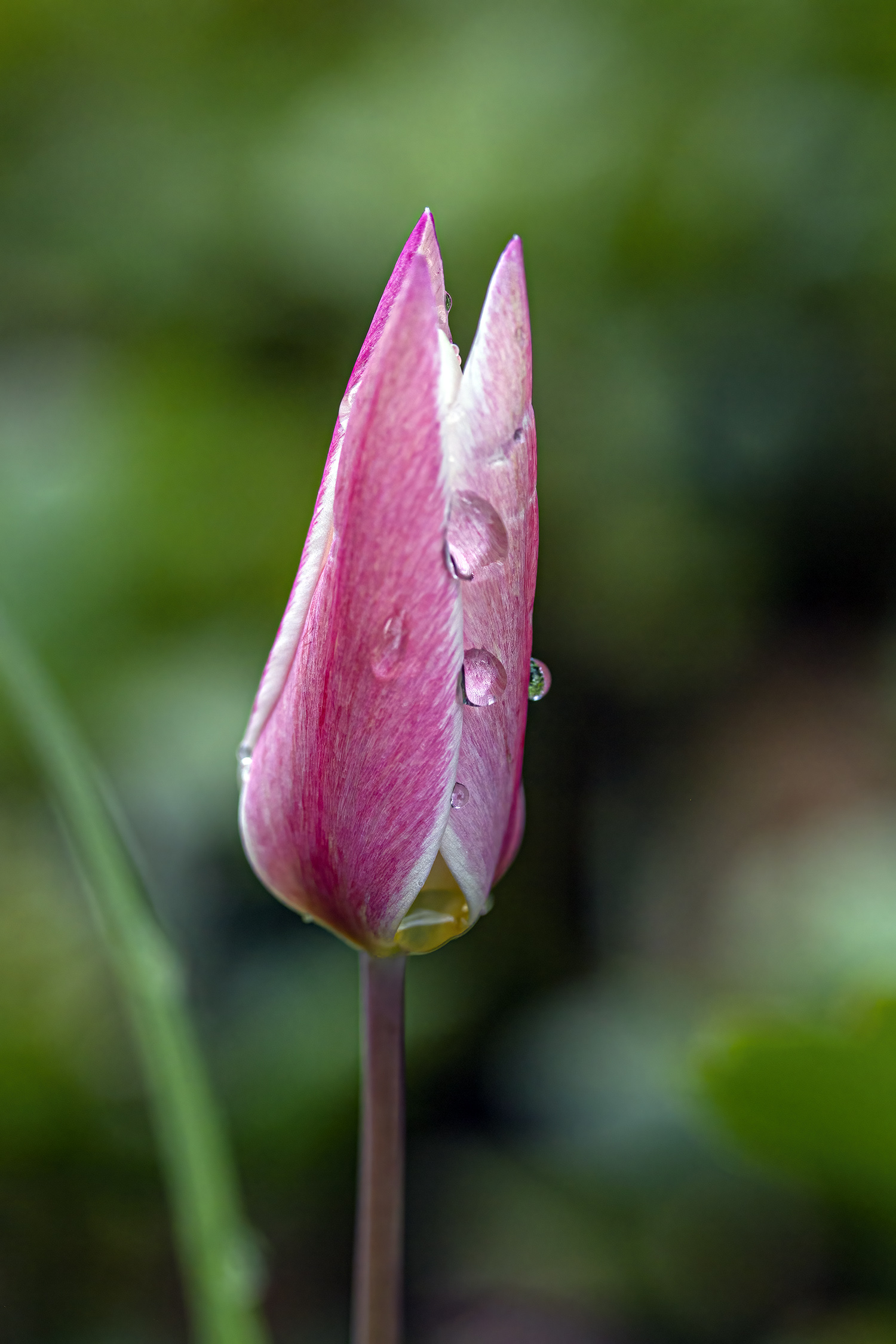
Raindrops on tulips are one of my favorite things. I photographed these different varieties of colorful tulips today in the garden of my dear friend and fellow photographer Cindy Dyer during a break in the rain.

I love spring flowers.

tulip

Lady Jane tulip

tulip

© Michael Q. Powell. All rights reserved.


Read Full Post »

I love the shape of Grape Hyacinths (g. Muscari), one of the early-appearing flowers that I look forward to each spring. The names of species sometimes do not match their appearances, but in this case the name fits perfectly—the little flowers do indeed look like a bunch of grapes.

Our recent weather has been windy, which makes it challenging to go out hunting for wildlife to photograph, because most of my potential subjects use common sense and seek shelter from the wind. As a result, I have resorted to visiting the garden of my dear friend Cindy Dyer and photographing her flowers, like this Grape Hyacinth that I spotted earlier this week.

I used a macro lens to get really close to the tiny flower to capture details, but the wind made it tough to get a sharp shot—as you get closer to a subject, the effect of any movement of the camera or the subject is magnified. On the whole, though, I like this modest portrait of one of my favorite spring flower.

Grape Hyacinth

© Michael Q. Powell. All rights reserved.

Read Full Post »

As many of you know, I do not have a garden of my own. My dear friend and photography mentor Cindy Dyer, however, lives close to me and loves to plant photogenic flowers. At this time of the year I really enjoy passing by her garden to see what has popped up.

I was delighted yesterday to see a beautiful red tulip in bloom in the middle of the garden in front of her townhouse. There was only a single tulip blooming in the midst of some hellebore plants, but it was not hard to spot. I don’t know much about tulip varieties, but think that this might be a Lady Jane tulip (Tulipa clusiana var. ‘Lady Jane‘)—I recall Cindy mentioning this variety in previous years.

I thought I would be photographing flowers close up, so I had a 60mm macro lens on my camera. This tulip, alas, was farther away than I would have liked and I did not want to step on any vegetation to get closer or to get a better angle.

I contented myself with a few shots to record this beautiful flower, my first tulip of this spring (with many more to come).

UPDATE: My memory failed me. Cindy let me know that the Lady Jane tulip is pink and white and not red like this one. I should probably have checked with her before I posted the images.

tulip

tulip

© Michael Q. Powell. All rights reserved.


Read Full Post »

When does spring begin? Many of us in the Northern Hemisphere measure the seasons using the astronomical calendar and this year spring begins on the 19th of March, i.e. the vernal equinox. For those who use the meteorological calendar, however, spring began on the 1st of March.

I generally use something other than a calendar when I measure the change of seasons. I feel the beginning of spring when the weather starts to warm up and the daylight begins to linger a bit longer. I can feel nature stirring, preparing for new life in the animal and plant kingdoms.

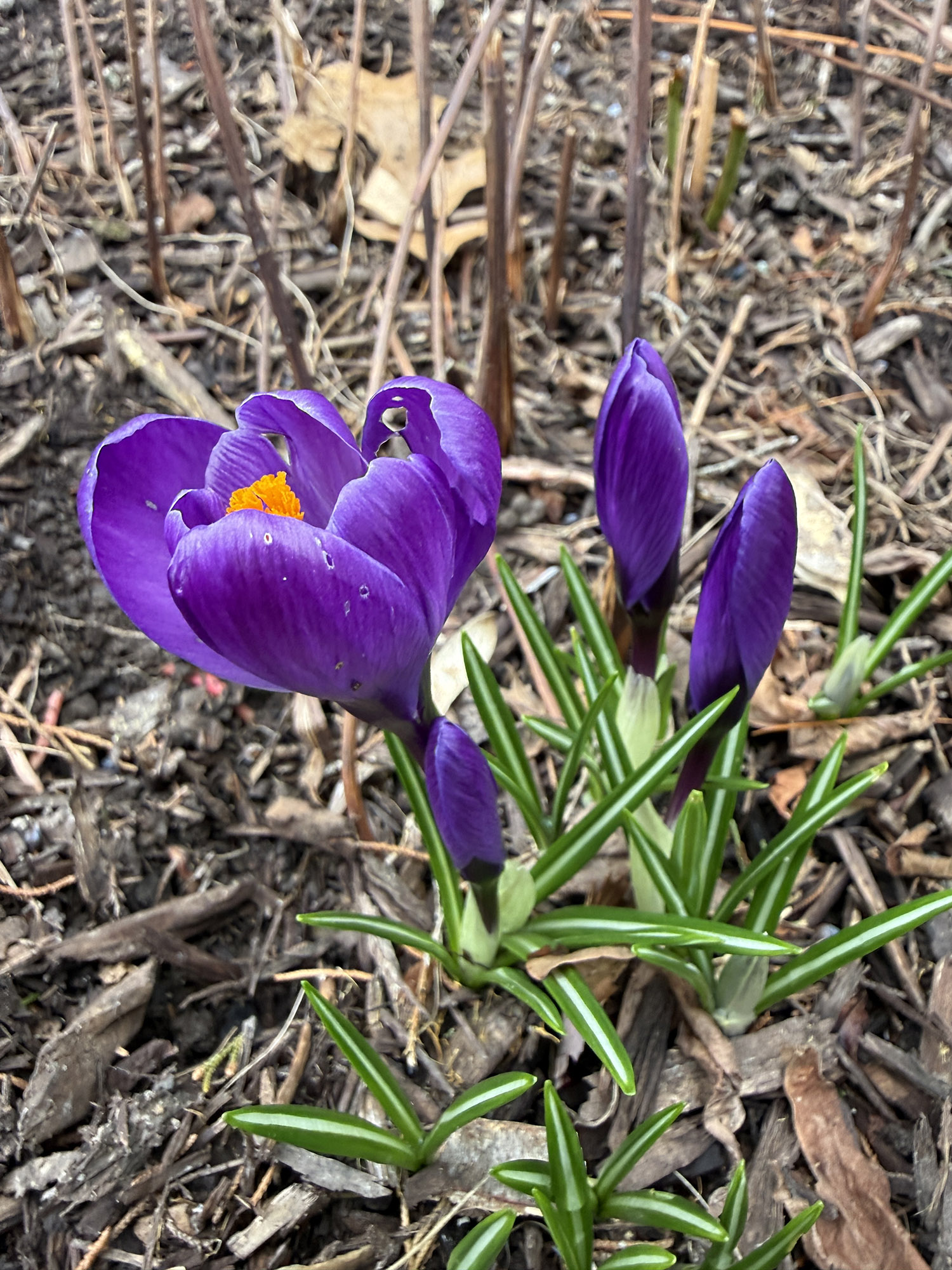
One of the signs of spring that I look for is the emergence of early spring flowers. This weekend I am cat sitting for my friend Cindy and her husband Michael, who are out of town on a trip to Texas. Cindy, my photography mentor and fellow photographer, has a wonderful garden that I have featured in this blog numerous times. The last couple of weeks I have checked out her garden, waiting patiently for the first flowers to appear.

I was delighted on Thursday to see that a tiny purple crocus was blooming amid all of the leaf clutter. It was only a single bloom, but it somehow filled my heart with joy and excitement. For me, spring has begun.

crocus

crocus

© Michael Q. Powell. All rights reserved.


Read Full Post »

Nature moves in seasonal cycles, constantly changing as plants and creatures appear and disappear. At this time of the year I begin to look for signs of spring. The calendar tells me that I have another month to wait, but nature does not always follow the manmade calendar.

As I was walking to a craft store on Saturday I was delighted to spot this solitary daffodil poking out of the ground, already in bloom. I snapped this quick photo with my iPhone to record the moment, my first daffodil of 2024.

Whenever I record the “first” photo of any subject, whether it is a completely new one or the reappearance of a familiar one, I am happy to capture whatever photo I can. Later, when I have a second chance, I will worry more about artistry and technique. At that first moment, I am content to immerse myself in joy and wonder—the photo is of secondary concern.

daffodil

© Michael Q. Powell. All rights reserved.

Read Full Post »

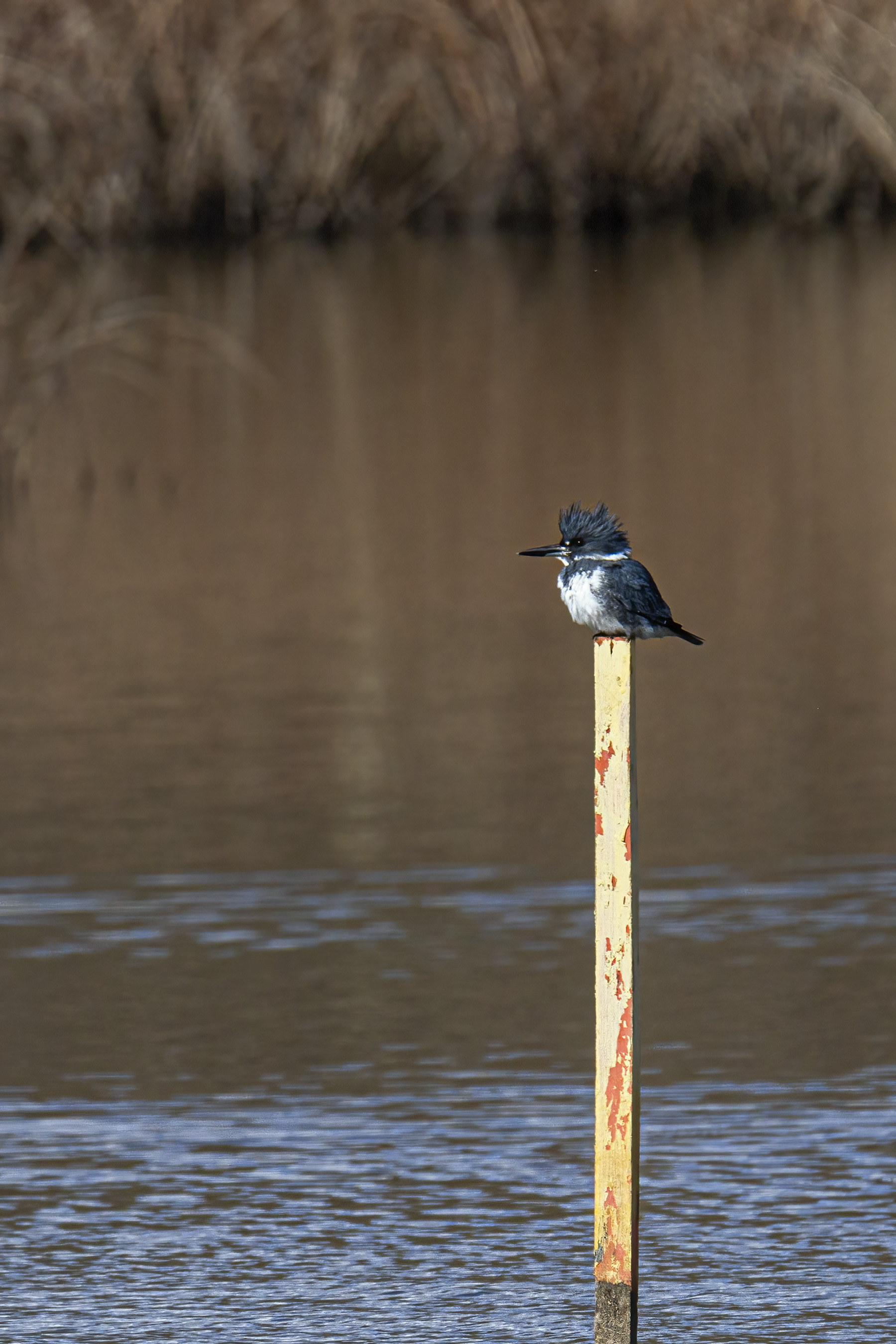
Belted Kingfishers (Megaceryle alcyon) are one of my nemesis birds. They are small and fast and incredibly skittish. I see (or hear) them quite often, but I am rarely able to get a decent shot of one.

I spent a good amount of time last Friday at Huntley Meadows Park observing a male Belted Kingfisher trying to catch a fish. He was perched on some kind of board sticking out of the water and repeatedly dove into the water and returned to the same post. Eventually he caught a fish, but, alas, flew away with it before I could get a shot of him with his catch.

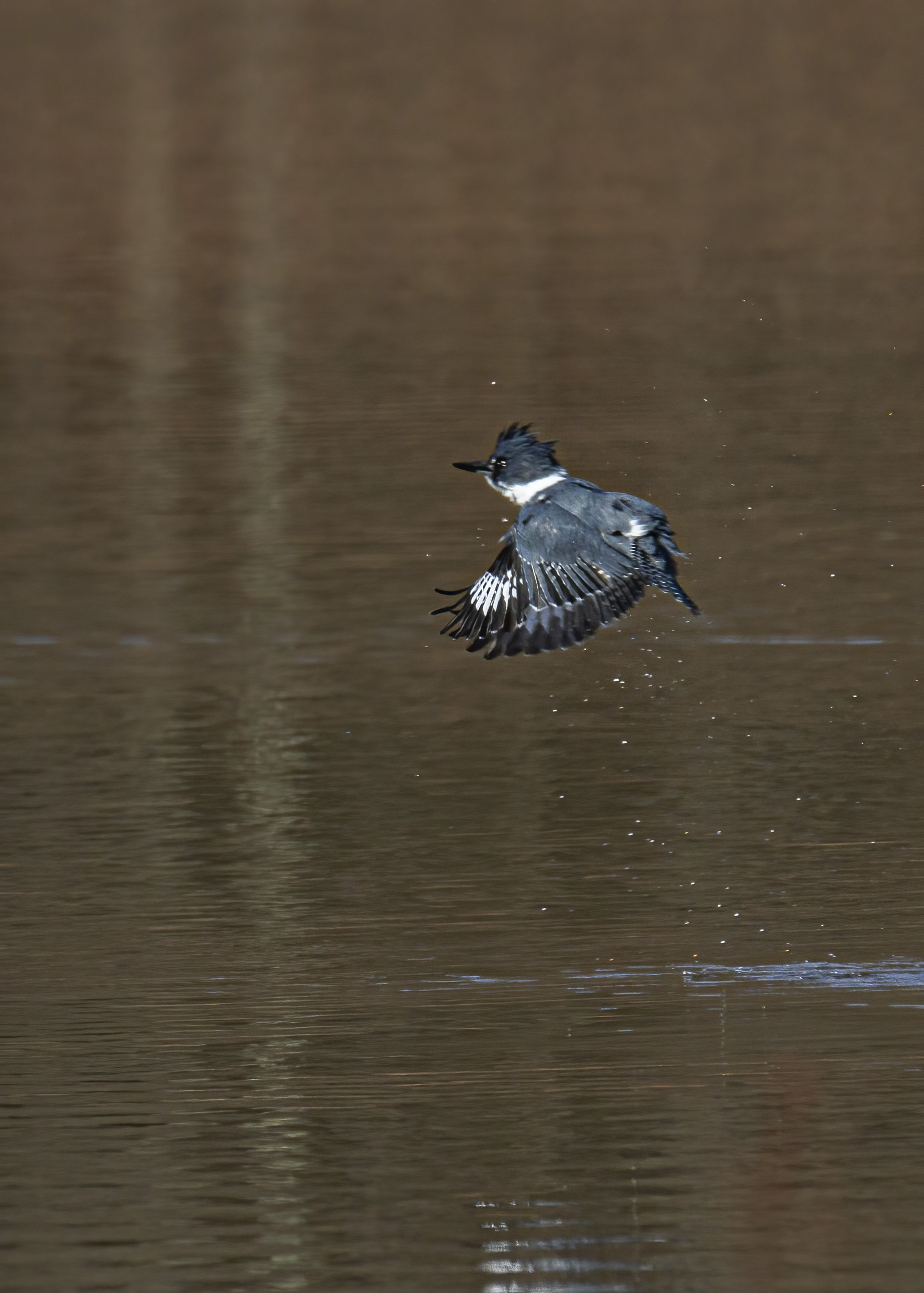
Unlike an eagle that grabs a fish with its talons without submerging itself, a kingfisher dives headfirst into the water, creating a big splash. According to the Cornell Lab of Ornithology, “When it spots a fish or crayfish near the surface, it takes flight, dives with closed eyes, and grabs the prey in its bill with a pincer motion. Returning with its prize, it pounds the prey against the perch before swallowing it head first.”

I was perched on am observation platform some distance away, but had a clear line of sight to the kingfisher. Over time I was able to capture some relatively sharp shots of the kingfisher in action. The first shot is my favorite—the kingfisher was rising up out of the water, surrounded by water droplets, after what appeared to have been an unsuccessful attempt.

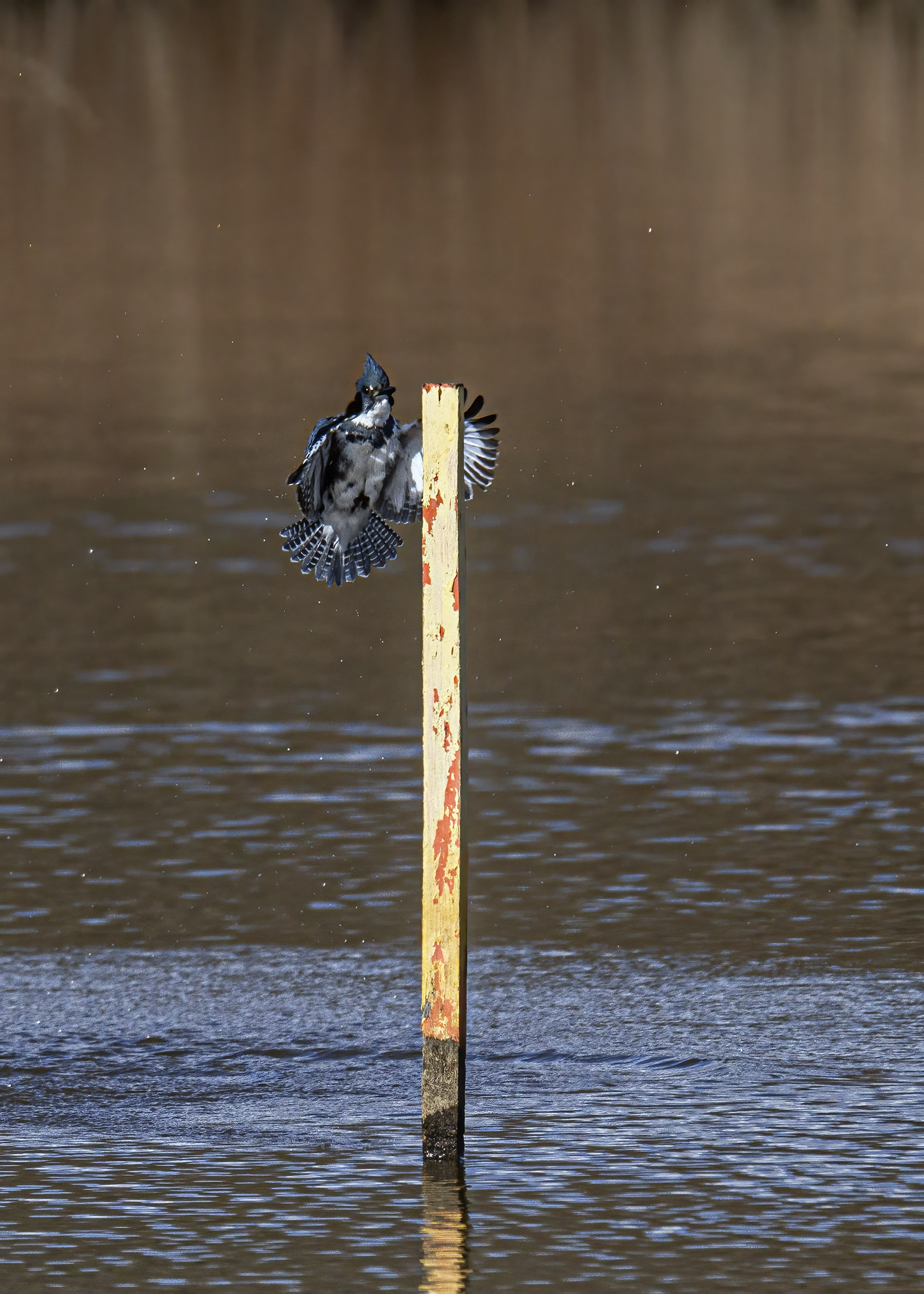
The second photo shows the kingfisher on its perch. I am not sure why this board was sticking out of the water, but noted several similar boards nearby. The subsequent images show the kingfisher in various stages of action. I was fortunate that the kingfisher made several attempts, sometimes diving to the left and sometimes to the right, so I had multiple chances to get shots. Actions shots are a tough, but fun challenge. The kingfisher would take off without warning and after it dove into the water, I was never sure exactly when and where he would reemerge.

Belted Kingfisher

Belted Kingfisher

Belted Kingfisher

Belted Kingfisher

Belted Kingfisher

Belted Kingfisher

© Michael Q. Powell. All rights reserved.


Read Full Post »

Usually when I hear some rustling in the leaves and see a flash of rust-colored feathers, I assume that it is an American Robin. I was delighted last Friday at Huntley Meadows Park to be wrong in my assumption. When I zoomed in on the bird that had attracted my attention, I realized that it was an Eastern Towhee (Pipilo erythrophthalmus), a species that I see a lot less frequently than the American Robin,

This colorful little bird proved to be quite skittish and I managed to capture only a few shots of it before it flew deeper into the underbrush. Fortunately I was able to capture enough details that you can see the bird’s beautiful markings and coloration.

Eastern Towhee

© Michael Q. Powell. All rights reserved.

Read Full Post »

Older Posts »