December 17, 2017 by Mike Powell
These three Buffleheads (Bucephala albeola) were a long distance away when I spotted them swimming in formation on the water at Occoquan Bay National Wildlife Refuge on 8 December, but they are distinctive looking, so it was pretty easy to identify them. In case you are curious, male buffleheads have white bodies and a big white patch on the head and the females have darker bodies and a Nike-like swoosh on their heads.

© Michael Q. Powell. All rights reserved.
Posted in Birds, Nature, Photography, wildlife | Tagged Bucephala albeola, bufflehead, Canon 50D, Occoquan Bay National Wildlife Refuge, Tamron 150-600mm, Woodbridge VA | Leave a Comment »
December 16, 2017 by Mike Powell
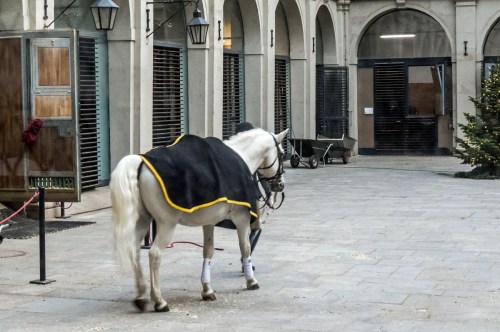
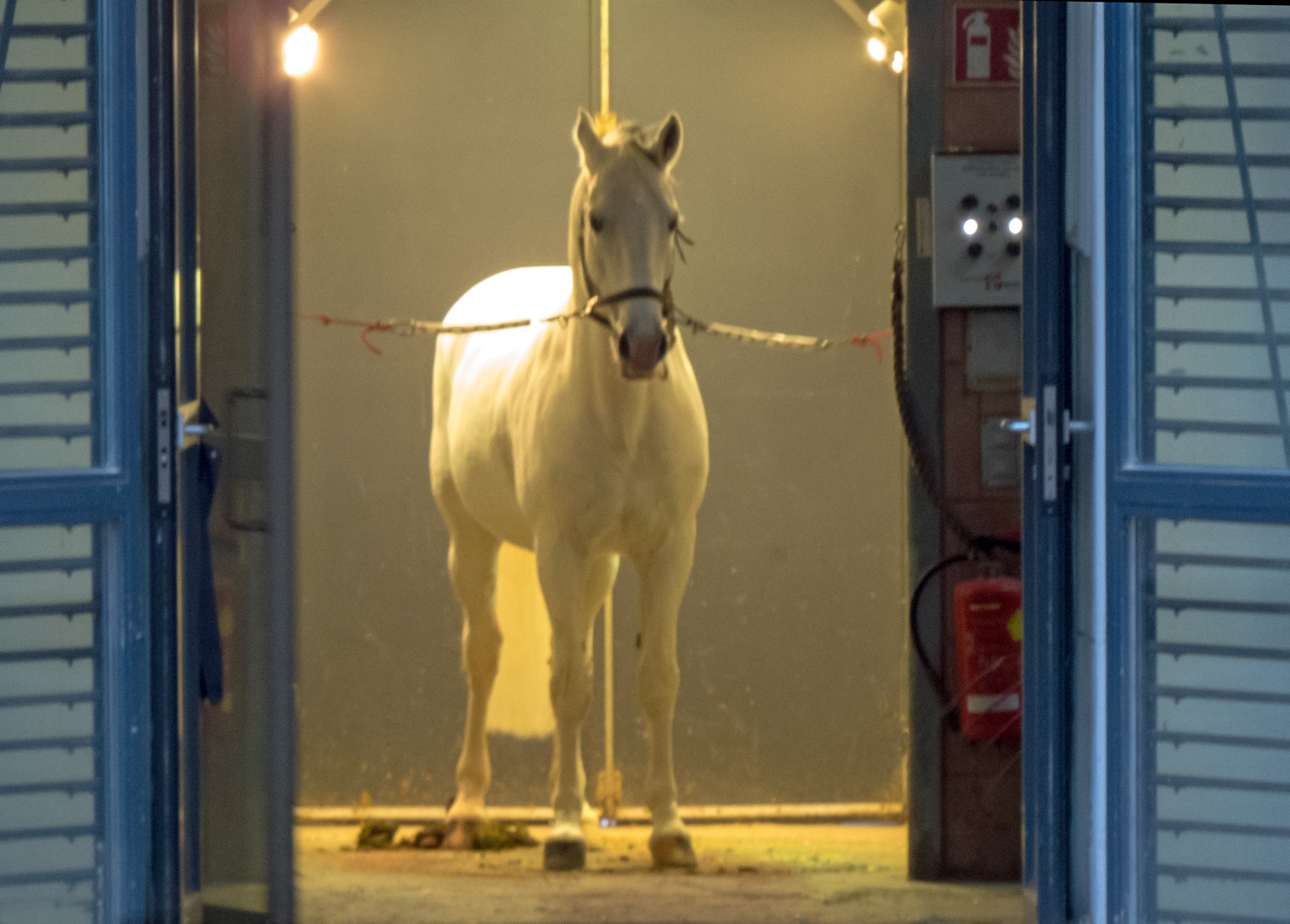
As I was walking to work through the streets of Vienna Friday morning, I passed by the Spanish Riding School in the Hofburg Palace and was thrilled to get a glimpse of some of the world-famous Lippizaner stallions. They were mostly hidden in their stalls, but occasionally one of these beautiful horse would pop its head out or a door would open briefly. I was also able to snap some quick photos as one of the horses was being prepared and was then walked across an open area.
Perhaps someday I will see a performance of the Lippizaners, but for now I am happy to have caught a glimpse of them on my last working day in Vienna for this trip.


© Michael Q. Powell. All rights reserved.
Posted in animals, Photography, Travel | Tagged Canon SX-50, Canon SX50, Hofburg Palace, Lippizaner, Lippizaner stallions, Spanish Riding School, Vienna VA | 11 Comments »
December 15, 2017 by Mike Powell
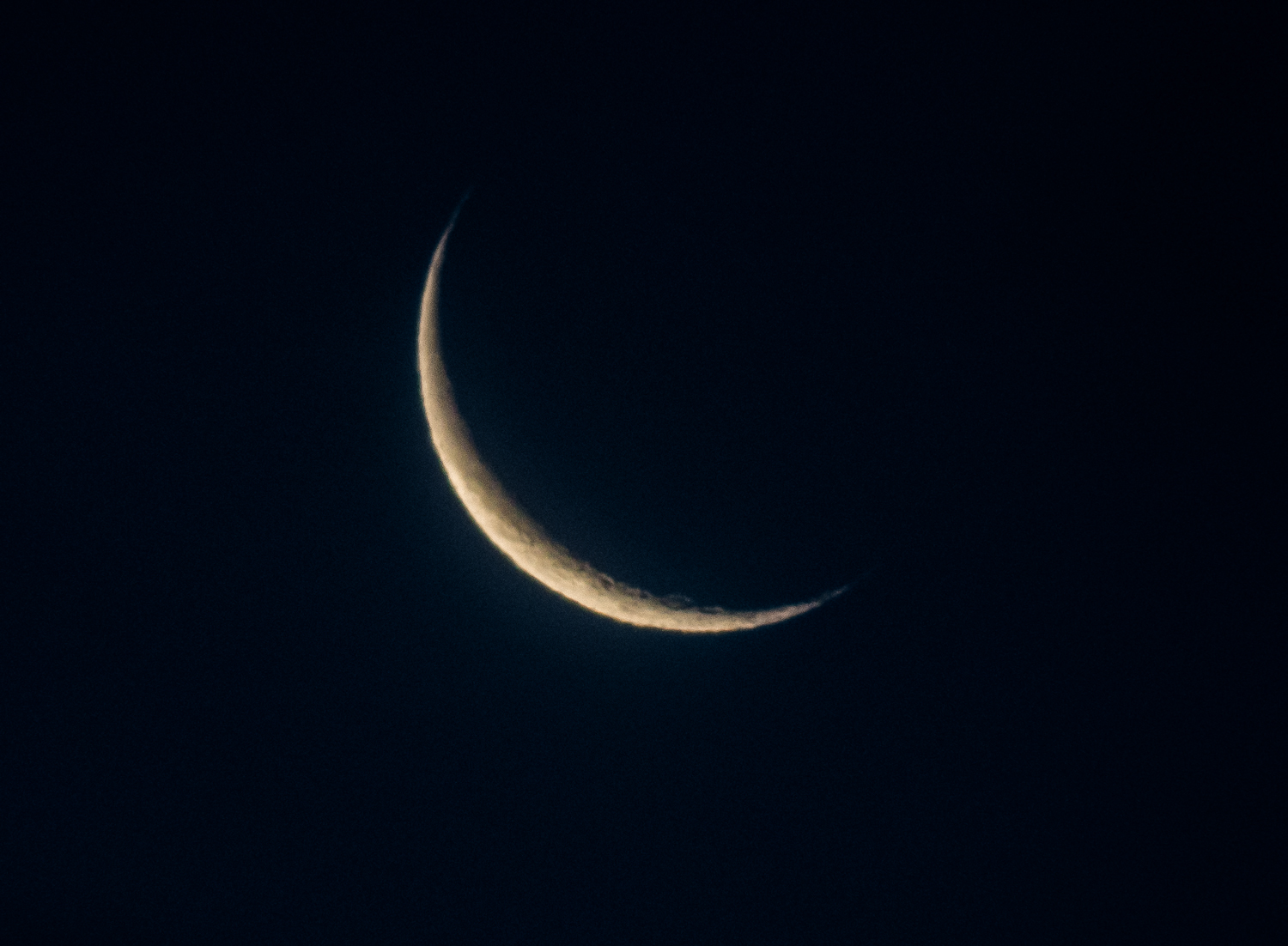
The view from my hotel room in Vienna seems to be mostly of ongoing construction work, but this morning it featured a touch of color as the sun slowly began to rise. A nice highlight was the sliver of a crescent moon still visible in the sky.


© Michael Q. Powell. All rights reserved.
Posted in Landscape, Photography, Travel | Tagged Canon A620, Canon SX50, moon, sunrise, Vienna, Vienna Austria | 4 Comments »
December 14, 2017 by Mike Powell
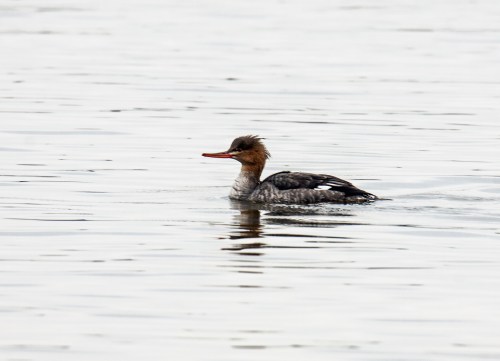
I spotted this duck last Friday at Occoquan Bay National Wildlife Refuge in Northern Virginia. At first I was certain that it was a female Hooded Merganser, but the bill seemed extra long and the coloration different from others I had seen.
I asked some birding experts in a Facebook group for assistance with identification and they informed me that it is a female Red-breasted Merganser (Mergus serrator), a species that spends its summers in Canada and its winters in coastal areas.
The sky was covered with clouds and lighting was limited when I took these shots, which made it tough to capture the details of this duck, which was located a pretty good distance from me. The second image gives a good view of the Red-breasted Merganser, but I personally am drawn even more to the “artsy” first image.

© Michael Q. Powell. All rights reserved.
Posted in Birds, Nature, Photography, wildlife | Tagged Canon 50D, Mergus serrator, Occoquan Bay National Wildlife Refuge, Red-breasted Merganser, Tamron 150-600mm, Woodbridge VA | 2 Comments »
December 13, 2017 by Mike Powell
In the middle of December, it starts to get dark really early in Vienna. As I was exploring one of the Christmas markets late in the afternoon a few days ago, my eyes were drawn to the interplay of light and shadows on the top of the building of the Museum of Natural History (Naturhistorisches Museum). Natural light was rapidly fading and the artificial lights began to come on, highlighting some of the architectural details of this magnificent building.
Folks passing by probably wondered why I was staring at this scene for an extended period, sometimes with my camera to my eye and sometimes with my naked eyes. We photographers are a peculiar breed.

© Michael Q. Powell. All rights reserved.
Posted in Architecture, Photography, Travel, Winter | Tagged Canon SX50, Museum of Natural History, Naturhistorisches Museum, Vienna Austria | 1 Comment »
December 12, 2017 by Mike Powell
I am in Vienna, Austria for a brief work trip and had a chance to stop by the Christmas Market in front of the Rathaus (City Hall). Even on a Monday afternoon, the market was crowded with shoppers. The market is noisy, busy, and a bit gaudy, but despite all of the commercialization, I could still feel the spirit of Christmas.
As the big sign in front of the market states in German, “Merry Christmas.”


© Michael Q. Powell. All rights reserved.
Posted in Christmas, Landscape, Photography, Travel, Urban | Tagged Canon SX50, Christmas 2017, Christmas market, Rathaus, Vienna, Vienna Austria | 1 Comment »
December 11, 2017 by Mike Powell
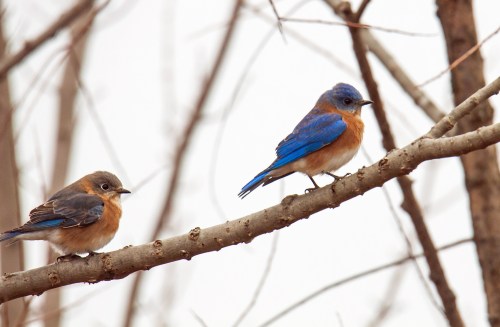
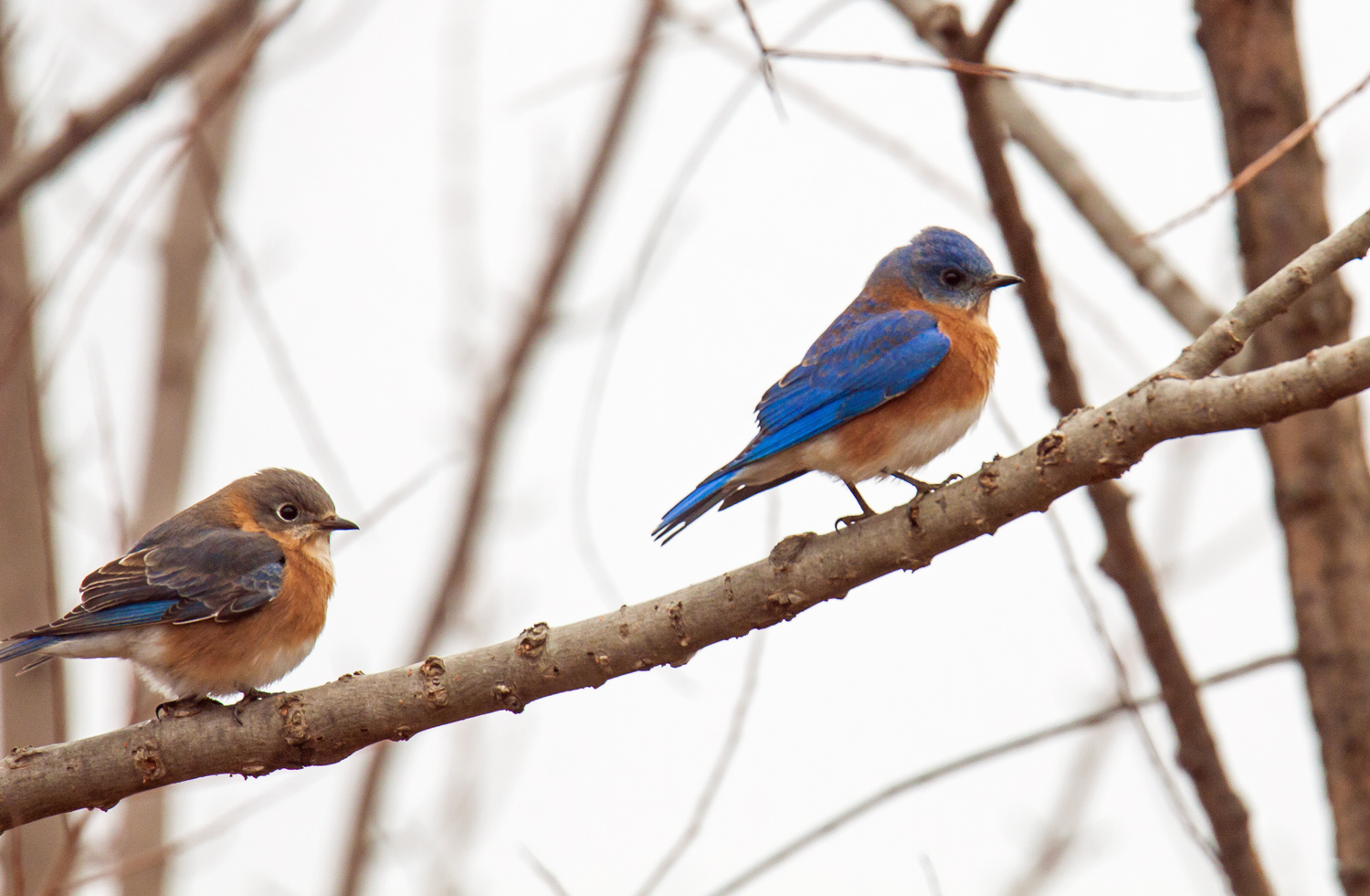
I don’t tend to think of Eastern Bluebirds (Sialia sialis) as winter birds, so I was very happy to see a small flock of them this past Friday at Occoquan Bay National Wildlife Refuge. The sky was covered with clouds and there was almost no sunshine, turning my background to almost pure white in many of my shots. This tended to make some of my images, especially the one of the bluebird perched on the uppermost branches of a bush, look almost like they were shot in a studio.


© Michael Q. Powell. All rights reserved.
Posted in Birds, Nature, Photography, wildlife, Winter | Tagged bluebird, Canon 50D, Eastern Bluebird, Occoquan Bay National Wildlife Refuge, Sialia sialis, Tamron 150-600mm, Woodbridge VA | 7 Comments »
December 9, 2017 by Mike Powell
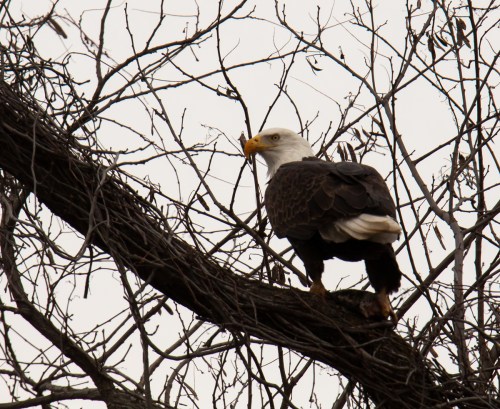
When a Bald Eagle took off from a perch with its partially-eaten fish yesterday morning at Occoquan Bay National Wildlife Refuge, I didn’t zoom out fast enough to photograph its entire wingspan, but did manage to capture a rather fierce expression.
I spotted the eagle in the tree from a long way off and tried to approach it as quickly and cautiously as I could. The eagle was facing away from me and seemed to have its head pointing downward. Once I got a bit closer, I could see that the eagle was focused on eating a freshly-caught fish, which is why, I assume, it was not alert to my approach.
Every now and then, the eagle would look up from its late breakfast and do a survey of its surroundings, as you can see in the second photo. I think that it was during ones of these surveys that it spotted me. I was still a pretty good distance from the tree in which the eagle was perched, but I was standing at the edge of a wide path, so I was not exactly camouflaged,
Without any warning, the eagle took to the air, making sure to bring along the partially-consumed fish. I didn’t have much time to react, but was thrilled with the image that I was able to capture as the eagle zoomed toward me. I really like the eagle’s expression and the way that I was able to capture the white tail feathers.
I watched as the eagle flew to a distant perch, where it could finish its meal without further interruption,

© Michael Q. Powell. All rights reserved.
Posted in Birds, Nature, Photography, wildlife | Tagged Bald Eagle, birds in flight, Canon 50D, Haliaeetus leucocephalus, Occoquan Bay National Wildlife Refuge, Tamron 150-600mm, Woodbridge VA | 11 Comments »
December 8, 2017 by Mike Powell
Ducks do not seem to like to be alone. I will occasionally run across an odd solitary duck, but more often than not, the ducks that I encounter are in pairs or in larger groups. Sometimes the pairs are mixed-gender, like this Hooded Merganser (Lophodytes cucullatus) couple that was relaxing together recently at Huntley Meadows Park. At other times, the pair may be of the same gender, like these two male Northern Shovelers (Anas clypeata) at the same park that were preening and grooming themselves early one morning—one Facebook viewer speculated that they were getting ready for dates.


© Michael Q. Powell. All rights reserved.
Posted in Birds, Nature, Photography, wildlife | Tagged Alexandria VA, Anas clypeata, Canon 50D, Hooded Merganser, Hooded Merganser duck, Huntley Meadows Park, Lophodytes cucullatus, Northern Shoveler, Tamron 150-600mm | Leave a Comment »
December 7, 2017 by Mike Powell
Unlike most other woodpeckers, Northern Flickers (Colaptes auratus) like to spend a lot of time on the ground, which makes it tough to get a clear shot of one. According to the Cornell Lab of Ornithology website, “Although it can climb up the trunks of trees and hammer on wood like other woodpeckers, the Northern Flicker prefers to find food on the ground. Ants are its main food, and the flicker digs in the dirt to find them. It uses its long barbed tongue to lap up the ants.”
When I spotted this male Northern Flicker—females don’t have the black mustache stripe—last weekend at Huntley Meadows Park, it was perched horizontally on a fallen tree, which gave me a clear view of its beautiful colors and patterns. Other woodpeckers, which are mostly black and white, seem drab by comparison. For the first time ever, I was also able to see the downward curve of its bill that I had seen described in birding identification guides.
This bird remained still for only a moment and then seemed to fade away into the background.

© Michael Q. Powell. All rights reserved.
Posted in Autumn, Birds, Nature, Photography, wildlife | Tagged Alexandria VA, Canon 50D, Colaptes auratus, flicker, Huntley Meadows Park, Northern Flicker, Tamron 150-600mm | 7 Comments »
December 6, 2017 by Mike Powell
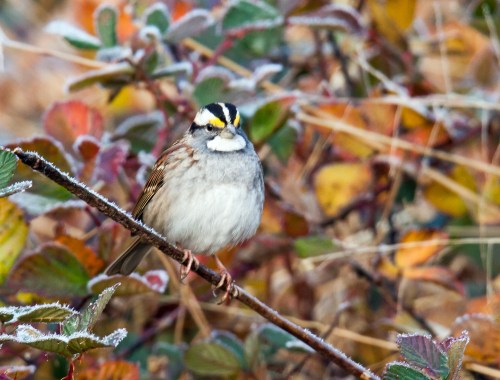
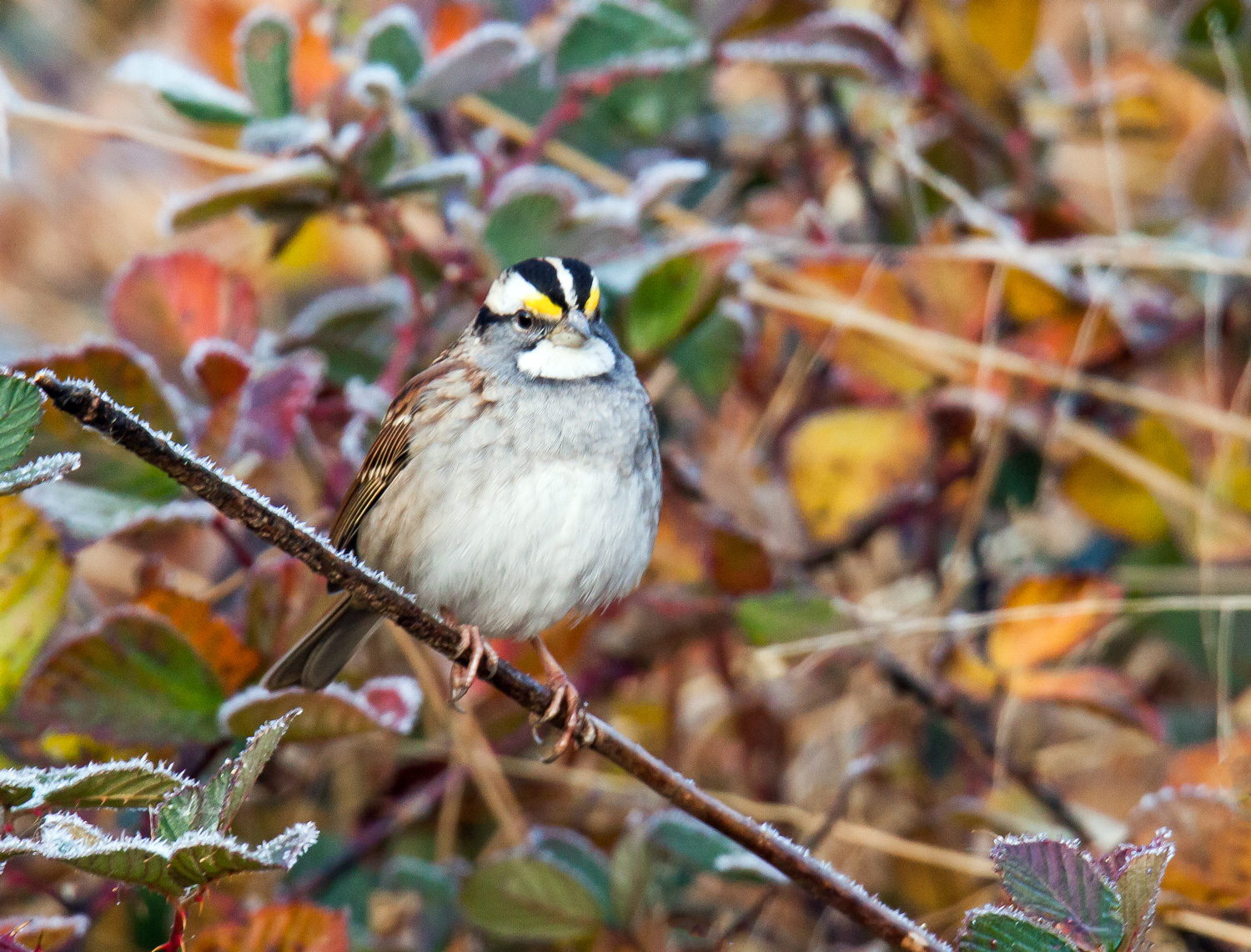
The Santa-like “beard” of the White-throated Sparrow (Zonotrichia albicollis) that I observed this past weekend at Huntley Meadows Park seems seasonally appropriate as we move closer and closer to Christmas. The backdrop of colorful foliage adds to the festive feel of the photo, which is further enhanced by the frosty leaves in the foreground.
© Michael Q. Powell. All rights reserved.
Posted in Birds, Christmas, Nature, Photography, wildlife, Winter | Tagged Alexandria VA, Canon 50D, Christmas, Huntley Meadows Park, Santa, Santa Claus, Tamron 150-600mm, white-throated sparrow, Zonotrichia albicollis | 6 Comments »
December 5, 2017 by Mike Powell
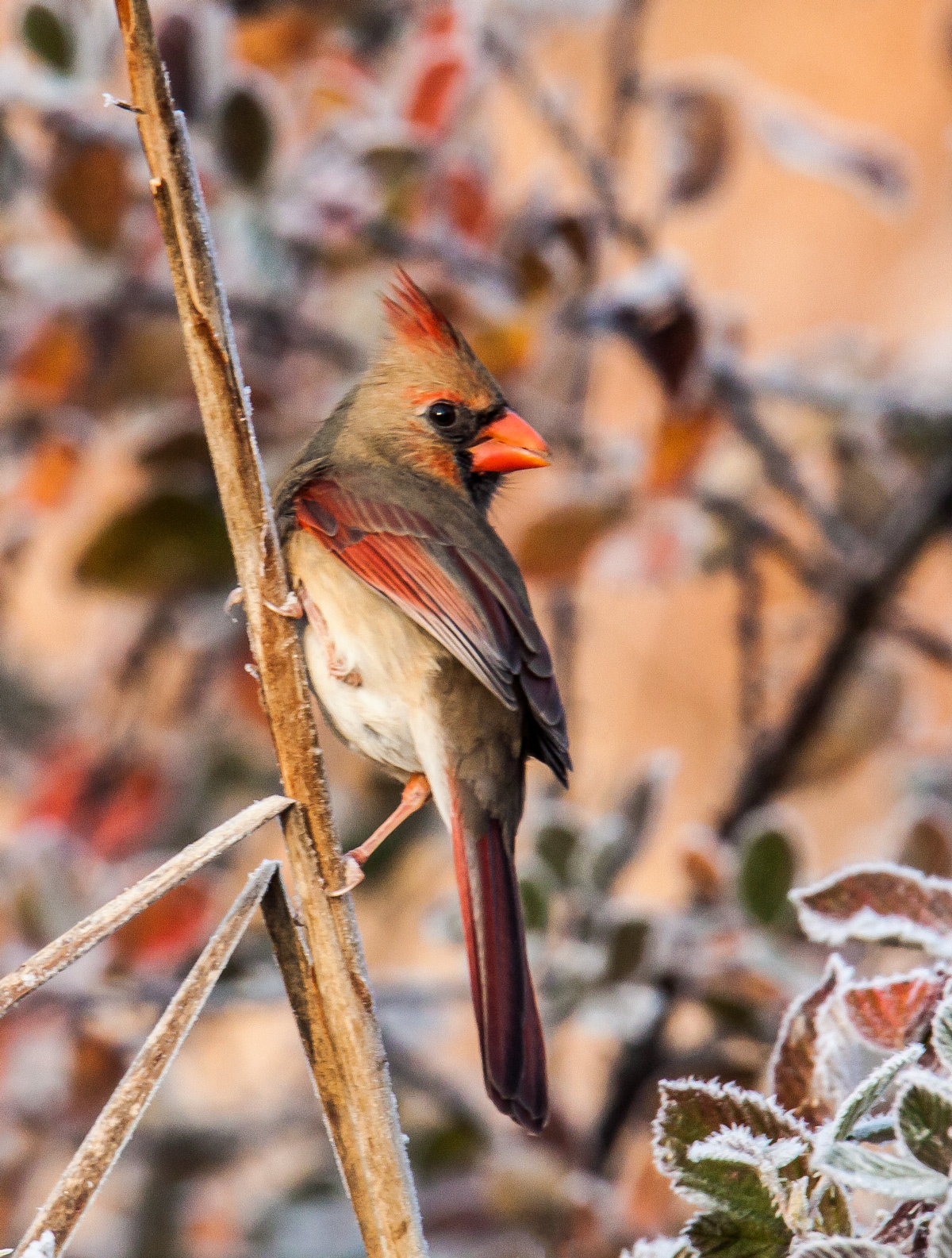
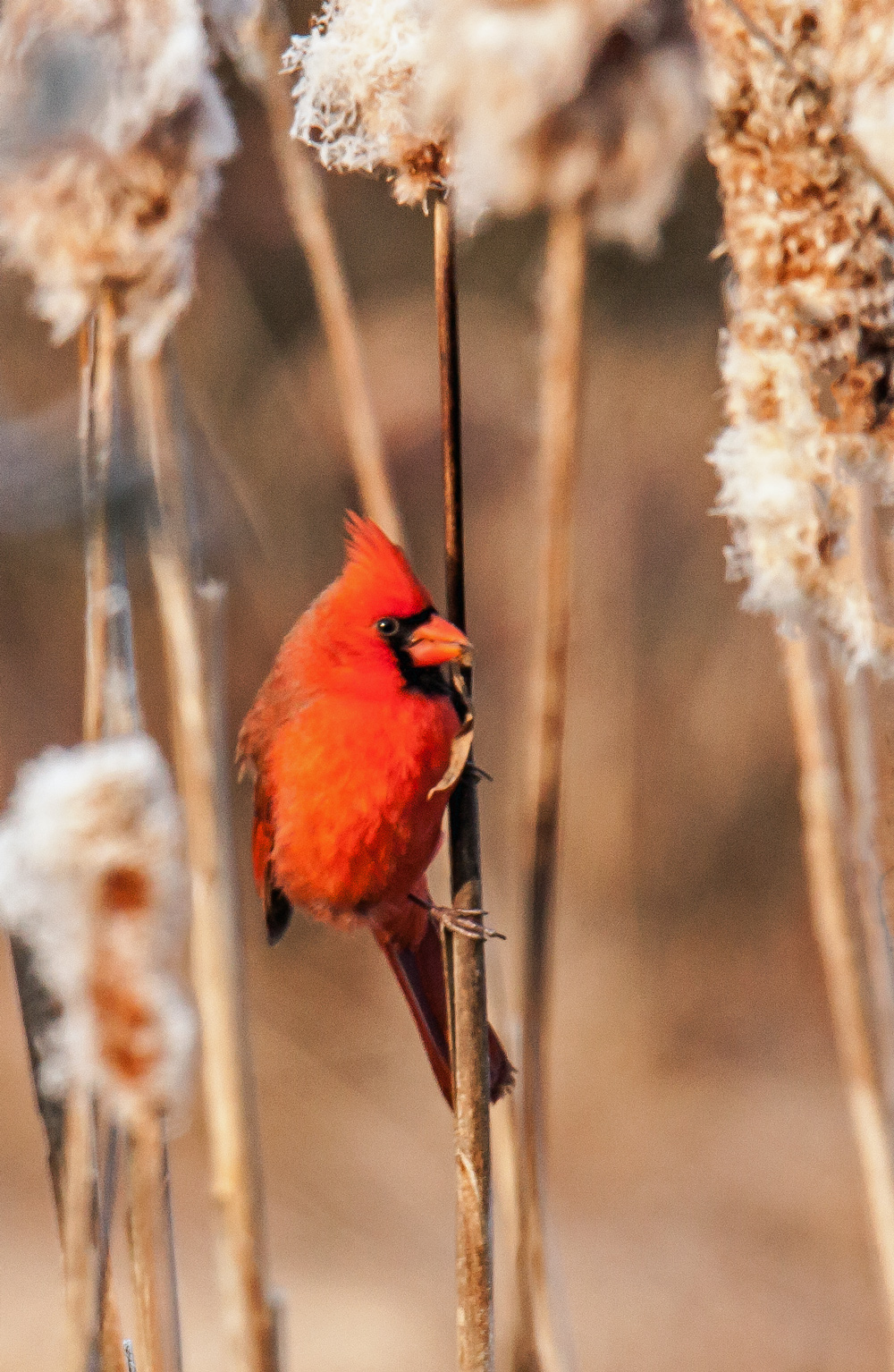
I love Northern Cardinals (Cardinalis cardinalis). The bright red of the male cardinal helps to lift my spirits throughout the winter when the world seems almost monochromatic. In terms of beauty, though, the more subdued coloration of the female cardinal is arguably even more impressive.
This past weekend I encountered several cardinals as I was exploring the frosty fields of Huntley Meadows Park in the early morning hours. I was focused on some sparrows in a patch of vegetation when suddenly a female cardinal flew in. I quickly adjusted my focus—I was focusing manually at that moment—and tried to steady my breathing as I took the first shot below just before she flew away.
A little while later, I caught sight of some movement out of the corner of my eyes in a stand of cattails. The red of a male cardinal is pretty hard to camouflage, so it was easy to spot him, but I was a little surprised by his pose. Somehow it looked more like the pose of a blackbird than that of a cardinal. Even though I was pretty far away, the cardinal seemed to be intently staring at me and didn’t seem too happy about my presence.
Cardinals are common where I live, but I never grow tired of photographing such ordinary subjects, seeking to discover and share the extraordinary that can often be found in the ordinary.


© Michael Q. Powell. All rights reserved.
Posted in Autumn, Birds, Nature, Photography, wildlife | Tagged Alexandria VA, Canon 50D, Cardinalis cardinalis, female Northern Cardinal, Huntley Meadows Park, male Northern Cardinal, Northern cardinal, Tamron 150-600mm | Leave a Comment »
December 5, 2017 by Mike Powell
Liz from New Zealand loves to explore a lot more than just color in her blog Exploring Colour. She has a wonderful ongoing series on different aspects of beauty by guest writers and has started a new series on eyes. I am honored to be the first featured photographer and together we selected some of my photos that showed the eyes if such diverse subjects as a birds, a turtle, a fish, a dragonfly, and a fox. Be sure to check out her blog for beauty and inspiration in many forms and to see the five images of eyes (this turtle eye is a sneak preview).

 Exploring Colour
Everywhere, eyes are watching! Wildlife and animal photography often provide a wonderful view into animals’ eyes and gives us a small insight into their world and their behaviour.
Eye detail, colour, shape and pattern are interesting in themselves. Focused eyes of predator, wary eyes of prey, even just a curious glance – all can make a strong impression.
Mike Powell (Virginia, USA) kindly assisted me in finding five photos from his collection that relate to ‘eyes’.
Let me know if you enjoy this post as I’m considering doing a ‘Five Eyes’ series, featuring a different photographer each time 🙂
Mike Powell blogs at: Mike Powell | My journey through photography
As well as enjoying Mike’s photos, I enjoy the information and discussion that he writes for each post. Under each photo below is a link to his original post where you can read the story that goes…
View original post 126 more words
Posted in animals, Birds, Nature, Photography, wildlife | Tagged exploring colour, eyes | 1 Comment »
December 4, 2017 by Mike Powell
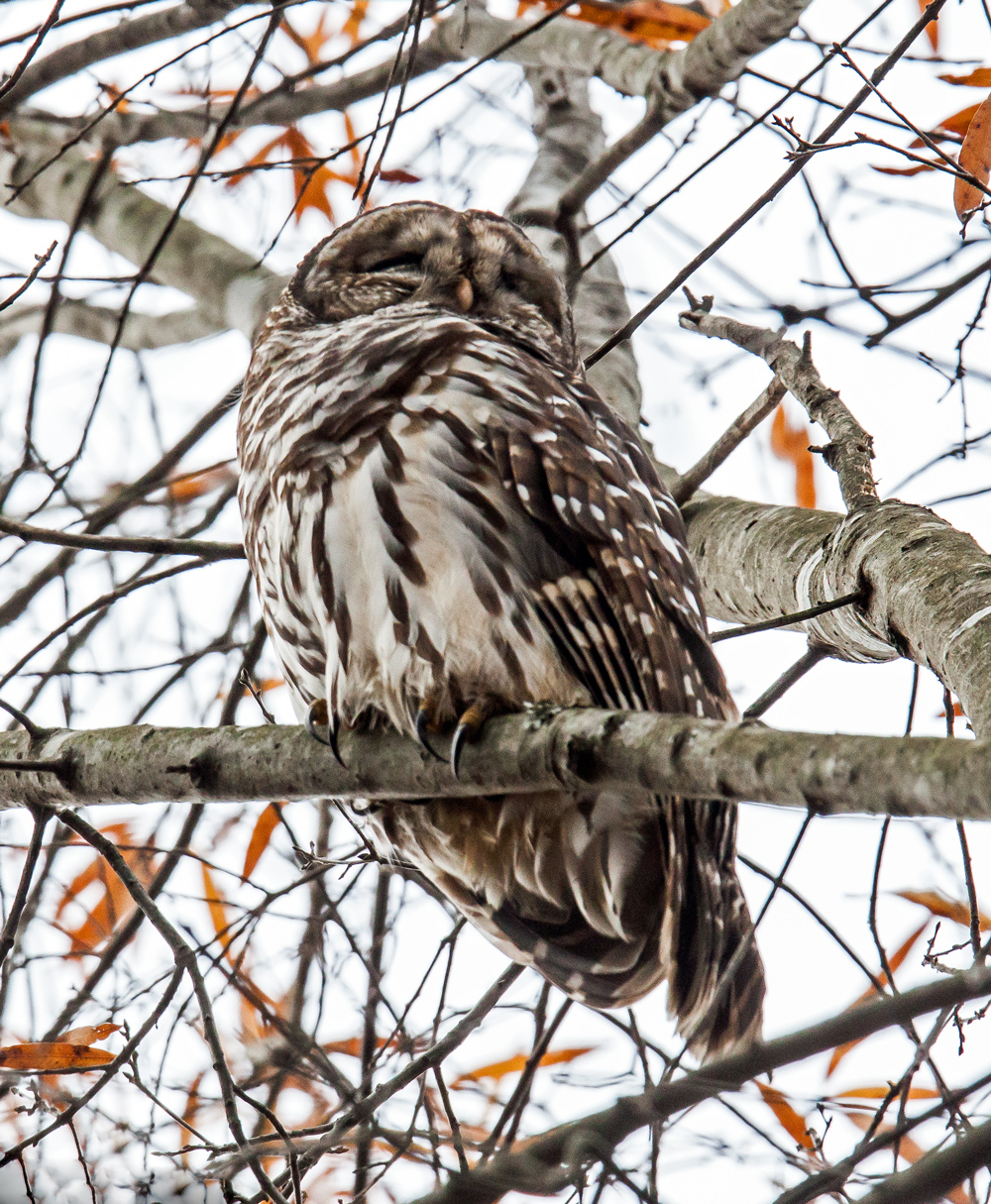
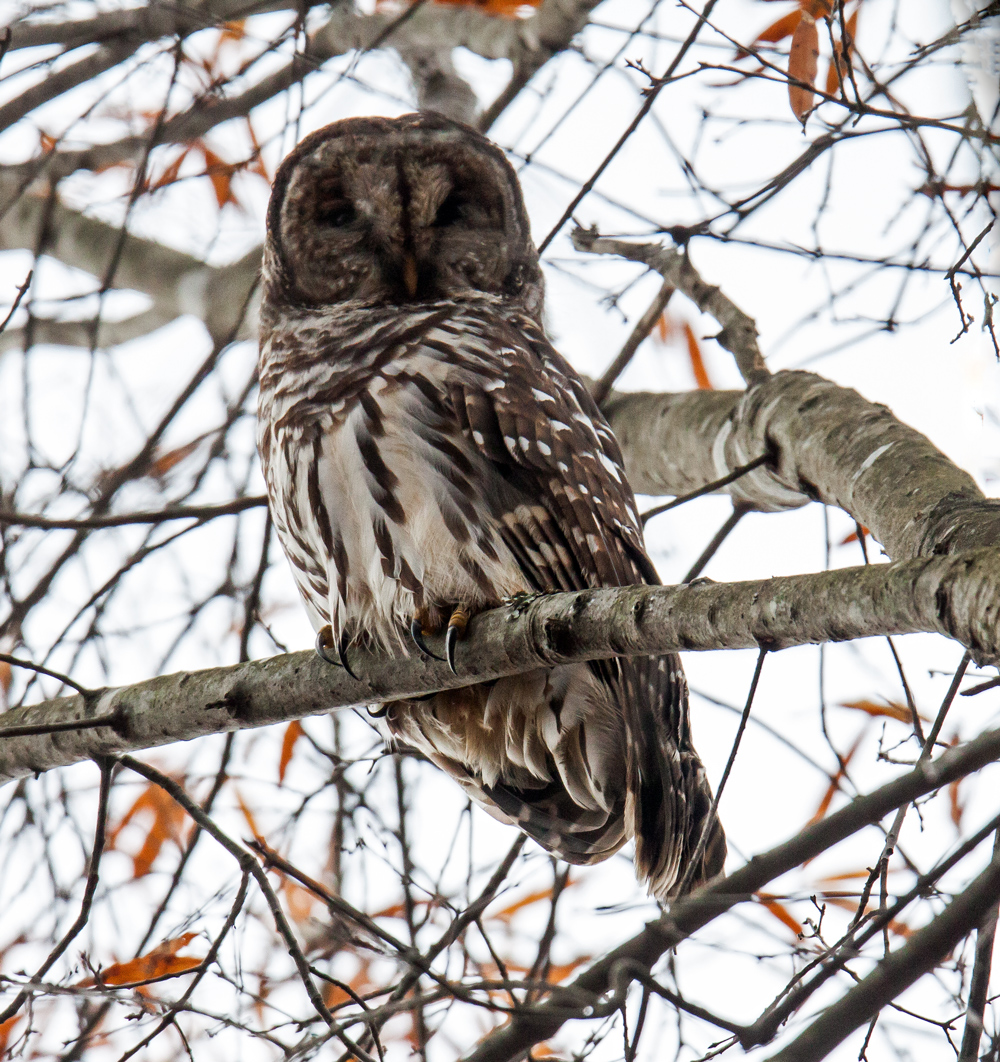
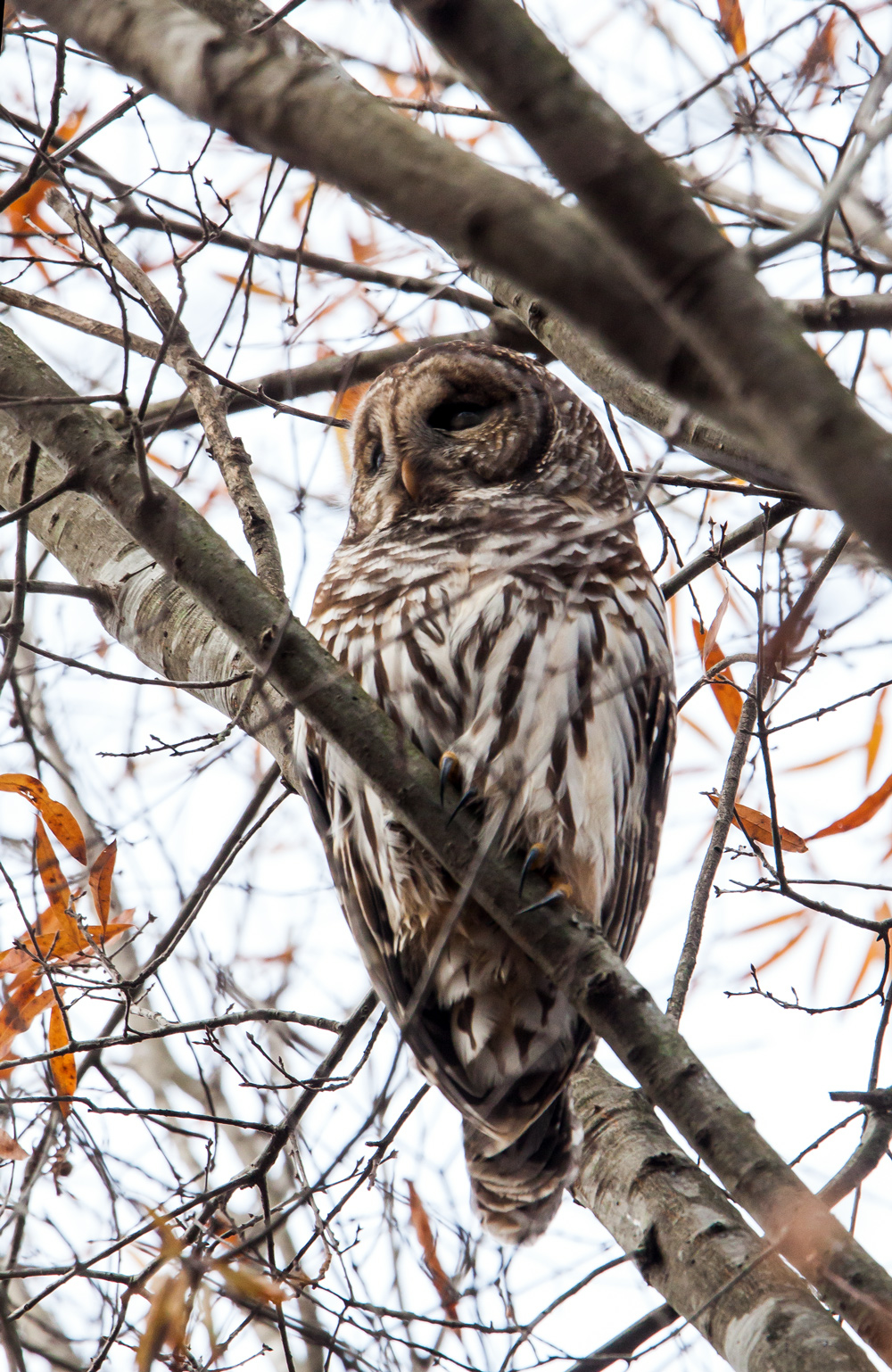
It’s not often that I see an owl during the day, but, thanks to a tip from a fellow visitor at Huntley Meadows Park, I managed to photograph this Barred Owl (Strix varia) on Saturday around noon.
Now, you might think that seeing an owl during daylight hours would make it simple to photograph, but, in fact, it was quite a challenge. The owl was perched high in a tree in a rather heavily wooded area. That meant that it was tough to get an unobstructed view of the owl. By moving a bit closer, I got a slightly better view, but was shooting almost straight up at an awkward angle. Then there was the problem of light, or more particularly the absence of light, especially on the face. I was patient and the owl appeared to be snoozing, so eventually I was able to get some decent shots.
I had never thought to look for an owl in that area of the park, but will now have to add it to my list of places to check out whenever I am visiting my favorite marshland park.


© Michael Q. Powell. All rights reserved.
Posted in Autumn, Birds, Nature, Photography, wildlife | Tagged Alexandria VA, Barred Owl, Canon 50D, Huntley Meadows Park, owl, Strix varia, Tamron 150-600mm | 18 Comments »
December 3, 2017 by Mike Powell
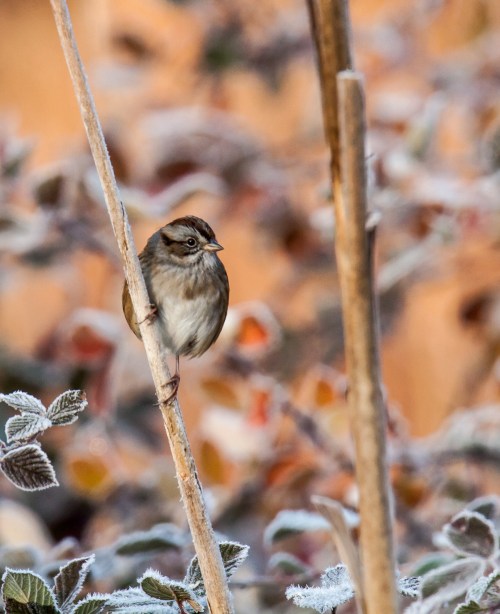
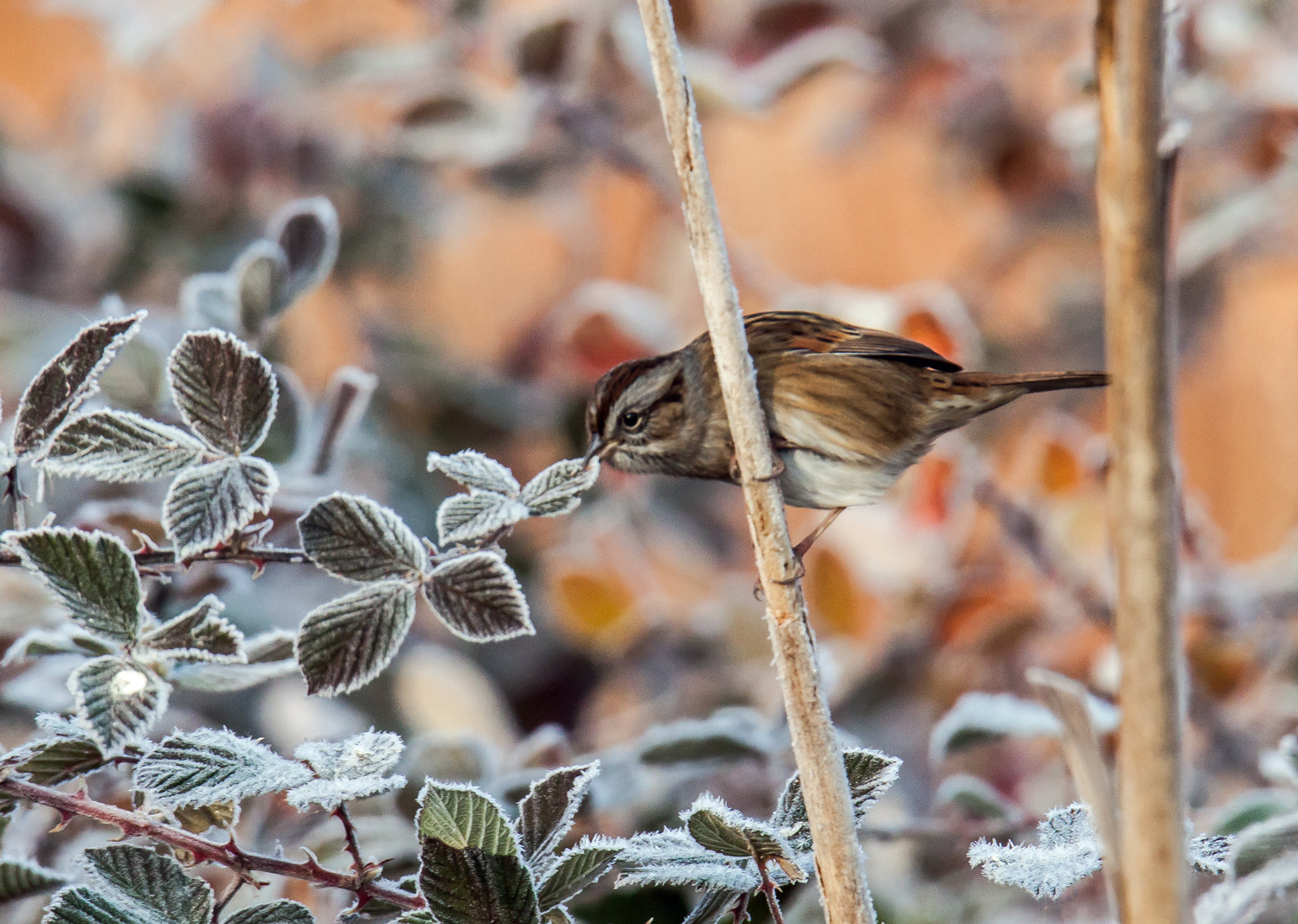
It was really frosty yesterday morning in the back area of Huntley Meadows Park where I spotted this Swamp Sparrow (Melospiza georgiana). I was standing in a mostly dried-up marshy area and noted that a series of little birds would stop at a little patch of vegetation in the middle as they pecked about in the cattails and denser vegetation at the tree lines on either side of me.
I parked myself with my monopod far enough away from the vegetation that I hoped that I would not disturb the birds and eventually the birds began to return to the area on which I was focused. There were a lot of small branches that kept misleading my auto-focus, so I switched to manual focus and waited. I could see birds pretty frequently, but most remained partially hidden down low near the ground.
Eventually my patience was rewarded and I got these two shots of a little sparrow. I wasn’t sure what kind of sparrow it was, but got some assistance on-line and learned that it was a Swamp Sparrow.
The background looks a little unusual in terms of the coloration, but it is a pretty good reflection of what I was seeing. That is also the reason why I was willing to plant myself in one spot—generally I like to keep moving as I look for photo opportunities.

© Michael Q. Powell. All rights reserved.
Posted in Autumn, Birds, Nature, Photography, wildlife | Tagged Alexandria VA, Canon 50D, Huntley Meadows Park, Melospiza georgiana, sparrow, swamp sparrow, Tamron 150-600mm | 5 Comments »
December 2, 2017 by Mike Powell
This bird was tiny and elusive, but I finally managed to get a shot of what I confirmed is a Winter Wren (Troglodytes hiemalis) today at Huntley Meadows Park. The Winter Wren is smaller—about 3-4 inches (8-11 mm) in length—and has darker markings on its belly than the Carolina Wrens that I am more accustomed to seeing.
The description of this bird found on the website of the Cornell Lab of Ornithology matches perfectly the behavior I observed today. “It habitually holds its tiny tail straight up and bounces up and down. This rather weak flier hops and scampers among fallen logs mouselike, inspecting upturned roots and vegetation for insects.”

© Michael Q. Powell. All rights reserved.
Posted in Birds, Nature, Photography, wildlife | Tagged Alexandria VA, Canon 50D, Huntley Meadows Park, Tamron 150-600mm, Troglodytes hiemalis, Winter Wren, wren | 12 Comments »
December 1, 2017 by Mike Powell
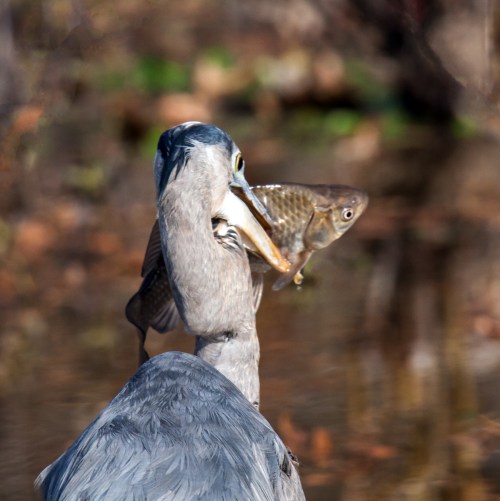
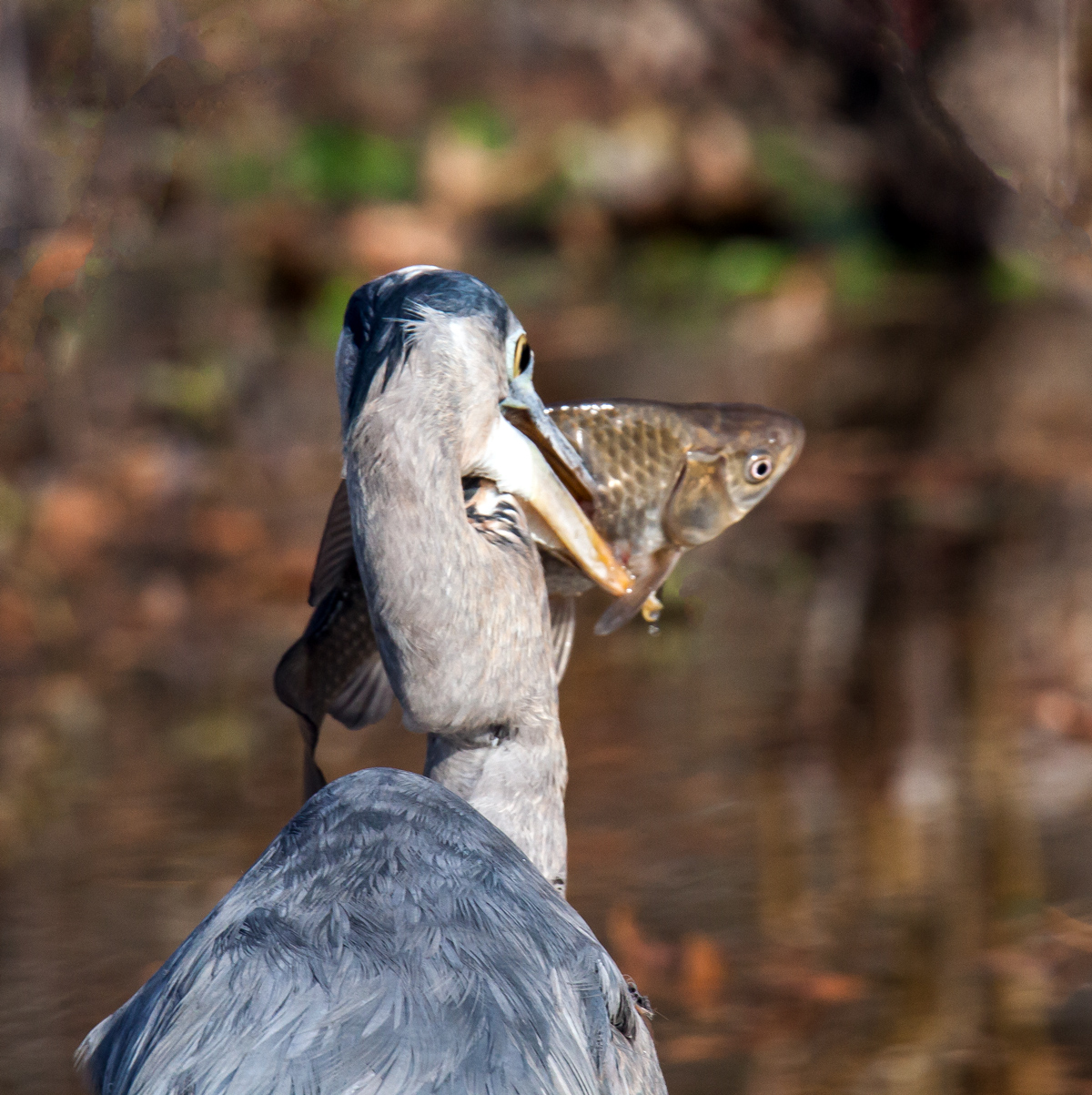
As I was watching a Great Blue Heron (Ardea herodias) at pretty close range from the boardwalk today at Huntley Meadows Park, I wrongly assumed that his nonchalant attitude meant that he was not fishing. He struck quickly and speared a pretty good-sized fish and immediately turned his back to me and headed for the shore. Partially hidden by the vegetation, the heron consumed his catch.
© Michael Q. Powell. All rights reserved.
Posted in Birds, Nature, Photography, wildlife | Tagged Alexandria VA, Ardea herodias, Canon 50D, fishing, Great Blue Heron, Huntley Meadows Park, Tamron 150-600mm | 18 Comments »
November 30, 2017 by Mike Powell
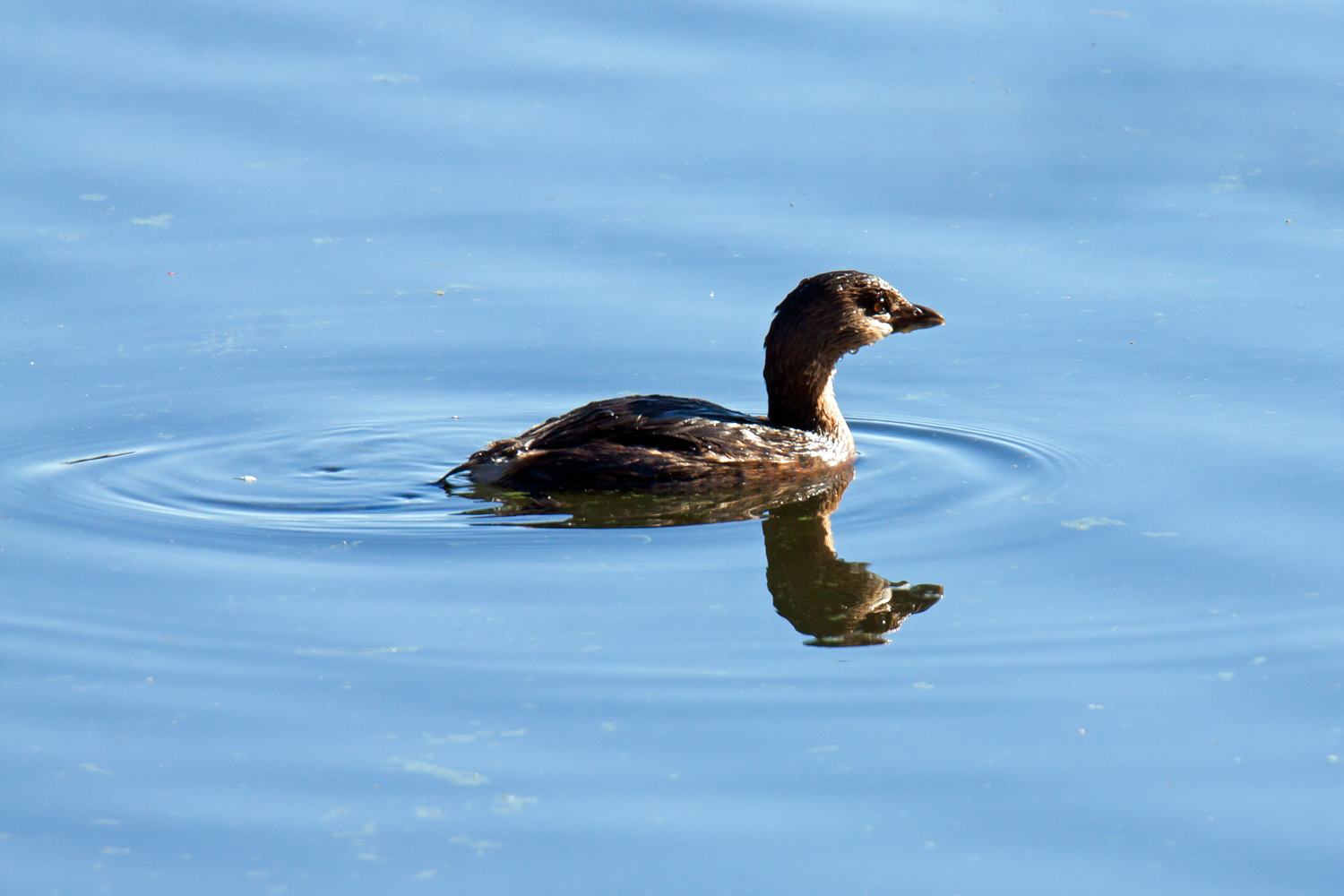
Although they behave like diving ducks, Pied-billed Grebes (Podilymbus podiceps) are members of an entirely different family and have small, distinctive bills that make them easy to identify. They tend to hang out in deeper water, are in constant motion, and are pretty small, which makes it a challenge to get a good shot of one. I spotted this grebe this past weekend at the same little suburban pond where I observed the Hooded Mergansers and Wood Duck that have been featured recently in recent blog posts.
As I do research on my subjects, I often run across quirky little facts about them. I smiled when I read the following information about Pied-billed Grebes on the website of the Cornell Lab of Ornithology:
“The Latin genus name for “grebe” means “feet at the buttocks”—an apt descriptor for these birds, whose feet are indeed located near their rear ends. This body plan, a common feature of many diving birds, helps grebes propel themselves through water. Lobed (not webbed) toes further assist with swimming. Pied-billed Grebes pay for their aquatic prowess on land, where they walk awkwardly.”
I haven’t yet seen grebes out of the water, but I am really curious now to get a look at their feet.

© Michael Q. Powell. All rights reserved.
Posted in Birds, Nature, Photography, wildlife | Tagged Alexandria VA, Canon 50D, Grebe, Kingstowne, Pied-billed Grebe, Podilymbus podiceps, Tamron 150-600mm | 1 Comment »
November 29, 2017 by Mike Powell
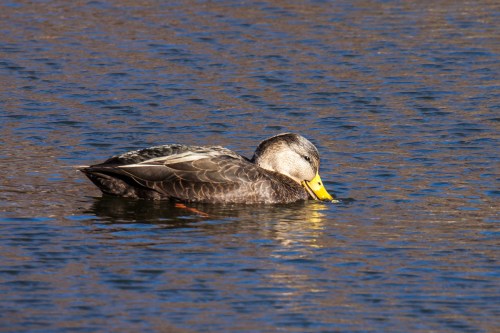
Can ducks smile? I realize that a duck’s bill is pretty inflexible, but I couldn’t help but think that this American Black Duck (Anas rubripes) was giving me a coy little smile as it dipped its bill into the water this past Monday at a small suburban pond in Kingstowne, Virginia..
When I first spotted two ducks swimming around together, I thought they were simply two female mallards. When I looked more closely at them, it seemed that their bills were brighter and more yellow than that of a a female mallard. When I got home, I pulled out my birding guide and looked through the section on ducks. I concluded that the two ducks, one of which is shown in the photo, are American Black Ducks.
When I am really uncertain about a bird species, I will post it to a Facebook page on which more experienced birders provide help with identification. In this case, I decided to be bold and make this posting without confirmation of my identification. If I am incorrect, it won’t be the first time, and certainly not the last time—bird identification is not easy, with lots of variation caused by gender, season, age, and location.
© Michael Q. Powell. All rights reserved.
Posted in Birds, Humor, Nature, Photography, wildlife | Tagged Alexandria VA, American Black Duck, Anas rubripes, Canon 50D, Kingstowne, Tamron 150-600mm | 6 Comments »
November 28, 2017 by Mike Powell
In the interests of gender equality, I decided to feature a handsome male Hooded Merganser duck (Lophodytes cucullatus) after spotlighting his beautiful female counterpart yesterday. I captured this image yesterday afternoon at a small suburban pond in Kingstowne, a community about a mile or so from where I live.
Hooded Merganser ducks are notoriously skittish and will usually fly away as soon as they sense my presence. The small group of “Hoodies” at this pond, however, react by swimming slowly away toward the center of the pond, where they are out of range of my long telephoto zoom lens. As a result, I have to react quickly whenever I am luck enough to catch one relatively close to the shore.

Having captured this image, I was faced with choices of how to crop it. Conventional wisdom dictates that a bird swimming to the right should be placed in the left side of the image. In this case, though, I really liked the V-shaped wake that the duck was leaving behind it, so I put the “Hoodie” just to the right of center. I encourage you to double-click on the image to see some of the details of this shot, like the drop of water on the tip of the duck’s bill.
As I contemplate the image, I can’t help but think how much the water deserves equal billing as the primary subject. I love the wake in the rear, the ripples in the front, the ripples coming toward the viewer, and the beautiful reflections.
© Michael Q. Powell. All rights reserved.
Posted in Autumn, Birds, Nature, Photography, wildlife | Tagged Alexandria VA, Canon 50D, Hooded Merganser, Hooded Merganser duck, Kingstowne, Lophodytes cucullatus, male Hooded Merganser, Tamron 150-600mm | 3 Comments »
November 27, 2017 by Mike Powell
Hooded Mergansers (Lophodytes cucullatus) are among my favorite ducks, and I especially love the freaky hairstyle of the females, like this one that I spotted this past Friday at the a small pond in Kingstowne, a suburban community in Northern Virginia near where I live.

© Michael Q. Powell. All rights reserved.
Posted in Autumn, Birds, Nature, Photography, wildlife | Tagged Canon 50D, female Hooded Merganser, Hooded Merganser, Hooded Merganser duck, hoodie, Kingstowne, Lophodytes cucullatus, Northern Virginia, Tamron 150-600mm | 7 Comments »
November 26, 2017 by Mike Powell
Three Wood Ducks (Aix sponsa) silently swam into view in the early morning light, their passage creating a trail of ripples in the still waters of the little creek. A sense of tranquility filled the air as another day slowly began.

© Michael Q. Powell. All rights reserved.
Posted in Birds, Nature, Photography, wildlife | Tagged Aix sponsa, Canon 50D, dawn, Occoquan Bay National Wildlife Refuge, Tamron 150-600mm, wood duck, Woodbridge VA | 4 Comments »
November 25, 2017 by Mike Powell
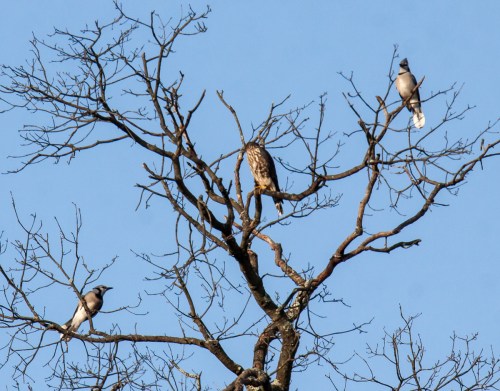
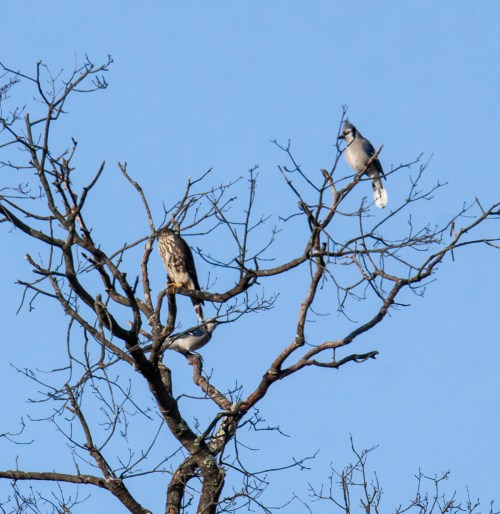
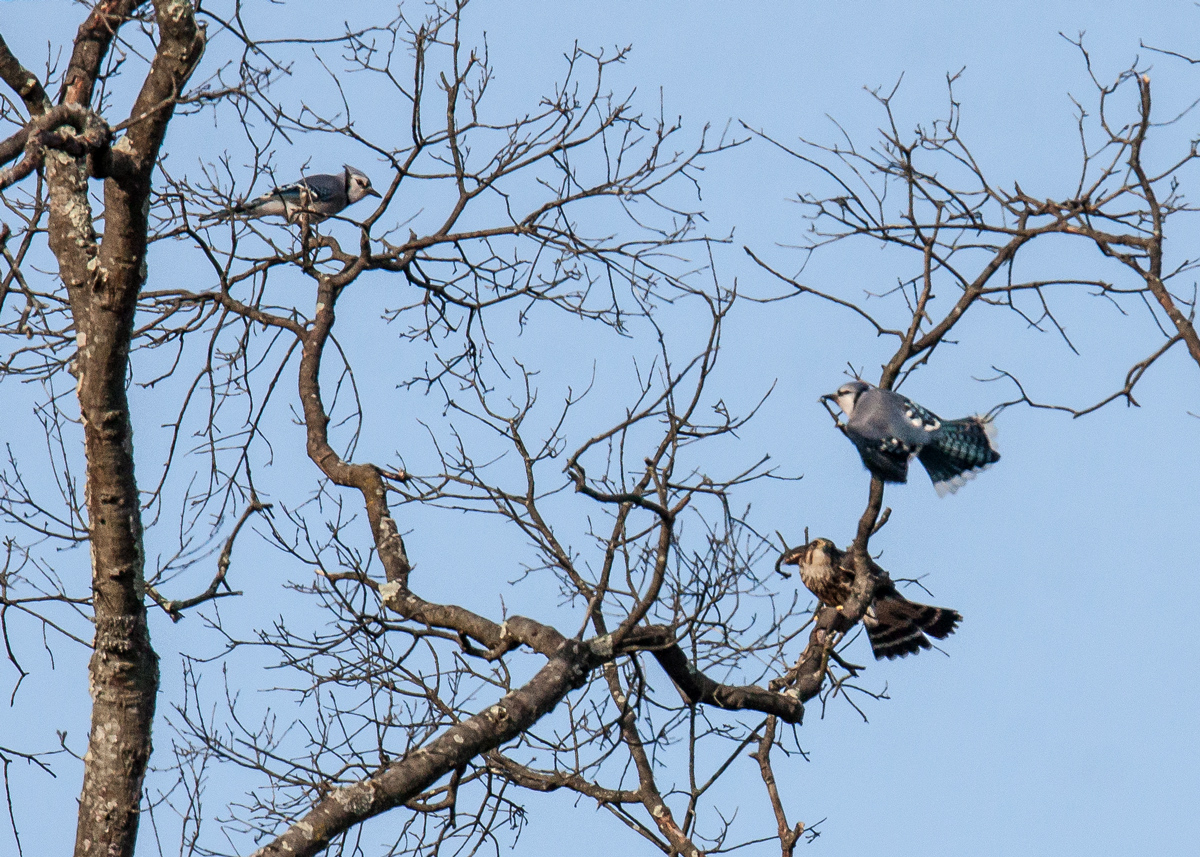
I really enjoy capturing action sequences of the interaction between creatures in the wild. It’s not easy sometimes to explain the behavior that I observe, but often it seems that many wild creatures have a sense of territoriality and will fiercely defend their space against all encroachers.
That seems to have been the case on Thanksgiving Day when I observed two Blue Jays (Cyanocitta cristata) harassing a Merlin (Falco columbarius) at Huntley Meadows Park in Northern Virginia. I have seen blackbirds and crows in the past harassing eagles and hawks and have been shocked to see how much smaller the aggressors were than the birds they were chasing. In this case, however, the blue jays and the merlin appeared to be about the same size.
The blue jays appeared to be using a variety of techniques. The two shots below show one of the blue jays buzzing the merlin, flying surprising close to the little falcon.


The next three shots show a concerted effort to crow the merlin. Initially the blue jays positioned themselves on opposite sides of the merlin. Then one of the blue jays moved closer, to a position almost directly below the merlin. In the final shot, the merlin exploded into the air and one of the blue jays simultaneously took off to chase after the merlin.
I took these shots from quite a distance away and still had to crop them a lot, but I think the images still manage to show some pretty fascinating behavior that I was privileged to observe and document.

© Michael Q. Powell. All rights reserved.
Posted in Autumn, Birds, Nature, Photography, wildlife | Tagged Alexandria VA, Blue Jay, Canon 50D, Cyanocitta cristata, Falco columbarius, Huntley Meadows Park, Merlin, Tamron 150-600mm | 13 Comments »
November 24, 2017 by Mike Powell
What was on your menu for Thanksgiving? No, I did not dine on muskrat for Thanksgiving dinner, but early in the morning yesterday this little muskrat (Ondatra zibethicus) at Huntley Meadows Park decided to celebrate the holiday with some fresh greens. That was almost certainly a healthier meal than most of us consumed later in the day.

© Michael Q. Powell. All rights reserved.
Posted in animals, Nature, Photography, Thanksgiving, wildlife | Tagged Alexandria VA, Canon 50D, Huntley Meadows Park, muskrat, Ondatra zibethicus, Tamron 150-600mm | 3 Comments »
November 24, 2017 by Mike Powell
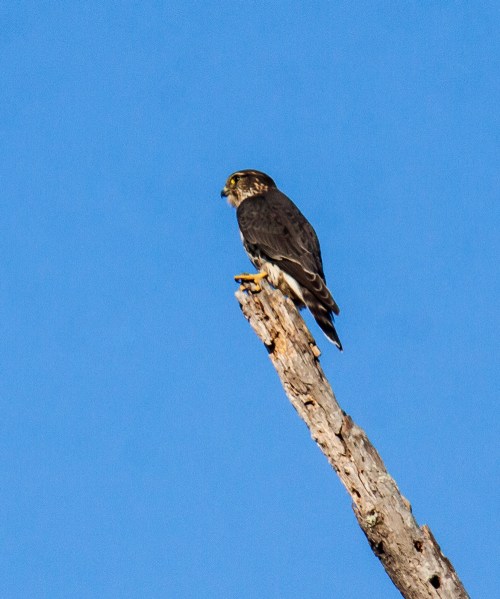
When I saw this bird in the distance being harassed by two blue jays on Thanksgiving Day at Huntley Meadows Park, I wasn’t sure what it was, but folks at What’s This Bird Facebook group identified it for me as a Merlin (Falco columbarius), a type of small falcon. I shot quite a few photos attempting to pbotograph the two blue jays flying by the merlin and perching close to it, but I am not sure how well I was able to capture the action. If I get a few that are reasonably clear, I may do another posting with the merlin, a bird that I believe that I had previously seen only once before.

© Michael Q. Powell. All rights reserved.
Posted in Autumn, Birds, Nature, Photography, Thanksgiving, wildlife | Tagged Alexandria VA, Canon 50D, Falco columbarius, Huntley Meadows Park, Merlin, Tamron 150-600mm | 4 Comments »
November 23, 2017 by Mike Powell
Early on Thanksgiving morning, some Northern Pintail ducks (Anas acuta) at Huntley Meadows Park in Northern Virginia decided to celebrate the holiday by sleeping in a bit. Their decision may have been prompted in part by the weather—it was just below freezing and a thin layer of ice covered some of the water at the park. Unlike the ducks, I did not sleep in and ventured out into the frosty morning to see what I could discover.
Happy Thanksgiving to all those who are celebrating this special day. Even if you are not, it’s always a good idea to pause for a minute to remember all of the blessings in our lives that so often we take for granted.

© Michael Q. Powell. All rights reserved.
Posted in Autumn, Birds, Nature, Photography, wildlife | Tagged Alexandria VA, Anas acuta, Canon 50D, Huntley Meadows Park, Northern Pintail, Northern Pintail Duck, Tamron 150-600mm, Thanksgiving, Thanksgiving Day | 2 Comments »
November 22, 2017 by Mike Powell
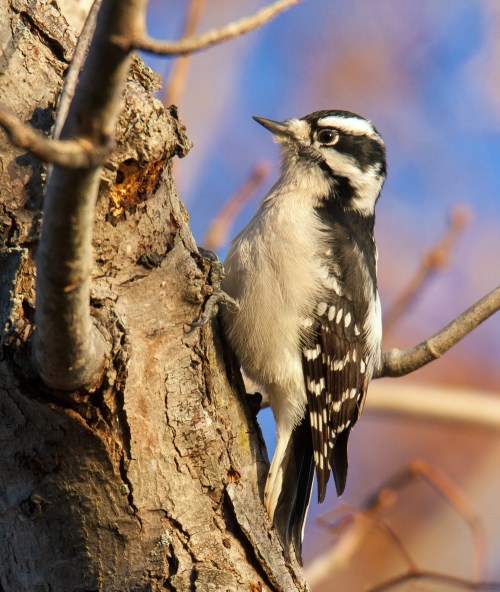
I have always admired the fierce determination and intense focus of little Downy Woodpeckers (Picoides pubescens) as they hammer away at the trees in search of something to eat, like this beauty that I spotted this past Monday at Occoquan Bay National Wildlife Refuge.
© Michael Q. Powell. All rights reserved.
Posted in Autumn, Birds, Nature, Photography, wildlife | Tagged Canon 50D, Downy Woodpecker, Occoquan Bay National Wildlife Refuge, Picoides pubescens, Tamron 150-600mm, Woodbridge VA | 3 Comments »
November 21, 2017 by Mike Powell
Seeing one Bald Eagle (Haliaeetus leucocephalus) is pretty exciting, but seeing two together is even more awesome. I spotted these two eagles on Monday morning at Occoquan Bay National Wildlife Refuge.
At a certain location within the refuge there is a tall pole, which resembles a telephone pole, with a wooden platform. I am not sure of its purpose, but several times in the past I have seen a bald eagle perching on it. I have tried several times to get shots of the eagle, but have generally been unsuccessful, because of the height of the pole and the fact that I cannot get close to it.
When I spotted an eagle there yesterday morning, I decided to give it another shot, hoping that my monopod would help me to get a sharp enough shot to survive a severe crop. As my eye was pressed to the viewfinder taking some shots, imagine my surprise when another bald eagle entered the frame and landed next to the first one. They perched together for a little while and then the larger of the two, which I later learned is the female, began to embrace the other, eventually using her beak to give what looked like a kind of massage. What was going on?
Thanks to some experienced birders in a Facebook group, I learned that the breeding season for eagles in our area begins in early December and that this is likely a bonded pair. I also discovered that the pecking that I observed, as seen in the second photo below, is almost certainly a kind of courting behavior.
I think that there may be several pairs of bald eagles at this wildlife refuge, so I will keep my eyes open for more of this kind of behavior and for more photographic opportunities.


© Michael Q. Powell. All rights reserved.
Posted in Autumn, Birds, Nature, Photography, wildlife | Tagged Bald Eagle, Bald Eagle couple, Canon 50D, eagle, Occoquan Bay National Wildlife Refuge, Tamron 150-600mm, Woodbridge VA | 14 Comments »
November 20, 2017 by Mike Powell
I spotted this very blue Eastern Bluebird (Sialia sialis) last Friday morning at Huntley Meadows Park. The brightness of its color suggests to me that it is probably a male—the females tend to have duller plumage.
When I posted this photo on Facebook, I got lots of “Likes,” which is not all that surprising to me. Over time I have come to realize that many of my best-like photos have been the ones with the simplest of compositions and often have featured relatively common subjects. In this case, I managed to capture the bluebird pretty well, but the branch on which it is perched has some nice texture and perhaps most important of all, the background is pretty cool, with the faint shapes of the tree trunks and autumn foliage rendered in a pleasing blur of shapes and colors.
Beauty is often very subjective, but in rare cases like this one an image seems to have an almost universal appeal.

© Michael Q. Powell. All rights reserved.
Posted in Autumn, Birds, Nature, Photography, wildlife | Tagged Alexandria VA, bluebird, Canon 50D, Eastern Bluebird, Huntley Meadows Park, Sialia sialis, Tamron 150-600mm | 10 Comments »
November 19, 2017 by Mike Powell
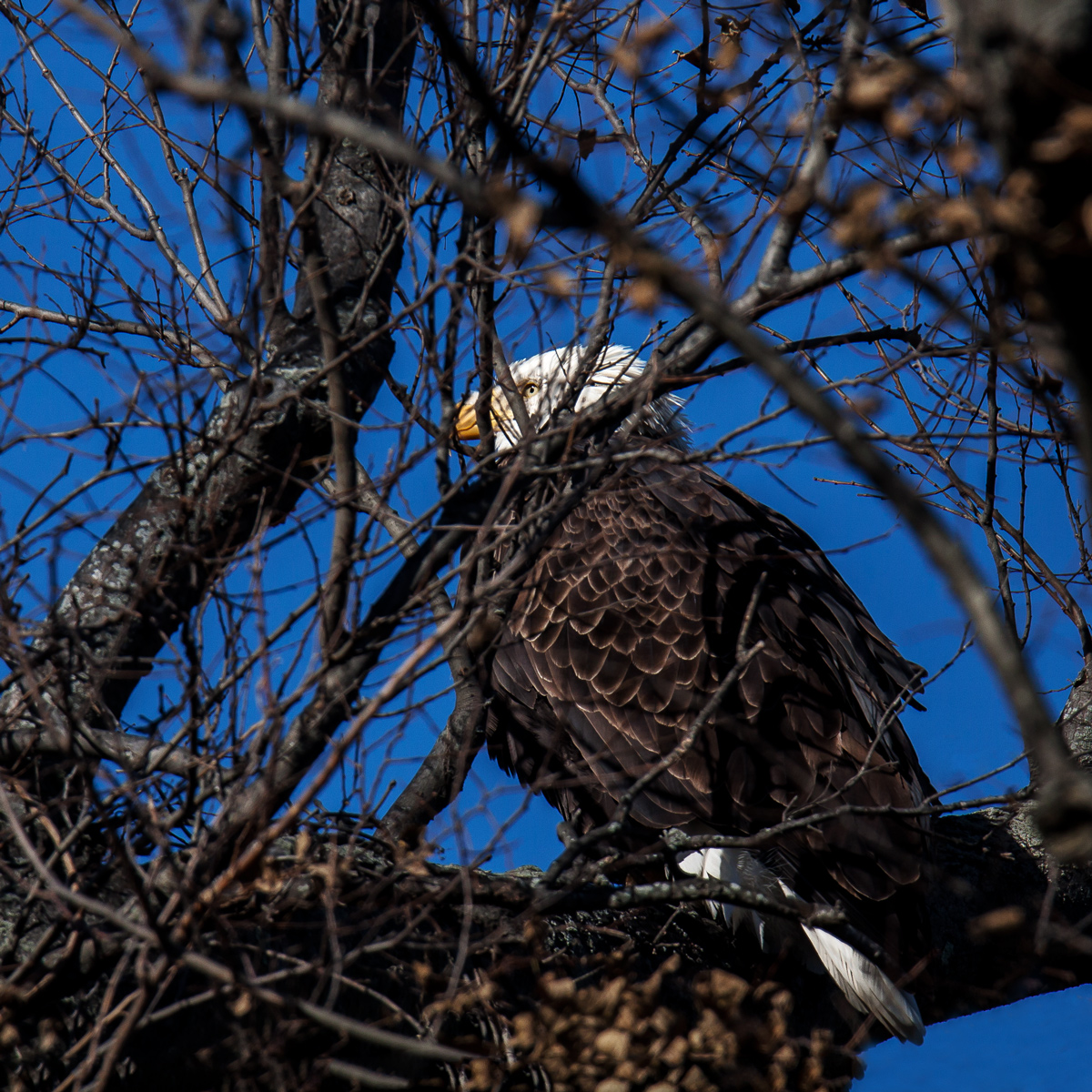
It’s almost impossible to sneak up on a Bald Eagle (Haliaeetus leucocephalus), but that didn’t stop me from attempting to do so this past Friday afternoon at Occoquan Bay National Wildlife Refuge. I was walking along a trail that runs to parallel to the water when I spotted the unmistakable white head of a Bald Eagle. The eagle was partially hidden in a mass of branches and was facing away from me, so I moved forward with as much stealth as I could manage.
When I reached a point where I was shooting up at a rather steep angle, I stopped and waited, hoping the eagle would turn its head to the side and offer me a glimpse of its eyes. Eventually that happened and I shifted from side to side in a desperate attempt to capture an unobstructed view of its eye. Clearly this is not the best shot of a Bald Eagle that I have ever captured, but I do like the pose and the details in its feathers. Besides, it’s a Bald Eagle, a subject that never fails to excite me.

© Michael Q. Powell. All rights reserved.
Posted in Autumn, Birds, Nature, Photography, wildlife | Tagged Bald Eagle, Canon 50D, eagle, Haliaeetus leucocephalus, Occoquan Bay National Wildlife Refuge, Tamron 150-600mm, Woodbridge VA | 1 Comment »
November 19, 2017 by Mike Powell
I spotted some cute little American Goldfinches (Spinus tristis) early on Friday morning as they foraged in the vegetation adjacent to the observation tower at Huntley Meadows Park. The lighting was somewhat limited, but it was soft and beautiful and gives the photos an overall sense of peace and serenity, the start of a new day.


© Michael Q. Powell. All rights reserved.
Posted in Autumn, Birds, Nature, Photography, wildlife | Tagged Alexandria VA, American Goldfinch, Canon 50D, Huntley Meadows Park, Spinus tristis, Tamron 150-600mm | 7 Comments »
« Newer Posts - Older Posts »
















 Mike Powell