June 28, 2019 by Mike Powell
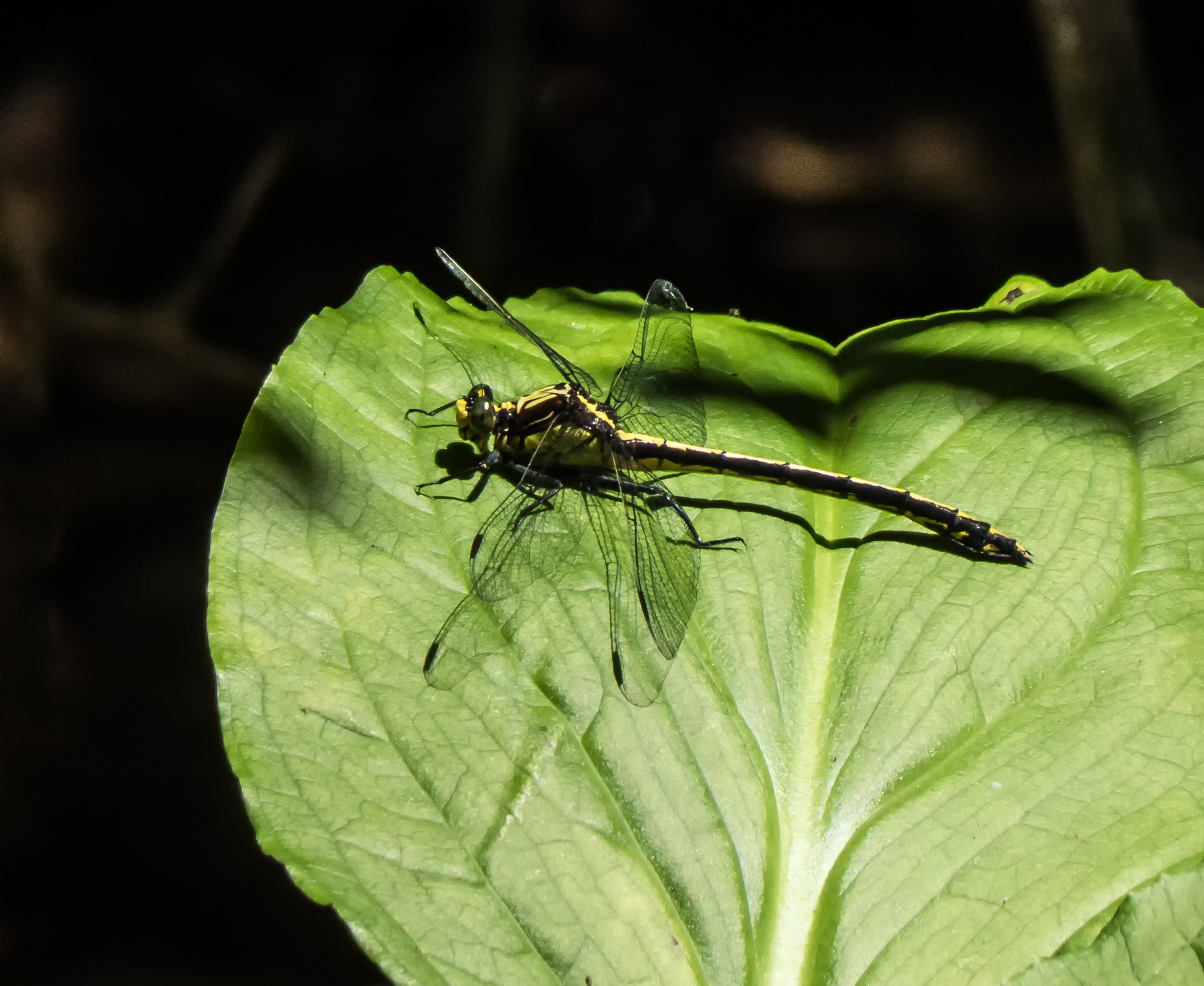
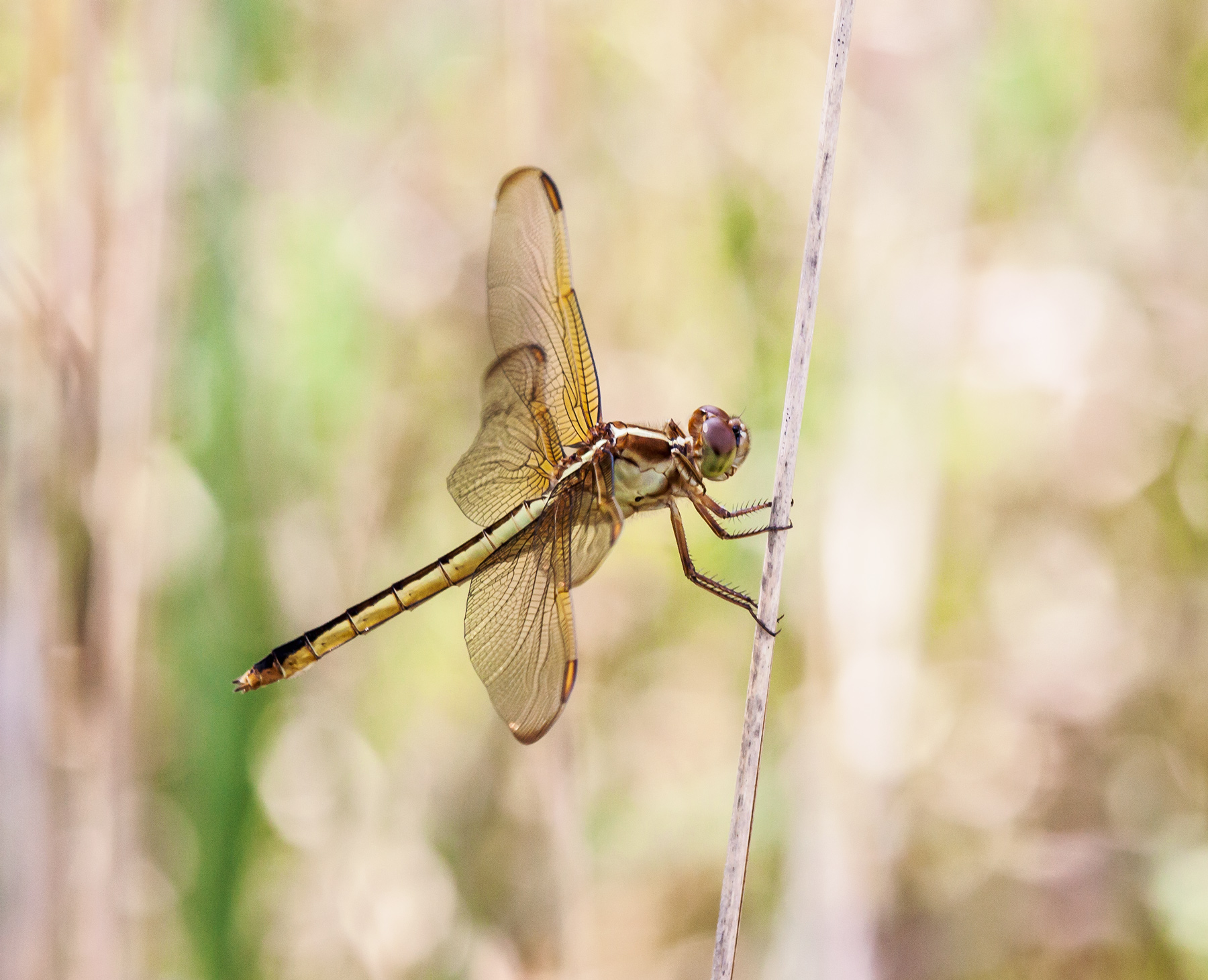
Perhaps there are dragonflies with longer names than the Black-shouldered Spinyleg dragonfly (Dromogomphus spinosus), but none of them immediately come to mind. Sometimes I will complain about the inaccurate names given to various species, but in this case the descriptors are accurate. Alas, when I spotted this dragonfly in a boggy area of Prince William County, Virginia last week, I couldn’t get close enough to capture those details very well.
The vegetation on which the dragonfly is perched is skunk cabbage, a plant that grows in the mucky confines of seeps and swamps. It is said that bruised leaves present a fragrance reminiscent of skunk, so I try to step carefully whenever I am near any skunk cabbage.

© Michael Q. Powell. All rights reserved.
Posted in Dragonflies, dragonfly, Nature, Photography, Summer, wildlife | Tagged Black-shouldered Spinyleg, Black-shouldered Spinyleg dragonfly, Canon 50D, Dromogomphus spinosus, Prince William County VA, Tamron 180mm | 7 Comments »
June 27, 2019 by Mike Powell
Last Tuesday as I was exploring Occoquan Bay National Wildlife Refuge I spotted this handsome male Calico Pennant dragonfly (Celithemis elisa). Unlike some species that perch close to the ground and are hard to see, Calico Pennants perch on the uttermost tips of vegetation. Although they are visible, they are often hard to photograph, because their precarious perches start to sway at the slightest hint of a breeze.

© Michael Q. Powell. All rights reserved.
Posted in Dragonflies, dragonfly, Insects, Nature, Photography, Summer, wildlife | Tagged Calico Pennant, Calico Pennant dragonfly, Canon 50D, Celithemis elisa, male Calico Pennant, Occoquan Bay National Wildlife Refuge, Tamron 180mm, Woodbridge VA | 4 Comments »
June 26, 2019 by Mike Powell
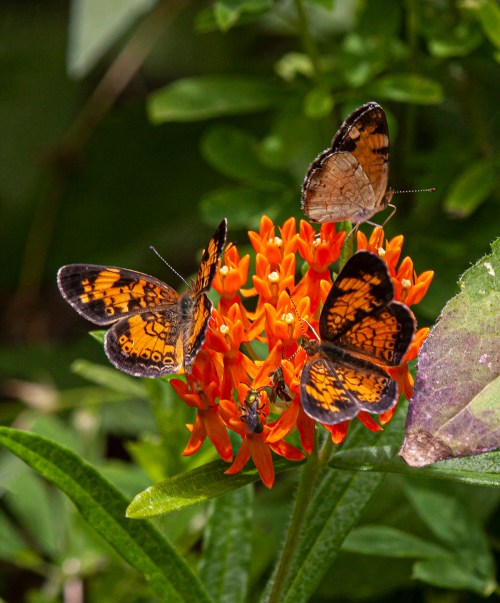
On Monday I spotted this small patch of Butterfly Weed (Asclepias tuberosa) at Jackson Miles Abbott Wetland Refuge. True to its name, the Butterfly Weed had attracted several butterflies, which I think are Pearl Crescent butterflies (Phyciodes tharos), as well as several metallic green sweat bees (genus Agapostemon). The insects seemed to love the plant’s nectar and the scene provided a visual feast for viewers like me.
© Michael Q. Powell. All rights reserved.
Posted in Butterflies, Insects, Nature, Photography, Summer, wildlife | Tagged Agapostemon, Asclepias tuberosa, Butterfly Weed, Canon 50D, Fort Belvoir VA, Jackson Miles Abbott Wetland Refuge, metallic green sweat bee, Pearl Crescent, pearl crescent butterfly, Phyciodes tharos, Tamron 180mm | 13 Comments »
June 25, 2019 by Mike Powell
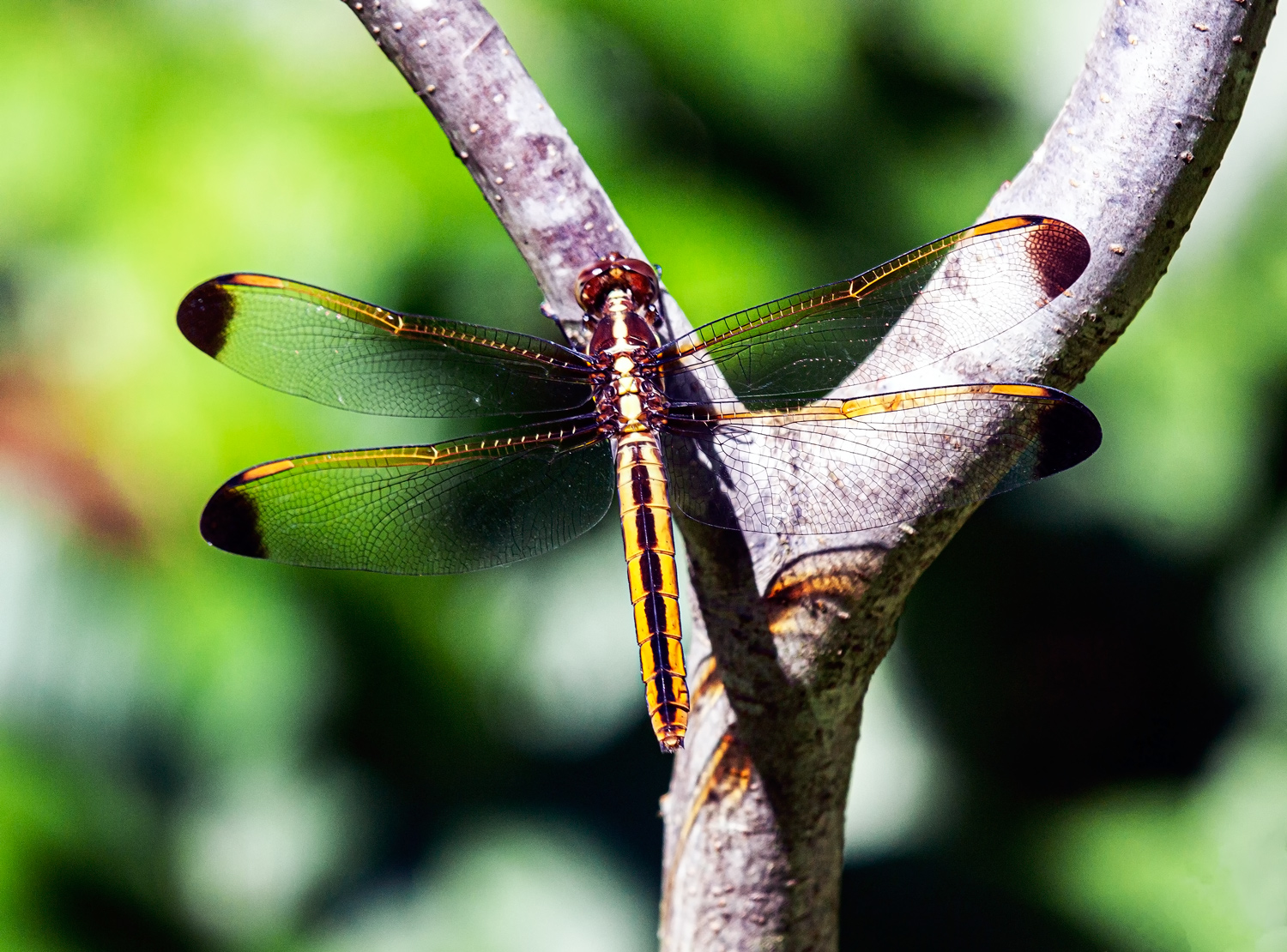
Although I love seeing my old familiar dragonfly friends, it is always exciting to observe new species. Last week while I was exploring in Prince William County, Virginia with fellow dragonfly enthusiast Walter Sanford, I spotted this dragonfly perched on a small tree. I really liked the pose and moved closer for some shots.
I initially thought it was a Needham’s Skimmer, a fairly common species in our area, but the more I looked at my photos afterwards on my computer screen, the more I began to note some differences in the colors and patterns on wings and the body. After consultations with some dragonfly experts on Facebook, I learned that it is a Yellow-sided Skimmer (Libellula flavida).
As far as I know, this is the first time that I have seen a Yellow-sided Skimmer. There is a possibility that I have unwittingly seen one in the past and dismissed it as “only” a common species. I try not to do that, because this is not the first time that I have photographed something new without realizing until later that it was in fact new.

© Michael Q. Powell. All rights reserved.
Posted in Dragonflies, dragonfly, Insects, Nature, Photography, Summer, wildlife | Tagged Canon 50D, Libellula flavida, Prince William County VA, Tamron 180mm, Yellow-sided Skimmer, Yellow-sided Skimmer dragonfly | 8 Comments »
June 24, 2019 by Mike Powell
Dragonhunter dragonflies (Hagenius brevistylus) love to perch and wait for their prey to come by and then use their powerful back legs to snag that prey, which is often another dragonfly. Those legs are so long and ungainly, though, that Dragonhunters’ poses often seem awkward when they are perched—they remind me of teenage males who have undergone a recent growth spurt and haven’t gotten used to their longer limbs.
Last Friday as I was exploring a stream at Prince William Forest Park with fellow blogger and dragonfly enthusiast Walter Sanford, he spotted this female Dragonhunter perched at the edge of the water. I was walking toward him when I spotted the Dragonhunter on the rocks that I featured yesterday and was delayed in getting to see this dragonfly. Fortunately, she was relatively tolerant of our presence and remained in place long enough for me to get some shots.
All of the images that I captured show a side view of the Dragonhunter, because she was facing toward the water and I was trying not to get wet. Walter, however, wanted more of a frontal view and waded into the water to get that shot. Check out today’s posting on his blog and you can compare the results of our different approaches.

© Michael Q. Powell. All rights reserved.
Posted in Dragonflies, dragonfly, Insects, Nature, Photography, Summer, wildlife | Tagged Canon SX50, Dragonhunter, dragonhunter dragonfly, female Dragonhunter, Hagenius brevistylus, Prince William County VA, Prince William Forest Park | 9 Comments »
June 23, 2019 by Mike Powell
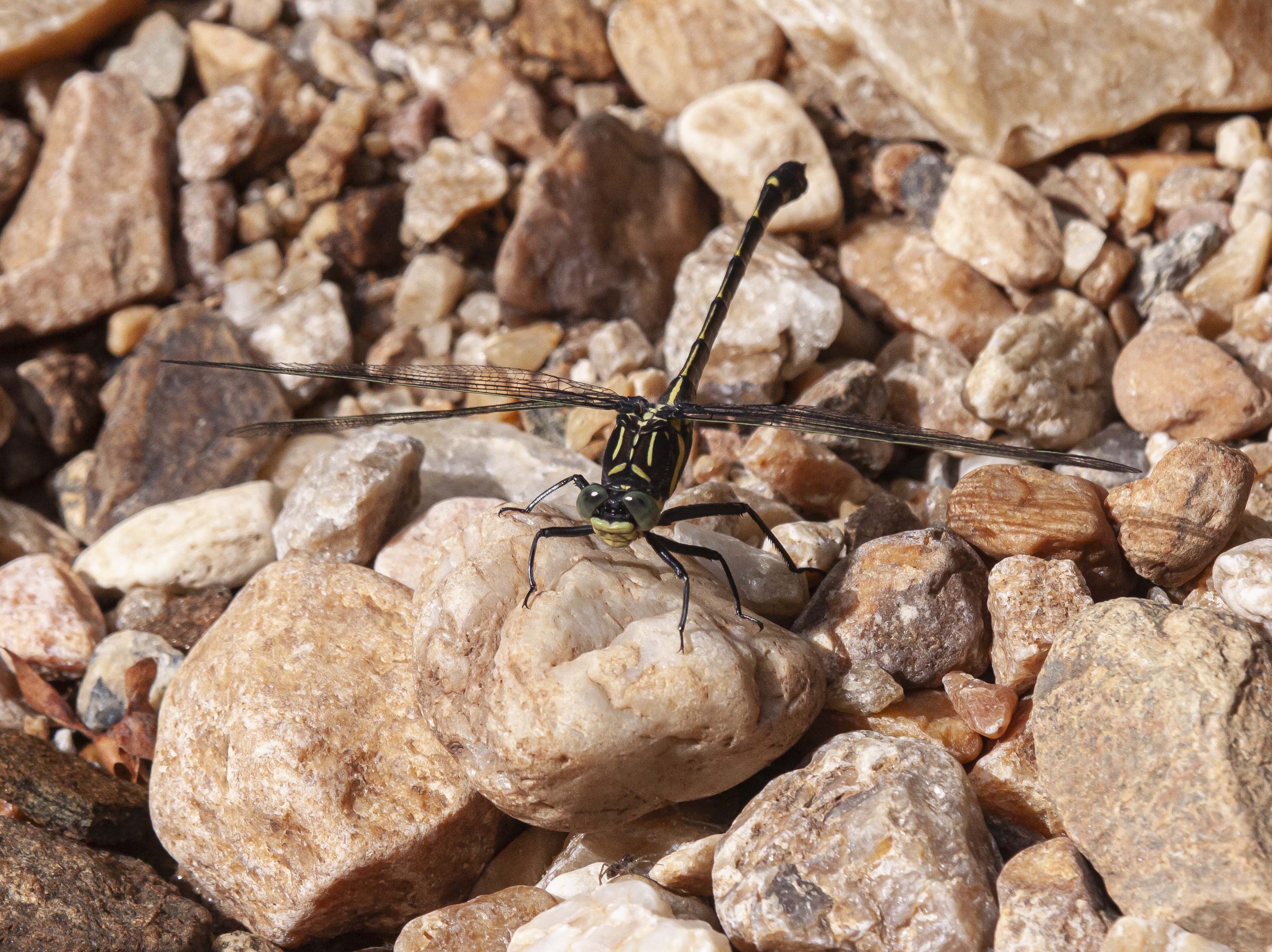
Dragonfly on the rocks? It sounds like a summertime beverage, but it accurately describes what I saw last Friday while exploring a stream in Prince William County, Virginia with fellow dragonfly enthusiast Walter Sanford. I think it is a Dragonhunter dragonfly (Hagenius brevistylus), but the unusual angle makes it tough to made a definitive determination of the species, because I am not able to see critical portions of the dragonfly’s anatomy.
In the past when I have spotted Dragonhunters, they have been perched on branches overhanging the water and that is where I expect to find them. This encounter is a good reminder for me to stay alert at all times—my subjects may not have read the identification guides about how they are supposed to behave.

© Michael Q. Powell. All rights reserved.
Posted in Dragonflies, dragonfly, Insects, Nature, Photography, Summer, wildlife | Tagged Canon 50D, dragonfly on the rocks, Dragonhunter, dragonhunter dragonfly, Hagenius brevistylus, Prince William County VA, Tamron 180mm | 10 Comments »
June 22, 2019 by Mike Powell
When the weather gets hot, some dragonflies will raise their abdomens (the “tail”) in what is believed to be an attempt at thermoregulation. I can’t say for sure if it works, but the theory is that in this position, sometimes referred to as the “obelisk,” dragonflies are able to stay cooler by reducing the amount of their bodies subject to direct sunlight.
Earlier this week I spotted this male Eastern Amberwing dragonfly (Perithemis tenera) in a modest obelisk position at Jackson Miles Abbott Wetland Refuge. I characterized the position as “modest,” because sometimes a dragonfly will elevated its abdomen until is almost vertical.
© Michael Q. Powell. All rights reserved.
Posted in Dragonflies, dragonfly, Insects, Nature, Photography, Summer, wildlife | Tagged Canon 50D, Eastern Amberwing, Eastern Amberwing dragonfly, Fort bel, Jackson Miles Abbot Wetland Refuge, male Eastern Amberwing, Perithemis tenera, Tamron 180mm | 6 Comments »
June 21, 2019 by Mike Powell
When I spotted a small patch of milkweed while exploring Occoquan Bay National Wildlife Refuge earlier this month, I stopped and waited. I knew that numerous butterflies are attracted to this plant. Before long, several butterflies in fact appeared.
Here are photos of two of them, both swallowtail butterflies. The first one, a Spicebush Swallowtail (Papilio troilus), appears to be in perfect condition. Its wings and “tails” are intact and its colors are vibrant. By contrast the second butterfly, a Zebra Swallowtail (Protographium marcellus), is clearly a veteran. There are chunks missing from its wings and its long beautiful swallowtails are gone.
Do you find one of the butterflies to be more inherently beautiful than the other? Here in the United States, we tend to worship beauty and a standard of supposed perfection. We are daily bombarded with advertising messages that tell us we can look young again, that we can cover up our imperfections. The current focus on selfies and dating apps that allow you to judge others with a swipe encourages a kind of narcissism and attention to superficial appearances that I personally find to be unhealthy.
I remember watching a video several years ago about photographing nature. The photographer encouraged viewers to photograph only perfect specimens of flowers and insects, following the lead of those who say that in order to create beautiful photographs, you need beautiful subjects.
The photos here are my response to that kind of thinking. There is an incredible beauty to be discovered in the ordinary, everyday subjects that surround us, full of imperfections and blemishes. Take a moment today to slow down and truly experience that beauty.


© Michael Q. Powell. All rights reserved.
Posted in Butterflies, Insects, Nature, Photography, Summer, wildlife | Tagged Canon 50D, Occoquan Bay National Wildlife Refuge, Papilio troilus, Protographium marcellus, Spicebush Swallowtail, Spicebush Swallowtail butterfly, Tamron 150-600mm, Woodbridge VA, Zebra Swallowtail, Zebra Swallowtail butterfly | 17 Comments »
June 20, 2019 by Mike Powell
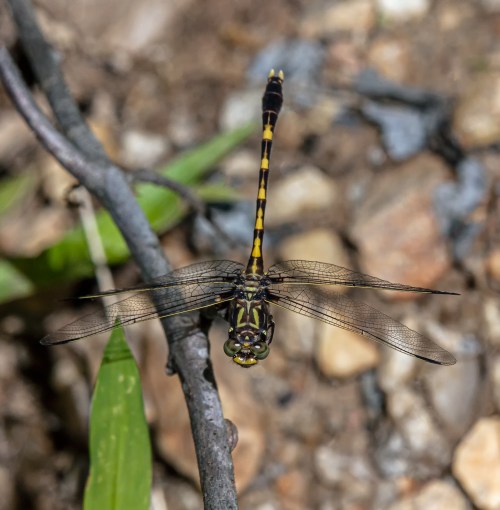
Most of the times that I have observed a Common Sanddragon dragonfly (Progomphus obscurus) it has been perched directly on the sand, which makes sense, given its name. Last week, however, I spotted this Common Sanddragon perched in some vegetation overhanging the water of a stream in Prince William County, Virginia.
I like the way that the dragonfly almost looks like he is flying, because I managed to take the photograph from almost directly overhead, causing the perch almost to disappear. I also really like the look of rocky portion of the stream that makes up most of the background of this image.
© Michael Q. Powell. All rights reserved.
Posted in Dragonflies, dragonfly, Insects, Nature, Photography, wildlife | Tagged Canon 50D, Common Sanddragon, Common Sanddragon dragonfly, Prince William County VA, Progomphus obscurus, Tamron 180mm | 3 Comments »
June 19, 2019 by Mike Powell
The most common view that I have had of White-tailed Deer (Odocoileus virginianus) the last few months has been of their bobbing tails as they ran away from me. Last week, however, I managed to capture some shots of a young buck as it ran laterally across a trail at Occoquan Bay National Wildlife Refuge.
When I first spotted the deer, its head was just sticking out of the vegetation at the edge of the trail. As you can see in the first image, the deer looked straight at me and seemed to hesitate a moment before deciding what to do. Without much warning, the deer sprung into action and I was able to capture these shots as the young deer bounded across the trail. Note how the deer had only a single hoof in contact with the ground in many of the photos.


© Michael Q. Powell. All rights reserved.
Posted in animals, Nature, Photography, wildlife | Tagged Canon 50D, deer, Occoquan Bay National Wildlife Refuge, Odocoileus virginianus, Tamron 150-600mm, white-tailed deer, Woodbridge VA, young buck | 13 Comments »
June 18, 2019 by Mike Powell
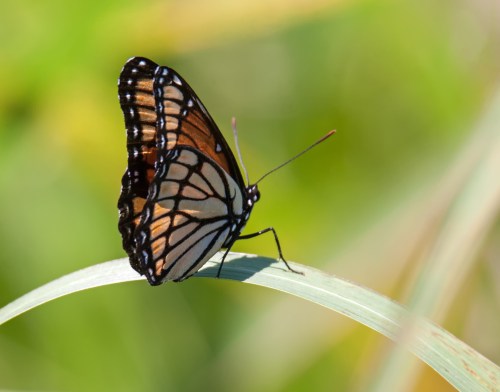
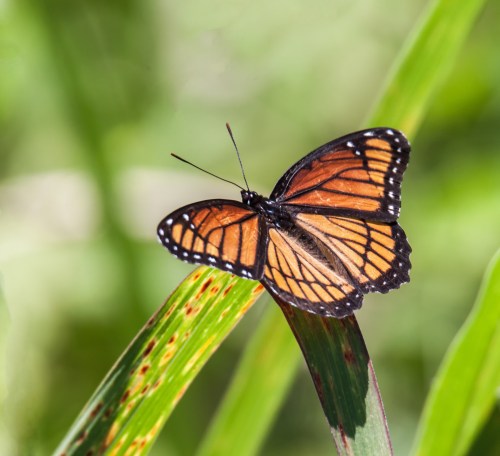
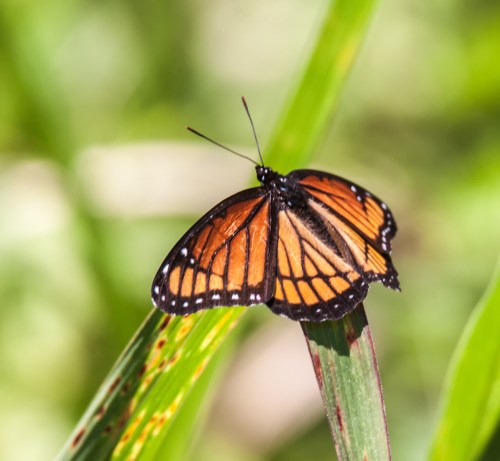
I have not yet spotted any Monarch butterflies this season, but last week at Occoquan Bay National Wildlife Refuge I did see a number of the similarly-colored Viceroy butterflies (Limenitis archippus). Viceroy butterflies are smaller than Monarchs, but the main visual difference between the two is the black line across the hind wings that is present with Viceroys, but not with Monarchs.
I chased after one Viceroy last week for quite some time and eventually managed to get these shots.
© Michael Q. Powell. All rights reserved.
Posted in Butterflies, Insects, Nature, Photography, Summer, wildlife | Tagged Canon 50D, Limenitis archippus, Occoquan Bay National Wildlife Refuge, Tamron 150-600mm, Viceroy, Viceroy butterfly, Woodbridge VA | 11 Comments »
June 17, 2019 by Mike Powell
Last week as I was exploring Prince William County, I encountered this large dragonfly perched in a tree overhanging a fairly large stream. When I captured these images, I was not sure what kind of dragonfly it was. After consultations with some experienced dragonfly experts, I learned that this is a female Dragonhunter dragonfly (Hagenius brevistylus).
Dragonhunters are among the largest dragonflies in our area. Unlike darners, another group of large dragonflies that fly almost continuously as they seek prey, dragonhunters prefer to perch and wait patiently before they strike. As their name suggests, they specialize in hunting other dragonflies, reportedly including members of their own species.


© Michael Q. Powell. All rights reserved.
Posted in Dragonflies, dragonfly, Insects, Nature, Photography, Summer, wildlife | Tagged Canon 50D, Dragonhunter, dragonhunter dragonfly, female Dragonhunter, Hagenius brevistylus, Prince William County VA, Tamron 180mm | 6 Comments »
June 15, 2019 by Mike Powell
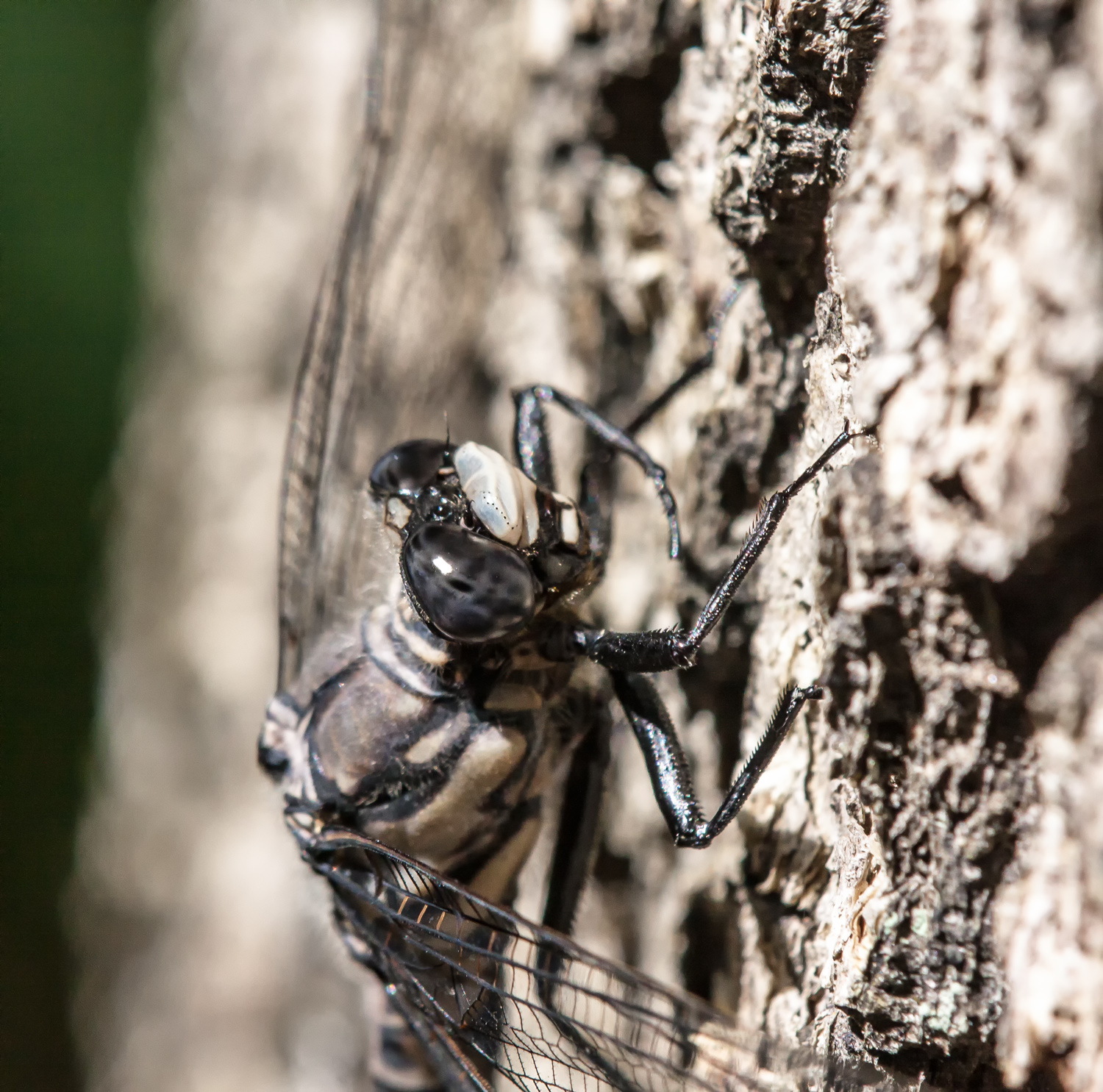
This past Wednesday I encountered a really cooperative Gray Petaltail dragonfly (Tachopteryx thoreyi) as I explored nearby Prince William County and was able to capture this tight head shot. I simply love this dragonfly’s beautiful gray eyes, which are a perfect for the monochromatic palette of the rest of its body and give this dragonfly a more sophisticated look than many of its more gaudily-clad brethren. (The coloration also helps this dragonfly to almost disappear from view when it is perched on a tree like this one.)

© Michael Q. Powell. All rights reserved.
Posted in Dragonflies, dragonfly, Insects, Nature, Photography, Portraits, wildlife | Tagged Canon 50D, Gray Petaltail, Gray Petaltail dragonfly, Prince William County VA, Tachopteryx thoreyi, Tamron 180mm | 4 Comments »
June 14, 2019 by Mike Powell
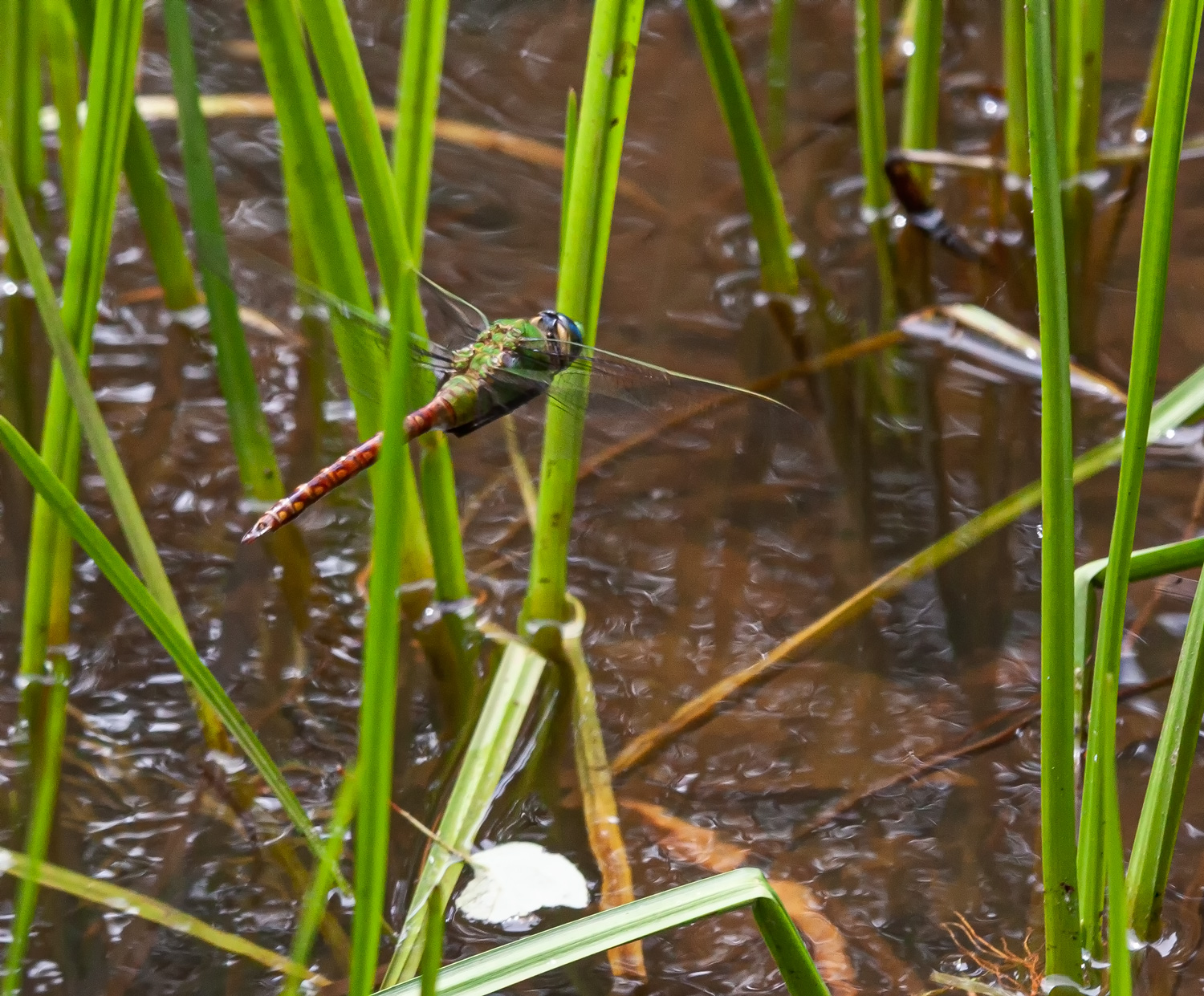
I have often thought that Comet Darner dragonflies (Anax longipes) are appropriately named for they have always been beautiful objects speeding by that I have been forced to admire from a distance. It is hard to miss a Comet Darner when they are around because they are very large and the red color on their bodies is so bright that it seems to glow. They generally patrol near the center of the ponds where I have seen them and I have never seen one stop to perch. According to the Dragonflies of Northern Virginia website, “Comets have expansive territories that may cover several miles and a network of small, shallow, forest-edged ponds. They’ll visit your pond, leave for 30 minutes to patrol other sites, then return.”
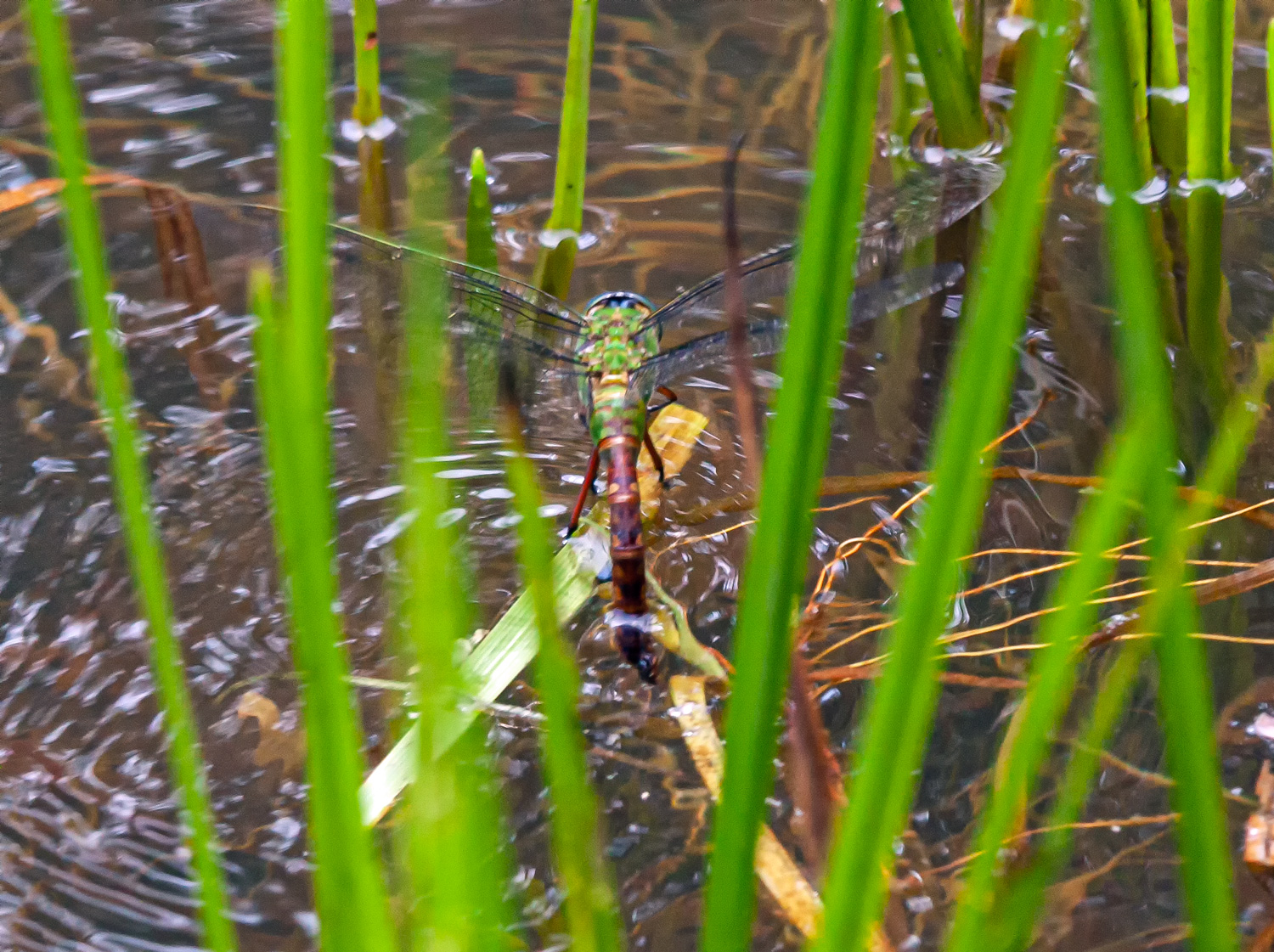
On Wednesday, I spotted a Comet Darner while I was at a small pond and started to track it in my camera’s viewfinder. Strangely this dragonfly was flying in and out of the vegetation growing in the shallow water, as you can see in the first shot. As I was trying to figure out what was going on, the Comet Darner dipped her abdomen in the water and began to deposit her eggs. If you look closely at the second image, it looks like she may actually have the tip of her abdomen submerged as she oviposited. I didn’t have a completely unobstructed view of this beautiful dragonfly, but I actually like the effect of the vegetation in the foreground—it helps to convey the sense that we are sharing a private moment.


© Michael Q. Powell. All rights reserved.
Posted in Dragonflies, dragonfly, Insects, Nature, Photography, wildlife | Tagged Anax longipes, Canon 50D, Comet Darner, Comet Darner dragonfly, Prince William County VA, Tamron 180mm | 5 Comments »
June 13, 2019 by Mike Powell
When it comes to photography, how do you balance its creative and technical components, how do you mix art and science? In the uncontrolled natural environment in which I take my photographs, I often have to be content with merely capturing an image, any image, of my subject before it disappears.
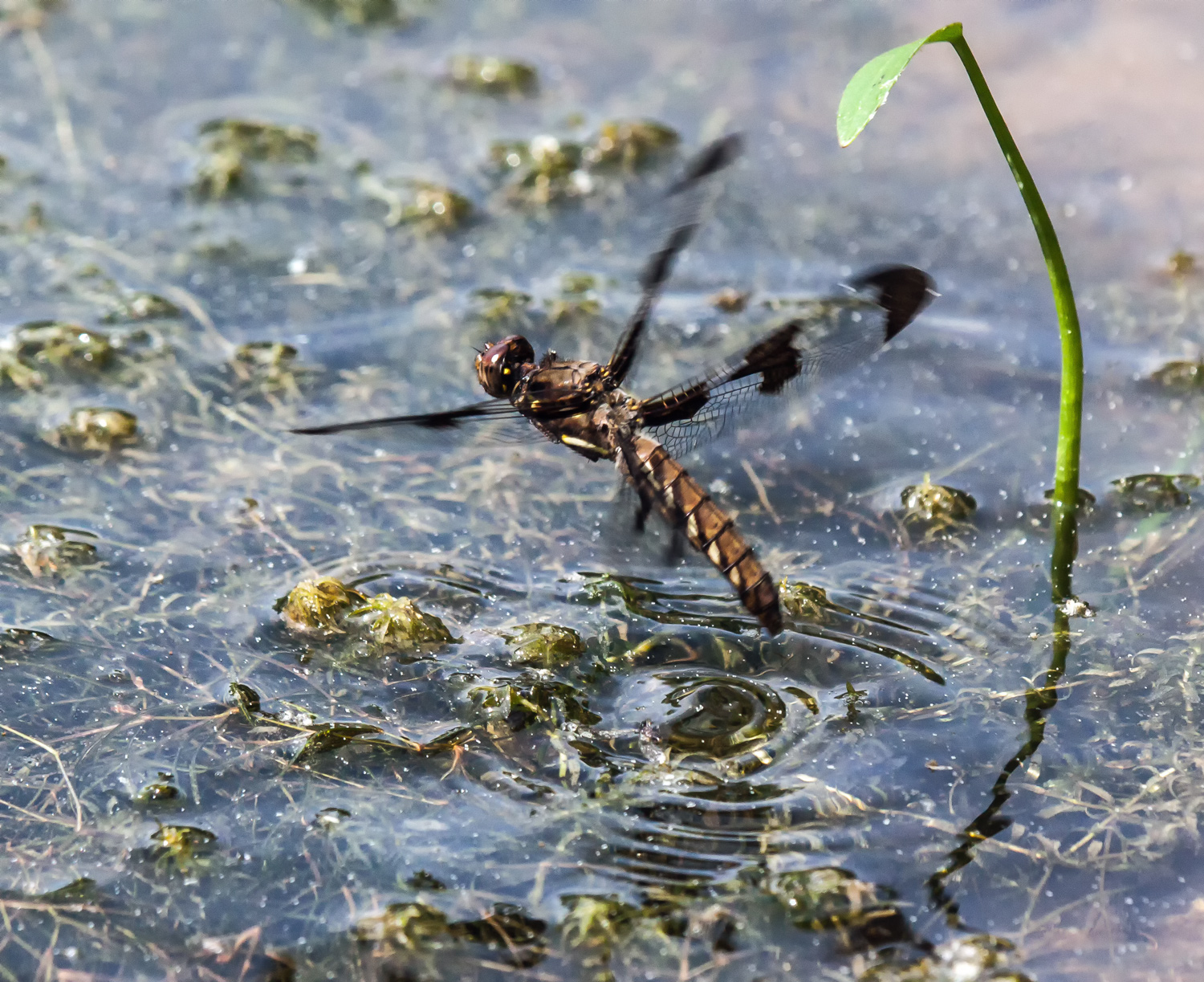
Sometimes, though, I can make minor adjustments on the fly that have a major impact on the final shot. Last week I was at Occoquan Regional Park, observing dragonflies as they zigged and zagged over the surface of the water. Most of them were common, readily identifiable species. Suddenly I spotted one that was different. I suspected, and later confirmed, that it was a female Unicorn Clubtail (Arigomphus villosipes) and knew that it was pretty rare to spot the female of this species.
The dragonfly began to dip the tip of her abdomen down in the water to deposit eggs and I sprung into action. She was not far from the shore and I snapped off a few shots looking down at her. Those images simply did not have any impact. Instinctively I dropped to my knees, which brought me closer to my subject. More importantly, it gave me a new perspective. I was closer to being at eye level with my subject and I was able to capture a more interesting background with the ripples in the water created by her actions.
This image, for me, is close to being an optimal mix of the technical and creative components of photography. It was challenging to shoot and simultaneously allowed me to express myself artistically. It is my response to the occasional naysayers who assert that photography is merely about capturing reality.

© Michael Q. Powell. All rights reserved.
Posted in Dragonflies, dragonfly, Insects, Nature, Photography, wildlife | Tagged Arigomphus villosipes, Canon 50D, female Unicorn Clubtail, Lorton VA, Occoquan Regional Park, Tamron 180mm, Unicorn Clubtail, Unicorn Clubtail dragonfly | 8 Comments »
June 12, 2019 by Mike Powell
Last week at Occoquan Regional Park, I spotted a pair of Carolina Saddlebags dragonflies (Tramea carolina) flying in tandem. I managed to capture this sequence of shots as the male released the female so she could deposit eggs in the water (ovipositing). Once she was done, he grabbed her again and they went on to the next spot.
After mating, male dragonflies and damselflies are concerned about protecting their reproductive efforts, lest a rival intervene and dislodge their sperm. Some males will circle overhead to fight off potential rivals while the female oviposits; some will hang onto her during the entire process; and a few will use the “catch and release” method illustrated in these images.
If you are interested in additional information about dragonflies and mating, I recommend an article on ThoughtCo.com entitled “How Dragonflies Mate–A Rough-and-Tumble Affair.” Some of you may be worried that this is some kind of scientific treatise, but it is not. To allay your fears and entice you to read the article, here is the opening paragraph of the article.
“Dragonfly sex is a rough-and-tumble affair. If you’ve ever seen a pair of mating dragonflies in the act, you know that their sexual coupling requires the flexibility and acrobatic skill of a “Cirque de Soleil” performer. Females get bitten, males get scratched, and sperm winds up everywhere. These strange mating habits have survived millions of years of evolution, so the dragonflies must know what they’re doing, right? Let’s take a closer look at how dragonflies mate.”


© Michael Q. Powell. All rights reserved.
Posted in Dragonflies, dragonfly, Insects, Nature, Photography, wildlife | Tagged Canon 50D, Carolina Saddlebags, Carolina Saddlebags dragonfly, Lorton VA, Occoquan Regional Park, Tamron 180mm, Tramea carolina | 4 Comments »
June 11, 2019 by Mike Powell
Frequent viewers of this blog have probably noticed that I am doing a little series of postings featuring common dragonflies that at first glance might look similar. Today’s “star” is a mature male Eastern Pondhawk (Erythemis simplicicollis). Like several other dragonflies in recent postings, the Eastern Pondhawk has a primarily blue body, but several characteristics make it possible to distinguish this species from others.
Both the male and female Eastern Pondhawks have green faces and the male has distinctive white terminal appendages, i.e. those little protrusions at the end of the abdomen (the “tail). Dragonfly specialists spend a lot of time focusing on those appendages, because immature males often have the same coloration as females. In this case, an immature male Eastern Pondhawk would be green with black bands on the abdomen. For the sake of comparison, I am including a photo I took on the same day of a female Eastern Pondhawk. If you compare the tips of the “tails” of the male and the female, you should be able to see the anatomical differences between the genders.
Although it doesn’t help in identifying them, I can’t help but note that Eastern Pondhawks are voracious predators. I think that I have captured more photos of Eastern Pondhawks feeding on other insects that of any other species. When I captured this image last week, I had no idea that the dragonfly was devouring a damselfly. If you click on the image to enlarge it and look just to the left of the dragonfly’s head, you will notice a set of small wings. As you look more closely, you can see the damselfly’s body hanging vertically just below the dragonfly’s head. Yikes!


© Michael Q. Powell. All rights reserved.
Posted in Dragonflies, dragonfly, Insects, Nature, Photography, wildlife | Tagged Canon 50D, Eastern Pondhawk, Eastern Pondhawks mating, Erythemis simplicicollis, Fort Belvoir VA, Jackson Miles Abbott Wetland Refuge, male Eastern Pondhawk, Tamron 180mm | 5 Comments »
June 10, 2019 by Mike Powell
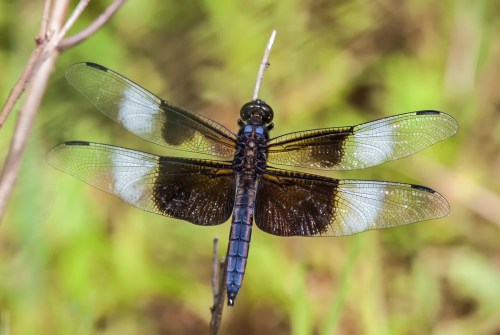
Most dragonflies have clear wings, so I am happy when I see one with dark patches on its wings. It is even more exciting to see one with both brown and white patches, like this male Widow Skimmer dragonfly (Libellula luctuosa) that I spotted on Saturday at Occoquan Regional Park in nearby Lorton, Virginia.
When it comes to identifying dragonfly species, I have learned to focus not only on the colors of the wing patterns, but also on the number of such patches and their shapes. In the case of the Widow Skimmer, for example, both the males and females have the brown patches on the portion of the wings nearest the body.
Why are they called “Widow Skimmers?” Someone apparently thought the dark patches looked like the mourning crepe that historically widows wore. Even the Latin name “luctuosa” means “sorrowful.”
I used to be confused by the use of a female-associated word like “widow” with males, but I have gotten used to it. In fact, I no longer give a second thought to the idea of male damselflies, though I don’t have a clue about how that label affects their self-image.

© Michael Q. Powell. All rights reserved.
Posted in Dragonflies, dragonfly, Insects, Nature, Photography, wildlife | Tagged Canon 50D, Libellula luctuosa, Lorton VA, male Widow Skimmer, Occoquan Regional Park, Tamron 180mm, Widow Skimmer, Widow Skimmer dragonfly | 6 Comments »
June 9, 2019 by Mike Powell
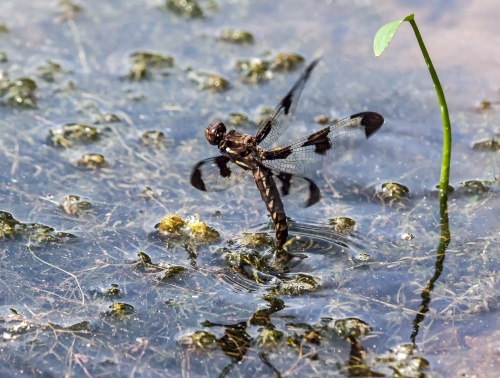
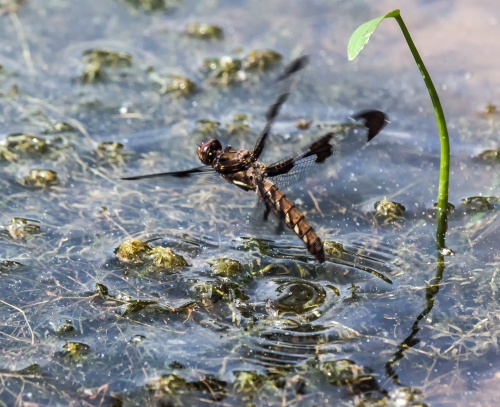
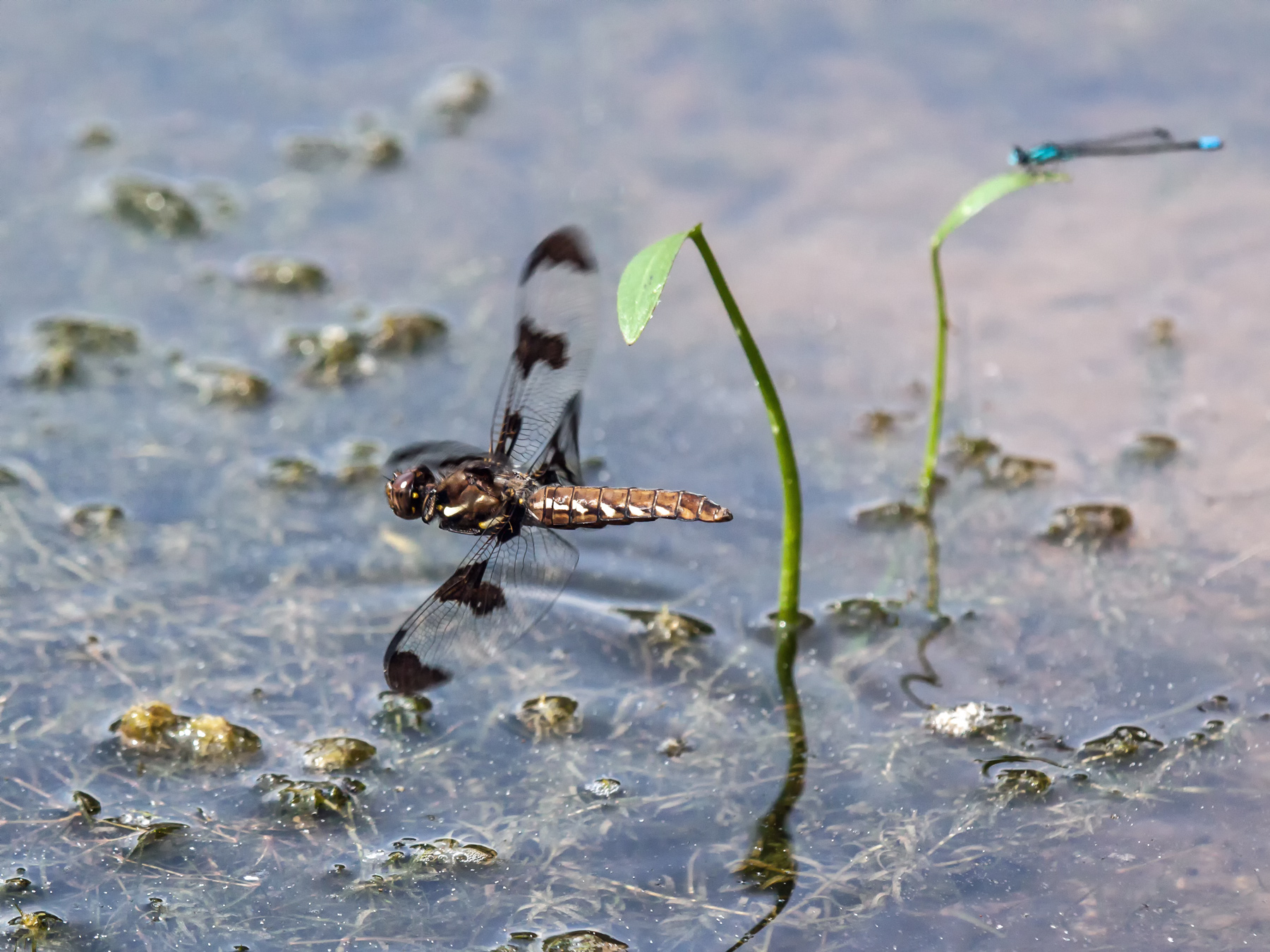
Yesterday at Occoquan Regional Park I spotted this female Common Whitetail dragonfly (Plathemis lydia) as she was depositing eggs into the water. I managed to capture a short series of shots that help to illustrate what she was doing.
She would fly low over the water as in the first shot and then hover over what she determined was a good spot. When she was ready, she dipped the tip of her abdomen into the water, creating the circular ripples that you see in the second image. Immediately she returned to her starting position as the ripples began to spread. Sometimes she would repeat this sequence several times at the same spot, while other times she would move on to another spot.
What was the male doing at this time? A male Common Whitetail dragonfly, which I assume was the one with which she had just mated, patrolled a few feet directly over her as she was depositing the eggs. I am pretty sure that he was there to deter or fight off potential rivals that might try to interfere with the perpetuation of his genes.

© Michael Q. Powell. All rights reserved.
Posted in Dragonflies, dragonfly, Insects, Nature, Photography, wildlife | Tagged Canon 50D, Common Whitetail, Common Whitetail dragonfly, Occoquan Regional Park, ovipositing, Plathemis lydia, Tamron 180mm, Woodbridge VA | 4 Comments »
June 8, 2019 by Mike Powell
Most of the dragonflies that I see at this time of the year—and there are a lot of them—are members of the skimmer family. This is the largest family of odonates (the insect order of dragonflies and damselflies) and includes the species most likely to be seen by a casual dragonfly observer.
When I first started getting interested in dragonflies, I focused primarily on colors—there were blue dragonflies, white dragonflies, red dragonflies, and so on. Over time I began to notice more and more differences between somewhat similar species.
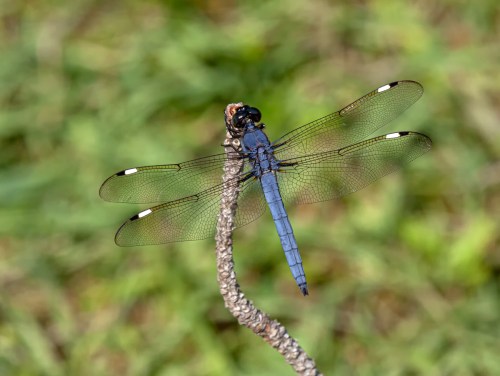
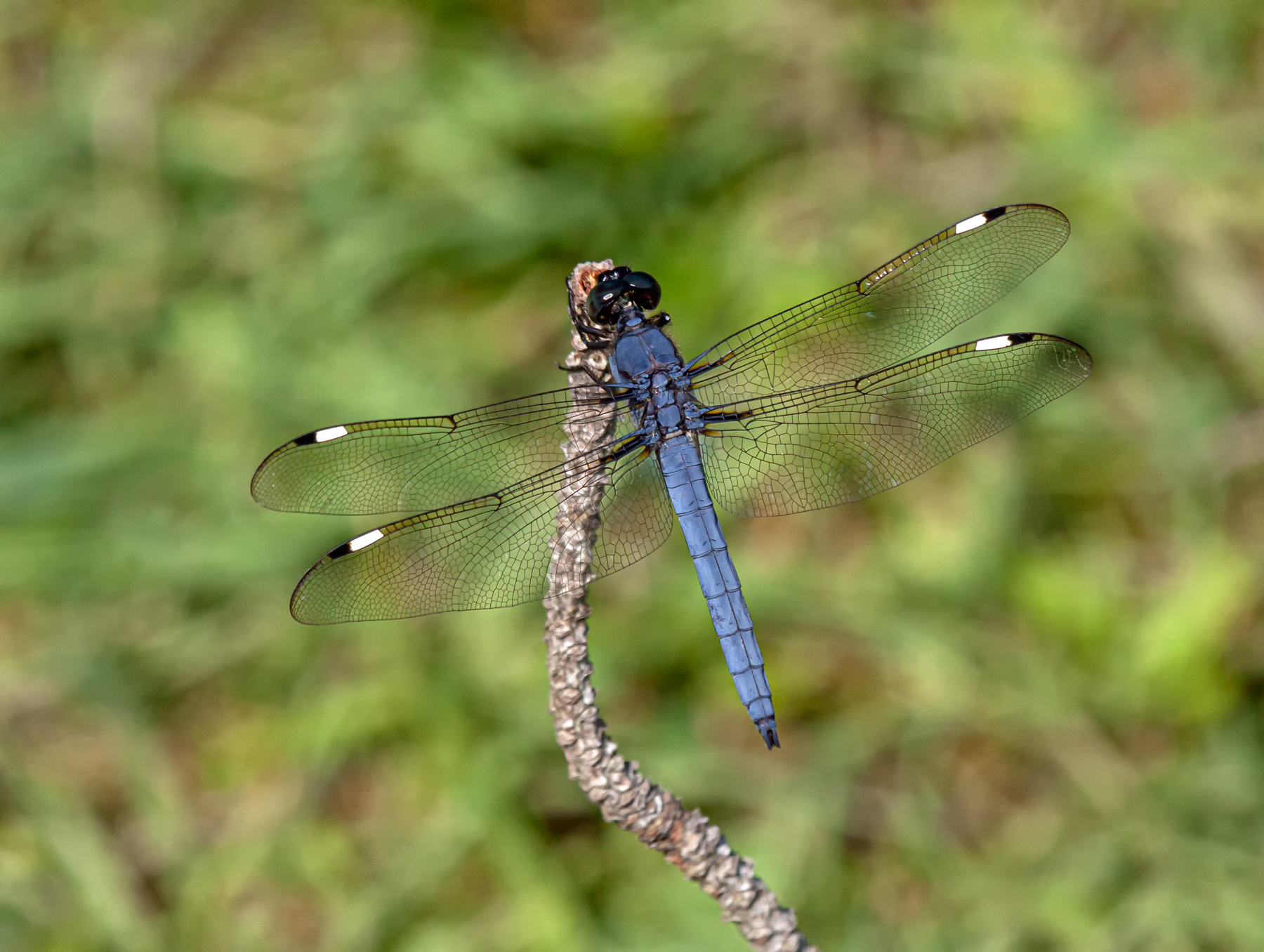
Today I decided to feature photos of two dragonflies that I spotted on Thursday at Jackson Miles Abbott Wetland Refuge. Both are male, both are blue, and both are perched in a similar position. The first one is a Spangled Skimmer (Libellula cyanea). Even though it shares its blue coloration with several other species, the little white patches on the edge of the wings, known as “stigma,” are both distinctive and diagnostic. The second one is a Slaty Skimmer (Libellula incesta). It is probably the darkest colored dragonfly in our area in terms of both its body and its eyes, which sometimes appear to be almost black.
Do you see these two dragonfly species in your area? I encourage you to look closely at the ones that you happen to see and see if you can identify some of the differences. You may find yourself being drawn more deeply, as I have been, into the wonderful world of dragonflies.

© Michael Q. Powell. All rights reserved.
Posted in Dragonflies, dragonfly, Insects, Nature, Photography, Summer, wildlife | 9 Comments »
June 7, 2019 by Mike Powell
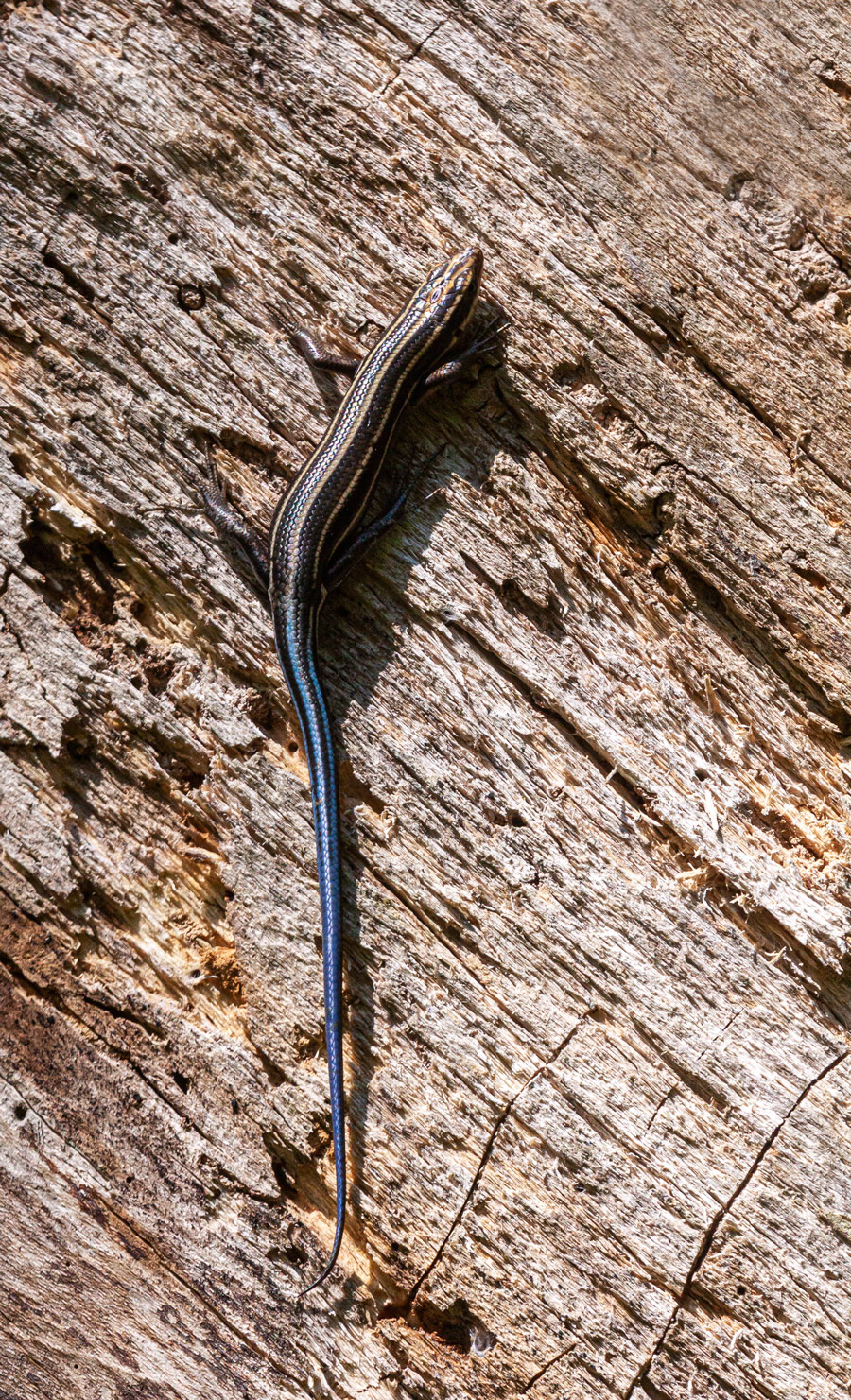
I love to see young Common Five-lined Skinks (Plestiodon fasciatus) with their long, bright blue tails, like this one that I spotted on a dead tree earlier this week in Prince William County, Virginia. There is something so whimsically incongruous about that striking color on the skink’s body that I can’t help but smile whenever I see one.

© Michael Q. Powell. All rights reserved.
Posted in Nature, Photography, Reptiles, wildlife | 2 Comments »
June 6, 2019 by Mike Powell
There are not very many species of venomous snakes in Virginia, but I managed to encounter one of them, an Eastern Copperhead (Agkistrodon contortrix), while exploring in Prince William County earlier this week will fellow wildlife enthusiast Walter Sanford. I had just climbed over the trunk of a fallen tree when I looked to the side and spotted the snake about three to four feet away from me (100 to 120 cm).
The first shot is a cropped image that shows the copperhead’s eerie eye with a vertical pupil—I was definitely not as close as it may appear. The second shot shows the view that I had when looking through my 180 mm macro lens. The snake, which is pretty large and well camouflaged, appeared to be fully alert and was facing the tree trunk that I had just crossed.
I have read a lot about copperheads since that encounter. One of the tips for avoiding them included checking the other side of logs before stepping over them—I am pretty sure I will heed that advice from now on.
UPDATE: Check out Walter Sanford’s blog posting that includes his impressions of our encounter with the copperhead and some additional photos.


© Michael Q. Powell. All rights reserved.
Posted in Nature, Photography, Reptiles, wildlife | Tagged Agkistrodon contortrix, Canon 50D, Eastern Copperhead, Eastern Copperhead snake, Prince William County, Tamron 180mm | 9 Comments »
June 5, 2019 by Mike Powell
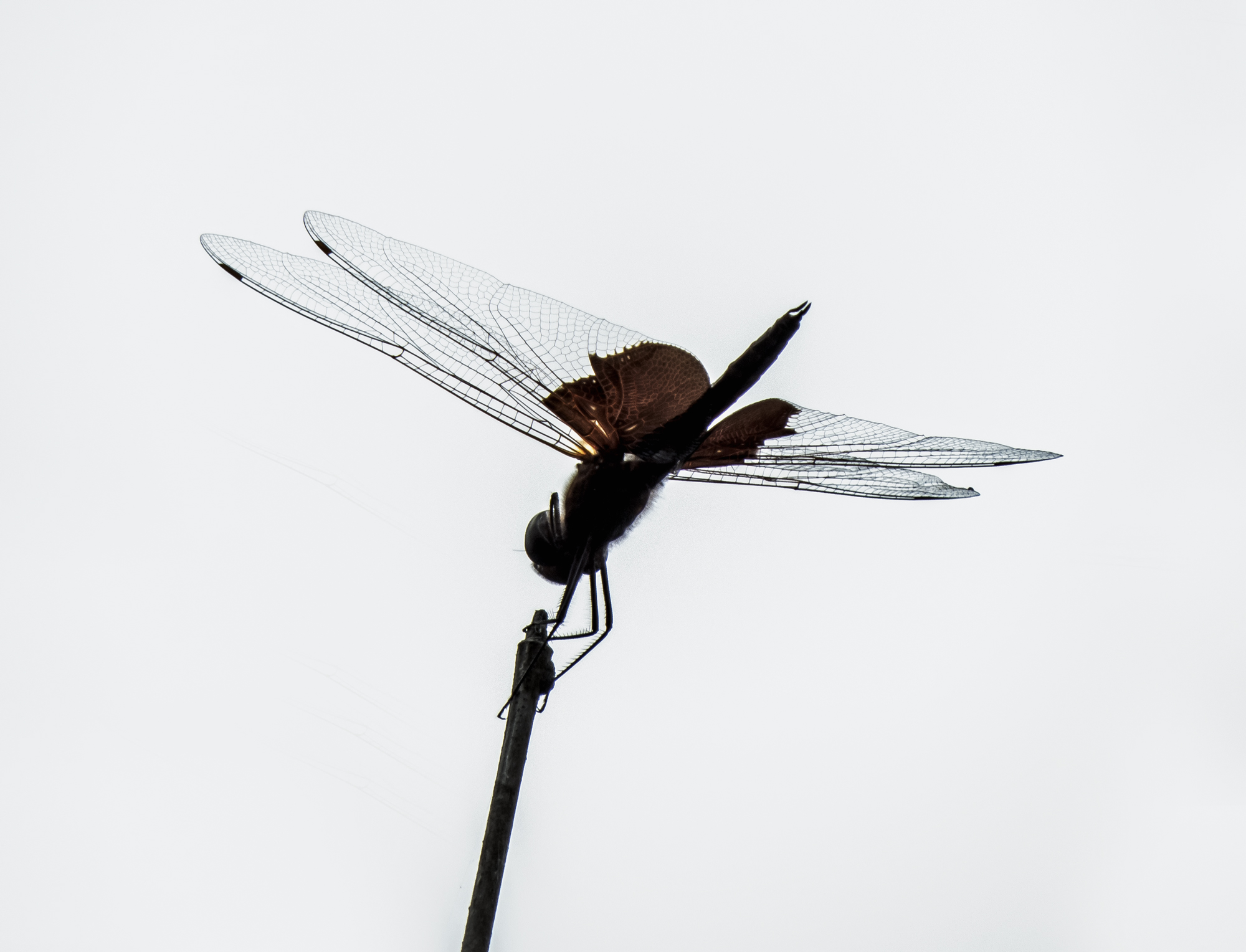
As I was exploring Mason Neck West Park in nearby Lorton, Virginia last Saturday, fellow dragonfly enthusiast Walter Sanford pointed to a dragonfly perched at the top of a tree and said it would make a good “artsy” shot. He was right. Although some details are lost in the shadows, the simplified silhouetted view lets you focus on the essence of the dragonfly.
The patches on the inner wings indicate that it is one of the saddlebags dragonflies. I think it might be a Carolina Saddlebags (Tramea carolina), but there is also a chance that it could be a Black Saddlebags (Tramea lacerata).

© Michael Q. Powell. All rights reserved.
Posted in Dragonflies, dragonfly, Insects, Nature, Photography, wildlife | Tagged Black Saddlebags, Canon SX50, Carolina Saddlebags, Carolina Saddlebags dragonfly, dragonfly silhouette, Lorton VA, Mason Neck West Park, Tramea carolina | 1 Comment »
June 4, 2019 by Mike Powell
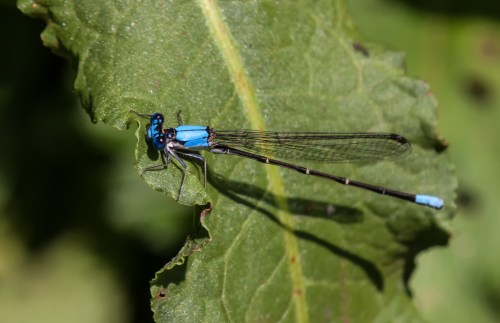
I am not sure if Blue-fronted Dancer damselflies (Argia apicalis) are always happy, but the ones that I spotted yesterday at Jackson Miles Abbott Wetland Refuge seemed to be smiling at me.
The beautiful light blue color on their upper bodies and their striking blue eyes make Blue-fronted Dancers relatively easy to spot and to identify.


© Michael Q. Powell. All rights reserved.
Posted in damselfly, Insects, Macro Photography, Nature, Photography, wildlife | Tagged Argia apicalis, Blue-fronted Dancer, Blue-fronted Dancer damselfly, Canon 50D, Fort Belvoir VA, Jackson Miles Abbott Wetland Refuge, Tamron 180mm | 12 Comments »
June 3, 2019 by Mike Powell
This past Saturday I was thrilled to spot this mating pair of Ebony Jewelwing damselflies (Calopteryx maculata). No, I am not a peeping Tom, but I do enjoy being able to see the male and female of a species together, so that I can compare their coloration and markings.
When it comes to damselflies, I just love the sidewards heart that their bodies create when they are in this mating position. I have been told that the process is somewhat brutal, but I like to think of it as romantic, two hearts joined as one.

© Michael Q. Powell. All rights reserved.
Posted in damselfly, Insects, Macro Photography, Nature, Photography, wildlife | Tagged Calopteryx maculata, Ebony Jewelwing, Ebony Jewelwing damselfly, mating ebony jewelwings, Occoquan Regional Park, Woodbridge VA | 4 Comments »
June 2, 2019 by Mike Powell
I have always been fascinated by shadows and reflections, which often lend an additional element of interest to a more straightforward shot. When a recently emerged dragonfly, probably a Lancet Clubtail (Gomphus exilis), flew into a nearby tree, I was utterly mesmerized by the shadow that it cast onto the leaves of the tree. The shapes and patterns of the green leaves create an almost abstract backdrop for the scene that really drew me in.
Most of my images are detailed, realistic portraits of my wildlife subjects, but at certain moment I love to attempt to capture more “artsy” images like this one.

© Michael Q. Powell. All rights reserved.
Posted in Art, Dragonflies, dragonfly, Insects, Nature, Photography, wildlife | Tagged Canon 50D, Gomphus exilis, Lancet Clubtail, Lancet Clubtail dragonfly, Prince William County, shadow, Tamron 180mm | 4 Comments »
June 1, 2019 by Mike Powell
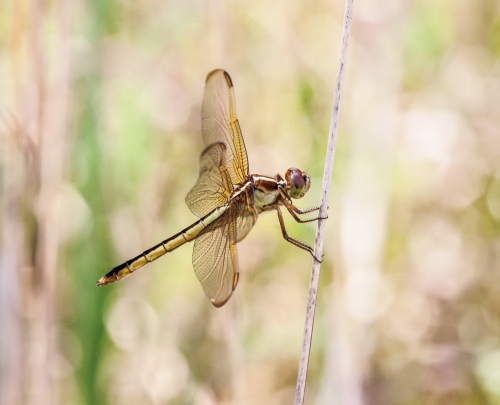
We are now in prime dragonfly season and many familiar species are reappearing, like this beautiful Needham’s Skimmer dragonfly (Libellula needhami) that I spotted on Wednesday at Occoquan Bay National Wildlife Refuge.
I love the beautiful orange-gold color on the leading edges of the wings of this species, a color that really sparkles in the sunlight. I was fortunate to capture this dragonfly in a way that blurred the background. Depth of field is always an issue in situations like this and you can probably see that the tips of the wings are not in sharp focus, but I am ok with that and think it helps draw the viewer’s eyes to the dragonfly’s main body and, in particular, to its wonderful eyes.
© Michael Q. Powell. All rights reserved.
Posted in Dragonflies, dragonfly, Insects, Nature, Photography, Summer, wildlife | Tagged Canon 50D, Libellula needhami, Needham's Skimmer, Needham's Skimmer dragonfly, Occoquan Bay National Wildlife Refuge, Tamron 180mm, Woodbridge VA | 4 Comments »
May 31, 2019 by Mike Powell
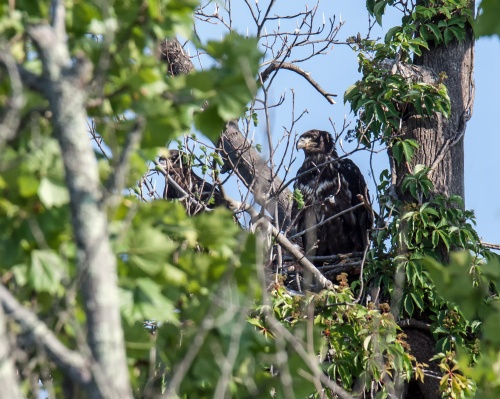
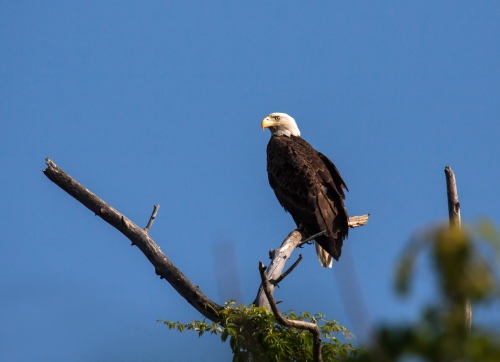
Now that the foliage on the trees is full, it is hard for me to monitor the status of the baby eagles in several Bald Eagle (Haliaeetus leucocephalus) nests at Occoquan Bay National Wildlife Refuge. On Wednesday, however, I detected some motion as I was peering at one of the nests and realized that it was the flapping of an eaglet’s wings. I managed to find a visual tunnel through which my view was mostly unobstructed and was able to capture this view of two eaglets. I was shocked to see how big they have grown and suspect that they soon will be flying.
The nest is probably too small to hold the adults along with the youngsters—what I would call “full nest” syndrome, i.e. the opposite of the more commonly known “empty-nest” syndrome. The second image shows one of the presumed parents perching on a higher branch of the tree in which the nest is located.
© Michael Q. Powell. All rights reserved.
Posted in Birds, Nature, Photography, spring, wildlife | Tagged Bald Eagle, Canon 50D, eaglet, eaglets, Haliaeetus leucocephalus, Occoquan Bay National Wildlife Refuge, Tamron 150-600mm, Woodbridge VA | 5 Comments »
May 30, 2019 by Mike Powell
Earlier this week I did a posting that described the Eastern Amberwing dragonfly as “unmistakable.” When it comes to damselflies, that title almost certainly belongs to the very distinctive Ebony Jewelwing damselfly (Calopteryx maculata). There is no other damselfly in our area that has completely dark wings like the Ebony Jewelwing.
I spotted this handsome male Ebony Jewelwing on Monday at Occoquan Regional Park. How do I know it is a male? Well, the female has a conspicuous little white patch on her wings that is technically known as a “pseudostigma,” which this damselfly in lacking. Additionally, the little hoop-like appendage at the end of this damselfly indicates that it is a male.
These little damselflies like to spend a lot of time in the semi-darkness of shaded forest streams, like the location at which I photographed this Ebony Jewelwing.

© Michael Q. Powell. All rights reserved.
Posted in damselfly, Insects, Macro Photography, Nature, Photography, wildlife | Tagged Calopteryx maculata, Canon 50D, Ebony Jewelwing, Ebony Jewelwing damselfly, Occoquan Regional Park, Tamron 180mm, Woodbridge VA | 4 Comments »
May 29, 2019 by Mike Powell
Before we went out last week to hunt for Gray Petaltail dragonflies (Tachopteryx thoreyi), fellow blogger and dragonfly enthusiast Walter Sanford reminded me to wear gray-colored clothing, because Gray Petaltails are known to perch on people dressed this way, presumably because they resemble trees. Walter’s words proved to be prophetic and Gray Petaltails perched on me repeatedly that day. Walter memorialized one such encounter in his posting last week You look like a tree to me! that included shots of one perched on my shoulder and one on my stomach.
It is generally pretty cool to have a dragonfly perch on you. It can be a little disconcerting, however, when a large dragonfly like a Gray Petaltail, which can be over three inches in length (75 mm), buzzes around your head. I couldn’t avoid flinching a couple of times that day when a dragonfly landed on me. Sometimes dragonflies are so incredibly cooperative that I am able to coax them to perch on my finger, as shown in a 2013 blog posting that I called Dragonfly Whisperer.
As the day wore on, Walter seemed disappointed that the dragonflies were not landing on him. As we were making some final checks before our departure, a Gray Petaltail finally made his wish come true and perched on him. Unlike the ones that landed on my front side, this one decided to land on his back side, on the untucked tail of his shirt. I am hoping that nobody was watching, because it would probably have looked a little strange for me to be pointing the long macro lens of my camera at that part of his anatomy.
Walter and I are good enough friends that he will laugh at my puns and attempts at humor, even when he is occasionally the butt of the joke. In fact, this is actually not the most embarrassing photo that I have taken of a dragonfly perching on Walter. In October 2013 I did a posting entitled Dragonflies mating on a calf that featured a dragonfly couple mating on his bare lower leg.
If you are really young, you may not remember Fred Astaire’s version of the song “Cheek to Cheek” that was the number one hit song of 1935, according to Wikipedia. Here is link to a YouTube clip of Fred Astaire and Ginger Rogers singing and dancing to that song.


© Michael Q. Powell. All rights reserved.
Posted in Dragonflies, dragonfly, Humor, Nature, Photography, wildlife | Tagged Canon 50D, Dancing Cheek to Cheek, Gray Petaltail, Gray Petaltail dragonfly, Prince William County, Tachopteryx thoreyi, Tamron 180mm, Walter Sanford | 4 Comments »
May 28, 2019 by Mike Powell
Throughout the month of May I have struggled to identify the dragonflies and damselflies that I have photographed. So many of the species seem so similar that I have had to defer to experts for help. Over the years I have learned that the best way to get help on a Facebook forum is to misidentify a subject—some experts, who might not respond to a request for help, feel compelled to correct you and demonstrate their superior knowledge.
This past Friday at Jackson Miles Abbott Wetland Refuge, it was nice to spot a familiar dragonfly species that was immediately identifiable—there is simply no other dragonfly in our area the looks like an Eastern Amberwing (Perithemis tenera). Even the name is helpful in drawing attention to the key identification feature, the distinctive amber wings.
These dragonflies are among the smallest ones in our area, but they tend to perch on low vegetation overhanging the water (especially males like this one), so they are relatively easy to spot. Although they tend to be a little skittish, if you are patient and persistent you can snag some shots that show the beautiful details of the Eastern Amberwing dragonfly.

© Michael Q. Powell. All rights reserved.
Posted in Dragonflies, dragonfly, Insects, Nature, Photography, Summer, wildlife | Tagged Canon 50D, Eastern Amberwing, Eastern Amberwing dragonfly, Fort Belvoir VA, Jackson Miles Abbott Wetland Refuge, male Eastern Amberwing, Perithemis tenera, Tamron 180mm | 6 Comments »
« Newer Posts - Older Posts »















 Mike Powell