August 28, 2019 by Mike Powell
How do spiders decide where to place their webs? Is there some special secret that is passed on from generation to generation about optimal web placement for capturing prey? I know that human fisherman and trappers look for specific conditions and wonder if it is the same with spiders.
Whatever the case, this Black and Yellow Garden Spider (Argiope aurantia) appears to have mastered her trapping skills and looks to have caught both a female Common Whitetail dragonfly (Plathemis lydia) and what I think is some kind of female grasshopper. I am not really sure about the latter victim, but that is what I believe the green-colored object is in the image.
Often I see the webs of this kind of spider in fairly thick vegetation, but this web was hanging in mid-air about six feet high at the edge of a small pond last weekend at Jackson Miles Abbott Wetland Refuge. The murky grayness in the upper right portion of the image is the water of the pond. In the left hand side you can see some of the web strands that tenuously connected the web to some nearby vegetation. This spider would not have one any contests for the beauty of its web, but there is no arguing with its success in capturing prey.

© Michael Q. Powell. All rights reserved.
Posted in Arachnids, Nature, Photography, spiders, Summer, wildlife | Tagged Argiope aurantia, Black and yellow garden spider, Canon 50D, Common Whitetail dragonfly, Fort Belvoir VA, Jackson Miles Abbott Wetland Refuge, Plathemis lydia, Tamron 180mm | 5 Comments »
August 27, 2019 by Mike Powell
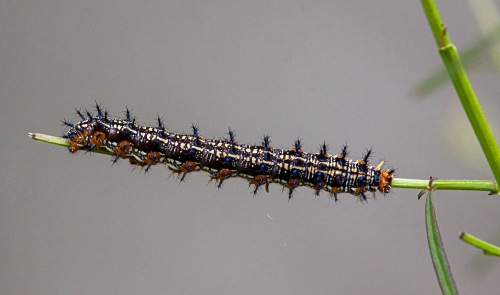
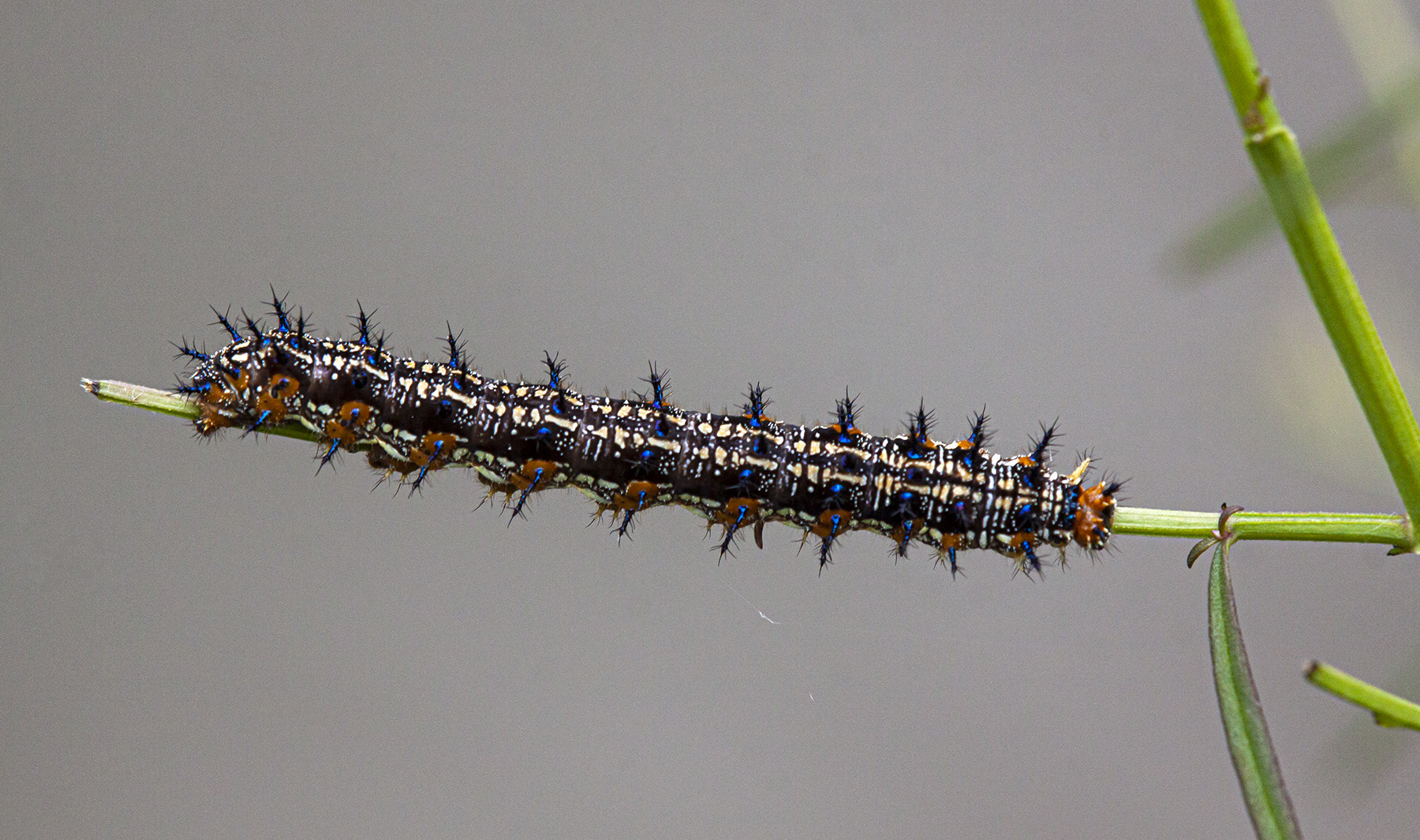
Yesterday I spotted this amazing looking caterpillar alongside a pond at Jackson Miles Abbott Wetland Refuge. I have not yet been able to identify it, but I was really struck by the stunning blue dots and the prickly spikes that run the length of the caterpillar’s body. Often these types of spikes are an indication of a venomous stinging caterpillar, so I kept my distance as I was taking this shot. Click on the image if you want to get a closer look at the wonderful details of the caterpillar.
UPDATE: Several helpful folks have weighed in and have identified this as a Common Buckeye caterpillar (Junonia coenia). Thanks for the help.
© Michael Q. Powell. All rights reserved.
Posted in Butterflies, Insects, Macro Photography, Nature, Photography, Summer, wildlife | Tagged Canon 50D, Common Buckeye, Common Buckeye caterpillar, Fort Belvoir VA, Jackson Miles Abbott Wetland Refuge, Junonia coenia, spiky caterpillar, Tamron 180mm | 17 Comments »
August 26, 2019 by Mike Powell
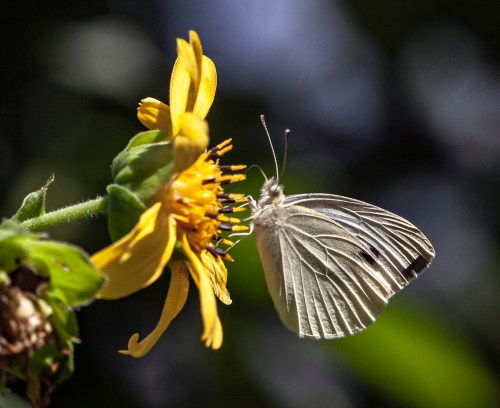
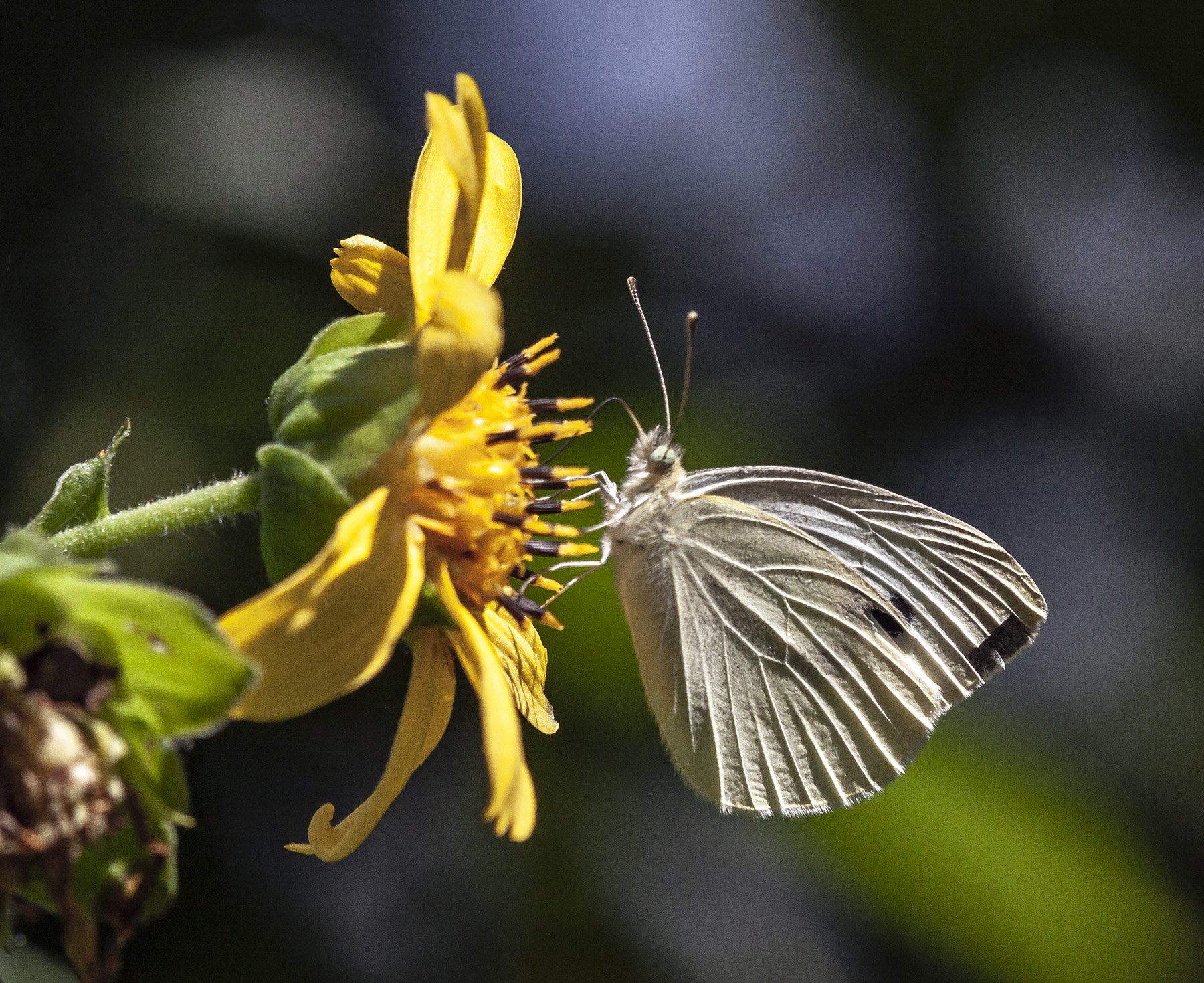
Cabbage White butterflies (Pieris rapae) are small, plain, and common, yet I find a real beauty in their elegant simplicity, especially when I get a view of their speckled green eyes. I spotted this Cabbage White last weekend when I was exploring Occoquan Bay National Wildlife Refuge. As always, my biggest challenge was getting into a shooting position in which the butterfly’s body was on a single plane in order to get most of it in focus—in this case I more or less succeeded in doing so.
© Michael Q. Powell. All rights reserved.
Posted in Butterflies, Nature, Photography, Summer, wildlife | Tagged Cabbage White, Cabbage White butterfly, Canon 50D, Occoquan Bay National Wildlife Refuge, Pieris rapae, Tamron 180mm, Woodbridge VA | 8 Comments »
August 25, 2019 by Mike Powell
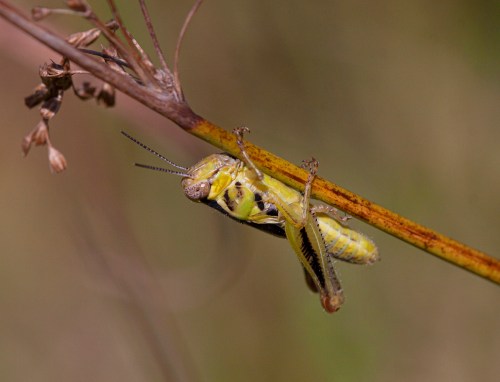
There were quite a few grasshoppers yesterday at Occoquan Bay National Wildlife Refuge and this one cooperated for me by posing momentarily. Initially the grasshopper hung upside down as shown in the first image, but eventually it climbed around on the stalk of vegetation and assumed a more upright pose.
I couldn’t help but notice that the background of the two shots seems really different. I think this was caused by the fact that I shot them from very different angles, even though I remained more or less in the same spot.

© Michael Q. Powell. All rights reserved.
Posted in Insects, Macro Photography, Nature, Photography, Summer, wildlife | Tagged Canon 50D, grasshopper, Occoquan Bay National Wildlife Refuge, Tamron 180mm, Woodb, Woodbridge VA | 5 Comments »
August 24, 2019 by Mike Powell
Some people see spiders as creepy and others see them as cool. I am definitely in the latter category and was happy to spot this Black and Yellow Garden Spider (Argiope aurantia) during a recent trip to Jackson Miles Abbott Wetland Refuge.
I love the zigzag pattern that is a distinctive characteristic of the webs constructed by this species of spider and was thrilled that I managed to capture the zigzag in this shot. This spider is pretty common and has a lot of different common names including zigzag spider, writing spider, yellow garden spider, and golden garden spider. Zigzag Spiders can get to be pretty big and I have seen them capture large prey including, alas, dragonflies. It is amazing to see how fast the spider is able to wrap up its captured prey in web material. In case you have never witnessed the process, here’s a link to a 2017 posting that shows a spider wrapping up a freshly caught damselfly.

© Michael Q. Powell. All rights reserved.
Posted in Nature, Photography, spiders, Summer, wildlife | Tagged Argiope aurantia, Black and yellow garden spider, Canon 50D, Fort Belvoir VA, Jackson Miles Abbott Wetland Refuge, Tamron 180mm, zigzag spider | 7 Comments »
August 23, 2019 by Mike Powell
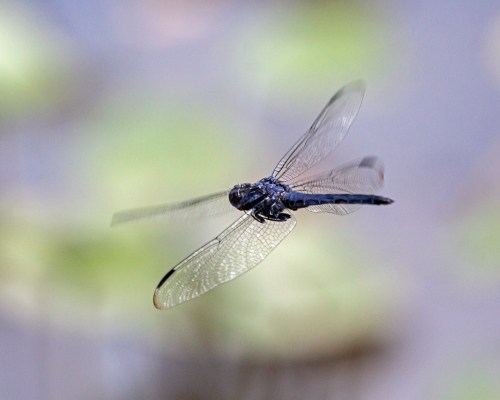
As many of you know, I love trying to capture images of dragonflies in flight. This Slaty Skimmer dragonfly (Libellula incesta) cooperated by periodically hovering a bit during a recent trip that I made to Jackson Miles Abbott Wetland Refuge. The first two images show you some of the details of the dragonfly’s body, including the way it tucks in its legs when in flight, and the final image gives you a wider view of the environment in which I was shooting.


© Michael Q. Powell. All rights reserved.
Posted in Dragonflies, dragonfly, Insects, Nature, Photography, Summer, wildlife | Tagged Canon 50D, Fort Belvoir VA, Jackson Miles Abbott Wetland Refuge, Libellula incesta, male Slaty Skimmer, Slaty Skimmer, Slaty Skimmer dragonfly, Tamron 180mm | 5 Comments »
August 22, 2019 by Mike Powell
Last Friday I spotted this handsome adult male Calico Pennant dragonfly (Celithemis elisa) while exploring Occoquan Bay National Wildlife Refuge with my friend and fellow dragonfly enthusiast Walter Sanford. Earlier this month I did a posting entitled Mosaic Wings that featured a photo of an immature male of this same species that had a bright yellow body. This image gives you an idea of how the body color changes to red as the male Calico Pennant dragonfly matures.

© Michael Q. Powell. All rights reserved.
Posted in Dragonflies, dragonfly, Nature, Photography, Summer, wildlife | Tagged Calico Pennant, Calico Pennant dragonfly, Canon 50D, Celithemis elisa, male Calico Pennant, Occoquan Bay National Wildlife Refuge, Tamron 180mm, Woodbridge VA | 17 Comments »
August 21, 2019 by Mike Powell
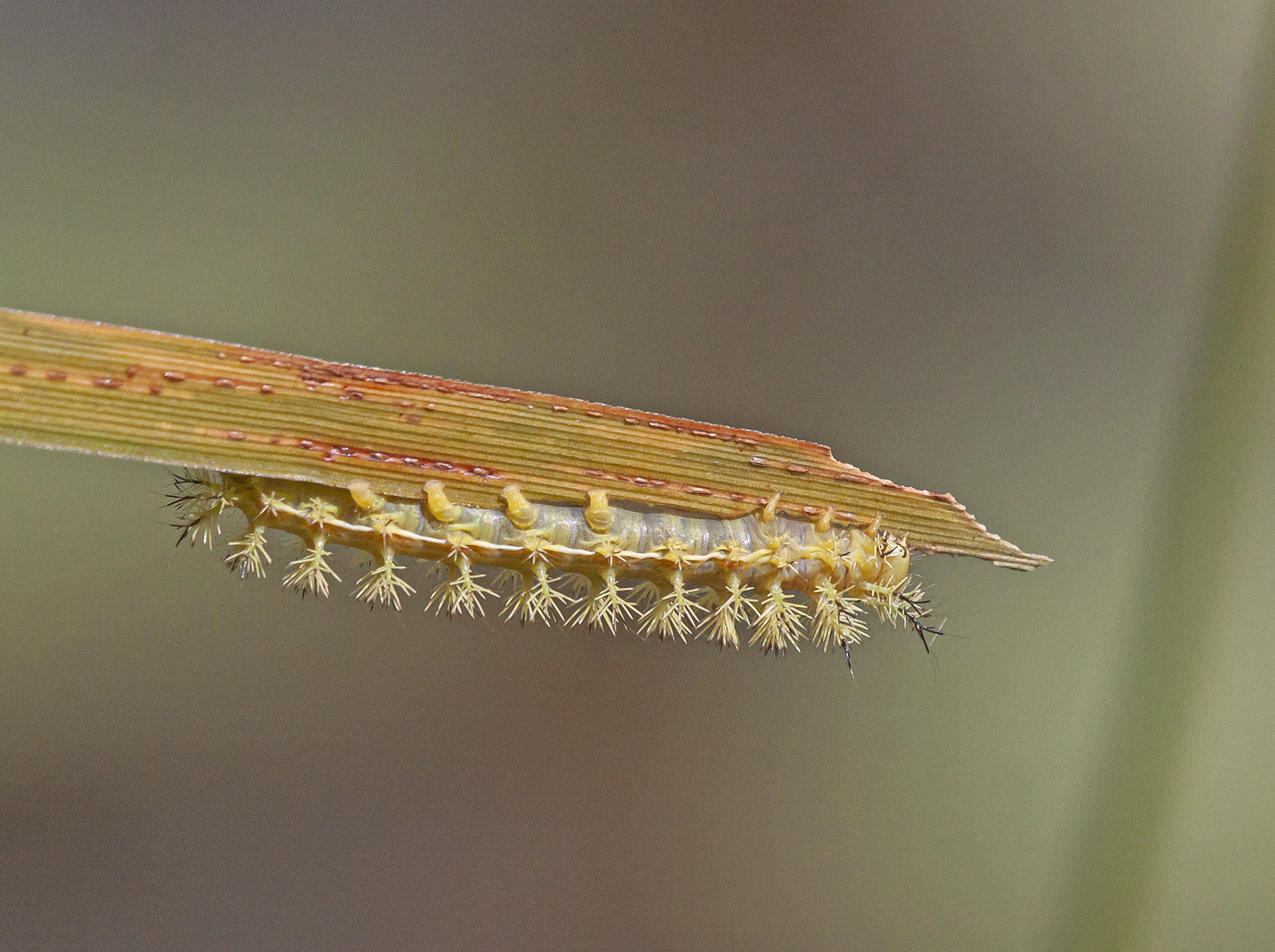
I spotted this strange looking caterpillar recently while exploring Jackson Miles Abbott Wetland Refuge. I was intrigued by all of the tufted spines sticking out of its back—I am pretty sure that it is upside down in this photo. Over the years, I have learned that it is best to avoid spiny caterpillars, because many of them are poisonous.
I sent a copy of a photo of this caterpillar to the helpful folks at bugguide.net and one of the viewers there suggested that this is an Eastern Buck Moth caterpillar (Hemileuca maia). I have not yet been able to get a confirmed identification, but according to Wikipedia, the caterpillars of this species are, “covered in hollow spines that are attached to a poison sac. The poison can cause symptoms ranging from itching and burning sensations to nausea.”
Fortunately I kept my distance when I captured this image with my long macro lens. I have no desire for a close encounter with a spiny caterpillar.

© Michael Q. Powell. All rights reserved.
Posted in Insects, Macro Photography, Nature, Photography, Summer, wildlife | Tagged Canon 50D, Eastern Buck Moth, Eastern Buck Moth caterpillar, Fort Belvoir VA, Jackson Miles Abbott Wetland Refuge, Tamron 180mm | 8 Comments »
August 20, 2019 by Mike Powell
As I was searching for butterflies last week at Jackson Miles Abbott Wetland Refuge, a flash of brilliant yellow suddenly crossed my field of view. It took a moment for me to figure out what it was and then I realized that several American Goldfinches (Spinus tristis) were diving into a field of Black-eyed Susan wildflowers (Rudbeckia hirta).
I waited for a long time, hoping in vain that the goldfinches would perch in the open on the flowers nearest me, but mostly they stayed buried deep in the vegetation. Here are a couple of long-distance shots that give you a sense of my experience with these colorful little birds.


© Michael Q. Powell. All rights reserved.
Posted in Birds, Flowers, Nature, Photography, Summer, wildlife | Tagged American Goldfinch, black-eyed susan, Canon SX50, Fort Belvoir VA, goldfinch, Jackson Miles Abbott Wetland Refuge, Rudbeckia hirta, Spinus tristis | 6 Comments »
August 19, 2019 by Mike Powell
I was really thrilled to spot this spectacular Black Swallowtail butterfly (Papilio polyxenes) last week as it fed on some kind of thistle plant at Occoquan Bay National Wildlife Refuge. There are several dark swallowtail species in our area and I often have trouble telling them apart. In this case, though, I could see the distinctive back dot inside the orange dot which is telltale sign that this is Black Swallowtail. I highly recommend a helpful posting by Louisiana Naturalist that points out way to distinguish among four dark swallowtails—it is a reference that I repeatedly return to when I have a question about a dark swallowtail.

© Michael Q. Powell. All rights reserved.
Posted in Butterflies, Flowers, Insects, Nature, Photography, Summer, wildlife | Tagged black swallowtail, black swallowtail butterfly, Canon 50D, Occoquan Bay National Wildlife Refuge, Papilio polyxenes, Tamron 180mm, Woodbridge VA | 5 Comments »
August 18, 2019 by Mike Powell
I don’t see rabbits very often during my visits to various wildlife parks. Perhaps the numerous hawks and eagles in the area keep the rabbit population under control, or at least make the rabbits especially cautious and stealthy. I was happy therefore when I spotted this Eastern Cottontail (Sylvilagus floridanus) during a recent visit to Occoquan Bay National Wildlife Refuge and thrilled when he posed momentarily for me.
This rabbit looks to be an adult, but somehow all rabbits are “bunnies” to me. I suspect that is because I had a rabbit as a pet for several years and got used to playing with him every day. I would let Prime Rib (yes, that really was his name) out of his cage and he would happily run around me as I sat on the living room floor, periodically bounding over my outstretched legs.
It was a sad moment for me when Prime Rib died and I can’t help but think of him every time that I see one of his cousins in the wild.

© Michael Q. Powell. All rights reserved.
Posted in animals, Nature, Photography, Summer, wildlife | Tagged bunny, Canon 50D, Eastern Cottontail, Eastern Cottontail rabbit, Occoquan Bay National Wildlife Refuge, Prime Rib, Sylvilagus floridanus, Tamron 180mm, Woodbridge VA | 11 Comments »
August 17, 2019 by Mike Powell
On Monday I spotted this beautiful Zebra Swallowtail butterfly (Protographium marcellus) at Occoquan Bay National Wildlife Refuge. Normally Zebra Swallowtails are very skittish and are in almost constant motion. This one, however, was so involved with the flower that it did not immediately fly away and allowed me to capture this image.

© Michael Q. Powell. All rights reserved.
Posted in Butterflies, Nature, Photography, Summer, wildlife | Tagged Canon 50D, Eurytides marcellus, Occoquan Bay National Wildlife Refuge, Protographium marcellus, Tamron 180mm, Woodbridge VA, Zebra Swallowtail, Zebra Swallowtail butterfly | 12 Comments »
August 16, 2019 by Mike Powell
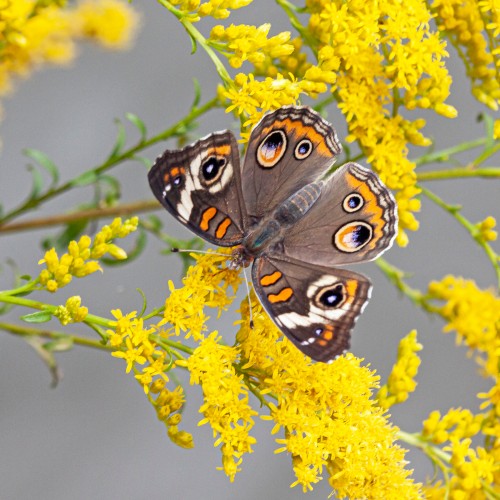
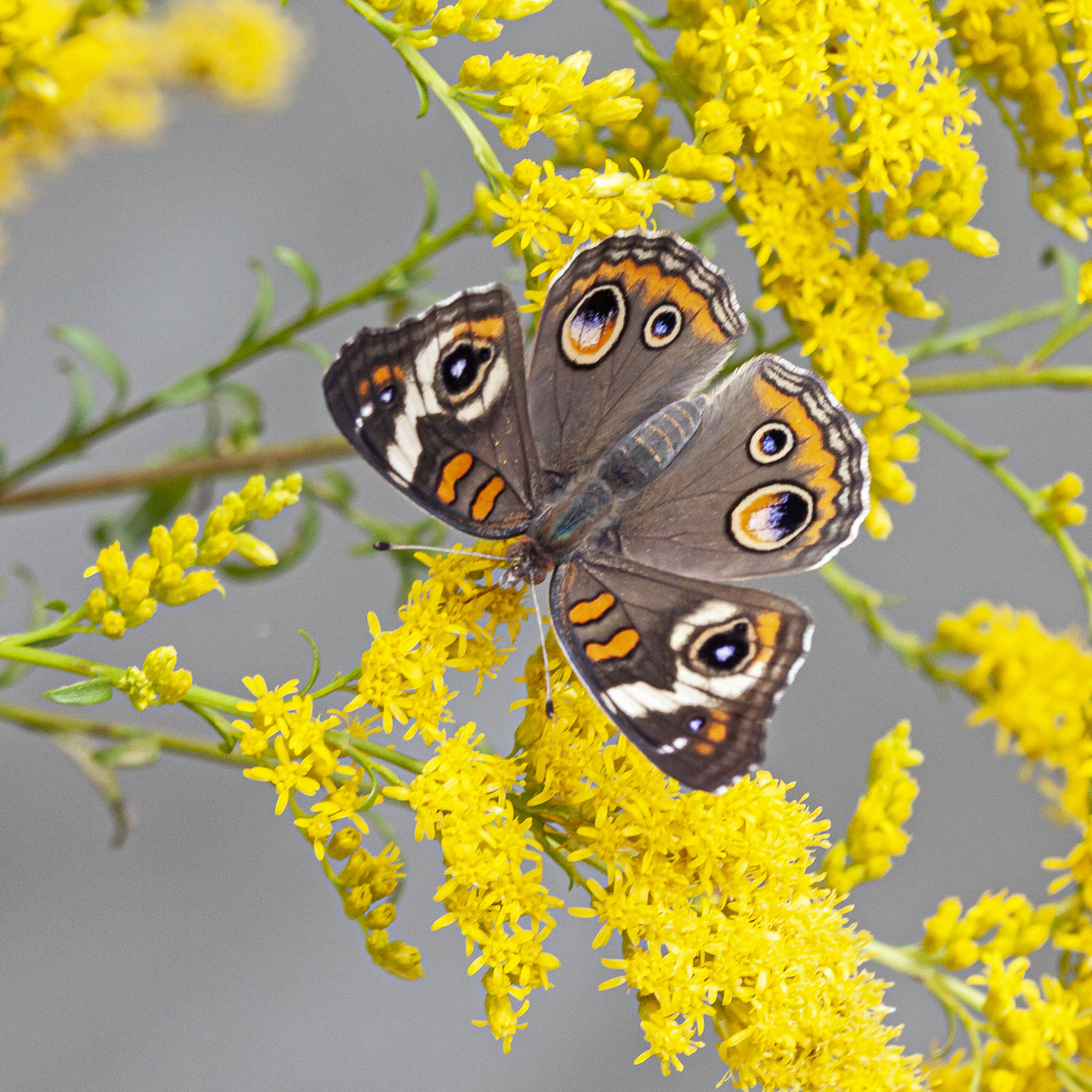
On Wednesday I spotted this colorful Common Buckeye butterfly (Junonia coenia) perched on some goldenrod at Jackson Miles Abbott Wetland Refuge. The fact that the butterfly was facing downward gives this image an abstract feel that I really like. My mind does not immediately register that this is a butterfly and instead focuses on the wonderful shapes and colors.
© Michael Q. Powell. All rights reserved.
Posted in Art, Butterflies, Nature, Photography, Summer, wildlife | Tagged Canon 50D, Common Buckeye, Common Buckeye butterfly, Fort Belvoir VA, goldenrod, Jackson Miles Abbott Wetland Refuge, Junonia coenia, Tamron 180mm | 11 Comments »
August 15, 2019 by Mike Powell
I haven’t seen many Monarch butterflies (Danaus plexippus) this season, so I was thrilled when I spotted this one on some goldenrod on Monday at Occoquan Bay National Wildlife Refuge.
The habitat of Monarch butterfly has been threatened in recent years both in the United States and in the areas to which Monarchs migrate. According to an article yesterday at oregonlive.com, the Monarch butterfly is currently under government consideration for listing under the U.S. Endangered Species Act.

© Michael Q. Powell. All rights reserved.
Posted in Butterflies, Flowers, Nature, Photography, Summer, wildlife | Tagged Canon 50D, Danaus plexippus, Monarch, monarch butterfly, Occoquan Bay National Wildlife Refuge, Tamron 180mm, Woodbridge VA | 16 Comments »
August 14, 2019 by Mike Powell
This tattered male Great Blue Skimmer dragonfly (Libellula vibrans) seemed to be auditioning for a role as a replacement for the goose on this sign on Monday at Occoquan Bay National Wildlife Refuge. Or perhaps he was merely seeking a place of refuge—all dragonflies are welcome here.

© Michael Q. Powell. All rights reserved.
Posted in Dragonflies, dragonfly, Insects, Nature, Photography, Summer, wildlife | Tagged Canon 50D, Great Blue Skimmer, Great Blue Skimmer dragonfly, Libellula vibrans, Occoquan Bay National Wildlife Refuge, refugee, Tamron 180mm, Woodbridge VA | 6 Comments »
August 14, 2019 by Mike Powell
Liaison dangereuse? Living life on the edge? That’s how I would characterize these mating Big Bluet damselflies (Enallagma durum) that I spotted on Monday at Occoquan Bay National Wildlife Refuge. Neither of them was harmed during their “activity,” though those thorns look really menacing.
It is definitely not what I would call “safe sex.”

© Michael Q. Powell. All rights reserved.
Posted in damselfly, Insects, Nature, Photography, Summer, wildlife | Tagged Big Bluet, Big Bluet damselfly, Canon 50D, Enallagma durum, Occoquan Bay National Wildlife Refuge, safe sex, Tamron 180mm, Woodbridge VA | 13 Comments »
August 13, 2019 by Mike Powell
I have seen birds and bees stick their heads inside tubular flowers, but I had never before seen a small butterfly do so. I watched this Cloudless Sulphur butterfly (Phoebis Sennae) yesterday at Occoquan Bay National Wildlife Refuge almost bury itself inside this flower as it searched for nectar. I love the way that the light was shining though its wings, illuminating some of the fine details of its tiny body.
I think that this is a Cloudless Sulphur butterfly, but I am easily confused because there is a similar-looking Clouded Sulphur butterfly. To borrow a line from Joni Mitchell, “I really don’t know clouds at all.”

© Michael Q. Powell. All rights reserved.
Posted in Butterflies, Flowers, Nature, Photography, Summer, wildlife | Tagged Canon 50D, Cloudless Sulphur, Cloudless Sulphur butterfly, I really don't know clouds at all, Joni Mitchell, Occoquan Bay National Wildlife Refuge, Phoebis Sennae, Tamron 180mm, Woodbridge VA | 6 Comments »
August 12, 2019 by Mike Powell
Like dragonflies, there are many species of nature photographers—some prefer to perch in one location for long periods of time, waiting for the action to come to them, while others are in constant motion, aggressively seeking potential prey. As most of you probably suspect, I put myself primarily in the latter group and spend a lot of time walking when I am out in the wild with my camera.
Last week I visited Prince William Forest Park, a hilly, tree-covered oasis that is the largest protected natural area in the Washington, D.C. metropolitan region at over 16,000 acres, according to Wikipedia. I have explored this park on numerous occasions and one of my favorite activities is walking on the trails that run parallel to creeks that run trough the park. Normally when I am doing so, I am scouring the shorelines looking for dragonflies and other wildlife.
This time, though, I was in a contemplative mood and was repeatedly struck by the interplay of the light and shadows and by the textures and sounds created by the flowing water. I obviously can’t convey the sounds in still photos, but here are a few photos that capture some of my impressions from my walk along Quantico Creek that day.
I realize that these are quite different from my usual photos and are a bit more “artsy.” It’s fun for me to mix things up a bit from time to time and attempt to photograph some different subjects.


© Michael Q. Powell. All rights reserved.
Posted in Landscape, Nature, Photography, Summer, wildlife | Tagged Canon SX50, floating leaf, Prince William Forest Park, Quantico Creek, Triangle VA | 9 Comments »
August 11, 2019 by Mike Powell
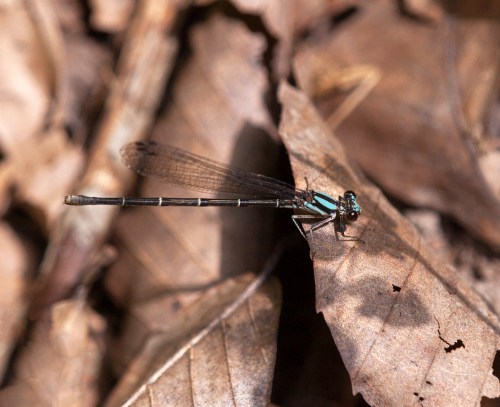
On Friday I spotted this female Blue-tipped Dancer damselfly (Argia tibialis) alongside a creek in Prince William County, Virginia. The fallen leaves provided a nice backdrop for the damselfly and remind me that the days of the summer are numbered.
Some of you undoubtedly noticed that there is no blue tip on this Blue-tipped Dancer. As is often the case for species names for insects (and for birds too), the name applies primarily to the males of the species. There is, however, some variety among female Blue-tipped Dancers, with a blue variant, as seen below, and a brown variant.
© Michael Q. Powell. All rights reserved.
Posted in damselfly, Insects, Nature, Photography, Summer, wildlife | Tagged Argia tibialis, Blue-tipped Dancer, Blue-tipped Dancer damselfly, Canon 50D, Prince William Forest Park, Tamron 180mm, Triangle VA | 5 Comments »
August 10, 2019 by Mike Powell
As I was exploring Prince William Forest Park yesterday morning, I spotted this little spider. I was shooting almost directly into the sun when I captured this image and the light caused the spider’s legs to look almost transparent and the web to glow with all kinds of colors.
It looks almost like the spider was in outer space (and a Facebook viewer commented that she was totally ok with the spider being as far away as possible from her)..

© Michael Q. Powell. All rights reserved.
Posted in Arachnids, Nature, Photography, spiders, wildlife | Tagged Canon 50D, outer space, Prince William Forest Park, spider, spider web, Tamron 180mm, Triangle VA | 19 Comments »
August 9, 2019 by Mike Powell
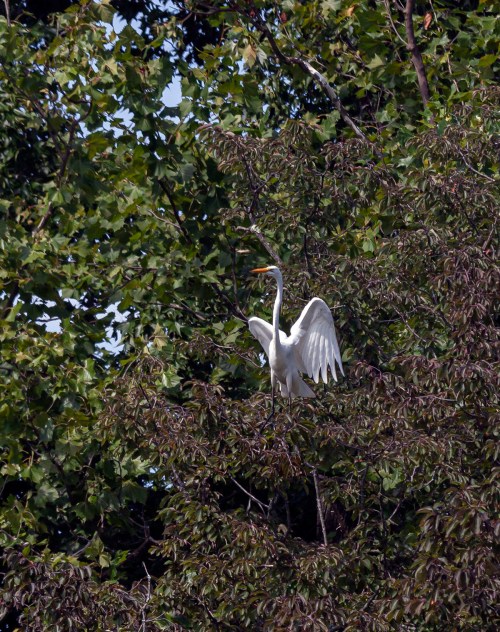
I inadvertently spooked a Great Egret (Ardea alba) last week while exploring a small pond at Occoquan Bay National Wildlife Refuge. I thought that it was going to fly away, but instead it opted to perch in a nearby tree. The sun was really bright as I tried to track the bird in my camera’s viewfinder, so many of my shots were overexposed. As the bird was settling in among the tree branches, I was able to capture this shot. I really like this shot because of the egret’s wing positions that are so unusual and graceful.
© Michael Q. Powell. All rights reserved.
Posted in Birds, Nature, Photography, Summer, wildlife | Tagged Ardea alba, Canon 50D, egret, Great Egret, Occoquan Bay National Wildlife Refuge, Tamron 180mm, Woodbridge VA | 6 Comments »
August 8, 2019 by Mike Powell
Dragonfly wings are amazing, but most of the time they are so transparent that it is hard to see all of the tiny little “cells” that make up the wings. Last Friday, though, I captured this shot of an immature male Calico Pennant dragonfly (Celithemis elisa) at Occoquan Bay National Wildlife Refuge that really highlights the beautiful mosaic-like pattern of its hind wings. Wow!

© Michael Q. Powell. All rights reserved.
Posted in Art, Dragonflies, dragonfly, Insects, Nature, Photography, Summer, wildlife | Tagged Calico Pennant, Calico Pennant dragonfly, Canon 50D, Celithemis elisa, male Calico Pennant, Occoquan Bay National Wildlife Refuge, Tamron 180mm, Woodbridge VA | 12 Comments »
August 7, 2019 by Mike Powell
Does you mood affect how you react to images? When I am reviewing images that I have captured, most of the time I use an analytical approach. I seek to identify the species of my subject and then look at the technical aspects of the photo, such as the sharpness of the focus. Finally I will see if I can improve the composition by cropping the image.
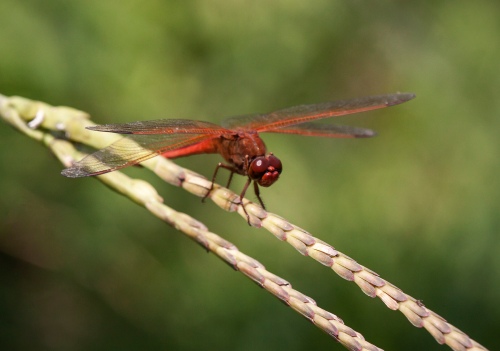
For some images, though, I respond initially with my heart and not my head. I don’t worry about “what” it is and simply enjoy the beauty of the shapes and colors that make up the image. That was the case with this shot of a male Needham’s Skimmer dragonfly (Libellula needhami) that I captured during a recent visit to Occoquan Bay National Wildlife Refuge.
I love the contrast between the orangish-red of the dragonfly’s body and the green background. The shape and texture of the vegetation, which I believe is Eastern Gamagrass (Tripsacum dactyloides), also really grabbed my eye (in part because I missed focus a little and the sharpest part of the image is the grass in front of the dragonfly). The composition is simple and straightforward and is pretty much the way I shot it.
We all like what we like. Most often we don’t even ask ourselves why we like something. I personally find it beneficial to try to articulate why I like something. Words fail me quite often when attempting to describe with words what is primarily an emotional reaction, but I think that the effort itself makes the process worthwhile.
© Michael Q. Powell. All rights reserved.
Posted in Art, Dragonflies, dragonfly, Insects, Nature, Photography, Summer, wildlife | Tagged Canon 50D, Eastern gamagrass, Libellula needhami, Needham's Skimmer, Needham's Skimmer dragonfly, Occoquan Bay National Wildlife Refuge, Tamron 180mm, Tripsacum dactyloides, Woodbridge VA | 6 Comments »
August 6, 2019 by Mike Powell
Are you always in search of new subjects or are you content to photograph the same subjects over and over again? Several years ago I came across an author who described two different types of people—those who prefer to live “widely” and those who prefer to live “deeply.” Those in the first group are always seeking new experiences and traveling to new places and, as photographers, are constantly looking for new things to photograph. By contrast, those in the second group are looking for a deeper experience and are likely to repeatedly return to the same locations over and over and photograph the same limited set of subjects.
As you might suspect, I see myself primarily as a member of the second group. Many of you have undoubtedly noted that I tend to hang out a lot in the same wildlife refuges throughout the year and often photograph familiar subjects. Why? For me, each encounter is unique—the lighting is different, the poses are different, and the age and genders of my subjects vary. I enjoy documenting the seasonal changes in fora and fauna at these locations. Each time I strive to capture different and, if possible, better images.
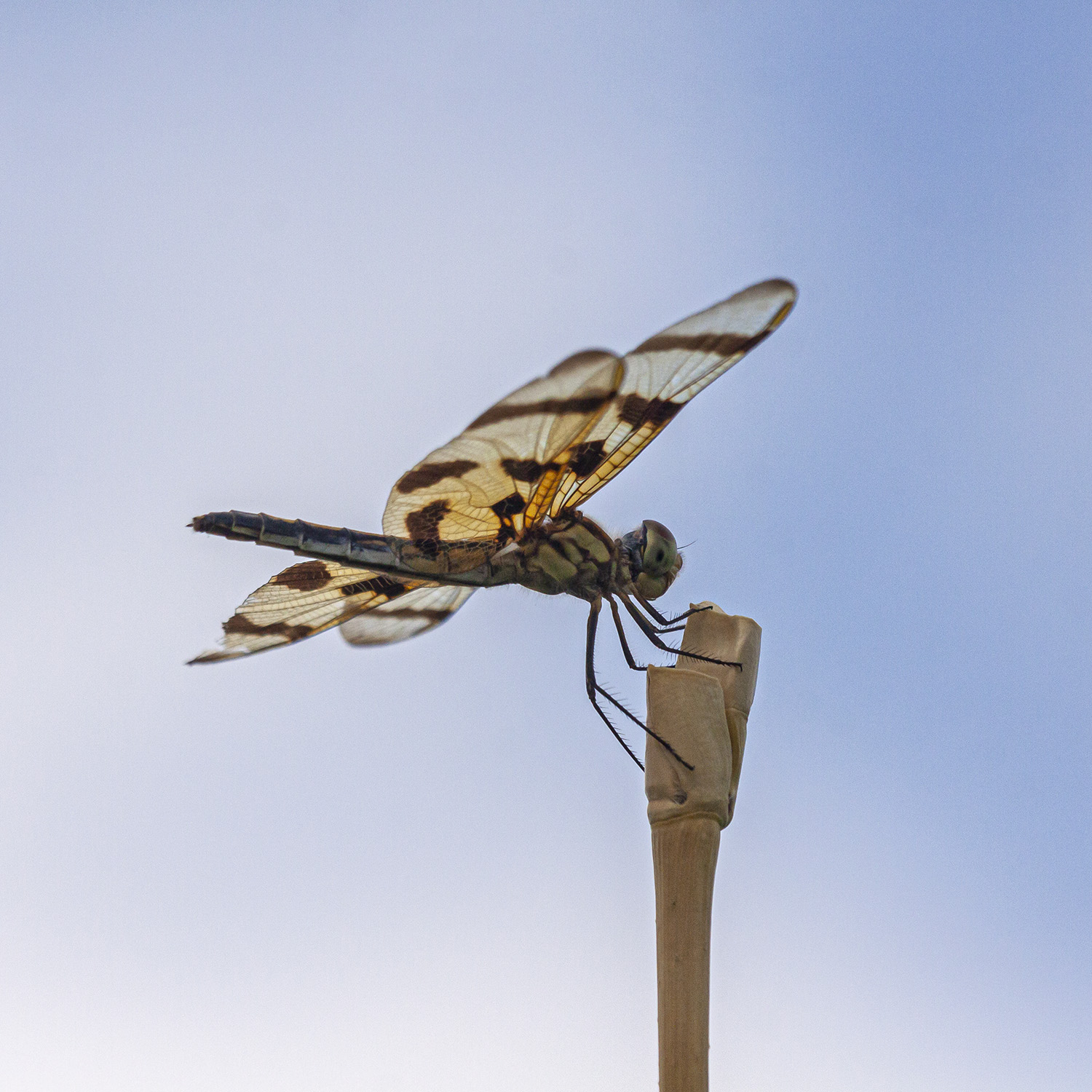
So, I am posting another photo of a Halloween Pennant dragonfly (Celithemis eponina), even though I posted several images of this species last week. My angle of view for this image from this past weekend was better; the lighting was coming from a better direction; and the slight breeze prompted the dragonfly to move its wings in a way that created a better pose. Consequently, I like this image more than the ones I posted earlier.
My simple approach to blog postings is to present something that is interesting to viewers. The photos may be visually appealing or show details or behavior that you may not have noticed before. You may learn something from my words or may have a better understanding of how the images came into being. Each day we have new opportunities to fill our lives with beauty and meaning. Photography and blogging have become part of my daily journey and I feel blessed to be able to share my experiences with so many of you.

© Michael Q. Powell. All rights reserved.
Posted in Dragonflies, dragonfly, Insects, Nature, Photography, Summer, wildlife | Tagged Canon 50D, Celithemis eponina, halloween pennant, Halloween Pennant dragonfly, Occoquan Bay National Wildlife Refuge, Tamron 180mm, Woodbridge VA | 13 Comments »
August 5, 2019 by Mike Powell
What is the best way to photograph a dragonfly that perches low to the ground? How can you create an image in which the dragonfly is not lost amidst the clutter of the vegetation? That was the challenge that fellow dragonfly enthusiast Walter Sanford and I faced last Monday when we journeyed to Riverbend Park in Great Falls, Virginia in search of Eastern Ringtail dragonflies (Erpetogomphus designatus).
Walter has a lot of experience with dragonflies and knew where to find Eastern Ringtails in the park. He knew, for example, that they like to perch on a section of concrete aggregate and indeed we spotted one not long after we arrived. Walter likes to maximize the chance of getting the entire dragonfly in focus by shooting downwards, ideally from as close to overhead as possible. For him, the concrete background is uncluttered and allows him to capture all of details of the dragonfly.
Although I prefer to photograph dragonflies on natural vice manmade surfaces, I took some photos, including the third one below, while the dragonfly was on the concrete—you have to shoot when the opportunity arises and I was not confident that I could wait for the dragonfly to choose a better perch. Rather than shooting from above when the dragonfly is on the ground, I usually choose to get down with the dragonfly.
Eventually I was able to get some shots of Eastern Ringtails perched in the grass. The middle image shows the dragonfly tilting its head to look towards me as I photographed it. I like the pose, but I was not fully satisfied. Those of you who have followed my blog for a while know that I like to get as close to a dragonfly as it will let me. The initial photo of this posting was one of my final shots of my session with the Eastern Ringtails and it is probably my favorite.
I began this post with a question and feel like I owe you a response. In reality, there is no “best” way to photograph a dragonfly on the ground, but my preferred option is to get low to the ground and close to the subject so that I am able to focus on part of the dragonfly, hopefully the eyes, and blur out the background because of the shallow depth of field when shooting that close. If you would like to see Walter’s wonderful photos of Eastern Ringtails from the same trip, I encourage you to check out his blog postings Eastern Ringtail reunion, continued and Reconnecting with Eastern Ringtail. Those postings provide his visual response to the question that I posed.


© Michael Q. Powell. All rights reserved.
Posted in Dragonflies, dragonfly, Insects, Macro Photography, Nature, Photography, Summer, wildlife | Tagged Canon 50D, Eastern Ringtail, Eastern Ringtail dragonfly, Erpetogomphus designatus, Great Falls VA, Riverbend Park, Tamron 180mm | 7 Comments »
August 4, 2019 by Mike Powell
Eastern Tiger Swallowtails (Papilio glaucus) were definitely enjoying this patch of Joe Pye Weed (Eutrochium purpureum) when I spotted them last Saturday at Riverbend Park. The butterfly in the foreground is a dark morph female and I believe the one in the background is a male. One of the cool things about Eastern Tiger Swallowtails is that females come in two varieties, one with coloration close to that of the male and one with the dark colors that you see in the image below.
This image is a a pretty straightforward presentation of a fairly common subject, but there is something about the composition that I really like. Maybe it’s the contrasting colors or the overlapping shapes. Who knows? So often I like what I like without being able to articulate the precise reasons why.

© Michael Q. Powell. All rights reserved.
Posted in Butterflies, Flowers, Insects, Nature, Photography, Summer, wildlife | Tagged Canon 50D, Eastern Tiger Swallowtail, Eastern Tiger Swallowtail butterfly, Eutrochium purpureum, Great Falls VA, Joe-Pye weed, Papilio glaucus, Riverbend Park, Tamron 180mm | 5 Comments »
August 3, 2019 by Mike Powell
This Osprey (Pandion haliaetus) spotted me about the same time as I spotted it and immediately took to the sky with its half-eaten fish yesterday at Occoquan Bay National Wildlife Refuge. Fortunately I had heard the osprey’s cry a few seconds earlier and was able to capture this image as it prepared for takeoff. Like another shot that I posted recently of an osprey, this image was captured using my 180mm macro lens.
This osprey was definitely not interested in sharing its freshly caught fish with me. If I want sushi, I’ll have to find it on my own.

© Michael Q. Powell. All rights reserved.
Posted in Birds, Nature, Photography, Summer, wildlife | Tagged Canon 50D, Occoquan Bay National Wildlife Refuge, Osprey, Pandion haliaetus, Tamron 180mm, Woodbridge VA | 7 Comments »
August 3, 2019 by Mike Powell
Recently there seems to have been an explosion of Big Bluet damselflies (Enallagma durum) at Occoquan Bay National Wildlife Refuge. This damselfly species is a coastal species and usually likes brackish water. Not surprisingly I saw them repeatedly yesterday as I walked along a trail near the water’s edge.
I like the first shot a lot, because of the repeated angled lines that provide a nice contrast with the damselfly. The second image shows a mating Big Bluet couple in a position known as the “wheel” that is viewed by many as a sidewards heart. As is usually the case with insects and with birds, the male Big Bluet is the more brightly-colored than his female counterpart.


© Michael Q. Powell. All rights reserved.
Posted in damselfly, Insects, Nature, Photography, Summer, wildlife | Tagged Big Bluet, Big Bluet damselfly, Canon 50D, Enallagma durum, Occoquan Bay National Wildlife Refuge, Tamron 180mm, Woodbridge VA | 3 Comments »
August 2, 2019 by Mike Powell
Although we still have quite a lot of summer remaining, some of my favorite dragonfly species have already disappeared for the season. I have been fortunate this year to see Gray Petaltail dragonflies (Tachopteryx thoreyi) on multiple occasions in several different locations. A little over a week ago I spotted this one at Occoquan Regional Park on the date that the Dragonflies of Northern Virginia website lists as the tail end of the season for this species. It is quite possible that I will have to wait until next year to see another one.
Gray Petaltails are remarkable dragonflies. They will sometime perch on you, which can be a bit disconcerting because they are so large and you can hear them when they fly by your head. Additionally, many scientists view this species as an ancient one. According to the website cited above, Gray Petaltails are “our oldest and most primitive dragonfly; species almost identical to petaltails flew alongside dinosaurs during the Jurassic period. Imagine petaltails and a herd of Brontosaurus sharing the same giant, fern-filled forests.”
It is hard to know exactly how long dragonflies have been around, but according to Wikipedia, fossils of very large dragonfly ancestors with wingspans of 30 inches (750 mm) have been found that are 325 million old. Given the ferocity of most dragonflies as predators, I am happy that modern day dragonflies are quite a bit smaller in size.

© Michael Q. Powell. All rights reserved.
Posted in Dragonflies, dragonfly, Insects, Nature, Photography, Summer, wildlife | Tagged Canon 50D, Gray Petaltail, Gray Petaltail dragonfly, Lorton VA, Occoquan Regional Park, Tachopteryx thoreyi, Tamron 180mm | 2 Comments »
August 1, 2019 by Mike Powell
Last Saturday I spotted this Blue-fronted Dancer damselfly (Argia apicalis) couple while exploring Riverbend Park in Great Falls, Virginia. I like this shot because it gives a good sense of the differences in coloration between the male and the female of this species. Most of the time when the damselflies are coupled, they are in contorted positions and most of the body of one or the other damselfly is out of focus in my photos. In this case, the damselflies are in the tandem position, but appear to be resting.

© Michael Q. Powell. All rights reserved.
Posted in damselfly, Insects, Nature, Photography, wildlife | Tagged Argia apicalis, Blue-fronted Dancer, Blue-fronted Dancer damselfly, Canon 50D, Great Falls VA, Riverbend Park, Tamron 180mm | 2 Comments »
July 31, 2019 by Mike Powell
Last Thursday I spotted this beautiful Halloween Pennant dragonfly (Celithemis eponina) perched on a very photogenic plant at Occoquan Bay National Wildlife Refuge. I love the curlicue curves of the plant that remind me of ornamental wrought iron.
The perch in the second and third images is not as interesting, but I thought that I would share those images because of the way that I was able to capture the sky and the clouds in the background. As you can probably tell, the vegetation was really high and I was shooting at an upwards angle.


© Michael Q. Powell. All rights reserved.
Posted in Dragonflies, dragonfly, Insects, Nature, Photography, Summer, wildlife | Tagged Canon 50D, Celithemis eponina, halloween pennant, Halloween Pennant dragonfly, Occoquan Bay National Wildlife Refuge, Tamron 180mm, Woodbridge VA | 14 Comments »
« Newer Posts - Older Posts »















 Mike Powell