September 27, 2019 by Mike Powell
Last week I spotted this male Common Green Darner dragonfly (Anax junius) while exploring with fellow photographer and dragonfly enthusiast Walter Sanford . This beauty was part of a swarm of dragonflies we observed that was probably preparing for migration.
As I processed these images I was struck by the wonderful range of colors on this dragonfly’s body. As its name suggests, a Common Green Darner has lots of green, but this one also has beautiful shades of blue and violet. I have included two images that may look very similar, but in fact were taken with two different cameras from the same spot.
In the first shot, I zoomed in close with my SX50 super zoom camera to try to capture as much detail as I could. I took the second shot with a fixed-focus lens. The heavy vegetation did not permit me to get any closer, so I tried to compose the image to include more of the environment.
Personally I like the second shot a bit more than the first—I prefer the additional “breathing space” around the subject and I think the second shot is a little sharper. Do you prefer one of them over the other?


© Michael Q. Powell. All rights reserved.
Posted in Art, Autumn, Dragonflies, dragonfly, Insects, Nature, wildlife | Tagged Anax junius, Canon 50D, Common Green Darner, Common Green Darner dragonfly, Lorton VA, Old Colchester Park and Preserve, Tamron 180mm | 16 Comments »
September 26, 2019 by Mike Powell
I am blessed to live in an area in which Bald Eagles (Haliaeetus leucocephalus) are present throughout most of the year. During the summer, however, my encounters have been pretty infrequent, so I was excited to spot this one on Monday while visiting Occoquan Bay National Wildlife Refuge. I was looking for dragonflies that day and had a macro lens on my DSLR camera and I realized the eagle was too far away for me to capture a decent image.
It was precisely for situations like this that I also carry my Canon SX50 super-zoom camera. The resolution of this camera is not as good as that of my “big” camera, but it gives me a lot of reach. After I had zoomed in to take the first shot, I zoomed out and realized that there was a second bald eagle perched above the one I had just photographed. The second shot shows the relative positions of the two eagles.
I was hoping for better head positions for the two eagles, but they flew away shortly after I took the second shot. I have discovered that it is usually best to get a shot as early as possible in such encounters and then work to get a better shot. If I had waited for the “perfect” moment, I almost certainly would have come up empty-handed.


© Michael Q. Powell. All rights reserved.
Posted in Autumn, Birds, Nature, Photography, wildlife | Tagged Bald Eagle, Bald Eagle couple, Canon SX50, Haliaeetus leucocephalus, Occoquan Bay National Wildlife Refuge, Woodbridge VA | 13 Comments »
September 25, 2019 by Mike Powell
On Monday I was really happy to spot this male Twelve-spotted Skimmer dragonfly (Libellula pulchella) at Occoquan Bay National Wildlife Refuge. Most dragonflies have clear wings and it is always special to see one with boldly patterned wings, like the Twelve-spotted Skimmer. This species is not particularly rare, but this is the first one that I have photographed this season.
Those of you who are mathematically inclined may wonder why this species is called “twelve-spotted” when there are clearly more than twelve spots. For the purposes of counting, however, only the dark spots matter and there are three on each wing. The female of the species also has twelve spots, but lacks the distinctive white spots of the male.

© Michael Q. Powell. All rights reserved.
Posted in Dragonflies, dragonfly, Insects, Nature, Photography, wildlife | Tagged Canon 50D, Libellula pulchella, Occoquan Bay National Wildlife Refuge, Tamron 180mm, Twelve-spotted Skimmer, Twelve-spotted Skimmer dragonfly, Woodbridge VA | 5 Comments »
September 24, 2019 by Mike Powell
Although the astronomical calendar indicates that it is now autumn, the summer season continues for many dragonflies. Many of them are showing a lot of wear and tear, like this female Great Blue Skimmer (Libellula vibrans) with tattered wings that I spotted last week at Occoquan Bay National Wildlife Refuge.
At this time of the year it is not uncommon to see dragonflies and butterflies with damaged wings, but this is one of the most extreme cases that I have ever witnessed. Amazingly, she was still able to fly.

© Michael Q. Powell. All rights reserved.
Posted in Dragonflies, dragonfly, Insects, Nature, Photography, wildlife | Tagged Canon 50D, female Great Blue Skimmer, Great Blue Skimmer, Great Blue Skimmer dragonfly, Occoquan Bay National Wildlife Refuge, Tamron 180mm, Woodbridge VA | 8 Comments »
September 23, 2019 by Mike Powell
For those of us in the Northern Hemisphere, today is the first day of autumn. In my area, today’s high temperature is forecast to reach 90 degrees (32 degrees C), so it does not really feel like autumn yet. However, it is beginning to look like autumn, with browns and orange tones starting to appear in the landscape.
Fortunately there are still lots of butterflies around, like this Viceroy Butterfly (Limenitis archippus) that I spotted last Wednesday at Occoquan Bay National Wildlife Refuge. The color palette of this shot really speaks to me of this new season.
Given that seasons are determined differently in different places by using meteorological or astrological calendars, I probably should try to be scrupulously inclusive and wish everyone a Happy September Equinox Day rather than Happy Autumn.
UPDATE: I took this shot while photowalking with fellow photographer and blogger, Walter Sanford. We did not talk about when we/if we might post an image of this butterfly, but it turns out he also posted one today. Checking out his posting if you like to read another take on our adventure and see a slightly different approach to photographing this butterfly. Walter and I have different backgrounds that affect the way we express ourselves in our words and in our images. Our complementary posts help to remind me that “reality” is as much subjective as it is objective.

© Michael Q. Powell. All rights reserved.
Posted in Autumn, Butterflies, Insects, Nature, Photography, wildlife | Tagged Canon 50D, Limenitis archippus, Occoquan Bay National Wildlife Refuge, Tamron 180mm, Viceroy, Viceroy butterfly, Woodbridge VA | 6 Comments »
September 22, 2019 by Mike Powell
Dragonflies are remarkably uncooperative—I can rarely get them to perch in places where the light is good and the background is photogenic. I love photographing butterflies in patches of colorful flowers, for example, and have often thought that it would be cool to shoot a dragonfly in a similar environment. Alas, dragonflies don’t seem to be attracted by nectar and pollen. I have repeatedly been frustrated by dragonflies that zoom past flowers and refuse to stop.
This past Wednesday, though, an emerald green female Eastern Pondhawk dragonfly (Erythemis simplicicollis) that I had been chasing surprisingly set herself down in a patch of bright yellow flowers. Moving as stealthily as I could with a racing heart, I managed to get close enough to the dragonfly to capture this image before she flew away.
When I am walking about with my camera, I try to be ready for the unexpected and on this occasion my persistence and quick reaction paid off.

© Michael Q. Powell. All rights reserved.
Posted in Dragonflies, dragonfly, Insects, Nature, Photography, wildlife | Tagged Canon 50D, Eastern Pondhawk, Eastern Pondhawk dragonfly, Erythemis simplicicollis, female eastern pondhawk, Lorton VA, Old Colchester Park and Preserve, Tamron 180mm | 9 Comments »
September 21, 2019 by Mike Powell
A few days ago I made a trip to the National Zoo in Washington D.C. and one of my highlights was visiting the massive Amazonia exhibit. While walking through the indoor rain forest, I could hear activity high in the trees and caught sight of some brightly colored small bird. I think there are also several varieties of monkeys that I did not spot and all kinds of amphibians and fish.
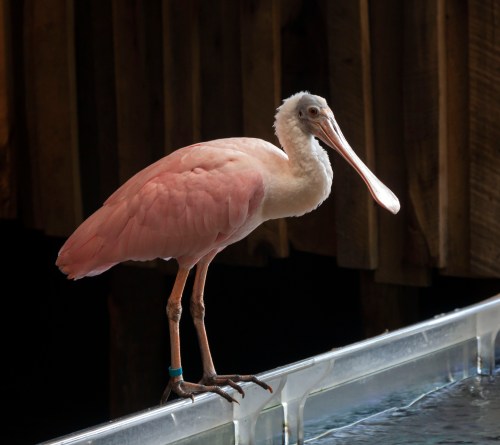
I was shocked and thrilled when a Roseate Spoonbill (Platalea ajaja) flew over and perched a few feet away from me when I was observing an exotic duck. I had previously marveled at the photos of Roseate Spoonbills posted by photographers in Florida and other southern US states, but had never seen one before. The spoonbill seemed to be a bit curious about my presence and willingly posed for me.
It was nice that the Roseate Spoonbill was so cooperative, because I had only a single lens with me, a Canon 24-105mm zoom lens. Initially I was worried that most subjects would be too far away for me to capture with the modest telephoto reach of the lens, but it proved to be perfect when taking portraits of the spoonbill who was less than three feet (one meter) away from me.
My wonderful experience with this beautiful bird increases my desire to see a spoonbill in the wild. I really enjoy visiting zoos, particularly ones like the National Zoo that, I believe, make special efforts to care for the animals. The zoo gives me a chance to observe animal behavior, including animals that I am not likely to see in the wild, but it can never be a replacement for the overall experience of observing animals, birds, and other wondrous creatures in their natural environment.


© Michael Q. Powell. All rights reserved.
Posted in Birds, Nature, Photography, zoo | Tagged Canon 24-105mm, Canon 50D, National Zoo, Platalea ajaja, Roseate Spoonbill, Washington D.C. | 16 Comments »
September 20, 2019 by Mike Powell
I spotted this large Snapping Turtle (Chelydra serpentina) in the grassy vegetation at the edge of one of the trails at Occoquan Bay National Wildlife Refuge on Monday. The turtle seemed to notice me as I bent down to take the shot, but made no attempt to move away (or to snap at me). Still. I decided to play it safe, kept a healthy distance from the turtle, and departed from the turtle without disturbing it from its comfortable resting spot.
In the past I have seen snapping turtles out of the water only in the spring, when they emerge from the muddy pond bottoms where they spend their winters, and when they are laying their eggs. I am not at all sure why this one decided to spend some time on dry land.

© Michael Q. Powell. All rights reserved.
Posted in Nature, Photography, Reptiles, turtle, wildlife | Tagged Canon 50D, Chelydra serpentina, Eastern Snapping Turtle, Occoquan Bay National Wildlife Refuge, snapping turtle, Tamron 180mm, Woodbridge VA | 12 Comments »
September 19, 2019 by Mike Powell
I will often shoot the same subjects over and over again. Each photo opportunity offers the possibility of a difference setting, a different pose, and different lighting conditions. I guess that is why I like the excitement and unpredictability of nature photography versus the more controlled environment of studio photography.
Last week I captured this image of a female Big Bluet damselfly (Enallagma durum) at Occoquan Bay National Wildlife Refuge. The single leaf on which the damselfly is perched makes for a simple composition that helps the subject to stand out, which is really important when the subject is so small. The sunlight helped to create a cool elongated shadow on the leaf that add additional visual interest to the shot. The minimal color palette works well too, I think.
Sometimes it is nice to have a little extra drama in our lives, even if it is only a dramatic damselfly.

© Michael Q. Powell. All rights reserved.
Posted in damselfly, Insects, Nature, Photography, wildlife | Tagged Big Bluet, Big Bluet damselfly, Canon 50D, damselfly, Enallagma durum, female big bluet, Occoquan Bay National Wildlife Refuge, Tamron 180mm, Woodbridge VA | 8 Comments »
September 18, 2019 by Mike Powell
On Monday I spotted this freshly emerged female Common Green Darner dragonfly (Anax junius) at Occoquan Bay National Wildlife Refuge. It won’t be long before it will be time for her to migrate southward. Yes, some dragonflies actually migrate.
When I first started getting into dragonflies, it never struck me that dragonflies could travel long distances. I figured that they lived and died in a relatively confined geographic area. Although that may be true for some dragonfly species, that is not the case for the Common Green Darner. One of my favorite websites, Dragonflies of Northern Virginia, describes the amazing saga of this species in these words:
“They emerge in the Southeast and fly north, arriving here late March thru May. After their long flight, they mate, lay eggs and die. Their young emerge in July and August. Congregating in large swarms, this 2nd generation begins flying south in September. They lay eggs that fall, after arriving in their southern destinations, and die. When their young hatch in March, they fly back to Northern Virginia and it starts again – a two generation migration.”
Many of us have gotten used to using Global Positioning System (GPS) devices to help us navigate or use Google Maps. How do these dragonflies know where to go? How do they find a destination that they have never visited before? It boggles my mind and fills me with awe and wonder when I contemplate questions like these.


© Michael Q. Powell. All rights reserved.
Posted in Autumn, Dragonflies, dragonfly, Insects, Nature, Photography, wildlife | Tagged Anax junius, Canon 50D, Common Green Darner, Common Green Darner dragonfly, migration, Occoquan Bay National Wildlife Refuge, Tamron 180mm, Woodbridge VA | 10 Comments »
September 17, 2019 by Mike Powell
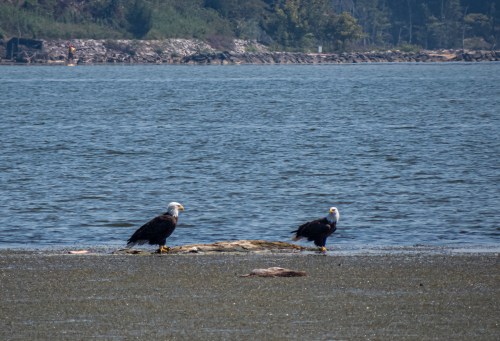
When I first spotted two small dark shapes in the the waters of Occoquan Bay, I wasn’t sure what I was seeing. As I zoomed in and saw that it was two birds, I assumed that they were cormorants or some similar bird. When the birds changed position and the sun reflected off their white heads, I was shocked to realize that it was two adult Bald Eagles (Haliaeetus leucocephalus) perched on a floating log.
The photo is a little deceptive because it makes it look like the foreground is a beach. The tide was fairly low when I took this shot and the shallower water was covered with some kind of floating debris—it was definitely not solid ground.
Why were the eagles on the log? I thought that maybe they were feeding, but when I scanned the log, I could not see any evidence of a fish. It looks to me like this is a couple, with the larger female on the left, that is involved in some kind of marital dispute. She seems to be telling her mate something and he seems to be a bit cowed and defensive.
What do you the conversation is about between these two eagles?
© Michael Q. Powell. All rights reserved.
Posted in Birds, Nature, Photography, wildlife | Tagged Bald Eagle, Canon SX50, Haliaeetus leucocephalus, Occoquan Bay National Wildlife Refuge, Woodbridge VA | 7 Comments »
September 16, 2019 by Mike Powell
I was looking into the bright sun when I spotted this Eastern Tiger Swallowtail butterfly (Papilio glaucus) feeding on a nearby flower. Normally that is not an ideal situation for photography and often renders the subject as a silhouette. However, I adjusted my camera settings and was able to capture the translucency of the butterfly’s wings and the shape and color of the vegetation showing through from behind the wings.

© Michael Q. Powell. All rights reserved.
Posted in Butterflies, Nature, Photography, wildlife | Tagged Canon 50D, Eastern Tiger Swallowtail, Eastern Tiger Swallowtail butterfly, Meadowlark Botanical Gardens, Papilio glaucus, Tamron 180mm, Vienna VA | 13 Comments »
September 15, 2019 by Mike Powell
From a distance I noticed a flash of yellow moving from a tree to a patch of flowers. The flight was too fast for a butterfly, and when I moved a bit closer I spotted, as I had suspected, an American Goldfinch (Spinus tristis). Judging from its coloration, I think it may be a juvenile, though I must admit that after a summer of chasing insects, my bird identification skills are a little rusty. The goldfinch was somewhat skittish and uncooperative, but I was able to capture these two images that I decided to share them with you all.


© Michael Q. Powell. All rights reserved.
Posted in Birds, Nature, Photography, wildlife | Tagged American Goldfinch, Canon 50D, Canon SX50, goldfinch, Meadowlark Botanical Gardens, Spinus tristis, Tamron 180mm, Vienna VA | 7 Comments »
September 14, 2019 by Mike Powell
I have not seen as many Green Herons (Butorides virescens) this year as in previous years, so I was happy to spot one this past Tuesday during a quick trip to Meadowlark Botanical Gardens in nearby Vienna, Virginia.
Green Herons are smaller and squatter than the more commonly seen Great Blue Herons (Ardea herodias). Normally I see Green Herons at water’s edge, because their shorter legs do not allow them to wade into deeper water, and they are often partially hidden from view by vegetation. This Green Heron, though, had placed itself at the edge of a drainage system in the middle of a small pond, which is why I was able to get an unobstructed shot of this handsome bird.

© Michael Q. Powell. All rights reserved.
Posted in Birds, Nature, Photography, wildlife | Tagged Butorides virescens, Canon SX50, green heron, Meadowlark Botanical Gardens, Vienna VA | 7 Comments »
September 13, 2019 by Mike Powell
I thought it was too late in the season for lotuses, so I was thrilled to see them at Meadowlark Botanical Gardens earlier this week in bloom, as seed pods. and most surprisingly as buds.
I am fascinated by lotuses in all of their stages. I love the three-dimensional quality of the flowers and the way that you can look into the center of them. Lotus seed pods are a little creepy—from certain angles they look like a cluster of eyeballs that follow you around. By contrast, I always feel a sense of calm when I am enjoying the simple beauty of the lotus buds.


© Michael Q. Powell. All rights reserved.
Posted in Flowers, Nature, Photography, Summer | Tagged Canon 50D, lotus, lotus bud, lotus seed pod, Meadowlark Botanical Gardens, Tamron 180mm, Vienna VA | 10 Comments »
September 12, 2019 by Mike Powell
The Red-footed Cannibalfly (Promachus rufipes), a kind of robber fly has just about the coolest (and creepiest) name of any insect. I spotted this female Red-footed Cannibalfly last week at Occoquan Bay National Wildlife Refuge. If you look very closely at the image, you can actually see some of its tiny red feet. However, this insect is not known for being cute—it is a particularly fierce predator that can take down much larger prey, reportedly including hummingbirds.
On a personal basis, I have a particular fondness for the Red-footed Cannibalfly. On 31 August 2013, I did a posting called simply Red-footed Cannibalfly. The posting had some decent photos and and some interesting information and had a modest degree of success, with a total of 44 likes.
Amazingly, though, the posting has been viewed 2530 times to date. Apparently when folks go searching with Google, Bing, or some other search engine, they come across my posting and are intrigued enough to view it. I know that search engine algorithms are closely-guarded secrets, but for this one particular topic, I seem to have broken the code. If you do a search for “red-footed cannibalfly,” you might see my name pop up on the first page of results—it’s a weird claim to fame, but life on the internet is often a mystery.

© Michael Q. Powell. All rights reserved.
Posted in Insects, Nature, Photography, wildlife | Tagged Canon 50D, Occoquan Bay National Wildlife Refuge, Promachus rufipes, Red-footed Cannibalfly, Tamron 180mm, Woodbridge VA | 13 Comments »
September 11, 2019 by Mike Powell
I was excited to spot this Ruby-throated Hummingbird (Archilochus colubris) during a short visit yesterday to Meadowlark Botanical Gardens with some friends. The hummingbird was feeding on some distant orange jewelweed flowers (Impatiens capensis) and I was using a macro lens at that moment, so I was especially thrilled when I managed to capture this image.
I do not see hummingbirds very often, so it really is a treat for me to see one in action. It is absolutely mesmerizing to watch these little birds frenetically flying among the flowers, stopping from time to time to sip the nectar from one of them. Tracking the moving hummingbird was definitely a challenge with my 180mm macro lens. Strangely enough, though, I probably had an easier time in doing so with this lens than if I had been using my much longer telephoto zoom lens—it can be tough trying to track, focus, and zoom simultaneously when handholding a long lens.
This image is a significant crop of the original image, but the detail holds up fairly well, all things considered. Does equipment matter? It matters to some extent, but you can often get decent results by simply taking the shots with whatever camera and lens that you have at hand.

© Michael Q. Powell. All rights reserved.
Posted in Birds, Flowers, Nature, Photography, wildlife | Tagged Archilochus colubris, Canon 50D, hummingbird, Impatiens capensis, Meadowlark Botanical Gardens, Orange Jewelweed, Ruby-throated Hummingbird, Tamron 180mm, Vienna VA | 4 Comments »
September 10, 2019 by Mike Powell
Do you have a favorite insect? Although I like dragonflies a lot, my favorite insect is probably the rainbow-colored Handsome Meadow Katydid (Orchelimum pulchellum). I was thrilled to spot this beauty on some colorful vegetation last Saturday at Occoquan Bay National Wildlife Refuge.
I remember well the sense of incredulity that I felt when I saw one of these insects for the very first time—I simply could not believe that the bright colors were real. The beautiful curling leaves hide the details of the katydid’s body a little, but add a wonderful artistic element to this image. If want to see the brilliant colors of a Handsome Meadow Katydid on full display, check out this link to a 2013 posting that I entitled Rainbow Grasshopper—it is one of my most popular posts to date with over 315 views.
The vivid colors of this katydid are sure to grab your attention, but you should also be sure to check out its eyes. I am still blown away every time that I see those amazing eyes that seem to be looking deeply into me. Here’s looking at you, kid.

© Michael Q. Powell. All rights reserved.
Posted in Insects, Macro Photography, Nature, Photography, wildlife | Tagged Canon 50D, Handsome Meadow Katydid, Occoquan Bay National Wildlife Refuge, Orchelimum pulchellum, rainbow grasshopper, rainbow katydid, Tamron 180mm, Woodbridge VA | 15 Comments »
September 9, 2019 by Mike Powell
If you were to pit a mantis against a spider, which one would have the advantage? I thought it would be the mantis, but that was clearly not the case this past week at Occoquan Bay National Wildlife Refuge. This spider had a large web stretched over a path on which I was walking, and I guess the mantis was unlucky enough to get stuck in its sticky strands as it was moving through the air.

© Michael Q. Powell. All rights reserved.
Posted in Arachnids, Insects, Macro Photography, Nature, Photography, wildlife | Tagged Canon 50D, mantis, mantis versus spider, Occoquan Bay National Wildlife Refuge, praying mantis, spider, Tamron 180mm, Woodbridge VA | 6 Comments »
September 8, 2019 by Mike Powell
What signposts mark for you the transition from summer to autumn? Many folks might point to changes in the foliage colors or cooler weather, but for me the spotting of my first Fine-lined Emerald dragonfly (Somatochlora filosa) marks an unofficial beginning to the new season.
Fine-lined Emeralds are a relatively uncommon dragonfly species, both locally as well as nationally. They seem to prefer a coastal plain and are active for only about a month, generally the month of September. Yesterday I visited Occoquan Bay National Wildlife Refuge, a place where I have seen Fine-lined Emeralds in the past, and I was thrilled when I eventually spotted one. However, it took me several hours before I was able to capture this shot, because most of the Fine-lined Emeralds that I saw flew by me without stopping and I would lose them when I gave chase.
You probably noticed a few things about this dragonfly when you looked at the photo. First, it is clear why the family to which this dragonfly belongs is called “Emerald”—those brilliant green eyes are mesmerizing. Secondly, you can’t help but notice that Fine-lined Emeralds do not perch horizontally like most dragonflies you are likely to encounter. Instead, they hang almost vertically from bare branches. As a result, their slender bodies are hard for the eye to detect and also tend to confuse a camera’s autofocusing system. Most of the time I end up having to manually focus, as I did in this situation. Lastly, if you click on the image, you can see this dragonfly’s beautiful markings on the thorax (the “chest”) and the abdomen (the “tail”).
So, for me autumn has begun with the arrival of the Fine-lined Emerald dragonfly. Has autumn started for you yet or are you waiting for some additional personal signs of the season?

© Michael Q. Powell. All rights reserved.
Posted in Dragonflies, dragonfly, Insects, Nature, Photography, wildlife | Tagged Canon 50D, Fine-lined Emerald, Fine-lined Emerald dragonfly, male Fine-lined Emerald, Occoquan Bay National Wildlife Refuge, Somatochlora filosa, Tamron 180mm, Woodbridge VA | 16 Comments »
September 7, 2019 by Mike Powell
As I was looking at a small patch of purple aster flowers yesterday at Jackson Miles Abbott Wetland Refuge, I noticed that the center of one of them was a different color than all of the rest. I moved closer and was thrilled to see this very cool-looking White-banded Crab Spider (Misumenoides formosipes) nestled in among the petals of the flower. This kind of spider does not build a web, but patiently perches, waiting to pursue passing prey.


© Michael Q. Powell. All rights reserved.
Posted in Arachnids, Flowers, Macro Photography, Nature, Photography, spiders, wildlife | Tagged Canon 50D, crab spider, Fort Belvoir VA, Jackson Miles Abbott Wetland Refuge, Misumenoides formosipes, spider, Tamron 180mm, White-banded Crab Spider | 18 Comments »
September 6, 2019 by Mike Powell
With a name that includes the word “bluet,” you might expect that this female Big Bluet damselfly (Enallagma durum) would be blue, but obviously that is not the case here. There is a blue female variant in this species, but this one appears to be the olive variant. Damselfly identification is difficult under the best of circumstances, because so many of them share the same colors—only the patterns help you distinguish among them. In this case, size helps a bit too, because Big Bluets are in fact larger than many other damselflies.
As I was exploring Occoquan Bay National Wildlife Refuge a few days, I was fortunate that this damselfly chose to perch at almost eye level on a stalk of Eastern Gamagrass, which let me get a clear shot with the sky in the background. Most of the time damselflies like this perch lower to the ground in areas with denser vegetation.

© Michael Q. Powell. All rights reserved.
Posted in damselfly, Macro Photography, Nature, Photography, Summer, wildlife | Tagged Big Bluet, Big Bluet damselfly, Canon 50D, Enallagma durum, female big bluet, Occoquan Bay National Wildlife Refuge, Tamron 180mm, Woodbridge VA | 5 Comments »
September 5, 2019 by Mike Powell
I guess that the main subject of this image is the tiny male Eastern Amberwing dragonfly (Perithemis tenera), but I must confess that I was equally drawn to the curving shapes of the branches sticking out of the water during my recent trip to Jackson Miles Abbott Wetland Refuge. Normally I try to fill as much of my frame with my primary subject by using a zoom lens or by moving closer, but in this case I actually moved back in order to be able to capture more of the vegetation.
I really like the way that the warm amber color of the aptly named Eastern Amberwing stands out against the muted tones of the rest of the image. The style of this image is different from most of my shots (assuming that I have an identifiable style), but I enjoy mixing it up from time to time by shooting from different angle or distances.

© Michael Q. Powell. All rights reserved.
Posted in Art, Dragonflies, dragonfly, Insects, Nature, Photography, Summer, wildlife | Tagged Canon 50D, Eastern Amberwing, Eastern Amberwing dragonfly, Fort Belvoir VA, Jackson Miles Abbott Wetland Refuge, male Eastern Amberwing, Perithemis tenera, Tamron 180mm | 8 Comments »
September 4, 2019 by Mike Powell
The milkweed plants were dirty and dried up, but I knew from past experience that there might be ladybugs crawling around on them. The first two plants that I checked were full of aphids, a favorite food of ladybugs, but I did not see any ladybugs at all. As I approached a third plant, I saw a flash of red and spotted a small ladybug crawling quickly down the stem of the plant. I was not as close as I could have like to have been, but managed to capture some images before the ladybug disappeared from sight.
I like the way that this shot turned out because the reddish-orange of the ladybug really stands out against the blues and greens in the rest of the photos. In case you are curious, the little specks of yellow are aphids. In this case, the aphids were safe, for this ladybug seemed to be in too much of a hurry to stop for a snack.

© Michael Q. Powell. All rights reserved.
Posted in Insects, Macro Photography, Nature, Photography, Summer | Tagged Alexandria VA, aphids, Canon 50D, green spring gardens, ladybug, Tamron 180mm | 3 Comments »
September 3, 2019 by Mike Powell
Monarch butterflies (Danaus plexippus) are beautiful in any situation, but when you surround them with red, orange, and yellow flowers, they absolutely explode with color. I was thrilled when I spotted this Monarch during a short visit to Green Spring Gardens this past Saturday morning. The butterfly was initially quite skittish and flew all around before finally settling on what I believe to be some kind of lantana flower. I had to maneuver around to try to get a good shooting position, but the butterfly stayed put for a minute and accommodated me. I was super happy when I managed to include some of the colorful flowers in the background and I just love the way that the colors work so well together.

© Michael Q. Powell. All rights reserved.
Posted in Art, Butterflies, Nature, Photography, Summer | Tagged Alexandria VA, Canon 50D, Danaus plexippus, green spring gardens, lantana, Monarch, monarch butterfly, Tamron 180mm | 12 Comments »
September 2, 2019 by Mike Powell
I spotted this beautiful American Lady butterfly (Vanessa virginiensis) during a quick visit this past Saturday morning to Green Spring Gardens, a county-run historic garden not far from where I live. A lot of butterflies were active that day, but my eyes were immediately drawn to this American Lady, a species that I do not see very often. I had to chase it a bit before it stopped to feed on this flower, which was so popular that the American Lady had to share it with a much smaller skipper butterfly. The flower was growing near a fenced in area of public plots where people grow vegetables and the fence caused the striped effect in the background.
Although I spend most of my time photographing subjects in the wild, it was nice to visit a more cultivated place that was still ablaze with summer colors. I am quite conscious of the fact that the summer is slowly slipping away.

© Michael Q. Powell. All rights reserved.
Posted in Butterflies, Flowers, Insects, Nature, Photography, Summer | Tagged Alexandria VA, American Lady butterfly, American Painted Lady butterfly, Canon 50D, green spring gardens, Tamron 180mm, Vanessa virginiensis | 12 Comments »
September 1, 2019 by Mike Powell
What do you see first when you look at this image? Do you see the beautiful colors, textures, and shapes of the rock that makes up both the foreground and the background? Are you drawn to the lines and somber coloration of the Powdered Dancer damselfly (Argia moesta) and its shadow? Do you focus on the damselfly’s brightly shining gray eye?
I spotted this little damselfly this past week while exploring a creek in Fairfax County with fellow dragonfly enthusiast Walter Sanford. There is a simplicity to this image that I find really appealing. I especially like the limited color palette and the sense of harmony in the way that the colors work together.
What do you think?

© Michael Q. Powell. All rights reserved.
Posted in damselfly, Insects, Nature, Photography, Summer, wildlife | Tagged Argia moesta, Canon 50D, Fairfax County Virginia, Powdered Dancer, Powdered Dancer damselfly, stream, Tamron 180mm | 10 Comments »
August 31, 2019 by Mike Powell
Really, an image of a horsefly? That sentence fragment was part of an internal dialogue that I had with myself when considering whether to post this image. I know that most people find flies to be fairly disgusting. However, I was really taken with the details that I managed to capture when this enormous horsefly—it looked to be about 2 inches (50 mm) in length—perched in front of me earlier this week as I was resting alongside a rocky creek.
The fly’s eyes seem to have multiple colors and its body has several wonderful patterns. It is not all beauty, though, and I find those sharp points protruding from the face to be menacing, an impression enhanced by the enlarged shadow that cast by the fly.
I have to admit that I was fascinated by this giant horsefly and that fascination prompted me to post the photo despite my initial inhibitions. What do you think?

© Michael Q. Powell. All rights reserved.
Posted in Insects, Macro Photography, Nature, Photography, Summer, wildlife | Tagged Canon 50D, Fairfax County Virginia, horsefly, Tamron 180mm | 9 Comments »
August 30, 2019 by Mike Powell
Yesterday I was thrilled to spot this spectacular female American Rubyspot damselfly (Hetaerina americana) while exploring a creek in Fairfax County, Virginia with my good friend and fellow dragonfly enthusiast Walter Sanford. This species is found along streams and rivers and this in only the second time that I have ever seen American Rubyspots. The green and brown colors on the thorax (the “chest”) of this damselfly are incredible and I highly recommend you click on the images to get an even better look at the amazing details.
Signs are starting to appear that we are approaching the end of summer. Already I have noted that the number of dragonflies is dropping, though there still seem to be plenty of butterflies. It was therefore particularly gratifying to see this unfamiliar damselfly yesterday. The dragonfly season, though is far from over—there are some autumn dragonfly species that I have not yet seen. Birds are starting to migrate through this area, so some may appear in this blog soon, but there should still be dragonfly photos for the next few months at least.


© Michael Q. Powell. All rights reserved.
Posted in damselfly, Insects, Macro Photography, Nature, Photography, Summer, wildlife | Tagged American Rubyspot, American Rubyspot damselfly, Canon 50D, Fairfax County Virginia, Hetaerina americana, Tamron 180mm | 9 Comments »
August 30, 2019 by Mike Powell
Posted in Butterflies, Humor, Insects, Nature, Photography, Summer, wildlife | Tagged butterfly, butterfly perched on me, Occoquan Bay National Wildlife Refuge, Walter Sanford, Woodbridge VA | 2 Comments »
August 29, 2019 by Mike Powell
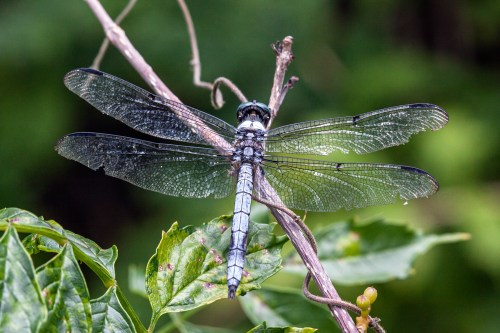
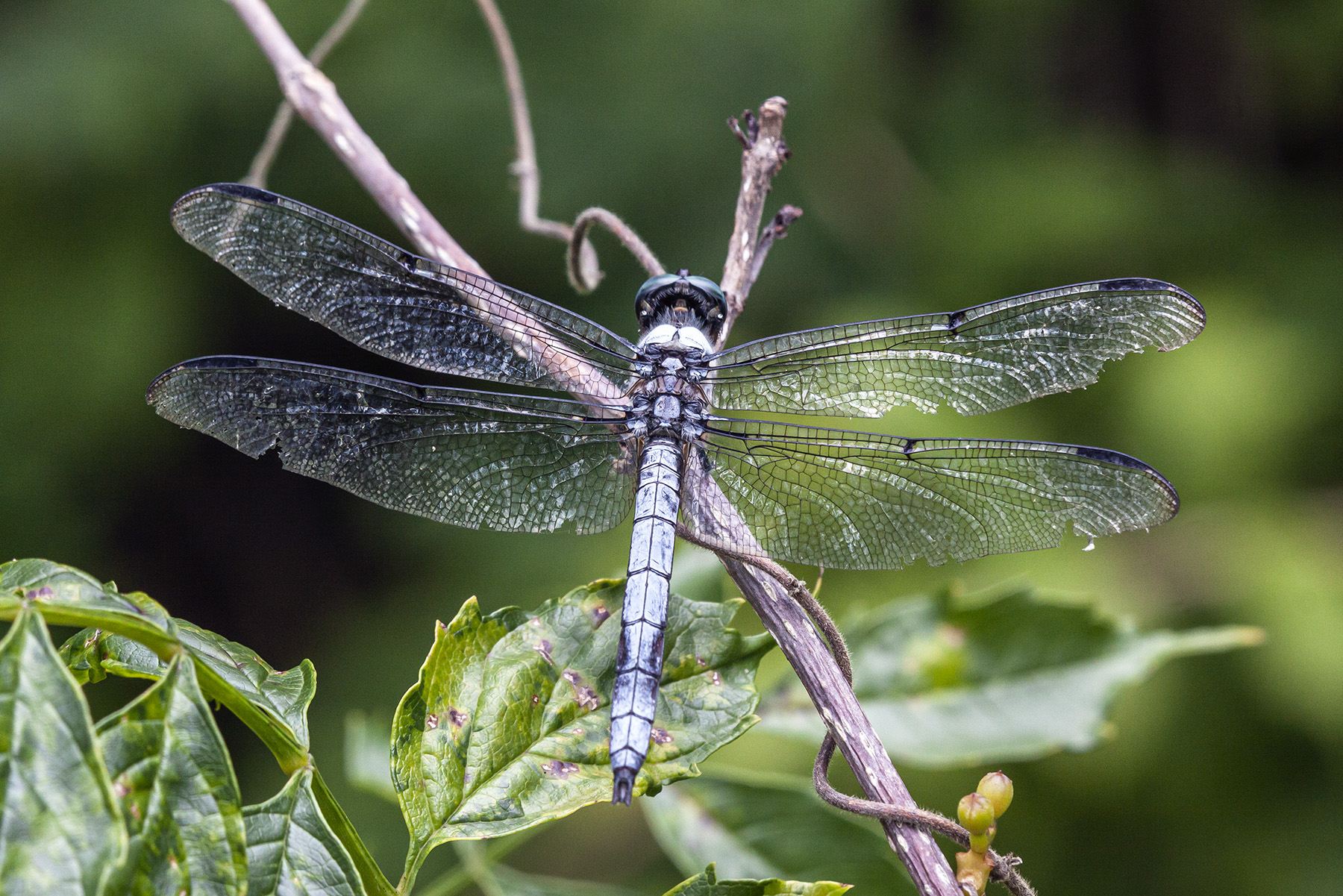
Great Blue Skimmer dragonflies (Libellula vibrans) are really common, but I enjoy photographing them anyways, like this grizzled male that I spotted earlier this week at Jackson Miles Abbott Wetland Refuge. The curling vines of the plant on which this dragonfly chose to perch add some additional visual interest to these photos.
I must confess that ordinary blue dragonflies have a special place in my heart, because my very first blog posting on July 7, 2012 featured a photo of a Blue Dasher, another common species. My photography skills and my knowledge about dragonflies have increased significantly since that time, though I am still quite proud of that initial photo that started me on this long journey into photography.

© Michael Q. Powell. All rights reserved.
Posted in Dragonflies, dragonfly, Insects, Nature, Photography, Summer, wildlife | Tagged Blue Dasher, Blue Dasher dragonfly, Canon 50D, Fort Belvoir VA, Great Blue Skimmer, Great Blue Skimmer dragonfly, Jackson Miles Abbott Wetland Refuge, Libellula vibrans, Pachydiplax longipennis, Tamron 180mm | 4 Comments »
« Newer Posts - Older Posts »





 Mike Powell