November 21, 2021 by Mike Powell
It was cold and breezy yesterday at Occoquan Bay National Wildlife Refuge and most of the birds seemed to have taken shelter and were hidden from view. There were large rafts of some kind of ducks visible in the distance on the bay, so periodically I would look out at the water, hoping that some bold bird had ventured close enough for me to identify it.
As I was scanning the surroundings, my eyes detected a bit of motion and I caught a glimpse of this Great Blue Heron (Ardea herodias). Normally I see herons in the water or occasionally perched in a tree. This heron, however, was perched atop a duck hunting blind a short distance from the shore. In some years this blind has been used by ospreys for nesting, so there always seems to be sticks piled on the roof that you can see behind the heron.
I am not sure why the heron chose this particular location, but maybe it felt secure and sheltered there. I noted that the heron was perched on one leg and recalled that herons will sometimes tuck the other leg underneath its feathers to keep it warm.
I was careful not to disturb the heron from its chosen spot while I grabbed a few shots and then I moved slowly down the trail in search of additional subjects to photograph.

© Michael Q. Powell. All rights reserved.
Posted in Autumn, Birds, Nature, Photography, wildlife | Tagged Ardea herodias, Canon 50D, Great Blue Heron, Occoquan Bay National Wildlife Refuge, Tamron 150-600mm, Woodbridge VA | 24 Comments »
November 20, 2021 by Mike Powell
As I was walking through a grassy field on Thursday at Huntley Meadows Park, I inadvertently disturbed a grasshopper that flew to a nearby tree. It had been weeks since I had last seen a grasshopper, so I searched carefully for the insect and was happy when I managed to locate it on the trunk of the tree.
Although I carefully composed my shot, I did not have high expectations for it—it was a simple shot with a simple composition. I was stunned when I reviewed the image on my computer at how well it turned out. I love the way I was able to capture the texture of the tree bark and of the grasshopper, though I must confess that the background on the right hand side of the image may be my favorite element of the image.
One of the joys of photography for me is the discovering images like this, appealing images in which the separate components work together to create a harmonious whole. If someone had asked me when I first returned home from the shoot if I had captured any good images, I probably would have responded negatively—I would have been wrong.
Have a wonderful weekend.

© Michael Q. Powell. All rights reserved.
Posted in Autumn, Insects, Nature, Photography, wildlife | Tagged Alexandria VA, autumn grasshopper, Canon 50D, grasshopper, Huntley Meadows Park, Tamron 150-600mm | 13 Comments »
November 19, 2021 by Mike Powell
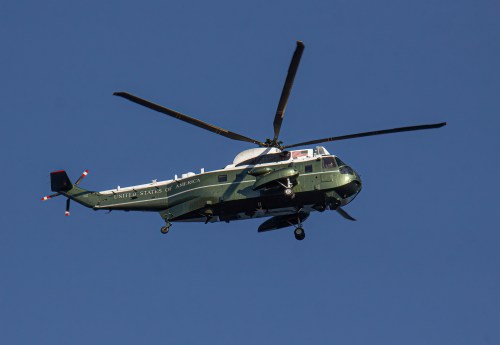
When I am out taking photos at Occoquan Bay National Wildlife Refuge, I often hear helicopters passing overhead. Generally the helicopters are green in color and probably belong to the US Army aviation unit at nearby Fort Belvoir.
I was a little surprised last week, though, when I spotted the a distinctive “White Top” helicopter, which meant that it probably belongs to the unit that provides helicopter support to the President, the Marine Helicopter Squadron One “Nighthawks.” The unit is based primarily in Quantico, Virginia, further south along the Potomac River from where I was located. This helicopter seemed to be by itself, which makes it very unlikely that it was Marine One, the designation given to the helicopter carrying the President.
“As a security measure, Marine One always flies in a group of as many as five identical helicopters. One helicopter carries the president, while the others serve as decoys. Upon take-off these helicopters shift in formation to obscure the location of the president. This has been referred to as a “presidential shell game,” according to Wikipedia.
Helicopters often make me think of dragonflies, because of their general shape and aerial flight capabilities. I recently went to see the new “Dune” movie and was totally blown away by the “ornithopters” that play a centrol role in the movie—they look even more like dragonflies than a “normal” helicopter does.
According to an article on motorbiscuit.com, “Director Denis Villeneuve instructed the team to base them on dragonflies while still making the military vehicles appear “muscular.” As a result, the aircraft look like part helicopter gunship, party huge insect.” For the record, I really enjoyed the “Dune” movie, which combines some of the storytelling of the Matrix and Star Wars movies with the stunning desert cinematography of “Lawrence of Arabia.”
© Michael Q. Powell. All rights reserved.
Posted in Photography, Urban | Tagged Canon 50D, helicopter, Marine Helicopter Squadron One, Marine One, Occoquan Bay National Wildlife Refuge, presidential helicopter unit, Tamron 150-600mm, Woodbridge VA | 8 Comments »
November 18, 2021 by Mike Powell
There was a lot of bird activity on Tuesday at Occoquan Bay National Wildlife Refuge both in the air and on the water. Unfortunately most of the action took place well out of the optimal range of my camera, so I had to be content with capturing long distance photos.
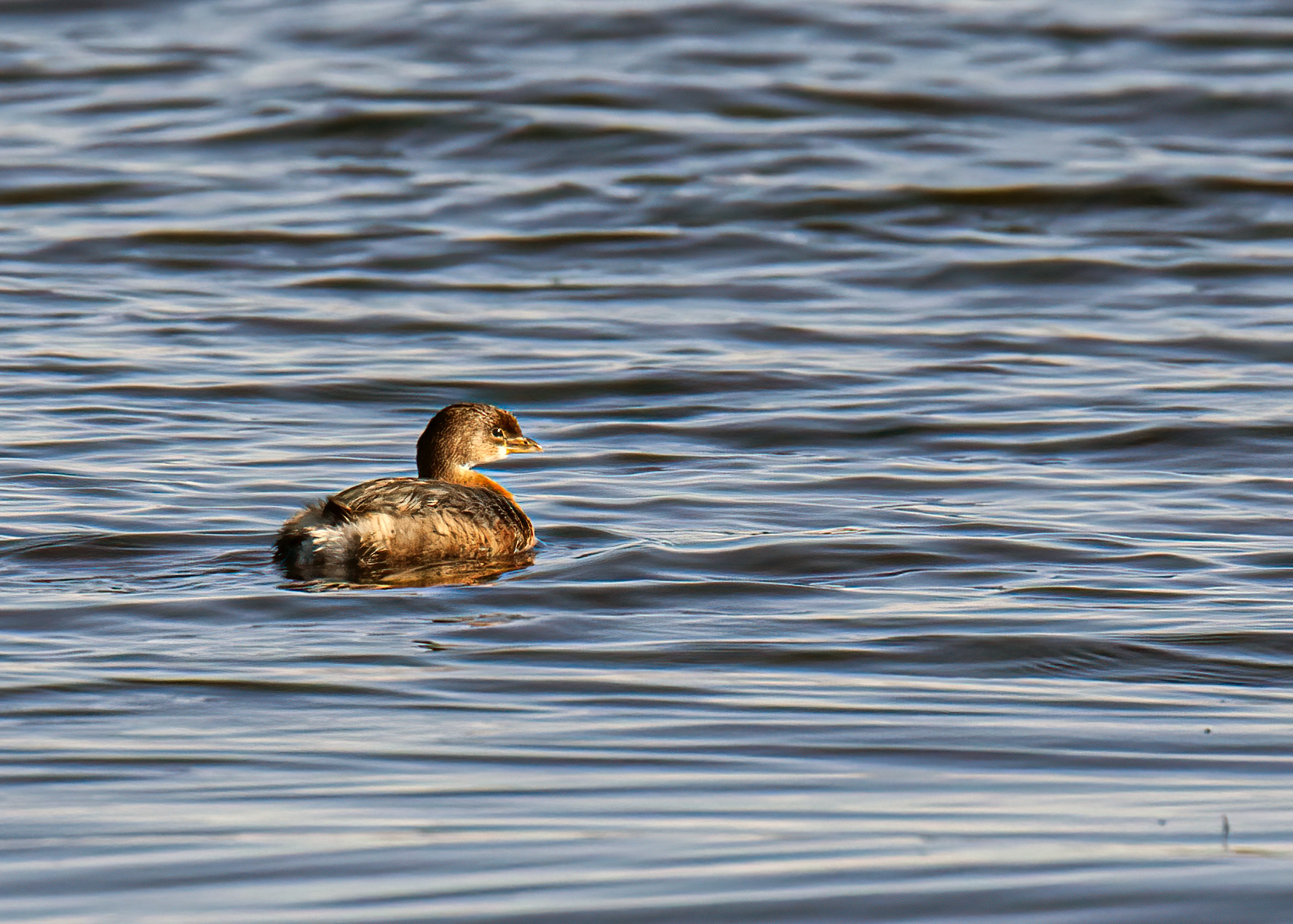
Flocks of Canada Geese (Branta canadensis) periodically announced their presence as they passed by. A large flock of crows was equally vocal as it harassed a pair of Bald Eagles (Haliaeetus leucocephalus) perched peacefully in a distant tree. Only the shy little Pied-billed Grebes (Podilymbus podiceps) were silent as they paddled about, periodically diving in search of food.
I spent several hours walking about, listening and observing, enjoying the fresh air and the beauty of natural surroundings, unconcerned that I was not able to capture amazing photos during this outing. That is the uncertain fate of a nature photographer. To borrow a line from Paul in his letter to the Philippians, I have learned to be content whatever the circumstances.
I returned home from this walk in the wild feeling renewed and refreshed—that was my biggest reward.


© Michael Q. Powell. All rights reserved.
Posted in Autumn, Birds, Nature, Photography, wildlife | Tagged Bald Eagle, Branta canadensis, Canada Geese, Canon 50D, Haliaeetus leucocephalus, Occoquan Bay National Wildlife Refuge, Pied-billed Grebe, Podilymbus podiceps, Tamron 150-600mm, Woodbr | 16 Comments »
November 17, 2021 by Mike Powell
We may be down to a single active dragonfly species in my area. Yesterday I went out with my camera to Occoquan Bay National Wildlife Refuge, my favorite location for wildlife photography the last few years, and found only Autumn Meadowhawk dragonflies (Sympetrum vicinum)—the Wandering Gliders seem to have departed from the areas where I had seen them previously during the last few weeks.
The good news is that I saw multiple Autumn Meadowhawks, so the population seems to be still strong. I was planning to return to the refuge tomorrow, when temperatures are supposed to soar to 73 degrees (23 degrees C), but just noted that the refuge is closed all day for one of the annual managed deer hunts. I may have to go to another location to see if the warmer temperatures coax any stragglers or survivors from other dragonfly species to make a final curtain call.
I captured these three photos of Autumn Meadowhawks last week and really like them for different reasons. In the first photo, I love the way that the color and shape of the leaf stems match the body of the dragonfly. In the second shot, I was thrilled to be able to include the sky in the composition when the dragonfly chose a high perch—I also am quite fascinated by the interplay of light and shadows in the image and the shapes that they help to create.
The simple, stark composition of the final shot appeals to me a lot. The monochromatic color palette of the branch and the background really help to draw a viewer’s eyes to the handsome male Autumn Meadowhawk and his bright red coloration really pops.


© Michael Q. Powell. All rights reserved.
Posted in Autumn, Dragonflies, dragonfly, Nature, Photography, wildlife | Tagged Alexandria VA, Autumn Meadowhawk, Autumn Meadowhawk dragonfly, Canon 50D, Huntley Meadows Park, Occoquan Bay National Wildlife Refuge, Sympetrum vicinum, Tamron 150-600mm, Woodbridge VA | 4 Comments »
November 16, 2021 by Mike Powell
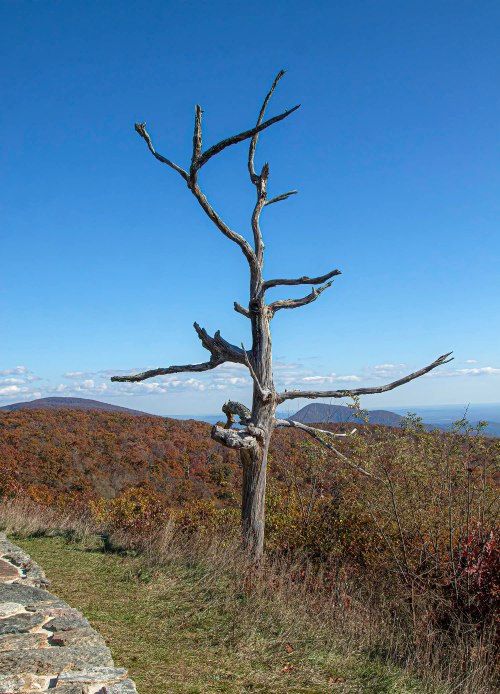
Fall foliage color are now past their peak in the mountains and fallen leaves are increasing littering the lawns and the streets of the suburbs where I live. Today I thought I would share a few more foliage photos from my trip to Shenandoah National Park earlier this month before those memories are swept away with those fallen leaves.
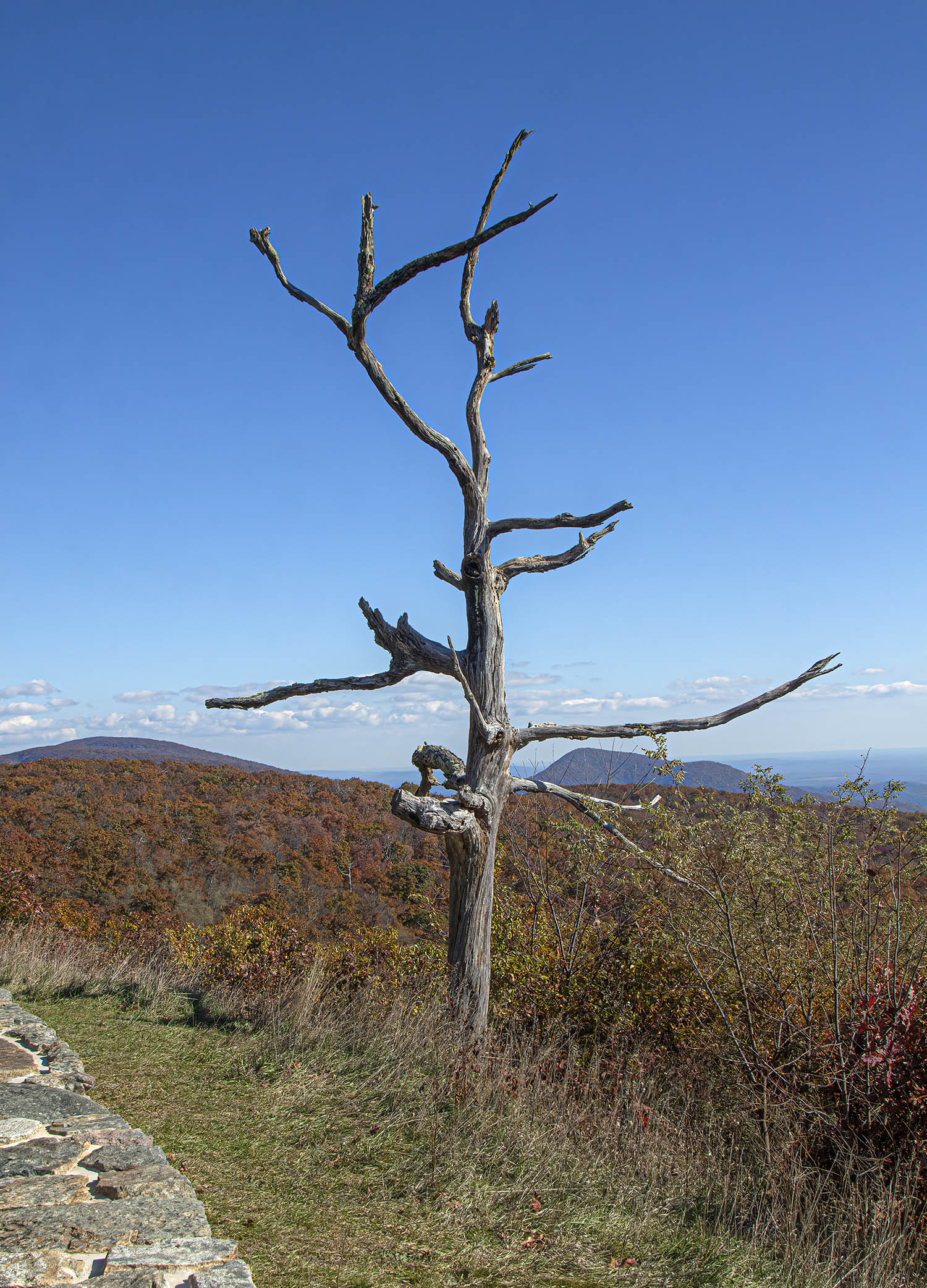
While I was driving along Skyline Drive in the national park, I was repeatedly struck by the “skeleton trees.” That is my term for the bare white trees that I often saw interspersed with their leafy counterparts—they somehow reminded me of the ribs of a skeleton.
I could not determine if my skeleton trees were dead or had simply lost their leaves, but did not spending too much time pondering that question. Instead, I concentrated on capturing a sense of their stark beauty. The first photo is definitely my favorite of the three—I remember spending a lot of time trying to compose the image very carefully, a kind of luxury for me that I do not usually get when taking wildlife photos.
I am not quite ready to bid farewell to autumn, but there are definitely signs that winter is on its way. I’m hanging on tenaciously to the final month of autumn, enjoying the remaining bits of fall color.


© Michael Q. Powell. All rights reserved.
Posted in Autumn, Landscape, Nature, Photography | Tagged Canon 24-105mm, Canon 50D, Luray Virginia, Shenandoah National Park, skeleton trees, Skyline Drive | 7 Comments »
November 15, 2021 by Mike Powell
As I noted in a recent posting, there appear to be only two active dragonfly species remaining in my area—Wandering Gliders and Autumn Meadowhawks (Sympetrum vicinum). Today I decided to feature some shots of Autumn Meadowhawk dragonflies that I spotted last week during a visit to Huntley Meadows Park, a local marshland refuge.
Quite often Autumn Meadowhawks perch flat on the ground which makes it easy for me to get shots of them. However, those shots tend to be relatively uninteresting from an artistic point of view. I am always on the lookout for those dragonflies that choose more photogenic perches, especially those that include colorful fall foliage.
I was quite fortunate that the Autumn Meadowhawks were cooperative last week in helping me to capture images that matched my “artistic vision,” which does not always happen in wildlife photography. Wildlife photography has so many variables over which I have little or not control, including the weather, the lighting, the environment, and the subjects themselves. Success is certainly not guaranteed, but I have found that patience, persistence, knowledge, and a bit of skill can often help to tip the odds a bit in my favor.


© Michael Q. Powell. All rights reserved.
Posted in Autumn, Dragonflies, dragonfly, Insects, Nature, Photography, wildlife | Tagged Alexandria VA, Autumn Meadowhawk, Autumn Meadowhawk dragonfly, Canon 50D, Huntley Meadows Park, Sympetrum vicinum, Tamron 150-600mm | 5 Comments »
November 14, 2021 by Mike Powell
Throughout this autumn season I have frequently seen large wasp-like insects as I have explored Occoquan Bay National Wildlife Refuge. Often I would catch a glimpse of red color as one flew by and I would think that it was an Autumn Meadowhawk dragonfly, which has a bright red body. Once I got a better look at my target, I could easily see that it was not a dragonfly.
What was it? Earlier this month I finally get a decent photo of the insect and began my search to identify it. I have come to the conclusion that it is probably a European Hornet (Vespa crabro). As the name suggests, this species originated in Europe and was first reported in North America about 1840 in New York. SInce then it has spread to most of the eastern United States, according to an article by North Carolina State University.
The first thing I noticed about European Hornets is that they are big, over an inch (25 mm) in length for workers and 1. 5 inches (38 mm) for queens. Fortunately they do not appear to be very aggressive, so I have never had to worry about being stung by one, although I must admit that I keep a healthy distance from them. In fact, I took the photo below with my telephoto zoom lens fully extended to its maximum focal length of 600 mm.
In the fall all of the workers die and the only individuals that survive are fertilized queens. The queens overwinter in protected places, such as under the bark of fallen trees, and construct new nests the following spring.

© Michael Q. Powell. All rights reserved.
Posted in Autumn, Insects, Nature, Photography, wildlife | Tagged Canon 50D, European Hornet, Occoquan Bay National Wildlife Refuge, Tamron 150-600mm, Vespa crabro, Woodbridge VA | 12 Comments »
November 13, 2021 by Mike Powell
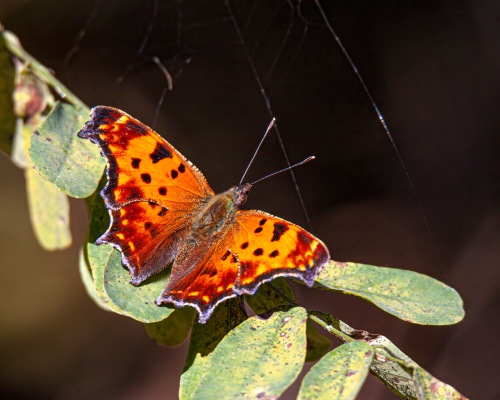
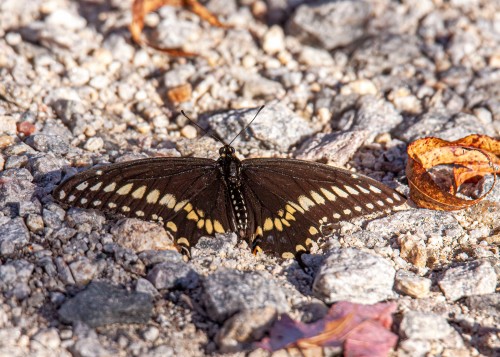
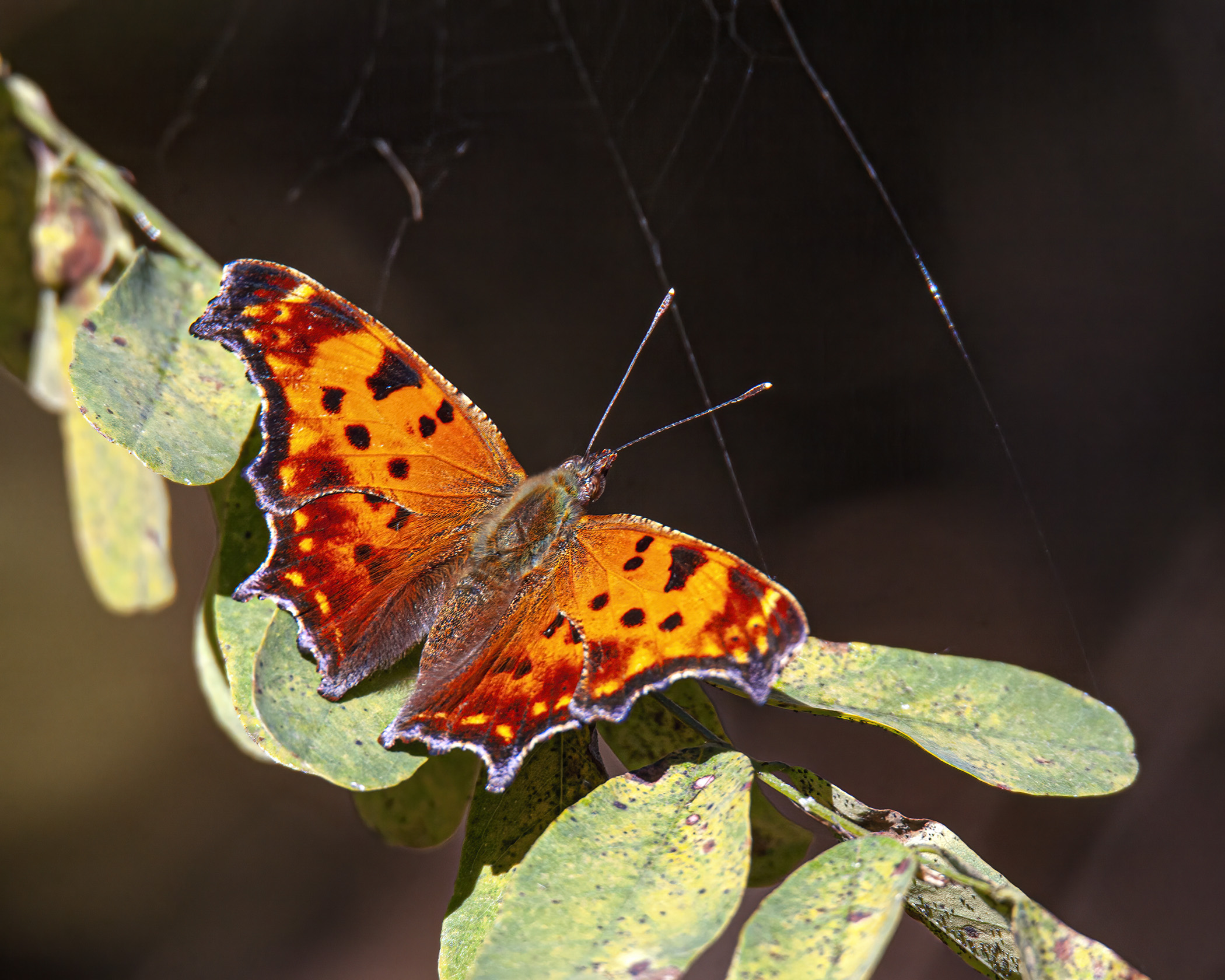
I am happy to see that some butterflies are still with us as we move deeper into November. Eastern Comma butterflies (Polygonia interrogationis), like the one in first photo, overwinter as adults, rather than as eggs or pupae as most butterflies do, so there is a chance that I will continue to see them for a while longer if the weather does not get too bad.
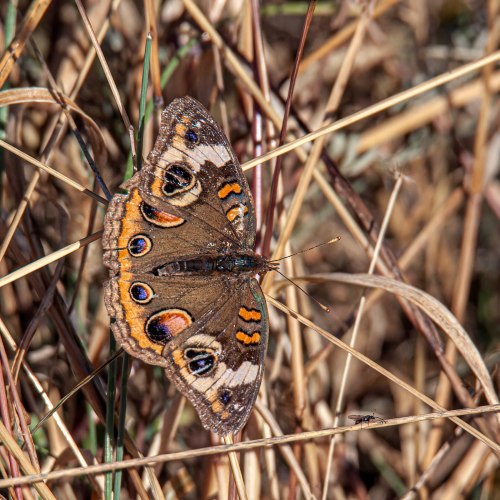
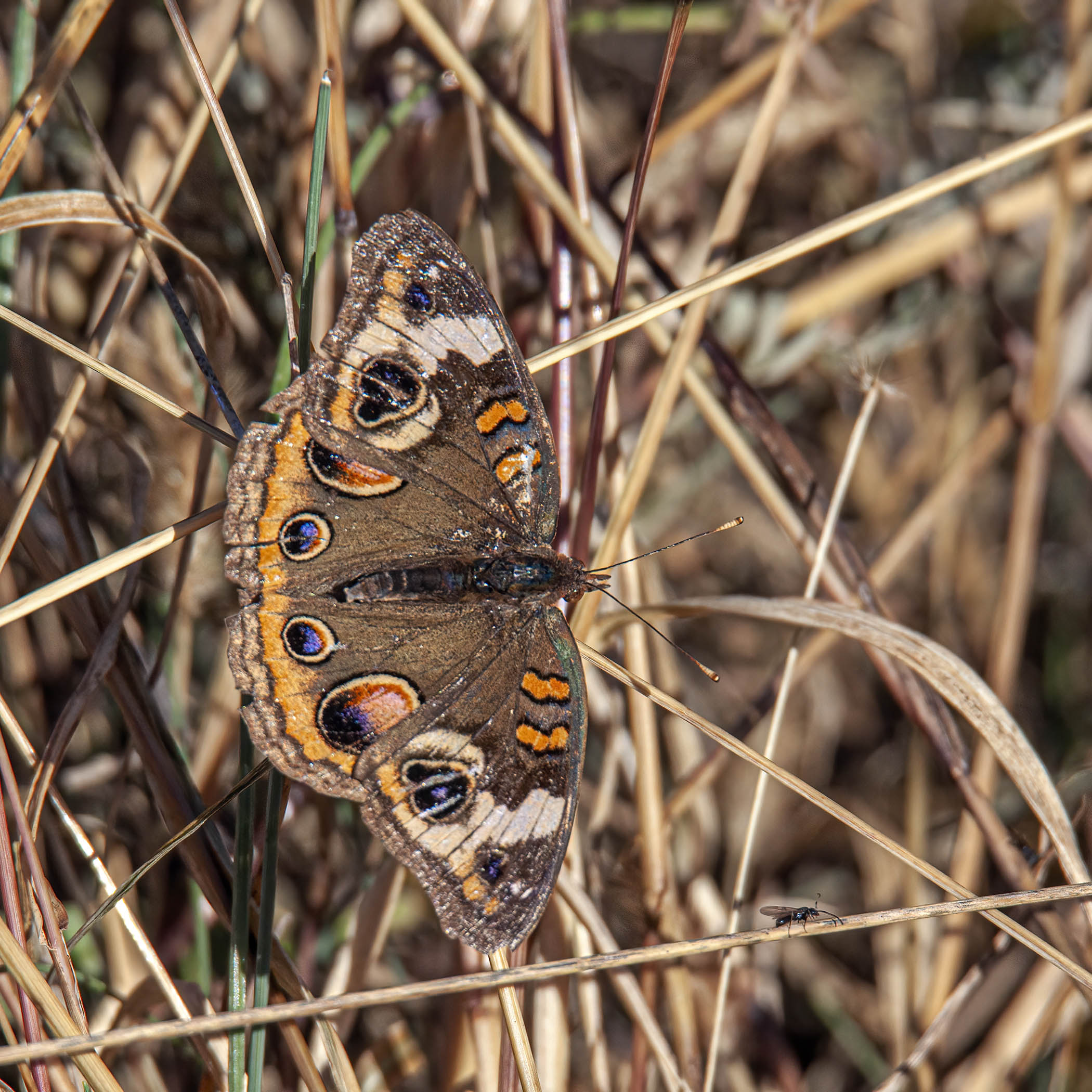
Common Buckeyes (Junonia coenia), like the one in the second photo, cannot tolerate cold temperatures. Some of them, according to Wikipedia, migrate to the south for the winter and then return when the weather warms up in the spring.
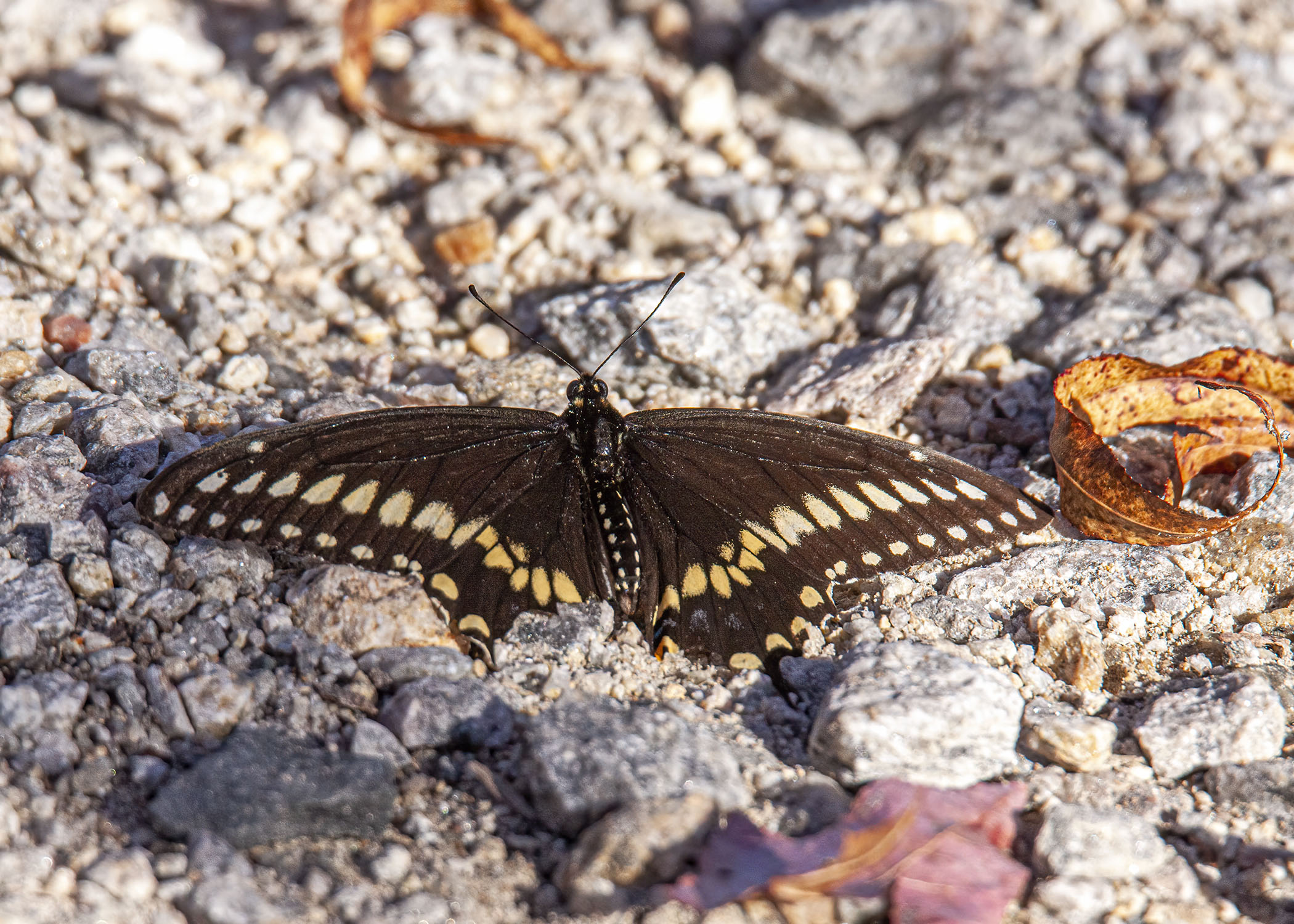
I was most surprised this week to spot the Black Swallowtail (Papilio polyxenes) in the final photo—it had been a month or so since I had last seen a Black Swallowtail. This species spends the winter in the chrysalis stage, and adults emerge in the spring to seek out host plants.
We are nearing the end of the butterfly season, but I am delighted to share my walks in nature with these fragile little creatures for a little while longer.
© Michael Q. Powell. All rights reserved.
Posted in Autumn, Butterflies, Insects, Nature, Photography, wildlife | Tagged black swallowtail, Canon 50D, Common Buckeye, Eastern Comma, Junonia coenia, Occoquan Bay National Wildlife Refuge, Papilio polyxenes, Polygonia interrogationis, Tamron 150-600mm, Woodbridge VA | 2 Comments »
November 12, 2021 by Mike Powell
On Tuesday at Occoquan Bay National Wildlife Refuge I watched this Red-winged Blackbird (Agelaius phoeniceus) try to balance itself on the tip of a small, broken-off branch. The bird teetered and tottered and extended its wings for balance before it finally gave up and flew to a less precarious perch.
Somehow the little bird reminded me of my childhood, when I enjoyed tiptoeing along on sidewalk curbs, trying to maintain my balance. On rare occasions when I felt really bold, I’d try the same balancing act on low brick walls. At an early age I concluded that I was not destined for a career in the circus as a high-wire performer.

© Michael Q. Powell. All rights reserved.
Posted in Autumn, Birds, Nature, Photography, wildlife | Tagged Agelaius phoeniceus, Canon 50D, Occoquan Bay National Wildlife Refuge, red-winged blackbird, Tamron 150-600, Tamron 150-600mm, teeter totter, Woodbridge VA | 7 Comments »
November 12, 2021 by Mike Powell
My dragonfly season is slowing winding down. During the month of November, I have seen only two species of dragonflies—Wandering Gliders (Pantala flavescens) and Autumn Meadowhawks (Sympetrum vicinum), but I have had multiple encounters with each species. Autumn Meadowhawks are usually the last dragonflies standing each year and there is a chance that I will see one in December.
Wandering Gliders, on the other hand, may disappear from the scene at any moment, so I am especially delighted whenever I spot one flying about, patrolling back and forth over a field. If I am lucky, I will see it perch on some vegetation when it comes down to earth for a rest and I will have a chance to get a shot. I took the first shot this past Tuesday, 9 November, at Occoquan Bay National Wildlife Refuge at a moment when I had my macro lens on my camera. I really like the way that I was able to capture the intricate patterns on the dragonfly’s body.
The two final photos are of a Wandering Glider that I spotted on the 1st of November. It is probably hard for you to tell, but I took these shots with my long telephoto zoom lens, which still managed to capture an amazing amount of detail, especially in the wings in the last image. I encourage you to click on the images to get a better look at those details.
It is raining today and the ground is littered with fallen leaves. As the trees are laid bare, I will have a better chance to spot some of the birds that I have been hearing recently, but have not seen.
For now, though, I am enjoying the waning moments of the season with my magical little dragonfly friends. Their time is not over until it is over.


© Michael Q. Powell. All rights reserved.
Posted in Autumn, Dragonflies, dragonfly, Insects, Nature, Photography, wildlife | Tagged Canon 50D, Occoquan Bay National Wildlife Refuge, Pantala flavescens, Tamron 150-600mm, Tamron 180mm, Wandering Glider, Wandering Glider dragonfly, Woodbridge VA | 18 Comments »
November 11, 2021 by Mike Powell
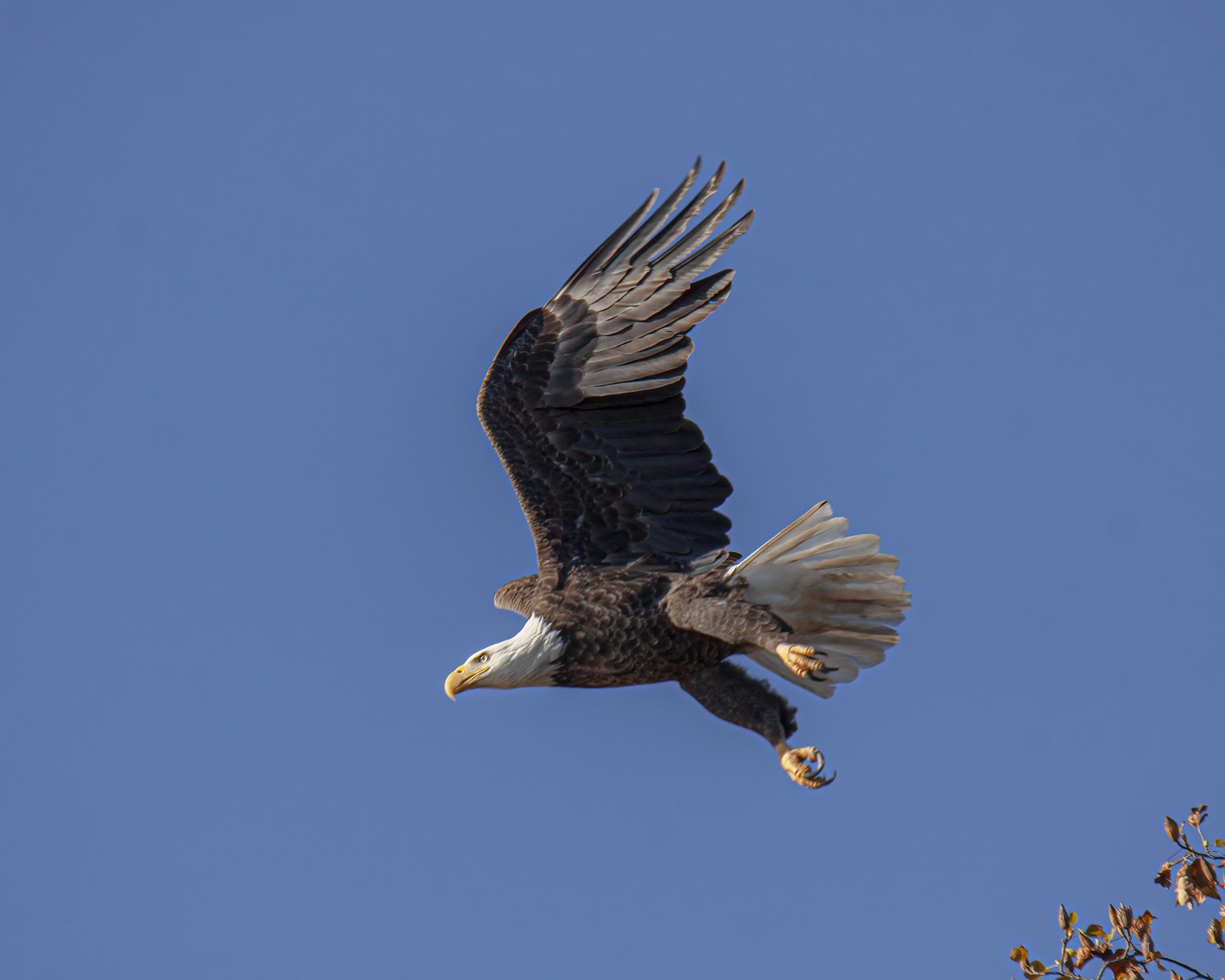
I was thrilled to spot this Bald Eagle (Haliaeetus leucocephalus) at Occoquan Bay National Wildlife Refuge. The eagle was perched high in a tree, as shown in the final photo and kept looking from side to side, as though it was looking for its mate. I am not sure if the eagle was aware of my presence, but all of the sudden it took off and flew away—I should know by now never to underestimate the acuity of an eagle’s vision.
I managed to capture the first shot below as the eagle was really stretching itself out just prior to takeoff. It is an unusual pose that I really like. A split second later I captured the shot of the eagle in flight. There were several other shots in between the first and second images, but I did not track the eagle accurately enough and the eagle’s wings were cut off in those shots.
It has been a while since I last got good shots of a Bald Eagle, so I was particularly happy when this photo opportunity arose.
Here in the US, today is Veterans Day, a day when we honor all those who have served in our armed forces. Elsewhere in the world, today is commemorated in many different ways, including as Armistice Day, the day when World War I ended. Wherever you happen to live, I hope that you never forget the the brave men and women who have served and are serving on your behalf, safeguarding your freedom—we owe them all a debt of gratitude.


© Michael Q. Powell. All rights reserved.
Posted in Autumn, Birds, Nature, Photography, wildlife | Tagged Bald Eagle, bald eagle takeoff, Canon 50D, Haliaeetus leucocephalus, Occoquan Bay National Wildlife Refuge, Tamron 150-600mm, Veterans Day 2021, Woodbridge VA | 29 Comments »
November 10, 2021 by Mike Powell
It is a fun challenge to try to photograph tiny songbirds, like this Golden-crowned Kinglet (Regulus satrapa) that I spotted last Thursday at Occoquan Bay National Wildlife Refuge. Golden-crowned Kinglets are approximately 3-4 inches (80-100 mm) in length and weigh about 0.1-0.3 ounces (4 to 8 grams) and they move about continuously, often high in the trees.
If you look carefully just above the kinglet’s eye, you can get a tiny glimpse of yellow, a small portion of the yellow “crown” that gives this little bird its name.

© Michael Q. Powell. All rights reserved.
Posted in Autumn, Birds, Nature, Photography, Portraits, wildlife | Tagged Canon 50D, Golden-crowned Kinglet, Occoquan Bay National Wildlife Refuge, Regulus satrapa, Tamron 150-600mm, Woodbridge VA | 16 Comments »
November 9, 2021 by Mike Powell
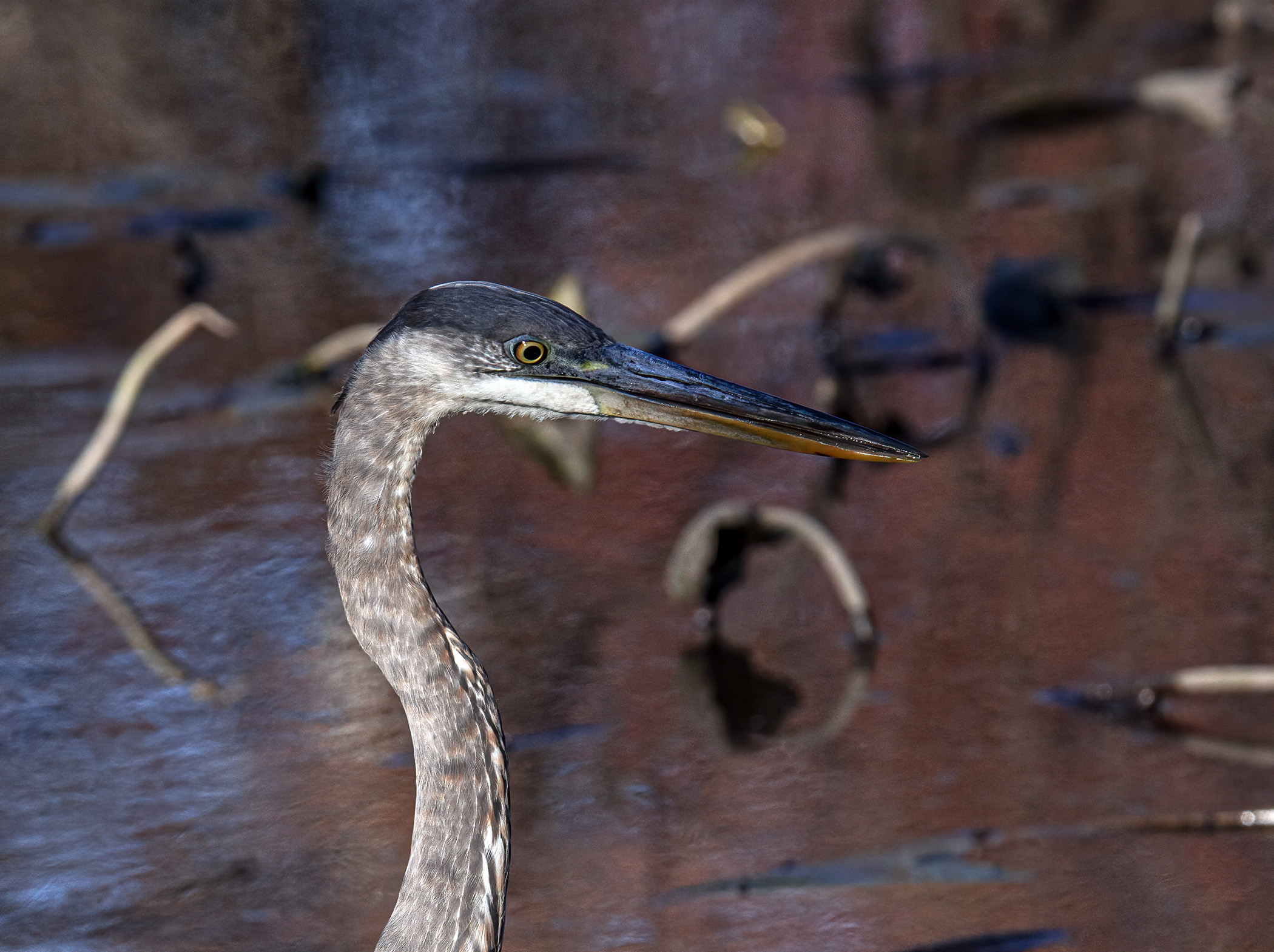
I was so close to this Great Blue Heron (Ardea herodias) yesterday at Occoquan Bay National Wildlife Refuge that there was no way I could fit its entire body into a shot. I decided to zoom in on its head and captured this little portrait of the heron as it walked slowly through the water. Ever vigilant, the heron kept its eyes focused on the water, looking for signs of potential prey, and ignored me, though I am sure that it was aware of my presence.

© Michael Q. Powell. All rights reserved.
Posted in Autumn, Birds, Nature, Portraits, wildlife | Tagged Ardea herodias, Canon 50D, Great Blue Heron, Occoquan Bay National Wildlife Refuge, Tamron 150-600mm, Woodbridge VA | 22 Comments »
November 8, 2021 by Mike Powell
I returned to Shenandoah National Park this past Friday to see how much the fall colors have progressed since my visit there three weeks ago—check out my post from October 17 entitled Shenandoah National Park to see my photos from the previous trip. There were some patches of brilliant color, though most of the colors were relatively muted. Over time, I have grown to appreciate all of the common shades of burnt orange, rust, and yellow that make the fiery reds and brilliant yellow stand out when they are present.
The drive along Skyline Drive, the road that runs through the length of the park mostly along a ridge, was relaxing and refreshing, with lots of overlooks to pull over and enjoy the scenery. The final photo gives you a feel for the road itself—most of the curves are gentle enough that I could enjoy the scenery even as I was driving, without fear of falling off a mountain.


© Michael Q. Powell. All rights reserved.
Posted in Autumn, Landscape, Nature, Photography | Tagged Canon 24-105mm, Canon 50D, fall colors, fall foliage, Luray Virginia, Shenandoah National Park, Skyline Drive | 25 Comments »
November 7, 2021 by Mike Powell
In the past I have seen Great Blue Herons (Ardea herodias) catch some incredibly large fish, but the tiny fish this heron caught on Thursday at Occoquan Bay National Wildlife Refuge may be the smallest prey that I have ever seen a heron catch.
Hopefully the fish was just an appetizer and not the main course.

© Michael Q. Powell. All rights reserved.
Posted in Autumn, Birds, Nature, Photography, wildlife | Tagged Ardea herodias, Canon 50D, Great Blue Heron, Great Blue Heron fishing, Occoquan Bay National Wildlife Refuge, Tamron 150-600mm, Woodbridge VA | 20 Comments »
November 6, 2021 by Mike Powell
I love milkweed plants—their shape and texture fascinate me at all stages of of their development. I photographed this milkweed plant last Thursday at Occoquan Bay National Wildlife Refuge, a plant that most might describe as past its prime—I would call it beautiful.
If you look carefully at the photo, you will see several red Large Milkweed Bugs (Oncopeltus fasciatus) crawling about on the plant. It is always worthwhile to examine milkweed plants carefully, because a fascinating variety of insects feed on milkweed or use it as part of their habitat.

© Michael Q. Powell. All rights reserved.
Posted in Autumn, Insects, Nature, Photography, wildlife | Tagged Canon 50D, large milkweed bug, milkweed, Occoquan Bay National Wildlife Refuge, Oncopeltus fasciatus, Tamron 180mm, Woodbridge VA | 11 Comments »
November 6, 2021 by Mike Powell
Has anyone ever told you that you eat like a bird? This somewhat weird expression is based on the mistaken notion that birds don’t eat very much—many birds have high metabolisms and actually eat at lot, relative to their size.
Some birds also consume things that are hazardous to humans. This week at Occoquan Bay National Wildlife Refuge I have spotted multiple Yellow-rumped Warblers (Setophaga coronata) feasting on the abundant poison ivy berries. Poison ivy berries serve as an important food source for a variety of overwintering birds, including these warbler. One of the consequences of the consumption of all of these berries is that the seeds pass through the birds and are spread everywhere, guaranteeing future supplies of the poison ivy berries.
No matter how nutritious or tasty they are for the birds, there is no way that I am voluntarily going near poison ivy or tasting the berries. The berries may not kill me, but I am pretty sure they would make me really sick.


© Michael Q. Powell. All rights reserved.
Posted in Autumn, Birds, Nature, Photography, wildlife | Tagged Canon 50D, Occoquan Bay National Wildlife Refuge, poison ivy berries, Setophaga coronata, Tamron 150-600mm, Woodbridge VA, Yellow-rumped Warbler | 17 Comments »
November 5, 2021 by Mike Powell
I am still on the lookout for summer dragonfly stragglers and survivors. There are certain dragonfly species that I expect to see during the autumn, but there are also a few particularly hard individuals from the summer species that are managing to hang on. Over the past week and a half I have spotted one Great Blue Skimmer (Libellula vibrans), one Eastern Pondhawk (Erythemis simplicicollis), and one Blue Dasher (Pachydiplax longipennis), as shown in the photos below.
It is interesting to note that all three of these dragonflies appear to be females. I wonder if female dragonflies tend to outlive their male counterparts, as is the case with humans.
I went looking for dragonflies today, after several frosty nights, and did not see a single dragonfly. The daytime temperature was only about 52 degrees (11 degrees C), which is a bit cold for dragonfly activity. Temperatures are forecast to rise to 68 degrees (20 degrees C) early next week and I anticipate that I will see a few dragonflies then.


© Michael Q. Powell. All rights reserved.
Posted in Autumn, Dragonflies, dragonfly, Insects, Nature, Photography, wildlife | Tagged Alexandria VA, Blue Dashher, Canon 50D, Eastern Pondhawk, Erythemis simplicicollis, Great Blue Skimmer, Huntley Meadows Park, Libellula vibrans, Occoquan Bay National Wildlife Refuge, Pachydiplax longipennis, Tamron 150-600mm, Woodbridge VA | 7 Comments »
November 4, 2021 by Mike Powell
I really do not expect to find any damselflies this late in the season, so I was both surprised and delighted to spot several Familiar Bluets (Enallagma civile) last Thursday at Occoquan Bay National Wildlife Refuge. As many of you may recall, damselflies are the smaller “cousins” of dragonflies—together they make up the order of insects known as odonata. Damselflies have eyes farther apart than dragonflies and generally perch with their wings held closed above them, unlike dragonflies that extend their wings when perching.
The damselfly in the first photo is a female Familiar Bluet. The brown, nondescript color is fairly typical for female damselflies, which tend to be less colorful than their male counterparts. In order to determine the species, I have to look at the pattern of stripes on the thorax (the “shoulders”) and the abdomen (the “tail”) and the color and size of the eye spots.
The damselfly in the second photo is a male Familiar Bluet. Like most other male bluets, this damselfly’s body is covered in patterns of black and blue. I often have trouble distinguishing between the different species of bluets, but once again the eye spots, shoulder stripes, and the specific color pattern are key factors that I look for in trying to come up with an identification.
I am not sure if these damselflies are unusually late or if I simply was not looking for them as hard in previous years. At this time of the year I spend a lot of time looking up at the distant trees for indications of bird activity and I may not have been paying as much attention to the vegetation at my feet.
Temperatures have dropped close to the freezing mark the last couple of nights and I fear that the frosty weather may hasten the demise of these beautiful little creatures. If so, these may well be the last damselflies that I will see until next spring. Au revoir, mes petits amis.


© Michael Q. Powell. All rights reserved.
Posted in Autumn, damselfly, Insects, Macro Photography, Nature, Photography, wildlife | Tagged Canon 50D, Enallagma civile, Familiar Bluet, Familiar Bluet damselfly, Occoquan Bay National Wildlife Refuge, Tamron 180mm, Woodbridge VA | 12 Comments »
November 3, 2021 by Mike Powell
When I first spotted this stunning hawk last week at Occoquan Bay National Wildlife Refuge, I was really struck by the length of its tail. I suspected therefore that it was not a Red-shouldered Hawk, the most common hawk species in our area, but the colors did not quite match up with my mental picture of a Cooper’s Hawk (Accipiter cooperii), the second species that came to mind. I scoured my hard-copy and on-line resources for information and similar shots and gradually came to the conclusion that it might be an immature Cooper’s Hawk.
I posted my photo and tentative identification to the Birding Virginia group in Facebook and was a little shocked to receive confirmation of the identification from multiple viewers. One response was particular helpful, because it helped me to focus on the reasons why they concluded that it was an immature Cooper’s Hawk—I love comments in which a person is willing to take the time to explain their reasoning. The viewer explained, “Long tail, short wings, outer tail feathers are shorter than the inner tail feathers, flat, squared head with a strong suborbital ridge. Yellow eye instead of red/orange, and brown feathers instead of gray feathers indicate that it is not an adult.”
I feel like I am always learning, gaining additional knowledge and honing my observational skills. Feedback really helps in that process and I always welcome questions, comments and suggestions from all of you.

© Michael Q. Powell. All rights reserved.
Posted in Autumn, Nature, Photography, Portraits, wildlife | Tagged Accipiter cooperii, Canon 50D, Cooper's Hawk, immature Cooper's Hawk, Occoquan Bay National Wildlife Refuge, Tamron 150-600mm, Woodbridge VA | 11 Comments »
November 2, 2021 by Mike Powell
It is hard to believe that it is already November. Rather than rushing boldly forward, I think that I will ease my way slowly into the new month, following the example of this Eastern Box Turtle (Terrapene carolina carolina) that I spotted last Thursday at Occoquan Bay National Wildlife Refuge. I believe this is a female box turtle—females of this species, which are also known as Woodland Box Turtles, generally have brown eyes, while the males most often have bright red eyes.

© Michael Q. Powell. All rights reserved.
Posted in Autumn, Nature, Photography, Reptiles, wildlife | Tagged box turtle, Canon 50D, Eastern Box Turtle, Occoquan Bay National Wildlife Refuge, Tamron 150-600mm, Terrapene carolina, Terrapene carolina carolina, Woodbridge VA, Woodland Box Turtle | 11 Comments »
November 1, 2021 by Mike Powell
Autumn leaves floating on the dark waters of a marsh—a static moment in a season of change, a time for reflection.
Sometimes I am content to capture a feeling in my photos rather than focusing on a well-defined subject.


© Michael Q. Powell. All rights reserved.
Posted in abstract, Art, Autumn, Nature, Photography | Tagged Alexandria VA, autumn leaves, Canon 50D, Huntley Meadows Park, reflection, Tamron 150-600mm | 2 Comments »
November 1, 2021 by Mike Powell
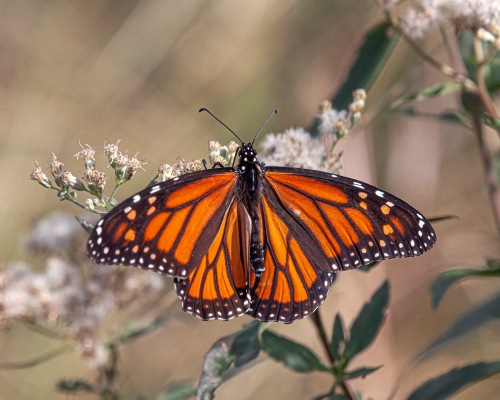
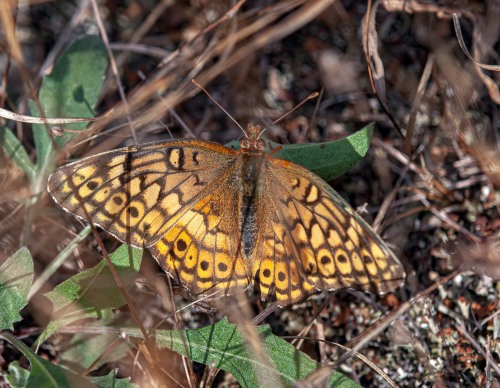
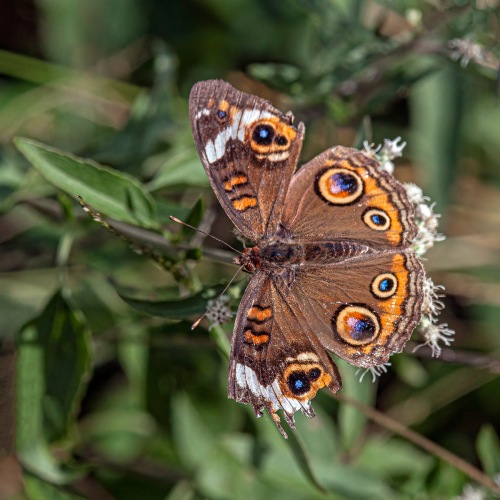
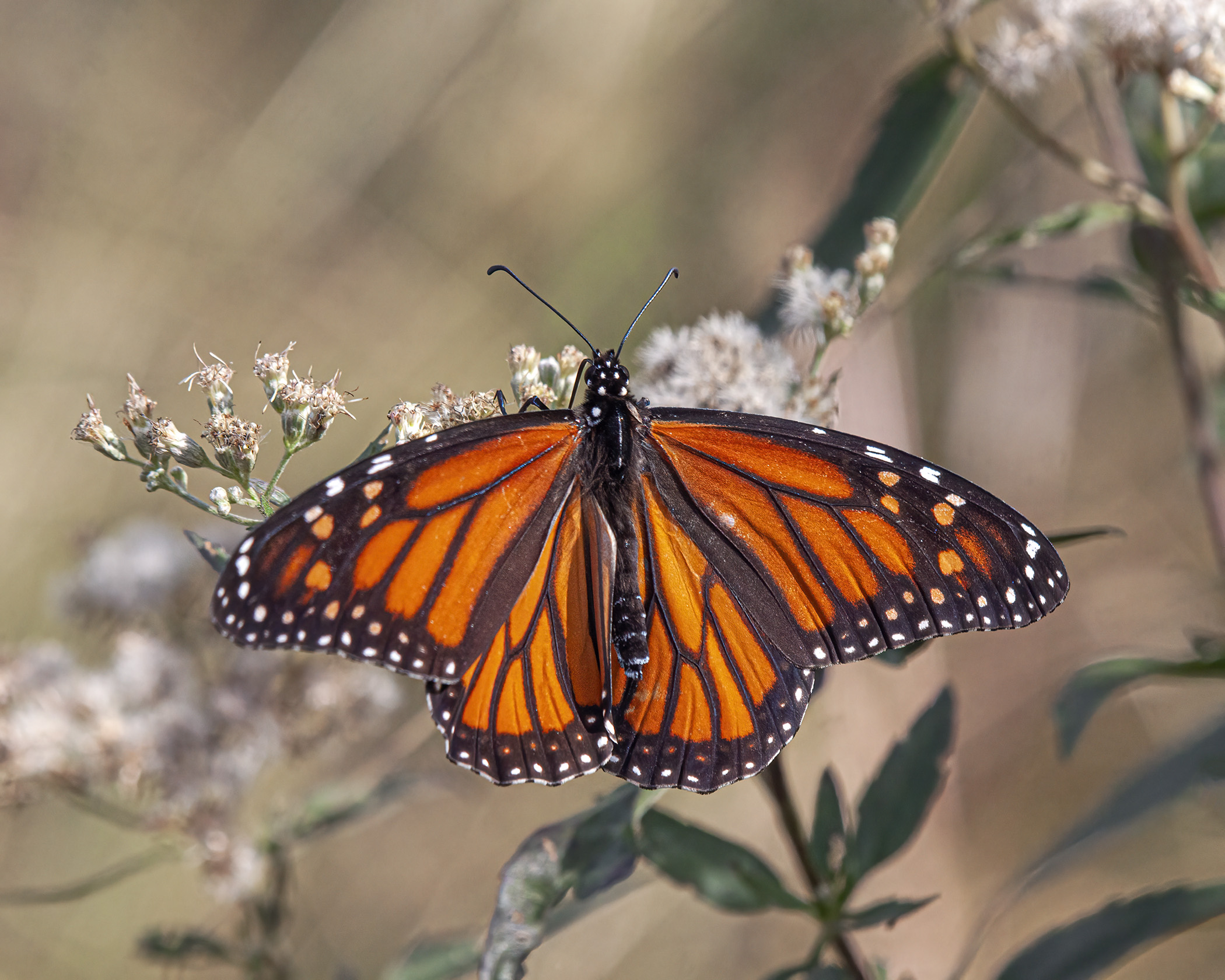
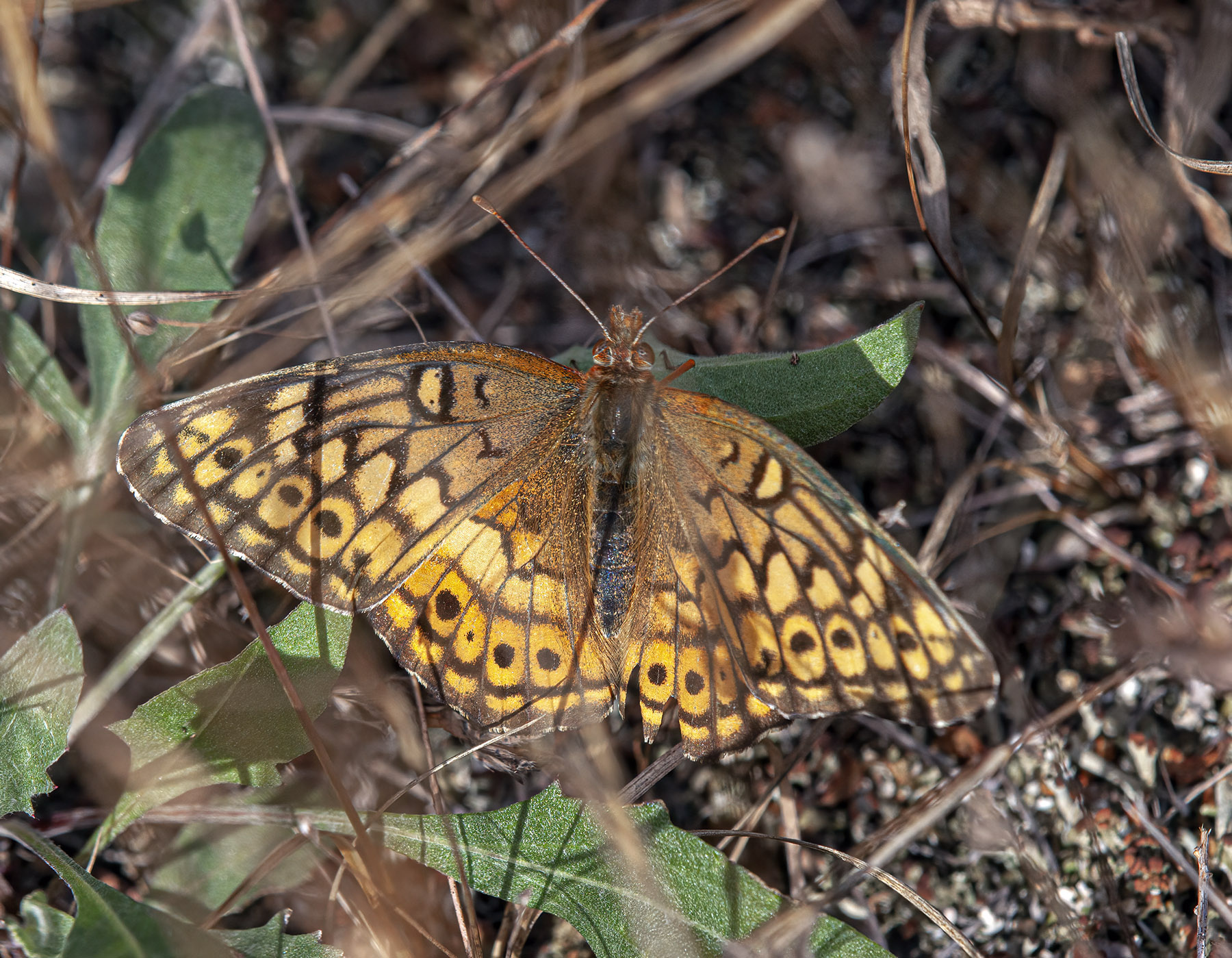
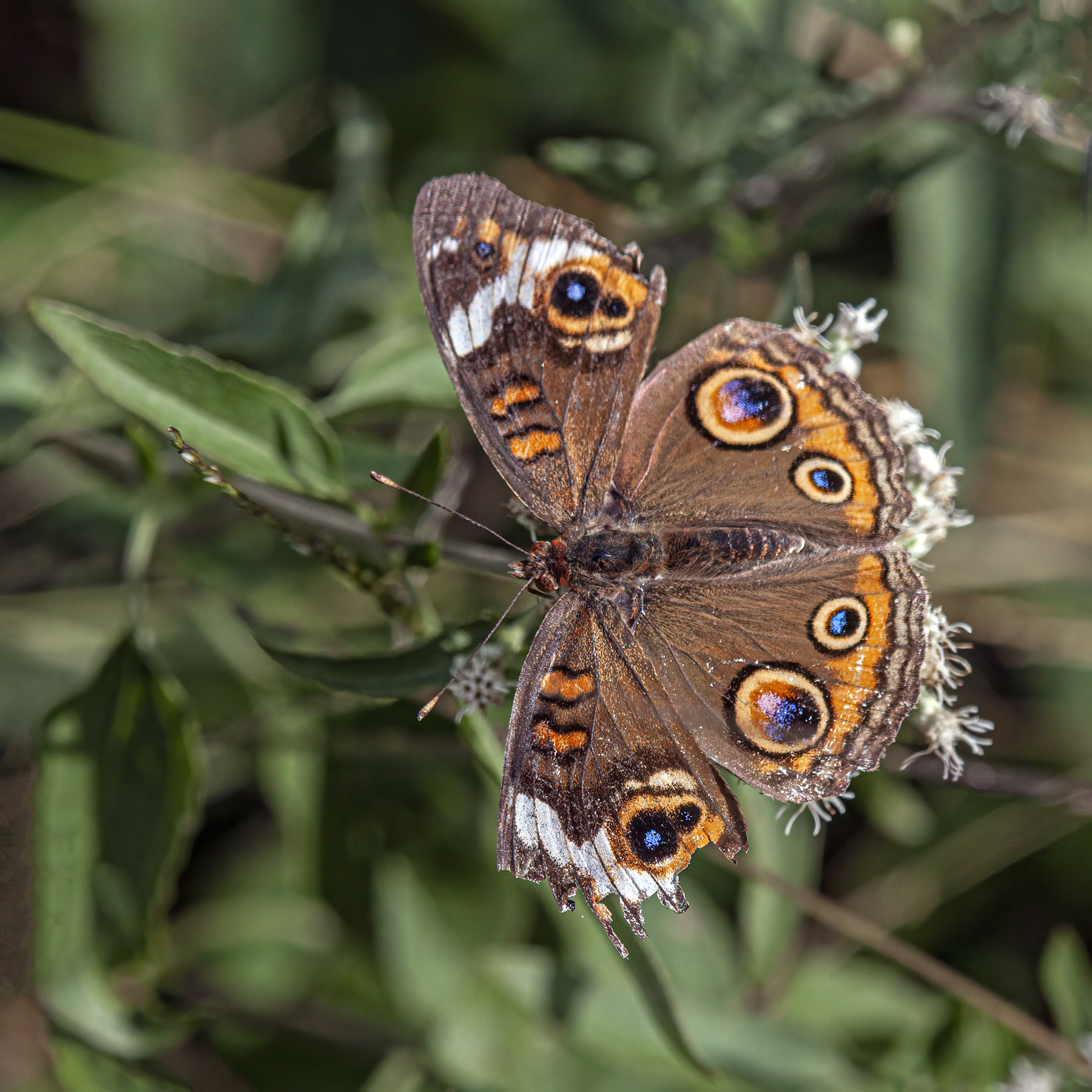
I am shocked and delighted by the number of butterflies that I continue to see at the end of October, despite the cooling temperatures and decreasing number of hours of daylight. Last Thursday, 28 October, I spotted a Monarch butterfly (Danaus plexippus) and multiple Variegated Fritillaries (Euptoieta claudia) and Common Buckeyes (Junonia coenia).
The dominant browns and oranges in the color palette of these butterflies seems to be a perfect reflection of the autumn season, when the colors in nature seem more muted than they were during the spring and the summer. For me, though, there is an inner warmth and comfort in these colors, like the feel of a well-worn flannel shirt or the taste of an autumn soup.
© Michael Q. Powell. All rights reserved.
Posted in Autumn, Butterflies, Insects, Nature, Photography, wildlife | Tagged Canon 50D, Common Buckeye, Danaus plexippus, Euptoieta claudia, Junonia coenia, Monarch, Occoquan Bay National Wildlife Refuge, Tamron 180mm, Variegated Fritillary, Woodbridge VA | 5 Comments »
October 31, 2021 by Mike Powell
I have seen groups of American Crows (Corvus brachyrhynchos) harass eagles and hawks many times in the past, so whenever I hear the excited cawing of of crows, I immediately start to look for a large raptor. When this happened on Thursday at Occoquan Bay National Wildlife Refuge, I quickly spotted the dark shadow of a large bird in a tree and assumed that it was a Bald Eagle.
I was a bit shocked when I zoomed in on the bird and realized that it was a Black Vulture (Coragyps atratus), not an eagle. I had no idea that crows would chase vultures. Sometimes the crows would perch on branches of the tree close to the vulture and appear to try to convince the vulture to leave—this is what seems to be happening in the second photo.
At other times, the crows would aggressively buzz the vulture, flying right at the vulture and veering off only at the last second. I managed to capture the first image just as one of the crows appeared ready to attack the vulture from behind, but there was no collision. The vulture flapped its wings several times to try to scare off the crows, an action that did not seem to deter the pesky crows. A short time later the vulture departed to search for a more peaceful perch.
Happy Halloween.


© Michael Q. Powell. All rights reserved.
Posted in Birds, Nature, Photography, wildlife | Tagged American Crow, Black Vulture, Canon 50D, Coragyps atratus, Corvus brachyrhynchos, crow, Occoquan Bay National Wildlife Refuge, Tamron 150-600mm, vulture, Woodbridge VA | 13 Comments »
October 30, 2021 by Mike Powell
Here’s a couple of looks at an enormous praying mantis that I photographed on Thursday at Occoquan Bay National Wildlife Refuge. I was walking towards the parking lot at the end of a day of shooting when I passed a couple of fellow photographers who asked me if I wanted to photograph a praying mantis. I think that praying mantises are pretty cool, so of course I was quite happy to have them show me where it was.
I had never seen such a large praying mantis—I estimate that this one was about 5 inches (127 mm) in length. It was a challenge to find a shooting angle that allowed me to get most of this insect’s long angular body in focus. However, the mantis was cooperative and stayed in place until I was able to get some shots that I liked.
I am pretty sure that this is a Chinese Praying Mantis (Tenodera sinensis), a non-native species that is much larger and more aggressive than the native species. I did a little research about mantises in the United States and apparently there are a variety of views about the degree to which the non-native species are “invasive,” i.e. that cause environmental harm.
When I posted a photograph on Facebook, several readers commented that it looked like “my” mantis was about ready to lay her eggs. I had not initially considered that possibility, but it certainly does look like the mantis has a swollen abdomen. Female mantises generally lay their eggs in the fall in a protective sac structure called a “ootheca” and then she dies. The nymphs hatch in the spring when the weather warms up again.
Nature is amazing!


© Michael Q. Powell. All rights reserved.
Posted in Autumn, Insects, Nature, Photography, wildlife | Tagged Canon 50D, Chinese Praying Mantis, Occoquan Bay National Wildlife Refuge, praying mantis, Tamron 180mm, Tenodera sinensis, Woodbridge VA | 10 Comments »
October 29, 2021 by Mike Powell
It is a fun challenge to try to photograph little birds moving about in the trees. I managed to capture this shot of an American Goldfinch (Spinus tristis) on Tuesday during a visit to Huntley Meadows Park, a local marshland refuge.
I like how the muted colors of this bird seem to reflect the autumn colors of its surroundings. I am more used to seeing goldfinches in the spring, when the adult males are bright yellow in color and are really easy to spot.

© Michael Q. Powell. All rights reserved.
Posted in Autumn, Birds, Nature, Photography, wildlife | Tagged Alexandria VA, American Goldfinch, Canon 50D, goldfinch, Huntley Meadows Park, Spinus tristis, Tamron 150-600mm | 6 Comments »
October 28, 2021 by Mike Powell
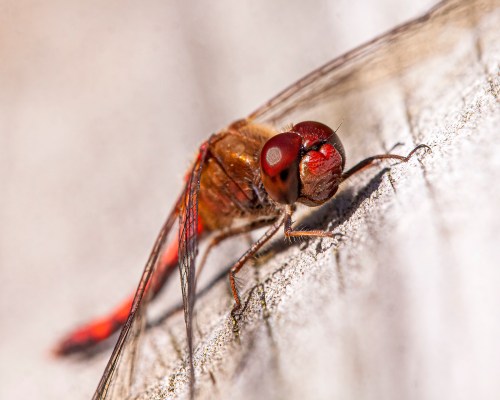
When I went out with my camera on Tuesday, I made sure to carry both my 150-600mm telephoto zoom lens, my preferred lens in the cold months, and my 180mm macro lens, my lens of choice during the warm months. As you may have noticed, I have started photographing more birds during the month of October than in previous months, so I really need the additional reach afforded by the long lens. However, I also know that there is a good chance that I will see some dragonflies, and the macro lens helps me get certain photos that are just not possible with other lenses.
I spent most of my time that day trying to photograph little birds, like sparrows and goldfinches. In the early afternoon, though, I changed lenses when I spotted some Autumn Meadowhawk dragonflies (Sympetrum vicinum) basking in the sun on the wooden rails of a split-rail fence. I have learned in the past that Autumn Meadowhawks are often willing to let me move in close for shots and sometimes they will even perch on me—the perfect scenario for me to use my beloved macro lens.
In the first photo, I was so close to the dragonfly that I was balancing the lens hood on the edge of the rail on which the dragonfly was perched. As you can see, the depth of field was pretty shallow and most of the body is blurry. I am ok with that, because the eyes are in relatively sharp focus—I encourage you to click on the image to see some of the amazing details that I was able to capture, include the hairy “stubble” on the dragonfly’s face.
The second shot gives you a better overall view of the body of a male Autumn Meadowhawk. The bright red color of of its body really stands out again the backdrop of the brown fallen leaves and the gray gravel.
We will soon be moving forward to a new month. I am hopeful that November will include additional encounters with these colorful little Autumn Meadowhawk dragonflies.

© Michael Q. Powell. All rights reserved.
Posted in Autumn, Dragonflies, dragonfly, Insects, Nature, Photography, wildlife | Tagged Autumn Meadowhawk, Autumn Meadowhawk dragonfly, Canon 50D, Occoquan Bay National Wildlife Refuge, Sympetrum vicinum, Tamron 180mm, Woodbridge VA | 7 Comments »
October 27, 2021 by Mike Powell
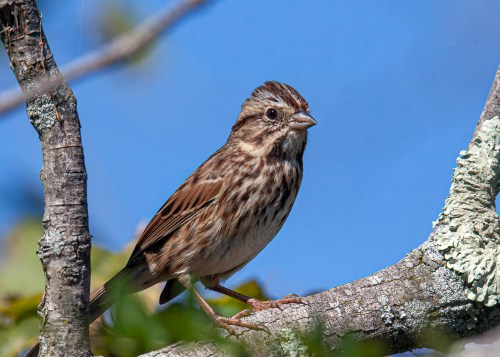
Increasingly I find myself peering into trees as we move deeper into autumn, listening and watching for signs of small birds that may be hidden therein. The process can be somewhat maddening and often results in a sore neck, but my patience is sometimes rewarded and I manage to get a clear shot of one of the birds. Getting the shot, though, is only half of the challenge—identifying the bird can be equally frustrating.
Sparrow species can be particularly problematic, because so many of them are so similar in appearance. Last Thursday I photographed this sparrow at Occoquan Bay National Wildlife Refuge. As is generally the case, I did not worry about trying to identify the bird while I was in the field, but waited to do so at home. I went back and forth in my birding guide and concluded that it was probably a Song Sparrow (Melospiza melodia).
I have learned not to be overconfident in my bird identifications, though, and posted it to a Facebook birding forum. I felt gratified when a more experience birder confirmed my identification. It takes time, but I feel like I am gradually getting better at seeing the details that distinguish one species from another.
In many ways, my photography journey is focused on learning to see the world in new and different ways. As noted photographer Dorothea Lang so aptly put it, “The camera is an instrument that teaches people how to see without a camera.”

© Michael Q. Powell. All rights reserved.
Posted in Autumn, Birds, Nature, Photography, Portraits, wildlife | Tagged Canon 50D, Melospiza melodia, Occoquan Bay National Wildlife Refuge, song sparrow, sparrow, Tamron 150-600mm, Woodbridge VA | 7 Comments »
October 26, 2021 by Mike Powell
As I was wandering about in Occoquan Bay National Wildlife Refuge last Thursday, I could not help but notice that the water levels were really low—the waters of the Potomac River and adjoining bodies of water are definitely influenced by the tide. Large stretches of the land that are normally covered with water were visible.
I spotted an opportunistic Great Blue Heron (Ardea herodias) poking about in the tidal pools, searching for tasty tidbits. The heron seemed to be having some success, though its “catch” was so small that I could not tell what it was, even with my telephoto zoom lens fully extended.
I love watching Great Blue Herons and am happy that they remain with us all winter, unlike their cousins, the Great Egrets, that depart my area in the autumn for warmer locations.

© Michael Q. Powell. All rights reserved.
Posted in Autumn, Birds, Nature, Photography, wildlife | Tagged Ardea herodias, Canon 50D, Great Blue Heron, heron, low tide, Occoquan Bay National Wildlife Refuge, Tamron 150-600mm, Woodbridge VA | 7 Comments »
October 25, 2021 by Mike Powell
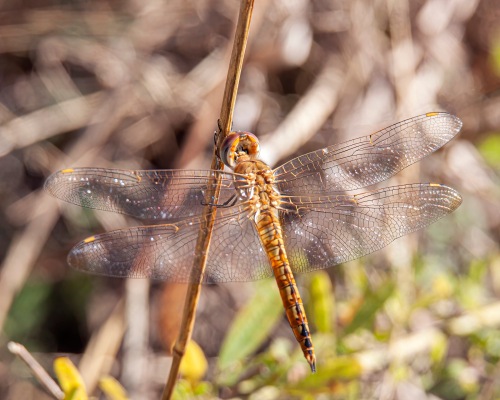
There are not very many dragonflies flying around this late in the season, so I was happy to spot this Wandering Glider (Pantala flavescens) last Thursday at Occoquan Bay National Wildlife Refuge. I was even more thrilled when it perched within range of my long telephoto zoom lens and I was able to get the first shot below. The dragonfly was perched really look to the ground in a grassy field and it was a challenge to frame a shot where my view was not blocked by the tall grass.
What could possibly be better than getting a shot of an elusive dragonfly like a Wandering Glider? How about capturing two of them in a single photo? My first thought when I spotted the two Wandering Gliders together last Monday at the same refuge was that they were trying to hook up—I think that one of them is a male and one a female. The hook-up did not happen, at least not while I was observing them.
The weather forecast for this week shows lots of clouds and rain and cooler temperatures. None of those conditions are particularly hospitable to dragonflies, so I suspect that the population will continue to drop as members of some species die off and others, like these Wandering Gliders, migrate to locations with more favorable conditions.

© Michael Q. Powell. All rights reserved.
Posted in Autumn, Dragonflies, dragonfly, Insects, Nature, Photography, wildlife | Tagged Canon 50D, Occoquan Bay National Wildlife Refuge, Pantala flavescens, Tamron 150-600mm, Wandering Glider, Wandering Glider dragonfly, Woodbridge VA | 12 Comments »
« Newer Posts - Older Posts »















 Mike Powell