Feeds:
Posts
Comments

Archive for the ‘wildlife’ Category

When I first saw this dragonfly land yesterday at Occoquan Bay National Wildlife Refuge, I had no idea what it was. Zooming in, I was shocked to see that it was a Wandering Glider (Pantala flavescens), a migratory species that almost never perches.

The Wandering Glider is considered to be the most widespread dragonfly in the world, found on every continent except Antarctica. According to odonatacentral.com, “It is a strong flier that is regularly encountered by ocean freighters and a well-known migratory species. Because of its ability to drift with the wind, feeding on aerial plankton, until it finally encounters a rain pool in which it breeds, it has been called “…the world’s most evolved dragonfly.” ”

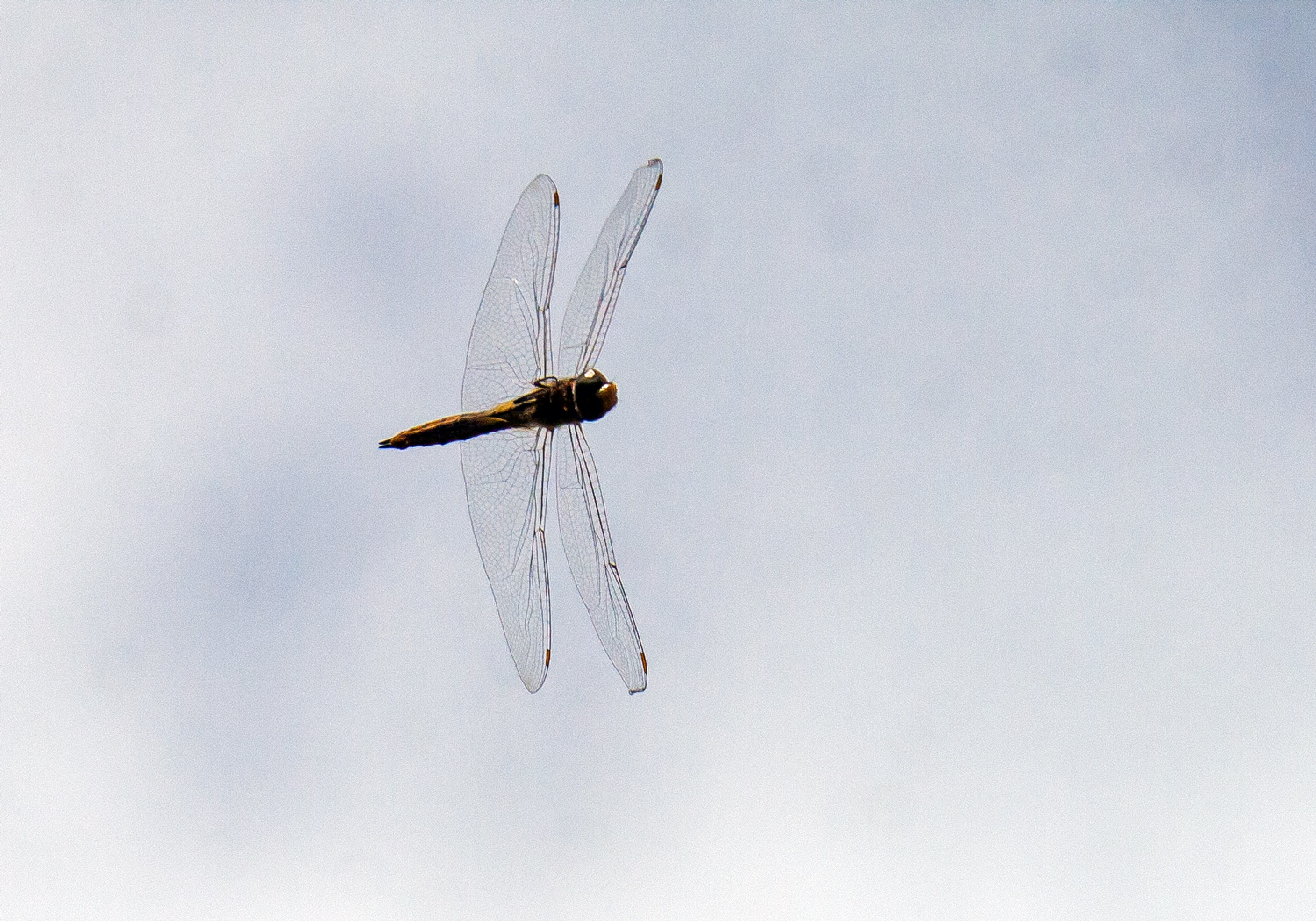
After I got the initial shots of the dragonfly on two different perches, I decided to follow the dragonfly and wait for it to perch again. It wandered about through the air over my head for an extended period of time and never again came down to land. The last photo gives you an idea of my view during that period of waiting—note the long wings that help it to fly such long distances.

Wandering Glider

Wandering Glider

Wandering Glider

© Michael Q. Powell. All rights reserved

Read Full Post »

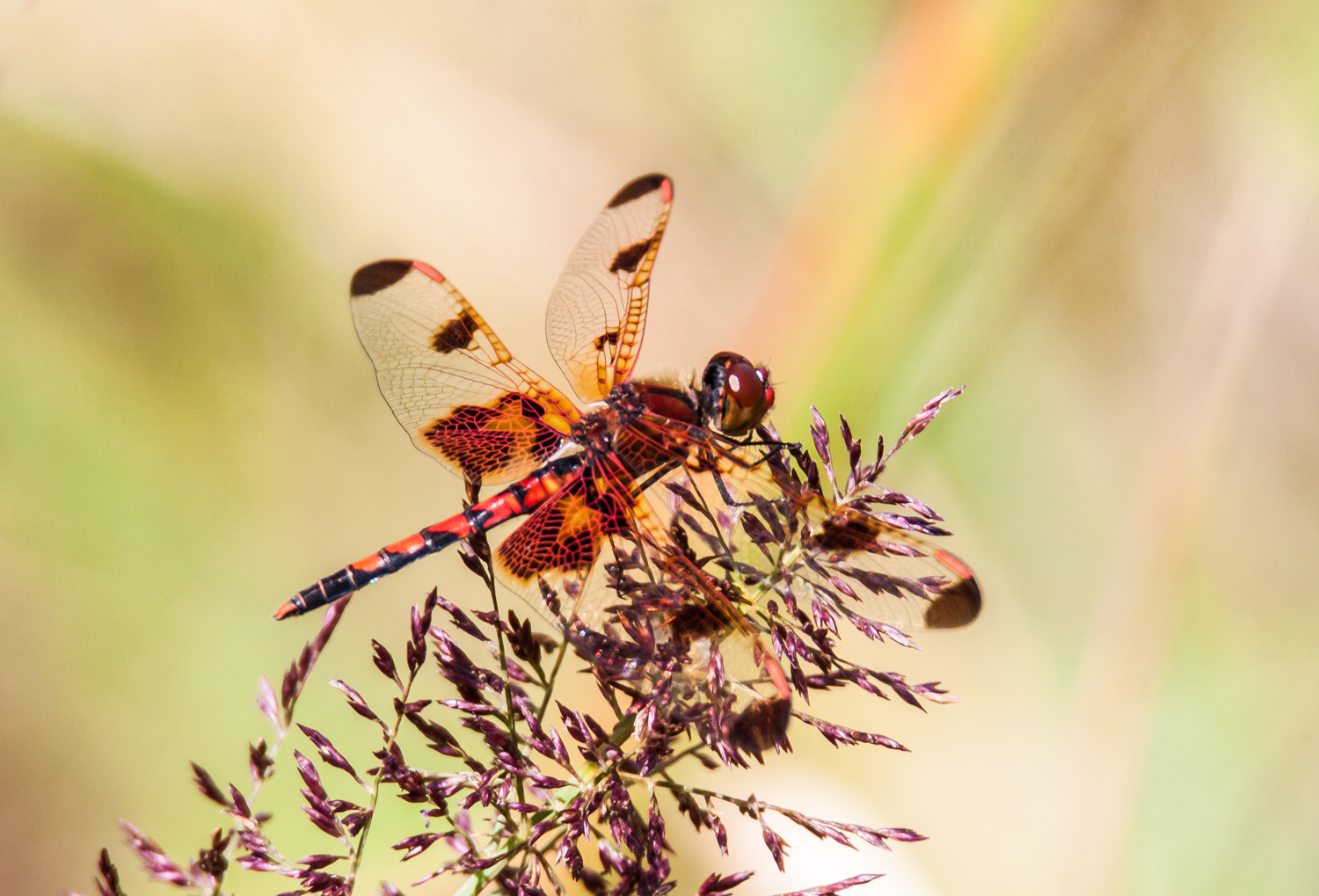
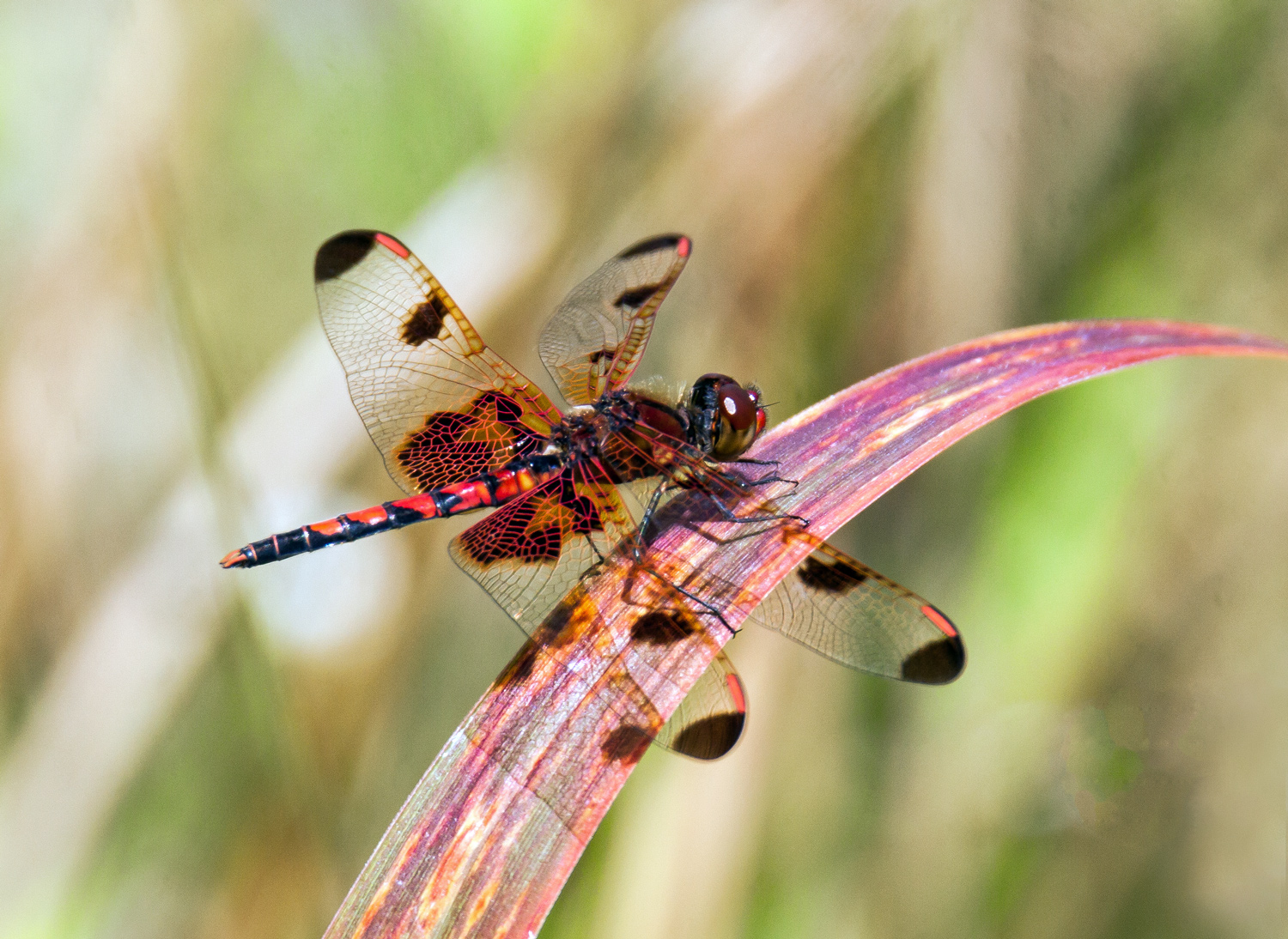
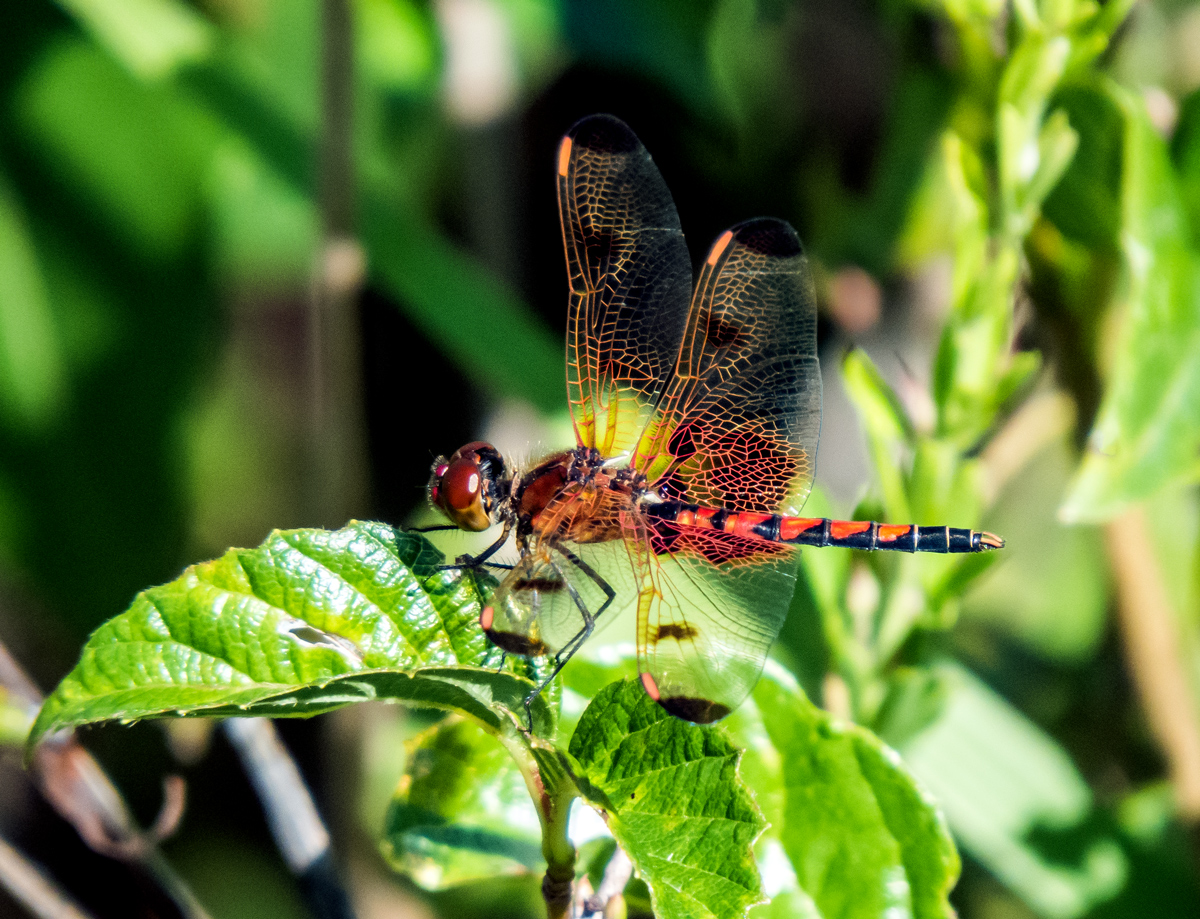
I was really happy to spot a couple of male Calico Pennant dragonflies (Celithemis elisa) during a visit today to Occoquan Bay National Wildlife Refuge in Woodbridge, Virginia. The weather was pretty cool when I set out early this morning, about 56 degrees (13 degrees C), so I was not certain that I would be able to find many dragonflies. Fortunately for me it warmed up a bit and a few dragonflies appeared.

The bright red color of this dragonfly helps a little in finding them, but Calico Pennants are pretty small and it is easy to lose them in the vegetation. I shot the first two shots with my Canon 50D DSLR and Tamron 150-600mm telephoto zoom lens and the third one with my Canon SX50 super zoom camera. The poses are not identical, but I think that you can see how much shallower the depth of field is when using the DSLR than the point-and-and-shoot—I think it is related to the difference in the size of the sensors in the cameras.

Calico Pennant

Calico Pennant

Calico Pennant

© Michael Q. Powell. All rights reserved


Read Full Post »

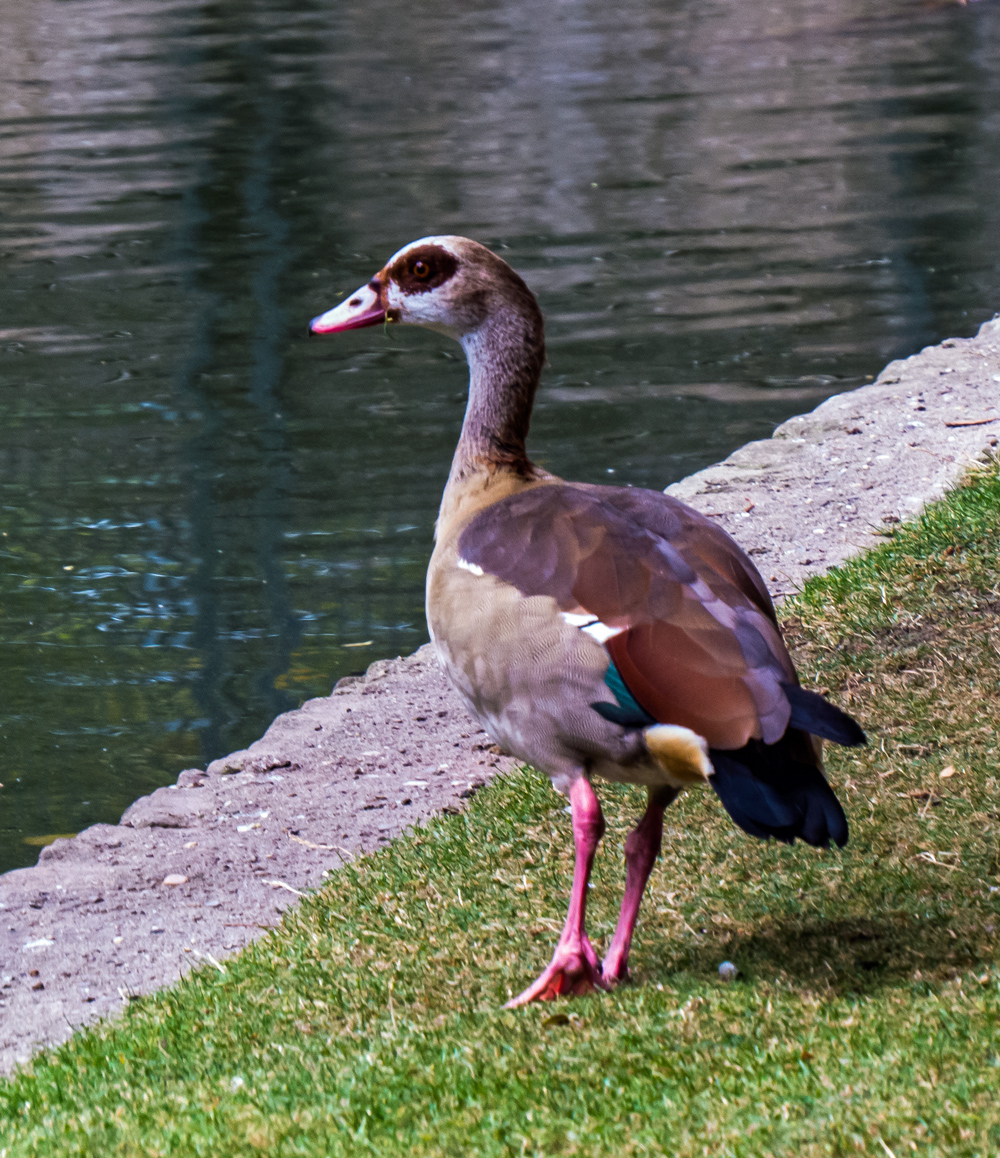
When I spotted this odd-looking bird yesterday at the Botanical Garden in Brussels, I couldn’t make my mind up if it was a duck or a goose. It seemed too big to be a duck, but its markings seemed too colorful for a goose.

After a lot of searching on the internet, I have concluded this is probably an Egyptian Goose (Alopochen aegyptiaca). As its name suggests, this species is native to Africa south of the Sahara and the Nile Valley and is an introduced species in Europe, according to Wikipedia. There are in excess of 250 breeding pairs in Belgium, primarily around Brussels and the Flanders area, according to a posting on birdforum.net.

This bird did not hang around for very long, so I did not have a chance to see if, as The Bangles famously sang, it walked like an Egyptian (https://www.youtube.com/watch?v=Cv6tuzHUuuk).

Egyptian Goose

Egyptian Goose

Egyptian Goose

© Michael Q. Powell. All rights reserved

Read Full Post »

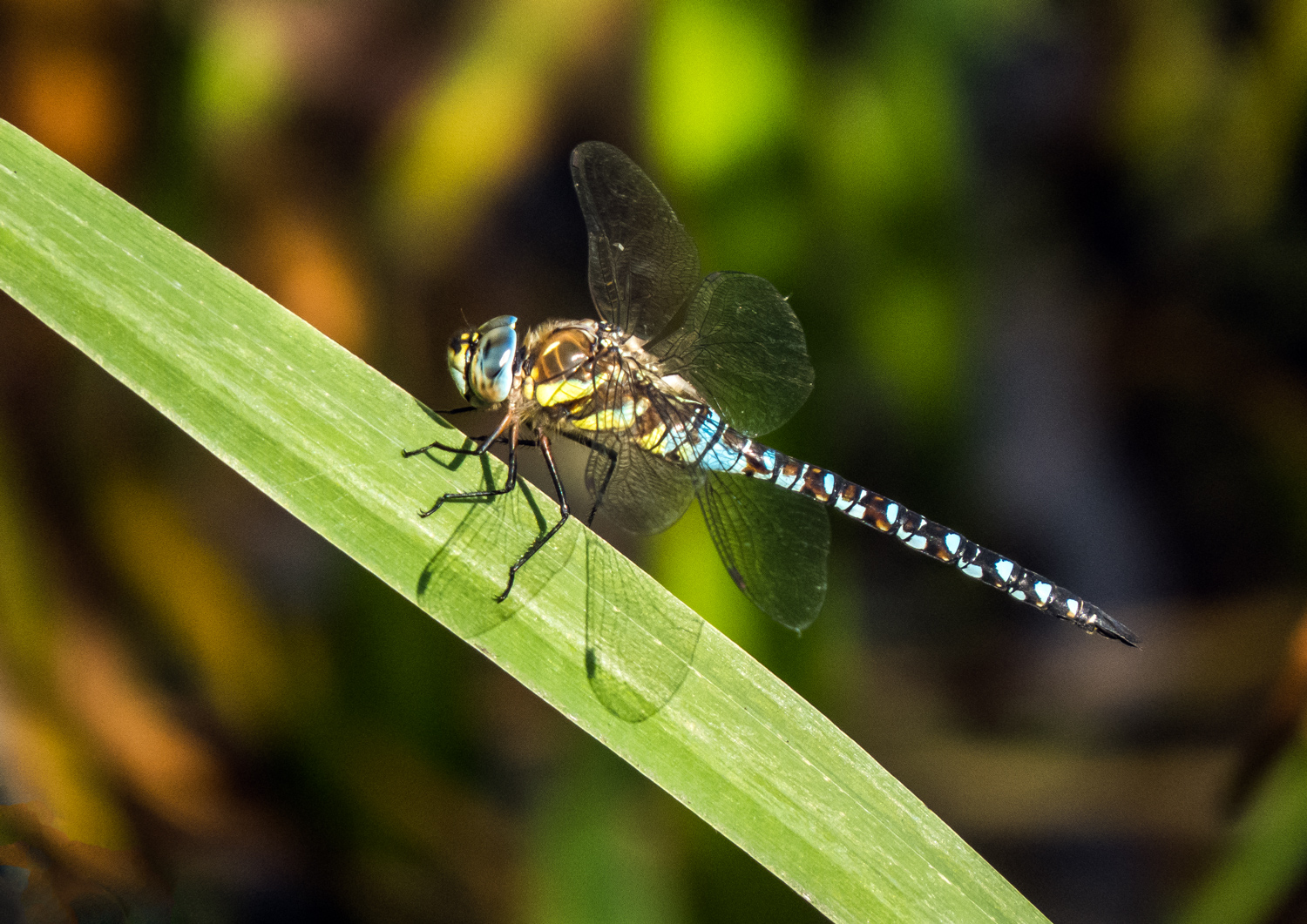
The most colorful dragonfly that I have spotted in Brussels during this trip has been a spectacular male Migrant Hawker dragonfly (Aeshna mixta) that was flying patrols over a small pond at the botanical garden.  It spent a lot of time in the air, but occasionally would perch for a short while. Every now it then it would hover over the water, which let me capture the second shot of the dragonfly in flight. My Canon SX50 is a little slow in acquiring focus, so I didn’t think that I would be able to capture any action shots of the dragonfly. However, I kept trying and eventually was able to get a reasonably sharp shot. When I checked out the shooting data for the image, I realized that the shutter speed had dropped to 1/100 second because of the dark water, so it’s almost a miracle that I stopped the action at all—I was shooting in aperture priority mode and was letting the camera choose the shutter speed.

Migrant Hawker

Migrant Hawker

 © Michael Q. Powell. All rights reserved

Read Full Post »

When I spotted a red dragonfly in flight while exploring the botanical garden in Brussels, I immediately gave chase. Unfortunately the dragonfly chose to perch on a weathered wooden fence a good distance away. Unable to get any closer to the dragonfly, I did my best to incorporate the fence into the composition.

I kept looking later in the day for the elusive red dragonfly, which looks a little like the Autumn Meadowhawk dragonfly that I see in my home area, but I never saw it again.

dragonfly in Brussels

dragonfly in Brussels


© Michael Q. Powell. All rights reserved

Read Full Post »

Over the last few years it has become traditional for me to be in Brussels over Labor Day weekend in early September for meetings. After I arrived today, I had some free time and captured these images of damselflies in the Botanical Gardens. Some of them are quite similar to those that I see at home, while others appear to be a bit different. As is often the case when I am traveling for work, I left my big camera at home and took these shots with my Canon SX50 HS superzoom camera.

damselfly in Brussels

damselfly in Brussels

mating damselflies in Brussels

© Michael Q. Powell. All rights reserved

Read Full Post »

Do you have a favorite insect? This is such a strange question that most folks would not have an immediate answer and would have to stop and think a bit before responding. The quickest responses would undoubtedly come from those who simply do not like insects at all. The most common positive answer, I suspect, might well be a Monarch Butterfly.

Many readers know that I see lots of beautiful dragonflies and butterflies, but my favorite insect is almost certainly the Handsome Meadow Katydid (Orchelimum pulchellum), like this one that I photographed on Monday at Occoquan Bay National Wildlife Refuge. I remember my sense of awe and amazement the first time that I spotted one—I couldn’t believe my own eyes, because the combination of colors seemed so bright and almost unreal. When I initially posted a photo of the Handsome Meadow Katydid, one of my friends thought that I had added the colors in Photoshop.

To this day, I never fail to marvel at a Handsome Meadow Katydid’s spectacular rainbow colors and incredible blue eyes and am always thrilled to discover again their amazing beauty when I am fortunate enough to find one.

Handsome Meadow Katydid

© Michael Q. Powell. All rights reserved

Read Full Post »

Whenever I see bees buzzing around flowers, I keep an eye out for hummingbird moths. For some unknown reason, I have seen more of these colorful moths this summer than in past years.

Although you could argue about whether or not thistles are flowers, my vigilance was rewarded when I spotted this beautiful Hummingbird Clearwing Moth (Hemaris thysbe) feeding on this thistle bloom on Monday at Occoquan Bay National Wildlife Refuge.

Hummingbird Clearwing Moth

Hummingbird Clearwing Moth

© Michael Q. Powell. All rights reserved

Read Full Post »

As summer begins to wind down for those of us in the Northern Hemisphere, some of the dragonfly species in our area are starting to disappear. Fortunately, though, some new species appear late in the season to take their places, like this Russet-tipped Clubtail dragonfly (Stylurus plagiatus) that I spotted yesterday at Occoquan Bay National Wildlife Refuge in Woodbridge, Virginia.

Unlike many of the dragonflies that I see regularly that seem to prefer pole-like perches or perch flat on the ground, Russet-tipped Clubtails like to hang from the leaves of vegetation either at an angle, as this one is doing, or vertically. I was pretty excited to find this dragonfly, because I have seen a member of this species only once before, last year at a different location, Jackson Miles Abbott Wetland Refuge.

Russet-tipped Clubtail

© Michael Q. Powell. All rights reserved

Read Full Post »

“Beautiful Spider”—I know that some people would consider that an oxymoron, a contradiction in terms. I, however, am fascinated with spiders and photographed this Black and Yellow Garden Spider (Argiope aurantia) at Jackson Miles Abbott Wetland Refuge as carefully as if I were doing a beauty shot in a photo studio. The spider had constructed her web on some vegetation overhanging a small pond, which is why  I was able to get such an uncluttered gray background.

Argiope aurantia

Earlier this month I captured an image of a spider of the same species while exploring Occoquan Bay National Wildlife Refuge—this seems to be the prime season for these spiders, which I have seen at multiple locations. This image shows well the amazing reach of the spider’s amazingly long legs and, as was the case in the first image, shows the ziz-zag portion of the web that is associated with this species.

Argiope aurantia

© Michael Q. Powell. All rights reserved

Read Full Post »

The bright blue color of a juvenile skink’s tail is so startling and whimsical that I never fail to smile whenever I see one. When I first spotted this Common Five-lined Skink (Plestiodon fasciatus), it was basking in the sun on top of a concrete fishing platform at Jackson Miles Abbott Wetland Refuge. As I approach, it scurried under the platform and I stopped and waited. Eventually the skink poked its head out and cautiously crawled forward and I was able to capture this image.

Generally I prefer a more natural backdrop for my shots of insects and amphibians, but in this case I really like the varied colors and textures of the man-made materials. I also like the angular lines that contrast nicely with the curves of the skink’s body. Finally the neutral colors of the image help to draw the viewer’s eyes to the beautiful blue tail.

juvenile skink

© Michael Q. Powell. All rights reserved

Read Full Post »

Different species of dragonflies fly in different ways. Some soar high in the air and some cruise just above the surface of the water. A dragonfly’s wings allow it to perform all kinds of aerial acrobatics that are entrancing to observe. Given their size and speed, it’s a significant challenge to try to capture them in flight, though frequent readers of this blog know that I will sometimes spend extended periods of time trying to meet that challenge.

During a recent trip to Occoquan Bay National Wildlife Refuge, I noticed a dragonfly flying above my head. Its flight reminded me of eagles and hawks that I have seen gliding effortlessly on thermal updrafts. I couldn’t make out the flight pattern that it was following, but it repeatedly flew over me. Each time that it returned, I would point my camera almost straight up and eventually I was able to capture this shot of an easy-to-identify Black Saddlebags dragonfly (Tramea lacerata)—the pattern of black blotches on the wings are very distinctive.

Black Saddlebags

Later that same day I spotted a dragonfly making repeated patrols above the water. The dragonfly never seemed to rest or to perch, so I tried and tried to capture some shots of it as it zoomed on by me. Most of my shots were out of focus, but I like the one below. The choppy water in the background reminds me of the clouds that I will sometimes see when I look out of the window of an aircraft that has reached its cruising altitude. In my mind’s eye, I can imagine this dragonfly flying high in the sky, peacefully soaring above the clouds and the turbulence below it.

Prince Baskettail

© Michael Q. Powell. All rights reserved


Read Full Post »

When is a cluttered background so distracting that it draws attention away from the primary subject? When I have the luxury of time, I will normally attempt to compose my shots so that the background fades into the background as a creamy blur. As a wildlife photographer, though, I am often photographing live subjects that are likely to flee as soon as they become aware of my presence. Frequently I barely have time to bring the camera up to my eye and am forced to react rapidly and instinctively—I just don’t have time to think about the background.

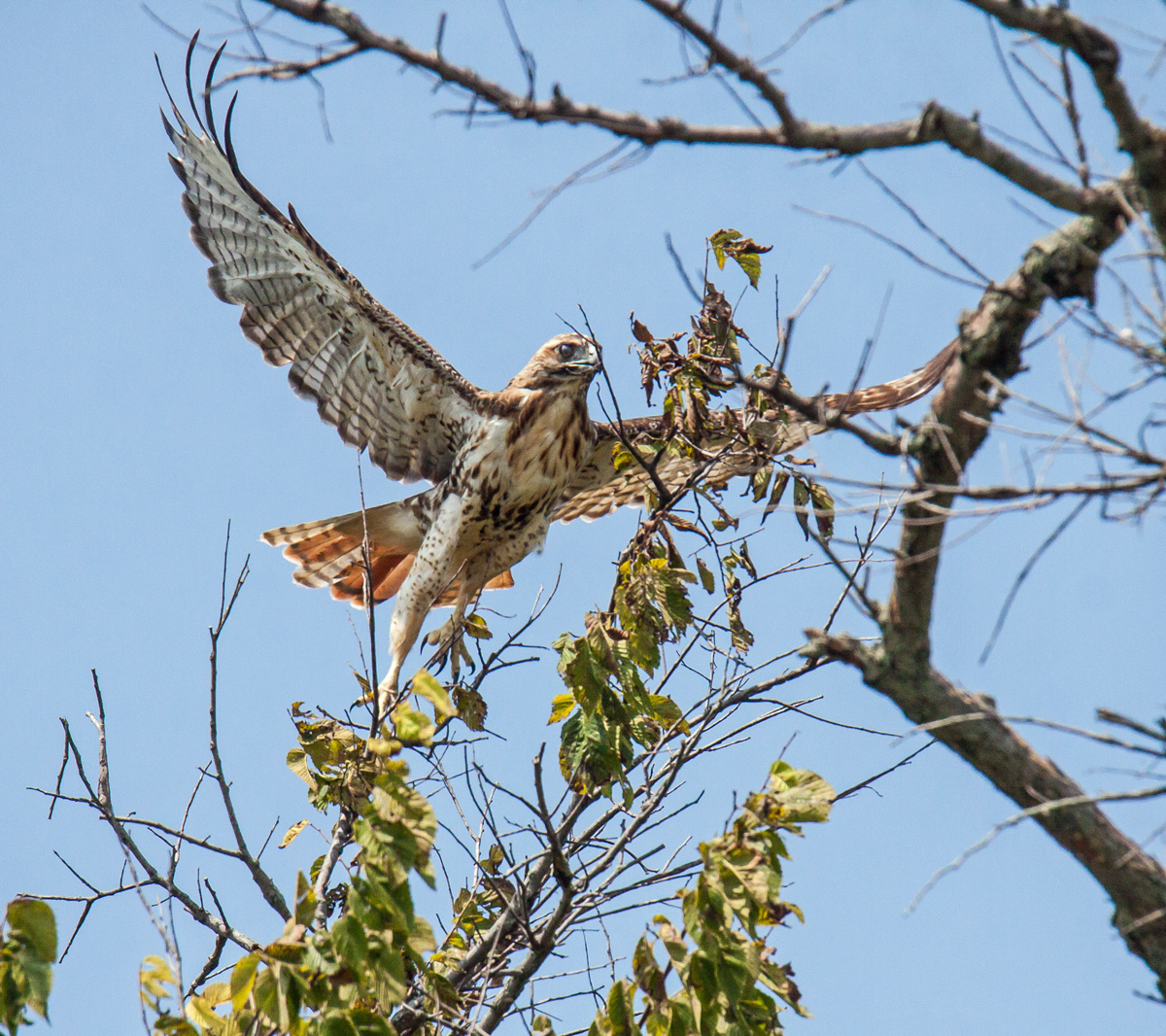
Yesterday as I was walking along the Mount Vernon Trail in Alexandria, Virginia parallel to the Potomac River, I spotted a bird at the very top of a distant tree. Earlier in the day I had seen an osprey in a similar position, so I initially assumed it was another osprey. I had just zoomed in on the bird when it exploded out of the tree into the air. From the way that it was flying, I realized that it was probably an eagle or a hawk. I tracked the bird, which I believe is a Red-tailed Hawk (Buteo jamaicensis) as it flew behind some trees and eventually into the clear blue skies.

Here are my three favorite shots of the encounter. Two of them are cluttered and one has a plain blue background. Which one do you like most? I am not bothered by the branches in the first two shots and like the way that they help to give a sense of context to the action that is depicted. The third shot shows some of the wonderful details of the beautiful hawk, but it seems a bit more sterile to me. (For the record, the first shot is probably my favorite of the three images.)

Are cluttered backgrounds ok? Like so many factors in photography, the correct response appears to be that it depends on the specific circumstances.

Red-tailed Hawk

Red-tailed Hawk

Red-taile Hawk

© Michael Q. Powell. All rights reserved

Read Full Post »

One of the coolest looking butterflies in our area is the Zebra Swallowtail butterfly (Eurytides marcellus). In addition to having beautiful coloration, it has amazingly long “tails” that flutter when it is in flight. It is not a species that I see very often, so I will spend a lot of time chasing after one when I spot it, hoping, often in vain, that it will perch long enough for me to get a shot.

This Zebra Swallowtail, which I chased this past Friday at Occoquan Bay National Wildlife Refuge, was reasonably cooperative, though it refused to open its wings to give me a view of its entire wingspan.

Zebra Swallowtail

© Michael Q. Powell. All rights reserved

Read Full Post »

I spent a considerable amount of time one morning earlier this month at Huntley Meadows Park trying to get some shots of this skittish female Belted Kingfisher (Megaceryle alcyon). It was almost impossible to get really close, so I had to rely on my long telephoto zoom lens.

Belted Kingfisher

Belted Kingfisher

Belted Kingfisher

© Michael Q. Powell. All rights reserved

Read Full Post »

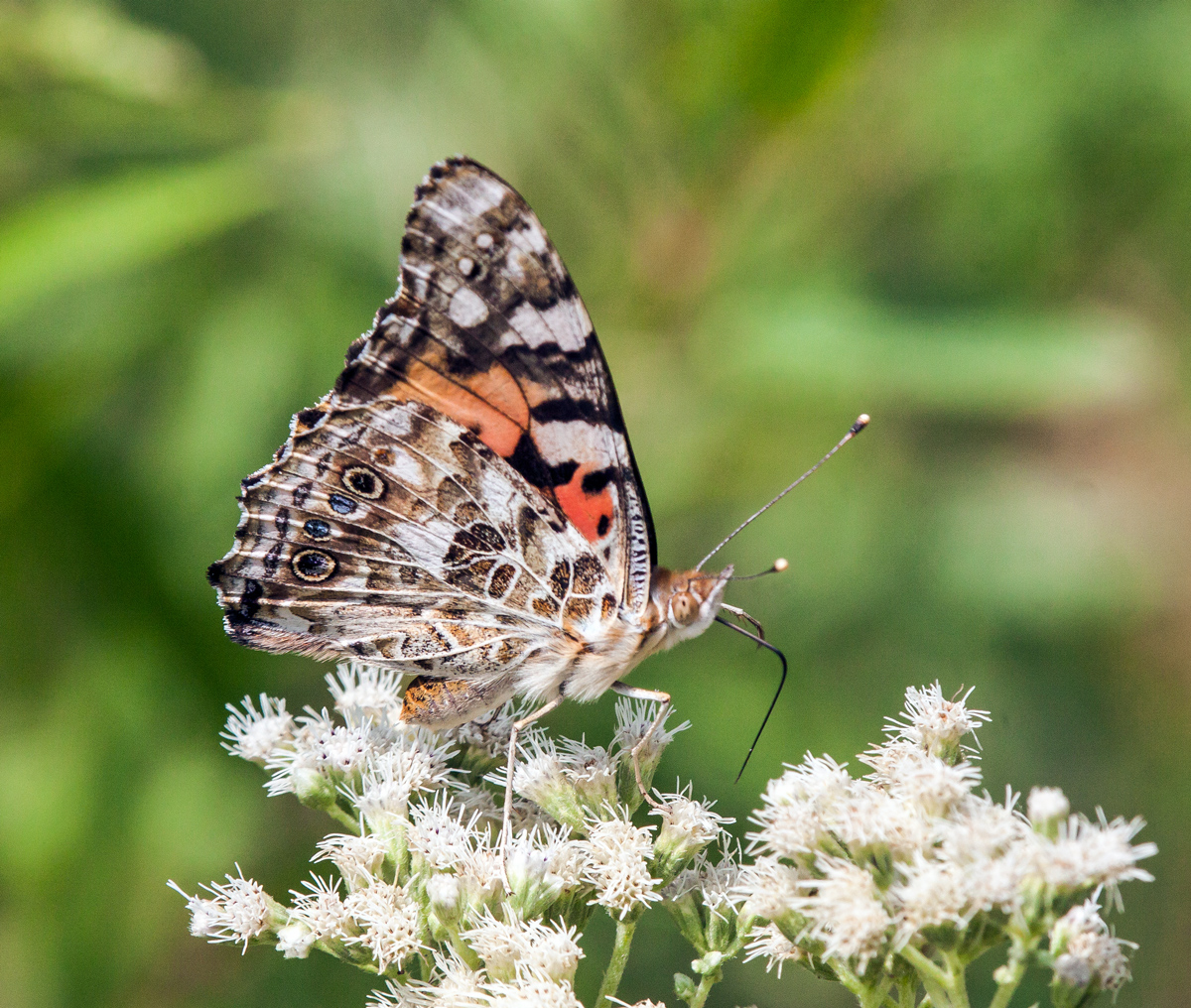
As I was exploring at Huntley Meadows Park this past weekend, I was thrilled to stumble upon this beautiful Painted Lady butterfly (Vanessa cardui), a species that I have not seen in several years. In the field, I couldn’t remember the differences between a Painted Lady and the similar-looking American Lady. Fortunately, there are plenty of resources on-line, including this helpful comparison page on bugguide.net that shows the differences between the two types. On the basis of the pattern of the eye spots, I concluded that this is almost certainly a Painted Lady.

Painted Lady

© Michael Q. Powell. All rights reserved

Read Full Post »

One of the little woodland butterflies that I see only rarely is the Common Wood Nymph (Cercyonis pegala). I was therefore pretty excited when I spotted this beauty on Friday while it was perched on a tree at Huntley Meadows Park. The yellow patch is so distinctive that it was pretty easy for me to identify this one, unlike so many other woodland butterflies that are mostly brown with different patterns and colors of eye spots on their wings.

Common Wood Nymph

© Michael Q. Powell. All rights reserved

Read Full Post »

In the insect world, Red-footed Cannibalflies (Promachus rufipes) are fearsome predators. Yesterday I spotted one at Huntley Meadows Park in Alexandria, Virginia that appeared to be subduing a Hummingbird Clearwing Moth (Hemaris thysbe) that it had just captured.

What happens next? Wikipedia describes the tactics of a robber fly, the family to which the Red-footed Cannibalfly belongs, in these words:  “The fly attacks its prey by stabbing it with its short, strong proboscis  injecting the victim with saliva containing neurotoxic and proteolytic enzymes which very rapidly paralyze the victim and soon digest the insides; the fly then sucks the liquefied material through the proboscis.”

Yikes!

red-footed cannibalfly subdues hummingbird moth

© Michael Q. Powell. All rights reserved

Read Full Post »

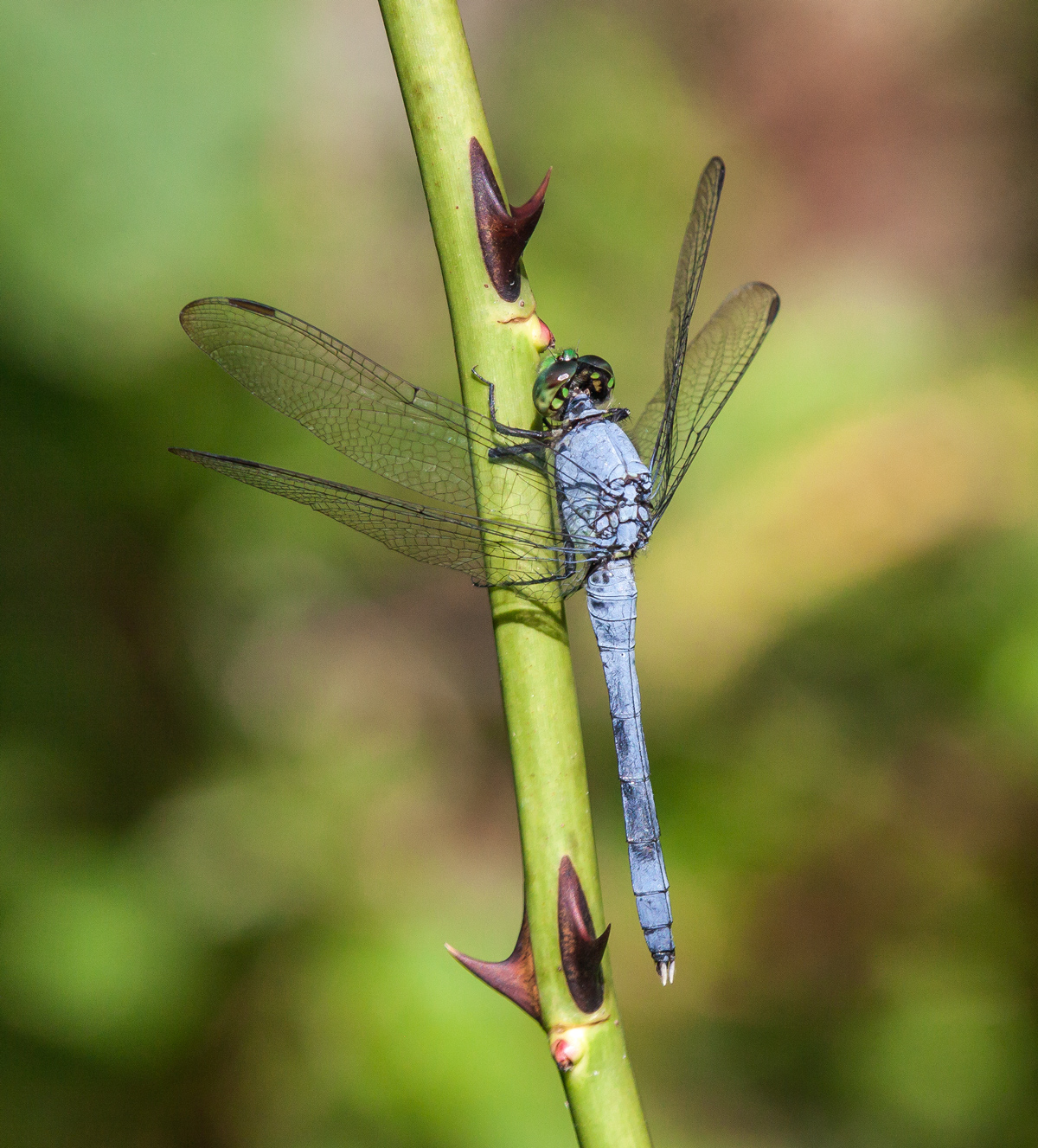
I don’t know about you, but if I were an insect with large, fragile wings, I think that I would avoid perching on vegetation with large thorns. This male Eastern Pondhawk dragonfly (Erythemis simplicicollis), however, is obviously bolder and more skilled than I am. With precision flying skills matching the parking abilities of an inner city driver, he has managed to squeeze into a space that seems barely large enough to accommodate him.

Pointless perching—that seems to be the point.

Eastern Pondhawk

© Michael Q. Powell. All rights reserved


Read Full Post »

I didn’t see the Green Heron (Butorides virescens) actually catch his breakfast last Friday morning at Huntley Meadows Park, but when he climbed up onto a protruding branch he gave me a quick look at the fish before swallowing it.

Green Heron

© Michael Q. Powell. All rights reserved

Read Full Post »

Although it looks a bit like a tug of war, I think that these two Red-footed Cannibalflies (Promachus rufipes) actually were mating when I spotted them on Friday at Huntley Meadows Park. (Don’t ask me any anatomical questions–I am not sure how it works for them.)

This photo was taken from a pretty good distance away with my 150-600mm lens and is a little soft, but I thought I’d post it today as an accompaniment to my earlier macro shot of what I think is a female Red-footed Cannibalfly.

mating Red-footed Cannibalflies

© Michael Q. Powell. All rights reserved

Read Full Post »

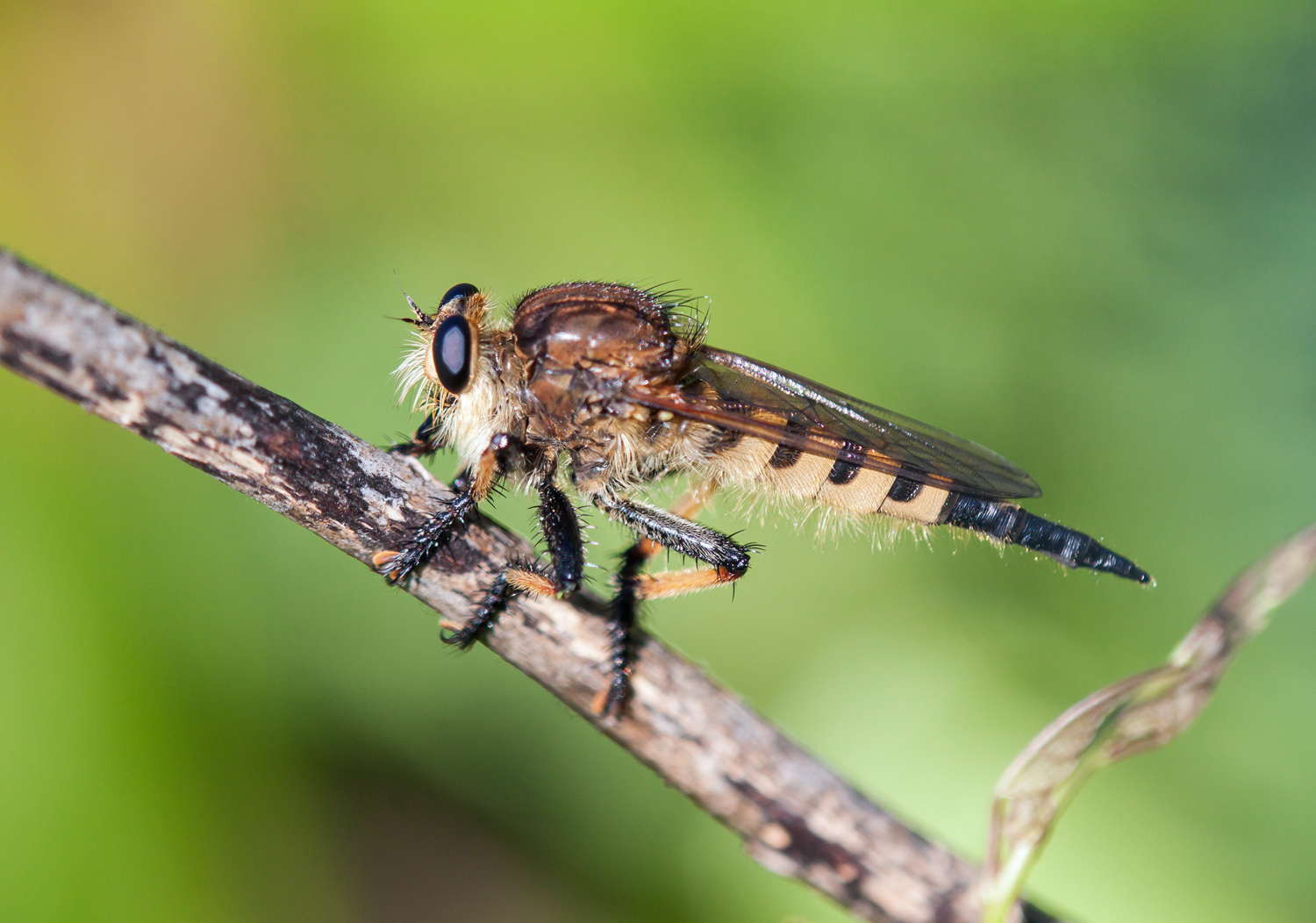
A Red-footed Cannibalfly (Promachus rufipes) is one of the coolest and creepiest insects that you can encounter in the wild. A type of robber fly, Red-footed Cannibalflies usually feed on other insects, but they reportedly are capable of taking down a hummingbird. I spotted this “beauty” during a visit this past weekend to McKee-Beshers Wildlife Management Area in Poolesville, Maryland after a fellow photographer pointed it out to me.

Red-footed Cannibalflies are special to me for an unusual reason—a posting that I did about one in August 2013 has proven to be my most widely viewed normal blog posting over time. (I did have a couple of postings about the rescue of an injured bald eagle that received a huge boost in readership when linked in local media reports, but that spike was  a one-time occurrence and I tend to exclude those posts in my calculations.) The enduring popularity of that posting is a bit of a mystery to me. Yes, the subject is fascinating, but the accompanying photos are not really my best work.

Why then do I keep getting viewers for this posting? The posting, for example, had 512 views in 2015 and 612 views in 2016. During this year, there have already been 211 views, including 39 in August. I don’t know what kind of algorithms Google and the other search engines use in deciding how to rank order listings when searches are conducted, but somehow I have frequently made it onto the first page of the listings when a search is done for “red-footed cannibalfly.”

I receive offers all of the time for something called Search Engine Optimization (SEO) that promises me that, after I have paid a fee, my posting will rise higher on the Google results.  I am not sure that it would be possible for me to get any higher on the list than I already am—I think that my posting has on occasion been as high as fourth on the Google results.

I am a little amused that my name may have become associated with Red-footed Cannibalflies in the minds of some viewers after a Google search. On the whole, readership statistics remain a mystery to me. I can sometimes guess which of my postings will have a good number of viewers when originally posted, but I am clueless in figuring out which ones will have additional views after a couple of days have passed.

For better or for worse, my postings seem to have a life of their own. I never know when or how a viewer somewhere in the world may stumble across my words and images. Wow! How cool is that?

Red-footed Cannibalfly

© Michael Q. Powell. All rights reserved

Read Full Post »

This majestic osprey (Pandion haliaetus) was keeping a close watch on a fellow photographer and me as we pointed our long lenses in its direction as it perched high in a tree early one morning this weekend at Huntley Meadows Park.

osprey

© Michael Q. Powell. All rights reserved

Read Full Post »

Early yesterday morning at Huntley Meadows Park, the Great Egrets (Ardea alba) were relaxing in the trees, awaiting the start of another beautiful day. When birds are as brilliantly white as egrets, it’s a challenge to get an exposure that retains the details in the feathers. I set the metering on my camera to spot metering and it seems to have worked pretty well. I even like the way that it darkened the background and made the egret stand out even more.

Great Egret

© Michael Q. Powell. All rights reserved

Read Full Post »
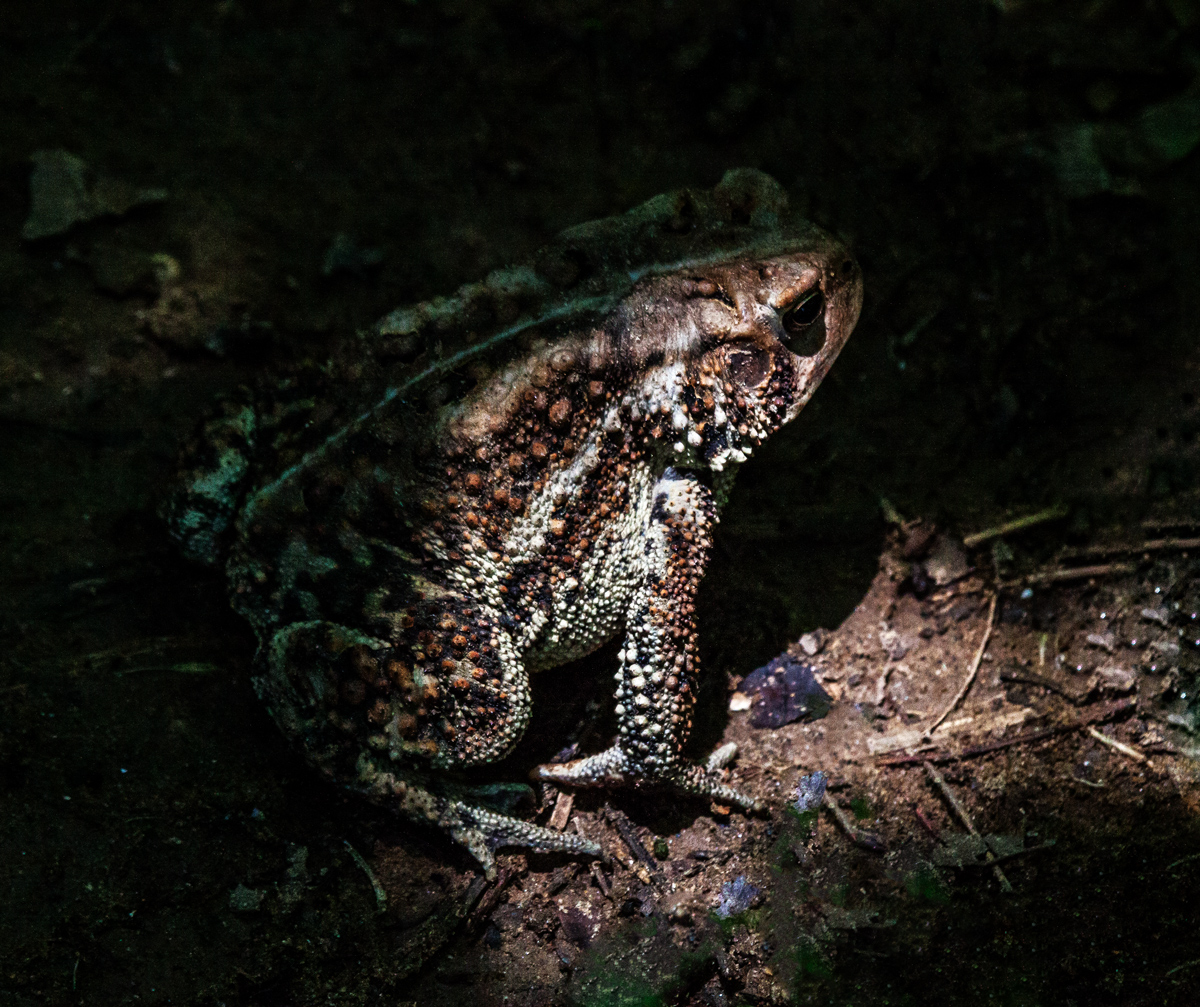
As I was walking along the Potomac River one day last month, I came upon this large toad, which I think might be a Fowler’s Toad (Anaxyrus fowleri). I was really struck by the way that the light and shadows helped to emphasize the very bumpy texture of the toad’s skin.

Fowler's Toad

© Michael Q. Powell. All rights reserved

Read Full Post »
Last weekend I spotted a shorebird in the distance while exploring Huntley Meadows Park. It was sharing a log with several turtles. Initially the little bird stayed on the opposite end of the log from the turtles. Gradually the curious and energetic bird moved closer and closer to the turtles. I couldn’t tell for sure, but it looked like the bird came close to pecking one of the legs of a turtle. Perhaps the bird was surprised when the turtle reacted or the turtle made a threatening move, but in any case the bird flew off after the brief encounter.

I was pretty conftdent that the bird was some kind of sandpiper, but I have never seen one with these markings. I posted to a Facebook group and got a quick response. What was the sandpiper I had spotted? It turned out to be a Spotted Sandpiper (Actitis macularius).

Spotted Sandpiper


Spotted Sandpiper

© Michael Q. Powell. All rights reserved

Read Full Post »
I was looking high and in the distance and the Bald Eagle (Haliaeetus leucocephalus) came in low and was almost on top of me before I saw it yesterday morning at Huntley Meadows Park. I had to scramble and pull back on my zoom lens to capture this image, which barely fit into the frame of the viewfinder. (The EXIF data for the shot indicate that it was shot at 309mm of my 150-600mm Tamron telephoto zoom lens.)

I feel like I should have been able to take better advantage of the situation that presented itself, but I am not disappointed. As I have noted repeatedly, any day with a bald eagle is a great day.

Bald Eagle

© Michael Q. Powell. All rights reserved

Read Full Post »
This female Ruby-throated Hummingbird (Archilochus colubris) must have been feeling tired or lazy yesterday afternoon at Huntley Meadows Park. Rather than going in through the opening in the trumpet vine flower and helping to pollinate it, she opted to drill in through the side of the flower to get to the nectar.

Ruby-throated Hummingbird

© Michael Q. Powell. All rights reserved

Read Full Post »

It looks like a massive amount of fluorescent Silly String has exploded onto parts of the marshland at Huntley Meadows Park, but I believe it is in reality a parasitic plant known as dodder. Early yesterday afternoon a White-tailed Deer (Odocoileus virginianus) found it to be so tasty that it was willing to ignore the people passing on the boardwalk less than ten feet away.

In taking this photo, I did something that I rarely do—I used the 150mm setting of my 150-600mm telephoto zoom lens. The deer was so close that I could capture only its head and shoulders, even with the lens at its widest setting.


deer and dodder

© Michael Q. Powell. All rights reserved

Read Full Post »

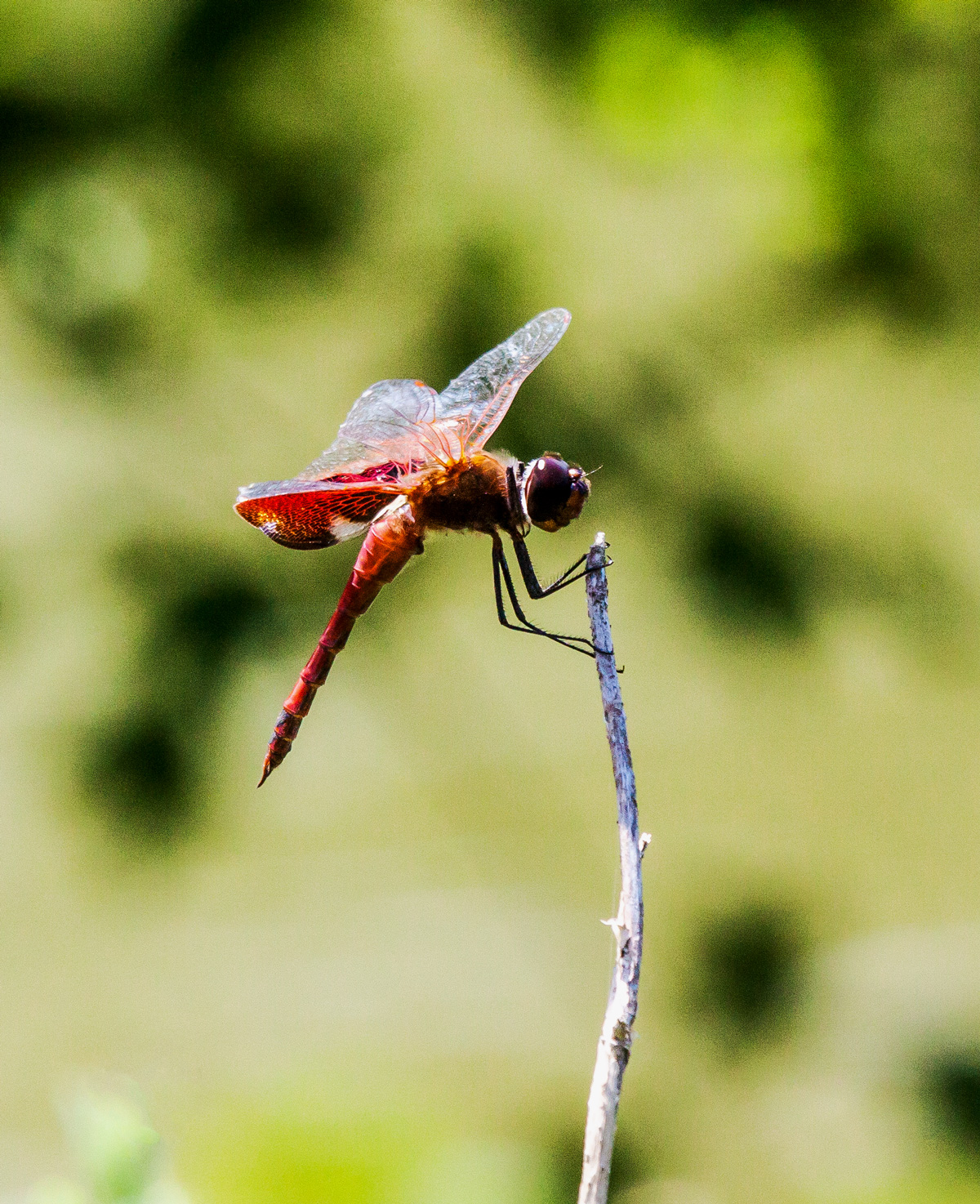
What are Carolina Saddlebags? Luggage for horseback or motorcycle riding? No, Carolina Saddlebags (Tramea carolina) are a species of bright red dragonflies with reddish-brown blotches of color on their hindwings. Why aren’t they Carolina Blue in color? Obviously the folks who named the dragonfly were not fans of the University of North Carolina (UNC) basketball team. (According to Wikipedia, the use of the light blue color at UNC dates back to 1795.)

I first became aware of the Carolina Saddlebags yesterday at Jackson Miles Abbott Wetland Refuge when a flash of red caught my eye. A dragonfly was patrolling over a section of the water and the adjacent grassy area. I tracked it visually and eventually realized it was a saddlebags dragonfly—those blotches of color stand out even when the dragonflies are flying. Most of the saddlebags dragonflies that we encounter in our area are Black Saddlebags (Tramea lacerata), but I was pretty confident that my eyes were seeing the red of the relatively rarer Carolina Saddlebags. I tried to capture some in-flight shots, including the first one below, but eventually lost sight of the dragonfly.

Carolina Saddlebag dragonflies, according to the information on the Dragonflies of Northern Virginia website, are powerful fliers and are one of only a few species that routinely migrate hundreds of miles. Additionally, according to that same website, they rarely perch.  As I continued to walk around the small pond of the wildlife refuge, imagine my surprise when I came upon one that was perching.

I didn’t dare approach too closely initially and may well have been holding my breath when I took some preliminary shots. My caution proved to be justified, because the dragonfly flew away when I tried to move forward, even though I was approaching as slowly and as stealthily as I could. Either the dragonfly was skittish or its short rest break was over.

Carolina Saddlebags was not a species that I had seen before at this location and it was not really on my radar. Fortunately I was able to react quickly enough and was lucky enough to get some shots, including the in-flight one as the dragonfly was zooming past me. As I learned in the Boy Scouts, it is always good to be prepared.

Carolina Saddlebags

Carolina Saddlebags

Carolina Saddlebags

© Michael Q. Powell. All rights reserved

Read Full Post »
I have known for a while that hummingbirds are attracted to trumpet vines, so I keep my eyes open whenever I pass a stand of them near the observation tower at Huntley Meadows Park. Yesterday morning I finally lucked out and spotted a female Ruby-throated Hummingbird (Archilochus colubris) in the midst of the trumpet vines (Campsis radicansand managed to capture these images, including one in which the hummingbird was resting for a few seconds on a branch before resuming her energetic activity.

Ruby-throated Hummingbird

Ruby-throated Hummingbird

© Michael Q. Powell. All rights reserved

Read Full Post »
« Newer Posts - Older Posts »