I was delighted to spot this beautiful female Calico Pennant dragonfly (Celithemis elisa) last Tuesday at Occoquan Bay National Wildlife Refuge. She was perched high in the vegetation and tolerated my presence pretty well, which permitted me to get shots from several angles. I love the way that the feet and the wings are in slightly different positions in each shot, as she adjusted her position to maintain her balance.
You can’t get much more basic than this shot of a Blue Dasher (Pachydiplax longipennis), one of the most common dragonflies where I live, that I spotted last Tuesday at Occoquan Bay National Wildlife Refuge.. I find, though, that there is a really beauty in that simplicity that allows me to immerse myself in the details of my subject.
I am able to notice the two-toned eyes, the pattern on the abdomen, and the yellowish portions of the legs where they are connected to the body. Even the perch, which I think is stalk of Eastern Gamagrass (Tripsacum dactyloides), has fascinating details.
This looks like such a tranquil scene, with two dragonflies of different species sharing a prime perch on a branch overhanging the pond at Jackson Miles Abbott Wetland Refuge, a moment of peaceful coexistence. However, I had been watching these two dragonflies for an extended period of time and knew that the moment of sharing was the exception rather than the rule.
The male Slaty Skimmer dragonfly (Libellula incesta) on the left and the male Swift Setwing (Dythemis velox) had been repeatedly challenging each other for sole possession of the perch. Whenever one of them would perch on the end of the branch, the other dragonfly would fly straight at the one that was perched, attempting either to dislodge the interloper or at least convince him to fly away. They went back and forth like this for quite a while, alternating possession, though I think the Slaty Skimmer, the larger of the two, held onto the branch for a longer period of time than the Swift Setwing.
I tried to capture them “buzzing” each other, but timing was really tricky and it was almost impossible to keep them both in focus. The second image below is my best effort in showing their interaction. I was low to the ground when I took the shot and really like the perspective with the sky in the background. If you look closely at the lower left corner of the second photo, you may notice that a long-jawed spider was also sharing the perch with the two dragonflies.
Black Saddlebags dragonflies (Tramea lacerata) are one of a dozen or so dragonfly species in North America that migrate. Not surprisingly they are strong fliers and most of the time when I see one, it is flying high overhead—they do not seem to perch very often.The dark patches on their hind wings, which someone thought resembled saddlebags, are so distinctive that it is pretty easy to identify a Black Saddlebags when I see one in the sky.
As I was exploring Occoquan Bay National Wildlife Refuge on Tuesday, I spotted a dragonfly as it zoomed by me and watched it land low in the vegetation. I moved forward as stealthily as I could and was delighted to see that the perching dragonfly was a Black Saddlebags. The background was quite cluttered, but I managed to find a clear visual path to the dragonfly and was delighted to capture this detailed image—I encourage you to click on the photo to see the beautiful markings on the abdomen and the distinctive “saddlebags.”
If you want to learn more about this particular species, I recommend an article from the University of Wisconsin at Milwaukee entitled “Black Saddlebags Dragonfly (Family Libellulidae).” Among other things, you will learn that for Black Saddlebags dragonflies, “Mating is brief if done aerially [the ultimate multitasking] and only slightly longer if the pair is perched.”
I am still learning to take videos with my iPhone 11. During my recent road trip, I convinced myself that it could be used with large subjects like bison and wild horses. I wasn’t sure, however, if it could be used effectively with the small subjects that I enjoy photographing.
Yesterday I visited Occoquan Bay National Wildlife Refuge, my favorite local wildlife photography spot, and kept my iPhone in my front pants pocket—normally I keep it in my backpack, which it is much less accessible. I was still using my Canon 7D with the Tamron 18-400mm zoom lens most of the time, but I made a conscious effort to look for subjects that I could also film with my iPhone.
I was astonished when I encountered a relatively cooperative Zebra Swallowtail butterfly (Eurytides marcellus). Normally these butterflies are extremely skittish and it is a challenge to get a photo of one, even with a long telephoto lens. How could I make a video of one when I would have to be really close to it?
The first video, which is hosted in YouTube, is a short clip I was able to capture of a Zebra Swallowtail. I added a piano track as accompaniment to enhance the experience.
The second video features an Eastern Tiger Swallowtail butterfly (Papilio glaucus) feeding on a colorful thistle plant. This video was a bit easier to capture, because the butterfly was perched much higher and was really preoccupied. I was therefore able to frame the video much better. Once again I added piano music to the video, using the copyright free music available in the YouTube Studio.
As I mentioned in a previous posting, I have chosen to embed YouTube links to the videos rather than place them directly in my blog, where they would count against the blog’s data limits. In order to have an image appear for this posting in the Reader section of WordPress, I have reprised an image of a Zebra Swallowtail that was in a May 2022 posting.
I am having fun playing with videos and think they give a slightly different perspective to my normal blog postings. What do you think? Do you enjoy these kinds of short video clips?
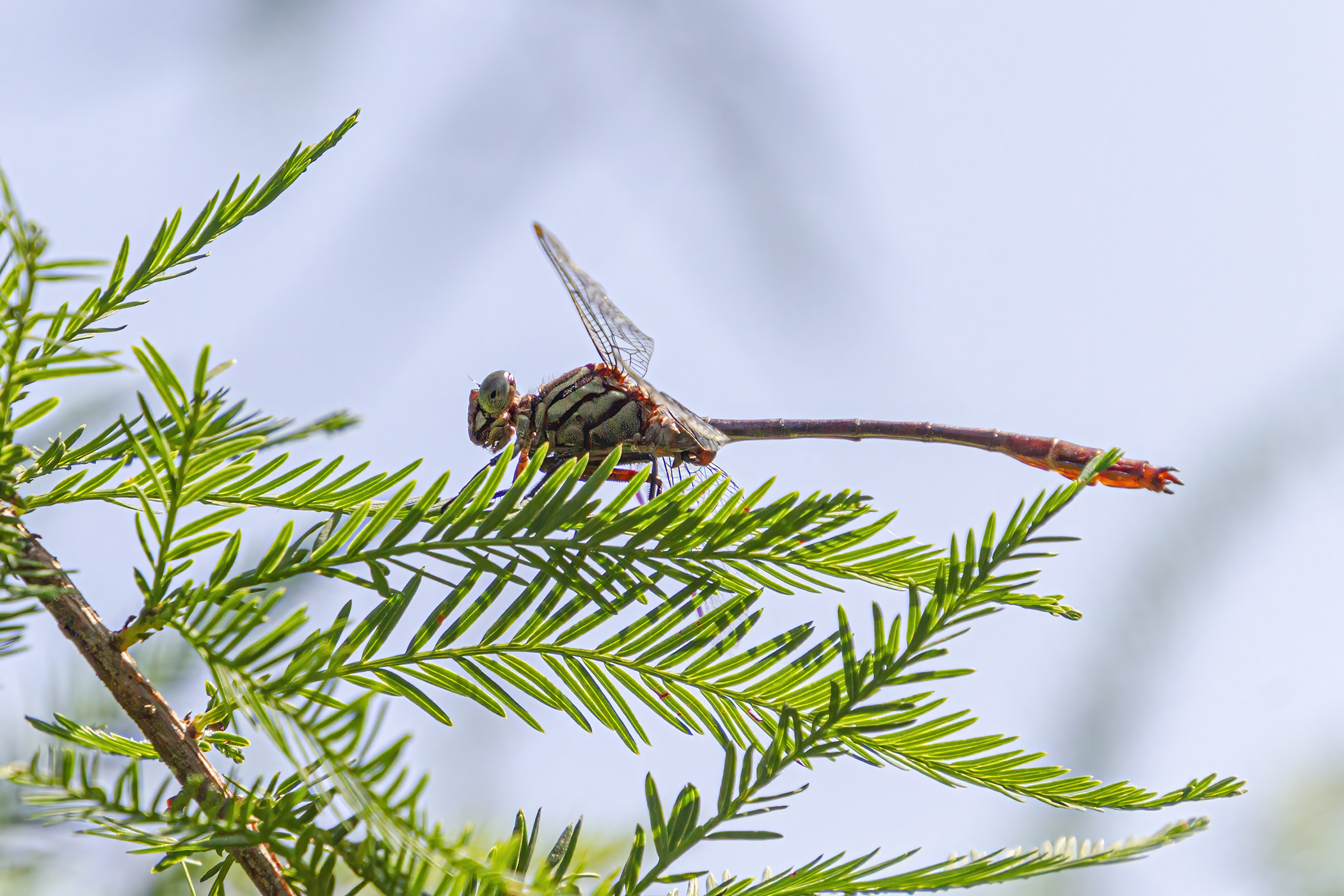
Here are some shots of Russet-tipped Clubtail dragonflies (Stylurus plagiatus) that I photographed at Jackson Miles Abbot Wetland Refuge last Saturday. The first image shows a male perched in an evergreen tree. Sharp-eyed views may recognize this tree, which is the same one on which yesterday’s Common Green Darner was perched.
The second image shows a female Russet-tipped Clubtail in some vegetation. If you compare the tip of her abdomen (the “tail”) with that of the first dragonfly, you can readily see they they are different. That is one of the reasons why the terminal appendages of a dragonfly are a key identification feature in determining the gender of an individual. You can’t help but notice that her left hind wind is almost completely shredded. I suspect that she can still fly, albeit with some difficulty.
The final shot shows a male in flight over the pond at the refuge. This is the first time that I have gotten an identifiable shot of this species in the air. I actually did not realize that it was a Russet-tipped Clubtail when I took a burst of shots of then flying dragonfly. I had simply reacted instinctively when I spotted the dragonfly—if it’s flying, I’m trying. It was a pleasant surprise when I opened the images on my computer and realized what I had captured.
There are a few species that emerge in September, so this year’s dragonfly season is far from over. Tomorrow marks the start of a new month, a month that I hope will be full of new opportunities for me and for all of you.
I was thrilled on Saturday when one of my fellow dragonfly enthusiasts spotted this colorful male Common Green Darner dragonfly (Anax junius) at Jackson Miles Abbott Wetland Refuge and pointed it out to me. Common Green Darners are relatively common, but most of the time when I see them they are patrolling overhead, so it was quite a treat to find one perched.
Common Green Darners are one of the few dragonfly species that migrate. According to Kevin Munroe, creator of the wonderful Dragonflies of Northern Virginia website, “Common Greens seen in our area in early spring are in fact migrants from points south. They emerge in the Southeast and fly north, arriving here late March thru May. After their long flight, they mate, lay eggs and die. Their young emerge in July and August. Congregating in large swarms, this second generation begins flying south in September. They lay eggs that fall, after arriving in their southern destinations, and die. When their young hatch in March, they fly back to Northern Virginia and it starts again—a two generation migration.” Wow!
This dragonfly was hanging on the same evergreen tree where I recently photographed a Russet-tipped Clubtail—see my blog posting entitled “Russet-tipped Clubtail dragonfly.” I guess that I will be checking that tree from now on to see if lightning will strike again. When I am hunting for dragonflies, I tend to return first to places where I have seen them previously and then widen my search. Sometime it pays off, though, as is the case for all wildlife photography, there are certainly no guarantees of success.
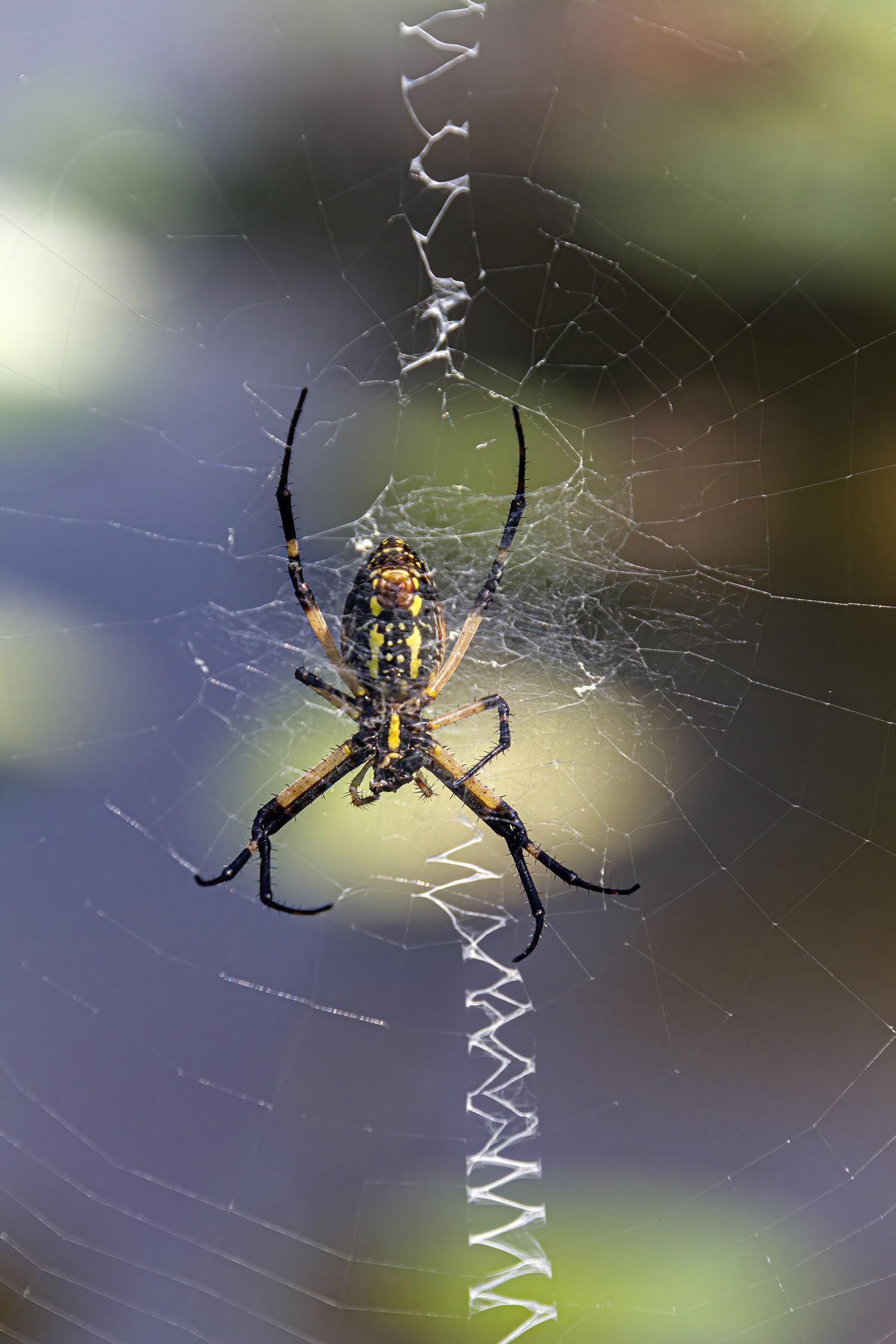
During my recent visits to Jackson Miles Abbott Wetland Refuge, I have noticed the reappearance of Black and Yellow Garden Orbweaver Spiders (Argiope aurantia). During the late summer and early fall, these relatively large spiders can be seen in the vegetation surrounding the pond and in the adjacent fields.
One of the coolest things about this spider is the distinctive zig-zag pattern, known technically as a stabilimentum that the spider uses for the central part of its web. According to Wikipedia, the purpose of the zig-zags is disputed. “It is possible that it acts as camouflage for the spider lurking in the web’s center, but it may also attract insect prey, or even warn birds of the presence of the otherwise difficult-to-see web.”
Goldenrod was in full bloom on Wednesday at Jackson Miles Abbott Wetland Refuge, attracting all kinds of insects, including a little Skipper butterfly and a colorfully-patterned Ailanthus Webworm moth (Atteva aurea). I believe that the butterfly is a Sachem Skipper (Atalopedes campestris), although it is hard to be confident when identifying skipper butterflies—there are quite a number of similar looking species.
I love the intricate orange, black, and white pattern on the body of the Ailanthus Webworm moth, a type of ermine moth. This moth looks quite a bit like a beetle when it is at rest with its wings tucked in, but reportedly it looks like a wasp when in flight. I encourage you to click on the image to get a better look at the wonderful details of the two insects.
When I composed this image, I was conscious of the fact that my primary subject, which was initially the skipper, filled only a small part of the frame. However, I really liked the brilliant yellow of the goldenrod and framed the shot to focus viewers’ attention as much on the sweeping curve and color of the goldenrod as on the insects. The goldenrod became the co-star of the photo and therefore has equal billing in the title of this blog posting.
Most of the wild horses that I saw at Theodore Roosevelt National Park in North Dakota during my recently completed road trip were on relatively level ground, but I did observe one band of horses climbing a steep slope. They were pretty far away, but I managed to capture these shots as they slowly made their way up a canyon wall.
In the first photo, the horses were just starting their climb and were bunched together. As they climbed higher, they spread out a bit. In the second shot, the lead horse was nearing the top, perhaps the edge of a plateau.
From what I have read, the bands are usually led by a head mare when they are traveling and she leads the band to watering holes and grazing spots. The band’s stallion brings up the rear when the band travels—his job is to fight off predators and other males who try to join the herd and to nip at stragglers to make sure they keep up with the others.
I was delighted on Wednesday to spot this male Swift Setwing dragonfly (Dythemis velox) during a short visit to Jackson Miles Abbott Wetland Refuge. These little dragonflies perch in a distinctive pose with their wings pulled forward, which looked to some scientist like the “ready-set-go” position of a sprinter and is reportedly the reason for the name of the species.
This species is really special to me, because this primarily southern species had never before have been documented in Fairfax County, Virginia, the county where I live, until I spotted one six years ago at this same location. By now there seems to be an established breeding population, and I look forward to seeing them each summer.
As August draws to a close, I am acutely aware that each sighting of a dragonfly could be the last one of the season for that species, so I really savor each encounter. There is beauty all around us, but somehow I have a particular affinity for dragonflies and damselflies—I am endlessly fascinated by these colorful little aerial acrobats.
Seasons are starting to change for those of us in the Northern Hemisphere as summer gradually releases its hold on us. Already the children in my area have returned to school and the weather is cooling off a bit.
Some of the summer dragonfly species are starting to disappear or decrease in numbers. Fortunately, some new species appear late in the season to take their places, like this handsome male Russet-tipped Clubtail dragonfly (Stylurus plagiatus) that I spotted yesterday at Jackson Miles Abbott Wetland Refuge.
Russet-tipped Clubtails are a late season species and are seen most often in August and September. Unlike many of the dragonflies that I see regularly that seem to prefer pole-like perches or perch flat on the ground, Russet-tipped Clubtails like to hang from the leaves of vegetation at an angle or almost vertically—members of the genus Stylurus are sometimes called “Hanging Clubtails.”
I am not quite ready to welcome “autumn,” but there are signs everywhere that the seasons are inexorably changing. Autumn is probably my favorite season of the year, but I am still holding on to the summer.
UPDATE: As a kind of experiment I decided to do a little video version of this posting that I put on my YouTube channel. What do you think?
I was thrilled to spot this very pretty filly in the midst of a band of wild horses at Theodore Roosevelt National Park in North Dakota on 10 August 2022. If you look closely, you’ll see that she has incredible blue eyes.
I think that this baby horse may be named Dreamer, born on 2 June, judging from the photos of the 2022 foals at the park on the North Dakota Badlands Horse website. The North Dakota Badlands Registry, according to its website, is a non-profit organization that “was established to register, promote, appreciate and preserve the wild horses of Theodore Roosevelt National Park, North Dakota that are unique to the area.”
Several times during my visits to the national park, I encountered members of this organization while I was observing the , who shared with me a lot of information about the wild horses. One of the really cool things that the group does is keep track of the composition of the different bands of horses within the park—it is estimated that there are about 183 wild horses scattered throughout the national park.
It definitely was a challenge getting a clear shot of the baby horse’s face—most often her head was down or she was hidden behind her mother. However, I waited patiently and eventually was able to capture these shots of the sweet little horse.
Today I am featuring the Blue Dasher dragonfly (Pachydiplax longipennis), one of the most common dragonflies in my area. The Blue Dasher is special to me because my very first posting on this blog in July 2012 included a shot of a Blue Dasher. Click on this linkif you are curious to see what my photography looked like ten years ago.
I took these shots at two different locations in July, prior to my road trip, and am only now catching up on some of my backlog of shots. Blue Dashers seem to be quite adaptable and can be found in a wide variety of habitats, so it is not hard to find one.
These images show Blue Dashers in a variety of poses, including the “obelisk” pose in the final image, one of the signature poses of this species.
Most of the dragonflies that I spotted during my most recent visit to Occoquan Bay National Wildlife Refuge were common species that I have been seeing for months. Some photographers are driven to search for rare and exotic species and ignore the everyday ones. I am usually content with trying to capture the beauty of the ordinary ones.
In the first photo, I love the ways that the shadows of the wings of this female Common Whitetail dragonfly (Plathemis lydia) create the optical illusion that the dragonfly has extra wings. In the second photo, the female Blue Dasher dragonfly (Pachydiplax longipennis) is quite beautiful herself and the stunning background enhances that beauty.
The final photo shows a pair of Eastern Amberwing dragonflies (Perithemis tenera), the smallest dragonflies in our area. I love the way that the two dragonflies are reflected in the water.
Beauty can be found in the rare and exotic species, but I think that these images demonstrate that beauty can also be found in ordinary things. When we slow down and look closely, we discover that beauty is everywhere.
I was hoping on Tuesday that this male Common Green Darner dragonfly (Anax junius) at Occoquan Bay National Wildlife Refuge would land, but his stamina was impressive and I had to content myself with a couple of shots as he zoomed by overhead.
I missed focus on most of my shot attempts, but the first shot below turned out pretty well—I encourage you to click on the image to see some of the beautiful colors and details of this dragonfly.
Tracking the dragonfly visually and keeping it in the viewfinder is a real challenge. I was intrigued to see that my camera more or less held onto focus in the second shot, despite the fact that the dragonfly had flown closer to the foliage.
On Tuesday I was happy to see that there are still lots of dragonflies at Occoquan Bay National Wildlife Refuge. We still have at least several months before the dragonfly season will be over, but already I am noticing some changes in dragonfly demographics. Some of the dragonflies that I saw in great numbers in July, like Needham’s Skimmers for example, are now much less common.
When I visited the small pond at the refuge, I was delighted to spot some Calico Pennant dragonflies (Celithemis elisa), among the most colorful and prominently marked dragonflies in our area. The first two images show mature male Calico Pennants and highlight really well their wonderful wing markings and the beautiful red patterns on their abdomens.
Female and immature male Calico Pennants have yellow and black markings on their bodies, so when I first saw the dragonfly in the third image, I assumed it was a Calico Pennant. When I looked more closely at the image on my computer screen, however, I realized that the markings on the front wings of this dragonfly are shaped more like bands than spots. This means that the dragonfly is most likely a Halloween Pennant dragonfly (Celithemis eponina).
Pennant dragonflies, including the Calico and Halloween Pennants, love to perch at the very tip of vegetation. When even the slightest wind begins to blow, the dragonflies flap about, like pennants, especially when the vegetation is as flimsy as the one in the final photo.
Tuesday was a wonderful day for butterflies at Occoquan Bay National Wildlife Refuge and I was delighted to see lots of them, including the three orange varieties that I am featuring today. First up is a pretty Monarch butterfly (Danaus plexippus). Although its wings show some damage, it was happily feeding on some milkweed. Recent reports have shown that Monarchs are endangered, so it is always exciting to spot one.
The next photo shows a Viceroy butterfly (Limenitis archippus), which is visually quite similar to the Monarch. As I have noted before, the biggest distinguishing feature to tell the two species apart is the line on the hind wing of the Viceroys that Monarchs do not have.
The final orange butterfly is the much smaller Pearl Crescent butterfly (Phyciodes tharos). I see Pearl Crescent butterflies much more often than its larger counterparts, but they are usually quite skittish and perch so close to the ground that it is a challenge to photograph them.
Many of you know that I really like the color orange. I frequently wear a pair of orange Converse All-star sneakers and drive the orange KIA Soul that made a guest appearance in a recent blog post. For me, the color is warm and comfortable. Although it is often associated with the autumn, orange is very much a summer color too, as you can easily see in these butterfly photos.
Yesterday I visited Occoquan Bay National Wildlife Refuge, my favorite local venue for wildlife photography, for the first time in almost a month. It was a beautiful summer day for a walk in nature, with temperatures and humidity lower than usual for this area. I was thrilled to be able to capture a few modest images of birds, which is a bit unusual for me during the summer, when most of the time I am more likely to hear birds hidden in the foliage than actually see them.
The first image shows a rather fluffy-looking Gray Catbird (Dumetella carolinensis). This is probably my favorite shot of the day, because the pose is more dynamic than most perched bird images. The little catbird seems to have a lot of personality and energy.
I was delighted to photograph a Bald Eagle (Haliaeetus leucocephalus) perched above the large eagle nest at the refuge. I composed the second shot to include some of the clouds that, in my view, add some visual interest to otherwise solid blue sky background. No matter how many times I see a Bald Eagle, it is always special for me.
The final image is a long distance shot of a Ruby-throated Hummingbird (Archilochus colubris). When I first spotted the hummingbird, I thought it was a butterfly as it flitted about among the flowers. When it finally registered on my brain that it was a hummingbird, I clicked off a series of shots, without much hope of getting a usable image. I was pleasantly surprised when several of the shots had the hummingbird relatively in focus. I selected this particular image because it shows the hummingbird hovering and because its wing positions reminded me of a butterfly.
It was exciting this month to be on the road, seeing different parts of the country and photographing some different subjects, but it was comforting to return to the familiar confines of a location that is a refuge for me in all senses of the word—it felt like I had returned home.
Until quite recently, I had never tried to create videos with my iPhone and still have not tried to do so with my DSLR camera. I guess that I am a little old-fashioned and think of a phone as primarily a device for making phone calls and a camera as a device for taking still photos. I am gradually changing to using my phone for texting and during my recently completed road trip, I played around with taking short videos with my iPhone. Maybe it is possible to teach an old dog new tricks.
The change was prompted in part by the fact that I had to radically change my shooting habits when visiting Theodore Roosevelt National Park in North Dakota. I camped out at the park for two nights when I was headed westward towards Seattle and another two nights on my return trip eastward to Virginia. At that park, I got used to seeing large creatures like American Bison (Bison bison) at close-range and photographing them from inside my car. Suddenly it dawned on me that videos would be an effective way of capturing some of that action. In addition to bison, I also had several encounters with wild horses that I was able to document in videos.
As you probably noticed, the first image is not a video—I inserted it so that an image would show up as a thumbnail in the “Reader” feed for those who view my postings in that way. The still photo shows a large bull moving down the recently repaved roads of the park. At that time they had not yet painted lines on the road, so I had to pay a lot of attention while driving, given that many of the roads were full of curves and and in some cases there were steep drop-offs. I do not think that the bison cared about the lack of lines—as far as I was concerned, they owned the roads and always had right-of-way.
The first video shows one of the huge male bisons that I encountered on the roads at the national park. I was safely inside of my car when I took this video, though I must confess that this bull bison looked to be almost as big as my KIA Soul and may have outweighed it.
The second and third videos show bands of wild horses that I encountered at separate locations in the park. I was particularly impressed by the beauty of these horses and it was cool to capture them in action.
I was not sure how to present videos here in WordPress, but I think it works to post them to YouTube first and then to embed a link to that posting here. In this way, the videos do not count against my data allowance on my WordPress plan.
I definitely need to improve on my skills as a videographer, but I am happy with these initial results. The sound quality is still a problem, because it was often windy and the video also includes some extraneous conversation. I may have to learn to do voiceovers for the videos or to add some music to them.
So what do you think? These little clips are definitely a change from my normal content, but I thought it would be a fun way to share some of my experiences more directly with all of you. As you probably noticed, the first image is not a video—I inserted it so that an image would show up as a thumbnail in the “Reader” feed for those who view my postings in that way.
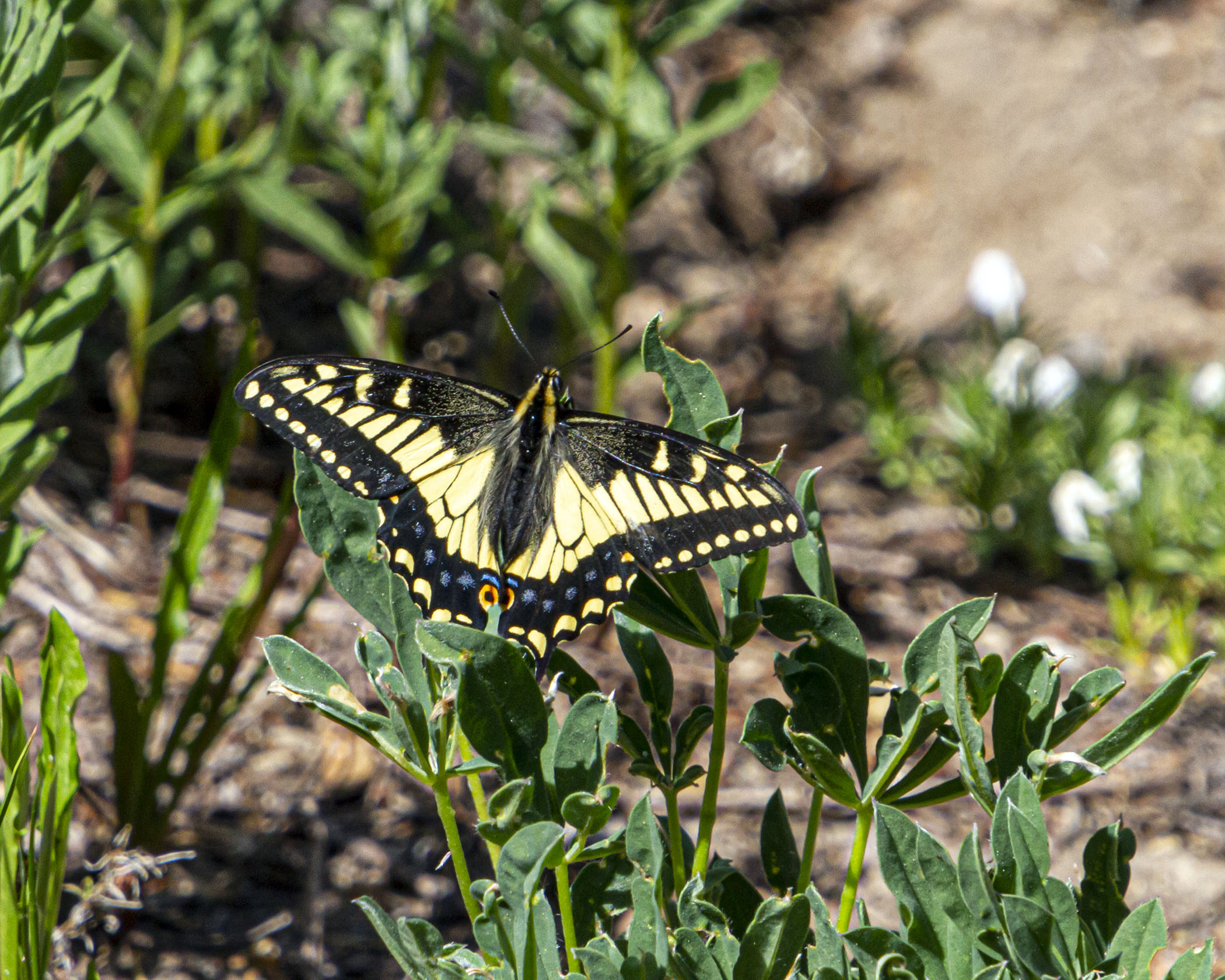
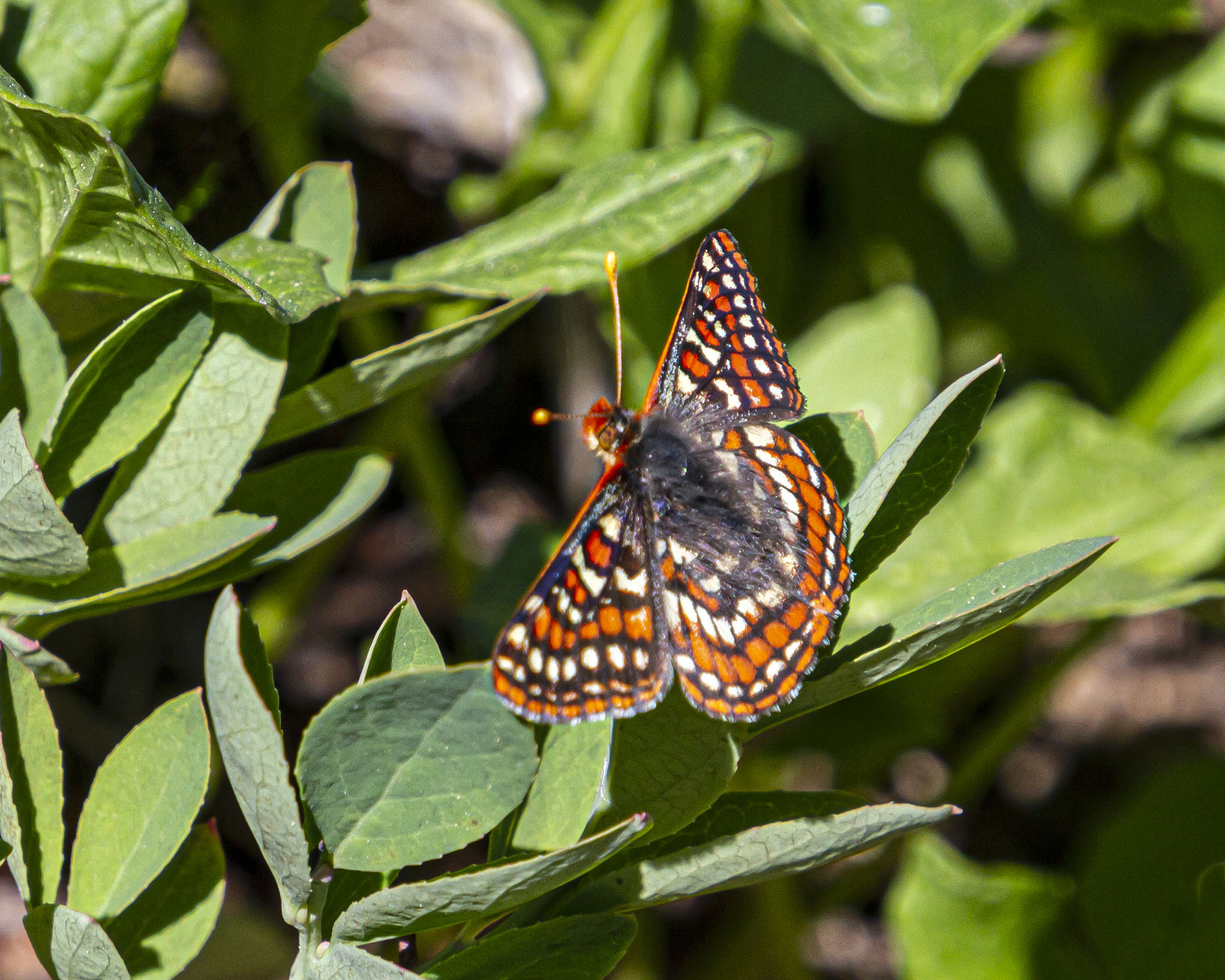
Here are some shots of butterflies that I spotted yesterday while hiking in Mt Rainier National Park. All three were photographed at over 6000 feet altitude (1829 m), flying among the wildflowers and other vegetation.
I think they are an Anise Swallowtail (Papilio zelicaon), an Edith’s Checkerspot (Euphydryas editha), and an Arctic Fritillary (Boloria chariclea), none of which I had seen previously. As I have mentioned before, I am not very familiar with Western species, so I therefore welcome corrections if I have identified these butterflies.
Today is my last full day in Washington State—I will begin my long drive back to the East Coast tomorrow and my blog posting schedule will almost certainly will be sporadic during this coming week. With a little luck, I’ll be able to capture some images along the way that I can share with you when I am finally home in a week or so.
It was so much fun to watch the Black-tailed Prairie Dogs (Cynomys ludovicianus) that I encountered in multiple locations during my recent visit to Theodore Roosevelt National Park in Medora, North Dakota. I could see them from my car when I was driving along the roads looking for buffalo and wild horses, but I also encountered them on both sides of some of the trails when I was hiking.
The prairie dogs seemed playful and energetic and were surprisingly vocal. They seemed to be calling out to each other all of the time in very distinctive squeaky voices. It seems like some of the calls were warnings that I was approaching, because quite often the prairie dogs would scurry into their holes as I drew near, sometimes peeking out with just the top of their heads and their eyes visible.
Here are some selected shots of prairie dogs in which I tried to capture a sense of their playful personalities.
I have observed large Darner dragonflies flying overhead on multiple occasions during my trip across the United States. Although I know that my best chance of getting a detailed shot of one of these beauties is to wait for them to perch, their stamina seems almost unlimited. Consequently I have often resorted to attempting to photograph them in flight.
On Wednesday I managed to capture a cool in-flight shot of what I think is a Blue-eyed Darner dragonfly (Aeshna multicolor) during a visit to Billy Frank Jr. Nisqually National Wildlife Refuge in Olympia, Washington. This is a Western dragonfly that is a new one for me.
I also watched several of these dragonflies patrolling lower over a small marshy pond and amazingly one of them perched on some vegetation. Finally I was able to get the kind of detailed shot that I had been seeking.
As is often the case with my wildlife photography, my persistence finally paid off.
When I was visiting Theodore Roosevelt National Park in North Dakota last week, I did most of my wildlife photography while inside of my car. Surprisingly that included bird photography. In order to spot birds, I had to drive slowly, often at about 10 mph (16 kph), and listen very attentively. Fortunately, there were not many other people around in the early morning, so I was able to move about at my own pace.
The Wild Turkey (Meleagris gallopavo)in the first photo, did not make a sound, but was big enough for me to spot visually. I have photographed Wild Turkeys numerous times, always in a forested environments. I was therefore astonished to see on in a desert-like area of the park.
The bird in the second photos is a Lazuli Bunting (Passerina amoena), I believe. I spotted them several times, but most of the time they were out of range or were blocked by branches. I was fortunate to capture this one as it was singing.
The bird in the final photo was initially a bit of mystery for identification purposes. However, the speckled wings, dark body, and bright red eyes led me to conclude that it is probably a Spotted Towhee (Pipilo maculatus).
The birds in the last two photos are western birds that are not found in my home state of Virginia, so I am only semi-confident about my identifications. Please let me know if I have made a mistake in my efforts to figure out the species to which they belong.
While I was hiking a trail parallel to the Little Missouri River last week in Theodore Roosevelt National Park in North Dakota, I managed to photograph three different species of dragonflies, two of which I thought were familiar to me.
The first photo shows a male Wandering Glider (Pantala flavescens). Normally I consider myself lucky to be able to photograph a single individual, but during this hike I was able to photograph several Wandering Gliders. UPDATE: An eagle-eyed fellow dragonfly enthusiast in Virginia pointed out to me that this is probably a male Variegated Meadowhawk (Sympetrum corruptum). Thanks, Michael Ready, for the assist in identification.
The second photo shows a male Twelve-spotted Skimmer (Libellula pulchella). The males of this species are quite easy to identify, because the have white and dark patches on each of their wings. I was surprised to be able to get this shot, because I had to shoot almost straight down from a high bank of the river. Fortunately the dragonfly cooperated by perching in plain view rather than in heavy vegetation.
The third photo shows what I believe to be a Variable Darner (Aeshna interrupta), a new species for me. I saw the dragonfly patrolling overhead and began to track it visually. I watched it land low in some vegetation on the opposite bank of the river.
Believe it or not, I could not actually see the dragonfly when I took the final shot below, but I was pretty confident that I knew where to aim my camera. Amazingly, it worked and I was able to capture a usable image of the dragonfly.
When I began this trip across the country, I did not plan to have chances to hunt for dragonflies. It has been an unexpected joy to have had opportunities to see dragonflies at different places and a true delight to be able to capture images of some of them.
It should not come as a surprise to readers of this blog that I kept my eyes open for insects as I hiked about in Mount Rainier National Park earlier this week. The pickings were pretty slim, despite the fact that I passed through a variety of habitats.
At one particular stream, I noted some dragonfly activity, with multiple large dragonflies patrolling over the water, endlessly zooming back and forth. I hoped in vain that one would land, but eventually settled for trying capture a shot of them as they flew by. I was thrilled to actually succeed with one shot, which I think might be a Paddle-tailed Darner dragonfly (Aeshna palmata).
While I was chasing the dragonflies, I came upon the distinctive butterfly in the second photo. I believe that it is a Lorquin’s Admiral (Limenitis lorquini), as species that is new to me.
The final photo features some kind of Comma butterfly. The Pacific Northwest has different varieties of Comma butterflies than I am used to seeing in Virginia. I think this one might be a Green Comma (Polygonia faunus).
One of the real joys of traveling is having the chance to see new species and I am happy that this trip is providing me with such opportunities. If you happen to be an expert on any of these species and notice that I have misidentified them, please do not feel shy about providing a correction.
Theodore Roosevelt National Park in North Dakota is one of the few national parks where visitors can observe free-roaming horses. According to the National Park Service, “their presence represents Theodore Roosevelt’s experiences here during the open-range ranching era. Ranchers turned horses out on the open range to live and breed. When needed, they would round up horses and their offspring for use as ranch horses. For generations, ranchers used land that would later become the park for open-range grazing.”
Once the park was fenced in, one of the issues was what to do with the horses. Initially the authorities tried to capture and remove all of the horses, but some small bands of horses eluded capture and continued to live free-range in the park. “In 1970, a change of park policy recognized the horse as part of the historical setting. New policies were written and enacted to manage the horses as a historic demonstration herd.”
I had multiple sightings of wild horses during my visit to the national park. Most of the time it was only one or two horses, but on my final day I ran into a larger group. As I was observing them, another visitor told me that this was Xander’s band, named for the lead stallion.
The other visitor turned out to be a member of a group that tracks the bands of wild horses in the park. She patiently explained to me that the horses travel in groups of 5 to 15 horses, known as bands, with a well-established social hierarchy. The bands are pretty stable—young colts and fillies are kicked out of their groups at the age of 2-3 and form new bands. Some of the individual horses that I observed, she said, were likely to be bachelors.
The first photo shows the band all grouped up together in a shadow of a rock formation where I first saw them. They were packed together so tightly that it was hard to get an accurate head count. I believe that the gray horse in the front is Xander, the leader. Eventually the individuals of the group spread out a bit (it looks like there are ten members in the band) and began to graze, as you can see in the second and third photos.
The National Park Service tries to manage the number of wild horses in this park tor prevent overpopulation. “Historically, the park conducted roundups every three to four years using helicopters to herd horses to a handling facility and then sold them at public auction. More recently, the park has tried new methods for herd management including contraceptives, low-stress capture techniques, genetics research, and partnerships with nonprofit horse advocacy groups. Horses are currently captured using tranquilizer darts and sold in online auctions.”
As many of you know, I have spent the last week driving across the United States to spend some time with family outside of Seattle, Washington. I departed from Virginia at midday last Monday and by the time that I finally arrived on Saturday afternoon, I had traveled a distance of 3085 miles (4964 km).
I spent a lot of time driving, but made an extended stop at Theodore Roosevelt National Park in western North Dakota, where I camped out for two nights. During my visit, I had multiple encounters with American Bison (Bison bison), including one memorable moment when my car was almost surrounded as a small herd of bison moved past me on the road.
It was a bit strange for me to take wildlife photos from inside my car, but that definitely was the safest thing to do with these bison. Some of the bulls looked to be as large as my KIA Soul. I noted that there were a good number of calves too, and definitely did not want to mess with a potentially mad mamma bison if I got between her and her baby.
I am still sorting through my images, but I thought I would lead with these little portraits that show some of the personality of the individual bison.
In addition to the bison at the national park, I was able to photograph wild horses, prairie dogs, birds, and even a few dragonflies. You should see some of them in the near future.
Normally I try to do a posting to my blog every day, but for the next three weeks my posting schedule will be much more erratic. I am in the final stages of packing my car for a trip to visit my son and his family outside of Seattle, Washington. There are multiple decision points along the way and I have not yet decided on my final route, but no matter how I go, it is likely to be about 3,000 miles (4828 km) each way.
I have some camping gear with me, including a water jug that holds six gallon (23 liter), so I may well be spending some time disconnected from the virtual world. I’ll try to take some photos along the way and will share them when I am able.
I am leaving you with a shot of a pretty little butterfly, which I think is a Pearl Crescent (Phyciodes tharos) perched on some Butterfly Weed (Asclepias tuberosa). I love the different shades of orange in the image.
In case some of you do not know it, my KIA Soul, in which I am driving out West, is orange in color. It is a coppery orange and not a pumpkin orange and it definitely stands out in a parking lot. My license plate holder has SOUL on it and my license plate itself is “BLESS MY.”
I am attaching a couple of photos of my car from January 2016, after a big snow storm. So many of us throughout the Northern Hemisphere are suffering from oppressive heat and I thought that the sight of snow might cool us off a little. I’ll close with a joke that I say on-line today that is a perfect fit for my quirky sense of humor—”Just be thankful that it is not snowing. Imagine shoveling snow in this heat!”
I have not seen very many Monarch butterflies (Danaus plexippus) this summer, though I did spot a similar-looking Viceroy butterfly (Limenitis archippus) on Tuesday at Occoquan Bay National Wildlife Refuge. Monarchs were in the news last week. According to the Smithsonian Magazine, “The International Union for Conservation of Nature (IUCN), a Switzerland-based conservation organization that monitors the status of wildlife, added migratory monarchs (Danaus plexippus plexippus) to its list of threatened species this week.”
I decided to include an image of a Monarch that I captured earlier this month as it was feeding on a cone flower. I thought I would have more chances to photograph more monarchs, but this one was the only one that I have seen in July.
How do you tell the two species apart? The main visual difference between the two species is the black line across the Viceroy’s hind wings, which Monarch butterflies do not have. Both are stunningly beautiful.
I was delighted to encounter this group of butterflies last Tuesday at Occoquan Bay National Wildlife Refuge. Several Zebra Swallowtails (Eurytides marcellus) and one prominent Spicebush Swallowtail (Papilio troilus) were poking among the rocks, drinking in salts and other nutrients. If you look carefully at the image, you will see that one of the Zebra Swallowtails (the one to the right of the Spicebush Swallowtail flying—apparently it wanted to join the party.
Did you know that one of the collective nouns for a group of butterflies is “kaleidoscope?” I think the word is a a perfect descriptor for these multi-colored swirling beauties.











 Mike Powell