Feeds:
Posts
Comments

Archive for the ‘turtle’ Category

I was delighted to spot this Eastern Box Turtle (Terrapene carolina carolina) yesterday alongside one of the trails at Occoquan Bay National Wildlife Refuge. These beautiful land-dwelling turtles, also known as Woodland Box Turtles, are extremely long-lived and are capable of living over 100 years in captivity, though in the wild they often live much shorter lives due to disease and predation.

The brown eyes of this turtle suggest that that it is a female, though I have read that eye color is not always 100% accurate in determining the gender of a box turtle—males of this species often have red eyes. The shell pattern for each box turtle is supposed to be unique, like a fingerprint, which makes the wonderful patterns of this turtle’s shell especially intriguing.

Eastern Box Turtle

Eastern Box Turtle

© Michael Q. Powell. All rights reserved.


Read Full Post »

Long telephoto lenses tend to distort your depth perception. On Tuesday I watched this North American Snapping Turtle (Chelydra serpentina) swimming about in a pond at Occoquan Bay National Wildlife Refuge. I was a bit creepy as the turtle got bigger and bigger in my viewfinder when it began to swim directly towards me. One part of my brain objectively knew that the turtle was still a long way off, but it was nonetheless a bit disconcerting when the snapping turtle’s dinosaur-like eyes appeared to be staring right at me.

Spring is here, though the weather has been cool recently and there were some local frost warnings last night, and all kinds of creatures are waking up. I’m still looking for my first dragonfly of the year and will probably continue my quest later today.

snapping turtle

© Michael Q. Powell. All rights reserved.

Read Full Post »

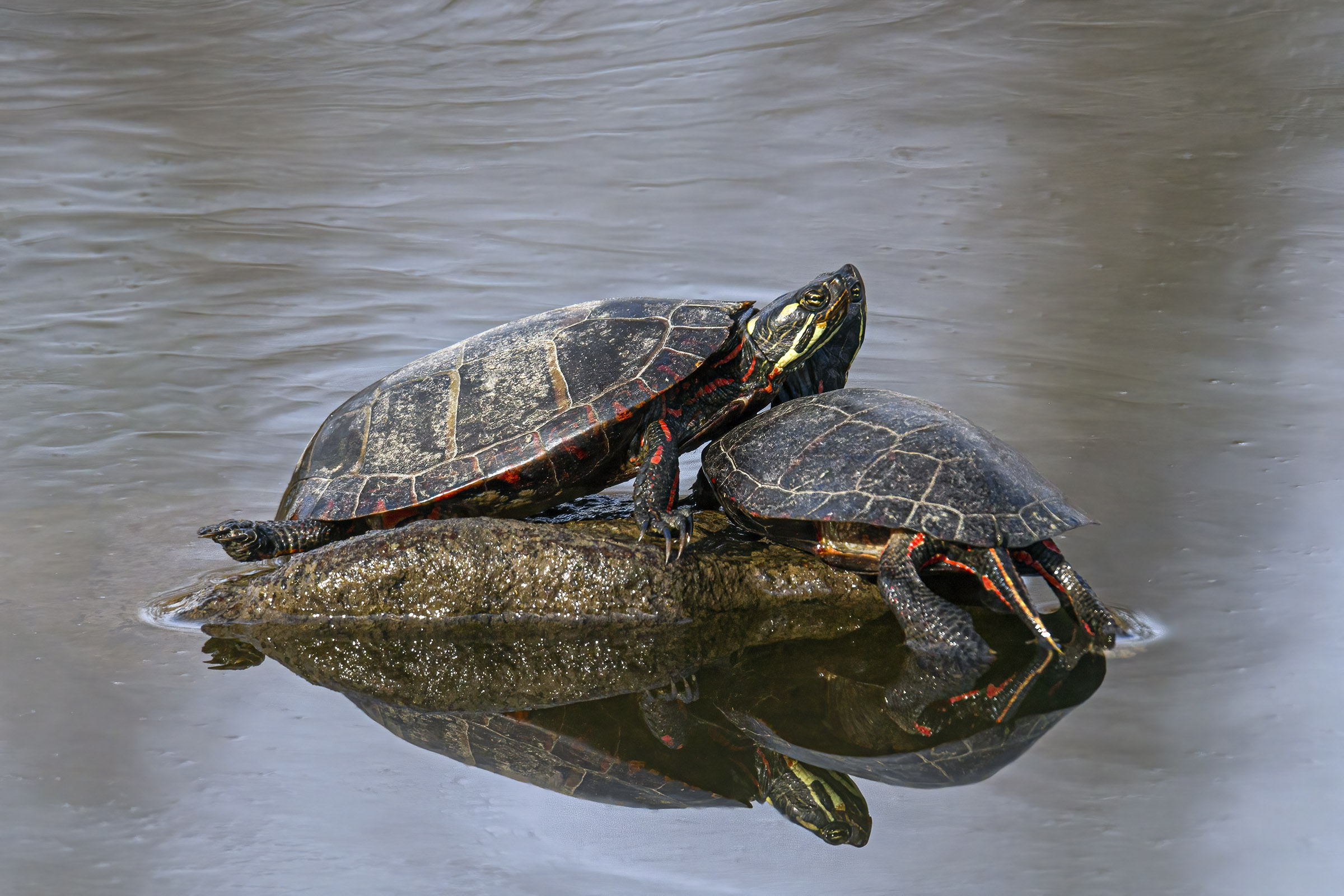
I don’t know if thegroup of Painted Turtles (Chrysemys picta)) was a family unit or merely good friends, but they seemed to be cooperating to maximize their exposure to the warmth of the sun last week at Occoquan Bay National Wildlife Refuge. At some of the other wildlife parks in my area there are large logs on which the turtles will space themselves out as they bask in the sun, but flat dry land is limited at this refuge, so the turtles are willing to share the space with others.

As I was taking the first photo, several more turtles emerged from the pond, as you can see in the second photo below. Their wet shells are much darker than those of the first three turtles that have had a chance to dry out a bit.

Painted Turtles

Painted Turtles

© Michael Q. Powell. All rights reserved.

Read Full Post »

As the weather has warmed up and the sun has started to shine a bit more brightly, Painted Turtles (Chrysemys picta) have emerged from the mud at the bottom of the ponds at Occoquan Bay National Wildlife Refuge. These turtles used whatever objects they could find to pull themselves out of the water and bask in the sunlight. Sometimes their shells are washed clean of mud, but, as you can see in the final photo, some of the turtles were still covered in mud when I photographed them last week.

Painted Turtle

Painted Turtle

Painted Turtle

© Michael Q. Powell. All rights reserved.


Read Full Post »

Do turtles show affection? If so, how do they overcome the obstacle posed by their hard shells?

Last week on an unusually warm December day, I spotted two Eastern Painted Turtles (Chrysemys picta) sitting on a log in a small swampy pond at Occoquan Bay National Wildlife Refuge. They were sitting pretty close to each other, which was not unusual given the small size of the log. What really struck me, though, was the way that they appeared to be rubbing the sides of their faces against each other.

Was this a sign of affection? It certainly seemed that way to me.

I’ve met people who appear to have as tough an exterior as these turtles. How do you reach people like that? Persistent small act of unrequited kindness may help to penetrate those barriers. For me, that is what Christmas is all about, an attitude towards others that lasts a whole lot long that a single-day celebration.

A belated Merry Christmas to all of you who celebrated yesterday and best wishes for a happy and healthy 2025 to you all.

Painted Turtles

© Michael Q. Powell. All rights reserved.

Read Full Post »

It was uncomfortably hot for me and I tried to stay in the shade as much as possible during a recent visit to Jackson Miles Abbott Wetland Refuge. A Painted Turtle (Chrysemys picta), however, had pulled itself almost completely out of the water to maximize its exposure to the direct sunlight. For the record, I am not the kind of guy who enjoys baking in the sun on a beach.

I really like the turtle’s pose and the way that it stands out amidst all of the water and the abundant vegetation. The beautiful reflection was a nice bonus, adding a bit of symmetry and additional visual interest to the image.

Painted Turtle

© Michael Q. Powell. All rights reserved.


Read Full Post »

I love the sweet little face on this Southeastern Mud Turtle (Kinosternon subrubrum subrubrum) that I spotted last Thursday at Occoquan Bay National Wildlife Refuge. Most of the turtles that I encounter are Red-eared Sliders or Painted Turtles and they generally are in the water or perched on logs floating in the water. Occasionally I will spot a box turtle or a snapping turtle. When it comes to mud turtles, however, I normally see only one or two a year.

According to the Virginia Herpetological Society, “Kinosternon subrubrum occupies a wide variety of aquatic habitats, including ponds, lakes, creeks, swamps, freshwater and brackish marshes, ditches, and boggy areas. They avoid large, deep bodies of water and fast-moving water. Preferred habitat is shallow, slow-moving water, with aquatic or emergent vegetation and a soft organic substrate. This turtle is often seen on land, especially after rainstorms. Mud Turtles may spend a considerable portion of the year on land and often overwinter in shallow burrows.”

mud turtle

© Michael Q. Powell. All rights reserved.


Read Full Post »

Over the past week I have spotted Woodland Box Turtles (Terrapene carolina carolina) at two different locations in my local area. The red eyes of both turtles suggest that that they are males, though I have read that eye color is not always 100% accurate in determining the gender of a box turtle. The shell pattern for each box turtle is supposed to be unique, like a fingerprint, and you can definitely see differences in the patterns on the shells of these two turtles.

It is always a treat to spot one of these box turtles, because they are so cool-looking. Unlike many turtles, the box turtle is primarily terrestrial rather than aquatic, and most of the times that I have encountered them, they have been out in the open. According to the Virginia Department of Wildlife Resources (DWR), “The box turtle has a low reproductive rate and is long lived. It requires 10-20 years to reach sexual maturity. Box turtles may sometimes live to over 100 years.”

Virginia has special protections for this species. According to the DWR,  “it is illegal to keep one in your home in Virginia due to the significant number of wild caught animals found in captivity. This species is primarily threatened due to the thousands that are caught for the pet trade from the wild each year; although habitat fragmentation and urbanization also account for a fraction of the population’s drop of 32% over the last 100 years.”

Woodland Box Turtles

Woodland Box Turtle

© Michael Q. Powell. All rights reserved.


Read Full Post »

When the weather is sunny, turtles at local ponds often bask in the sun in large groups. Sometimes the turtles are packed in so tightly that it looks like a mall parking lot at Christmas time. The turtles seem to have no concept of “personal space and often are leaning against each other.

I spotted a few turtles on Wednesday at Prince William Forest Park and was struck by the fact that all seemed to have chosen solitude over solidarity—they were perched by themselves.

The first one, a small Painted Turtle (Chrysemys picta) was perched on a small log in the shallow part of a marshy area. I really like the limited color palette of this image, made up of mostly earth tone. If you look carefully, though, you can spot a few red markings on the turtle’s neck.

The second turtle, a much larger Painted Turtle, had crawled entirely out of the water and appeared to be napping on dry land. The greenery in this image gives it a much more lively feel than the first image and the bright red markings on the turtle’s neck are much easier to see.

Like these two turtles, I tend to avoid crowds and like to be myself when I am pursuing my photography. Go with the crowd? No, I will leave that to others.

Painted Turtle

Painted Turtle

© Michael Q. Powell. All rights reserved.

Read Full Post »

It won’t be long before basking turtles become a common sight, but they are still relatively rare in early March, when temperatures here dip down below the freezing level some nights. I spotted this Painted Turtle (Chrysemys picta) last Thursday at Occoquan Bay National Wildlife Refuge as it basked in the sun.

I was struck by the way the red markings on its neck stood out, even in the beautiful reflection on the surface of the small pond. Most turtles will try to find a horizontal perch to maximize exposure to the sunlight, but this turtle had to make do with with a steeply sloped spot. I could not see its claws, but I suspect that they were dug in to keep the turtle from sliding back into the water.

Painted Turtle

© Michael Q. Powell. All rights reserved.

Read Full Post »

Last Friday at Huntley Meadows Park a host of turtles emerged from their winter sleep to bask in the unseasonably warm sun, including this beautiful Spotted Turtle (Clemmys guttata). Unlike most of the turtles where I live that prefer larger, more open bodies of water, Spotted Turtles are found most often in the shallow water of marshy areas and are considered to be semi-aquatic.

As I recall, turtles do not hibernate, but instead enter a period of brumation in which they bury themselves in the mud and slow down their metabolisms. According to the Pee Dee Wildlife Control website, “Brumation is different than hibernation as the animals who brumate can wake up on the random warm days to sun themselves and drink water to avoid dehydration, whereas a hibernating animal will not.”

The temperature last Friday soared to 80 degrees (27 degrees C) at Ronald Reagan National Airport here in the Washington D.C. area, a record high temperature for the month of January. The change in temperature was particularly jolting, because it came just one week after a snowstorm had dropped five inches (13 cm) of snow on us and a protracted period of sub-freezing temperatures that followed that storm.


Spotted Turtle

© Michael Q. Powell. All rights reserved.

Read Full Post »

The days are growing cooler, but when the sun is shining brightly, turtles will still come up from the bottom of the ponds to bask, like this Painted Turtle (Chrysemys picta) that I spotted last Friday on a log at Occoquan Bay National Wildlife Refuge. One of its comrades was lounging nearby with just its head stuck out of the mucky surface of the water.

Neither of these two images is incredible, but I really like the small details that I was able to capture, like the claws on the turtle’s feet in first photo and the bubbles on the water in the second shot. I think that life is often like that—there is amazing beauty in the most mundane, everyday moments if we can manage to look closely enough.

Painted Turtle

Painted Turtle

© Michael Q. Powell. All rights reserved.


Read Full Post »

While I was composing a shot of this turtle at a small pond in Kingstowne, a suburban area only a mile or so from where I live, another turtle popped its head out of the water to photobomb its friend. I am pretty sure that the basking turtle is a Red-eared Slider (Trachemys scripta elegans), though I must admit that turtles are definitely not my speciality when it comes to identifying species.

We are in a transitional time of the year—we have already had some days with frost, but some other days have been warm and sunny. Today, for example, we may be flirting with record high temperatures up to 76 degrees (24 degrees C). Tomorrow, on the other hand, the high temperature is forecasted to reach only 52 degrees (11 degrees C).

turtle

© Michael Q. Powell. All rights reserved.


Read Full Post »

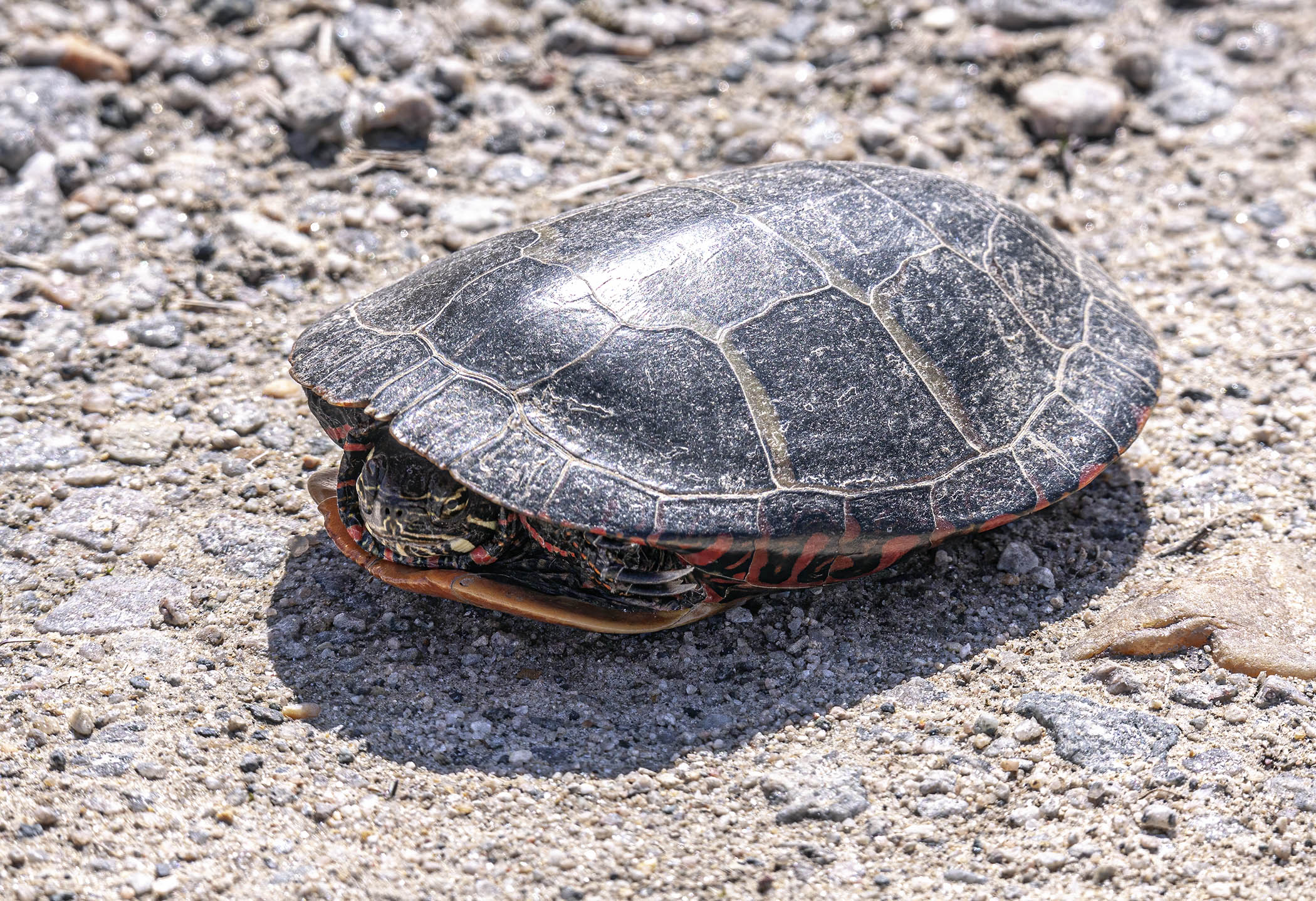
I encountered this Woodland Box Turtle (Terrapene carolina carolina) last Friday on a paved road at Occoquan Bay National Wildlife Refuge. The brown color of the eyes suggests that this is a female—males generally have red eyes. However, according to the Virginia Herpetological Society, “The color of the iris is sometimes considered indicative of a turtle’s sex, but it is not always reliable.”

The turtle was quite small, about the size of the palm of my hand. I normally try not to disturb wildlife, but I worried that this turtle might be hit by a car, so I picked it up and moved it off of the surface of the road. I was concerned that its claws might scratch me, but the turtle drew in all of its legs and its head as soon as I lifted it.

Hopefully this turtle will live to a ripe old age, but it definitely needs to stay out of traffic, according to the Virginia Herpetological Society, “Box turtles are notorious for living as long, or longer, than humans. An adult male with the date 1874 carved in its plastron was found in Rockingham County in August 1985 (Daily News Record, Harrisonburg), indicating an age of >111 years. It is difficult to confirm such sightings, however.” Yikes!

Woodland Box Turtle

© Michael Q. Powell. All rights reserved.


Read Full Post »

I love the way these turtles were lined up on an upward-slanting log as they basked in the autumn sunlight last Tuesday at Jackson Miles Abbott Wetland Refuge. One smaller turtle looked like it was trying to merge into the traffic on the log, but the other turtles, like drivers in the Washington D.C. area where I live, were not letting him in.

The reflections in the water were a nice bonus and few floating leaves add little pops of autumn color.

turtles

© Michael Q. Powell. All rights reserved

Read Full Post »

When the weather is nice, many turtles emerge from the waters of the ponds to bask in the sunlight. Often I will see turtles jammed so close together on logs that it looks like a mall parking lot just before Christmas.

During a recent visit to Jackson Miles Abbott Wetland Refuge, I spotted an Eastern Painted Turtle (Chrysemys picta picta) that had found a solitary perch that was just big enough for a single turtle. The only problem was that the tree was sticking out from the water at a sharp angle. I could not tell, but suspect that the turtle had dug the claws in its front feet into the bark to keep from sliding into the water.

I love the serene look on the face of this turtle—it seemed to be in a meditative state, a picture of peaceful contentment.

Painted Turtle

© Michael Q. Powell. All rights reserved.

Read Full Post »

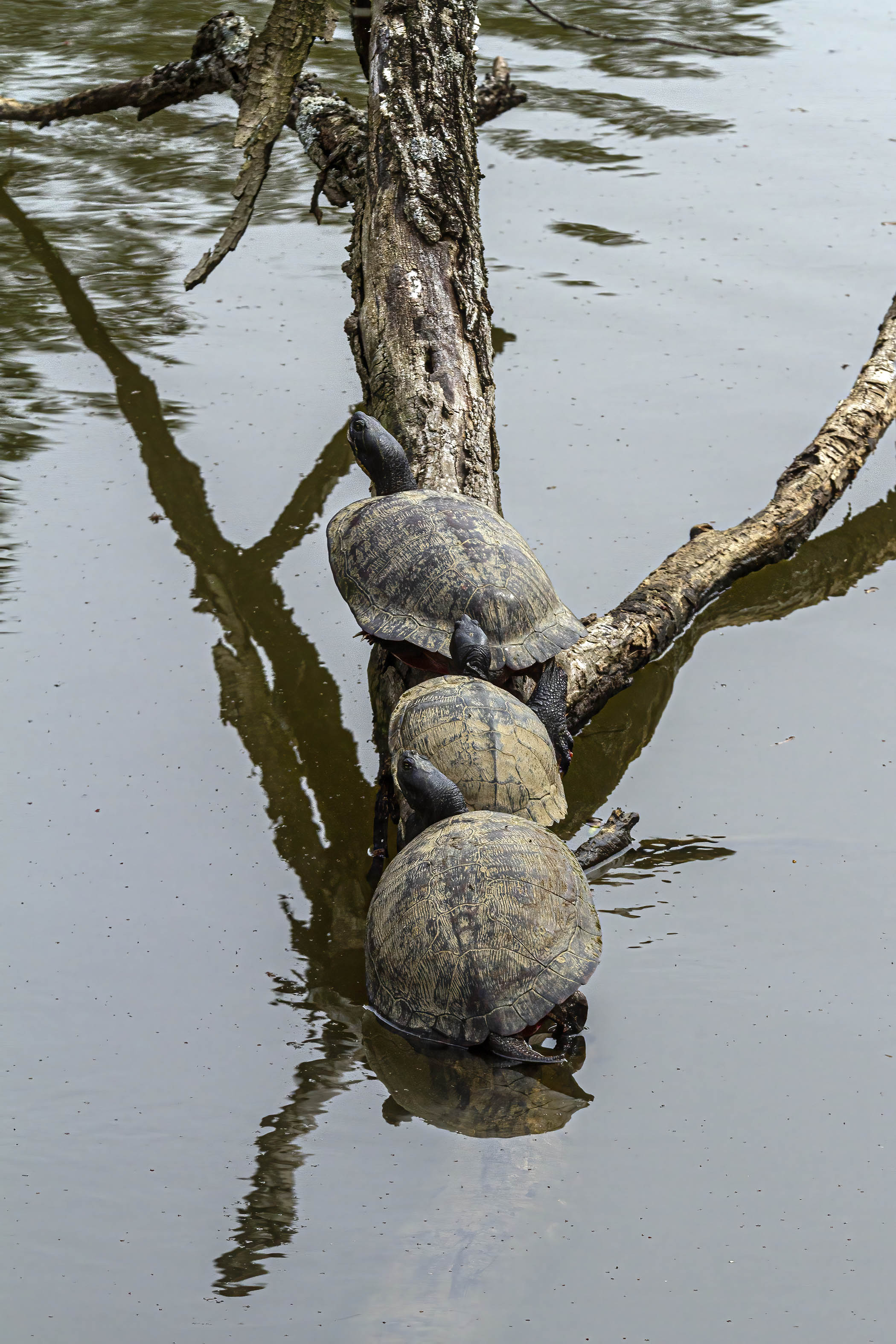
It is not unusual to see turtles in a row on a log, basking in the sunlight. Normally, though, the log is horizontal. In the case of the turtles that I spotted last week at Jackson Miles Abbott Wetland Refuge, the large fallen branch on which they were perched was sticking out of the water at an angle. The turtles, especially the one in the front, had to climb upwards on the branch and secure themselves firmly to keep from sliding back into the water.

I really like the way that this image turned out. I managed to capture the texture of the bark and of the turtles’ shells and the reflections were a nice bonus. The limited color palette allows the viewer to focus on the shapes and textures without being distracted by bright colors. It is a simple, almost abstract image, characteristics shared by many of my favorite photos.

turtles

© Michael Q. Powell. All rights reserved.

Read Full Post »

Most of the turtles that I see are either Painted Turtles or Red-eared Sliders, so I am delighted when I spot a member of another turtle species. Last Wednesday I was thrilled to spot several Spotted Turtles (Clemmys guttata), a relatively uncommon turtle species in my area. Spotted turtles tend to be found in marshy areas rather than in ponds, and it was indeed in a small wetland area at Jackson Miles Abbott Wetland Refuge that I photographed this turtle.

Species names can sometimes feel confusing or inappropriate, but the name of “Spotted Turtle” is perfect for these turtles that, as you can see in the photos below, have small yellow spots on their bodies and shells. For the first time this season I was walking around with my 180mm macro lens attached to my camera, hoping to photograph some butterflies, dragonflies, or other insects, but I came up empty-handed in that regard. I was happy, though, to be able to get a few shots of these little Spotted Turtles, perched on a log as they basked in the warmth of a sunny March day.

Spotted Turtle

spotted turtle

© Michael Q. Powell. All rights reserved.

Read Full Post »

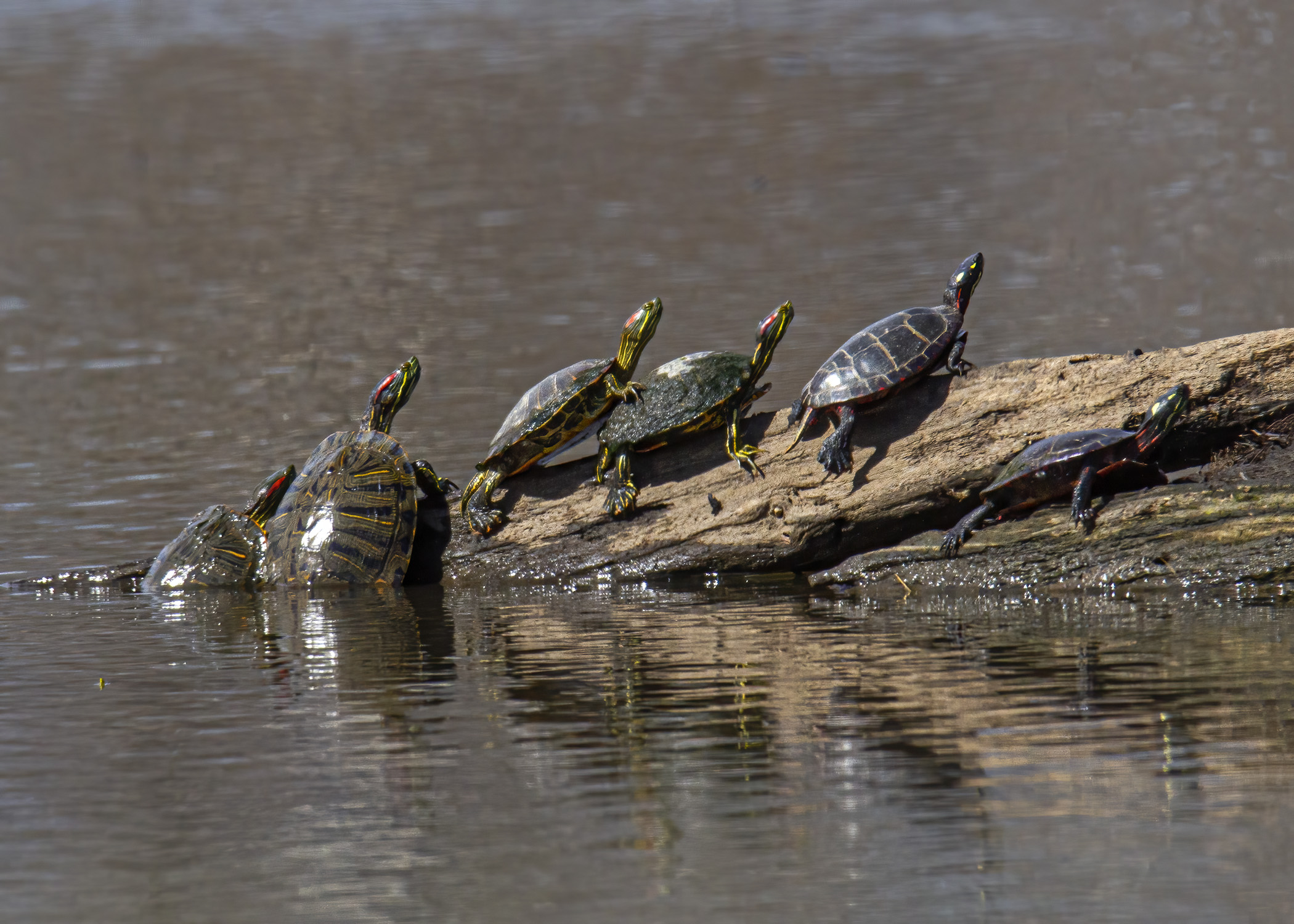
I was delighted yesterday to see that some of the turtles at Occoquan Bay National Wildlife Refuge were taking advantage of the spring-like weather to bask in the sun. I believe that the turtles spend most of their time in the mud at the bottom of the pond during the winter and in you can see mud still caked on the back of at least one of the turtles in the photo.

I think that the four turtles on the left are Red-eared Sliders (Trachemys scripta elegans) and the two on the right may be Painted Turtles (Chrysemys picta). I spotted a few small flies buzzing about yesterday, but it is almost certainly too early for my beloved dragonflies to appear. Several butterfly species, including the Mourning Cloak, overwinter as adults, so there is a chance that I will see one in the coming days.

turtles in February

© Michael Q. Powell. All rights reserved.

Read Full Post »

When the winter weather warms up a little and there is abundant sunlight, turtles will sometimes come up out of the mud at the bottom of the pond to bask in the sun. Last Friday I made a short visit to Green Spring Gardens, a historic county-run garden in Northern Virginia, and spotted this turtle at the edge of a small pond. I think it may be a Red-eared Slider (Trachemys scripta elegans), although the turtle was so far away and covered in mud that I am not sure of the identification.

Turtles enter into a period of dormancy know as “brumation” when the weather gets cold. According to the ReptileKnowHow website, “When red-eared sliders brumate, they do not eat or defecate and they remain almost completely motionless for long periods. Their metabolic rate reduces to a minimum, reducing all vital functions – even breathing to the strictly necessary.” I don’t know all of the technical differences between hibernation and brumation, but I believe that the former term is reserved for warm-blooded creatures and the latter term for cold-blooded ones.

winter turtle

© Michael Q. Powell. All rights reserved.


Read Full Post »

I note the transition to spring in small ways, quite often in the reappearance of familiar species of plants, insects, and other living creatures. I was delighted on Monday to discover that tiny Virginia Spring Beauty wildflowers (Claytonia virginica) have already started to push their way up from the forest floor in Prince William County. According to Wikipedia, the individual flowers bloom for three days, although the five stamens on each flower are only active for a single day.

On the same day, I spotted an Eastern Comma butterfly (Polygonia comma), the first full-sized butterfly that I have been able to photograph this year. I was not able to get very close to the butterfly, but you can see the beautiful orange pattern of its inner wings in the middle shot below.

The final image shows a Spotted Turtle (Clemmys guttata) that I spotted last week. This species seems to be found only in shallow marshy areas and I rarely encounter one, so it was exciting to be able to photograph it.

We all celebrate different signs of spring at this time of the year (or of autumn if you live in the Southern Hemisphere). What indications do you look for that signal the change of the season?

Spring Beauty

Eastern Comma

spotted turtle

© Michael Q. Powell. All rights reserved.


Read Full Post »

Turtles were out in force on Wednesday at Jackson Miles Abbott Wetland Refuge, including these three that appeared to be practicing social distancing. They looked to me to be different species—a Red-eared Slider, maybe a Northern Red-bellied Cooter, and one that I’m really not sure about.

I must confess that I am not very good at identifying different types of turtles, especially when they are covered in dried mud. The middle turtle was shockingly clean and had especially beautiful and colorful markings. Be sure to click on the image to get a better look at the turtles. If you know a lot about turtles, I would welcome your assistance in identifying the species of these three turtle that were basking in the sunlight on an unusually warm March day.

turtles

© Michael Q. Powell. All rights reserved.

Read Full Post »

This Woodland Box Turtle, a species that is also known as an Eastern Box Turtle (Terrapene carolina carolina) was chilling out in the grass at the edge of a trail when I spotted it last week at Occoquan Bay National Wildlife Refuge. It was not moving about very much, but I could sense a real intensity in its bright red eyes.

In order to capture this shot, I got down as low as I could, though I was not quite low enough to be at eye level with the turtle. I was quite happy to be able to capture a lot of detail in the shell and in the portion of the head sticking out of the shell. I encourage you to click on the image to get a closer view of the wonderful details of this strikingly handsome box turtle.

Woodland Box Turtle

© Michael Q. Powell. All rights reserved.

Read Full Post »

I spotted this really cool-looking turtle on Friday while exploring at Jackson Miles Abbott Wetland Refuge during a light rainstorm. The turtle does not look like any turtle that I have seen before—its speckled face really grabbed my eye. The turtle was nestled into the thick grass and I did not want to disturb it, so I moved on after grabbing a few quick shots.

When I returned home, I rushed to the Virginia Herpetological Society website to see if I could identify “my” turtle. The Commonwealth of Virginia, in which I live, has 25 species and subspecies of turtle, of which five are sea turtles, so I figured that it would not be very difficult to find a match. I could easily eliminate many species from consideration and finally decided that the turtle looks a bit like some of the photos for a Northern Diamond-backed Terrapin (Malaclemys terrapin terrapin).

However, the map and information about the geographic distribution of the turtle within the state does not appear to include my county or any of the surrounding counties. According to the aforementioned website, the Northern Diamond-backed Terrapin is the only truly estuarine reptile in Virginia and it inhabits coastal, brackish marshes and their tributaries, bays, inlets, and tidal portions of coastal rivers—I was at a small pond adjacent to a larger marshland area. I am still seeking confirmation of my identification from more knowledgeable expert.

Where I live, Terrapins—the species seems to be variously referred to as “diamondback” and “diamond-backed”—is most often associated with the nearby state of Maryland, where the terrapin is the official state reptile and mascot for the University of Maryland College Park.


Northern Diamond-backed Terrapin

© Michael Q. Powell. All rights reserved.


Read Full Post »

The shell of the Eastern Snapping Turtle (Chelydra serpentina) must have looked as big as the deck of an aircraft carrier to the Common Whitetail dragonfly (Plathemis lydia) that was circling around the pond, looking for a place to land yesterday at Occoquan Regional Park. I am pretty sure that the turtle, who was semi-submerged in the shallow water, basking in the sun, did not notice the temporary additional weight of the dragonfly.

When I first noticed the motionless snapping turtle in the water, I wondered if it was still alive. I kept a healthy distance from the turtle, because, as their name suggests, snapping turtles may snap with their powerful jaws when they feel threatened. I continued to observe the turtle and noticed the ever-changing pool of bubbles around its mouth that suggested that to me it was alive and breathing.

A number of Common Whitetail dragonflies were patrolling over the pond and I mused to myself that it would be really cool if one of them landed on the turtle. I was shocked when that scene unfolded in front of me just as I had imagined. Fortunately, I was not so shocked that I forgot to capture the moment with my camera.

Common Whitetail


© Michael Q. Powell. All rights reserved.

Read Full Post »

The warm weather on Friday brought out a lot of turtles at Occoquan Bay National Wildlife Refuge, including this group of Painted Turtles (Chrysemys picta). I too enjoyed soaking up the sun, but felt more of a need to distance myself from other members of my species than these turtles did.

In terms of photography, I love the way that the red stripes on the turtles’ neck really stand out in an image made up of mainly muted colors. I thought of removing the leaf in the background, but decided that I liked the touch of whimsy that it added to the image.

Painted Turtles

© Michael Q. Powell. All rights reserved.

Read Full Post »

When I spotted this Eastern Painted Turtle (Chrysemys picta picta) on Monday at Occoquan Bay National Wildlife Refuge, I immediately thought how apt a visual metaphor it was for our lives this past year. Surrounded by its protective shell, the turtle tentatively looked out at a hostile world, wondering if it was safe to stick out its neck and move forward.

It is still not completely safe, but conditions appear to be improving somewhat in many parts of the world. Yesterday I had my second Pfizer-BioNTech vaccination shot and I hope that as many people as possible will choose to get vaccinated when they have the chance.

In the meantime, we owe it to each other to continue to wear our masks, to wash our hands, and to practice social distancing. None of us really like these restrictions, but they will protect us as we await the day when we can all come out of our shells.

Painted Turtle

© Michael Q. Powell. All rights reserved.

Read Full Post »

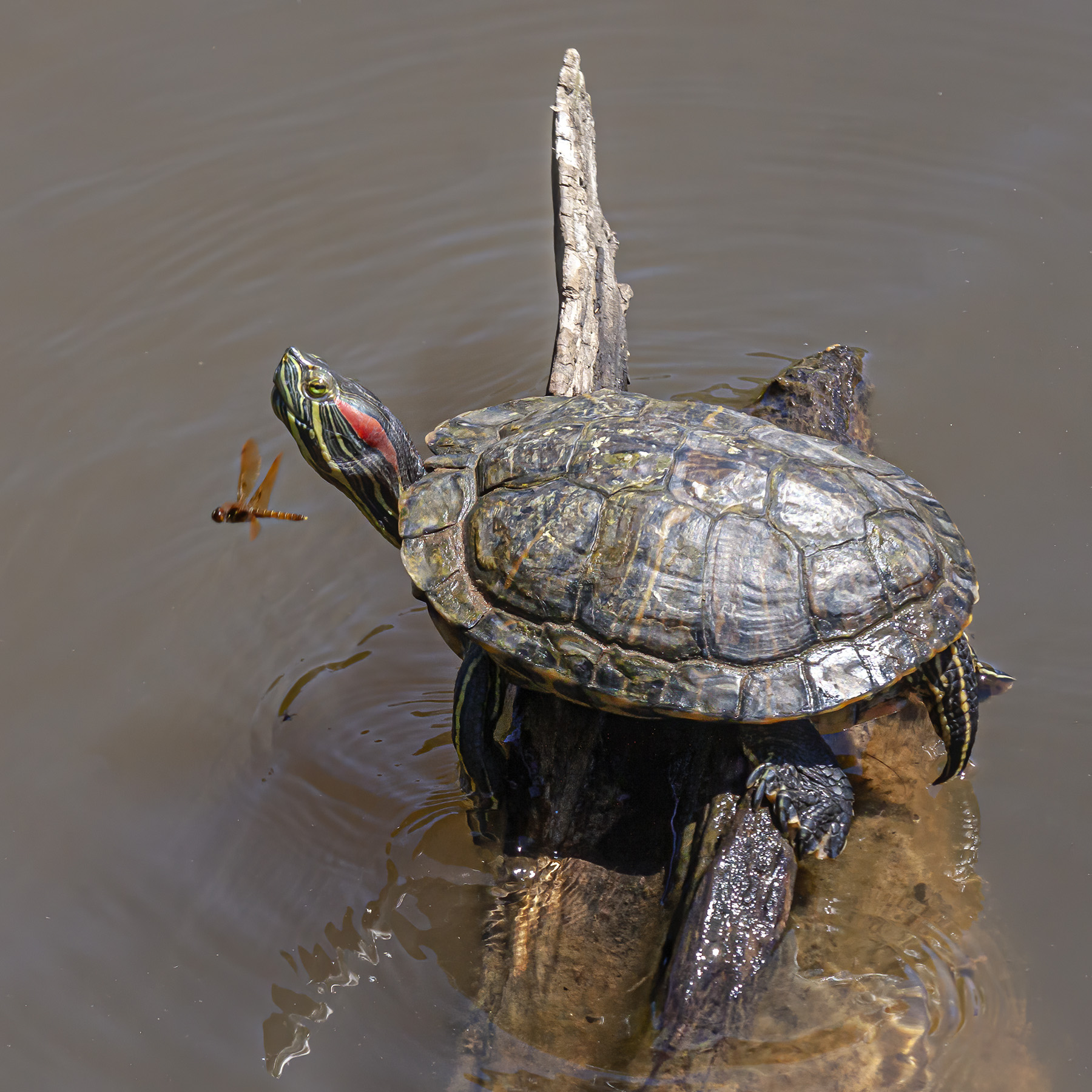
Most of the time Red-eared Slider turtles (Trachemys scripta elegans) slide into the water as soon as they detect my presence. Yesterday, however, this turtle seemed to be in such a deep meditative state that it remained in place when I approached it at Jackson Miles Abbott Wetland Refuge. The turtle was even impassive to repeated buzzings by several Eastern Amberwing dragonflies, some of which flew within inches of its face.

I was hoping to get some a shot of a dragonfly landing on the turtle’s shell, but was content to capture this image with both the turtle and a passing dragonfly.

Red-eared Turtle

© Michael Q. Powell. All rights reserved.

Read Full Post »

Last week I featured an actual mud turtle, but today’s muddy turtles  are actually Painted Turtles (Chrysemys picta) that appear to have been painted with a coating of mud. The last few months we have had a lot of unusually cool weather, and I think the turtles have been spending a lot of time in the mud at the bottom of the ponds. Last week the weather improve  and there were turtles in all kinds of places at Occoquan Bay National Wildlife Refuge trying to absorb the warmth of the sun.

The pose of the first two turtles brings to mind a well-known scene from the movie Titanic in which Jack and Rose (Leonardo DiCaprio and Kate Winslet) were standing at the railing at the prow of the ship. I must confess that I spent 4+ hours watching the movie on television last Sunday night, which may be why the scene is so fresh in my mind. Yeah, I’m a bit of a romantic.

I encountered the second Painted Turtle as it was slowly making its way across a trail at the wildlife refuge. In addition to noting the large amount of fresh mud still on its shell, I was delighted by the way the two little leaf fragments on its shell matched the yellow markings on its neck.
Painted Turtle

Painted Turtle

© Michael Q. Powell. All rights reserved.

Read Full Post »

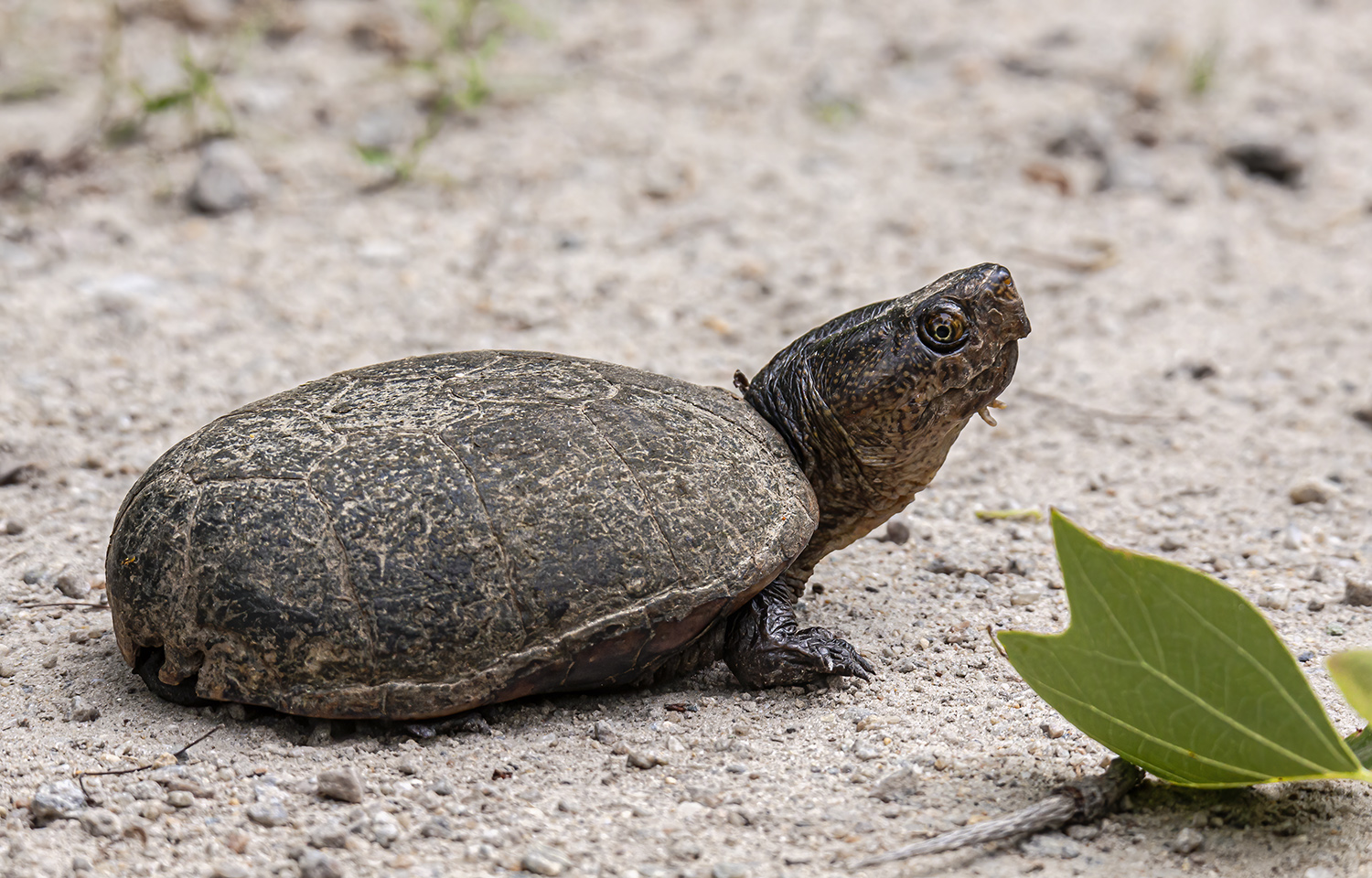
No matter how many times that I see an Eastern Mud Turtle (Kinosternon subrubrum), I am always shocked by the disproportionately large size of its head. When I spotted this one on Tuesday at Occoquan Bay National Wildlife Refuge, I remember wondering if it was physically possible for the turtle to withdraw its head into its shell. The turtle was standing in the middle of a wide trail, apparently in the process of crossing the trail. Although the mud turtle seemed to be fully aware of my presence, it appeared to be totally unfazed and merely gave me a sidewards glance as it waited for me to pass.

Given the circumstances in which we now live, I think we all could use some of the patience and imperturbability of this little creature.


Eastern Mud Turtle

© Michael Q. Powell. All rights reserved.

Read Full Post »

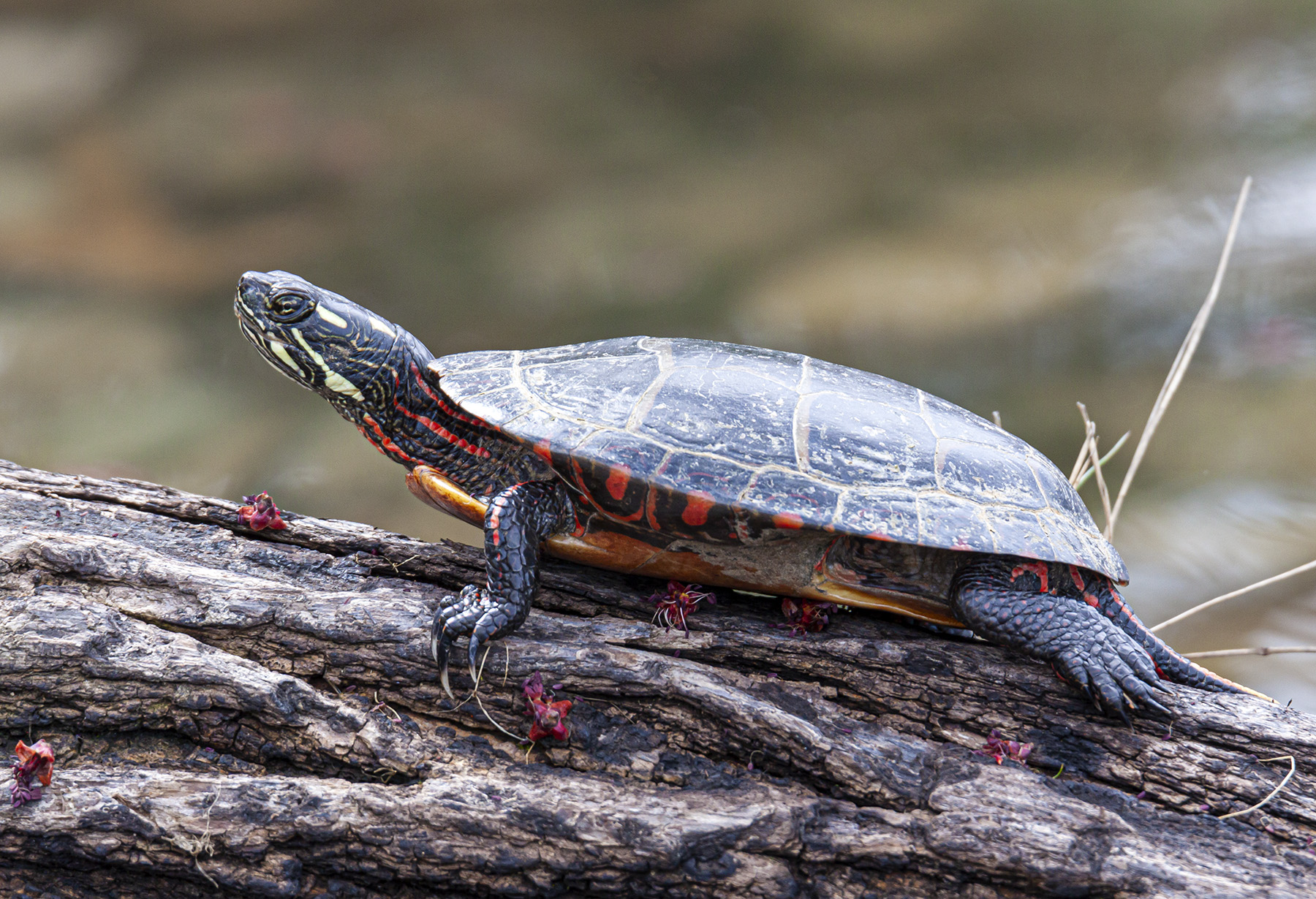
On Friday I encountered this basking Eastern Painted Turtle (Chrysemys picta picta) at the appropriately named Painted Turtle Pond at Occoquan Bay National Wildlife Refuge. Although painted turtles are common in the area in which I live, I am always happy to see their bright colors. In this case, the fallen flowers from a nearby tree added a nice accent to my little portrait of this colorful turtle.

Painted Turtle

© Michael Q. Powell. All rights reserved.


Read Full Post »

Older Posts »