Feeds:
Posts
Comments

Archive for the ‘Summer’ Category

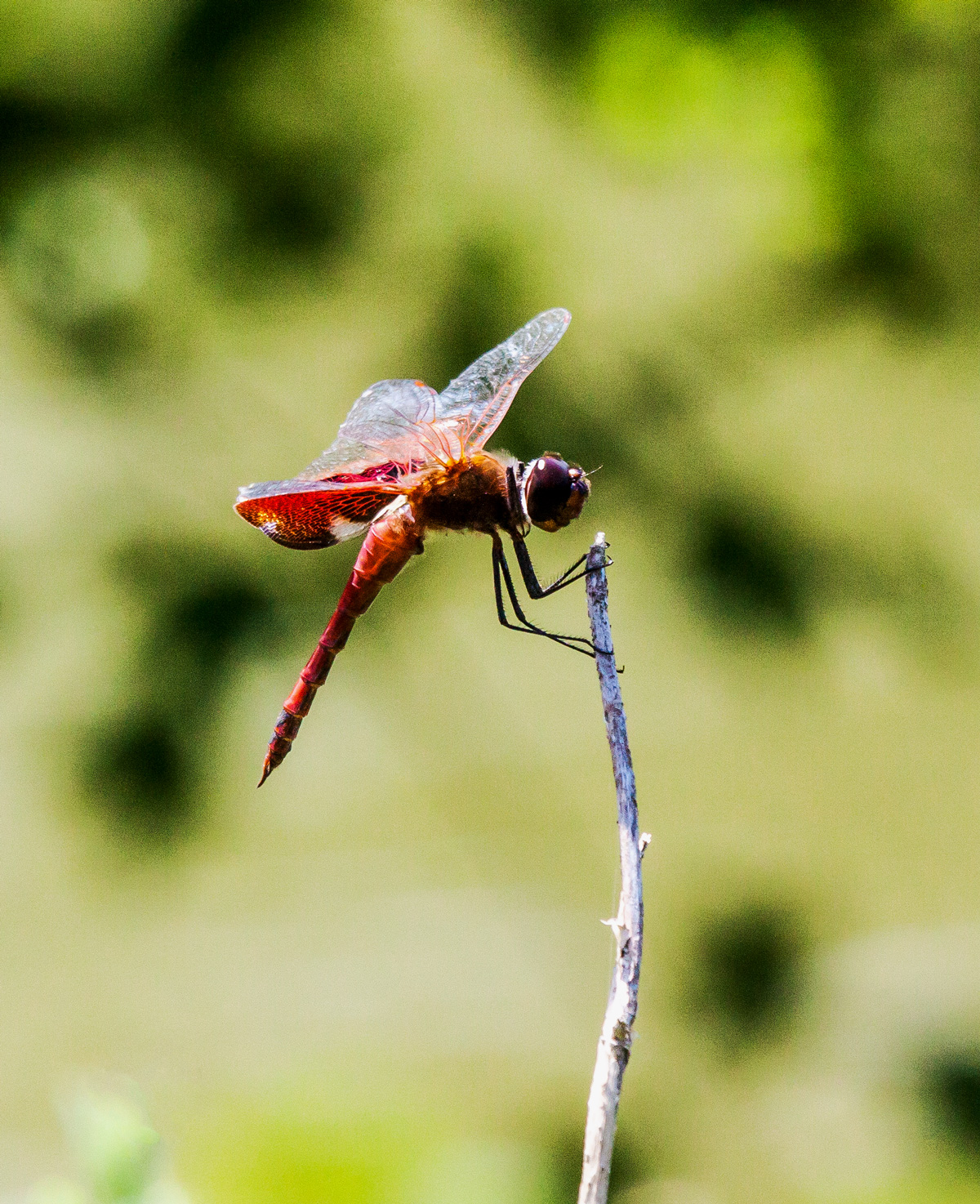
Some of my readers know that I especially love dragonflies with patterned wings and one of my favorites is the Halloween Pennnant (Celithemis eponina). Despite its name, it is a summertime dragonfly and I was thrilled to spot a beautiful female Halloween Pennant yesterday at Occoquan Bay National Wildlife Refuge.

The “Halloween” part of its name comes from the orange-brown color of its wings. The “pennant” comes from this predisposition of members of this genus to perch on the very tip of vegetation, which causes them to wave back in forth in even the slightest breeze.

In the photo below, the Halloween Pennant is perched on a stalk of very distinctive Eastern gamagrass (Tripsacum dactyloides). I have frequently seen this kind of grass with red bits hanging from its stalks, but it was only yesterday that I learned what it was called from fellow dragonfly enthusiast Walter Sanford.

Halloween Pennant

© Michael Q. Powell. All rights reserved.


Read Full Post »

It is easy to be so dazzled by the beauty and the aerial skills of dragonflies that you forget that they are also fearsome predators. I had a stark reminder of this grim reality on Friday when I encountered a Cobra Clubtail dragonfly (Gomphurus vastus) that had captured a Hackberry Emperor butterfly (Asterocampa celtis) at Riverbend Park. The dragonfly was starting to consume the butterfly and in the photo below almost appears to be suspended in mid-air.

In the past I have observed dragonflies with small butterflies, but this was the first time to see one with a larger butterfly. I really like butterflies and so I felt a mixture of horror and fascination when I stumbled upon this scene. Life in the wild can be brutal and today’s predators can become tomorrow’s prey—a fellow photographer posted a photo yesterday of a bird that had captured a dragonfly.

All in all, this moment served as a sober reminder to me of the fragility of life and of beauty. Somehow it brings to mind a country music song that I really like by Tim McGraw, a song that recommends that you live like you were dying. If you have not familiar with the song or simply want to hear it again, check out the official music video here on YouTube.

Cobra Clubtail

© Michael Q. Powell. All rights reserved.


Read Full Post »

With the temperatures today reaching almost 100 degrees (38 C), I long for the cooler weather of autumn, my favorite season of the year. The aptly named Autumn Meadowhawk (Sympetrum vicinum) is generally one of the last surviving dragonfly species each year and I was therefore a bit surprised last week when I spotted this young female Autumn Meadowhawk. The very clear wings and pale body coloration are an indication that it had only recently emerged.

Summer, though, is the prime season for dragonflies and I hope to be able to take advantage of this season to see lots more of them. I’ll just have to make sure that I pace myself and stay well hydrated as we move through a period of exceptionally hot weather.


© Michael Q. Powell. All rights reserved.

Read Full Post »

On Friday I kept encountering dragonflies that were clearly different from any I had seen before. There is a family of dragonflies known as “clubtails” in which the ends of their abdomens (the “tail”) are enlarged. I have seen a number of different members of this family, but none of them had as large a “club” as the ones that I spotted repeatedly as I explored Riverbend Park along the Potomac River.

I suspected and eventually was able to confirm that these are Cobra Clubtails (Gomphurus vastus). Isn’t that a cool name for a dragonfly—someone obviously thought that the “clubtail” looked like a cobra’s hood.

The Cobra Clubtails perched on the rocks and in the vegetation along the water’s edge and I was able to capture images of several of them. I am leading with a photo that provides a good look at the “clubtail,” though I tend to be drawn more to photos like final one in which you get to look into the eyes of the dragonfly.

This is probably the closest I want to be to staring into the eyes of a cobra.


Cobra Clubtail

Cobra Clubtail

Cobra Clubtail

© Michael Q. Powell. All rights reserved.

Read Full Post »

On Monday I was thrilled to get a shot of one of my favorite damselflies at Occoquan Regional Park, the beautifully colored Violet Dancer (Argia fumipennis violacea), a subspecies of the Variable Dancer damselfly (Argia fumipennis). I love the color combination of this tiny beauty, a spectacular shade of violet on its body and the wonderful blue accents. Sharp-eyed viewers may have noted that a photo of this same type of damselfly has been my banner image for quite some time.

Violet Dancer

© Michael Q. Powell. All rights reserved.

Read Full Post »

The Biblical book of Ecclesiastes reminds us that “to every thing there is a season, and a time to every purpose under the heaven” and that is certainly the case with dragonflies. Some dragonfly species are with us for the entire summer, but other species can be seen for only days or weeks and then their season is over. Short flight seasons and specific habitat requirements combine to make some dragonfly species uncommon or even rare.

This past Monday I was happy to capture some more photos of one of those uncommon species, the Gray Petaltail dragonfly (Tachopteryx thoreyi). Earlier this month I observed several of these gray and black beauties for the first time and I was thrilled to be able to take photos to document my sighting. That was the start of a familiar cycle for me—my momentary joy at documenting a new species was replaced by a desire to capture better images, ones that appeal to me artistically.

This may well be my last Gray Petaltail dragonfly sighting of the season, and that makes me a little sad, but other dragonflies will soon be coming onto the scene. So I’ll keep moving forward in search of my next subject, content to photograph familiar ones, but with eyes wide open as I scan my surroundings for new ones too—to everything there is a season.

Gray Petaltail

© Michael Q. Powell. All rights reserved.

Read Full Post »

This shot from Monday is for Cindy Dyer, my photography mentor, who used to refer to me as her “grasshopper” and taught me some important lessons when I was just starting to get serious about my photography six years ago.

Folks of a certain age may recall that “grasshopper” was the nickname used by Master Po for his young student Kwai Chang Caine in the western martial arts television series Kung Fu in the 1970’s. The name is a reference to a wonderful scene in the pilot episode for the series in which the blind teacher helps to teach his new student that “seeing” requires more than the simple use of your eyes.

Here, from Wikipedia, is a snippet of dialogue with some of the wisdom of Master Po:

Master Po: Close your eyes. What do you hear?
Young Caine: I hear the water, I hear the birds.
Po: Do you hear your own heartbeat?
Caine: No.
Po: Do you hear the grasshopper which is at your feet?
Caine: Old man, how is it that you hear these things?
Po: Young man, how is it that you do not?

In case you have never heard of the Kung Fu television series or want to relive a moment from your past, here is a link to a short YouTube video of the above-referenced scene.

As a nature photographer, I think a lot about “seeing” as I seek a closer connection with the natural world and so many of its inhabitants. My observations have caused me to conclude that the pace of the natural world is different from that of my everyday life and that I consequently have to slow down in order to be in synch with it.

grasshopper

© Michael Q. Powell. All rights reserved.

Read Full Post »

Carolina Saddlebags dragonflies (Tramea carolina) bounce about as they fly, which makes them look a bit like butterflies as they move through the air. It is easy to spot their bright red bodies and prominent rear wing patches, but it is a challenge to photograph them, because they don’t perch very often.

I was fortunate on Monday to see one land high in a nearby tree and was able to capture this view of the underside of its wings. The vegetation was far enough away that it blurred out nicely, drawing the eye of viewers to this modest portrait of a beautiful little dragonfly.

Carolina Saddlebags

© Michael Q. Powell. All rights reserved.

Read Full Post »

Summer officially starts today and if you are like many people, your summer plans may include a trip to the beach. I tend to associate dragonflies with marshes and ponds, but a few dragonflies also like sandy beaches. It’s not too likely that you will encounter them at an ocean beach, but if you spread out your towel at the sandy edge of a stream, perhaps you might see a Common Sanddragon (Progomphus obscurus).

Common Sanddragons like to perch flat on the sand and transform themselves from water-dwelling nymphs to dragonflies in the open on the sand, rather than attaching themselves to vegetation as do many other dragonfly species. (If you want to see that amazing metamorphosis documented in a series of photos, check out this blog posting, Metamorphosis of a dragonfly, from two years ago.)

I have begun to recognize the kind of habitat that Common Sanddragons prefer and spotted my first one of the year last weekend on the banks of a small stream in Northern Virginia that I was exploring. That dragonfly is featured in the first two photos below. The very next day, I spotted some more Common Sanddragons at a stream in a local park where I had seen them in previous years. The third photo, which gives you a good view of the body of a Common Sanddragon, is from the second day.

This little series of shots illustrates one of the basic dilemmas that I face when photographing dragonflies. Should I try to capture a bit of the personality of this little creatures, which usually means direct eye contact, or should I try to give the clearest possible view of the entire body of the dragonfly, which usually means a side view? Fortunately, I am sometimes able to get both types of shots, but I am instinctively drawn more to shots like the second one below than to ones like the third image.

Common Sanddragon

Common Sanddragon

Common Sanddragon

© Michael Q. Powell. All rights reserved.


Read Full Post »

What’s your strategy for beating the heat? One of the favorite approaches here in the Washington D.C. area is to stay indoors with the air conditioning cranked up. For a wildlife photographer, though, that is not really an option. My subjects manage to survive in the heat of the day and I need to be other there if I want to photograph them.

Birds seem to be most active early in the day and late in the day, when temperatures are usually coolest, but many dragonflies seem to thrive in bright, direct sunlight. How do they do it? How do they regulate their body temperatures?

If you have ever observed dragonflies on a hot summer day, you may have seen some of them perching in a hand-stand like position, like an Olympic gymnast. This is often referred to as the obelisk posture. The abdomen is raised to minimize the surface area exposed to the sun and when the sun is close to directly overhead, the vertical alignment of the dragonfly’s body suggests an obelisk, like the Washington Monument that I see every time that I venture into the city.

Here are a couple of shots of a Lancet Clubtail dragonfly (Gomphus exilis) that I spotted this past Monday at Jackson Miles Wetland Refuge, only a few miles from where I live. Unlike some clubtail dragonflies, like the Dragonhunter that I featured recently, the Lancet Clubtail is pretty small, about 1.7 inches (43 mm) in length. What I find to be particularly stunning about this dragonfly are its deep blue eyes, which seemed to draw me in.

Initially the dragonfly had its abdomen at an angle, but gradually it kept raising it higher until it ended up in an almost perfect obelisk pose. If I were a judge at the Olympics, I would give this dragonfly a perfect score of 10.

Lancet Clubtail

Lancet Clubtail

© Michael Q. Powell. All rights reserved.

Read Full Post »

The biological clocks of some species seem to be ticking as the summer winds down, compelling them into frantically mating sessions, like this pair of Halloween Pennant dragonflies (Celithemis eponina) that I spotted this past weekend at Lilypons Water Gardens in Adamstown, Maryland. The challenge in photographing this type of activity is to present it in a way that is artistic rather than purely sexual.

halloween pennant

halloween pennant

© Michael Q. Powell. All rights reserved

Read Full Post »

Whenever I see bees buzzing around flowers, I keep an eye out for hummingbird moths. For some unknown reason, I have seen more of these colorful moths this summer than in past years.

Although you could argue about whether or not thistles are flowers, my vigilance was rewarded when I spotted this beautiful Hummingbird Clearwing Moth (Hemaris thysbe) feeding on this thistle bloom on Monday at Occoquan Bay National Wildlife Refuge.

Hummingbird Clearwing Moth

Hummingbird Clearwing Moth

© Michael Q. Powell. All rights reserved

Read Full Post »

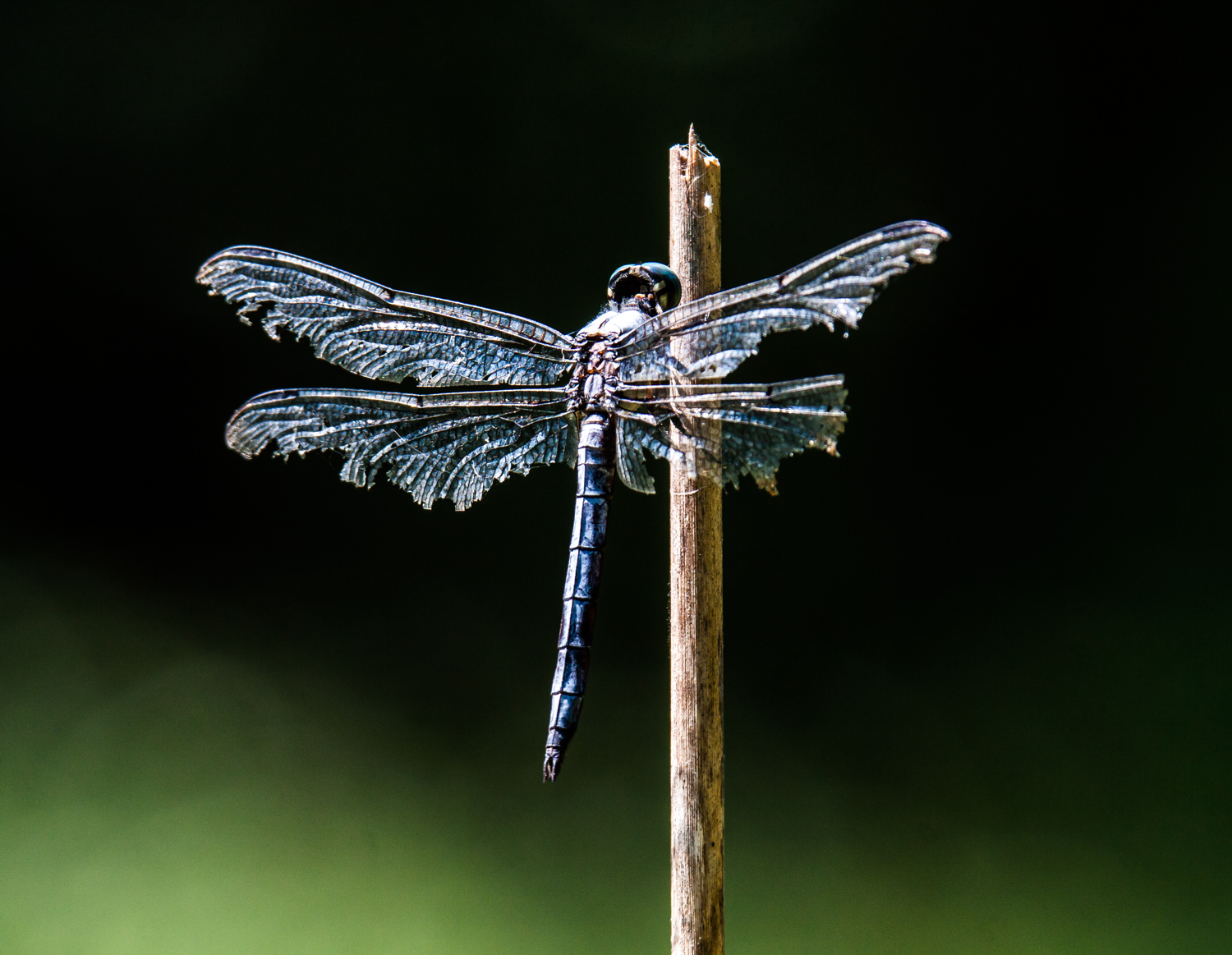
As the days of summer gradually wind down, I can’t help but notice a significant amount of wear and tear on the bodies and especially the wings of some of the dragonflies and butterflies that I see. Clearly it has been a long, tough season for some of them. Despite its tattered wings, this male Great Blue Skimmer dragonfly (Libellula vibrans) that I spotted on Monday at Huntley Meadows Park seemed to have no trouble flying, though I suspect that his days are numbered.

I hope that all of you have managed to survive this season well and that your “summer wear” refers to your clothes and not to the condition of your body.

Great Blue Skimmer

© Michael Q. Powell. All rights reserved

Read Full Post »

In the insect world, Red-footed Cannibalflies (Promachus rufipes) are fearsome predators. Yesterday I spotted one at Huntley Meadows Park in Alexandria, Virginia that appeared to be subduing a Hummingbird Clearwing Moth (Hemaris thysbe) that it had just captured.

What happens next? Wikipedia describes the tactics of a robber fly, the family to which the Red-footed Cannibalfly belongs, in these words:  “The fly attacks its prey by stabbing it with its short, strong proboscis  injecting the victim with saliva containing neurotoxic and proteolytic enzymes which very rapidly paralyze the victim and soon digest the insides; the fly then sucks the liquefied material through the proboscis.”

Yikes!

red-footed cannibalfly subdues hummingbird moth

© Michael Q. Powell. All rights reserved

Read Full Post »

This majestic osprey (Pandion haliaetus) was keeping a close watch on a fellow photographer and me as we pointed our long lenses in its direction as it perched high in a tree early one morning this weekend at Huntley Meadows Park.

osprey

© Michael Q. Powell. All rights reserved

Read Full Post »

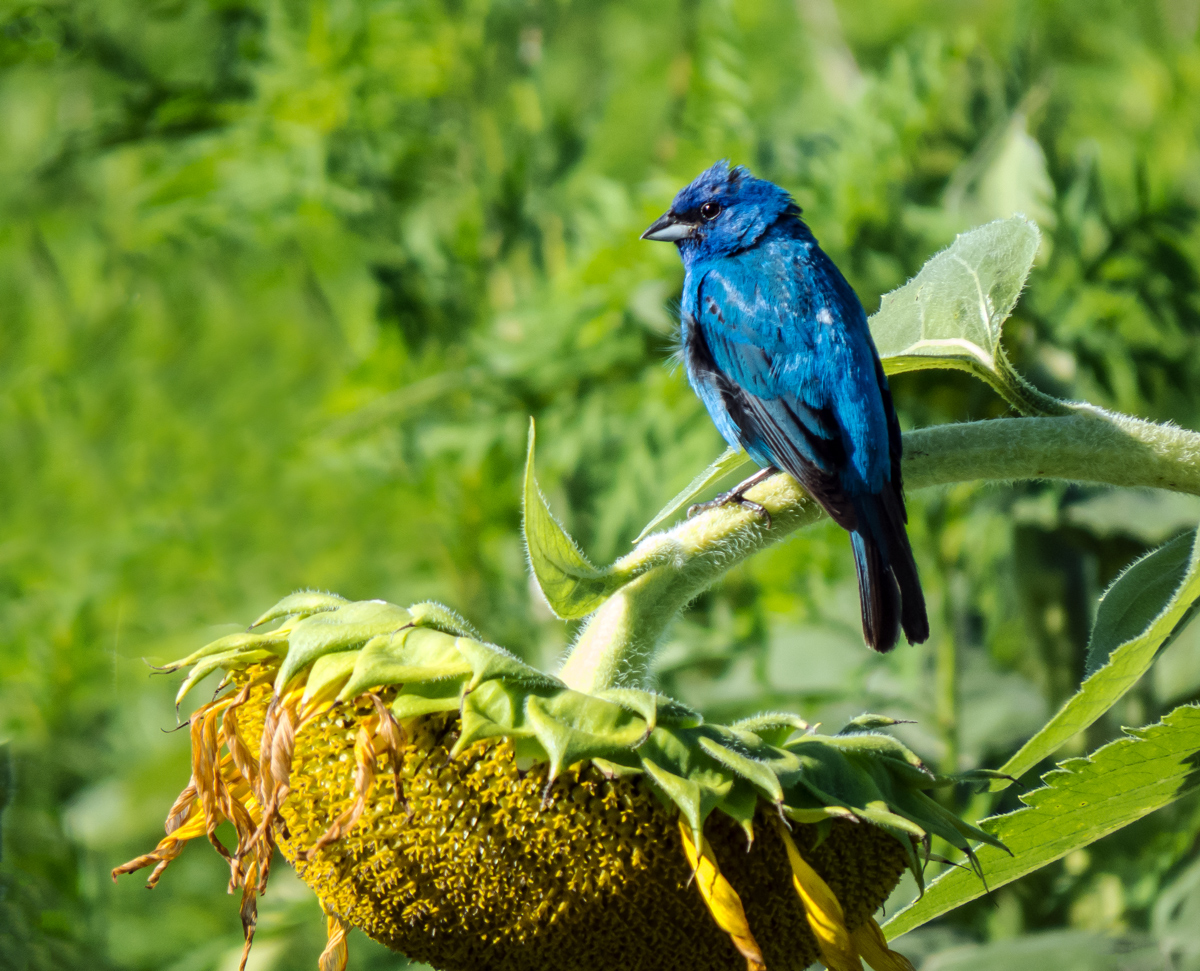
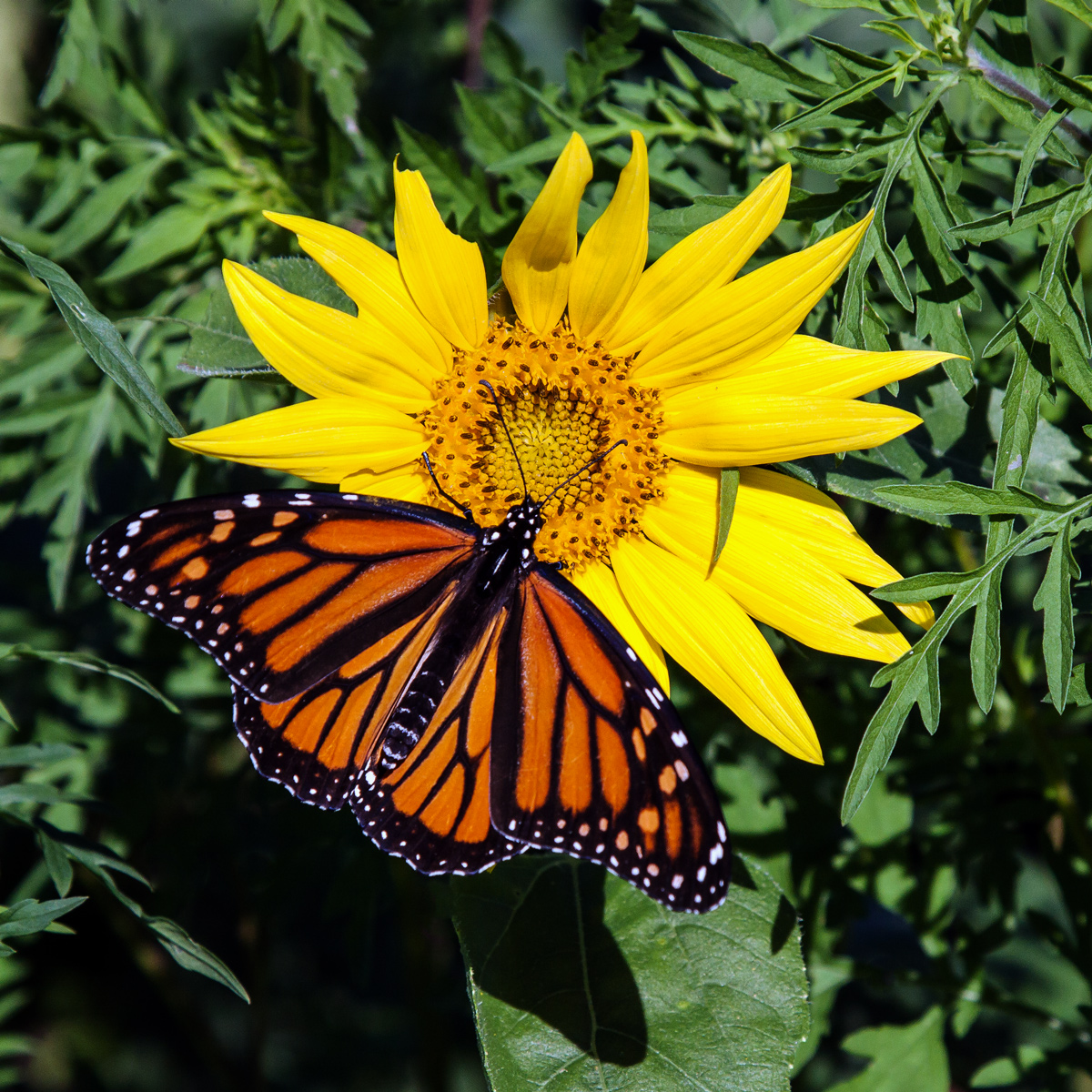
In the first sunflower field that we visited yesterday morning at McKee-Beshers Wildlife Management Area, many of the sunflowers were drooping because of the weight of their seeds. They may not have been very photogenic, but the birds and butterflies seemed to love them, like this Indigo Bunting (Passerina cyanea) and this Monarch butterfly (Danaus plexippus) that I spotted among the sunflowers.

Several photographer friends and I made the trip to the sunflower fields in Poolesville, Maryland, hoping to see endless rows of tall sunflowers. According to its website, McKee-Beshers has 30 acres of sunflowers planted in nine different fields. I think that the sunflowers may have been a little past their prime and appeared to be a little stunted in size, compared to some past years.

It was tricky to figure out what kind of gear to bring on a trek like this. I ended up using my super zoom Canon SX50 to photograph the Indigo Bunting, which was a first sighting for me of this beautiful bird, and my Canon 24-105mm lens on my normal Canon 50D DSLR for the butterfly. I had both of the cameras with me at all times, which gave me a pretty good amount of flexibility. I’ve seen some photographers walk around with two DSLR bodies, but that seems like a lot of weight to carry around, especially when you are moving through vegetation as I was doing as I waded through the rows of sunflowers.

I did take shot shots of the sunflowers  and I’ll post some of them eventually. Folks who know me, though, are probably not surprised that my first instinct was to post images of birds and butterflies, rather than ones of the flowers alone.

Indigo Bunting

Monarch butterfly

© Michael Q. Powell. All rights reserved

Read Full Post »

Cardinal flowers (Lobelia cardinalis) are now in bloom at Huntley Meadows Park. In addition to being beautiful, these vivid red flowers attract butterflies, like this Spicebush Swallowtail butterfly (Papilio troilus) that I spotted this past weekend at the park.

Spicebush Swallowtail

© Michael Q. Powell. All rights reserved

Read Full Post »

There is not denying that it is exciting to capture unusual moments, like a snake swallowing a catfish, or to photograph a new species, as I have done recently with dragonflies. For me, though, there is something equally satisfying about returning to a familiar location and observing ordinary subjects. It is a different kind of challenge to present the ordinary in an extraordinary way, in a way that makes people stop and realize that natural beauty surrounds them every single day.

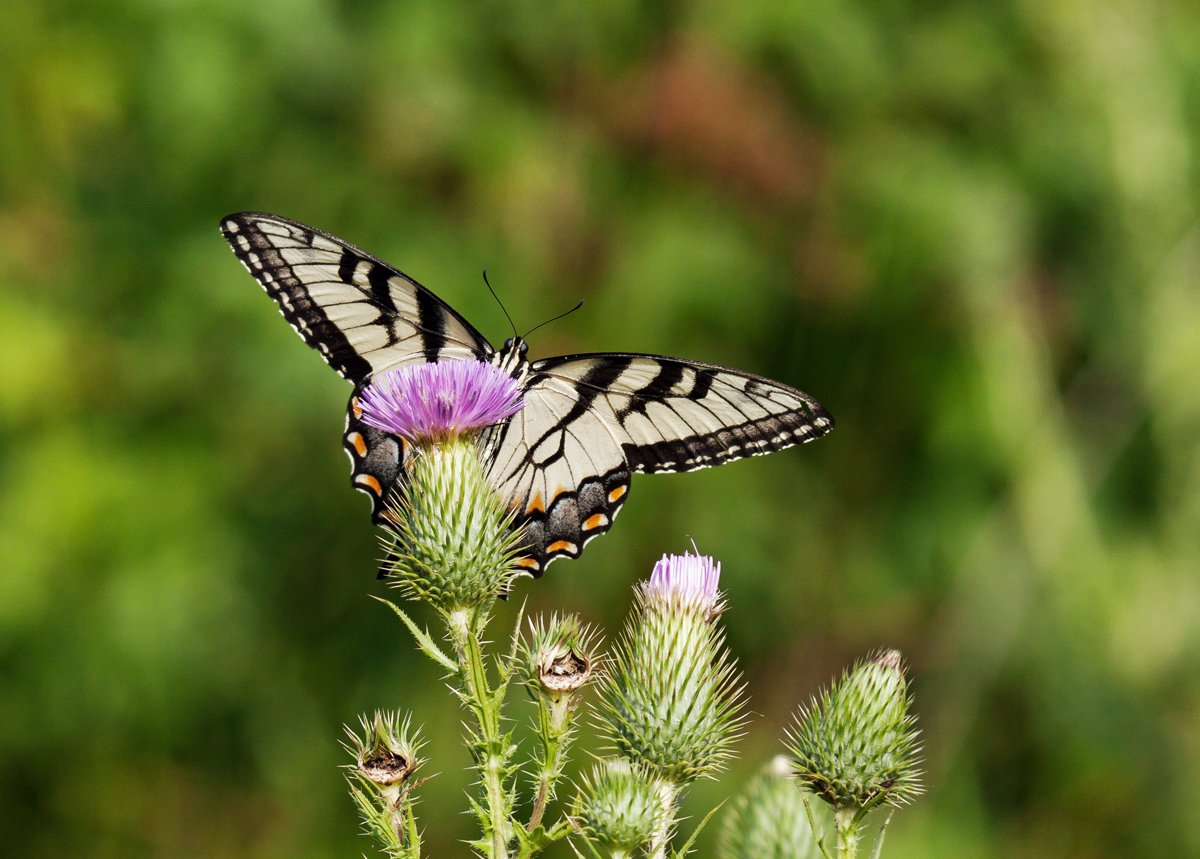
Last week, butterflies were really active at Huntley Meadows Park.  When I am in a garden, it is easier for me to guess where a butterfly will fly next, but in the wild, butterfly behavior is a little more unpredictable. When I noticed that a stand of what looks to be some kind of thistle was beginning to open, I hoped that the Eastern Tiger Swallowtail (Papilio glaucus) that was flying about would be attracted to it. Eventually it flew to the thistle and I was able to capture this image.

Spectacular? No, not really. Beautiful? I’d say so. The image works for me, because it has just enough stopping power to cause views to recall how beautiful ordinary butterflies can be, to rekindle the childhood memories of being excited by butterflies, and to remember how exciting it was abandon caution and simply and joyfully chase after butterflies.

Eastern Tiger Swallowtail

© Michael Q. Powell. All rights reserved

Read Full Post »

Sanddragon on the rocks? No, it’s not a tropical summertime drink—it is simply a description of a dragonfly that I saw earlier this month in a somewhat unusual location.

Common Sanddragon dragonflies (Progomphus obscurus) have been one of my favorite dragonfly species from the moment I first encountered them at Huntley Meadows Park a few years ago as I was exploring a remote area of the park. I almost literally stumbled upon them and didn’t really know what species they were at the time. I sent photos off to my local dragonfly expert Walter Sanford and he was able to identify them for me.

Since that time I have learned a lot more about the species, including the fact that they emerge on the sandy banks of streams. (Many other dragonfly nymphs attach themselves to vegetation growing out of the water and leave their discarded exoskeletons attached to the vegetation when they emerge.) Last year I even had the awesome experience of watching the emergence of a Common Sanddragon and documented it in series of images in a blog posting called Metamorphosis of a Dragonfly.

This year I have had an unusually hard time finding Common Sanddragons, because the creeks where I normally find them have had unusually high water levels, leaving all of the sandy areas underwater. Earlier this month while I was exploring Jackson Miles Abbott Wetland Refuge, which is rapidly becoming one of my favorite locations for finding dragonflies, I decided to check out the creek that runs through the refuge. It is actually part of the same creek where I was used to finding sanddragons, but is further downstream.

I noticed that part of a sandbar was exposed, but I didn’t think that it would be suitable for sanddragons, because it was covered with small rocks. I decided to investigate it anyways and my persistence was rewarded when a male Common Sanddragon flew in and perched on one of the rocks.

Sanddragon on the rocks? It was definitely a refreshing experience for me on a hot summer day. Any ideas on the appropriate ingredients for a cocktail with that name?

Common Sanddragon

© Michael Q. Powell. All rights reserved

Read Full Post »

What are Carolina Saddlebags? Luggage for horseback or motorcycle riding? No, Carolina Saddlebags (Tramea carolina) are a species of bright red dragonflies with reddish-brown blotches of color on their hindwings. Why aren’t they Carolina Blue in color? Obviously the folks who named the dragonfly were not fans of the University of North Carolina (UNC) basketball team. (According to Wikipedia, the use of the light blue color at UNC dates back to 1795.)

I first became aware of the Carolina Saddlebags yesterday at Jackson Miles Abbott Wetland Refuge when a flash of red caught my eye. A dragonfly was patrolling over a section of the water and the adjacent grassy area. I tracked it visually and eventually realized it was a saddlebags dragonfly—those blotches of color stand out even when the dragonflies are flying. Most of the saddlebags dragonflies that we encounter in our area are Black Saddlebags (Tramea lacerata), but I was pretty confident that my eyes were seeing the red of the relatively rarer Carolina Saddlebags. I tried to capture some in-flight shots, including the first one below, but eventually lost sight of the dragonfly.

Carolina Saddlebag dragonflies, according to the information on the Dragonflies of Northern Virginia website, are powerful fliers and are one of only a few species that routinely migrate hundreds of miles. Additionally, according to that same website, they rarely perch.  As I continued to walk around the small pond of the wildlife refuge, imagine my surprise when I came upon one that was perching.

I didn’t dare approach too closely initially and may well have been holding my breath when I took some preliminary shots. My caution proved to be justified, because the dragonfly flew away when I tried to move forward, even though I was approaching as slowly and as stealthily as I could. Either the dragonfly was skittish or its short rest break was over.

Carolina Saddlebags was not a species that I had seen before at this location and it was not really on my radar. Fortunately I was able to react quickly enough and was lucky enough to get some shots, including the in-flight one as the dragonfly was zooming past me. As I learned in the Boy Scouts, it is always good to be prepared.

Carolina Saddlebags

Carolina Saddlebags

Carolina Saddlebags

© Michael Q. Powell. All rights reserved

Read Full Post »

I have known for a while that hummingbirds are attracted to trumpet vines, so I keep my eyes open whenever I pass a stand of them near the observation tower at Huntley Meadows Park. Yesterday morning I finally lucked out and spotted a female Ruby-throated Hummingbird (Archilochus colubris) in the midst of the trumpet vines (Campsis radicansand managed to capture these images, including one in which the hummingbird was resting for a few seconds on a branch before resuming her energetic activity.

Ruby-throated Hummingbird

Ruby-throated Hummingbird

© Michael Q. Powell. All rights reserved

Read Full Post »

I don’t feature rabbits very often on this blog because I don’t see them very often. Actually that is not entirely accurate—I have a rabbit named Prime Rib who appears from time to time, but I don’t count him, because he does not live in wild and instead lives in a cage in my living room.

At Huntley Meadows Park,  where I do a lot of my wildlife photography, I rarely see rabbits. Perhaps the marshy and wooded habitat is less than ideal for the rabbits or perhaps the hawks are brutally efficient at keeping their numbers low. During some recent visits to Occoquan Bay National Wildlife Refuge, which has more open grassy areas, I’ve spotted numerous rabbits and decided to feature a couple of them today.

In a recent posting, I expressed my concern about possibly oversaturating my readers with dragonfly photos. In an exchange of comments, a faithful reader, Dan Antion, shared similar concerns about his photos of rabbits and squirrels and I warned him that I was going venture into his niche and post some rabbit photos. Dan is one of my favorite bloggers and I encourage everyone to check out his blog No Facilities for his humorous and insightful looks at the joys and frustrations of everyday life as well as some great photos, including images of the aforementioned squirrels and rabbits and his faithful dog Maddie.

This one is for you, Dan.

rabbit

rabbit

© Michael Q. Powell. All rights reserved

Read Full Post »

Green Herons (Butorides virescens) have so much personality packed into their small bodies. This one almost seemed to be smiling as it flew by me last weekend  at Huntley Meadows Park. Perhaps it was just my imagination running away with me.

Green Heron

© Michael Q. Powell. All rights reserved


Read Full Post »

What in the world is that? That was my initial reaction when I spotted a mass of black, orange, and white fibers sitting atop a milkweed plant leaf. As I moved closer, I changed my mind and decided it was probably a cocoon. I was shocked when it started moving and I realized that it was a strange-looking caterpillar.

When it comes to finding insects, milkweed plants are one of my favorite locations. There are all kinds of bugs and butterflies that make their homes on these plants and I make a point to explore them whenever I find them growing. These particular milkweeds were growing in a wooded area of Wickford Park, a small park adjacent to Huntley Meadows Park, the marshland location where I shoot many of the photos featured in this blog.

After photographing the single caterpillar, I stumbled across a whole family of them devouring a leaf on a another milkweed plant. I didn’t know the species of the caterpillar, but it was easy to do a search on the internet, because I could identify the host plant. I learned that this is a Milkweed Tiger Moth caterpillar (Euchaetes egle), also known as a Milkweed Tussock Moth caterpillar.


Milkweed Tiger Moth caterpillar

Milkweed TIger Moth caterpillar

© Michael Q. Powell. All rights reserved

Read Full Post »

Is it possible that I am sharing too many dragonfly images, that I am oversaturating the market and taxing the patience and tolerance of my readers? I realize that not everyone is as drawn as I am to these amazing little creatures and that some folks are repelled by insects of any variety or are simply not interested in them.

An old adage asserts that beauty is in the eyes of the beholder and to a certain extent I agree with that statement. However, I would counterargue that beauty is not entirely subjective, that there are cases in which the majority of people would agree that something is beautiful.

I somehow think that this might be the case for an image I captured this past Friday of a spectacular female Halloween Pennant dragonfly (Celithemis eponina) at Huntley Meadows Park. Most of the Halloween Pennants that I have photographed this year have been males, which tend to be more visible, since they are trying to attract females, so it was a treat to spot a female. In the dragonfly world, females usually are the ones that choose the partner for mating and they frequently remain in the treeline or in open fields until they are ready.

I had my 150-600mm lens mounted on my camera, because I was hoping that I might see a bald eagle or a hawk, so I was able to shoot this dragonfly from a distance without disturbing her. I focused manually and was able to capture some beautiful details of the dragonfly, such as the two-toned eyes and the long, two-toned legs. I love the organic shape and feel of the cool-looking perch that the dragonfly had chosen. The background dropped out of focus so much that it almost looks like a studio shot and draws the eyes of viewers to the subject.

When you first read the title, you might have scratched your head in puzzlement, because the color palette is more subdued than oversaturated. By now, it should be clear that I was not referring to the colors, but to the question of whether or not I am posting too many images of dragonflies. Fear not, not all of my postings will be about dragonflies, but we are in the prime period for dragonflies, so stay tuned for more images of these amazing aerial acrobats. When it comes to the quantity of my dragonfly images, I feel like some Southerners do about sugar in their sweet tea—you can never have too much of a good thing.

Halloween Pennant

© Michael Q. Powell. All rights reserved


Read Full Post »

I spotted several young Wood Ducks (Aix sponsa) this morning at Huntley Meadows Park, including these two who playfully posed for me. Actually, there were three young Wood Ducks grooming themselves on a long and one decided to jump into the water. After swimming around for a while, the duck in the water decided to dry its wings and I was able to capture the extended wings in this shot. In case you are curious, the third duck was just out of the frame to the right. Although it was well past the “golden hour,” the light was beautiful and I was happy to be able to capture a partial reflection of the duck with outstretched wings.

wood duck

© Michael Q. Powell. All rights reserved


Read Full Post »

Why do we like certain photos more than others? What makes a good image? These questions churn away in my brain every time that I have my camera in my hand and often even when my hands are empty. Sure, there are rules and guidelines and generally accepted norms, but often it comes down to personal, unexplainable preferences—I like what I like.

Last weekend I spent a lot of time observing Green Herons (Butorides virescens) at Huntley Meadows Park. I kept trying to capture action shots of the herons catching fish or flying through the air, but I pretty much came up empty-handed. Oh, I took a lot of shots and once I wade through them all there may be some decent images of the herons that I will choose to post, but none of those images really spoke to me during my initial review of the photos from that day.

I was drawn instead to some images from early in the day when a fellow photographer and I spotted a Green Heron in the trees in the distance. We were standing on a boardwalk, so there was only a limited freedom of movement to frame our shots. There was a lot of vegetation that partially obstructed our view of the heron. I searched in vain for a visual tunnel that afforded a clear view of the entire body of the heron. Still, the light was beautiful, so I kept shooting—when it comes to birds, expressions are so fleeting that it is best to shoot a lot of images.

I decided to post this shot and attempt to explain why. There are so many things that I like about this image that I am not really bothered by the leaves that blocked my view. What do I like? I love the tilted head as the heron looks to the sky and basks in the sun; I like the little head feathers that look like a cowlick; I really like the shapes and colors in the background; and I am happy that I was able to capture some details in the wing feathers.

Is it one of my best shots? No, it is not, but I choose to post images that I like and especially the ones that make me happy, like his image of a pensive, relaxed Green Heron in a tree.

green heron

© Michael Q. Powell. All rights reserved


Read Full Post »

I haven’t seen many hummingbirds this year, so I am always excited to spot one of their insect counterparts in action. Hummingbird Clearwing Moths (Hemaris thysbe) act a lot like hummingbirds, with the notable difference of gathering nectar with their long proboscises rather than with needle-like bills.

I photographed this moth yesterday  at Jackson Miles Abbott Wetland Refuge at Fort Belvoir, Virginia. As you can probably imagine, I had to take a lot of shots to get one in which the moth was in focus and had its wings in a relatively good position. These moths are really fast, keep moving in and out of the flowers, and are pretty small—about a wingspan of about an inch and a half  (4 cm).

Hummingbird Clearwing Moth

© Michael Q. Powell. All rights reserved

Read Full Post »

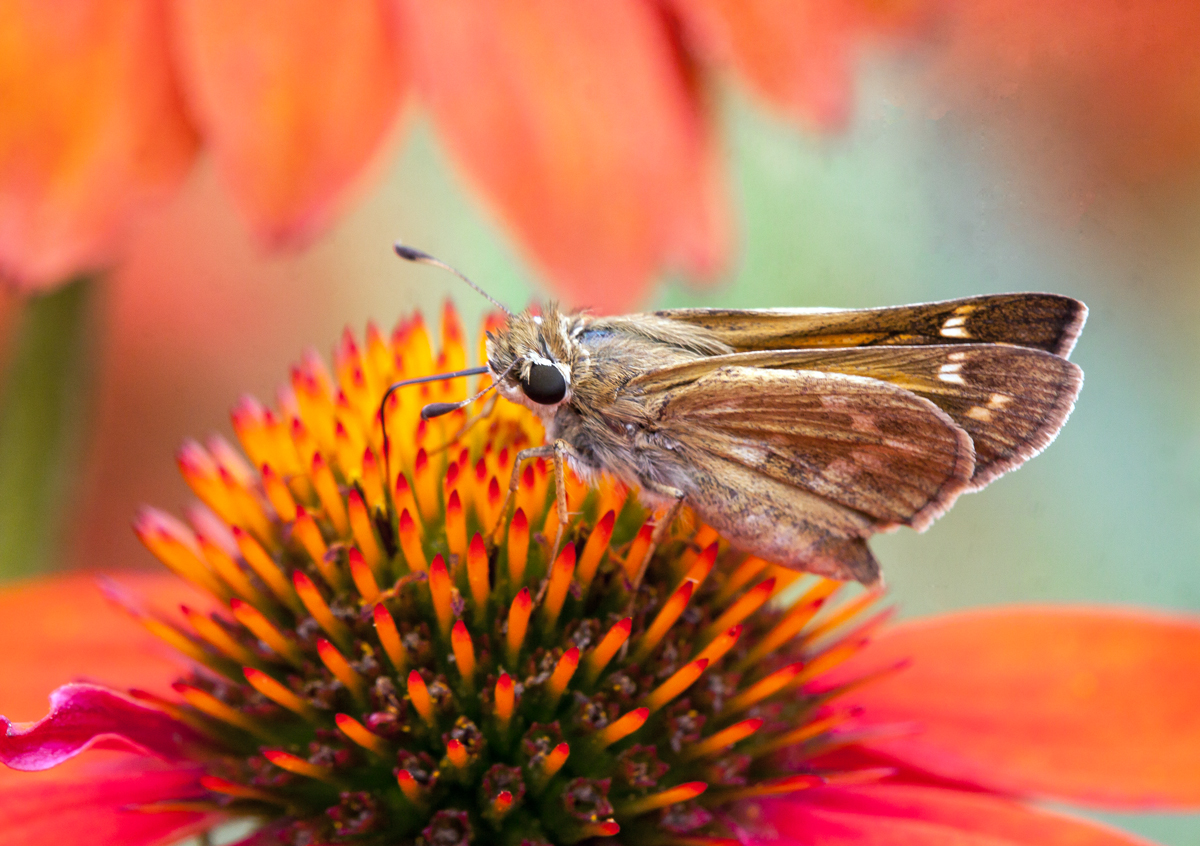
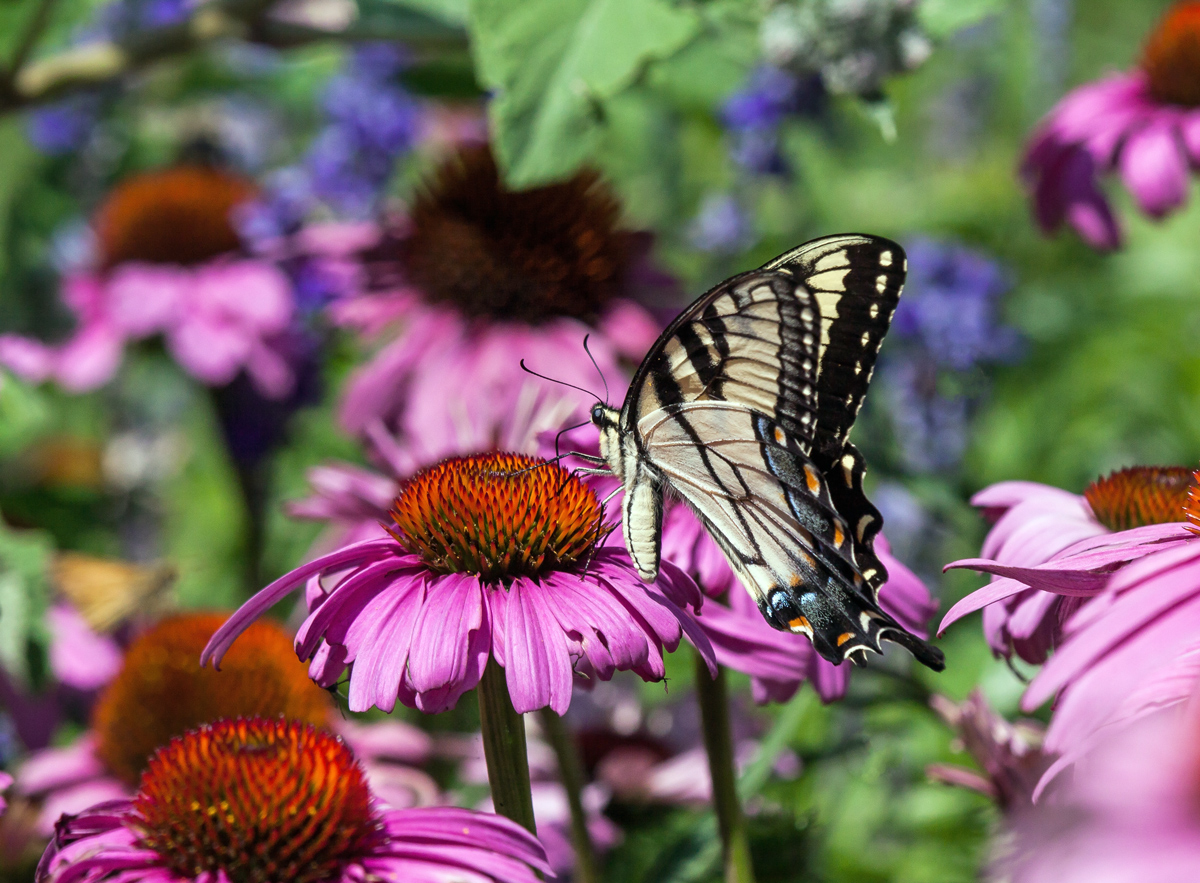
Brightly-colored flowers and butterflies—-what a wonderful combination for a summer’s day. I spotted these beauties this past weekend at Meadowlark Botanical Gardens in Vienna, Virginia.

The first shot features a little skipper butterfly on a spectacular, orange-red coneflower. The other two shots highlight the beauty of an Eastern Tiger Swallowtail (Papilio glaucus) in a patch of the more frequently observed purple coneflowers.

skipper on a coneflower

Eastern Tiger SwallowtailEastern Tiger Swallowtail

© Michael Q. Powell. All rights reserved

Read Full Post »

I just love the vibrant colors of the tropical water lilies at Kenilworth Park and Aquatic Gardens, like this one that I photographed on Sunday during a brief trip there. These gardens, located in a part of Washington D.C.,  are run by the National Park Service and have acres of ponds with all kinds of lotuses and water lilies. The tropical water lilies are in small cement ponds behind the visitor center and are one of my favorite spots to visit.

tropical water lily

tropical water lily

tropical water lily

© Michael Q. Powell. All rights reserved.

Read Full Post »

I’ll often try to get shots of butterflies with their wings wide open, but when they turn sideward, you can sometimes get an equally spectacular view of them slowly sipping nectar. I can’t identify the flower, but the butterfly definitely is an Eastern Tiger Swallowtail (Papilio glaucus) that I chased about this past weekend at Green Spring Gardens.

Eastern Tiger Swallowtail

© Michael Q. Powell. All rights reserved

Read Full Post »

« Newer Posts - Older Posts »