Feeds:
Posts
Comments

Archive for the ‘Reptiles’ Category

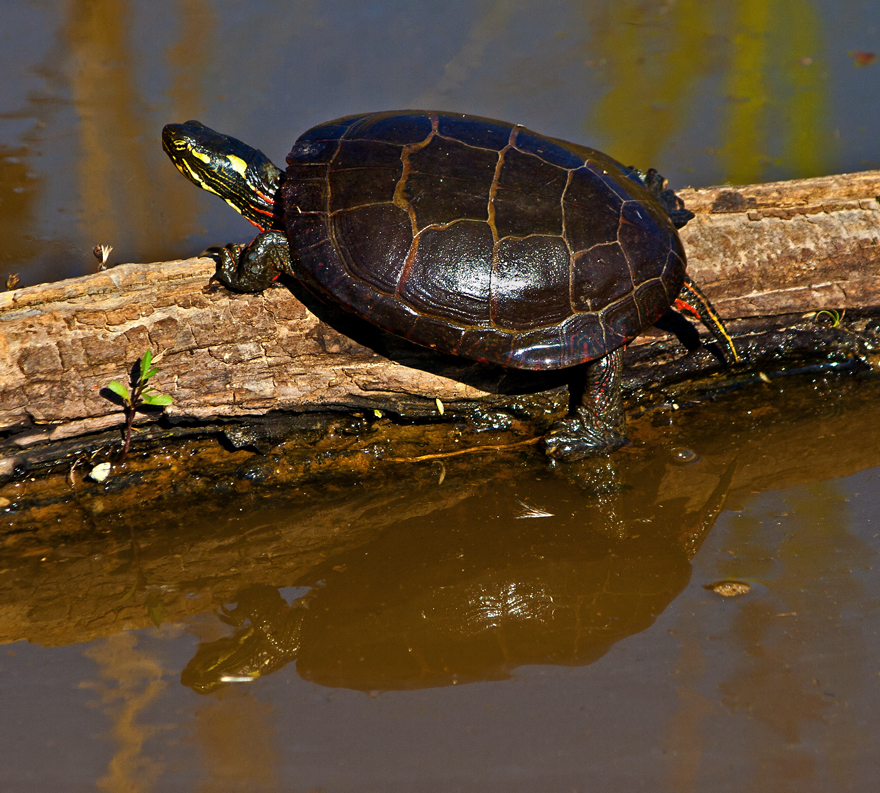
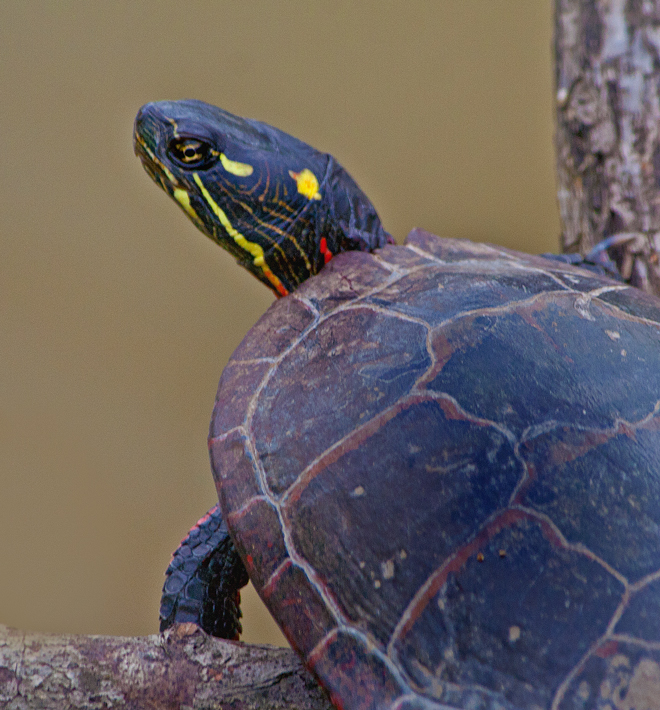
Yesterday when the sun was shining and the temperature soared to the high 50’s (15 degrees C), I was blissfully ignorant that snow was headed our way. Like this Eastern Painted Turtle (Chrysemys picta picta) that I observed at my local marsh, I wanted only to bask in the warmth of the sun.

Today in the Washington D.C. area, the federal government and most of the schools are closed and we are all hunkered down as we await the arrival of what is forecast to be the biggest snowstorm we’ve had in a few years, as much as eight inches (20cm).

During the summer, I often see a whole row of turtles on this particular log, but yesterday this was the only turtle that had bee roused from its slumbering state by the surprisingly warm, sunny weather. The mud on its shell suggests that this turtle did not swim around a lot, but made a beeline for this log after rose to the surface.

I suspect that this turtle is already back in the mud at the bottom of the pond today, comfortably dreaming of spring, when it will reemerge into the sun.

turtle_jan_blog

Click on the photo to see a higher resolution view of the turtle.

© Michael Q. Powell. All rights reserved

Read Full Post »

Fellow photographer and blogger, Walter Sanford, has an incredible talent for capturing photos of dragonflies, in this case one that was perched on the sleeve of my sweatshirt.

waltersanford's avatarwalter sanford's photoblog

The following gallery features photos of the undisputed champion dragonfly!

This individual is a female Autumn Meadowhawk dragonfly (Sympetrum vicinum), spotted at Huntley Meadows Park on 15 November 2013. She is perching on the sleeve of Mike Powell’sChampion USA sweatshirt.

Hey Champion, how ’bout a little something, you know, for the product placement in my photos?

Copyright © 2013 Walter Sanford. All rights reserved.

View original post

Read Full Post »

Deep in the cattails, this Northern Water snake (Nerodia sipedon) seemed to have taken refuge from the rising waters of the marsh after several days of heavy rainfall. The snake’s body looked a little thicker around the middle, causing me to wonder if it had eaten recently and was in the kind of food coma that I experience after a really big meal.

snake_bush_blog

© Michael Q. Powell. All rights reserved.

Read Full Post »

In the shallow water of the marsh, this Northern Water snake (Nerodia sipedon) patiently waits for its unwary prey, probably a frog. At one point its body began to vibrate violently and I thought it was getting ready to strike, but it turned out to be a false alarm. In the end, the snake turned out to be more patient than I was and I left without observing the snake capture its next meal.

snake_water_blog

Click on the photo to see a higher resolution view of the snake.

© Michael Q. Powell. All rights reserved


Read Full Post »

Far away from any adult supervision, this baby snapping turtle seemed to be having trouble figuring out how to forage for food on his own.  He stretched out his neck as far as it would go, but was still not within reach of the plants that he was eying. The realization had not yet struck him that was going to have to move his body closer. Just above him you can see a little fish that was monitoring his progress, but staying beyond the reach of those jaws, in case the turtle decides he needs a little protein in his diet.

baby_snapper_blog

© Michael Q. Powell. All rights reserved

Read Full Post »

Most of the time, when I see these green snakes, they are half-buried in a bush and it is impossible to get a decent shot.  yesterday, however, I almost stepped on this Rough Green Snake (Opheodrys aestivus) on one section of the boardwalk at my local marsh and was able to compose this shot before he slithered away.

The snake had stopped moving and was surveying the situation, sticking its tongue out repeatedly. I got several shots with the tongue extended, but I especially like this one, because it shows the forked tongue.

green_snake_blog

© Michael Q. Powell. All rights reserved.

Read Full Post »

Do Northern Water Snakes (Nerodia sipedon) blow bubbles in the water for fun, like I used to do as a child? Does it help them to attract prey? Are the bubbles simply a result of the snake remaining semi-submerged in the shallow marsh water as it waits for its next victim?

Whatever the reason for the bubbles, I spent some time yesterday observing this snake, hoping that I might see a successful hunt. In the end, I came up empy-handed, as the snake’s patience outlasted mine.

water_snake_bubbles_blog

© Michael Q. Powell. All rights reserved

Read Full Post »

Do Great Blue Herons (Ardea herodias) have a sense of humor? What would prompt one to burst out in laughter?

Maybe one of the many turtles surrounding the heron’s feet decided to tickle them. (Click on the photo to get a better look at the turtles).

Perhaps he is preparing for an audition for the reality television show America’s Got Talent. What’s his talent? Judging from his appearance, I’d say this heron might have a future as a stand-up comic. I might have captured hims as he was trying out new material on the turtles, which are notoriously tough as judges—you have to be really funny to be able to penetrate those thick shells.

laughing_heron_blog

© Michael Q. Powell. All rights reserved

Read Full Post »

It’s hard to imagine an odder couple than this dragonfly and this turtle, sunbathing together on a log in the beaver pond. What do they see in each other? How do they communicate? Love seems to find a way to overcome obstacles like these.

One thing is clear—they are happy together, sharing this special moment in the warmth of the sun. If you don’t believe me, check out the smile on the turtle’s face.

fun_blog

© Michael Q. Powell. All rights reserved

Read Full Post »

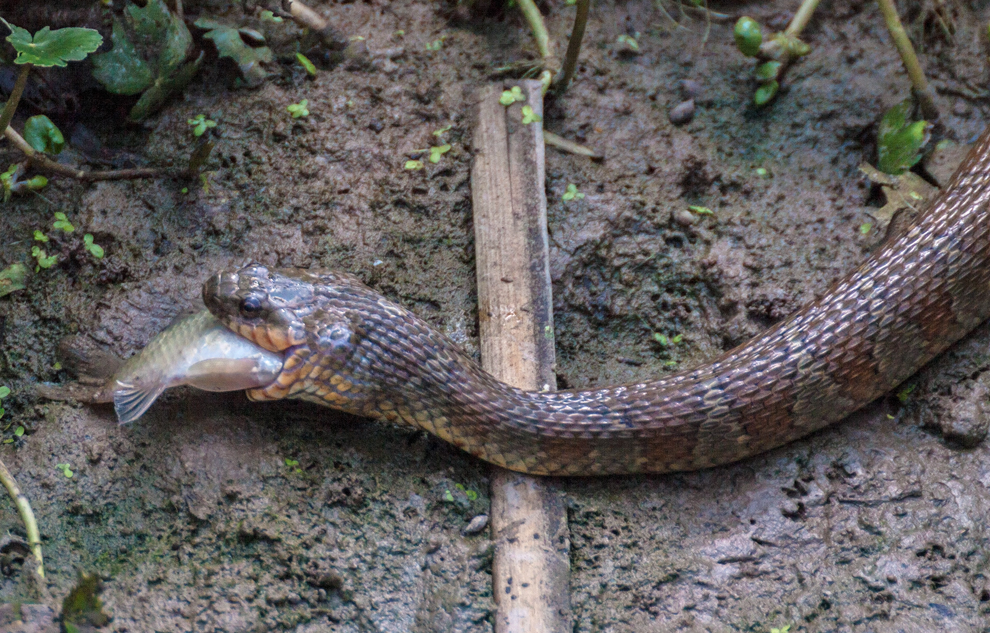
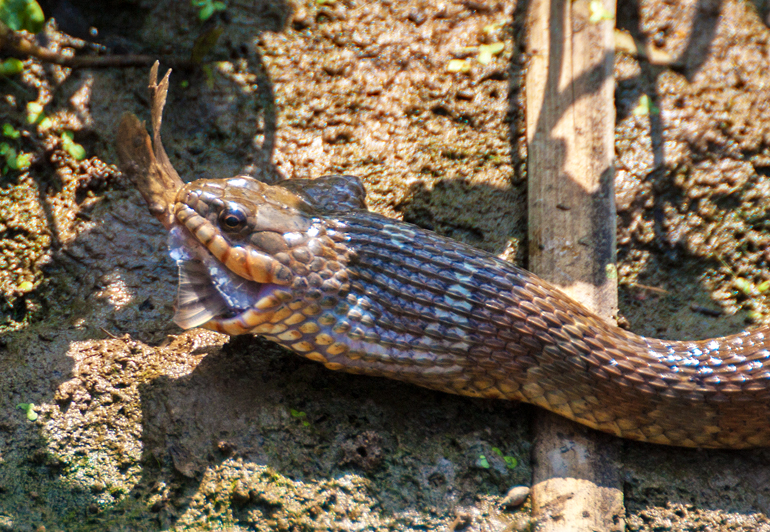
As I was walking along the boardwalk at my local marshland park, I heard some splashing in the shallow, muddy water and was surprised to see a Northern Water Snake (Nerodia sipedon) emerging from the water with a fish in its mouth. I did not see the snake actually catch the fish, but by the time I caught sight of it, the snake already had a firm grip on the head of the fish. I suspect that the snake had moved onto dry land to make certain that the fish had no chance of escaping.

Fascinated and a little horrified, I watched as the snake opened its mouth wider, worked the obviously strong muscles of its throat, and gradually swallowed the small fish. In the series of photos below, you can see how the snake’s head and throat grew larger as more and more of the fish was drawn in.

After the snake finished its meal, it returned to the water and joined two other snakes searching for prey.  At times it looked like they might be working together to push the fish into the shallow water. That may have been my imagination, though, as I noted that the successful snake made no attempt to share his catch with the others.

snake_fish1_blogsnake_fish2_blogsnake_fish3_blogsnake_fish4_blog

© Michael Q. Powell. All rights reserved

Read Full Post »

Soaring summer temperatures have caused the water level in some areas of my marshland park to drop and Northern Water snakes (Nerodia sipedon) can now be seen trolling these shallow waters for prey. Yesterday, in one small area I saw three of these snakes and managed to get shots of two them.

Sometimes the snakes will sit on brush and logs just above the level of the water, as in the first photo, while in other cases they submerge their bodies in the water, with their heads sticking out of the water, as in the second photo.

I like the way that the first image shows the details of the snake’s scales and like how the second photo highlights the marking on the snake’s body (and realize that some folks may find both images to be creepy).

snake2_blogstriped_snake_blog

© Michael Q. Powell. All rights reserved

Read Full Post »

It may be hard for this snapping turtle to climb the ladder of success, when he had such difficulties merely getting himself onto a floating log. It would be understatement to note that Eastern Snapping Turtles (Chelydra serpentina serpentina) are not exactly graceful when they pull themselves out of the water (and even in the water, they seem a bit clumsy).

I read somewhere on-line that snapping turtles—unlike most other turtles—generally do not bask in the sun out of the water. Therefore, I was a little surprised when this turtle swam up to the log and began his attempt to climb onto it. It was like watching a movie in slow motion as he struggled and strained to pull his body up out of the water.

The first image shows him taking a break after making it halfway to his goal. I love the details of his visible front leg and all of his wrinkles. In the second shot, he has achieved his objective and seems to be settling in for an afternoon nap in the sun.

I noted that the log is no longer floating out of the water as it was at the start.—apparently success weighs heavy on the victor.

snapper2_blogsnapper3_blog

Michael Q. Powell. All rights reserved

Read Full Post »

Yesterday, when an Eastern Snapping Turtle (Chelydra serpentina serpentina) crawled onto a floating log, where a much smaller Red-eared Slider (Trachemys scripta elegans) was already basking in the sun, it looked like there might be a showdown.

The two faced off, staring at each other. Despite the size difference, the small turtle did not appear to be intimidated and refused to back off at all. Eventually they both relaxed and decided that peaceful co-existence was the best option.

It turned out that both the log and the sun were big enough to share.

turtles_blog

Click on the photo to see a higher resolution view.

Michael Q. Powell. All rights reserved
Read Full Post »

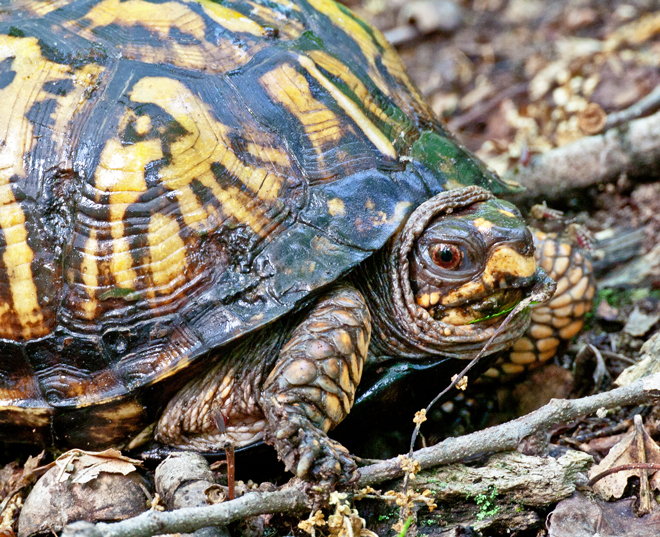
Previously I have seen turtles only in the water or sunning themselves on logs, but this weekend I encountered this cool-looking turtle, which I have identified as an Eastern Box Turtle (Terrapene carolina carolina), while I was walking through the woods.

As I was searching to identify the turtle, I came across all kind of interesting factoids, like the box turtle’s ability to close itself up entirely in its shell and its normal lifespan of 25-30 years. The Eastern Box Turtle is so popular that, according to Wikipedia, it is is the official state reptile of North Carolina and Tennessee.

As for me, I am particularly attracted to its eyes, which somehow remind me of those of Yoda, the Star Wars character.

turtle2_blogturtle1_blog

Michael Q. Powell. All rights reserved

Read Full Post »

Snake eyes are often cold and menacing, but somehow this snake that I encountered yesterday seems to have warm brown eyes that look almost like he is smiling.

This snake, which I think is a Common Garter Snake (Thamnophis sirtalis), was curled up in some underbrush near the edge of the marsh. It was a real challenge getting a clear view of his head, the more so because I was using my 135-400mm lens that has a minimum focusing distance of almost seven feet (two meters).

For this shot, I used my tripod so that I could get an exposure of 1/30 second at f/9, with the lens zoomed out to about 350mm. I like the fact that I was able to capture some of the beautiful texture of the scales on his skin. You can easily see how I had to look for little sight windows through the brush, which is mostly blurred and hopefully is not too distracting. Finally, I am happy that I managed to capture some of the sinuous curves that help to guide the viewer’s eye to the snake’s head.

snake1_blog

Michael Q. Powell. All rights reserved
Read Full Post »

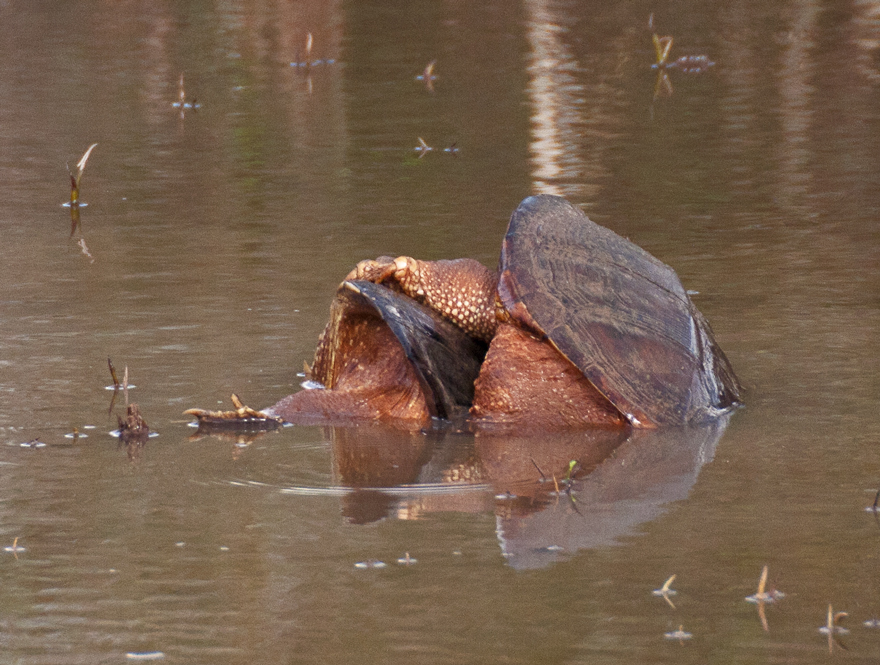
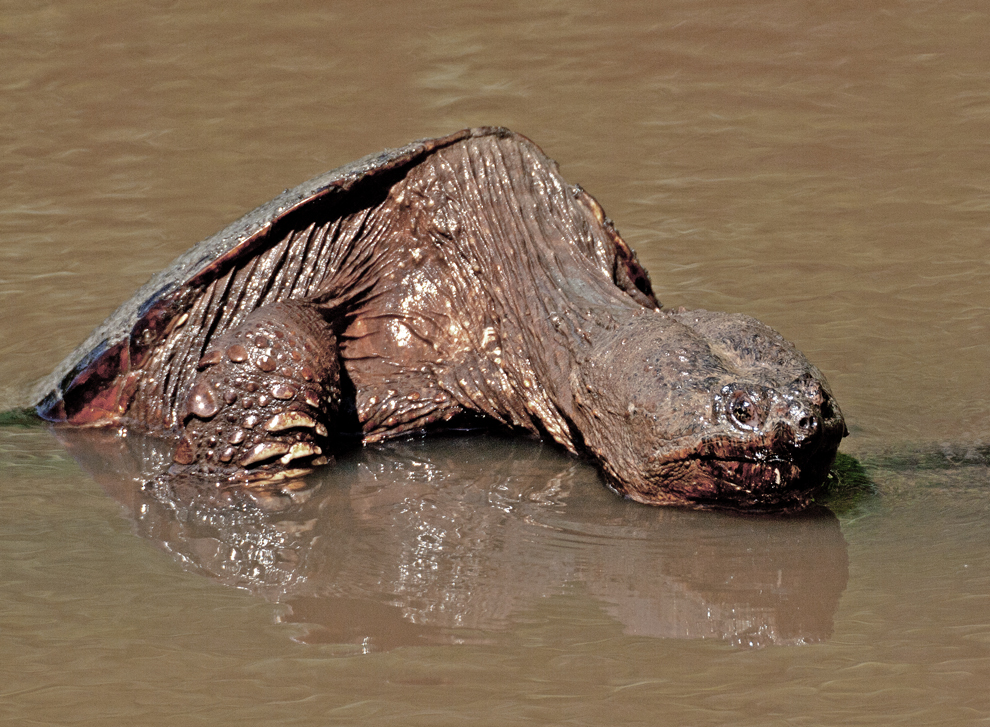
Last weekend I kept seeing snapping turtles in the water with their shells at an angle to the surface. Initially I couldn’t figure out what was going on, until a helpful fellow photographer explained that the turtles were mating.

Mating? That sort of made sense, but I was a little confused, because in each case I could see only a single turtle. Doesn’t it take two to tango? I kept watching and eventually I was able to see that there were two turtles, but one of them was being held underwater most of the time. It seemed pretty violent. On the positive side, it seems that the female did not bite off the male’s head in the process, as praying mantises are said to do while mating.

As I look the photos below, I have trouble identifying body parts and determining which ones belong to which turtle. I don’t understand the anatomy of the Eastern Snapping Turtle (Chelydra serpentina serpentina) and will leave that to the experts.

turtles2_edited-1_blogturtle1_edited-1_blog

Michael Q. Powell. All rights reserved

Read Full Post »

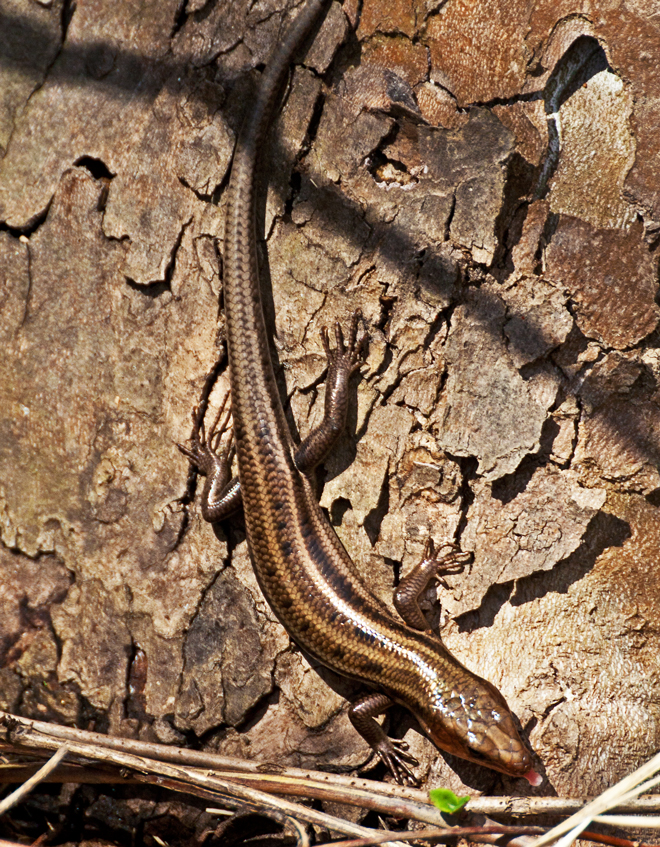
The warmer weather seems to have brought out all of the critters in my marshland park, including what I think is a Common Five-Lined Skink (Plestiodon fasciatus). I don’t often see lizards around here, so I was particularly happy when this one slowly crawled down a tree, permitting me to get this shot.

I wonder why he was sticking out his tongue at me.

skink_edited-1_blog

Michael Q. Powell. All rights reserved
Read Full Post »

When I came across this fairly large snake, which I think is a Northern Black Racer snake (Coluber constrictor constrictor), I was happy that I had a fairly long telephoto lens.

He looked to be about 48 inches long (1.2 meters) and was partially coiled on top of a bush at the edge of the beaver pond at my local marsh. Although he was basking in the sun, he was definitely alert, which was one of the reasons why I was very cautious. The photo provides a close-up view of his head, but it was shot with my zoom lens at about 340mm, so I was not close and personal with him.

Wikipedia notes that this snake usually swallows its prey alive, despite the “constrictor” in its Latin name. Although these snakes will try to avoid predators, “once cornered they put up a vigorous fight, biting hard and often.” I’ll definitely keep that in mind.

One other interesting bit of trivia that I discovered about the Northern Black Racer snake (and I recognize that I could be wrong in my identification) is that the snake was designated as the official state reptile of Ohio in 1995.

snake_blog

Michael Q. Powell. All rights reserved
Read Full Post »

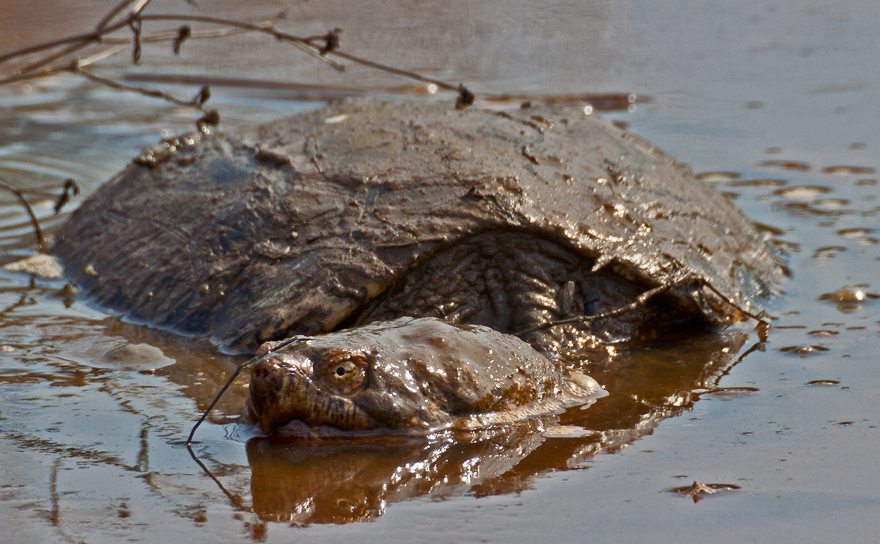
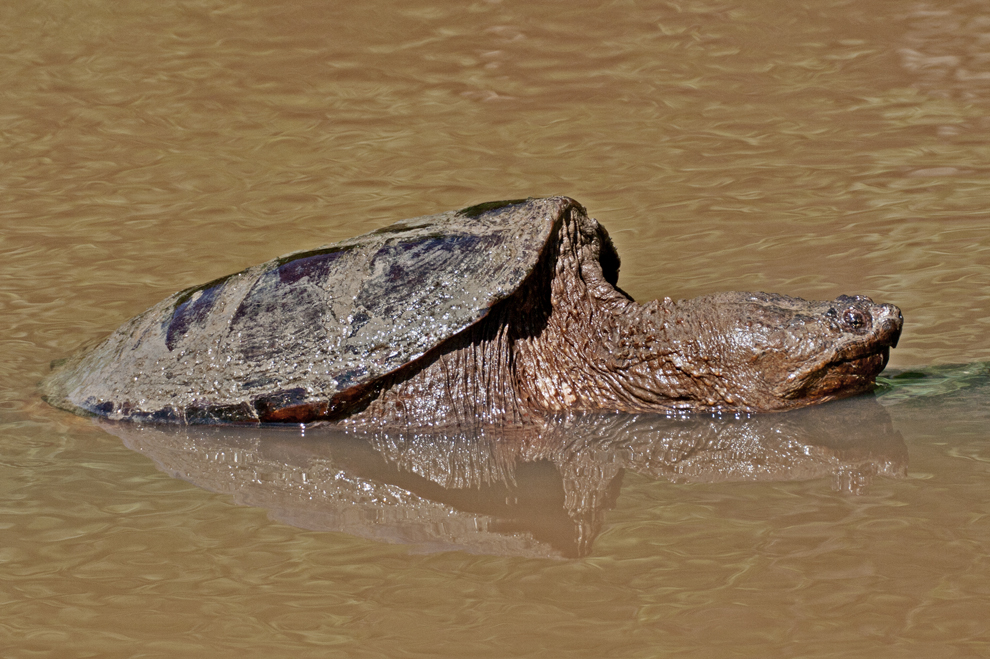
Like prehistoric beasts from another era, the snapping turtles have finally emerged from the mud and the slime of my local marsh.

Painted turtles and Red-eared Sliders have been basking in the sun for weeks now, but it seems like the Eastern Snapping Turtles (Chelydra serpentina serpentina) like for it to be a bit warmer before they start moving. This past weekend I saw quite a few snapping turtles in the marsh, most of them with a lot of mud still piled on the top of their shells, including some pretty big ones. Some of them were floating on the surface of the water, but they don’t appear to bask on land like their smaller counterparts.

I would hesitate to call any of them beautiful or even ruggedly handsome—scarey seems a more appropriate adjective. After reading that snapping turtles are omnivores, I have reconfirmed my desire to keep my distance from these creatures. Thankfully, I have a long telephoto lens.

snapping_blogsnapping2_blog

Michael Q. Powell. All rights reserved
Read Full Post »

A warm day this past weekend brought out the turtles in my local marsh, who lined up on logs to bask in the sun. On some logs as many as a dozen turtles of all sizes were crowded together, but somehow this big Red-eared Slider turtle (Trachemys scripta elegans) managed to get a log all to himself.

In the first photo, he seemed a little annoyed when the sun disappeared behind the clouds, but he quickly resumed his zen-like pose in the second shot, when the sun reappeared.

turtle2_blogturtle1_blog

Michael Q. Powell. All rights reserved

Read Full Post »

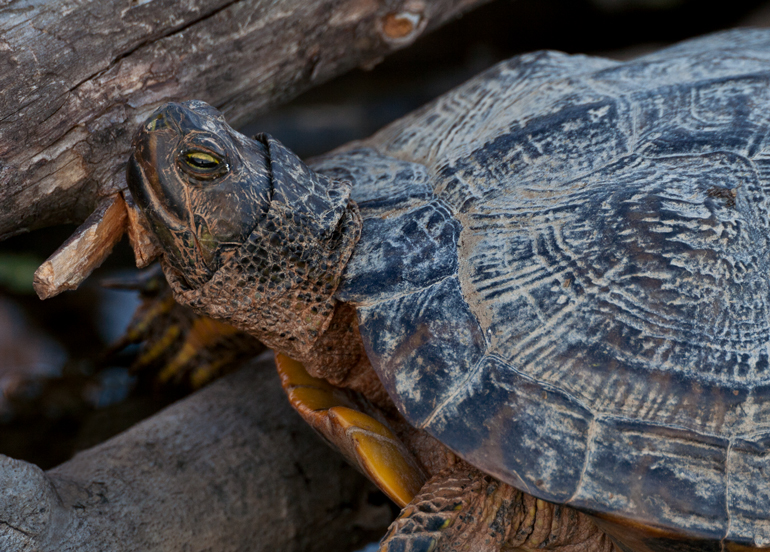
Yesterday I decided to take some close-up shots of some of the turtles sunning themselves at my local marsh.

I am pretty sure that the first one is a painted turtle, but I am not sure if the turtle in the second photo is a different species. I was intrigued by the contrast between the clean, bright colors of the first turtle and the muddy, muted colors of the second one. The turtles were pretty cooperative and let me get close enough to fill the frame of my camera.

It’s not quite warm enough for humans to be sunbathing, but now that spring is officially here, it won’t be long.

turtle1_blogturtle2_blog

Michael Q. Powell. All rights reserved
Read Full Post »

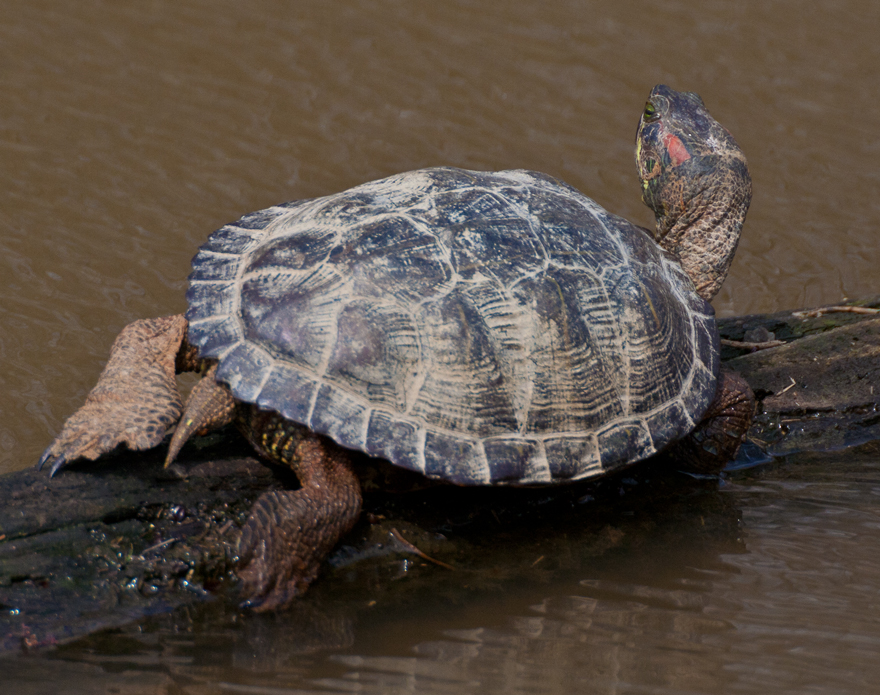
Most of the turtles that I have seen on recent sunny days have climbed out of the water entirely to bask in the sun, but this Eastern Painted Turtle (Chrysemys picta picta) seems to have taken a more tentative approach.

Although he seems poised for a quick reentry into the water, he seemed undisturbed when I approached him to take this photo. The angle of the photo provides a view of the turtle’s torso that I rarely see, and as you can probably tell, I got down pretty low to get the shot.

 I was surprised by the amount of red on his body and the length of his claws. When I saw the claws, I decided not to go for an extreme close-up shot. I can only imagine the newspaper headline, “Wildlife photographer mauled by killer turtle.”

turtle1_blog

© Michael Q. Powell. All rights reserved

Read Full Post »

The weather yesterday was so nice that turtles emerged from the mud for the first time in months to bask on logs and enjoy the warmth of the sun.

My understanding is that the turtles have been spending the cold winter months buried in the mud with their metabolism slowed way down. I would call this state “hibernation,” although there apparently is some argument in the scientific community about whether that term should be reserved for mammals and the term “brumation” used for reptiles, because the physiological processes are different. Whatever you call it, reptiles can move in and out of this state and seem to have moved out of it to soak up some sum.

The turtle in this photo looks like he has not had a lot of time to clean off the mud that fills all of the creases and crevices in his body and shell. He almost looks like he is smiling and he is definitely alert.

Most of the turtles that I have photographed previously at my marshland park have been Red-eared Sliders, but I can’t tell if this one is a member of that species or is a different type. I did note that there is a semi-circular pies missing from both the left and right front areas of the shell. Has something been gnawing on the shell? What would have caused the damage?

I looked around to see if I could see any frogs yesterday, but they are still in their wintering mode. I suspect that it won’t be long before the frogs and snakes are back and I’ll soon be keeping a look-out for my first dragonfly of the season.

turtle1_blog

© Michael Q. Powell. All rights reserved

Read Full Post »

I haven’t seen a frog in a couple of weeks, but the turtles and snakes still make an appearance when the sun is high overhead, seeking somehow to warm themselves in the rays of the sun.

The first shot is a red-eared slider turtle (Trachemys scripta elegans), a type that I have featured before in blog posts. I find them to be amazingly photogenic. In this shot, I particularly love the reflection that he is casting. The blue of the water is a little unusual and reminds me a little of some of Monet’s paintings in which he used a similar blue.
Sunning turtle in the fall

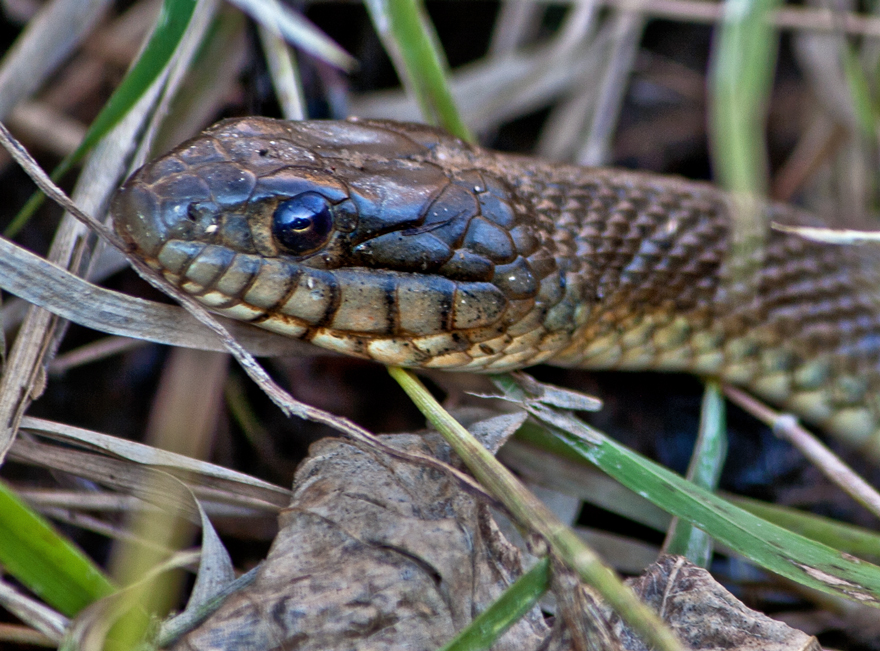
The second image is a head shot of a Northern Water snake (Nerodia sipedon). He was stretched out in a grassy portion of the marsh, probably trying to expose the maximum amount of his body to the sun. I got down pretty low to get the shot and, as you can see, the grass made it difficult to get an unobstructed shot.

Sunning snake in the fall

© Michael Q. Powell. All rights reserved.

Read Full Post »

I often see turtles lined up on branches in the water, basking in the sun. Usually they are arranged as neatly as cars in a parking lot, though occasionally I see them in haphazard patterns or so close to each other that they are touching (I see that in parking lots too, actually). Nonetheless, I really like the configuration of the turtles in this photo, who all appear to be red-eared slider turtles (Trachemys scripta elegans). I find the different positions of the heads and bodies to be interesting and the facial expressions particularly fascinating.

My favorite element, though, is the little turtle near the bottom of the photo, who is mostly in the shade, but has managed to extend his neck to catch a bit of the sun. Do you prefer a different turtle?

Turtles in the sun

© Michael Q. Powell. All rights reserved.

Read Full Post »

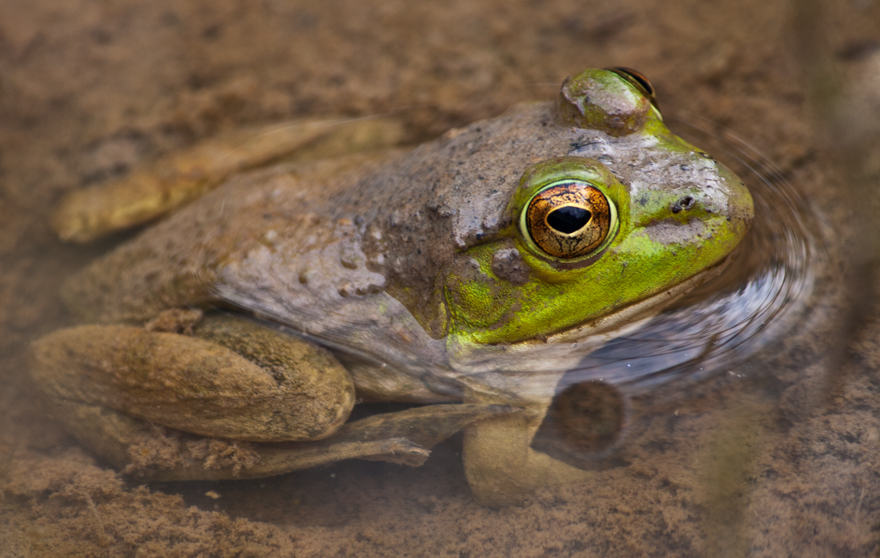
I have a confession to make—I really like to photograph little green frogs. Maybe it’s the influence of Kermit the Frog on my perceptions, but, whatever the reason, there seems to be something whimsical about frogs. Like this little frog that I photographed yesterday, they appear to have a perpetual half-smile, as though they find this world to be unceasingly amusing.

It brings to mind one of my favorite movies scenes, the opening sequence of The Muppet Movie, in which the camera gradually zooms in on Kermit, sitting on a log in the swamp and playing the banjo. The words of the song he is singing express the kind of eternal optimism to which I aspire, “Someday we’ll find it, the Rainbow Connection, the lovers, the dreamers and me.” (Here’s a link to the video of that scene on YouTube—I highly recommend that you take a couple of moments to relax with it, especially if you’ve never seen it before.) With all of the cares of everyday life, it’s hard to be a dreamer, it’s tough to see hope in rainbows, it’s not easy to see whimsey in frogs. It’s my hope, though, that we all can maintain (or rediscover) that child-like optimism about our world.

Fall frog

© Michael Q. Powell. All rights reserved.

Read Full Post »

What do turtles think about? When I came upon this red-eared slider turtle (Trachemys scripta elegans), that was my first thought. Perched at an angle on a branch, the turtle seemed to be lost in contemplation. His eyes looked out over the expanse of brown, muddy march water, but he seemed inwardly focused.

Maybe this is a form of turtle yoga.

Pensive turtle

© Michael Q. Powell. All rights reserved.

Read Full Post »

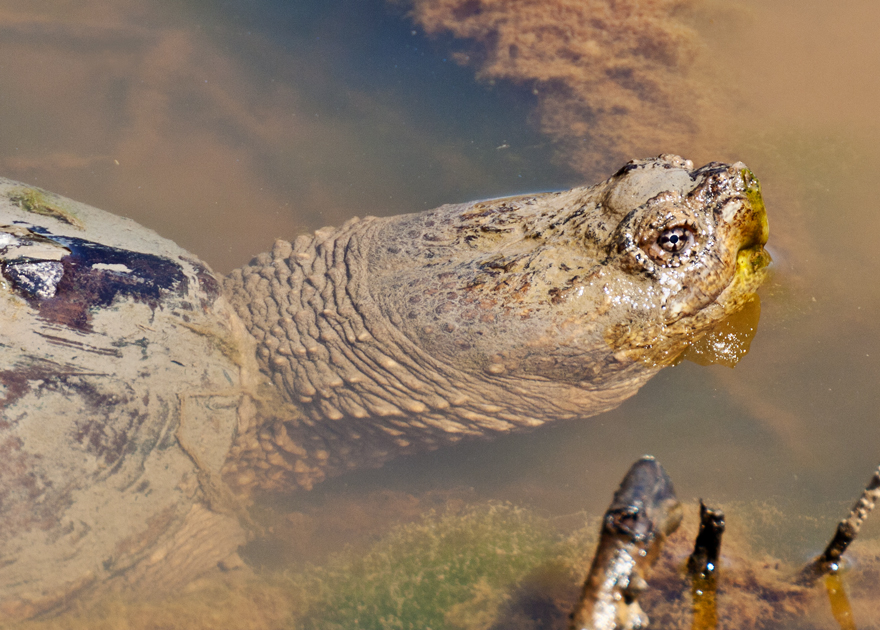
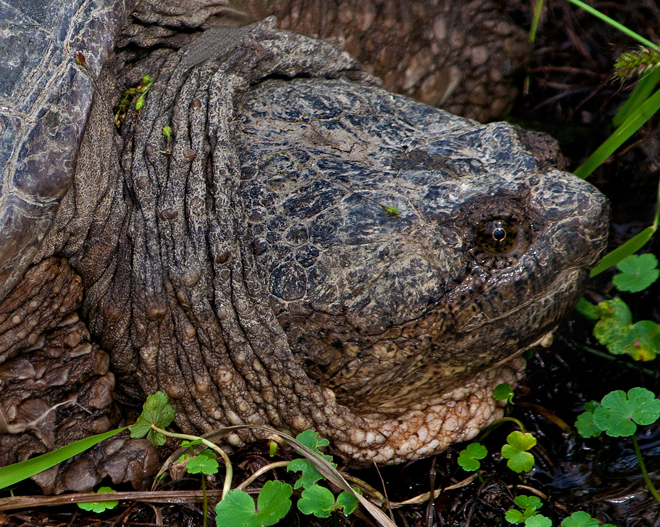
This summer has been a dry one and the recent fall rains have not done much to replenish the water in the local marshes. Recently I came across this snapping turtle in a sunny area relatively far from the water. The turtle looked like he was starting to dry out a little and I feared that he might be trouble. Fortunately, when I came back a little later, he had disappeared, presumably to another location with water, or at least shade.

I love the amazing texture of the neck area and even the head of the snapping turtle. I considered doing this photo in black and white to emphasize that texture, but would have lost the beautiful gold circles in his eyes and the green of the plants that make a semi-circle around his face.

When I gaze into the eyes of this snapping turtle, I am reminded of Yoda, the wizened sage of Star Wars, who had seen a lot during his nine hundred years. The turtle also seems to have the bemused, yet sad expression on his face that Yoda displayed when he was trying to train the young, impatient Luke Skywalker and said these words:

“Ready are you? What know you of ready? For eight hundred years have I trained Jedi. My own counsel will I keep on who is to be trained. A Jedi must have the deepest commitment, the most serious mind. This one a long time have I watched. All his life has he looked away… to the future, to the horizon. Never his mind on where he was. Hmm? What he was doing. Hmph. Adventure. Heh. Excitement. Heh. A Jedi craves not these things. You are reckless.”  (quote from imbd.com)

Snapping turtle on dry land

© Michael Q. Powell. All rights reserved.

Read Full Post »

Basking in the warmth and light of the fall sun, turtles of all sizes were perched on the logs and other chunks of wood in the muddy waters of a local marsh pond. I was struck by the attitude of this red-eared slider turtle (Trachemys scripta elegans), whose stiff-necked and imperious pose seemed almost aristocratic. He had gained this prime piece of real estate by crawling over one of his fellow turtles and was now standing on that turtle’s back to provide himself better access to the sun.

I have to admit that he is beautiful and I suspect that he would be the first to tell me so if he could speak.

Red-eared slider turtle basking in the sun

© Michael Q. Powell. All rights reserved.

Read Full Post »

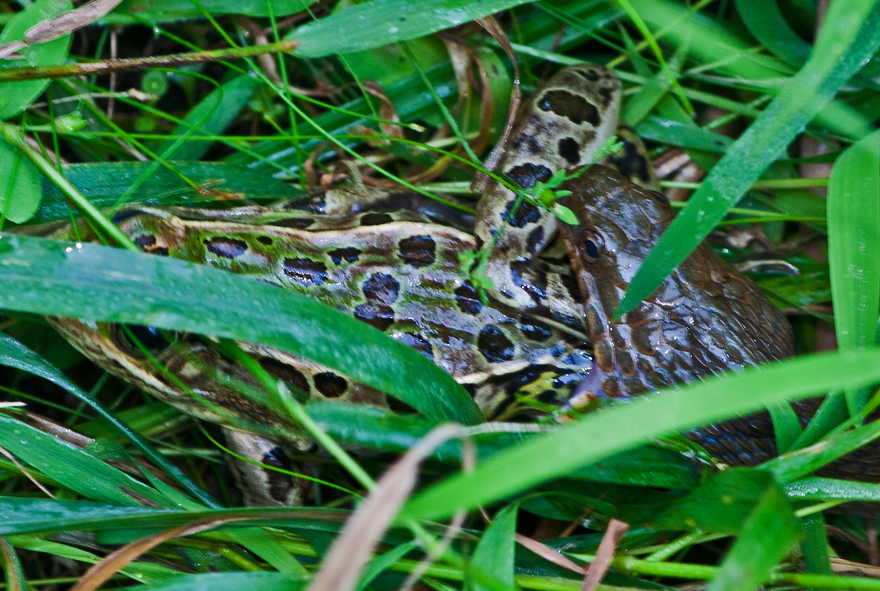
Walking along a boardwalk in the center of a marsh, I suddenly heard a sound that I had never heard before, a strange and eerie squeak. I had no idea of the source of the sound, but a man who was walking by with his family pointed it out to me. It was a frog that had been captured by a snake and was slowly being swallowed whole.

I leaned over the edge of the boardwalk and tried to take some shots of this terrifying spectacle, but there was too much grass between me and the two protagonists in this drama for me to get a really clear shot. The shot below shows the snake working to get past the frog’s hind legs. As you can see, the snake is swallowing the frog beginning with the legs. In a previous post, I showed a green heron swallowing a frog. The heron slid the frog down his throat in a single gulp beginning with the head. The process with the snake was more protracted and therefore more gruesome.

Eventually it was over. I continued on with my day, feeling a mixture of awe and horror for what I had just witnessed.

Frog being swallowed by a snake (click for higher resolution)

© Michael Q. Powell. All rights reserved.

Read Full Post »

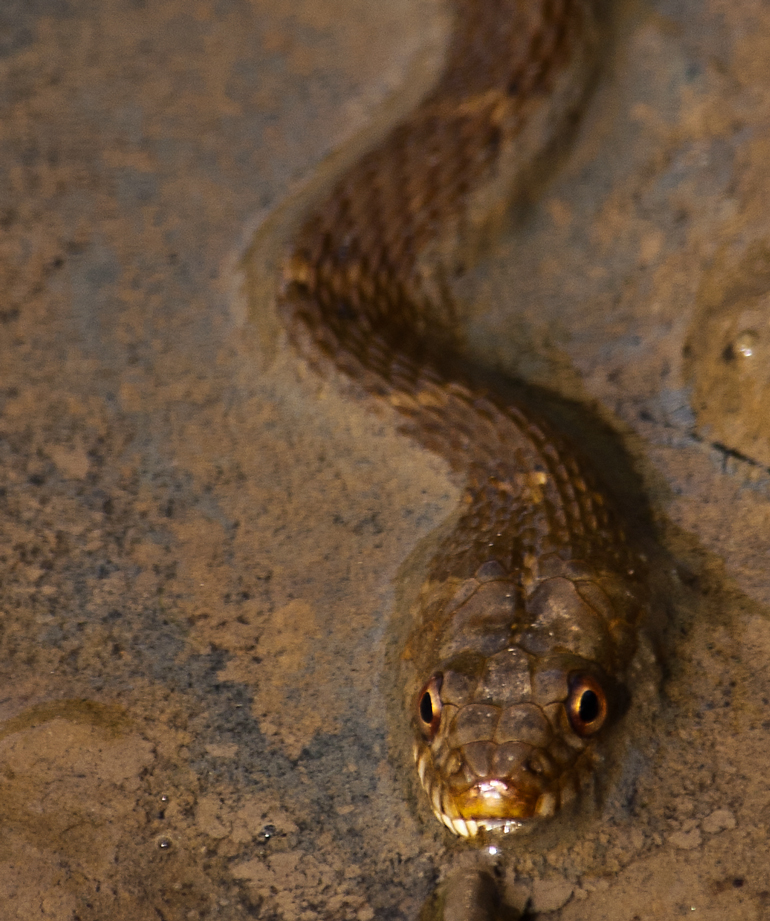
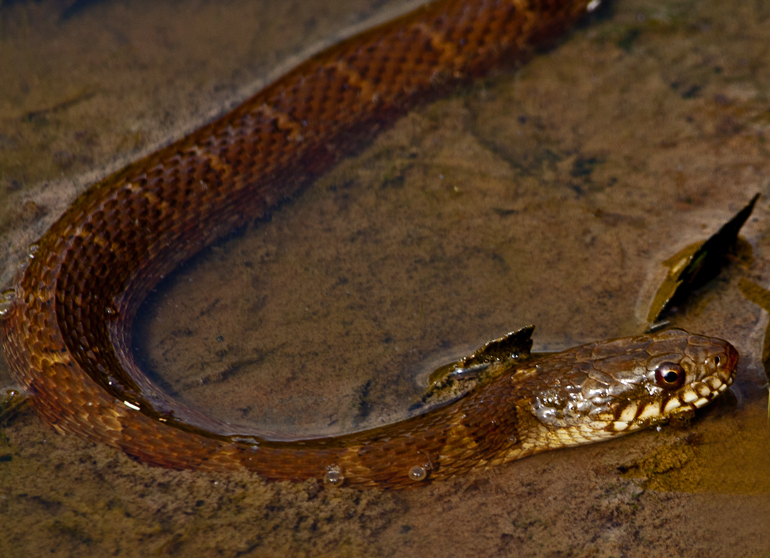
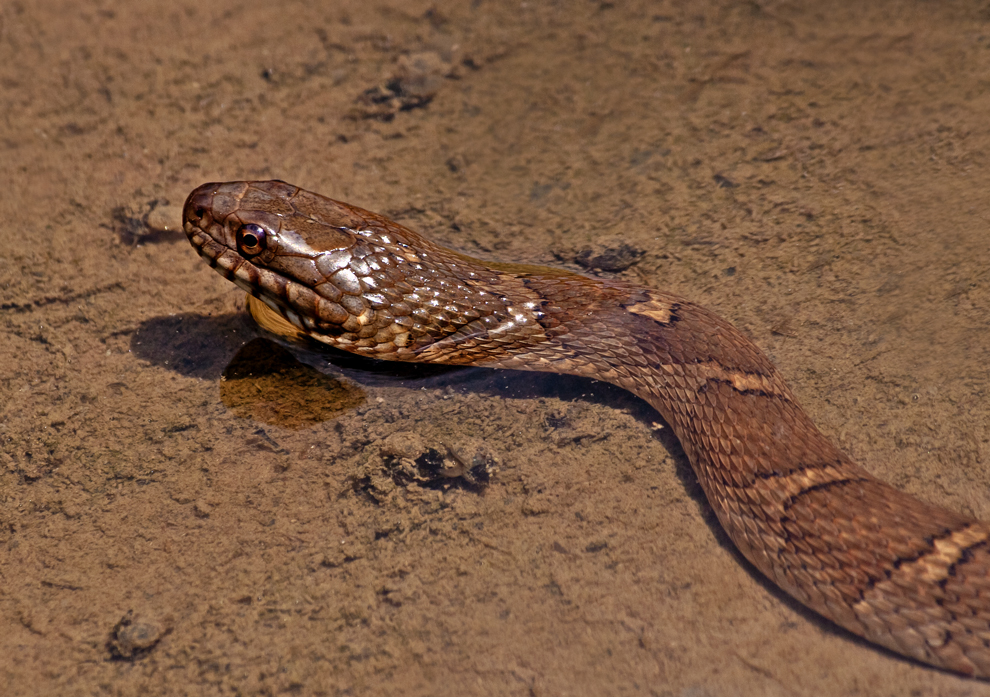
Throughout this dry summer, the water level in the marsh area of Huntley Meadows Park has continued to drop. I was shocked to see how low the levels were today. In an area where the water had previously been deep enough to support large snapping turtles (an open area outside of a beaver lodge), I now saw snakes, at least four or five of them. They were swimming in the shallow water and even burrowing into the soft mud in search of food. I am pretty sure they were all Northern Water snakes (Nerodia sipedon), a fairly large, non-venomous snake.

Face-to-face with a Northern Water snake

As I was watching the snakes, a couple came by and they said that they sometimes like to pick up these kind of snakes, examine them, and then release them. In passing, they mentioned that the snakes will bite hard and will release musk when handled. I don’t know why they thought I wanted to play with the snakes (trust me, I had no such desire), but they warned me not to be surprised if the bite wound bled a lot. According to the Wikipedia article on Northern Water snakes, the snake’s saliva contains a mild anticoagulant.

Northern Water snake, full-body shot

I did not see the snakes catch any prey, but the Wikipedia article states that during the day they hunt among plants at the water’s edge, looking for small fish, frogs, worms, leeches, crayfish, salamanders, birds, and small mammals. At night, they concentrate on minnows and other small fish sleeping in shallow water.

Northern Water snake focusing on a potential prey

One other interesting fact about the Northern Water snake is that—unlike many other snakes—they do not lay eggs. According to one academic article, the mother carries the eggs inside her body for three to five months and, on average, gives birth to 26 babies, each about 7-9 inches long. Once they are born, the babies are on their own; the mother does not care for them at all.

© Michael Q. Powell. All rights reserved.

Read Full Post »

« Newer Posts - Older Posts »