Feeds:
Posts
Comments

Archive for the ‘Reptiles’ Category

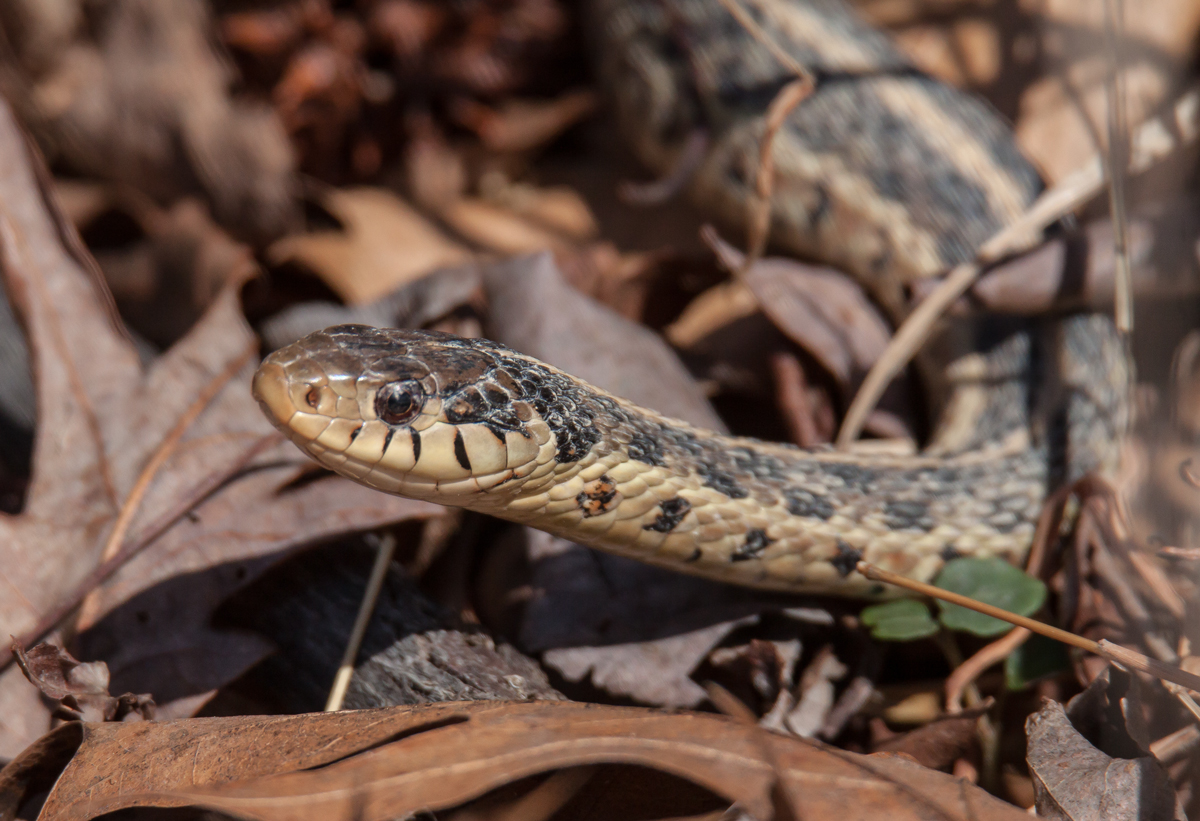
This past Monday as I was exploring Huntley Meadows Park with fellow photographer Walter Sanford, he spotted an Eastern Garter Snake (Thamnophis sirtalis sirtalis). We both like to photograph snakes, so we sprung into action. Following my normal instincts, I moved in close to the snake. How close did I get? At a certain point in time I actually had to back up a little to make sure I included the snake’s entire head in the image.

Some readers of this blog may recall that Walter and I use different camera systems and approach our shots in different ways, partly because he is using a zoom lens and I am often using a macro lens with a fixed focal length. If you shoot side by side with another photographer, you’ll often get the same shots, but that’s usually not the case for Walter and me. We normally choose different angles of view and frame our shots differently—I am usually the one sprawled on the ground.

Walter and I have shot together often enough that he knows the “tricks” that I employ when shooting. From my earliest days, my photography mentor Cindy Dyer emphasized to me the importance of using a tripod. Frequently I carry a tripod with me, but for low-angle shots, I prefer to use my camera bag as a kind of improvised tripod to help steady my camera. In the past month I have used this techniques with varying subjects including a jumping spider and a beaver. Special thanks to Walter for allowing me to use one of the photos he shot of me in action with my improvised tripod.

The snake was amazingly tolerant of our presence. Unbelievably it stayed in place when I moved a stalk of grass next to its head that was getting in the way of a clear shot. The first shot below was shot with my improvised tripod and was not cropped at all. The other two shots, I believe, were handheld and cropped slightly, because the snake had changed positions and I did not have the luxury of stabilizing my camera. In all cases I tried to focus on the snake’s eye and I really like the way that I managed to capture a reflection in the eye.

Walter will soon be posting a companion post that I will reblog, so that you can contrast the images that we captured when shooting the same subject together.

Eastern Garter Snake

alternative tripod

Using my camera bag as an improvised tripod (Photo by Walter Sanford)


Eastern Garter Snake

He’s got lips like Jagger

Eastern Garter Snake

Environmental portrait of a garter snake

© Michael Q. Powell. All rights reserved.


Read Full Post »

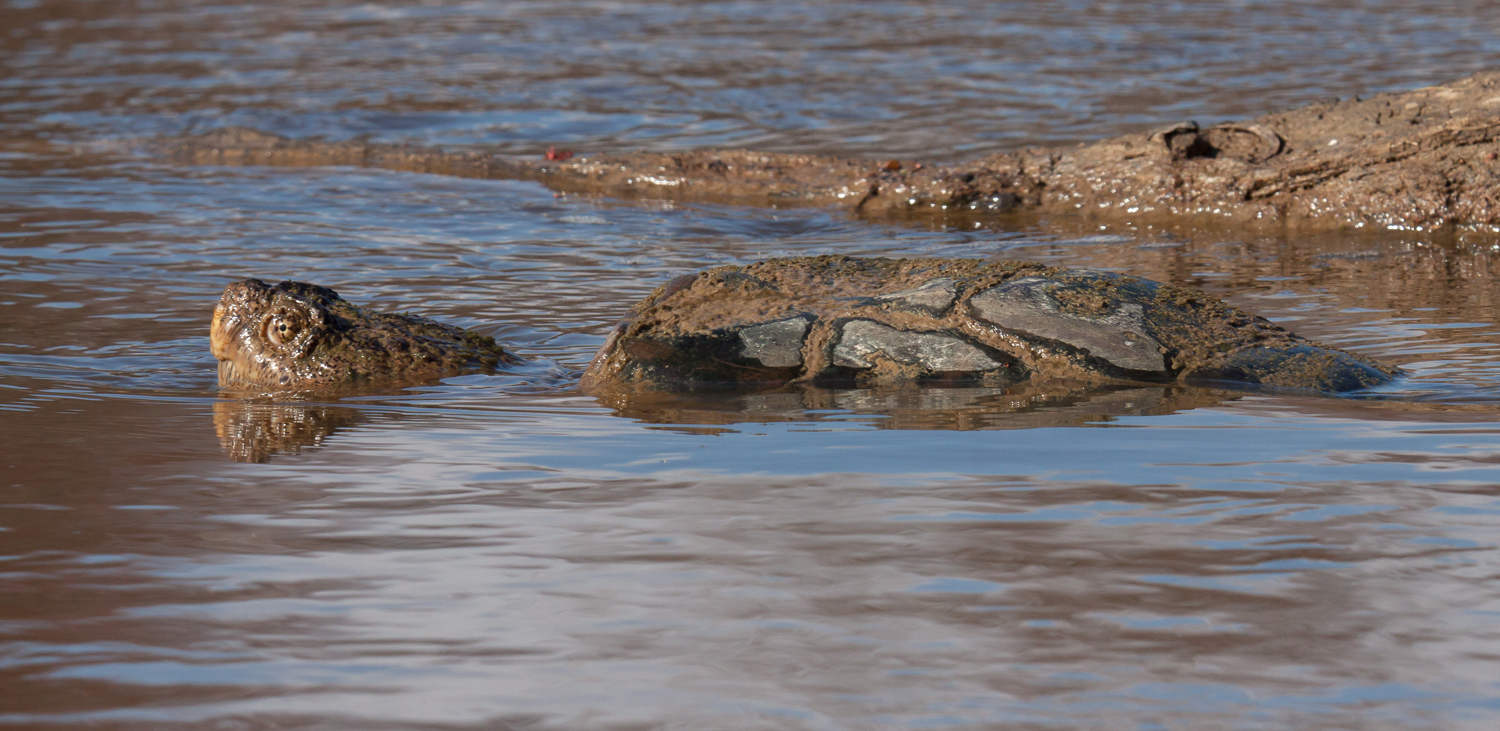
I was a little surprised when an unusually shaped mound of dirt slowly began to move in the shallow waters of a muddy pond at Huntley Meadows Park. When it raised its massive head, I realized it was an Eastern Snapping Turtle (Chelydra serpentina serpentina) newly arisen from the bottom of the pond.

The extra weight of the mud on its back didn’t seem to affect the turtle’s swimming ability—it must be nice to be so big and strong.

Snapping Turtle

© Michael Q. Powell. All rights reserved.

Read Full Post »

With our recent warm weather, turtles have risen from the mud at Huntley Meadows Park.  Sunning turtles are now vying for space on logs that are more crowded than a mall parking lot on Black Friday.

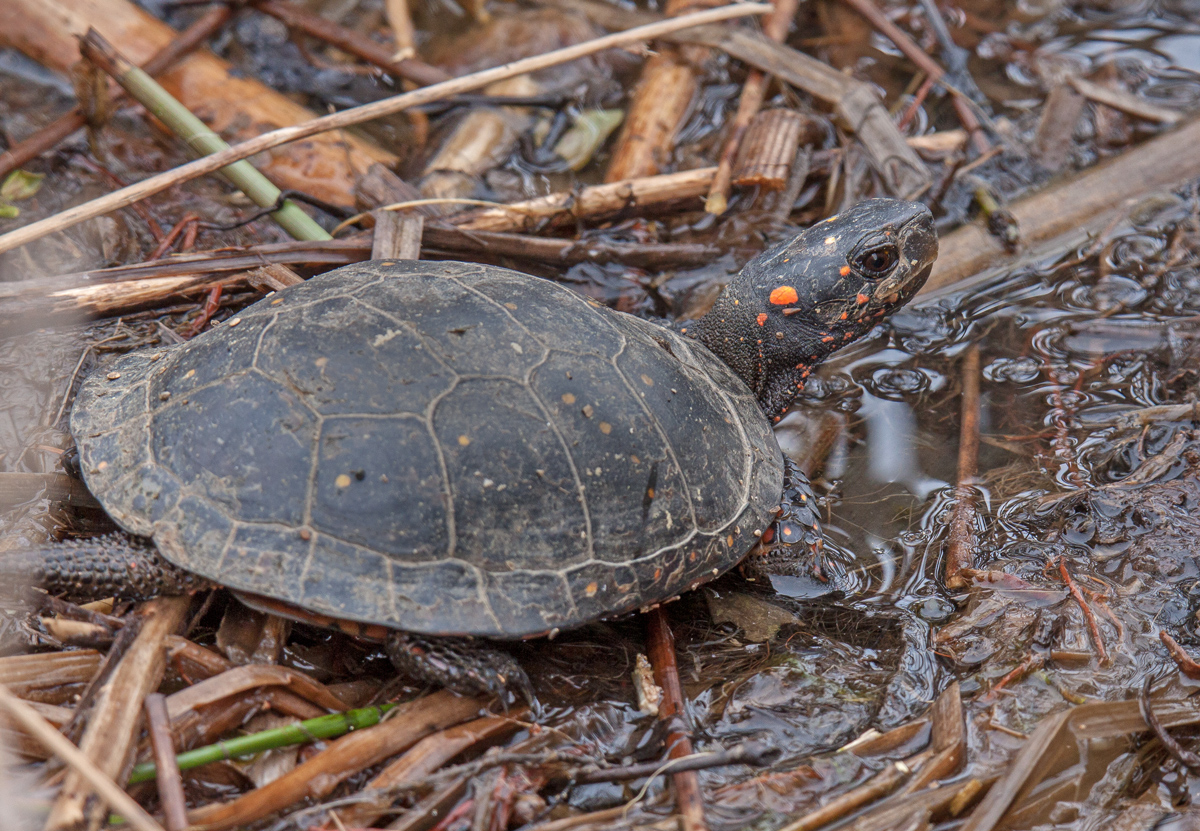
On Monday, a Spotted Turtle (Clemys guttata) tried a different approach. He slowly clawed his way up out of the water onto some vegetation amid the cattails and assumed an almost vertical perch.

Who needs a log?

Spotted Turtle

© Michael Q. Powell. All rights reserved.

Read Full Post »

As I was wandering about Huntley Meadows Park this morning, I came upon the remains of an Eastern Snapping Turtle (Chelydra serpentina) that quite obviously did not survive the winter. It looks to have been in place for quite some time not far from the water’s edge of a stream in a remote area of the park.

I don’t know if a predator consumed its flesh, but it looks like a lot of the bones were scattered around the skull of the turtle, as you can see in the first photo. I move the shell to nearby location to get shots of the the top and underside and also took a close-up shot of the skull.

Snapping Turtle

Snapping Turtle remains in situ

Snapping Turtle

Detailed view of the top of the shell

Snapping Turtle

Detailed view of the underside of the shell

Snapping Turtle

Detailed view of the skull

© Michael Q. Powell. All rights reserved.

Read Full Post »

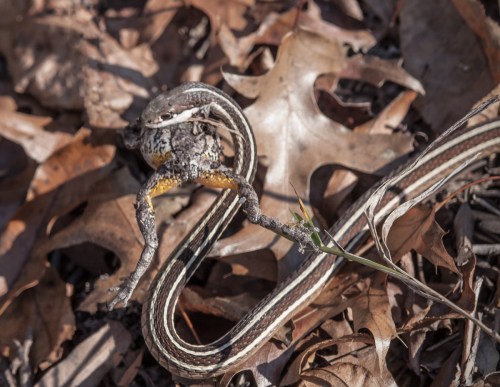
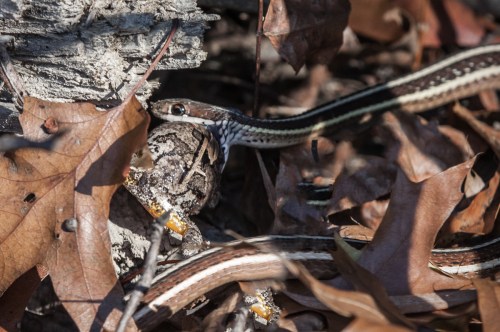
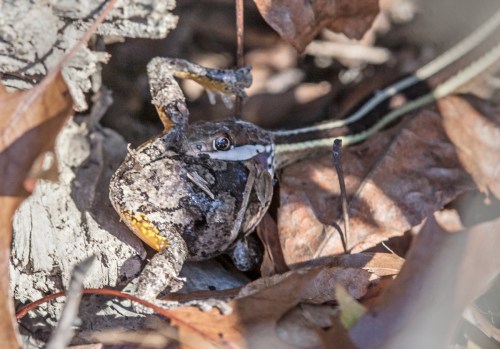
How is it possible to sneak up on a frog and grab it with such force that it is unable to escape as you slowly swallow it headfirst while it is still alive? With a mixture of horror and fascination, I witnessed part of the process yesterday when I spotted an Eastern Ribbon Snake (Thamnophis sauritus sauritus) that had captured a Gray Treefrog (Hyla versicolor).

I was walking through the vegetation at the edge of a field when I spotted a part of the body of the ribbon snake. I moved closer as my eyes traced the body of the snake as I searched for its head. When I spotted the head from a distance, I was confused—it was enlarged like that of a hooded cobra and it was swaying back and forth. What was going on?

I slowed down and gradually came to realize that the snake had a struggling frog in its mouth and was holding it in the air so that the flailing legs had nothing to grab onto for leverage. The frog seemed so much bigger than the snake’s head that it seemed almost impossible that the snake could swallow it.

The snake slithered a short distance away with its partially swallowed prey and continued the process. I managed to get a glimpse of the astonishing extent to which the snake can open its mouth before the disappeared disappeared under a pile of wood to enjoy its meal in peace.

Initially I couldn’t identify the frog, but my good friend Walter Sanford made an initial identification and pointed me to the website of the Virginia Herpetological Society. I carefully read the information there and have concluded that the frog is probably a Gray Treefrog (Hyla versicolor), although it is possible it could be a Cope’s Tree Frog (Hyla chrysoscelis). “Our two native gray treefrogs are identical in appearance. In the field the only two ways to distinguish H. chrysoscelis from H. versicolor is by their call and in some cases geographic location.”

I was particularly struck by the bright orange color on the hind legs of the frog. Wikepedia notes that both of the potential species have bright-yellow patches on their hind legs, which distinguishes them from other tree frogs and that “the bright patches are normally only visible while the frog is jumping.” Obviously the situation I witnessed is not “normal,” so I was able to see the colors, even though the frog was obviously not jumping.

I’ve included a small series of shots to give you a sense of the situation. They were all shot handheld with my Tamron 180mm macro lens.

Gray Treefrog

Gray Treefrog

Gray Treefrog

Gray Treefrog

Gray Treefrog

© Michael Q. Powell. All rights reserved.

Read Full Post »

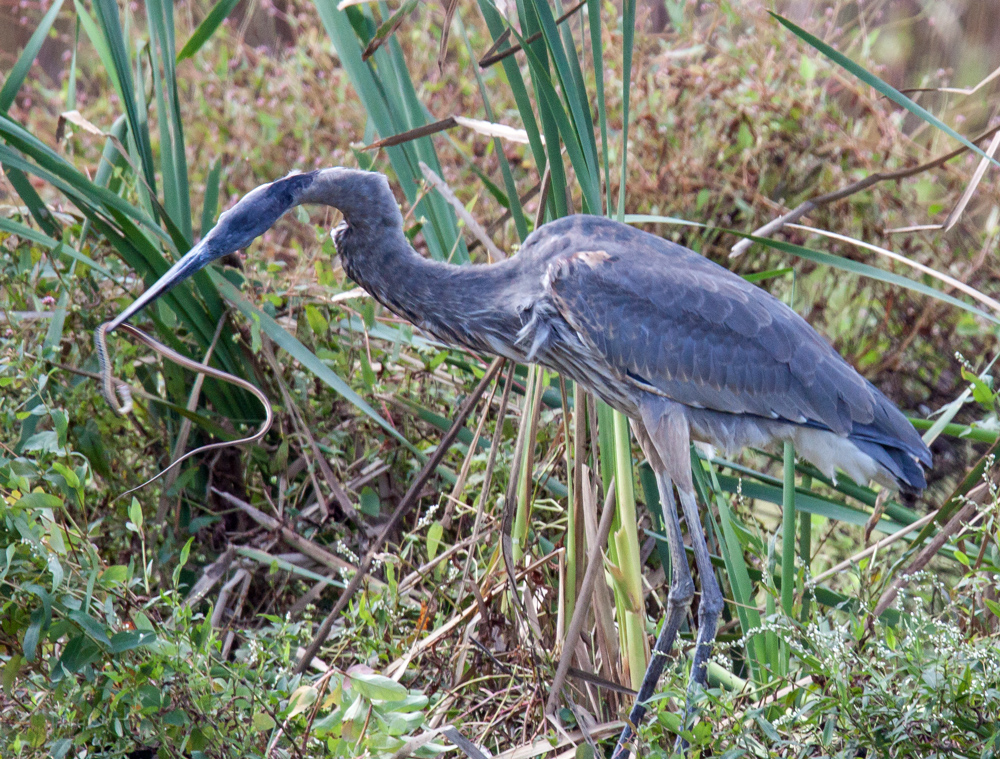
A snake struggled mightily when snagged by a Great Blue Heron (Ardea herodias). The heron looked a little confused by the actions of its prey and seemed to be having trouble figuring out how to grip the snake. I was a bit far away when I took these shots so I couldn’t tell for sure, but it looked to me that the heron eventually dropped the snake and the snake escaped into the thick vegetation.

Great Blue Heron

Great Blue Heron

Great Blue Heron

Great Blue Heron

© Michael Q. Powell. All rights reserved.

Read Full Post »

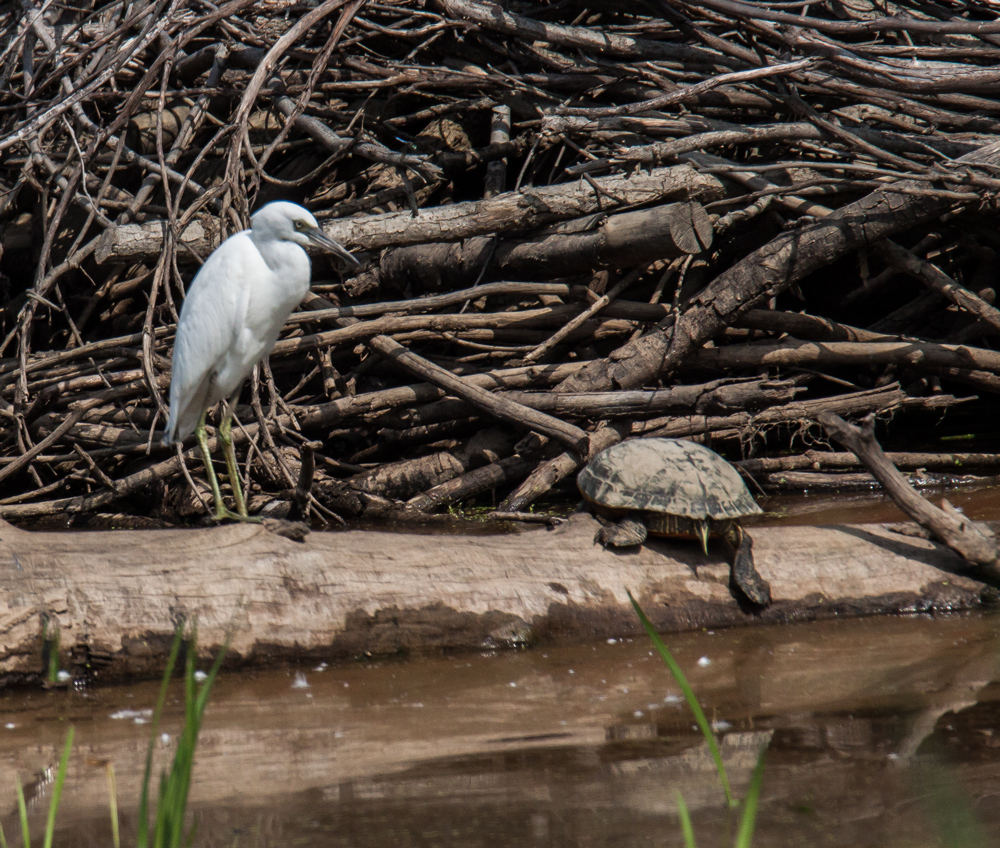
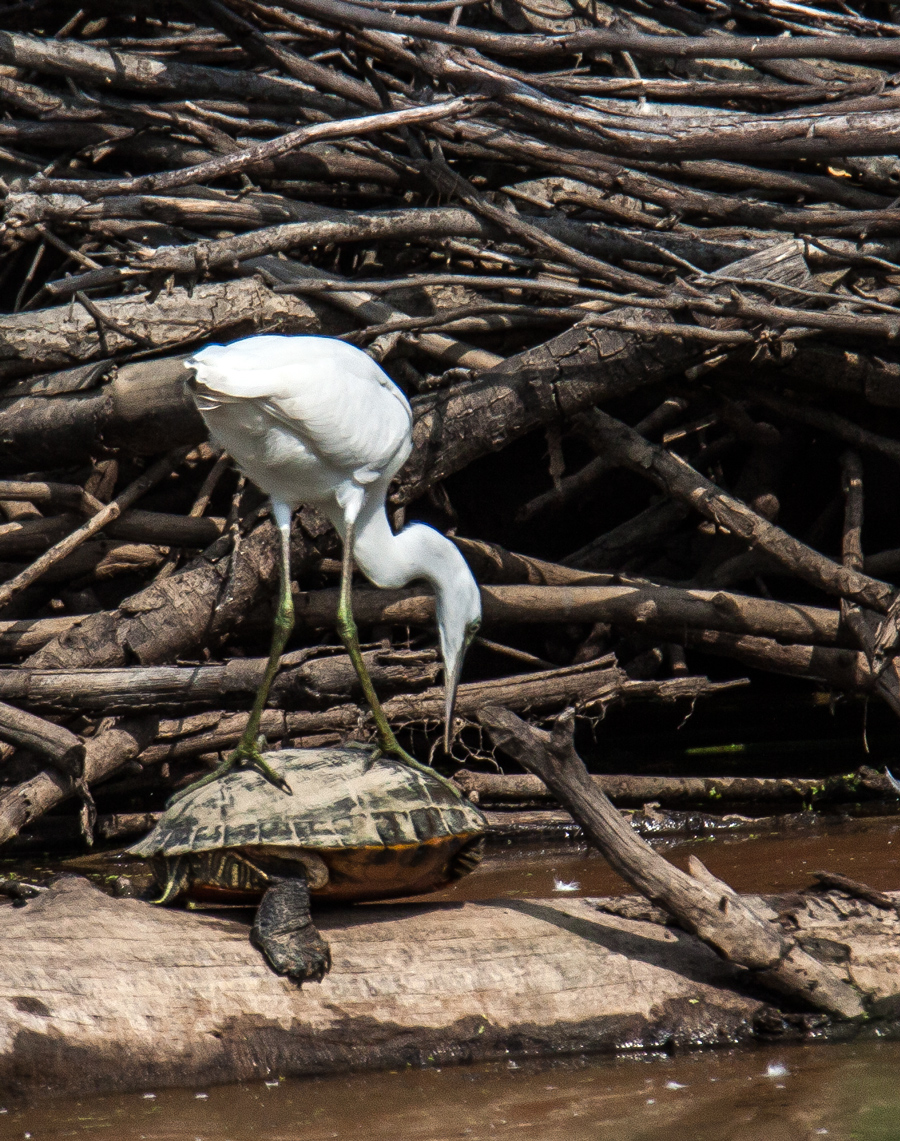
As I watched through my telephoto lens last Friday, one of the juvenile Little Blue Herons (Egretta caerulea) at Huntley Meadows Park became increasingly curious about the turtle with whom it was sharing a log. The heron moved closer and closer and finally jumped on top of the turtle. I was shocked to see the heron then put its face mere inches from that of the turtle.

This past month, a group of four or more juvenile Little Blue Herons has taken up residence at my local marshland park. When I first saw them, I assumed they were Great Egrets, because of the bright white coloration. However, the bills are a different color than those of the egrets. I am hoping that the Little Blue Herons hang around long enough for us to see them change into the blue color for which they are named.

I managed to take a series of shots of the encounter between the heron and the turtle. I initially thought it was a snapping turtle, but one of the folks who saw a photo I posted on Facebook thinks it might be a slider of some sort, a Red-eared Slider (Trachemys scripta elegans), I would guess after taking a closer look at the second image.

Little Blue Heron

Initially the heron eyed the turtle from a distance.

Little Blue Heron

Then he decided to get a closer look.

Little Blue Heron

Feeling bold, he placed one foot on the turtle…

Little Blue Heron

…and jumped on top of the turtle.

Little Blue Heron

His curiosity still not yet satisfied, the heron leaned in for a face-to-face encounter. (Note that the turtle has retracted one of its front legs.)

© Michael Q. Powell. All rights reserved.
Read Full Post »

When a Northern Watersnake (Nerodia sipedon) sensed my presence at the edge of a pond this weekend at Meadowlark Botanical Gardens, it began to swim right at me. As the snake grew larger and larger in my viewfinder, I assumed it would veer off. I was wrong. The snake actually came out of the water and I captured this first shot of the triumphant snake who forced me to back away.

Northern Watersnake

Initially the snake was swimming lazily in the shallow water of the pond, seemingly basking in the warm of the midday sun.

Northern Watersnake

Suddenly the snake turned its head and looked straight at me. It did not look amused.

Northern Watersnake

The snake started to flick its forked tongue and began to swim rapidly through the vegetation that separated us.

Northern Watersnake

A part of my brain certainly understood that the snake was not as close as it looked in my telephoto zoom lens, but a more instinctive, primordial part of the brain kicked in when the snake started to fill the viewfinder. I know that this kind of snake is not poisonous and that I had nothing to fear, those rational thoughts were crowded out by the emotional responses that screamed at me that I needed to back away.

I honestly did not expect the snake to come out of the water and it happened so fast that I am not sure how it did it. The snake seemed to propel itself out of the water in a jump. Once it was on terra firma, the snake assumed the confrontational pose that you see in the first photo.

This round goes to the snake.

© Michael Q. Powell. All rights reserved.


Read Full Post »

When you can see your own reflection in an eye, you know that you have managed to get really close to a subject, in this case an Eastern Box Turtle (Terrapene carolina carolina) that I encountered this past week while walking through the woods at my local marshland park.

Of course, it is equally possible that I am imagining things and the reflections are merely those of the trees and the sky. In either case, I really like the isolated, almost abstract view that I managed to get of the eye of the turtle.


Eastern Box Turtle

© Michael Q. Powell. All rights reserved.

Read Full Post »

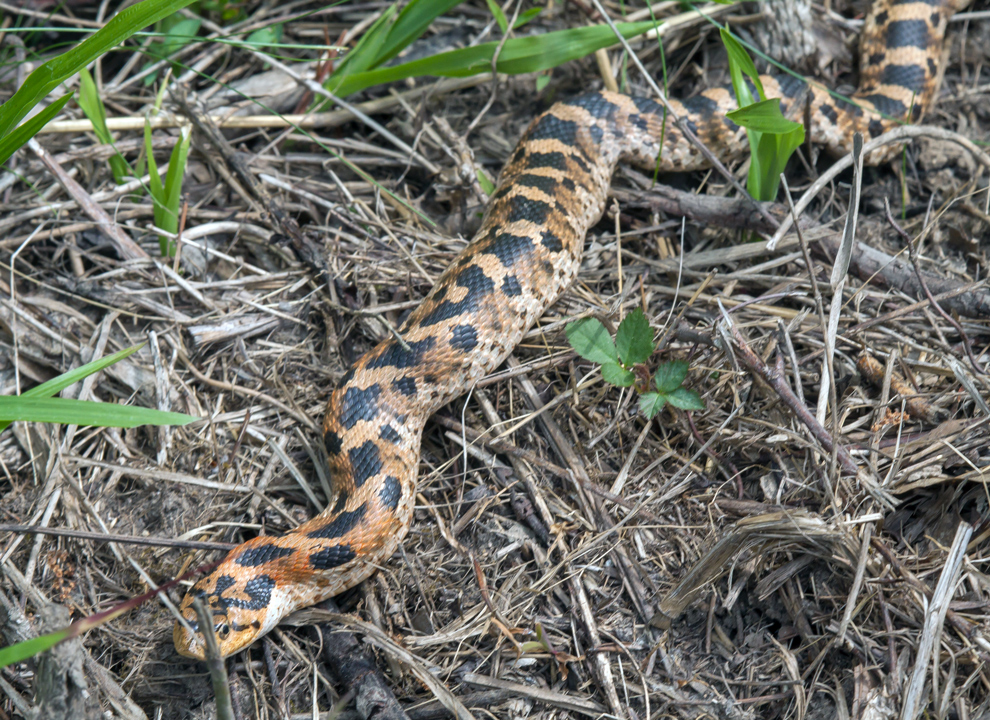
Most of the snakes that I encounter at my local marshland park blend in well with their surroundings, but the one that I almost literally stumbled on this past Monday in one of the park’s meadows was a notable exception—it was bright orange in color.

I had never before seen a snake that looked like this one and moved as close as I could to get a shot of its head with my macro lens. (During this time of the year I tend to have my 180mm macro lens on my camera much of the time.) The snake was cooperative when I was taking the close-up shots. However, after I backed up to try to get a shot of its whole body, the snake decided that enough was enough and slithered away quickly into the underbrush. I managed to get only a single body shot that has a partially obscured head, but I included it to give you an overall view of the snake.

I searched around several websites about snakes in Virginia and have concluded that this is probably an Eastern Hognose snake (Heterodon platirhinos. These snakes come in a variety of colors and I didn’t find too many photos of them with this exact coloration, but I did find several references to an “orange phase.”

I continue to be amazed at the diversity of wildlife that I find in Huntley Meadows Park—I have been going there regularly for several years now, but continue to find to find new and different creatures. It sure helps to keep  me motivated to hit the trails in a constant state of excited expectation with my camera in hand.

Eastern Hognose snake

Eastern Hognose snake

© Michael Q. Powell. All rights reserved.
Read Full Post »

As I looked intently through my long telephoto lens at the stagnant, debris-filled water in a ditch, I became acutely aware of bright red eyes staring back at me. What was this unusual red-eyed marsh creature?

Eastern Box Turtle

Pulling my eyes away from the magnified view in the camera’s viewfinder, I could see the contours of a turtle’s shell in the water, partially obscured by all of the debris. The bright color and distinctive shape of the shell and the striking red eyes made it easy to determine when I got home that this is a male Eastern Box Turtle (Terrapene carolina carolina).

Eastern Box Turtle

Although these turtles spend most of their time on land, they seek damp mud or pools when temperatures get too high, according to information on the website of the Virginia Herpetological Society. On the day when I took this photo, temperatures soared above 80 degrees F (27 degrees C), and it’s probably pretty safe to assume that this turtle was simply trying to stay cool on an unseasonably warm spring day.

© Michael Q. Powell. All rights reserved.
Read Full Post »

At the edge of a steep-banked little creek, this Spotted Turtle (Clemmys guttata) lifted its head above the surface of the water. I must have spooked it a little with the sound of the camera’s shutter for it moved to a more concealed position underneath the vegetation, but continued to keep an eye on me.

Spotted Turtle

Spotted Turtle

© Michael Q. Powell. All rights reserved.

Read Full Post »

The forest floor is carpeted with tiny wildflowers at this time of the year and even this large black snake seemed to be taking time to appreciate their beauty.

The little flowers are Spring Beauties (Claytonia virginica) and I think the snake may be a Northern Black Racer (Coluber constrictor constrictor), though I must confess that I grow a bit confused when reading the descriptions about how to distinguish Black Racers from Eastern Ratsnakes.

Unlike an earlier shot this spring of another black snake, which I photographed with my telephoto zoom lens, I took this shot with my 180mm macro lens, getting as low as I could and as close as I dared.

Northern Black Racer

© Michael Q. Powell. All rights reserved.


Read Full Post »

It’s springtime. Love is in the air and mating is on the mind of many marsh creatures, including these Snapping Turtles (Chelydra serpentina). The first image makes it look like love is a tender affair for these turtles, but the reality seems to be that mating is brutal and violent.

Most of the activity takes place underwater so it is hard to know what is going on, but it looks like the male jumps the female and essentially tries to drown her. Periodically she is able to struggle to the surface to grab a breath of air before the weight of the male forces her underwater. After a half hour or so, the female managed to decouple and to swim away, leaving the male, as you can see in the final shot,with a look of satisfaction on his face.

snapping turtlesnapping turtlesnapping turtlesnapping turtle

© Michael Q. Powell. All rights reserved.

Read Full Post »

I am seeing more and more wildlife as we move deeper into spring and even encountered a couple of snakes this past Monday as I was walking along some of the informal trails at my local marshland park. When I say “encountered,” I mean that I almost unwittingly stepped on them and was shocked when they made sudden movements.

The smaller of the two was a cute little Eastern Garter snake (Thamnophis sirtalis sirtalis) a pretty common species in out area. The second, much larger snake is probably an Eastern Ratsnake (Pantherophis alleghaniensis), formerly known as the Black Ratsnake.

According to the Virginia Herpetological Society, the Eastern Ratsnake is the only snake in Virginia that can grow to a length of more than six feet (1.8 meters).  This snake was not quite that long, but it was pretty big and rather fierce looking. Although I occasionally have photographed snakes with a macro lens, I was more than content to get this shot with my telephoto zoom lens extended to it maximum 600mm focal length.

Eastern Garter SnakeEastern Ratsnake

© Michael Q. Powell. All rights reserved.
 

Read Full Post »

When this Common Five-lined Skink (Plestiodon fasciatus) is standing up, it looks pretty tall, but as the second image shows, it can get down so low that I don’t think that you could want to challenge it to a limbo contest.

How low can you go?

skinkCommon FIve-lined Skink

© Michael Q. Powell. All rights reserved.
Read Full Post »

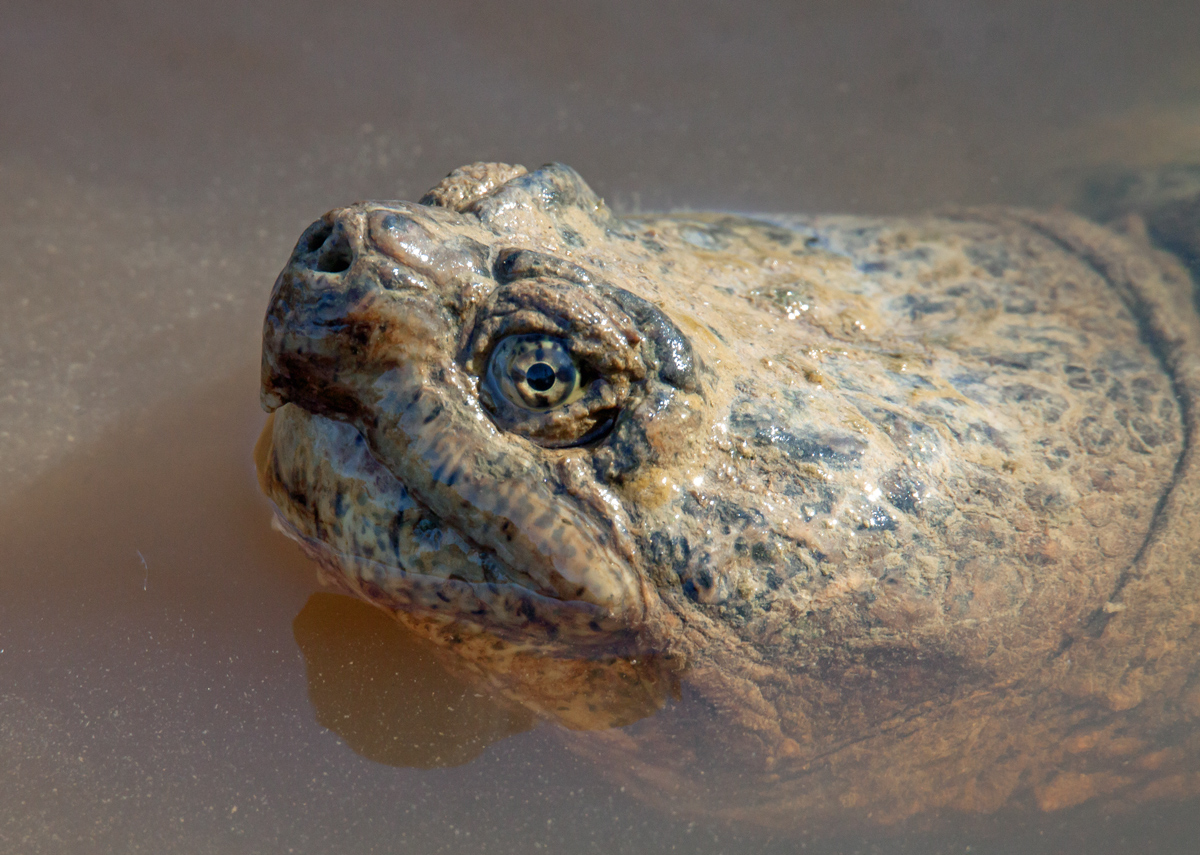
Creatures of all sorts are stirring in the marsh now that the weather has warmed up, including this particularly fierce-looking one with amazing eyes. What is it? It’s an Eastern Snapping Turtle (Chelydra serpentina serpentina), a species that is pretty common in my local marsh.

snapping turtlesnapping turtle

© Michael Q. Powell. All rights reserved.

Read Full Post »

Now that the ice on the ponds has melted, the turtles have resurfaced, including this relatively uncommon Spotted Turtle (Clemmys guttata) that I photographed yesterday at Huntley Meadows Park.

According to the Virginia Herpetological Society, “Extinction or extirpation is possible. Populations of these species are in decline or have declined to low levels or are in a restricted range. Management action is needed to stabilize or increase populations.”

I was very happy to spot this turtle and tried hard not to disturb it too much in getting a few shots.

Spotted Turtle

© Michael Q. Powell. All rights reserved..

Read Full Post »

It has often been said that the eyes are the windows to the soul. I’m not sure what I can say about the soul of this Northern Watersnake (Nerodia sipedon), but I recently had a chance to take a long, close look into one of its eyes.

As I was walking in my local marshland park last week, one of my fellow photographers pointed out the snake to me in the low vegetation. Most of the time that I see this species, it is in the water, where it is almost impossible for me to get a close-up shot. The snake started to move several times as I got closer and closer to it, but then it would stop, thinking perhaps that it would be invisible if it remained motionless.

Most of the time, my view to the snake was obscured by the vegetation, so I waited and tried to anticipate where it would move next, hoping that it would move to a more open area. Finally, I was able to get a relatively clear shot of its eye in a head-and-shoulders portrait, though, of course, snakes don’t really have shoulders.

Northern Watersnake

© Michael Q. Powell. All rights reserved.

Read Full Post »

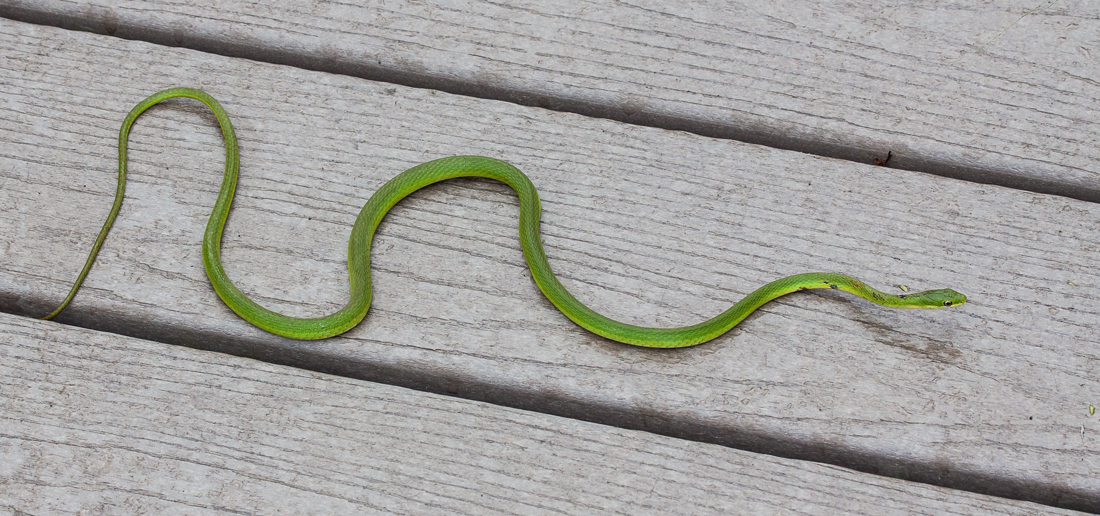
Earlier this month, I was really happy to spot this Northern Rough Greensnake (Opheodrys aestivus) on the boardwalk at Huntley Meadows Park, my local marshland park. These snakes spend most of the time in the trees and in heavy brush, so I rarely get to see one, despite their very distinctive color and overall appearance. The Virginia Herpetological Society claims that this is a docile species that will not bite, but just to be safe, I took the close-up shot from a good distance away, shooting at 300mm on my telephoto zoom lens.

Generally I like to photograph my wildlife subjects in a natural environment and the “wood” on this boardwalk isn’t even natural—it’s some kind of synthetic material. In this case, however, the neutral color of the background helps to focus viewers’ attention on the colors and textures and shape of the snake. In the final two images, in particular, I really like the contrast between the sinuous curves of the snake’s body and the hard, straight lines of the man-made objects.

Rough GreensnakeRough GreensnakeRough Greensnake

© Michael Q. Powell. All rights reserved.

Read Full Post »

As I reached the boardwalk, I glanced to my right and realized that I was eye-to-eye with a snake that was loosely coiled on top of a bush. This Common Ribbonsnake (Thamnophis sauritus sauritus) seemed to have appointed himself as the official greeter of the day at the marsh, though I suspect that not all visitors welcomed his presence so close to them as they walked by.

ribbon_blog

© Michael Q. Powell. All rights reserved.
Read Full Post »

Over the last few weeks, I’ve repeatedly seen a Northern Watersnake (Nerodia sipedon) sunning itself on a log at my local marsh. I don’t know whether it was hunger or boredom that prompted it to move, but I was utterly fascinated this past weekend as I watched the snake make preparations to dive into the water.

The snake initially sensed the conditions by sticking out its tongue and then gradually slid its head into the water. After testing the water with its head, it slowly slithered into the muddy waters of the marsh, probably in search of fish or frogs.

Northern Watersnake

I’ve never before used the slideshow feature on my blog, but decided to try it out here to show a sequence of shots of the snake diving into the water. (I think the slide show starts automatically. If not, click on one of the photos and it should start.)

This slideshow requires JavaScript.

The alternative to the slide show is to do the gallery look, in which you click through the images at your own pace (and the images show up a lot bigger). Here’s the same images in that format. You start by clicking on any one of the images. Do you prefer this look?

Just for fun, here’s a blown-up view of the image in which the snake is sticking out its tongue. Click on the image (if you dare) to see a higher resolution view of the snake.

Northern Watersnake

© Michael Q. Powell. All rights reserved.

Read Full Post »

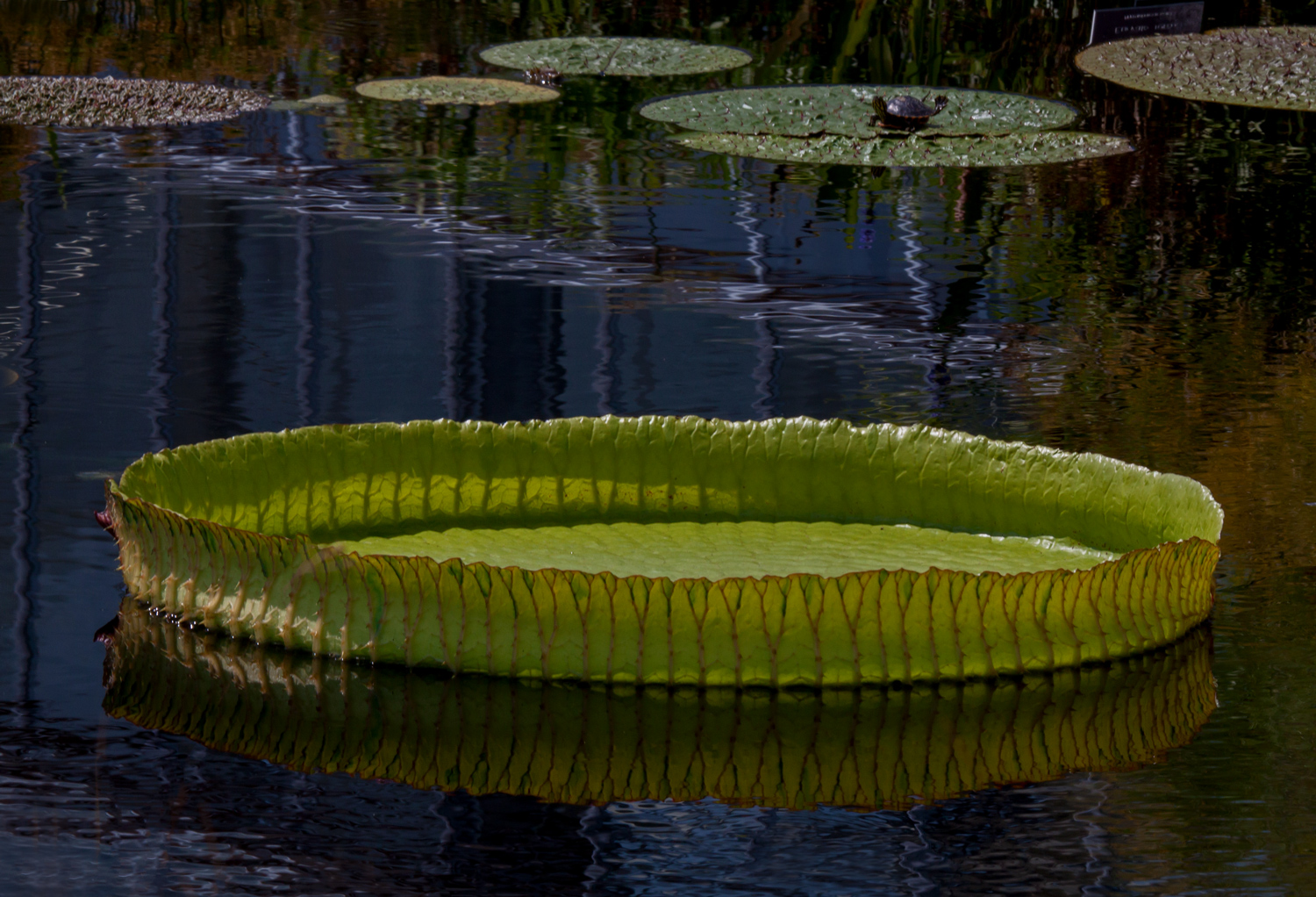
One of the highlights of last weekend’s trip with some friends to Lewis Ginter Botanical Garden in Richmond, Virginia was the giant lily pads outside of the glass-encased conservatory. I think they are from the Victoria genus of water lilies (possibly Victoria amazonica) which, according to Wikipedia, can grow to almost ten feet in diameter and support a weight of up to 70 pounds.

The turtle in the background was a bonus—I didn’t even realize that it was there until I looked at my images on my computer.

giant_lily1_blog

© Michael Q. Powell. All rights reserved.

Read Full Post »

Is it just me, or does the word “skink” sound funny to you? Certain words simply sound odd to me and for some reason “skink” is one of them—I can’t help but smile whenever I say the word out loud.

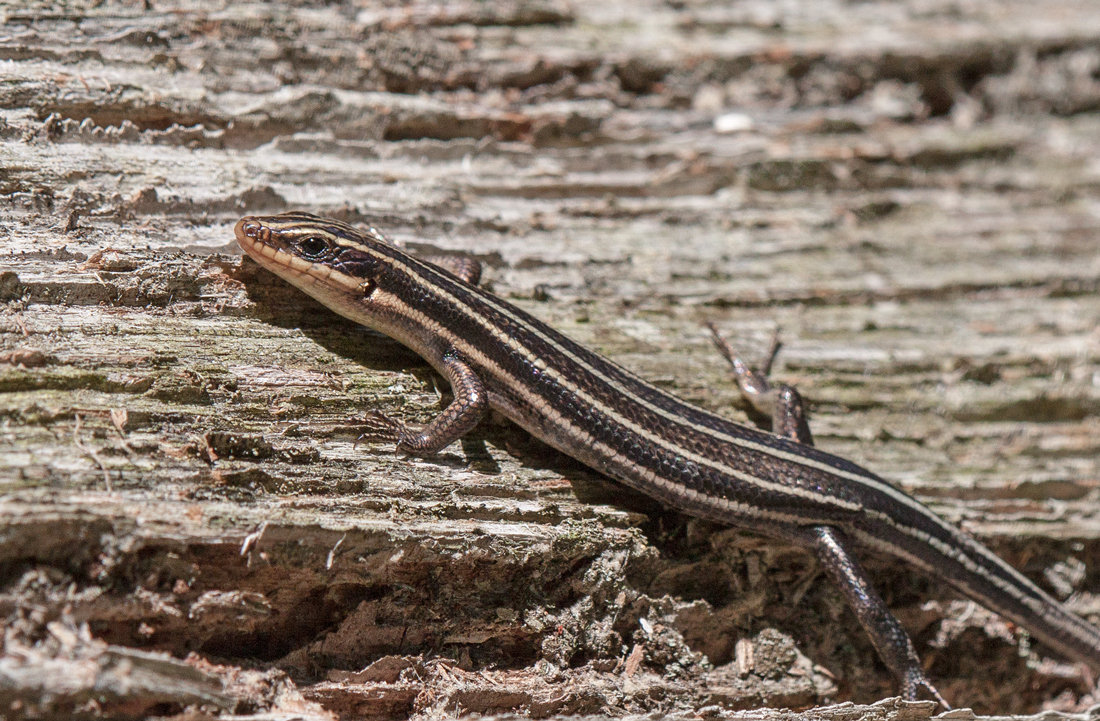
Recently I took this shot of a Common Five-lined Skink (Plestiodon fasciatus, formerly Eumeces fasciatus) at my local marshland park. It was sunning itself on a rotten log and didn’t detect my presence immediately and run away, which is what usually happens when I spot a skink. It seems to have its head cocked a little and has a smile on its face, as though daydreaming, as I do when sunbathing.

skink1_blog


I wonder if you could use “skink” as a verb to describe the crawling-type behavior typical of a skink, as in, “I saw my friend skinking about.” If “skink” were a verb, would it follow the model of “drink,” with verbal forms that included “skank” and “skunk?”  That might induce a bit of confusion, I suppose, since “skank” suggests a different kind of behavior, as does “skunk.” English can be a strange language.

I’ll just continue smiling.

© Michael Q. Powell. All rights reserved.

Read Full Post »

All of nature seems to be speeding up as we move deeper into spring. Even the turtles seem to be moving faster, like this Red-eared Slider (Trachemys scripta elegans) that I spotted recently at a county-run historical garden.

Initially the turtle was swimming around in a small pond (as shown in the second shot). I was pleased that I was able to capture a shot of the turtle as it was emerged from the water onto the shore.

I had my 180mm macro lens on my camera when I caught sight of the turtle and I was reminded of the need to zoom with my feet when using a lens with a fixed focal length. In my zeal to get a bit closer to the turtle, I narrowly avoided sliding down the bank into the water.

slider1_blogslider2_blog

© Michael Q. Powell. All rights reserved

Read Full Post »

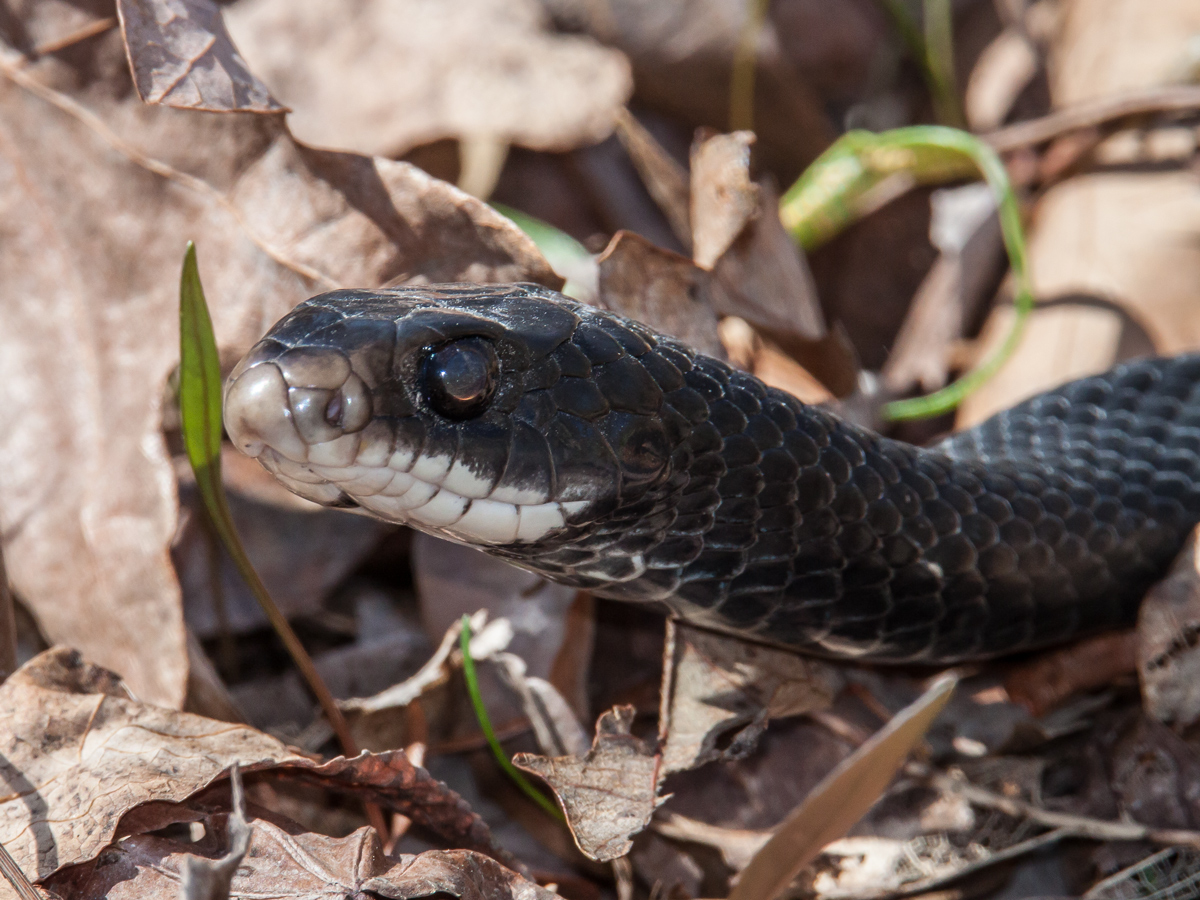
What’s your first reaction when you see a snake? I was walking through the woods at my local marsh this past weekend when I spotted a snake curled up on the leaves. My first reaction was to move closer to get a shot of the snake.

The area was relatively open, but there were lots of leaves and sticks on the forest floor, so it was not really possible to get an unobstructed shot of the snake. I took a shot anyways, fearing the snake would leave, and include it as a second image here so you can see how the snake was positioned. I noticed that the snake’s head was in an uncluttered area and a clear shot seemed possible. I changed lenses from my telephoto zoom to my macro lens, set up my tripod as low as it would go, and moved really close, until the snake’s head almost filled the frame of my viewfinder. I took some shots in natural light and some with my popup flash. The snake seemed unbothered by my actions until I inadvertently moved a small branch when adjusting my position on ground and he slithered away.
When I looked at the images on my computer, I was struck by the degree to which my reflection is visible in the snake’s eye. If you click on the first photo, you’ll get a higher resolution view that shows me taking the shot (with flash this time).

I am not sure what kind of snake this is, but it looks a bit like a Northern Black Racer snake (Coluber constrictor constrictor) as described on the webpage of the Virginia Herpetological Society. I’d welcome a confirmation or correction of my identification from anyone with more experience with snakes.

snake_reflection2_blog snake_reflection3_blog

© Michael Q. Powell. All rights reserved

Read Full Post »

Sometimes a coiled snake is prepared to strike, but this Northern Water Snake (Nerodia sipedon) was definitely not ready for action. The snake seemed total relaxed as it basked in the sun, curled up above the surface of the water on some dried up vegetation.

I really like the texture of the snake’s skin, but there was no way that I was going to reach out and touch it. Telephoto lenses are a good thing in situations like this.

snake_coil_blog

© Michael Q. Powell. All rights reserved

Read Full Post »

As I was tiptoeing my way along a tree that had fallen across a flooded area of my local marsh, I glanced down and caught sight of this turtle, submerged in the shallow water. I am no expert in identifying turtles, but it was pretty easy to identify this as a Spotted Turtle (Clemmys guttata), a species that I don’t see very often.

According to Wikipedia, the spotted turtle is federally endangered in Canada and in the United States it is considered to be vulnerable to extinction in the wild in the medium-term future, or threatened in most of its habituating states. Within Virginia, the state in which I live, the Herpetological Society is pretty grim in its prognosis, “Extinction or extirpation is possible. Populations of these species are in decline or have declined to low levels or are in a restricted range. Management action is needed to stabilize or increase populations.”

It was a bit of a challenge getting a shot of this turtle. I was standing on the trunk of a tree, so my footing was a bit precarious. The water was probably only a few inches deep, but it seemed to defeat my auto-focusing system, so I ended up focusing manually. Finally, there was a bit of glare coming off of the surface of the water, so I had to bend down to search for an angle that allowed me to minimize the glare.

I am hoping that I will see these turtles often and that Huntley Meadows Park, the place where I take a lot of my wildlife photographs, will continue to be a refuge for this species and for many other ones.


turtle_spotted_blog

© Michael Q. Powell. All rights reserved

Read Full Post »

Can snakes whistle? It sure looks like this Common Ribbonsnake (Thamnophis sauritus) is trying hard to whistle as he purses his lips and seems to be blowing air in this series of shots. Who knew that snakes had lips? This snake has lips that rival those of Mick Jagger and look a bit like they were enhanced with collagen.

When you shoot subjects, how close do you get to them? My general rule for wildlife subjects is to shoot them from a distance (so I can be sure of getting a shot) and then move slowly closer and closer. I was amazed at how close this snake let me approach—this first shot was not cropped very much at all.

I like the head-and-shoulders look of the first image (taking into account the fact that snakes don’t really have shoulders), which draws attention to the snake’s eye. At times, though, I prefer the shots that show more of the snake’s body and my favorite of this group is probably the third shot. I really like the curve of the snake’s body and the tilt of its head. It’s hard to see in this reduced-size image, but two little tips of the snake’s forked tongue are visible in its partially open mouth.
snake3_march_blogsnake2a_march_blogsnake4_march_blog

© Michael Q. Powell. All rights reserved

Read Full Post »

Now that it is spring, I have started carrying around my macro lens, which I was able to use to get this really close-up shot today of an Eastern Garter snake (Thamnophis sirtalis) at Huntley Meadows Park, my favorite local spot for nature photography. The snake was curled up in a mossy area and seemed to be a little sluggish. Consequently, he did not slither away when I got down low and moved in close to take this photo.

CORRECTION: Fellow photographer and blogger Walter Sanford, who is much more of an expert in snakes than I am, has identified this snake as a Common Ribbonsnake (Thamnophis sauritus sauritus), not an Eastern Garter snake.

snake1_march_blog

© Michael Q. Powell. All rights reserved

Read Full Post »

The temperatures this past weekend soared past 60 degrees (16 degrees C), bringing the turtles up from the mud on the bottom of the ponds at my local marsh. Most of the turtles crowded together on the log in the first shot appear to be Eastern Painted Turtles (Chrysemys picta picta), but I think I detect at least one Red-eared Slider (Trachemys scripta elegans).

Not all of turtles, however, wanted to bask in the sun in a communal environment. The second image shows a turtle that managed to find its own log and was enjoying a few moments of contemplative solitude.

turtles_sunning_blogturtle_sunning_blog

© Michael Q. Powell. All rights reserved

Read Full Post »

« Newer Posts - Older Posts »