Despite the frigid cold and snow, the squirrels in my neighborhood are out and active (and looking surprisingly cute).

© Michael Q. Powell. All rights reserved
Posted in animals, Nature, Photography, Portraits, wildlife, Winter, tagged Alexandria VA, Canon 50D, Canon 70-300mm telephoto zoom lens, Eastern Gray Squirrel, gray squirrel, Runnymeade, snow, squirrel on January 24, 2014| 4 Comments »
Despite the frigid cold and snow, the squirrels in my neighborhood are out and active (and looking surprisingly cute).
© Michael Q. Powell. All rights reserved
Posted in animals, Art, Dog, Photography, Portraits, Winter, tagged Alexandria VA, Canon 50D, Canon 70-300mm telephoto zoom lens, Cocker Spaniel, Freckles, Runnymeade, snow on January 23, 2014| 11 Comments »
Little kids get pretty excited about snow, but it’s hard to match the enthusiasm of a puppy as she propels herself face-first into the freshly fallen snow.
These shots show Freckles, a year-old Cocker Spaniel, a few seconds after she dove into the snow in my backyard. The yard had areas of sunshine and shadows and the snow appears white when Freckles was in the sun, as in the first image. The snow took on a bluish cast however, when the snow in the background was in the shadows. I liked the effect and cropped the second image to make the background more uniform, causing it to look a bit like a formal studio shot.


© Michael Q. Powell. All rights reserved
Posted in Art, Nature, Photography, Portraits, wildlife, Winter, tagged Alexandria VA, bird in flight, Branta canadensis, Canada Goose, Canon 50D, Canon 70-300mm telephoto zoom lens, goose, Huntley Meadows Park on January 20, 2014| 9 Comments »
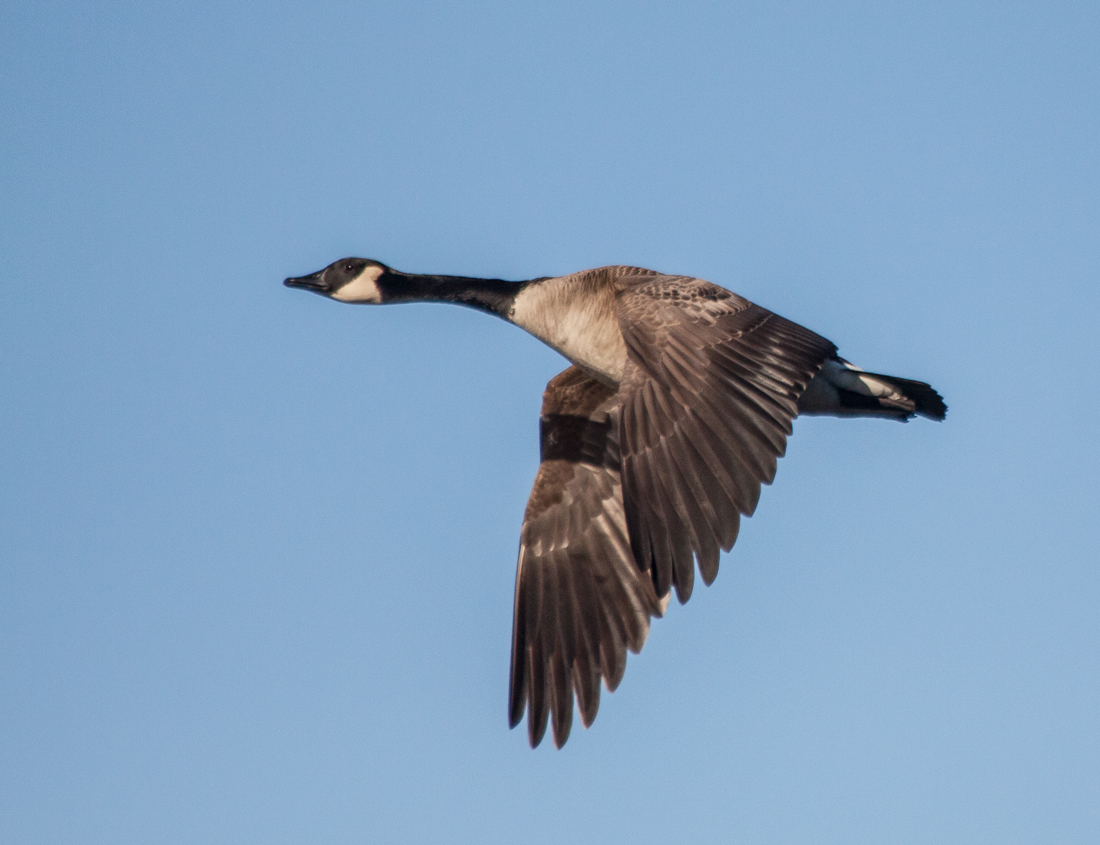
So many factors have to work together perfectly to get good shots of a bird in flight—the lighting has to be right, the exposure needs to be correct, the shutter speed needs to be fast enough to stop the motion, and, most critically perhaps, the camera has to focus properly on the moving subject. Of course, it helps also to be able to capture the wings in an interesting position and to have a background that is not distracting.
I have been working on taking photos of birds in flight, especially Canada Geese, but it has been rare for me to get all (or even most) of the variables to fall into place at the same time. However, in late December I took a series of shots of a Canada Goose (Branta canadensis) that turned out really well. The background was the sky, which some folks don’t find to be very interesting, but at least the goose was not obscured by branches. Click on the photos to see them in higher resolution—I was thrilled that I even managed to get a catchlight in the visible eye.
The challenge for me will be to repeat this success with smaller birds that fly faster and less predictably.


© Michael Q. Powell. All rights reserved
Posted in Birds, Nature, Photography, Portraits, wildlife, Winter, tagged Alexandria VA, Canon 50D, Canon 70-300mm telephoto zoom lens, Dryocopus pileatus, Huntley Meadows Park, Pileated Woodpecker, woodpecker on January 19, 2014| 6 Comments »
It’s nice to be back home from my recent overseas trip and to have the chance to go out in the wild for some photos. Urban shooting is ok, but somehow I feel more comfortable chasing after wildlife.
Yesterday I spotted this Pileated Woodpecker (Dryocopus pileatus) high in the trees at Huntley Meadows Park, the local marsh that is my favorite spot for wildlife shooting. I’ve been trying for quite a while to get some good shots of this spectacular woodpecker and they are getting better, though they are not quite there yet.
These two shots are part of a series that I took as the woodpecker moved its head from side to side as well as up and down, chiseling out a hole in the tree. I was amazed to see how far back the woodpecker pulled its head before each stroke and the powerful force with which it struck—it was enough to give me a headache.
I’m still hoping that I will find a Pileated Woodpecker a bit lower in a tree (or working on a fallen log) in a location that will permit me to get some better shots, but I am content that I was able to get these shots when I caught sight of this woodpecker yesterday.


© Michael Q. Powell. All rights reserved
Posted in Art, Birds, Nature, Photography, Portraits, wildlife, Winter, tagged Agelaius phoeniceus, Alexandria VA, blackbird, Canon 50D, Canon 70-300mm telephoto zoom lens, Huntley Meadows Park, male Red-winged Blackbird, red-winged blackbird on January 18, 2014| 7 Comments »
Most birds seem to seek shelter when it is raining (and most people too), but this male Red-winged Blackbird (and this photographer) were an exception to that rule in late December.

© Michael Q. Powell. All rights reserved
Posted in Birds, Nature, Photography, Portraits, wildlife, Winter, tagged Alexandria VA, Ardea herodias, Canon 50D, Canon 70-300mm telephoto zoom lens, Great Blue Heron, heron, hunkering down, Huntley Meadows Park on January 12, 2014| 8 Comments »
It concerns me that this young Great Blue Heron (Ardea herodias) at my local marsh may be too tolerant of people and desensitized to the reality of genuine predators that could do it harm. I worry too about its ability to catch enough food to survive, especially if this is the same young heron that I observed during the fall striking in vain at leaves in the water.
On a cold, wet day this past week, the heron was hunkered down on a log not far from the boardwalk. Other than a few movements of its head as it watched me, the heron didn’t budge a bit as I snapped away and even stayed in place when a noisy group of people walked by us.
When I see this little heron, I try to get a few pictures and then move on, thankful for the photo opportunity, but not wanting to reinforce its comfort level with the presence of people.

© Michael Q. Powell. All rights reserved
Posted in Art, Birds, Nature, Photography, Portraits, wildlife, Winter, tagged Alexandria VA, Canon 50D, Canon 70-300mm telephoto zoom lens, Downy Woodpecker, Huntley Meadows Park, Picoides pubescens, woodpecker on January 7, 2014| 8 Comments »
Like most Downy Woodpeckers, this little male woodpecker started spiraling his way up the tree as soon as he landed on it. Then to my surprise, he worked his way back down the tree and stopped at eye level, where he stayed long enough for me to take a number of shots and even make a few adjustments in between the shots.
I really like Downy Woodpeckers (Picoides pubescens). Their high energy and acrobatic activities are a constant source of interest for me as I watch them at work in the trees and in the cattails. I’ve usually had a tough time, though, getting an uncluttered shot of a Downy Woodpecker.
I took this shot in an area where there were mostly young trees, which made it easier for me to isolate the woodpecker as he moved about and to slowly move closer and fill the frame with the little bird. The area was shaded, so I ended up using my pop-up flash to add a little fill light. I opened up the aperture as wide as I could, which had the effect of blurring out the background.
I ended up with a portrait-like shot of the Downy Woodpecker that I really like. Click on the image to see it in higher resolution.

© Michael Q. Powell. All rights reserved
Posted in Art, Birds, Nature, Photography, Portraits, wildlife, Winter, tagged Alexandria VA, bird in snow, Canon 50D, Canon 70-300mm telephoto zoom lens, Huntley Meadows Park, Melospiza melodia, snow, song sparrow, sparrow on January 5, 2014| 11 Comments »
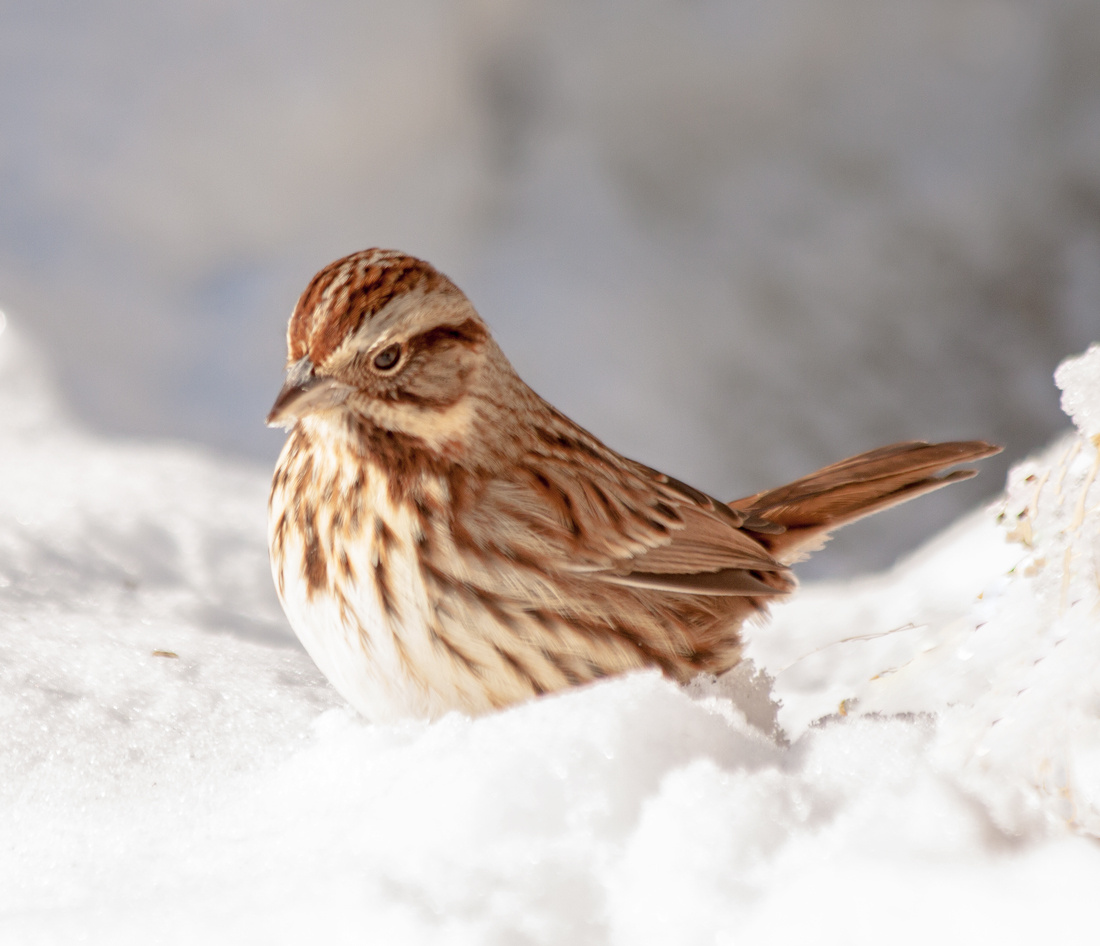
Although I already posted a photo earlier today of a Song Sparrow (Melospiza melodia) in the snow, I came across one I liked even more as I was going through yesterday’s images. This sparrow (and I am never certain of my sparrow identifications) seemed to be posing for me. Somehow I was able to capture details in its eyes that I have never seen before.
After our brief portrait session, the sparrow hurried back to work.
© Michael Q. Powell. All rights reserved
Posted in Art, Birds, Nature, Photography, Portraits, wildlife, Winter, tagged Alexandria VA, Ardea herodias, birds in flight, Canon 50D, Canon 70-300mm telephoto zoom lens, Great Blue Heron, heron, Huntley Meadows Park, rain on December 30, 2013| 15 Comments »
Do you like long walks in the rain? Although this sounds like a question for an on-line dating service, it’s really about your style of photography.
I enjoy taking wildlife photos in the rain, if the rain is not coming down too hard and if it is not too windy. Of course, I can’t control the intensity of the rain, so I have various levels of protection. Generally, I’ll try to hold an umbrella in one hand and shoot one-handed, steadying my shot by leaning against the umbrella handle, if possible. If the rain starts to fall harder I’ll cover up my camera inside my raincoat or sometimes will pull out a plastic trash bag for additional protection until the rain slows down.
Last week, I was walking in the rain at Huntley Meadows Park, my local marshland park, when I came upon a Great Blue Heron (Ardea herodias), standing on the boardwalk. I approached the heron quietly and stopped. The heron was looking right at me and somehow I knew that it was going to take off.
I dropped to one knee, turned the camera sideways, and pulled way back on the zoom lens, hoping to fit the heron into the frame. This image was shot at 75mm on a 70-300mm lens, so you can tell that I was relatively close to the heron. The other settings were f5, 1/400 sec., and ISO 500 for those who might be interested in the technical aspects of the shot.
It’s always interesting to see which birds are active in the rain and I did get some shots of other birds that day, but I will save them for another blog posting.

© Michael Q. Powell. All rights reserved
Posted in Birds, Nature, Photography, Portraits, wildlife, Winter, tagged Alexandria VA, American Acclimitization Society, Cameron Run, Canon 50D, Canon 70-300mm telephoto zoom lens, European Starling, Shakespeare, starling, Sturnus vulgaris on December 29, 2013| 12 Comments »
Starlings are supposed to be common birds, but I never knew what they looked like up close, so I initially had a lot of trouble identifying the odd-looking bird in these photos that I took in early December.
I’m pretty sure now that it is a European Starling (Sturnus vulgaris), a bird that was first introduced into North America in the 19th century by Shakespeare enthusiasts, according to the Cornell Lab of Ornithology. What does Shakespeare have to do with it?
Well, Shakespeare mentions them in one of his plays. Steve Mirsky explained the reference in an article in Scientific American entitled “Shakespeare to Blame for Introduction of European Starlings to U.S.”
“In the late 1590s Shakespeare noted the mimicking ability of the starling while writing Henry IV, Part 1. Hotspur is contemplating driving King Henry nuts by having a starling repeat the name of Hotspur’s brother-in-law Mortimer, whom Henry refuses to ransom out of prisoner status. “Nay, I’ll have a starling shall be taught to speak nothing but ‘Mortimer,’ ” Hotspur whines.”
In 1871, a group called the American Acclimatization Society was formed in New York, dedicated to introducing European plants and animals and birds into North America, according to Wikipedia. The group’s chairman was an avid admirer of Shakespeare and is said by some to have desired to introduce every bird mentioned by the playwright. The Cornell Lab notes that the more than 200 million starlings now in North American are descendants of the original 100 starlings released in New York’s Central Park in the early 189o’s. Yikes!
I am always curious about the origin of bird names and learned from the Cornell Lab that the starlings got their name because their wings are short and pointed, making them look rather like small, four-pointed stars when they are flying.


© Michael Q. Powell. All rights reserved
Posted in Birds, Nature, Photography, Portraits, wildlife, Winter, tagged Alexandria VA, Belted Kingfisher, birds in flight, Canon 50D, Canon 70-300mm telephoto zoom lens, Huntley Meadows Park, kingfisher, Megaceryle alcyon on December 23, 2013| 4 Comments »
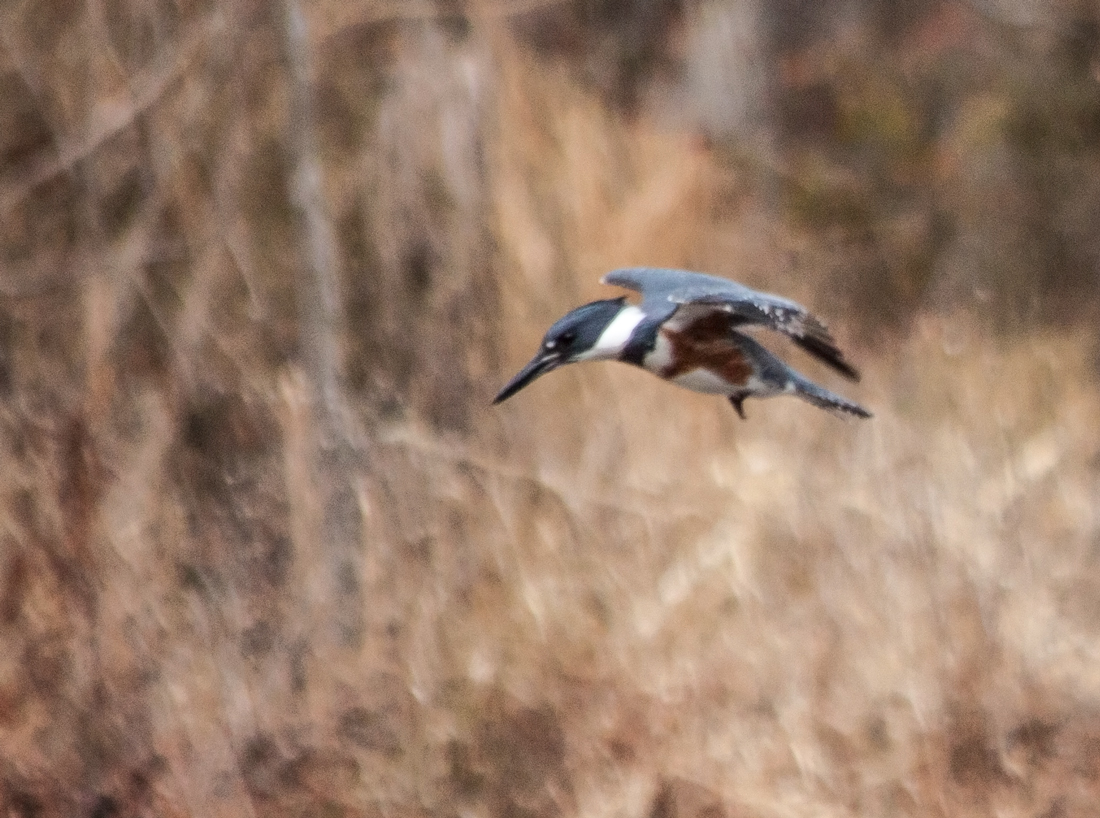
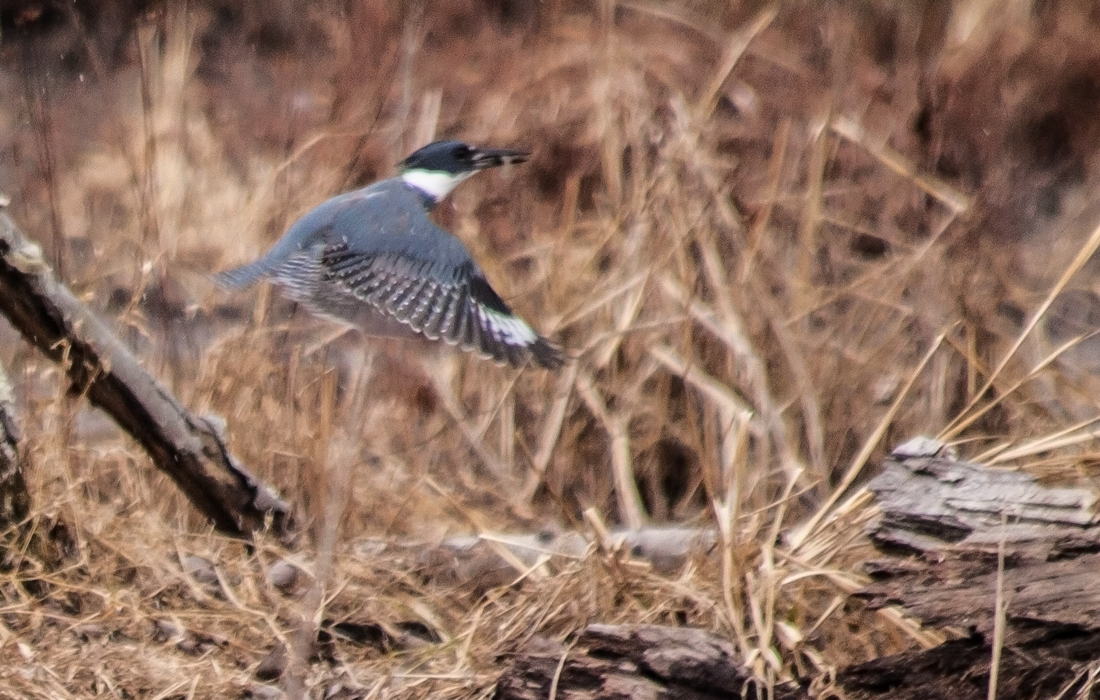
This past week I have observed female Belted Kingfishers (Megaceryle alcyon) at a couple of different locations at my marshland park and tried to capture them in flight as they dove into the water from their perches in the trees. It was challenging, because the kingfishers were pretty far away, but I did get a couple of decent shots (with a fair amount of cropping).


© Michael Q. Powell. All rights reserved
Posted in animals, Nature, Photography, Portraits, wildlife, Winter, tagged Alexandria VA, Beatles, Canon 50D, Canon 70-300mm telephoto zoom lens, Huntley Meadows Park, Procyon lotor, raccoon, Rocky Raccoon on December 21, 2013| 7 Comments »
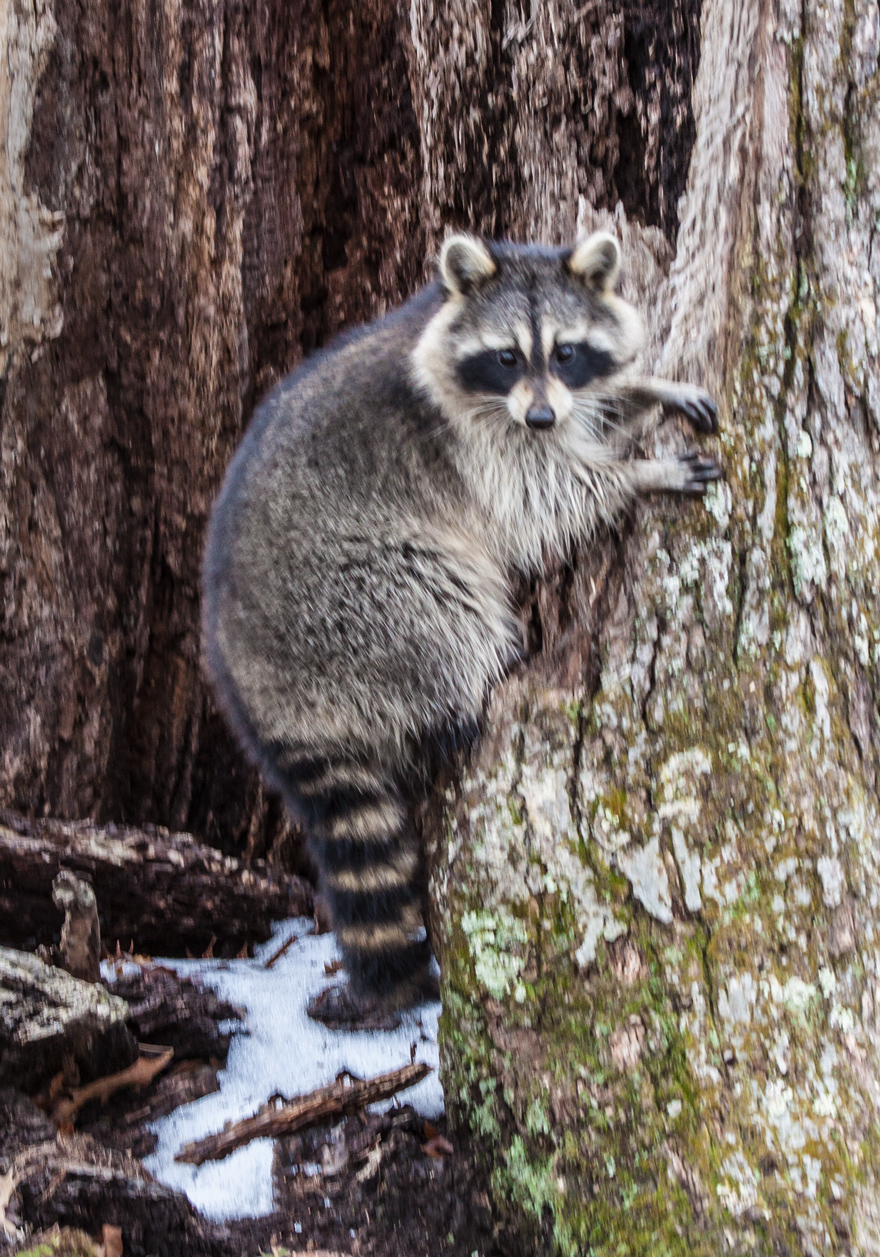
Yesterday, I returned to the pond where I had previously seen the river otter, hoping to see it again. As I stood silently at the water’s edge, I heard something pretty big moving about in the underbrush, something that seemed to be bigger than an otter.
I was surprised to see a raccoon emerge—generally they are nocturnal and previously I had seen them only at twilight. The raccoon seemed to be rooting around, looking for food. He didn’t seem to be aware of my presence and as I watched it move about, I managed to get a few clear shots before it moved away into the deeper brush.
It you are of a certain age, you remember the fun little Beatles song “Rocky Raccoon”—every time that I see a raccoon, that song comes to mind.
© Michael Q. Powell. All rights reserved.
Posted in Birds, Humor, Nature, Photography, Portraits, wildlife, Winter, tagged Alexandria VA, Canon 50D, Canon 70-300mm telephoto zoom lens, Carolina Wren, Huntley Meadows Park, Thryothorus ludovicianus, Troglodytes hiemalis, Winter Wren, wren on December 20, 2013| 26 Comments »
Peering through my telephoto lens at this tiny bird, I couldn’t help but smile—its energetic personality, round body, and tiny wings and tail were cartoon-like. It looked like a wren, but it certainly didn’t resemble the Carolina Wrens that I am used to seeing.
I did a little research and have concluded that this is probably a Winter Wren (Troglodytes hiemalis). According to the Cornell Lab of Ornithology, these little birds are “incomparably energetic in voice” and per unit weight deliver their songs with ten times more power than a crowing rooster. I can only imagine groups of scientists with tiny scales and microphones conducting the research to back up that statement.
I noted on the statistics page of my blog that this will be posting number 1,000. I never imagined how much I would come to enjoy the process of blogging when I started this blog on July 7, 2012 with a photo of a Blue Dasher dragonfly. The support and encouragement from innumerable readers has helped to sustain me on my journey into photography. Thanks to all of you.
The journey continues.


© Michael Q. Powell. All rights reserved.
Posted in Birds, Nature, Photography, Portraits, wildlife, Winter, tagged Alexandria VA, Ardea herodias, Canon 50D, Canon 70-300mm telephoto zoom lens, early morning, Great Blue Heron, heron, Huntley Meadows Park, reflection on December 19, 2013| 19 Comments »
In the weak early morning light, the sky and the water merged together, providing an uncluttered backdrop for this portrait of a Great Blue Heron.
I’ve taken quite a few photos of Great Blue Herons (Ardea herodias), but rarely have I encountered one as cooperative as this one was early on Monday morning. He looked to be cold and may have been trying to snooze as he huddled near the edge of the boardwalk. He let me get pretty close to him and didn’t seem to object to my presence, though he did follow me with his eyes. As a result of his tolerance, I was able to capture more detail in the heron’s feathers than I usually can manage.
After a few shots, I left him in peace to catch a few more winks.

© Michael Q. Powell. All rights reserved.
Posted in animals, Nature, Photography, Portraits, wildlife, Winter, tagged Alexandria VA, beaver, Canon 50D, Canon 70-300mm telephoto zoom lens, Huntley Meadows Park, Lontra canadensis laxatina, Northern River Otter, otter on December 18, 2013| 21 Comments »
On Monday I was checking out what looked to be a beaver lodge at one of the ponds at my local marsh, when suddenly a head popped out of the water. It was not a beaver–it was a Northern River Otter (Lontra canadensis laxatina). I was amazed (otterly amazed, you might say), but had the presence of mind to capture the moment with my camera.
I had been told that otters occasionally had occasionally been sighted at the park and that very day I overheard part of a conversation about otter scat, but I never expected to actually see an otter myself. (The conversation revolved around some scat on the boardwalk, and how it was almost certainly from an otter, because of the fish scales and shells in in it).
The otter turned his head in all directions, surveying the situation. Then all too quickly, the otter submerged itself and swam away.


© Michael Q. Powell. All rights reserved.
Posted in Architecture, Christmas, Landscape, Portraits, Travel, tagged Canon A620, Christmas, Christmas market, moon, Vienna Austria on December 10, 2013| 5 Comments »
It finally stopped raining in Vienna and I was able to take a walk through the Christmas market in front of the Rathaus (City Hall). There are rows and rows of stalls set up with all kinds of products and food.
In the midst of all of the artificial lights, I was struck by the beauty of the moon, which kept peeking in and out of the clouds.

© Michael Q. Powell. All rights reserved.
Posted in Autumn, Birds, Nature, Photography, Portraits, wildlife, tagged Alexandria VA, Canon 50D, Canon 70-300mm telephoto zoom lens, Cathartes aura, Huntley Meadows Park, turkey vulture, vulture on December 6, 2013| 9 Comments »
This Turkey Vulture (Cathartes aura) was circling around me last week, so I followed the advice given to me by one of my fellow photographers—I made sure that I moved periodically as I captured shots of this large bird with an impressive wingspan.
I will be away from home on a business trip starting tomorrow and I am not sure how often I will be able to update my blog. I wanted to alert readers in case they are concerned if they don’t see any movement for me for a number of days—the vultures probably have not made a meal of me yet. 


© Michael Q. Powell. All rights reserved.
Posted in Art, Birds, Inspiration, Nature, Photography, Portraits, wildlife, tagged Alexandria VA, Cameron Run, Canon 50D, Canon 70-300mm telephoto zoom lens, dove, mourning dove, window, Zenaida macroura on December 5, 2013| 4 Comments »
Do you ever sit by a window and daydream as you look out into the world with unfocused eyes? Somehow that was what came to mind when I spotted this Mourning Dove (Zenaida macroura) perched on a branch, framed by the trees. The dove seemed gentle and pensive, unlike so many of the birds (and people) in this area that are so driven, always intense and tense.
There is a real value in slowing down and daydreaming more in order to recharge my creative batteries. Sometimes I need a gentle reminder.

© Michael Q. Powell. All rights reserved.
Posted in Art, Autumn, Birds, Nature, Photography, Portraits, wildlife, tagged Alexandria VA, Canon 50D, Canon 70-300mm telephoto zoom lens, cardinal, Cardinalis cardinalis, Huntley Meadows Park, Northern cardinal on December 4, 2013| 1 Comment »
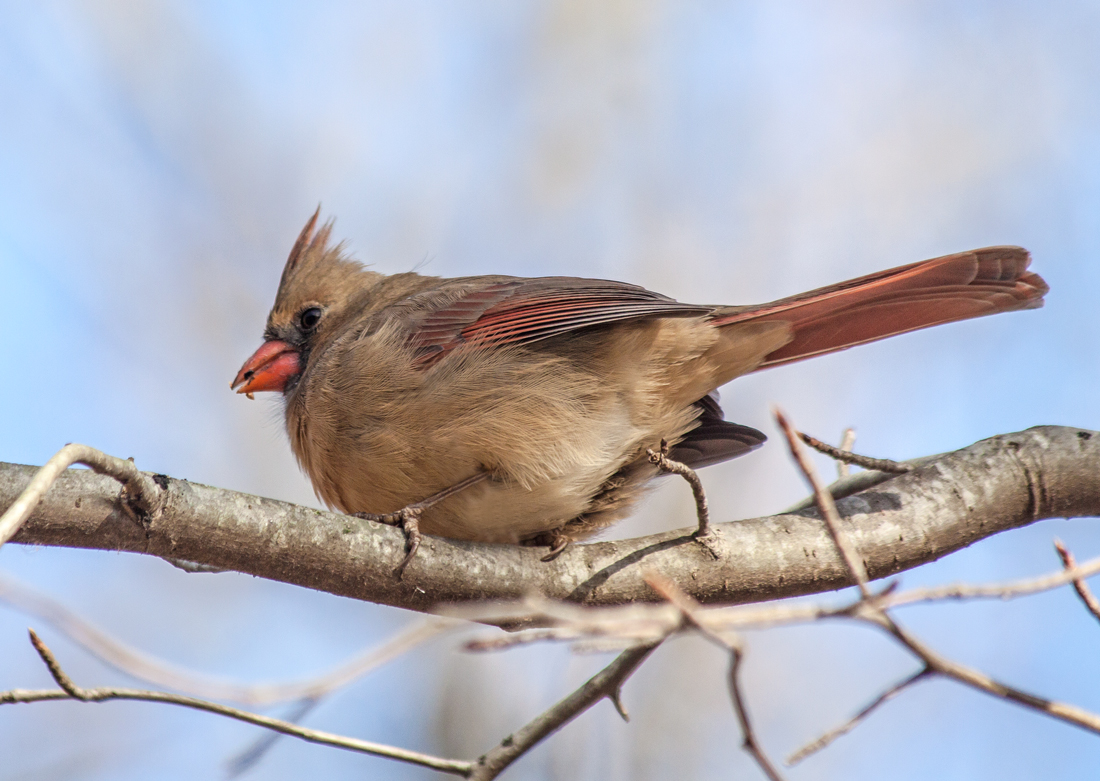
I looked up at her from below and then she cocked her head and looked down at me. Our eyes met and we shared a brief, magical moment together. Then it was over, my all-too-short encounter with a beautiful female Northern Cardinal (Cardinalis cardinalis).
© Michael Q. Powell. All rights reserved.
Posted in Art, Autumn, Birds, Nature, Photography, Portraits, wildlife, tagged Agelaius phoeniceus, Alexandria VA, blackbird, Canon 50D, Canon 70-300mm telephoto zoom lens, cattail, Huntley Meadows Park, red-winged blackbird on December 3, 2013| 11 Comments »
Although it is exciting to search for new birds or for unusual interactions, I love to return to familiar subjects, like this male Red-winged Blackbird (Agelaius phoeniceus) that I photographed last week.
There is nothing complicated about this image, a blackbird perched on a cattail, but the small details make it special for me. I like the angled body and the turned head. The feathers seem unusually glossy and the eye is shiny too. There are a few wispy feathers that are matched by the “fluff” from the cattail. The background is brown, but there are a wide variety of shapes and shades.
What does it take for you to be satisfied as a photographer? For now at least, I am content to stay relatively close to home and photograph whatever I can find as well as I can. Life doesn’t have to be complicated all of the time.

© Michael Q. Powell. All rights reserved.
Posted in Art, Autumn, Birds, Nature, Photography, Portraits, wildlife, tagged Alexandria VA, Canon 50D, Canon 70-300mm telephoto zoom lens, Huntley Meadows Park, Melanerpes erythrocephalus, Red-headed Woodpecker, woodpecker on December 1, 2013| 6 Comments »
I suspect that I may qualify as a stalker, because I spent over thirty minutes on Friday sitting on a fallen tree, observing every movement of a juvenile Red-headed Woodpecker (Melanerpes erythrocephalus) high in the oak trees.
The small branches and the shadows made it almost impossible to get a clear shot of the little bird, but they did not keep me from trying. I was really fortunate to get this shot of the woodpecker as it took off from one of its perches with an acorn in its mouth and gave me a glimpse of its beautifully-patterned wings. As I understand it, when the Red-Headed Woodpecker becomes an adult, its wings will be pure black and white, so I am glad that I was able to get the shot of the black dots.
After I posted this photo, I noticed that there is a least one acorn jammed into a crack in the bark just above the top edge of the bird’s tail, mostly likely a snack that it has cached for future consumption.

© Michael Q. Powell. All rights reserved.
Posted in Autumn, Dragonflies, Humor, Macro Photography, Nature, Photography, Portraits, wildlife, tagged Alexandria VA, Autumn Meadowhawk dragonfly, Huntley Meadows Park, perching dragonflies, Sympetrum vicinum on November 30, 2013| 4 Comments »
I don’t know what it was about Autumn Meadowhawk dragonflies, but they really seemed to like to perch on me during several sessions when I was stalking them with fellow photographer and blogger Walter Sanford, who was able to capture shots of them (including mating pairs) on various parts of my clothing and body. His shots are wonderful and provide some great views of these colorful dragonflies, which seem to have disappeared with the arrival of frigid weather in our area.
Autumn Meadowhawk dragonflies (Sympetrum vicinum) like Mike! Mike Powell, that is, a.k.a. “Meadowhawk Mike.” The following photos were taken at Huntley Meadows Park on 15 November 2013. Each set of images, or individual image, features a different dragonfly (or dragonflies) perching on Mike at various times during the day. Disclaimer: No dragonflies were either injured or killed in the making of these photos.
Now you see it; now you don’t! A male dragonfly perching on Mike’s shoulder, that is. Or was.
A time-series of images showing a mating pair in tandem. Mating pairs are usually more skittish than this male and female.
Sometimes the same dragonfly — or more than one dragonfly — perched in different places.
Another male, testing a couple of perching places.
A male on Mike’s arm.
This isn’t an optical illusion — a male dragonfly actually is…
View original post 133 more words
Posted in Art, Autumn, Birds, Nature, Photography, Portraits, wildlife, tagged Alexandria VA, blackbird, Canon 50D, Canon 70-300mm telephoto zoom lens, Euphagus carolinus, Huntley Meadows Park, Rusty Blackbird on November 26, 2013| 11 Comments »
I encountered another small flock of blackbirds this past weekend and this time I managed to get a shot of a female Rusty Blackbird (Euphagus carolinus). If you want to compare the female with the male, check out my earlier posting with an image of a male.
I have now gotten used to the idea that these blackbirds are likely to be be found in the water and the mud, rather than in the cattails, where I usually find the Red-winged Blackbirds. I have also gotten used to the notion that female blackbirds are not black—that used to mess with my head.
What I have not gotten used to, however, is the pale yellow color of the eyes of the Rusty Blackbirds. There is something a little eerie and disconcerting about those eyes and I find them to be a bit creepy.

© Michael Q. Powell. All rights reserved.
Posted in Autumn, Birds, Nature, Photography, Portraits, wildlife, tagged Alexandria VA, birds in flight, Canon 50D, Canon 70-300mm telephoto zoom lens, ducks, Hooded Merganser duck, Hooded Merganser ducks, Huntley Meadows Park, Lophodytes cucullatus on November 25, 2013| 12 Comments »
It’s been months since I have seen any Hooded Merganser ducks (Lophodytes cucullatus), so I was thrilled when I spotted several pairs in the distance this past weekend, swimming around as shown in the second photo.
Unfortunately, they sensed my presence before I could get much closer and took to the air. Given the distance and the small size and speed of these ducks, I was surprised that I got a reasonably good shot of one of the males in flight. Hooded Mergansers always look a little cartoonish, but that effect is magnified when they are straining forward in flight. If you click on the first photo, you can get a better look at some of the details of the wings and some of the beautiful colors of this little duck.
The second photo was taken before the first and it gives you a general idea of the differences between the male and female of this colorful species of duck.


© Michael Q. Powell. All rights reserved.
Posted in Art, Autumn, Birds, Nature, Photography, Portraits, wildlife, tagged Alexandria VA, blackbird, Canon 50D, Canon 70-300mm telephoto zoom lens, Euphagus carolinus, Huntley Meadows Park, Rusty Blackbird on November 23, 2013| 13 Comments »
When I saw a small flock of blackbirds on Monday at my local marsh, I assumed that they were Red-winged Blackbirds, but a closer look showed that I was wrong—they were Rusty Blackbirds (Euphagus carolinus), a species that I had never photographed before.
The shape of the body seems similar to that of the Red-winged Blackbird, but the coloration is different and the pale yellow eyes of the Rusty Blackbird are particularly distinctive. They also seem to prefer a flooded area of the woods and I observed them pecking about in the shallow water, periodically flipping over wet leaves.
The Cornell Lab of Ornithology notes that the Rusty Blackbird is one of North America’s most rapidly declining species, whose population has plunged an estimated 85-99 percent over the past forty years and scientists are not sure why.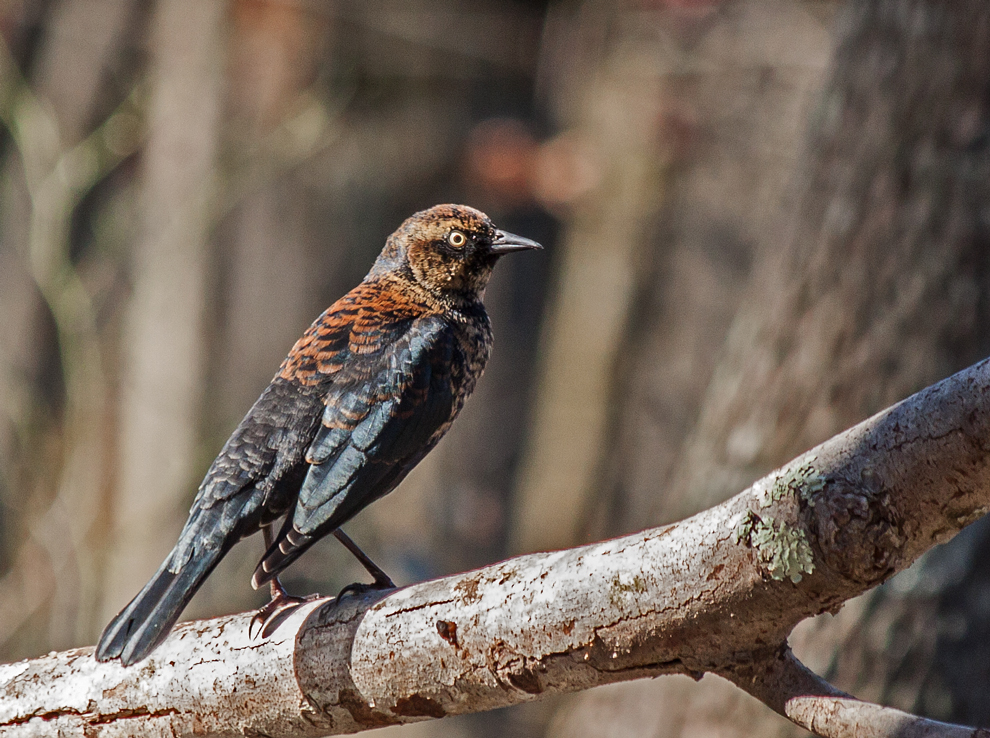
© Michael Q. Powell. All rights reserved.
Posted in Art, Autumn, Birds, Nature, Photography, Portraits, wildlife, tagged Alexandria VA, autumn, Canon 50D, Canon 70-300mm telephoto zoom lens, fall, House Sparrow, Kingstowne, Passer domesticus, sparrow on November 22, 2013| 4 Comments »
It won’t be long before my bird photos have the colorless backgrounds characteristic of winter, so I am photographing as many birds as I can find with autumn colors in the background, like this House Sparrow (Passer domesticus) that I observed last Sunday. As I noted in a posting last month, these birds are non-native (introduced from the Old World) and sometimes crowd out native birds. Still, I find them to be beautiful, especially when they pose like this. This pose is one of my favorites, when I get to look down the tail toward the head turned to the side.
 © Michael Q. Powell. All rights reserved.
Posted in Art, Autumn, Birds, Nature, Photography, Portraits, Winter, tagged Alexandria VA, autumn, fall, Kingstowne, Mimus polyglottos, mockingbird, Northern Mockingbird on November 21, 2013| 12 Comments »
The autumn colors may be fading fast, but the remaining leaves still provided a colorful background for this Northern Mockingbird (Mimus polyglottos) this past weekend.
Normally mockingbirds sing all of the time, but this one was curiously silent the entire time as I moved around at pretty close range, trying to get the best possible background for the shots. From time to time, the mockingbird would turn its head, almost like it was striking new poses for me. This was my favorite pose, a serious portrait in profile in which the mockingbird looks unusually stern.

© Michael Q. Powell. All rights reserved.
Posted in Art, Autumn, Dragonflies, Insects, Macro Photography, Nature, Photography, Portraits, wildlife, tagged Alexandria VA, Autumn Meadowhawk, Autumn Meadowhawk dragonfly, Canon 100mm macro lens, Canon 50D, denim, dragonfly, Huntley Meadows Park, Sympetrum vicinum on November 19, 2013| 7 Comments »
When an Autumn Meadowhawk dragonfly (Sympetrum vicinum) landed on my thigh last Friday, my first thought was to get a photograph of him. Fortunately, my 100mm macro lens was already on my camera—in anticipation of a shot like this—and I was able to capture a close-up, eye-to-eye portrait of the dragonfly by contorting my body and attempting to stabilize my shooting position.
My blue jeans were broken in and their texture, color, and pattern made a pretty cool backdrop for this colorful dragonfly. It may be my imagination, but he seemed to be looking up at me with a mixture of curiosity and amusement.
For whatever reason, many of these dragonflies, which I was able to observe as recently as yesterday, do not seem fearful of people. The classic Drifters song from the 1960’s may talk of spending time with your sweetheart under the boardwalk, but these Autumn Meadowhawks seem to spend most of their time warming up on (and not under) the boardwalk, with periodic mating forays into the bushes.

Click on the photo to see it in higher resolution.
© Michael Q. Powell. All rights reserved.
Posted in Art, Autumn, Birds, Nature, Photography, Portraits, wildlife, tagged Alexandria VA, birds in flight, Branta canadensis, Canada Goose, Canon 50D, Canon 70-300mm telephoto zoom lens, fill the frame, goose, Huntley Meadows Park on November 18, 2013| 10 Comments »
How often have you been told (or read) that you need to fill the frame with your primary subject? If you photograph wildlife as I do, you know that it is rare that you have the opportunity to “fill the frame,” especially when your subject is moving.
I was a little shocked when I first looked at this image of a Canada Goose (Branta canadensis)—not only had I filled the frame, but I had managed to compose it pretty well. Yes, this is an uncropped image of a flying goose. I was awfully lucky to get this shot and I know that several of the images in the burst I took featured cutoff bodies or heads.
Now if I could just get a raptor to fly by this closely…

© Michael Q. Powell. All rights reserved.
Posted in Birds, Humor, Nature, Photography, Portraits, wildlife, tagged Alexandria VA, Anas platyrhynchos, Canon 50D, Canon 70-300mm telephoto zoom lens, conductor, duck, Huntley Meadows Park, mallard duck, orchestra on November 17, 2013| 13 Comments »
Orchestral conductors tend to be flamboyant characters and that is exactly what came to mind when I first say this image of a female Mallard Duck (Anas platyrhynchos) with fully outstretched wings. She seems to be conducting an unseen duck orchestra creating what some might call music and other would characterize as a quackonophy.

© Michael Q. Powell. All rights reserved.
Posted in Art, Autumn, Birds, Nature, Photography, Portraits, wildlife, tagged Alexandria VA, birds in flight, Branta canadensis, Canada Geese, Canada Goose, Canon 50D, Canon 70-300mm telephoto zoom lens, geese, goose, Huntley Meadows Park on November 13, 2013| 7 Comments »
Sometimes you don’t have to make a choice between two options—you can have them both.
In this morning’s blog posting, I posed the question, “When it comes to images of birds in flight, do you prefer the sky as the background or some element of the earth?” and I received quite a few responses, with a greater number having a preference, in general, for background or contextual elements rather than a plain blue sky.
Sometimes I manage to get an image that incorporates the best of both worlds. This image, for example, has one Canada Goose against a leafy background, one against the sky, and one in between.
Who says you have to choose? (In the interest of full disclosure, I intentionally set up the question as a false dichotomy in order to stimulate thinking. For me, the best answer to the question I posed, which called on you to make a sweeping overgeneralization, was the person who responded quite simply with the words, “It depends.”)

© Michael Q. Powell. All rights reserved.

 Mike Powell