Feeds:
Posts
Comments

Archive for the ‘Photography’ Category

At this time of the year my peaceful pursuit of photos is often punctuated with the sound of shotgun blasts as I walk along the trails parallel to the water at Occoquan Bay National Wildlife Refuge—it is duck hunting season. As you might suspect, duck hunting is not permitted on the territory of the wildlife refuge itself, but there is a series of duck blinds not far from the shore.

Some hunters simply take their boats and occupy the blinds, while others take the additional step of putting out duck decoys. In previous years I was fooled into taking photos of the decoys, thinking they were real ducks, but my decoy identification skills seem to have improved.

Here are a couple of photos of one of the blinds to give you an idea of what they look out and how close they are to the shore. I took the final shot of a group of hunters as they slowly motored by me. I don’t know the hunting rules, but I don’t think that they can hunt from a moving boat.

I am not against hunting per se, but I am definitely a bit edgy when I hear shots fired not far from where I am walking and will definitely welcome the eventual end of the hunting season.

duck blind

duck blind

duck hunting

© Michael Q. Powell. All rights reserved.
Read Full Post »

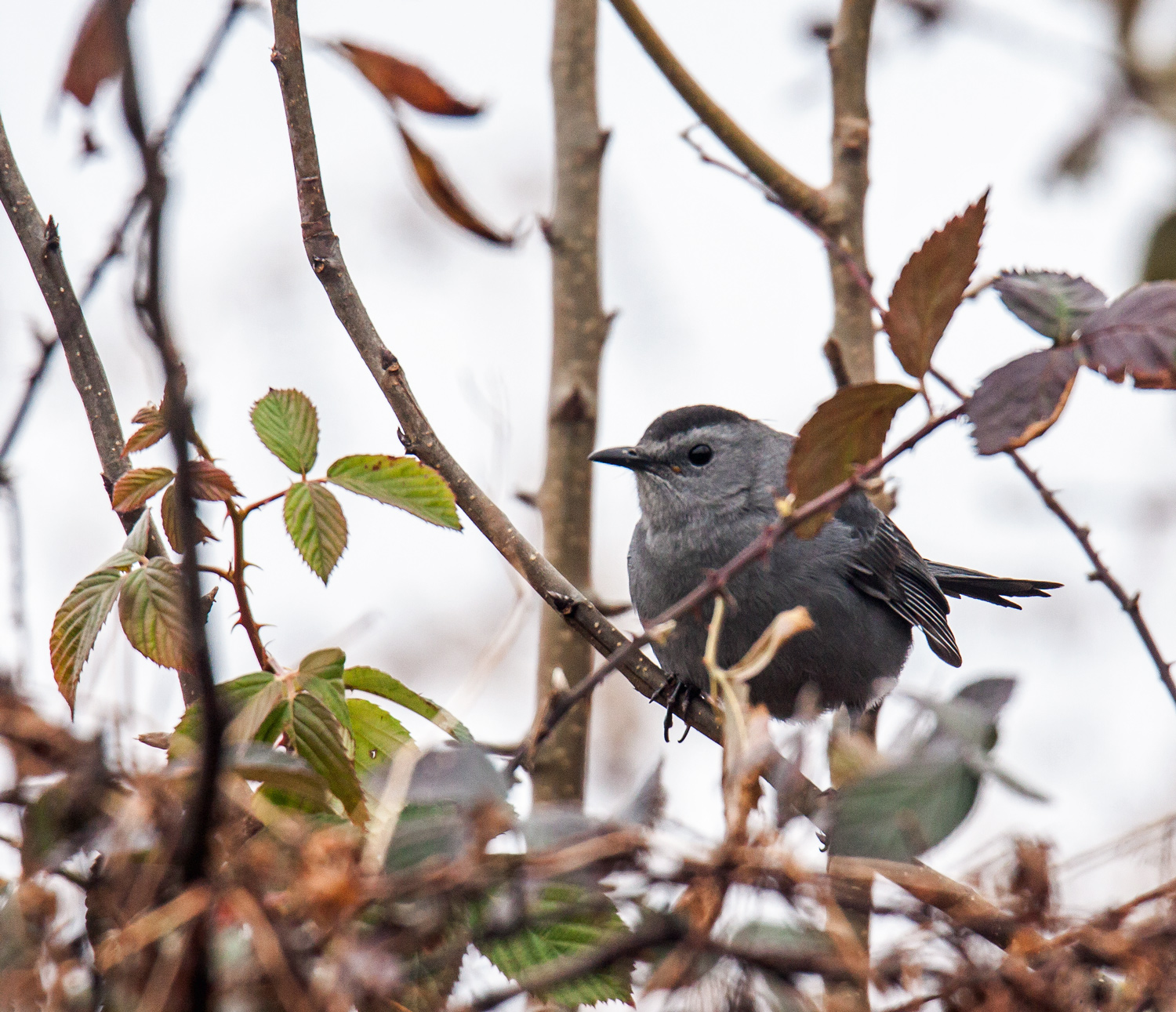
I’ve read that a Gray Catbird (Dumetella carolinensis) makes a distinctive cat-like mewing sound, but I don’t recall ever having heard a catbird make any sound whatsoever. According to the Cornell Lab of Ornithology, Gray Catbirds can also copy the sounds of other species and string them together to make their own song that can last as long as ten minutes.

Even without hearing its song, I was able to spot this Gray Catbird earlier this week at Occoquan Bay National Wildlife Refuge. As is most often the case with catbirds, this one was in thick vegetation, but I did manage to get a relatively clear shot of its head and body.

Gray Catbird

© Michael Q. Powell. All rights reserved.


Read Full Post »

The long sloping shape of the bills of these ducks in the waters off of Occoquan Bay National Wildlife Refuge indicated to me that they are Canvasbacks ducks (Aythya valisineria). Most of the time I rely primarily on colors when trying to identify birds, but during the non-breeding season, many ducks share the same subdued colors, especially when viewed from a distance. This was a rare case when a single distinctive characteristic—in this case the bill—was enough for me to identify the birds with a reasonable degree of confidence.

According to Wikipedia, the duck’s common name is based on early European inhabitants of North America’s assertion that its back was a canvas-like color. In other languages it is just a white-backed duck; for example in French, morillon à dos blanc, or in Spanish, pato lomo blanco.

canvasback

© Michael Q. Powell. All rights reserved.
Read Full Post »

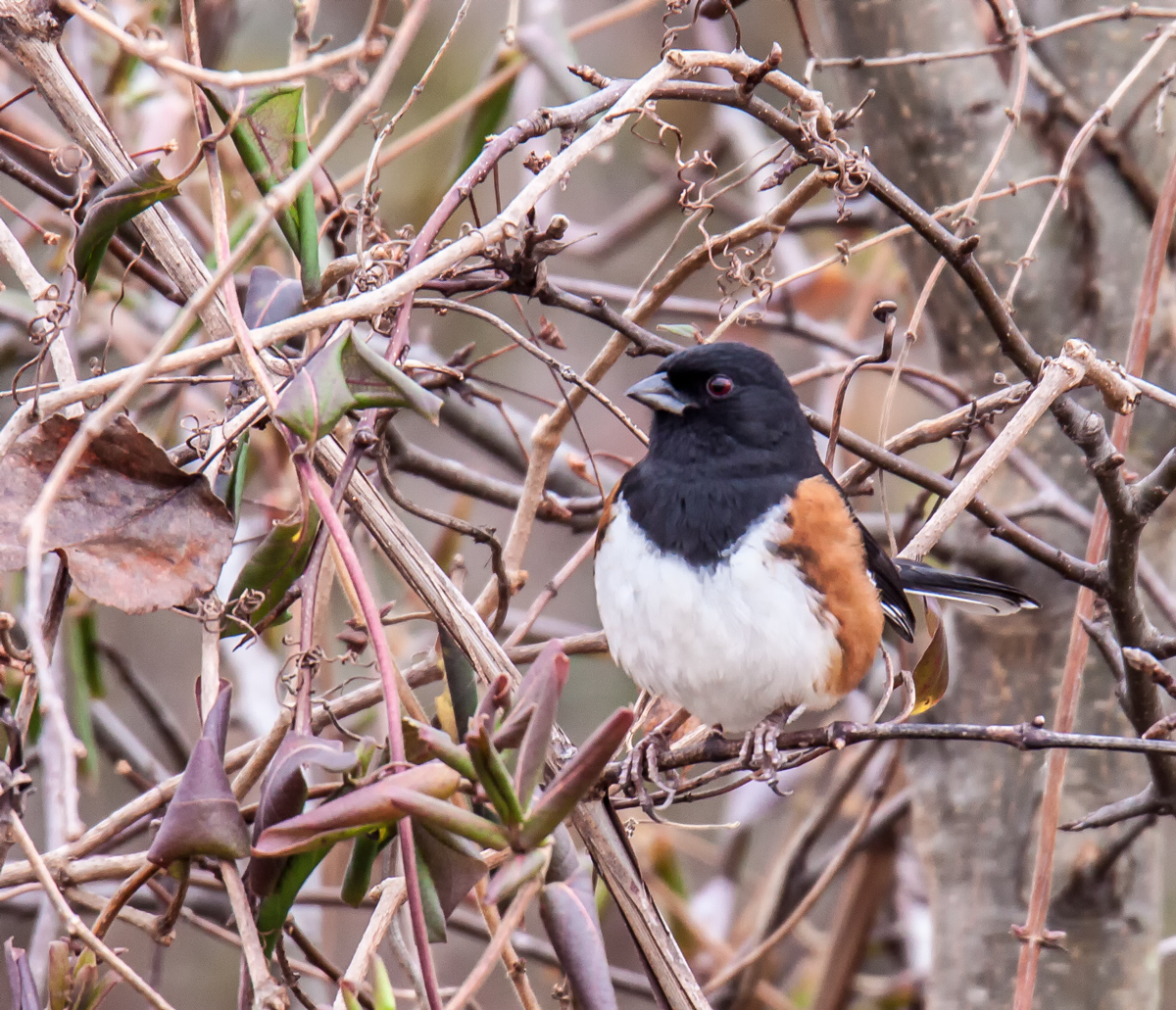
During the winter months you sometimes have to search a little harder to find birds, but they are definitely still with us. When I caught a glimpse of this bird’s rust-colored feathers earlier this week at Occoquan Bay National Wildlife Refuge, I assumed it was an American Robin.

When I zoomed in, however, I was thrilled to see like that the bird was an Eastern Towhee (Pipilo erythrophthalmus). Towhees share many of the same colors with the robins, but they are arranged in a completely different way. I think that towhees are supposed to be relatively common, although I personally do not see them very often.

I love to play with words and “towhee” for some reason is fun to say out loud. Try it yourself—it is virtually guaranteed to put a smile on your face.

Eastern Towhee

© Michael Q. Powell. All rights reserved.


Read Full Post »

Many of you know that I normally post every day—in 2018 I think that I missed only 12 days.  I used to be really obsessive about this and would get anxious if I didn’t have an image to post. Over time, though,I have mellowed a bit and so I am not at all concerned that I write a posting on New Year’s Day.

I have been in a contemplative mood ever since I did the retrospective look at some of my favorite photos from last year. As I looked back I simultaneously looked forward. I have never been a big fan of New Year’s resolutions, but my hopes and plans for this new year can be summed up in two words “more” and “better.”

Those two words are non-specific and subjective, but for me, that is the nature of my approach to photography. I strive to spend as much time as I can in the wild, opportunistically looking for subjects. When situations present themselves, I try to react as quickly and creatively as I can.

That was the case earlier today when I visited Occoquan Bay National Wildlife Refuge. Despite the partial federal government shutdown, the wildlife refuge is still open. It was a cool and gray day, and there was not too much activity. I was therefore thrilled when I spotted this Red-bellied Woodpecker (Melanerpes carolinus) feverishly pecking away at a distant tree.

The woodpecker kept its head down as it circled the branch, but finally paused for a moment when it was upright and I was able to capture this shot. Although the woodpecker is relatively common, the organic shapes of the branches really caught my eye.

I’m ok with shooting familiar subjects over and over again. What about you? Some people like to live “widely,” seeing lots of different things in different places, while others prefer to live “deeply,” seeing the same places in different ways and in different seasons. I tend to be in the latter group, but recognize that each person has his/her own comfort zone.

Red-bellied Woodpecker

© Michael Q. Powell. All rights reserved.

Read Full Post »

As another year in my journey through photography comes to a close, I decided to share a few of my favorite photos of the past year. I initially planned to choose one image for each month and that was doable for the first few months of the year. Once I moved into the prime seasons for shooting, though, there were so many good photos I couldn’t select a single one, so I chose multiples for those months and ended up with these thirty photos.

If you want to see the images in a larger size, all you need to do is click on one of them and they will then be displayed in a slide show format.

Thanks so much to all of you who have followed my blog postings and supported and encouraged me in so many ways. It has been a wonderful year and I look forward to more photos and new adventures in the upcoming new year.

Happy New Year to you all and best wishes for a blessed 2019.


© Michael Q. Powell. All rights reserved.

Read Full Post »

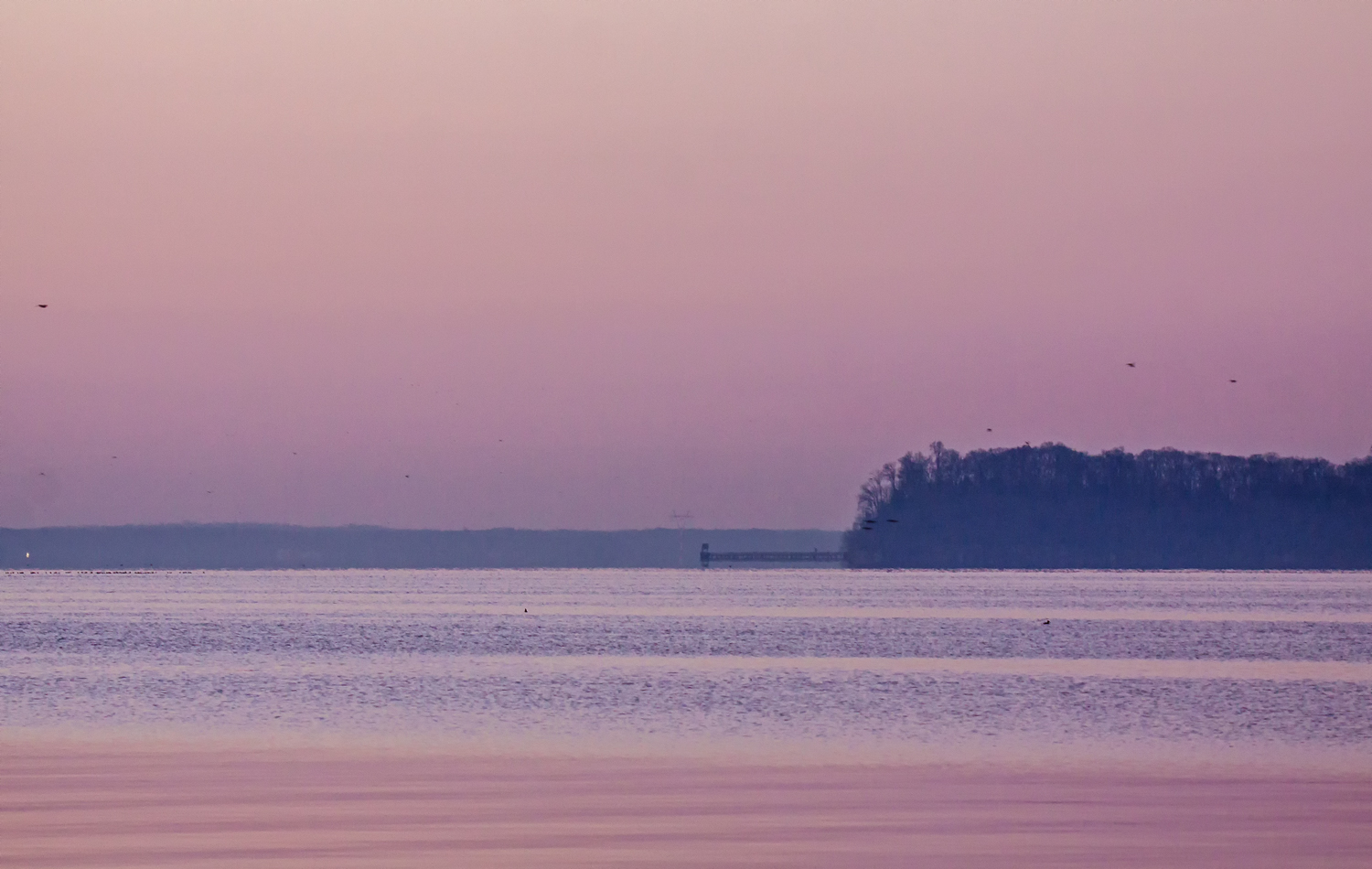
A few days ago I posted a shot of a sunrise over Occoquan Bay and I remember waiting somewhat impatiently for the sun to rise. Fortunately I took some shots as I was waiting and as I finally went over those shots today, I was happy that they showed some of the beautiful colors as the night finally turned into day.

The sunrise was by no means spectacular—its beauty was more subdued and subtle. You’ll probably notice that the color changes a bit in each of the images. I think that the colors were influenced by the direction in which I was pointing my camera and the amount of light present in the scene.

pre-dawn light

pre-dawn light

pre-dawn light

© Michael Q. Powell. All rights reserved.

Read Full Post »

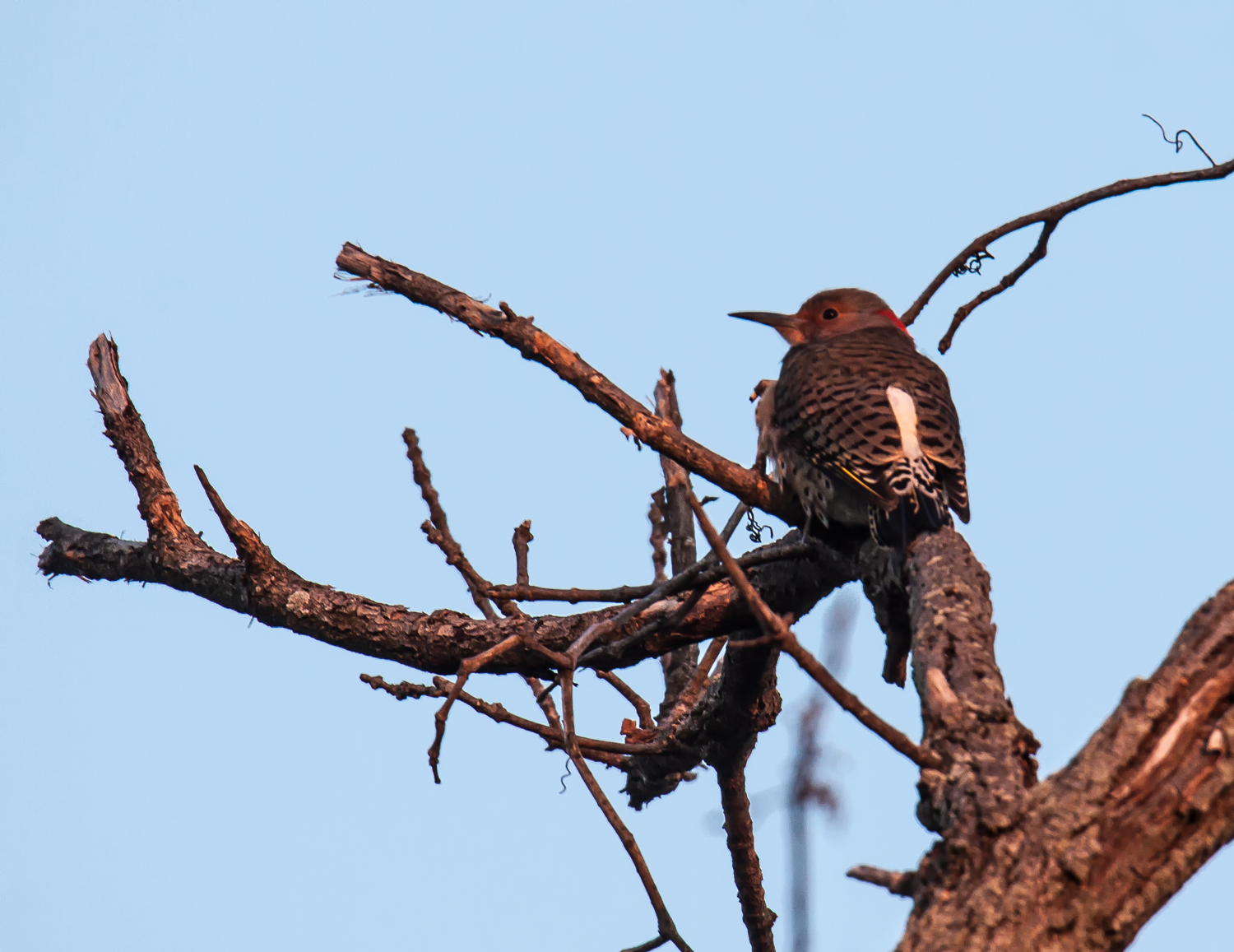
Northern Flickers (Colaptes auratus) have very distinctive patterns and colors, but in the early morning light this one blended in well with the bark and branches of the tree on which it was perched earlier this week at Occoquan Bay National Wildlife Refuge.

I was able to detect the bird’s presence only when it moved its head a bit from side to side. Some of my friends are able to spot birds in the trees on the basis of their shapes, but for the most part I need some movement to be able to do so.

Northern Flicker

© Michael Q. Powell. All rights reserved.


Read Full Post »

White-throated Sparrows (Zonotrichia albicollis) always remind me of Santa Claus because of their white “beards.” The effect was magnified on a recent frigid morning at Occoquan Bay National Wildlife Refuge, when a White-throated Sparrow had fluffed up its feathers to retain heat and looked even chubbier than normal.

White-throated Sparrow

© Michael Q. Powell. All rights reserved.

Read Full Post »

From a distance I spotted a flash of white, high in the uppermost branches of a tree. It was vaguely bird-shaped, but I had to move closer to know for sure—I am often fooled by misshapen branches or clumps of leaves. Eventually I was able to determine that what I had seen were the white breast feathers of an Eastern Bluebird (Sialia sialis) grooming itself in the early morning sunshine.

I love bluebirds and they invariably bring a smile to my face, especially when I recall the words of Benjamin, a young viewer of my blog, who remarked that these birds should be called “orange bluebirds,” because they have as much orange as they do blue.

Eastern Bluebird

© Michael Q. Powell. All rights reserved.

Read Full Post »

It was 24 degrees (minus 4 C) this morning when I first got into my car and I had to take time to clear away the frost. Nevertheless I managed to make it to Occoquan Bay National Wildlife Refuge in time to catch the sunrise over the water.

sunrise

© Michael Q. Powell. All rights reserved.

Read Full Post »

The pastor at the Christmas service today reminded us of the theological implications of saying “Merry Christmas.” Every time that we utter those words, he said, we are telling another person that God loves them, that the true message of Christmas is God Incarnate, God taking on a human form to dwell among us.

Earlier this morning I was thinking about what kind of a photo I would post today. I considered selecting a recent wildlife photo, but not of them spoke to me. As I walked the dog while it was still dark, I thought about taking a photo of some of the colorful lights and decorations in my neighborhood, but somehow they didn’t represent Christmas to me at that moment.

I finally went out to my front yard and took this modest photo of one of the bushes there. I think it is called Heavenly Bamboo (Nandina domestica) and its simple form and traditional colors seemed an accurate reflection of my inner thoughts and feelings about Christmas this year. Christ came into the world in a humble way and meets us today where we are, no matter what our circumstances may be.

With the angel chorus and the heavenly host, I think about these words of the traditional Christmas story that I learned so long ago in the King James version: Glory to God in the highest, and on earth peace, good will toward men.

Merry Christmas to you all.

Heavenly Bamboo

© Michael Q. Powell. All rights reserved.

Read Full Post »

As the waves washed over the Double-crested Cormorant (Phalacrocorax auritus) perched on a floating remnant of a tree, the solo bird looked like a shipwrecked sailor, adrift on a swamped, semi-submerged sailboat. My mind conjured up scenes from different movies with this theme.

A short time later, I encountered a basketball dashing up against the shore with each successive wave. As the ball slowly turned I caught sight of its faded lettering. Like Tom Hank’s companion in the movie Cast Away, the ball was labelled “Wilson.” Perhaps the shipwrecked cormorant had been engaging in lengthy conversations with this Wilson, as Tom Hanks did during the movie.

double-crested cormorant

Wilson

© Michael Q. Powell. All rights reserved.

Read Full Post »

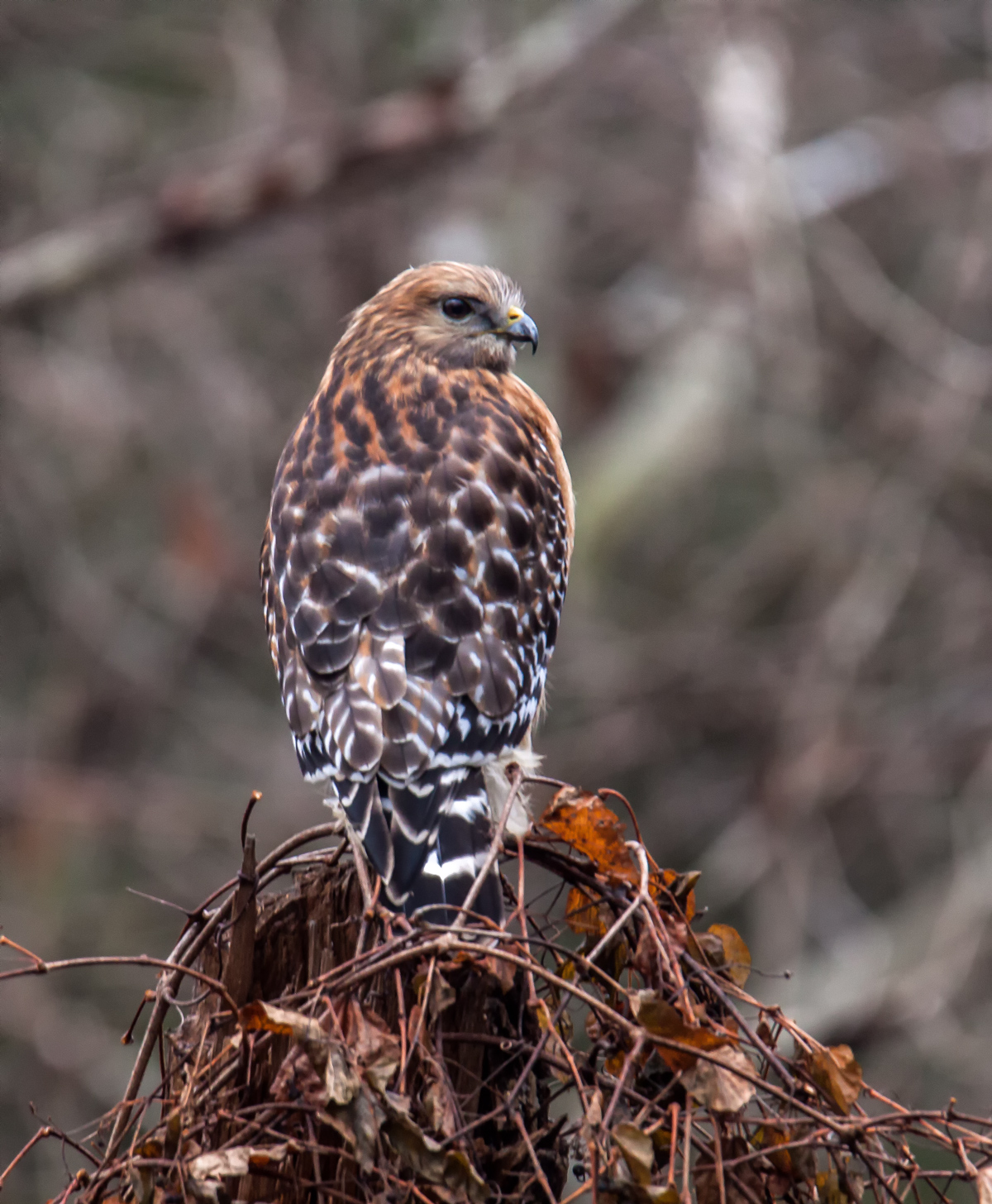
I didn’t have to go far to find this Red-shouldered Hawk (Buteo lineatus)—I spotted it while walking a friend’s Cocker Spaniel in my suburban townhouse neighborhood. I rushed home to get my camera and was thrilled when I returned to find that the hawk was still perched on a broken-off tree in a small marshy area.

Red-shouldered Hawk

Red-shouldered Hawk

© Michael Q. Powell. All rights reserved.

Read Full Post »

As I was walking across the Key Bridge from Georgetown on Wednesday night, I glanced down at the Potomac River and saw that the Kennedy Center was aglow with rainbow colors. I believe that the colors were part of the celebration of the Kennedy Center Honors, an annual honor given to those in the performing arts for their lifetime of contributions to American culture. Honorees receive a medallion that hangs from a rainbow colored ribbon.

Most of the landmarks shown here will be familiar only to locals, but some of you may recognize the Washington Monument in the middle left in the photo. In case you are curious, I took this shot with a Canon A620 camera, an old 7.1 megapixel point-and-shoot camera that I carry with me sometimes because it fits easily into my pocket. I leaned against the railing of the bridge to take this shot in what turned out to be a one second exposure.

Although I know what the subject matter of the image is, I enjoy it equally as a kind of abstract, man-made landscape, a beautiful combination of lines and shapes and colors, with some of them reflected in the dark waters of the river.

Kennedy Center Honors

© Michael Q. Powell. All rights reserved.


Read Full Post »

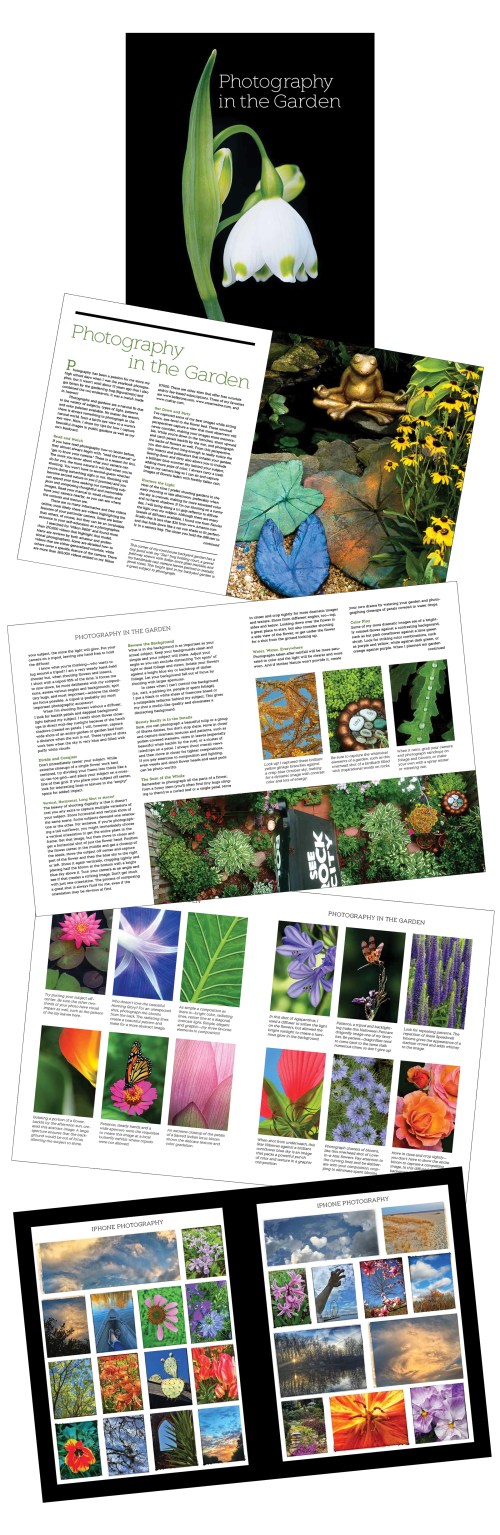
My dear friend and photography mentor Cindy Dyer just created a free mini-magazine on Photography in the Garden. Cindy is the one who helped me get more serious with photography six years ago. Her beautiful work has been featured on US postage stamps and in Nikon publications and exhibitions. In addition to her DSLR work, she has added a selection of amazing images that she shot with her iPhone.

Cindy is a constant source of inspiration for me and I encourage you all to check out her work—this mini-magazine is a great start.

cindydyer's avatarCindy Dyer's Blog

In this 20-page mini-magazine, I share my tips and tricks for photographing your garden in its best light, whether you’re shooting with a DSLR, point-n-shoot, or smartphone. You’ll learn about composition, harnessing the light, photographic resources, and what’s in my bag. Photographing gardens and the natural world has been enormously rewarding for me. Below are some sample pages from the mini-magazine.

Read your manual, shoot regularly, learn how to process your digital images and above all else, always stay curious!

Click here: Cindy Dyer Garden Photography

© Cindy Dyer. All rights reserved.

GP Sample Display

View original post

Read Full Post »

In theory, it is easier to spot a Bald Eagle (Haliaeetus leucocephalus) now that the leaves have fallen from the trees. In reality, however, the eagles often seem to like to perch in locations where they are at least partially hidden by branches.

That was certainly the case this past Monday when I spotted this bald eagle at Occoquan Bay National Wildlife Refuge. There was a lot of tangled vegetation between me and the eagle, so there was no way that I could get any closer. I was happy that I was able to find a shooting angle that allowed me to get a clear view of the eagle’s head and tail.

Bald Eagle

© Michael Q. Powell. All rights reserved.

Read Full Post »

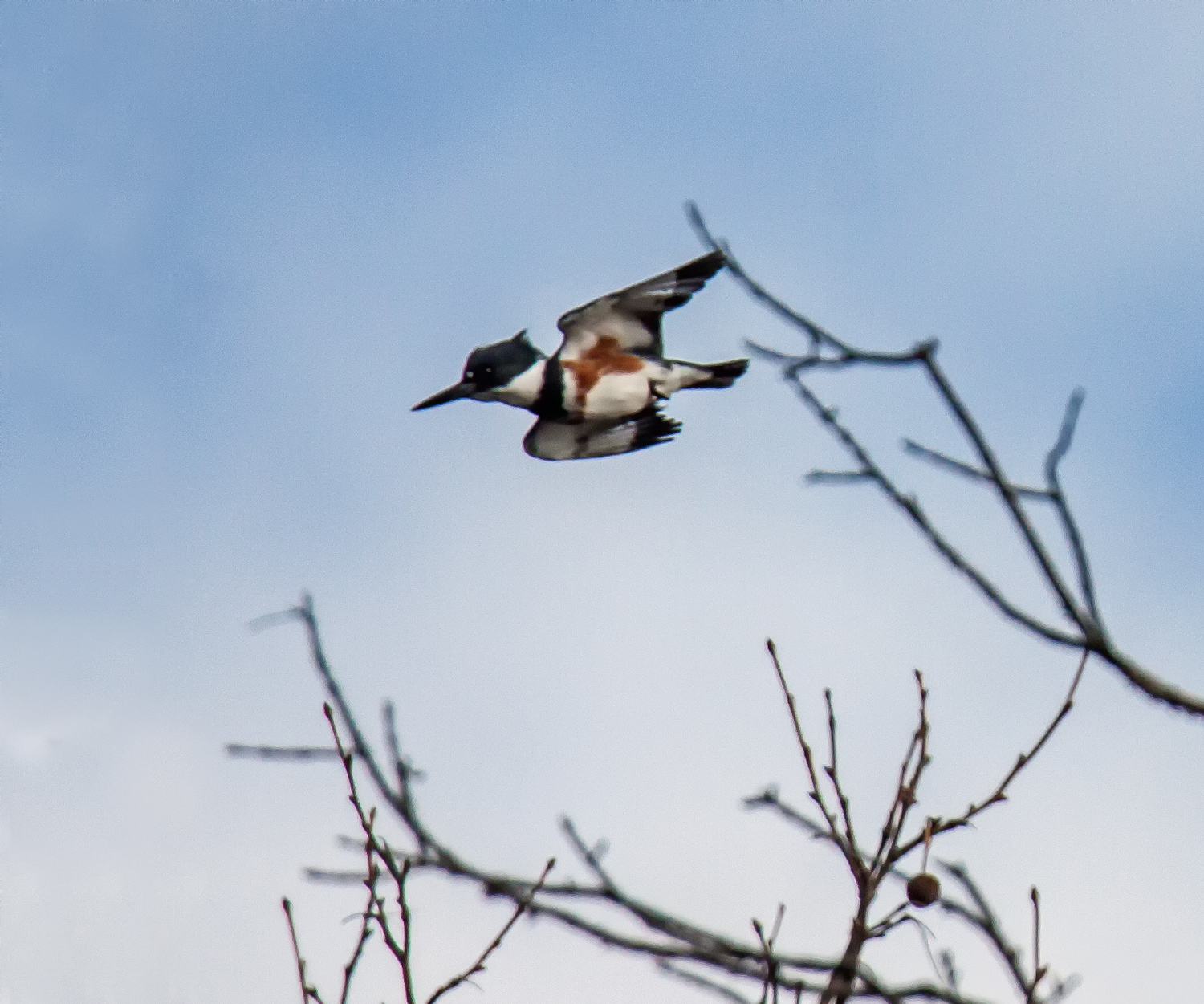
It often feels like Belted Kingfishers (Megaceryle alcyon) are taunting me. They boldly advertise their presence with a distinctive rattling call, but keep their distance or fly away quickly before I can spot them. I dream of spotting one at close range and getting some shots before it is aware of my presence.

Well, my dream did not not come true this past Monday, but I did manage to get some shots of a female Belted Kingfisher in flight while exploring Occoquan Bay National Wildlife Refuge. I took the shots at pretty long range as the kingfisher was moving from perch to perch in the distant trees.

Belted Kingfisher

Belted Kingfisher

Belted Kingfisher

© Michael Q. Powell. All rights reserved.


Read Full Post »

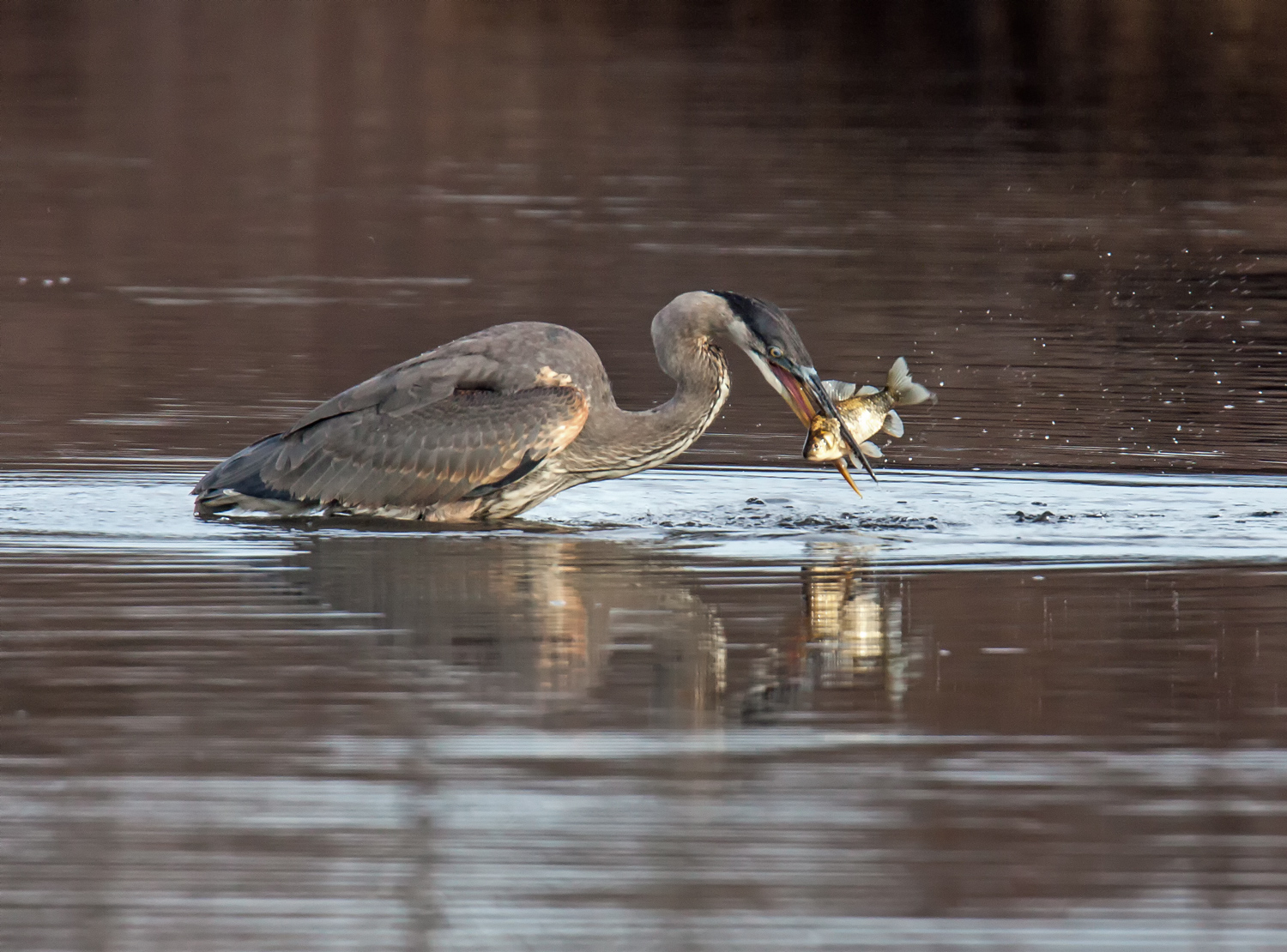
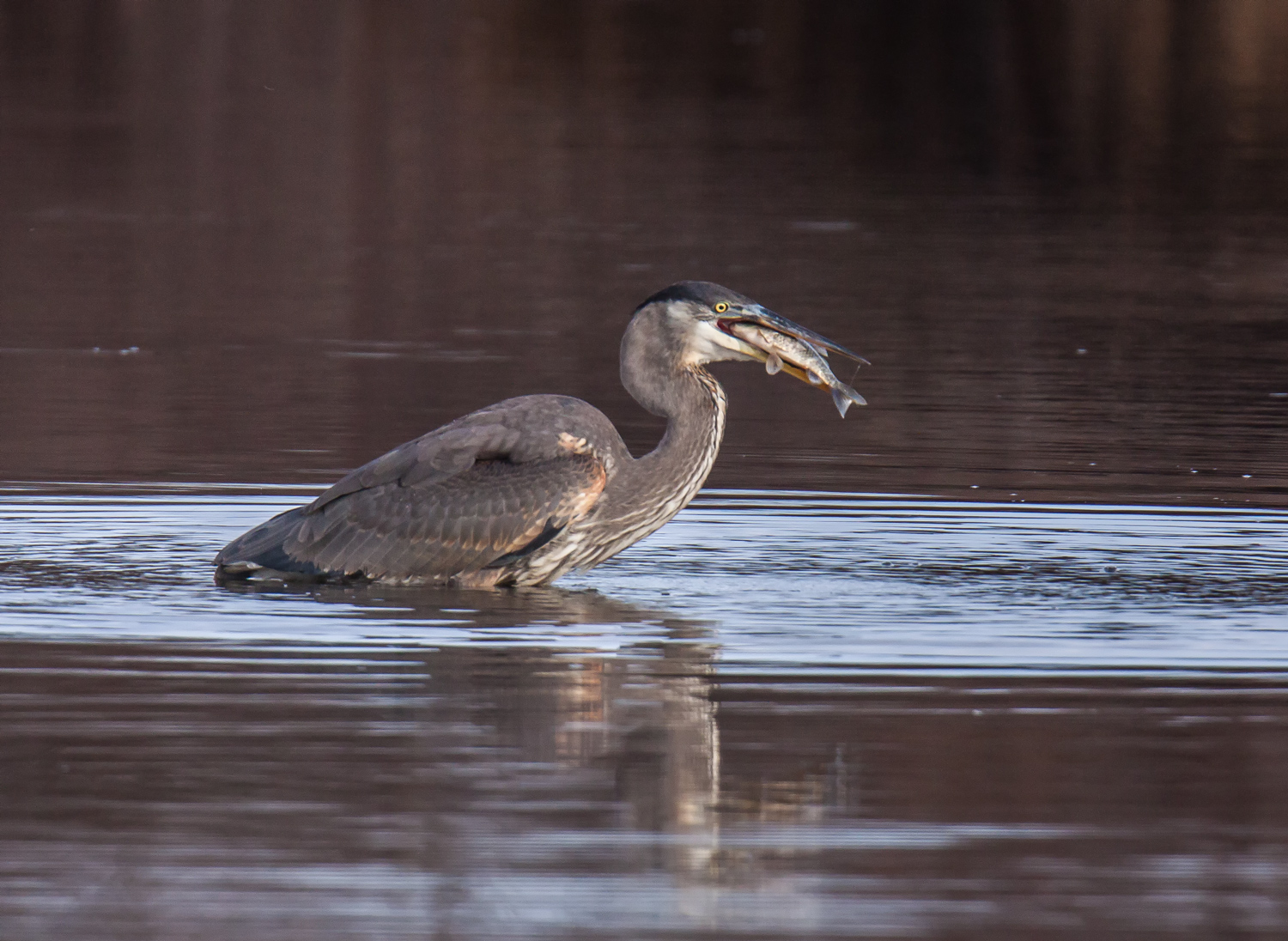
After several unsuccessful attempts, this Great Blue Heron (Ardea herodias) pulled a good-sized fish out of the waters of a small pond on Monday at Occoquan Bay National Wildlife Refuge. A few second later the heron had the fish correctly positioned and swallowed in a single big gulp. I thought the heron would take a break to digest his meal, but it returned immediately to fishing.

Great Blue Herons have an amazing amount of patience. They will stand immobile for extended periods of time and then strike forcefully into the water without any notice. When I am observing a heron, it is always a challenge to remain alert and ready. Often the heron’s patience exceeds my own, but fortunately that was not the case on this particular day. I was lucky too that the heron did not turn away after it had caught the fish, which allowed me to capture some of the action.

Great Blue Heron

Great Blue Heron

© Michael Q. Powell. All rights reserved.

Read Full Post »

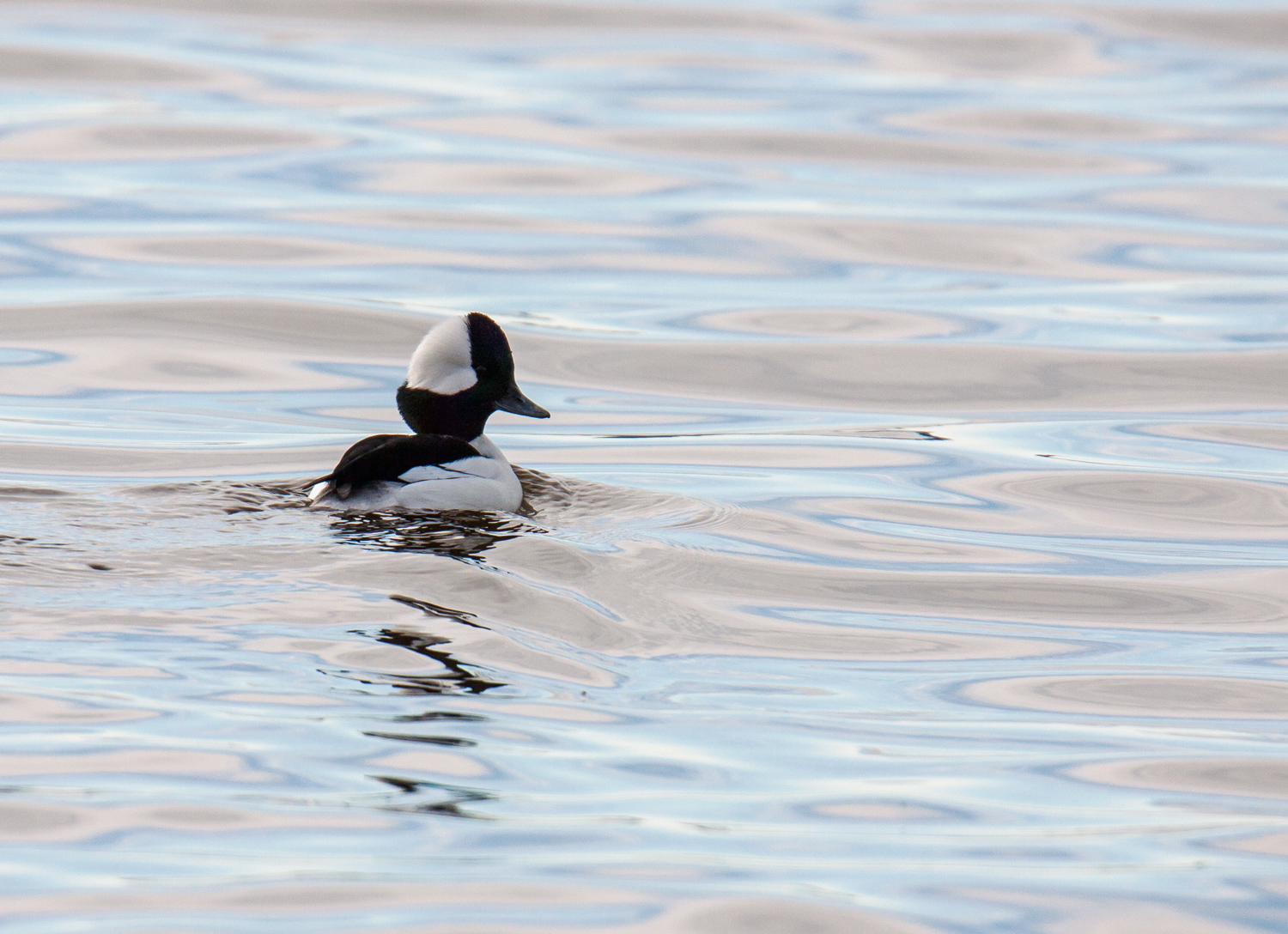
For the first time in a while, a male Bufflehead (Bucephala albeola) ventured close enough for me to get some shots yesterday when I was exploring Occoquan Bay National Wildlife Refuge. I have posted some photos of buffleheads fairly recently, but they have all been of females (or possibly immature males).

The shape and colors of these little water birds, especially the males, always strike me as cartoonish—like they were drawn by Disney artists.

Bufflehead

Bufflehead

© Michael Q. Powell. All rights reserved.

Read Full Post »

Last night, my final night in Vienna this trip, I had a chance to walk by Stephansdom (St. Stephen’s Cathedral), an incredible building in the center of the city.

The beauty of Vienna is magnified at this time of the year by wonderful decorations and lights everywhere.

Stephansdom

© Michael Q. Powell. All rights reserved.

Read Full Post »

My short trip to Vienna, Austria is rapidly coming to a close and I want to leave you with this image of the entrance to the outdoor Christmas market at the Rathaus (City Hall), the tall building in the background.

My busy work schedule and the rainy weather this year have conspired against me and kept me from getting new photos. I decided to reprise a photo from a similar posting that I did in 2016. I did have a chance earlier in the week to visit this Christmas market and, as always, it was amazingly beautiful, despite the bustling crowds and often commercialized decorations and merchandise.

Best wishes to all for a “Frohe Weihnachten,” German for “Merry Christmas.”

Christmas 2018

© Michael Q. Powell. All rights reserved.

Read Full Post »

Sometimes the most mundane scenes capture my eye and prompt me to photograph them. On Monday morning, I looked out of my hotel window and was captivated by the way that the early sunlight was falling on the dome of a building in the distance. As I started exploring the scene I saw lots of wonderful details, a wonderful juxtaposition of elements of the old and the new, of historical buildings and new construction.

This is not my normal style of photography, but I thought it would be fun to share with you a couple of images that give you a sense of the feel of that early morning in Vienna, Austria. I had hoped to take some additional photos of the city, but the last couple of days have been cold, wet, and windy. With a little luck I will be able to take a few photos of the Christmas markets to share with you before I depart this beautiful old city.

Vienna Austria

Vienna Austria

© Michael Q. Powell. All rights reserved.


Read Full Post »

Whenever I am traveling for work I try to find some local wildlife to photograph. I am currently in Vienna, Austria and yesterday morning I went for a short walk in the Stadtpark, a park in central Vienna that is not far from my hotel. In the small pond there I found mostly mallard ducks (Anas platyrhynchos), a species with which I am quite familiar.  One duck, however, really stood out because it had such unusual markings.

I focused my attention and my camera on this particular duck. Its shape looked to be similar to that of normal mallards and I wonder if this might be some kind of hybrid. I suppose that it could be another species altogether, though it did not look like any of the species in the photographic list I found on-line of the birds of Austria.

Whatever the case, this bird struck me as being a bit of an odd duck.

duck in Vienna

duck in Vienna

© Michael Q. Powell. All rights reserved.

Read Full Post »

Over the past few months I have repeatedly heard the screaming of hawks in the distance, but it has been rare for me to actually catch sight of one. I was thrilled therefore when I spotted this Red-tailed Hawk (Buteo jamaicensis) last week at Occoquan Bay National Wildlife Refuge. The hawk soared almost directly over me, providing me with a wonderful view of its fully extended wings and red tail.

This was one of the few cases when it was not an advantage to have my camera attached to a monopod. I ended up taking this shot with the camera held at a high angle with monopod sticking straight out, almost parallel to the ground.

Red-tailed Hawk

© Michael Q. Powell. All rights reserved.

Read Full Post »

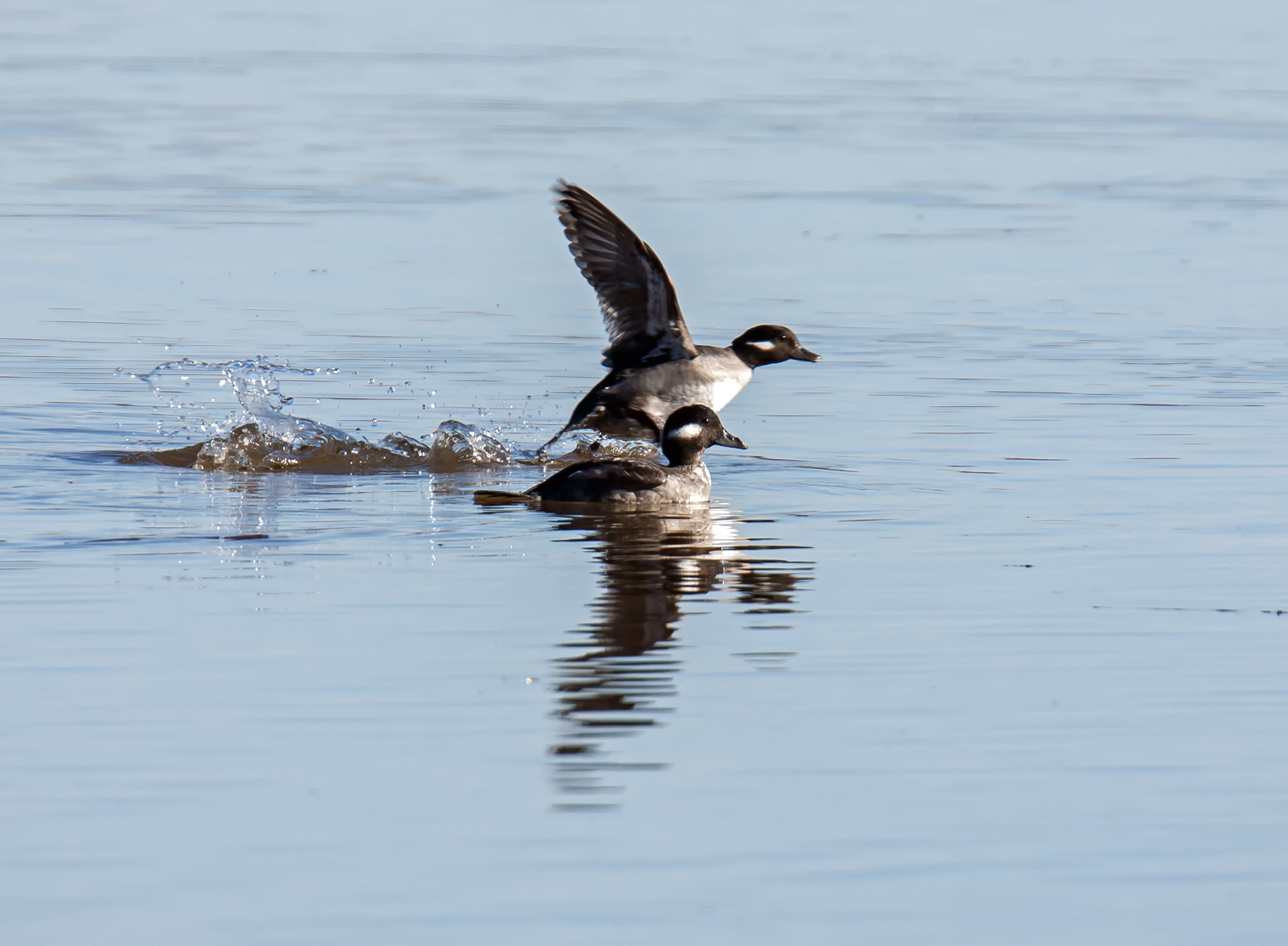
When I am watching water birds, it is hard for me to predict when they will decide to take to the air. Often they give no visible warning. Some species, though, need to dance across the water to gain momentum before they can lift off, like this pair of female Buffleheads (Bucephala albeola) that I observed last week at Occoquan Bay National Wildlife Refuge.

The one in the back had already started its takeoff maneuvers when I captured this image and a second later the second bufflehead was also skipping across the water.

bufflehead

© Michael Q. Powell. All rights reserved.

Read Full Post »

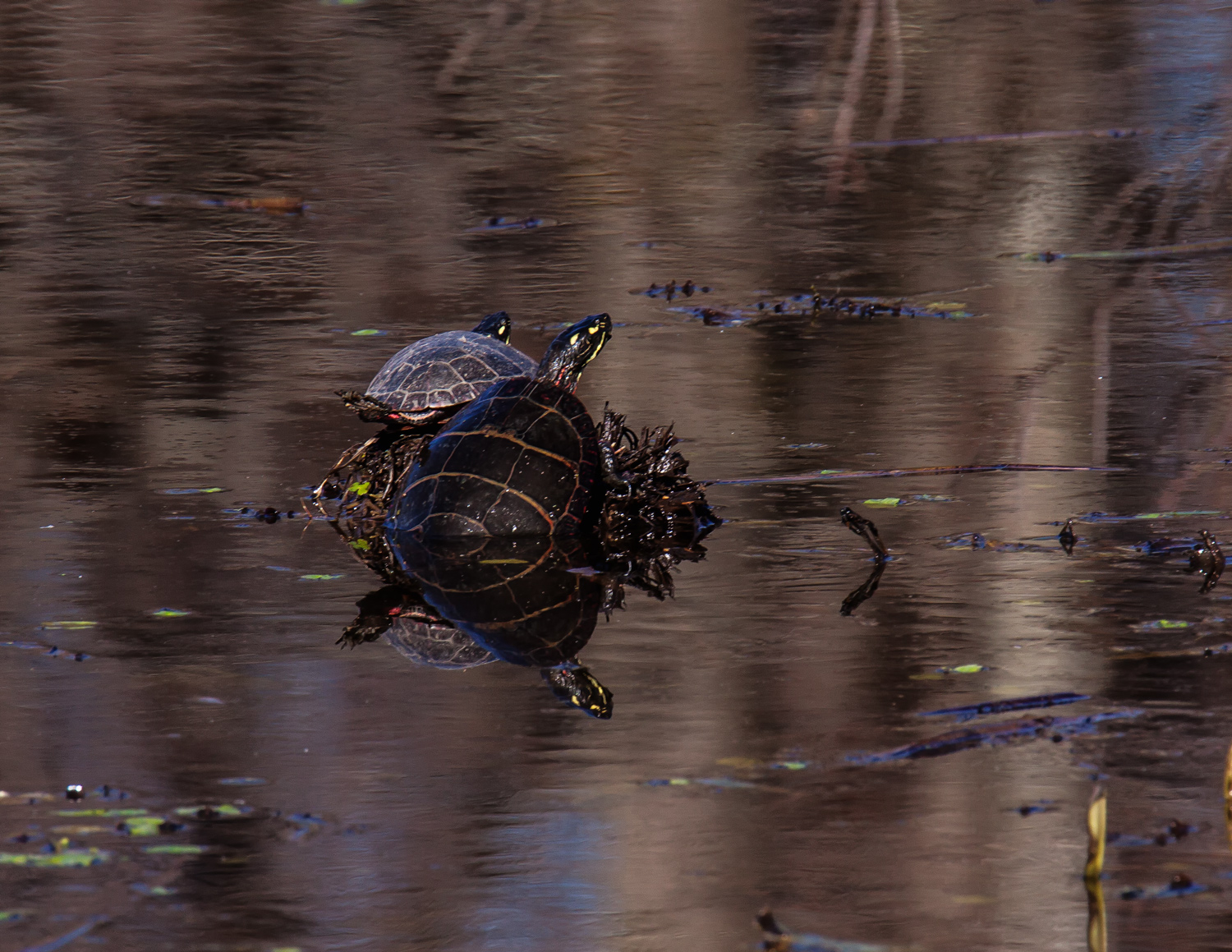
The temperature today feels so frigid—right about the freezing level—that it is hard to remember that only this past Monday it was sunny and 60 degrees (16 degrees C). While I was enjoying the unseasonably warm weather and exploring Occoquan Bay National Wildlife Refuge, I photographed these sunning turtles, a relatively rare sight in December.

I did not get a good enough view of the turtles to be able to identify them with any confidence, but I think they may be Eastern Painted Turtles (Chrysemys picta picta) or possibly Red-eared Sliders (Trachemys scripta elegans).

Turtles in December

© Michael Q. Powell. All rights reserved.


Read Full Post »

Recently I served as the assistant for a fellow photographer Cindy Dyer as she shot some portraits in her studio. I had never before participated in that kind of a venture and I was a little shocked by the amount of coaching that the subject needed to ensure a proper head position, body position, and expression. Apparently most of us do not know how to act “naturally” in a way that will yield a goof portrait.

Fortunately many birds do not require these instructions. On Monday of this week, this Cedar Waxwing (Bombycilla cedrorum) took a break from its foraging and seemed to be posing for me.  The bird decided that a profile shot would be good to show of its distinctive eye mask and that any hint of a double chin could be eliminated by slightly elongating its neck. Although the Cedar Waxwing tried to maintain a serious expression, I think I detect the beginning of a tiny smile.

Cedar Waxwing

© Michael Q. Powell. All rights reserved.

Read Full Post »

Despite his diminutive size, this male Golden-crowned Kinglet (Regulus satrapa) seemed to have plenty of attitude when I spotted him on Monday at Occoquan Bay National Wildlife Refuge.

Size is relative, of course, but by almost any standard Golden-crowned Kinglets are tiny. The are about 3-4 inches (8 to 10 cm) in length and weigh only 0.1 to 0.3 ounces (4 to 8 gm). Their small size and hyperactivity make them a fun challenge to photograph.

I particularly like this bird’s combative stance and the way that it provides us with such a good view of its bright yellow “crown.” It is one of the rare occasions when I got an unobstructed shot of a kinglet—normally there are branches blocking at least part of the view.

Golden-crowned Kinglet

© Michael Q. Powell. All rights reserved.

Read Full Post »

I was quite excited on Monday at Occoquan Bay National Wildife Refuge when this Brown Creeper (Certhia americana) finally let me get a relatively unobstructed shot of it. I had spent quite a while trying to track it as it climbed up and around several trees in a kind of corkscrew pattern.

In the past I have seen this elusive little bird several times, but as far as I know, this is the first time that I have ever gotten a shot of one. The Brown Creeper moves in a pattern that is not at all like any other bird that I have observed. The Cornell Lab of Ornithology website provides the following description of this behavior:

“The Brown Creeper spends most of its time spiraling up tree trunks in search of insects. It holds its short legs on either side of its body, with the long, curved claws hooking into the bark, and braces itself with its long, stiff tail. Both feet hop at the same time, making the bird’s head duck after each hop. Because of its specialized anatomy, the Brown Creeper rarely climbs downward: once high in a tree, it flies down to begin a new ascent at the base of a nearby tree.”

I am happy with this shot, though I must confess that I get a little dizzy if I look at it too long.

Brown Creeper

© Michael Q. Powell. All rights reserved.


Read Full Post »

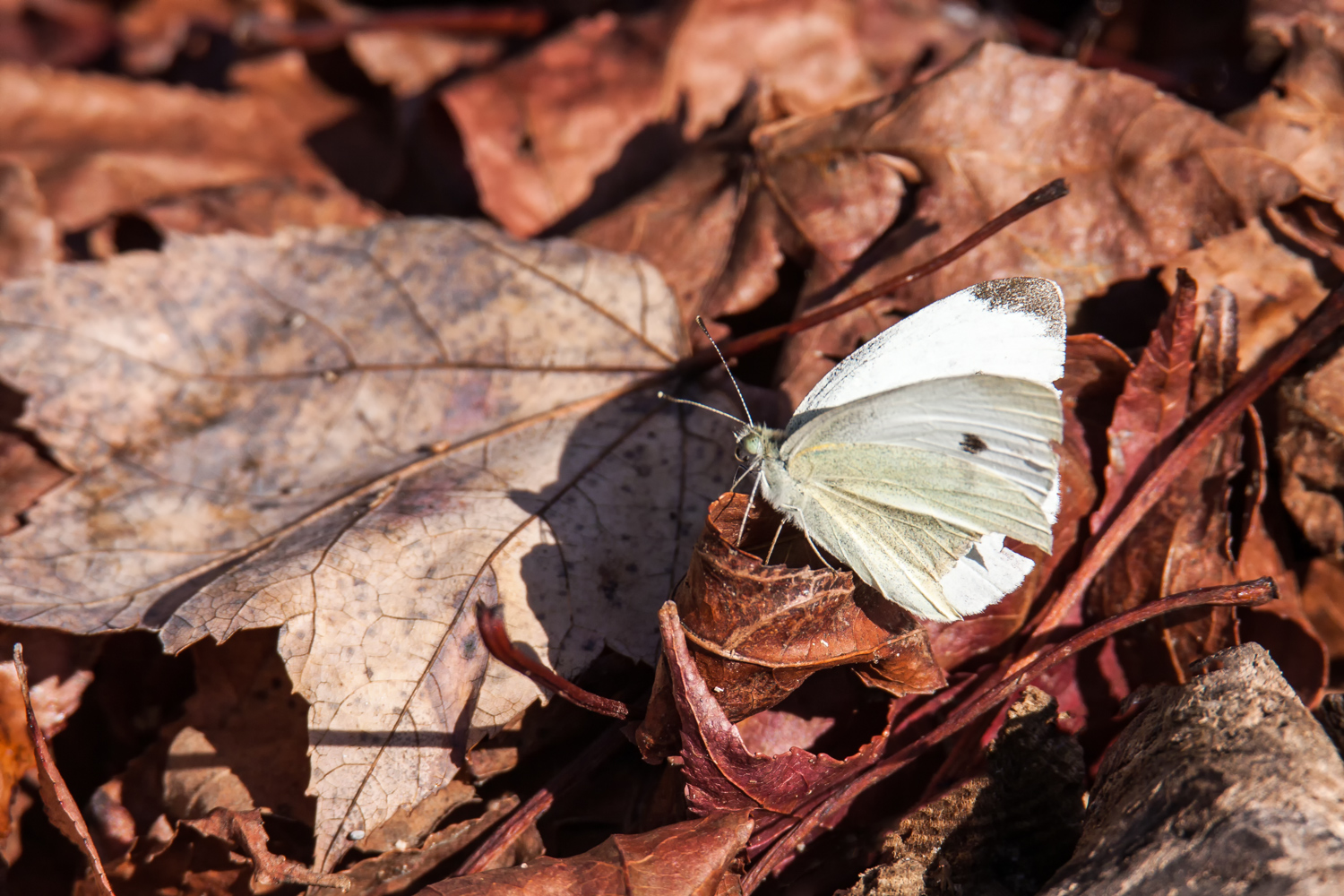
A butterfly in December? I was shocked and thrilled to see this tattered Cabbage White butterfly (Pieris rapae) flying around yesterday at Occoquan Bay National Wildlife Refuge.

I photographed this little butterfly with my telephoto zoom lens fully extended to 600mm. I contemplated cropping the image, but decided that I really like the look and feel of all of the fallen leaves and left it uncropped. I also like the way that the veining in the leaves seems to mirror the veining in the butterfly’s white wings.

Cabbage White

© Michael Q. Powell. All rights reserved.

Read Full Post »

« Newer Posts - Older Posts »