Feeds:
Posts
Comments

Archive for the ‘Photography’ Category

Do you use your name as part of the title of your blog? Do you use your face as the avatar that shows up when you like a post? How much of yourself do you reveal in your postings?

Recently I have been pondering these types of questions. Ever since I turned 65 this past summer, I have been more reflective and introspective than usual. Retirement has posed some new opportunities and challenges as I seek to redefine myself in a way that does not necessarily include paid work.

As most of you know, my name is part of the title of this blog, “Mike Powell: My journey through photography,” and the URL is simply michaelqpowell.com. The template of the blog and even the “About me” section have not changed much since I set up the blog more than seven years ago. I think it is time to make some changes there and will probably do so over the next few months.

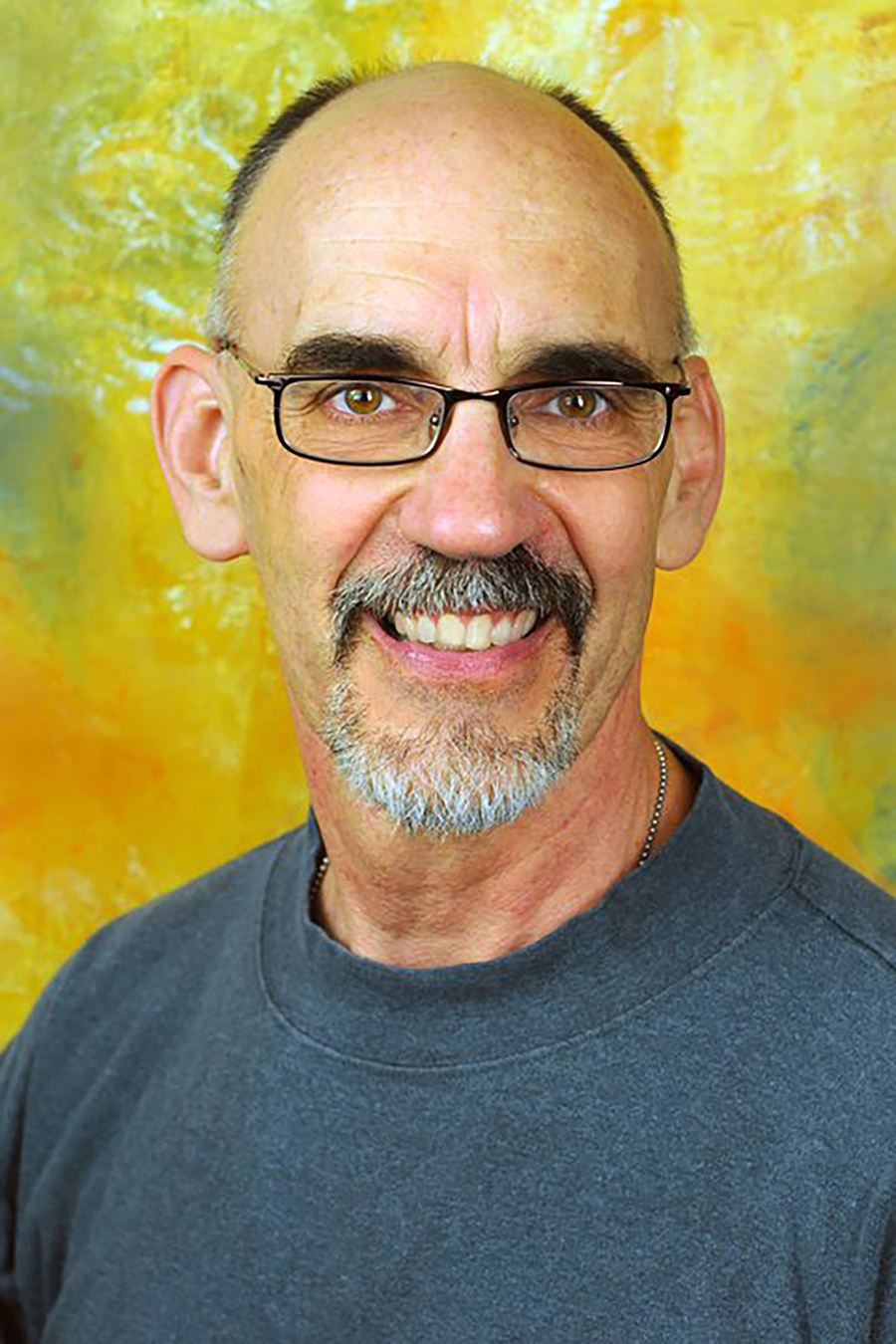
As a first step, I have updated the photo in my avatar. Over the past year or so I have assisted my mentor Cindy Dyer with some portrait sessions and, in addition to helping to set up lights and hold reflectors, I have served as the “model” to test out the lighting set-ups. Earlier this month, Cindy sent me the first photo below from one of those sessions.

Ever since I had cataract removal surgery a couple of years ago, I wear glasses only for reading and sometimes for computer work, so I am happy that my updated photo shows me without glasses. A side benefit is that I now have a much clearer sense of the actual color of my eyes. As you can see in the second photo, my previous avatar image that was also shot by Cindy, my eyes tended to look darker behind the glasses.

To a significant degree, I don’t care what others think about the way I look and act. I don’t think a lot about my appearance and you will rarely find me taking selfies—I feel a little strange posting photos of myself. What I care more about is having a sense of integrity, a sense of consistency in my actions, a feeling of comfort with who I am, and a willingness to do what I think is right. This blog provides a relatively unfiltered view of what I see and often what I feel—I am generally proud with having my name and my face associated with it.

So what about you? Do you ever think about your image? Has your view of yourself changed over time? Do others see you the way you see yourself? Do you care what others think?

Mike Powell

Mike Powell

© Michael Q. Powell. All rights reserved.

Read Full Post »

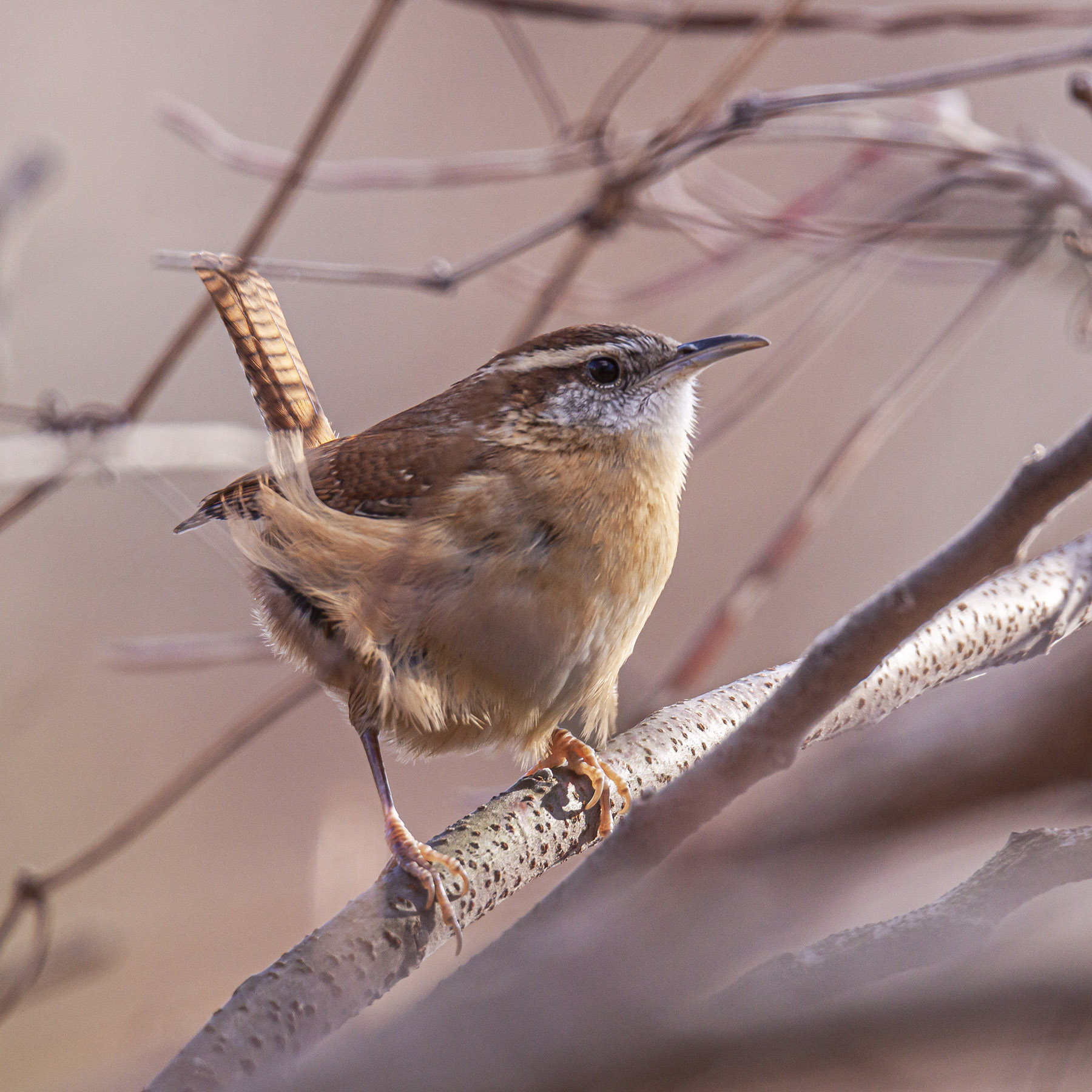
Carolina Wrens (Thryothorus ludovicianus) are usually active very close to the ground in the undergrowth. I was therefore quite surprised when one recently flew into a tree at almost eye level as I sought to track a different bird. The minimum focusing distance for my telephoto lens is almost 9 feet (270 cm) and although this little bird seemed to be really close, it was apparently a little beyond that distance.

I managed to quickly focus on the wren and capture this shot before it flew away. It is always cool when I am able to be at eye level with a bird, because I think that it tends to show the personality of a bird more than a shot from a lower or higher angle.


Carolina Wren

© Michael Q. Powell. All rights reserved.

Read Full Post »

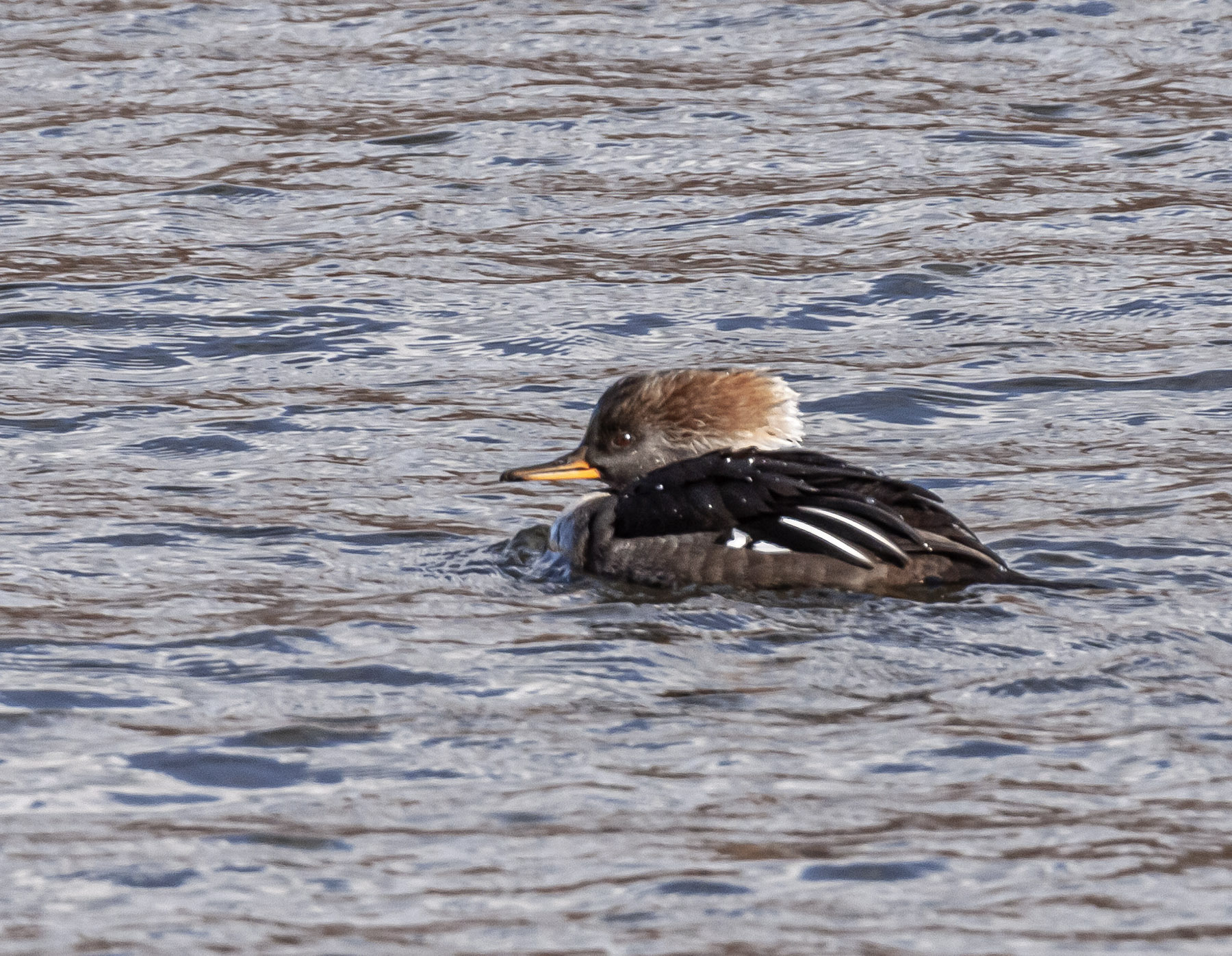
I love the “hairstyles” of the female Hooded Merganser (Lophodytes cucullatus).  Sometimes the “hair” is circular, like an Afro of the 1960’s, sometimes it is more flattened, and occasionally it has a pointed peak.

Earlier in December I tried to photograph an elusive female Hooded Merganser. She never came close to shore and seemed to always be twisting and turning. Eventually I was able to capture some shots from a distance. As you look at the images, you will undoubtedly notice how the texture and color of the water and the lighting changed as I moved to different parts of the pond.  For me, those variations add interest to shots that might look more humdrum with a more uniform background.

Hooded Merganser

Hooded Merganser


Hooded Merganser

© Michael Q. Powell. All rights reserved.

Read Full Post »

As I was walking around a pond in Northern Virginia, I spotted this Great Blue Heron (Ardea herodias) standing at the edge of the water. My view, however, was significantly obstructed by the vegetation that separated us. I moved a little closer and then started to make tiny movements up and down and from side to side, searching for a visual tunnel that would give me a clearer view of this beautiful bird.

Although I never did get a completely unobstructed shot, I really like this one. The image has kind of a whimsical feel to it, because at first glance it looks like the heron has speared the small tree and I was also quite happy with the amount of detail that I was able to capture in the feathers and in the eye.

Great Blue Heron

© Michael Q. Powell. All rights reserved.

Read Full Post »

I was going through photos that I captured earlier in December, before my brief trip to Vienna, and came upon these shots of a Hooded Merganser couple (Lophodytes cucullatus) at a small suburban pond. I observed them for quite a while and noticed that the female was busily diving into the water, while the male spent most of his time grooming himself. As a result, it was tough to capture them both in a single frame. Even when they were together, I had to react quickly, because, as you can see in the second photo, the female would often dive without any advance warning.

I love taking photos of these distinctive-looking ducks—no other ducks in my area look anything like them. With a little luck, I will continue to see them during the upcoming cold winter months and they will undoubtedly be featured again in a blog posting.

Hooded Mergansers

Hooded Mergansers

Hooded Mergansers

© Michael Q. Powell. All rights reserved.

Read Full Post »

One of  the best known buildings in Vienna is Stephansdom (St. Stephen’s Cathedral), the mother church of the Roman Catholic Diocese of Vienna. You can see the multicolored tiled roof, one of its distinctive features, in the photos below that I took a few nights ago. The cathedral is located in a busy area in the center of the city with surrounding buildings quite close. As a result, you have to get pretty close and shoot upwards to get an unobstructed view and the angles get all skewed.

In a few hours a taxi will bring me to the airport to catch my flight back to the USA. It has been a brief trip to Vienna with most of my daylight hours occupied with work, but I have been fortunate to have the chance to catch some of the beautiful Christmas decorations in the city at nights. I might do another posting or two of Vienna when I return home, but this will almost certainly be my last one that I write in Vienna itself.

Merry Christmas to you all, wherever the holidays happen to find you.

Stephansdom Vienna

Stephansdom Vienna

© Michael Q. Powell. All rights reserved.

Read Full Post »

Last night I had the chance to go strolling through the central pedestrian shopping area in Vienna. A light snow was gently falling, making things feel even more festive as the city prepares for Christmas. One of the really cool things about this area is that each of the streets has a different style lighting. The photos below show three of my favorites.

Vienna Christmas

Vienna Christmas lights

Vienna Christmas lights

© Michael Q. Powell. All rights reserved.

Read Full Post »

Once again I find myself in Vienna, Austria just before Christmas for a work trip. Many of you know that I retired earlier this year, but I was requested to come back to assist with a workshop this week that I have helped to run for the past seven years. It is hard to say no to an overseas trip and Vienna is particularly beautiful at this time of the year. There are lots of Christmas markets throughout the city, wirh the largest one in front of the Rathaus (City Hall).

In the market there are rows and rows of vendors selling all kinds of products, including a wide variety of food and beverages. My personal favorite is the käsekrainer, a large sausage filled with chunks of cheese that melt when the sausage is grilled. I usually have mine in a hard crusted roll (like a mini baguette) with lots of spicy mustard. The most popular item for consumption, though, appears to be glühwein, hot spicy wine, served in festive mugs. You put down a deposit on the mugs and either return them or take them away with you.

Most of my daylight hours, which seem really limited at this time of the year, are filled with work, but I managed to make it to the Rathaus Christmas Market and grabbed a few photos one evening earlier this week. Hopefully they give you a sense of the festive atmosphere at the market, though you don’t get the smells of the food cooking in the open air and the sounds of the Christmas music, with a variety of individuals and groups performing live.

Merry Christmas in advance and Happy Holidays to those of you who do not celebrate Christmas.

Vienna Christmas Market 2019

Vienna Christmas Market 2019

Vienna Christmas Market 2019

© Michael Q. Powell. All rights reserved.

Read Full Post »

Most of the birds that I spotted last Thursday at a small pond seemed to be part of a small flock or at least of a couple. This Double-crested Cormorant (Phalacrocorax auritus), however, appeared to be the only one of its species. It mostly hung out with a flock of gulls, floating along on the surface of the water.

I observed the cormorant off and on for over an hour and not once did it dive underwater.  Most cormorants that I have seen in the past have either been diving or drying out their wings.

Perhaps this cormorant felt the need to feel like it was part of a group, although it clearly stood out from the other members of its chosen group. I personally would agree that conformity is overrated—be yourself. (Speaking of non-conformity, be sure to check out the cormorant’s striking blue eyes.)

Double-crested Cormorant

© Michael Q. Powell. All rights reserved.


Read Full Post »

As soon as I spotted this female Bufflehead (Bucephala albeola), she started to swim away. Then all of the sudden she stopped, turned her head, and seemed to smile back at me. This image captured our shared moment together.

Bufflehead

© Michael Q. Powell. All rights reserved.


Read Full Post »

Most of the times when I see a Great Blue Heron (Ardea herodias), it is in the open water patiently waiting to catch a fish. This past Thursday, however, I initially had trouble spotting this heron—it was hunkered down among the trees at the edge of the water of a small suburban pond, probably seeking shelter on a cold and windy day. I moved close enough to get some shots and then silently moved away, being careful not to disturb the heron and force it to move from its carefully chosen spot.

Great Blue Heron

© Michael Q. Powell. All rights reserved.


Read Full Post »

Would you feel insecure and self-conscious if you sat down in a crowded public place and started to sketch? Most adults would feel that way. It would take a really good instructor to get them so excited about drawing that their inhibitions disappeared and they could lose themselves in a few blissful moments of creation—probably like a child feels when creating art. Romain, my instructor for two sketching tours in Paris, was that kind of instructor.

Romain Olivier Thieulot is an energetic and engaging 29 year old artist in Paris. He teaches art at the University of Paris and has his own art studio. As with most artists, though, money is tight, so he conducts sketching tours as a kind of “side hustle” to earn some additional money. Although he is quite young, he is devoted to a traditional style of art rather than digital art. That, he believes, is one of the reasons why he was chosen to teach at the University of Paris. He did not go into a lot of details about the curriculum at the university, but he described the style that is taught there as “academic,” and it sound like it is a regimented system with very specific rules.

Fortunately, that is not the approach that he used with us. He coached and encouraged us as we moved from place to place with our sketchbooks and collapsible stool, all the while providing us with instructions on the major principles of drawing like composition, perspective, and showing emphasis through detail and value (degree of lightness and darkness). Importantly, I think, he left a lot of room for individual expression. Before we started to draw our first building, I remember, he told us that we could choose to draw it any way that we wanted, sketching, for example, the entire building or only a part of it. What was important, he said was to have a clear idea of what we saw as the major area of interest, because the first lines we put on the paper would dictate important considerations like scale and composition.

Romain had carefully chosen the locations and routes of these tours, one in Montmartre and one in the Left Bank area beginning at Notre Dame, in order to provide us with fascinating bits of information along the way on the history of the city of Paris and in particular on its rich artistic and architectural history. (Architecture is one of Romain’s areas of expertise and he was able to explain many aspects of the architecture that makes Paris so distinctive.)

One of the places that Romain highlighted was Le Consulat, a historic coffee house that was frequented by many of the artists, writers and painters that flocked to the Montmartre area in the 19th century, including Picasso, Sisley, Van Gogh, Toulouse-Lautrec, and Monet. In the second photo below, Romain was showing us a postcard-sized copy of a drawing that he had done of the café. If you click on the photo you can get a real appreciation of the amount of detail in his drawing. I don’t recall long he spent on that particular drawing, but I remember him showing us similar ones on which he had spent forty or fifty hours of work.

One of the fun little bonuses of Romain’s sketching tours was the quick sketch he would do of the individuals in our little group as we were at work. The third photo shows the three members of our group in Montmartre—I think it is pretty obvious which one is me.

During one conversation that I had with Romain, he shared some insights into the world of a professional artist in Paris. As we we passing a series of galleries in the Left Bank area, he noted how difficult it was to get your work into a gallery. Even if you were fortunate enough to get your worked displayed, there were so many fees involved that the artist was often left with very little money when a piece of art was actually sold.

Romain seemed to be much more content to display his work at his own studio/workshop, Atelier Thieulot in the 15th arrondissement in Paris. You can check out his studio on his website and get a better idea of his workplace and of his work. The website is in French, but even if you can’t read the details, you can’t help but be impressed by the number of exhibitions in which he has participated and the awards he has received. If you click on the tab, “Mes Créations,” you can look at his work divided into categories such as architecture, oil painting, drawing, and design. One of my favorite ways to view his work, though, is to click on the “E-boutique” tab and if you do, you too will look with amazement at his detailed drawings.

I saw some wonderful art and architecture in Paris, but some of my favorite moments in the city were spent in creating my own art during the sketching tours with Romain as our guide, coach, and instructor. I was intrigued that the tour is titled “Être artiste à Montmartre,” which means “To be an artist in Montmartre.” We were not pretending to be artists as we toiled over our sketchbooks—Romain made us feel like we really were artists.

We have become friends on Facebook, have exchanged texts since concluding the course, and he is also now following this blog. Paris is wonderful, of course, but it really is the people you meet that make a trip memorable. Thanks, Romain.

Romain Thieulot

Romain Thieulot

Romain Thieulot

© Michael Q. Powell. All rights reserved.

Read Full Post »

Hooded Merganser ducks (Lophodytes cucullatus), often referred to as “hoodies,” are small, colorful, and very skittish. Most of the time they spot me long before I am close enough to get a shot and either take to the air immediately or swim rapidly away from me. I was really happy to spot a Hooded Merganser couple on Thursday in a suburban pond near where I live.

The little ducks mostly stayed in the deep water, out of range, but the wind was blowing and occasionally they drifted a bit closer to shore. I circled the pond three times and finally was able to capture this shot during one such drift. Alas, I was not able to capture a similarly detailed shot of the female, but I am hoping that this pond will be their winter home and that I will have more chances later this season.

Now that I have retired, “hoodies” have also become one of my favorite items of clothing. My less than full head of hair means that I get cold easily. I love to slip on the hood of a hooded sweatshirt for an additional  bit of warmth, sometimes even when I am indoors.

© Michael Q. Powell. All rights reserved.

Read Full Post »
As I was going through my photos again from last week I came upon this image of an Autumn Meadowhawk dragonfly (Sympetrum vicinum) that I had spotted at Occoquan Bay National Wildlife Refuge. I already posted another shot of this dragonfly species from that day, but I like this shot even more, because it shows some of the details of the leaves on which the little red dragonfly was perched. I think the leaves help to give a better sense of the environment and emphasize the “autumn” in the name of the species.

Autumn Meadowhawk

© Michael Q. Powell. All rights reserved.

Read Full Post »
At this time of the year several species of ducks migrate into my area and take up residence for the winter. One of the most distinctive species is the Ring-necked Duck (Aythya collaris), especially the male. Even from a distance you can notice the oddly peaked head and when you move in closer you can see the multi-colored bill and the bright yellow eyes if it is a male. As is most often the case with birds, the females are less colorful in appearance, though, as you can see from the final photo, they are quite beautiful.

I spotted a small flock of these ducks yesterday in a nearby suburban manmade pond where I have seen then annually for at least the last five years. Although Ring-necked Ducks are diving ducks, they don’t seem to require really deep water.

So where is the ring around the neck? According to the Cornell Lab of Ornithology, “This bird’s common name (and its scientific name “collaris,” too) refer to the Ring-necked Duck’s hard-to-see chestnut collar on its black neck. It’s not a good field mark to use for identifying the bird, but it jumped out to the nineteenth century biologists that described the species using dead specimens.”


Ring-necked duck

Ring-necked duck

Ring-necked duck

© Michael Q. Powell. All rights reserved.


Read Full Post »

I was shocked the first time that a friend identified little white-colored berries like those in these photos as poison ivy berries. I had no idea that poison ivy plants produced berries and, upon learning that they did, I assumed they must be poisonous. I was both right and wrong. These little berries are definitely poisonous for humans, but they are an important food source for many birds during the winter. It is amazing to me how birds that eat almost exclusively bugs during the warm months can switch to a plant-based diet in the winter, but it helps to ensure their survivability.

Last week I spotted this Ruby-crowned Kinglet (Regulus calendula) as it poked about among several clusters of poison ivy berries. The kinglet was in constant motion and was mostly in the shadows, but I was able to capture these images. I like the way that you can see some of the details of the vines wrapped around the branches and the way that the distant branches provide some shadowy forms in the background.

Ruby-crowned Kinglet

Ruby-crowned Kinglet

Ruby-crowned Kinglet

© Michael Q. Powell. All rights reserved.

Read Full Post »

I spent some of my favorite moments during my recent trip to Paris exploring again the Rodin Museum and its wonderful outdoor sculpture garden. There is something really special about seeing sculptures outdoors, where the time of day, the season, and the weather can make them come alive in new ways that are not possible in the controlled confines of an indoor museum.

When I travelled to Washington D.C. on Saturday, one of my goals was to see some of the Rodin sculptures that I recalled were in the Hirshhorn Sculpture Garden. The garden is sunken slightly below ground level and as I descended I immediately spotted the large sculpture known as The Burghers of Calais (Les Bourgeois de Calais). This multi-person sculpture is very well-known and I had seen another casting of it recently in Paris. (According to French law, there can be only 12 original castings of a Rodin sculpture, and both the one that I saw in Paris and this one are original castings.)

I couldn’t remember the story behind the sculpture, so I turned to Wikipedia. From a factual perspective, the sculpture commemorates an event during the Hundred Years’ War, when Calais, a French port on the English Channel, was under siege by the English for about eleven months. As you study the faces and the postures of the men in the sculpture, you realize that it is much more than a monument to a historical event.

According to Wikipedia, “Edward, the king of England, offered to spare the people of the city if six of its leaders would surrender themselves to him, presumably to be executed. Edward demanded that they walk out wearing nooses around their necks, and carrying the keys to the city and the castle. One of the wealthiest of the town leaders, Eustache de Saint Pierre, volunteered first and five other burghers joined with him. Saint Pierre led this envoy of volunteers to the city gates. It was this moment, and the poignant mix of defeat, heroic self-sacrifice, and willingness to face imminent death that Rodin captured in his sculpture.”

The sculpture in the second image is known simply as The Walking Man (L’homme qui marche). I am amazed at Rodin’s skill in capturing a sense of movement in such an incomplete figure. For me, it’s like a three-dimensional sketch that has come to life.

The final Rodin sculpture that I wanted to highlight is known as the Crouching Woman (also known as Lust). I find the pose of the woman to be intriguing and the Rodin Museum, which has a terracotta version of the sculpture, asserts that it “looks like a compact block with limbs gathered together and pressed tightly against the torso. This block-like sculpture reflects Rodin’s aesthetic analysis of Michelangelo’s sculpture: it is a work that, to quote the great Italian artist, could roll down a hill without breaking.”

These Rodin sculptures remind me of Paris, but in a greater sense, they highlight my heightened appreciation for the work of artists. Sometimes artists capture beauty and other times they create beauty (and often they do both at the same time). What is beauty? That will have to be the subject of a separate blog someday.


Burghers of Calais

The Walking Man

Crouching Woman

© Michael Q. Powell. All rights reserved.

Read Full Post »
Landscape photography has always been problematic for me—it often feel like I am taking a photo without a real subject. I spend most of my time in photography trying to fill the frame with a single subject using telephoto or macro lenses, so it is hard to pull back and see the proverbial “big picture.” Sure, I realize that the actual landscape is the subject, but I have trouble “seeing” wide in my mind as I think composing a shot.

My experience in Paris changed my perspective a bit, because I took a lot of wide and even ultra-wide panoramic shots there. So last week when returned to Occoquan Bay National Wildlife Refuge, which is located less than 20 miles (32 km) from where I live, I consciously thought about capturing some of the different types of environments there.

The first shot shows one of the streams that flows through the refuge. I can often find herons, ducks, and occasionally deer along the edges of the stream. The stream is affected by tidal surges coming from the Potomac River and in this image the water level causes me to think that it was low tide.

My favorite trail runs parallel to the waters of Occoquan Bay. Small birds hang around in the vegetation at water’s edge, water birds congregate in the deeper waters, and Bald Eagles can often be found in the trees overlooking this tails. During warmer weather, this trail is a great location in which to hunt for dragonflies.

Wide trails crisscross the refuge, which used to be a military installation. The trails are off limits to the vehicles except for official ones. I never know what I might see when I walk on these trails. On occasion I will stumble upon groups of wild turkeys, flocks of migrating birds, and turtles crossing the road.

I hope that you have enjoyed this brief overview of the environment in which I have been taking so many of the insect, bird, and animal shots featured on this blog. It is good to remind myself yet again that what is familiar to me is unusual and maybe even exotic to someone in another part of the country or of the world. So periodically I will try to mix in shots like these to make it easier for you as you accompany me on my journey into photography.


Occoquan Bay National Wildlife Refuge


Occoquan Bay National Wildlife Refuge

Occoquan Bay National Wildlife Refuge

© Michael Q. Powell. All rights reserved.


Read Full Post »

Blogging helps to create communities. We are exposed to people from all around the world, some of whom may be like us, but many of whom are quite different. What is critical is that we interact with each other—we “like” and comment on the postings of others. All of this takes place in a virtual world and we develop relationships in that world. Wouldn’t it be cool if we could meet each other in person, in “real” life?

It may sound like the story line for a corny Hollywood movie, but an American photographer recently met an Irish poet in Paris, thanks to the efforts of a New Zealand blogger who had much earlier highlighted their respective blogs. As you might suspect, I am that photographer; Damien Donnelly of deuxiemepeaupoetry.com is that poet; and Liz Cowburn of exploringcolour.wordpress.com is that blogger.

Several days ago I said a few words about Damien when I re-blogged one of his postings with photos from our time inside the Grand Palais in Paris, so his name may sound familiar. When I first made plans to visit Paris, I thought there might be a chance that I could meet Damien, but what I did not realize at that time was that he was preparing to leave Paris. As it turned out, I made it to Paris before he left.

We agreed to meet for lunch. Have you ever met someone in person that you met initially on-line? Did you worry that the on-line “persona” would not mesh with reality? I really encourage you to read Damien’s poetry, which I previously characterized as “personal and universal,” and I can reassure you that he is just as thoughtful, introspective, and engaging in person. During our lunch together, we shared deeply details about our personal lives and our connection with Paris.

One of the things I remember best was Damien’s description of how long it took to reach the point when he felt comfortable telling people that he was a “poet.” You see, like many creative people, Damien has a full-time job and crafts his verbal art in the remaining time. Gradually, though, writing appears to have taken on a greater role in his life. As of a few day ago, he no longer has that full-time job and in a few more days he is leaving Paris.

Is he calling it quits? As the French would say, “au contraire”—Damien is in fact returning to Ireland to pursue a dream. You can read more about it in the “About Me” section of his website, but the essence is that he plans to find and renovate a property in Ireland that will serve as a writers’ retreat and bed-and-breakfast. Damien is also working on a novel and I believe more of his poetry is about to be published.

Why am I writing all of this? First of all, I want to let you all know how wonderful it is when the virtual world and the real world overlap—meeting and spending time with Damien was one of the highlights of my three weeks in Paris. I hope to have the chance to meet more of my readers whom I consider friends. Maybe New Zealand?

Secondly, I am personally inspired by someone who decides at age 44 to go all in on his passion, who has the courage to radically change the course of his life in pursuit of his creative vision.

Let me end with the words of a short poem that Damien posted a few days ago, part of a series of poems as he prepares to leave Paris. This one was entitled “Bookends; Timing is Everything.” (In order to get the full impact of the poem, you should click on the name of the poem which is a link to the original posting with Damien’s accompanying photograph and brief words of explanation.)

“Coming in

is easy.

Learning when to leave

is an art

not easily understood.”

Damien Donnelly

Damien in the Grand Palais


Damien Donnelly

Damien in the Grand Palais


Damien and Me

Damien and me after lunch.

© Michael Q. Powell. All rights reserved.


Read Full Post »

I have lived in the Virginia suburbs of Washington D.C. for over 25 years. Like most people who live in the region, I rarely travel into the city except when I have guests. We tend to look a bit negatively at tourists, who impede our paths and generally get in the way as we rush about trying to get important things—primarily work—accomplished. It is a bit of a stereotype, but it does seem to be that most people in this area are very focused and driven.

As I continued to struggle to readapt to “normal” life after my glorious three weeks in Paris, I started to wonder how things would look differently if I approached Washington D.C. with the same sense of awe and enthusiasm that I felt for Paris. What if I stopped taking for granted all of the treasures our nation’s capital has to offer and looked at them with fresh eyes?

Saturday, I grabbed the camera gear and the raincoat that I used in Paris and rode into the city on the Metro system. I had a relaxing time visiting several of the Smithsonian museums, which all have no admission fee, so you don’t have to exhaust yourself trying to get your money’s worth. I may cover my museum experience in another posting.

What struck me the most during the day, however, was the view that greeted me when I walked out of the National Gallery of Art at closing time. It was starting to get dark and lights had come on, gently illuminating some of the buildings. As I looked to the left, I could see the U.S. Capitol Building, home of Congress, and to the right in the distance was the Washington Monument, with a part of the Lincoln Memorial visible behind it. Wow!

Now I realize that most people don’t have Washington D.C. in their backyard, but I encourage you to look afresh at the area in which you live. Imagine that you have traveled thousands of miles to see its unique beauties. For me, that change in attitude helped me to look beyond the familiar and better appreciate the beauty that was always there. I had always used that approach in my wildlife photography and only now realize how it can be broadened into so many other areas of my life.

U.S. Capitol

Washington Monument

U.S. Capitol

© Michael Q. Powell. All rights reserved.

Read Full Post »

At this time of the year I have to work hard to get photographs of birds. If I am lucky, I will spot a Bald Eagle or another raptor, but most of the time I walk slowly down the trails, looking and listening for small birds. I know that they are there, but even with the leaves gone from most of the trees, the birds often remain hidden from view.

One of my favorites is the White-throated Sparrow (Zonotrichia albicollis), like this one that I spotted last week at Occoquan Bay National Wildlife Refuge. Maybe it is the effect of the season, but this sparrow always makes me think of Santa Claus. With the white “beard” and the distinctive yellow stripe over the eye, this sparrow is also relatively easy to identify, a real plus considering how many sparrow species are similar in appearance to each other.

An even smaller bird is the tiny Ruby-crowned Kinglet (Regulus calendula), which is about 4 inches in length (10 cm) and weighs only 0.2-0.3 ounces (5-10 g). This one was bouncing in and out of the vegetation so much that I thought I would never get a clear shot of it. Eventually I was more or less successful. What a sweet little bird.


White-throated Sparrow

Ruby-crowned Kinglet

© Michael Q. Powell. All rights reserved.

Read Full Post »

So many creative people are multi-talented and Irish poet Damien Donnelly is no exception. His poetry, which can be found on his blog at deuxiemepeaupoetry.com is both personal and universal and often prompts me to look deeply inside myself. You definitely should check out his website.

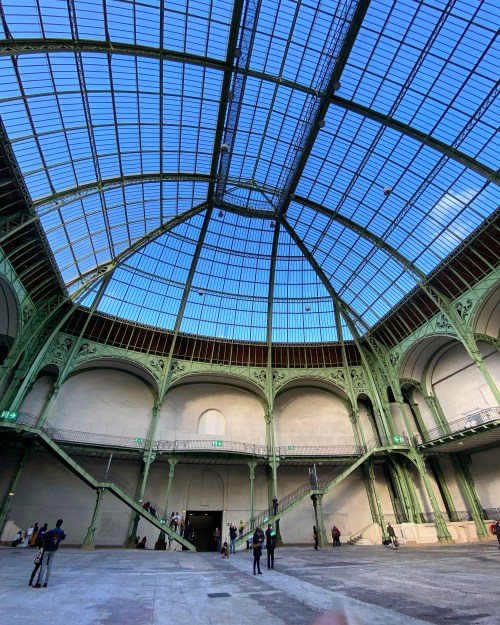
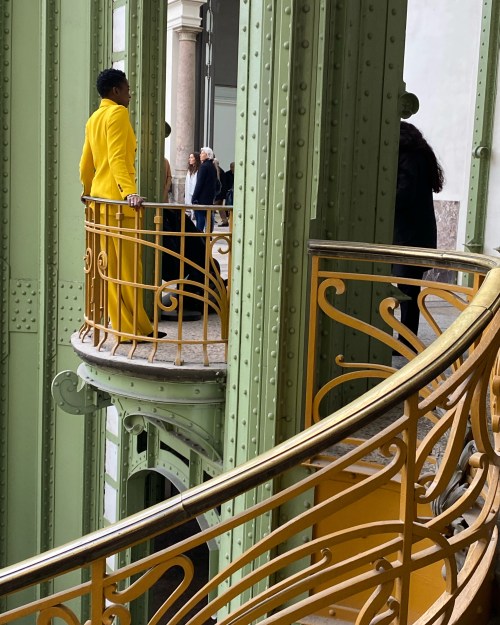
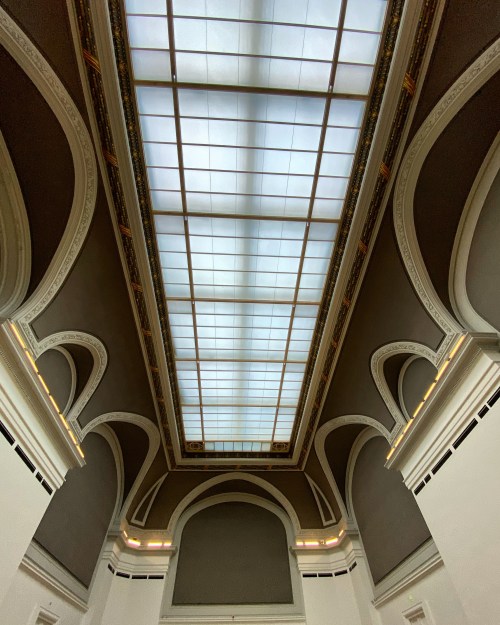
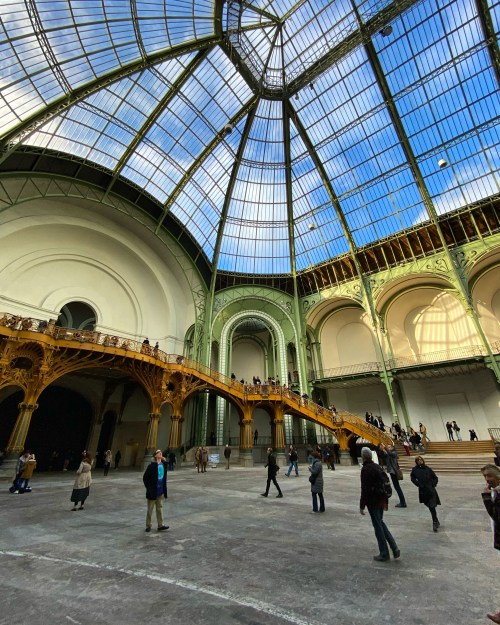
He is also a talented photographer. I was thrilled last Sunday to have the chance to spend some time with him as we photographed the inside of the Grand Palais in Paris. Here are some of his wonderful photos from that day.

deuxiemepeau's avatarDamien B. Donnelly

Last Sunday, this masterpiece of beaux-arts architecture, le Grand Palais was open to the public for a few hours and I rushed in along with fantastic photographer, and now street sketch artist, Mike Powell, on one of his last days in Paris, in order to snap a little of the light under the glass.

All photographs by Damien B Donnelly

View original post

Read Full Post »

I was thrilled yesterday to spot almost a dozen Autumn Meadowhawk (Sympetrum vicinum) dragonflies at Occoquan Bay National Wildlife Refuge. These hardy little red dragonflies are always the last ones of the season and they often hang on until December. In some years they have even been spotted in early January.

When I explored the exact same area on Wednesday, I did not see a single one of these dragonflies. Why? Wednesday was heavily overcase, but yesterday the sun was shining brightly. Every single Autumn Meadowhawk that I saw was basking in the sun, perched on fallen leaves or logs. The sun seems to warm them up enough so that they can fly a bit, though I wonder if they manage to find anything to eat, given that there are almost no other insects flying.

So this year’s dragonfly season continues for at least a little while longer. As I search in the trees for birds, I will continue to look down as well, hopeful of spotting one of these beautiful aerial acrobats.

Autumn Meadowhawk

Autumn Meadowhawk

© Michael Q. Powell. All rights reserved.

Read Full Post »

When it comes to woodpeckers, I often hear them before I see them. Sometimes it is a gentle tapping sound, but at other times it sounds as loud as a jackhammer.

I spotted this little Downy Woodpecker (Picoides pubescens) on Wednesday morning at Occoquan Bay National Wildlife Refuge. He was slowly making his way up the tree in a spiral pattern, stopping periodically to probe for insects. I tried to track him as he moved in and out of view and was happy to capture a few relatively unobstructed shots.

Normally, it is best to capture a subject when its eyes are looking more or less in your direction. I, however, are more attracted to the first photo below in which the little woodpecker is looking away and slightly up. Perhaps he had seen or heard something that caught his attention, but I like to think that he was taking a break in order to daydream. Perhaps he too was longing for Paris.

Woodpeckers are industrious by nature, though, so after his short pause, he was back to work, slamming his head against the unforgiving wood. It is what woodpeckers do—hopefully that does not sound like your job.

Downy woodpecker

downy woodpecker


© Michael Q. Powell. All rights reserved.

Read Full Post »

This is definitely not Paris. Yesterday, less than 24 hours after my return from my stay in Paris, I was back on the trails at Occoquan Bay National Wildlife Refuge, one of my favorite places to photograph wildlife.

It was a cloudy, blustery day and there was not a lot of wildlife active, but I did manage to capture this shot of a Bald Eagle (Haliaeetus leucocephalus). From a distance, I spotted the top of the eagle’s head as it hunkered down in a nest, presumably seeking shelter from the wind. Although I was a pretty far away, it spotted me and quickly took to the air. My vision is really good after my cataract removal surgery a couple of years ago, but when it comes to being “eagle-eyed,” I am no match for the real thing.

Bald Eagle

© Michael Q. Powell. All rights reserved.

Read Full Post »

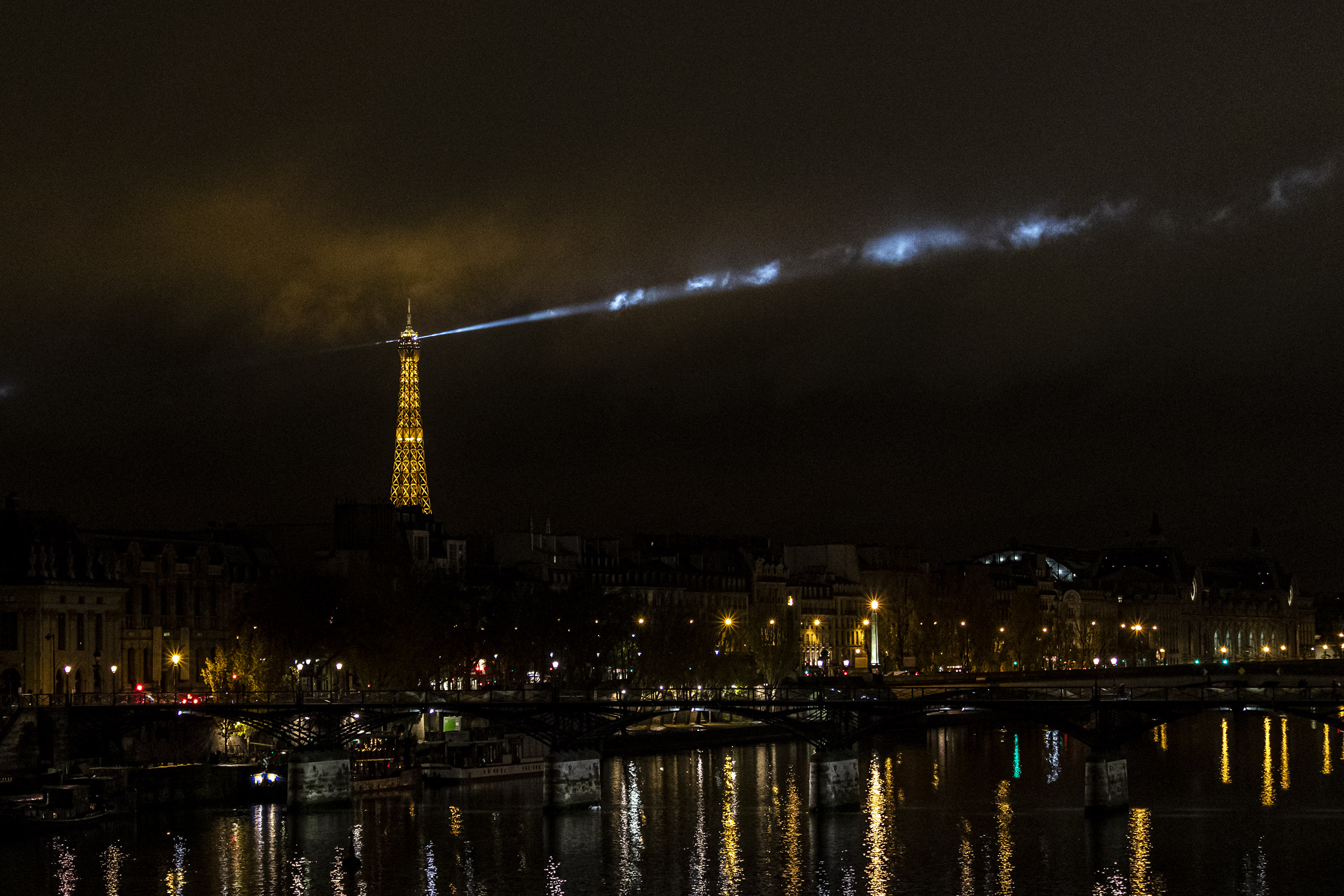
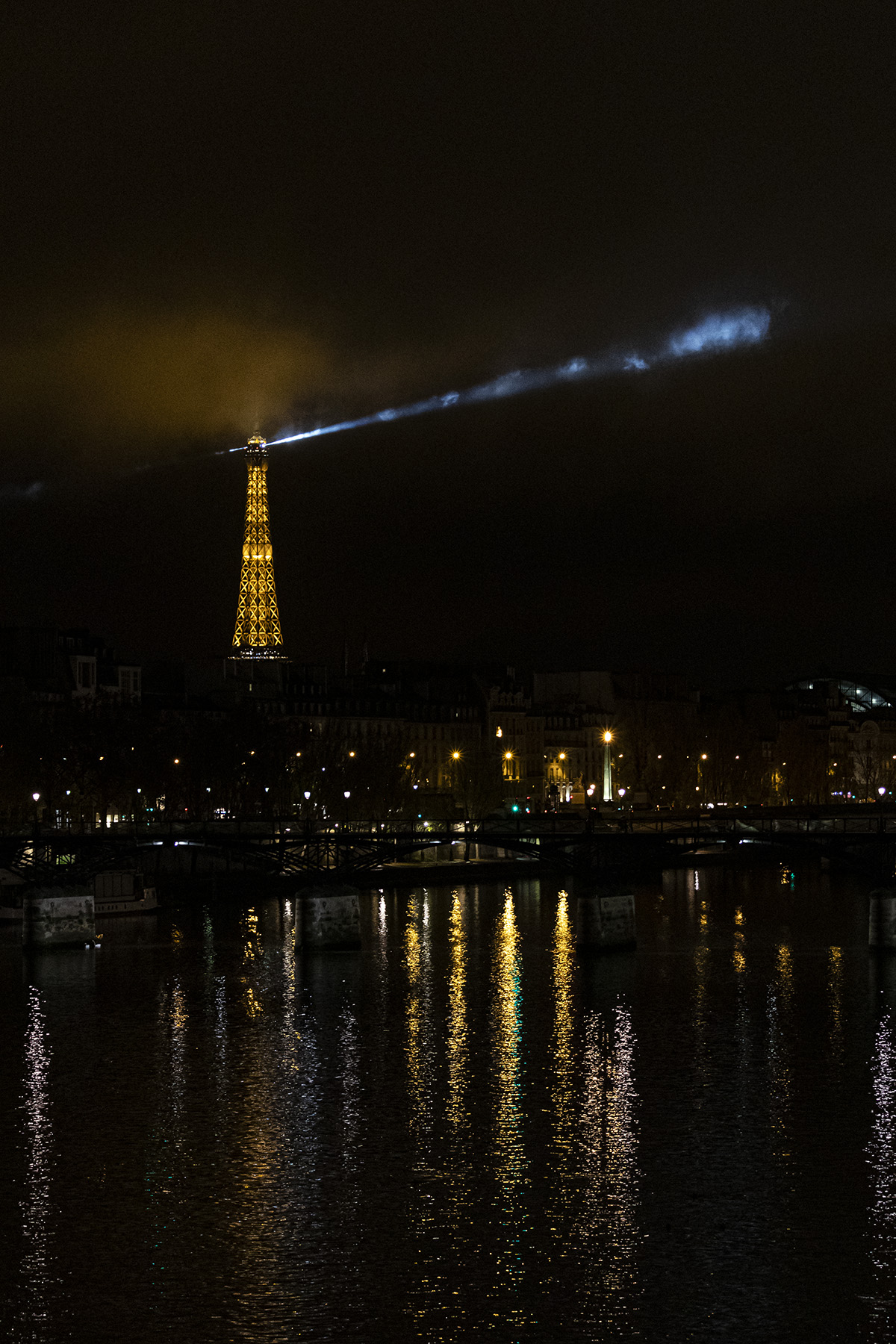
I am back from Paris now, but very much still under its influence. My final night in Paris, I walked down to the Seine River just before midnight. A light drizzle was falling, but I did not care. If anything, the rain made everything more beautiful, creating additional reflections on the cobblestone streets. As I crossed a bridge over the river,  I could see the Eiffel Tower all lit up, its searchlight piercing in and out of the clouds. It was magical!

I was having a great time trying to capture the scene when suddenly the lights on the tower went out. It was as if the Eiffel Tower had suddenly disappeared. I knew that the tower’s lights were not on all night, but I did not expected them to be extinguished right at midnight. Reality sometime has a way of crashing in on moments of fantasy.

One of my readers, Michael Scandling, challenged me to be out walking the streets at midnight to see if I might end up in the 1920’s having a drink with Hemingway. Obviously he too had seen the 2011 movie Midnight in Paris. The lead character played by Owen Wilson spends a lot of time wandering the streets of Paris and suddenly at midnight he repeatedly ends up in the 1920s, rubbing elbows with famous authors, actors, and artists of that era. Who wouldn’t want to have a chance to talk to icons like Cole Porter, Picasso, Gertrude Stein, and Salvador Dali? The movie additionally has wonderful footage of many places in Paris that are very familiar to me. It is one of the few DVDs that I have purchased in the past ten years.

Alas, real life does not generally play out as it does in the movies. Instead I quietly continued my walk, watching as waiters stacked up chairs in restaurants and lights began to dim as Paris prepared to sleep. For many in Paris, it was the end to just another day, but for me it was special, it was midnight on my final day in this special city, at least for this trip.

Eiffel Tower

Eiffel Tower

© Michael Q. Powell. All rights reserved.

Read Full Post »

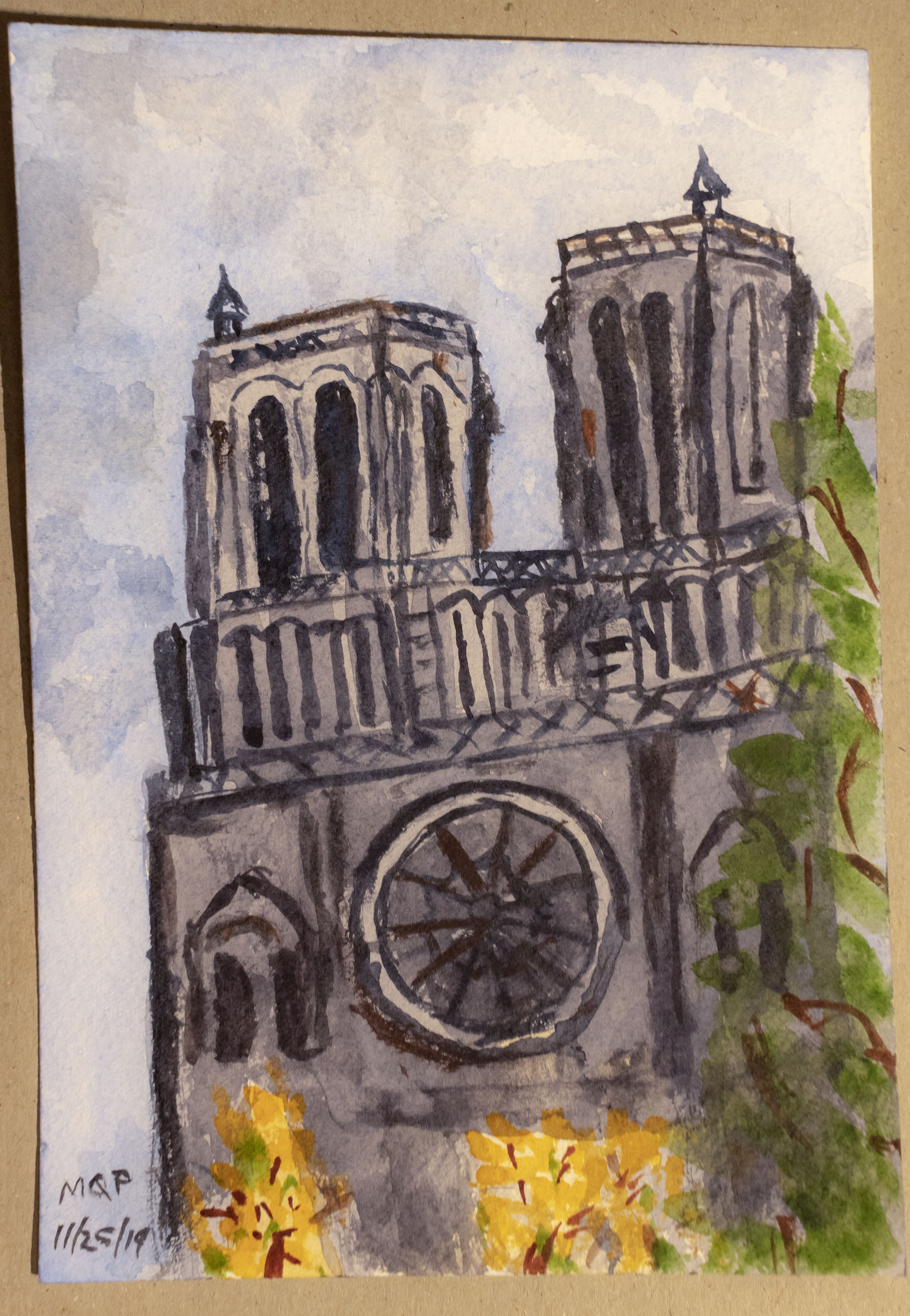
I knew that doing a painting of Notre Dame de Paris is well beyond my current skill level with watercolors, but I decided this evening that I had to give it a try before I leave this beautiful city tomorrow. I just got done with my little painting using DaVinci watercolors on Fabriano Artistico paper and it is 5×7 inches in size (13×18 cm).

I won’t bore you will all of the reasons why this is a tough subject, but I chose the front view, which made things a little easier and I ended up simplifying a lot of details. The paper is not really flat at the moment, which means the photo I took looks a little warped, but I think you can see well enough what I accomplished.

All in all, I’m pretty happy with the results. I may give it another go from home, but it is recognizable, I think as Notre Dame—I especially thrilled that I completed this while I was still in Paris.

In case you are curious, I based it roughly on a photo that I took today that is included after the painting.


Notre Dame de Paris

Notre Dame de Paris

© Michael Q. Powell. All rights reserved.

Read Full Post »

I’m normally very self-conscious about taking photos of people in public, but today I decided to throw caution to the wind and tried to capture images of a few of the guys who caught my attention.

The first image shows a young guy who was at the overlook area in front of Sacre Coeur and was trying to interest people in tours of the city in a bright orange vintage Citroën 2CV, the one that looks vaguely like the original Volkswagen Beetle.

I first heard the guy the second image playing the bongos (with a tambourine to his side) on a bench across the Seine from me, on a bank of Île de la Cité, the island on which Notre Dame de Paris is located. Although I was a long way away, he seemed to sense my presence and looked up at me for a moment before returning to his music.

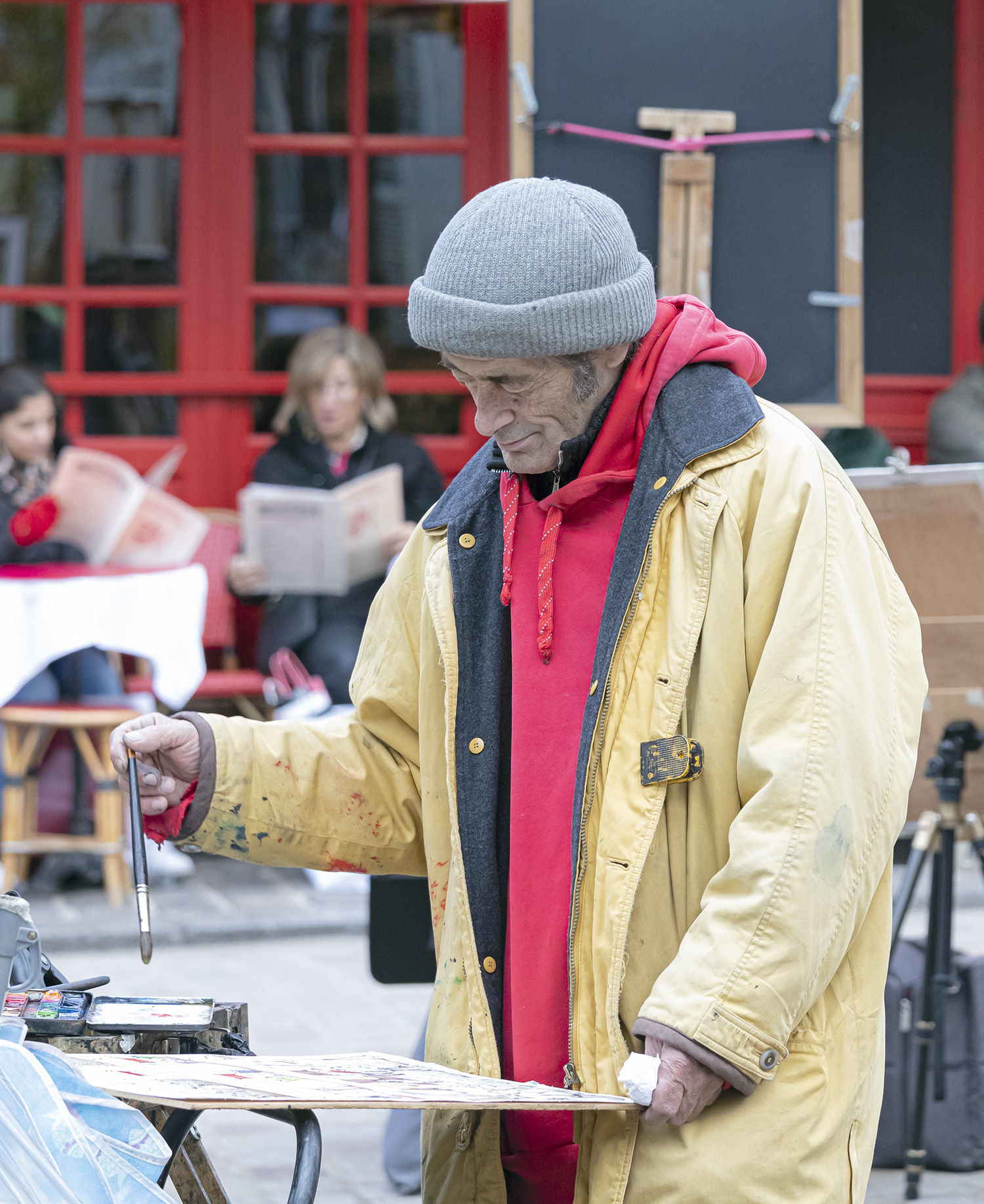
During my final visit to Place de Tertre in Montmartre late this afternoon, I again watched Jean-Marc Lambert, my favorite watercolor artist at work. You may recognize him in the final photo from an earlier posting I did about him. Unlike the two previous times, I did not engage with him, but silently and wistfully watched from a distance.

Tour guide in Paris

Bongos player in Paris

Watercolor painter in Paris

© Michael Q. Powell. All rights reserved.


Read Full Post »

People do some crazy things when they travel to ensure good luck. Art in a museum is untouchable and there are guards and surveillance systems to make sure that you do not get too close to it. When art, particularly statues, is in a public place, however, people choose to rub various parts of the artwork, which is particularly noticeable with bronze statues.

Last week I came across two examples of this “touchable” art while wandering the back streets of Montmartre. The first one is a tribute to the work of French author Marcel Aymé, a short story called Le Passe-Muraille (The Man Who Could Walk Through Walls). I read a synopsis of the short story and essentially a man gained the ability to pass through wall, but eventually this ability began to fade and he got stuck forever in the wall. The statue is pretty high up from the ground, so it appears that people have chosen to rub his now shiny left hand.

The second piece of “touchable” art is a bust dedicated to French music icon Dalida. Dalida, whose real name was Yolanda Cristina Gigliotti, was a French singer and actress, born in Egypt to Italian parents, according to Wikipedia. She won the Miss Egypt beauty contest in 1954 and began a 31-year singing career in 1956, selling 170 million albums and singles worldwide, and died by suicide in 1987.

It is obvious from the shiny areas of the Dalida statue which parts of her anatomy people choose to touch.

touchable art

© Michael Q. Powell. All rights reserved.


Read Full Post »

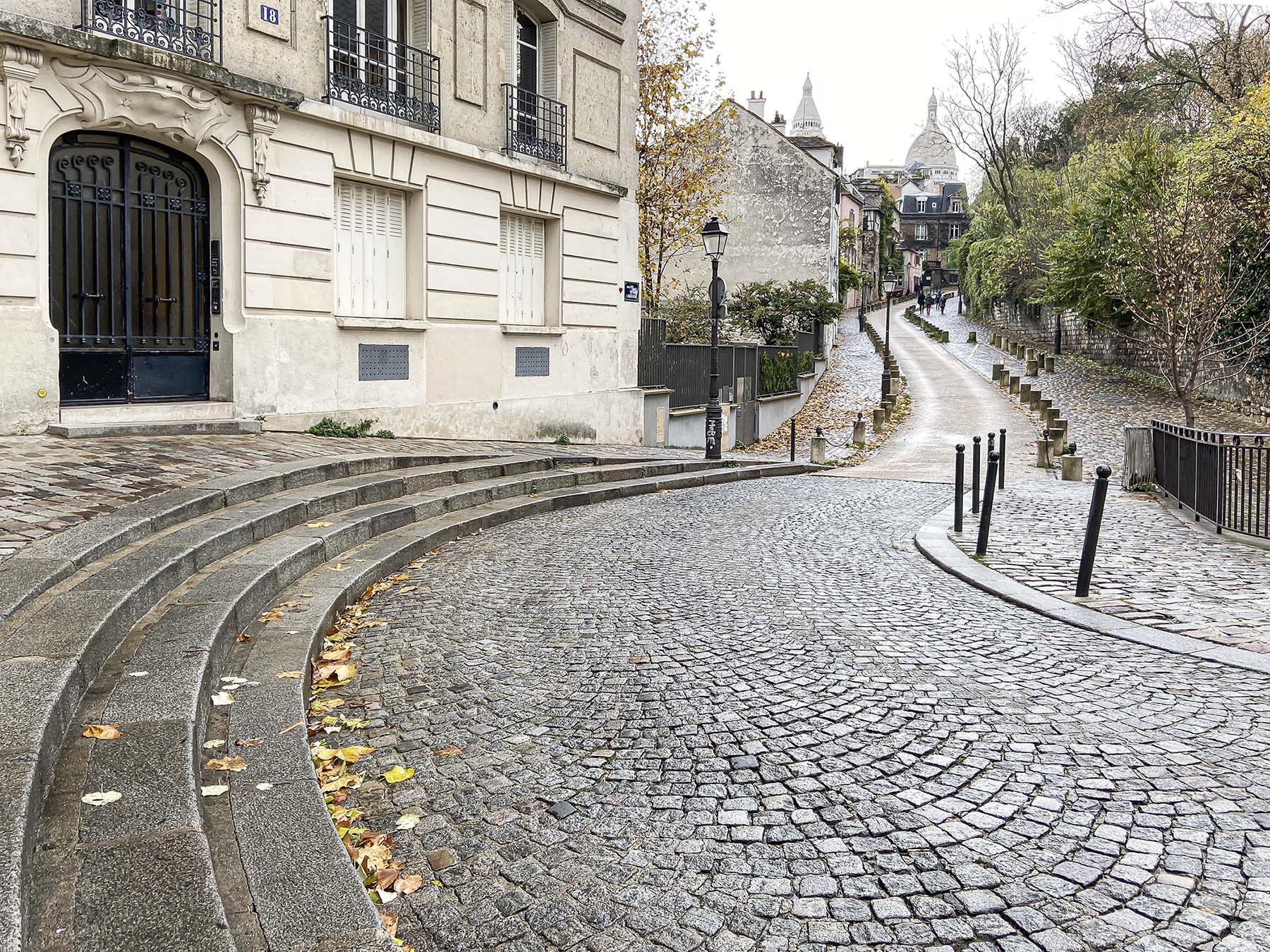
This simple image of a curvy road in Montmartre captures well my experiences during this extended stay in Paris. I’ve spent endless hours walking the narrow cobblestone streets, marveling at the architecture, and paying attentions to shapes and colors. I’ve played tourist from time, but the famous landmarks have been of almost secondary significance to me, like the Sacre Coeur Basilica that is tucked away in one corner of this shot.

Sacre Coeur is there, I am aware of it, but I would rather spend my time wandering around the surrounding area than merely taking a shot of it and then moving on to the next destination on a checklist list. Who needs a list?

Road in Montmartre

© Michael Q. Powell. All rights reserved.

Read Full Post »

Any wild animals in Paris? While wandering through the gardens at the Rodin Museum on Friday, I came across this adorable rabbit sunning itself in a semi-shaded open area. I watched it for a while until some noisy visitors scared it away.

I knew there had to be some wildlife in Paris other than the two-legged partygoers that were awfully loud late into the night yesterday in the streets outside of my apartment.

Rabbit in Rodin garden

Rabbit in Rodin garden

© Michael Q. Powell. All rights reserved.

Read Full Post »

« Newer Posts - Older Posts »