Feeds:
Posts
Comments

Archive for the ‘Macro Photography’ Category

As I have observed animals, birds, and animals, I have noticed that sometimes the male is larger than the female and sometimes the opposite is the case. Quite often the size difference is so slight that you have to rely on other characteristics to try to determine the gender of a subject.

When it comes to spiders, though, the size difference is shockingly large—the male is often one quarter the size of the female or even smaller. On Monday I spotted my first black and yellow garden spider (Argiope aurantia) of the season. I have long been fascinated with these large spiders and the distinctive zigzag pattern that they weave into their webs.

When I looked at my images on my computer, I was surprised to see that there was a second, smaller spider just to the left and behind the main subject. Could this possibly be a male garden spider? According to Wikipedia, males range in size from .2-.35 inches (5-9 mm) and females range in size from .75 to 1.1 inches (18 to 28 mm), so the size differential seems about right. Additional the smaller spider looks like photos I was able to find of male garden spiders.

Spider mating can hazardous for male spiders. In some species, if the male is rejected by the female, she eats him. I thought that might be the case for these garden spiders, but came across a fascinating article at newscientist.com with the sensationalist title “Spider sex causes spontaneous death” that suggests something stranger than cannibalism.

According to a study conducted at Concordia University and the University of California, “Researchers found that for male orb-weaving spiders of the species Argiope aurantia completing copulation leads to certain death. The deceased suitor’s corpse is then trapped in the female genitalia. This may be a strategy to prevent other males from subsequently mating with the female, say the scientists.” The scientists determined that the female did nothing to kill the males who died spontaneously and concluded, “The females do sometimes remove and devour their dead mates. But the researchers do not think the death program evolved to give her a post-sex snack, as the males are too tiny to provide much nutrition.”

Nature can be wild, weird, and wonderful and endlessly fascinating. I guess that is what prompted the scientists to carefully study 100 pairs of spiders mating. 🙂


Argiope aurantia

© Michael Q. Powell. All rights reserved.

Read Full Post »

Having recently photographic some hummingbirds in flight, I couldn’t help but think of them when I first spotted several Snowberry Clearwing Moths (Hemaris diffinis) last week at Occoquan Regional Park. The fight characteristics are quite similar as they hover in mid-air and extract nectar from flowers. Unlike hummingbirds that have a skinny bill and a tongue, clearwing moths use a long proboscis to reach into the flowers.

In our area we have two similar species of clearwing moths, the Snowberry Clearwing and the Hummingbird Clearwing (Hemaris thysbe). They are similar in appearance and behavior, but generally the Hummingbird Clearwing Moth is redder in appearance, so I believe these are all Snowberrys.

The clearwing moths seem to be very attracted to several small patches of swamp milkweed. Other insects had a similar attraction and if you look in the center of the milkweed in the second photo, you will note an orange insect that I can’t see well enough to identify.

Snowberry Clearwing Moth

Snowberry Clearwing Moth

Snowberry Clearwing Moth

© Michael Q. Powell. All rights reserved.

Read Full Post »

When it comes to damselflies, you often have to look closely for identifying marks, because so many of them are colored with variations of blue and black. I really could not identify the species of this little damselfly when I took this photo on Wednesday while exploring a creek in Prince William County. I decided that if he was willing to pose for me on a leaf, I was more than willing to take his picture.

When I pulled up the image on my computer, I immediately noticed some distinctive blue markings near the tip of the abdomen. Those markings helped me to  identify it as a male Dusky Dancer (Argia translata), a species that I had never before photographed.

We are still in a kind of summer doldrums period, where the summer dragonflies have been buzzing around for quite some time, and it is too early for the autumn species to appear. It is therefore pretty exciting for me to photograph a new species—I might have seen a Dusky Dancer in the past, but I am pretty sure that I was not able to capture an image, so in my mind it did not “count.”

Be sure to click on the image if you want to get a closer view of the distinctive markings and beautiful eyes of this cool-looking Dusky Dancer damselfly.

Dusky Dancer

© Michael Q. Powell. All rights reserved.

Read Full Post »

Do you chase wildlife or do you wait for it to come to you? I tend to be in the former group and will sometimes walk for hours and hours in search of suitable subjects.

On Wednesday, however, the action came to me. I was returning from a walk along a stream hunting for dragonflies and was shocked as I approached my car to see a pair of Red-footed Cannibalflies (Promachus rufipes) mating on my car. I watched in fascination as they moved from one part of the car’s exterior to another, locked in the peculiar tail-to-tail position that robber flies use for mating. (Even before this incident, I knew that I needed to wash my car, as you can readily see in the second photo.)

I must confess that I have long had a fascination with this insect species—there is something really cool and slightly horrifying about the macabre moniker ‘Red-footed Cannibalfly.’ They are fierce predators who reported have been able to take down a hummingbird. They inject their victims with a toxin that paralyzes them and liquifies their insides so that the cannibalfly can more easily ingest their innards. If you are not totally creeped out by now, you might agree that cannibalflies are cool insects.

I have written over 3500 blog postings over the past eight years and my most-viewed regular posting is one that I published in August 2013 with the simple title of “Red-footed Cannibalfly,” with 2595 views. Yes, a lot of people seem to be interested in this insect and somehow find their way to that blog posting each year. It is a good posting, I think, but neither the prose nor the photos are great, but sometimes that doesn’t matter for popularity in this digital world. (You can judge for yourself by clicking on the title of the posting that I linked to the original posting.)

Some of you may have noted that I used the term “regular posting” in describing my posting on the red-footed cannibalfly. In November 2014 I was fortunate to be at a local nature park during the rescue of an injured bald eagle by the animal control officers of the local police department and documented it in a blog posting entitled “Rescue of an injured Bald Eagle.”

Several news outlets picked up the story including the Washington Post , some local radio and television stations, including WTOP, and the Fairfax County Police Department News. A number of them included a link to my blog posting, which had over 3000 views in a couple of days, but has had relatively few views since that time. I had authorized the Police Department to use my posting and photos and as a result of that exposure I was contacted by a number of media organizations asking permission to use my photos, which I agreed to, requesting that they give attribution and, if possible, a link to my blog.

A small number of media organizations, including the Washington Post, used my photos without asking for permission, though the Washington Post did at least give attribution. When I contacted the reporter, he said that he had “assumed” it was ok, because he had obtained the photos through the Police Department site. I have not had to deal with the media since, but know now to be a bit careful in doing so.

Red-footed Cannibalfly

Red-footed Cannibalfly

© Michael Q. Powell. All rights reserved.

Read Full Post »

Some of our smallest butterflies are among our prettiest, like this tiny Banded Hairstreak butterfly (Satyrium calanus) that I spotted on Tuesday at Jackson Miles Abbott Wetland Refuge. I always check out a patch of wildflowers in one corner of this small refuge and once again it paid dividends.

I was able to photograph this butterfly as it nectared on one of the many black-eyed susans that are now in bloom. Actually I am not entirely certain if these flowers are black-eyed susans, but they are the same shape and color and may be part of the larger rudbeckia flower family.

UPDATE: A friend of mine on Facebook who is more experienced than I am with butterflies tells me that this is probably a Gray Hairstreak butterfly (Strymon melinus), not a Banded Hairstreak. The difference is so subtle that I am not sure I can see it and certainly cannot explain it. At least the beauty is undeniable.

Banded Hairstreak

© Michael Q. Powell. All rights reserved.


Read Full Post »

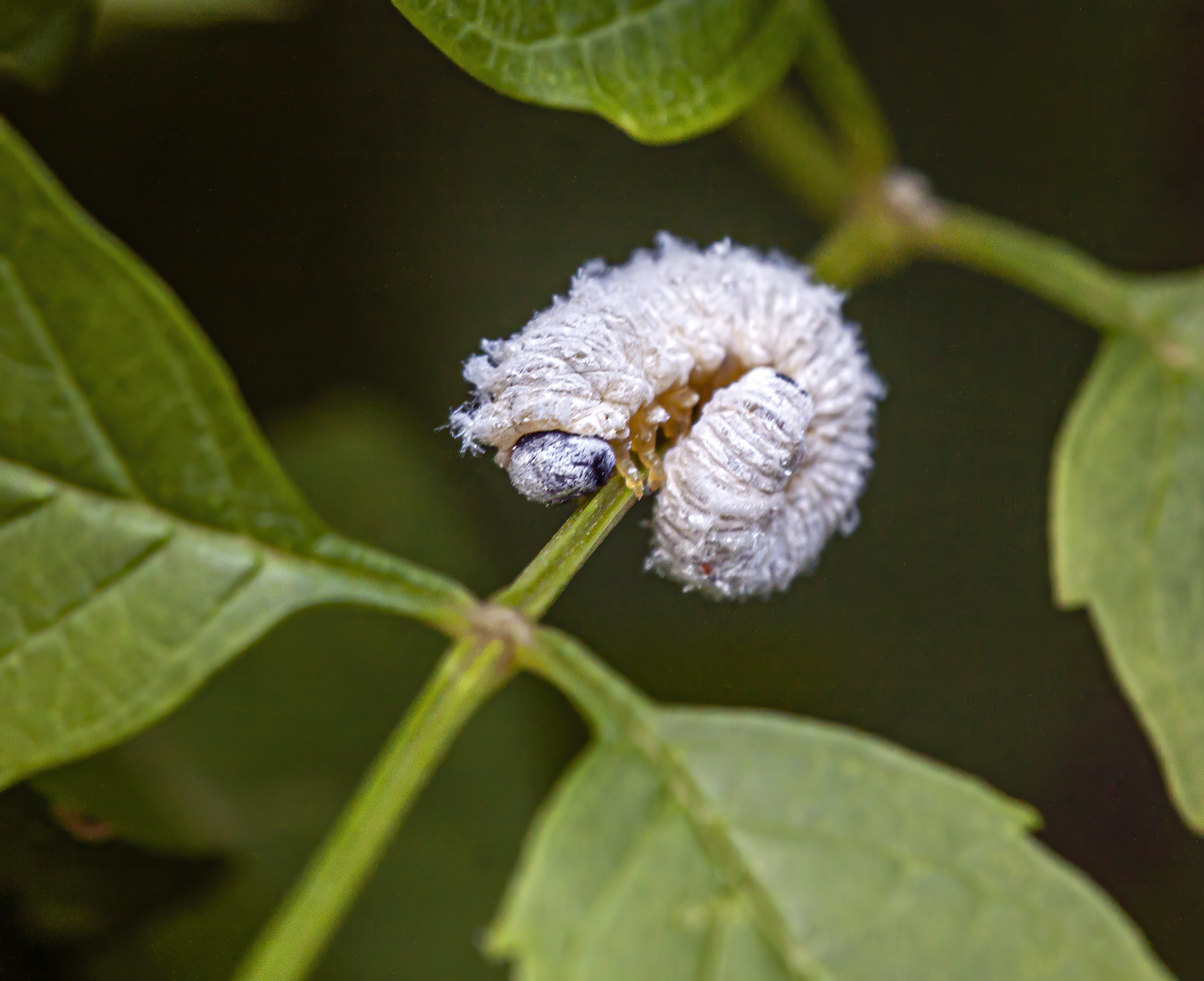
Last week when I was exploring Jackson Miles Abbott Wetland Refuge, I spotted this very strange looking caterpillar in one of the trees. It was quite small and was in motion, so getting a photo was somewhat of a challenge. As I was doing research, I was a little shocked to discover that this is actual the larval stage of a Dogwood Sawfly (Macremphytus tarsatus), a wasp-like insect. The larvae go through a number of different phases of development and this looks to middle-instar stage.

No matter how many times I return to a location, there always seems to be something new and different to see, as long as I take the time to look slowly and carefully.


Dogwood Sawfly larva

© Michael Q. Powell. All rights reserved.

Read Full Post »

I had forgotten how small Fragile Forktail damselflies (Ischnura posita) are until I spotted one perched in some vegetation last week while I was exploring at Jackson Miles Abbott Wetland Refuge. Even by damselfly standards, Fragile Forktails are tiny at only .8 to 1.1 inches (21-29 mm) in length. The good news is that they are relatively easy to identify, because they have pale interrupted shoulder stripes that look like exclamation points.

I love how the green of the damselfly’s thorax and in its eyes match the soft green palette of the rest of the image. For me, there is something really soothing about this simple portrait of a tiny damselfly.

Fragile Forktail

© Michael Q. Powell. All rights reserved.

Read Full Post »

When dragonflies and damselflies complete the metamorphosis from water-dwelling nymphs to air-breathing aerial acrobats, initially their wings are clear and shiny, their bodies are pale and colorless, and they are very vulnerable. At this stage of development, it is often difficult to identify the species to which they belong. Over time, their wings harden, their bodies take on the markings and coloration of their species, and identification becomes easier.

During a dragonfly-hunting trip earlier this month with fellow dragonfly enthusiast Walter Sanford, I spotted several damselflies that had recently emerged, a stage often referred to as “teneral.” The first one was perched on a rock in the creek that we were exploring and the second was perched in some vegetation alongside the creek.

If you click on the images to get a more close-up view of the damselflies, you will note some indication of stripes on the thorax and thin rings around some of the segments of the abdomen. During the day, we saw adults of at least three different damselfly species, so we can infer that these tenerals belong to that small group of species, but there is not enough information to make a call. I’m happy that I was able to capture some cool images of the damselflies.

If you would like to read Walter’s discussion of the first damselfly and to view his photos, check out his blog posting that he titled “Acceptable uncertainty.”

teneral damselfly

teneral damselfly

© Michael Q. Powell. All rights reserved.
Read Full Post »

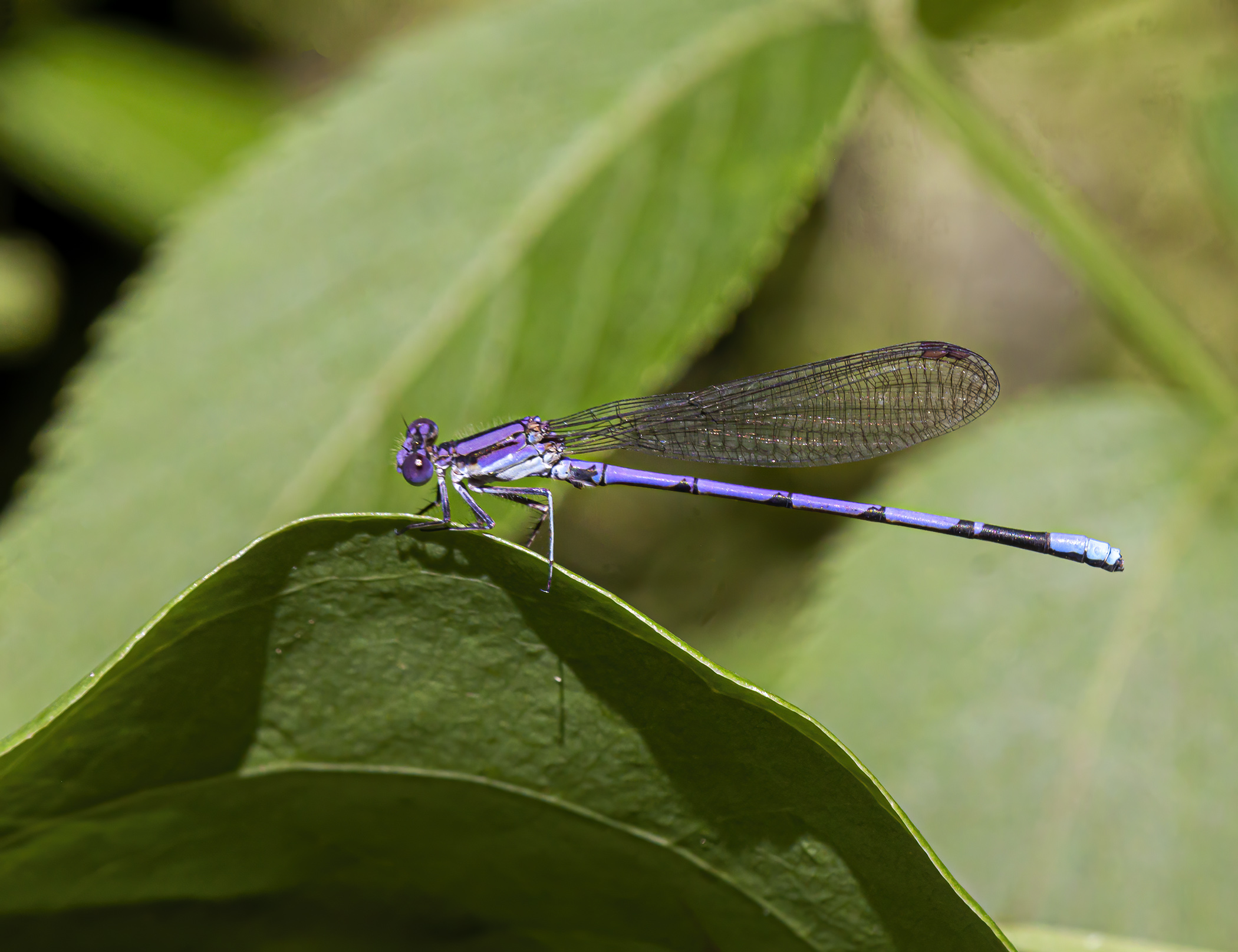
This stunning Variable Dancer damselfly (Argia fumipennis) was living life on the edge when I spotted him amidst the leaves last week during a trip to Green Spring Gardens with my good friend Cindy Dyer. Many of you probably realize that this violet-colored beauty is one of my favorites, given that my most frequently used banner image for this blog is a photo of a Variable Dancer. Perhaps there are other insects that are this color, but none come to mind.

As for the title of this post, consider it to be a sign of the times—the content could easily have gone in multiple directions.

variable dancer

© Michael Q. Powell. All rights reserved.

Read Full Post »

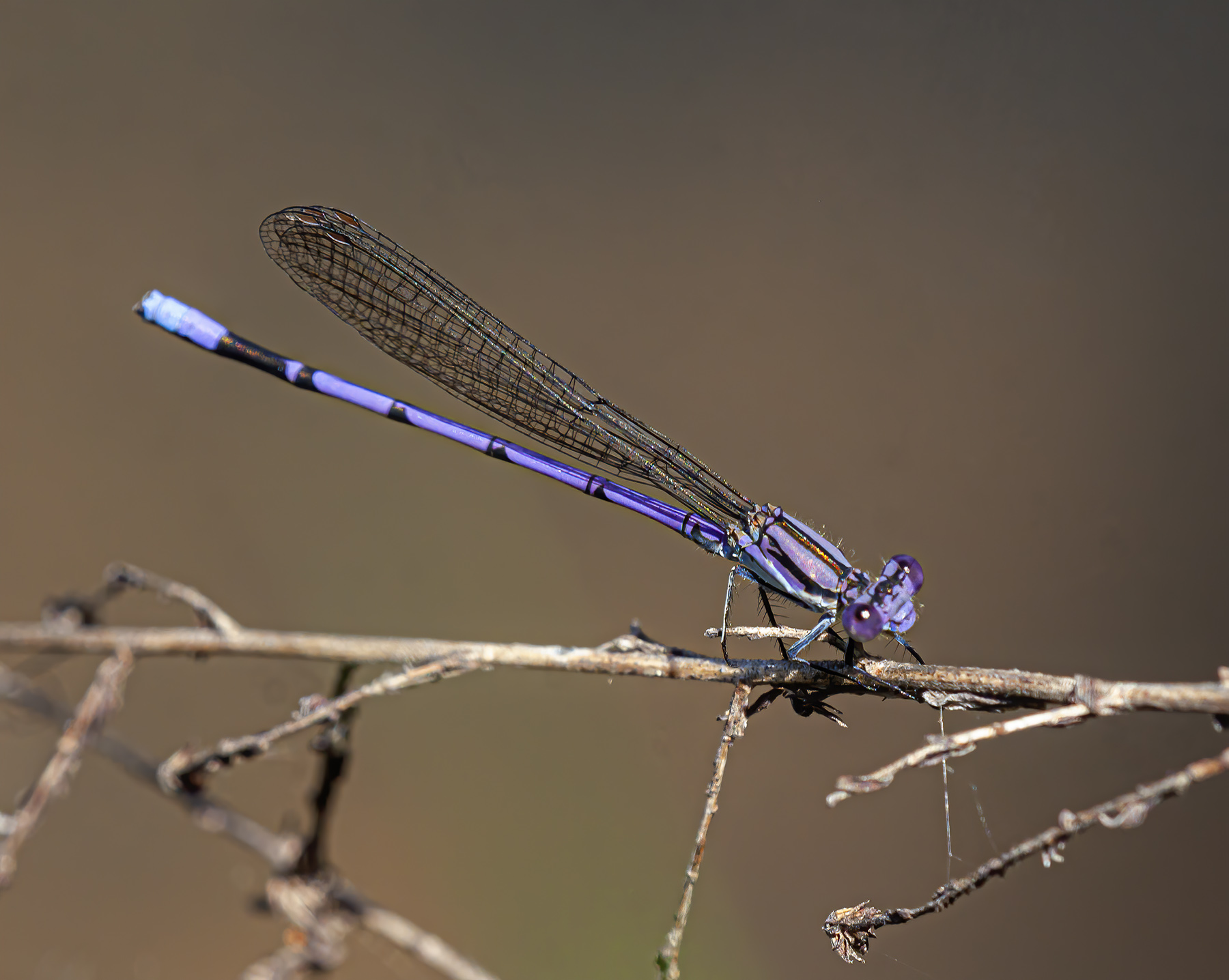
Many of the species that I photograph have names that do not match up that well with their physical appearances. While I was exploring a creek this week with my friend Walter Sanford, it was wonderful, therefore, to spot a dark damselfly with blue at the end of its abdomen that is appropriately called the Blue-tipped Dancer (Argia tibialis). If you click on the images, you will note that this male damselfly has beautiful purple stripes on its thorax (upper body) in addition to that blue tip.

When photographing damselflies like this one that perch on the ground, I try to get as low as I can in order to see eye-to-eye and simplify the background. I managed to do that in the first image and I really like the soft glow in the background from the waters of the creek.

I did not get as close for the second shot, in part because the damselfly was a bit skittish. However, I do like the way that I was able to capture the colors and textures of the rocky environment along the edge of the stream, giving the viewer a better idea of this damselfly’s habitat.

Like most damselflies, Blue-tipped Dancers are tiny, no more than 1.5 inches (38 mm) in length, so it is always a challenge to get detailed shots of them. The largest damselflies that I have ever photographed were the appropriately named Great Spreadwings, that are as much as 2.4 inches (61 mm) in length. If you want to see what one of those beautiful “giants” looks like, check out this posting from October 2015 entitled “Great Spreadwing damselfly (male).”

blue-tipped dancer

blue-tipped dancer

© Michael Q. Powell. All rights reserved.


Read Full Post »

As I was exploring the banks of a creek yesterday hunting for dragonflies with my friend, Walter Sanford, I stumbled upon a really cool-looking caterpillar. I love fuzzy white caterpillars and apparently I am not the only one—an August 2013 posting that I entitled “Fuzzy White Caterpillar” is my third most-viewed posting ever, with over 1820 views. The photos in that posting are definitely not among my best ever, but somehow people find their way to that posting when doing Google searches.

I was immediately struck by the bright red head and the “horns” and the front and back end of the caterpillar. Those characteristics made it easy to identify the caterpillar as a Sycamore Tussock Moth caterpillar (Halysidota harrisii). I do not know trees very well, so I cannot tell if the fallen log that the caterpillar was exploring was a sycamore, but perhaps one of my viewers can identify it for me.

Be sure to double-click on the images if your would like to get a closer view at the wonderful details of this unusual-looking caterpillar.

Sycamore Tussock caterpillar

Sycamore Tussock caterpillar

© Michael Q. Powell. All rights reserved.


Read Full Post »

Some of the dragonflies that I feature in my postings are uncommon species in my area. They are found in very small numbers, have a short flight period, and require very specific habitats. My good friend and fellow dragonfly enthusiast Walter Sanford did an extensive amount of research two years ago and re-discovered the Sable Clubtail dragonfly (Stenogomphurus rogersi), a species that is considered to be rare in Northern Virginia. Several of us were able to capture numerous images of this beautiful species during the 2018 dragonfly season.

Since that time, however, the habitat at that location has deteriorated significantly. As a result of some imprudent dumping of dirt and the resulting runoff, the stream habitat has been compromised by increased silt and higher levels of vegetation. Last year, as far as we know, there was only a single sighting of Sable Clubtails at this spot.

Had the population of Sable Clubtails been wiped out? During May and June this year, I made repeated trips to this location and on 12 June I captured the second shot below. When I took the shot, I was not sure if it was a Sable Clubtail, so my excitement was somewhat muted while I was in the field.  However, when Walter confirmed that it was in fact a male Sable Clubtail, I was really happy. In many ways, though, my excitement was no match for Walter’s the next day, when we returned to that location and, after much searching, had several encounters with Sable Clubtails, including the one shown in the first image.

For more background on the saga of the Sable Clubtails, be sure to check out Walter’s posting from last Friday entitled “Sable Clubtail dragonfly (Male No. 1).” The posting includes Walter’s photos, range maps for the species, and fascinating details on the backstory. Walter has a background in science and his systematic and analytical approach allows him to view things from a different perspective than I do with my background in languages, literature, and political science. Our approaches are quite different, but are definitely complementary.


Sable Clubtail

Sable Clubtail

© Michael Q. Powell. All rights reserved.
Read Full Post »

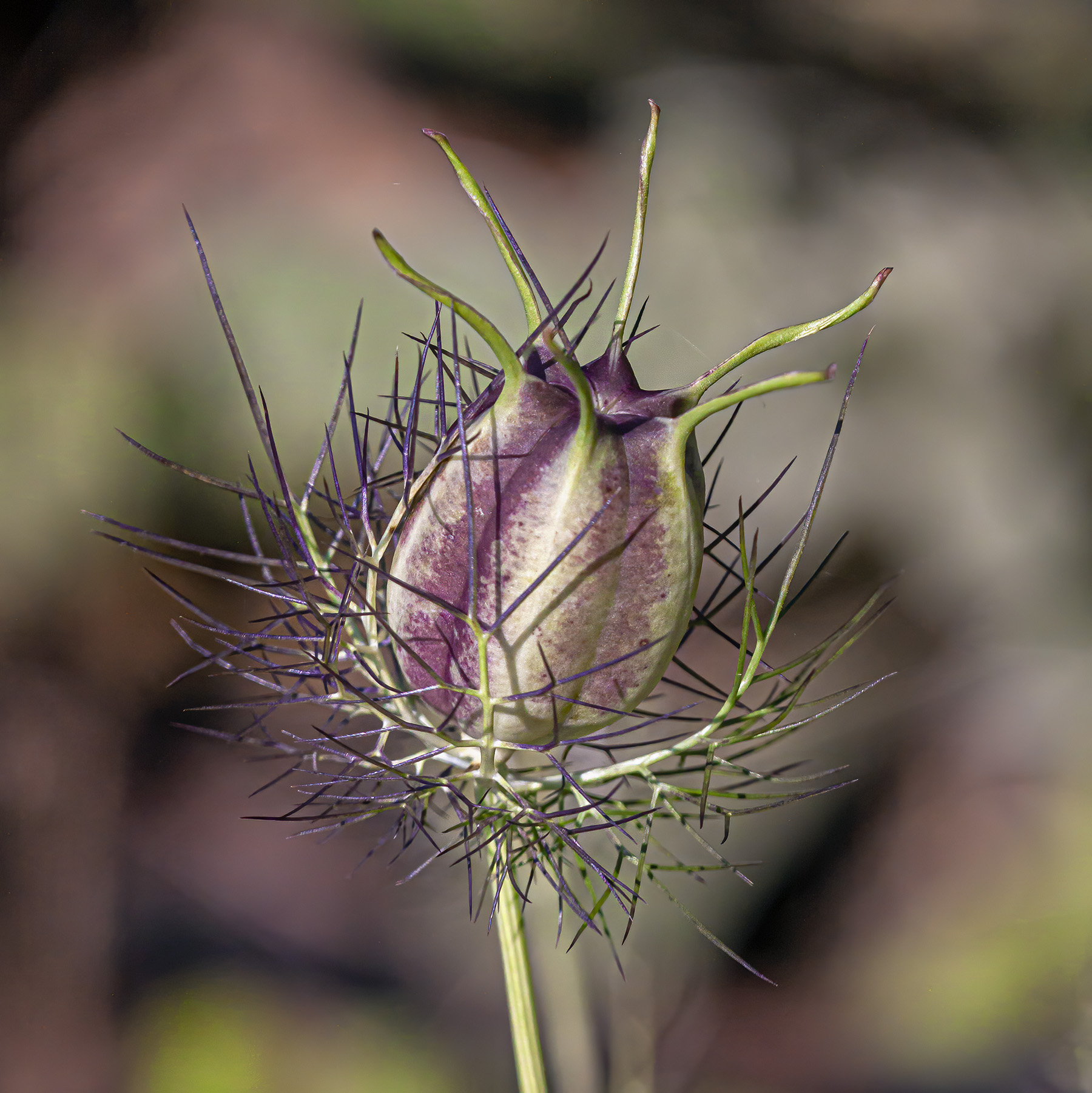
The alien-looking plant in the first photo is a seedpod of ‘Love in a mist’ (Nigella damascena), one of my favorite flowers, that I spotted during a short visit last Monday to Green Spring Gardens with my friend and photography mentor Cindy Dyer. It was a little late in the season, but I managed to spot a few flowers still in bloom, as shown in the second image. This flower is typically blue, but love-in-a-mist also comes in shades of white, pink, and lavender.

When I did a little research on-line, I learned that the striped, balloon-shaped object that I call a seedpod, is actually an inflated capsule composed of five fused true seedpods, according to an article by Wisconsin Horticulture. I also learned that the thorny-looking spikes that make up the “mist,” which are not sharp, despite their appearance, are technically bracts, a specialized kind of leaves.

This is one of the few local places where I know I can find this exotically beautiful flower. If you want to see love-in-a-mist yourself, you should probably go to a large garden. Otherwise you could waste a lot of your time looking for love in all the wrong places.


love in a mist

Love in a mist

© Michael Q. Powell. All rights reserved.


Read Full Post »

Bright, saturated colors can be wonderful, but in large doses they can overwhelm the senses and confuse a viewer’s eyes. I am often drawn to simple scenes with a limited palette of colors, scenes in which light and shadows and shapes and textures play a more prominent role than colors.

Those were my thoughts when I started to review my images of this male Powdered Dancer damselfly (Argia moesta) that I spotted on Thursday while exploring a stream in Fairfax County with fellow dragonfly enthusiast Walter Sanford. The Powdered Dancer is the closest that we come to having a monochromatic dragonfly or damselfly—the thorax and tip of the abdomen of males becomes increasingly white as they age.

I love the way that the coolness of the white on the body contrasts with the brownish-red warmth of the branch, the leaves, and the out-of-focus rocks in the background of the initial image. I like too the texture in the images, particularly in the bark in the first photo and in the rock in the second one. Shadows help to add some additional visual interest to both of these images, drawing a viewer’s attention to the damselfly’s head in the first image and to the details of its entire body in the second.

Powdered Dancer

Powdered Dancer

© Michael Q. Powell. All rights reserved.

Read Full Post »

In some of the locations that I visit, Blue Dasher dragonflies (Pachydiplax longipennis) are the most common species that I encounter. They are pretty easy to photograph, because they hunt by perching and waiting for suitable prey to come within range. When it does, they dart from their position to catch it and often return to the same perch.

Over the years, I am sure that I have taken hundreds of photos of Blue Dashers, but I still enjoy trying to capture new and potentially better images of these beautiful little dragonflies. Blue Dashers have a special place in my heart in part because my very first posting on this blog almost eight years ago featured a photo of one. My gear has changed over those eight years, but my approach has remained pretty consistent. If you are curious about the kind of images I was capturing way back then, check out the posting that was entitle simply “Blue Dasher dragonfly.”

One thing that has changed, though, is that I now have a greater appreciation for female dragonflies, which are generally less colorful than their male counterparts. Some might see the females as drab and uninteresting, but I often find a special beauty in them that is more subtle and refined than the garish males.

The images below are shots of female Blue Dashers that I have taken during the month of June. The final photo shows a younger female with brighter colors and a more distinct pattern on her abdomen. The first two images feature a more mature female—both sexes of Blues Dashers develop a waxy, frosted color with age, a phenomenon known as “pruinescence.” One of the coolest features of these females is their two-toned eyes, with a prominent red color on the top half of the large compound eyes.


Blue Dasher

Blue Dasher

Blue Dasher

© Michael Q. Powell. All rights reserved.


Read Full Post »

When I was photographing bees on Monday at Green Spring Gardens, I had no idea that it was the start of Pollinator Week (22-28 June 2020), “an international celebration of the valuable ecosystem services provided by bees, birds, butterflies, bats and beetles,” according to the pollinator.org website. All I knew was that I love bees and enjoy trying to photograph them.

I was reminded of this week’s celebration yesterday in an e-mail from Benjamin, a knowledgeable budding naturalist who is almost certainly the youngest reader of my blog, and his grandmother Ellen (Gem). The two of them were busily making special honey treats to celebrate the week.

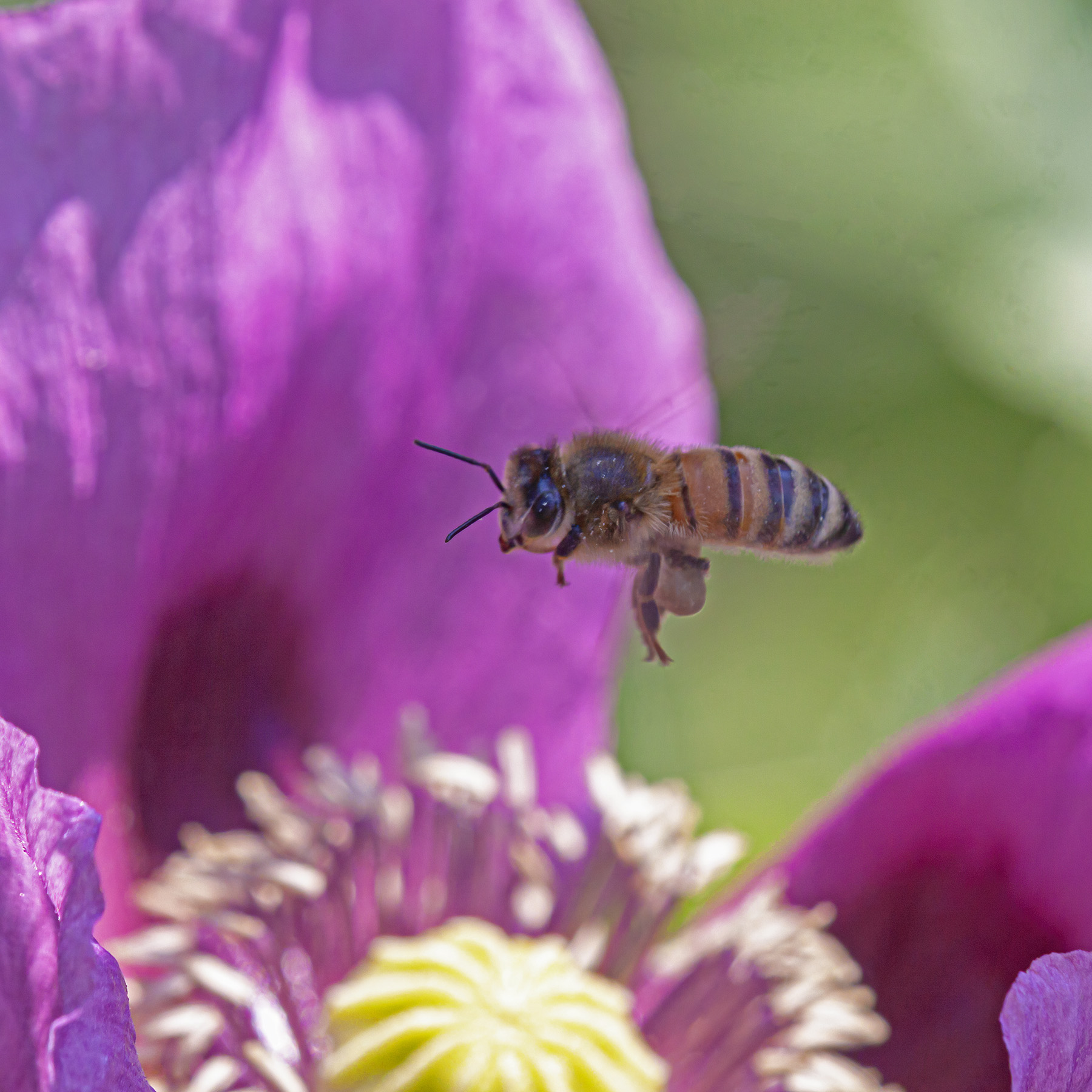
A honeybee came buzzing by me as I was attempting to photograph a poppy on Monday. Although the poppy was quite beautiful, I quickly abandoned it and decided that it was more fun to focus on the bee. The bee seemed to have been quite successful in gathering pollen and, as you can see in the first two photos, one of its pollen sacs seemed to be filled to its maximum capacity.

The final photo shows a honeybee at work in a Stokes’ Aster flower (Stokesia laevis) that I spotted in another part of the gardens. If you double-click on the image, you will see little white grains of pollen covering different many parts of the bee’s body.


honeybee

honeybee

© Michael Q. Powell. All rights reserved.


Read Full Post »

Can dragonflies smile? It sure looked like this male Great Blue Skimmer dragonfly (Libellula vibrans) was flashing me a toothy grin when I spotted him last Friday at Occoquan Bay National Wildlife Refuge. Perhaps it was just my imagination, running away with me.

smiling dragonfly

© Michael Q. Powell. All rights reserved.


Read Full Post »

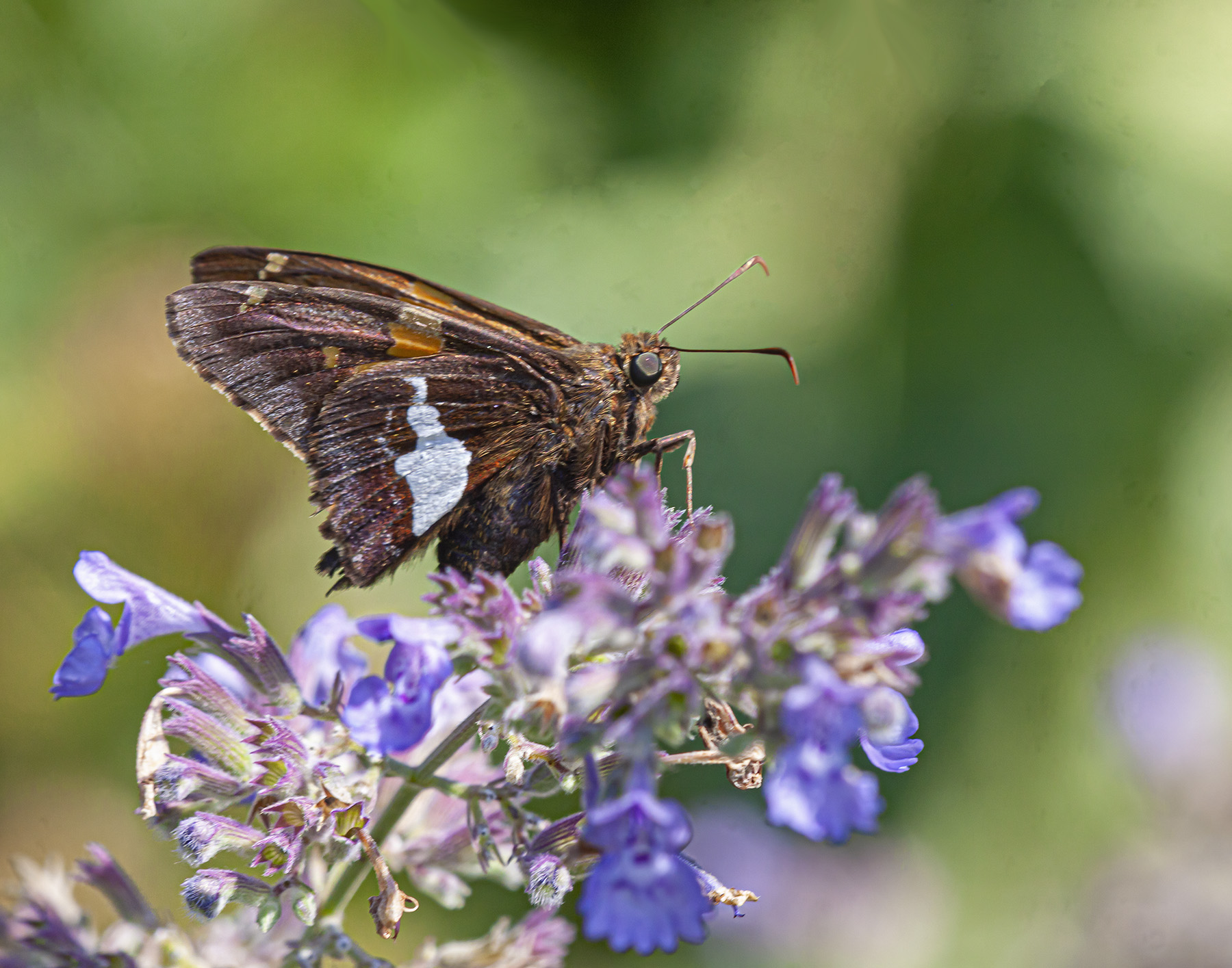
Out of the more than 3500 species of skipper butterflies worldwide, there is only one that I can reliably identify, the Silver-spotted Skipper (Epargyreus clarus). I spotted this little beauty on Monday during a brief visit to Green Spring Gardens with my friend and photography mentor Cindy Dyer.

Silver-spotted Skipper

© Michael Q. Powell. All rights reserved.

Read Full Post »

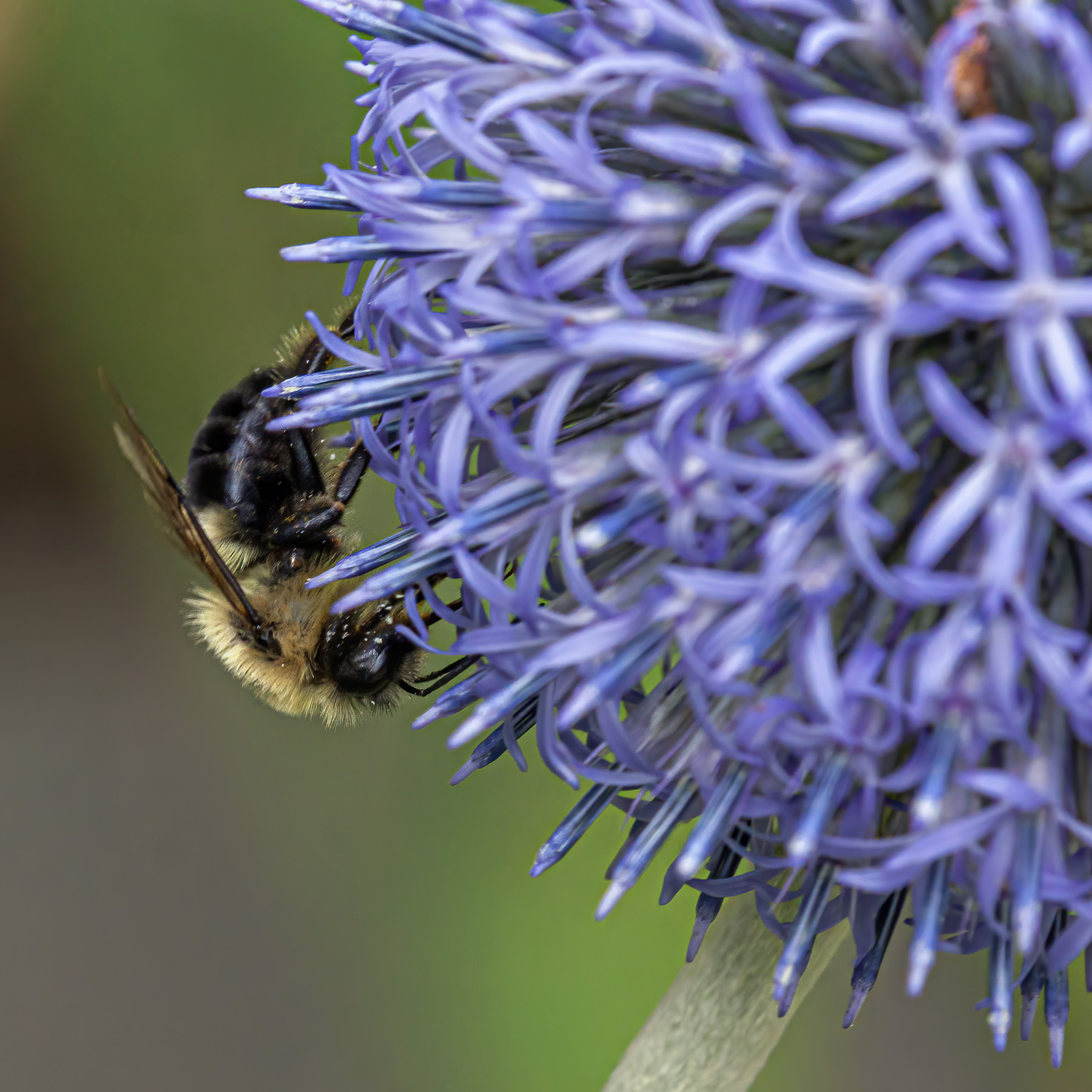
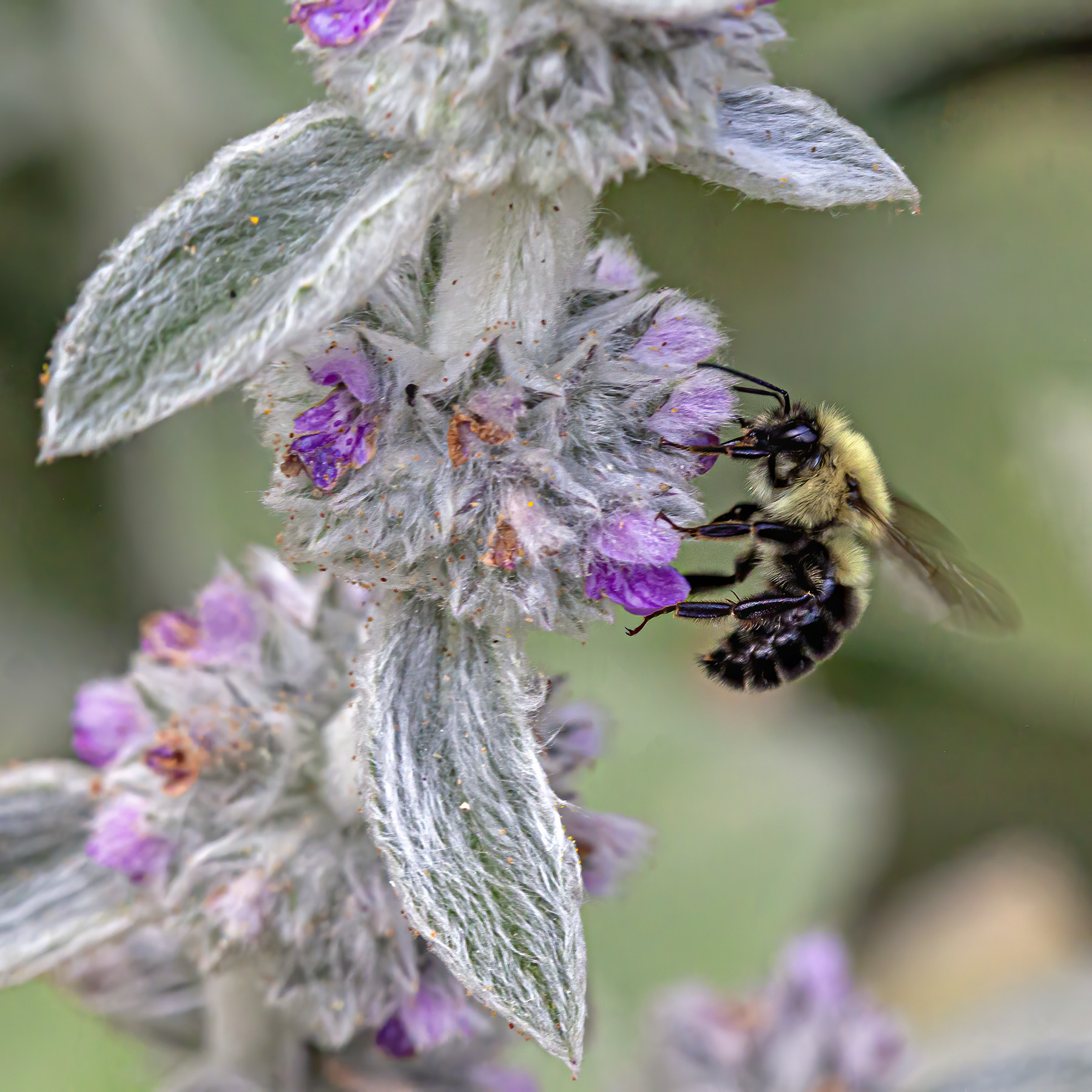
I love bees and spent quite a while on Monday in the garden of my friend and neighbor Cindy Dyer observing them and trying to photograph them. I had no idea that lamb’s ear plants produce flowers, but the bee in the first photo certainly was aware of that fact when I spotted it busily at work. The bee in the second shot decided to try an acrobatic move to gain access to the nectar in the lavender plant that swung wildly each time the bee landed on it. In the final shot, I captured the bee as it was crawling all over a flower of a cool-looking globe thistle plant.

I am not very good at identifying bees, but I think these bees are all Eastern  Carpenter Bees (Xylocopa virginica). Unlike bumblebees that have fuzzy abdomens, carpenter bees have shiny, relatively hairless abdomens.


lamb's ear

lavender

globe thistle

© Michael Q. Powell. All rights reserved.
 

Read Full Post »

Gray Petaltail dragonflies (Tachopteryx thoreyi) are one of the friendliest and tamest dragonfly species that I have encountered. If you hang around with them often enough, they are almost certain to land on you, particularly if you are wearing gray clothing that somehow reminds them of a tree. It is a little hard not to flinch when one of these relatively large dragonflies (3 inches (75 mm) in length) perches on your head or shoulder.

Gray Petaltails will also let you get pretty close to them when they are perched on trees. Quite frequently, though, they are perched above eye level, so being that close does not allow you to capture close-up images. This past Saturday when I was hunting for dragonflies with my friend Walter Sanford, we spotted a Gray Petaltail perched on a fallen branch that was at knee level. After we had both taken some shots, Walter challenged me to see how close I could get to the dragonfly to capture images with my macro lens.

The first shot shows one of my attempts to get a head-on shot. It is very cool to look another creature straight in the eyes, but it is rare that one will permit you to do so, especially at such close range. It seemed clear to me that the dragonfly was quite aware of my presence, but did not consider me to be a threat.

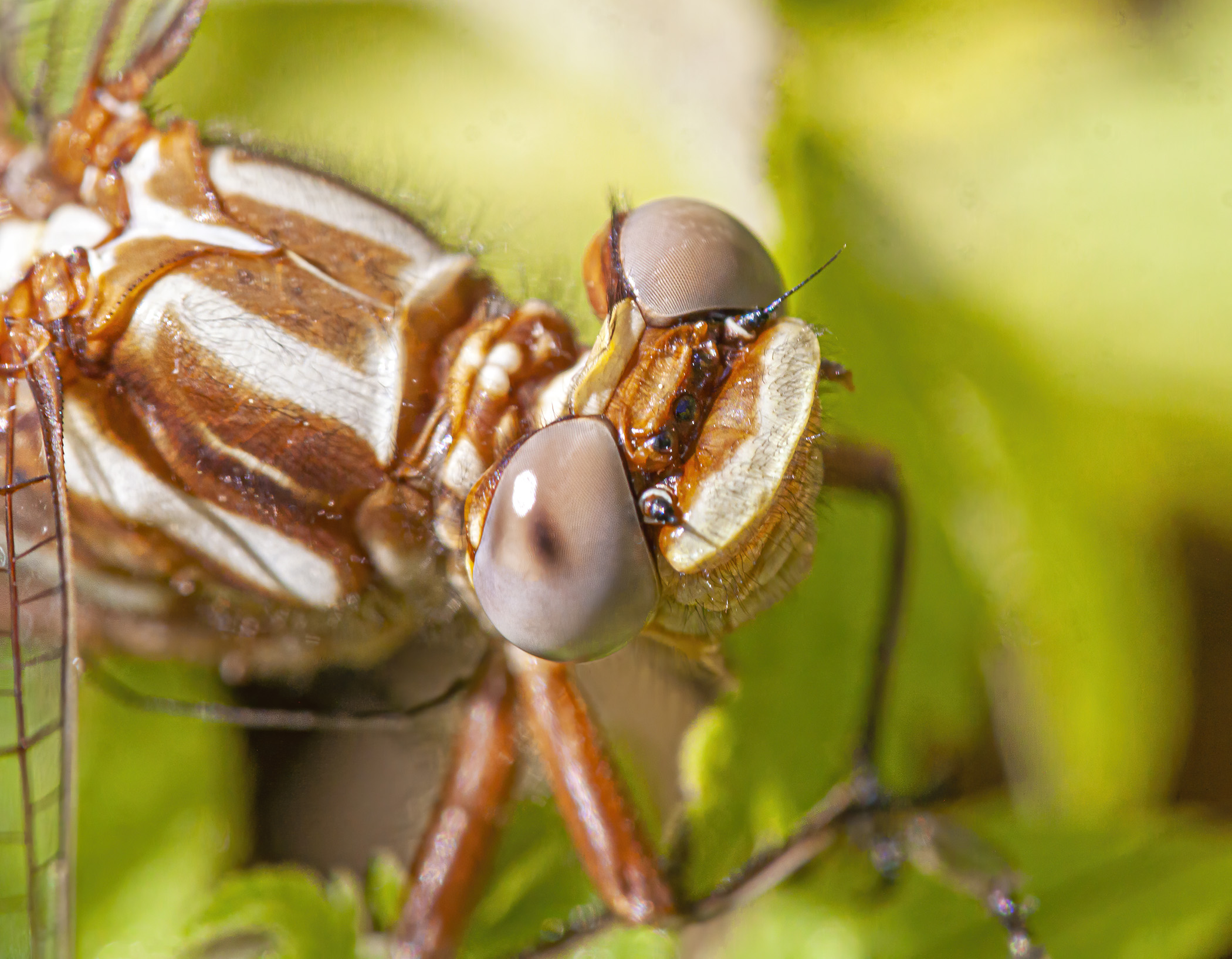
I took the second shot from the side as I moved even closer to my subject. I was trying my best to capture some of the details of the dragonfly’s eye that was nearest to me and was not concerned that most of the rest of its head was out of focus. If you double-click on the image, you can see some of the ommatidia, the individual optical units that make up a dragonfly’s amazing multi-faceted compound eyes.

If you want to learn more about dragonfly eyes, check out a wonderful article at medium.com entitled  “30,000 Facets Give Dragonflies A Different Perspective: The Big Compound Eye In The Sky“. Scientists, for example, know that the thousands of ommatidia produce a mosaic of “pictures,” but how exactly this visual mosaic is integrated in the insect brain is still not known.

Gray Petaltail

Gray Petaltail

© Michael Q. Powell. All rights reserved.

Read Full Post »

The genus Argia, commonly known as dancers, is a large New World group of damselflies. Although the genus name Argia, αργία in Ancient Greek, is translated as “idleness,” dancers are quite active and alert damselflies, according to Wikipedia. Why are they called “dancers?” They are known as dancers “because of the distinctive jerky form of flight they use which contrasts with the straightforward direct flight of bluets, forktails, and other pond damselflies.” I wonder if I am part damselfly, because “distinctive” and “jerky” are definitely adjectives that could be used to describe my attempts at dancing.

This past week, I have seen three different species of dancers. The first one, the Variable Dancer (Argia fumipennis violacea) has perhaps the most strikingly beautiful color of any of the dragonflies and damselflies that I have seen—I love that shade of violet. Some of my longtime readers may have noted that a photo of a Variable Dancer has been the banner image for this blog for many years.

The damselfly in the second image is a Blue-fronted Dancer (Argia apicalis). The thorax of the males of this species are almost completely blue, with only hairline stripes in the middle of their backs and shoulders.

The final damselfly is a Powdered Dancer (Argia moesta), our only mostly white damselfly. As you can see in the photo, members of this species often like to perch on stones at the edge of the water. I chose to leave this image mostly uncropped, because of the way that it shows the water moving around the stone and the submerged stones on the stream bottom in the background.

All of this talk of dancers brings to mind a country music song that I really like by Lee Ann Womack called “I Hope You Dance.” I am really touched by the basic message of the song—when you get the choice to sit it out or dance, I hope you dance.

Here is the first verse of the song, just in case you have never heard it:

“I hope you never lose your sense of wonder
You get your fill to eat but always keep that hunger
May you never take one single breath for granted
God forbid love ever leave you empty handed
I hope you still feel small when you stand beside the ocean
Whenever one door closes I hope one more opens
Promise me that you’ll give faith a fighting chance
And when you get the choice to sit it out or dance
I hope you dance.”
(I Hope You Dance lyrics © Sony/ATV Music Publishing LLC, Universal Music Publishing Group, Songtrust Ave)

Variable Dancer

Blue-fronted Dancer

Powdered Dancer

© Michael Q. Powell. All rights reserved.


Read Full Post »

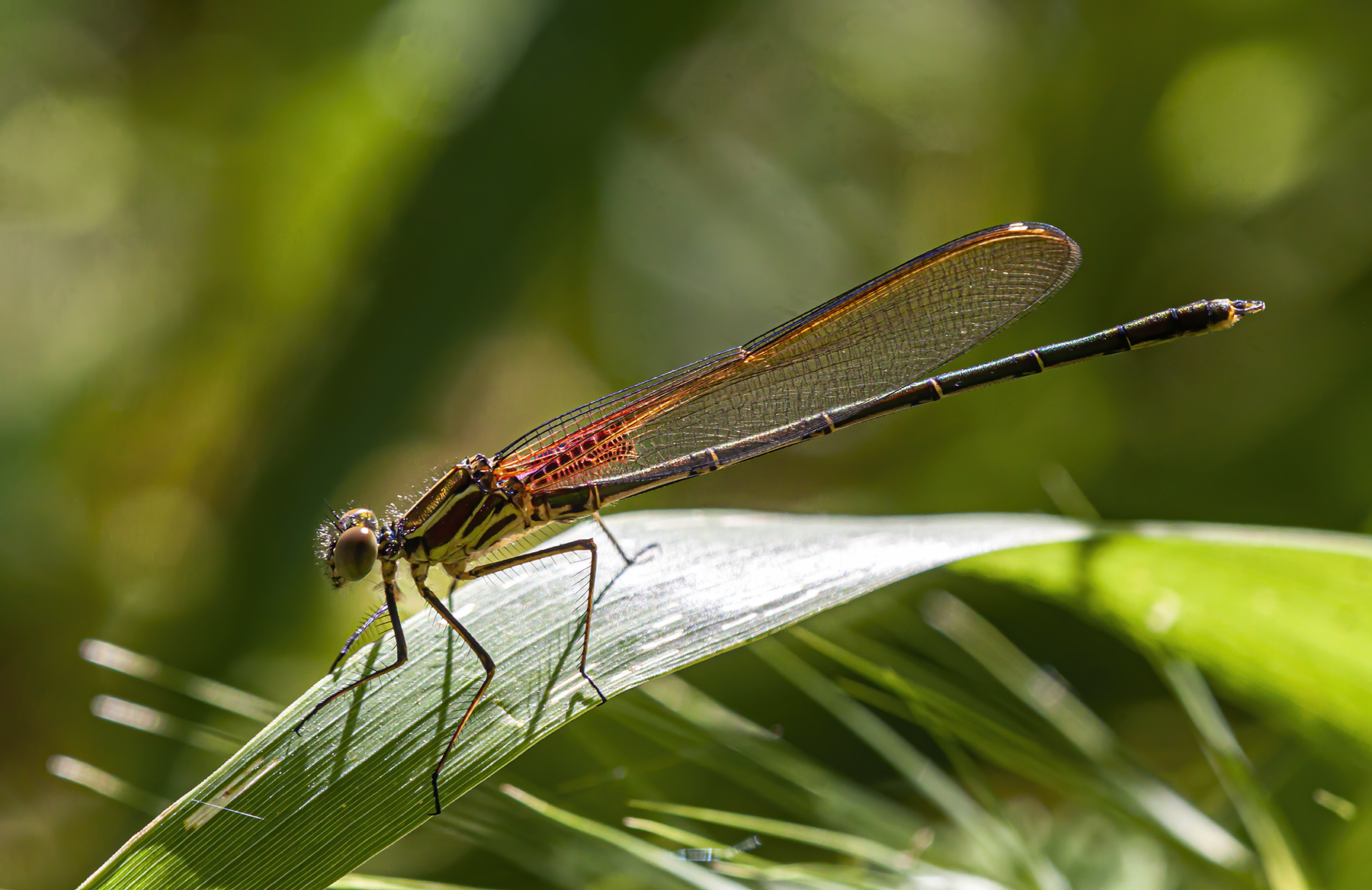
I was really excited to spot this male American Rubyspot damselfly (Hetaerina americana) on Monday while exploring in Fairfax County, Virginia with my good friend and fellow dragonfly enthusiast Walter Sanford. I have seen this species only a few times before, but had no trouble identifying it, thanks to the distinctive “rubyspot” on its wings.

The first image gives you the best view of this gorgeous little damselfly, but the second shot is my favorite. I love to look straight into the eyes of dragonflies and damselflies—they have an almost hypnotic effect on me. Whenever I get the chance, I try to get a close-up shot of the eyes of these acrobatic insects that fascinate and delight me endlessly.

American Rubyspot

American Rubyspot

© Michael Q. Powell. All rights reserved.

Read Full Post »

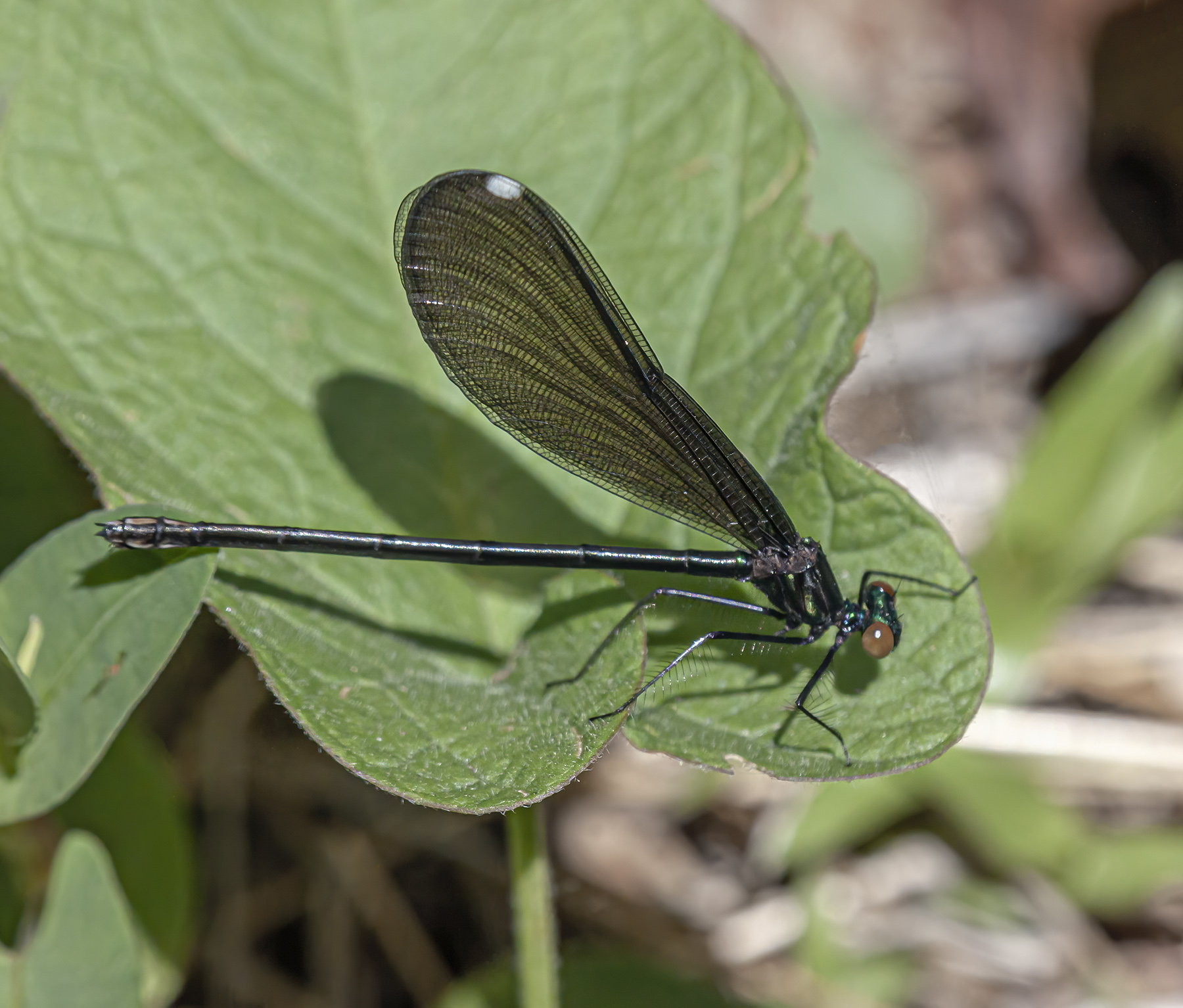
Yesterday I posted images of Eastern Amberwings, one of the most easily identified dragonfly species in my area. Today I am going to continue the mini-trend of going easy on my identification skills by presenting our most easily identified damselfly species, the Ebony Jewelwing damselfly (Calopteryx maculata).

I spotted this beautiful female Ebony Jewelwing last week as I was exploring in Occoquan Regional Park. Ebony Jewelwings are found most often along wooded slow-moving streams and frequently perch on low shrubbery in sun-lit openings in the forest canopy, which pretty well describes the circumstances of my encounter with this little beauty.

How do I know that it is an Ebony Jewelwing? There is no other damselfly in our area that has completely dark wings like the Ebony Jewelwing. How can I be sure that it is a female? Females have a conspicuous little white patch on their wings, technically known as a “pseudostigma,” that is pretty obvious in the photo below.

Some recent postings have noted the difficulties in making a correct identification of the dragonflies and damselflies that I photograph. I enjoy a mystery from time to time, but there is something reassuring about spotting a familiar species and being able to identify it immediately.


Ebony Jewelwing

© Michael Q. Powell. All rights reserved.

Read Full Post »

Names can sometimes be misleading. There is a genus of damselflies, consisting of 35 species, called American bluets. As the common name “bluet” suggests, most members of the genus are primarily blue in color. One notable exception is the adult male Orange Bluet (Enallagma signatum) that often does not appear to have even a speck of blue on its body.

I spotted this little guy last Friday at Jackson Miles Abbott Wetland Refuge and was a bit shocked by his bright red eyes when I looked through the viewfinder of the camera. The male Orange Bluet was perched at the extreme end of some vegetation overhanging a pond.

I would have liked to have gotten a shot in which more of its body was in focus, but I did not want to risk falling in the water, which looked to be pretty deep at that spot. As I look at the photo now, I realize that the soft focus of the body may actually be a good thing, because it draws a viewer’s attention even more to the eyes of the handsome little damselfly.

orange bluet

© Michael Q. Powell. All rights reserved.

Read Full Post »

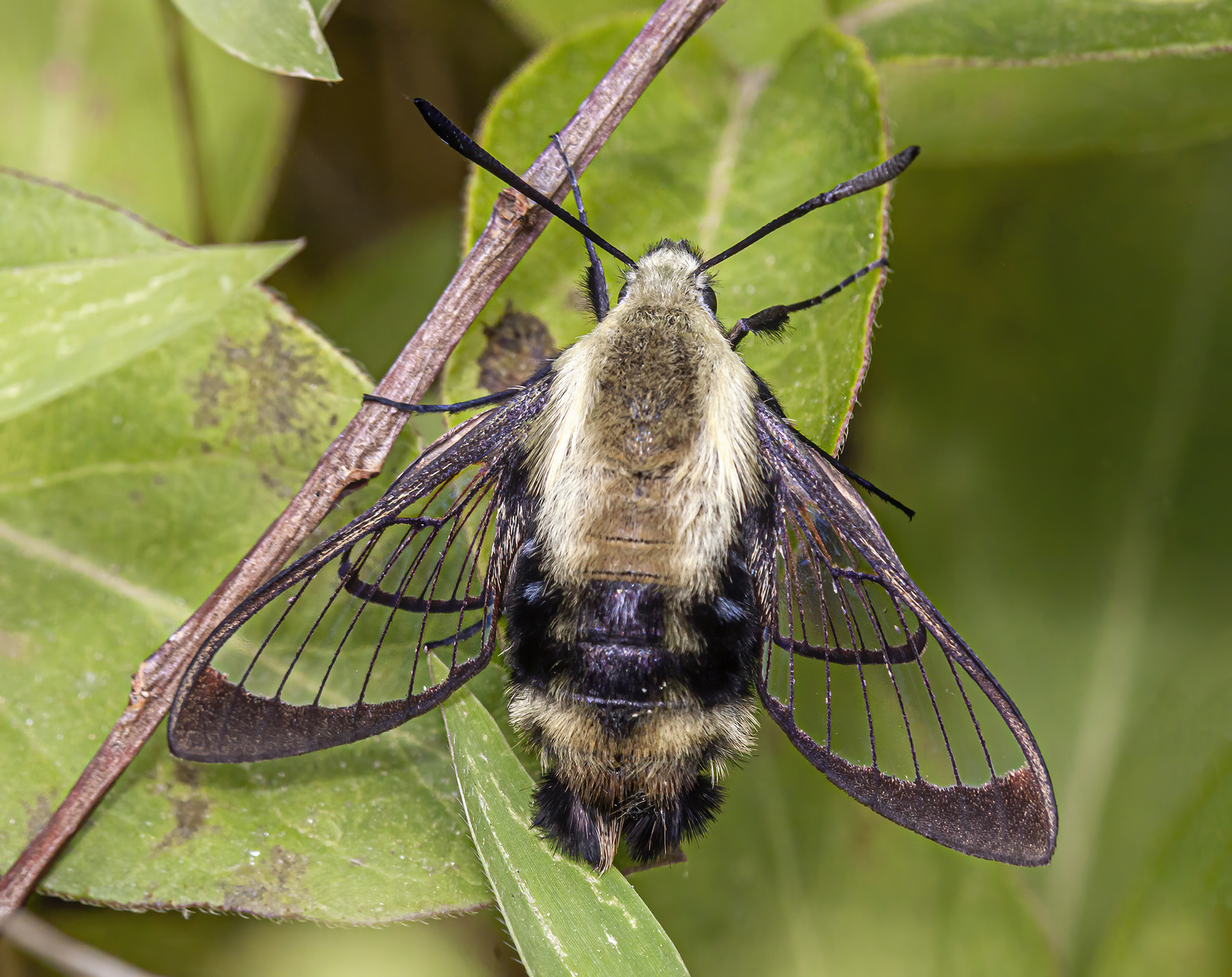
When I first spotted this insect last Thursday at Occoquan Regional Park, it looked like a large bumblebee. I tracked it visually as it buzzed about and when it landed, I could see from its distinctive wings that it was definitely not a bee. In our area we have two species of clear wing moths that are similar in appearance and behavior, the Snowberry Clearwing Moth (Hemaris diffinis) and the Hummingbird Clearwing Moth (Hemaris thysbe). Identification guides warn that both species are variable in color, which complicates identification, but the Hummingbird Clearwing Moth has light-colored legs, so I am pretty confident that this one is a Snowberry Clearwing Moth.

Most of the time when I see clearwing moths they are beating their wings rapidly and hovering in the air as they collect nectar from a variety of flowers, which causes some people to think they are hummingbirds. I do not know why this one was perched in the low vegetation—perhaps it was taking a break—but its static position allowed me to get a detailed look at its wings and the rest of its body.

Snowberry Clearwing moth

© Michael Q. Powell. All rights reserved.

Read Full Post »

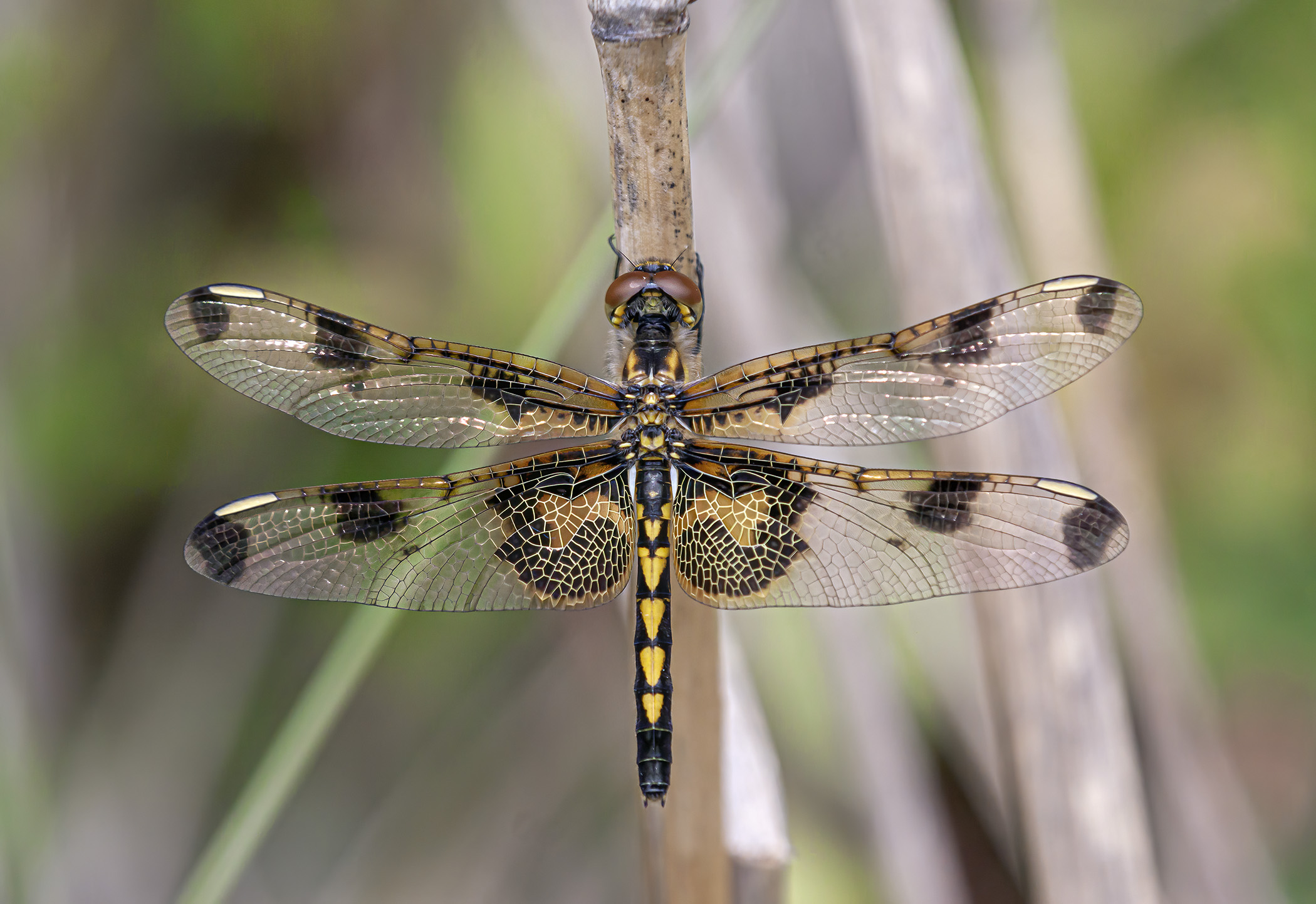
On Tuesday I spotted this beautiful female Calico Pennant dragonfly (Celithemis elisa) during a visit to Occoquan Bay National Wildlife Refuge.  I always love to see the wonderfully patterned wings of this dragonfly species and the first shot provides a good view of the wing details, especially if you click on the image to enlarge it.

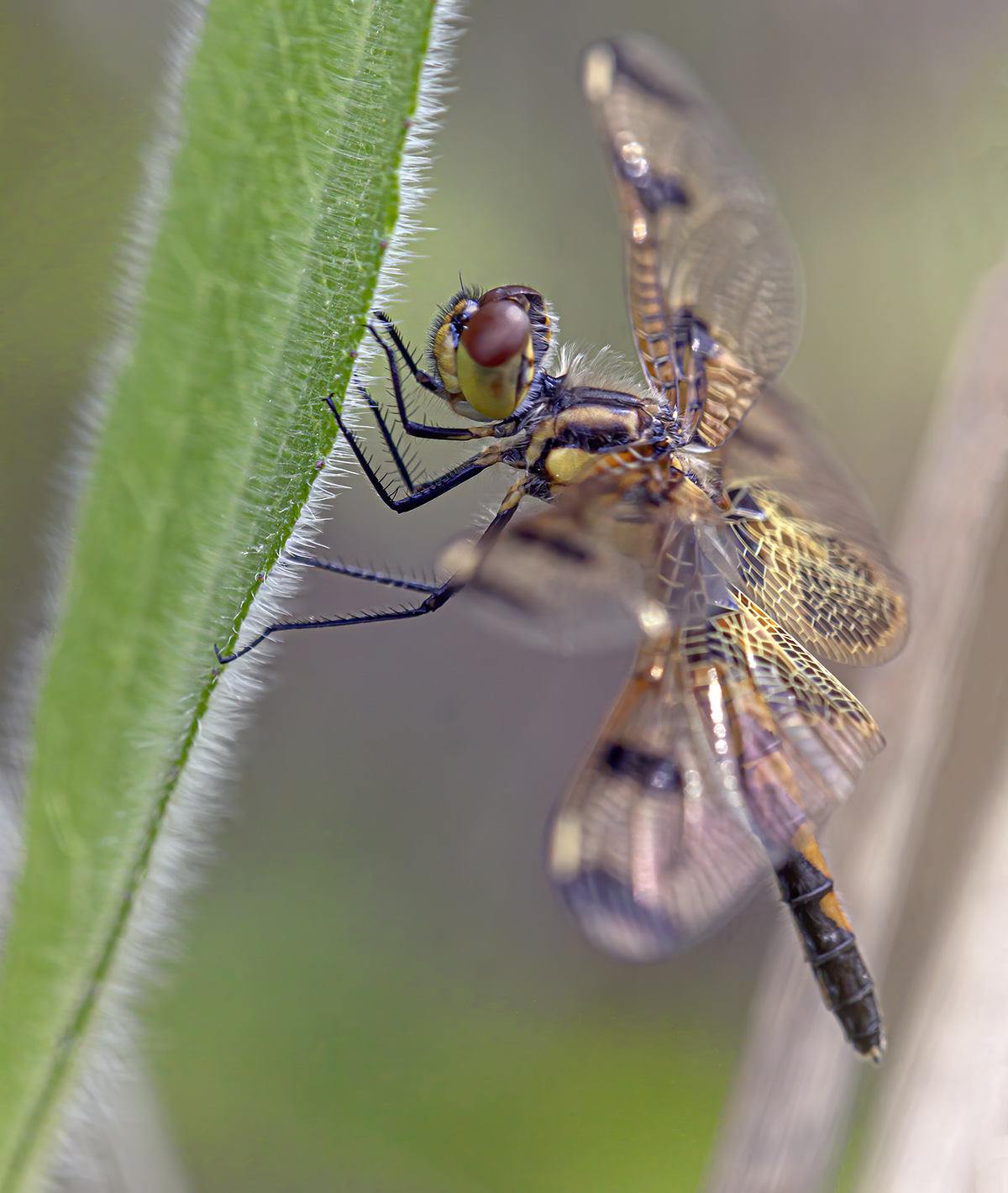
In the second image, I focused primarily on the dragonfly’s head and body and the wings are mostly out of focus. I love the way that you can see the dragonfly’s tiny feet and the tenuous grasp they have on the fuzzy plant stem from which the dragonfly is hanging.

Calico Pennant

calico pennant

© Michael Q. Powell. All rights reserved.
Read Full Post »

I wasn’t sure if Uhler’s Sundragon dragonflies (Helocordulia uhleri) would still be around when I set out exploring in Prince William County earlier this month. This species of dragonfly is one of the first to appear in the spring and generally is flying for only a month or so. I had spotted several females on the third of April—see my posting Female Uhler’s Sundragons for details and photos—so I knew that the clock was ticking.

I scoured all of the locations where I had seen them in the past and was about to give up hope when some movement low in the vegetation caught my eye. I was excited to see that it was a Uhler’s Sundragon, my target species. As I tried to control my racing heart and slow down my breathing, I maneuvered into position and was able to capture this image of a handsome male Uhler’s Sundragon. As it turned out,  this dragonfly was the only one of its species that I would see that day and I have not seen one since. In this case, though, one was more than enough.

Uhler's Sundragon

© Michael Q. Powell. All rights reserved.

Read Full Post »

Many beetles are dark-colored and go about their business in the underbrush, unseen by human eyes. Six-spotted Tiger Beetles (Cicindela sexguttata), on the other hand, are hard to miss—their metallic-green bodies sparkle as they perch in the middle of the sun-lit forest trails on which I have been hiking in recent weeks.

The beetle’s common name refer to the six small white spots on the beetle’s metallic-green elytra (the beetle’s hardened wing cases), although the number of spots is somewhat variable—I think I count eight spots on this individual. As I was doing a bit of research, I stumbled upon the fact that elytra is the plural form of elytron—I think that I have almost always seen the word used in the plural form and the spell-check highlights elytron as an unknown word.

It is often hard to get a shot of one of these beetles, because they are skittish and often fly away as I bend down to photograph them. For this photo, I was fortunate that the beetle chose to perch on a trunk of a tree at eye-level and no contortions were therefore required on my part.

Six-spotted Tiger Beetle

© Michael Q. Powell. All rights reserved.

Read Full Post »

I often feel a bit overwhelmed when I visit a public garden—there are so many flowers all around vying for my attention. I am rarely attracted to large clusters of flowers, but instead tend to gravitate toward individual flowers that I can photograph up close with my macro lens.

Here are three of the flowers that I photographed during a recent photographic foray to nearby Green Spring Gardens with my friend Cindy Dyer. The first is a spiderwort (g. Tradescantia), a flower that I love for its simple geometric shape. I am not sure if the plant in the second photo, some species of allium, counts as a flower, but I love the way that the partially open “bud” reveals the complex structure inside. The final flower is a simple viola that I spotted amidst a bed of green ground cover—like pansies, violas always make me smile.

spiderwort

allium

viola

© Michael Q. Powell. All rights reserved.


Read Full Post »

How close can you get to a dragonfly when trying to photograph it? As with most things in life, the vexing answer is that  “it depends.” In my experience, some dragonfly species tend to be more skittish than others and will fly away for good at the first indication of your presence. Other species will fly away, but return to the same perch a short time later. Occasionally I will encounter a dragonfly that remains in place and permits me to get as close as I want, although I still have to pay close attention to where I place my feet, so that I do not disturb its perch, and to the location of the sun, so that I do not cast my shadow on the dragonfly.

Last Saturday I went hunting for dragonflies with my friend and fellow dragonfly enthusiast Walter Sanford at a remote location in Fairfax County, Virginia, the county in which we live. Under normal circumstances, we probably would have made multiple excursions together by this time of the year, but this was our first trip of the season.

The first dragonfly that we encountered was a female Ashy Clubtail dragonfly (Phanogomphus lividus) and she proved to be remarkably cooperative. Why? I think that the dragonfly was a little distracted because she was in the process of consuming a cranefly. In some of my photos I could see remnants of the legs, wings, and other body parts of the victim.

The three photos show in inverse chronological order how I started out photographing the entire body of the dragonfly and them moved in closer and closer. Each of shows some pretty remarkable details of the dragonfly’s anatomy and it is definitely worth clicking on them to get a better look. For example, the third photo shows the beautiful coloration of the body; the second shot shows the spines on the legs and the hook-like tips of the feet; and the first image draws your attention to the dragonfly’s amazing compound eyes.

I took all of the photos below handheld with my Canon 50D DSLR and Tamron 180mm macro lens. My partner in this adventure used totally different gear and his approach to capturing images was definitely not the same as mine. In the past Walter and I have done companion postings on our respective blogs when we have taken photos together and we decided to continue the tradition.

Walter and I have different backgrounds, writing styles, and shooting styles and it has always been fascinating to contrast our “takes.” Even though we were shooting the same subject under the same conditions, I can almost guarantee that the images we post will be quite different. Be sure to check out Walter’s blog at waltersanford.wordpress.com for all kinds of wonderful postings, mostly about dragonflies.

I will include a link to his posting on our encounter with this Ashy Clubtail dragonfly after I publish this posting—I have not yet seen how he described our adventures.

UPDATE: Here, as promised, is a link to Walter’s posting about our encounter with this female Ashy Clubtail dragonfly.

Ashy Clubtail

Ashy Clubtail

Ashy Clubtail

© Michael Q. Powell. All rights reserved.
 

Read Full Post »

Yesterday my friend and photography mentor Cindy Dyer and I were photographing flowers in different parts of her garden when she excitedly called out to me that she had spotted a ladybug inside one of the irises. I rushed over and spotted a tiny Multi-colored Asian Lady Beetle (Harmonia axyridis) feverishly crawling around inside of a beautiful yellow bearded iris.

I had a mental picture of composing an image in which the viewer would looking from the outside into the interior of the flower.  That meant that I could not get too close to the ladybug. It also meant that the ladybug had to cooperate by crawling into the right part of the frame. I watched and waited and eventually was able to capture the kind of artsy image that I had imagined.

ladybug in iris

© Michael Q. Powell. All rights reserved.
 

Read Full Post »

« Newer Posts - Older Posts »