Feeds:
Posts
Comments

Archive for the ‘Macro Photography’ Category

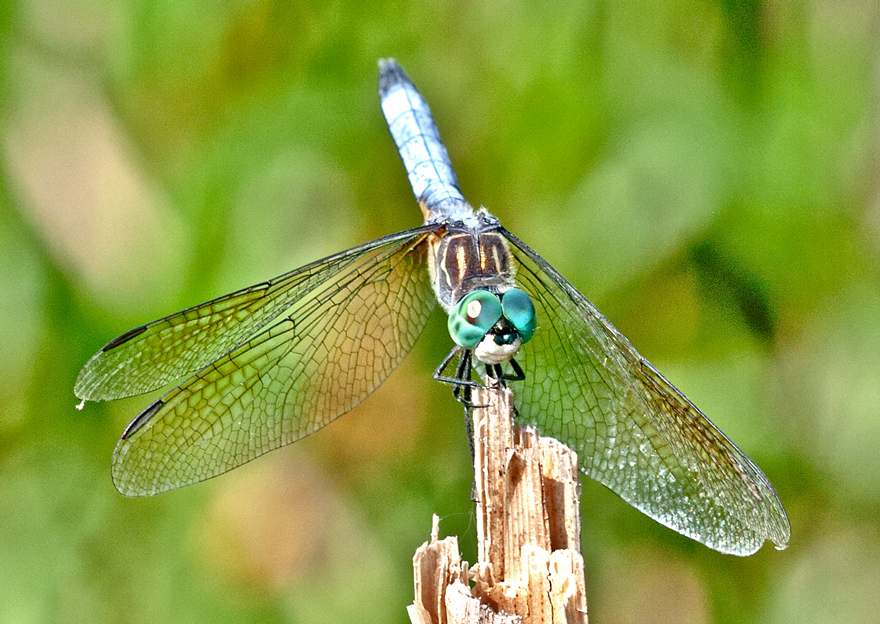
Do you ever have days when you crave solitude, but others just won’t stop bothering you? That may be how this male Blue Dasher dragonfly (Pachydiplax longipennis) felt today, when other dragonflies harassed him from the back and from the front.

behind_blogsuspended_blog© Michael Q. Powell. All rights reserved

Read Full Post »

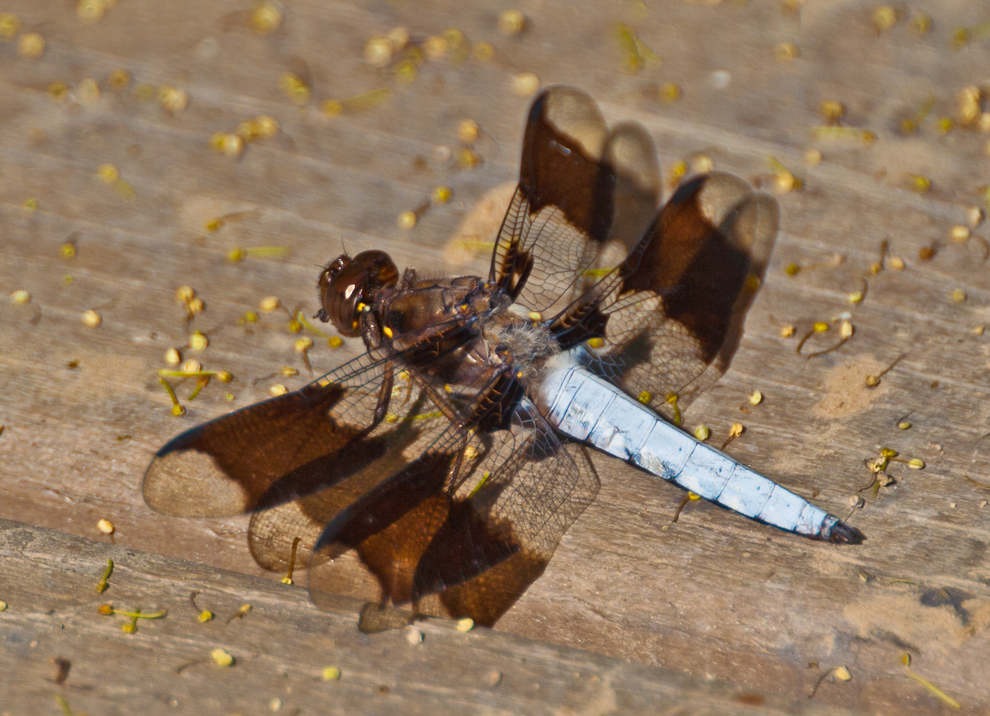
It was exciting for me to spot a new dragonfly this weekend, a male Widow Skimmer dragonfly (Libellula luctuosa).

I really like the brown and white pattern on the wings, which was distinctive enough that it also helped me in identifying it. According to Bugguide, the species name means sorrowful or mournful, perhaps because the wings of both male and female seem to be draped in mourning crepe.

The weather has turned hot and humid, which is typical for the Washington D.C. area, which seems to be great for the dragonflies, so I’ll be out as often as I can tolerate the heat, searching for new dragonflies to photograph.

brown_white1_blogbrown_white2_blog

© Michael Q. Powell. All rights reserved

Read Full Post »

Some bees seem to be really tidy when they are gathering pollen, but this bee was a total mess, with pollen sticking all over its legs and underside. The bee looks to be some kind of honey bee, although the striped markings on its lower body seem a little unusual.

Often when I am shooting a macro shot, I am so worried about the technical aspects of the shot that I forget that photography is also an art. This image helps remind me that photography remains a creative pursuit, a fusion of art and science.

pollen_1a_blog

© Michael Q. Powell. All rights reserved

Read Full Post »

Male Blue Dasher dragonflies (Pachydiplax longipennis) assume this handstand-like position, called the obelisk posture, when they feel threatened or want to minimize exposure to the sun. I was leaning a little closer than normal to this dragonfly, because I had a 100mm lens attached to the camera and not a longer zoom lens, so maybe that caused him to be a little alarmed. As the weather warms up and more dragonflies appear, I am sure that I will be getting a lot more shots of Blue Dashers, which were my favorite dragonflies to photograph last summer.

dasher1a_blog

© Michael Q. Powell. All rights reserved

Read Full Post »

Do you have a favorite insect? I realize that’s a strange question and, if pressed, most people would respond with the name of a beautiful butterfly or perhaps a ladybug, but my favorite is a very special katydid.

Last summer, though, I fell in love with a multi-colored grasshopper-like insect called the Handsome Meadow Katydid (Orchelimum pulchellum). I was absolutely thrilled yesterday to encounter and photograph a tiny insect that is almost certainly one a juvenile Handsome Meadow Katydid.

Although its colors are pretty distinctive, it’s the blue eyes that make it really stand out. The eyes really draw me in, even if they do look a little cartoonish.

Each time I visit the marsh, I will now be on the lookout for these insects, which actually grow more handsome as they age. If you want to see what they look like as adults check out my previous postings called Neon-colored grasshopper; More Handsome Meadow Katydids; and Ol’ Blue Eyes is Back.

Be forewarned, though, that you too may fall in love and end up with a new favorite insect.

katy1_blog

Michael Q. Powell. All rights reserved

Read Full Post »

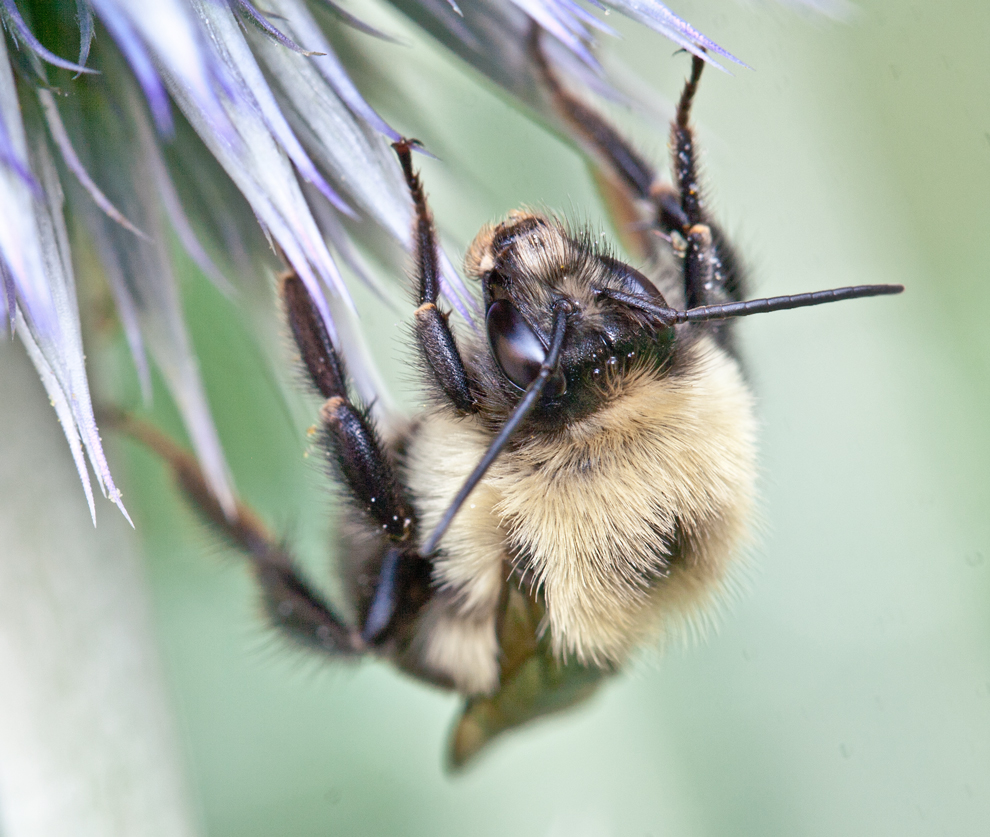
Before going out to the marsh park to shoot this morning, I decided to check out my neighbor’s garden and came across this bumblebee, hanging from the side of a a beautiful Small Globe Thistle (Echinops ritro).

I took some initial shots and then began to wonder if the bee was still alive, because it was not moving at all. When I blew gently on its face, however, it moved a little, so I figure that it was probably just sleeping. I carefully set up my tripod and got as close as my lens would let me get, which caused the bee to fill a substantial part of the frame.

I managed to capture some details that normally I do not see, like the little lines on the antennae and the hairs on the bee’s face. The bee was still sleeping when I departed—I didn’t want to risk the possibility that bees get angry if you wake them up prematurely.

close-up_bee1_blog

Michael Q. Powell. All rights reserved

Read Full Post »

As you walk through certain areas of my local marsh, the air is filled with the fragrance of the wild roses, probably Virginia Roses (Rosa virginiana), which, according to Wikipedia, are native to eastern North America.

I stooped down closer to draw in the perfumed air and my eyes were attracted to the bold pattern of a beetle that was gathering nectar from the flower.  It appears to be a kind of Flower Longhorn beetle,  which I have tentatively identified as a member of the species Strangalia luteicornis. 

Check out the entry in Bugguide, one of my favorite on-line sources of information on insects, if your want additional information on this species.

long_beetle1_blog

Michael Q. Powell. All rights reserved

Read Full Post »

I chased around this beautiful female Eastern Pondhawk dragonfly (Erythemis simplicicollis), hoping in vain that she would land on something more natural-looking than the composite boards of the marsh boardwalk. Several times she took off and circled around a bit, but returned each time to the boardwalk.

Shooting from a high angle, I was able to capture some of the details of the dragonfly that I do not usually see, like the little hooks at the end of the hairy legs. I really like her pose as she seemed to lean toward me, without seeming threatening in any way.

As always, I was struck by the strikingly beautiful emerald color of the females of this species. It’s even more impressive in real life.

green_blog

Michael Q. Powell. All rights reserved

Read Full Post »

The little skipper butterfly found a dandelion to be particularly appealing and I like this simple image that captured their brief encounter.

dandy_skipperA_blog

Michael Q. Powell. All rights reserved

Read Full Post »

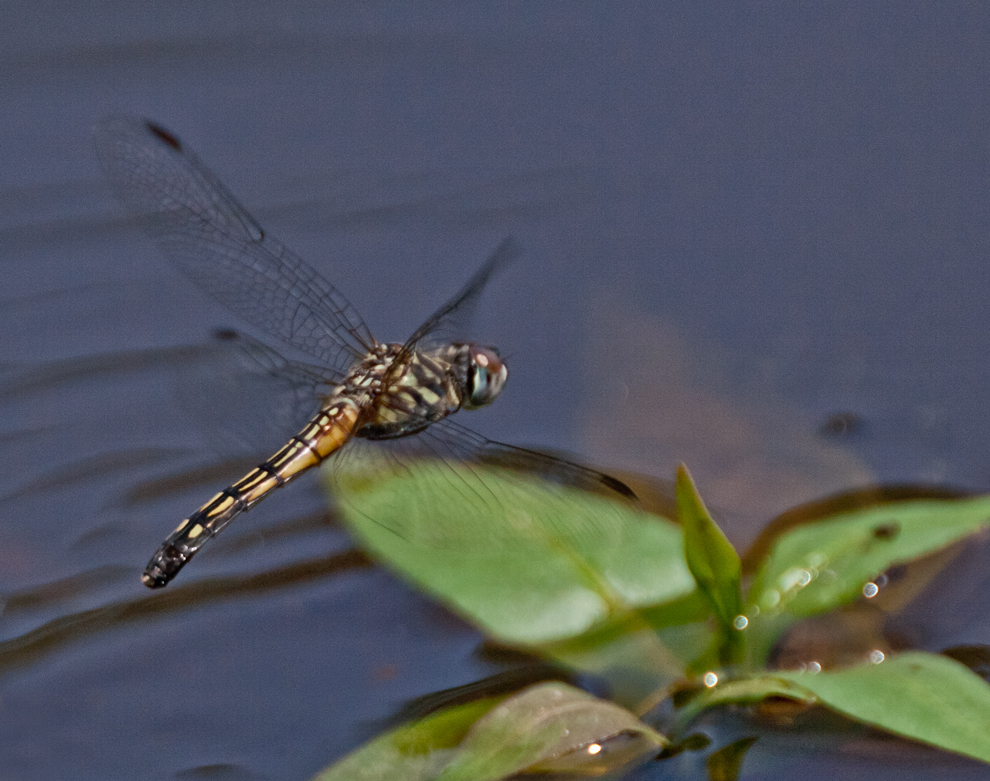
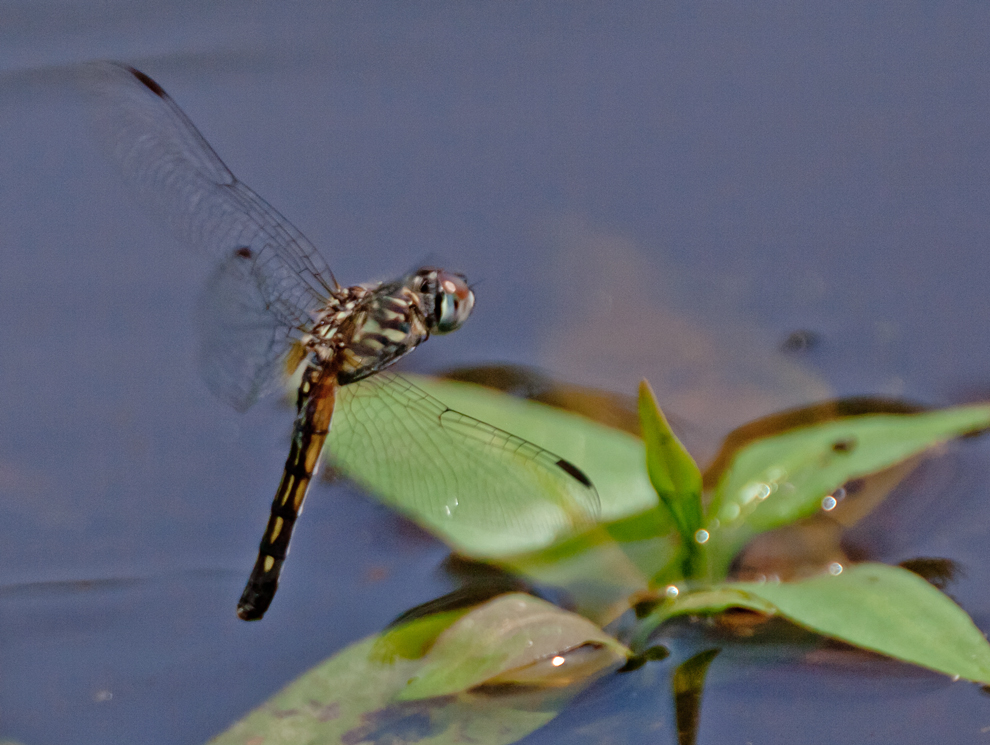
Continuing my quixotic quest to photograph dragonflies in flight, I went boldly out into the wild, armed with my trusty 100mm macro lens, and managed to capture this cool image of a dragonfly as it hovered over the water.

In previous attempts, I used longer telephoto zoom lenses, which increased the number of potential subjects but gave only mixed results. Using a shorter, fixed focal-length lens, I had to change my strategy a little and try to get closer to the subject.

I noticed this dragonfly hovering about the water to the side of the boardwalk on which I was walking. I crept as close as I could and tried to shoot as close to straight down as I could (the boardwalk was at least a foot (30 cm) above the level of the water and it looked like the dragonfly was hovering almost level with the boards of the boardwalk). I was really sensitive to my shadow, because I have learned that nothing scares away an insect faster than casting a shadow on it.

I used autofocus and was a little surprised to see that my dragonfly is in pretty clear focus, although the shutter speed was not fast enough to stop the action of  the wings. I shot this handheld and really tried to pay attention to my technique, because my macro lens does not have any built-in image stabilization. As I thought about it afterwards, I realized that the auto focusing on the macro lens (using what Canon calls an ultrasonic motor) is much faster and better than the focusing on my Canon 55-250 or my Sigma 135-400mm zoom lens.

I have been having some difficulties identifying this dragonfly. The coloration of the tail looks a little like a female Blue Dasher, but the beautiful blue eyes do not seem right for the female. The tip of the tail should be a help, but I can’t seem to find one that matches it.

Although I can’t identify the dragonfly, it’s my best shot to date of a dragonfly in flight and I’m pretty content with it today, though my quixotic quest is likely to continue this weekend.

hover1_blog

Michael Q. Powell. All rights reserved

Read Full Post »

With my macro lens on my camera on Monday, I was happily scouring every plant and flower for insects to photograph when I came upon this unusual-looking spider. Instead of having a rounded body like most spiders, it had a really elongated body and what appeared to be legs of varying lengths.

I have purposely attached a clickable higher resolution image to give you a better look at the details of this strange spider. For example, I think I can see at least two rows of tiny eyes in the middle of the photo.

Last year, I photographed a similar spider and I think that it is probably a kind of Long-jawed Orbweaver, though I can’t make a more definite identification.

What mental image do you have when you think of a spider? Perhaps this photo will help you broaden your perspective about what a spider might look like.

long_spider_blog

Michael Q. Powell. All rights reserved

Read Full Post »

As I was checking out the cattails that are growing like crazy at my local marsh, I spotted this little beetle chewing on the soft insides of a broken cattail.  I immediately recognized him as a Spotted Cucumber beetle (Diabrotica undecimpunctata), a species that I encountered numerous times last summer when photographing flowers.

I really like the texture of the immature cattail, both on the outside as well as on the inside, and the bold design of the beetle.  I think that those elements and the varied shades of green make for a cool, graphic image.

cucumber1_blog

Michael Q. Powell. All rights reserved

Read Full Post »

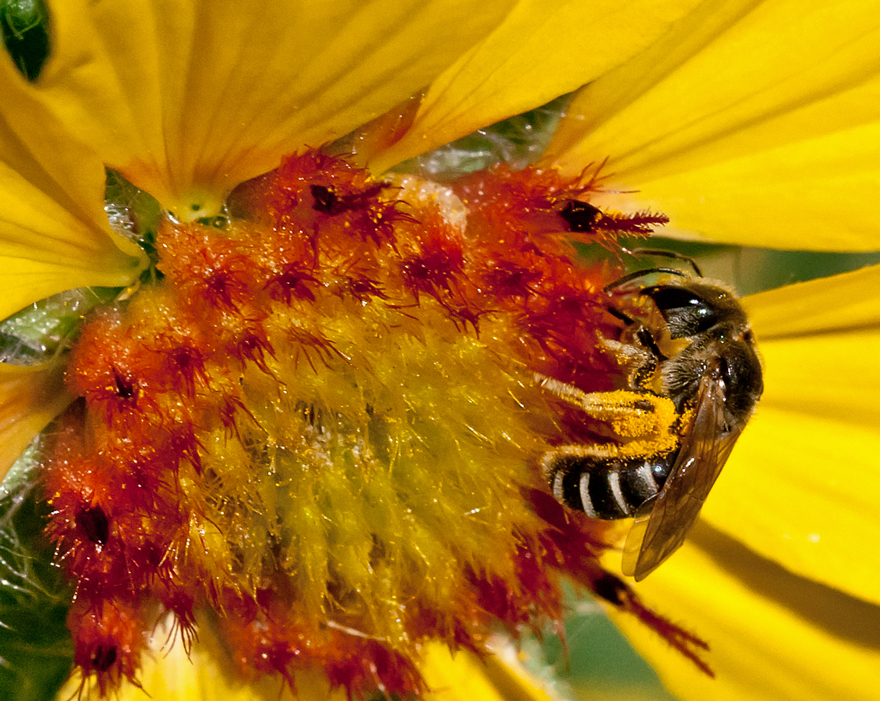
One of the first rules of photography that I learned was the importance of keeping a subject’s eye in focus and I managed to accomplish that with this bee that I photographed yesterday. However, the depth of field turned out to be so shallow that only a few other parts of the bee are as precisely focused as the eye.

I was hand-holding my macro lens, which is not image-stabilized, and the sky was overcast, so I had to open up the aperture and keep the shutter speed fairly high to get a decent shot (f/6.3, 1/100 sec, ISO400). The bee was moving all around a patch of lavender in a neighbor’s garden, gathering nectar with its tongue, which is visible in the photo.

I stalked the bee for quite a while and a lot of my shots turned out to be blurry, but I ended up with a few that were ok. This is my favorite of the bunch and I think that the shallow depth of field, which is a shortcoming in many situations, is the primary reason that I like it.

lavender1_blog

Michael Q. Powell. All rights reserved
Read Full Post »

Looking for spiders to photograph, I came across this one, which I think may be a Lattice Orbweaver spider (Araneus thaddeus). I tried a number of different techniques to get a shot of this little spider and think that this may be one of the ones on which I used my pop-up flash.

I especially like the way in which part of the web is visible against the dark background and the way the light seems to be shining through the jelly-like front part of the spider’s body.

spider_drops_blog

Michael Q. Powell. All rights reserved
Read Full Post »

As we move through spring, I am finally starting to see more hover flies and bees, busily at work collecting food and pollinating the flowers.

The insect in the first photo is, I believe, an American Hover Fly (Eupeodes americanus). A year ago, I would almost certainly have called it a bee, but I have learned a lot about insects since then, thanks to my photography.

The second photo feature a beautiful variegated flower and what looks to be a honey bee, though it’s a little difficult to make a positive identification, because of the angle.

It’s early in the season, so I am having to recall some lessons from last year, like the need to pay attention to my distance. In my desire to get closer, I have already managed a few times to bump the flower and scare off the bee, forgetting that the lens hood on my macro lens is pretty big.

hover1_blogbee1_blog

Michael Q. Powell. All rights reserved

Read Full Post »

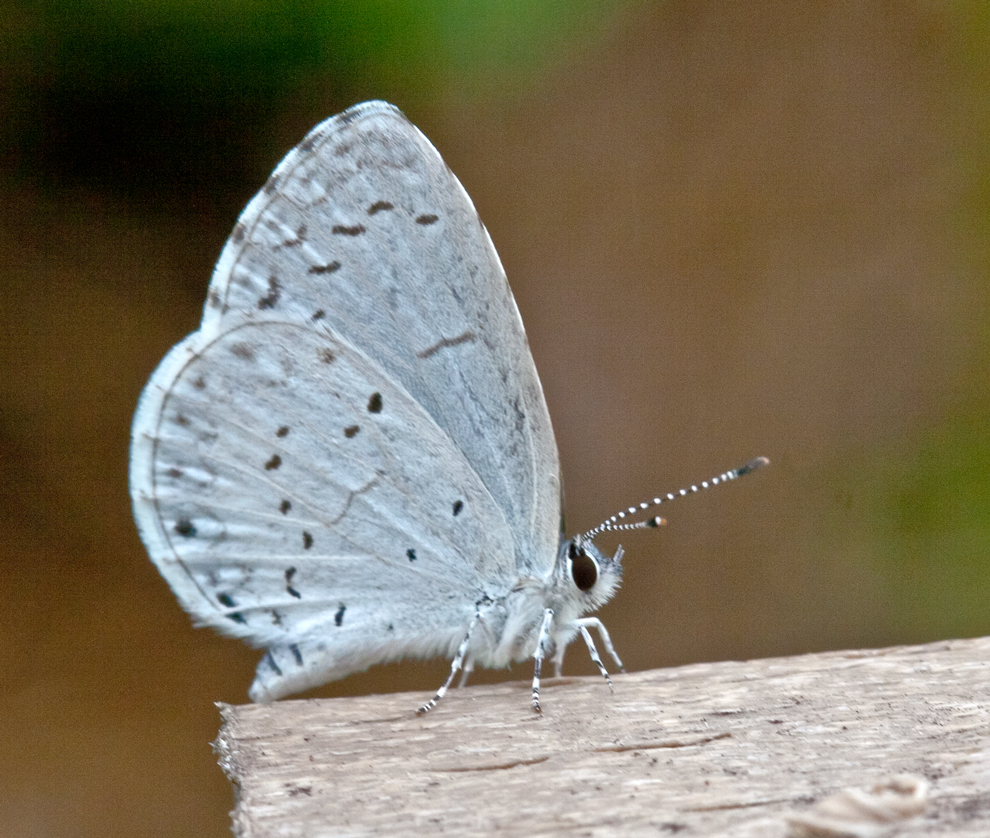
This past weekend I chased around this little butterfly—which I think may be a Summer Azure butterfly (Celastrina neglecta)—for quite some time until it finally landed.

This butterfly was really tiny, with a wing span of only about an inch (2.5 cm), so it was hard to get close enough to get a decent shot without spooking it. It took flight a couple of times, but landed nearby so I could continue the hunt.

It is always fun to photography the larger, more colorful butterflies like the Eastern Swallowtail or the Monarch, but I find that these little butterflies have a simple beautiful of their own.

little_white1_blog

Michael Q. Powell. All rights reserved
Read Full Post »

As I was going over my images from the last few weeks, I came across this image of a daddy longlegs (also known as a harvestman) that I really like, in part because of the way that the photo shows its eyes.

Previously I posted  what I had characterized as an artistic shot of this arachnid that showed mostly its bottom side. In this shot, the harvestman had turned toward the camera and the eyes, which grow on a stalk in the middle of its back are visible.

They are a huge contrast with the eyes of a jumping spider that I featured recently in a posting, which had multiple sets of large eyes.  

daddy2_blog

Michael Q. Powell. All rights reserved

Read Full Post »

As I was searching for dragonflies and butterflies in the vegetation overlooking a small pond this past weekend, I spotted this little patch of yellow on the leaf of a small tree, which turned out to be a tiny tree frog.

The frog appears to still be in a developmental stage, with indistinct feature and a substantial amount of the tail that it had as a tadpole. The frog was yellowish in color and it is a little tough for me to figure out what kind of a frog it is.

I should note that this it the first tree frog that I have ever seen and I was amazed at how small it was. It is not much bigger than some of the insects that I have been photographing, but it is definitely a whole lot cuter.

little_frog1_bloglittle_frog2_blog

Michael Q. Powell. All rights reserved

Read Full Post »

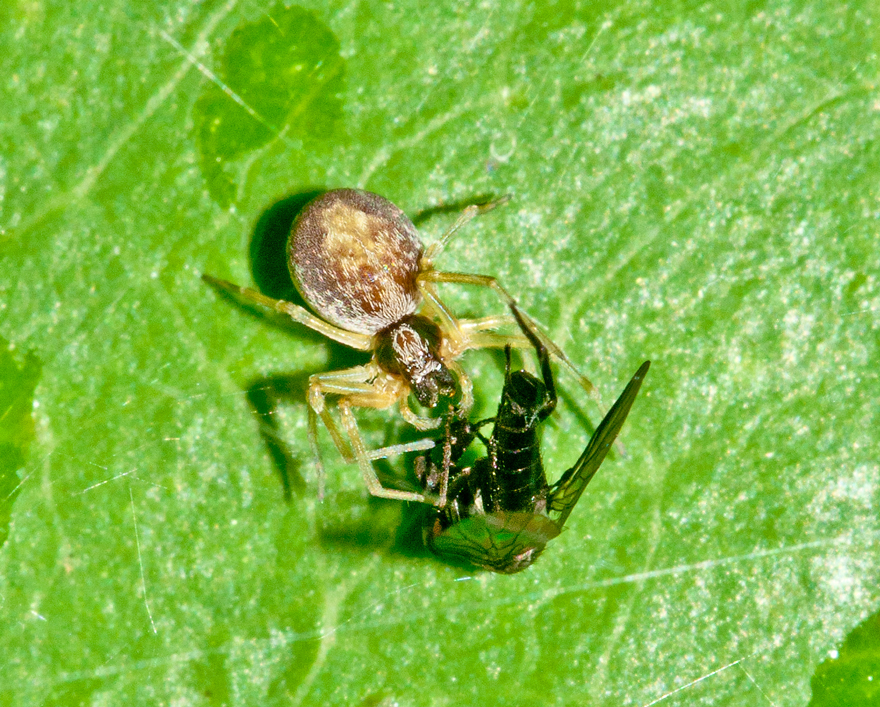
This past weekend I was off in search of spiders again and came across this little spider perched on a leaf, munching on a flying insect.

The lighting was poor, so I used the pop-up flash on my camera to provide a little extra light. Generally I don’t like it if the flash causes a shadow, but in this case it seems to add a somewhat more menacing and sinister look to the spider.

I am still trying to identify the spider and would welcome assistance. The patterns on its body, and especially the front section, are particularly cool and should assist me in finally being able to identify it.

spider_fly_blog

Michael Q. Powell. All rights reserved

Read Full Post »

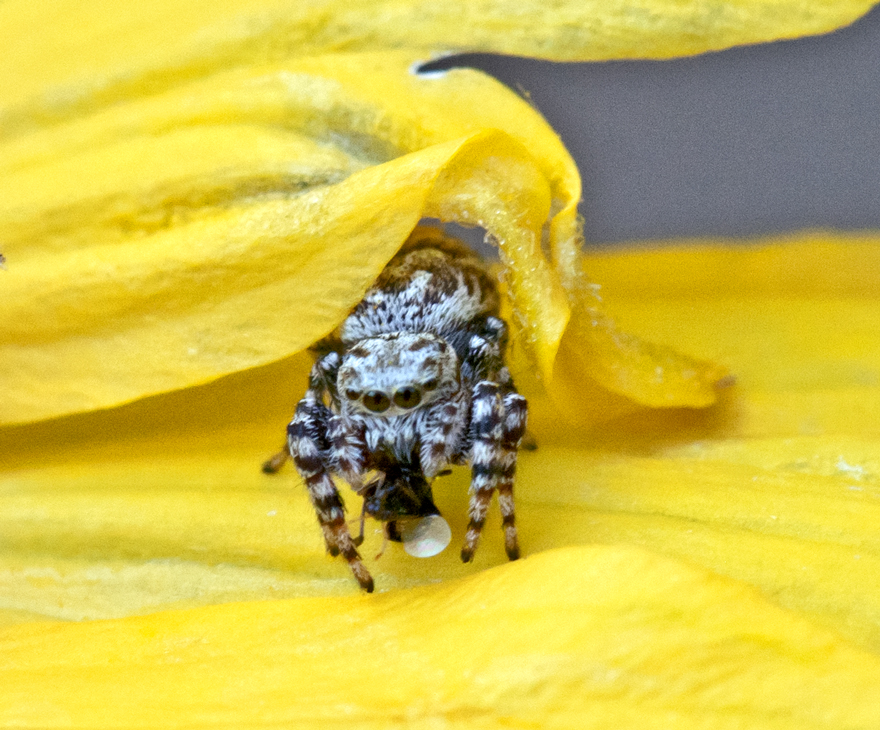
As I was checking out the flowers in my neighbors’ garden yesterday afternoon, I came across this little spider, sitting on top of a flower. There was no web anywhere in the vicinity, so I suspected that I might have a jumping spider.

Last month, I encountered a tiny, fuzzy spider that turned out to me a jumping spider, so I am a little more attuned to looking for them now. This one is definitely not the same kind, though, with completely different colors and markings. You can compare the two by checking out the photos in my previous posting.you

When I first saw the spider, it had just captured some kind of insect as you can see in the second photo. It then moved under the shade of a petal of the flower to enjoy its freshly caught dinner. I showed this moment in the first and third shots. The first one was taken a little closer and shows a lot of detail, but I really like the context that the third one provides and it is probably my favorite one. The final shot gives you an overall view of the spider.

I love the color and pattern of the spider and was happy that I was able to capture some of the details. The spider was not very big and I had trouble placing my tripod on the uneven ground to get a sharp shot. I am really happy with the results, however, and will definitely keep looking for these spiders with eyes that I find to be simply irresistible.

jumping3_blog

jumping2_blogjumping1_blogjumping4_blog

Michael Q. Powell. All rights reserved

Read Full Post »

One of my neighbors, fellow blogger Cindy Dyer, now has lavender blooming in her garden. It smells wonderful and this Cabbage White butterfly (Pieris rapae) seemed to be really enjoying it earlier this afternoon.

cabbage1_blog

Michael Q. Powell. All rights reserved

Read Full Post »

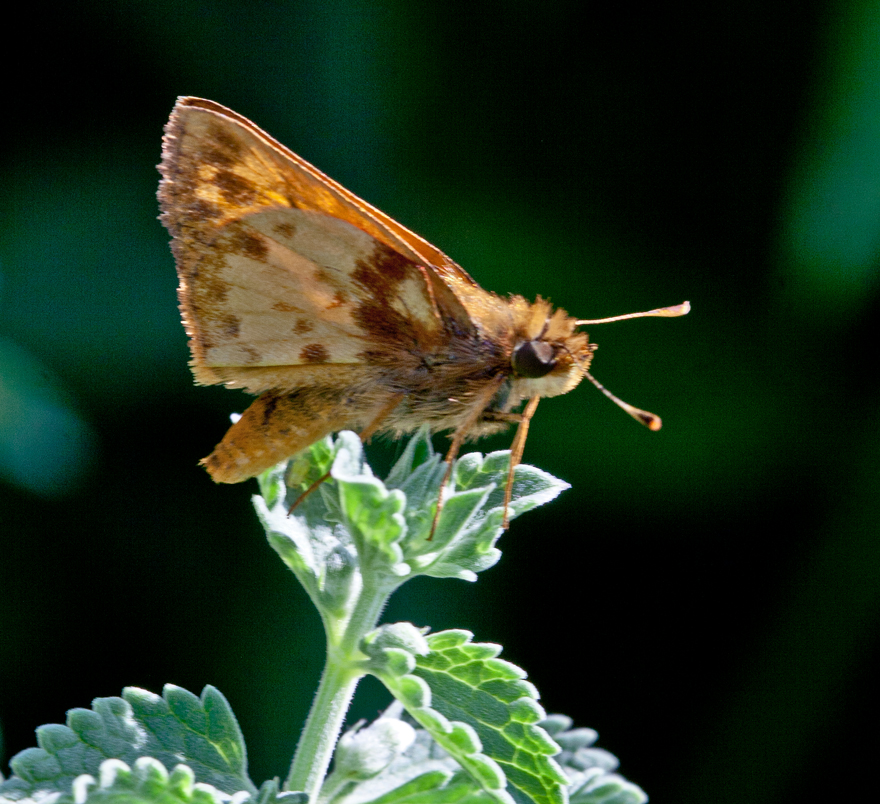
I have trouble identifying a lot of my photographic subjects, but skipper butterflies are among the toughest. Wikipedia says that are more than 3500 recognized species of skippers worldwide, so I don’t feel too bad about my difficulties.

As I perused photos on the internet, I came across a few shot of butterflies that looked at lot like the one that I photographed, and on that basis I am going to tentatively identify it as a Fiery Skipper (Hylephila phyleus).

I like the way in which the skipper was lit and he stayed perched long enough to permit to use my macro lens.

skipper_blog

Michael Q. Powell. All rights reserved

Read Full Post »

Who hasn’t wished for an extra set of hands to get more done in this multi-tasking world?

When I first looked at this photo that I took of a male Common Whitetail dragonfly (Plathemis lydia), it looked like he had grown two extra sets of wings. Had a genie granted one of his wishes? Could he now fly faster than his friends (he is a male, after all)? Will this impress the ladies?

A close look at the image, however, reveals that the extra wings are merely illusions, shadowy reflections of a more ordinary reality.

That doesn’t mean, though, that he has ceased to dream and to wish from time to time for those extra wings.

wings_blog

Michael Q. Powell. All rights reserved

Read Full Post »

How can you photographing a dragonfly while it is flying? As we have moved into dragonfly season, I have been thinking a lot about that question and earlier this week, I had some success in getting images of a female Blue Dasher dragonfly that I believe was ovipositing.

female_dasher2_blog

Last year, I was content to photograph perched dragonflies (and still love to do so) and occasionally would capture one as it was leaving a perch. This year I am challenging myself and am actively seeking out opportunities to follow dragonflies with my lens and, if possible, to catch them in motion. They are so agile in flight, that the challenge is somewhat daunting. I have experimented with auto focusing and manual focusing. I have tried pre-focusing on an area and waiting and hoping a dragonfly would fly into it. I have had my best luck so far when I can catch the dragonfly as it is hovering.

This female Blue Dasher dragonfly (Pachydiplax longipennis) approached this little clump of vegetation several times and would begin to hover. Then she would bend her tail forward and move it rapidly back-and-forth for a few seconds, which I think meant that she was laying eggs.

female_dasher1_blog

I am definitely not an expert on dragonfly behavior and may be totally wrong about what she was doing. However, from a purely photographic point of view, this offered my best chance of getting some shots of this dragonfly in flight. As I recall, I got my best shots when focusing manually and snapping as many shots as I could when it looked like things were coming into focus.

female_dasher3_blog

The Blue Dasher female (and you’ve probably noticed that the females of this species are not blue, despite their name) flew away and returned several times, but eventually was done with her business. I am continuing to observe the different species of dragonflies and hope to identify the types of behavior they exhibit that will maximize the chance of me getting some more shots like these ones.

Michael Q. Powell. All rights reserved

Read Full Post »

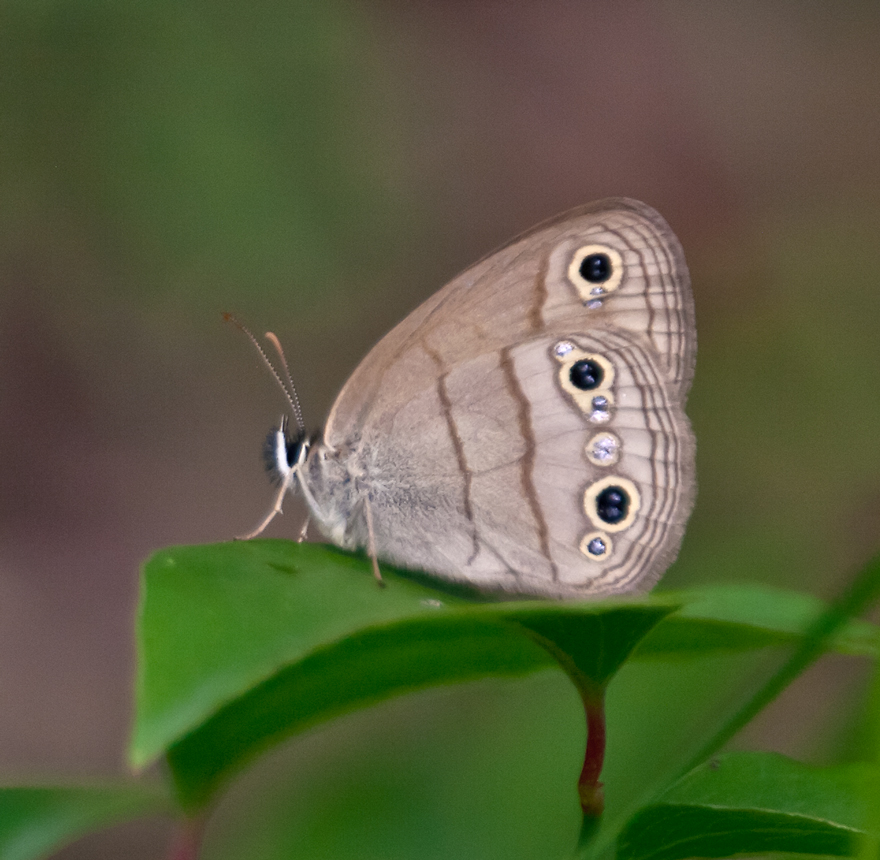
I have been seeing little brown butterflies (or moths) flitting about in the woods recently, but have not gotten a good look at any of them, so I was thrilled when a Little Wood Satyr butterfly (Megisto cymela) landed on a nearby leaf this past Monday and remained long enough for me to get some shots.

I am not a hundred percent certain of my identification, because there are a lot of similar butterflies and the distinctions seem pretty subtle to me at the moment. Please let me know if you can identify this little butterfly with greater precision.

This is another photo in which I took the time to use my tripod and to focus carefully, shooting at a focal length just short of 400mm. The focus is a little soft, particularly for the leaf, but I think that it helps to give the image a kind of dreamy feel, though it’s a little early for a midsummer night’s dream.

brown1_blog

Michael Q. Powell. All rights reserved

Read Full Post »

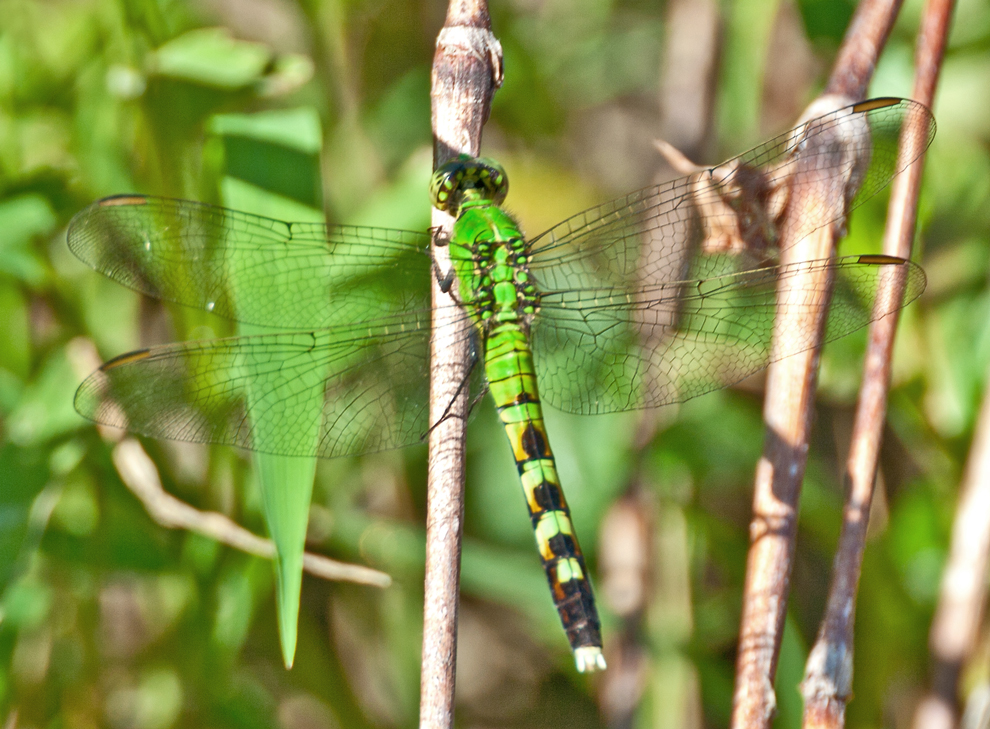
Normally, I try to have an uncluttered background for my dragonfly shots, but the brilliant green body of this female Eastern Pondhawk (Erythemis simplicicollis) really helps it to stand out (and this was the first pondhawk that I saw this spring).

Most of the dragonflies that I observe at my local marsh are either Blue Dashers or Common Whitetails, so I was really excited when a flash of emerald green caught my eye—the color is distinctive enough that I knew immediately what it was. Without paying too much attention to my surroundings, I moved forward to try to get a better angle on the dragonfly.  The next thing I knew, I was ankle-deep in marsh mud, but did manage to get some shots.

I haven’t yet seen any male Eastern Pondhawks, which are mostly blue, but I am keeping my eyes open and hope that it is only a matter of time until I photograph one this spring.

pondhawk1_blog

pondhawk2_blog

Michael Q. Powell. All rights reserved

Read Full Post »

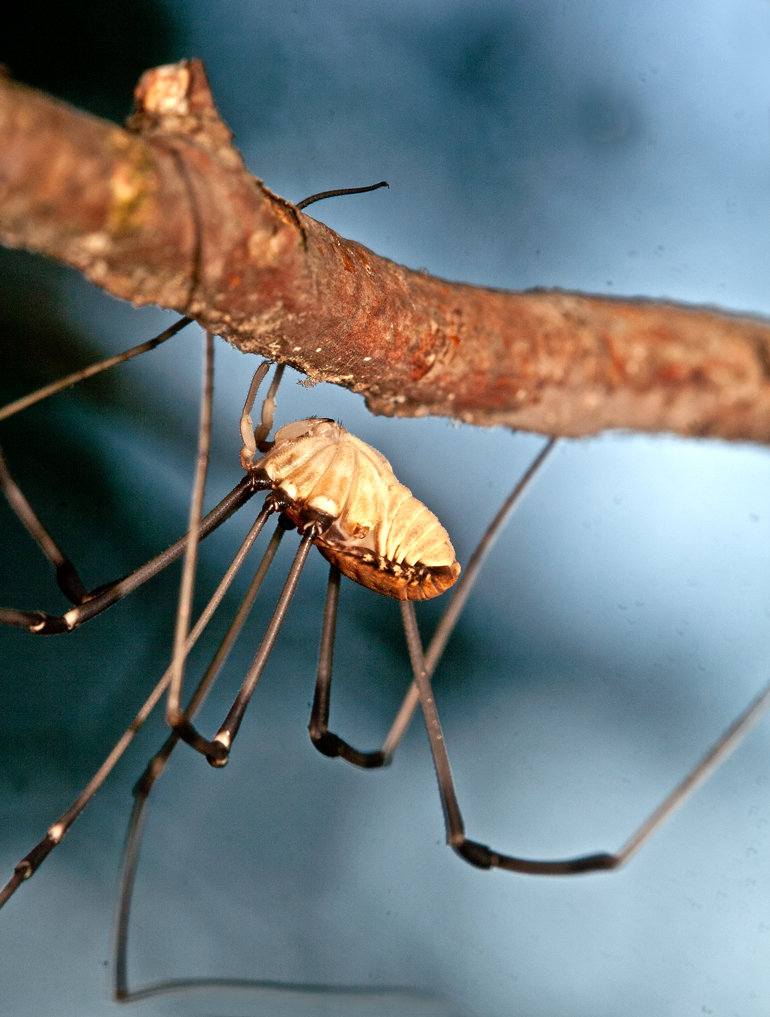
Can a photo of a daddy longlegs (also known as a harvestman) be artistic?

Ordinarily, I would emphatically respond in the negative, but somehow this macro shot that I took of a daddy longlegs, suspended upside down from a branch, came out with a cool, creative vibe to it. I like the way the legs are placed, the way the light is hitting its body, and the way the branch is in focus only in the center area.

I ran across this daddy longlegs as I was walking through the woods and I took the time to set up my tripod and use my 100mm macro lens to get this shot. The daddy longlegs was amazingly tolerant of my efforts and remained in place the whole time, even when I experimented with the use of my pop-up flash.

daddy1a_blog

Michael Q. Powell. All rights reserved
Read Full Post »

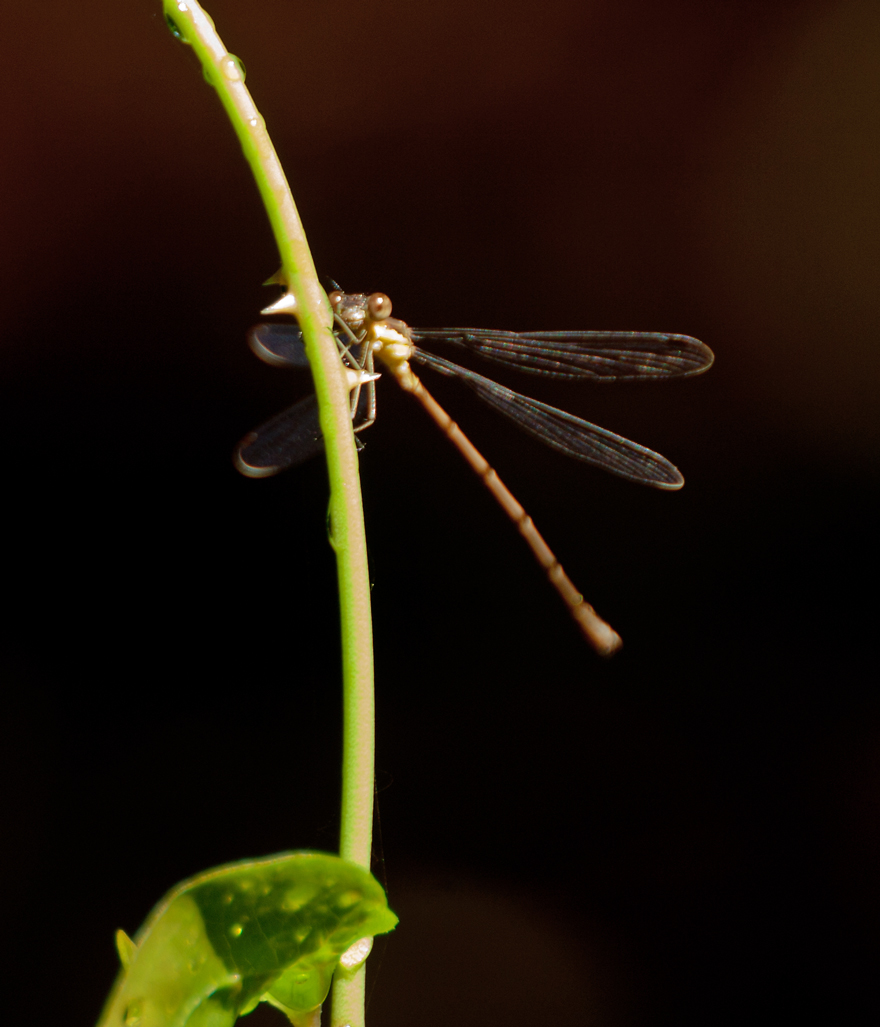
Walking through the woods today at my local marshland park, I managed to photograph my first damselfly of the spring, what appears to be some type of spreadwing damselfly, possibly a Slender Spreadwing (Lestes rectangularis).

My camera was already on my tripod, with my 135-400mm zoom lens attached, when the damselfly flew by and perched on a thorny vine right in front of me. I decided to try to get a shot and the first thing that I had to do was to back up, because the minimum focusing distance of the lens at full extension is 7.2 feet (2.2 meters). Secondly I had to switch to manual focus—the damselfly is so slender that my camera refused to autofocus on it. Finally, I had to adjust the aperture manually, when I realized that there was a lot of direct light falling on the vine and on the damselfly.

The two shots that I am posting may look like they were taken using flash, with an almost black background, but the damselfly was in a little pocket of light and the rest of the area was pretty heavily shaded.

damselfly_blog

damselfly2_blog

Michael Q. Powell. All rights reserved

Read Full Post »

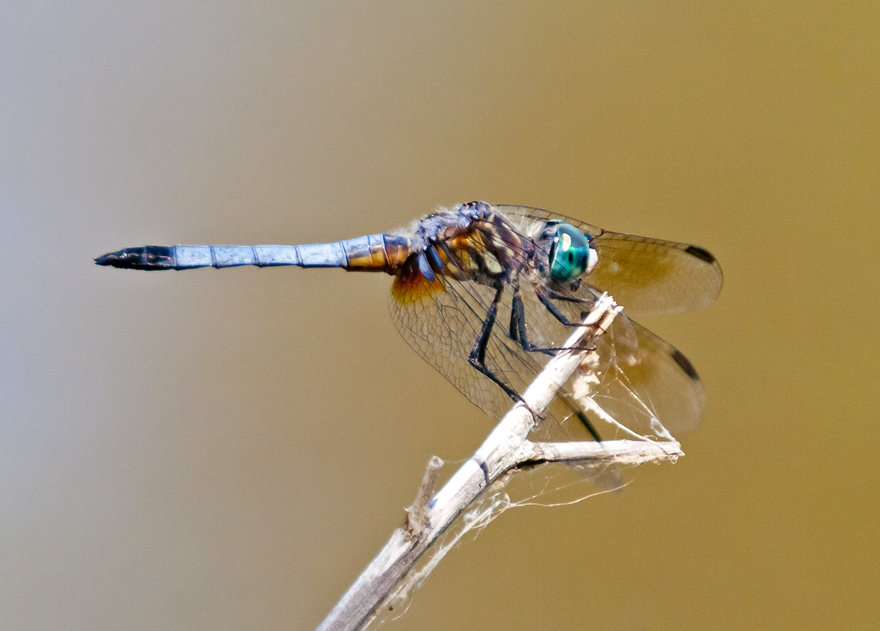
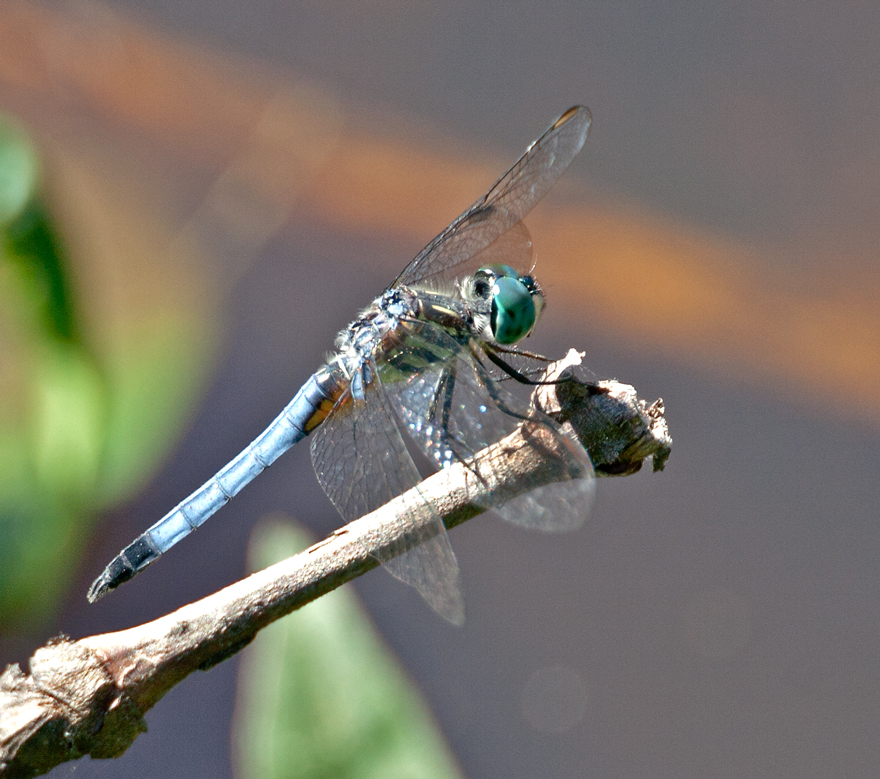
Last summer, my favorite photographic subject was the Blue Dasher dragonfly (Pachydiplax longipennis) and I was really excited on Friday to see that they are once again present at my local marshland park.

It continues to be a challenge to get close enough to capture the wonderful details of the dragonfly and to manage the background so that it is not too cluttered. I am happy to have gotten a few good images of male Blue Dashers to start the season, with the promise of more shots to come.

dasher1_blogdasher2_blog

Michael Q. Powell. All rights reserved

Read Full Post »

With thousands of gorgeous flowers blooming at Brookside Gardens in Wheaton, Maryland today, this beautiful butterfly, which I think is a Variegated Fritillary (Euptoieta claudia), chose to land on a lowly dandelion growing at the edge of a walkway. Why did it make that choice?

I had been chasing this butterfly around though several sections of the garden, hoping desperately that it would land somewhere within range of my 100mm macro lens. When it did finally land, I approached it cautiously and got a few shots handheld that came out pretty well. I am also including a shot that gives you an idea of the setting—there was a landscape timber to the left and a series of stone tiles that made up the walkway, and the dandelion was growing low to the ground at the edge of the walkway. The lighting was less than optimal, but sometimes you have to work with what you have, especially when the subject is likely to fly away at any moment.

I deliberated for quite some time over the identification of the butterfly. At first, I was sure that it was a Pearl Crescent (Phyciodes tharos), which is orange and has brown spots. As I looked at more photos, though, I changed my mind and now think that it may be a Variegated Fritillary.

As always, I welcome assistance on the identification of my subjects.

pearl2_blogpearl1_blogpearl3_blogMichael Q. Powell. All rights reserved

Read Full Post »

Temperatures were forecast to soar yesterday, so I arrived early at the marsh—about 6 o’clock— and was treated to many stunning examples of spider art. The early morning light and the dew made it possible to get these shots.

I had thought that it was a bit early in the season for spiders to be active, but I was thrilled to be proven wrong. I never fail to be impressed by the handiwork of the different kinds of spiders and how they are able to adapt their webs to the environment.

I shot some webs with my macro lens and others with a telephoto zoom. In virtually all cases, I focused manually and used my tripod.

Only a few of the webs had visible spiders and I chose to highlight one of those in the first image, which is a close-up of the web shown in the final shot. The webs themselves are not perfect and have gaps and breaks in some places, an appropriate metaphor for the lives that most of us live.

web3_blogweb1_blogweb4_blogweb2_blog

Michael Q. Powell. All rights reserved
Read Full Post »

« Newer Posts - Older Posts »