Feeds:
Posts
Comments

Archive for the ‘Landscape’ Category

I haven’t been out shooting in nature for almost a week, so I ventured out into my marshland park early this morning. I have not yet had a chance to go through all of my shots, but I knew I really liked this one as soon as I took it and did a quick review on the LCD of my camera.

I found myself in a good position when several Canada Geese (Branta canadensis) were coming in for a water landing and was able to track them and get a good focus. The buffer of my camera fills up pretty fast, so I didn’t want to start shooting too early. Just before they hit the water, I snapped off a few exposures and managed to get this shot in which one of the geese has landed and created a splash.  A goose in the foreground is landing in the midst of the splashing water. My shutter speed (1/320 sec) was fast enough to freeze most of the motion, with the exception of a slightly blurred wing. I like the blurry wing and thing it helps give the sense of motion, as do the droplets of water.

I have been trying to shoot a scene like this for quite some time and think that this is my best result to date. (I recommend clicking on the image to get a higher resolution view.)

Splashdown

Splashdown

© Michael Q. Powell. All rights reserved

Read Full Post »

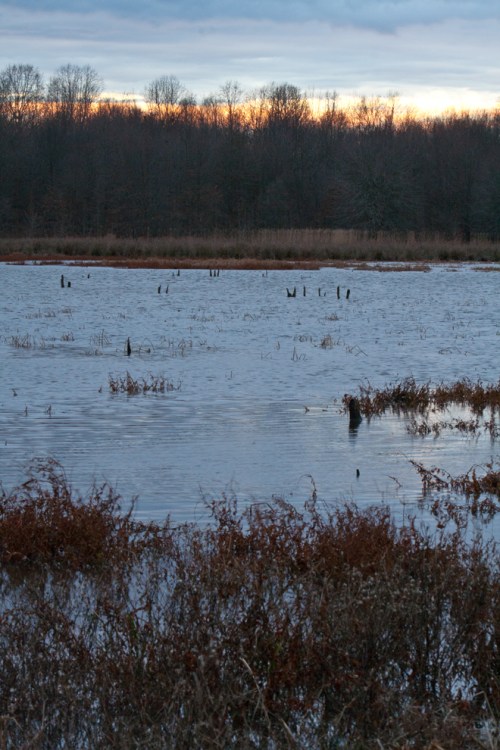
One of my fellow bloggers, Lyle Krahn, asked me to take some landscape shots to give readers a better idea of the scenery at the marsh at Huntley Meadows Park, where I have been shooting a lot of my nature photographs.

I don’t have a lot of experience taking landscape-style photos, but I did try to step back this morning and shoot some photos of one of the water areas in the park, where I often see geese and ducks taking off and landing. I took this photo just after the sun had risen today, the day of the winter solstice. In the background of the photo you can see part of a field of cattails, through which a boardwalk runs. There is also a large wooded area of the park and an area with a beaver lodge and pond. It’s pretty amazing to have such a treasure in the midst of a suburban area.

dawn_blog

© Michael Q. Powell. All rights reserved
Read Full Post »

In the marshland park where I spend a lot of time shooting photographs, there is a small, shallow pond accessible only by an unimproved trail through the woods. It’s really peaceful there. At times there are ducks there or an occasional heron or deer, but usually it’s just me and the trees and the wind and the water. How do you capture that sense of tranquility in a photo? Here’s a modest attempt to do so.

Reflections

© Michael Q. Powell. All rights reserved.

Read Full Post »

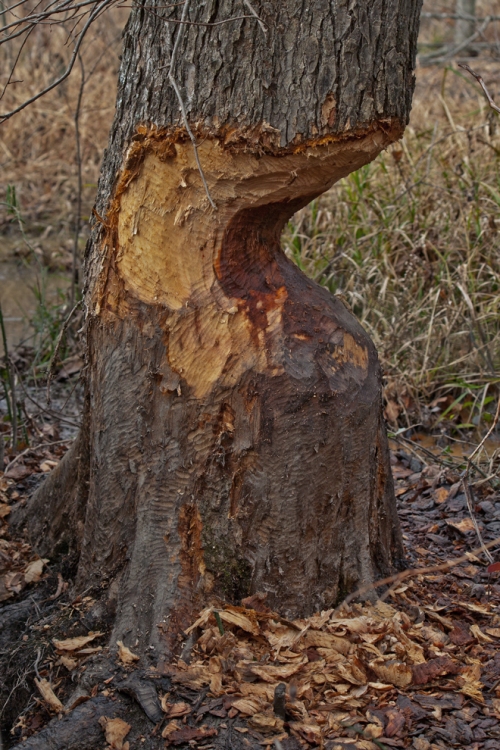
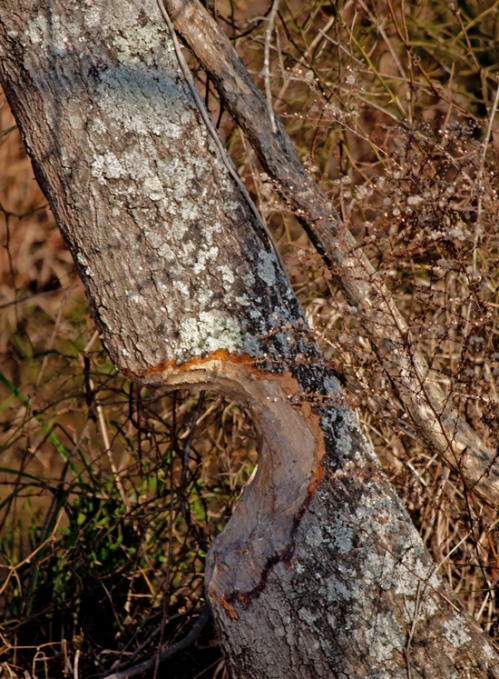
The beavers in my local marsh have been really busy recently as winter draws near (“busy as beavers,” you might say). Each time I visit the marsh I can see evidence of their handiwork. Hmm, “handiwork” is probably not the right word, since most of the evidence I see is work they have accomplished with their teeth. Maybe I should call it “dentalwork,” but that terms conjures up images of beavers with braces on their teeth. I’ll just call it “work.”

Over the past few weeks I have been noting their progress on chewing through a pretty large tree. First they chewed one side and then it looks like they gradually moved around the circumference of the tree. Circumference? Who says that high school geometry doesn’t have everyday applications? They now have gnawed (try saying that phrase quickly multiple times) into the center of the tree and I expect to see to see a fallen tree soon. I won’t be disappointed, and certainly not crestfallen.

On a slightly more serious note, I am genuinely amazed that the beavers don’t just take down small saplings. I confess that, as a result of living most of my life in the suburbs, I don’t know much about wildlife. It’s fascinating to me to look at all of the individual tooth marks in the wood that bear witness to the persistence of this industrious creature. I also see its work in the mud walls that have been built up along the edges of parts of this little pond and the ever-increasing amounts of mud that have been packed on the lodge.

The beaver is ready for a cold winter. Am I?

Let the chips fall where they may

Let the chips fall where they may

How do they gnaw this high?

How do they gnaw this high?

© Michael Q. Powell. All rights reserved.

Read Full Post »

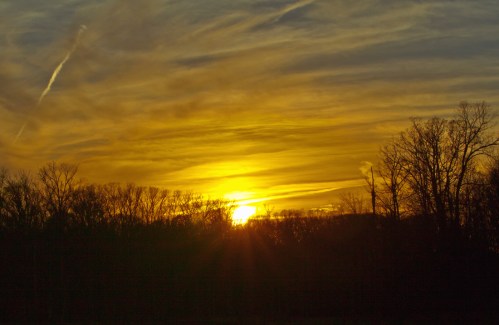
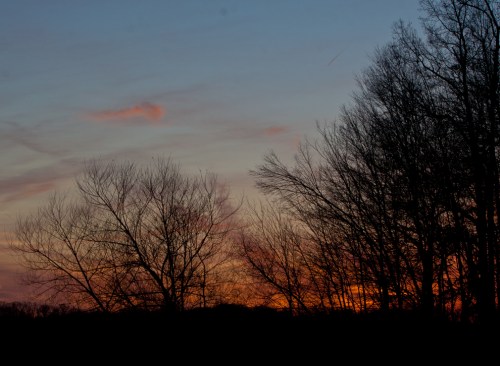
I spent much of today at home waiting for a FedEx package that required a signature, so it was late afternoon when I finally managed to get out with my camera. The sun was already pretty low on the horizon when I arrived at my favorite marshland and I didn’t find many subjects to shoot. However, almost as compensation, I was treated to a spectacular sunset. The sky was blue and there were a good number of clouds in the west to reflect the colors of the setting sun. I tried to catch the sun as it was setting as I looked across the marsh; as I looked out to the distant treeline after the sun had already gone down; and as I looked through some nearby trees at the beautiful reds that appeared. It was a gorgeous way to start the weekend.

Looking into the marsh

Looking into the marsh

Looking toward the treeline

Looking toward the treeline

Looking through the trees

Looking through the trees

© Michael Q. Powell. All rights reserved.

Read Full Post »

I knew that yesterday was the day of the full moon, so I was disappointed to see that it was already pretty high in the sky when I was driving home from work. I was surprised and pleased this morning as I was taking out the trash to see that the moon was out and was really bright. I rushed into the house, grabbed my camera and tripod and took some initial shots. I must confess that these are the first outdoor shots that I have taken in my slippers. My exposures were not right when I looked at the images on the computer, so I made some adjustments and rushed back outdoors. I blindly set the camera on manual and made some guesses on appropriate settings. I went through that cycle twice more before I got an image that I judged was ok. It’s not perfect (I need to experiment some more on settings), but it looks reasonably close to what my eyes were seeing a few short minutes ago.

Full moon in November

© Michael Q. Powell. All rights reserved.

Read Full Post »

The late afternoon sun was still illuminating the top of trees today in my neighborhood as the moon began to rise. According to The Old Farmer’s Almanac, the full moon will be on Wednesday the 28th of November.  November’s full Moon (also called the Full Frost Moon) traditionally was called the Beaver Moon because it was the time to set beaver traps, before the waters of the swamps froze over.

November moonrise

© Michael Q. Powell. All rights reserved.

Read Full Post »

When migrating geese land at my local marsh, most of them spend their time foraging for food, storing up energy for the next leg of their trip. This Canada Goose, however, seemed to have decided to rest a bit to regain his strength and secluded himself from the feverish activity of the other geese. His position is not that unusual, but his surroundings make this photo stand out for me. The colors contrast nicely with the black of his head and I really like the reflections. Click on the photo if you would like to see it in higher resolution.

Canada Goose at rest

© Michael Q. Powell. All rights reserved.

Read Full Post »

Usually when I see a deer, it turns and runs away, sometimes stopping to gaze back at be from a distance just beyond the range of the lens that I have on my camera at that moment. Recently, however, I encountered a deer that seemed content to look at me as I looked at him. It sounds like a nature photographer’s dream come true.

The biggest challenge was that he was in the middle of a mostly dried-up marshy field full of cattails and other tall growth that made it impossible to get a clear view of the young buck, a white-tailed deer, I believe. It became pretty clear to me that auto-focus was not a viable option—the camera seemed to really want to focus on some arbitrary branch rather than on the deer—so I relied on manual focusing. It was also in the middle of the day, so shadows were pretty harsh. During the protracted period of time that the deer stayed in the same little area, I shot a lot of photos and these are two of my favorites. You’ll note that the deer blends in pretty well with the background. If he had remained absolutely still, I may very well have walked on by without seeing him.

Deer in the cattails

White-tailed buck in a field of cattails

© Michael Q. Powell. All rights reserved.

Read Full Post »

Late this afternoon, I was at a nearby suburban pond and noticed a Great Blue Heron (Ardea herodias) on the opposite bank. He was in a shaded area, where the water was calm and the reflections were beautiful. I was a bit too far away for a close-up shot, but couldn’t get any closer because of the bushes and underbrush that kept me from the water’s edge. Nevertheless, I was able to get some images that I like, including this one. I decided not to crop too closely to the heron in order to retain some of the bushes and their reflections that add a lot to the photo.

Heron in the shade (click for higher resolution)

© Michael Q. Powell. All rights reserved.

Read Full Post »

The light was sinking lower in the sky late this afternoon when I took this photo of two Canada geese (Branta canadensis) in the still waters of a little pond. The light was beautiful, as are the reflection of various parts of the scene in the water. If you click on the photo, you can see a higher resolution view of the scene. To use the term of a fellow blogger, Steve Schwartzman, I consider this photo to be a “semi-landscape.”

Geese in late afternoon light

© Michael Q. Powell. All rights reserved.

Read Full Post »

This duck tale has a happy ending, as two Hooded Merganser duck couples paddle gently down the stream, but a potential crisis had been averted only moments before.

It began like this. Five Mallard ducks (Anas platyrhynchos), three males and two females, were swimming upstream. Two of the males were in the lead, while the other male seemed to be carrying on a conversation with one of the females. Their course had them in the partial shade, not far from one of the banks.

At the same time, four Hooded Merganser ducks (Lophodytes cucullatus), two males and two females, were headed downstream in perfect formation on a collision course with the Mallard ducks.

What would happen when the groups met? Would there be a confrontation? Would they exchange information about the attractions of the places they had just passed through? Who has the right-of-way in situations like this?

The signals were a bit ambiguous at the first encounter, as one of the male Mallards tried to have a conversation with one of the male Hooded Mergansers, who had turned away. All eyes were turned on the two representatives. Would they be able to negotiate an agreement? If a fight broke out, it was clear that the Mallards had an advantage in both size and numbers.

Who know what was said, but it appears that an agreement was reached and a possible confrontation was avoided. The ducks peacefully passed each other and continued on their separate ways.

The first photo showed the Hooded Merganser ducks after the encounter with the Mallards, so sequentially it should go here. Did you notice that the duck formation had changed and that the males were now in the lead? Was this a protective, chivalrous gesture on their part?

Of course, I may have completely misread this situation. Perhaps the male duck ego is less fragile than the human one and the two male ducks were simply asking each other for directions when they met in the middle of the stream.

© Michael Q. Powell. All rights reserved.

Read Full Post »

I arrived early in the marsh on a cold fall morning when the dew and a touch of frost seemed to have combined to coat objects with a kind of frozen mist. I was hoping to find some large, beautiful spiders shining in the early morning light, as I had found repeatedly during the summer and early fall mornings. My initial scan found no spider webs at all, but suddenly I spotted one in the cattails. It was not large, but its rarity made it extra special. The structure is not very complex or symmetrical and the silk threads seem to be heavy-duty, rather than delicate. I wondered what kind of spider made such a web, but did not spot the maker of the web. Perhaps she’ll continue her handiwork for a little while longer—I’ll be checking each time I return to the marsh.

Last web standing in the fall

© Michael Q. Powell. All rights reserved.

Read Full Post »

It was a beautiful weekend and I did a lot of walking. I came across an assortment of ducks, including some Hooded Merganser ducks (Lophodytes cucullatus). Most of my photos of them were from a good distance away, so I may need to work on them before I post them. This image was in such a beautiful setting that I thought I’d post it first. (It looks better if you click on it and see it in greater resolution.) I took this photo from a little bridge looking down on the ducks, which is why the heads do not have the distinctive look associated with Hooded Merganser ducks. I’m making the call on the identification on basis of the color and markings, but would welcome a correction if I am mistaken.

Hooded Merganser ducks in a stream

© Michael Q. Powell. All rights reserved.

Read Full Post »

After a frosty start, today was the warmest it’s been in a while, partly sunny with highs above 60 degrees F (about 16 degrees C). As the sun was starting to set, I decided to be a little creative and see if I could highlight a single leaf with the colorful sky in the background. I found a suitable tree without too much problem, but finding a leaf at the right height with an unobstructed background was a little tricky. I happened to have my 100mm macro lens on the camera and decided to go with that. I knew that I would need to use a little flash on the leaf to keep it from getting lost in the shadows. I used settings of ISO 100, F32, and 8/10 sec to get the effect and tweaked the image slightly in Photoshop Elements, though I chose not to crop at all. Here’s a couple of shots of my experiment. (In case you are curious, the leaf is still attached to the tree, even though it looks like I am merely holding it in from of the lens.)

© Michael Q. Powell. All rights reserved.

Read Full Post »

Sometimes my eye is drawn to the shapes and colors and textures of objects more than to the objects themselves. The result can be a somewhat abstract looking photo, which is very different from what I usually shot. Here are couple of photos of that ilk from a trip last week to a local garden.

The first was taken looking through a ground-level weathered weathervane and the framing of the shot is just as it came out of the camera. I like the contrast between the light and the shadows and between the rust and the blurry natural colors in the background.

The second is a shot of a feathery looking yellow plant in which I narrowed the depth of field to isolated a few of the yellow needles and the reddish branch. I like the variations of color in the photo and the blurry repetitions of the foreground shapes and colors that can be found in the background.

Weathered weathervane

Abstract yellow

© Michael Q. Powell. All rights reserved.

Read Full Post »

It seemed like this beautiful male Northern Cardinal (Cardinalis cardinalis) was posing for me on the dead log, somehow knowing that this position would provide for an equally beautiful reflection.

© Michael Q. Powell. All rights reserved.

Read Full Post »

On a cold and overcast morning, I walked through the marsh today, heading toward a little pond area where I was hoping to see migrating ducks and geese. As I arrived at that area, I realized there was a deer in the distance near the far side of the water’s edge. I didn’t have time to make many adjustments and got off only two shots. This is the better of the two, and I like the pose of the deer, as she back at me before taking off. To give you an idea of the limited light, this was shot at ISO400, f5.6, and 1/30 second. I was at the far end of my 55-250mm zoom lens (and still had to crop quite a bit).

Early morning deer

© Michael Q. Powell. All rights reserved.

Read Full Post »

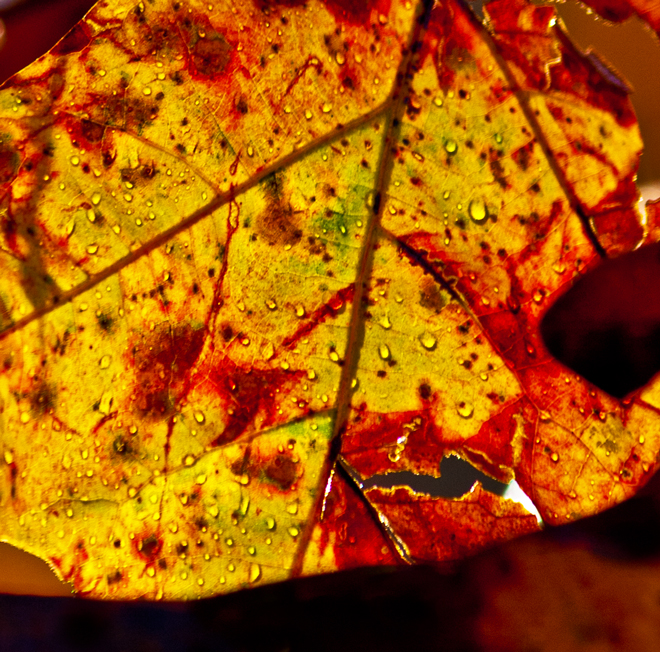
The leaf is back-lit and drops of dew glisten on its surface, a surface that is scarred and torn and unevenly colored with the tints of the fall. In its beautiful imperfection, this autumn leaf speaks to me in the simple, abstract language of lines and shapes, of light and color.

Abstract fall leaf

© Michael Q. Powell. All rights reserved.

Read Full Post »

Here’s one last photo of the geese from last weekend, possibly my favorite shot. I like the fact that it shows geese in action—the geese look like they are having a race across the water, though I think they had just landed and were slowing down. The colorful fall foliage and its reflection in the water add interest too. Somehow the picture works well for me as an autumn landscape. (Be sure to click on it to see a higher resolution view.)

Geese racing in the fall

© Michael Q. Powell. All rights reserved.

Read Full Post »

It was still raining early this morning when I ventured out into my suburban Virginia neighborhood to see what havoc Hurricane Sandy had wreaked upon us. One big tree had fallen onto several cars, but beyond that we had escaped virtually unscathed.

Run-off water was coursing rapidly down the little stream that runs through the neighborhood as part of the drainage system. I decided to attempt to take some shots of the moving water, inspired by some awesome images that I have seen recently in other blogs. There was a railing overlooking the stream and I placed my camera on it and used the self-timer, which permitted me to take some relatively long exposures.

Here are a few of the images that I produced. I still have a lot to learn about taking these kinds of shots, but I like some aspects of these initial efforts.

Suburban Virginia stream after Hurricane Sandy

Post-hurricane run-off in suburban Virginia

Runnymeade stream


© Michael Q. Powell. All rights reserved.

Read Full Post »

Life’s pleasures can be so simple, like watching a floating leaf on a sunny day as it is propelled across the water’s surface by a gentle breeze.

© Michael Q. Powell. All rights reserved.

Read Full Post »

The water level in the area of the marsh where I photographed herons and egrets earlier this summer is so low that it is now just a big puddle. Therefore, I was surprised early one morning this past weekend to see a Great Blue Heron (Ardea herodias) wading in the water. The light was not very bright, but the surface of the water had a really beautiful reflection of the orange of the fall foliage. The heron was a pretty good distance away and I was on a boardwalk, so my options were limited for framing my shots. Here are a couple of my favorite shots of the heron, surrounded by the reflection of the fall colors.

Great Blue Heron in the fall at Huntley Meadows Park

Fall reflection of a Great Blue Heron

© Michael Q. Powell. All rights reserved.

Read Full Post »

In the autumn, rural areas in New England are often invaded by hordes of city dwellers anxious to see the spectacular fall foliage. Locals frequently refer (often derisively) to these outsiders as “leaf peepers.” Still, it’s hard to ignore the beauty of the changing leaves, and the Northern Cardinal in this photo appears to have paused for a moment to admire the scenery. Apparently birds can be leaf peepers too.

Northern Cardinal checks out the fall foliage

© Michael Q. Powell. All rights reserved.

Read Full Post »

It was just after 5:00 in the afternoon and storm clouds were gathering for rain showers that eventually came. I headed back to my car and just as I reached the parking lot I looked up. Beautiful late-afternoon light was shining on the tops of the trees with dark clouds in the background and I snapped a few shots. I decided to fight my temptation to tweak the image (for fear of messing up what I had) and didn’t crop at all.I did just a little sharpening and a slight increase in saturation. I don’t know if the image adequately (and accurately) captured the wonderful light, but it gives you an idea of what the scene looked like to me.

Stormy light

© Michael Q. Powell. All rights reserved.

Read Full Post »

Early morning sunlight illuminates the cattails (and the webs in between them) in the marsh at Huntley Meadows Park in Alexandria, VA. Low hanging mist/fog that morning added a special beauty and mystery to the quietness of that fall morning.

(click on photo to see a higher resolution view)

© Michael Q. Powell. All rights reserved.

Read Full Post »

I arrived early at the marsh on a cool fall morning. The dew was heavy on the vegetation and the warmth of the rising sun was creating a fog-like list that hung over the field of cattails. Looking toward the west, I could see trees in the distance that were starting to show their glorious fall foliage and there was a soft illumination from the sun (as shown in the first photo). Looking in another direction, I could see darker shadows of the tress and a heavier mist (as shown in the second photo). You can see some golden light in the upper branches of the tree.

I am not sure that I was able to capture completely the inner peace I felt as I watched interplay of the light and the water on the cattails in the foreground and on the trees in the background. For a few moments, nothing else seemed to matter as I was caught up in the beauty of nature.

Morning mist and fall foliage

Morning mist and shadows

© Michael Q. Powell. All rights reserved.

Read Full Post »

Reflections often look much better than the original objects that are being reflected. The water (and the objects in the water, like the rocks in this photo) can distort the “reality” and add a different tonality and texture to the reflection. As I was walking along the edge of the water, I was happy to finally find a patch of foliage with the fall colors of my childhood, but the beauty was marred by the utility poles and traffic signs of my suburban area. The reflection seems to have cleansed the image of those blemishes and shows a purer, more beautiful view, a view closer to what my heart was seeing.

Fall reflection

© Michael Q. Powell. All rights reserved.

Read Full Post »

It was early in the morning and I was walking almost directly east along a stream. The sun had already risen and was in my eyes, but I spotted a Great Blue Heron in the water. I was able to get a shot that I knew would turn out as a silhouette, but the heron was standing in such a way that I was pretty confident that his silhouette would be immediately recognizable. The glare caused the color to wash out almost entirely and there are all kinds of artifacts from the light, but I like the overall effect.

Great Blue Heron Silhouette

© Michael Q. Powell. All rights reserved.

Read Full Post »

Over the past month I have complained repeatedly about the lack of bright color in the fall foliage here in the Washington, D.C. area. The muted color changes just do not match up to my childhood memories of spectacular displays of red, orange, and yellow leaves in the trees of New England. As a result, I have not felt inspired to take up my camera and capture the changing season.

My attitude changed, though, when I read an article by Sparky Stensaas in The Photonaturalist entitled 10 Reasons NOT to Take Fall Leaf Photos. I encourage you to read the article (by following the link above) if you keep coming up with excuses, as I did, why you cannot photograph the leaves of the fall. The author summarized the article in this concluding paragraph:

“There you have it…A bunch of reasons NOT to shoot this fall’s gorgeous leaves…And a bunch of solutions to these common excuses. Now let’s get out there and shoot like crazy before all the leaves are gone!”

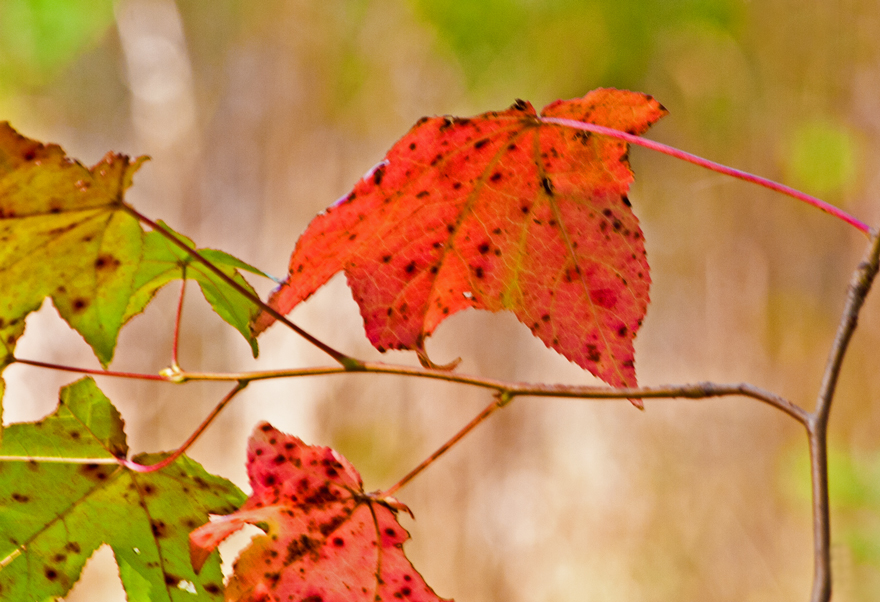
Feeling a bit more motivated, I set out yesterday determined to take some shots, among other things, of the autumn leaves. I tried a number of different approaches and am still sorting through my photos, but thought I’d post this one that caught my attention.

Fall leaves before they fall

I was walking through a path in the woods when I came into a small area where the sunlight was shining directly in my eyes, providing some backlighting for these leaves that were almost at eye-level. The leaves themselves are far from being perfect specimens, speckled as they are with brown spots. For the moment, the leaves remain attached to the tree, but inevitably they will drop to the ground to join the ranks of the fallen.  The colors, shapes, and textures of these leaves, however, serve as visual reminders for me of the beauty of the changing seasons, a beauty that may proclaim itself in bold swaths of spectacular color or speak with a quieter, more intimate voice.

© Michael Q. Powell. All rights reserved.

Read Full Post »

As the sun dropped lower and lower in the sky yesterday, I was struck by the way in which the light caused the cattails to glow. Many of the cattails had already burst into masses of cottony fibers and the backlighting showed them in wonderful detail and texture.

I tried to capture this beauty, but it was difficult shooting directly into the sun and I ended up with all kinds of light artifacts. Because I was mostly interested in the effects of the light, I decided to experiment this morning and converted one of the photos into black and white and played around with it (probably too much).

I think I need to read up some more on how to convert images to black and white and how to tweak them, but for now I’ll continue to enjoy the process of experimentation. I might stumble onto something really good.

Backlit cattails in the marsh

© Michael Q. Powell. All rights reserved.

Read Full Post »

« Newer Posts - Older Posts »