Feeds:
Posts
Comments

Archive for the ‘Insects’ Category

Many people in the United States were excited to view yesterday’s solar eclipse. I too paused for a few moments in the afternoon to view the eclipse through solar glasses that I had obtained last week during a visit to the Air and Space Museum in the Washington D.C. area.

However, I must confess that I was more excited earlier in the day when I had multiple encounters with Uhler’s Sundragons (Helocordulia uhleri), the first dragonflies that I have been able to photograph in 2024. (Some of you may recall that I searched for dragonflies last week and think that I saw one flying over a stream. However, I did not get a photo of the dragonfly, so for me that first sighting does not really “count.)

I spent several hours yesterday looking carefully at the vegetation along a creek in Prince William County, Virginia where I had spotted Uhler’s Sundragons in previous years. This species appears in limited locations in the early spring and is usually gone by early May. Unlike many of the dragonflies that I will see during the summer that are habitat generalists, Uhler’s Sundragons require a specific kind of habitat, usually a mountain stream. According to the Dragonflies of Northern Virginia website, “Uhler’s need clean, small to medium, rocky forest streams with gravelly and/or sandy substrate, and a decent flow.”

I was fortunate to be able to photograph both female and male Uhler’s Sundragons. I have alternated genders in the photos below, with the females in the odd-numbered images and the males in the even ones. One of the ways to tell the genders apart is to look at the tips of the abdomens (the “tails”) and you can see that the terminal appendages are different. The lower portion of the abdomens of the males is also somewhat enlarged, as you can see in some of the photos.

Dragonflies perch in many different ways. Some species perch horizontally and some hang vertically. Uhler’s Sundragons most often perch at an angle, as shown in the first and last photos, though sometimes they may hang vertically from the vegetation.

The dragonfly season has now opened and I look forward to many more encounters with these amazingly beautiful aerial acrobatic insects that have a magical appeal for me.

Uhler's Sundragon

Uhler's Sundragon


Uhler's Sundragon

Uhler's Sundragon

Uhler's Sundragon

Uhler's Sundragon

© Michael Q. Powell. All rights reserved.

Read Full Post »

Early spring wildflowers, like the Virginia Spring Beauty (Claytonia virginica), are an important source of food for a host of small bees and other insects. Many insects gather pollen from these flowers and in doing so help to pollinate the plants. One species, the Spring Beauty Miner Bee (Andrena erigeniae), is so specialized that it reportedly feeds only on this ephemeral flower.

According to the Bug of the Week website that featured this species in an article, “Using jaws and legs the female bees excavates a gallery in the soil, leaving a small pile of dirt near the entrance hole. This gallery can be as long as 15 centimeters and contain numerous lateral brood chambers. During the daytime she forages for pollen on flowers of spring beauties, which apparently are the sole source of food for her brood. Pollen from these blossoms is formed into balls and placed into brood chambers…As brood chambers are built and provisioned with pollen, the bee deposits a single egg on a pollen cake. During spring and early summer developing larvae consume the pollen, and later in summer they will form pupa. By late autumn development of the adult is complete and winter is spent in the adult stage within the brood chambers. Newly minted adults emerge each spring coincident with the appearance of spring beauty’s’ blossoms.” Wow!

On Monday I was fortunate to capture a shot of a Spring Beauty Miner Bee in action gathering pollen. If you look closely at the image, you will see how the tiny bee has collected pollen on its back legs.

Last year I posted an image of a Cuckoo Bee on the same kind of flower. That bee does not collect pollen. Instead it enters the nests of a host and lay eggs there, stealing resources that the host has already collected. From what I understand the cuckoo bee waits for the miner bee to leave its burrow and then lays its egg there. The offspring of the cuckoo bee eats the pollen in the burrow and then eats the larva of the miner bee. Yikes!

Spring Beauty Miner Bee

© Michael Q. Powell. All rights reserved.


Read Full Post »

I went on a pretty long hike yesterday in Prince William Forest Park—just over 18,000 steps (7.1 miles or 11 km) according to my iPhone—and was delighted to spot this beautiful Eastern Tiger Swallowtail butterfly (Papilio glaucus), my first of the season.

When I first spotted the butterfly, it appeared to be sucking moisture and minerals from the wet soil, as you can see in the first photo. The butterfly flew to a nearby location and resumed its efforts and I was able to maneuver around to get the second image that shows the markings of the butterfly a bit better.

Personally I prefer the first photo that is more dynamic and gives a better sense of the activity of the butterfly. From a purely scientific perspective, the second one might be preferable because it shows more of the butterfly’s identification features. I am more of an artist than a scientist, though, so capturing all of the details with clinical precision is not as important to me.


Eastern Tiger Swallowtail

Eastern Tiger Swallowtail

© Michael Q. Powell. All rights reserved.

Read Full Post »

Our recent warm weather has brought out a whole lot of little creatures. As I was hiking about in Prince William Forest Park last week, I notice a spot of bright red moving about on a rock at the edge of a small creek. When I looked at it more closely, it had a shape that made it look like a tiny red spider.

I did some initial searches when I returned home to see if I could identify the spider. I could not find an exact match, but I think this might be a spider mite (or some kind of mite) rather than an actual spider. If I understand it right, mites and spiders belong to the same family of arachnids, though I might have this wrong.

spider mite

© Michael Q. Powell. All rights reserved.

Read Full Post »

Yesterday I went on a hike at Prince William Forest Park, the largest protected natural area in the Washington D.C. area at over 13,000 acres (53 square kilometers), that is located about 27 miles (43 km) from my home. Unlike the wildlife refuge that I usually visit, which is on a coastal plain, Prince William Forest Park, as its name suggests, is heavily wooded and it is quite hilly. I love to walk along the many creeks and streams that crisscross the park—the sound of the flowing water always has a therapeutic effect on me.

I was thrilled to spot this beautiful Question Mark butterfly (Polygonia interrogationis) as it perched on some leaves in a marshy area adjacent to one of the creeks. I could not tell for sure, but it looked like this butterfly was sipping water, possibly gathering nutrients from the soil. Question Mark butterflies and their punctuation “cousins,” the Eastern Commas, overwinter as adults, so they are among the earliest appearing butterflies in the spring.

Question Mark and Eastern Comma butterflies are quite similar in appearance. When the wings are fully open, as in the photo below, you can see a brown dash near the top of the upper wings that is not present on the wings of Eastern Comma butterflies.

Question Mark butterfly

© Michael Q. Powell. All rights reserved.

Read Full Post »

Yesterday I was thrilled to spot several Spring Azure butterflies (Celastrina ladon) at Occoquan Bay National Wildlife Refuge. This early-appearing butterfly is one of the tiniest butterflies in our area, with a wing span of about an inch (25 mm). Unlike Mourning Cloak butterflies—like the I featured last week in a blog posting—that overwinter as adults, Spring Azures overwinter in the pupal form, safe inside their chrysalis.

All of the Spring Azures that I saw yesterday were extremely skittish, spending most of their time in flight. Occasionally one would fly near the ground and come close to landing and then abruptly resume its flight. When they did land, the little butterflies almost disappeared into the abundant leaf litter and were tough to photograph.

Nature is coming alive as flowering trees begin to pop and new wildlife species reappear on the scene as we move deeper into March. It won’t be long before osprey, green herons, and great egrets return to our area and I hope to be seeing dragonflies within the next month. It is an exciting time of the year.

Spring Azure

© Michael Q. Powell. All rights reserved.


Read Full Post »

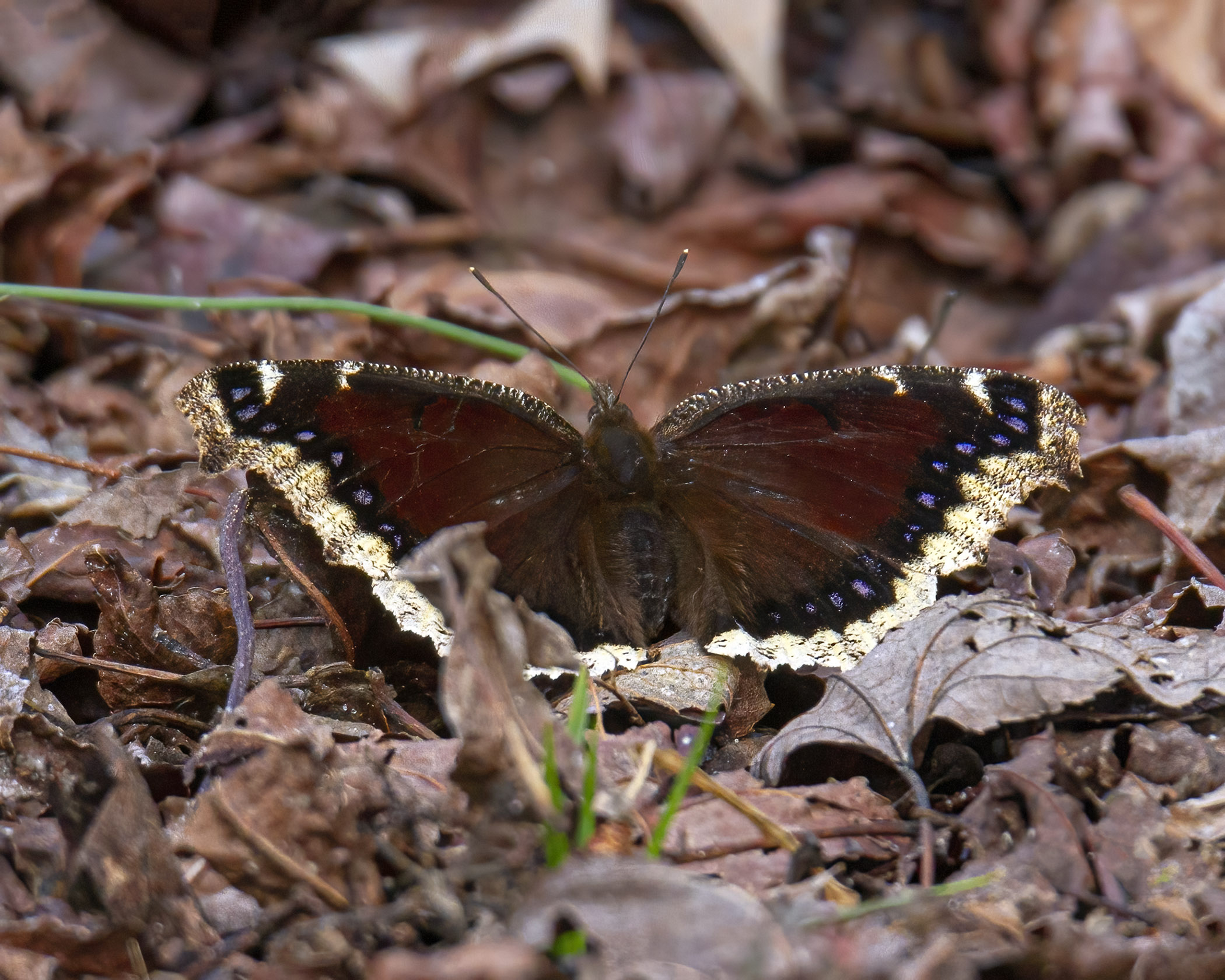
I was delighted yesterday (7 March) to spot this beautiful Mourning Cloak butterfly (Nymphalis antiopa) at Occoquan Bay National Wildlife Refuge, my first butterfly sighting of 2024. Mourning Cloaks, known as Camberwell Beauties in the Great Britain, overwinter as adults and are usually among the first butterflies to appear each spring.

Mourning Cloak butterflies, according to Wikipedia, have a lifespan of 11 to 12 months, one of the longest lifespans for any butterfly. As I noted, these butterflies spend spend the winters in us as adults, by “hiding away in cracks in rocks or holes in trees, and are able to shut down their bodies all winter long, effectively hibernating, in a manner known in insects as torpor,” according to the One Earth website.

Mourning Cloak butterflies have a distinctive look that some scientist thought looked like the traditional cloak worn in mourning. I was happy that I was able to capture the row of blue spots on the wings—another one of its identification features—in the photo of “my” butterfly.

The butterfly spent most of its time flying up and down, in and out of some trees. Eventually it perched for a moment on the ground and I was able to capture this image. It will be at least a few more weeks before I see my first dragonfly of the season, but I will soon begin to keep my eyes open for them. As many of you know, dragonflies are one of my favorite subjects to photograph and I look forward to the start of “dragonfly season” each year.

Mourning Cloak

© Michael Q. Powell. All rights reserved.


Read Full Post »

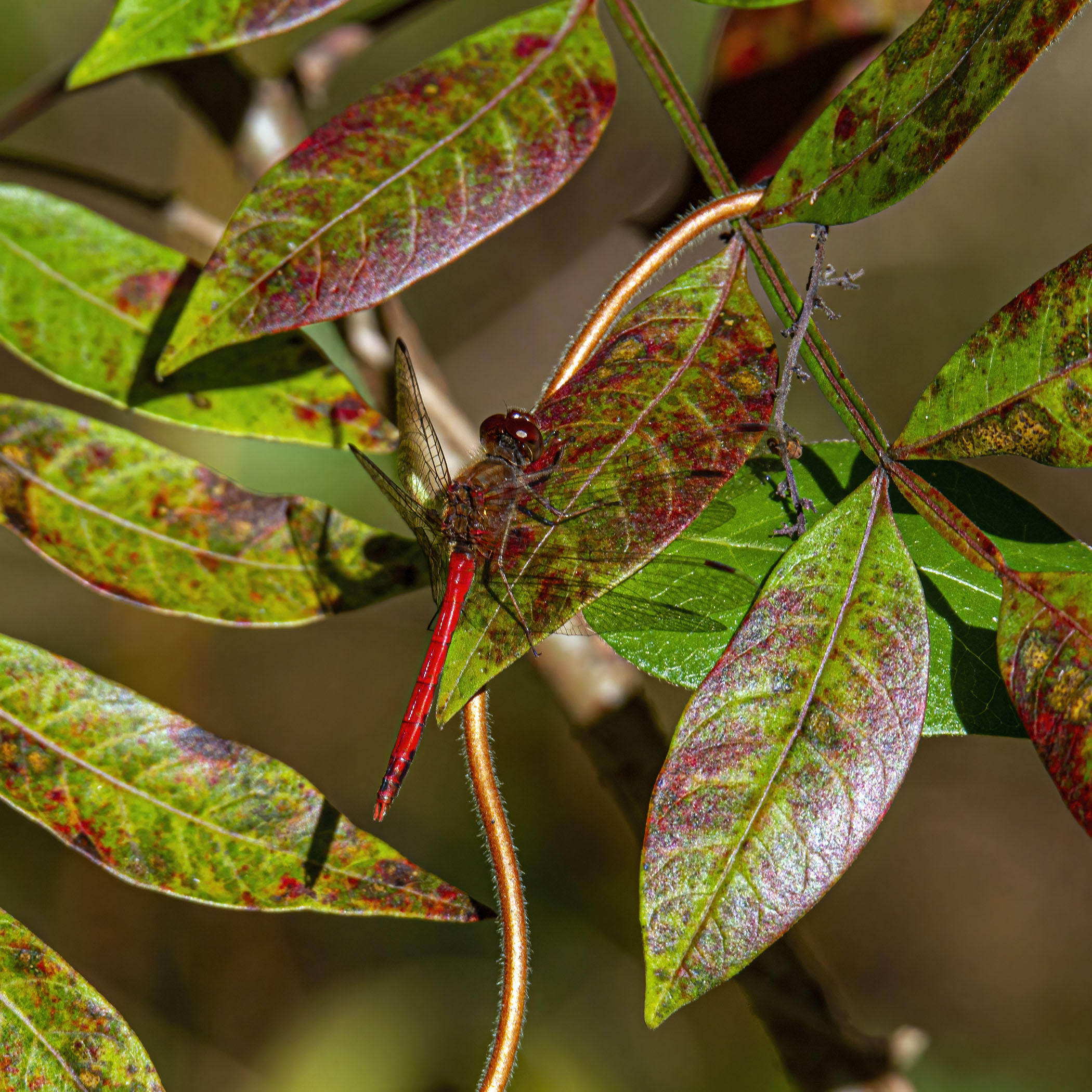
As we move into December, I am still managing to see a few Autumn Meadowhawks (Sympetrum vicinum), like this dragonfly on the rocks that I spotted on Monday at Occoquan Bay National Wildlife Refuge. Dragonfly on the rocks…sounds like a holiday adult beverage to me.

I suspect that the end is near for these little creatures. Although these dragonflies can tolerate brief periods of cold temperatures, it is difficult for them to survive during an extended cold snap. I will be keeping an eye out for these tiny red dragonflies in the upcoming weeks, but it is clear that the end of the dragonfly season is rapidly approaching.

Autumn Meadowhawk

© Michael Q. Powell. All rights reserved.

Read Full Post »

Autumn Meadowhawk dragonflies (Sympetrum vicinum) are still hanging in there as we approach the end of November. At other times of the year their bright red bodies would stand out, but there are lots of red and brown leaves on the ground now that help to camouflage them when they land. If the dragonflies remain still while on these perches, they are almost undetectable.

I photographed these little beauties on Wednesday at Occoquan Bay National Wildlife Refuge. Amazingly, I used the same telephoto zoom lens for these images that I used to capture shots of a Bald Eagle that same day—check out yesterday’s posting called What’s for dinner? that featured shots of an eagle with a duck that it had captured. The Tamron 150-600mm lens is a really versatile lens that, if I am careful, can capture a wide range of subjects ranging from an eagle in flight to a tiny perched dragonfly.

Autumn Meadowhawk

Autumn Meadowhawk

© Michael Q. Powell. All rights reserved.


Read Full Post »

We have reached the point of the season when the only dragonflies remaining are the hardy Autumn Meadowhawks (Sympetrum vicinum). I try to photograph every one that I see, knowing that it could be the last one that I spot for the year. In past years I have sometime seen Autumn Meadowhawks in December, but their continued presence is dependent on a number of factors, including the weather.

I photographed this Autumn Meadowhawk last Friday at Occoquan Bay National Wildlife Refuge in Northern Virginia—it was one of a half-dozen or so that I spotted that day. The little dragonfly appeared to be staring right at me with a mixture of curiosity and defiance. The dragonfly was perched on a log and I was happy to capture some of the texture of the wood along with a bit of autumn color in the background.

I will continue to keep an eye out for these little red dragonflies, knowing full well that their time is rapidly coming to an end.

Autumn Meadowhawk

© Michael Q. Powell. All rights reserved.

Read Full Post »

It has been quite a while since I have seen any dragonflies other than Autumn Meadowhawks, so I was thrilled yesterday (17 November) when I spotted this Wandering Glider (Pantala flavescens) patrolling over a field at Occoquan Bay National Wildlife Refuge. I watched and waited for a long time and the dragonfly finally landed for a moment.

I captured the image below with my Tamron 150-600mm telephoto zoom lens extended all the way to 600mm on my Canon 7D DSLR. The dragonfly was perched only a few inches above the ground, so I had to crouch down quite low to get this shot. Although I had my camera on a monopod, it was tough to get into a steady shooting position and I had to focus manually, because my camera’s autofocus kept locking onto the vegetation. I took lots of photos and happily a few of them were in focus and were relatively sharp.

Wandering Gliders are a migratory species and are considered to be the most widespread dragonfly on the planet, with good population on every continent except Antarctica. According to Wikipedia, Wandering Gliders, also known as Globe Skimmers, “make an annual multigenerational journey of some 18,000 km (about 11,200 miles); to complete the migration, individual globe skimmers fly more than 6,000 km (3,730 miles)—one of the farthest known migrations of all insect species.” Wow!

Wandering Glider

© Michael Q. Powell. All rights reserved.

Read Full Post »

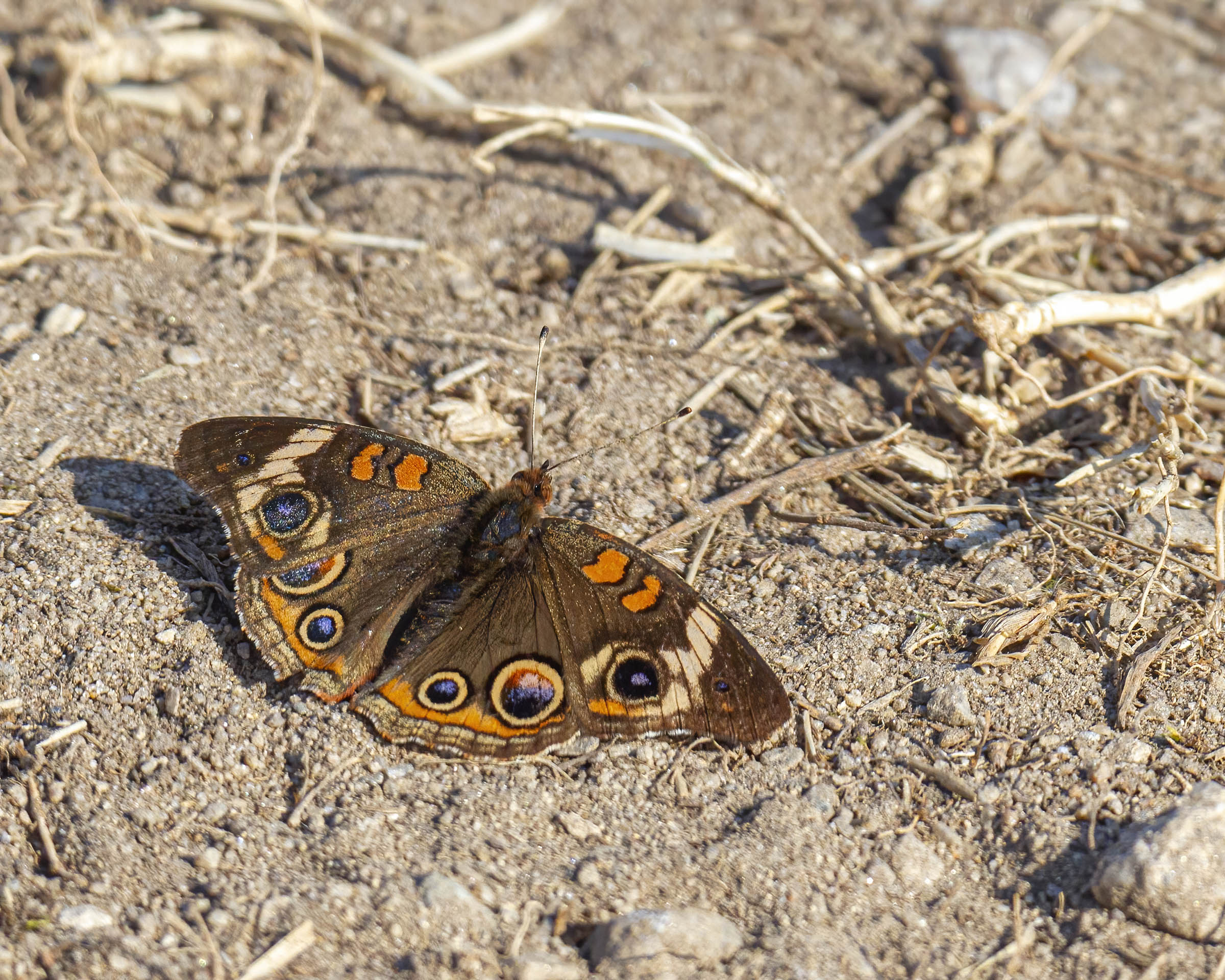
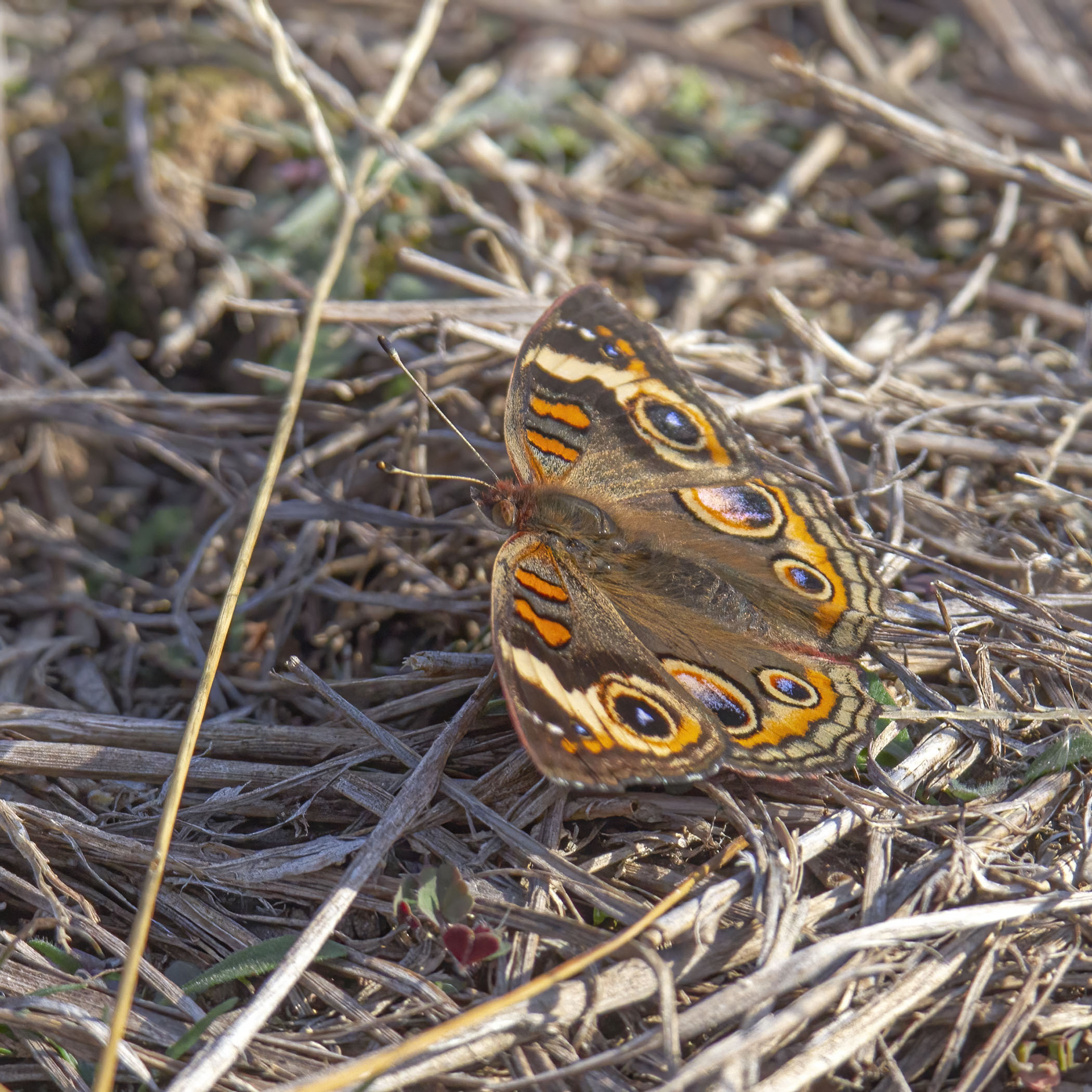
There were few insects flying last Thursday at Occoquan Bay National Wildlife Refuge, so I was a bit surprised to encounter several Common Buckeye (Junonia coenia) butterflies. The body color of this butterfly is pretty drab, but its markings are stunning in their beauty—I especially love its multi-colored eyespots. Wow!

I do not think that Common Buckeye butterflies overwinter in my area as adults, so I wonder if the butterflies that I observed are in the process of migrating southward. If not, then they are appearing on the scene quite late in the season, when we have already had several frosty nights. Perhaps they will hang around for a little while longer—I will keep an eye out for them on my next trips to my favorite local wildlife refuge.

Common Buckeye


Common Buckeye

© Michael Q. Powell. All rights reserved.


Read Full Post »

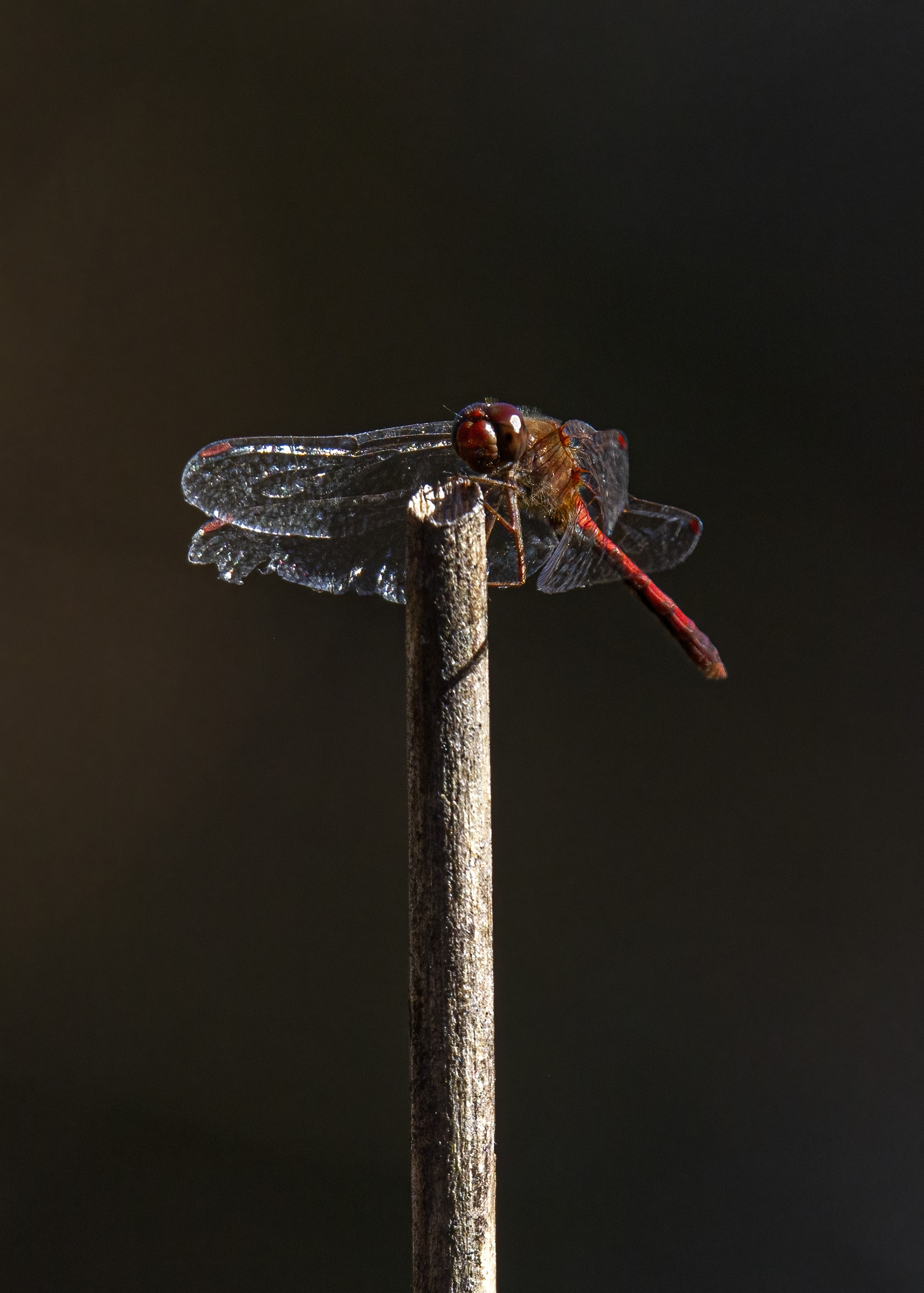
I can’t totally exclude the possibility that I may see a hardy survivor of another species, but it is beginning to look like Autumn Meadowhawks (Sympetrum vicinum) are the sole remaining dragonfly species. Last week I spotted quite a few of them during a visit to Huntley Meadows Park, a county-owned marshland not far from where I live.

I tried to capture images of these bright red beauties in as many different environments as I could. Autumn Meadowhawks often perch on the ground, which does not provide a very interesting background, as you can see in the final photo. It is much more interesting if they perch on fallen leaves, or even better if they choose a more elevated perch.

The photos below give you an idea of how I try to “work” a subject. I try to shooting from different angles and distances.  When possible, I try to selectively include or exclude background elements by choosing the appropriate camera settings, as you can see in the fourth photo, where I caused the background to be totally out of focus. Paying attention to the direction of the light really helps too, as you can see particularly in the second image in which the light is so directional that it almost looks like a studio portrait.

Autumn Meadowhawks will probably be around for another few weeks or maybe a month or so, depending in part on the severity of the local weather. At that point, I will rekuctantly turn my focus to birds, landscapes, and other non-insect subjects. I also hope to devote a bit more attention to learning more about creating videos—I have a modest YouTube channel that I have allowed to languish this past year.

Autumn Meadowhawk

Autumn Meadowhawk

Autumn Meadowhawk

Autumn Meadowhawk

Autumn Meadowhawk

© Michael Q. Powell. All rights reserved.
Read Full Post »

Most of the insects are gone by now, so I was a bit shocked to spot this Sleepy Orange butterfly (Eurema nicippe) last Thursday at Occoquan Bay National Wildlife Refuge. When I first saw it, I assumed that it was a Clouded Sulphur butterfly, a species that I photographed a few weeks ago. Upon examining my shot on my computer screen, I realized that it was an unfamiliar species, and a friend of mine who is more of an expert on butterflies helped to identify the butterfly for me.

I really like the way that the bright color of the inside of the butterfly contrasts with the brown tones of the dried leaves on which the butterfly was perched.

Sleepy Orange

© Michael Q. Powell. All rights reserved.

Read Full Post »

Woodpeckers are amazingly industrious. They repeatedly hammer their heads against trees, with seemingly a low success rate. Yesterday, though, this male Downy Woodpecker (Picoides pubescens) was successful in capturing an insect at Occoquan Bay National Wildlife Refuge and paused for a moment to show it to me.

Downy Woodpeckers are the smallest woodpeckers in my area and are the species that I see most often. In addition to pecking away at trees, I have also seen them search for insects in cattails and in other vegetation. It is easy to distinguish a male Downy Woodpecker from a female, because males have a bright red patch on the back of their heads, a feature that you can just see in this photo.

Downy Woodpeckers are usually very energetic. I spotted this woodpecker as he was spiraling his way up the tree. I prepared myself when he disappeared behind the trunk and was able to anticipate where he would reappear. I really like the angle of view of this shot that allows us to see the bird’s sharp claws and intense eyes. Downy Woodpeckers always seem to be intensely focused on what they are doing and it was wonderful to see this one’s efforts rewarded with a nice little treat.

Downy Woodpecker

© Michael Q. Powell. All rights reserved.

Read Full Post »

And then there was one…

Now that the calendar has turned over to November, we have reached the point in the dragonfly season when there is essentially only one remaining species, the Autumn Meadowhawk (Sympetrum vicinum). There is a chance that I will encounter a hardy survivor from some of the summer species or a migratory dragonfly species passing through our area, but in all likelihood, the only dragonflies that I am likely to see this month are the tiny red Autumn Meadowhawks.

This past Thursday I visited Occoquan Bay National Wildlife Refuge and spotted a total of about ten Autumn Meadowhawks at various points throughout the refuge. Unlike some species that require specific habitats, Autumn Meadowhawks seem to be pretty adaptable and I have found them in a variety of different environments.

The dragonfly in the first photo is a female Autumn Meadowhawk—you can tell it is female by looking at her terminal appendages, i.e. the tip of her “tail.” She was perching more or less in the open, so I managed to capture an obstructed shot of her.

Most of the time, though, Autumn Meadhawks perch low to the ground on fallen leaves and dried-up vegetation, as you can see in the final two shots. Both photos show male Autumn Meadowhawks. I love the lighting in the penultimate shot, although the cluttered background makes the dragonfly a little hard to see. In the final photo, I really like the way that the dragonfly appeared to be looking up at me with a sense of curiosity.

Autumn Meadowhawk

Autumn Meadowhawk

Autumn Meadowhawk

© Michael Q. Powell. All rights reserved.


Read Full Post »

The sunlight coming from the back and side of this Clouded Sulphur butterfly (Colias philodice) produced a really dramatic effect in this image that I captured last Friday at Occoquan Bay National Wildlife Refuge. It looks almost like I had the butterfly posing for me in a photography studio, where I would have had full control over the power and direction of the light.

In situations like this, the settings on the camera are really important, because there is so much light that it threatens to blow out the highlights of the light-colored subjects. As a result, I deliberately underexposed the photo, which is why the background appears to be so dark, but I did retain a lot of the details in the butterfly and the asters.

For those of you who enjoy the geeky, technical aspects of photography, I was shooting with a Canon 7D DSLR and a Tamron 150mm-600mm telephoto zoom lens at 600m—I was using a monopod for additional stability. My camera was set to f/8.0, 1/1600 sec, and ISO 400 with negative 1.33 stops of exposure compensation.

Clouded Sulphur

© Michael Q. Powell. All rights reserved.

Read Full Post »

Now that Autumn Meadowhawk dragonflies (Sympetrum vicinum) have become the only dragonflies that I see regularly, I have been paying a great deal of attention to their perches when I am photographing them—when there are a limited number of subjects available, I try to make each encounter count. During a recent trip to Huntley Meadows Park, a county-run marshland park only a few miles from where I live, I managed to capture images of these colorful little dragonflies perching on a variety of different types of vegetation.

Often I have to choose between zooming in close to show the details of my subjects or pulling way back to show the environment in which I found them. In the case of these Autumn Meadowhawks, though, the images balance those competing priorities quite well, in part, I believe, because the dragonflies were so immersed in their environment, i.e. they do not choose high perches that produce “dragonfly on a stick” photos that isolate the subject too much from its surroundings.

Autumn Meadowhawk

Autumn Meadowhawk

Autumn Meadowhawk

© Michael Q. Powell. All rights reserved

Read Full Post »

The red bodies of male Autumn Meadowhawk dragonflies (Sympetrum vicinum) make them relatively easy to spot.  However, when they choose to perch on foliage that matches their coloration, they can sometimes be well camouflaged.

The first photo shows an Autumn Meadowhawk perched on some kind of red vegetation (Virginia Creeper ?) at Huntley Meadows Park last Thursday. The red leaves really help to give the image a feel of autumn.

In the second image, the dragonfly stands out a bit more, but the dying leaves provide an artistically pleasing backdrop for the beautiful little dragonfly—I love this composition a lot.

Autumn Meadowhawk

Autumn Meadowhawk

© Michael Q. Powell. All rights reserved.


Read Full Post »

Lots of wildflowers still in bloom as we move deeper into autumn here in Northern Virginia. Last night we had our first frost warning of the season, but I don’t think there was any frost this morning in my neighborhood—a hard frost may speed the demise of many of the remaining butterflies and dragonflies. I was therefore delighted last Thursday to spot this Clouded Sulphur butterfly (Colias philodice) feeding on the flowers of what I believe is a White Heath Aster (Symphyotrichum ericoides) plant at Huntley Meadows Park.

Although part of the butterfly is obscured by the stem and the leaves in the foreground of this image, I like the way that I was able to capture the details of the butterfly’s green eyes and its extended proboscis.

Clouded Sulphur

© Michael Q. Powell. All rights reserved.
Read Full Post »

I was thrilled yesterday on Thursday at Huntley Meadows Park, a local marshland park, when I finally spotted some Blue-faced Meadowhawk dragonflies (Sympetrum ambiguum), a stunning species that is one of my favorites, after searching in vain for them at other locations for over a month. The Blue-faced Meadowhawk is a late-season dragonfly that is somewhat similar in appearance to the more common Autumn Meadowhawk—males of both species have bright red bodies, but the Autumn Meadowhawks have brown eyes.

The females of both species are more muted in their coloration than their male counterparts, as is often the case with many dragonflies and birds, so they have more natural camouflage and are frequently more difficult to find. The second image shows a female Blue-faced Meadowhawk that I managed to spot in the same general area as the male in the first photo. I love the way that the female dragonfly appeared to be singing a song as she basked in the sunlight on some dried-out vegetation.

Blue-faced Meadowhawk

Blue-faced Meadowhawk

© Michael Q. Powell. All rights reserved.


Read Full Post »

This late in the season, most of the large butterflies seem to be gone, but I continue to see some of the smaller ones, like this beautiful Variegated Fritillary butterfly (Euptoieta claudia) that I spotted on Thursday during a visit to Huntley Meadows Park, a county-run marshland park not far from where I live. Earlier in the year I encountered some Great Spangled Fritillaries, but I think this may well be my first sighting of a Variegated Fritillary in 2023.

The butterfly appeared to be basking in the sun as it perched with its wings wide open on some dried-out vegetation. I was using my Tamron 150-600mm telephoto zoom lens, which has a minimum focusing distance of almost nine feet (270 cm), so I was pretty far from the butterfly when I captured this image. I have read reviews that state that this lens is soft when fully extended to 600mm, but I have found that I can get acceptably sharp images if I pay a lot of attention to my focusing and shooting techniques, including remaining steady—in this case I was using a monopod.

Variegated Fritillary

© Michael Q. Powell. All rights reserved.
 

Read Full Post »

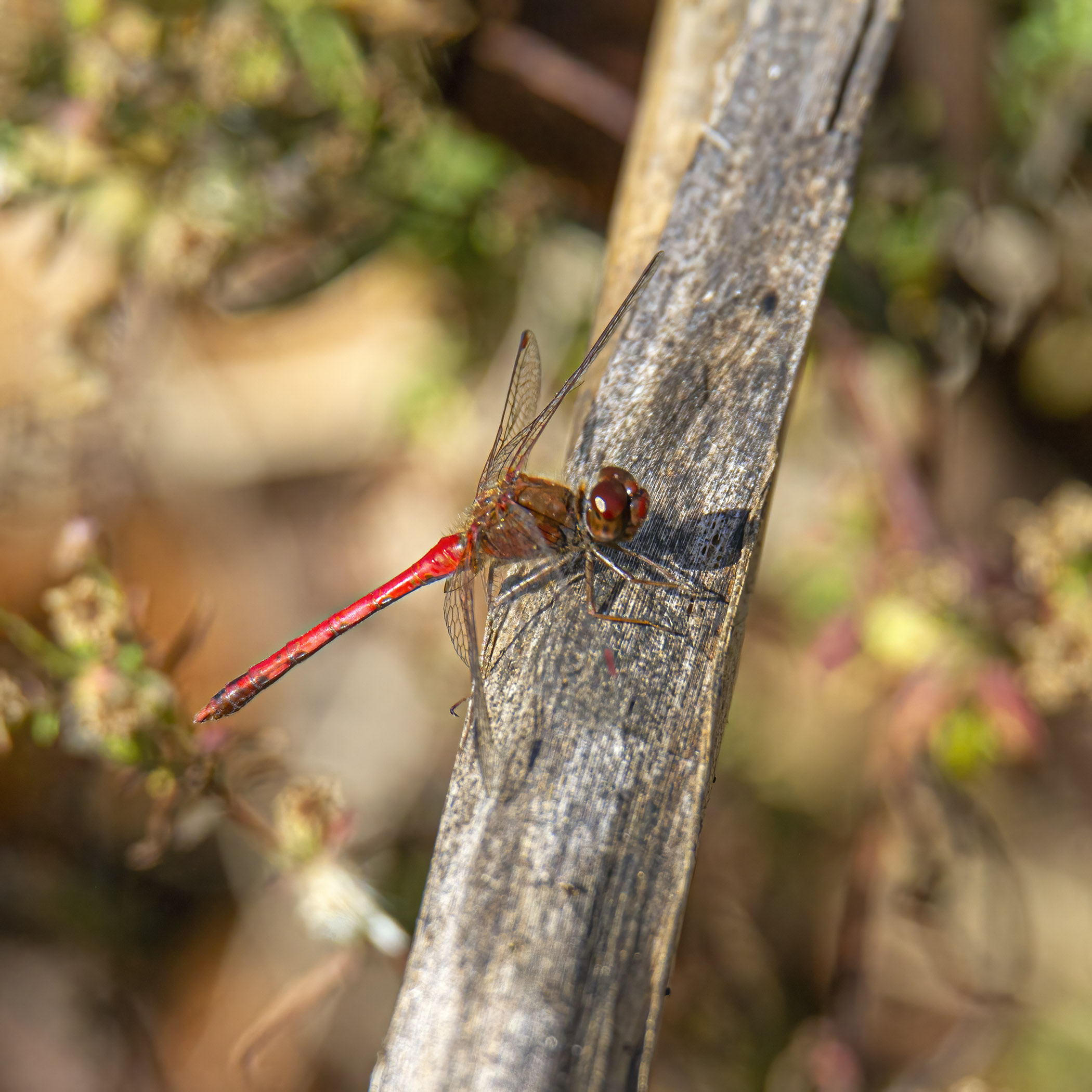
I walked about for a couple of hours on Wednesday at Occoquan Bay National Wildlife Refuge and visited some of my favorite dragonfly sites, but managed to spot only three dragonflies. Of those three, the only one that I managed to photograph was this pretty little Autumn Meadowhawk (Sympetrum vicinum).

Autumn Meadowhawks are quite small, about 1.3 inches (33 mm) in length, so they are not easy to spot, despite their bright red color. They tend to stay close to the ground, making short flights most of the time, so you have to be looking down to see them. At this time of the year, I focus a good amount attention on birds, so I end up alternating between looking up for birds and down for insects.

I really like the color and texture of the rocks on which the dragonfly chose to perch. Their cool muted tones contrast nicely with the red and brown colors of the dragonfly.

Autumn Meadowhawk

© Michael Q. Powell. All rights reserved.
Read Full Post »

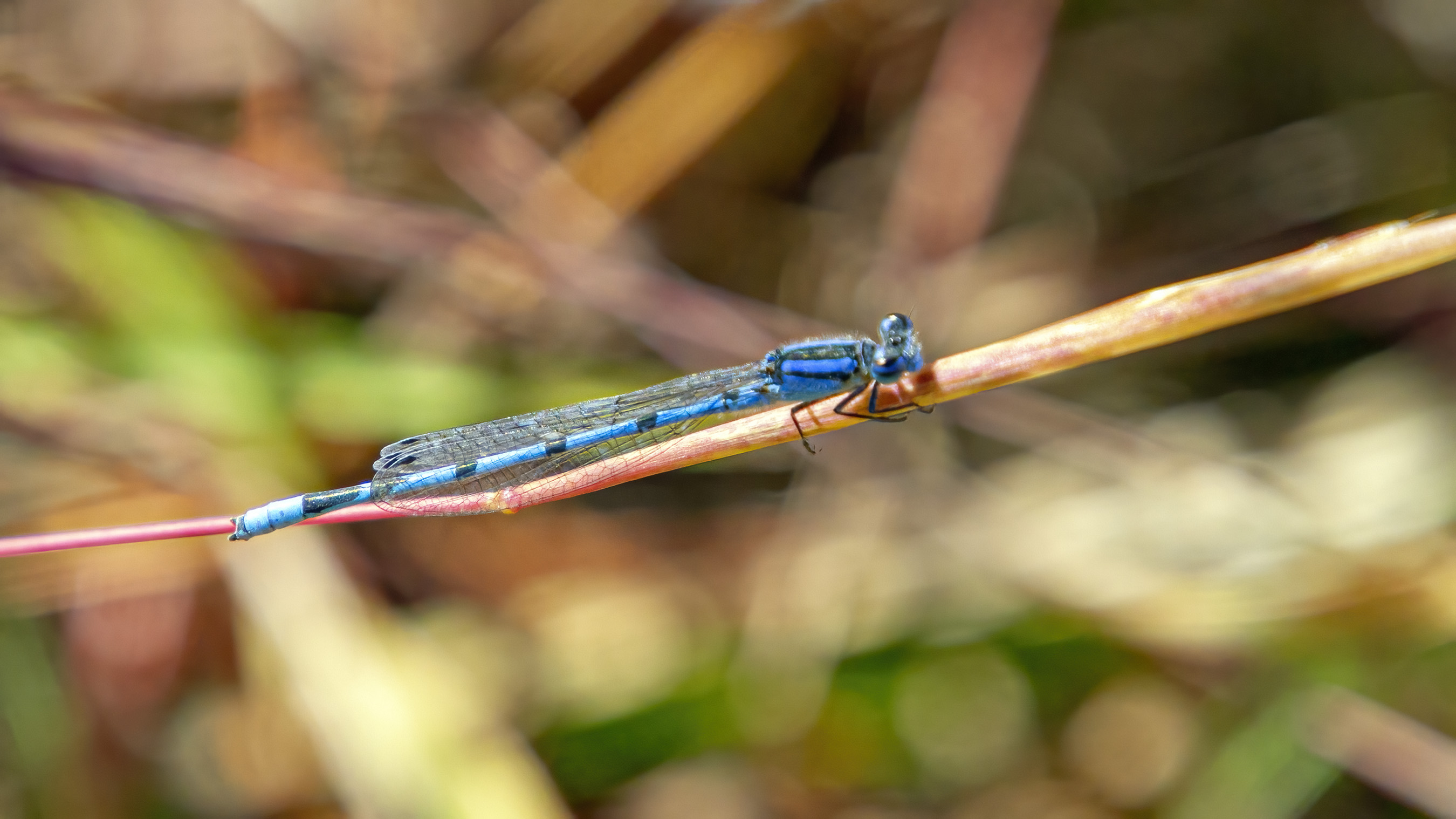
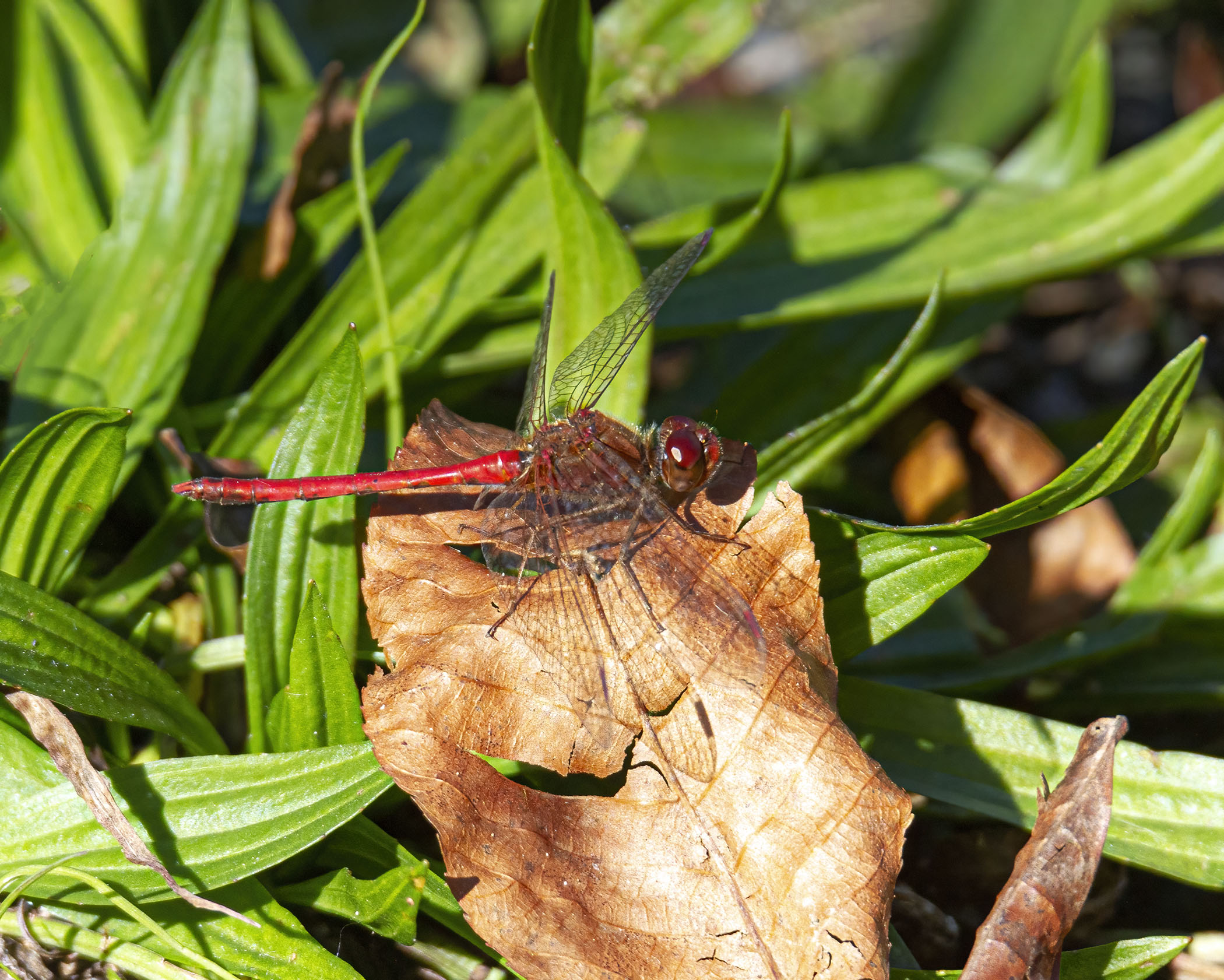
Like dragonflies, their larger “cousins,” damselflies have been rapidly decreasing in numbers this month. During recent visits to Occoquan Bay National Wildlife Refuge, I have seen only a few remaining damselflies. Therefore I was especially happy to spot this handsome male Familiar Bluet damselfly (Enallagma civile) last Tuesday.

The little damselfly seemed to be giving me a sideward glance as I carefully focused on him and I see a hint of what might be a smile. I really like the way that the background turned out in this image too—the colors and bokeh balls add additional visual interest without detracting from the primary subject.

Familiar Bluet

© Michael Q. Powell. All rights reserved.
 

Read Full Post »

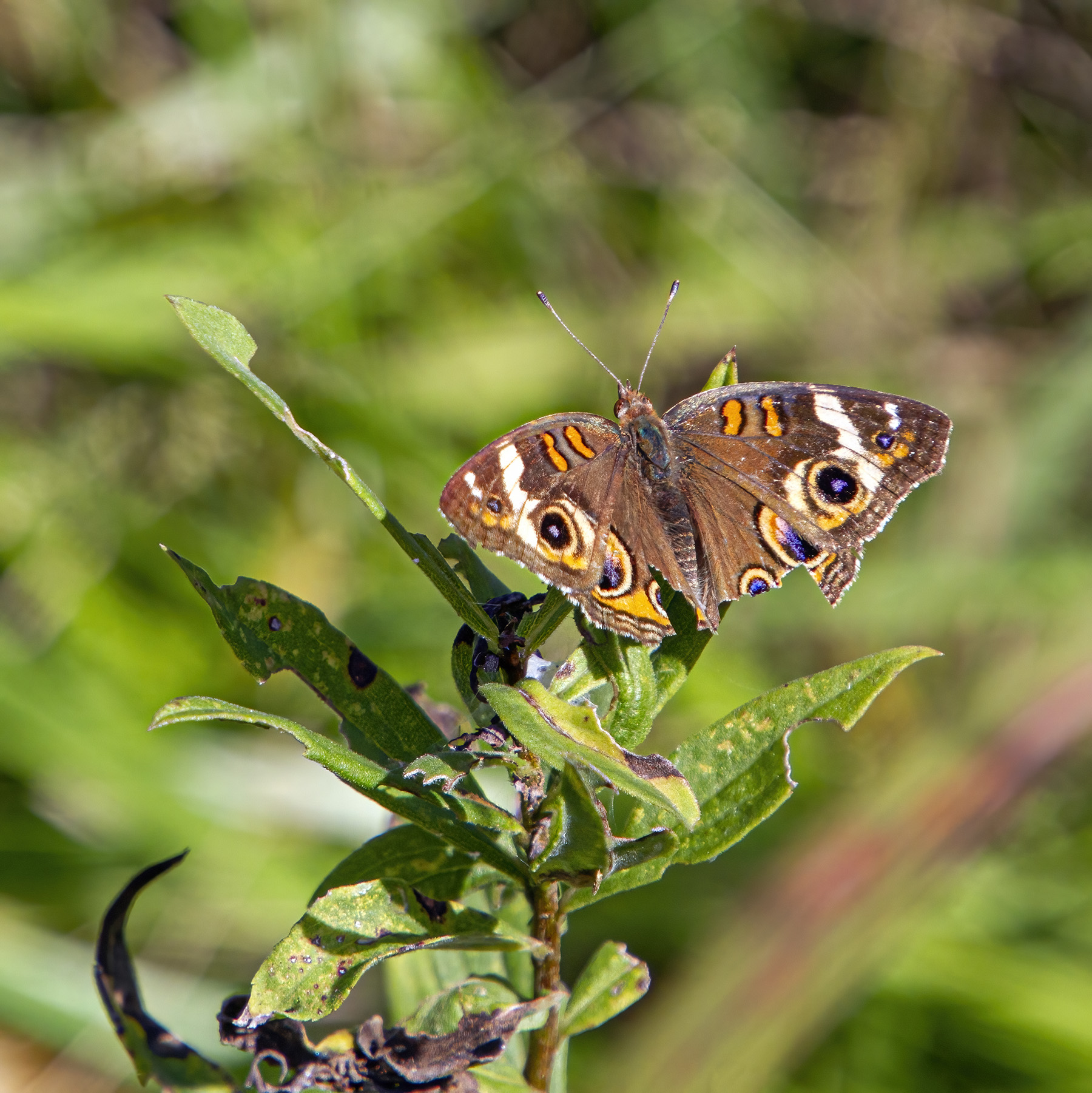
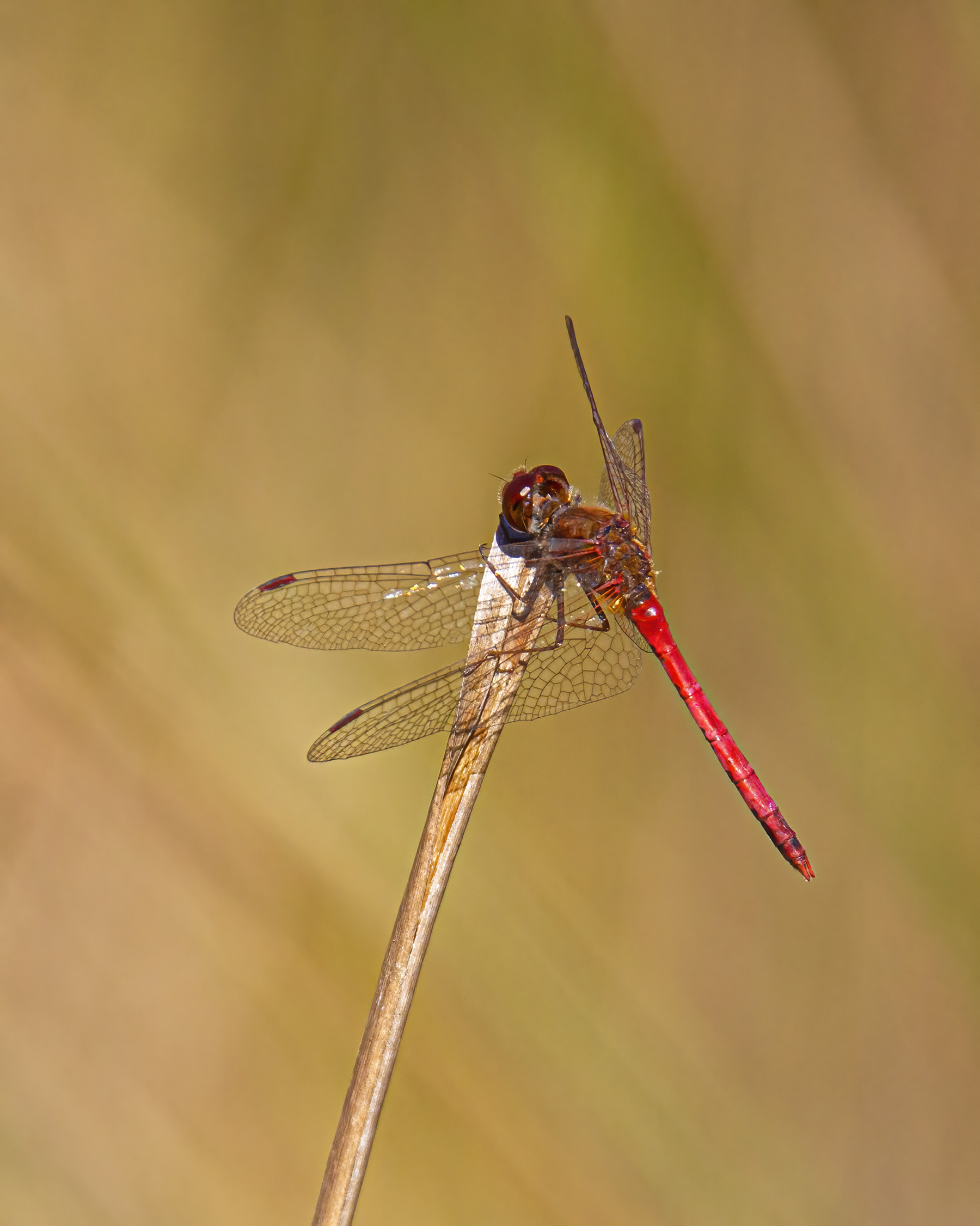
Many of the insects and plants that I now see show signs of the ravages of summer, like this damaged Common Buckeye butterfly (Junonia coenia) that I spotted atop an equally damaged plant during a recent visit to Occoquan Bay National Wildlife Refuge. Nonetheless the beauty of the butterfly shines through and it appears to be fully functional.

Autumn is a time for harvest celebrations as we rejoice in the bounty of the growth that has taken place, but there is also a tinge of melancholy as we experience a sense of loss and the feeling that our lives our changing. Change, of course, is a constant in our lives, but most of us—and I definitely fit into this group—become creatures of habit and have trouble dealing with changes at times. Yet we eventually adapt and may even learn to appreciate the results of the change, even if the process of change is a bit uncomfortable.

Common Buckeye

© Michael Q. Powell. All rights reserved.
Read Full Post »

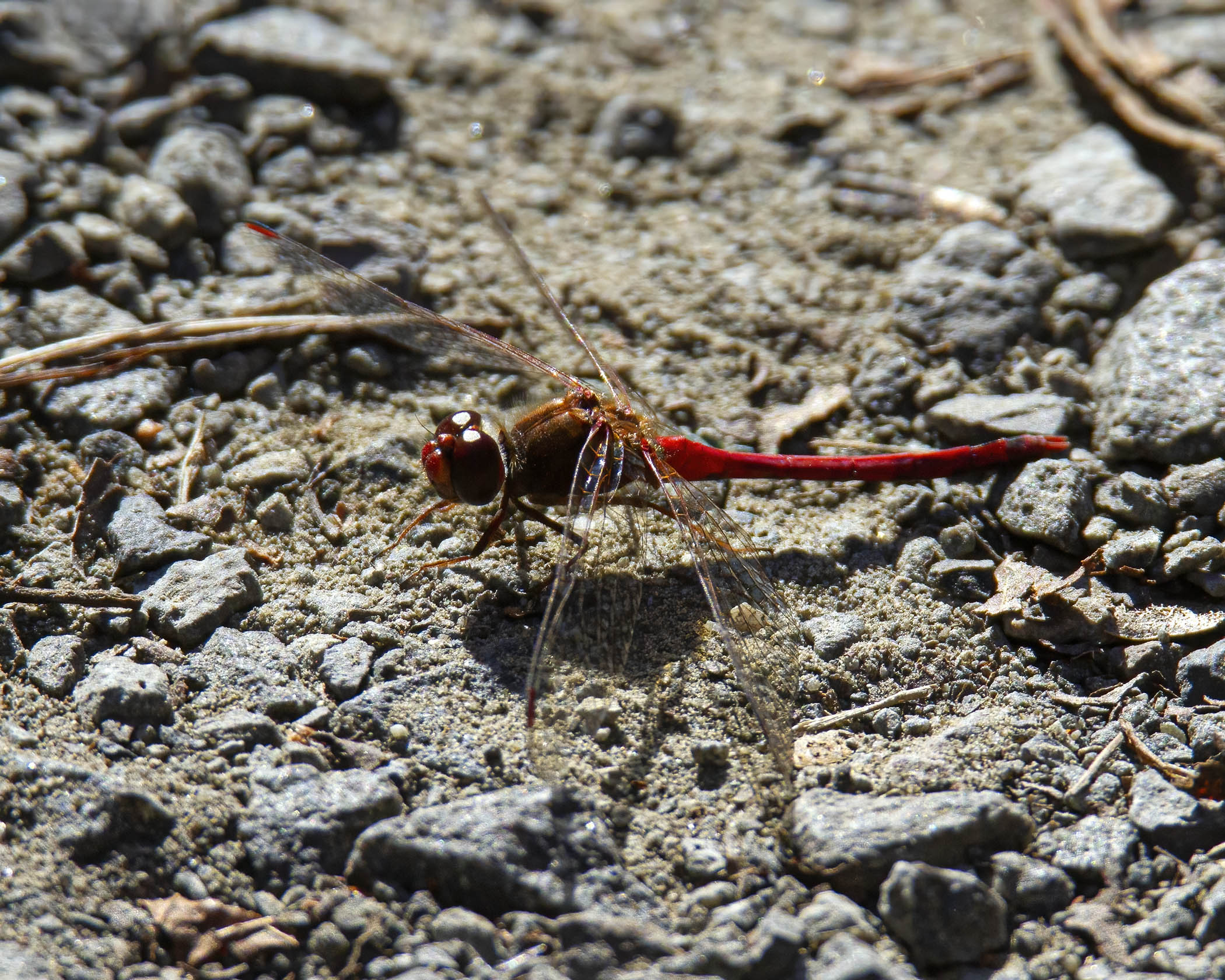
I endlessly tried to track several Wandering Glider dragonflies (Pantala flavescens) as they flew back and forth over a field at Occoquan Bay National Wildlife Refuge last Thursday and was thrilled when one of them finally landed some nearby vegetation, allowing me to capture this image.

Wandering Gliders, also known as Globe Skimmers or Globe Wanderers, are considered to be the most widespread dragonfly species on the earth, with a good population on every continent except Antartica, although they rare in Europe. According to Wikipedia, Wandering Gliders “make an annual multigenerational journey of some 11,200 miles (18,000 km); to complete the migration, individual Wandering Gliders fly more than 3,730 miles (6,000 km)—one of the farthest known migrations of all insect species.”

This modest image was technically quite challenging to capture. The vegetation in this field was dense and the autofocus on my camera kept getting confused by the stalks of vegetation, so I had to resort to manual focusing. I was reluctant to move about very much for fear of rippling the vegetation and disturbing the dragonfly and therefore had to crouch in an awkward position close to the ground. It is certainly not an award-worthy photo, but I am thrilled whenever I manage to get a decent shot of a dragonfly species that rarely perches.

Wandering Glider

© Michael Q. Powell. All rights reserved.
 

Read Full Post »

Although the name of this Orange Bluet damselfly (Enallagma signatum) sounds like an oxymoron, its colors are a perfect match for this autumn season. As the name suggest, most damselflies in the bluet family are blue, but they do come in other colors.

I photographed this handsome male Orange Bluet on 10 October at Occoquan Bay National Wildlife Refuge and was thrilled to be able to capture a little autumn color in the background of the image.

Orange Bluet

© Michael Q. Powell. All rights reserved.

Read Full Post »

There were several Common Green Darner dragonflies (Anax junius) flying overhead on 10 October at Occoquan Bay National Wildlife Refuge. One of them landed and perched momentarily low in the vegetation and I was able to capture this image.

I have been seeing fewer and fewer dragonflies on the ground as we move deeper and deeper into October, but in the air I have been seeing quite a few Common Green Darners, Black Saddlebags, and Wandering Gliders, the dragonfly species that migrate through our area. Many of the members of the surviving summer species appear to be faded and tattered, but the migrants appear to be bright and pristine.

The tangled grasses and vegetation where the dragonfly was perched were dried out and mostly void of color, which helps the green of the dragonfly’s thorax to really stand out in the photo. I also like the way that I was able to capture the transparency and details of the dragonfly’s wings.

Common Green Darner

© Michael Q. Powell. All rights reserved.

Read Full Post »

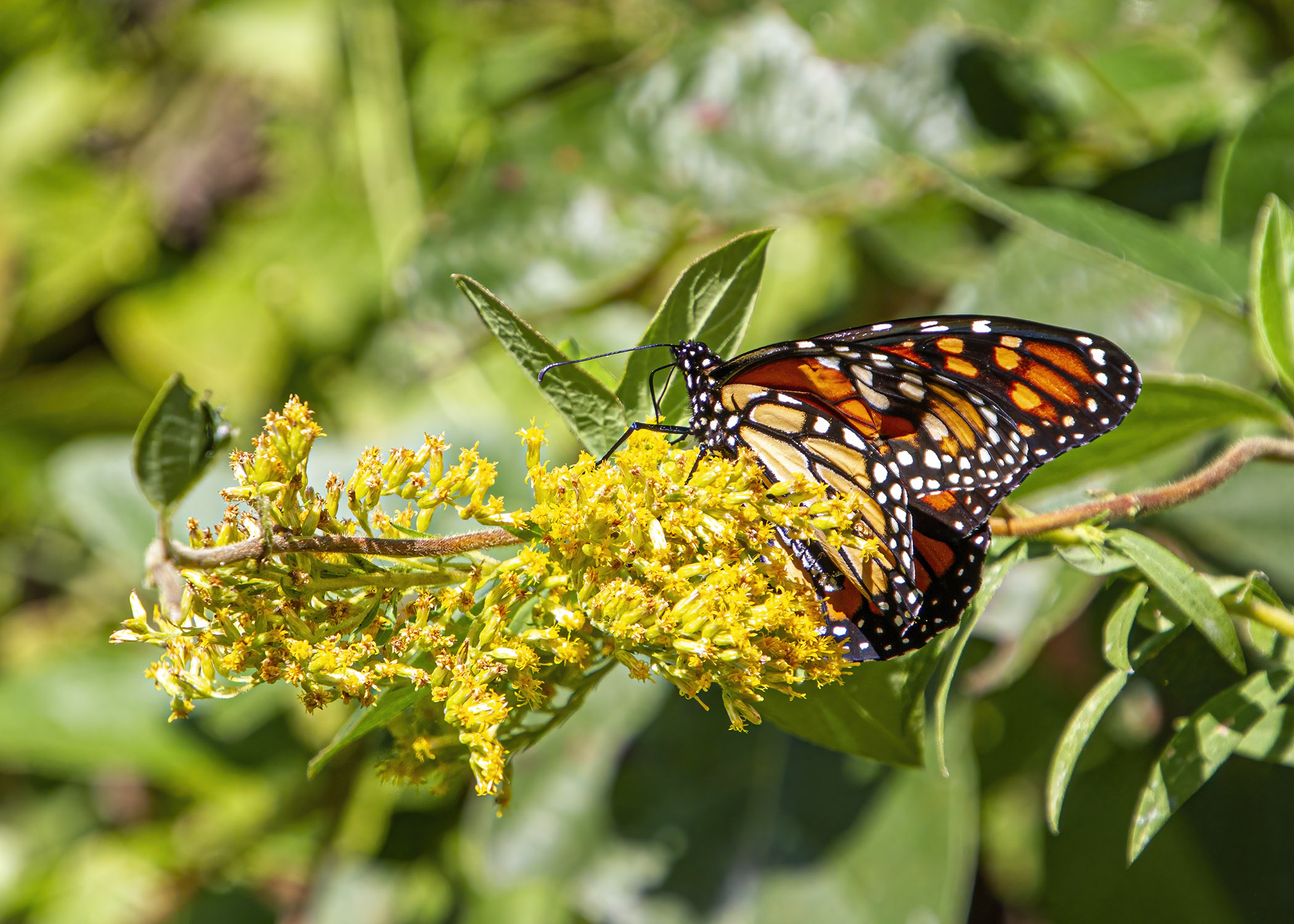
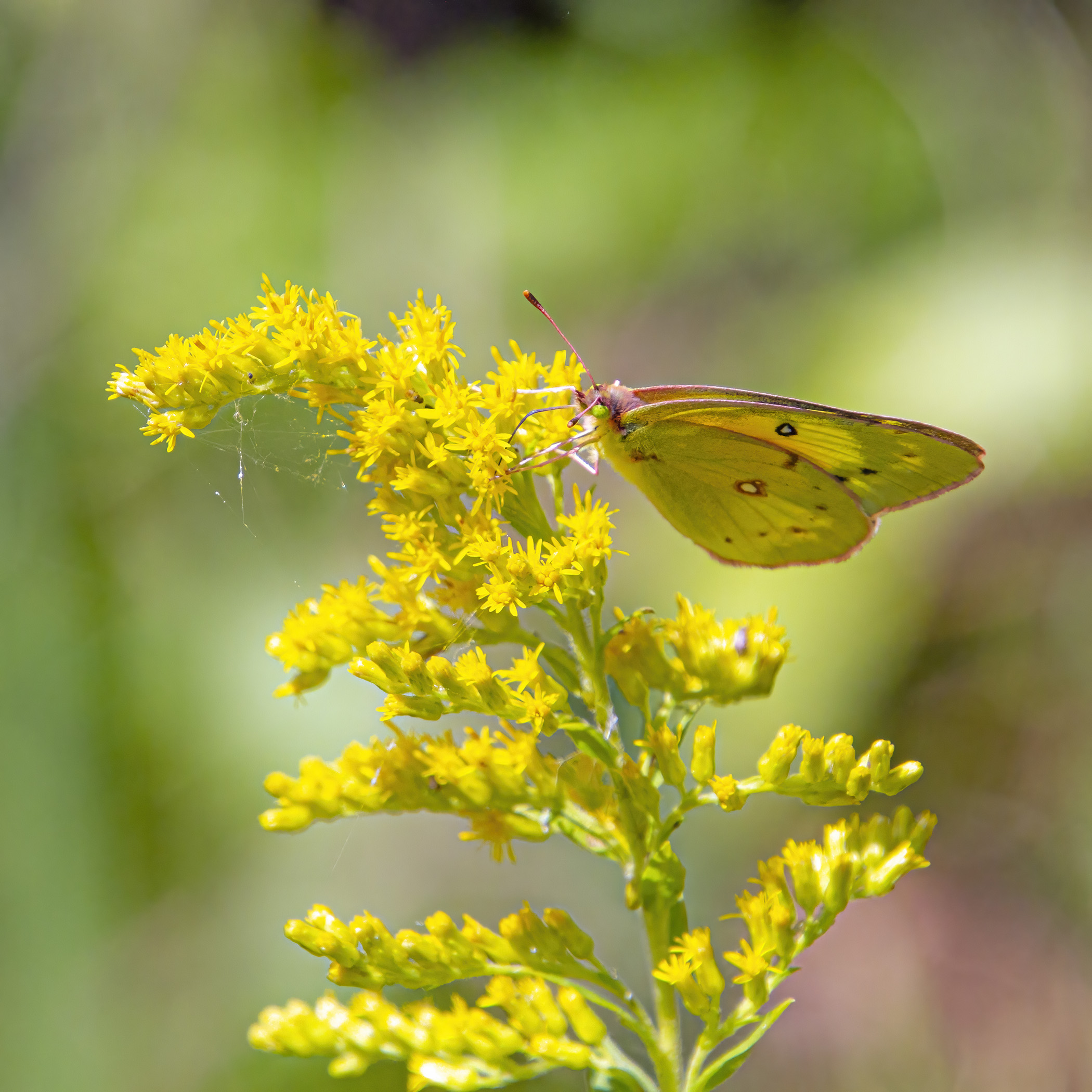
I love bright colors and instinctively smile when I see the large patches of goldenrod that are still in bloom at Occoquan Bay National Wildlife Refuge. The insects seem to love these flowers too and last Tuesday I spotted a large Monarch Butterfly (Danaus plexippus) and smaller Clouded Sulphur butterfly (Colias philodice) feeding on goldenrod.

Monarch

Clouded Sulphur

© Michael Q. Powell. All rights reserved.


Read Full Post »

When the calendar turns over to October, I never know which dragonflies I will encounter. Many of them have disappeared, but some hardy survivors are still around. The weather was warm last week, with several days in the 80’s (27 degrees C), but this week, high temperatures are predicted to be in the low to mid 60’s (17 degrees C) with nighttime temperatures dipping to the upper 40’s (9 degrees C)—this cool weather is less than optimal for most dragonflies.

I was thrilled last Tuesday to spot this Twelve-spotted Skimmer dragonfly (Libellula pulchella) at the edge of a small pond at Occoquan Bay National Wildlife Refuge. I was especially pleased to be able to capture the beautiful patterns on this dragonfly’s wings as it perched in the reeds.

Twelve-spotted Skimmer

© Michael Q. Powell. All rights reserved.

Read Full Post »

What is going on in this photo? It is really cool to photograph the interaction between two species, but it is often difficult to interpret the nature of their exchange. Is it mere curiosity or are there more deadly and sinister intentions on the part of one of the actors? If so, which one is the predator and which one is the potential prey?

I captured this image this past Monday at Occoquan Bay National Wildlife Refuge. I could not identify either of these insects, so I posted the photo and requested identification assistance on bugguide.net, a wonderful resource for insect identification.  It did not take long before I received a response that the insects were an Orange Assassin Bug (Pselliopus barberi) on the left and a Milkweed Leaf Beetle (Labidomera clivicollis) on the right.

I may be giving too much weight to the “assassin” part of the name of one of these insects, but, judging from their individual postures, it seems to me that the orange bug is preparing to attack the black-and-red beetle. Who know? It is such a cool and creepy photo that perhaps I should have waited until Halloween to post it.

Orange Assassin Bug Milkweed Leaf Beetle

© Michael Q. Powell. All rights reserved.

Read Full Post »

« Newer Posts - Older Posts »