Feeds:
Posts
Comments

Archive for the ‘Insects’ Category

I was delighted on Tuesday to spot some damselflies along the edge of the Colorado River in Bastrop, Texas. I believe that they are American Rubyspot damselflies (Hetaerina americana), with a female in the first photo and males in the other two photos.

Normally I prefer natural perches vice manmade ones when photographing wildlife, but I really like the texture and color of the rusty corrugated drainage pipe on which the damselfly chose to perch for the final photo.

American Rubyspot

American Rubyspot

American Rubyspot

© Michael Q. Powell. All rights reserved.


Read Full Post »

I have arrived safely in Bastrop, Texas (just outside of Austin) for a family wedding after a long drive from Virginia that turned out to be 1560 miles (2510 km).

I don’t have any new photos to post, but thought I would feature an image of a female Autumn Meadowhawk dragonfly (Sympetrum vicinum) that I photographed a little over a week ago. I spotted this beautiful dragonfly at Occoquan Bay National Wildlife Refuge and was delighted to capture the shadow that the little dragonfly was casting on a colorful fallen leaf.

Thanks to all of you who responded to my recent request to subscribe to the YouTube channel of young UK-based wildlife photographer Toby Wood. He has now surpassed the required level of one thousand subscribers and his channel is now presumably eligible for monetization on YouTube.

Autumn Meadowhawk

© Michael Q. Powell. All rights reserved.

Read Full Post »

Autumn Meadowhawk dragonflies (Sympetrum vicinum) love to perch on the ground and at this time of the year the ground is covered with fallen leaves in many places. Most of those leaves are brown, which makes for pretty good shots, but I am always hoping that an Autumn Meadowhawk will choose to perch on a more colorful red or yellow leaf. Last Wednesday at Occoquan Bay National Wildlife Refuge, I was fortunate when one of these colorful little dragonflies landed on a yellow leaf and I captured the first image.

Although the second and third images feature brown leaves, I love the textures and shapes of those leaves. I also like the way that the drabness of the leaves helps the bright red of the dragonfly’s body really stand out.

At this time of the year, most of my photographic subjects are likely to be birds, so I tend to walk around with my Tamron 150-600mm telephoto zoom lens on my camera. Although a long telephoto lens my not be my first choice for photographing such a small subject—an Autumn Meadowhawk is about 1.3 inches (33 mm) in length—I can get pretty good results if I am really careful in steadying the lens and paying attention to the focus point. All three of these images, for example, were shot with the lens fully extended to 600mm.

Autumn Meadowhawk

Autumn Meadowhawk

Autumn Meadowhawk

© Michael Q. Powell. All rights reserved.


Read Full Post »

Last Wednesday I spotted this beautiful little Eastern Comma butterfly (Polygonia interrogationis) at Occoquan Bay National Wildlife Refuge. It struck me that the butterfly’s colors are a perfect match for this autumn season.

I really like this image. When I posted in on my Facebook page, the word “contrast” keep coming up in the comments of my viewers. Some noted the contrast in colors, while others commented on the contrast in textures. I think that the downward-facing pose of the butterfly and the rather unusual shape of its wings also causes people to pause for a moment as their brains try to process what they are seeing.

Years ago I remember reading a post by a fellow blogger, Lyle Krahn, who used the term “stopping power.” Although he was referring to subjects that you found interesting enough that you would stop to take a photo, I think that it applies equally well to viewers. What makes a photo compelling enough that a viewer will stop and examine it, rather than simply scrolling on to the next posting?

We are constantly inundated with visual images that compete for our attention, but so often they affect us only superficially. It is my challenge as a photographer to capture and/or create images that help you to see the world in a different, deeper way, that prompt you to slow down and experience the beauty that surrounds you.

As noted American photographer Dorothea Lange stated, ““The camera is an instrument that teaches people how to see without a camera.”

Eastern Comma

© Michael Q. Powell. All rights reserved.

Read Full Post »

I was thrilled to spot this Blue-faced Meadowhawk dragonfly (Sympetrum ambiguum), one of my favorite species, this past Wednesday at Occoquan Bay National Wildlife Refuge. The dragonfly was cooperative and let me get pretty close with my Tamron 180mm macro lens and capture some of the amazing details of this colorful dragonfly, like its tiny feet and the little hairs on its legs.

I personally find the combination of the bright red body and the blue eyes to be stunningly irresistible and I look forward to spotting this species each autumn. If you click on either of the two images, you will be able to see some of the individual facets that make up the compound eyes. I have always wondered what it would be like to see the world through the eyes of a dragonfly.

I really like the description of a dragonfly’s sight that I found in a fascinating article by a writer called GrrlScientist that I encourage you to read. She wrote,

“Each compound eye is comprised of several thousand elements known as facets or ommatidia. These ommatidia contain light sensitive opsin proteins, thereby functioning as the visual sensing element in the compound eye. But unlike humans, day-flying dragonfly species have four or five different opsins, allowing them to see colors that are beyond human visual capabilities, such as ultraviolet (UV) light. Together, these thousands of ommatidia produce a mosaic of “pictures” but how this visual mosaic is integrated in the insect brain is still not known.”

I had to search hard to find this dragonfly and it was the only one of its species that I saw that day. At this time of the year few dragonflies are still flying. However, I am not ready to call it quits for the dragonfly season, though the end is drawing near.


Blue-faced Meadowhawk

Blue-faced Meadowhawk

© Michael Q. Powell. All rights reserved.


Read Full Post »

It looks like all of the summer dragonflies are gone. During three treks with my camera this week, I have not spotted any of the species that were common during the summer.

Fortunately, there are a few autumn species that hang on long after the summer species are gone. This week I was pleased to see some Autumn Meadowhawk dragonflies (Sympetrum vicinum), which in the past have been present as late as December.

The dragonfly in the first photo is a male Autumn Meadowhawk that I photographed yesterday at Jackson Miles Abbott Wetland Refuge. Each year when I see them I are struck by their small size—they are only about 1.3 inches (33mm) in length. Mature males are a bright reddish-orange in color and have beautiful brown eyes, a perfect color combination for the season.

Female Autumn Meadowhawks are less conspicuous and have a two-toned tan and red coloration. I spotted the female in the second photo on Wednesday at Occoquan Bay National Wildlife Refuge. Generally I see a lot more male Autumn Meadowhawks than females, so I was happy to be able to photograph this one, which also happened to be my first Autumn Meadowhawk of the season.

Autumn Meadowhawk

Autumn Meadowhawk

© Michael Q. Powell. All rights reserved.


Read Full Post »

Perspective and timing really matter. In the first photo, the Black Swallowtail (Papilio polyxenes) is immediately recognizable as a butterfly. When the butterfly opened its wings wider and I took the second shot, however, I captured an image that forces viewers to pause for a second to process what their eyes are seeing. We are so used to seeing butterflies with wings fully visible that we may not immediately recognize a butterfly when the angle of the shot causes the wings to virtually disappear. The final image is a more “normal” view of the butterfly on a different perch.

I spotted this Black Swallowtail butterfly last Friday as I was wandering about at Occoquan Bay National Wildlife Refuge. Dragonflies were pretty scarce that day, so it was nice to see so many butterflies still flying. That day was nice and warm, but since then our temperatures have been lower than average—it is currently 40 degrees (4 degrees C) as I write this posting at 5:30 in the morning and today’s high is forecast to be about 65 degrees (18 degrees C). Autumn has definitely arrived.

Black Swallowtail

Black Swallowtail

Black Swallowtail

© Michael Q. Powell. All rights reserved.

Read Full Post »

This past Friday I was delighted to spot this Question Mark butterfly (Polygonia interrogationis) during a visit to Occoquan Bay National Wildlife Refuge. Although these butterflies are with us the entire year—they overwinter as adults—I do not see them all that often. Question Mark butterflies (and their “cousins,” the Eastern Comma butterflies) hang out mostly in the woods, where their drab coloration helps them to blend in with the bark and the dried leaves of the trees, as you can see in the second photo.

I was particularly happy with the first shot, because it lets you see both the drab outer wing and the gorgeous orange and black of the inner wing. I was shooting with my Tamron 150-600mm, which is sometimes a little soft at the long end of the zoom, but managed to capture a good amount of detail nonetheless.

The butterfly’s warm orange coloration seems to be a perfect match for the season, as displays of pumpkins have start to appear.

Question Mark

Question Mark

© Michael Q. Powell. All rights reserved.

Read Full Post »

When I went out with my camera on Wednesday, it was cool and cloudy, but fortunately the rain had stopped falling. I was not optimistic that I would see a lot of wildlife, but it felt good to get out of the house and to spend some time in nature.

Most dragonflies prefer warm weather and become inactive when it is cool, so I did not expect to see many during my walk. I was thrilled therefore when I spotted this male Common Whitetail dragonfly (Plathemis lydia). I watched as he was flying and saw him land low in the vegetation, just off of the ground.

The background in this shot is really busy, but somehow the dragonfly really stands out. It’s kind of a fun little photo of one of the few remaining dragonflies as we move through October.

Common Whitetail

© Michael Q. Powell. All rights reserved.

Read Full Post »

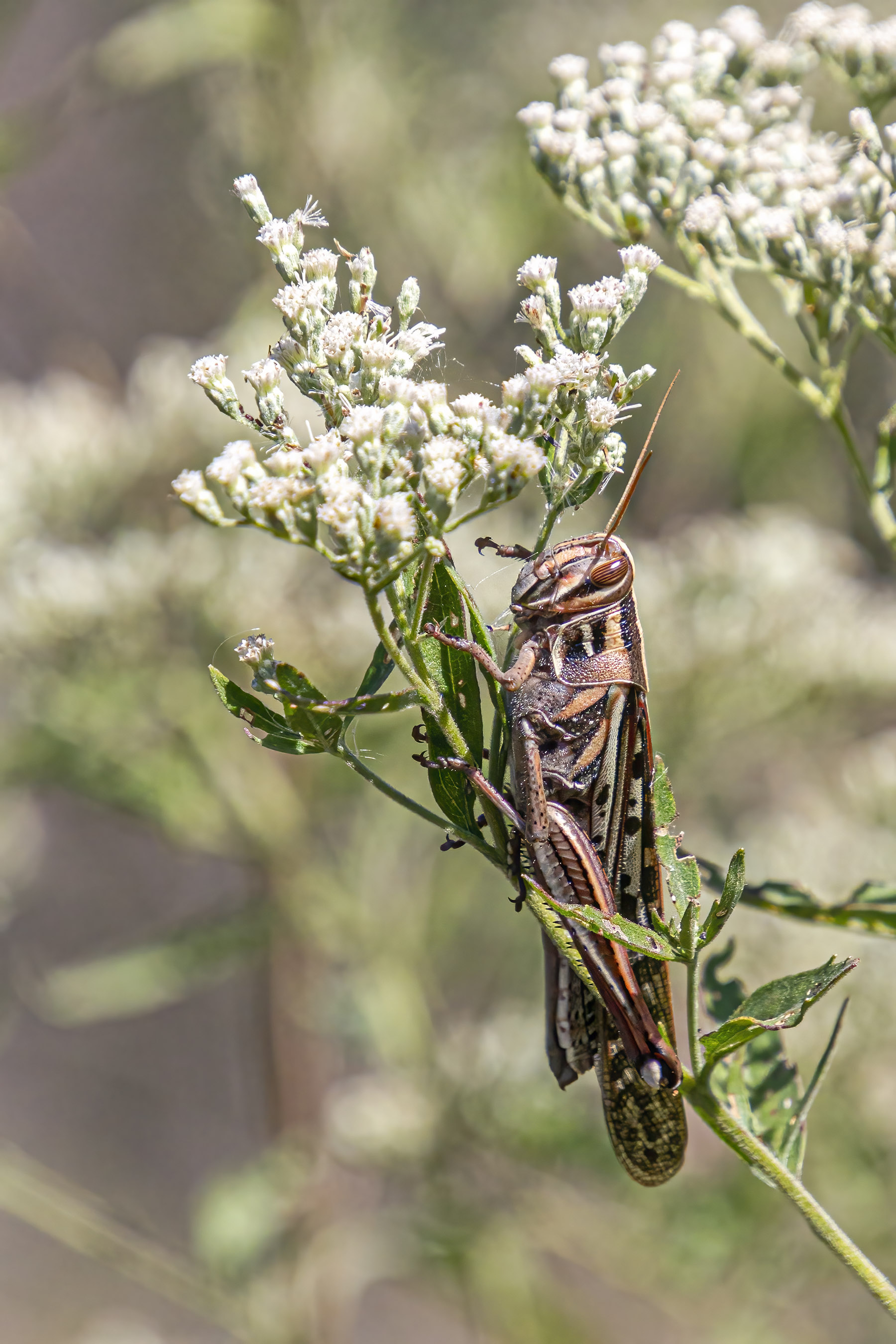
Quite often when I am walking through grassy fields, the ground in front of me seems to explode with grasshoppers arcing through the air in all directions. Last week during a visit to Occoquan Bay National Wildlife Refuge, I managed to capture images of two of them.

I am not certain of the species of the formidable looking grasshopper in the first photo. When I looked through sources on line, however, it looked most like an American Bird Grasshopper (Schistocerca americana). Grasshoppers like this always make me think of medieval knights, suited up in protective armor.

The insect in the second image is almost certainly a katydid, and not a grasshopper—the extremely long antennae are often an easy identification feature. I love the brilliant green of the katydid’s body and its matching green eyes. There are lots of different kinds of katydids and I do not know to which species “my” katydid belongs.

We have had a lot of rainy weather recently and temperatures have noticeably dropped. Today’s forecast calls for intermittent rain and a high temperature of only 50 degrees (10 degrees C). I wonder if this cool, rainy period will mark the end of the season for some of the insects that I have been photographing during the past few months.

grasshopper

katydid

© Michael Q. Powell. All rights reserved.

Read Full Post »

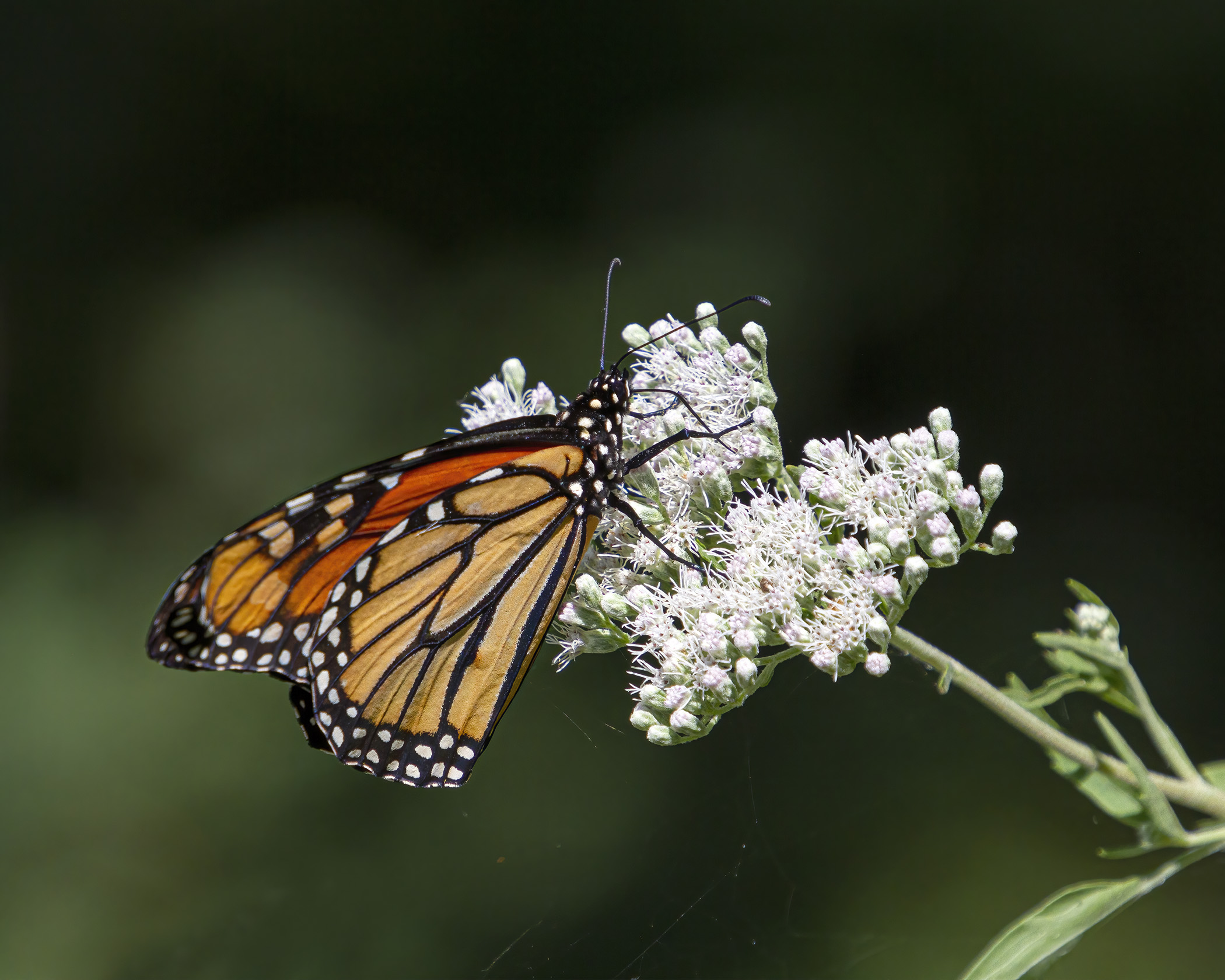
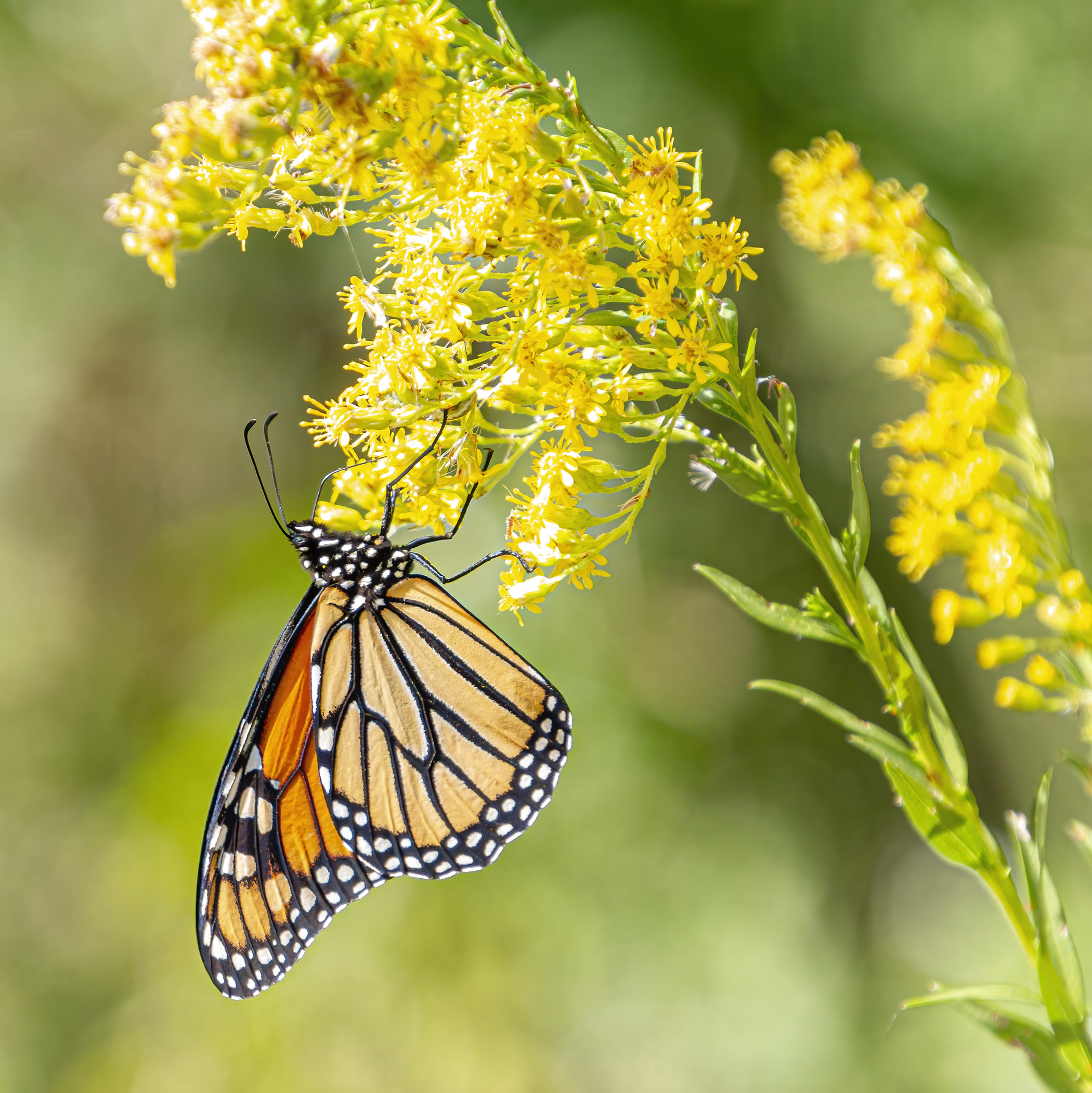
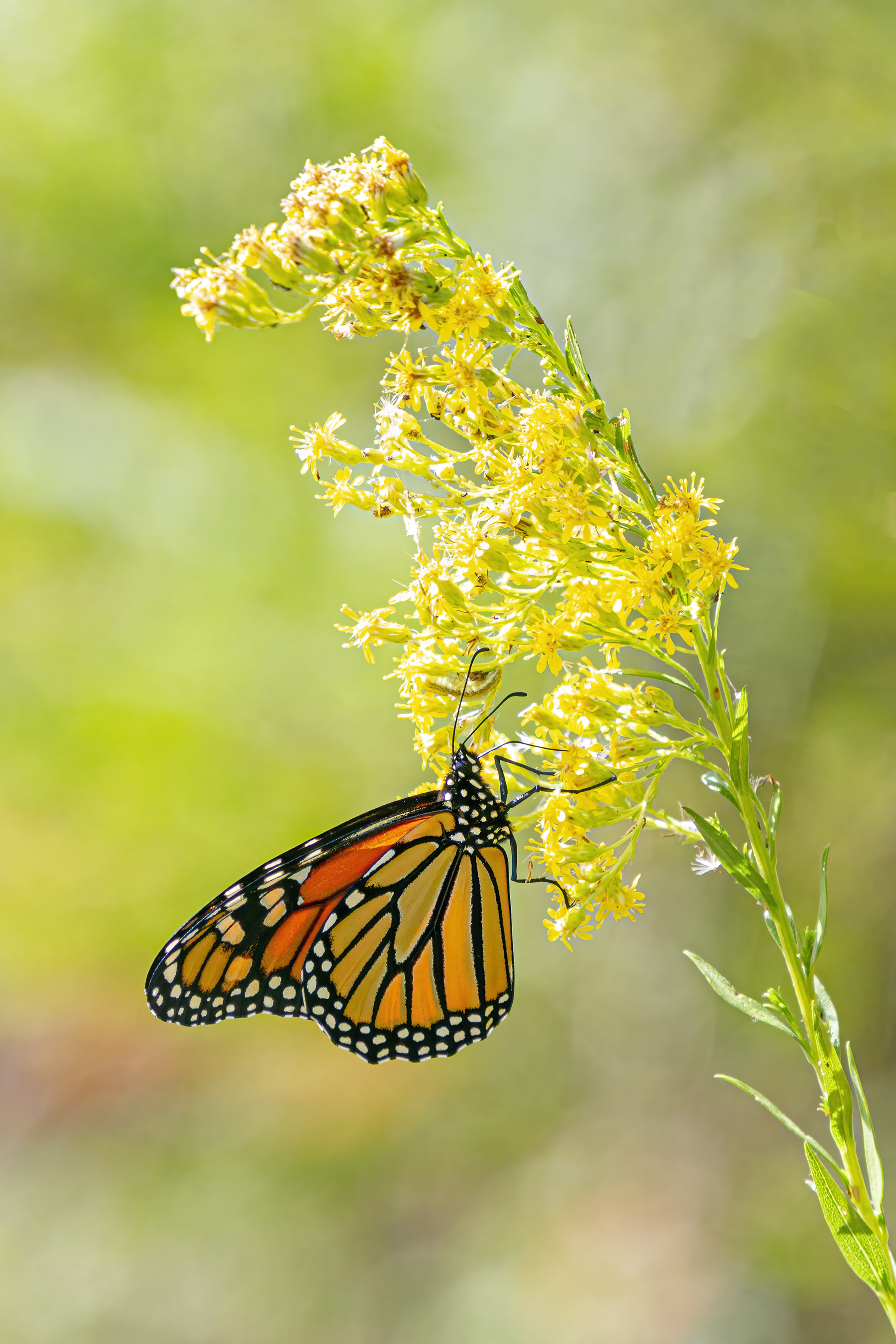
I was delighted this past Wednesday to spot several Monarch butterflies (Danaus plexippus) during a visit to Occoquan Bay National Wildlife Refuge. I often see news stories about Monarchs being threatened or becoming endangered, so I am happy whenever I see some. The ones that I saw looked to be in perfect condition—perhaps they have recently emerged and are preparing for migration.

I tried several different angles when photographing this Monarch. The first photo shows the detail of the butterfly best, but I really like the way that I was able to capture the curve of the vegetation in the second shot by shooting in a vertical format.


Monarch butterfly

Monarch butterfly

© Michael Q. Powell. All rights reserved.

Read Full Post »

Yesterday I was delighted to spot another Blue-faced Meadowhawk dragonfly (Sympetrum ambiguum), one of my favorite dragonflies, while wandering the trails at Occoquan Bay National Wildlife Refuge.  The previous one that I saw earlier this month was perched high in a tree, so it was difficult for me to get a good shot of it.

The newest Blue-faced Meadowhawk, a male, was perched on the ground amid the leaf litter, which is where I usually see this species. I love the way that the fallen leaves provide an instant indication that we are now in the autumn season. The drab brown color of those leaves really helps to make the bright red and blue of this spectacular dragonfly really pop.

It was almost impossible to blur out the background completely, but I got low and carefully chose an angle that makes the clutter a bit less distracting. It turned out that this was the only Blue-faced Meadowhawk, so I was happy that I managed to get some decent shots of this one before he flew away.

Blue-faced Meadowhawk

© Michael Q. Powell. All rights reserved.


Read Full Post »

As we approach the end of September, I am keeping a mental checklist of the dragonflies that I continue to see. Some species have already disappeared for the season. With other species, I see only the tattered survivors. There are a few other species that will remain with for at least another month.

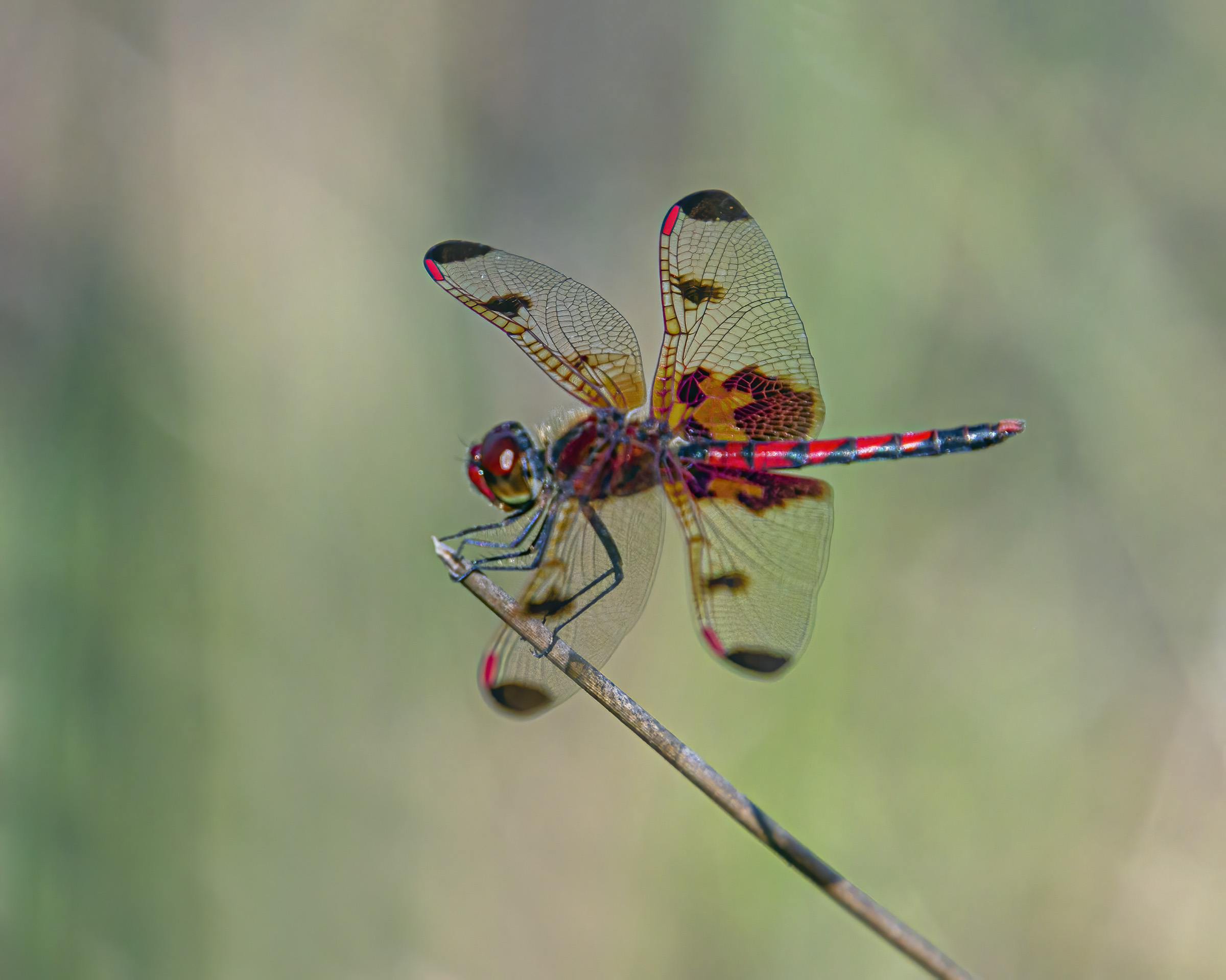
Here are some shots of three of the dragonflies that I saw last Tuesday at Occoquan Bay National Wildlife Refuge. The first one is a colorful male Calico Pennant (Celithemis elisa). We are nearing the normal late date for this species, so I was particularly happy to see this dragonfly.

The second image shows a female Common Whitetail (Plathemis lydia), one of the most common dragonflies in our area. This species is always one of the first to appear in the spring and one of the last to disappear in the autumn.

The final photo shows a male Slaty Skimmer (Libellula incesta) perching in the vegetation at the edge of a pond. This species is probably the most common one that I see right now when I am visiting a pond. I thought about cropping the image a little closer, but decided I really like the pops of pinkish-purple provided by the flowers near the edge of the frame.

There are, of course, other species still around that I have featured in recent postings, such as the Russet-tipped Clubtail, the Blue-faced Meadowhawk, and the Prince Baskettail, as well as several others. I am still searching for my first Autumn Meadowhawk of the season, a small red dragonfly that is often the last species to disappear.  I have seen Autumn Meadowhawks as late as the 3rd of December. If you want a sneak preview of what an Autumn Meadowhawk looks like, check out the December 2018 blog posting of that late sighting.

Calico Pennant

Common Whitetail

Slaty Skimmer

© Michael Q. Powell. All rights reserved.

Read Full Post »

I never realized how much the face of a Russet-tipped Clubtail dragonfly (Stylurus plagiatus) looks like the face of a human—the one in the first photo appears to have a nose, a chin, and even lips. The dragonfly was flying over the pond at Jackson Miles Abbott Wetland Refuge this past Wednesday and I watched it land in the goldenrod at the edge of the water, where I was able to capture the image.

When the Russet-tipped Clubtail was flying, it stayed in the center of the pond and did not come near to the shore, which made it tough for me to capture an in-flight shot. I was thrilled when I managed to capture a long distance shot of the dragonfly and its cool, distorted reflection in the water, as you can see in the second photo below.

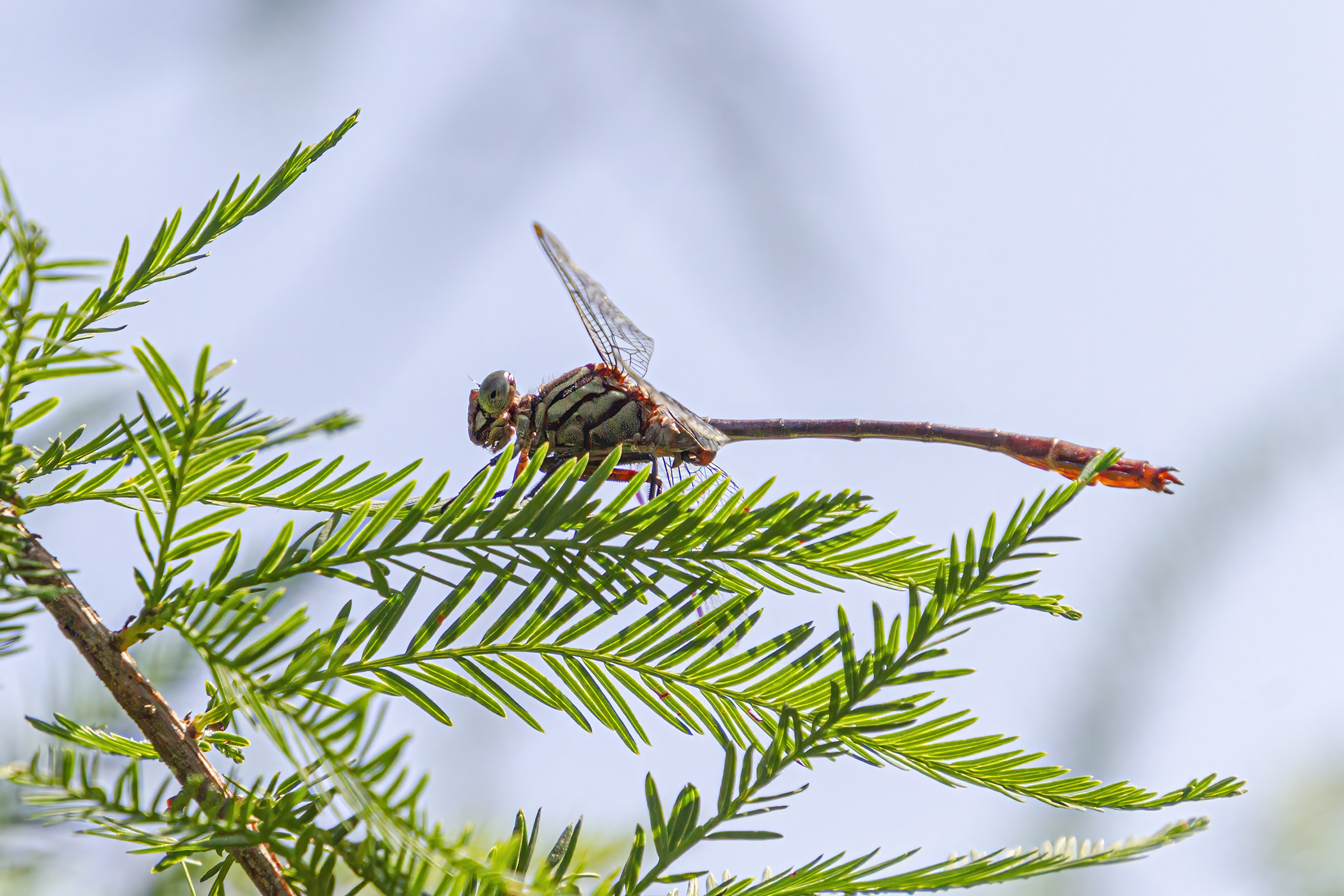
As I was walking around the small pond, I inadvertently flushed another Russet-tipped Clubtail and it flew into a tree. I could see where it was perched, but the lighting was tricky, because I was shooting almost directly into the sun. I liked the interplay of the light and shadows on the leaves of the tree and the way that sunlight illuminated the “tail” (which is technically the abdomen) of the dragonfly, which made for a nice environmental portrait.

Generally I consider myself lucky if I have a single encounter with a dragonfly like this, so it felt amazing to have multiple encounters with the Russet-tipped Clubtails and multiple chances to capture some beautiful images.

Russet-tipped Clubtail

Russet-tipped Clubtail

Russet-tipped Clubtail

© Michael Q. Powell. All rights reserved.

Read Full Post »

I was a little surprised on Wednesday to see a Prince Baskettail dragonfly (Epitheca princeps) flying over the pond at Jackson Miles Abbott Wetland Refuge—I thought they were all gone by now. There were not too many other dragonflies around, so I concentrated on trying to capture in-flight shots of this elusive dragonfly that I never saw perch.

Photographing dragonflies while they are flying is a huge challenge for both my skill and my patience. I had a general idea of the area in which this dragonfly was flying as he flew repeatedly over a patch of lily pads. However, his specific flight path varied a lot and he often changed directions without warning.

Most of my photos were blurry or did not contain my subject, but I eventually managed to get a few decent shots of the Prince Baskettail. The first one is the sharpest, but it does not give you much of a sense of the environment in which the dragonfly was flying. The second shot has a bit of blur, but I really like the background pattern of the water of the pond. The dragonfly was flying away from me when I took the final photo, but I like the way that the image shows the pond vegetation and the tiny perched Eastern Amberwing dragonfly in the foreground was a nice bonus.

Prince Baskettail

Prince Baskettail

Prince Baskettail

© Michael Q. Powell. All rights reserved.


Read Full Post »

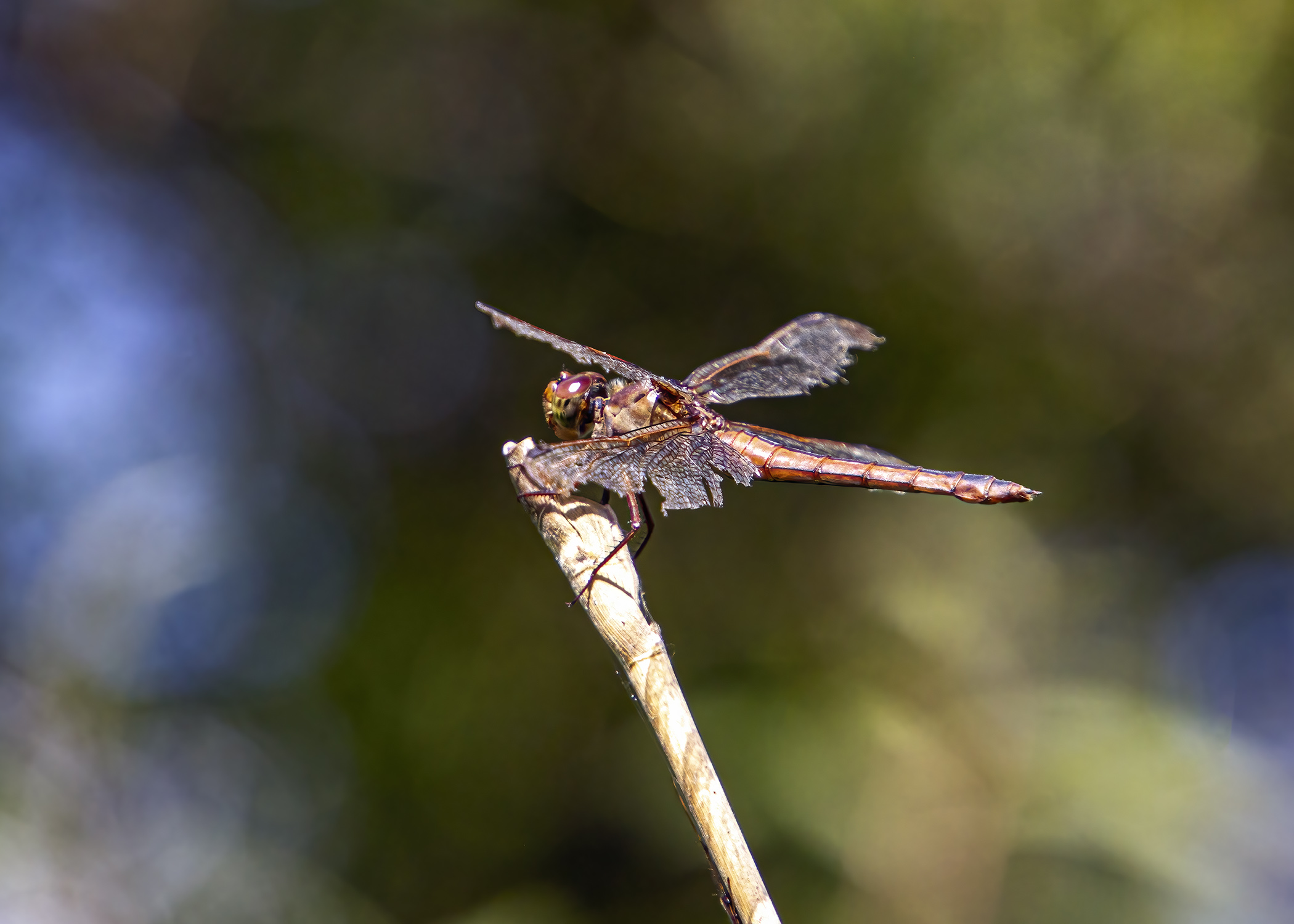
The season has ended for many dragonflies—many of the species that were present a month ago are now gone. From time to time, though, I will see a few strong survivors who are hanging on, like this female Needham’s Skimmer (Libellula needhami) that I spotted last week at Occoquan Bay National Wildlife Refuge. Though her wings are almost completely shredded, she still manage to fly, when necessary.

She somehow seemed to be content to turn to the light and enjoy the warmth of the sunlight, determined to enjoy life’s simple pleasures in her remaining days.

Needham's Skimmer

© Michael Q. Powell. All rights reserved.

Read Full Post »

It may come as a surprise to many readers of this blog that my favorite insect is not a dragonfly—it is the Handsome Meadow Katydid (Orchelimum pulchellum). I still recall the first time that I encountered a Handsome Meadow Katydid ten years ago and the resulting double take—I could not believe what my eyes were seeing. It was love at first sight. The bright rainbow colors of the body were astonishing and seemed so unreal that one of my friends wondered if I had colorized a photo that I had posted.

It is the eyes, though, that make this insect so attractive for me. There is just something so alluring about those blue eyes, eyes that I don’t expect to see in an insect.

I spotted this Handsome Meadow Katydid on Tuesday at Occoquan Bay National Wildlife Refuge. It was hopping about in the vegetation and I was thrilled when it finally perched on a stalk where I could get an unobstructed shot. I captured images from multiple angles. The first image provides a close look at the colors and details of this cool-looking insect. The second image gives you a look at the incredibly long antennae of the katydid. One of the quickest ways to distinguish between a grasshopper and a katydid is to look at the antennae—grasshoppers have relatively short, thick antennae and katydids’ antennae are often longer than their own bodies.

Do you have a favorite insect? I ask this strange question every few years and only occasionally will I get a response. In the past, some have told me that they like ladybugs or Monarch butterflies. What about you?

Handsome Meadow Katydid

Handsome Meadow Katydid

© Michael Q. Powell. All rights reserved.


Read Full Post »

There has been an explosion of butterflies in the last few weeks in my area. Throughout most of the summer, I felt lucky when I managed to spot a few large, colorful butterflies.  All of the sudden I am seeing lots of butterflies in multiple locations at Occoquan Bay National Wildlife Refuge.

Here are a few of my favorite butterfly shots from a visit to the wildlife refuge last Friday. Quite often I will focus on a single species in a blog posting, but in this case I like the way that these three images work as a set that highlights the beauty and diversity of these wonderful creatures that I was blessed to photograph that day.

The butterfly in the first image is a Monarch (Danaus plexippus); the butterfly in the second image is a Zebra Swallowtail (Eurytides marcellus); and the butterfly in the third image is a Black Swallowtail (Papilio polyxenes).

I like each of the photographs for different reasons, but, if pressed, I would probably say that the final one is my favorite. Do you have a favorite?

Monarch butterfly

Zebra Swallowtail

Black Swallowtail

© Michael Q. Powell. All rights reserved.


Read Full Post »

Hummingbird Clearwing Moths (Hemaris thysbe) act a lot like hummingbirds. With rapidly beating wings, they both hover and fly from flower to flower seeking nectar. Instead of a beak like a hummingbird, however, a Hummingbird Clearwing Moth has a long proboscis that rolls out of its coiled tube to reach the nectar deep inside flowers.

Normally when I get shots of a hummingbird moth, its proboscis is fully extended and the moth is sucking up nectar through this flexible hollow tube. On Monday, I was delighted to capture this first image in which the moth’s proboscis was still curled up as it approached a thistle in bloom. The second image shows the Hummingbird Moth actively feeding through the proboscis.

From the first moment when I encountered one, I have been fascinated by these curious creatures. They seem almost magical, combining characteristics of different species, or perhaps mythical, like a centaur or a sphinx. It is always fun to observes a Hummingbird Moth in action, but you have to react quickly to get shots when you see them, because they are really fast and in constant motion.

Hummingbird Clearwing Moth

Hummingbird Clearwing Moth

© Michael Q. Powell. All rights reserved.
Read Full Post »

Summer dragonflies continue to hang in there as we approach the September Equinox next week that for many marks the start of fall in the Northern Hemisphere and spring in the Southern Hemisphere—some places alternatively use the meteorological calendar in which autumn begins on the 1st of September in the Northern Hemisphere. This year the equinox arrives on Thursday, 22 September.

Last Friday I was delighted to see colorful Calico Pennant dragonflies (Celithemis elisa) as I explored Occoquan Bay National Wildlife Refuge. Calico Pennants are small in size—about 1.3 inches (33 mm) in length—but are among the most brightly colored dragonflies in my area. Adult males are bright red in color, as you can see in the first two photos, and females (and immature males) are bright yellow in color. Both genders have wonderfully intricate patterns on their wings.

I have noticed that the overall number of dragonflies has been dropping of later and I am mentally keeping track of which species are still around. In another month or so, most will be gone and I expect to see primarily Autumn Meadowhawks, Blue-faced Meadowhawks, and hopefully some Fine-lined Emeralds, a relatively uncommon late summer /early fall species that is found on coastal plains that include my favorite wildlife refuge.

Calico Pennant

Calico Pennant

Calico Pennant

© Michael Q. Powell. All rights reserved.

Read Full Post »

Damselflies in the genus Argia are known by the rather whimsical name of dancers, because of the distinctive jerky form of flight they use, in contrast to the straightforward direct flight of bluets, forktails, and other pond damselflies. This past Monday I was delighted to spot this male Blue-fronted Dancer damselfly (Argia apicalis) while I was exploring at Occoquan Bay National Wildlife Refuge.

I have seen this species at other locations, but I think that this is the first time that I have spotted one at this refuge. Normally I have trouble identifying damselflies, because so many of them are similar in appearance, with multiple variations of black and blue. Blue-fronted Dancers, however, are quite distinctive because their thoraxes are almost completely blue, with only hairline black stripes on the shoulders and the middle of the back.

I like the way that the stems of the plants are arrayed in a linear, almost geometric pattern that adds visual interest to the background without distracting too much attention from the primary subject. The bright pops of blue on the damselfly really help to make it stand out from the primarily green background.

Blue-fronted Dancer

© Michael Q. Powell. All rights reserved.
Read Full Post »

It is almost autumn, late in the season for most dragonflies. For many of them, their bright colors have faded and their wings are growing increasingly tattered. Yet somehow their beauty still shines through in their mature days.

With dragonflies, as with people, I am often drawn to their eyes, the so-called “window to the soul.” Dragonflies have such striking eyes and I invariably feel myself being pulled in as I gaze into them.

This past Monday I photographed several female Great Blue Skimmer dragonflies (Libellula vibrans) as I wandered the trails at Occoquan Bay National Wildlife Refuge. In both of the photos below, the beauty of the dragonfly’s eyes really shows through. I encourage you to click on the images and you too can marvel at the wonderful colors and patterns of those eyes.

Our society tend to focus on youthful external beauty, which will inevitably fade. True beauty, I would argue, is not dependent on age—it depends more on the perspective of the beholder. If you look for beauty, you will find it for it is present all around us—beauty is everywhere.

Great Blue Skimmer

Great Blue Skimmer

© Michael Q. Powell. All rights reserved.
Read Full Post »

The sunlight was a bit harsh, but I actually like the way that it turned the background white, drawing even greater attention to the beautiful Viceroy butterfly (Limenitis archippus) that I spotted last week at Occoquan Bay National Wildlife Refuge.

Every now and then I will take a shot, like this one, that turns out more “artsy” and stylized than my “normal” shots. It’s hard to explain, but this simple photo really appeals to me.

Viceroy

© Michael Q. Powell. All rights reserved.

Read Full Post »

Throughout most of the summer I have seen very few large butterflies. Recently, though, I have been seeing them in greater numbers. I do not know if this is somehow linked to the blooming of the thistle plants, but I have spotted numerous butterflies in patches of this plant during recent visits to Occoquan Bay National Wildlife Refuge.

Last week I spotted this beautiful Eastern Tiger Swallowtail butterfly (Papilio glaucus) high atop a plant and I captured the first image with the sky in the background. The second image is linked to a short video I captured yesterday of a Monarch butterfly (Danaus plexippus). Most of the time I tend to associate Monarchs with milkweed, but this one sure seemed to be enjoying the thistle flower. Before long, it should begin its migration and perhaps this was part of the fueling process.

I am still experimenting with taking short videos with my iPhone and once again posted the video to YouTube. I have started a little channel on YouTube and have already posted a number of short clips, primarily of butterflies, bison, and butterflies, some of them with music tracks as accompaniment—I inserted some copyright free piano music, for example, in the Monarch video below. I have also experimented with some slightly longer compilations of clips with voiceover narration. Check out my channel Mike Powell if you are at all curious to see and hear what I have done so far.

Eastern Tiger Swallowtail

© Michael Q. Powell. All rights reserved.


Read Full Post »

I was delighted to spot this beautiful female Calico Pennant dragonfly (Celithemis elisa) last Tuesday at Occoquan Bay National Wildlife Refuge. She was perched high in the vegetation and tolerated my presence pretty well, which permitted me to get shots from several angles. I love the way that the feet and the wings are in slightly different positions in each shot, as she adjusted her position to maintain her balance.

Calico Pennant

Calico Pennant

Calico Pennant

© Michael Q. Powell. All rights reserved.

Read Full Post »

You can’t get much more basic than this shot of a Blue Dasher (Pachydiplax longipennis), one of the most common dragonflies where I live, that I spotted last Tuesday at Occoquan Bay National Wildlife Refuge.. I find, though, that there is a really beauty in that simplicity that allows me to immerse myself in the details of my subject.

I am able to notice the two-toned eyes, the pattern on the abdomen, and the yellowish portions of the legs where they are connected to the body. Even the perch, which I think is stalk of Eastern Gamagrass (Tripsacum dactyloides), has fascinating details.

Beauty is everywhere.

Blue Dasher

© Michael Q. Powell. All rights reserved.

Read Full Post »

This looks like such a tranquil scene, with two dragonflies of different species sharing a prime perch on a branch overhanging the pond at Jackson Miles Abbott Wetland Refuge, a moment of peaceful coexistence. However, I had been watching these two dragonflies for an extended period of time and knew that the moment of sharing was the exception rather than the rule.

The male Slaty Skimmer dragonfly (Libellula incesta) on the left and the male Swift Setwing (Dythemis velox) had been repeatedly challenging each other for sole possession of the perch. Whenever one of them would perch on the end of the branch, the other dragonfly would fly straight at the one that was perched, attempting either to dislodge the interloper or at least convince him to fly away.  They went back and forth like this for quite a while, alternating possession, though I think the Slaty Skimmer, the larger of the two, held onto the branch for a longer period of time than the Swift Setwing.

I tried to capture them “buzzing” each other, but timing was really tricky and it was almost impossible to keep them both in focus. The second image below is my best effort in showing their interaction. I was low to the ground when I took the shot and really like the perspective with the sky in the background. If you look closely at the lower left corner of the second photo, you may notice that a long-jawed spider was also sharing the perch with the two dragonflies.

coexistence

coexistence


© Michael Q. Powell. All rights reserved.

Read Full Post »

Black Saddlebags dragonflies (Tramea lacerata) are one of a dozen or so dragonfly species in North America that migrate. Not surprisingly they are strong fliers and most of the time when I see one, it is flying high overhead—they do not seem to perch very often.The dark patches on their hind wings, which someone thought resembled saddlebags, are so distinctive that it is pretty easy to identify a Black Saddlebags when I see one in the sky.

As I was exploring Occoquan Bay National Wildlife Refuge on Tuesday, I spotted a dragonfly as it zoomed by me and watched it land low in the vegetation. I moved forward as stealthily as I could and was delighted to see that the perching dragonfly was a Black Saddlebags. The background was quite cluttered, but I managed to find a clear visual path to the dragonfly and was delighted to capture this detailed image—I encourage you to click on the photo to see the beautiful markings on the abdomen and the distinctive “saddlebags.”

If you want to learn more about this particular species, I recommend an article from the University of Wisconsin at Milwaukee entitled “Black Saddlebags Dragonfly (Family Libellulidae).” Among other things, you will learn that for Black Saddlebags dragonflies, “Mating is brief if done aerially [the ultimate multitasking] and only slightly longer if the pair is perched.”

Black Saddlebags

© Michael Q. Powell. All rights reserved.

Read Full Post »

As I approached a patch of thistle in bloom on Tuesday, I was looking carefully to see if there were any butterflies feeding on the flowers. Suddenly I noticed a flash of bright red and realized immediately that it was a Hummingbird Clearwing Moth (Hemaris thysbe).

Hummingbird Clearwing moths, which actually do resemble hummingbirds as they dart among the flowers, hovering periodically to such nectar, are not exactly rare where I live, but I tend to see them only a few times a year. Fortunately I reacted quickly enough to capture this image, because the moth flew out of sight after it had finished feeding on this flower.

For shots like this, the wing position is really important and I was thrilled that I was able to capture the wings fully extended, which highlights the transparent portions of the wing responsible the common name of this species. The details of the moth and the thistle are pretty sharp and the background is blurred enough that it is not a distraction—I like this shot a lot.

Hummingbird Clearwing Moth

© Michael Q. Powell. All rights reserved.


Read Full Post »

Here are some shots of Russet-tipped Clubtail dragonflies (Stylurus plagiatus) that I photographed at Jackson Miles Abbot Wetland Refuge last Saturday. The first image shows a male perched in an evergreen tree. Sharp-eyed views may recognize this tree, which is the same one on which yesterday’s Common Green Darner was perched.

The second image shows a female Russet-tipped Clubtail in some vegetation. If you compare the tip of her abdomen (the “tail”) with that of the first dragonfly, you can readily see they they are different. That is one of the reasons why the terminal appendages of a dragonfly are a key identification feature in determining the gender of an individual. You can’t help but notice that her left hind wind is almost completely shredded. I suspect that she can still fly, albeit with some difficulty.

The final shot shows a male in flight over the pond at the refuge. This is the first time that I have gotten an identifiable shot of this species in the air. I actually did not realize that it was a Russet-tipped Clubtail when I took a burst of shots of then flying dragonfly. I had simply reacted instinctively when I spotted the dragonfly—if it’s flying, I’m trying. It was a pleasant surprise when I opened the images on my computer and realized what I had captured.

There are a few species that emerge in September, so this year’s dragonfly season is far from over. Tomorrow marks the start of a new month, a month that I hope will be full of new opportunities for me and for all of you.

Russet-tipped Clubtail

Russet-tipped Clubtail

Russet-tipped Clubtail

© Michael Q. Powell. All rights reserved.

Read Full Post »

I was thrilled on Saturday when one of my fellow dragonfly enthusiasts spotted this colorful male Common Green Darner dragonfly (Anax junius) at Jackson Miles Abbott Wetland Refuge and pointed it out to me. Common Green Darners are relatively common, but most of the time when I see them they are patrolling overhead, so it was quite a treat to find one perched.

Common Green Darners are one of the few dragonfly species that migrate. According to Kevin Munroe, creator of the wonderful Dragonflies of Northern Virginia website, “Common Greens seen in our area in early spring are in fact migrants from points south. They emerge in the Southeast and fly north, arriving here late March thru May. After their long flight, they mate, lay eggs and die. Their young emerge in July and August. Congregating in large swarms, this second generation begins flying south in September. They lay eggs that fall, after arriving in their southern destinations, and die. When their young hatch in March, they fly back to Northern Virginia and it starts again—a two generation migration.” Wow!

This dragonfly was hanging on the same evergreen tree where I recently photographed a Russet-tipped Clubtail—see my blog posting entitled “Russet-tipped Clubtail dragonfly.” I guess that I will be checking that tree from now on to see if lightning will strike again. When I am hunting for dragonflies, I tend to return first to places where I have seen them previously and then widen my search. Sometime it pays off, though, as is the case for all wildlife photography, there are certainly no guarantees of success.

Common Green Darner

© Michael Q. Powell. All rights reserved.

Read Full Post »

« Newer Posts - Older Posts »