Feeds:
Posts
Comments

Archive for the ‘Insects’ Category

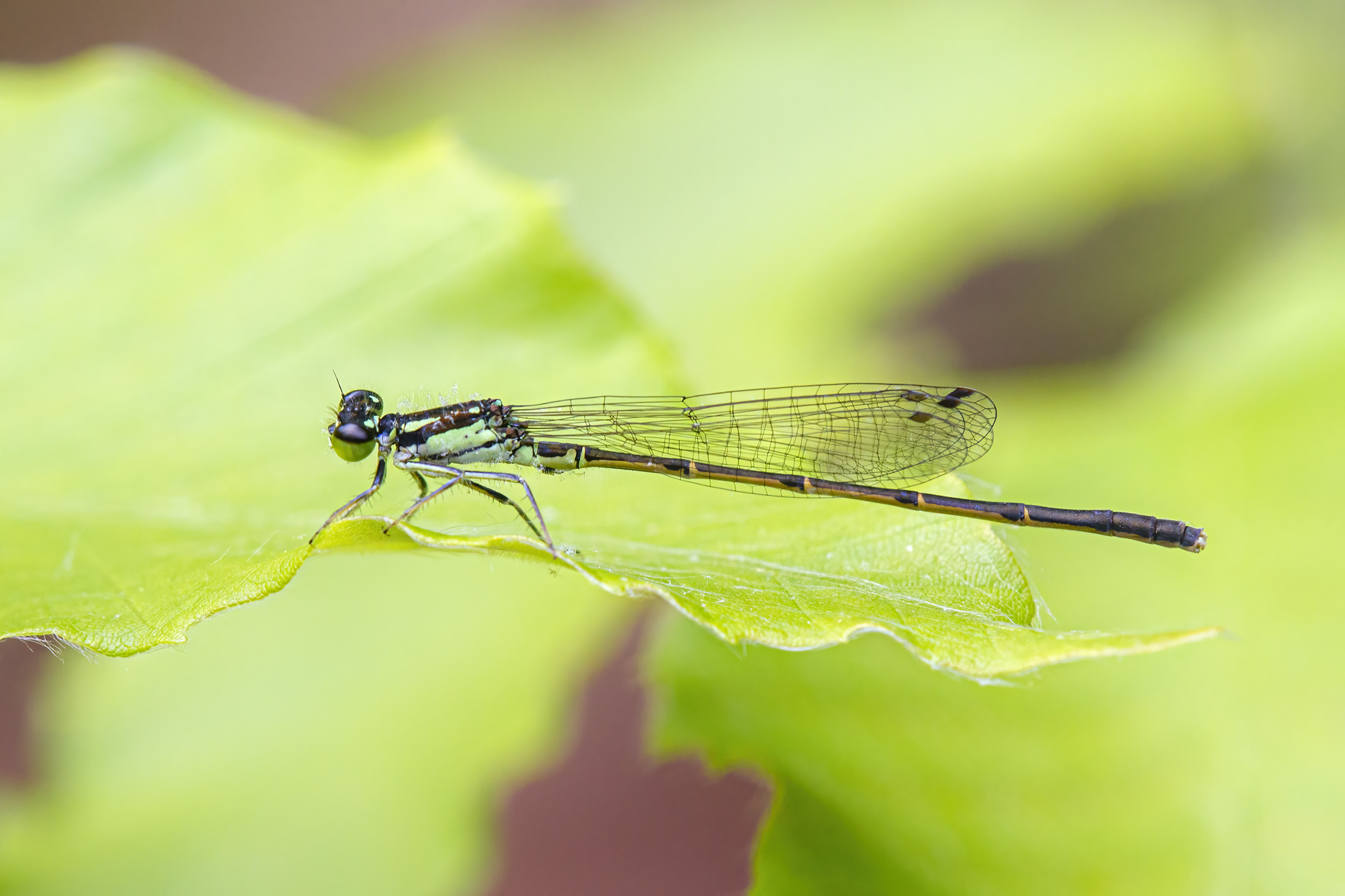
I love to use my macro lenses. There is something almost magical about capturing details on tiny subjects, like this Fragile Forktail damselfly (Ischnura posita) that I spotted this past Monday alongside a pond in Prince William County, Virginia. Fragile Forktails are only about an inch (25 mm) in length, so I had to get pretty close to my subject to “fill the frame,” even with my 180mm macro lens.

One of the biggest challenges when I get this close to a subject is that my depth of field is really shallow, so I risk having a lot of my subject out of focus. In fact, in the majority of my photos of this damselfly, either the eyes or the tip of the abdomen is in focus, but not both. In this kind of situation, the “trick” to having the entire subject in focus is to position myself so that the sensor of my camera is parallel with the plane of the subject.

In this image, you can see that about the only things in focus are the damselfly and the edge of the leaf on which it was perched—the rest of the image is pleasingly blurred. This approach works pretty well with damselflies, which hold their wings above their bodies when perched, but does not work as well with dragonflies, which perch with outstretched wings. As a result, portions of the dragonflies in most of my photos are blurred, though I usually give top priority to keeping their eyes in focus.

Fragile Forktail

© Michael Q. Powell. All rights reserved.
Read Full Post »

I was happy that I managed to get a shot of this tiny butterfly perched low in the vegetation at Occoquan Bay National Wildlife Refuge on Wednesday. I think it may be a Falcate Orangetip (Anthocharis midea), although the butterfly never opened its wings, so I was not able to confirm that the wings were tipped with orange.

I was a bit shocked that I was able to capture so much detail of this tiny creature, given that I was shooting with my Tamron 150-600mm zoom lens fully extended to 600mm. When I bought this lens in November 2014, I remember reading reviews about the lens that stated that it was soft at 600m. That has not really been my experience. If I pay attention to my techniques and use a monopod for additional stability (as I was doing for this shot), I can shots that are acceptably sharp to my eye.

For those of you who are especially geeky, for this shot I was shooting with a Canon 7D at f/8, 1/400 sec, and ISO 800 with an exposure compensation value of minus 1.33 stops. More important than the settings, though, is the fact that I like the image that I managed to capture—that is always my number one priority.

Falcate Orangetip

© Michael Q. Powell. All rights reserved.

Read Full Post »

I tracked this Common Baskettail dragonfly (Epitheca cynosura) in the air for quite some time as it patrolled back and forth along one of the trails at Occoquan Bay National Wildlife Refuge, hoping that it would land. Fortunately I acted quickly when finally it did perch and was able to capture these shots.

The Dragonflies of Northern Virginia website provides the following description of the Common Baskettail, “Small, dark, constantly hovering. Fast, acrobatic flight. Often high above clearings and sunny paths/old roads. Also along pond, stream and river edges.” As you can tell from this description, it is pretty challenging to get a shot of a Common Baskettail dragonfly.

Occasionally I will try to capture an image of a Common Baskettail while it is flying, but that works better when the dragonfly is flying above a pond than when it is flying with a background of vegetation. If you are interested in seeing some shots of Common Baskettails in flight, check out my blog posting from May 2022 entitled “Flying Common Baskettail dragonflies.”

Common Baskettail

Common Baskettail

© Michael Q. Powell. All rights reserved.

Read Full Post »

One of the clear signs that we are moving through spring is the emergence of large numbers of full-sized butterflies. Last week I was delighted to spot multiple Black Swallowtail (Papilio polyxenes) butterflies. Dark swallowtail butterflies can sometimes be problematic for identification, because in our area we have Pipevine Swallowtails, Spicebush Swallowtails, and the dark morph female Eastern Tiger Swallowtail, in addition to the Black Swallowtail.

However, these butterflies were relatively easy to identify, because I could clearly see the black dot inside the orange dot in each of the photos, one of the field markers of a Black Swallowtail. I was quite struck by the unblemished state of each of these butterflies, which seemed to be fresh and bright with fully intact swallowtails. As the season moves on, some of the butterflies will become more and more tattered and faded.

If you are curious about the identifying marks for the different kinds of dark swallowtails, I highly recommend a blog posting by Louisiana Naturalist called Four Dark Swallowtails. In this posting, she does side-by-comparisons of the four species from different angles and points out the visible differences that are really useful in identification.

Black Swallowtail

Black Swallowtail

Black Swallowtail

© Michael Q. Powell. All rights reserved.

Read Full Post »

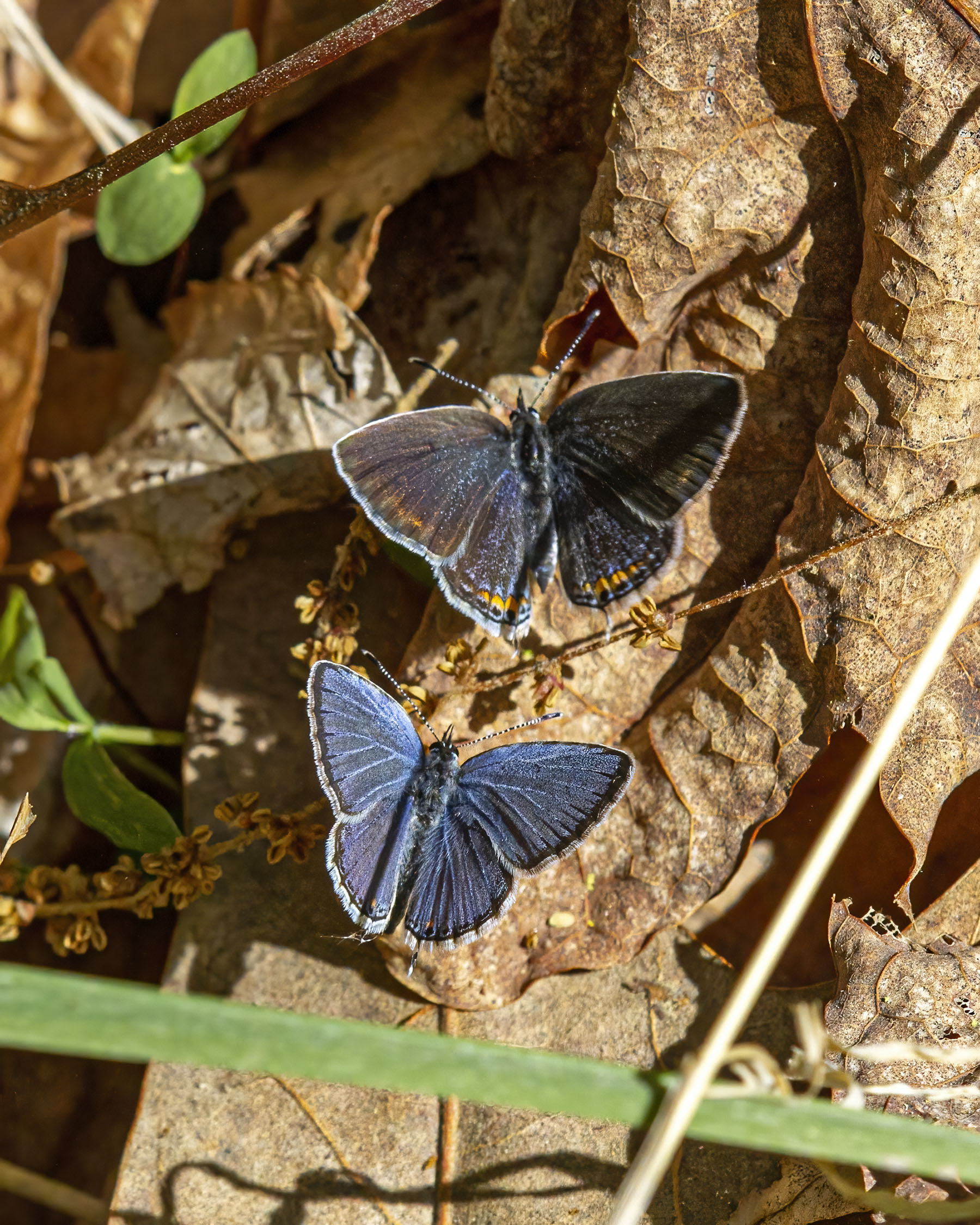
I don’t know much about the courting behavior of Eastern Tailed-blue butterflies (Cupido comyntas), but the male at the bottom of the photo was actively pursuing a female when I photographed them on Wednesday in Prince William County. Eastern Tailed-blues are tiny butterflies, with a wingspan of about an inch (25 mm), so you have to look really closely to see the single narrow tail on each hind wing. When their wings are closed, Eastern Tailed-blues are mostly grayish0-white in color, so it was a real visual treat to be able to capture them with their wings open.

Eastern Tailed-blue

© Michael Q. Powell. All rights reserved.

Read Full Post »

On Tuesday I spotted this female Common Green Darner (Anax junius) dragonfly at Occoquan Bay National Wildlife Refuge, the first darner that I have been able to photograph this season. Like most darners, Common Green Darners are relatively large dragonflies—about 3 inches (76 mm) in length—that spend a lot of time patrolling in the air. In fact, Common Green Darners are one of a handful of dragonflies that migrate, so that the earliest ones that we see in spring are likely to have migrated from more southern locations before local Common Green Darners have emerged.

When I first spotted this dragonfly, she was patrolling over a field of tall vegetation. I watched her fly back and forth for quite a while. When she decided to take a break, I was lucky to see where she landed.

As you can see in the photo, Common Green Darners normally hang vertically. In this case the dragonfly perched relatively close to the ground, so it was a bit of a challenge to frame the shot, particularly because I was shooting with my long telephoto zoom lens. I am quite pleased, though, with the resulting image that shows off a lot of the details of this species, including the distinctive black and blue “bullseye” in from of the dragonfly’s large compound eyes.

Common Green Darner

© Michael Q. Powell. All rights reserved.

Read Full Post »

Different dragonfly species perch in different ways. Some perch high and some perch low; some perch horizontally, others perch at an angle, and others hang vertically.  I am always intrigued to look at the way a dragonfly is perched and, in particular, to see how the dragonfly is using its legs.

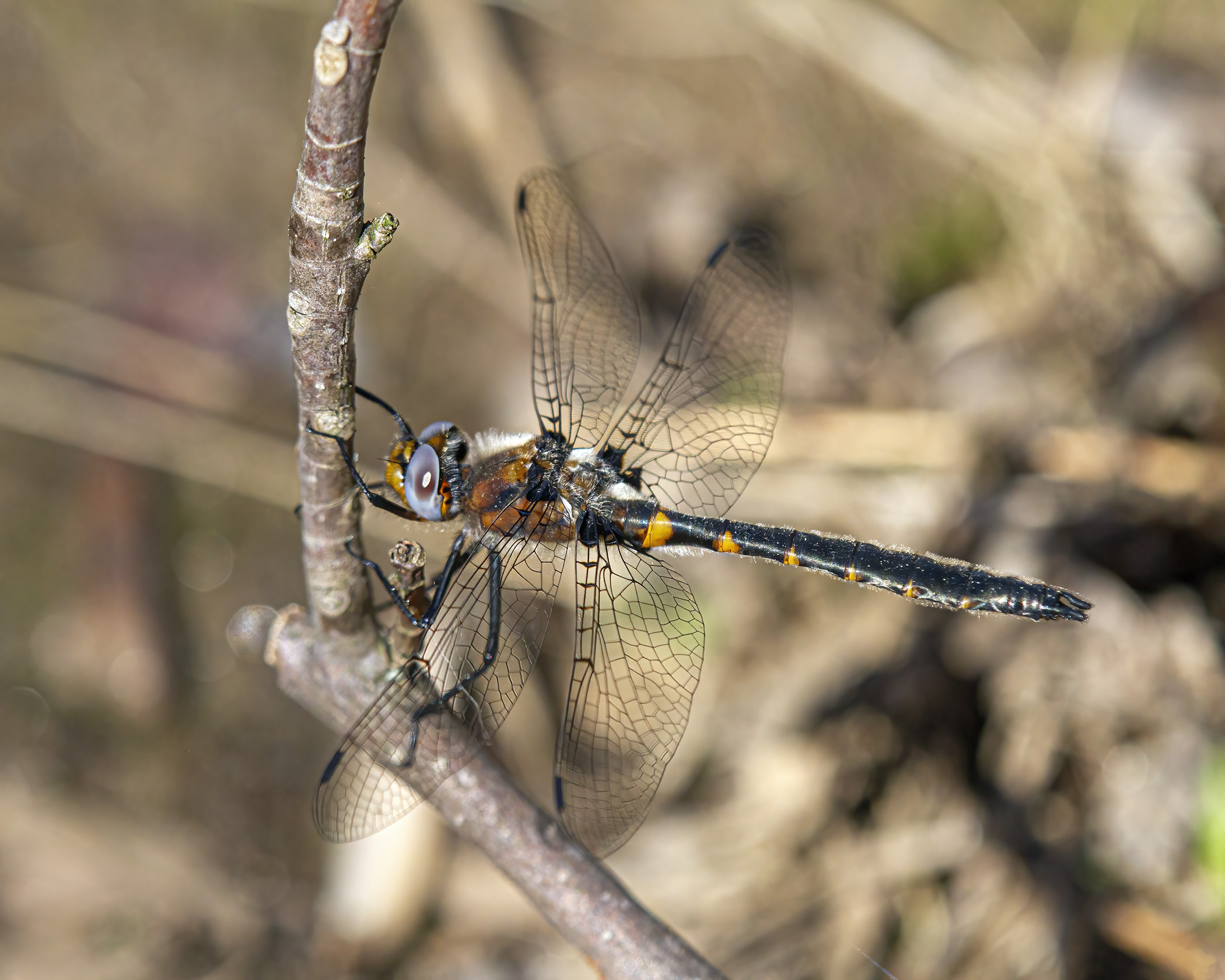
Last week I was delighted to spot a male Stream Cruiser (Didymops transversa) while I was exploring the edge of a creek in Prince William County, Virginia. The Steam Cruiser was perched low in the vegetation at an angle. Stream Cruisers have such long legs that they look somewhat uncomfortable when they are perching.

If you click on the image below, you can get a closer look at the dragonfly’s legs. The dragonfly does not seem to be using its front legs at all to perch and appears to be relying almost exclusively on its middle set of legs. The back set of legs look to be amazing long and are probably more useful for capturing prey than for perching.

Stream Cruiser

© Michael Q. Powell. All rights reserved.

Read Full Post »

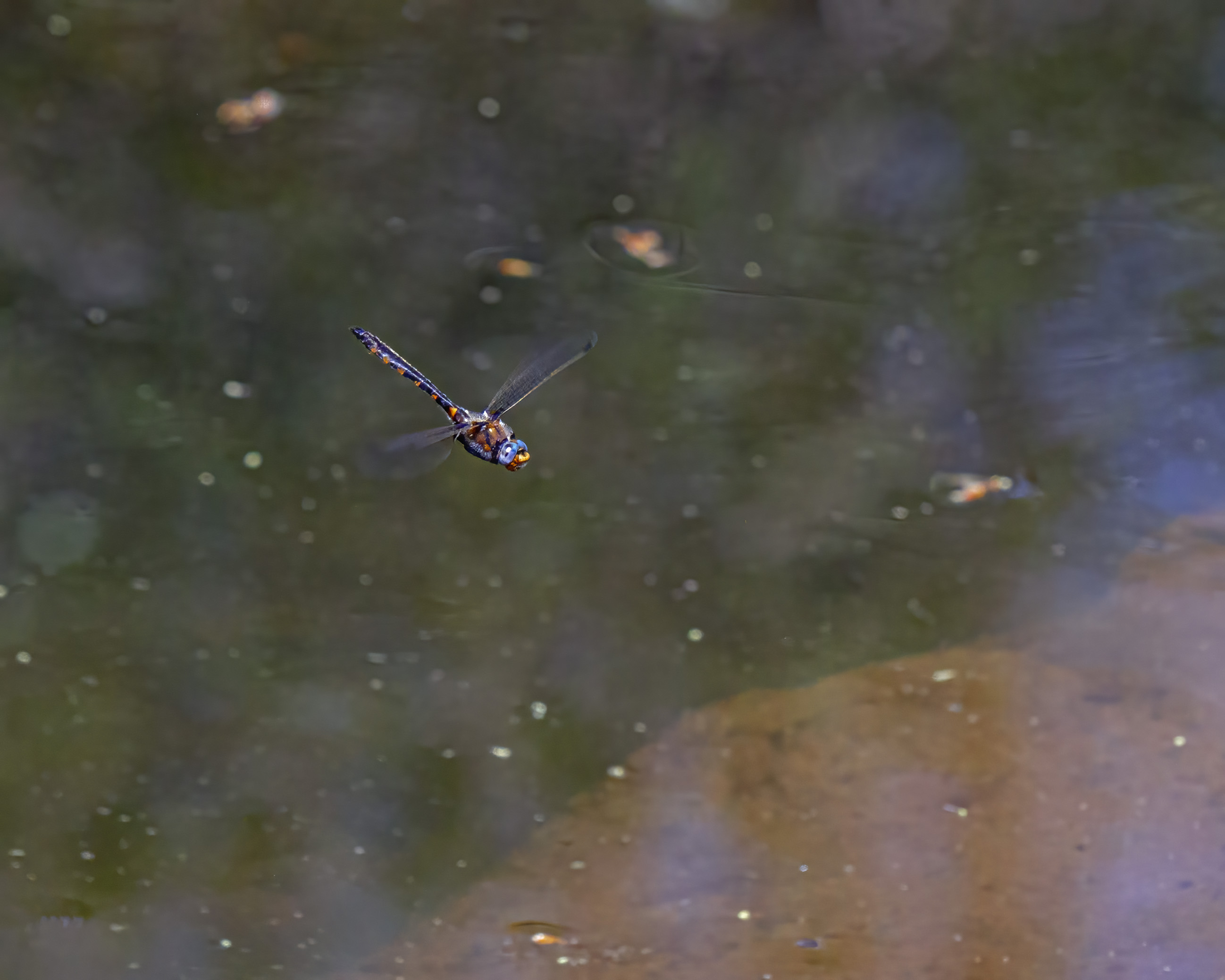
It is almost impossible, but I can’t help but try to capture images of dragonflies in flight. It is arguably the most difficult challenge of my ability to use my camera and also of my patience. None of the dragonflies in these photos flew close to the shores of the streams that I was exploring in Prince William County, Virginia, and I was using only a modest telephoto lens that I was focusing manually—the autofocus on my Tamron 180mm macro lens is relatively slow and could not focus on the dragonflies as they zoomed on by.

Last Wednesday I photographed the dragonfly in the first photo as it was patrolling over a creek. I believe that it is a Uhler’s Sundragon dragonfly (Helocordulia uhleri), which is about 1.8 inches (46 mm) in length. The dragonfly was not exactly following a pattern, but I was able to track it as it flew all around a small section of the creek.

The dragonfly in the second image may also be a Uhler’s Sundragon, though I am less confident of this identification. I really like the fact that the eyes of the dragonfly are in shart focus. It is probably just my imagination, but this dragonfly seemed to glance up at me and smile as it flew on by. In this photo, as in the first one, you really have a sense of the environment in which I found the dragonfly.

I captured the final image on Friday as I was exploring a different creek in Prince William County. The dragonfly in this photo was much larger than the ones in the other photos and was flying much faster and seemed to be conducting patrols over a much longer stretch of the creek. All the image was not completely sharp, I captured enough details to be able to identify it as male Stream Cruiser (Didymops transversa) dragonfly, a species that is about 2.2 inches (56 mm) in length.

Last year I did a short video on YouTube called Impossible Shots? Dragonflies in Flight in which I talked about one of my forays into the field and highlighted my approach to photographing dragonflies. Check it out if you want to see some more shots of dragonflies in flight or if you simply want to hear my voice and see my face. I included a link to the video in the title of the video (which should appear in color and underlined) and am also going to try to paste it into the end of posting, so you don’t have to go to YouTube to watch it. I am still just dabbling in video, but want to try to do more of it this year.

Uhler's Sundragon

Uhler's Sundragon

Stream Cruiser

© Michael Q. Powell. All rights reserved.
Read Full Post »

On Monday I was thrilled to photograph my first dragonfly of the year at Occoquan Bay National Wildlife Refuge, the location that I visit most frequently with my camera. The first prize goes to an immature male Blue Corporal dragonfly (Ladona deplanata)—males turn blue as they mature, but initially they have the same coloration as the females. Blue Corporals of both genders have two light-colored stripes on the front of their thoraxes, the traditional rank military insignia for corporals.

Later in the day I spotted a female Blue Corporal perched on some dry leaves, as shown in the second photo. Can you spot the differences between the dragonflies in the first and second photos? The male abdomen tends to be a bit thinner than the abdomen of the female. However, the biggest difference is in the terminal appendages, i.e. the specific parts at the very tip of their abdomens (their “tails”).

The following day I returned to the refuge and spotted another Blue Corporal perched in some vegetation—I think it is another immature male. Most of the time Blue Corporals like to perch on the ground, but this one looked like it had only recently emerged and may have been waiting for its wings to harden.

When dragonflies undergo their metamorphosis from water-dwelling nymphs to aerial acrobats, their wings are initially very clear and fragile and the creatures are very vulnerable, so I was careful not to disturb the dragonfly when I took a few photos. If you are interested to learn more, check out a 2016 blog posting  Metamorphosis of a dragonfly in which I documented the entire transformation process of a Common Sandragon dragonfly in a series of 15 photos. At the end of that series you will be able to see why I characterized the wings of a newly-emerged dragonfly as “fragile.”

Blue Corporal

Blue Corporal

Blue Corporal

© Michael Q. Powell. All rights reserved.

Read Full Post »

I was extremely happy yesterday to encounter several Twin-spotted Spiketail dragonflies (Cordulegaster maculata) during a visit to Occoquan Regional Park, a county-run recreational park in Lorton, Virginia. In the past I have occasionally seen Twin-spotted Spiketails at this location and I went there specifically to look for this species—I was hopeful, but realistic in my expectations of finding this relatively uncommon dragonfly.

Spiketails are a small family of large black or brown dragonflies with similar bright yellow stripes on their thoraxes and species-specific makings on their abdomens. Females have a spike-like pseudo-ovipositor at the end of their abdomens that is responsible for the “spiketail” name.

When I first encountered a spiketail yesterday, it was flying in the air and I was not sure what kind of dragonfly it was. Fortunately I was able to see where it landed and when I got closer, I was ecstatic, because I could actually see the dragonfly’s “spike,” as you can see in the first photo.

There are several other spiketail species in our area, but the Twin-spotted Spiketail is the only one that is flying this early in the season. The flight season for most of the early season dragonflies lasts for only a month or so, so I try to spend as much time outdoors as I can during April and May to maximize my chances of seeing these uncommon species. As you can probably judge, from the first photo, Twin-spotted Spiketails are large, almost 3 inches (76 mm) in length. Although you can’t really seen the markings in the first photo, there are a paired yellow spots or rounded triangles along the length of the abdomen.

I decided to hang around the area where I spotted the first spiketail to see if others would fly by and my patience was rewarded. I was able to capture shot of several other Twin-spotted Spiketails as you can see in the second and third photos. Both of these spiketails are males, I believe, and therefore do not have the visible “spike.” In those photos, though, you get a pretty good view of the pattern of the paired spots, which is why the species is called “twin-spotted.”

This dragonfly season is starting out with a bang and I feel blessed to have photographed several uncommon species already. Temperatures today are forecast to rise to about 84 degrees (29 degrees C) and I plant to continue my search for beautiful and elusive aerial acrobats, like these Twin-spotted Spiketails.

Twin-spotted Spiketail

Twin-spotted Spiketail

Twin-spotted Spiketail

© Michael Q. Powell. All rights reserved.


Read Full Post »

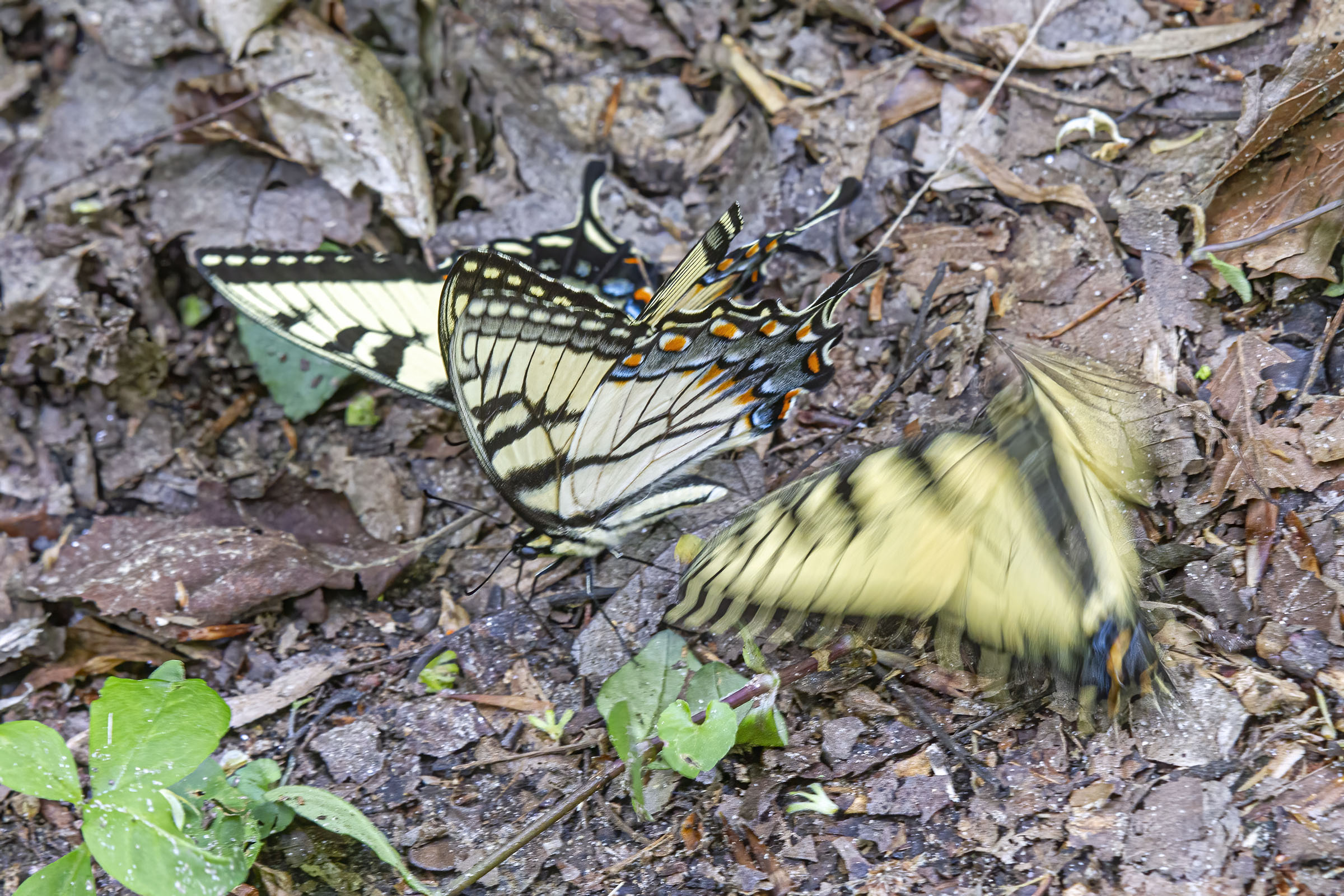
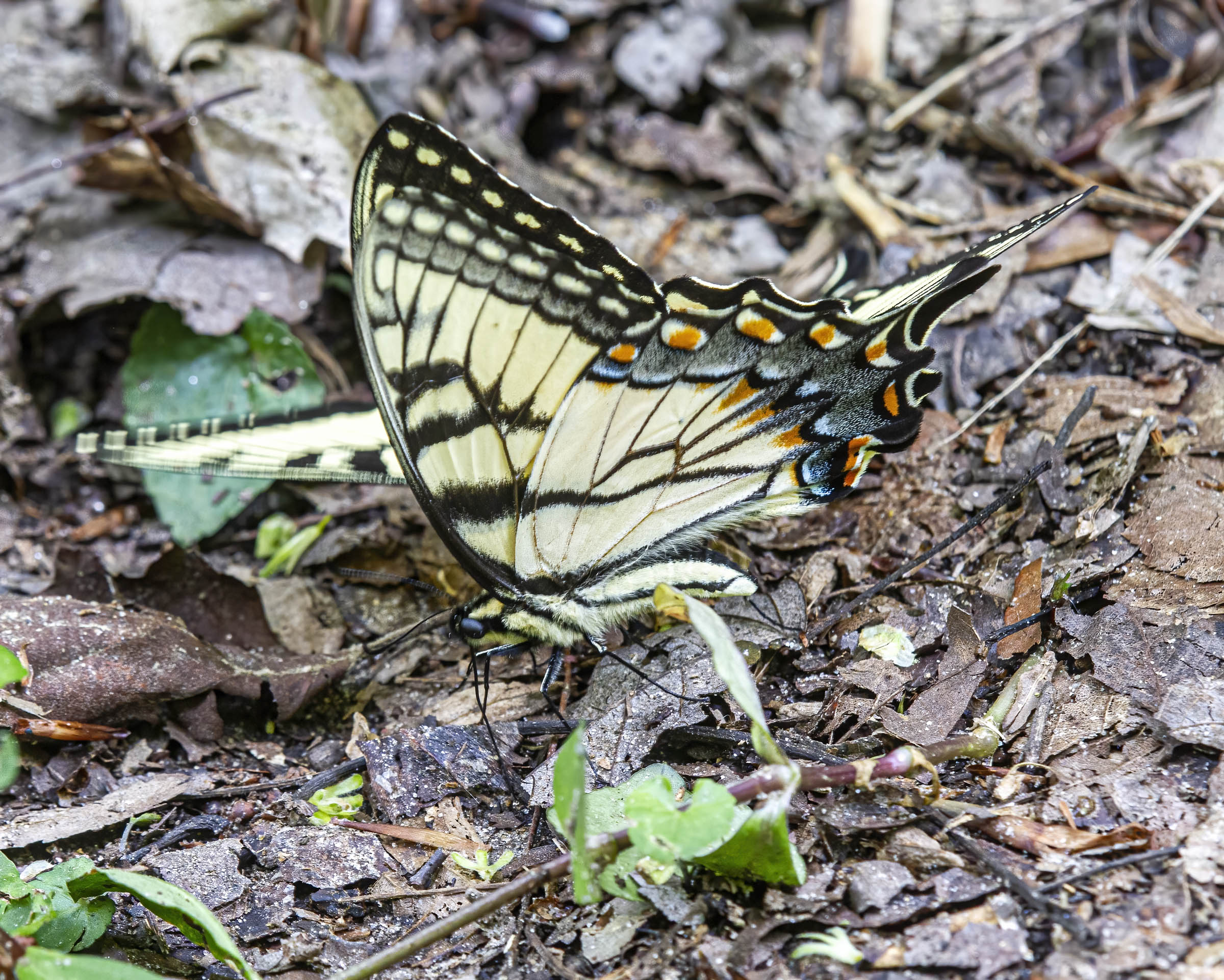
Yesterday was a beautiful spring day and I was delighted to capture this image of a Zebra Swallowtail (Eurytides marcellus), one of my favorite butterflies, at Occoquan Bay National Wildlife Refuge. I chased after this hyperactive butterfly and luckily was close enough to get a shot when it landed for a split second. I love the touches of red and blue on this mostly monochromatic butterfly and its distinctive long “tails.”

As I was doing a little research on this butterfly, I discovered that the Zebra Swallowtail has two seasonal forms, one occurring in the spring and the other in the summer. According to Wikipedia, the spring forms are smaller, more white, and have short, black tails with white tips. As you can see from the first photo below, yesterday’s Zebra Swallowtail was a spring form butterfly.

Summer forms of the Zebra Swallowtail are larger, have broader black stripes, and longer, black tails with white edges. For the sake of comparison, I reprised a photo from a 6 September 2021 blog posting. The butterfly in the second photo, a summer form butterfly, indeed looks darker than the one in the first photo and there are noticeable differences in the shape and coloration of the tails.

Zebra Swallowtail

Zebra Swallowtail

© Michael Q. Powell. All rights reserved.

Read Full Post »

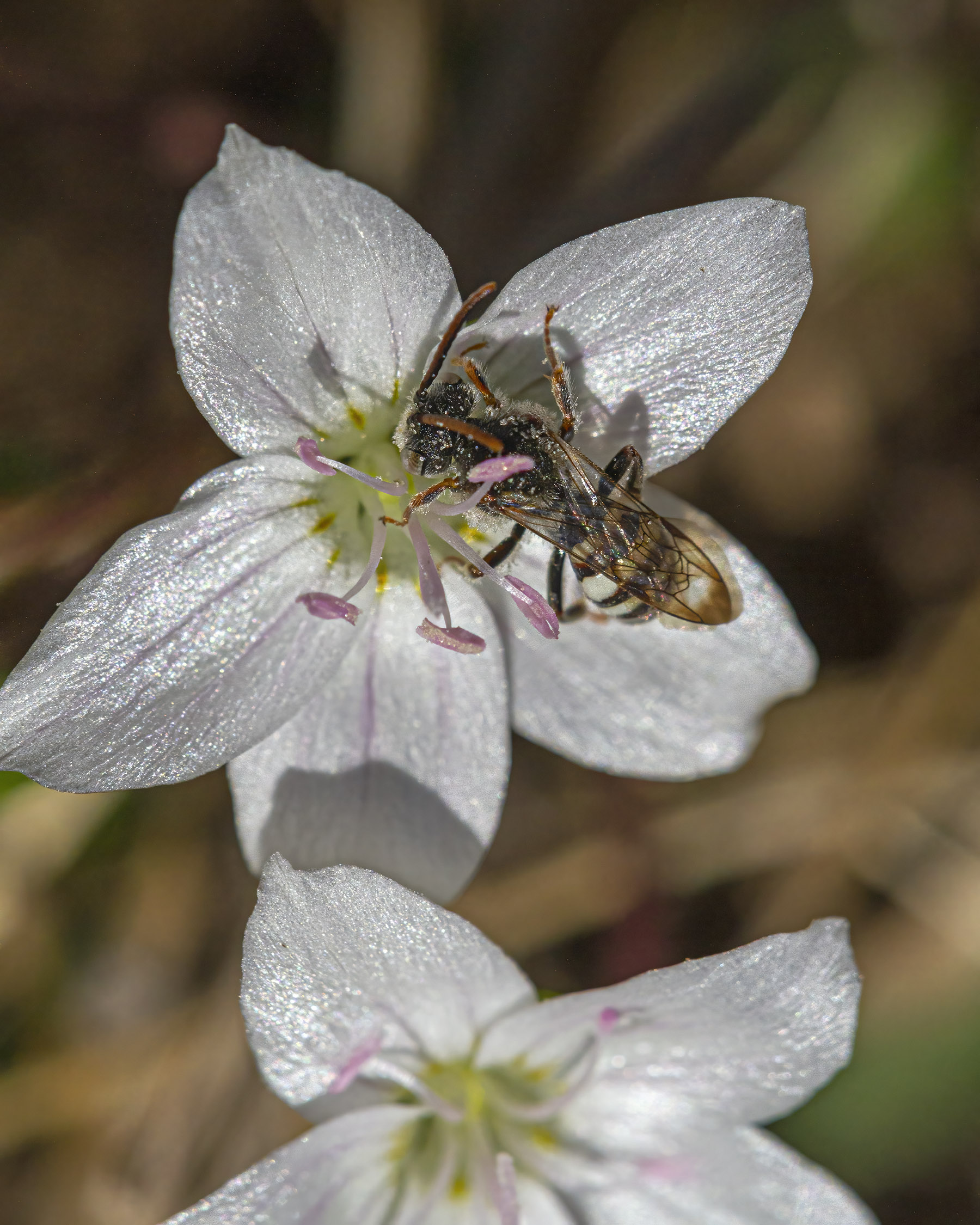
Early spring wildflowers, like the Virginia Spring Beauty (Claytonia virginica), are an important source of food for a host of small bees and other insects. Many insects gather pollen from these flowers and in doing so help to pollinate the plants.

Some species of bees, though, lack  scopa (the pollen-collecting hairs) and do not collect pollen to feed their offspring. The genus Nomada, according to Wikipedia, is the largest genus of kleptoparasitic bees sometimes referred to as “cuckoo bees.” Kleptoparasitic bees are so named because they enter the nests of a host and lay eggs there, stealing resources that the host has already collected.

It is a little hard to see the body of the bee in the photo below, but if you look closely you can see its striped abdomen, which is wasp-like in appearance. I was not sure of the type of bee, so I posted it to BugGuide, a useful resource for insect identification, and one of the experts there identified the bee as belonging to the genus Nomada.

cuckoo

© Michael Q. Powell. All rights reserved.
Read Full Post »

Have you ever looked closely at a dragonfly’s legs? A dragonfly has six legs that are attached in pairs to its thorax. The main parts of the leg are the upper leg or femur, the lower leg or tibia, and the foot or tarsus, which is made up of three segments and ends with a pair of claws. The legs are covered with spiky hairs and fulfill a variety of functions, including perching, catching and holding onto prey, and cleaning its mouth and eyes.

The first photo is a close-up view of a Uhler’s Sundragon (Helocordulia uhleri) that I spotted on 4 April near a creek in Prince William County, Virginia. You get a really good view of one of the middle legs of the dragonfly, including the way that it bends at two joints and the way the tiny claws are used to hold onto the perch. I can’t be sure, but I believe that the dragonfly may be using one of its front legs to wipe its large compound eye. If you click on the photo, you can see some of the thousands of ommatidia, the faceted optical units that allow a dragonfly to see in almost 360 degrees around itself.

In the second photo, you can see that the sets of legs are of different lengths. The back legs, which are the longest, are the ones that are most often used to catch and subdue prey. The front leg nearest us, does not seem to be used and the moment for perching and the “elbow” appears to be touching the eye. At first I thought that this was merely an awkward perch, but the more I look at the photo, the more I think that the dragonfly is cleaning its eye.

The final photo, which was actually the first of these photos that I took, shows the entire body of the Uhler’s Sundragon. The Uhler’s Sundragon is visually similar to the Selys’s Sundragon, the first dragonfly that I spotted this year, with the notable difference that the Uhler’s Sundragon has little orange patches at the base of its wings, as you can see in the photo, that are not present with the Selys’s Sundragon. If you look at the front legs, it appears to me that the dragonfly was using both of them initially for perching—its “elbow” does not appear to bent as it was in the middle photo.

This post was a little more “geeky” than usual, delving deeper into dragonfly anatomy than I usually do. I think it is fascinating to try to observe and understand the behavior that I see in my subjects and hope that you may also find these details to be somewhat interesting.

Uhler's Sundragon

Uhler's Sundragon

Uhler's Sundragon

© Michael Q. Powell. All rights reserved.

Read Full Post »

As I was exploring the edge of the same small pond where I photographed the newt featured in yesterday’s blog posting, I spotted my first damselfly of the season. Damselflies and dragonflies both belong to the order of flying insects known as Odonata. Damselflies tend to be smaller and slimmer that dragonflies and most damselflies hold their wings above their bodies when at rest, unlike dragonflies that perch with wings extended.

Identification of this damselfly was somewhat difficult for me. On the one hand, I saw the broken shoulder stripe that looks like an exclamation point, which suggests that this is a Fragile Forktail damselfly (Ischnura posita). On the other hand, my identification guide states that there is no blue at the tip of the abdomen (the “tail”) of the Fragile Forktail, making me think it might be an Eastern Forktail.

I posted the photo to a Facebook forum called Virginia Odonata and one of the experts there made the following comment, “This is quite an unusual Forktail. Easterns rarely have the split shoulder stripe, but I am still inclined toward Fragile even though the amount of blue on S9 is unusual.”  For your information, naturalists divide the abdomen of a dragonfly into ten segments and you start counting from the thorax area (the upper body), so S9 is the penultimate segment.

When it comes to identifying birds and insects, I have grown accustomed to living with some degree of uncertainty. Even experts will sometimes disagree, particularly if there is only a photo from a single angle, which was the case with this damselfly.

For me, the precision of my identification is not critically important—I can enjoy the beauty of this little damselfly without knowing its name. For the second day in a row, I am reminded of Shakespeare, who famously wrote in Romeo and Juliet, “What’s in a name? That which we call a rose, by any other name would smell as sweet.”


Fragile Forktail

© Michael Q. Powell. All rights reserved.


Read Full Post »

Yesterday was an unusually warm spring day, with temperatures soaring to 82 degrees (28 C). I suspected that I might find some early season dragonflies and I was right. Last week I saw my first dragonfly of 2023, but it does not really count for me, because I was not able to get a photograph of it.

My first “official” dragonfly of 2023 turned out to be an uncommon one, a Selys’s Sundragon (Helocordulia selysii). According to the Maryland Biodiversity Project, “Selys’s Sundragon is an uncommon, early-season corduliid which breeds in small streams in wooded areas through much of the southeast.” Corduliidae, also known as the emeralds, emerald dragonflies, or green-eyed skimmers, is the family of dragonflies to which the Selys’s Sundragons belong.

As far as I can recall, I have seen this species only twice in the past, both times in 2021. Check my 16 April 2021 blog posting entitled Selys’s Sundragon Dragonfly for details about my first encounter, including some photos that compare the Selys’s Sundragon with the very similar-looking Uhler’s Sundragon.

As many of you know, dragonflies are my favorite subjects to photograph during the warmer months. There is something almost magical about this beautiful aerial acrobats that inspires me. I love the challenge of spotting and photographing these tiny creatures—the Selys’s Sundragon in these photos, for example, is only about 1.7 inches (43 mm) in length.

During the summer, many common dragonfly species can be seen in a variety of habitats, but the early season dragonflies tend to be habitat specialists and have very brief flight season, often less than a month. For that reason, I usually try to go out with my camera as often as I can during the month of April.

Selys's Sundragon

Selys's Sundragon

© Michael Q. Powell. All rights reserved.

Read Full Post »

At this time of the year I am drawn to any insects that I see flying about and I have found myself chasing after even small flies. There’s usually a period of readjustment as I switch from searching for subjects that are far away to looking for tiny subjects that are often only an arm’s length away from me. Most of the time I have to rely upon movement to spot these insects—only occasionally am I able to spot a perched insect.

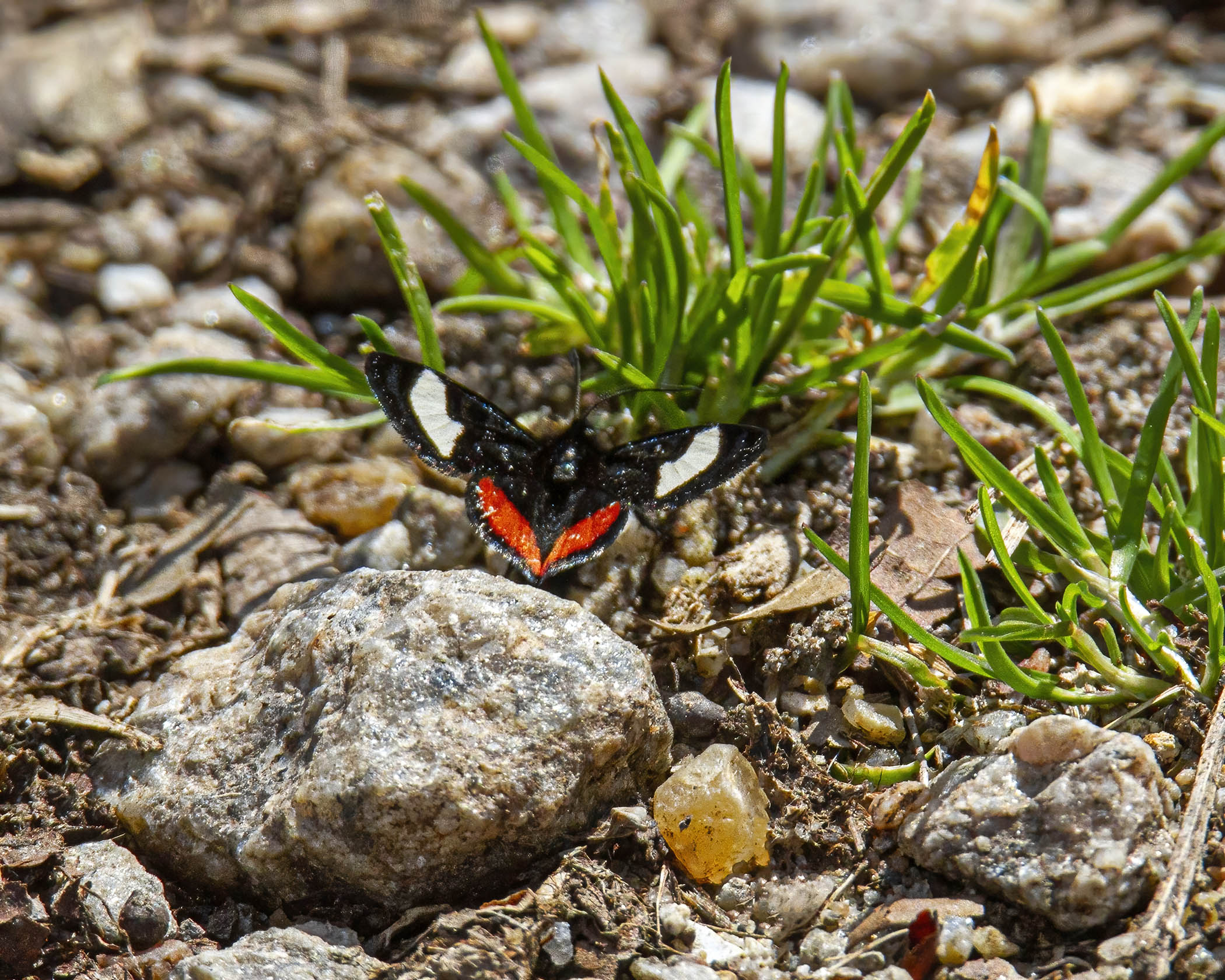
As I noted in yesterday’s blog posting, I finally spotted my first two butterflies of the spring. I thought I had spotted a third butterfly last Wednesday at Occoquan Bay National Wildlife Refuge when this colorful little insect flew in front of me. I am pretty familiar with the butterflies in my area, but did not recognize this one.

After doing some research, I have concluded that this is probably a Grapevine Epimenis Moth (Psychomorpha epimenis). According to the Missouri Department of Conservation, “The grapevine epimenis flies during daytime and would seem too colorful to be a moth, but a moth it is. A member of the noctuid family, its many drab, grayish relatives include dagger, owlet, armyworm, cutworm, and earworm moths.”

Grapevine Epimenis Moth

© Michael Q. Powell. All rights reserved.

Read Full Post »

I finally spotted my first butterflies of the spring. As I was walking down one of the trails at Occoquan Bay National Wildlife Refuge on Wednesday, a fellow photographer excitedly pointed out this Mourning Cloak (Nymphalis antiopa) butterfly that was sunning itself on the trail. Mourning Cloaks overwinter as adults and are usually one of the first species to appear in the spring. According to Wikipedia, “These butterflies have a lifespan of 11 to 12 months, one of the longest lifespans for any butterfly.”

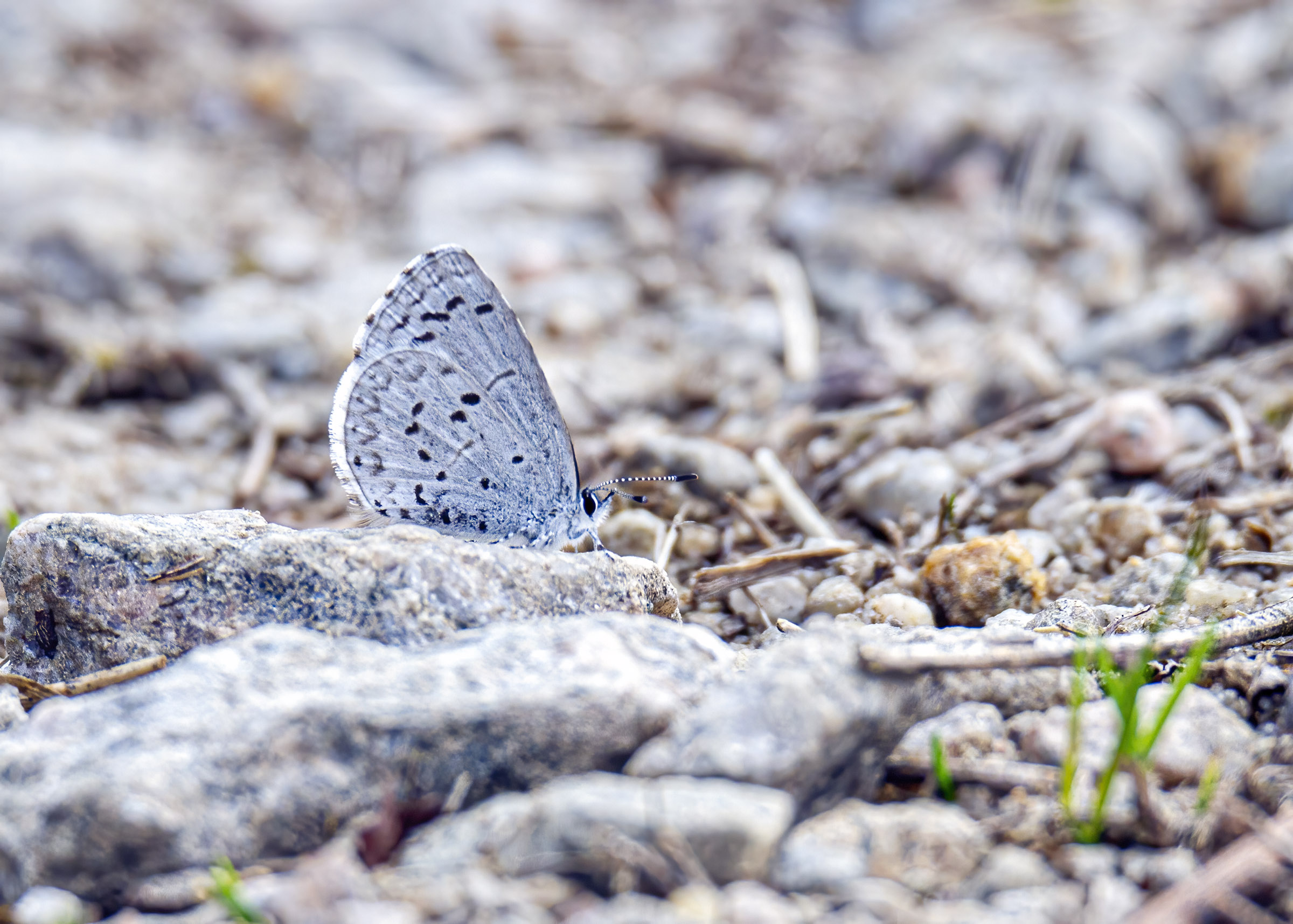
Later in the afternoon, I spotted a Spring Azure (Celastrina ladon) butterfly that was perched amidst the rocks on a gravely section of one of the trails. Spring Azure butterflies are very small—about one inch (25 mm) in size—and it was quite a challenge to get a shot of this one using the 150-600mm lens that was on my camera at that moment.

Yesterday I spotted an Eastern Tiger Swallowtail butterfly as I was searching for dragonflies at another location, but was unable to get a shot of it. I also briefly caught a glimpse of one dragonfly, but again was unable to get a shot. As the weather continues to warm, I’ll be out with my camera more often in search of these beautiful little creatures—it finally feels like spring is here.

Mourning Cloak

Spring Azure

© Michael Q. Powell. All rights reserved.

Read Full Post »

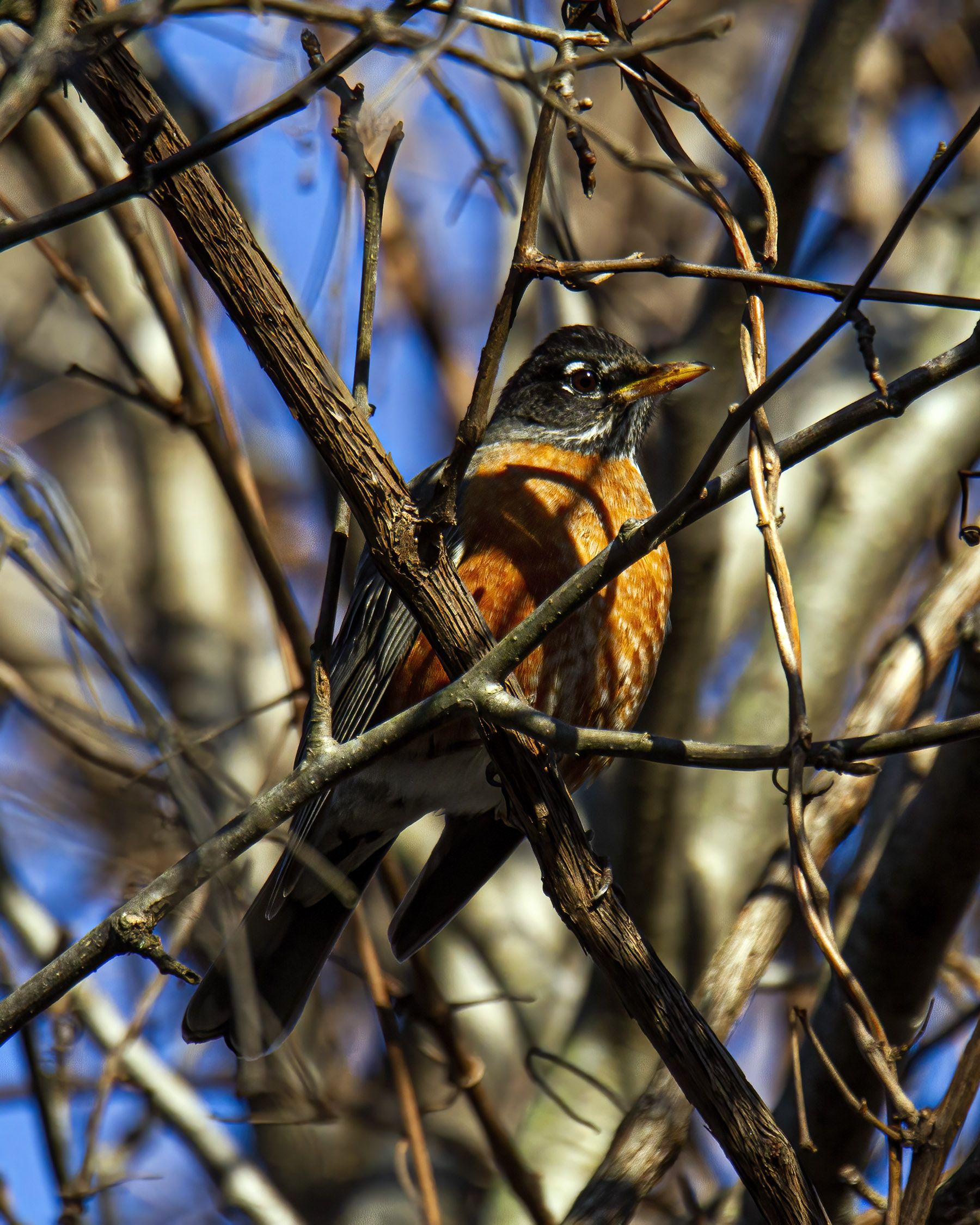
When I was growing up, American Robins (Turdus migratorius)were viewed as a harbinger of spring. In Northern Virginia, where I now live, I see them throughout most of the year. Last week I spotted this one almost hidden in the vegetation at Occoquan Bay National Wildlife Refuge. Despite the cluttered environment, the robin’s orange breast seemed to almost glow in the bright sunshine, making it easy to spot.

During most of my life I have been accustomed to calling this bird simply a “robin.” Since I started my blog, though, I have become sensitized to the fact that there are other robins in different parts of the year that share little in common with the American Robin other than their shared name. The European Robin, for example, is part of the flycatcher family, while the American Robin is part of the thrush family.

In November 2019 I was blessed to spot a European Robin as I was walking along one of the trails in the Bois de Boulogne in the outskirts of Paris. If you have never seen a European Robin, you may want to check out my blog posting entitled “European Robin in Paris,” that features a photo from that encounter.

American Robin

© Michael Q. Powell. All rights reserved.


Read Full Post »

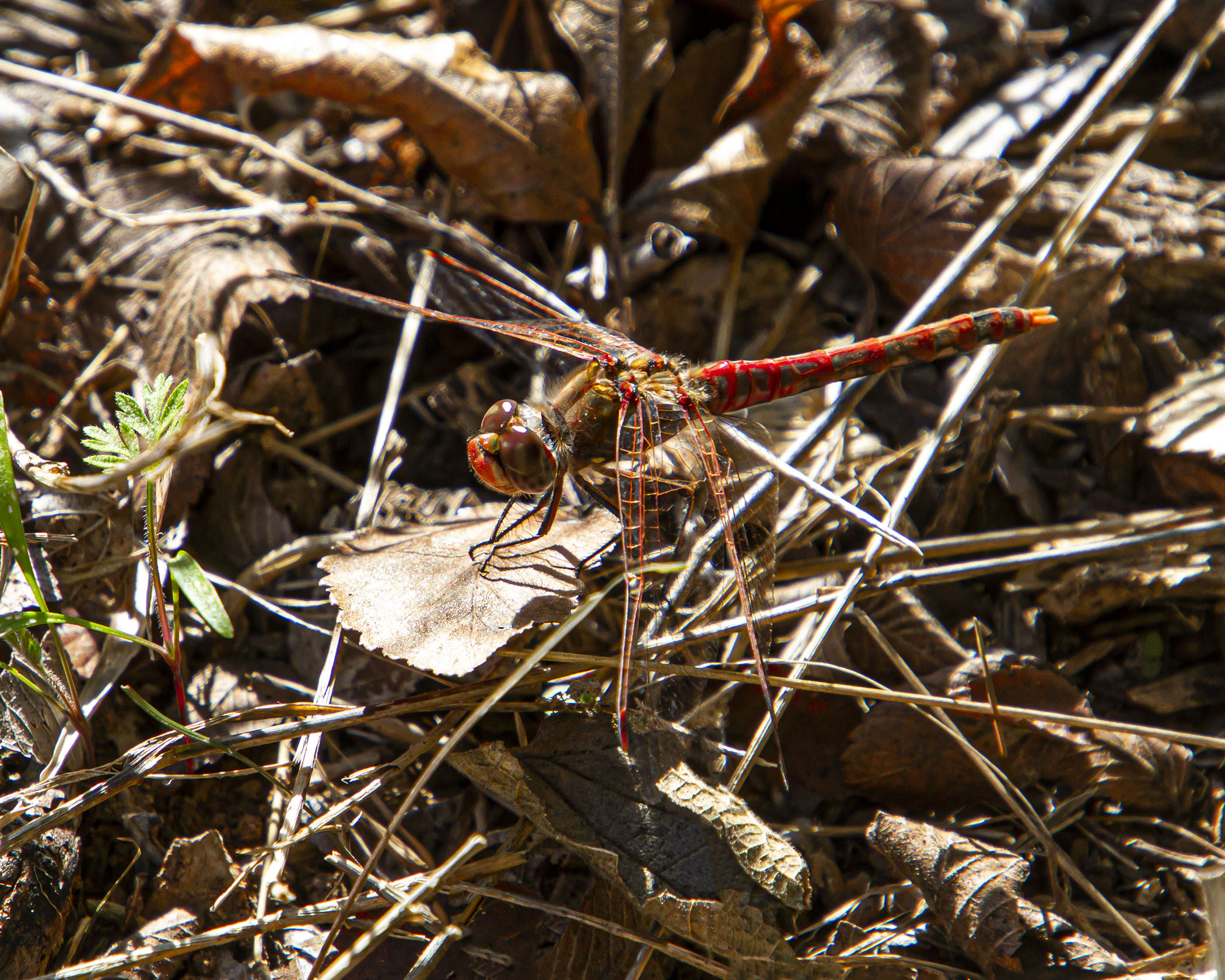
Despite our recent frigid weather, some Autumn Meadowhawk dragonflies (Sympetrum vicinum) are still with us, like this handsome male that I spotted on Monday at Occoquan Bay National Wildlife Refuge. Autumn Meadowhawks are invariably the last dragonflies of the season in my area. They are more tolerant of the cold than most other dragonflies and seem to be able capable of withstanding frosts and freezes if not prolonged or severe.

It is a real challenge to find and photograph Autumn Meadowhawks, because they are small—about 1.3 inches (33 mm)—and they tend to perch among the fallen leaves, where they blend in well with their surroundings. One additional challenge for me was the fact that I was shooting them at the 600mm end of my Tamron 150-600mm zoom lens. At that focal length, the minimum focusing distance for the lens is about 8.8 feet (270 cm), which means that I have to be a pretty good ways away from my tiny subject.

I hope to see these little red dragonflies into early December, assuming that the weather does not stay cool for too long a period and we do not have an extended period of cloudy weather—on cool days I tend to find Autumn Meadowhawks in areas where there is direct sunlight.

Autumn Meadowhawk

Autumn Meadowhawk

© Michael Q. Powell. All rights reserved.

Read Full Post »

I suspect that the species is gone for the season by now, but here are a couple of shots of a female Blue-faced Meadowhawk dragonfly (Sympetrum ambiguum) that I spotted at Occoquan Bay National Wildlife Refuge on 21 October 2022, before my trip to Texas. Many of the females are tan in color, like the one in these shots, which makes them hard to spot among the fallen leaves.  Some female Blue-faced Meadowhawks, however, are male-like in color, i.e. they are red, and are sometimes referred to as andromorphs.

Since my return from Texas, we have had cold temperatures that have often dipped below the freezing level. This week I will be out looking for some late season dragonflies. In the past I have sometimes seen Autumn Meadowhawks in November and occasionally even in December. It is quite possible, though, that I have seen my final dragonflies of the season and will switch to photographing birds most of the time.

Blue-faced Meadowhawk

Blue-faced Meadowhawk

© Michael Q. Powell. All rights reserved.

Read Full Post »

As I begin my final preparations for hitting the road for my long drive home, it somehow seemed appropriate to post this image of a Wandering Glider dragonfly (Pantala flavescens) that I spotted on Sunday in Bastrop, Texas. Wandering Gliders, also know as Globe Skimmers or Globe Wanderers, are considered to be the most widespread dragonfly on the planet, with a good population on every continent except Antarctica, although they are rare in Europe, according to Wikipedia.

My drive will be a bit over 1500 miles (2414 km), which sounds like a long distance to travel. However, Wandering Gliders “make an annual multigenerational journey of some 18,000 km (about 11,200 miles); to complete the migration, individual Globe Skimmers fly more than 6,000 km (3,730 miles)—one of the farthest known migrations of all insect species,” according to Wikipedia. Yikes!

Wandering Glider

© Michael Q. Powell. All rights reserved.

Read Full Post »

I spotted this unfamiliar dragonfly on 13 November in a meadow adjacent to the Colorado River in Bastrop, Texas. Its shape reminded me of the Swift Setwing (Dythemis velox) that I have seen in Northern Virginia, where I live, but its coloration looks more like that of photos of the Black Setwing (Dythemis nigrescens) that I discovered while doing some research.

Was I right? I have had some difficulties correctly identifying some of the dragonflies that I have seen in Texas, but in this case I was right. Setwing dragonflies perch in a distinctive pose with their wings pulled forward, which looked to some scientist like the “ready-set-go” position of a sprinter and is reportedly the reason for the name of the species. When I spotted this dragonfly, I immediately recognized that pose.

In a few hours,  I am starting my long drive back to Virginia from Texas. I suspect that I will not be doing any blog postings for the next few days. I have had a wonderful stay in Texas, with a beautiful wedding, a fun time dogsitting for two delightful dogs while the couple was away on their honeymoon, and plenty of time for exploring nature and extending my dragonfly season.

Black Setwing

© Michael Q. Powell. All rights reserved.
 

Read Full Post »

I am continuing to find cool-looking dragonflies here in Bastrop, Texas, including these handsome ones that I think are Variegated Meadowhawks (Sympetrum corruptum). I spotted them yesterday as I was exploring a meadow adjacent to the Colorado River.

The first two photos show the same dragonfly on two different perches. As you can see, this species, like other meadowhawk species, likes to perch low on the ground, which makes it tough to get a clear shot.

The coloration of this species is very similar to that of the Autumn Meadowhawk that I am used to seeing in Northern Virginia. However, the dark banding on the abdomen and the red veining on the wings are quite distinctive, leading me to judge that this may instead be a Variegated Meadowhawk.

The final photo shows an immature dragonfly. I am a little less confident of my identification of this one, but I think that it might be an immature Variegated Meadowhawk. I am used to the dragonflies in my home area and feel a lot less confident with my identifications when I am traveling.

Variegated Meadowhawk

Variegated Meadowhawk

Variegated Meadowhawk

© Michael Q. Powell. All rights reserved.

Read Full Post »

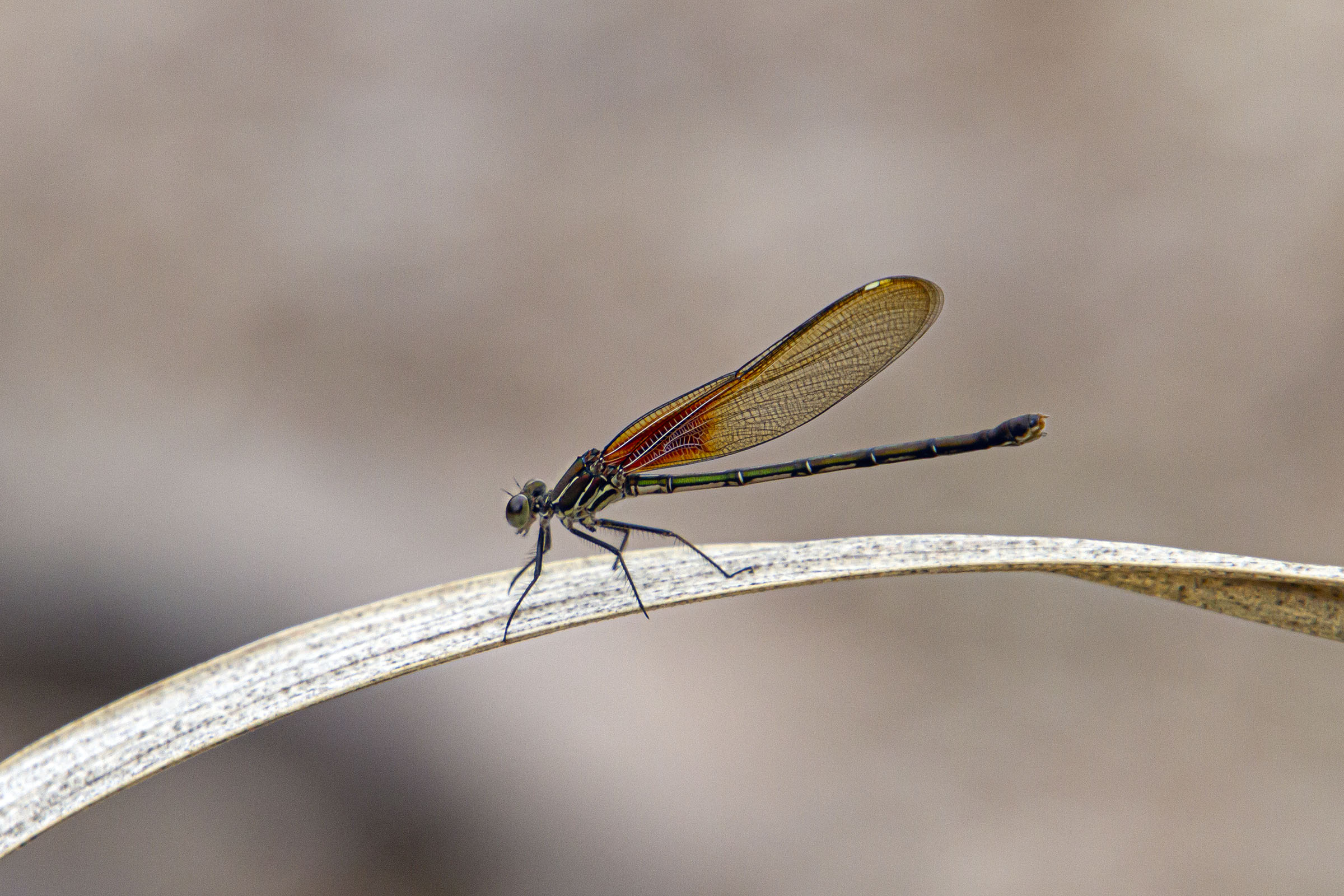
This past week I managed to get some more shots of American Rubyspot damselflies (Hetaerina americana) along the Colorado River in Bastrop, Texas. The sun was shining that day, unlike during my previous encounter with this species when the weather was overcast. This extra light helped to bring out the amazing colors and patterns on these spectacular damselflies.

The male in the first image displays well the bright ruby patch for which this species is named. Though they do not have such a distinctive red spot, the females in the second and third images are equally beautiful. I encourage you to click on the images to get a closer look at the wonderful details of these damselflies.

American Rubyspot

American Rubyspot

American Rubyspot

© Michael Q. Powell. All rights reserved.

Read Full Post »

I have always admired photos of Roseate Skimmers (Orthemis ferruginea), a spectacular dragonfly species in which mature males are bright pink in color. There have been a handful of sighting over the years of Roseate Skimmers at one of the parks I visit in Northern Virginia, but until last week I had never seen one.

A little over a week ago, when I spotted the dragonfly in the first photo, I knew almost immediately that it was a Roseate Skimmer, because of the shockingly pink color of its body. Later that day and on a subsequent walk along the Colorado River in Bastrop, Texas, I spotted other Roseate Skimmers, but did not realize that was what they were until much later.

Why did I have such trouble with their identification? When it comes to dragonflies, mature males tend to be brighter in color and have more distinctive markings than their female counterparts that have drab colors that are somewhat similar across species. Additionally, immature males often have the same coloration as the females.

So, when I posted the second photo below in an earlier posting and thought is might be a Variegated Meadowhawk, I was absolutely wrong. According to some experts in Facebook groups and at Odonata Central, the dragonfly is an immature male Roseate Skimmer.

The dragonfly in the final photo is a female Roseate Skimmer that I photographed a few days ago. Note how the coloration is similar to that of the dragonfly in the second photo. How do you tell them apart? If you look closely at the terminal appendages at the end of the abdomen (the “tail”) of the two dragonflies, you should be able to see that they are quite different in shape. Most often, those terminal appendage are key in distinguishing immature male dragonflies from females.

In a few days I will be heading home from Texas. It has been fascinating to see quite a few dragonflies, some of which have been new for me. Even here, though, I suspect that the season may be coming to a close soon. Earlier in the week temperatures were in the mid-80’s (29 degrees C), but I awoke this morning to a temperature of 41 degrees (5 degrees C) and we will drop even closer to the freezing level over the next couple of days.

Roseate Skimmer

Roseate Skimmer

Roseate Skimmer

© Michael Q. Powell. All rights reserved.

Read Full Post »

I have been a bit befuddled by the dragonflies that I have seen here in Bastrop, Texas and have misidentified about half of them. I was therefore delighted on Wednesday when I managed to get a few shots of a familiar species—a Common Green Darner.

The Common Green Darner dragonfly (Anax junius) had been patrolling overhead and I managed to track it when it came down to earth and perched low in the vegetation. I only had a little latitude in trying to frame my shot, because I know from experience that Common Green Darners can be very skittish. I varied my angle a little between shots by moving slightly, but most of the shots ended up looking pretty similar.

Common Green Darners are a migratory species and are one of the most common and abundant dragonfly species in North America. I love the beautiful colors of this species and am happy when I can get a shot, like the first one, in which you can see the bullseye marking on the “nose” of the dragonfly.

Common Green Darner

Common Green Darner

© Michael Q. Powell. All rights reserved.

Read Full Post »

Yesterday I spotted this really cool-looking dragonfly as I was exploring a meadow area beneath some power lines just off a trail along the Colorado River in Bastrop, Texas. My primary purpose for coming to Texas was to participate in a wedding last Saturday, but I am staying a few extra days to watch the couple’s two dogs while they are away on their honeymoon.

In a recent post, I featured photos of some dragonflies that I had spotted here in Bastrop last week. I identified one as a Russet-tipped Clubtail, a species I am used to seeing, but when I posted a photo in Odonata Central, an expert informed me that it was a female Narrow-striped Forceptail dragonfly (Aphylla protracta)

I believe that the dragonfly in this image is from that same species, possibly a male. I am not at all familiar with forceptail dragonflies, so I can’t tell if the terminal appendages (the “tail”) are the right shape. Whatever its identity, I love the image that I managed to capture of this beautiful dragonfly as it was briefly perching.

Narrow-striped Forceptail


© Michael Q. Powell. All rights reserved.

Read Full Post »

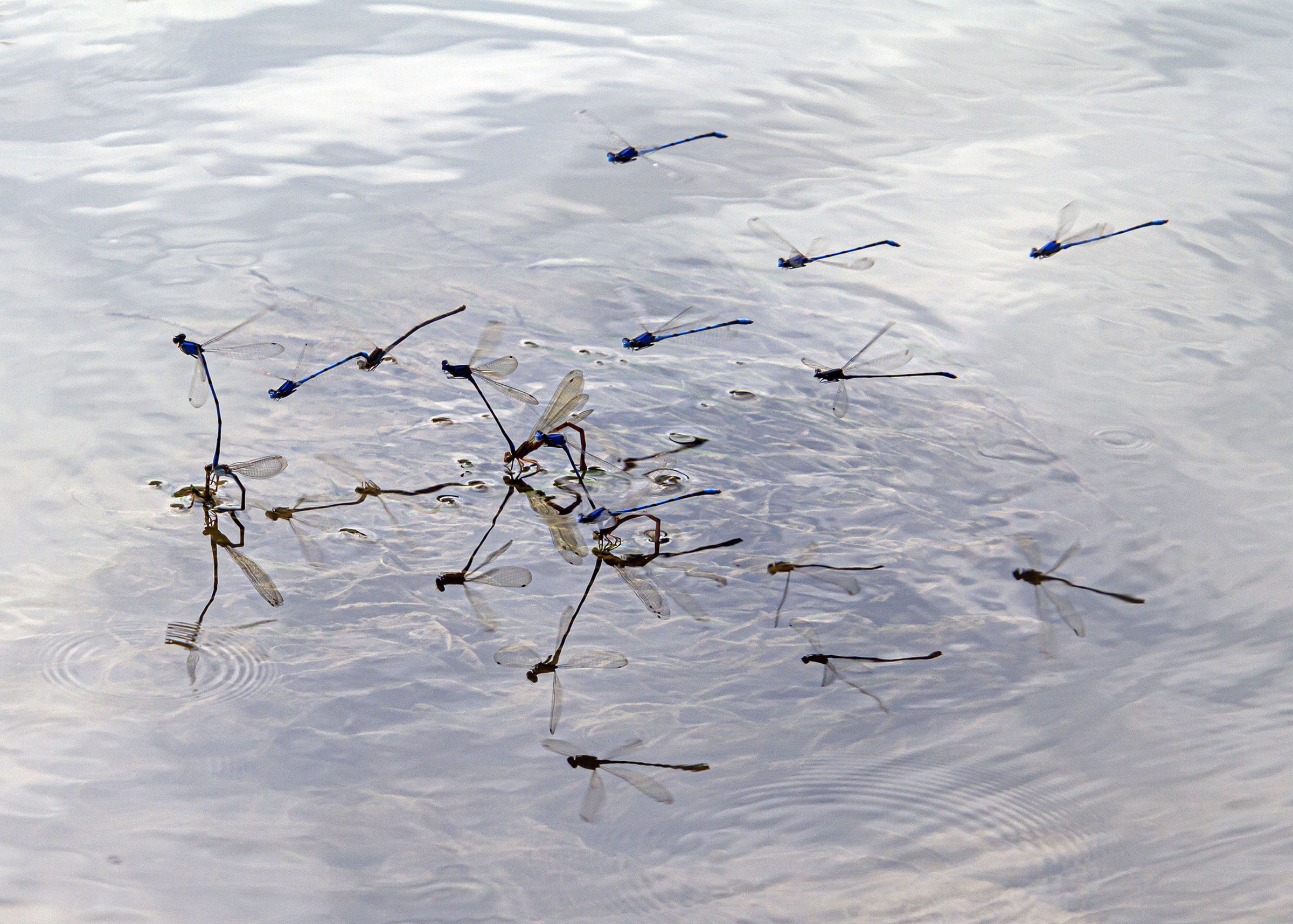
I don’t know what was so special about this spot on the Colorado River in Bastrop, Texas, but lots of couples in tandem as well as some single damselflies were concentrated in one small area last week. I love the way that the reflections in the water of the various flying damselflies makes it look like there were twice as many damselflies as were actually present.

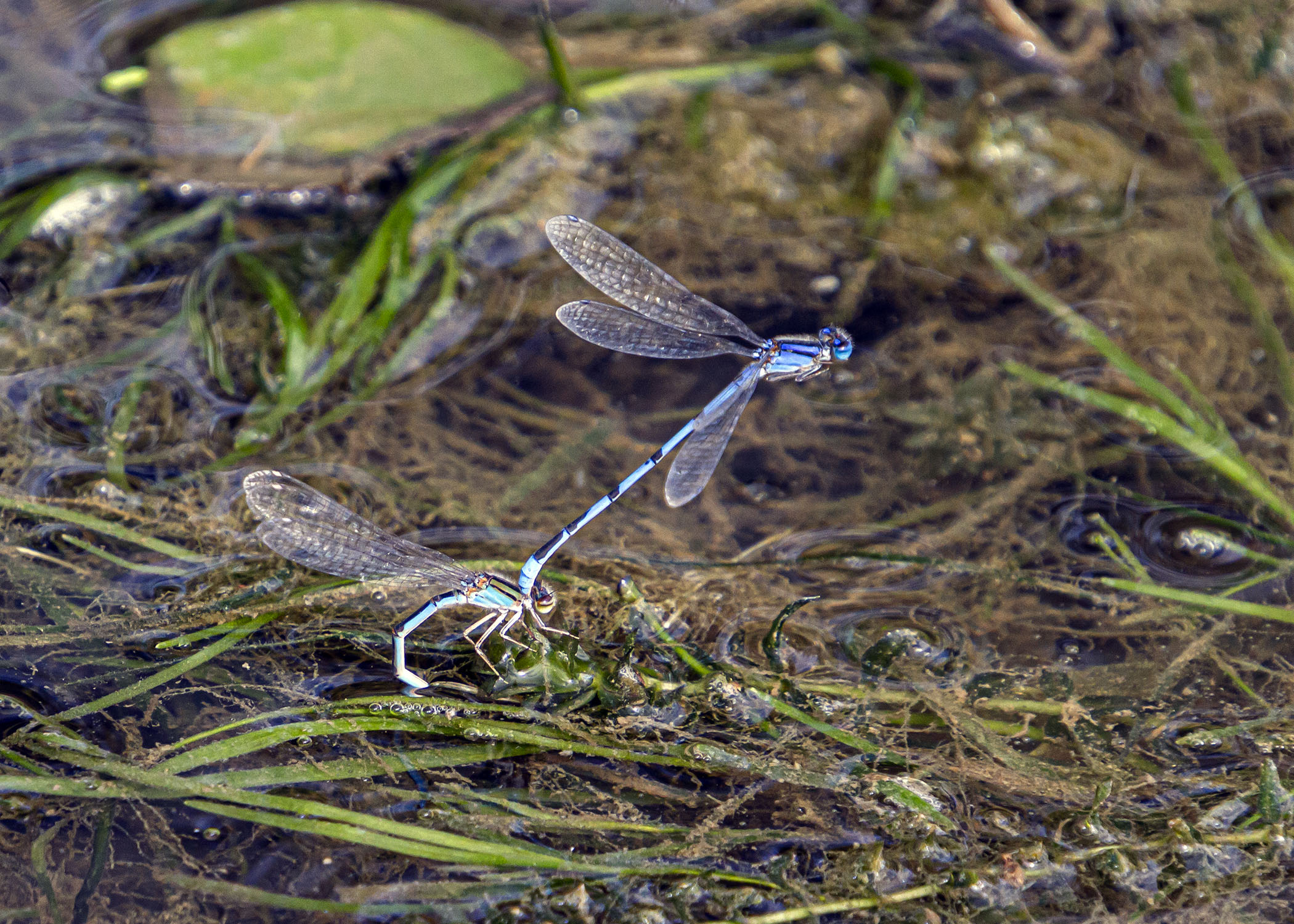
The couple in the second image found a somewhat more private spot where the female can deposit her eggs underwater in the vegetation, while the male continues to grasp her head.

damselflies

damselflies

© Michael Q. Powell. All rights reserved.
 

Read Full Post »

I spotted this colorful Gulf Fritillary butterfly (Agraulis vanillae) perched on a cactus last week as I was exploring some trails along the Colorado River in Bastrop, Texas. This is the kind of shot that it would be impossible to capture in my home area, since neither the butterfly nor the cactus is found in the wild in Virginia.

Gulf  Fritillary

© Michael Q. Powell. All rights reserved.
Read Full Post »

Here are a couple of shots of what I believe are American Snout butterflies (Libytheana carinenta) that I spotted on 2 November in Bastrop, Texas. Although you can’t see the butterfly very well in the first shot, I really like the “artsy” feel of the image. The second shot has a completely different feel to me, perhaps because of the coolness of the green background vice the warmth of the yellow in the first image.

American Snout

American Snout

© Michael Q. Powell. All rights reserved.

Read Full Post »

Last Wednesday, 2 November, I took a walk along the Columbia River in Bastrop, Texas, not far from where I am staying, and was delighted to spot a number of different dragonflies. As I have found in the past, it is difficult to identify dragonflies (and birds) when I am outside of my home area. Sometimes the species are the same, but there may be regional variations. At other times, though, I have found species that are not present at all where I live.

The dragonfly in the first image looks like a female Russet-tipped Clubtail (Stylurus plagiatus), but I must admit that I am not very confident about that call. In the second, the dragonfly looks a bit like a female Eastern Ringtail (Erpetogomphus designatus). When it comes to the third dragonfly, I am not sure that I can even make a guess, other than the fact that it looks like some kind of skimmer.

It was really nice to extend my dragonfly season by traveling briefly to a warmer southern location. By early November, there will only a few dragonflies left in Northern Virginia when I return home next week.

Russet-tipped Clubtail

Eastern Ringtail

Eastern Ringtail dragonfly

© Michael Q. Powell. All rights reserved.
Read Full Post »

« Newer Posts - Older Posts »