Feeds:
Posts
Comments

Archive for the ‘Humor’ Category

I am not sure what the other Canada Goose said or did, but this goose was clearly an angry bird yesterday. He seemed to put his whole body into the expression of his strong feelings, from the tip of this tongue to the tip of his tail.

Do they have a goose in the game Angry Birds?  If not, perhaps they should.

goose_tongue_blog

Michael Q. Powell. All rights reserved

Read Full Post »

One of my fellow photographers identified some newly arrived birds as Tree Swallows (Tachycineta bicolor) and yesterday I spotted them checking out the nesting boxes at my local marsh. I felt like they could have used a real estate agent to point out the advantages of the different styles of houses available. The first one has the charm of a log cabin and the second one has enhanced security features to discourage intruders. I don’t think that the swallows have made their decision yet—for now they seemed to be checking out the neighborhood.

swallow1_blogswallow2_blogswallow3_blogMichael Q. Powell. All rights reserved

Read Full Post »

There is just something about this Red-winged Blackbird that makes me laugh. Perhaps it is his whimsical little half-smile or the way that he has cocked his head. Maybe it is the way that his feathers stick out like a little boy’s cowlick or the glint in his eyes or the way he is perched on the cattail. All of these features give him an almost comical look that I really enjoy.

blackbird1_blog

Michael Q. Powell. All rights reserved

Read Full Post »

Can cardinals smile?

This past weekend, I was observing a male Northern Cardinal (Cardinalis cardinalis) in the underbrush. He was busily pecking away, probably searching  for something to eat.

All of the sudden he stopped what he was doing. Cocking his head to the side a little, he turned in my direction and smiled, or at least it seemed that way to me. The glint in his eye enhanced the effect, as though he was amused by my antics.

Smiling cardinals? I choose to believe in them.

cardinal_smile_blog

© Michael Q. Powell. All rights reserved

Read Full Post »

I am not absolutely sure what this muskrat (Ondatra zibethicus) was doing when I took these photos yesterday, but it look to me like he was grooming himself.

I really like the way that you can see his two little front paws in the first photo—he almost looks like he is praying. In the second photo, it appears that he is rubbing something onto his cheek. Was he putting on make-up because he knew that I was photographing him?

I don’t know the beauty secrets of muskrats, but maybe rubbing cattails on your face helps to reduce wrinkles.

muskrat1_blogmuskrat2_blog

© Michael Q. Powell. All rights reserved

Read Full Post »

When they were soaring through the sky, the vultures were beautiful, even majestic, but when they started to swoop down toward a nearby location, I couldn’t help but feel a little uneasy.

This past weekend, I was walking along the C&O Canal path, approaching Washington D.C., when a number of large black birds started swooping down in my direction. I could tell immediately that they were Turkey Vultures (Cathartes aura), because of their red heads and distinctive feather pattern.  As they got closer, they veered off toward the road that parallels the path—perhaps there was a recent bit of road kill that attracted their attention.

I don’t know why, but everywhere that I go, I seem to see vultures. In this case it was an urban setting, but I see them often when I am in the wild too. I’m trying not to develop a complex about this, but I do make sure that I take a shower before I go shooting.

vulture5_blogvulture3_blogvulture4_blog

© Michael Q. Powell. All rights reserved

Read Full Post »

I don’t know where the male lions were this weekend when I visited the National Zoo, but there were three or four female lions and it was fun to watch them play together.

I tried to get a group photo, but they were about as cooperative as kids, with one of them turning her back and another sticking out her tongue.

lioness3_blog

After a while they seemed to get bored with me and I caught one of them in a big yawn.

lioness2_blogI wanted very much to get an action photo, but the lions seemed content to lounge around together. This is the closest thing I got to an action photo. I like it a lot, even though it is not super sharp, primarily because of the body position and the angle of the shot.

lioness1_blog

© Michael Q. Powell. All rights reserved

Read Full Post »

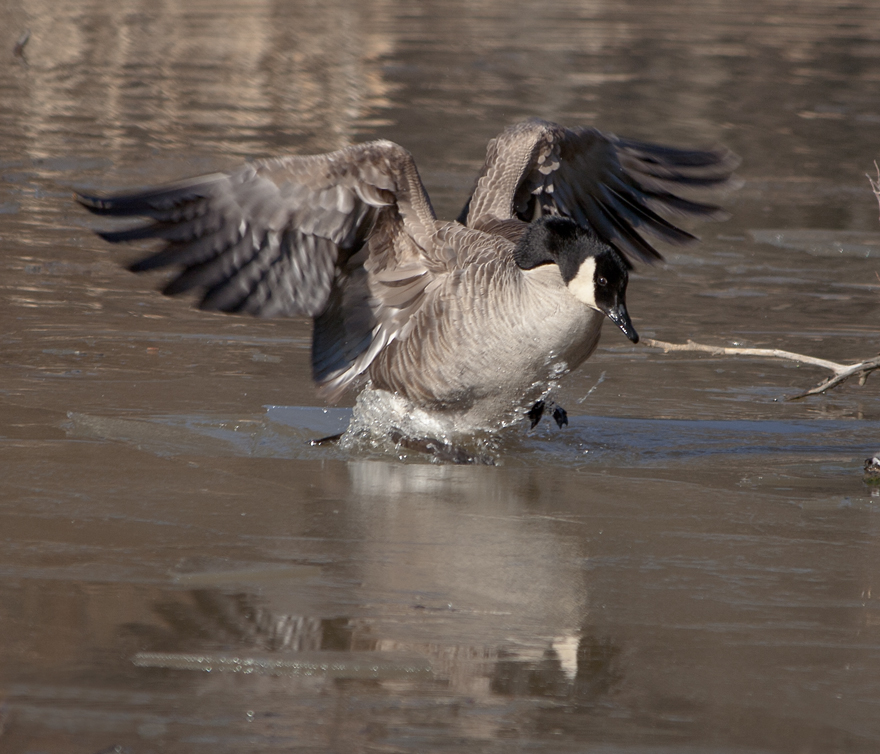
I usually think of Canada Geese as extroverts. They are loud and gregarious and announce their presence when they arrive. I captured this one making a big splash, literally.

Looking at the photo, I think that I must have had my focusing point on an area between the wings, because there are a lot of beautiful details in the feathers. In some ways I am using these geese as test subjects as I learn to track birds in flight (and landing) and try to time my exposures for maximum effect. They don’t seem to mind (though I am waiting for one to ask me for copies of the photos to show to his friends).

splash_blog

© Michael Q. Powell. All rights reserved

Read Full Post »

If you think that you are having a bad hair day today, check out the windblown hair of this Great Blue Heron.

It was cold and really windy today and it seemed like the small birds had sought shelter somewhere, because there were relatively few around. The bigger birds could handle the wind better and I saw lots of crows and geese and a number of vultures.

I also saw one Great Blue Heron, who was pretty far away from me. I watched him for quite some time as he stared down at the waters at the far edge of the beaver pond and I wondered if it would be possible for him to find anything to eat.

When I looked at some of my photos of the heron, I was struck by his hair. It looks like he is suffering from male pattern baldness and has grown his hair long in a vain attempt to hide that reality. Perhaps he has an artistically arranged comb over most of the time, but the wind caused his hair to go in all directions.

Do you think that they have a Hair Club for herons?

badhair_blog

© Michael Q. Powell. All rights reserved

Read Full Post »

Walking alongside a stream yesterday, I heard the unmistakable call of a Belted Kingfisher, a call that is usually described as a “piercing rattle.” Here is a link to the Cornell Lab of Ornithology, which has sound clips that you might find interesting if you have never heard a Kingfisher’s call in person.

A previous post chronicled my quest for an elusive female Belted Kingfisher (Megaceryle alcyon) at a little suburban lake that is stocked with trout. I made multiple attempts on different days to photograph that Kingfisher as she perched on tree branches overlooking the water.

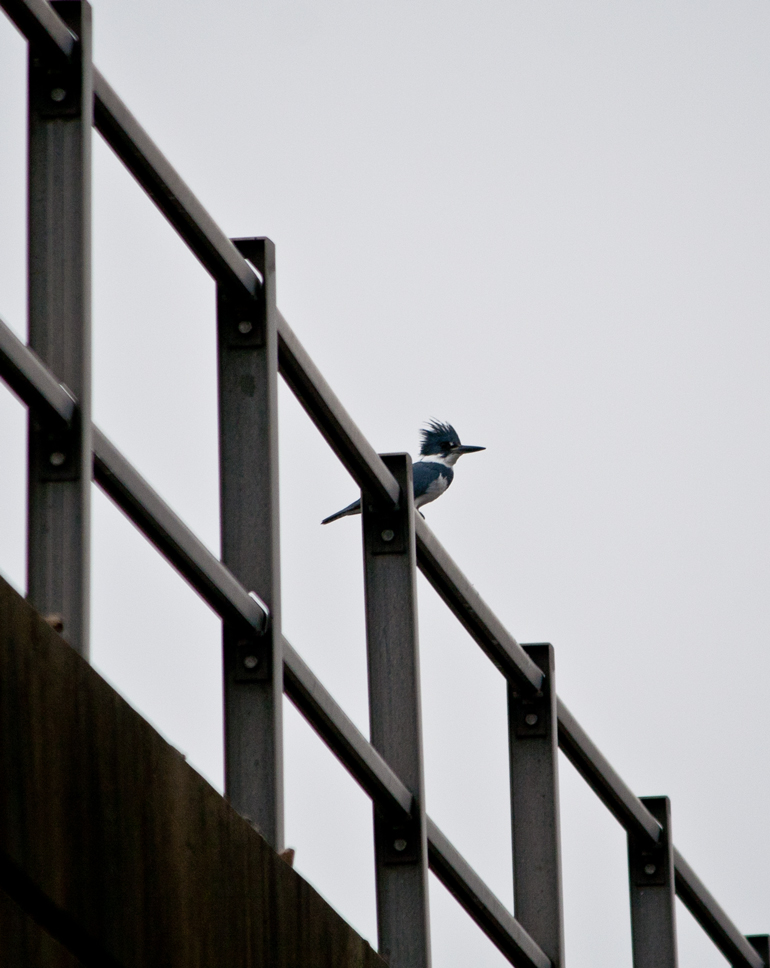
Although the stream along which I was walking yesterday is only a half mile or so from the female Kingfisher’s fishing spot, I was surprised to hear a Kingfisher’s call, because there are no trees on the banks of the stream at that location. When I heard its call again, I turned my head in the direction of the sound and was surprised to see a male Kingfisher perched on a power line above the stream. (It’s really easy to distinguish a male Belted Kingfisher from a female, because the male has only a blue stripe on is chest and a female has blue and chestnut stripes.)

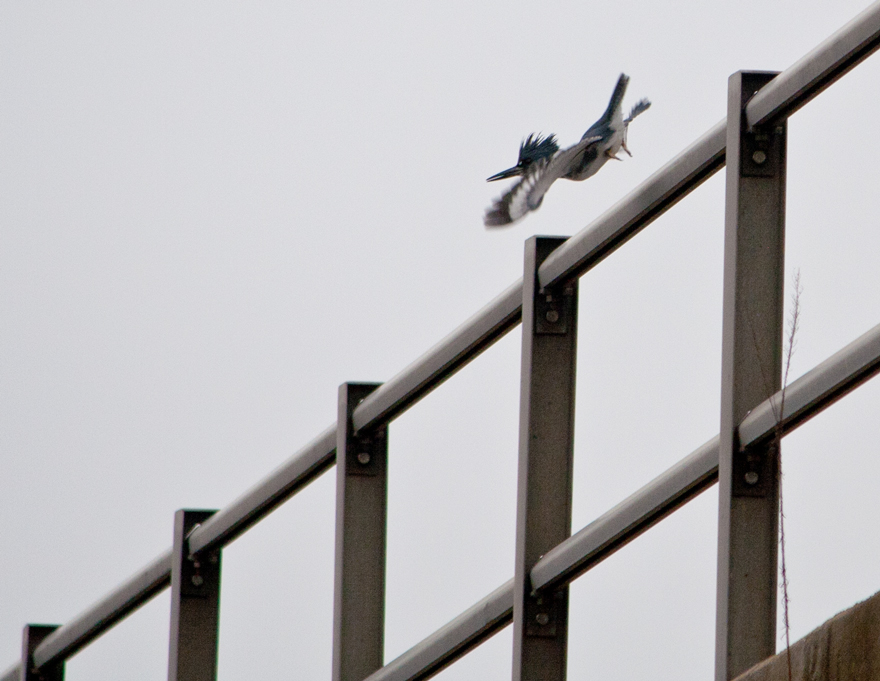
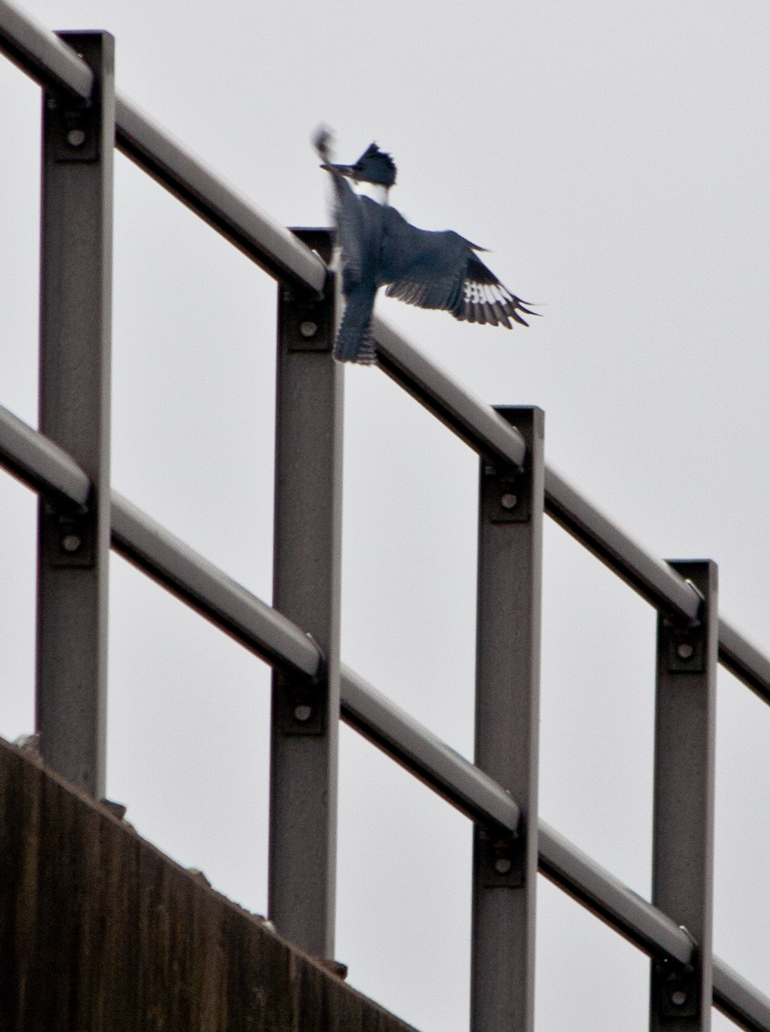
When I moved a little closer to him, he flew a short distance downstream and I located him again, this time perched on the railing of a railroad bridge over the stream. Over the course of an hour or so, he and I played  a little game in which he would pose for a few minutes on the railing and then fly downstream. A short while later he would be back on the suspended power line. I would walk slowly in the direction of the power line and once I arrived there, the Kingfisher would return to the railroad bridge.

Although I was not able to get really close to the Kingfisher, I managed to get some pretty cool pictures, including several in-flight shots. I really like the industrial-looking setting of the railroad bridge, with its simple geometric structure and beautiful angular lines. In many ways, the bridge is a much a subject in the photos as the bird.

I confessed in a previous post that I was a stalker of Kingfishers, but maybe it’s time to elevate my status—perhaps from now on I will refer to myself as a member of the Kingfisher paparazzi.

kingfisher_M3_blogkingfisher_M1_blogkingfisher_M2_blogkingfisher_M5_blogkingfisher_M6_blogkingfisher_M4_blog

© Michael Q. Powell. All rights reserved

Read Full Post »

I really like to show contrasts, like the difference in the expressions and body positions of these two Canada Geese.

What prompted the one on the right to get so vocal and in the face of the other? Is this the kind of taunting that I see so often in professional sports? Is it some kind of marital misunderstanding? Is the one on the right playing the role of a drill sergeant dealing with a recruit?

Whatever the cause, one I know for sure—at close range the honking was earsplittingly loud. I can only imagine the goose on the right reprising the line from a television commercial for a phone company, “Can you hear me now?”

now_blog

© Michael Q. Powell. All rights reserved

Read Full Post »

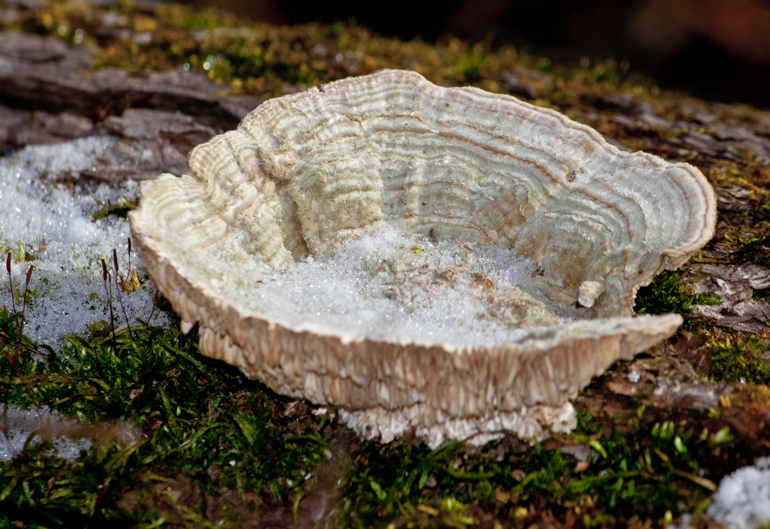
Walking through the woods yesterday, I stumbled across this mushroom bowl on a mossy log—so beautiful that I might call it “super,” but  probably need expensive market rights to call it a “super bowl.”

Seriously, though, I really do like the color and texture of the mushroom itself and the little splashes of yellow and green in the foreground. The snow in the bowl and to the side also adds a nice touch. If I remember correctly, this may have been one of the images when I used my camera’s built-in flash to throw a little light into the center of the mushroom bowl.

Until spring comes, I will probably look for more of these flower-like fungi to satisfy my desire to photograph beautiful inanimate objects (it takes more than birds and beasts to keep me satisfied).

winter_bowl_blog

© Michael Q. Powell. All rights reserved

Read Full Post »

I have seen some rotund cardinals this winter, but this male Northern Cardinal has to be the roundest one yet. He looks a bit to me like an overinflated balloon figure. I saw him fly away, so I know he is airworthy, but I am pretty sure that his current shape produces more aerodynamic drag than usual.

On the other hand, maybe he is merely big-boned.

rounded_blog

© Michael Q. Powell. All rights reserved

Read Full Post »

The Black Vulture (Coragyps atratus) needs to improve its public image and what could be better in these times of economic difficulty than emphasizing its energy efficiency?  The Cornell Lab of Ornithology states that the Black Vulture “soars on thermals to gain altitude and to cover large distances with little energy expenditure.”

This past weekend we had warm weather and a breeze, which made it perfect for soaring. Normally I see Black Vultures very high in the sky and in groups, but this time I spotted a solitary vulture soaring at a a lower altitude, which permitted me to get some decent photos. The Cornell Lab notes that Black Vultures have a less well-developed sense of smell than Turkey Vultures and rely more on sight than smell to find carrion, which may be why they soar at greater heights than Turkey Vultures.

I propose that the Black Vulture become the new symbol for energy-saving practices. What do you think?

vulture1_blogvulture2_blogvulture3_blog

© Michael Q. Powell. All rights reserved

Read Full Post »

I spent several hours on Sunday and Monday stalking a female Belted Kingfisher (Megaceryle alcyon). Does that make me a bad person?

I first encountered this beautiful bird a couple of weeks ago and was immediately smitten. Like a paparazzi photographer, I started snapping photos frantically when I saw her. I included some of those photos in a previous posting that I creatively entitled “Belted Kingfisher.”

Now I have started to hang out what I think are some of her favorite places, hoping desperately to catch a glimpse of her. She is still quite standoffish and won’t let me get close, but perhaps she will get used to having me around. Maybe she has commitment issues.

Here are a few shots from my recent encounters, including two in which I captured her as she was flying away.

For now, it is a classic case of unrequited love.

kingfisher1_blogkingfisher2_blogkingfisher3_blogkingfisher4_blog

© Michael Q. Powell. All rights reserved

Read Full Post »

I am catsitting again for my neighbor and fellow blogger Cindy Dyer and her cats are amazingly photogenic.

Pixel was the most cooperative. He posed on windowsill this morning and was even willing to lift his head so that the light coming from the side would take away any shadows.

Pixel2_blog

Pixel’s brother, Lobo (Cindy was going to name him JPEG, but her husband objected), was a little less cooperative. I captured him in his favorite spot, looking down on the main entry from the second floor with his head dangling over the edge.

Lobo1_blog

The third and final cat, Zena, an older female, was even harder to photograph. She gave me a look that seemed to indicate that she was not going to put up with any nonsense from me.zena1_blog

© Michael Q. Powell. All rights reserved

Read Full Post »

It is not well known that geese are jealous of their water fowl colleagues, the swans, for all of the attention they get in numerous productions of Swan Lake. Geese consider themselves equally adept at dancing and have picked up regional folk dancing during their long migratory travels through numerous territories. In this photo, a goose is practicing a variation of a traditional fan dance (and it turns out that geese, unlike humans, don’t need any props for the fan dance).

dance_blog

© Michael Q. Powell. All rights reserved

Read Full Post »

On rare occasions I can anticipate a photo opportunity as a series of actions seems to heading towards an inevitable conclusion. That was the case this past weekend.

The weather here has warmed up and the layer of ice on the ponds has started to melt a bit. I watched as a mixed group of Canada Geese and Mallard Ducks started walking across the iced-over beaver pond.

A duck walked past a branch sticking out from the ice and I thought I detected some water, suggesting to me that they were walking on thin ice. A goose (in the second photo) looked down at the ice and made a mental calculation that it was safe to cross. His calculations proved to be wrong as he broke through the ice and started to sink into the water. I caught his initial reaction in the third photo. I especially like the startled look in his eyes.

Without further delay, he flapped his wings and was able to lift himself out of the water. The photo I took of that moment is the first one shown on this blog posting and is my favorite. I am happy that I was able to capture a lot of the the details of the wings and of the ice. You can see, for example, the sheets of ice that have broken off on either side of the goose. I also like the sense of action in the position of the goose, a moment frozen in time (sorry about the obvious pun).

I always feel a little strange when I post a series of action shots in non-sequential order, but I worry that folks won’t stay around to see the dramatic conclusion if all they see is the first shot (which is not that exciting, but is an important part of the story). That is why I led with the conclusion, thereby giving away the end of the story. Maybe I need to employ the kind of techniques used in television, “Stay tuned as this goose rescues himself from the frozen waters of the pond…”

Breaking the ice

Breaking the ice

Testing the ice

Testing the ice

Starting to go under

Starting to go under

© Michael Q. Powell. All rights reserved

Read Full Post »

As I was out shooting today, I was happy to encounter Hooded Merganser ducks (Lophodytes cucullatus) a couple of times, They are the coolest-looking ducks in my opinion (although Wood Ducks are in the running too). It’s a real challenge to get good shots of them, because they are small, fast, and skittish. I would love to find myself in a position like Phil Lanoue, a fellow blogger and incredible photographer, who recently photographed a Hooded Merganser duck coming in for a landing next to him (check out his blog posting).

I’m still going through my photos, but this one jumped out at me. It shows two duck couples swimming in formation. What is unusual is that one of the pairs appears to me a male Mallard and a female Merganser. Oh, I know that some of you are thinking that such a relationship could never work, but true love always finds a way.

I can only imagine what their children will look like.

Mixed couple

Mixed couple (click for higher resolution view)

© Michael Q. Powell. All rights reserved

Read Full Post »

Earlier this week I managed to photograph this male Mallard Duck as he secretly practiced the ancient art of Zen levitation. Note his closed eyes and relaxed concentration as his body is gently lifted out of the water. With sufficient practice, Zen master ducks can take off and land in this position,  like a helicopter or a Harrier jet.

Zen levitation

Zen levitation

© Michael Q. Powell. All rights reserved

Read Full Post »

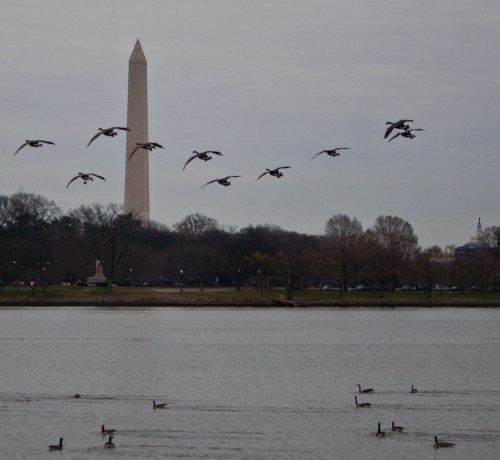
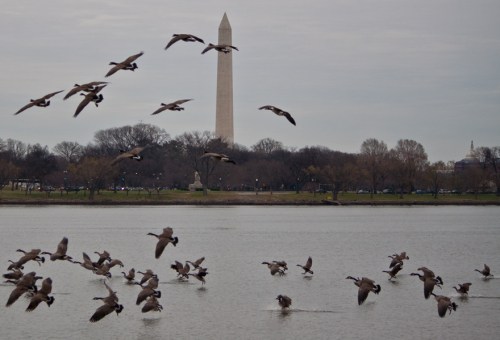
They came from the skies, invaders from the north in a tight military formation, seeking for openings to breach the defenses of their southern neighbor’s capital city.

Invaders

They sent out reconnaissance forces, in the air and on the waters of the Potomac River, collecting information and looking for a spot for a larger landing force.

Reconnaissance

The landing zone secure, a larger force arrived and thus began the naval blockade of Washington D.C. A declaration of war has not yet been made by either side.

Landing Force

© Michael Q. Powell. All rights reserved

Read Full Post »

Birders, I’m finding out, are an excitable breed. Sometimes they travel in flocks and sometimes alone. You can often identify them by their binoculars and spotting scopes and sometimes their cameras with enormous camouflaged lenses. They have special apps on their smartphones and frequently can be observed with their heads buried in one of the numerous identification guides they may be carrying.

I encountered a very excited member of this species as I passed by the bird feeders at my local marshland park this past weekend. He had his camera—with a large lens and flash—set up on a tripod pointed at the feeder.  Crouching in the shadows with a remote release in his hand, he was obviously waiting for something.

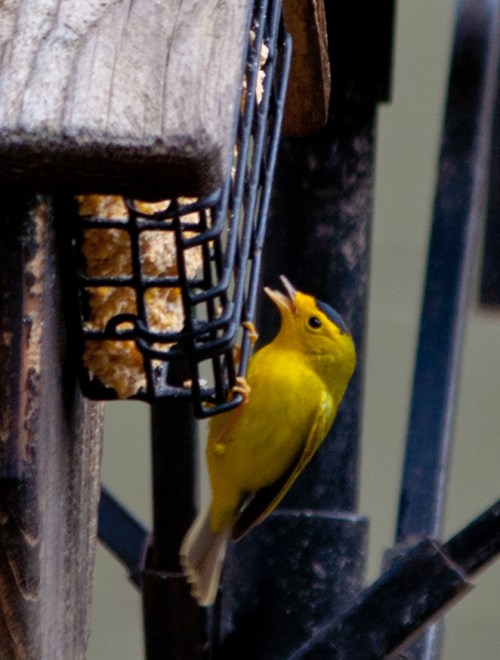
Before I could pose the obvious question, he asked me in a whisper if I also was there to photograph the Wilson’s Warbler. He must have mistaken me for one of his own kind, probably because I had a camera with a telephoto lens around my neck. I got the impression that this bird was rarely seen here and that word had circulated in birding circles of this find. Suddenly he snapped a few photos and went rushing off into the underbrush, saying that a fellow birders had alerted him that the bird had also been seen near one of the benches in the park. His closing words to me were that the warbler had been timed as coming back to the feeder every four to five minutes.

Caught up in the excitement, I waited near the feeder with my camera. The only problem was that I did not have a clue what a Wilson’s Warbler looked like. How was I going to photograph it if I couldn’t identify it? An assortment of Downy Woodpeckers and nuthatches arrived and departed at the feeder and I was beginning to despair that I would see this elusive bird, when all of the sudden I saw a flash of bright yellow. It was a small yellow bird, a welcome sight on a gray late December day, and over the course of the next fifteen minutes or so I attempted to take his picture.

When I arrived home, looked at my photographs on my computer, and did a little research, I realized that I had photographed a Wilson’s Warbler (Wilsonia pusilla or Cardellina pusilla). Judging from the range maps on the Cornell Lab of Ornithology website, Virginia is on the migratory path for these birds, which breed in the northern and western parts of North American and winter in the tropics.

I am not used to photographing birds at a feeder, but managed to get a few interesting shots of the Wilson’s Warbler. To avoid scaring off the bird, I was at a pretty good distance from the feeder,  so I had to crop the images quite a bit. I am quite content, though, that I have managed to capture some of the essence of this happy little bird.
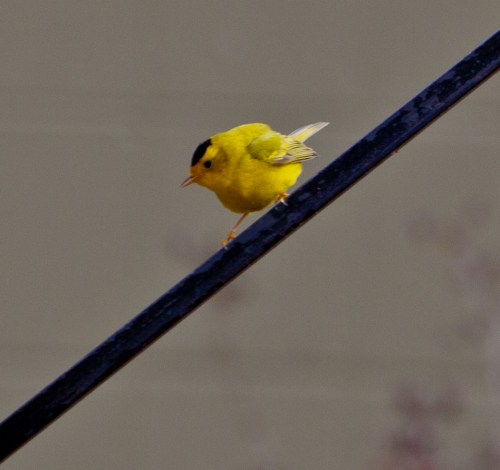
Wilson's Warbler Walking

Wilson’s Warbler Walking

Wilson's Warbler Hovering

Wilson’s Warbler Hovering

Wilson's Warbler Feeding

Wilson’s Warbler Feeding

© Michael Q. Powell. All rights reserved

Read Full Post »

It’s almost Christmas. Decorations are visible everywhere and all the radio stations are playing non-stop Christmas music. As I am driving to work, I am reminded of (and sometimes burst into singing) the lyrics of Silver Bells, which include the line, “Strings of street lights, even stoplights, blink a bright red and green, as the shoppers rush home with their treasures.”

Even in nature I am reminded of Christmas. Despite the title of this blog posting, this bird is not called a “Santa bird,” but I enjoy making up names of the creatures that I photograph. Usually I do so when I don’t know their real names, but in this case I know that the bird is a White-throated Sparrow (Zonotrichia albicollis).

His prominent white “beard” and his round belly, though, remind me of Santa Claus, and I can’t help but smile. I recall some of the words of the famous poem ‘Twas the Night Before Christmas, “He had a broad face and a little round belly, that shook when he laughed, like a bowl full of jelly. He was chubby and plump, a right jolly old elf, and I laughed when I saw him, in spite of myself.”

Soon it will be Christmas day.

Santa bird

Santa bird

© Michael Q. Powell. All rights reserved

Read Full Post »

Do you ever find that you totally missed a cool element of a photograph during initial review because the element was not near the center of the image? Today I looked over some squirrel shots from a week and a half ago and realized that the photo of a squirrel perched on the trunk of a tree was a whole lot more interesting than I had previously thought.

Hide and seek

Hide and seek

My attention had been so drawn to the downward-facing squirrel (is that a yoga pose?) that I didn’t even notice the squirrel in the upper right corner, peering out from inside the hollow tree. That squirrel is so cute that I enlarged the corner of the photo so you can appreciate its cuteness even more.

Cute squirrel

Cute squirrel

By itself, the cute squirrel would have been worth posting, but in combination with the other squirrel, it’s a really fun image.

The lesson learned for me is that I need to look at my photos more carefully during my first review or take the time to look at them later a second time with fresh eyes.

© Michael Q. Powell. All rights reserved.

Read Full Post »

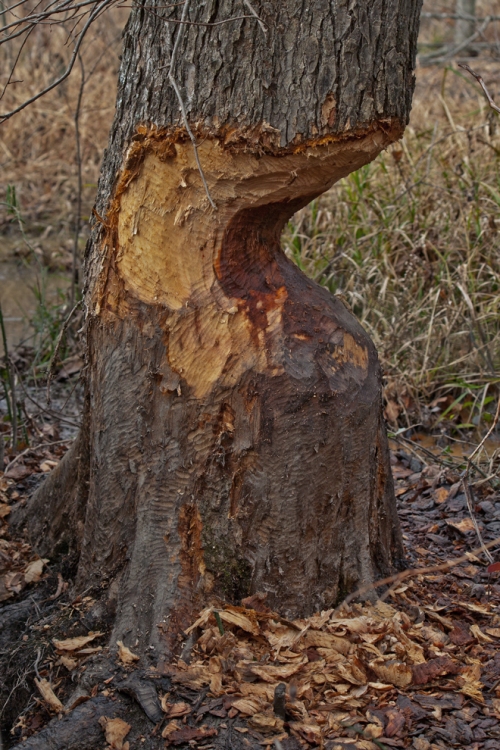
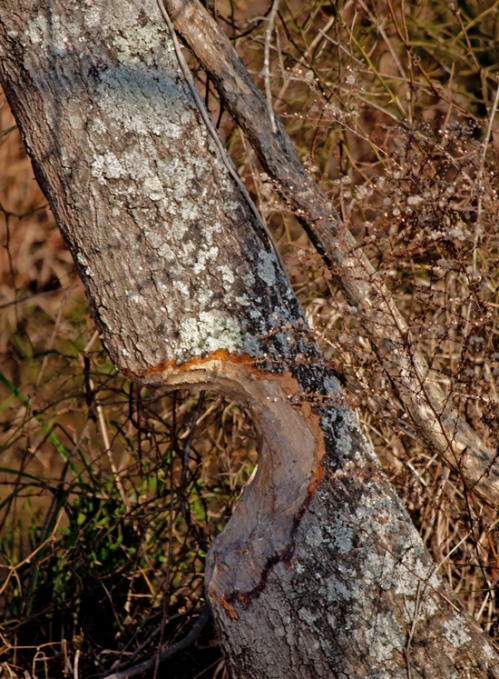
The beavers in my local marsh have been really busy recently as winter draws near (“busy as beavers,” you might say). Each time I visit the marsh I can see evidence of their handiwork. Hmm, “handiwork” is probably not the right word, since most of the evidence I see is work they have accomplished with their teeth. Maybe I should call it “dentalwork,” but that terms conjures up images of beavers with braces on their teeth. I’ll just call it “work.”

Over the past few weeks I have been noting their progress on chewing through a pretty large tree. First they chewed one side and then it looks like they gradually moved around the circumference of the tree. Circumference? Who says that high school geometry doesn’t have everyday applications? They now have gnawed (try saying that phrase quickly multiple times) into the center of the tree and I expect to see to see a fallen tree soon. I won’t be disappointed, and certainly not crestfallen.

On a slightly more serious note, I am genuinely amazed that the beavers don’t just take down small saplings. I confess that, as a result of living most of my life in the suburbs, I don’t know much about wildlife. It’s fascinating to me to look at all of the individual tooth marks in the wood that bear witness to the persistence of this industrious creature. I also see its work in the mud walls that have been built up along the edges of parts of this little pond and the ever-increasing amounts of mud that have been packed on the lodge.

The beaver is ready for a cold winter. Am I?

Let the chips fall where they may

Let the chips fall where they may

How do they gnaw this high?

How do they gnaw this high?

© Michael Q. Powell. All rights reserved.

Read Full Post »
If I were judging from behavior, I’d have to say that most male Red-winged Blackbirds (Agelaius phoeniceus) seem immature. They remind me a lot of teenagers—they are hyperactive and prone to attention-seeking behavior; they are extremely loud; they like to hang out with their friends (who are all dressed the same); and they appear to suffer from a kind of moody teenage angst.

In this case, however, I am referring to the appearance of this Red-winged Blackbird that I photographed this past weekend at Huntley Meadows Park in Alexandria, VA. At first glance, I was pretty sure that this was a female Red-winged Blackbird. I’ve gradually gotten used to the notion that the female of the species is not black nor does not have red wings, but is still called a Red-winged Blackbird.

Immature male Red-winged Blackbird ?

When I looked a little closer, though, I could see a small patch of red on the upper part of the wing, where the adult male has the red and yellow patch of color. I’ve read in a number of places that male Red-winged Blackbirds start out looking like females and darken as they mature. I confess to being a little confused in identifying this bird? Sometimes I think it is a female with a touch of color, but most often I think it is an immature male? What do you think?

In any case, I like this informal portrait of the bird, who seems relaxed in this angular pose. A minute or so later, the bird turned to the side and assumed a more formal, upright pose. You couldn’t ask for a more cooperative subject. It was almost like the bird realized that I was thinking of it as “immature” and wanted to demonstrate that it could be serious and dignified.

Immature? I can be serious.

© Michael Q. Powell. All rights reserved.

Read Full Post »

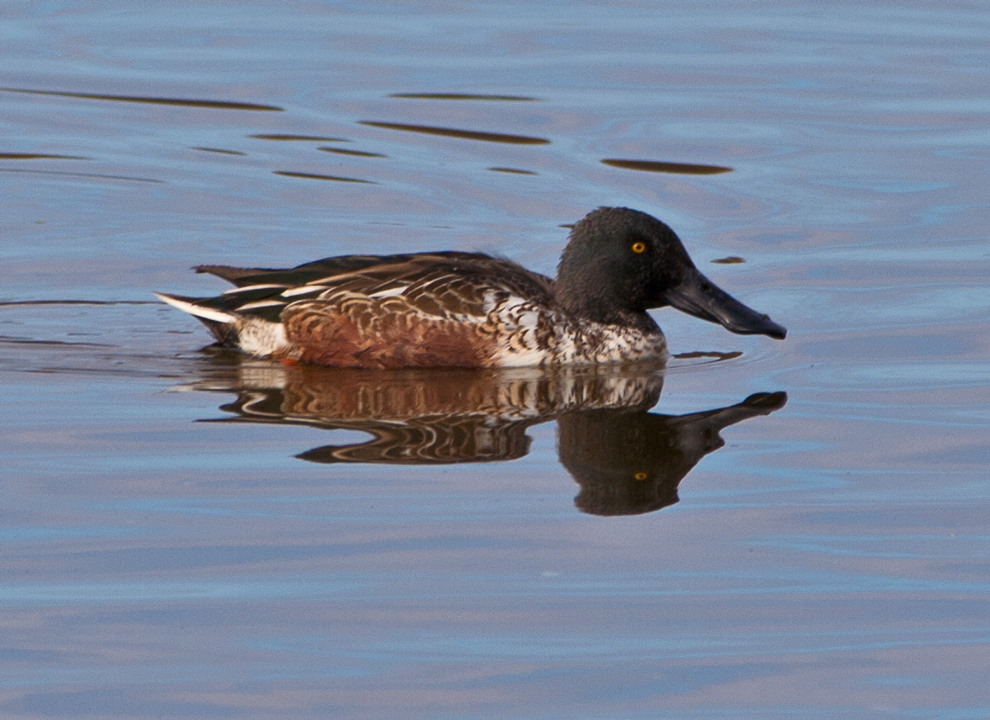
When I first saw this duck and his mate this week, I thought it was just another mallard couple. As I studied the male, though, I couldn’t help but notice his elongated black bill—it’s as plain as the nose on its face (wait a minute, duck don’t have noses). The female’s bill was similar in shape, but was orange in color. Not only are they long, their bills also seemed wider at the tip than at their bases, causing the ducks to look almost cartoonish.

Northern Shoveler

Using the duck’s distinctive bill as a search term, it was easy for me to discover that this duck is called a Northern Shoveler (Anas clypeata). Sometimes I am baffled by the names of species, but this time the reasoning behind the name was pretty obvious. Like the mallard, the Northern Shoveler is considered to be a “babbling duck.” It forages by swimming along with its bill lowered into the water, straining out small crustaceans and other invertebrates, and generally does not tip its head and upper body forward into the water, according to the Cornell Lab of Ornithology.

Foraging Northern Shoveler

The Cornell Lab also notes that Northern Shoveler couple are monogamous and “remain together longer than pairs of other dabbling duck species.” Longer than other dabbling duck species? It makes me wonder about the divorce rate among dabbling ducks. Does “dabbling” refer to their mating habits as well as to their feeding habits? Do they stay together for the sake of the ducklings?

Northern Shoveler Couple

Speaking of ducklings, the Cornell Lab, which I highly recommend as a source of information about birds, includes the following bizarre and disgusting, yet strangely interesting factoid about this duck species, “When flushed off the nest, a female Northern Shoveler often defecates on its eggs, apparently to deter predators.” What a strange reaction.  With humans, flushing almost occurs after defecation, not before.

© Michael Q. Powell. All rights reserved.

Read Full Post »

I have been watching migratory birds recently and observed that mallard ducks feed mainly by tipping forward and placing their fringed-edged bills in the water, straining out plants, seeds, and other material. The Cornell Lab of Ornithology categorizes mallards as “dabbling ducks” versus  “diving ducks” that go deep underwater to forage for food.

One mallard, though, used a different technique. Instead of dipping his head forward, he flattened himself out and placed his bill almost parallel to the water. He then slowly and systematically paddled back and forth with his beak in the water or just above it, continuously straining and restraining the surface of the water. (Did he require a restraining order?) As the photo shows, there was a lot of plant material available for him to gather. His female partner used the same technique, though I was not able to get a clear shot of her doing so.

Straining mallard

I observed another mallard straining in a different way. Along with his female companion, he was perched on a tiny piece of land. I must have startled him a little when I walked by, because he slipped into the water. Realizing he had nothing to fear from me, he tried to regain his spot. It required several vigorous attempts for him to climb out of the water and I managed to capture him straining to do so. I love the contrast between the determined look on his face and the impassive expression on the female’s face.

Mallard straining to regain his spot

Strain or strain? It’s so amazing that words can have so many different meanings—it strains the imagination.

© Michael Q. Powell. All rights reserved.

Read Full Post »

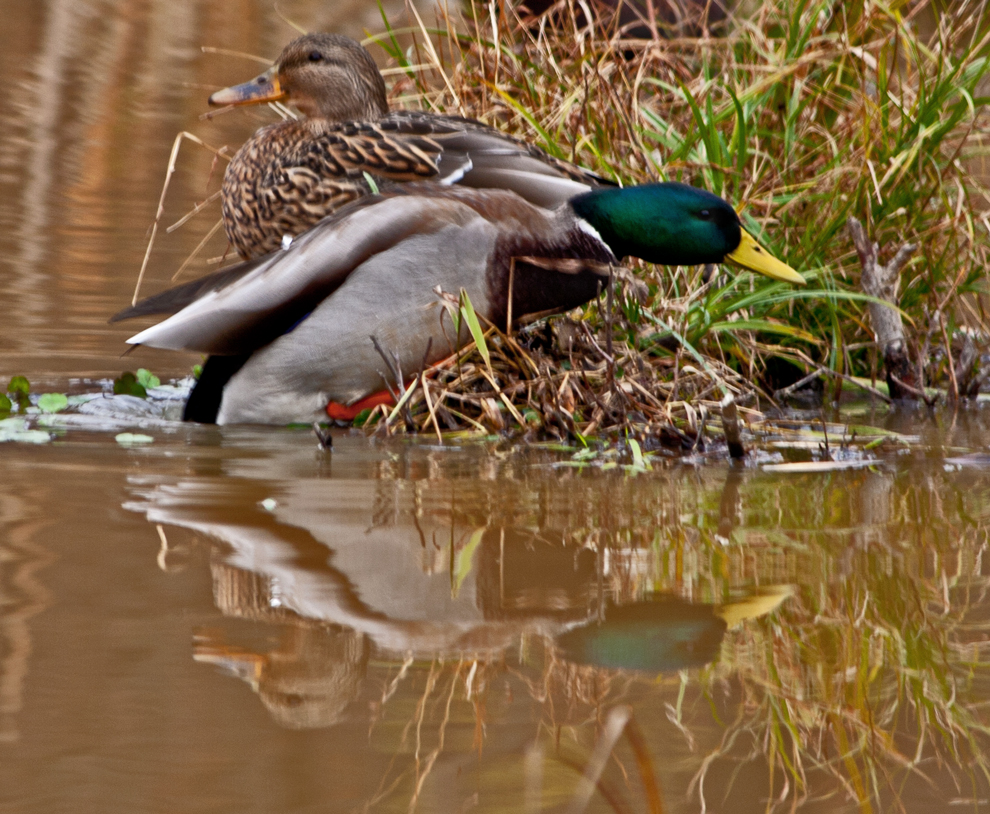
Geese and ducks continue to arrive and depart with such frequency in my local marsh that I feel like I am in a major bird airport. Fortunately, there are no long lines or security checks for them to endure. We must have a special arrangement with our northern neighbors, for the Canada Geese are not subject to any special customs scrutiny.

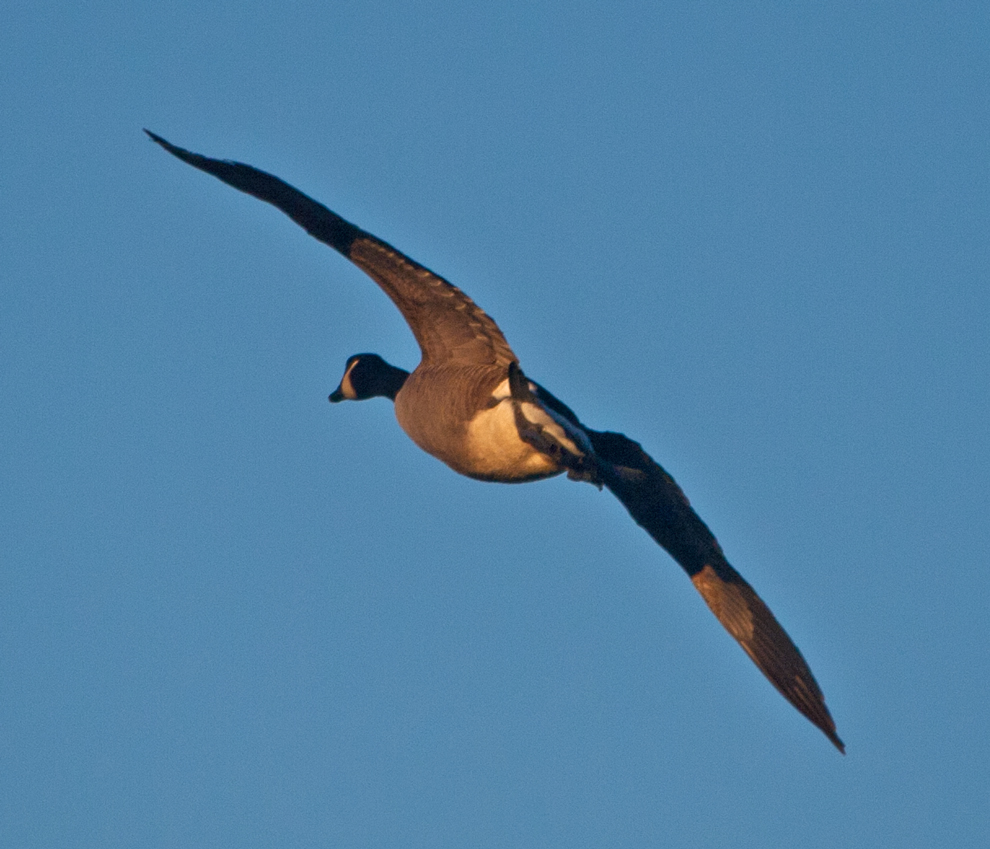
I continue to try to take photos of the geese while they are in flight, usually when the are coming in to land or taking off. Often the geese will circle around and honk loudly to announce their arrival (a kind of bird intercom system). Perhaps the birds on the ground can interpret the honks to mean something like, “Now arriving on pond number one, Canada Geese flight number one from Toronto.” My first photo is one of a Canada Goose banking. No, he is not at an ATM machine, withdrawing cash. He is making a sharp turn as he prepares to land.

Banking goose

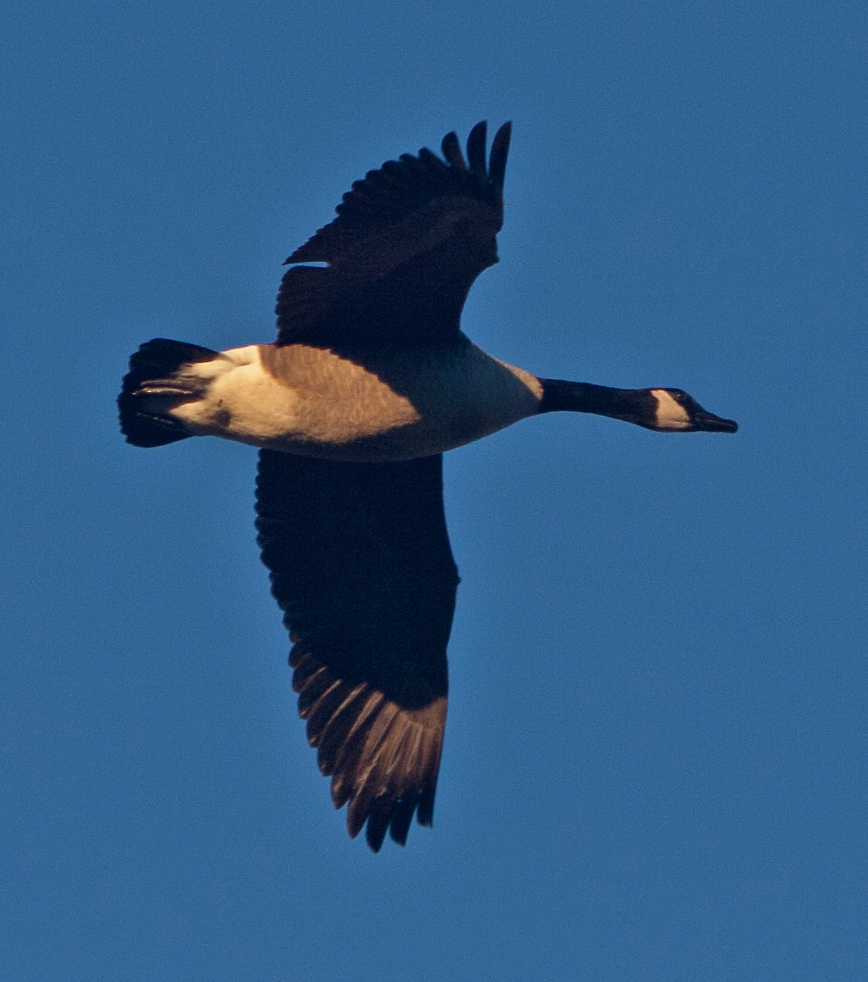
The second photo shows a goose in flight. If you click on the photo, you will notice that the goose has a zen-like look of contentment on is his face. Scientists have been working on implanting a tiny device into geese that will provide them an in-flight entertainment package (and autopilot features too) and this goose may be one of the early test subjects.

Goose in flight

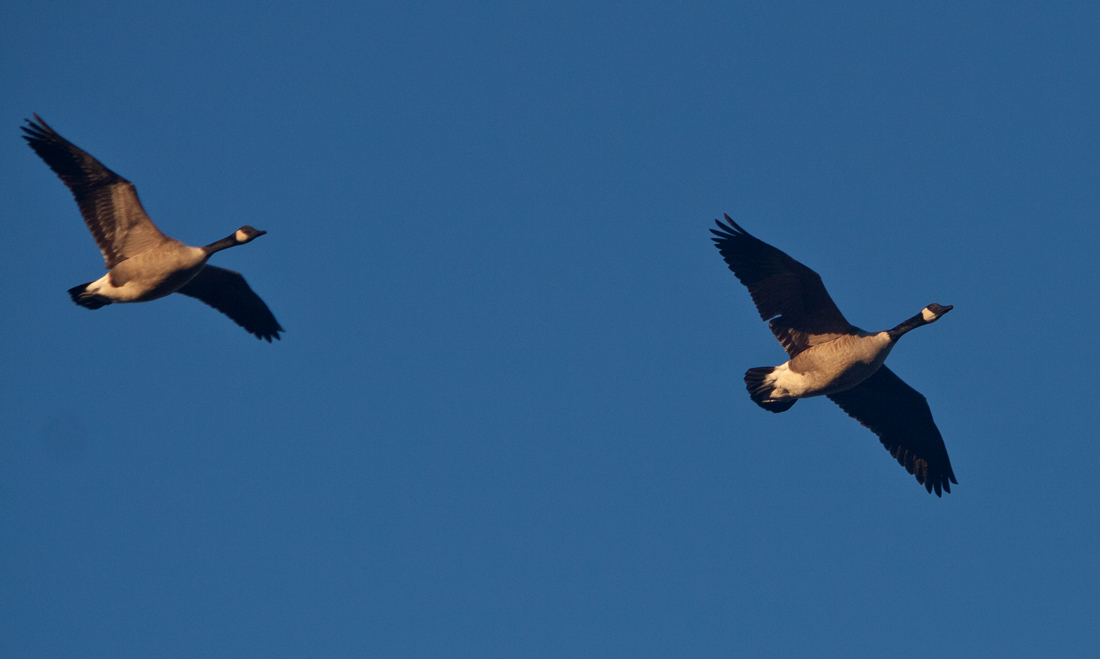
Some geese hate to fly alone and prefer companionship during the long flight. A new business has sprung up that provides escort service for the lonely goose, a fledgling matchmaking company that is just getting off of the ground. The company’s contracts are full of fine print about additional charges, but some geese continue to be surprised with the bill they are presented at their final destination.

Lonely goose escort service

© Michael Q. Powell. All rights reserved.

Read Full Post »

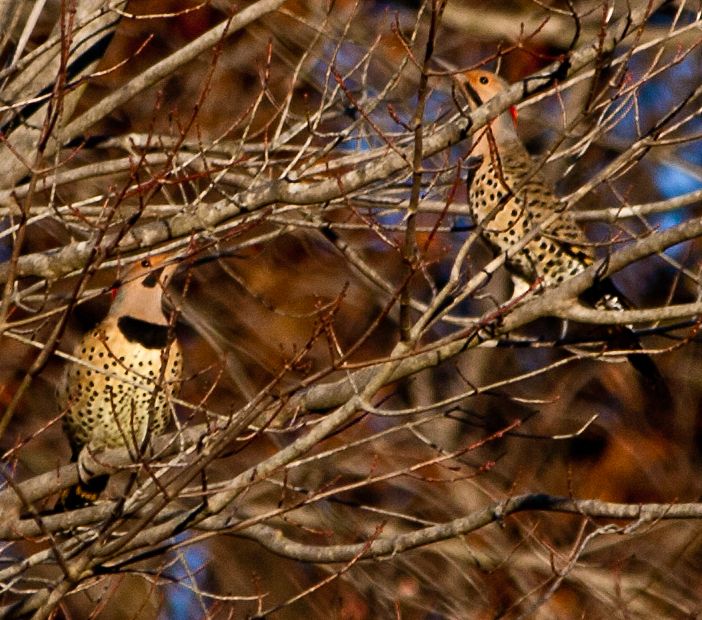
As I was walking this weekend past the beaver lodge at my local marshland park, a flash of brilliant yellow in the trees across the little pond caught my eye. Through my telephoto lens I could see that there were a couple of birds in the trees, but I couldn’t see them clearly because of tree branches nor could I identify them. Still, I kept shooting, aiming at the spot where I could see the movement and the flashes of color. Here is an example of what I was seeing (though this image is significantly cropped).

Northern Flicker couple

After returning home and doing a little research, I found out that I had photographed a pair of Northern Flickers (Colaptes auratus), a type of woodpecker that I had never seen before. I love their speckles and their black and red markings. These two birds were interacting in peculiar ways, with both of them flashing their feathers at the other, revealing the bright yellow colors that I had seen earlier.

Is this mating behavior? Were they putting on a performance for my benefit? I have not idea what was the cause for all of that behavior, but it certainly was intriguing.

None of my photos of these birds are that great, but I am always excited to share my photos when I see something for the first time. Perhaps the next time I will be better placed to get clearer shots.

“Maybe some sweet words will make an impression?”

“How do you like me now?”

“Two can play at that game.”

© Michael Q. Powell. All rights reserved.

Read Full Post »

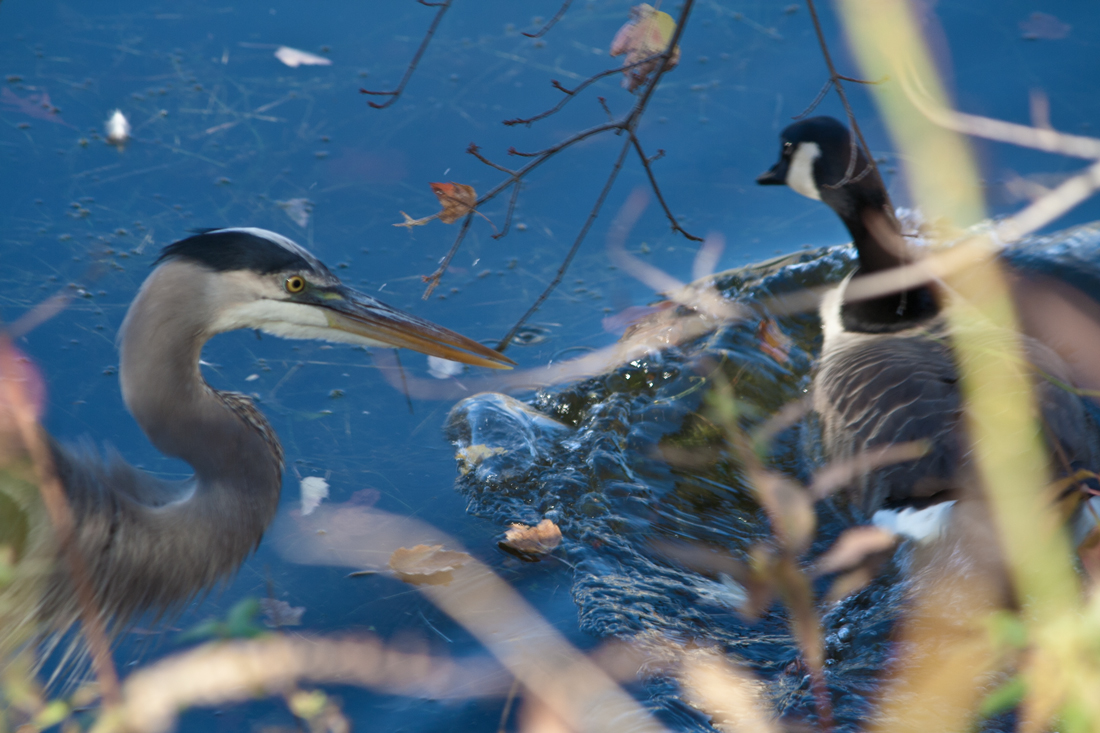
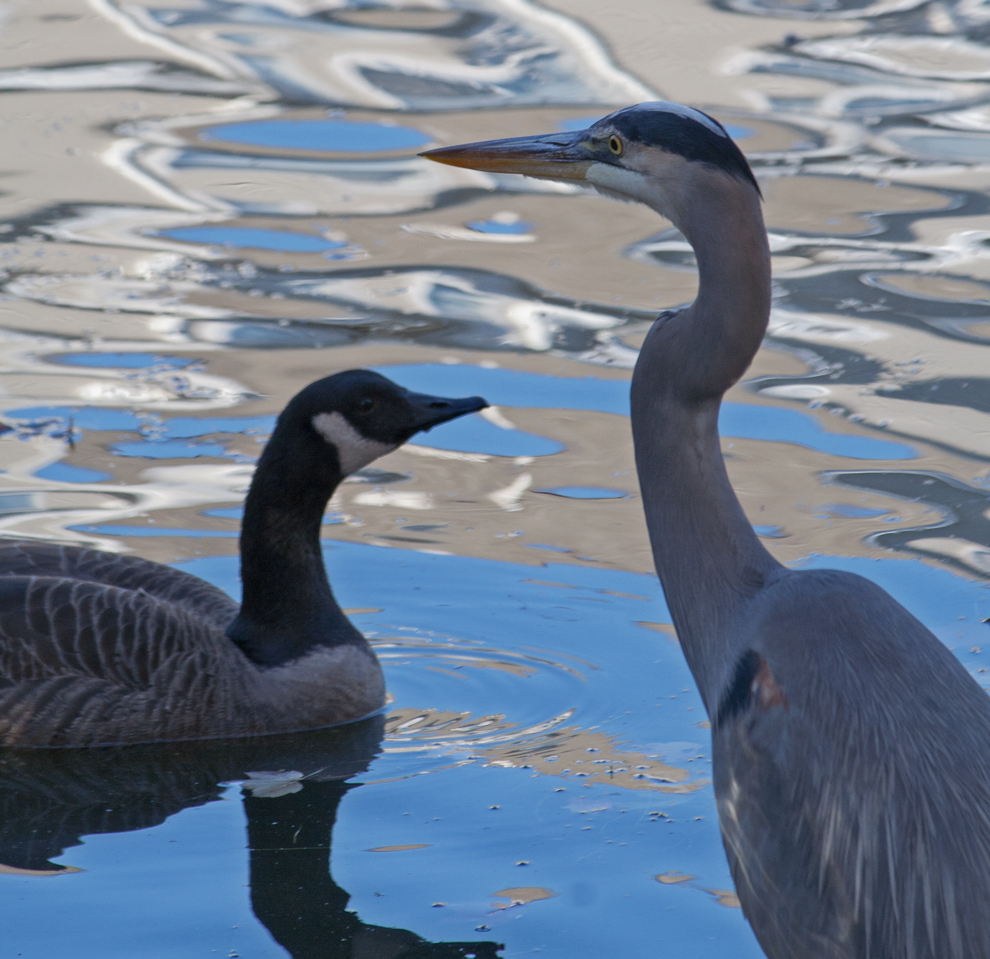
It is always interesting for me to see two species interact—you never quite know what will happen. Last Sunday, I was in the bushes in a local suburban pond area, pretty close to a Great Blue Heron (Ardea herodias). He seemed to be willing to tolerate my presence, though there were a lot of bushes that kept me from getting a clear shot. I photographed several encounters between the heron and Canada Geese (Branta canadensis) that live semi-permanently at the pond.

I took the first photo just after the heron made a threatening gesture with his beak at a goose that must have invade his personal space. The goose appears to have gotten the message and looks to be exiting the area. At the time of the shot, the sun was bright and was reflecting off the water, somehow turning it almost turquoise in color. The branches of the bush get in the way a little, but don’t detract too much from the charm of the photo. The whole effect is to make the image look almost as much like an illustration as a photograph.

“I need my personal space.”

The second photo is much less action oriented and is a study in contrasts. The goose seems to be looking at the heron with wonderment and curiosity, while the heron seems to be cool and disinterested. The background reminds me a little of a psychedelic image from the 1960’s.

“How did you grow to be so tall?”

© Michael Q. Powell. All rights reserved.

Read Full Post »

« Newer Posts - Older Posts »