Feeds:
Posts
Comments

Archive for the ‘Humor’ Category

Turnabout is fair play. In one of my earlier posts entitled “Dragonflies mating on a calf” I featured Walter Sanford, a fellow photographer and blogger. Today, in a posting called “The natives are friendly.” he featured my arm and finger as I tried to charm a couple of different dragonflies to perch on my index finger.

waltersanford's avatarwalter sanford's photoblog

Most dragonflies are skittish. Some dragonflies are “friendly,” such as Blue Corporal dragonflies (Ladona deplanata). Autumn Meadowhawk dragonflies (Sympetrum vicinum) are friendly; sometimes very friendly!

Mike Powell and I visited Huntley Meadows Park recently. We stopped to “charm” dragonflies a couple of times during our photowalk. The following gallery shows two different male Autumn Meadowhawk dragonflies perching on Mike: Photos 1-2 show Mike coaxing a dragonfly onto his finger; Photos 3-4 show another dragonfly perching on Mike’s arm.

Tech Tip: Either mouse-over or tap photos to see captions.

Copyright © 2013 Walter Sanford. All rights reserved.

View original post

Read Full Post »

Red-roofed barns, silos, and rolled bays of hay may seem ordinary if you live in the country, but they were exotic enough to cause a group of city-dwelling photographers to pull off to the side of the road this past weekend to photograph them.

Never having lived or worked on a farm, I have a romanticized vision of life on a farm, of living close to nature. There is something almost idyllic for me in a setting like the one in the first photo.

As for rolled bales of hay, I don’t quite understand them. A lot of the cowboy movies that I grew up with featured muscular cowboys tossing around bales of hay that looked nothing like the ones in the second and third photos. These bales look like giant Shredded Wheat biscuits that would require a huge bowl and lots of milk to soften up enough to swallow. I remember from my childhood the scratchy sensation in my throat when I was in a hurry and swallowed my Shredded Wheat cereal before it had absorbed the milk.

Red Barn blogBales x 3 blogWheaties blog

© Michael Q. Powell. All rights reserved.

Read Full Post »

“How many legs does a horse have if you call the tail a leg? Four. Calling a tail a leg doesn’t make it a leg.”

My apologizes to Abraham Lincoln for changing the animal from a dog to a horse in a famous quote attributed to him, but that was what came to mind when I first brought up this image of a horse that appeared to have five legs. The tail is so long that it just about touches the ground and it seems to be almost as rigid as the legs.

Of course, as some of you know, I am a product of the suburbs, so I am happy that I can identify this animal as a horse. Earlier in the day I saw two bulls with horns, but when I took a closer look, one of them seemed to have udders. When we stopped to photograph a farmhouse on the drive home, I could identify sheep and cattle, then suddenly a group of emus came running onto the scene accompanied by a llama (or maybe it was an alpaca).

Is it any wonder I find identifying domestic animals confusing?

Five Legged Horse blog

© Michael Q. Powell. All rights reserved.
Read Full Post »

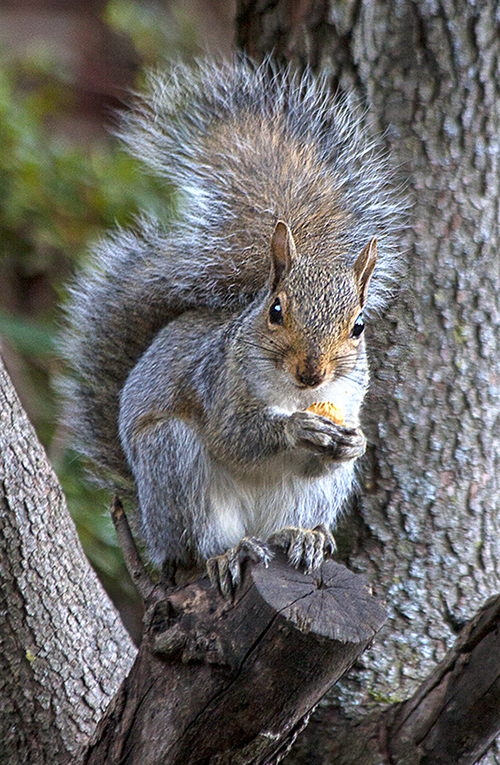
The squirrels in my neighborhood are very busy now as they scurry about getting ready for winter. This particular Eastern Gray Squirrel (Sciurus carolinensis) paused several times to enjoy a leisurely snack. Rather than devour the treat on the ground, he would leap up onto this posing stand and delicately nibble away. He almost seemed to be aware that I was photographing him and periodically would change his pose to give me a different look.

I guess that I lucked into photographing a squirrel with modeling experience (and great hair).

Squirrel Nut blogSquirrel Nut 2 blog

© Michael Q. Powell. All rights reserved.

Read Full Post »

Despite the frost that we’ve had the last few mornings, the gorgeous Morning Glory flowers of my neighbors continue to flourish. I photographed one of the flowers yesterday afternoon—does that make it an afternoon glory?

When you look at the photo it looks like I used flash, which caused the background to go black. However, if you look carefully at the way the light falls, with some of it coming from the back, you realize I would have had to use an elaborate multi-light setup to get this kind of lighting. I took this shot in the early afternoon, with the light mostly coming from the side and back of the flower.

My fellow photographer and blogger CIndy Dyer says that the shadow in the bottom area of the white part of the flower looks like a photographer (possibly with a bald head) with a camera and long telephoto lens and she initially thought I had somehow managed to get a reflection of myself onto the flower. We may have spent too many hours yesterday out in the sun with our cameras!

Glory Photographer blog

© Michael Q. Powell. All rights reserved.
Read Full Post »

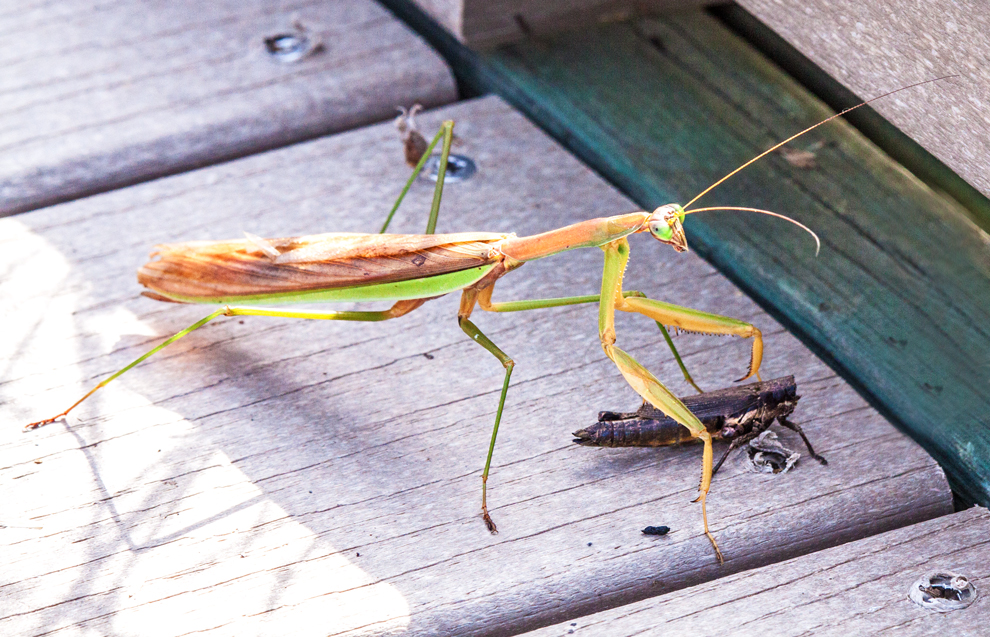
When this praying mantis began to straddle a hapless grasshopper, I wasn’t sure what was going to happen, but suspect that the grasshopper may have been the one that began to pray.

Was the mantis looking at the grasshopper as a potential mate or a potential meal? With praying mantises, the question of mate or meal is a little complicated, because some females reportedly bite off the heads of the males after mating.

As it turned out, the praying mantis ignored the grasshopper and simply climbed over him and the grasshopper’s prayer undoubtedly turned into one of giving thanks.

mantis_grasshopper_blog

© Michael Q. Powell. All rights reserved.

Read Full Post »

When this bright red male Autumn Meadowhawk dragonfly landed briefly on my fellow photographer’s white sneaker yesterday, it suddenly struck me that we might have hit on a potential fall fashion fad. Why not accessorize plain shoes with colorful dragonflies in seasonal colors? We could start with the Autumn Meadowhawk for fall and perhaps move on to the Common Whitetail as the snow begins to fall. Spring could bring on the Green Darner and summer could feature the Blue Dasher.

Of course, we couldn’t use real dragonflies, but they could serve as models for pin-on or clip-on dragonflies. Size-wise, it looks like this Autumn Meadowhawk is about the right size.

Now that I have a marketing idea, all I need is investors.

dragonfly_sneaker_blog

© Michael Q. Powell. All rights reserved.

Read Full Post »

There is something a little wistful about searching for the last dragonfly of the year. Most of the familiar dragonflies from the summer have disappeared and it looks like the sole remaining dragonfly in our area is the Autumn Meadowhawk dragonfly (Sympetrum vicinum).

Yesterday I spent some time trying to photograph this dragonfly along with fellow photographer and blogger Walter Sanford, who has an amazing collection of photographs of dragonflies on his blog site, including a world-class series on the Blue-faced Meadowhawk. I was willing to try to capture photos of any dragonfly that I could spot, but Walter noted that he had taken enough photos of the male Autumn Meadowhawk and was really interested in photographing females or, even better, mating pairs.

The mating pairs tended to elude him most of the day, until suddenly a pair in the “wheel” position circled around us and landed on his bare calf—talk about unprotected sex. There was no way that he could twist himself around to get a good photo, but I manage to get this shot of the two dragonflies in action.

Temperatures are supposed to continue to drop this week, so there is always a chance that these will be the last dragonflies that I see this year, though I will be out searching for them for weeks to come before I bid my final adieu to them.

wheel_leg_blog

© Michael Q. Powell. All rights reserved.
Read Full Post »

Perhaps the old adage that “opposites attract” applies to grasshoppers too. When I photographed this intimate moment on a leaf, I couldn’t figure out for sure what was going on.

Perhaps the grasshopper was attracted by the bright colors of the Handsome Meadow Katydid and was trying to start a conversation.  Maybe this was a blind date set up by some well-intentioned friends. Is it possible they matched on a lot of points in the insect version of Match.com?

I have photographed grasshoppers and katydids separately, but this is the first time I have them both in a single image. It is fascinating to be able to compare the bodies of the two species and note the differences in the eyes, the legs, and many other parts.

The striking colors of the Handsome Meadow Katydid have always drawn my attention, but I am left with one question to ponder. Do grasshoppers even see in color or only in shades of gray?

grasshopper_encounter_blog

© Michael Q. Powell. All rights reserved.

Read Full Post »

Have you ever watched a coot swim? When I first spotted this American Coot (Fulica americana) earlier this week at my local marsh, I thought it might be a duck. Once it started swimming, I could tell immediately that it was a coot.

Coots have a really clumsy way of swimming. They thrust their necks forward and then back, as if to generate momentum to propel themselves forward. The two photos show two different positions that the coot assumes while swimming. The Cornell Lab of Ornithology that coots, unlike ducks, don’t have webbed feet, but instead each one of the coot’s long toes has broad lobes of skin that help it kick through the water. In fact, they are closer relatives to Sandhill Cranes than to Mallards.

This coot was by itself and may be migrating through this area or may become a resident here for the winter. I was happy that I saw the coot in a relatively open area of the marsh. A short time later, the coot swam into the cattails and disappeared from sight.

Given the popular use of the term “coot,” I wonder if I am old enough to qualify as an American coot too.

coot_swimming2_blogcoot_swimming1_blog

© Michael Q. Powell. All rights reserved.

Read Full Post »

A blue heron with attitude? The pose, facial expression, and hair style of this Great Blue Heron (Ardea herodias) at Huntley Meadows Park, my local marsh, remind me of a punk rocker. Do you think he has tattoos and body piercings too?

heron_punkrocker_blog

© Michael Q. Powell. All rights reserved

Read Full Post »

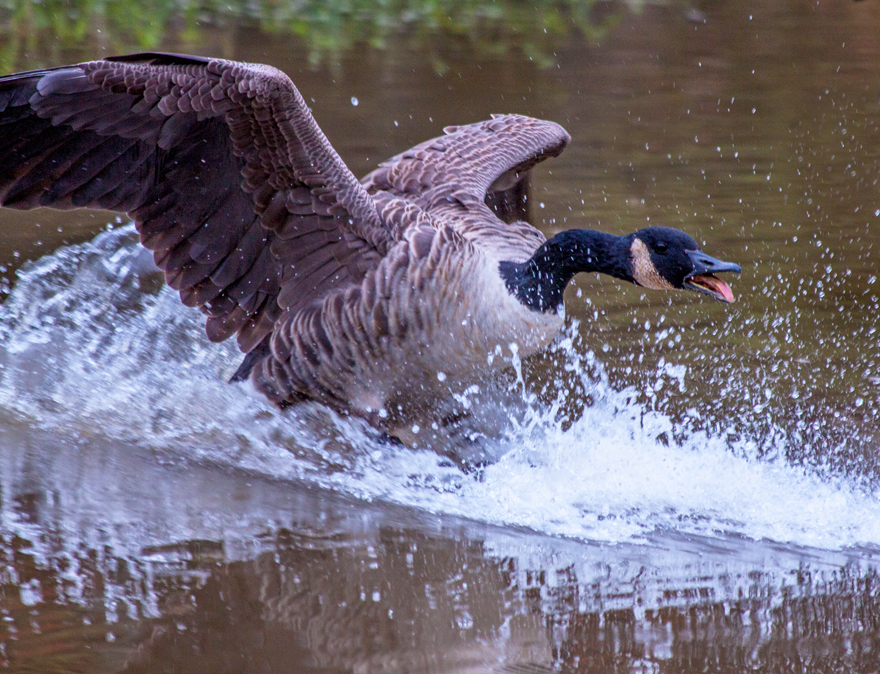
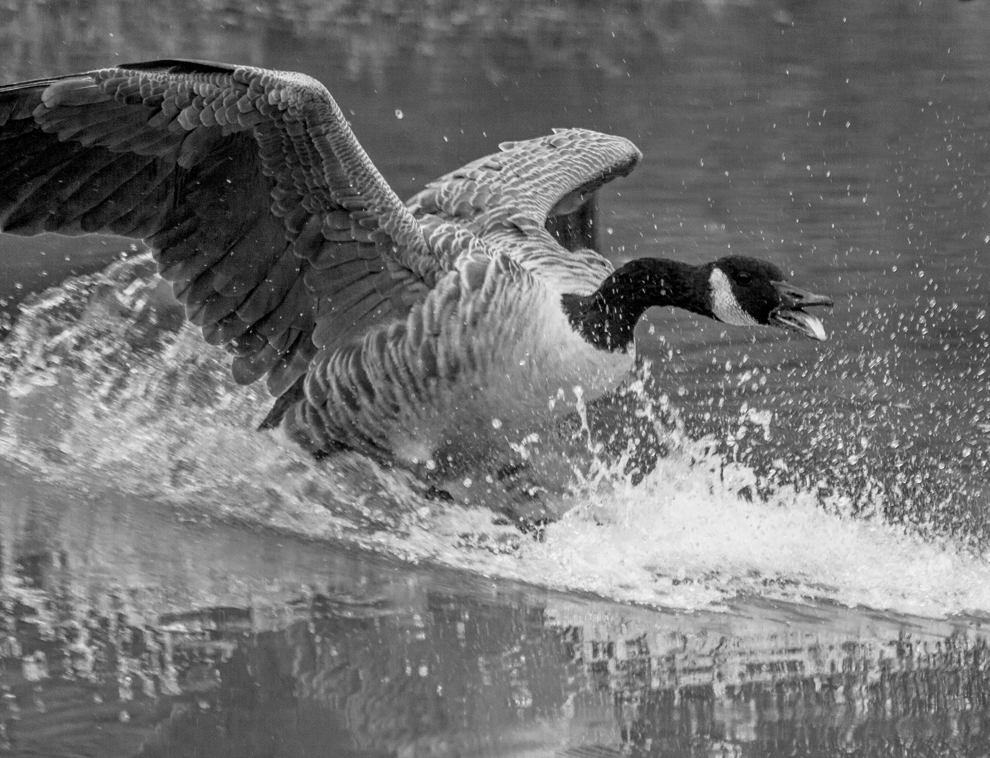
One of the first waves of migrating Canada geese (Branta canadensis) loudly announced its arrival and landed right in front of me in the beaver pond of my local marsh yesterday.

Last year we seemed to have geese arriving and departing so frequently that I felt like I was at a major geese transit airport. I kept expecting to hear departure announcements on a loudspeaker.

Several areas of the marsh had dried up in the last few months, because of a lack of rain, and I had been fearful that the migrating birds would not stop over. The rain storms this week have partially filled those areas, so my concerns have been partially assuaged.

When I looked at this photo, it seemed like it was mostly black and white already (except for the pink tongue), so I played around a little and converted it to black-and-white. For me, the second version really draws my eye to the texture of the feathers, but I can’t decide whether I like it more than the color version.

What do you think about the black-and-white version?

goose_arrrival1_bloggoose_arrrival1a_blog

© Michael Q. Powell. All rights reserved

Read Full Post »

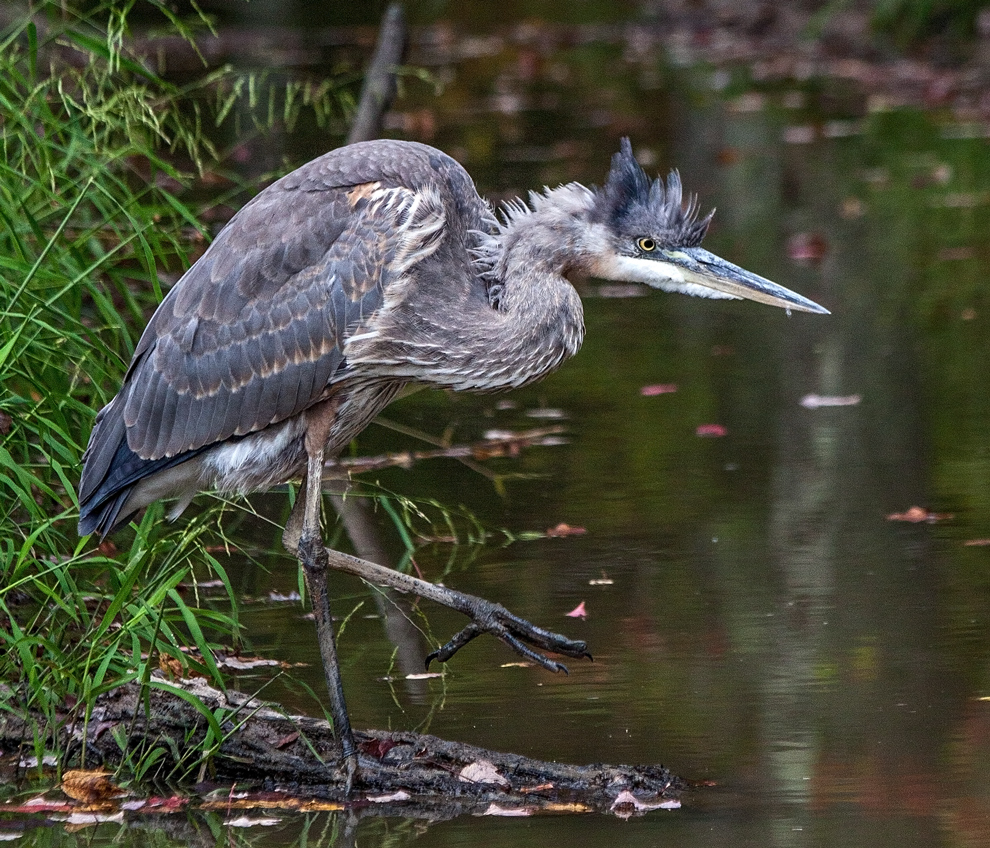
This Great Blue Heron, which I think was a juvenile, was clearly not experienced at hunting for food. Unlike his more patient elders, he seemed unable to stay in one spot for more than a few minutes and his success rate when he made a strike was not very high. He was persistent, however, and I kept hoping that he would pull a frog or some other tasty morsel out of the waters of the beaver pond.

I readied myself as he prepared for another strike and fired away as he triumphantly pulled his catch out of the water. The photo confirmed my initial impression—the big catch was just a leaf that had been floating on the surface of the water.

With more practice, this heron’s fishing skills are sure to improve or it is going to be a long, cold autumn and winter for him.

heron_leaf_blog

© Michael Q. Powell. All rights reserved

Read Full Post »

Most of the tree frogs that I have seen until now have been lime green, but the one that I saw on Friday was a much darker shade of green. I am pretty sure, though, that he is a Green Treefrog (Hyla cinerea) and he was in a very familiar pose, comfortably napping during the heat of the day.

He was a pretty good distance away, perched on a small tree (or maybe a bush) in the partial shade, but luck was with me, because the sunlight was shining on him. I had a telephoto lens on my camera and managed to get a pretty good shot without scaring him away.

I left the frog thinking that he probably had the right approach—a nap sounded like a good idea.

dark_green_treefrog_blog

© Michael Q. Powell. All rights reserved

Read Full Post »

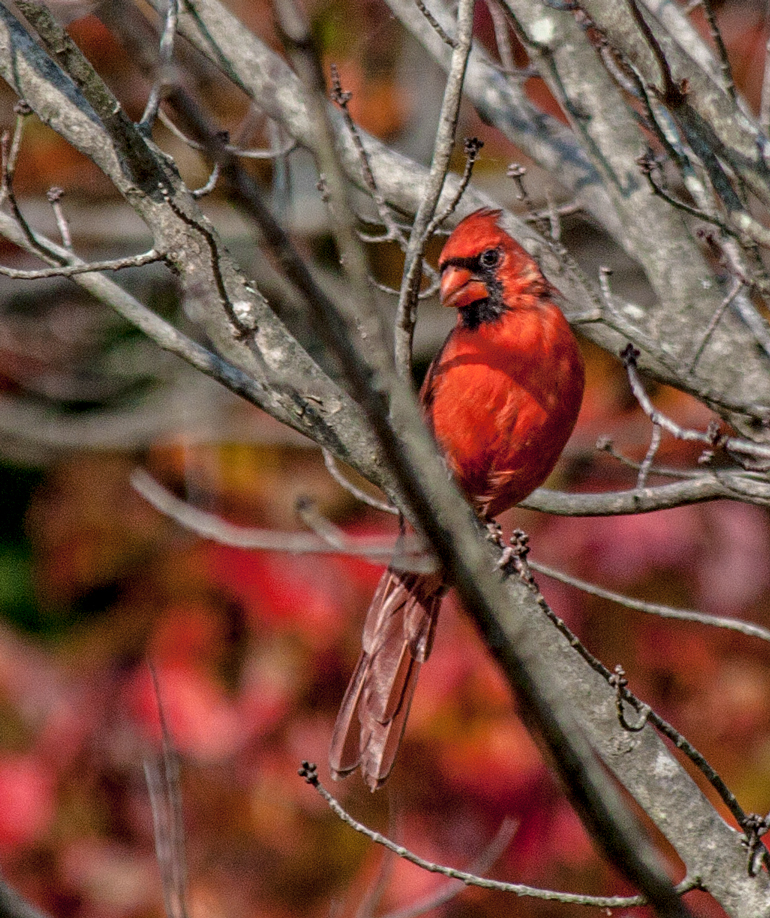
I love to photograph cardinals throughout the year, but I was really excited when I saw this male Northern Cardinal (Cardinalis cardinalis) land on a tree with colorful fall foliage in the background. There were a lot of branches, but I somehow managed to get a facial shot with an interesting expression.

The cardinal seemed to be staring at me, silently criticizing my behavior. It reminded me of the expression that parents sometimes adopt when they want to publicly communicate their displeasure to their offspring without uttering a single word.

cardinal_autumn_blog

© Michael Q. Powell. All rights reserved

Read Full Post »

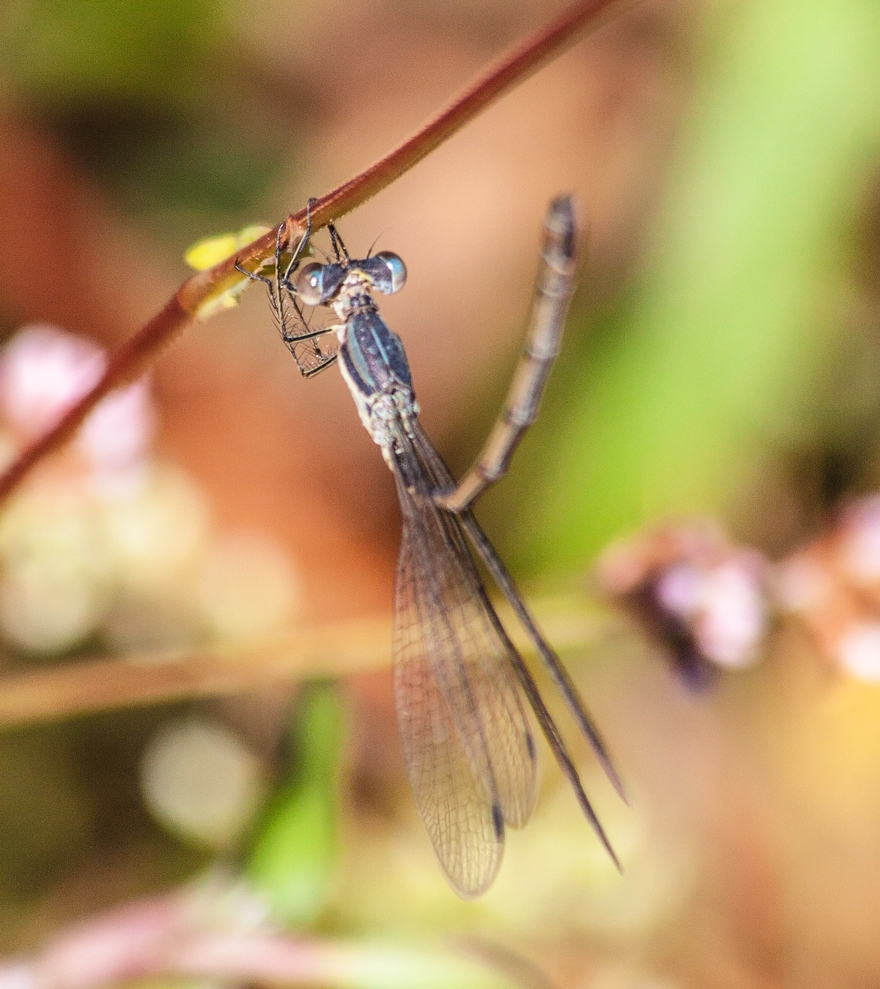
As I was observing this Slender Spreadwing damselfly (Lestes rectangularis) earlier this week, it suddenly launched into a series of acrobatic maneuvers worthy of an Olympic gymnast on the high bar. I captured several action shots of the routine, possibly related to laying eggs, although I managed my clearest shot when the damselfly returned to its starting position and waited for the scores from the judges.

Pointing the toes for maximum extension

Pointing the toes for maximum extension

damsel_spread2_blog

Swinging back to generate greater velocity for the next trick

Finishing up the routine

Finishing up the routine

Waiting for the scores from the judges

Waiting for the scores from the judges

© Michael Q. Powell. All rights reserved

Read Full Post »

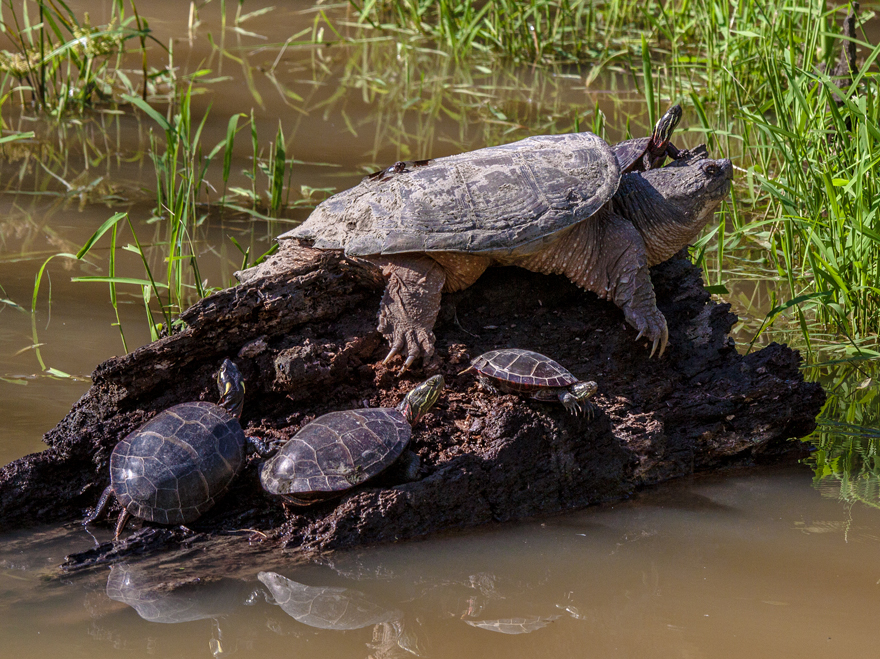
When the family of Red-eared Slider turtles (Trachemys scripta elegans) adopted an orphaned turtle, they had no idea that the baby would grow so big. Despite his disproportionate size, the larger turtle, an Eastern Snapping turtle (Chelydra serpentina serpentina), likes to participate in all family activities and doesn’t seem to realize that he is different from the other members of his adopted family.

I chose a natural setting for this family portrait and managed to catch almost everyone in a good pose—unfortunately, one of them had an attitude and refused to look directly at the camera and smile. Most of us have similar informal family portraits with the same problem. I don’t know how professional portrait photographers get everyone to cooperate.

co-existence_blog

© Michael Q. Powell. All rights reserved

Read Full Post »

Imagine how skinny this fuzzy white caterpillar would appear if its fur were “groomed,” like some of the dogs in my neighborhood. There is one fuzzy white dog, in particular, that looks huge, which I think is a Great Pyrenees. I was shocked one day when I saw that dog with closely cropped fur—it looked to be only half of its normal size.

For some reason, this caterpillar’s hair seems to be more tufted than usual, compared to similar caterpillars that I have seen. Maybe the hair is bunched because of the heavy dew or the way that the caterpillar slept. Clearly the caterpillar is having a bad hair day.

Do you think it could get away with wearing a hat to cover the bad hair?

really_fuzzy2_blogreally_fuzzy1_blog

© Michael Q. Powell. All rights reserved.

Read Full Post »

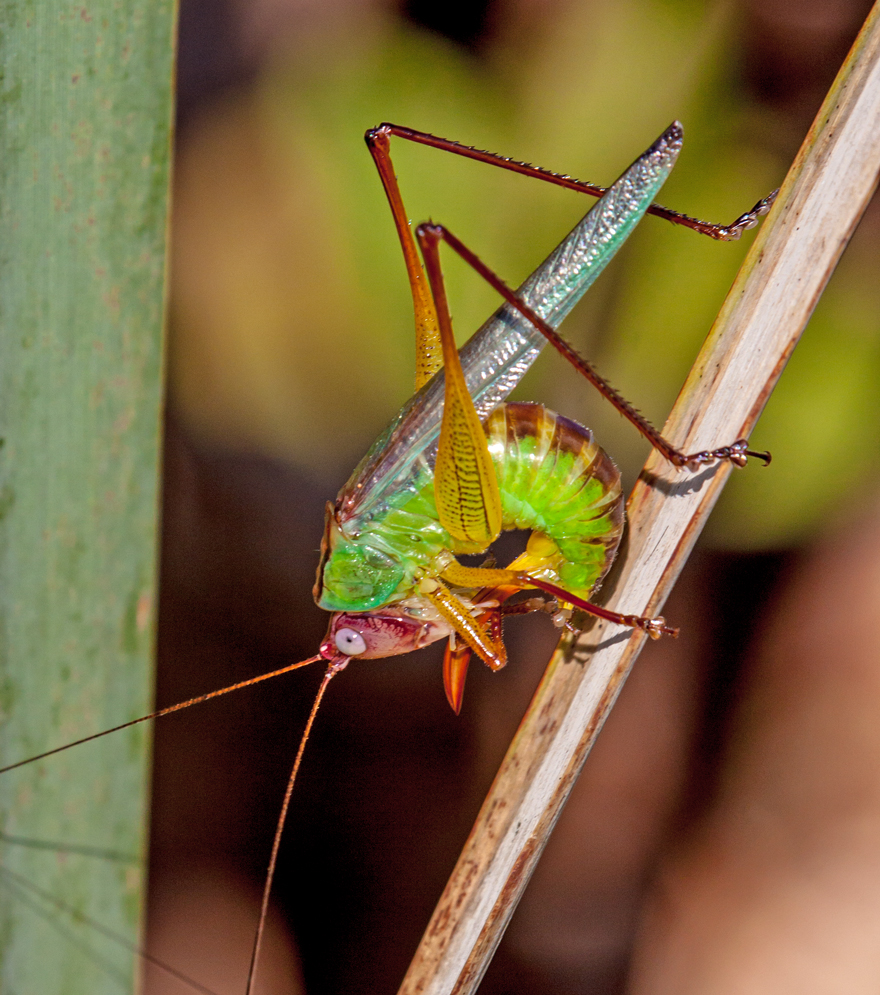
As was watching this Handsome Meadow Katydid (Orchelimum pulchellum) through my viewfinder,  it suddenly arched its body and assumed a position worthy of an world-class gymnast or yoga master. What was it doing?

rainbow_gymnastics_blog

My first thought was that the katydid was merely stretching, getting ready for the day’s activities. When you jump around as much as these insects do, you can’t risk a pulled muscle or other injury by not warming up properly.

Over the past year, this rainbow-colored katydid has become my favorite insect, but I confess that I don’t much about their anatomy. Looking over my photos, I realized that I needed to identify the orange-colored body part, a part that I don’t recall observing before, in order to figure out what was going on. What could it possibly be?

rainbow_gymnastics3_blog

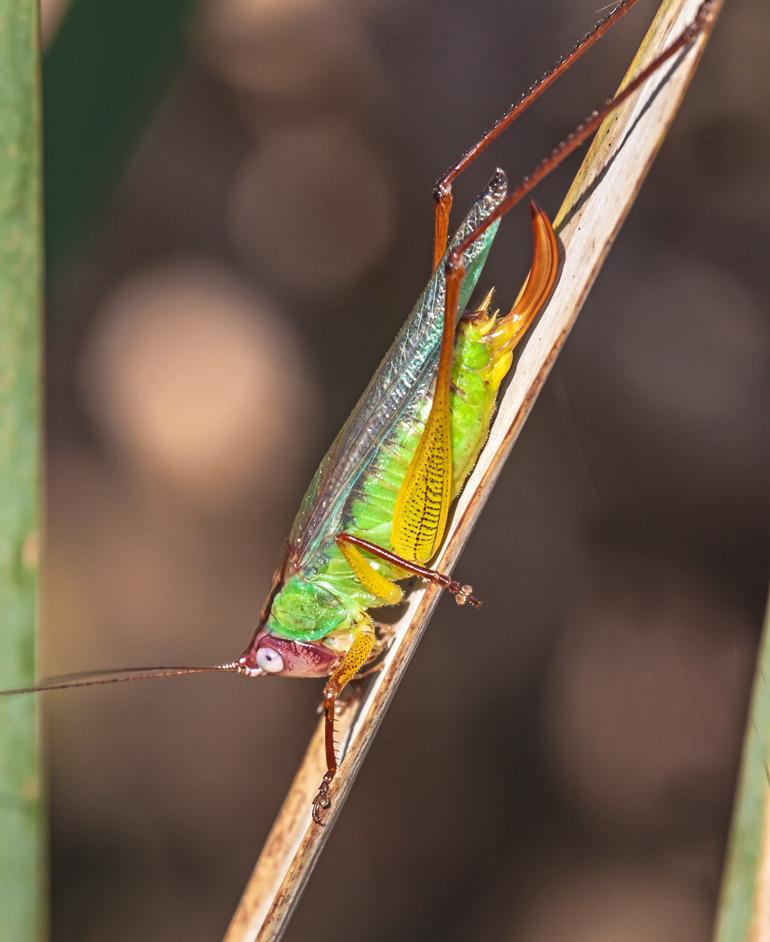
Well, it looks like this katydid probably is a female and the orange-colored thing is her ovipositor, the organ used for depositing eggs. So, is she depositing eggs in the photos? I am not sure.

A University of Arkansas website describes the ovipositing for a similar katydid with these words, “An ovipositing female embraces a plant stem with her prothoracic and mesothoracic legs and brings the curved and sword-like ovipositor far forward so its tip can scrape the substrate.” It’s not really helpful when the explanation contains so many words with which I am unfamiliar. I think that I will leave this kind of science to the scientists.

As a photographer, I continue to be amazed by the multi-colored beauty of this fascinating insect and especially by its alluring blue eyes. I know that it’s an illusion, but those eyes often seem to be looking right at me. I’m not sure if this Handsome Meadow Katydid is depositing eggs in these photos, but I am sure that  I like the images a lot, including the final image, which shows the katydid in a more “normal” position following her brief series of gymnastics.

rainbow_gymnastics2_blog

© Michael Q. Powell. All rights reserved.
Read Full Post »

Most of us have heard that female praying mantises eat their mates after mating, so what happens when a pair of cannibal flies mate?

I was quite a distance away when I spotted this pair of insects, but I immediately recognized them as  Red-footed Cannibalflies (Promachus rufipes), a species of giant robber flies. These flies are really big and have a very distinctively shaped body (and I had done some research on them for a previous posting). Cannibalflies are fierce predators and are reportedly very aggressive. Would the male survive the mating process?

I observed the pair for quite a while and concluded that the “cannibal” in this insect’s name refers to its behavior toward other insects. The male cannibal fly flew away unscathed.

robber_mating_blog

© Michael Q. Powell. All rights reserved.
Read Full Post »

When almost everything that you see looks like a bug, you know it may be time to take a break from photographing insects.

Recently I have been getting shots of different kinds of very fuzzy caterpillars and a posting on a fuzzy, white caterpillar has become my most viewed posting by a significant margin. This has whet my appetite to look even more intently for caterpillars and Monday I was pretty sure that I had spotted one with spiky tufts of hair on the thin branch of a plant. It was only when I got really close that I realized that my eyes had deceived me—it was not another fuzzy caterpillar.

Don’t get me wrong, it ‘s a pretty cool collection of seed pods and tendril-like branches, but it’s definitely not the caterpillar that I had in my mind.

not_caterpillar_blog

© Michael Q. Powell. All rights reserved.

Read Full Post »

As I was observing a tiny green tree frog in the cattails, a large fly suddenly buzzed into the frame and landed right next to the frog. Did the fly initially consider the frog to be a potential prey? Was the fly a daredevil who liked to flirt with danger? Was this an initiation test into a fly fraternity or perhaps the result of a bet between drunk buddies?

The unlikely juxtaposition of these two creatures makes me smile every time I look at it. As a child, I watched lots of cartoons in which frogs would flick out their very long tongues and snag unsuspecting flies from a great distance. I waited and watched, anticipating the moment when the frog would turn and strike. That moment never came—the fly eventually flew off to safety.

Real life doesn’t always live up to life in the cartoons.

frog_fly_blog

(Click on the photo to see a higher resolution view.)

© Michael Q. Powell. All rights reserved.

Read Full Post »

Do Northern Water Snakes (Nerodia sipedon) blow bubbles in the water for fun, like I used to do as a child? Does it help them to attract prey? Are the bubbles simply a result of the snake remaining semi-submerged in the shallow marsh water as it waits for its next victim?

Whatever the reason for the bubbles, I spent some time yesterday observing this snake, hoping that I might see a successful hunt. In the end, I came up empy-handed, as the snake’s patience outlasted mine.

water_snake_bubbles_blog

© Michael Q. Powell. All rights reserved

Read Full Post »

Earlier this week I came across this little Jumping spider, patiently waiting for a prey to come by.  I never fail to be amazed by those eyes that seemed to be staring right at me.

Transfixed, I can’t take my eyes off of you, tiny spider, and your eyes seem to follow me. I don’t want to seem paranoid, but when I am with you, I always feel like somebody is watching me.

Somehow I thought I heard the spider humming, “I only have eyes for you,” but it was just my imagination, running away with me.

jumping_marsh2_blog

© Michael Q. Powell. All rights reserved

Read Full Post »

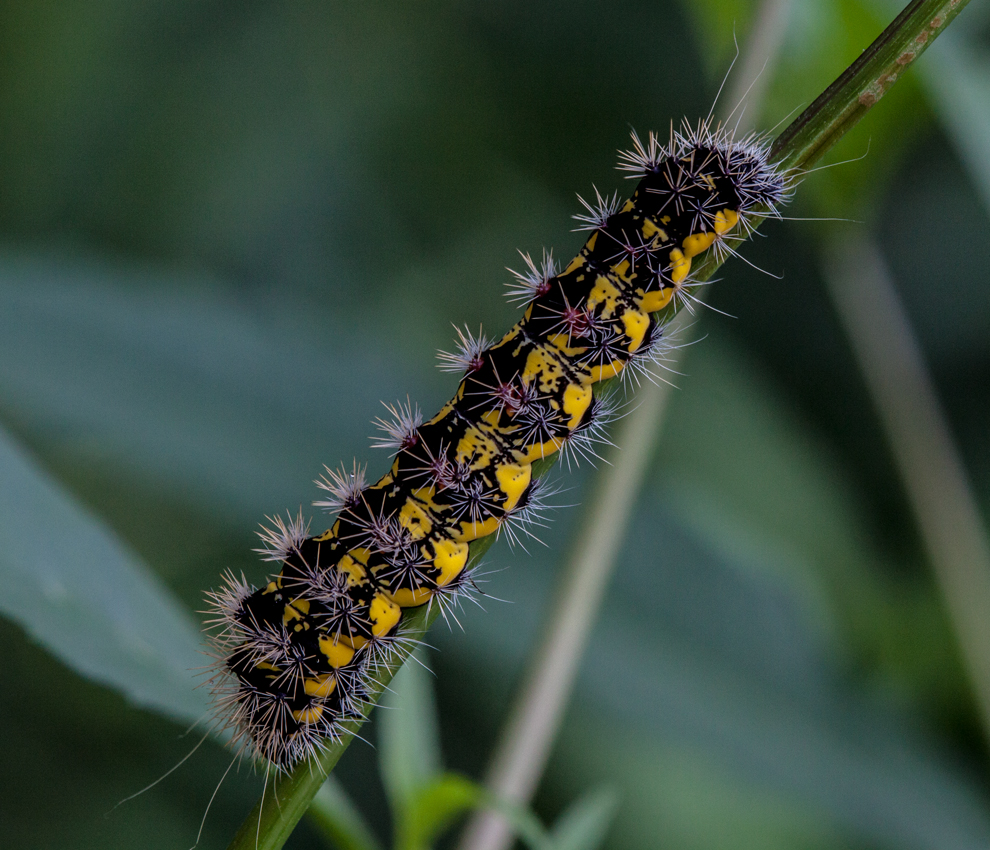
This past weekend I came across a type of caterpillar that I first encountered last fall.  Its black, yellow, and white markings once again made me think of the Pittsburgh Steelers National Footbal League team that wears those same colors.

The sports pages of the newspaper currently are saturated with articles on football, so it’s only natural that I think in those terms (and I apologize to the rest of the world for any confusion caused by the fact that we Americans use the word “football” to refer to a game that doesn’t use feet much at all and use “soccer” to refer to the other “football” game).

I enjoy referring to this caterpillar as the Steelers caterpillar, though, of course, it has a “real” name, which I think is a Smartweed caterpillar (Acronicta oblinita). Some US states have state insects, so I wonder if the Steelers would welcome a fuzzy new mascot. This could be the start of a trend and a marketing opportunity—there are more than enough caterpillar types around for each team to adopt its own.

black_and_yellow_blog© Michael Q. Powell. All rights reserved

Read Full Post »

Small butterflies have a special, delicate beauty all their own, like this Gray Hairstreak butterfly (Strymon melinus) that I photographed in mid-August at Lewis Ginter Botanical Gardens in Richmond, Virginia.

BugGuide states that this is the most common hairstreak in North American, but this is only the second time that I have seen one. Based on my limited observation of American women, I would assert that the blond hairstreak is the most common one, though, as a bald guy, I realize that hair is not my area of expertise.

hairstreak2_bloghairstreak1_blog

© Michael Q. Powell. All rights reserved

Read Full Post »

If you were an insect or even a hummingbird, you would definitely not want to encounter this large insect with the macabre moniker of Red-footed Cannibalfly (Promachus rufipes), also known as the Bee Panther.

This insect is considered to be a giant robber fly. Robber flies in general are predators that wait for their prey to fly by and then attack it. Wikipedia describes the attack in this way, “The fly attacks its prey by stabbing it with its short, strong proboscis  injecting the victim with saliva containing neurotoxic and proteolytic enzymes which very rapidly paralyze the victim and soon digest the insides; the fly then sucks the liquefied material through the proboscis.”

It’s hard to believe that a fly could actually take down a hummingbird, but bugguide, which I have found to be a good reference for insects, notes that there have been reports of a Red-footed Cannibalfly attacking a Ruby-throated Hummingbird.

When I first saw this insect fly by, I thought it was some strange kind of hairy dragonfly, but the more that I looked at it, the more I realized that it was not a dragonfly—the eyes and wings were all wrong. I have spotted several of these flies already, but so far have not seen any with captured prey.

I came across a wonderful commentary on these insects in a blog called Ohio Birds and Biodiversity that sums up my feelings about them—”Be thankful these insects aren’t the size of Sandhill Cranes.”

big_insect_blogcannibal_blog

© Michael Q. Powell. All rights reserved

Read Full Post »

Do Great Blue Herons (Ardea herodias) have a sense of humor? What would prompt one to burst out in laughter?

Maybe one of the many turtles surrounding the heron’s feet decided to tickle them. (Click on the photo to get a better look at the turtles).

Perhaps he is preparing for an audition for the reality television show America’s Got Talent. What’s his talent? Judging from his appearance, I’d say this heron might have a future as a stand-up comic. I might have captured hims as he was trying out new material on the turtles, which are notoriously tough as judges—you have to be really funny to be able to penetrate those thick shells.

laughing_heron_blog

© Michael Q. Powell. All rights reserved

Read Full Post »

It’s hard to imagine an odder couple than this dragonfly and this turtle, sunbathing together on a log in the beaver pond. What do they see in each other? How do they communicate? Love seems to find a way to overcome obstacles like these.

One thing is clear—they are happy together, sharing this special moment in the warmth of the sun. If you don’t believe me, check out the smile on the turtle’s face.

fun_blog

© Michael Q. Powell. All rights reserved

Read Full Post »

Who makes up these crazy names? Freddy Krueger? Jason? Believe it or not, this colorful little caterpillar is called a Smeared Dagger Moth caterpillar (Acronicta oblinita). Someone obviously had been been watching too many slasher or horror films.

Fortunately, it has another name—it is also called a smartweed caterpillar.

colorful_blog

© Michael Q. Powell. All rights reserved

Read Full Post »

Growing up in the suburbs of Boston, I was never exposed to muskrats and my first impression of them may well have come from the Captain and Tennille version of the song “Muskrat Love.” So every time I see one now, that song comes into my head and I think of Muskrat Susie and Muskrat Sam doing the jitterbug out in muskrat land.

This past Monday I came upon this little muskrat (Ondatra zibethicus) at my local marsh as I was trying to get some shots of a Green Heron. I was on the boardwalk, maybe 18 inches (about 45 cm) or so above the level of the land and the muskrat was close enough that I was able to get this shot with my 180mm macro lens. Once it became aware of our presence, the muskrat slipped into the water and swam away, perhaps returning to Muskrat Susie.

One interesting note about “Muskrat Love” is that the Captain and Tennille chose to sing that song at the White House in 1976 at a bicentennial dinner that included Queen Elizabeth as a guest, according to Wikipedia. If you have never heard the song (or if you want to relive memories of your childhood), here’s a link to a YouTube version. In the introduction to the song, Toni Tennille describes an impassive Henry Kissinger during the performance at the White House (http://www.youtube.com/watch?v=xBYV_7a0FQs).

muskrat_sam_blog

© Michael Q. Powell. All rights reserved

Read Full Post »

« Newer Posts - Older Posts »